Academy Overview
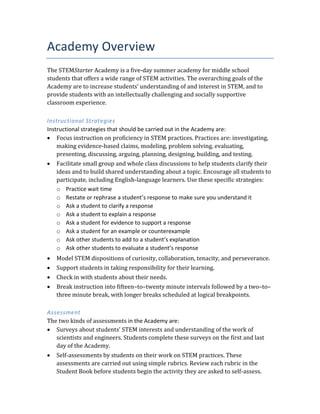
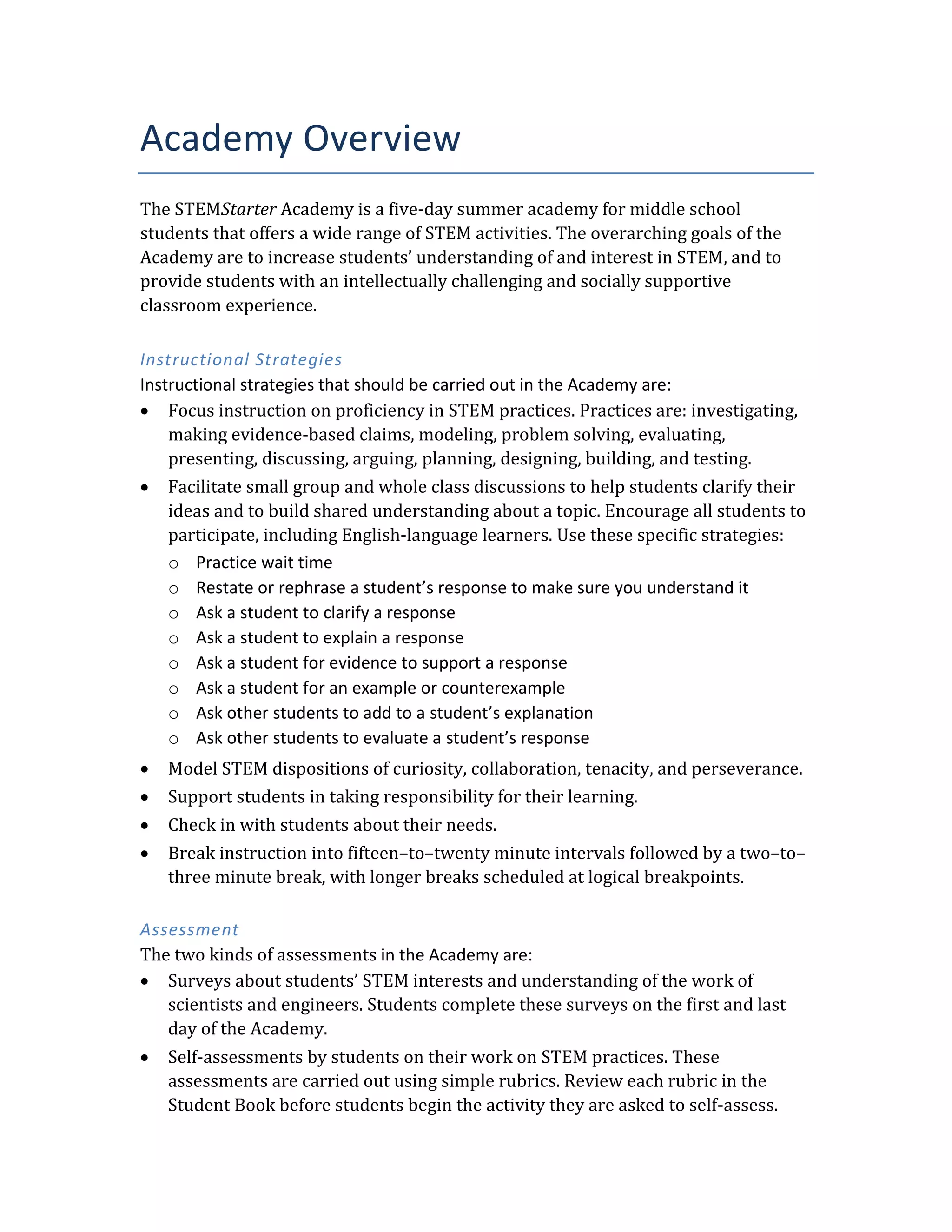
The STEMStarter Academy is a five-day summer academy for middle school
students that offers a wide range of STEM activities. The overarching goals of the
Academy are to increase students’ understanding of and interest in STEM, and to
provide students with an intellectually challenging and socially supportive
classroom experience.
Instructional Strategies
Instructional strategies that should be carried out in the Academy are:
 Focus instruction on proficiency in STEM practices. Practices are: investigating,
making evidence-based claims, modeling, problem solving, evaluating,
presenting, discussing, arguing, planning, designing, building, and testing.
 Facilitate small group and whole class discussions to help students clarify their
ideas and to build shared understanding about a topic. Encourage all students to
participate, including English-language learners. Use these specific strategies:
o Practice wait time
o Restate or rephrase a student’s response to make sure you understand it
o Ask a student to clarify a response
o Ask a student to explain a response
o Ask a student for evidence to support a response
o Ask a student for an example or counterexample
o Ask other students to add to a student’s explanation
o Ask other students to evaluate a student’s response
 Model STEM dispositions of curiosity, collaboration, tenacity, and perseverance.
 Support students in taking responsibility for their learning.
 Check in with students about their needs.
 Break instruction into fifteen–to–twenty minute intervals followed by a two–to–
three minute break, with longer breaks scheduled at logical breakpoints.
Assessment
The two kinds of assessments in the Academy are:
 Surveys about students’ STEM interests and understanding of the work of
scientists and engineers. Students complete these surveys on the first and last
day of the Academy.
 Self-assessments by students on their work on STEM practices. These
assessments are carried out using simple rubrics. Review each rubric in the
Student Book before students begin the activity they are asked to self-assess.
Activities
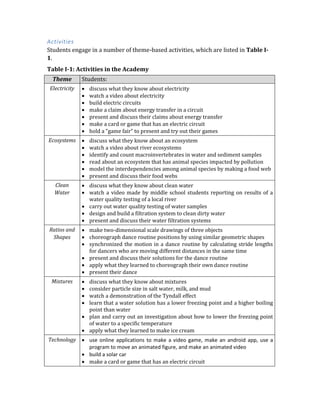
Students engage in a number of theme-based activities, which are listed in Table I-
1.
Table I-1: Activities in the Academy
Theme Students:
Electricity  discuss what they know about electricity
 watch a video about electricity
 build electric circuits
 make a claim about energy transfer in a circuit
 present and discuss their claims about energy transfer
 make a card or game that has an electric circuit
 hold a “game fair” to present and try out their games
Ecosystems  discuss what they know about an ecosystem
 watch a video about river ecosystems
 identify and count macroinvertebrates in water and sediment samples
 read about an ecosystem that has animal species impacted by pollution
 model the interdependencies among animal species by making a food web
 present and discuss their food webs
Clean
Water
 discuss what they know about clean water
 watch a video made by middle school students reporting on results of a
water quality testing of a local river
 carry out water quality testing of water samples
 design and build a filtration system to clean dirty water
 present and discuss their water filtration systems
Ratios and
Shapes
 make two-dimensional scale drawings of three objects
 choreograph dance routine positions by using similar geometric shapes
 synchronized the motion in a dance routine by calculating stride lengths
for dancers who are moving different distances in the same time
 present and discuss their solutions for the dance routine
 apply what they learned to choreograph their own dance routine
 present their dance
Mixtures  discuss what they know about mixtures
 consider particle size in salt water, milk, and mud
 watch a demonstration of the Tyndall effect
 learn that a water solution has a lower freezing point and a higher boiling
point than water
 plan and carry out an investigation about how to lower the freezing point
of water to a specific temperature
 apply what they learned to make ice cream
Technology  use online applications to make a video game, make an android app, use a
program to move an animated figure, and make an animated video
 build a solar car
 make a card or game that has an electric circuit

STEM Academy Overview

  • 1.
    Academy Overview The STEMStarterAcademy is a five-day summer academy for middle school students that offers a wide range of STEM activities. The overarching goals of the Academy are to increase students’ understanding of and interest in STEM, and to provide students with an intellectually challenging and socially supportive classroom experience. Instructional Strategies Instructional strategies that should be carried out in the Academy are:  Focus instruction on proficiency in STEM practices. Practices are: investigating, making evidence-based claims, modeling, problem solving, evaluating, presenting, discussing, arguing, planning, designing, building, and testing.  Facilitate small group and whole class discussions to help students clarify their ideas and to build shared understanding about a topic. Encourage all students to participate, including English-language learners. Use these specific strategies: o Practice wait time o Restate or rephrase a student’s response to make sure you understand it o Ask a student to clarify a response o Ask a student to explain a response o Ask a student for evidence to support a response o Ask a student for an example or counterexample o Ask other students to add to a student’s explanation o Ask other students to evaluate a student’s response  Model STEM dispositions of curiosity, collaboration, tenacity, and perseverance.  Support students in taking responsibility for their learning.  Check in with students about their needs.  Break instruction into fifteen–to–twenty minute intervals followed by a two–to– three minute break, with longer breaks scheduled at logical breakpoints. Assessment The two kinds of assessments in the Academy are:  Surveys about students’ STEM interests and understanding of the work of scientists and engineers. Students complete these surveys on the first and last day of the Academy.  Self-assessments by students on their work on STEM practices. These assessments are carried out using simple rubrics. Review each rubric in the Student Book before students begin the activity they are asked to self-assess.
  • 2.
    Activities Students engage ina number of theme-based activities, which are listed in Table I- 1. Table I-1: Activities in the Academy Theme Students: Electricity  discuss what they know about electricity  watch a video about electricity  build electric circuits  make a claim about energy transfer in a circuit  present and discuss their claims about energy transfer  make a card or game that has an electric circuit  hold a “game fair” to present and try out their games Ecosystems  discuss what they know about an ecosystem  watch a video about river ecosystems  identify and count macroinvertebrates in water and sediment samples  read about an ecosystem that has animal species impacted by pollution  model the interdependencies among animal species by making a food web  present and discuss their food webs Clean Water  discuss what they know about clean water  watch a video made by middle school students reporting on results of a water quality testing of a local river  carry out water quality testing of water samples  design and build a filtration system to clean dirty water  present and discuss their water filtration systems Ratios and Shapes  make two-dimensional scale drawings of three objects  choreograph dance routine positions by using similar geometric shapes  synchronized the motion in a dance routine by calculating stride lengths for dancers who are moving different distances in the same time  present and discuss their solutions for the dance routine  apply what they learned to choreograph their own dance routine  present their dance Mixtures  discuss what they know about mixtures  consider particle size in salt water, milk, and mud  watch a demonstration of the Tyndall effect  learn that a water solution has a lower freezing point and a higher boiling point than water  plan and carry out an investigation about how to lower the freezing point of water to a specific temperature  apply what they learned to make ice cream Technology  use online applications to make a video game, make an android app, use a program to move an animated figure, and make an animated video  build a solar car  make a card or game that has an electric circuit