









Presented by
Ayush Nepal
Barsha Shrestha
Chhokpa Sherpa
Deepak Pandey
Meera Khanal’
Neelam Malla
Prakash Pandey
Pramila Nepal
Advantage and disadvantage of each of the four dividend policy?
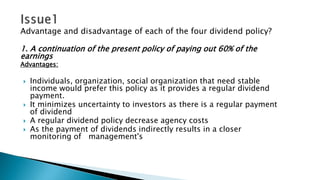
1. A continuation of the present policy of paying out 60% of the
earnings
Advantages:
 Individuals, organization, social organization that need stable
income would prefer this policy as it provides a regular dividend
payment.
 It minimizes uncertainty to investors as there is a regular payment
of dividend
 A regular dividend policy decrease agency costs
 As the payment of dividends indirectly results in a closer
monitoring of management's
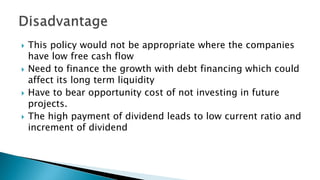
 This policy would not be appropriate where the companies
have low free cash flow
 Need to finance the growth with debt financing which could
affect its long term liquidity
 Have to bear opportunity cost of not investing in future
projects.
 The high payment of dividend leads to low current ratio and
increment of dividend
2. Lowering the present payout to below 60% and maintaining the
payout ratio relatively constant at this new figure ?
Advantage
• Individuals in upper income tax brackets might prefer lower
dividend payouts
• Low payouts can decrease the amount of capital that needs to
be raised
• As there is less need to raise external equity, controlling
interest of the stockholders will not be diluted.
• It resolves uncertainty, as dividend earnings are less risky than
capital gains
 It could signal that the firm is having financial
difficulties
 Majority of the Current stockholders are in favor of
stable growth rate than growth potential.
Therefore, these groups would sell their stocks if
the dividend payout ratio is reduced. Eventually, this
could reduce the marker price per share of the
company
3. Establishing a dollar amount of dividend and increasing with the increase
in income relatively stable dollar dividend is maintained. The dividend per
share is increased or decreased only after careful investigation by the
management
Advantage
 Investors may use the dividend policy as a part for information that is
not easily accessible. This dividend policy may be useful in assessing
the company's long-term earnings prospects. Increase in the dividend
would signal the prosperity of the firm. It would attract the growth
seeking investors.
 Here in the case of Warner Body Works this could be a better option as
the firm needs to retain its earnings to support the acquisitions.
Further, as the dividend per share of 2005 is $1.25 the firm can
convince its investors to provide a dividend per share of $1(which is
not very less than $1.25) and increase it with the increase in income as
it has a potential growth.
Disadvantages:
 Many investors like retired individuals, college
endowment funds, and income oriented mutual funds
rely on dividends to satisfy instant personal income need.
If dividends fluctuate from year to year, investors may
have to sell or buy stock to satisfy their current needs,
thereby incurring expensive transaction costs.
 Income seeking investors would sell the stocks as the
dividend income is uncertain.
4. Low dividend payout and supplementing it with extra income
Advantage
 This policy could be considered right if the firm’s
earnings are quite volatile
 This policy ensures that the investors get a certain
minimum amount as dividend
 The investors have less expectation with this sort of
policy
 This sort of policy prevents negative signaling as there is
a pre fixed minimum limit for those investors who are
satisfied with the minimum level that is pre fixed.
Disadvantages:
 There is an uncertainty in how much the investors are
getting as the dividend with this sort of policy; hence it
may not attract those parties who are seeking a stable
dividend.
 The investors might think that the company has a weak
financial position, so it is going for a reduction in dividend
payout which may be a cause for negative signaling to the
investors.
Issue 2
Evaluate the advantages and disadvantages of having an announced
dividend policy. Should Warner Body Works follow announced dividend
policy?
Advantage
 Attracts investors:
 Reduces uncertainty
 Reduction of cost of capital on future projects
Disadvantage:
 Difficult to alter the dividend policy once announced.
 Opportunity cost of reinvestment.
 Not suitable for unionized company
 Reduce credibility of the company
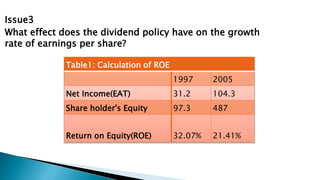
Issue3
What effect does the dividend policy have on the growth
rate of earnings per share?
Table1: Calculation of ROE
1997 2005
Net Income(EAT) 31.2 104.3
Share holder's Equity 97.3 487
Return on Equity(ROE) 32.07% 21.41%
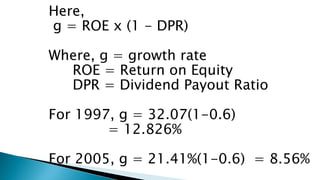
Here,
g = ROE x (1 - DPR)
Where, g = growth rate
ROE = Return on Equity
DPR = Dividend Payout Ratio
For 1997, g = 32.07(1-0.6)
= 12.826%
For 2005, g = 21.41%(1-0.6) = 8.56%
Issue 4
Could the figures in Table 3 be considered proof that firms with
low payout ratios have high price/earnings ratios? Justify your
answer.
Selected Stock Market Data
Particulars Payout P/E
Playboy 17% 25
Uniroyal 0% 19
Hewlett Packard 11% 17
Datapoint 0% 16
Texas instrument 30% 13
Xerox 40% 10
ATT 67% 8
Allied Stores 45% 6
Question 5
How does the firm’s debt position affect the dividend policy?
First, more debt capital means more amount to be paid as interest as
well as loan. They have to retain more amount of money to repay the
loan and interests i.e. less amount of money will be available to
distribute as dividend.
Second, with increased debt capital the firms are bound to several debt
contracts such as future dividend can be paid out of earnings generated after
the signing of the loan agreement, dividend cannot be paid when net working
capital is below a specified amount etc. in this case the firms will follow
conservative dividend policy by retaining more money out of their net
income
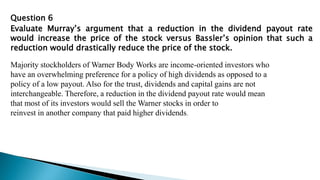
Question 6
Evaluate Murray’s argument that a reduction in the dividend payout rate
would increase the price of the stock versus Bassler’s opinion that such a
reduction would drastically reduce the price of the stock.
Majority stockholders of Warner Body Works are income-oriented investors who
have an overwhelming preference for a policy of high dividends as opposed to a
policy of a low payout. Also for the trust, dividends and capital gains are not
interchangeable. Therefore, a reduction in the dividend payout rate would mean
that most of its investors would sell the Warner stocks in order to
reinvest in another company that paid higher dividends.
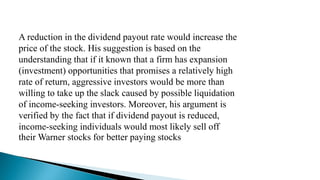
A reduction in the dividend payout rate would increase the
price of the stock. His suggestion is based on the
understanding that if it known that a firm has expansion
(investment) opportunities that promises a relatively high
rate of return, aggressive investors would be more than
willing to take up the slack caused by possible liquidation
of income-seeking investors. Moreover, his argument is
verified by the fact that if dividend payout is reduced,
income-seeking individuals would most likely sell off
their Warner stocks for better paying stocks
 It is beneficial for Warner Body Works to declare stock dividend on the basis of
financial position of the firm. The justifications to declare the stock dividend are as
follows:
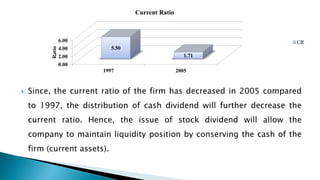
 Since, the current ratio of the firm has decreased in 2005 compared
to 1997, the distribution of cash dividend will further decrease the
current ratio. Hence, the issue of stock dividend will allow the
company to maintain liquidity position by conserving the cash of the
firm (current assets).
0.00
2.00
4.00
6.00
1997 2005
5.50
1.71Ratio
Current Ratio
CR
0.00%
50.00%
100.00%
1997 2005
16.80%
60%
Debt Ratio
1997
2005
In 2005, debt of company has increased up to 60%. In addition,
the distribution of stock dividend will allow the firm to invest in
future profitable projects. Such investment will help the firm to
increase its basic earning power resulting in the increase in
earnings per share.
Question 8
What specific dividend policy should Murray recommend to the
board of directors at its next meeting? Fully justify your answer.
.
1.Continuation of 60% dividend payout ratio
2.lowering the present payout ratio
3.Establishing a fixed dollar rate assuming the earnings will be increased and
hence the dollar dividend will also be increased
Question 9
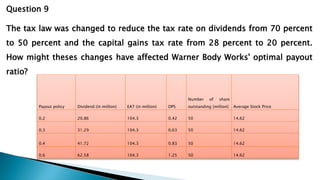
The tax law was changed to reduce the tax rate on dividends from 70 percent
to 50 percent and the capital gains tax rate from 28 percent to 20 percent.
How might theses changes have affected Warner Body Works' optimal payout
ratio?
Payout policy Dividend (in million) EAT (in million) DPS
Number of share
outstanding {million} Average Stock Price
0.2 20.86 104.3 0.42 50 14.62
0.3 31.29 104.3 0.63 50 14.62
0.4 41.72 104.3 0.83 50 14.62
0.6 62.58 104.3 1.25 50 14.62
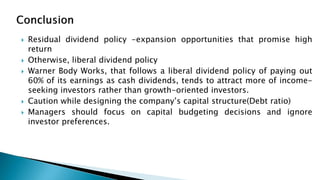
 Residual dividend policy -expansion opportunities that promise high
return
 Otherwise, liberal dividend policy
 Warner Body Works, that follows a liberal dividend policy of paying out
60% of its earnings as cash dividends, tends to attract more of income-
seeking investors rather than growth-oriented investors.
 Caution while designing the company’s capital structure(Debt ratio)
 Managers should focus on capital budgeting decisions and ignore
investor preferences.
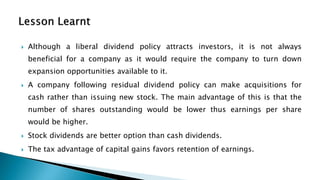
 Although a liberal dividend policy attracts investors, it is not always
beneficial for a company as it would require the company to turn down
expansion opportunities available to it.
 A company following residual dividend policy can make acquisitions for
cash rather than issuing new stock. The main advantage of this is that the
number of shares outstanding would be lower thus earnings per share
would be higher.
 Stock dividends are better option than cash dividends.
 The tax advantage of capital gains favors retention of earnings.
Thank you

Warner body works

  • 1.
    Presented by Ayush Nepal BarshaShrestha Chhokpa Sherpa Deepak Pandey Meera Khanal’ Neelam Malla Prakash Pandey Pramila Nepal
  • 2.
    Advantage and disadvantageof each of the four dividend policy? 1. A continuation of the present policy of paying out 60% of the earnings Advantages:  Individuals, organization, social organization that need stable income would prefer this policy as it provides a regular dividend payment.  It minimizes uncertainty to investors as there is a regular payment of dividend  A regular dividend policy decrease agency costs  As the payment of dividends indirectly results in a closer monitoring of management's
  • 3.
     This policywould not be appropriate where the companies have low free cash flow  Need to finance the growth with debt financing which could affect its long term liquidity  Have to bear opportunity cost of not investing in future projects.  The high payment of dividend leads to low current ratio and increment of dividend
  • 4.
    2. Lowering thepresent payout to below 60% and maintaining the payout ratio relatively constant at this new figure ? Advantage • Individuals in upper income tax brackets might prefer lower dividend payouts • Low payouts can decrease the amount of capital that needs to be raised • As there is less need to raise external equity, controlling interest of the stockholders will not be diluted. • It resolves uncertainty, as dividend earnings are less risky than capital gains
  • 5.
     It couldsignal that the firm is having financial difficulties  Majority of the Current stockholders are in favor of stable growth rate than growth potential. Therefore, these groups would sell their stocks if the dividend payout ratio is reduced. Eventually, this could reduce the marker price per share of the company
  • 6.
    3. Establishing adollar amount of dividend and increasing with the increase in income relatively stable dollar dividend is maintained. The dividend per share is increased or decreased only after careful investigation by the management Advantage  Investors may use the dividend policy as a part for information that is not easily accessible. This dividend policy may be useful in assessing the company's long-term earnings prospects. Increase in the dividend would signal the prosperity of the firm. It would attract the growth seeking investors.  Here in the case of Warner Body Works this could be a better option as the firm needs to retain its earnings to support the acquisitions. Further, as the dividend per share of 2005 is $1.25 the firm can convince its investors to provide a dividend per share of $1(which is not very less than $1.25) and increase it with the increase in income as it has a potential growth.
  • 7.
    Disadvantages:  Many investorslike retired individuals, college endowment funds, and income oriented mutual funds rely on dividends to satisfy instant personal income need. If dividends fluctuate from year to year, investors may have to sell or buy stock to satisfy their current needs, thereby incurring expensive transaction costs.  Income seeking investors would sell the stocks as the dividend income is uncertain.
  • 8.
    4. Low dividendpayout and supplementing it with extra income Advantage  This policy could be considered right if the firm’s earnings are quite volatile  This policy ensures that the investors get a certain minimum amount as dividend  The investors have less expectation with this sort of policy  This sort of policy prevents negative signaling as there is a pre fixed minimum limit for those investors who are satisfied with the minimum level that is pre fixed.
  • 9.
    Disadvantages:  There isan uncertainty in how much the investors are getting as the dividend with this sort of policy; hence it may not attract those parties who are seeking a stable dividend.  The investors might think that the company has a weak financial position, so it is going for a reduction in dividend payout which may be a cause for negative signaling to the investors.
  • 10.
    Issue 2 Evaluate theadvantages and disadvantages of having an announced dividend policy. Should Warner Body Works follow announced dividend policy? Advantage  Attracts investors:  Reduces uncertainty  Reduction of cost of capital on future projects
  • 11.
    Disadvantage:  Difficult toalter the dividend policy once announced.  Opportunity cost of reinvestment.  Not suitable for unionized company  Reduce credibility of the company
  • 12.
    Issue3 What effect doesthe dividend policy have on the growth rate of earnings per share? Table1: Calculation of ROE 1997 2005 Net Income(EAT) 31.2 104.3 Share holder's Equity 97.3 487 Return on Equity(ROE) 32.07% 21.41%
  • 13.
    Here, g = ROEx (1 - DPR) Where, g = growth rate ROE = Return on Equity DPR = Dividend Payout Ratio For 1997, g = 32.07(1-0.6) = 12.826% For 2005, g = 21.41%(1-0.6) = 8.56%
  • 14.
    Issue 4 Could thefigures in Table 3 be considered proof that firms with low payout ratios have high price/earnings ratios? Justify your answer. Selected Stock Market Data Particulars Payout P/E Playboy 17% 25 Uniroyal 0% 19 Hewlett Packard 11% 17 Datapoint 0% 16 Texas instrument 30% 13 Xerox 40% 10 ATT 67% 8 Allied Stores 45% 6
  • 15.
    Question 5 How doesthe firm’s debt position affect the dividend policy? First, more debt capital means more amount to be paid as interest as well as loan. They have to retain more amount of money to repay the loan and interests i.e. less amount of money will be available to distribute as dividend. Second, with increased debt capital the firms are bound to several debt contracts such as future dividend can be paid out of earnings generated after the signing of the loan agreement, dividend cannot be paid when net working capital is below a specified amount etc. in this case the firms will follow conservative dividend policy by retaining more money out of their net income
  • 16.
    Question 6 Evaluate Murray’sargument that a reduction in the dividend payout rate would increase the price of the stock versus Bassler’s opinion that such a reduction would drastically reduce the price of the stock. Majority stockholders of Warner Body Works are income-oriented investors who have an overwhelming preference for a policy of high dividends as opposed to a policy of a low payout. Also for the trust, dividends and capital gains are not interchangeable. Therefore, a reduction in the dividend payout rate would mean that most of its investors would sell the Warner stocks in order to reinvest in another company that paid higher dividends.
  • 17.
    A reduction inthe dividend payout rate would increase the price of the stock. His suggestion is based on the understanding that if it known that a firm has expansion (investment) opportunities that promises a relatively high rate of return, aggressive investors would be more than willing to take up the slack caused by possible liquidation of income-seeking investors. Moreover, his argument is verified by the fact that if dividend payout is reduced, income-seeking individuals would most likely sell off their Warner stocks for better paying stocks
  • 18.
     It isbeneficial for Warner Body Works to declare stock dividend on the basis of financial position of the firm. The justifications to declare the stock dividend are as follows:
  • 19.
     Since, thecurrent ratio of the firm has decreased in 2005 compared to 1997, the distribution of cash dividend will further decrease the current ratio. Hence, the issue of stock dividend will allow the company to maintain liquidity position by conserving the cash of the firm (current assets). 0.00 2.00 4.00 6.00 1997 2005 5.50 1.71Ratio Current Ratio CR
  • 20.
    0.00% 50.00% 100.00% 1997 2005 16.80% 60% Debt Ratio 1997 2005 In2005, debt of company has increased up to 60%. In addition, the distribution of stock dividend will allow the firm to invest in future profitable projects. Such investment will help the firm to increase its basic earning power resulting in the increase in earnings per share.
  • 21.
    Question 8 What specificdividend policy should Murray recommend to the board of directors at its next meeting? Fully justify your answer. . 1.Continuation of 60% dividend payout ratio 2.lowering the present payout ratio 3.Establishing a fixed dollar rate assuming the earnings will be increased and hence the dollar dividend will also be increased
  • 22.
    Question 9 The taxlaw was changed to reduce the tax rate on dividends from 70 percent to 50 percent and the capital gains tax rate from 28 percent to 20 percent. How might theses changes have affected Warner Body Works' optimal payout ratio? Payout policy Dividend (in million) EAT (in million) DPS Number of share outstanding {million} Average Stock Price 0.2 20.86 104.3 0.42 50 14.62 0.3 31.29 104.3 0.63 50 14.62 0.4 41.72 104.3 0.83 50 14.62 0.6 62.58 104.3 1.25 50 14.62
  • 23.
     Residual dividendpolicy -expansion opportunities that promise high return  Otherwise, liberal dividend policy  Warner Body Works, that follows a liberal dividend policy of paying out 60% of its earnings as cash dividends, tends to attract more of income- seeking investors rather than growth-oriented investors.  Caution while designing the company’s capital structure(Debt ratio)  Managers should focus on capital budgeting decisions and ignore investor preferences.
  • 24.
     Although aliberal dividend policy attracts investors, it is not always beneficial for a company as it would require the company to turn down expansion opportunities available to it.  A company following residual dividend policy can make acquisitions for cash rather than issuing new stock. The main advantage of this is that the number of shares outstanding would be lower thus earnings per share would be higher.  Stock dividends are better option than cash dividends.  The tax advantage of capital gains favors retention of earnings.
  • 25.