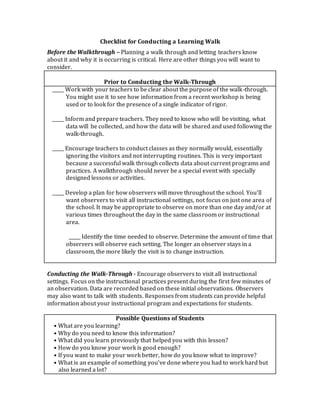
Checklist for Conducting a Learning Walk
Before the Walkthrough – Planning a walk through and letting teachers know
about it and why it is occurring is critical. Here are other things you will want to
consider.
Prior to Conducting the Walk-Through
_____ Work with your teachers to be clear about the purpose of the walk-through.
You might use it to see how information from a recent workshop is being
used or to look for the presence of a single indicator of rigor.
_____ Inform and prepare teachers. They need to know who will be visiting, what
data will be collected, and how the data will be shared and used following the
walk-through.
_____ Encourage teachers to conduct classes as they normally would, essentially
ignoring the visitors and not interrupting routines. This is very important
because a successful walk through collects data about current programs and
practices. A walkthrough should never be a special event with specially
designed lessons or activities.
_____ Develop a plan for how observers will move throughout the school. You’ll
want observers to visit all instructional settings, not focus on just one area of
the school. It may be appropriate to observe on more than one day and/or at
various times throughout the day in the same classroom or instructional
area.
_____ Identify the time needed to observe. Determine the amount of time that
observers will observe each setting. The longer an observer stays in a
classroom, the more likely the visit is to change instruction.
Conducting the Walk-Through - Encourage observers to visit all instructional
settings. Focus on the instructional practices present during the first few minutes of
an observation. Data are recorded based on these initial observations. Observers
may also want to talk with students. Responses from students can provide helpful
information about your instructional program and expectations for students.
Possible Questions of Students
• What are you learning?
• Why do you need to know this information?
• What did you learn previously that helped you with this lesson?
• How do you know your work is good enough?
• If you want to make your work better, how do you know what to improve?
• What is an example of something you’ve done where you had to work hard but
also learned a lot?
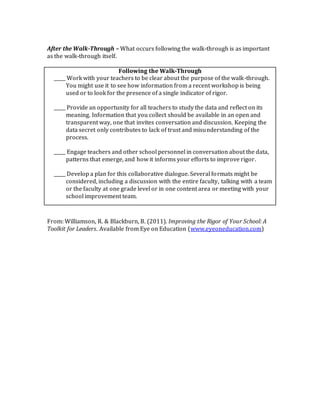
After the Walk-Through – What occurs following the walk-through is as important
as the walk-through itself.
Following the Walk-Through
_____ Work with your teachers to be clear about the purpose of the walk-through.
You might use it to see how information from a recent workshop is being
used or to look for the presence of a single indicator of rigor.
_____ Provide an opportunity for all teachers to study the data and reflect on its
meaning. Information that you collect should be available in an open and
transparent way, one that invites conversation and discussion. Keeping the
data secret only contributes to lack of trust and misunderstanding of the
process.
_____ Engage teachers and other school personnel in conversation about the data,
patterns that emerge, and how it informs your efforts to improve rigor.
_____ Develop a plan for this collaborative dialogue. Several formats might be
considered, including a discussion with the entire faculty, talking with a team
or the faculty at one grade level or in one content area or meeting with your
school improvement team.
From: Williamson, R. & Blackburn, B. (2011). Improving the Rigor of Your School: A
Toolkit for Leaders. Available from Eye on Education (www.eyeoneducation.com)

Walkthrough checklist

  • 1.
    Checklist for Conductinga Learning Walk Before the Walkthrough – Planning a walk through and letting teachers know about it and why it is occurring is critical. Here are other things you will want to consider. Prior to Conducting the Walk-Through _____ Work with your teachers to be clear about the purpose of the walk-through. You might use it to see how information from a recent workshop is being used or to look for the presence of a single indicator of rigor. _____ Inform and prepare teachers. They need to know who will be visiting, what data will be collected, and how the data will be shared and used following the walk-through. _____ Encourage teachers to conduct classes as they normally would, essentially ignoring the visitors and not interrupting routines. This is very important because a successful walk through collects data about current programs and practices. A walkthrough should never be a special event with specially designed lessons or activities. _____ Develop a plan for how observers will move throughout the school. You’ll want observers to visit all instructional settings, not focus on just one area of the school. It may be appropriate to observe on more than one day and/or at various times throughout the day in the same classroom or instructional area. _____ Identify the time needed to observe. Determine the amount of time that observers will observe each setting. The longer an observer stays in a classroom, the more likely the visit is to change instruction. Conducting the Walk-Through - Encourage observers to visit all instructional settings. Focus on the instructional practices present during the first few minutes of an observation. Data are recorded based on these initial observations. Observers may also want to talk with students. Responses from students can provide helpful information about your instructional program and expectations for students. Possible Questions of Students • What are you learning? • Why do you need to know this information? • What did you learn previously that helped you with this lesson? • How do you know your work is good enough? • If you want to make your work better, how do you know what to improve? • What is an example of something you’ve done where you had to work hard but also learned a lot?
  • 2.
    After the Walk-Through– What occurs following the walk-through is as important as the walk-through itself. Following the Walk-Through _____ Work with your teachers to be clear about the purpose of the walk-through. You might use it to see how information from a recent workshop is being used or to look for the presence of a single indicator of rigor. _____ Provide an opportunity for all teachers to study the data and reflect on its meaning. Information that you collect should be available in an open and transparent way, one that invites conversation and discussion. Keeping the data secret only contributes to lack of trust and misunderstanding of the process. _____ Engage teachers and other school personnel in conversation about the data, patterns that emerge, and how it informs your efforts to improve rigor. _____ Develop a plan for this collaborative dialogue. Several formats might be considered, including a discussion with the entire faculty, talking with a team or the faculty at one grade level or in one content area or meeting with your school improvement team. From: Williamson, R. & Blackburn, B. (2011). Improving the Rigor of Your School: A Toolkit for Leaders. Available from Eye on Education (www.eyeoneducation.com)