BRISK WALKING
OR FITNESS
WALKING
PHYSICAL EDUCATION
10
GROUP 3 PRESENTATION
INTRODUCTION
Walking is more accessible to
a large percentage of people
and you can turn walking into
an enjoyable social activity.
Walking id the bast exercise
and is suitable for any age
group.
BRISK WALKING OR FITNESS
WALKING
Brisk walking is not strolling or even walking at a moderate peace.It is
walking faster but not as fast as a full run. Brisk walking is actually a
moderately intense exercise that refers to your exertion. In brisk walking,
you need to walk at a pace higher than your normal rate of walking so as
to reach your moderate intensity zone. The moderate intensity zone is
defined as the 50-70%.of your maximum heart rate and it varies by age.
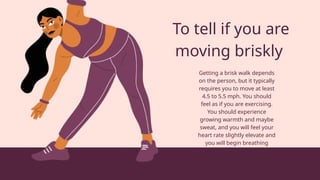
To tell if you are
moving briskly
Getting a brisk walk depends
on the person, but it typically
requires you to move at least
4.5 to 5.5 mph. You should
feel as if you are exercising.
You should experience
growing warmth and maybe
sweat, and you will feel your
heart rate slightly elevate and
you will begin breathing
heavier.
PROPER
BRISK
WALKING
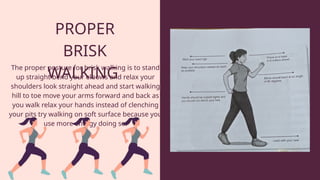
The proper posture for brisk walking is to stand
up straight bend your elbows and relax your
shoulders look straight ahead and start walking
hill to toe move your arms forward and back as
you walk relax your hands instead of clenching
your pits try walking on soft surface because you
use more energy doing so.
Brisk walking
techniques
You may need to slow down at first and
ensure you have the right techniques that
will enable you to speed up and walk
briskly. The technique that you can broke
down into posture arm motion ,step and
straight. here are key points for each:
1.
2.
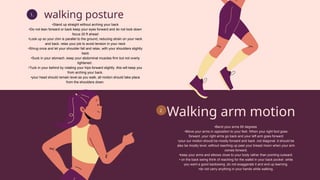
walking posture
Walking arm motion
•Bend your arms 90 degrees
•Move your arms in opposition to your feet. When your right foot goes
forward ,your right arms go back and your left arm goes forward
•your our motion should be mostly forward and back ,not diagonal .it should be
also be mostly level ,without reaching up past your breast moon when your arm
comes forward.
•keep your arms and elbows close to your body rather than pointing outward.
• on the back swing think of reaching for the wallet in your back pocket .while
you want a good backswing ,do not exaggerate it and end up learning.
•do not carry anything in your hands while walking.
•Stand up straight without arching your back
•Do not lean forward or back keep your eyes forward and do not look down
focus 20 ft ahead
•Look up so your chin is parallel to the ground, reducing strain on your neck
and back. relax your job to avoid tension in your neck
•Shrug once and let your shoulder fall and relax, with your shoulders slightly
back
•Suck in your stomach ,keep your abdominal muscles firm but not overly
tightened .
•Tuck in your behind by rotating your hips forward slightly .this will keep you
from arching your back.
•your head should remain level as you walk, all motion should take place
from the shoulders down.
3.
4.
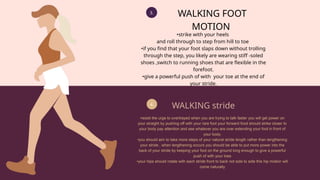
WALKING FOOT
MOTION
•strike with your heels
and roll through to step from hill to toe
•if you find that your foot slaps down without trolling
through the step, you likely are wearing stiff -soled
shoes ,switch to running shoes that are flexible in the
forefoot.
•give a powerful push of with your toe at the end of
your stride.
WALKING stride
•resist the urge to overtrayed when you are trying to talk faster you will get power on
your straight by pushing off with your rare foot your forward food should strike closer to
your body pay attention and see whatever you are over extending your foot in front of
your body.
•you should aim to take more steps of your natural stride length rather than lengthening
your stride , when lengthening occurs you should be able to put more power into the
back of your stride by keeping your foot on the ground long enough to give a powerful
push of with your toes
•your hips should rotate with each stride front to back not side to side this hip motion will
come naturally
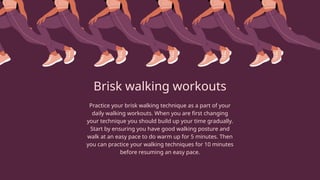
Brisk walking workouts
Practice your brisk walking technique as a part of your
daily walking workouts. When you are first changing
your technique you should build up your time gradually.
Start by ensuring you have good walking posture and
walk at an easy pace to do warm up for 5 minutes. Then
you can practice your walking techniques for 10 minutes
before resuming an easy pace.
Common brisk walking
injuries
Shin splint is the term of the lower leg pain that occurs below the knee either on the
front outside part of the leg(Interior shin splints) are the inside of the leg ( medical shin
split). It is the great distress of many athletes and often plague beginning walkers and
runners who do not build their mileage gradually enough or seasoned walkers or
runners who abruptly change their workout regimen, suddenly adding too much
workout, are switching from walking or running on flat surface to hills.
Below are the common causes of shin
splints
•inadequate stretching
•worn out shoes
•excessive stress placed on the leg or one hip form
•always running in rough surface
Treatment for shin
splints
•when shin splints happen to you stop running completely or
decrease your training depending on the extent and duration of
pain .
•then as a first step apply ice to your shin to reduce
inflammation .
•consider cross training for a while to let your shin heal, you can
swim ,run in the pool ,or ride a bike.
•make sure you wear the correct running shoes for your foot
type. Overpronators should wear motion control shoes. You
need arch supports to correct foot or ankle problems. Have two
pairs of shoes and alternately where them to bury the stressed
on your legs.
•avoid hills and excessively hard surface until shin pain goes
away completely.
•avoid roads with an obvious downward slope from the center of
a road to each side.
•run out and back on the same side of the road. also, when
running on a track switch direction
•if you are prone to developing shin splits stretch your calves
achilles tendon regularly as a preventive measure.
•when you return to running increase your mileage, slowly ,no
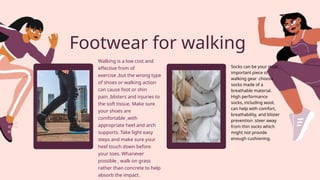
Footwear for walking
Walking is a low cost and
effective from of
exercise ,but the wrong type
of shoes or walking action
can cause foot or shin
pain ,blisters and injuries to
the soft tissue. Make sure
your shoes are
comfortable ,with
appropriate heel and arch
supports. Take light easy
steps and make sure your
heel touch down before
your toes. Whanever
possible , walk on grass
rather than concrete to help
absorb the impact.
Socks can be your most
important piece of
walking gear .choose
socks made of a
breathable material.
High performance
socks, including wool,
can help with comfort,
breathability, and blister
prevention .steer away
from thin socks which
might not provide
enough cushioning.
Attire for brisk walking
•when exercising in hot weather protect your
skin by wearing sunscreen a (minimum of 15
spf ),sunglasses ,are breathable hot or sun
visor .
•wear breathable fabrics. Cotton absorbs
moisture and dry slowly. Synthetic "wicking"
fabrics are better choices for shirts and socks.
•be visible by wearing light colored clothes.
light colors make you more visible to cars at
town and dusk. you might want to wear
reflective clothing. Reflective tape or vests
(such as the orange reflective bets worn by
many motorcyclist )are also a good idea for
visibility .you can also carry a glow stick or
flashlight.
fuel for brisk walking
Your body needs all nutrients: protein ,carbohydrates ,and fat in a healthy,
balance amount to maximize your fitness walking. carbohydrates are the
bodies preferred energy source. Carbohydrates rich food come in various s
forms, which can be classified by the glycemic index(gi). This measures how
much a food increase blood sugar levels. Low (gi )food that do not greatly
boost blood sugar such as oats, seeded bread ,pasta, yogurt, and some fruits
offer a sustained release of energy over time. They are good to eat before your
brisk walk or during a lunch stop, as they keep you fuller for longer.
Hydration during
walks
As well as nutrition hydration is important in this physical activity .drink
enough water especially in hot condition or at high altitude because serve
dehydration can be dangerous. You will become confused and
disorientated so be aware of the early signs, such as headaches. In a very
served hot environments drink 100 to 250 ml every 15 minutes but the best
advice is to stay vigilant and listen to your body.
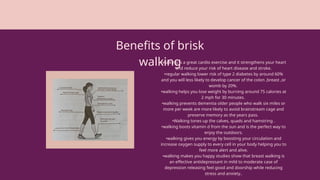
Benefits of brisk
walking
•walking is a great cardio exercise and it strengthens your heart
and reduce your risk of heart disease and stroke.
•regular walking lower risk of type 2 diabetes by around 60%
and you will less likely to develop cancer of the colon ,breast ,or
womb by 20%.
•walking helps you lose weight by burning around 75 calories at
2 mph for 30 minutes.
•walking prevents dementia older people who walk six miles or
more per week are more likely to avoid brainstream cage and
preserve memory as the years pass.
•Walking tones up the calves, quads and hamstring .
•walking boots vitamin d from the sun and is the perfect way to
enjoy the outdoors.
•walking gives you energy by boosting your circulation and
increase oxygen supply to every cell in your body helping you to
feel more alert and alive.
•walking makes you happy studies show that breast walking is
an effective antidepressant in mild to moderate case of
depression releasing feel good and doorship while reducing
stress and anxiety..
GROUP 3
Thank you

BRISKWALKING -PHYSICAL EDUCATION 10 pptx

  • 1.
    BRISK WALKING OR FITNESS WALKING PHYSICALEDUCATION 10 GROUP 3 PRESENTATION
  • 2.
    INTRODUCTION Walking is moreaccessible to a large percentage of people and you can turn walking into an enjoyable social activity. Walking id the bast exercise and is suitable for any age group.
  • 3.
    BRISK WALKING ORFITNESS WALKING Brisk walking is not strolling or even walking at a moderate peace.It is walking faster but not as fast as a full run. Brisk walking is actually a moderately intense exercise that refers to your exertion. In brisk walking, you need to walk at a pace higher than your normal rate of walking so as to reach your moderate intensity zone. The moderate intensity zone is defined as the 50-70%.of your maximum heart rate and it varies by age.
  • 4.
    To tell ifyou are moving briskly Getting a brisk walk depends on the person, but it typically requires you to move at least 4.5 to 5.5 mph. You should feel as if you are exercising. You should experience growing warmth and maybe sweat, and you will feel your heart rate slightly elevate and you will begin breathing heavier.
  • 5.
    PROPER BRISK WALKING The proper posturefor brisk walking is to stand up straight bend your elbows and relax your shoulders look straight ahead and start walking hill to toe move your arms forward and back as you walk relax your hands instead of clenching your pits try walking on soft surface because you use more energy doing so.
  • 6.
    Brisk walking techniques You mayneed to slow down at first and ensure you have the right techniques that will enable you to speed up and walk briskly. The technique that you can broke down into posture arm motion ,step and straight. here are key points for each:
  • 7.
    1. 2. walking posture Walking armmotion •Bend your arms 90 degrees •Move your arms in opposition to your feet. When your right foot goes forward ,your right arms go back and your left arm goes forward •your our motion should be mostly forward and back ,not diagonal .it should be also be mostly level ,without reaching up past your breast moon when your arm comes forward. •keep your arms and elbows close to your body rather than pointing outward. • on the back swing think of reaching for the wallet in your back pocket .while you want a good backswing ,do not exaggerate it and end up learning. •do not carry anything in your hands while walking. •Stand up straight without arching your back •Do not lean forward or back keep your eyes forward and do not look down focus 20 ft ahead •Look up so your chin is parallel to the ground, reducing strain on your neck and back. relax your job to avoid tension in your neck •Shrug once and let your shoulder fall and relax, with your shoulders slightly back •Suck in your stomach ,keep your abdominal muscles firm but not overly tightened . •Tuck in your behind by rotating your hips forward slightly .this will keep you from arching your back. •your head should remain level as you walk, all motion should take place from the shoulders down.
  • 8.
    3. 4. WALKING FOOT MOTION •strike withyour heels and roll through to step from hill to toe •if you find that your foot slaps down without trolling through the step, you likely are wearing stiff -soled shoes ,switch to running shoes that are flexible in the forefoot. •give a powerful push of with your toe at the end of your stride. WALKING stride •resist the urge to overtrayed when you are trying to talk faster you will get power on your straight by pushing off with your rare foot your forward food should strike closer to your body pay attention and see whatever you are over extending your foot in front of your body. •you should aim to take more steps of your natural stride length rather than lengthening your stride , when lengthening occurs you should be able to put more power into the back of your stride by keeping your foot on the ground long enough to give a powerful push of with your toes •your hips should rotate with each stride front to back not side to side this hip motion will come naturally
  • 9.
    Brisk walking workouts Practiceyour brisk walking technique as a part of your daily walking workouts. When you are first changing your technique you should build up your time gradually. Start by ensuring you have good walking posture and walk at an easy pace to do warm up for 5 minutes. Then you can practice your walking techniques for 10 minutes before resuming an easy pace.
  • 10.
    Common brisk walking injuries Shinsplint is the term of the lower leg pain that occurs below the knee either on the front outside part of the leg(Interior shin splints) are the inside of the leg ( medical shin split). It is the great distress of many athletes and often plague beginning walkers and runners who do not build their mileage gradually enough or seasoned walkers or runners who abruptly change their workout regimen, suddenly adding too much workout, are switching from walking or running on flat surface to hills. Below are the common causes of shin splints •inadequate stretching •worn out shoes •excessive stress placed on the leg or one hip form •always running in rough surface
  • 11.
    Treatment for shin splints •whenshin splints happen to you stop running completely or decrease your training depending on the extent and duration of pain . •then as a first step apply ice to your shin to reduce inflammation . •consider cross training for a while to let your shin heal, you can swim ,run in the pool ,or ride a bike. •make sure you wear the correct running shoes for your foot type. Overpronators should wear motion control shoes. You need arch supports to correct foot or ankle problems. Have two pairs of shoes and alternately where them to bury the stressed on your legs. •avoid hills and excessively hard surface until shin pain goes away completely. •avoid roads with an obvious downward slope from the center of a road to each side. •run out and back on the same side of the road. also, when running on a track switch direction •if you are prone to developing shin splits stretch your calves achilles tendon regularly as a preventive measure. •when you return to running increase your mileage, slowly ,no
  • 12.
    Footwear for walking Walkingis a low cost and effective from of exercise ,but the wrong type of shoes or walking action can cause foot or shin pain ,blisters and injuries to the soft tissue. Make sure your shoes are comfortable ,with appropriate heel and arch supports. Take light easy steps and make sure your heel touch down before your toes. Whanever possible , walk on grass rather than concrete to help absorb the impact. Socks can be your most important piece of walking gear .choose socks made of a breathable material. High performance socks, including wool, can help with comfort, breathability, and blister prevention .steer away from thin socks which might not provide enough cushioning.
  • 13.
    Attire for briskwalking •when exercising in hot weather protect your skin by wearing sunscreen a (minimum of 15 spf ),sunglasses ,are breathable hot or sun visor . •wear breathable fabrics. Cotton absorbs moisture and dry slowly. Synthetic "wicking" fabrics are better choices for shirts and socks. •be visible by wearing light colored clothes. light colors make you more visible to cars at town and dusk. you might want to wear reflective clothing. Reflective tape or vests (such as the orange reflective bets worn by many motorcyclist )are also a good idea for visibility .you can also carry a glow stick or flashlight.
  • 14.
    fuel for briskwalking Your body needs all nutrients: protein ,carbohydrates ,and fat in a healthy, balance amount to maximize your fitness walking. carbohydrates are the bodies preferred energy source. Carbohydrates rich food come in various s forms, which can be classified by the glycemic index(gi). This measures how much a food increase blood sugar levels. Low (gi )food that do not greatly boost blood sugar such as oats, seeded bread ,pasta, yogurt, and some fruits offer a sustained release of energy over time. They are good to eat before your brisk walk or during a lunch stop, as they keep you fuller for longer.
  • 15.
    Hydration during walks As wellas nutrition hydration is important in this physical activity .drink enough water especially in hot condition or at high altitude because serve dehydration can be dangerous. You will become confused and disorientated so be aware of the early signs, such as headaches. In a very served hot environments drink 100 to 250 ml every 15 minutes but the best advice is to stay vigilant and listen to your body.
  • 16.
    Benefits of brisk walking •walkingis a great cardio exercise and it strengthens your heart and reduce your risk of heart disease and stroke. •regular walking lower risk of type 2 diabetes by around 60% and you will less likely to develop cancer of the colon ,breast ,or womb by 20%. •walking helps you lose weight by burning around 75 calories at 2 mph for 30 minutes. •walking prevents dementia older people who walk six miles or more per week are more likely to avoid brainstream cage and preserve memory as the years pass. •Walking tones up the calves, quads and hamstring . •walking boots vitamin d from the sun and is the perfect way to enjoy the outdoors. •walking gives you energy by boosting your circulation and increase oxygen supply to every cell in your body helping you to feel more alert and alive. •walking makes you happy studies show that breast walking is an effective antidepressant in mild to moderate case of depression releasing feel good and doorship while reducing stress and anxiety..
  • 17.