“Theories of Compensation”
1.The theory was advocated by John Stuart Mill as a supplementary to subsistence theory. It assumed that the supply of labor at any moment of time is fixed and the demand consisted of a fixed sum determined by the intentions of the capitalist employers. Here demand is determined by the size of the fund.Surplus Value TheoryEfficiency Wage TheoryWage Fund TheoryBargaining Theory
2. This theory was advocated by Karl Marx on the assumption that the GNP influences the standard of living and therefore the workers should be paid according to that standard of living, so that they can support the self and the family and live comfortably in a society. Standard of Living TheoryEfficiency Wage TheoryExpectancy Wage TheorySupply and Demand Theory
3. This theory was propounded by John Davidson on the assumption that the wages are determined on the basis of the relative bargaining power of the two parties, the employer and the employees. Subsistence TheorySurplus Value Theory Efficiency Wage TheoryBargaining Theory
4. This theory was propounded by Adam Smith and David Ricardo based on the assumption that labor is a principal cause of increasing productivity and in the long run wages are necessary to maintain a worker and his family. It suggests that the amount paid to the workers should meet their basic needs.Expectancy TheorySupply and Demand TheorySubsistence TheoryEfficiency Wage Theory
5. This theory work on the demand and supply conditions affecting the labor pricing. If the demand is more than the supply of workforce, the expected compensation will be high and vice-versa.Expectancy Wage TheorySupply and Demand TheoryStandard of Living TheorySurplus Value Theory
6. This is a motivational theory which helps to choose that behavior which can yield the most satisfactory exchange. This theory argues that the employees have their own expectations and they evaluate their behavior in relation to what they are being paid against their expectation of their worth.Expectancy TheoryEfficiency TheorySubsistence TheoryBargaining Theory
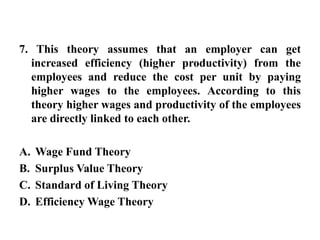
7. This theory assumes that an employer can get increased efficiency (higher productivity) from the employees and reduce the cost per unit by paying higher wages to the employees. According to this theory higher wages and productivity of the employees are directly linked to each other.Wage Fund TheorySurplus Value TheoryStandard of Living TheoryEfficiency Wage Theory
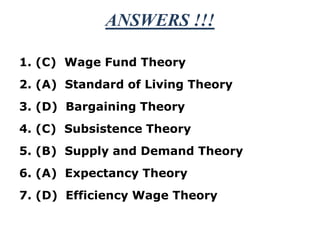
ANSWERS !!!1. (C)  Wage Fund Theory2. (A)  Standard of Living Theory3. (D)  Bargaining Theory4. (C)  Subsistence Theory5. (B)  Supply and Demand Theory6. (A)  Expectancy Theory7. (D)  Efficiency Wage Theory

Wage theory !!! mod 1

  • 1.
  • 2.
    1.The theory wasadvocated by John Stuart Mill as a supplementary to subsistence theory. It assumed that the supply of labor at any moment of time is fixed and the demand consisted of a fixed sum determined by the intentions of the capitalist employers. Here demand is determined by the size of the fund.Surplus Value TheoryEfficiency Wage TheoryWage Fund TheoryBargaining Theory
  • 3.
    2. This theorywas advocated by Karl Marx on the assumption that the GNP influences the standard of living and therefore the workers should be paid according to that standard of living, so that they can support the self and the family and live comfortably in a society. Standard of Living TheoryEfficiency Wage TheoryExpectancy Wage TheorySupply and Demand Theory
  • 4.
    3. This theorywas propounded by John Davidson on the assumption that the wages are determined on the basis of the relative bargaining power of the two parties, the employer and the employees. Subsistence TheorySurplus Value Theory Efficiency Wage TheoryBargaining Theory
  • 5.
    4. This theorywas propounded by Adam Smith and David Ricardo based on the assumption that labor is a principal cause of increasing productivity and in the long run wages are necessary to maintain a worker and his family. It suggests that the amount paid to the workers should meet their basic needs.Expectancy TheorySupply and Demand TheorySubsistence TheoryEfficiency Wage Theory
  • 6.
    5. This theorywork on the demand and supply conditions affecting the labor pricing. If the demand is more than the supply of workforce, the expected compensation will be high and vice-versa.Expectancy Wage TheorySupply and Demand TheoryStandard of Living TheorySurplus Value Theory
  • 7.
    6. This isa motivational theory which helps to choose that behavior which can yield the most satisfactory exchange. This theory argues that the employees have their own expectations and they evaluate their behavior in relation to what they are being paid against their expectation of their worth.Expectancy TheoryEfficiency TheorySubsistence TheoryBargaining Theory
  • 8.
    7. This theoryassumes that an employer can get increased efficiency (higher productivity) from the employees and reduce the cost per unit by paying higher wages to the employees. According to this theory higher wages and productivity of the employees are directly linked to each other.Wage Fund TheorySurplus Value TheoryStandard of Living TheoryEfficiency Wage Theory
  • 9.
    ANSWERS !!!1. (C) Wage Fund Theory2. (A) Standard of Living Theory3. (D) Bargaining Theory4. (C) Subsistence Theory5. (B) Supply and Demand Theory6. (A) Expectancy Theory7. (D) Efficiency Wage Theory