Introduction to Dynamic Programming
Approach Using DP to solve the Fibonacci
Numbers Problem
Week-08, Lesson-01 (part 1)
Introduction & Fibonacci
Numbers
CSE@DIU 1
2
Dynamic Programming
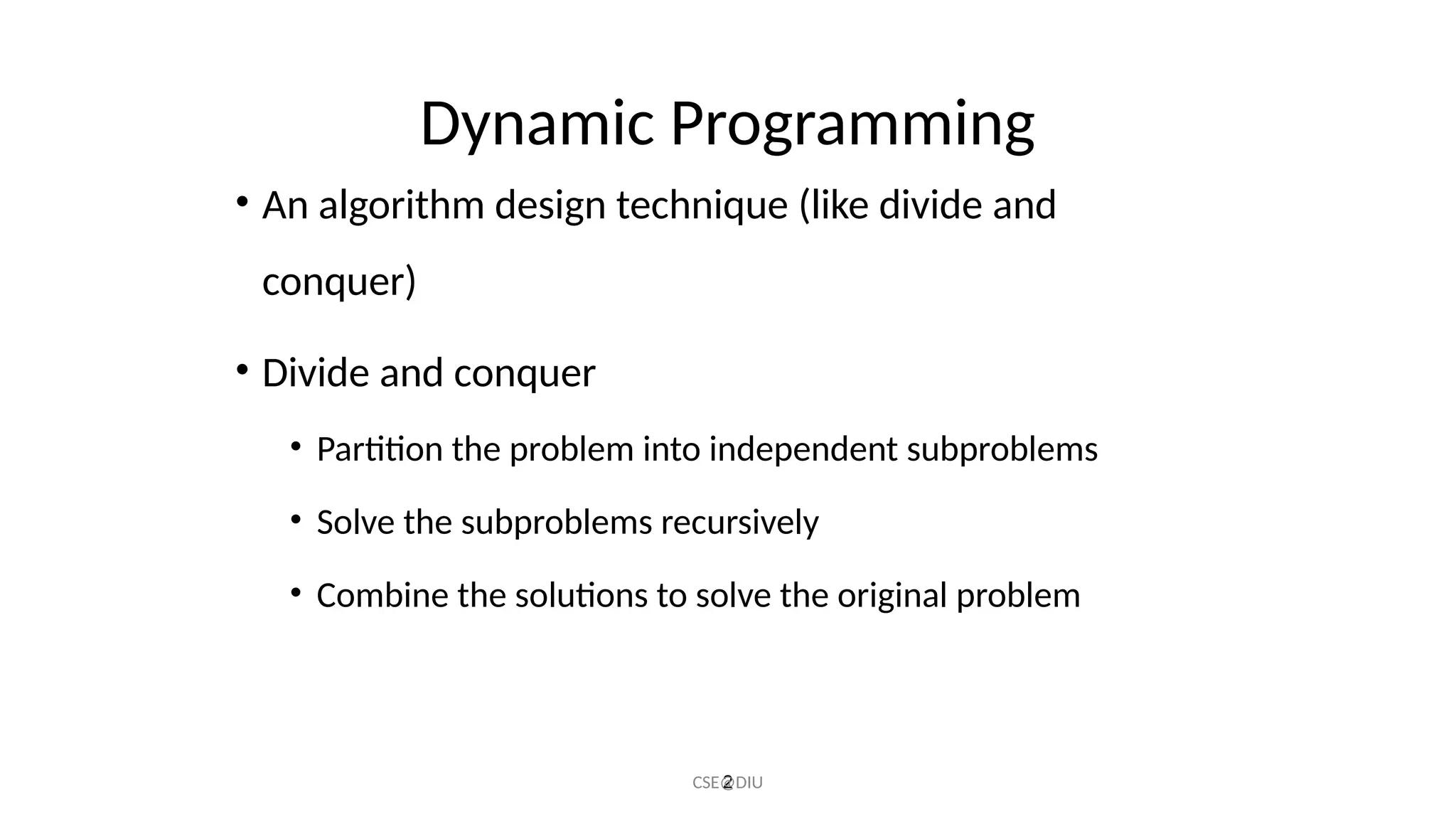
• An algorithm design technique (like divide and
conquer)
• Divide and conquer
• Partition the problem into independent subproblems
• Solve the subproblems recursively
• Combine the solutions to solve the original problem
CSE@DIU
3
DP - Two key ingredients
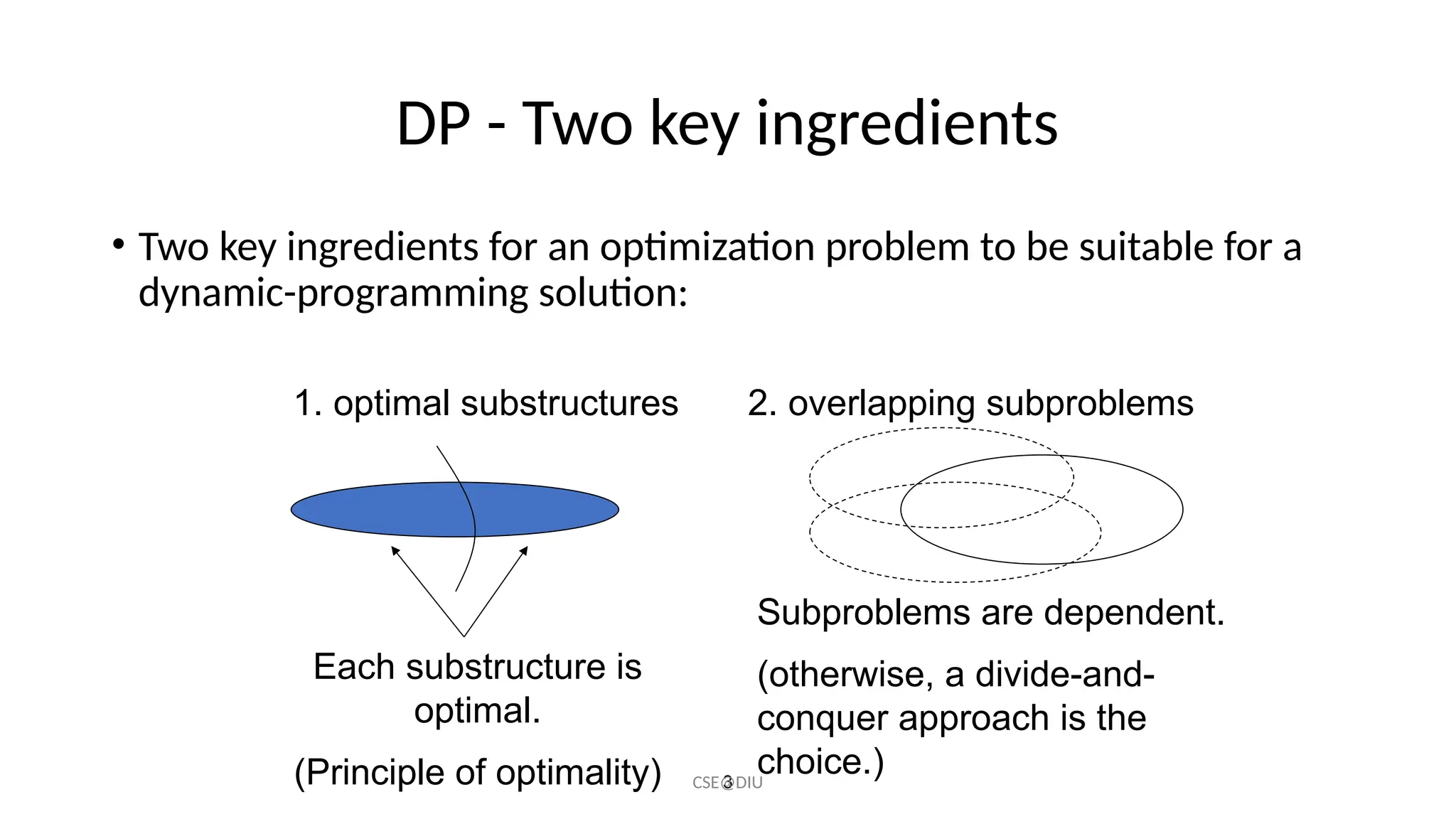
• Two key ingredients for an optimization problem to be suitable for a
dynamic-programming solution:
Each substructure is
optimal.
(Principle of optimality)
1. optimal substructures 2. overlapping subproblems
Subproblems are dependent.
(otherwise, a divide-and-
conquer approach is the
choice.)
CSE@DIU
4
Three basic components
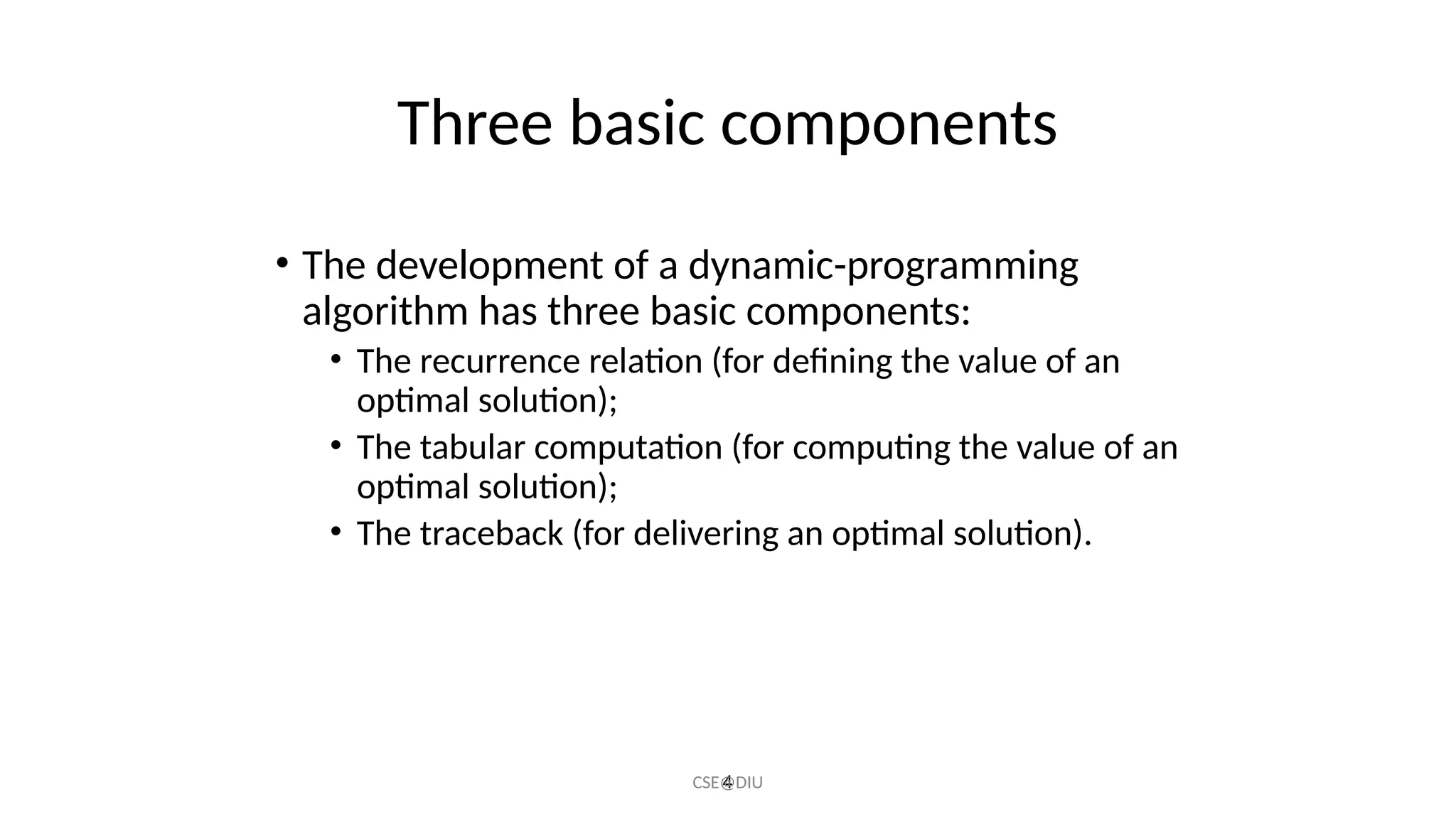
• The development of a dynamic-programming
algorithm has three basic components:
• The recurrence relation (for defining the value of an
optimal solution);
• The tabular computation (for computing the value of an
optimal solution);
• The traceback (for delivering an optimal solution).
CSE@DIU
5
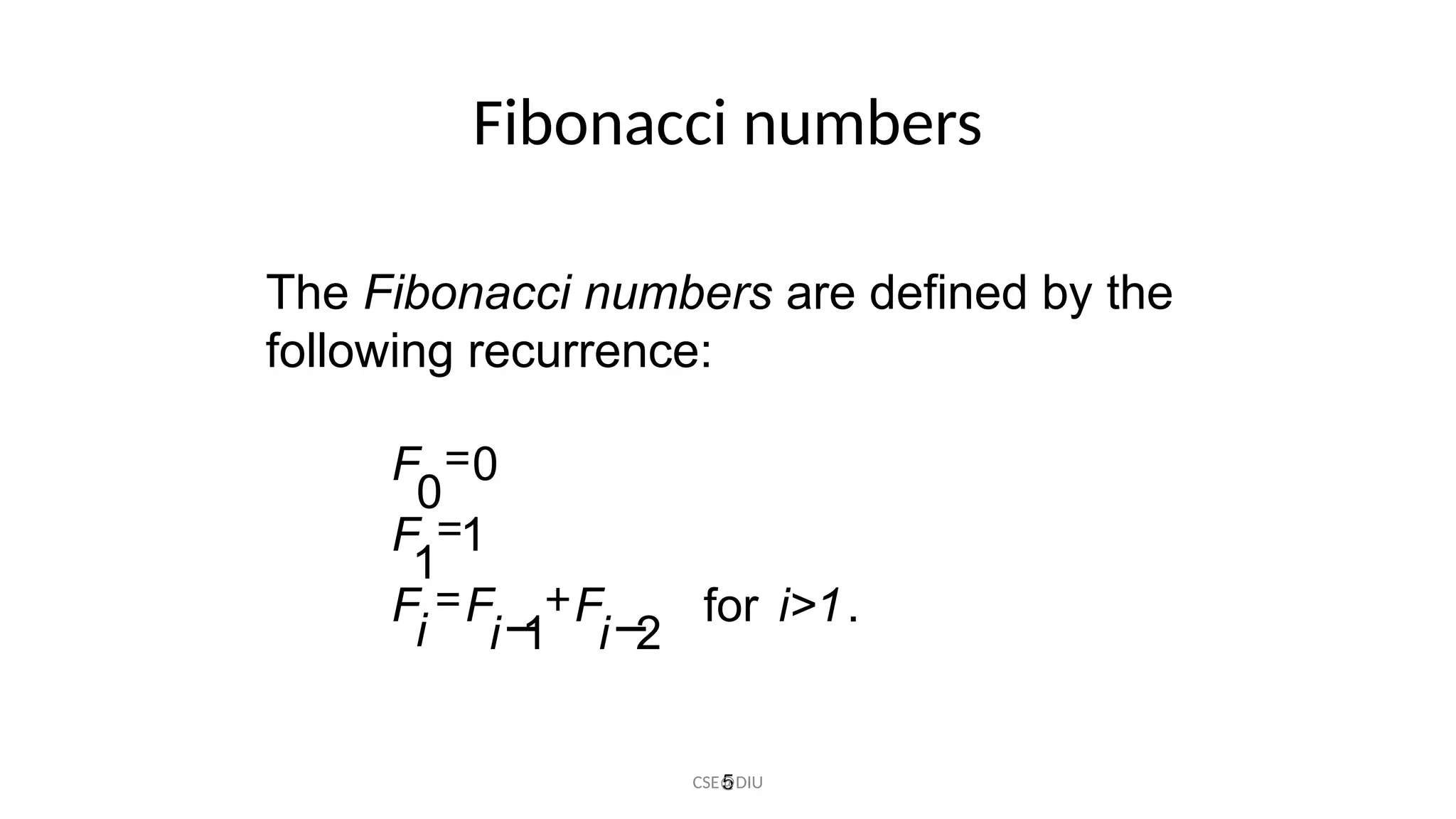
Fibonacci numbers
.
for
2
1
1
1
0
0
−
+
−
=
=
=
i>1
i
F
i
F
i
F
F
F
The Fibonacci numbers are defined by the
following recurrence:
CSE@DIU
6
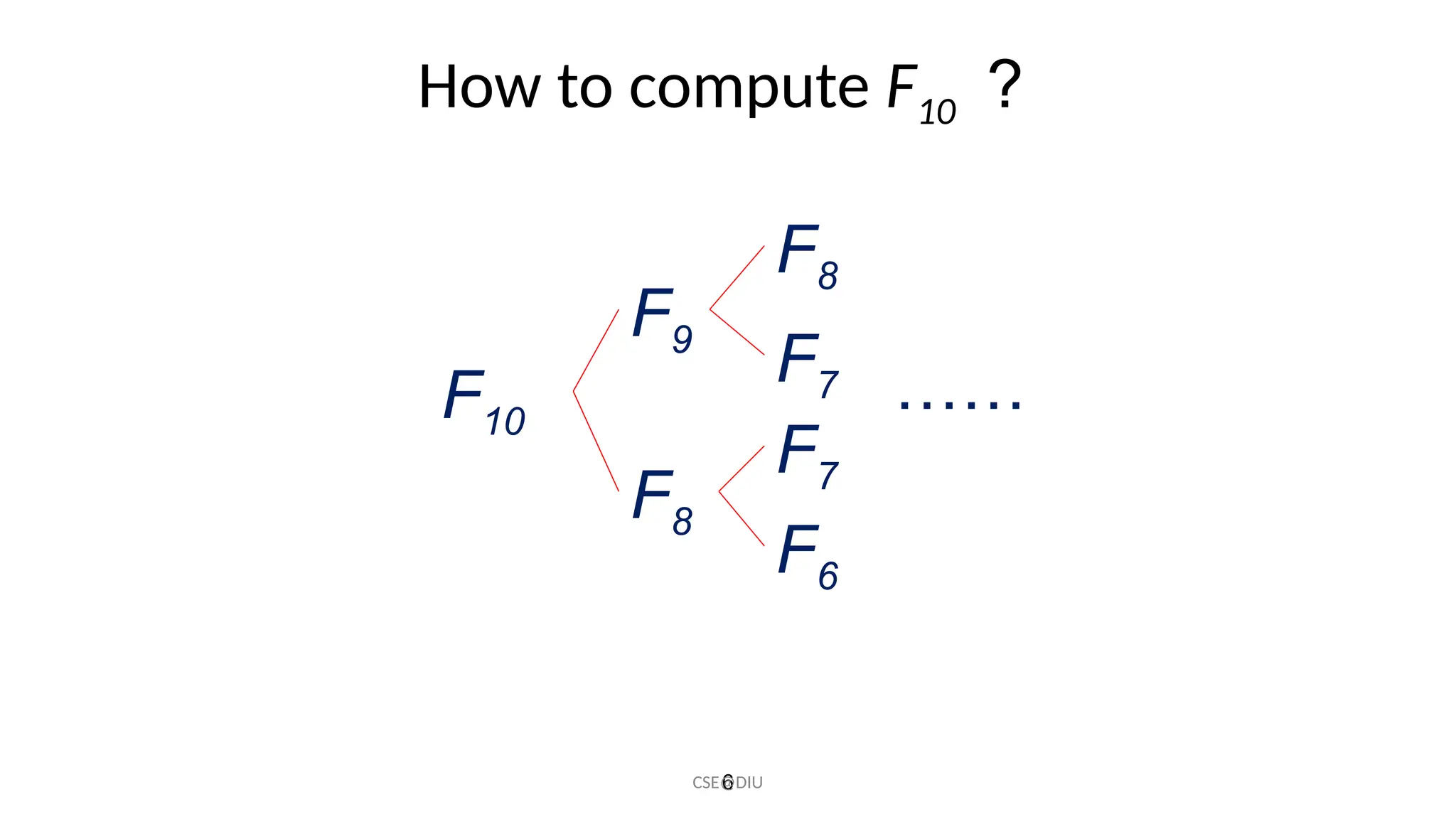
How to compute F10 ?
F10
F9
F8
F8
F7
F7
F6
……
CSE@DIU
7
Dynamic Programming
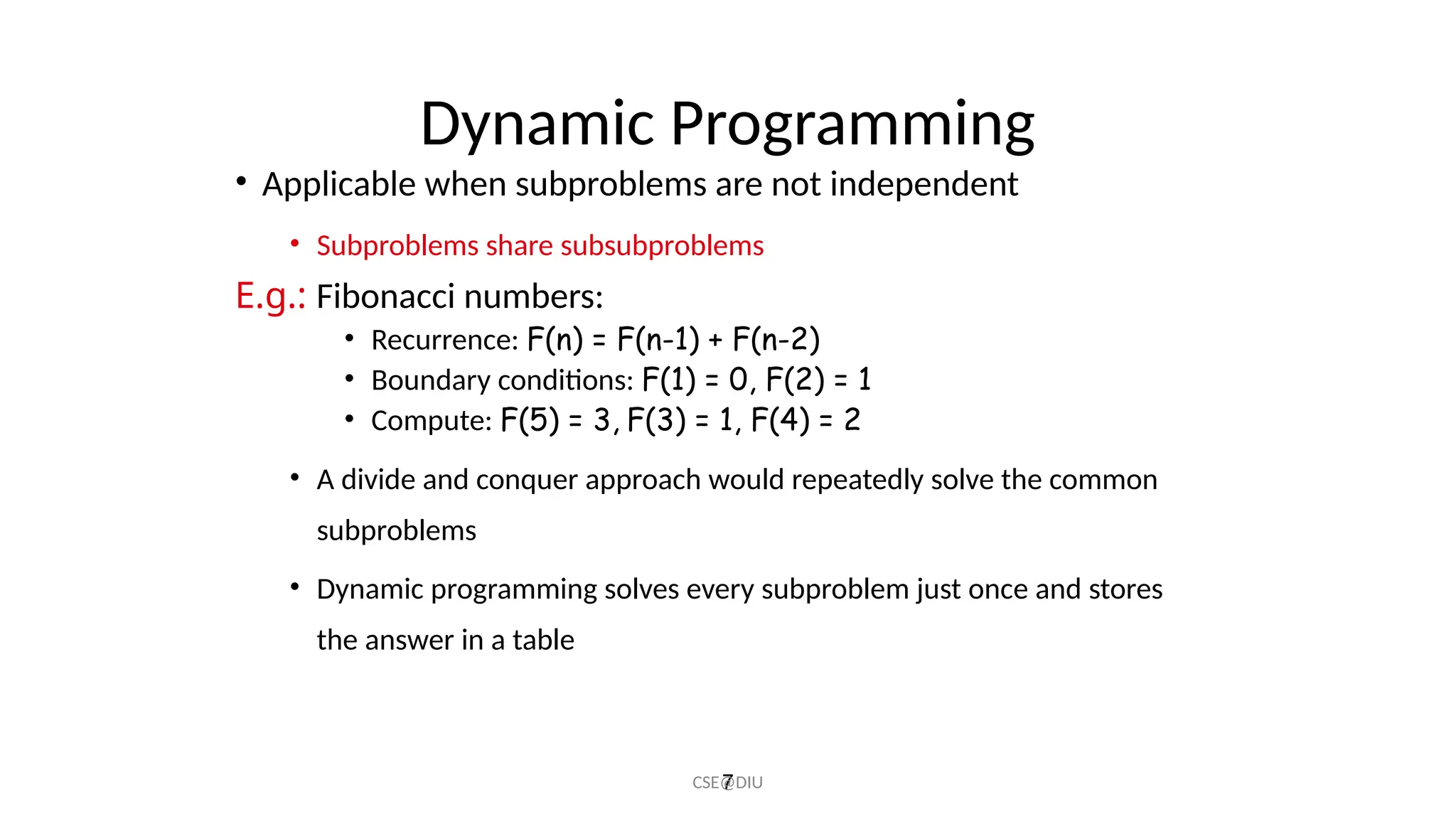
• Applicable when subproblems are not independent
• Subproblems share subsubproblems
E.g.: Fibonacci numbers:
• Recurrence: F(n) = F(n-1) + F(n-2)
• Boundary conditions: F(1) = 0, F(2) = 1
• Compute: F(5) = 3, F(3) = 1, F(4) = 2
• A divide and conquer approach would repeatedly solve the common
subproblems
• Dynamic programming solves every subproblem just once and stores
the answer in a table
CSE@DIU
8
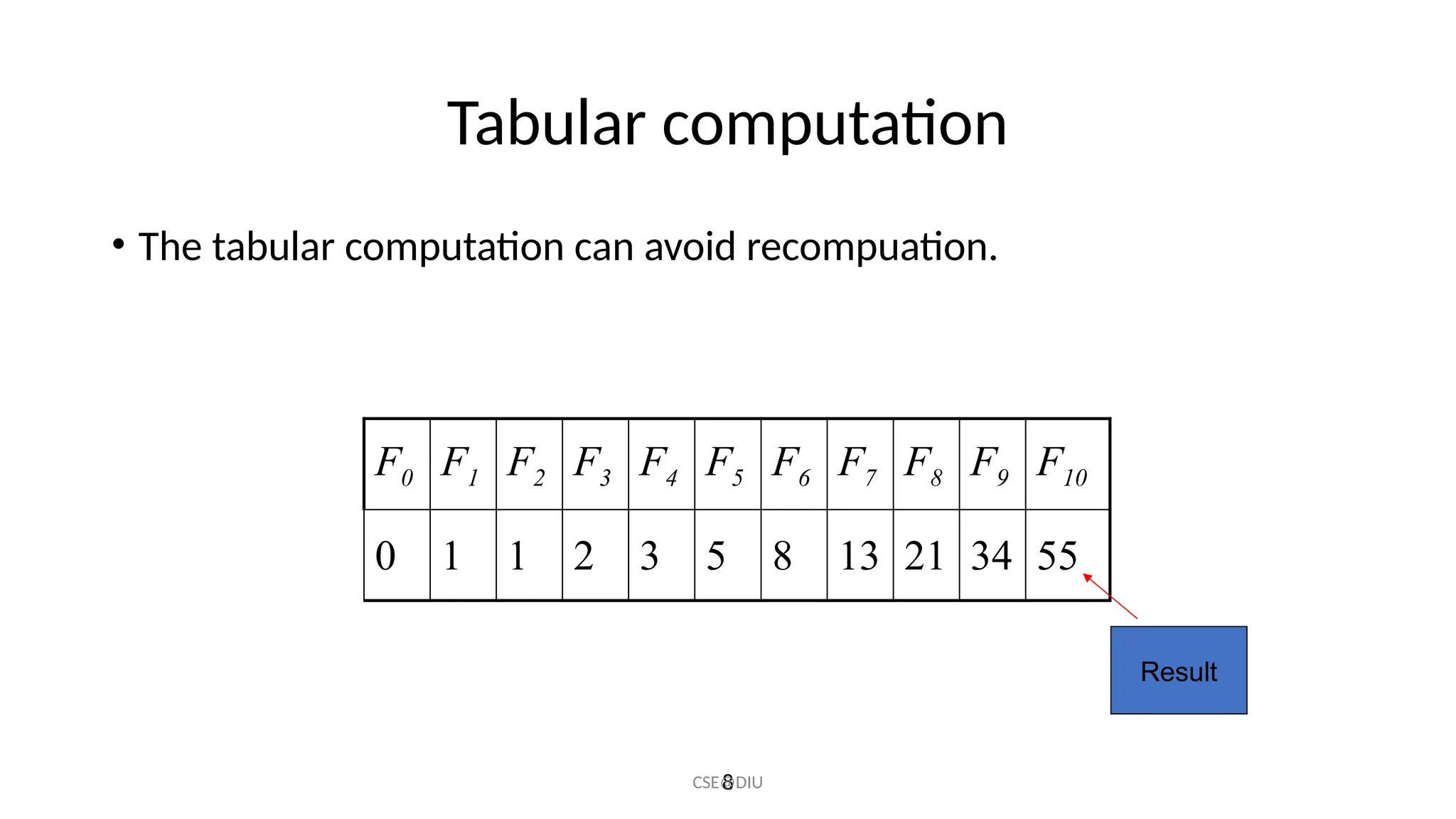
Tabular computation
• The tabular computation can avoid recompuation.
F0 F1 F2 F3 F4 F5 F6 F7 F8 F9 F10
0 1 1 2 3 5 8 13 21 34 55
Result
CSE@DIU
9
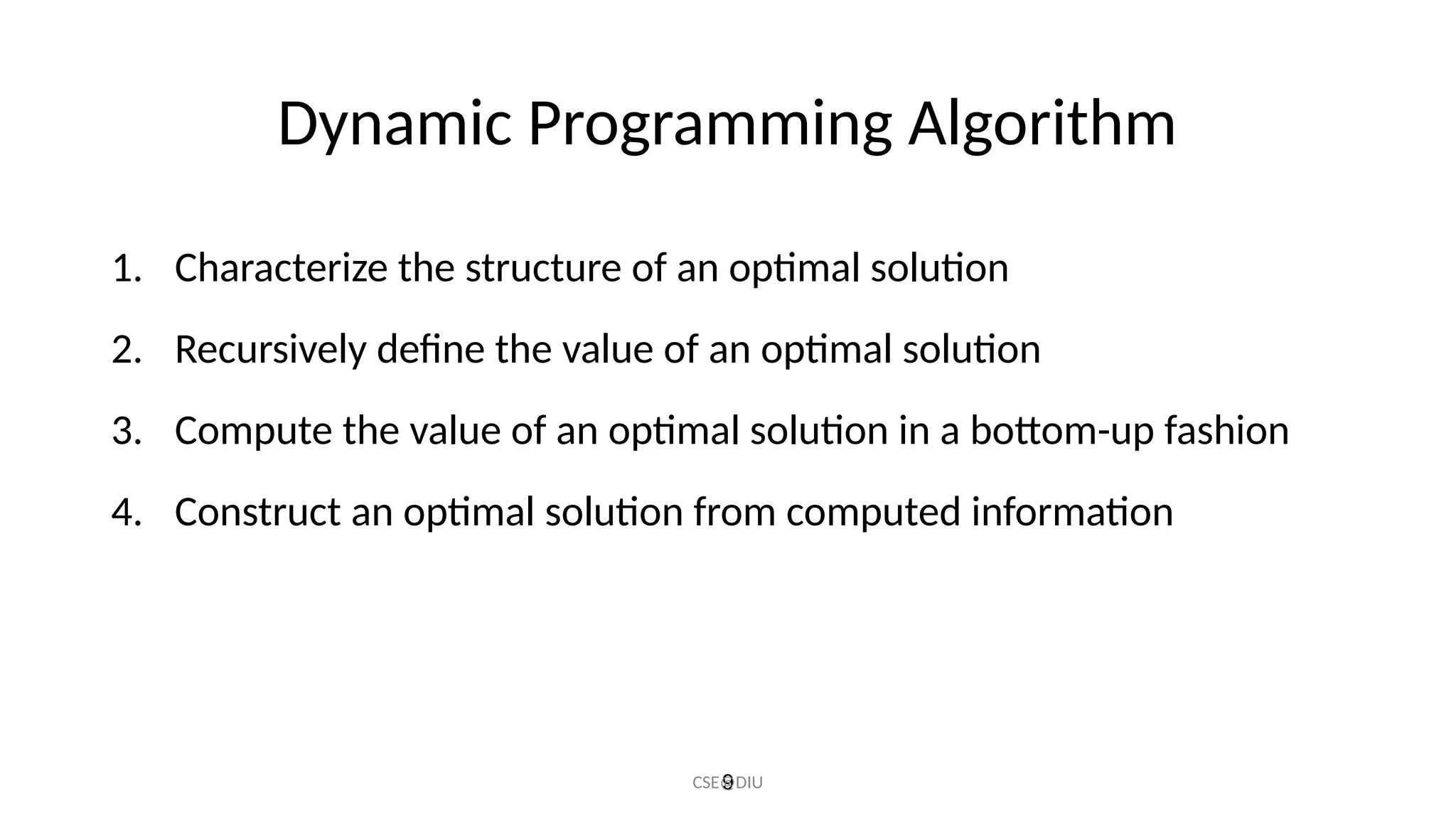
Dynamic Programming Algorithm
1. Characterize the structure of an optimal solution
2. Recursively define the value of an optimal solution
3. Compute the value of an optimal solution in a bottom-up fashion
4. Construct an optimal solution from computed information
CSE@DIU
Textbooks & Web References
• Text Book (Chapter 15)
• Reference book iii (Chapter 19)
• www.codeforces.com
• www.topcoder.com
CSE@DIU 10
Thank you!
CSE@DIU 11

W8L1 Introduction & Fibonacci Numbers part 1.pptx

  • 1.
    Introduction to DynamicProgramming Approach Using DP to solve the Fibonacci Numbers Problem Week-08, Lesson-01 (part 1) Introduction & Fibonacci Numbers CSE@DIU 1
  • 2.
    2 Dynamic Programming • Analgorithm design technique (like divide and conquer) • Divide and conquer • Partition the problem into independent subproblems • Solve the subproblems recursively • Combine the solutions to solve the original problem CSE@DIU
  • 3.
    3 DP - Twokey ingredients • Two key ingredients for an optimization problem to be suitable for a dynamic-programming solution: Each substructure is optimal. (Principle of optimality) 1. optimal substructures 2. overlapping subproblems Subproblems are dependent. (otherwise, a divide-and- conquer approach is the choice.) CSE@DIU
  • 4.
    4 Three basic components •The development of a dynamic-programming algorithm has three basic components: • The recurrence relation (for defining the value of an optimal solution); • The tabular computation (for computing the value of an optimal solution); • The traceback (for delivering an optimal solution). CSE@DIU
  • 5.
  • 6.
    6 How to computeF10 ? F10 F9 F8 F8 F7 F7 F6 …… CSE@DIU
  • 7.
    7 Dynamic Programming • Applicablewhen subproblems are not independent • Subproblems share subsubproblems E.g.: Fibonacci numbers: • Recurrence: F(n) = F(n-1) + F(n-2) • Boundary conditions: F(1) = 0, F(2) = 1 • Compute: F(5) = 3, F(3) = 1, F(4) = 2 • A divide and conquer approach would repeatedly solve the common subproblems • Dynamic programming solves every subproblem just once and stores the answer in a table CSE@DIU
  • 8.
    8 Tabular computation • Thetabular computation can avoid recompuation. F0 F1 F2 F3 F4 F5 F6 F7 F8 F9 F10 0 1 1 2 3 5 8 13 21 34 55 Result CSE@DIU
  • 9.
    9 Dynamic Programming Algorithm 1.Characterize the structure of an optimal solution 2. Recursively define the value of an optimal solution 3. Compute the value of an optimal solution in a bottom-up fashion 4. Construct an optimal solution from computed information CSE@DIU
  • 10.
    Textbooks & WebReferences • Text Book (Chapter 15) • Reference book iii (Chapter 19) • www.codeforces.com • www.topcoder.com CSE@DIU 10
  • 11.