CONCEPTS OF ECONOMIC
GROWTH
Lecture 1
DEFINING ECONOMIC
GROWTH
• Economic growth has been variously
defined. Some say it is an increase in the
production of goods and services over a
specific period of time. Some define it as
sustained annual increases in an
economy’s real national income over a
long period of time; while some others
define it as annual increases in real per
capita income of a country over a long
period of time.
CONCEPTS ASSOCIATED WITH THE ESTIMATE OF ECONOMIC GROWTH
Nominal versus real: Nominal values of something are its money
values in different years. Real values adjust for differences in the price
level in those years.
Gross versus net: The term gross refers to the total amount made as
a result of some activity. It can refer to things such as total income, total
profit, or total sales. Net refers to the amount left over after all deductions
are made.
Current versus constant prices: Current prices measures
income/inflation/asset prices using the actual prices we notice in the
economy. In other words they make no adjustment for inflation. Constant
prices adjust for inflation. Using constant prices enables us to measure
the actual change in output, and not just an increase due to the effects of
inflation.
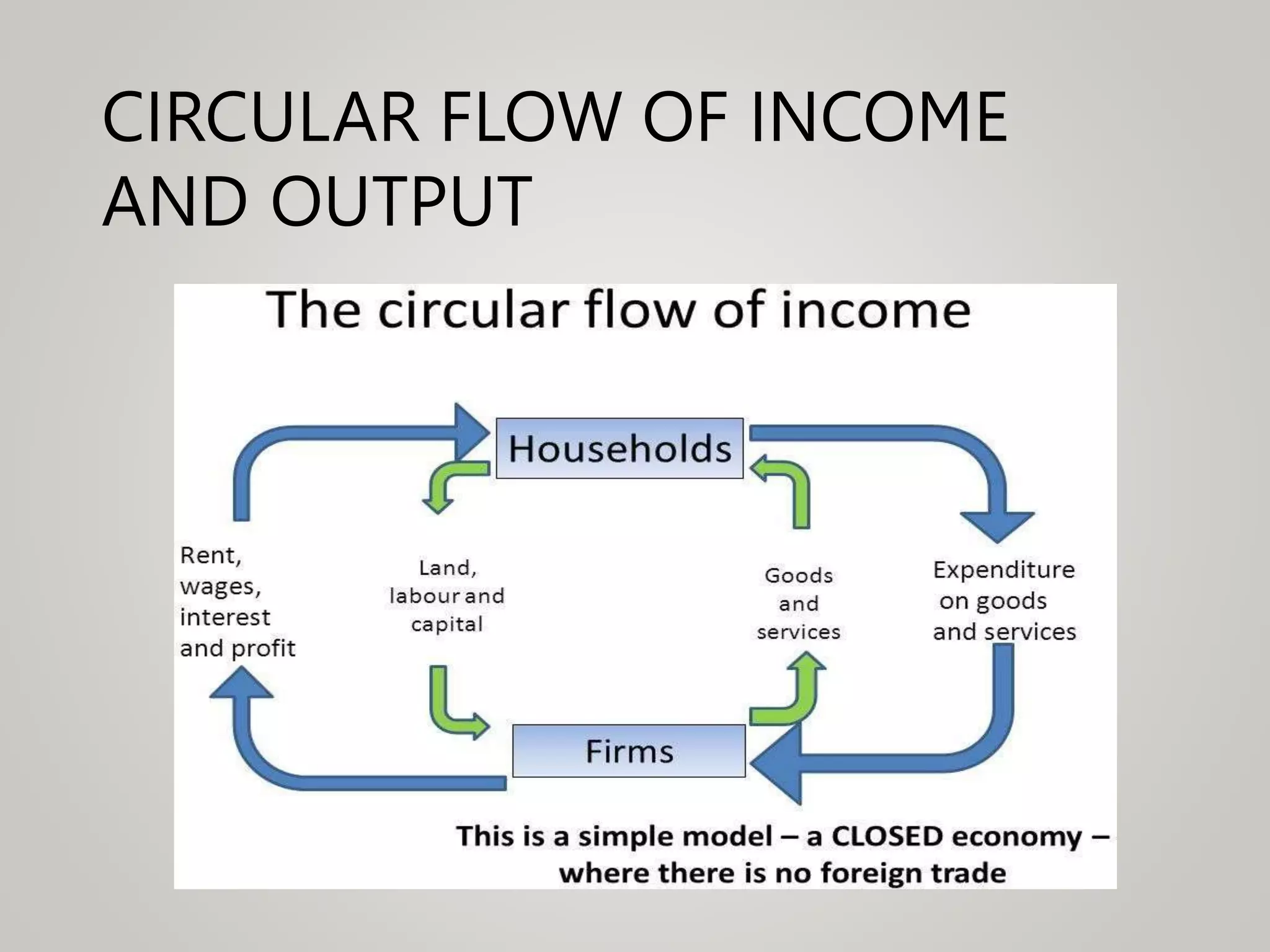
CIRCULAR FLOW OF INCOME
AND OUTPUT
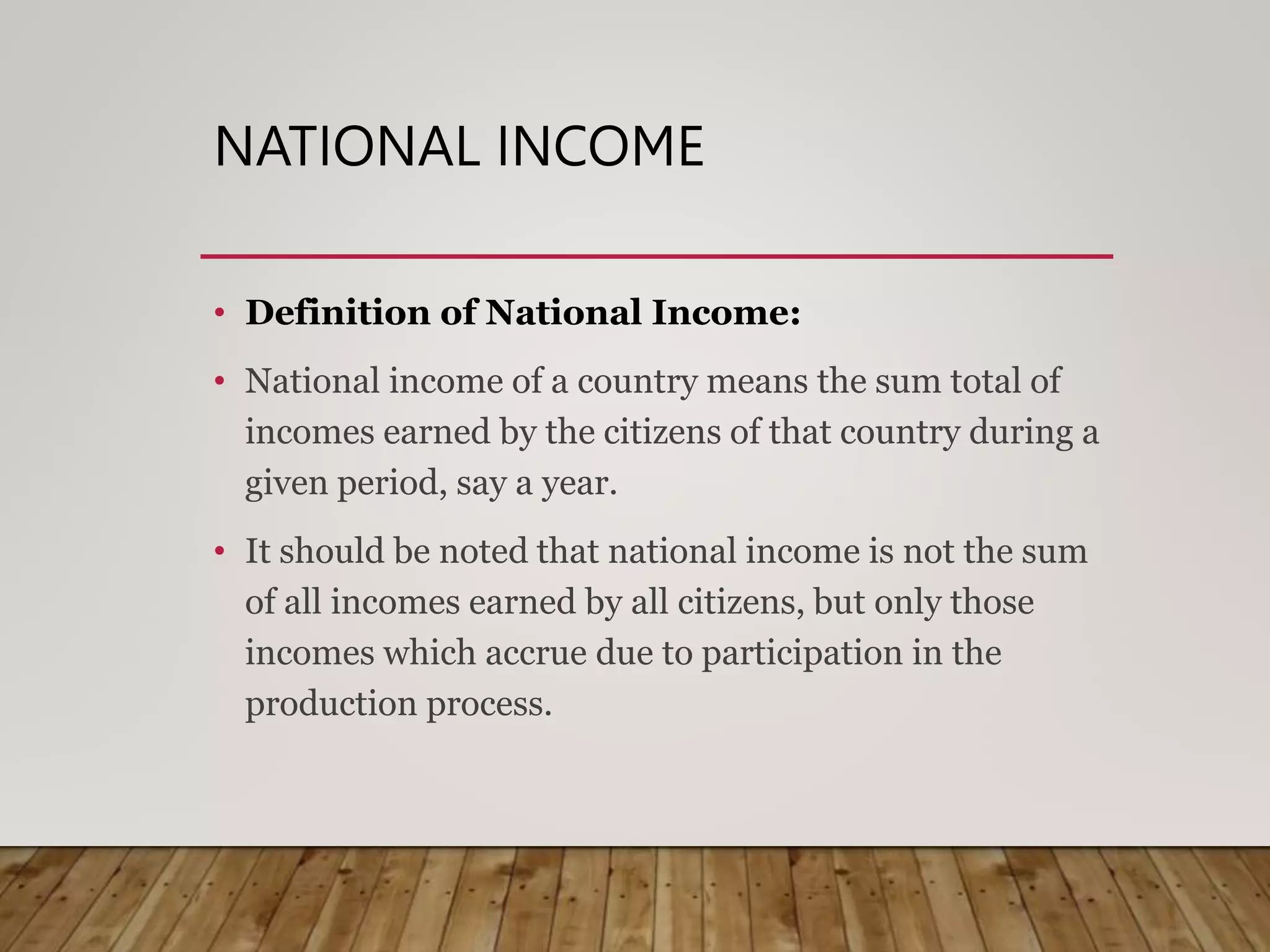
NATIONAL INCOME
• Definition of National Income:
• National income of a country means the sum total of
incomes earned by the citizens of that country during a
given period, say a year.
• It should be noted that national income is not the sum
of all incomes earned by all citizens, but only those
incomes which accrue due to participation in the
production process.
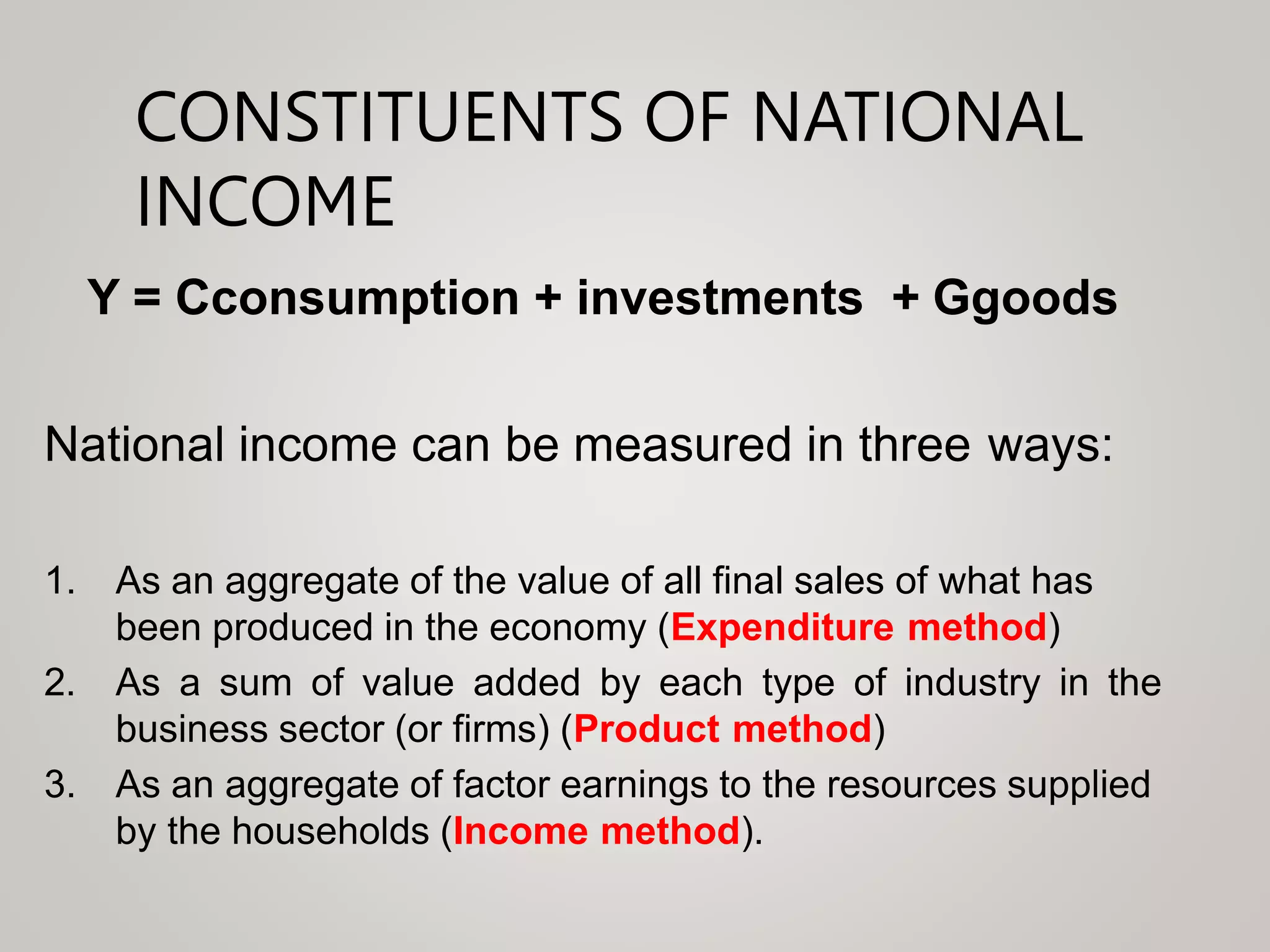
CONSTITUENTS OF NATIONAL
INCOME
Y = Cconsumption + investments + Ggoods
National income can be measured in three ways:
1. As an aggregate of the value of all final sales of what has
been produced in the economy (Expenditure method)
2. As a sum of value added by each type of industry in the
business sector (or firms) (Product method)
3. As an aggregate of factor earnings to the resources supplied
by the households (Income method).
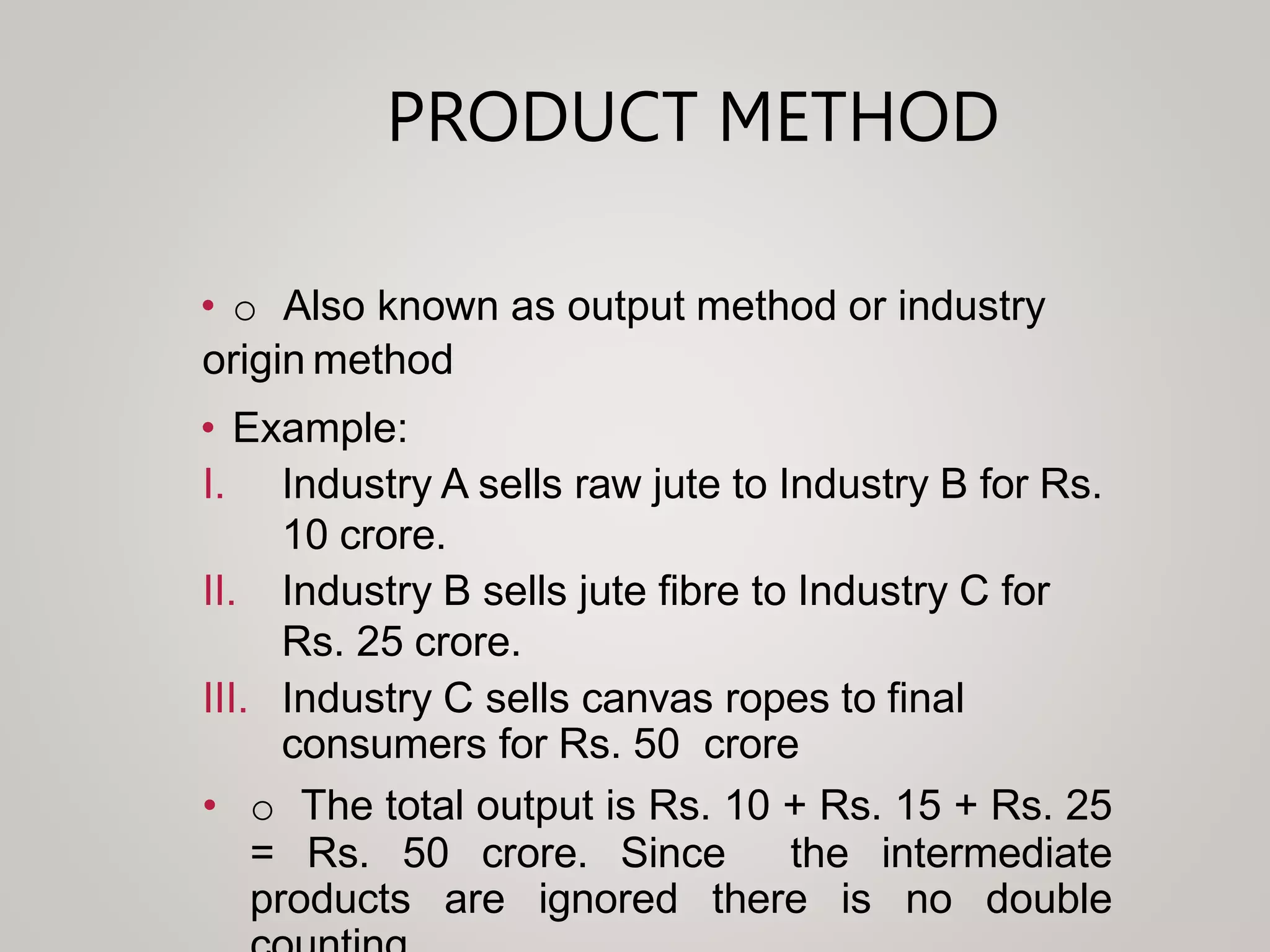
PRODUCT METHOD
• o Also known as output method or industry
origin method
• Example:
I. Industry A sells raw jute to Industry B for Rs.
10 crore.
II. Industry B sells jute fibre to Industry C for
Rs. 25 crore.
III. Industry C sells canvas ropes to final
consumers for Rs. 50 crore
• o The total output is Rs. 10 + Rs. 15 + Rs. 25
= Rs. 50 crore. Since the intermediate
products are ignored there is no double
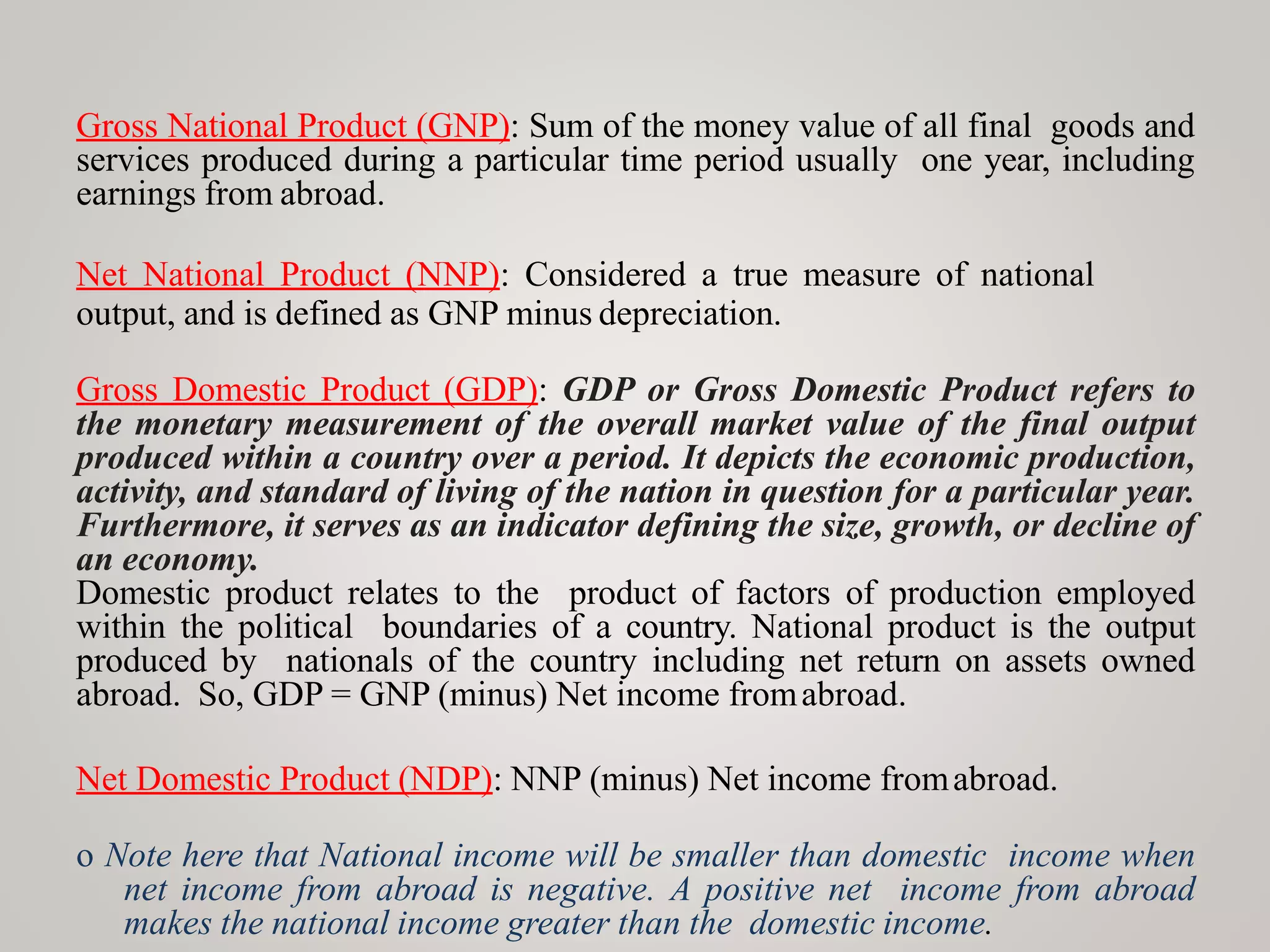
Gross National Product (GNP): Sum of the money value of all final goods and
services produced during a particular time period usually one year, including
earnings from abroad.
Net National Product (NNP): Considered a true measure of national
output, and is defined as GNP minus depreciation.
Gross Domestic Product (GDP): GDP or Gross Domestic Product refers to
the monetary measurement of the overall market value of the final output
produced within a country over a period. It depicts the economic production,
activity, and standard of living of the nation in question for a particular year.
Furthermore, it serves as an indicator defining the size, growth, or decline of
an economy.
Domestic product relates to the product of factors of production employed
within the political boundaries of a country. National product is the output
produced by nationals of the country including net return on assets owned
abroad. So, GDP = GNP (minus) Net income fromabroad.
Net Domestic Product (NDP): NNP (minus) Net income fromabroad.
o Note here that National income will be smaller than domestic income when
net income from abroad is negative. A positive net income from abroad
makes the national income greater than the domestic income.
WHAT IS MEANT BY “DEVELOPING
COUNTRIES”?
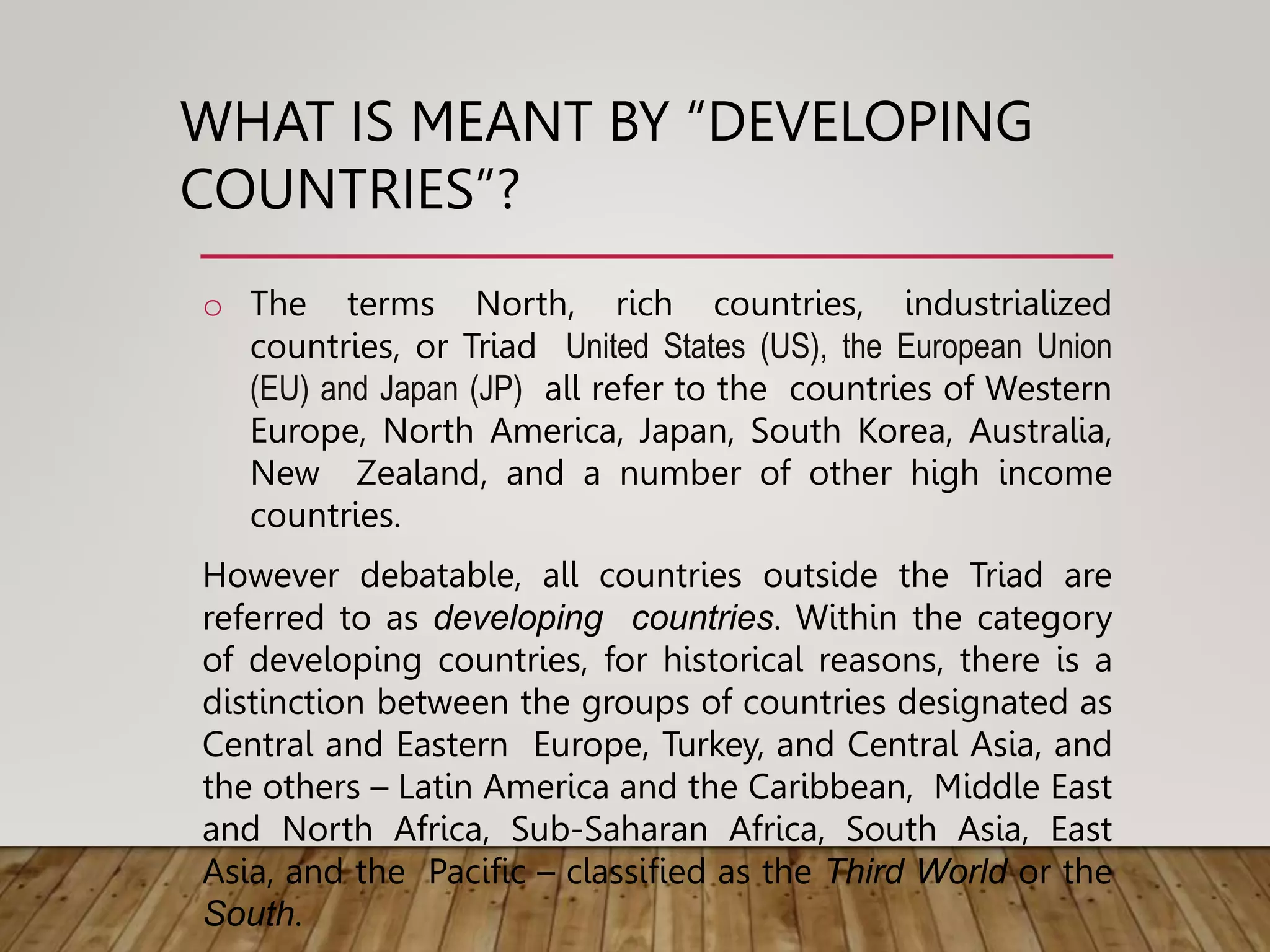
o The terms North, rich countries, industrialized
countries, or Triad United States (US), the European Union
(EU) and Japan (JP) all refer to the countries of Western
Europe, North America, Japan, South Korea, Australia,
New Zealand, and a number of other high income
countries.
However debatable, all countries outside the Triad are
referred to as developing countries. Within the category
of developing countries, for historical reasons, there is a
distinction between the groups of countries designated as
Central and Eastern Europe, Turkey, and Central Asia, and
the others – Latin America and the Caribbean, Middle East
and North Africa, Sub-Saharan Africa, South Asia, East
Asia, and the Pacific – classified as the Third World or the
South.
“THREE WORLDS, ONE PLANET”,
L’OBSERVATEUR, 1952
[..In 1951, I spoke in a Brazilian journal of three worlds, although I did not actually use the
term “Third World”. I invented and used that expression for the first time when writing in
the French weekly l’observateur, on 14 August 1952. The article ended: “Because finally
this Third World – ignored, exploited and despised as was the Third estate – also wants
to be something.” I thus transposed Sieyes’ famous words about the Third Estate during
the French Revolution.]
~ Alfred Sauvy, French Economist and Demographer
For those interested in looking at its history, may refer to B. R. Tomlinson’s essay “What
was the Third World” published in the Journal of Contemporary History in 2003.
DISTRIBUTION OF
DEVELOPING COUNTRIES
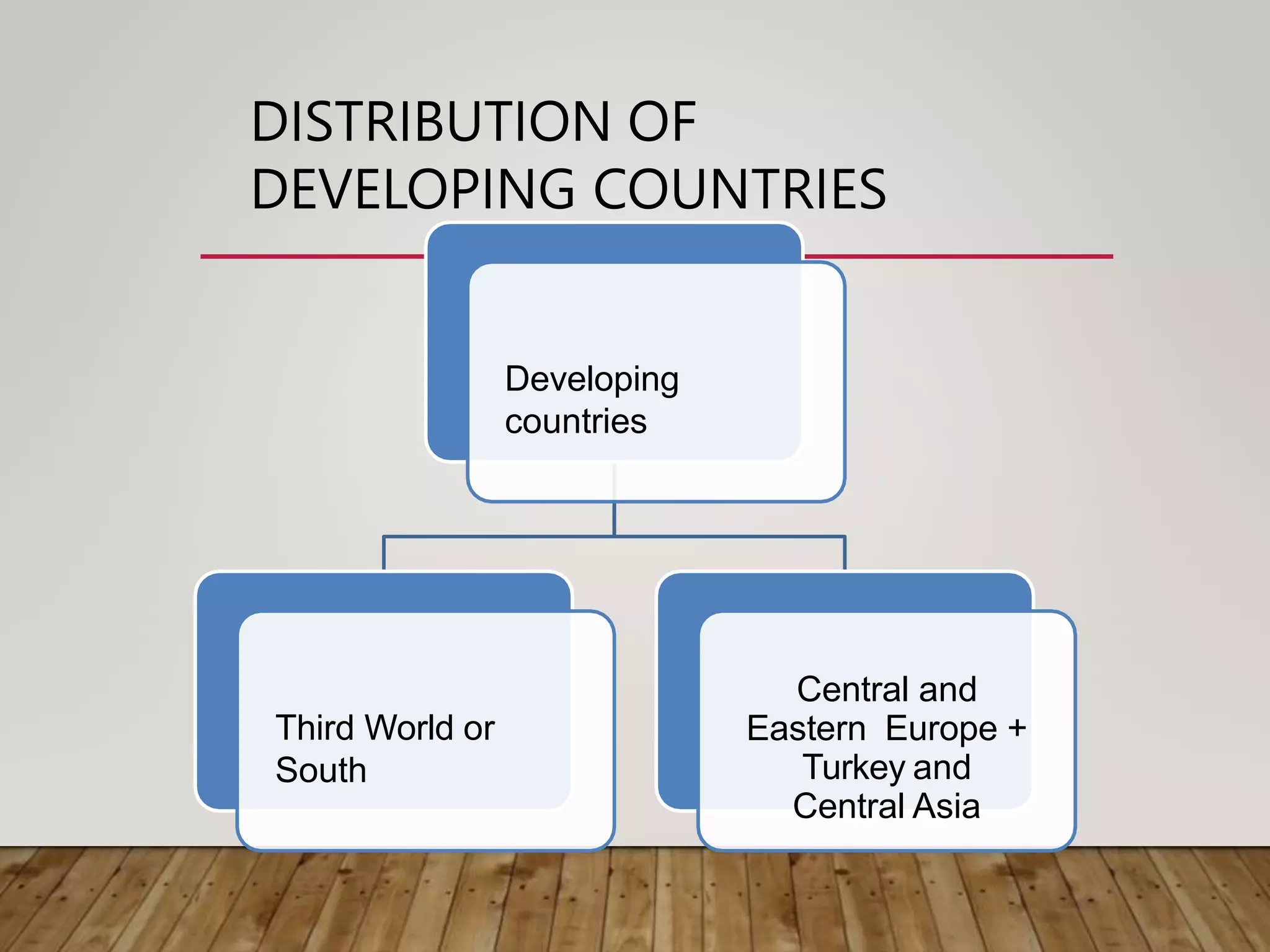
Developing
countries
Third World or
South
Central and
Eastern Europe +
Turkey and
Central Asia
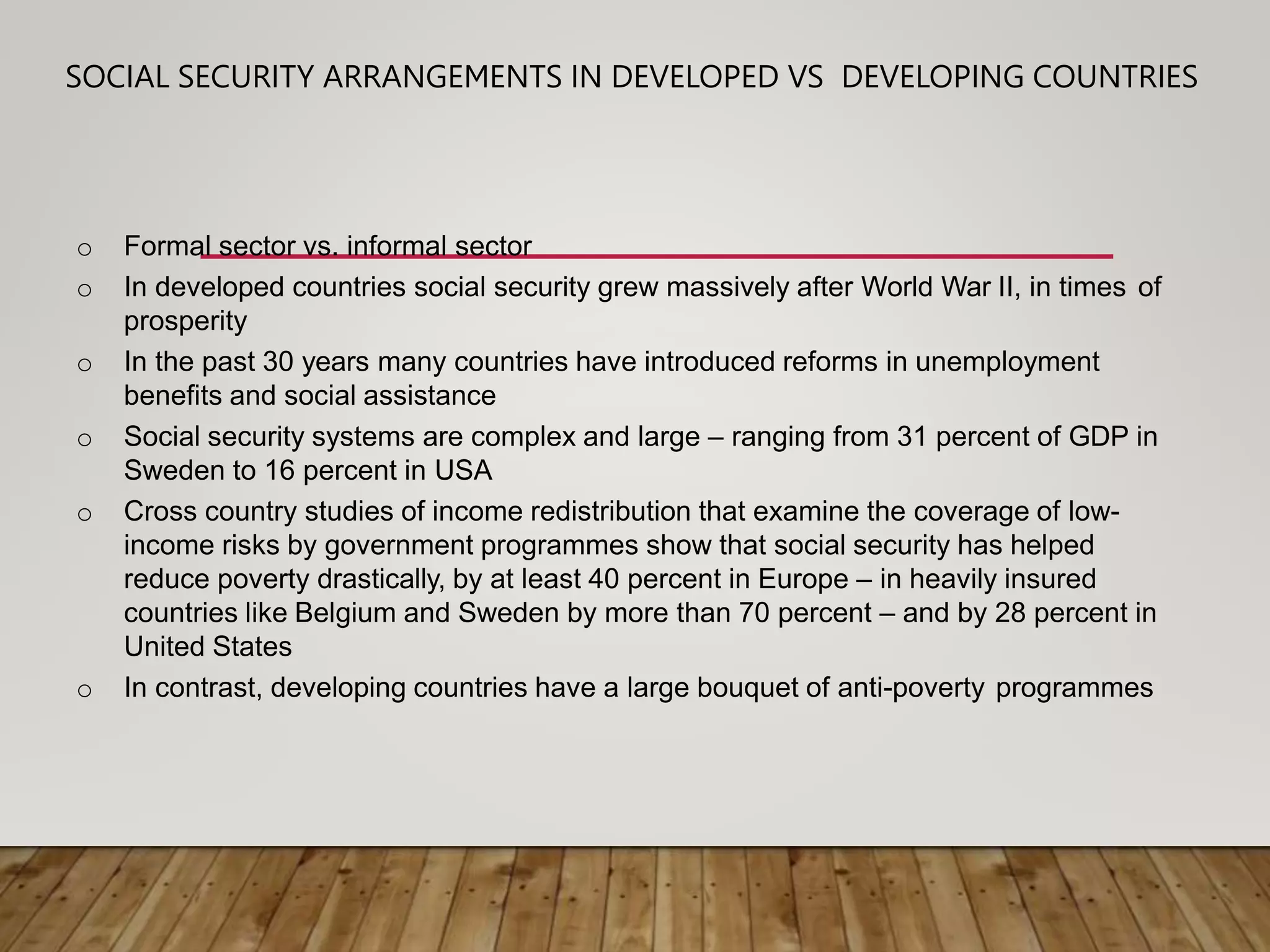
SOCIAL SECURITY ARRANGEMENTS IN DEVELOPED VS DEVELOPING COUNTRIES
o Formal sector vs. informal sector
o In developed countries social security grew massively after World War II, in times of
prosperity
o In the past 30 years many countries have introduced reforms in unemployment
benefits and social assistance
o Social security systems are complex and large – ranging from 31 percent of GDP in
Sweden to 16 percent in USA
o Cross country studies of income redistribution that examine the coverage of low-
income risks by government programmes show that social security has helped
reduce poverty drastically, by at least 40 percent in Europe – in heavily insured
countries like Belgium and Sweden by more than 70 percent – and by 28 percent in
United States
o In contrast, developing countries have a large bouquet of anti-poverty programmes
DISTINCTION BETWEEN DEVELOPED
AND UNDERDEVELOPED ECONOMIES
• We may now distinguish between the features of an
underdeveloped economy from that of developed one as follows: 1.
Underdeveloped economies are distinguished from developed
economies on the basis of per capita income. In general, those
countries which have real per capita incomes less than a quarter of
the per capita income of the United States, or roughly less than
5000 dollars per year, are categorized as under-developed countries.
• 2. An underdeveloped economy, compared with an advanced
economy, is underequipped with capital in relation to its population
and natural resources. The rate of growth of employment and
investment in such an economy lags behind the rate of growth of
population. The resources are not only employed but also
underemployed.
• 3. High rate of growth of population is an important characteristic
of most of the underdeveloped economies. Population growth in
underdeveloped countries neutralises economic growth. In
advanced economies, the case is different. As Prof. Hansen points
out, one of the empirical tests of secular stagnation in advanced
economies is the declining rate of population growth. The
stagnation problem in a developed economy is a problem of
population, natural resources and technology failing to keep pace
with capital accumulation.
• 4. The central problem of underdeveloped economies is the
prevalence of mass poverty which is the cause as well as the
consequence of their low level of development. Shortage and
scarcity are the main economic problems in these economies,
whereas the affluent societies of advanced countries have economic
problems resulting from abundance
• In an underdeveloped economy, the fundamental problem is that of output, real
income or the standard of living, as these economies are characterised by low
productivity, low income and a poor standard of living. A vast majority of people in
an underdeveloped country are ill clothed, undernourished and without adequate
shelter. To use Rostow’s terminology, economies of poor countries similar to those of
a traditional society, where modern science and technology are either not available or
not regularly and systematically applied. On the other hand, most of the developed
countries at present enjoy a high rate of mass-consumption. In their economies, per
capita real income has risen to a level at which a large number of people can afford
consumption transcending food, shelter and clothing.
• 6. Capital deficiency is the main cause of poverty of a poor country, while affluent
capital accumulation is the main cause of stagnation of an advanced country.
• 7. In an underdeveloped economy, the problem of under-employment is more
important than that of unemployment, whereas a developed economy may have a
cyclical unemployment problem. There is chronic unemployment in an
underdeveloped economy. An advanced economy may have unemployment
occasionally due to business fluctuations and a low marginal propensity to consume.
Whereas an under developed economy is confronted with the problem of disguised
unemployment in the sense that even with unchanged techniques in agriculture
could be removed without reducing agricultural output. Thus, in a developed
economy, unemployment means waste of resources, while in an underdeveloped
• 8. Poor countries are poor in technology, advanced countries are
advanced in technology. In fact, the level of technology attained in
production is a reliable indication of the level of economic
development. Employment of advanced technology goes along with
large capital resources, high attainments in the fields of scientific
research, greater availability of entrepreneurial skill and a good
supply of efficient skilled labour. Thus, development of technology
is the basic objective of the backward economy whereas
development of technology no longer remains the overriding
objective of an affluent society

W1L1_Lecture 1-Concepts of Economic Growth and Development.pptx

  • 1.
  • 2.
    DEFINING ECONOMIC GROWTH • Economicgrowth has been variously defined. Some say it is an increase in the production of goods and services over a specific period of time. Some define it as sustained annual increases in an economy’s real national income over a long period of time; while some others define it as annual increases in real per capita income of a country over a long period of time.
  • 3.
    CONCEPTS ASSOCIATED WITHTHE ESTIMATE OF ECONOMIC GROWTH Nominal versus real: Nominal values of something are its money values in different years. Real values adjust for differences in the price level in those years. Gross versus net: The term gross refers to the total amount made as a result of some activity. It can refer to things such as total income, total profit, or total sales. Net refers to the amount left over after all deductions are made. Current versus constant prices: Current prices measures income/inflation/asset prices using the actual prices we notice in the economy. In other words they make no adjustment for inflation. Constant prices adjust for inflation. Using constant prices enables us to measure the actual change in output, and not just an increase due to the effects of inflation.
  • 4.
    CIRCULAR FLOW OFINCOME AND OUTPUT
  • 5.
    NATIONAL INCOME • Definitionof National Income: • National income of a country means the sum total of incomes earned by the citizens of that country during a given period, say a year. • It should be noted that national income is not the sum of all incomes earned by all citizens, but only those incomes which accrue due to participation in the production process.
  • 6.
    CONSTITUENTS OF NATIONAL INCOME Y= Cconsumption + investments + Ggoods National income can be measured in three ways: 1. As an aggregate of the value of all final sales of what has been produced in the economy (Expenditure method) 2. As a sum of value added by each type of industry in the business sector (or firms) (Product method) 3. As an aggregate of factor earnings to the resources supplied by the households (Income method).
  • 7.
    PRODUCT METHOD • oAlso known as output method or industry origin method • Example: I. Industry A sells raw jute to Industry B for Rs. 10 crore. II. Industry B sells jute fibre to Industry C for Rs. 25 crore. III. Industry C sells canvas ropes to final consumers for Rs. 50 crore • o The total output is Rs. 10 + Rs. 15 + Rs. 25 = Rs. 50 crore. Since the intermediate products are ignored there is no double
  • 8.
    Gross National Product(GNP): Sum of the money value of all final goods and services produced during a particular time period usually one year, including earnings from abroad. Net National Product (NNP): Considered a true measure of national output, and is defined as GNP minus depreciation. Gross Domestic Product (GDP): GDP or Gross Domestic Product refers to the monetary measurement of the overall market value of the final output produced within a country over a period. It depicts the economic production, activity, and standard of living of the nation in question for a particular year. Furthermore, it serves as an indicator defining the size, growth, or decline of an economy. Domestic product relates to the product of factors of production employed within the political boundaries of a country. National product is the output produced by nationals of the country including net return on assets owned abroad. So, GDP = GNP (minus) Net income fromabroad. Net Domestic Product (NDP): NNP (minus) Net income fromabroad. o Note here that National income will be smaller than domestic income when net income from abroad is negative. A positive net income from abroad makes the national income greater than the domestic income.
  • 10.
    WHAT IS MEANTBY “DEVELOPING COUNTRIES”? o The terms North, rich countries, industrialized countries, or Triad United States (US), the European Union (EU) and Japan (JP) all refer to the countries of Western Europe, North America, Japan, South Korea, Australia, New Zealand, and a number of other high income countries. However debatable, all countries outside the Triad are referred to as developing countries. Within the category of developing countries, for historical reasons, there is a distinction between the groups of countries designated as Central and Eastern Europe, Turkey, and Central Asia, and the others – Latin America and the Caribbean, Middle East and North Africa, Sub-Saharan Africa, South Asia, East Asia, and the Pacific – classified as the Third World or the South.
  • 11.
    “THREE WORLDS, ONEPLANET”, L’OBSERVATEUR, 1952 [..In 1951, I spoke in a Brazilian journal of three worlds, although I did not actually use the term “Third World”. I invented and used that expression for the first time when writing in the French weekly l’observateur, on 14 August 1952. The article ended: “Because finally this Third World – ignored, exploited and despised as was the Third estate – also wants to be something.” I thus transposed Sieyes’ famous words about the Third Estate during the French Revolution.] ~ Alfred Sauvy, French Economist and Demographer For those interested in looking at its history, may refer to B. R. Tomlinson’s essay “What was the Third World” published in the Journal of Contemporary History in 2003.
  • 12.
    DISTRIBUTION OF DEVELOPING COUNTRIES Developing countries ThirdWorld or South Central and Eastern Europe + Turkey and Central Asia
  • 13.
    SOCIAL SECURITY ARRANGEMENTSIN DEVELOPED VS DEVELOPING COUNTRIES o Formal sector vs. informal sector o In developed countries social security grew massively after World War II, in times of prosperity o In the past 30 years many countries have introduced reforms in unemployment benefits and social assistance o Social security systems are complex and large – ranging from 31 percent of GDP in Sweden to 16 percent in USA o Cross country studies of income redistribution that examine the coverage of low- income risks by government programmes show that social security has helped reduce poverty drastically, by at least 40 percent in Europe – in heavily insured countries like Belgium and Sweden by more than 70 percent – and by 28 percent in United States o In contrast, developing countries have a large bouquet of anti-poverty programmes
  • 14.
    DISTINCTION BETWEEN DEVELOPED ANDUNDERDEVELOPED ECONOMIES • We may now distinguish between the features of an underdeveloped economy from that of developed one as follows: 1. Underdeveloped economies are distinguished from developed economies on the basis of per capita income. In general, those countries which have real per capita incomes less than a quarter of the per capita income of the United States, or roughly less than 5000 dollars per year, are categorized as under-developed countries. • 2. An underdeveloped economy, compared with an advanced economy, is underequipped with capital in relation to its population and natural resources. The rate of growth of employment and investment in such an economy lags behind the rate of growth of population. The resources are not only employed but also underemployed.
  • 15.
    • 3. Highrate of growth of population is an important characteristic of most of the underdeveloped economies. Population growth in underdeveloped countries neutralises economic growth. In advanced economies, the case is different. As Prof. Hansen points out, one of the empirical tests of secular stagnation in advanced economies is the declining rate of population growth. The stagnation problem in a developed economy is a problem of population, natural resources and technology failing to keep pace with capital accumulation. • 4. The central problem of underdeveloped economies is the prevalence of mass poverty which is the cause as well as the consequence of their low level of development. Shortage and scarcity are the main economic problems in these economies, whereas the affluent societies of advanced countries have economic problems resulting from abundance
  • 16.
    • In anunderdeveloped economy, the fundamental problem is that of output, real income or the standard of living, as these economies are characterised by low productivity, low income and a poor standard of living. A vast majority of people in an underdeveloped country are ill clothed, undernourished and without adequate shelter. To use Rostow’s terminology, economies of poor countries similar to those of a traditional society, where modern science and technology are either not available or not regularly and systematically applied. On the other hand, most of the developed countries at present enjoy a high rate of mass-consumption. In their economies, per capita real income has risen to a level at which a large number of people can afford consumption transcending food, shelter and clothing. • 6. Capital deficiency is the main cause of poverty of a poor country, while affluent capital accumulation is the main cause of stagnation of an advanced country. • 7. In an underdeveloped economy, the problem of under-employment is more important than that of unemployment, whereas a developed economy may have a cyclical unemployment problem. There is chronic unemployment in an underdeveloped economy. An advanced economy may have unemployment occasionally due to business fluctuations and a low marginal propensity to consume. Whereas an under developed economy is confronted with the problem of disguised unemployment in the sense that even with unchanged techniques in agriculture could be removed without reducing agricultural output. Thus, in a developed economy, unemployment means waste of resources, while in an underdeveloped
  • 17.
    • 8. Poorcountries are poor in technology, advanced countries are advanced in technology. In fact, the level of technology attained in production is a reliable indication of the level of economic development. Employment of advanced technology goes along with large capital resources, high attainments in the fields of scientific research, greater availability of entrepreneurial skill and a good supply of efficient skilled labour. Thus, development of technology is the basic objective of the backward economy whereas development of technology no longer remains the overriding objective of an affluent society