Water, Vitamins & Minerals
Vitamins
 Certain vitamins and minerals are
needed for the body to function.
◦ 13 vitamins
◦ 22 minerals
 Two types of vitamins
◦ Water-soluble
◦ Fat-soluble
Fat-Soluble vitamins
 Vitamin A, D, E and K
 Excess is stored in the liver and in
body fat
◦ It is possible to build up to a toxic level
Vitamin A (Retinol)
 Beta-carotene is converted into
vitamin A
 Vitamin A:
◦ Promotes good vision
◦ Promotes healthy skin
◦ Helps with growth and maintenance of
bones, teeth, and cell structure
 RDA: 900 micrograms for males; 700
micrograms for females
Too much vitamin A
 May turn your skin orange
 May cause fatigue, weakness, severe
headache, blurred vision, hair loss and
joint pain.
 Toxicity:
◦ May cause severe liver or brain damage
◦ Birth defects
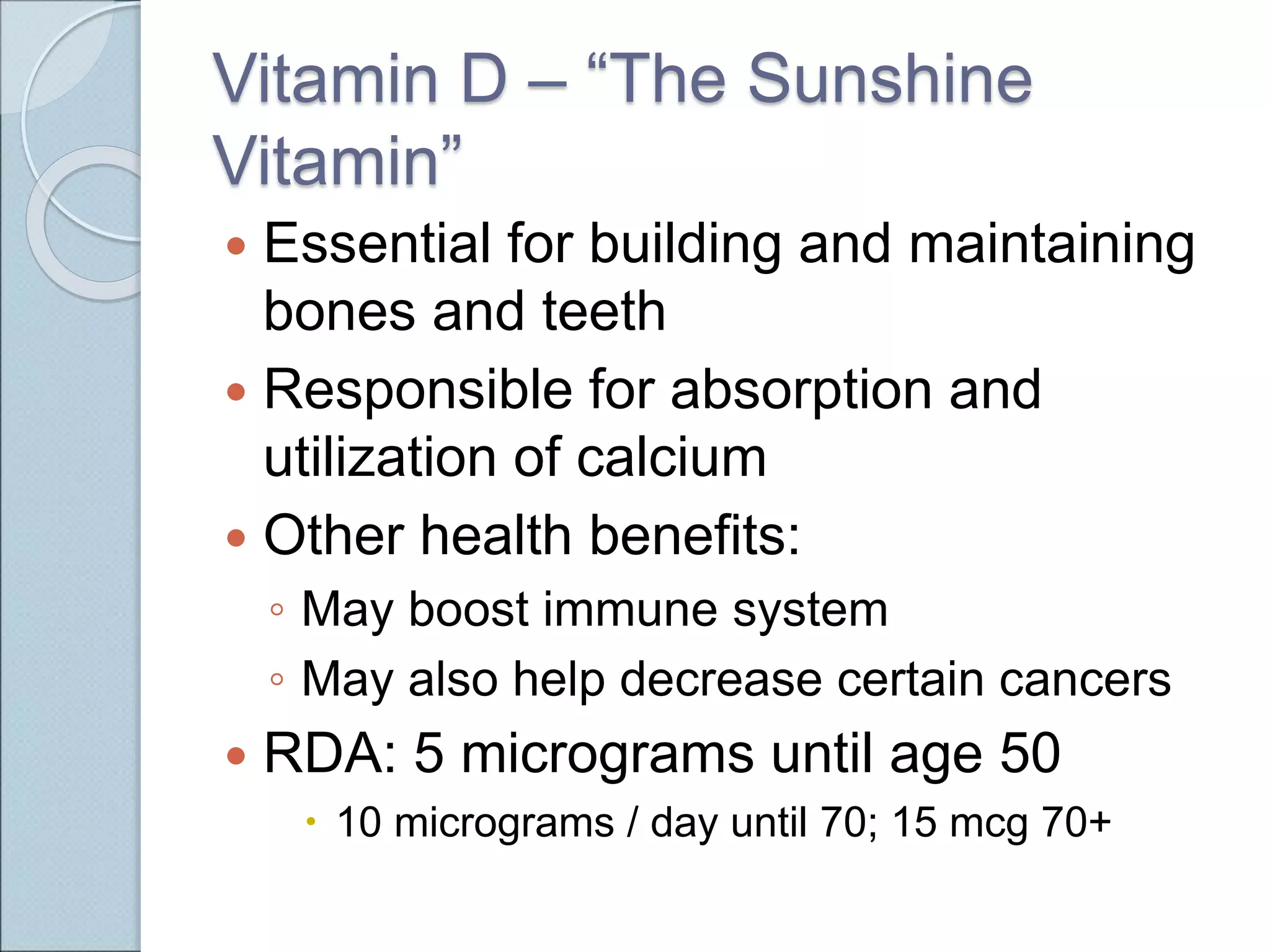
Too little vitamin A
 May cause night blindness
 Lowered immune system
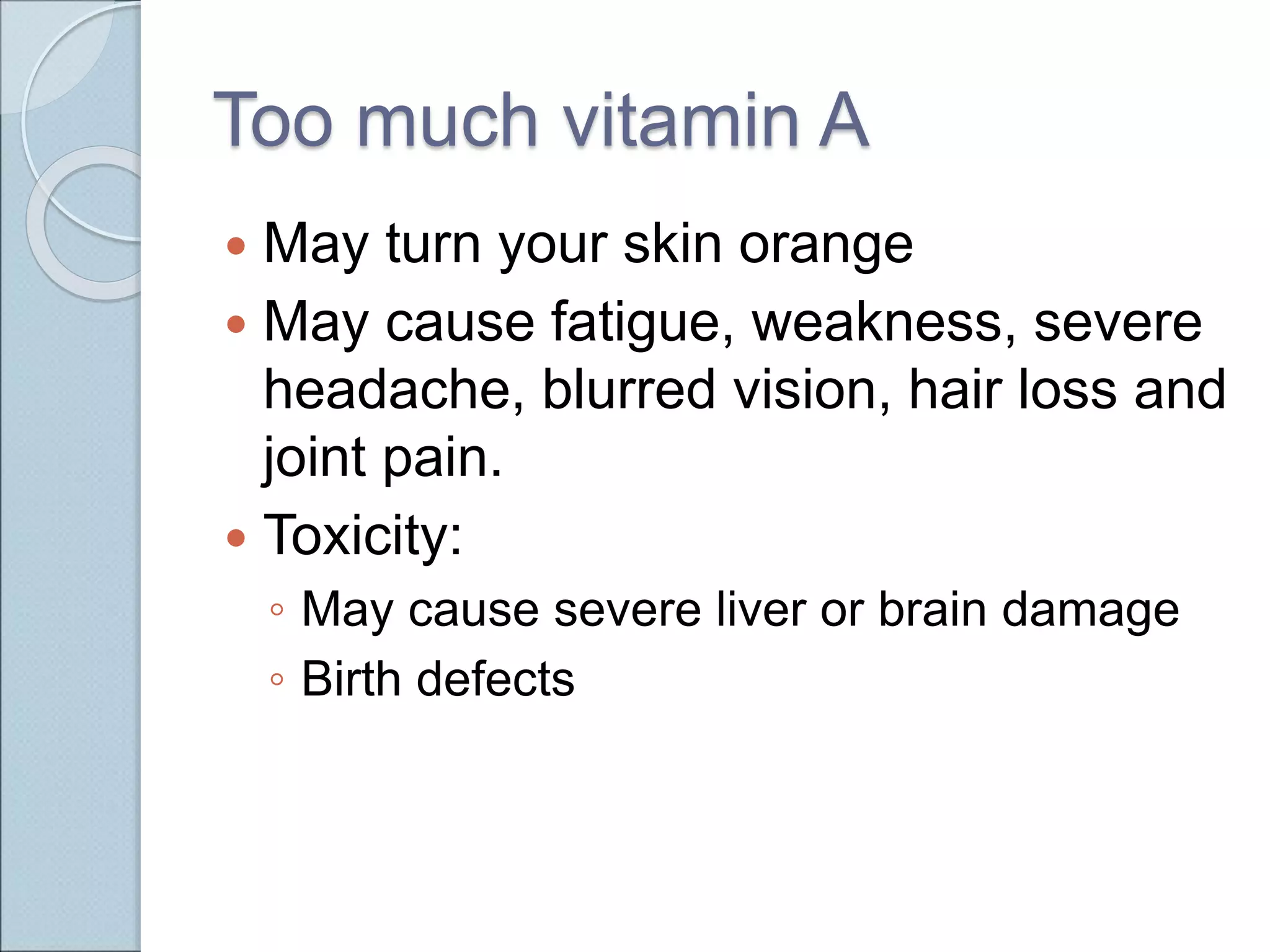
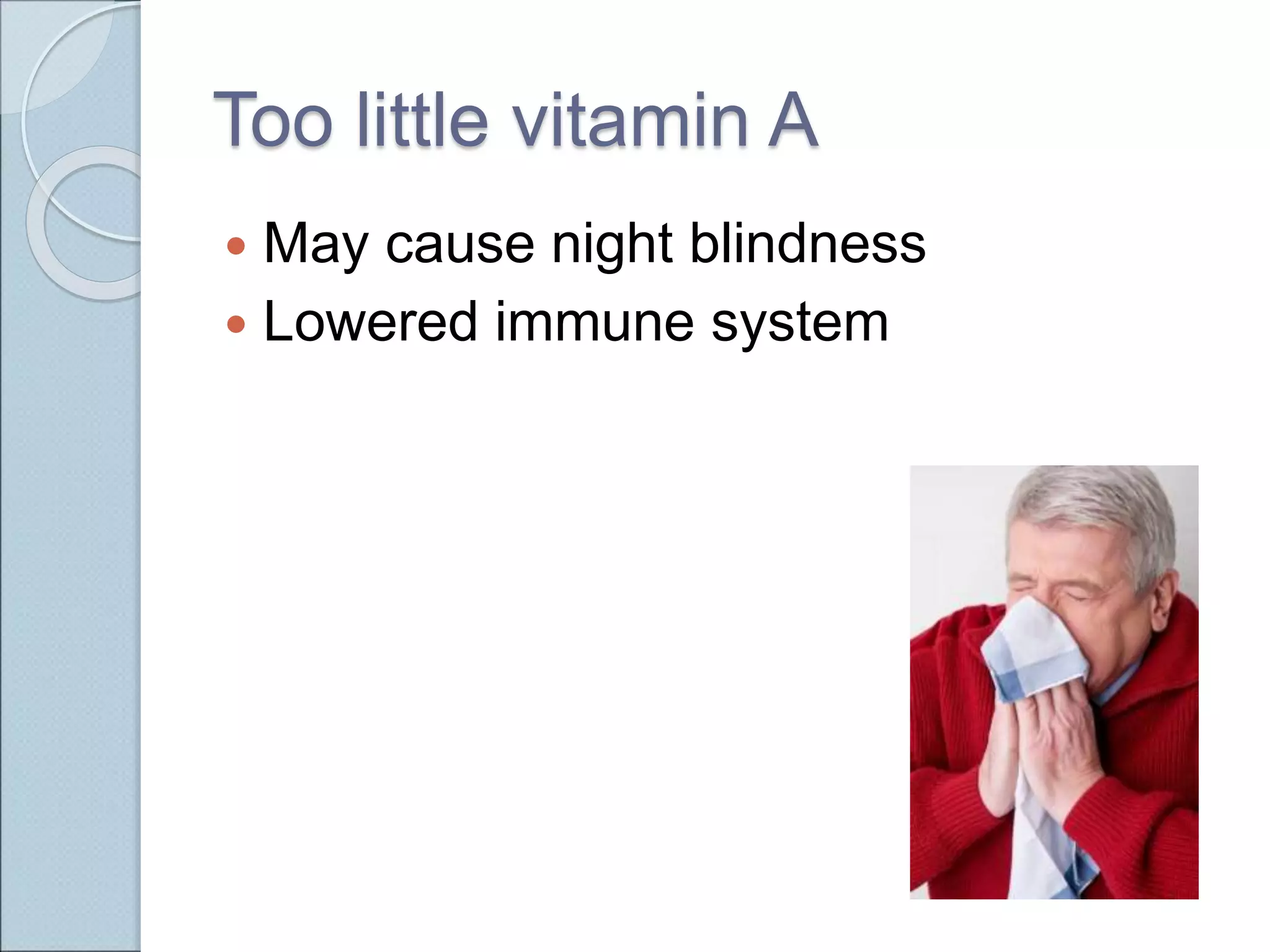
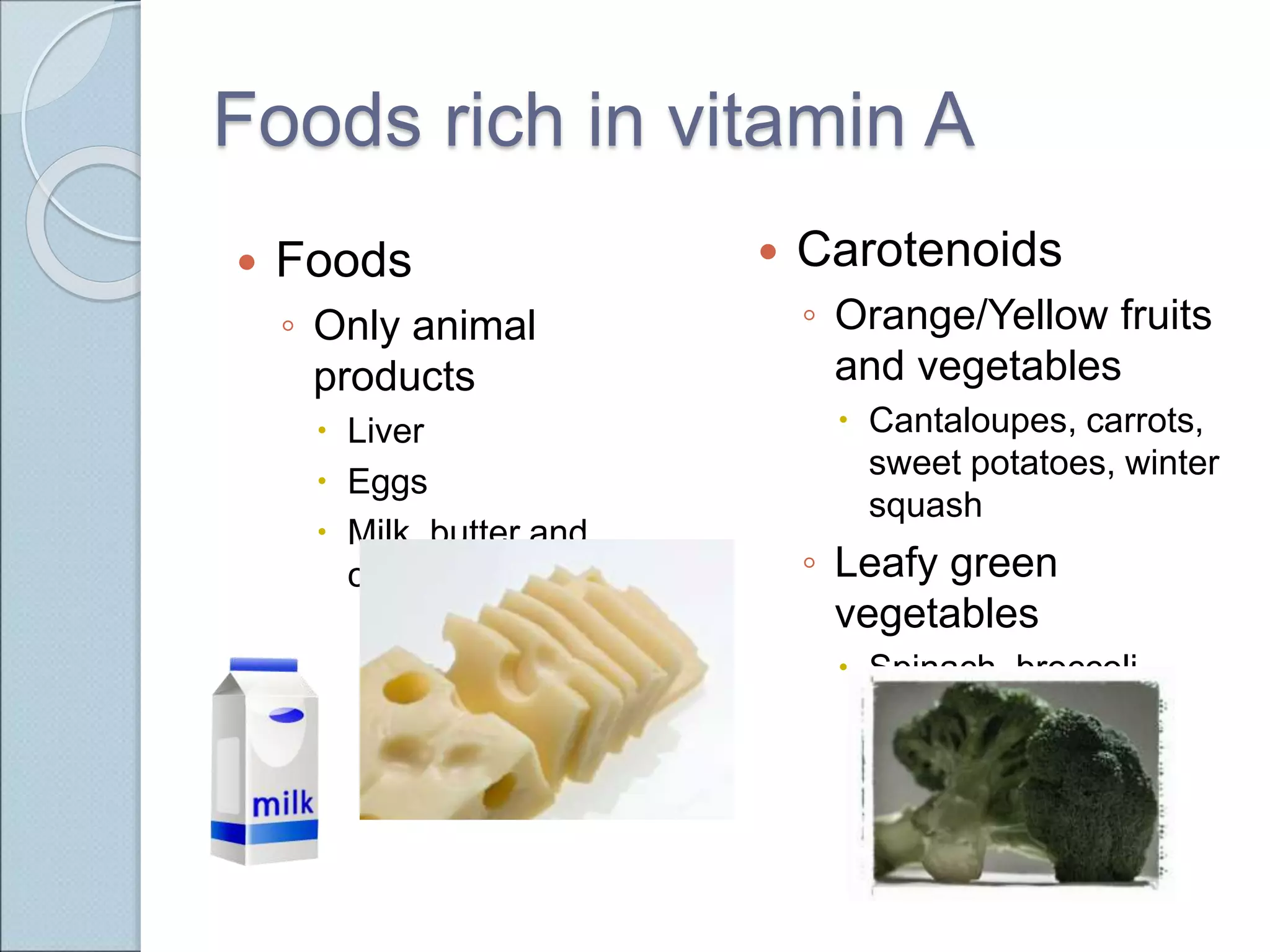
Foods rich in vitamin A
 Foods
◦ Only animal
products
 Liver
 Eggs
 Milk, butter and
cheese
 Carotenoids
◦ Orange/Yellow fruits
and vegetables
 Cantaloupes, carrots,
sweet potatoes, winter
squash
◦ Leafy green
vegetables
 Spinach, broccoli
Vitamin D – “The Sunshine
Vitamin”
 Essential for building and maintaining
bones and teeth
 Responsible for absorption and
utilization of calcium
 Other health benefits:
◦ May boost immune system
◦ May also help decrease certain cancers
 RDA: 5 micrograms until age 50
 10 micrograms / day until 70; 15 mcg 70+
Too little vitamin D
 Vitamin D deficiency has been in the
news a lot lately.
 Deficiency may occur from:
◦ Inadequate diet
 Vegetarianism, lactose intolerance, milk allergy
◦ Body unable to absorb needed vitamin D
◦ Limited exposure to sunlight
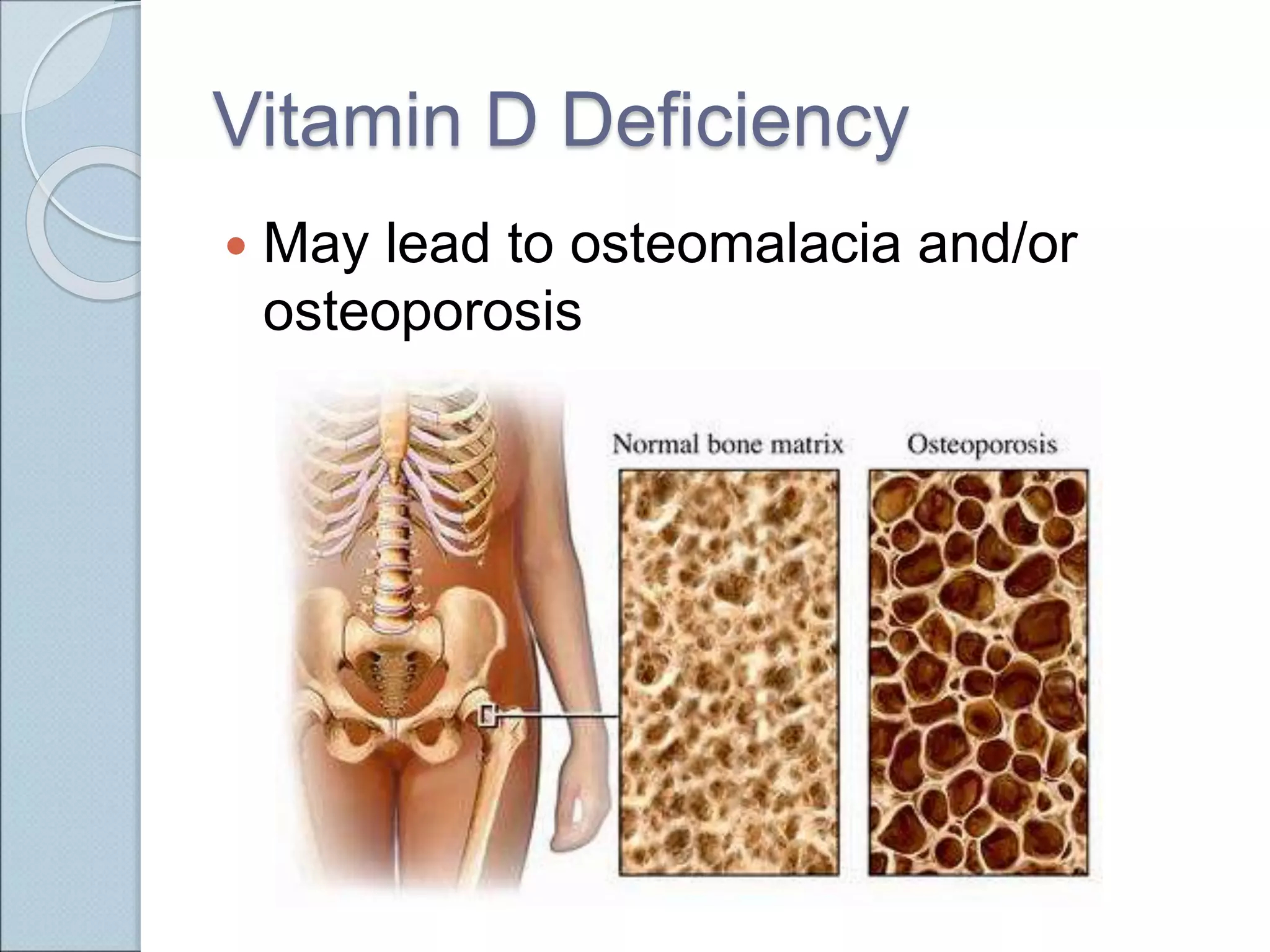
Vitamin D Deficiency
 May lead to osteomalacia and/or
osteoporosis
Getting vitamin D
 Sun exposure for 10 minutes a day
 Foods:
◦ Fortified milk
◦ Tuna
◦ Salmon
◦ May need a supplement
 Check with doctor first though
Vitamin E
 Important to red blood cells, muscles
and other tissues
 Deficiency is rare
 Toxicity is rare
◦ But Vitamin E acts as a blood thinner
 Foods:
◦ Vegetable oils, salad dressings, whole
grain cereals, green leafy vegetables,
nuts, seeds, peanut butter and wheat
germ.
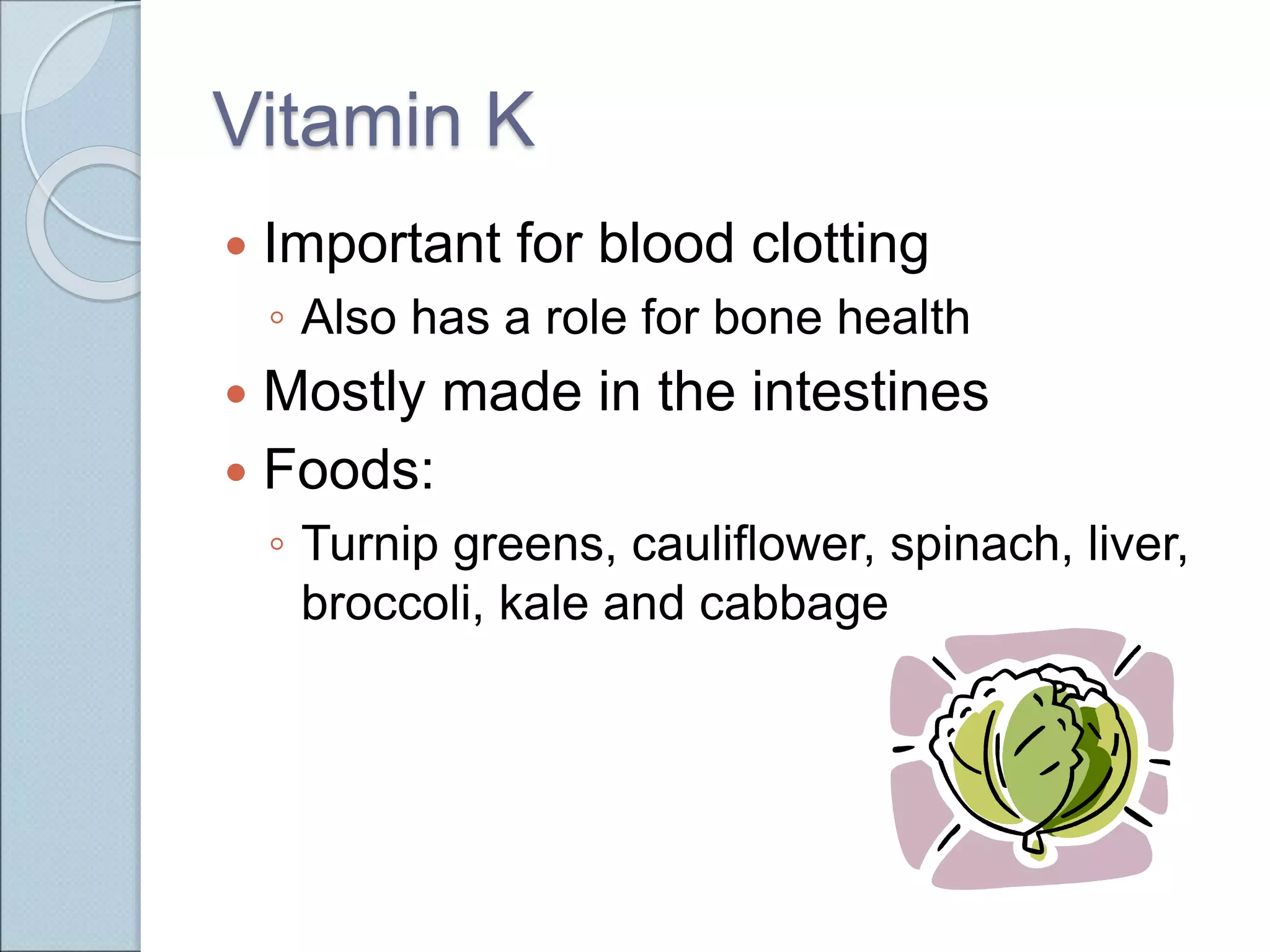
Vitamin K
 Important for blood clotting
◦ Also has a role for bone health
 Mostly made in the intestines
 Foods:
◦ Turnip greens, cauliflower, spinach, liver,
broccoli, kale and cabbage
Water-Soluble Vitamins
 Vitamins Bs and C
 Eight B vitamins:
◦ Thiamin (B-1)
◦ Riboflavin (B-2)
◦ Niacin (B-3)
◦ Pyridoxine (B-4)
◦ Cobalamin (B-12)
◦ Folic acid
◦ Pantothenic acid
◦ Biotin
Thiamin or B-1
 Helps to convert carbohydrates to
energy
 Deficiency:
◦ Fatigue, nausea, depression, nerve
damage
 Foods:
◦ Pork, beef, liver, peas, seeds, legumes,
whole-grain products, and oatmeal
Riboflavin or B-2
 Key to metabolism and red blood cells
 Deficiency:
◦ Dry, scaly skin
 Foods:
◦ Milk, yogurt, cheese, whole-grain breads,
green leafy vegetables, meat, and eggs
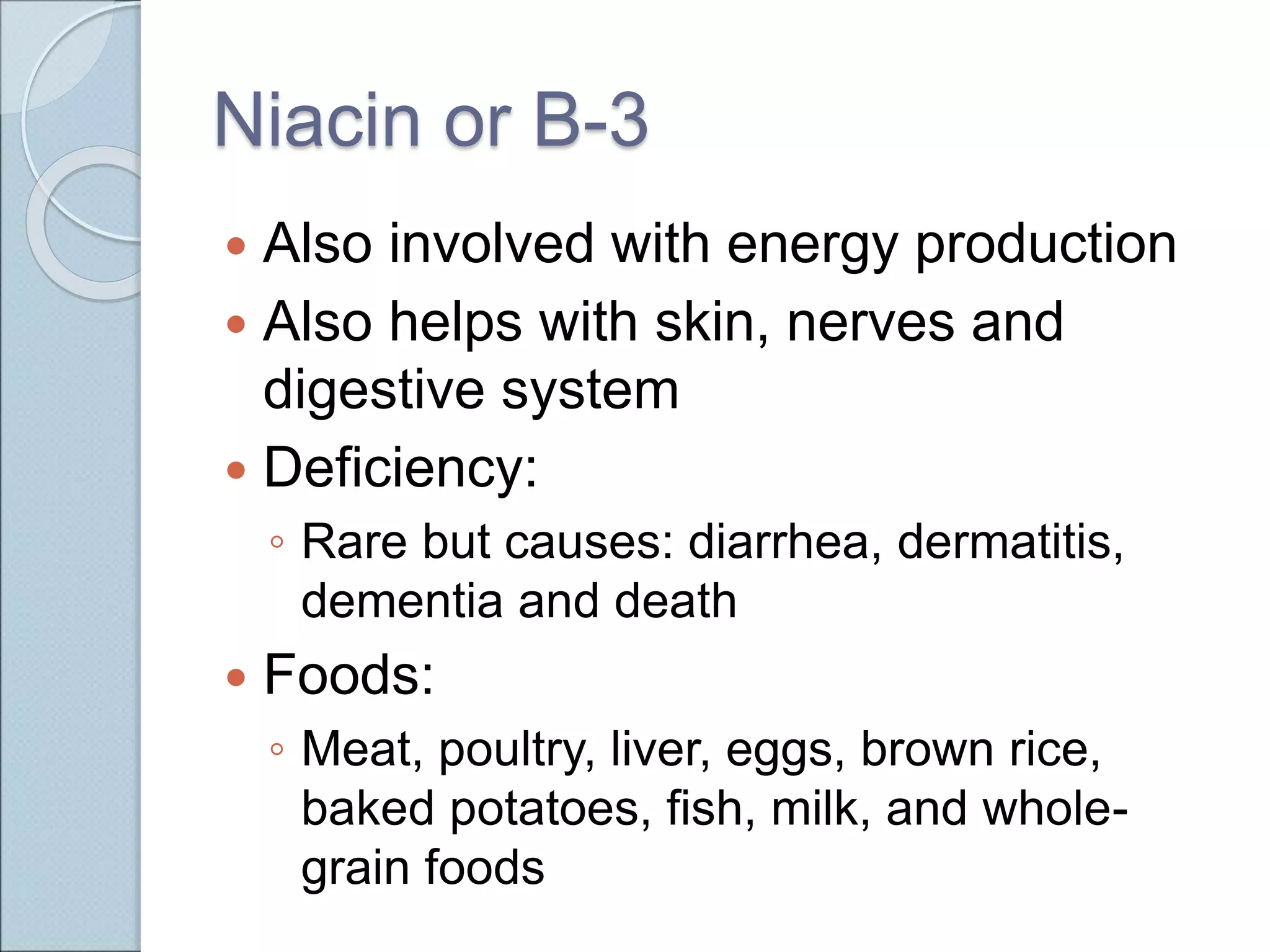
Niacin or B-3
 Also involved with energy production
 Also helps with skin, nerves and
digestive system
 Deficiency:
◦ Rare but causes: diarrhea, dermatitis,
dementia and death
 Foods:
◦ Meat, poultry, liver, eggs, brown rice,
baked potatoes, fish, milk, and whole-
grain foods
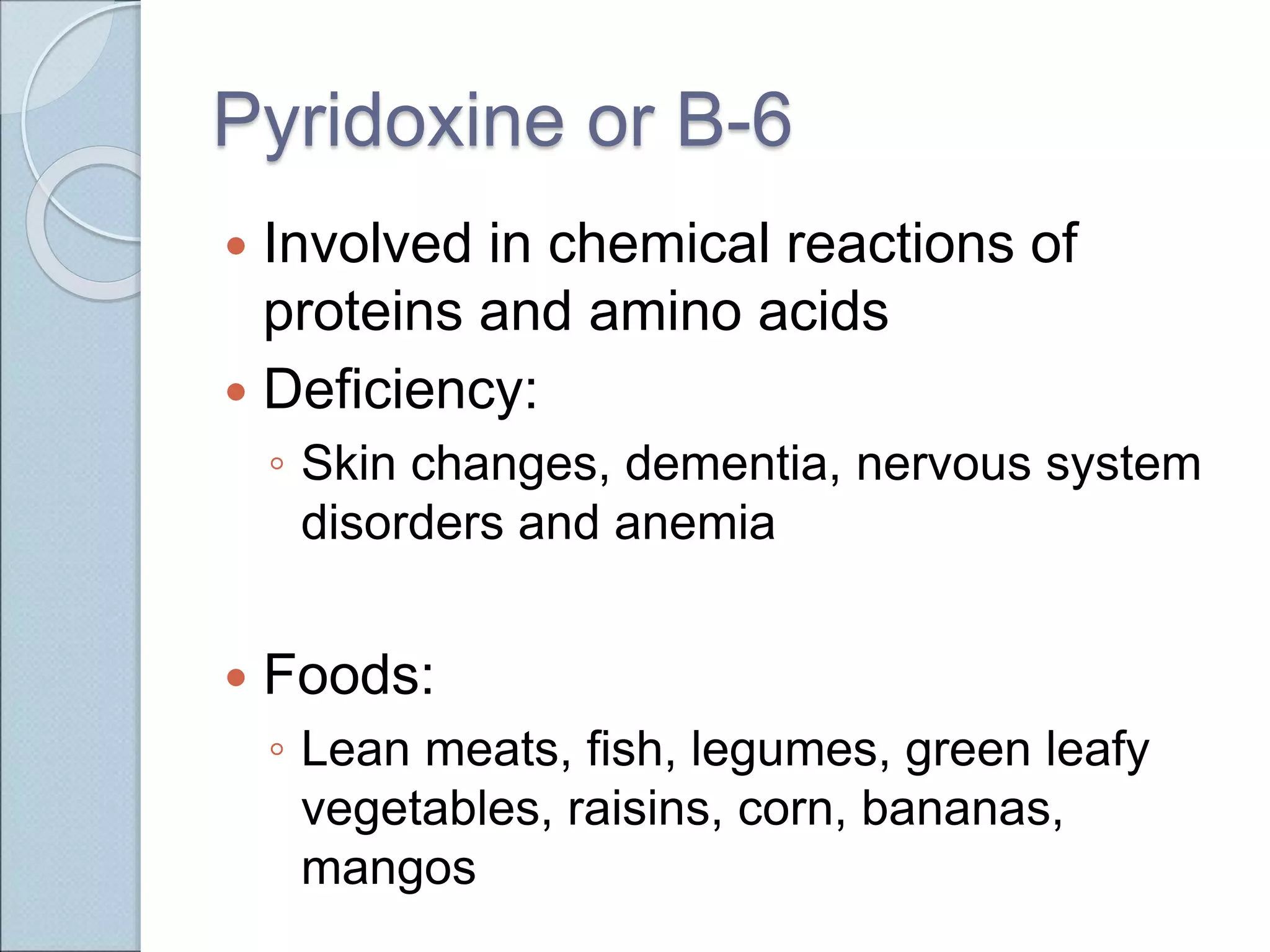
Pyridoxine or B-6
 Involved in chemical reactions of
proteins and amino acids
 Deficiency:
◦ Skin changes, dementia, nervous system
disorders and anemia
 Foods:
◦ Lean meats, fish, legumes, green leafy
vegetables, raisins, corn, bananas,
mangos
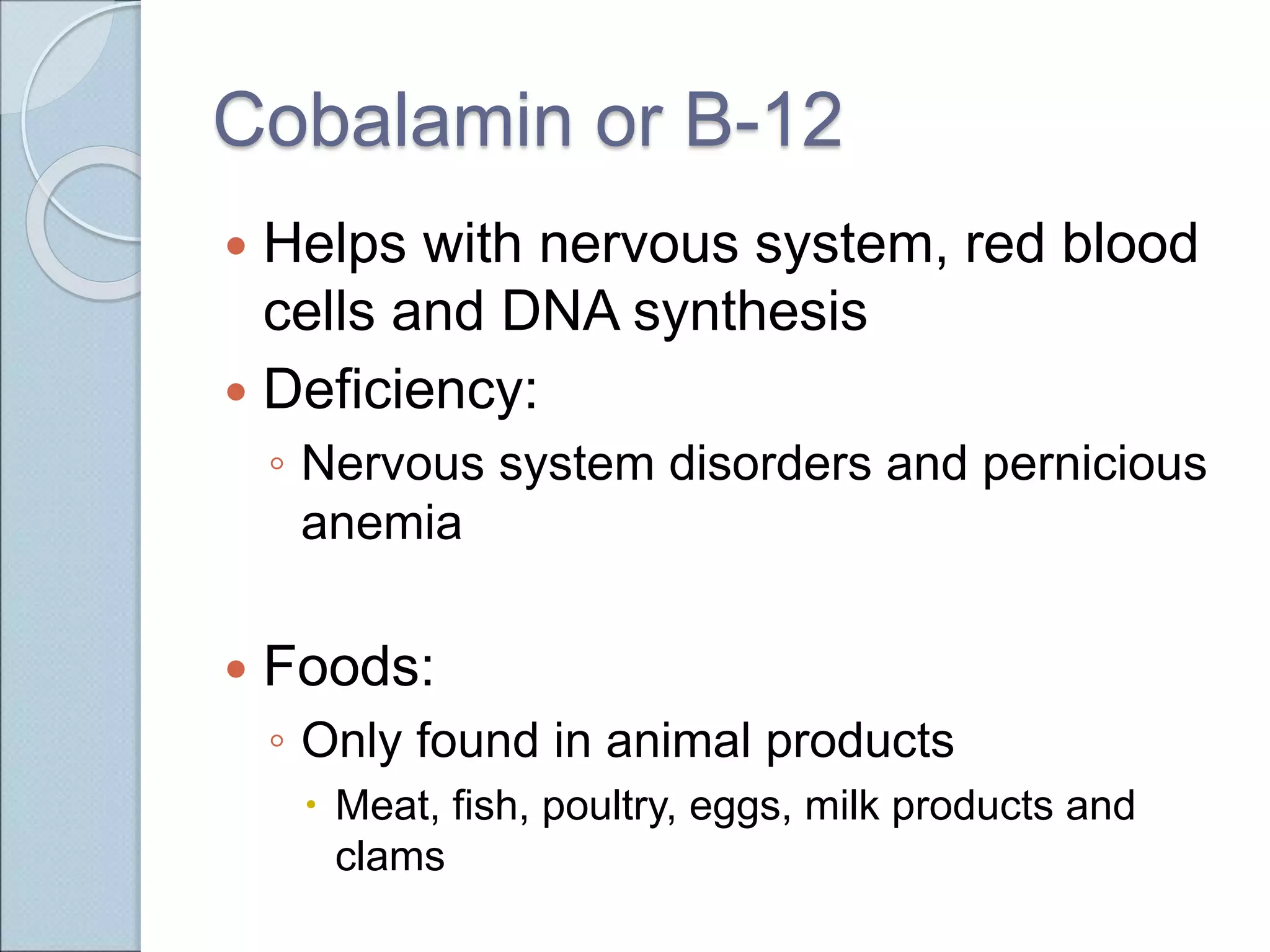
Cobalamin or B-12
 Helps with nervous system, red blood
cells and DNA synthesis
 Deficiency:
◦ Nervous system disorders and pernicious
anemia
 Foods:
◦ Only found in animal products
 Meat, fish, poultry, eggs, milk products and
clams
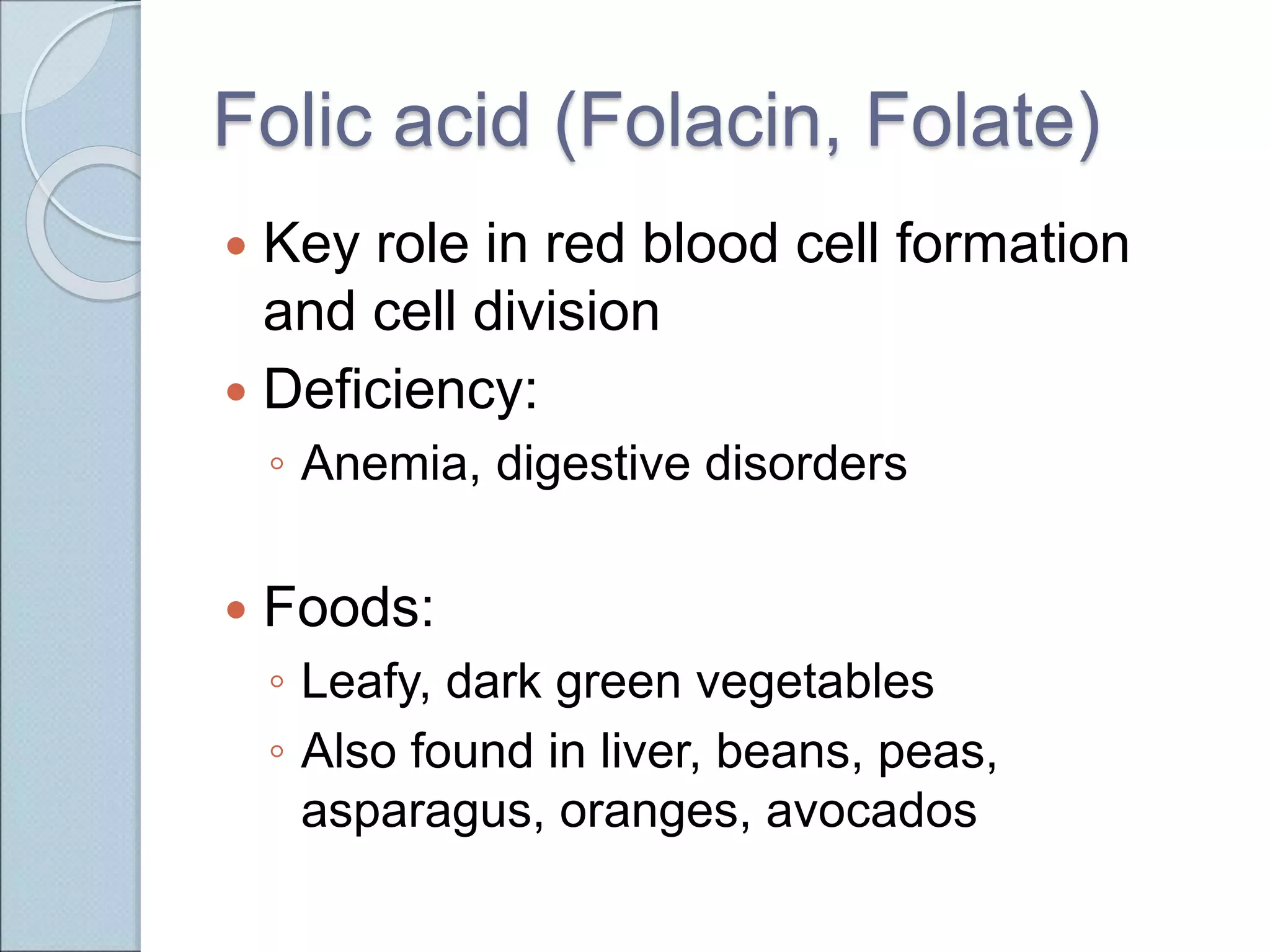
Folic acid (Folacin, Folate)
 Key role in red blood cell formation
and cell division
 Deficiency:
◦ Anemia, digestive disorders
 Foods:
◦ Leafy, dark green vegetables
◦ Also found in liver, beans, peas,
asparagus, oranges, avocados
Pantothenic Acid and Biotin
 Help with metabolism and formation of
some hormones
 Deficiencies are rare
 Foods:
◦ Almost any food, plant-based or animal-
based
Vitamin C
 Important to bone health, blood vessel
health, cell structure and absorption of
iron
 Deficiency:
◦ Rare
 Too much vitamin C
 Foods:
◦ Melons, berries, tomatoes, potatoes,
broccoli, fortified juices, kiwi, mangos,
yellow peppers and citrus fruits
Minerals
 22 minerals are needed by the body
 Two categories:
◦ Major
 Include calcium, chloride, magnesium,
phosphorus, potassium, sodium, and sulfur
◦ Trace
 Include iron, zinc, iodine, selenium, copper,
manganese, fluoride, chromium, molybdenum,
arsenic, nickel, silicon, boron and cobalt
Sodium
 What does sodium do for you?
◦ Helps maintain fluid balance
◦ Helps transmit nerve impulses
◦ Influences contraction and relaxation of
muscles
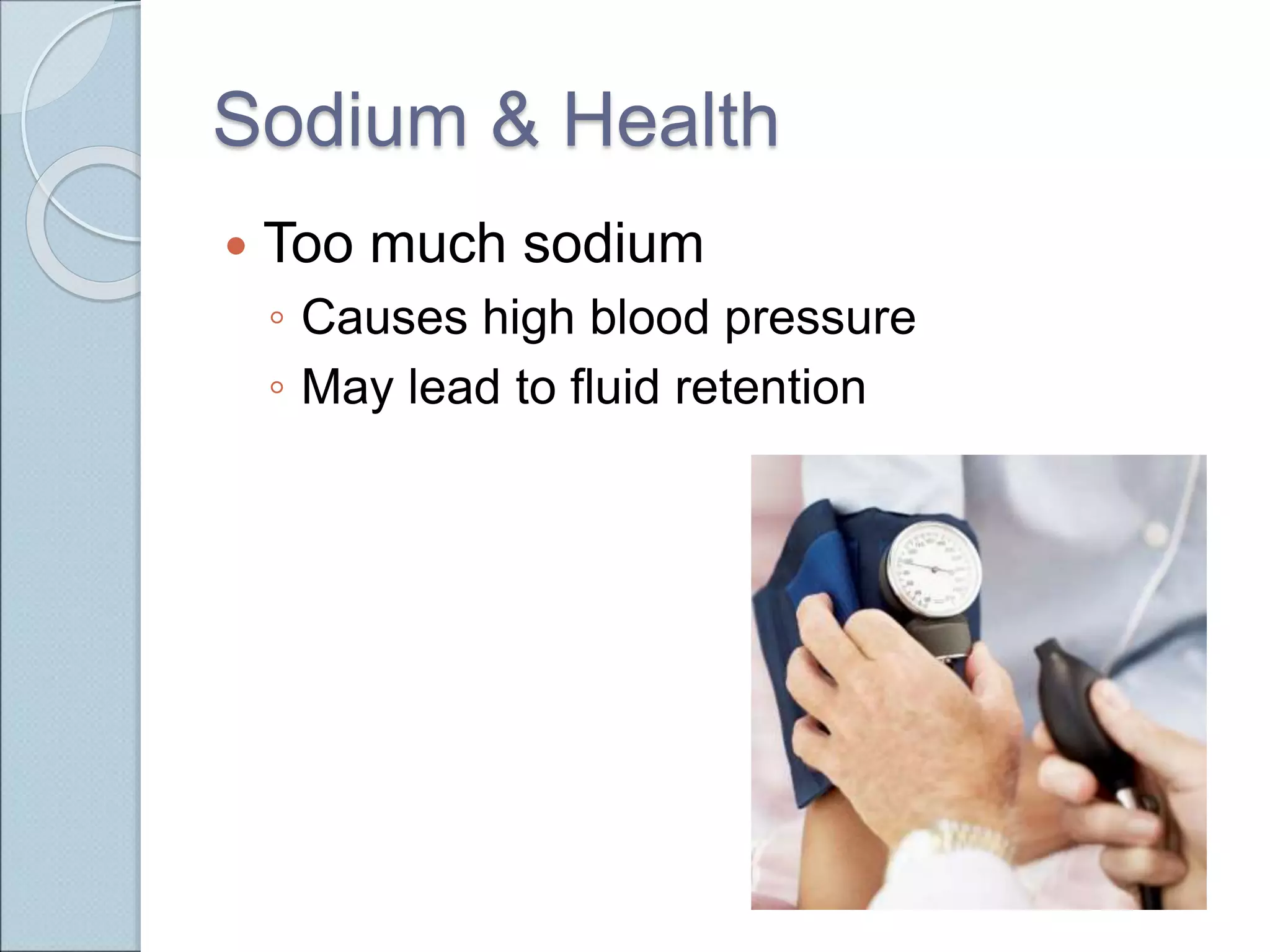
Sodium & Health
 Too much sodium
◦ Causes high blood pressure
◦ May lead to fluid retention
Sodium Savvy
 The human body requires about 500
mg of sodium per day, while the
average American usually ingests
between 2,300-6,900 mg each day.
 It is recommended to stay in a range
of 1,500 to 2,400 mg / day.
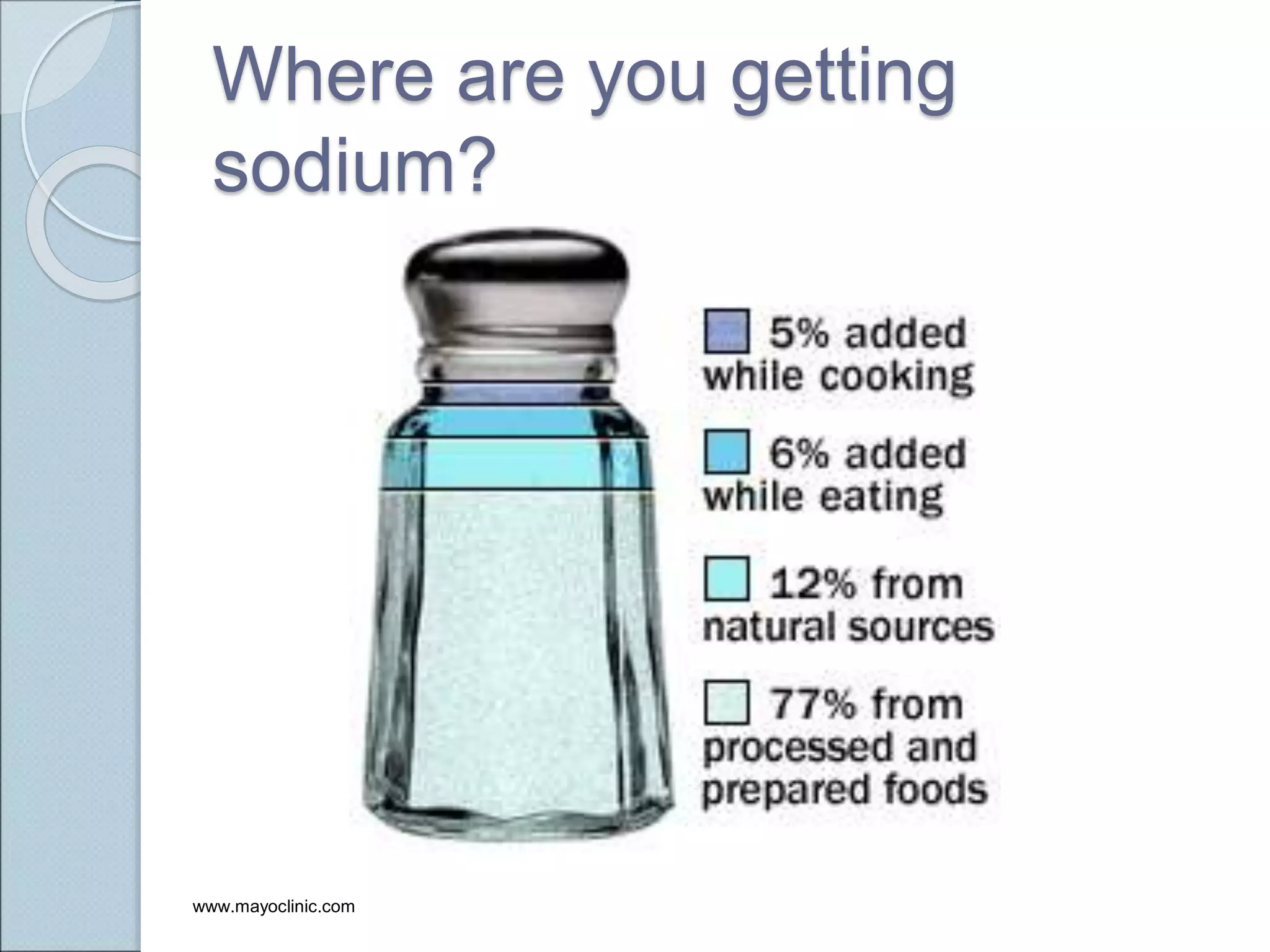
Where are you getting
sodium?
www.mayoclinic.com
Sodium & Food
 On food labels:
◦ Monosodium glutamate (MSG)
◦ Baking soda
◦ Baking powder
◦ Disodium phosphate
◦ Sodium alginate
◦ Sodium nitrate or nitrite
Reducing sodium in your diet
 Eat more fresh foods
 Eat less processed foods
 Look for low-sodium products
 Limit the salt you add to foods
 Experiment with other seasonings
 Use salt substitutes with caution
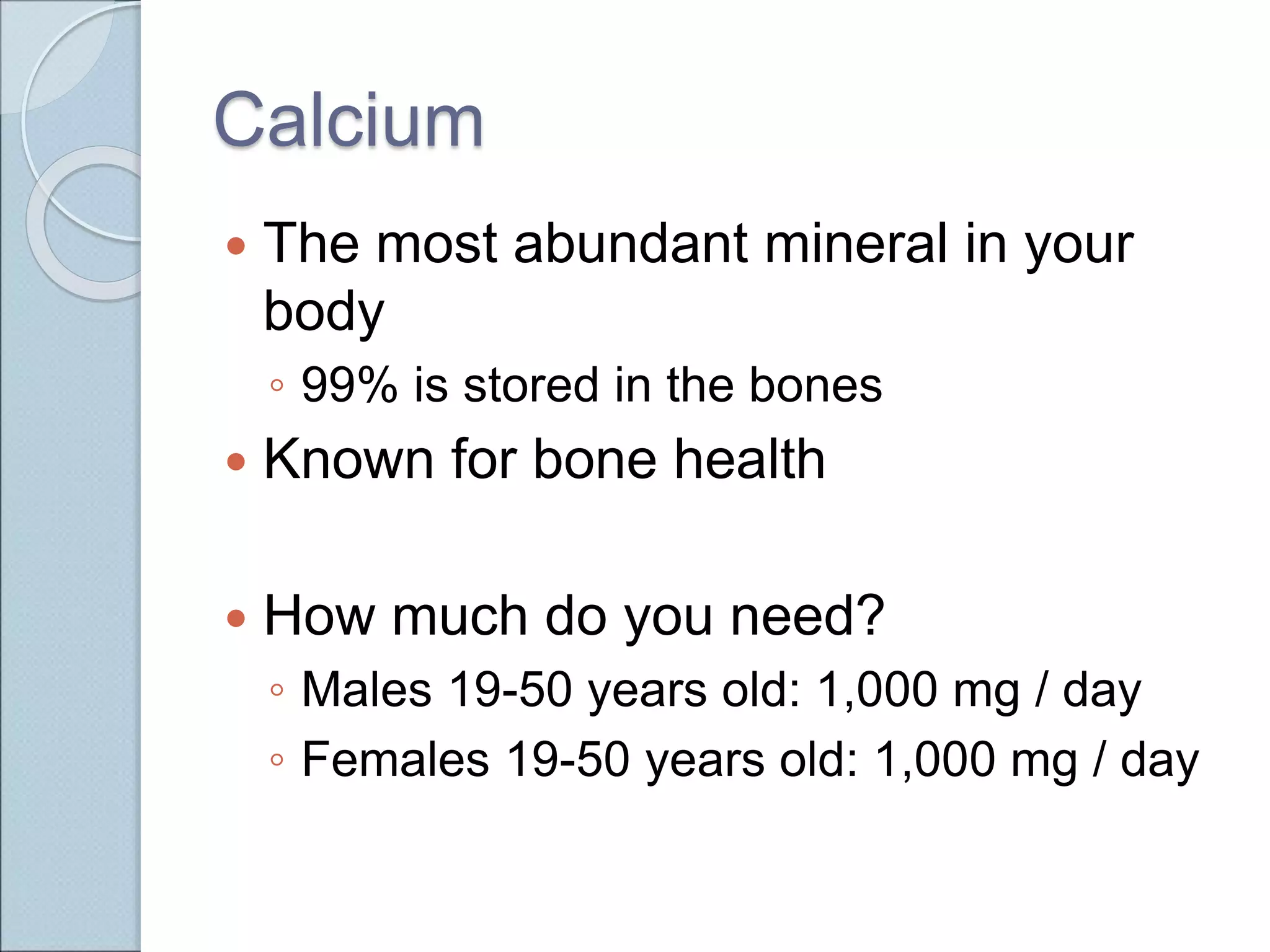
Calcium
 The most abundant mineral in your
body
◦ 99% is stored in the bones
 Known for bone health
 How much do you need?
◦ Males 19-50 years old: 1,000 mg / day
◦ Females 19-50 years old: 1,000 mg / day
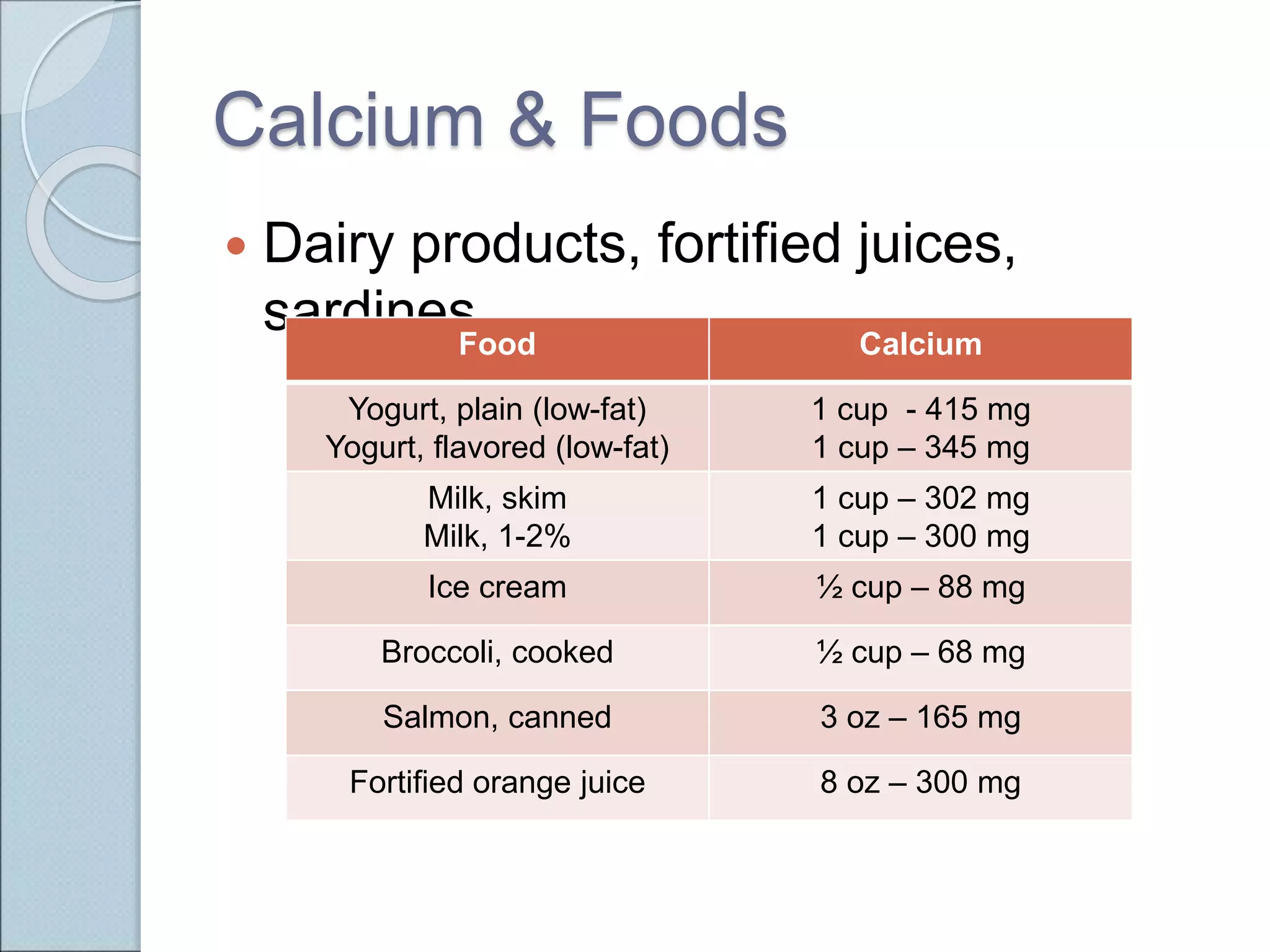
Calcium & Foods
 Dairy products, fortified juices,
sardines
Food Calcium
Yogurt, plain (low-fat)
Yogurt, flavored (low-fat)
1 cup - 415 mg
1 cup – 345 mg
Milk, skim
Milk, 1-2%
1 cup – 302 mg
1 cup – 300 mg
Ice cream ½ cup – 88 mg
Broccoli, cooked ½ cup – 68 mg
Salmon, canned 3 oz – 165 mg
Fortified orange juice 8 oz – 300 mg
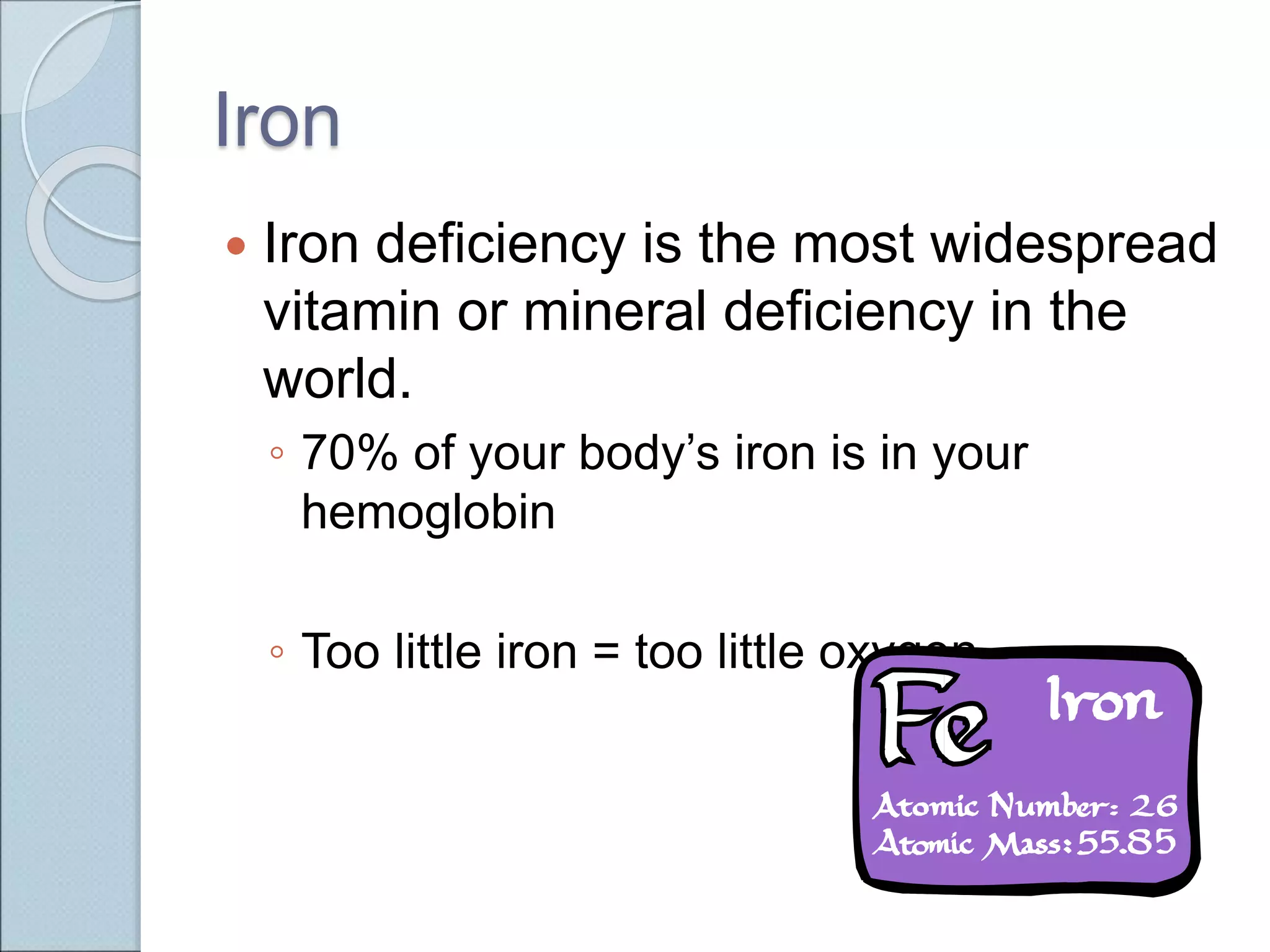
Iron
 Iron deficiency is the most widespread
vitamin or mineral deficiency in the
world.
◦ 70% of your body’s iron is in your
hemoglobin
◦ Too little iron = too little oxygen
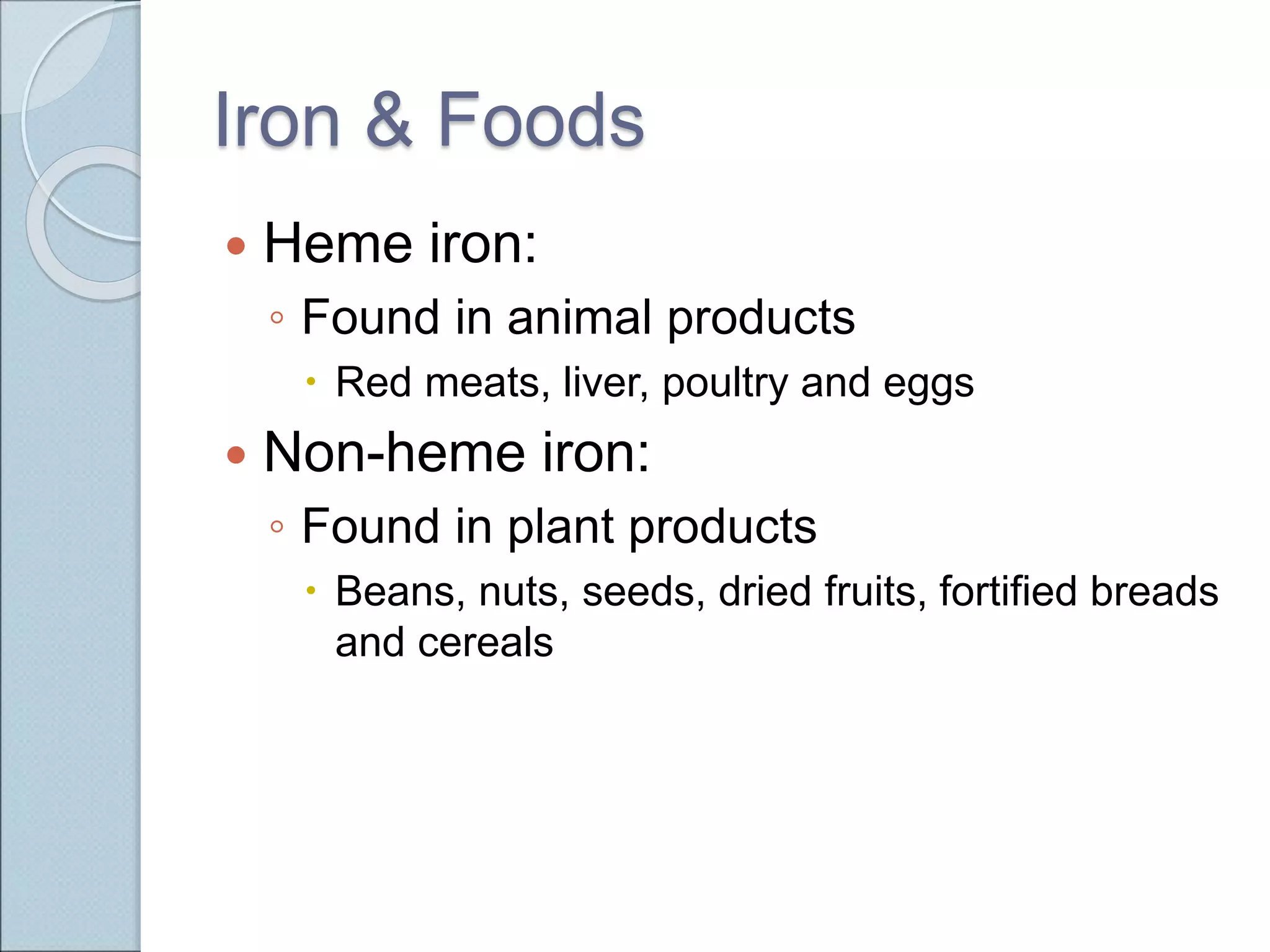
Iron & Foods
 Heme iron:
◦ Found in animal products
 Red meats, liver, poultry and eggs
 Non-heme iron:
◦ Found in plant products
 Beans, nuts, seeds, dried fruits, fortified breads
and cereals
Iron supplements
 Check with your doctor first.
 High risk groups:
◦ Strict vegetarians
◦ Those who do not eat a balanced diet
◦ Those who are over 60
◦ Smokers and those who regularly drink
alcohol
◦ Chronic dieters
◦ Those who suffer from food allergies,
intolerances
Water
 Essential for life
◦ It is possible to live without food than
without water.
 Water makes up about 45-75% of your
body weight
Why is water important?
 Aids with transport
 Mechanical functions
 Helps to break substances down
 Helps to maintain body
temperature/pH
How much water do you
need?
 Adequate intake:
◦ For men: 125 oz / day
◦ For women: 91 oz / day
◦ Ideally 80% of water should coming from
drinking fluids.
 20% of water intake should come from food

W10 Water, Vitamins & Minerals (1).ppt

  • 1.
  • 2.
    Vitamins  Certain vitaminsand minerals are needed for the body to function. ◦ 13 vitamins ◦ 22 minerals  Two types of vitamins ◦ Water-soluble ◦ Fat-soluble
  • 3.
    Fat-Soluble vitamins  VitaminA, D, E and K  Excess is stored in the liver and in body fat ◦ It is possible to build up to a toxic level
  • 4.
    Vitamin A (Retinol) Beta-carotene is converted into vitamin A  Vitamin A: ◦ Promotes good vision ◦ Promotes healthy skin ◦ Helps with growth and maintenance of bones, teeth, and cell structure  RDA: 900 micrograms for males; 700 micrograms for females
  • 5.
    Too much vitaminA  May turn your skin orange  May cause fatigue, weakness, severe headache, blurred vision, hair loss and joint pain.  Toxicity: ◦ May cause severe liver or brain damage ◦ Birth defects
  • 6.
    Too little vitaminA  May cause night blindness  Lowered immune system
  • 7.
    Foods rich invitamin A  Foods ◦ Only animal products  Liver  Eggs  Milk, butter and cheese  Carotenoids ◦ Orange/Yellow fruits and vegetables  Cantaloupes, carrots, sweet potatoes, winter squash ◦ Leafy green vegetables  Spinach, broccoli
  • 8.
    Vitamin D –“The Sunshine Vitamin”  Essential for building and maintaining bones and teeth  Responsible for absorption and utilization of calcium  Other health benefits: ◦ May boost immune system ◦ May also help decrease certain cancers  RDA: 5 micrograms until age 50  10 micrograms / day until 70; 15 mcg 70+
  • 9.
    Too little vitaminD  Vitamin D deficiency has been in the news a lot lately.  Deficiency may occur from: ◦ Inadequate diet  Vegetarianism, lactose intolerance, milk allergy ◦ Body unable to absorb needed vitamin D ◦ Limited exposure to sunlight
  • 10.
    Vitamin D Deficiency May lead to osteomalacia and/or osteoporosis
  • 11.
    Getting vitamin D Sun exposure for 10 minutes a day  Foods: ◦ Fortified milk ◦ Tuna ◦ Salmon ◦ May need a supplement  Check with doctor first though
  • 12.
    Vitamin E  Importantto red blood cells, muscles and other tissues  Deficiency is rare  Toxicity is rare ◦ But Vitamin E acts as a blood thinner  Foods: ◦ Vegetable oils, salad dressings, whole grain cereals, green leafy vegetables, nuts, seeds, peanut butter and wheat germ.
  • 13.
    Vitamin K  Importantfor blood clotting ◦ Also has a role for bone health  Mostly made in the intestines  Foods: ◦ Turnip greens, cauliflower, spinach, liver, broccoli, kale and cabbage
  • 14.
    Water-Soluble Vitamins  VitaminsBs and C  Eight B vitamins: ◦ Thiamin (B-1) ◦ Riboflavin (B-2) ◦ Niacin (B-3) ◦ Pyridoxine (B-4) ◦ Cobalamin (B-12) ◦ Folic acid ◦ Pantothenic acid ◦ Biotin
  • 15.
    Thiamin or B-1 Helps to convert carbohydrates to energy  Deficiency: ◦ Fatigue, nausea, depression, nerve damage  Foods: ◦ Pork, beef, liver, peas, seeds, legumes, whole-grain products, and oatmeal
  • 16.
    Riboflavin or B-2 Key to metabolism and red blood cells  Deficiency: ◦ Dry, scaly skin  Foods: ◦ Milk, yogurt, cheese, whole-grain breads, green leafy vegetables, meat, and eggs
  • 17.
    Niacin or B-3 Also involved with energy production  Also helps with skin, nerves and digestive system  Deficiency: ◦ Rare but causes: diarrhea, dermatitis, dementia and death  Foods: ◦ Meat, poultry, liver, eggs, brown rice, baked potatoes, fish, milk, and whole- grain foods
  • 18.
    Pyridoxine or B-6 Involved in chemical reactions of proteins and amino acids  Deficiency: ◦ Skin changes, dementia, nervous system disorders and anemia  Foods: ◦ Lean meats, fish, legumes, green leafy vegetables, raisins, corn, bananas, mangos
  • 19.
    Cobalamin or B-12 Helps with nervous system, red blood cells and DNA synthesis  Deficiency: ◦ Nervous system disorders and pernicious anemia  Foods: ◦ Only found in animal products  Meat, fish, poultry, eggs, milk products and clams
  • 20.
    Folic acid (Folacin,Folate)  Key role in red blood cell formation and cell division  Deficiency: ◦ Anemia, digestive disorders  Foods: ◦ Leafy, dark green vegetables ◦ Also found in liver, beans, peas, asparagus, oranges, avocados
  • 21.
    Pantothenic Acid andBiotin  Help with metabolism and formation of some hormones  Deficiencies are rare  Foods: ◦ Almost any food, plant-based or animal- based
  • 22.
    Vitamin C  Importantto bone health, blood vessel health, cell structure and absorption of iron  Deficiency: ◦ Rare  Too much vitamin C  Foods: ◦ Melons, berries, tomatoes, potatoes, broccoli, fortified juices, kiwi, mangos, yellow peppers and citrus fruits
  • 23.
    Minerals  22 mineralsare needed by the body  Two categories: ◦ Major  Include calcium, chloride, magnesium, phosphorus, potassium, sodium, and sulfur ◦ Trace  Include iron, zinc, iodine, selenium, copper, manganese, fluoride, chromium, molybdenum, arsenic, nickel, silicon, boron and cobalt
  • 24.
    Sodium  What doessodium do for you? ◦ Helps maintain fluid balance ◦ Helps transmit nerve impulses ◦ Influences contraction and relaxation of muscles
  • 25.
    Sodium & Health Too much sodium ◦ Causes high blood pressure ◦ May lead to fluid retention
  • 26.
    Sodium Savvy  Thehuman body requires about 500 mg of sodium per day, while the average American usually ingests between 2,300-6,900 mg each day.  It is recommended to stay in a range of 1,500 to 2,400 mg / day.
  • 27.
    Where are yougetting sodium? www.mayoclinic.com
  • 28.
    Sodium & Food On food labels: ◦ Monosodium glutamate (MSG) ◦ Baking soda ◦ Baking powder ◦ Disodium phosphate ◦ Sodium alginate ◦ Sodium nitrate or nitrite
  • 29.
    Reducing sodium inyour diet  Eat more fresh foods  Eat less processed foods  Look for low-sodium products  Limit the salt you add to foods  Experiment with other seasonings  Use salt substitutes with caution
  • 30.
    Calcium  The mostabundant mineral in your body ◦ 99% is stored in the bones  Known for bone health  How much do you need? ◦ Males 19-50 years old: 1,000 mg / day ◦ Females 19-50 years old: 1,000 mg / day
  • 31.
    Calcium & Foods Dairy products, fortified juices, sardines Food Calcium Yogurt, plain (low-fat) Yogurt, flavored (low-fat) 1 cup - 415 mg 1 cup – 345 mg Milk, skim Milk, 1-2% 1 cup – 302 mg 1 cup – 300 mg Ice cream ½ cup – 88 mg Broccoli, cooked ½ cup – 68 mg Salmon, canned 3 oz – 165 mg Fortified orange juice 8 oz – 300 mg
  • 32.
    Iron  Iron deficiencyis the most widespread vitamin or mineral deficiency in the world. ◦ 70% of your body’s iron is in your hemoglobin ◦ Too little iron = too little oxygen
  • 33.
    Iron & Foods Heme iron: ◦ Found in animal products  Red meats, liver, poultry and eggs  Non-heme iron: ◦ Found in plant products  Beans, nuts, seeds, dried fruits, fortified breads and cereals
  • 34.
    Iron supplements  Checkwith your doctor first.  High risk groups: ◦ Strict vegetarians ◦ Those who do not eat a balanced diet ◦ Those who are over 60 ◦ Smokers and those who regularly drink alcohol ◦ Chronic dieters ◦ Those who suffer from food allergies, intolerances
  • 35.
    Water  Essential forlife ◦ It is possible to live without food than without water.  Water makes up about 45-75% of your body weight
  • 36.
    Why is waterimportant?  Aids with transport  Mechanical functions  Helps to break substances down  Helps to maintain body temperature/pH
  • 37.
    How much waterdo you need?  Adequate intake: ◦ For men: 125 oz / day ◦ For women: 91 oz / day ◦ Ideally 80% of water should coming from drinking fluids.  20% of water intake should come from food