www.vxvista.org
J.D. Keith
vxVistA Network Architect
vxVistA Systems Architecture with
Intersystems Cache on Microsoft
Windows
April 2, 2010
Sponsored by
www.vxvista.org
Operating Systems and vxVistA
 Currently vxVistA is commercially supported by only DSS, Inc. and their
direct Partners on Windows Server 2003 and Windows Server 2008
 Linux is a viable option for those companies that have in-house
expertise with Linux and wish to utilize existing infrastructure and
resources – though at this time there is no commercial support available
for vxVistA on Linux.
 We will be discussing Windows-based solutions today.
 vxVistA may be adapted and supported for Linux and other platforms by
community members in the future.
www.vxvista.org
vxVistA – Why Windows Server?
 Microsoft Windows Server 2003 and Windows Server 2008 are stable
platforms with mature, structured support.
 Both versions of the Microsoft Server Operating System offer plentiful
availability of technical resources in both core information technology and
in healthcare globally.
 Costs of operating systems are offset by abundance of resources and
existing knowledge and support infrastructure in most areas and operating
environments.
 Currently the vxVistA Graphical User Interface Applications require
Windows client operating systems – making for easy interoperability
between client and server without mixed operating system environments
and costly support complexities.
 Again - future versions of vxVistA may be commercially supported on
other operating system platforms.
www.vxvista.org
Database Platforms for vxVistA
 Currently vxVistA is commercially supported by DSS, Inc. and their
direct Partners on Intersystems Cache
 The vxVistA Open Source installation and setup files are available for
download at www.vxVistA.org and the community is encouraged to
participate in future phases of development.
 Individuals or companies participating in the community eco-system
may contribute additional resources for operating vxVistA with other
database platforms.
 GT.M is another database option for vxVistA, though currently no
commercial support is available for the EHR on GT.M.
www.vxvista.org
vxVistA – Why Intersystems Cache?
 The Intersystems Cache Database platform is a mature platform with
global presence and a well-organized support infrastructure.
 Familiar GUI-style interfaces and web technology driven management
architecture make Cache simple to adopt and manage.
 The commercial expense of the database platform is offset by a feature-
rich operating platform supporting extensive redundancy and high-
availability measures, as well as data integrity protection .
 Ease of installation, integration, and extensive support resources make
this a suitable platform for organizations that require vendor support to
maintain their patient care model and preserve the integrity of the patient
health record.
www.vxvista.org
VxVistA Hardware: Processor Architecture
 VxVistA is supported only on the basis of the Operating System and the
Database Platform. Processor and motherboard architectures affect
primarily performance of the systems.
 Currently vxVistA is supported on Intel x86-32 and 64-bit as well as
AMD 32 and 64-bit processor architectures (K8/K10) by DSS, Inc. and its
direct Partners.
 The vxVistA Open Source installation and setup files are available for
download at www.vxVistA.org and the community is encouraged to
participate in future phases of development, including the expansion of
support into other processor architectures.
www.vxvista.org
VxVistA: Processors – Speed vs. Cores
 To reiterate: currently vxVistA is supported on Intel x86-32 and 64-bit as
well as AMD 32 and 64-bit processor architectures (K8/K10) by DSS, Inc.
and its direct partners.
 Generally adding cores is a better response to increasing user counts.
 Clock speeds beyond 1.8 Ghz generally provided diminishing returns
when compared to the performance improvements seen when adding
cores to the system .
 50 to 100 users per core can be a reasonable estimate for maintaining
high performance and low system response times – transactional load
may affect this estimation.
www.vxvista.org
VxVistA: RAM, Cache, Buffers
 RAM is key to performance for databases. 12 GB of RAM is a common
recommendation for systems supporting 20 or more concurrent users.
 High user counts and high transactional volume may indicate the need
to increase RAM – Database statistics (such as GLOSTAT for Cache)
are a good tool for discovering shortages.
 Reporting and querying performance – as well as multi-tasking – can
suffer from RAM shortages.
 Processor cache can have significant effects on throughput at the
database - especially if massive data queries, reporting requirements, or
analysis (math, stats, finance, complex billing, etc) are necessities.
 Buffering – configuration, but needs must be met by hardware
 All Intersystems Cache Buffers (Globals and Routines) should fit
within the available RAM resources .
 More information is available at
www.intersystems.com/cache/documentation
www.vxvista.org
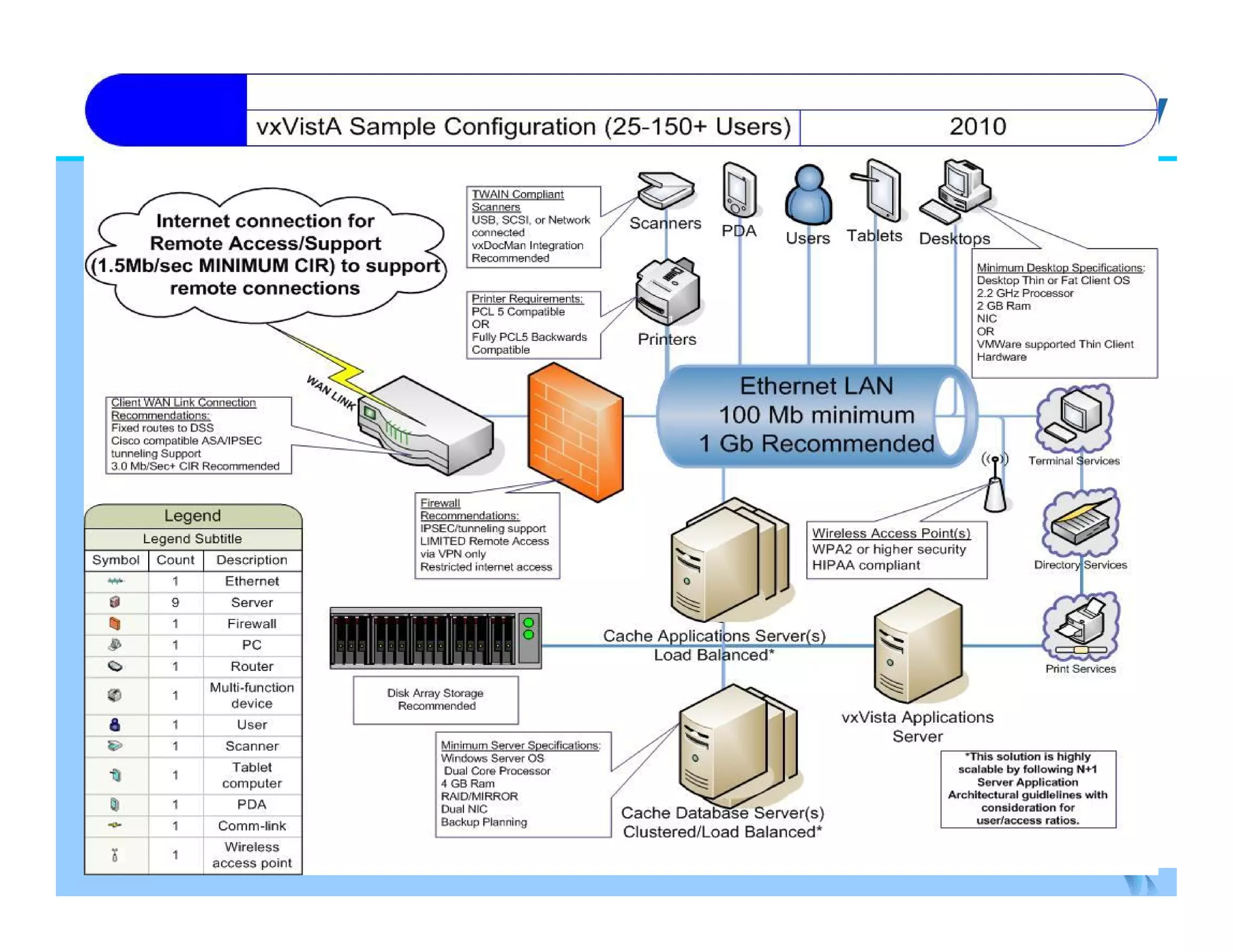
 vxVistA Architecture modeling
 Scalability
 High Availability and DR
 Other Architectures
vxVistA Hardware Configurations
www.vxvista.org
www.vxvista.org
www.vxvista.org
www.vxvista.org
www.vxvista.org
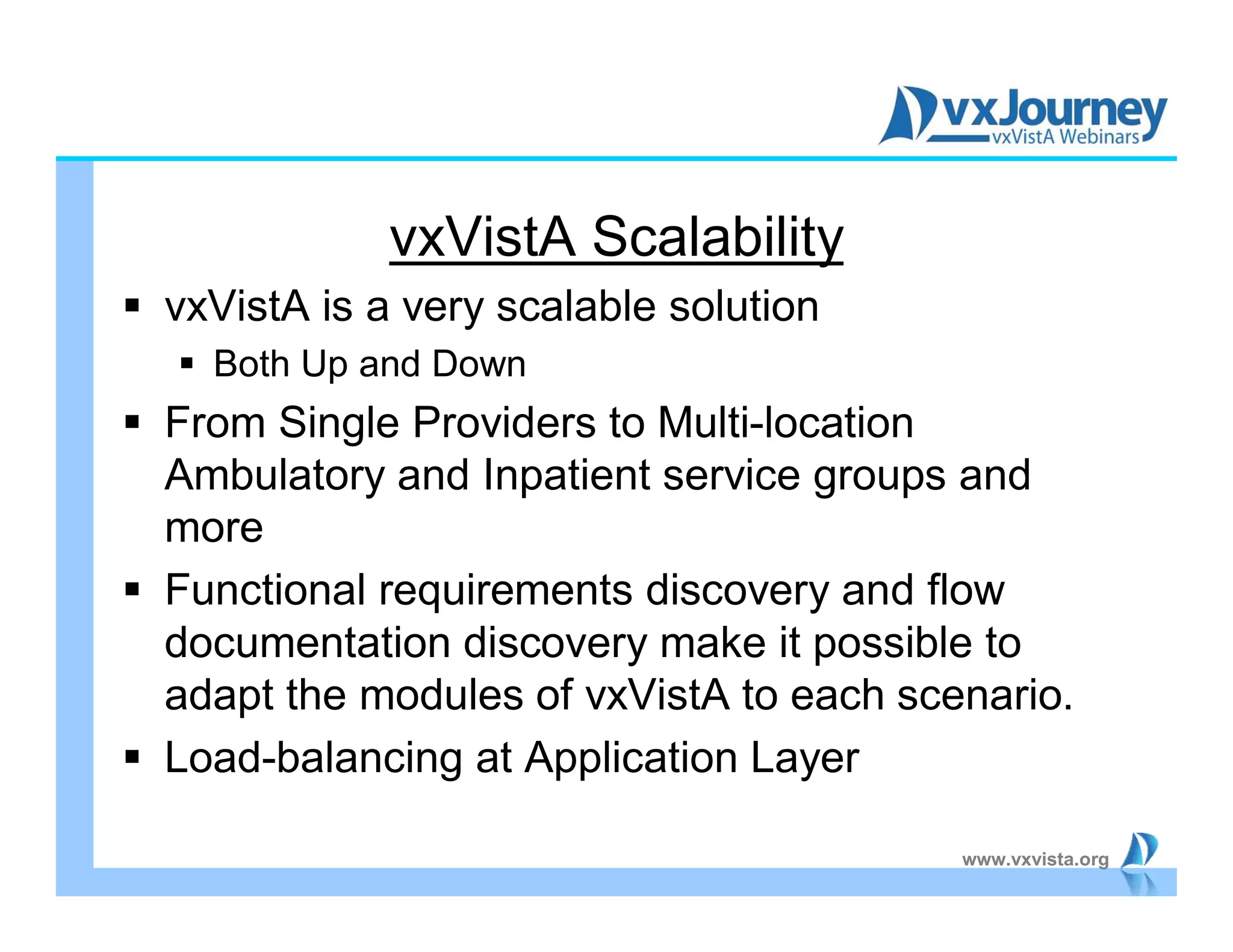
vxVistA Scalability
 vxVistA is a very scalable solution
 Both Up and Down
 From Single Providers to Multi-location
Ambulatory and Inpatient service groups and
more
 Functional requirements discovery and flow
documentation discovery make it possible to
adapt the modules of vxVistA to each scenario.
 Load-balancing at Application Layer
www.vxvista.org
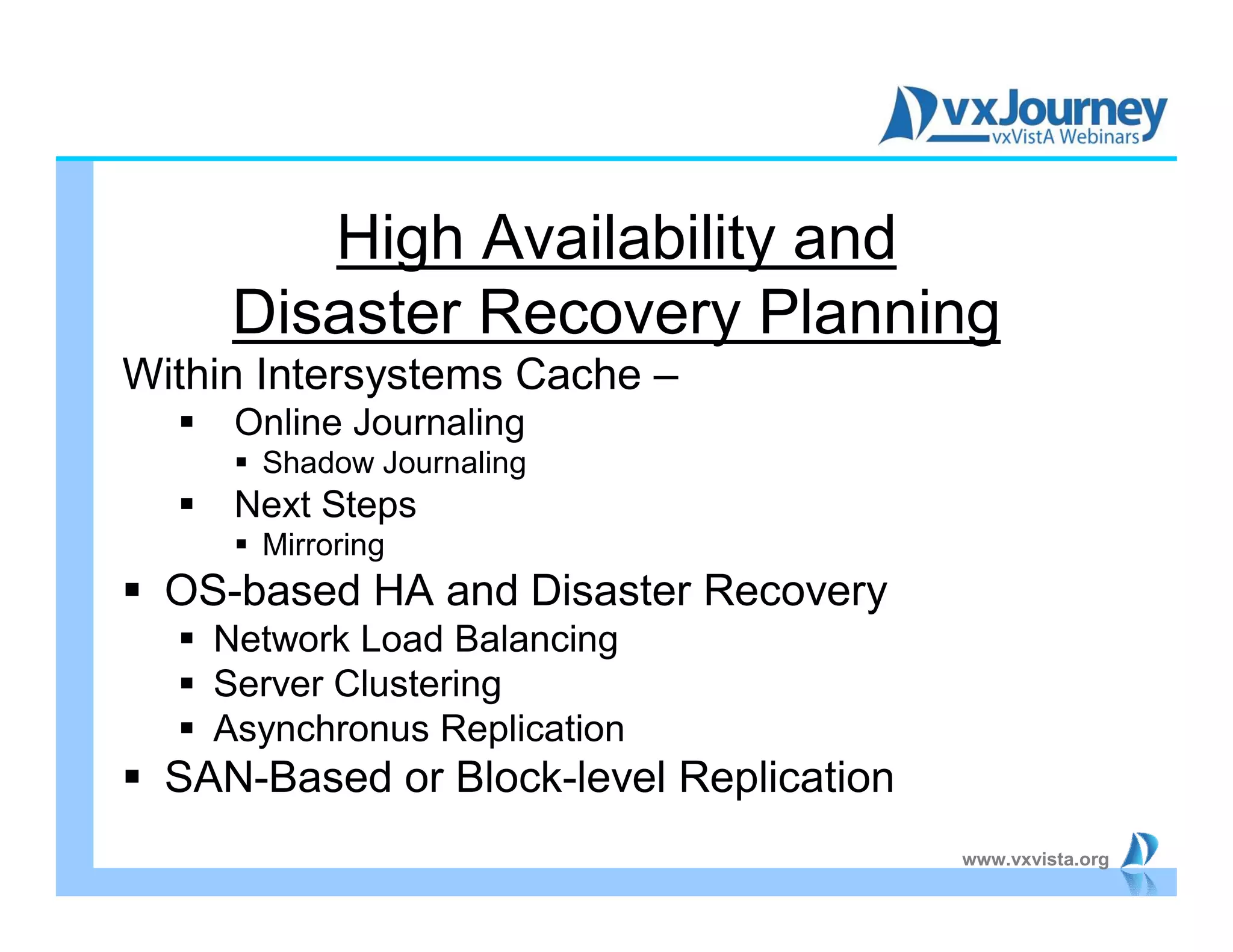
High Availability and
Disaster Recovery Planning
Within Intersystems Cache –
 Online Journaling
 Shadow Journaling
 Next Steps
 Mirroring
 OS-based HA and Disaster Recovery
 Network Load Balancing
 Server Clustering
 Asynchronus Replication
 SAN-Based or Block-level Replication
www.vxvista.org
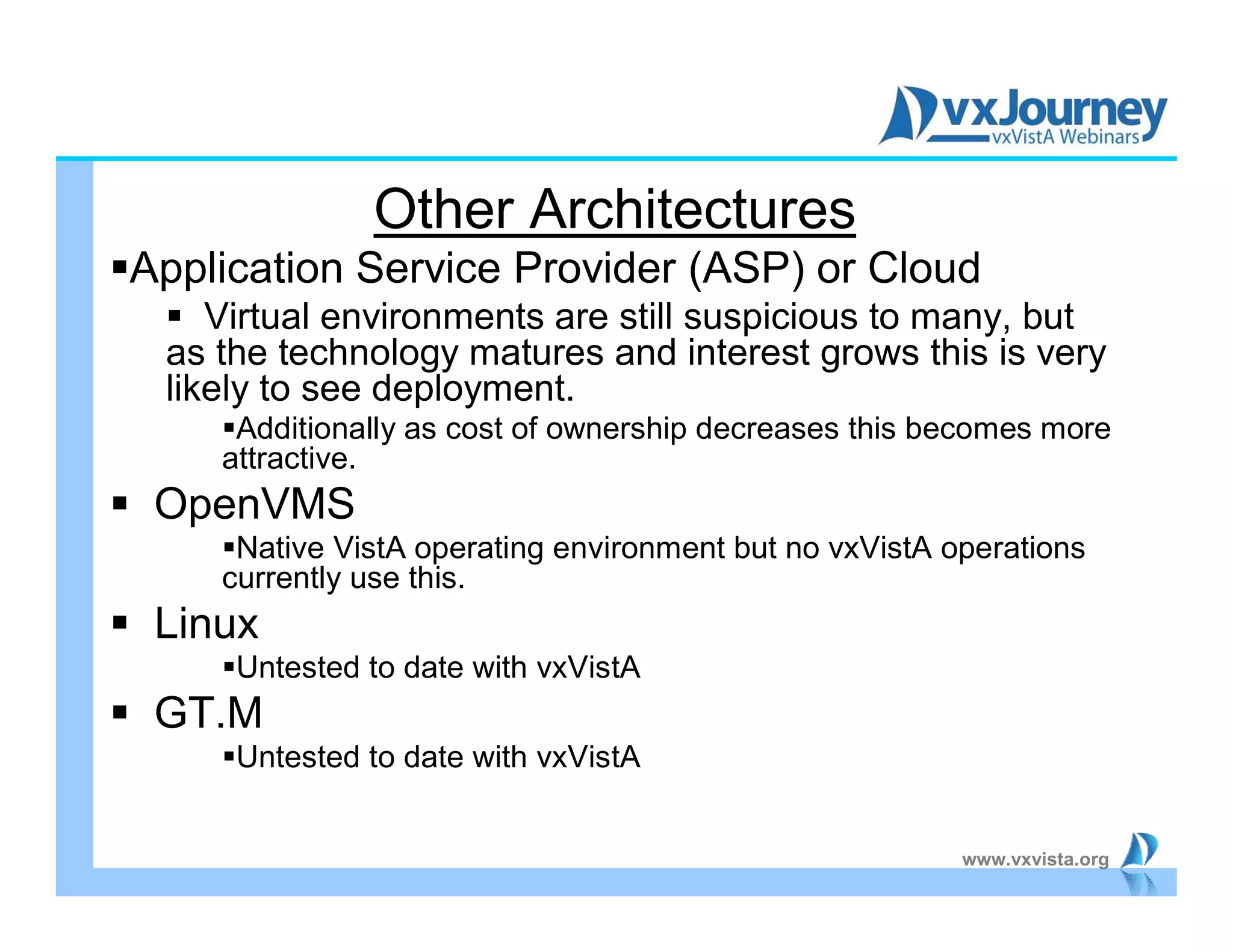
Other Architectures
Application Service Provider (ASP) or Cloud
 Virtual environments are still suspicious to many, but
as the technology matures and interest grows this is very
likely to see deployment.
Additionally as cost of ownership decreases this becomes more
attractive.
 OpenVMS
Native VistA operating environment but no vxVistA operations
currently use this.
 Linux
Untested to date with vxVistA
 GT.M
Untested to date with vxVistA
www.vxvista.org
VxVistA Open Source
 VxVistA Open Source 2010.1 is available with version 2010.2 expected to be
released later this year by DSS, Inc.
 The vxVistA Open Source installation and setup files are available for download at
www.vxVistA.org and the community is encouraged to participate in future phases of
development.
Individuals or companies participating in the community eco-system may contribute
additional resources for operating vxVistA on other operating system platforms.
Future versions of vxVistA may be commercially supported on other operating
system platforms.
www.vxvista.org
Open Source Commitment
 vxVistA is currently available as an Open Source core
release with commercial support available and
commercial modules for purchase.
 DSS, Inc. Is committed to the Open Health Tools model
of Open Sourcing the core tools and maintaining a viable
model of commercial support for vxVistA.
 vxVistA is the only VistA derivative currently fully aligned
with the FOIA VistA patch stream and currently mandated
to remain within that patch stream.
www.vxvista.org
Questions?
Thanks!

vxJourney7 vxVistA Architecture

  • 1.
    www.vxvista.org J.D. Keith vxVistA NetworkArchitect vxVistA Systems Architecture with Intersystems Cache on Microsoft Windows April 2, 2010 Sponsored by
  • 2.
    www.vxvista.org Operating Systems andvxVistA  Currently vxVistA is commercially supported by only DSS, Inc. and their direct Partners on Windows Server 2003 and Windows Server 2008  Linux is a viable option for those companies that have in-house expertise with Linux and wish to utilize existing infrastructure and resources – though at this time there is no commercial support available for vxVistA on Linux.  We will be discussing Windows-based solutions today.  vxVistA may be adapted and supported for Linux and other platforms by community members in the future.
  • 3.
    www.vxvista.org vxVistA – WhyWindows Server?  Microsoft Windows Server 2003 and Windows Server 2008 are stable platforms with mature, structured support.  Both versions of the Microsoft Server Operating System offer plentiful availability of technical resources in both core information technology and in healthcare globally.  Costs of operating systems are offset by abundance of resources and existing knowledge and support infrastructure in most areas and operating environments.  Currently the vxVistA Graphical User Interface Applications require Windows client operating systems – making for easy interoperability between client and server without mixed operating system environments and costly support complexities.  Again - future versions of vxVistA may be commercially supported on other operating system platforms.
  • 4.
    www.vxvista.org Database Platforms forvxVistA  Currently vxVistA is commercially supported by DSS, Inc. and their direct Partners on Intersystems Cache  The vxVistA Open Source installation and setup files are available for download at www.vxVistA.org and the community is encouraged to participate in future phases of development.  Individuals or companies participating in the community eco-system may contribute additional resources for operating vxVistA with other database platforms.  GT.M is another database option for vxVistA, though currently no commercial support is available for the EHR on GT.M.
  • 5.
    www.vxvista.org vxVistA – WhyIntersystems Cache?  The Intersystems Cache Database platform is a mature platform with global presence and a well-organized support infrastructure.  Familiar GUI-style interfaces and web technology driven management architecture make Cache simple to adopt and manage.  The commercial expense of the database platform is offset by a feature- rich operating platform supporting extensive redundancy and high- availability measures, as well as data integrity protection .  Ease of installation, integration, and extensive support resources make this a suitable platform for organizations that require vendor support to maintain their patient care model and preserve the integrity of the patient health record.
  • 6.
    www.vxvista.org VxVistA Hardware: ProcessorArchitecture  VxVistA is supported only on the basis of the Operating System and the Database Platform. Processor and motherboard architectures affect primarily performance of the systems.  Currently vxVistA is supported on Intel x86-32 and 64-bit as well as AMD 32 and 64-bit processor architectures (K8/K10) by DSS, Inc. and its direct Partners.  The vxVistA Open Source installation and setup files are available for download at www.vxVistA.org and the community is encouraged to participate in future phases of development, including the expansion of support into other processor architectures.
  • 7.
    www.vxvista.org VxVistA: Processors –Speed vs. Cores  To reiterate: currently vxVistA is supported on Intel x86-32 and 64-bit as well as AMD 32 and 64-bit processor architectures (K8/K10) by DSS, Inc. and its direct partners.  Generally adding cores is a better response to increasing user counts.  Clock speeds beyond 1.8 Ghz generally provided diminishing returns when compared to the performance improvements seen when adding cores to the system .  50 to 100 users per core can be a reasonable estimate for maintaining high performance and low system response times – transactional load may affect this estimation.
  • 8.
    www.vxvista.org VxVistA: RAM, Cache,Buffers  RAM is key to performance for databases. 12 GB of RAM is a common recommendation for systems supporting 20 or more concurrent users.  High user counts and high transactional volume may indicate the need to increase RAM – Database statistics (such as GLOSTAT for Cache) are a good tool for discovering shortages.  Reporting and querying performance – as well as multi-tasking – can suffer from RAM shortages.  Processor cache can have significant effects on throughput at the database - especially if massive data queries, reporting requirements, or analysis (math, stats, finance, complex billing, etc) are necessities.  Buffering – configuration, but needs must be met by hardware  All Intersystems Cache Buffers (Globals and Routines) should fit within the available RAM resources .  More information is available at www.intersystems.com/cache/documentation
  • 9.
    www.vxvista.org  vxVistA Architecturemodeling  Scalability  High Availability and DR  Other Architectures vxVistA Hardware Configurations
  • 10.
  • 11.
  • 12.
  • 13.
  • 14.
    www.vxvista.org vxVistA Scalability  vxVistAis a very scalable solution  Both Up and Down  From Single Providers to Multi-location Ambulatory and Inpatient service groups and more  Functional requirements discovery and flow documentation discovery make it possible to adapt the modules of vxVistA to each scenario.  Load-balancing at Application Layer
  • 15.
    www.vxvista.org High Availability and DisasterRecovery Planning Within Intersystems Cache –  Online Journaling  Shadow Journaling  Next Steps  Mirroring  OS-based HA and Disaster Recovery  Network Load Balancing  Server Clustering  Asynchronus Replication  SAN-Based or Block-level Replication
  • 16.
    www.vxvista.org Other Architectures Application ServiceProvider (ASP) or Cloud  Virtual environments are still suspicious to many, but as the technology matures and interest grows this is very likely to see deployment. Additionally as cost of ownership decreases this becomes more attractive.  OpenVMS Native VistA operating environment but no vxVistA operations currently use this.  Linux Untested to date with vxVistA  GT.M Untested to date with vxVistA
  • 17.
    www.vxvista.org VxVistA Open Source VxVistA Open Source 2010.1 is available with version 2010.2 expected to be released later this year by DSS, Inc.  The vxVistA Open Source installation and setup files are available for download at www.vxVistA.org and the community is encouraged to participate in future phases of development. Individuals or companies participating in the community eco-system may contribute additional resources for operating vxVistA on other operating system platforms. Future versions of vxVistA may be commercially supported on other operating system platforms.
  • 18.
    www.vxvista.org Open Source Commitment vxVistA is currently available as an Open Source core release with commercial support available and commercial modules for purchase.  DSS, Inc. Is committed to the Open Health Tools model of Open Sourcing the core tools and maintaining a viable model of commercial support for vxVistA.  vxVistA is the only VistA derivative currently fully aligned with the FOIA VistA patch stream and currently mandated to remain within that patch stream.
  • 19.