
Investment Law Reform:
the Case of Cambodia
By Chea Vuthy
Deputy Secretary General
Cambodian Investment Board / Cambodian Special Economic Zone Board
Council for the Development of Cambodia
Jakarta, December 10th
2014
Adoption of the Law on Investment
 Background:
1991: Paris Peace Accord to end civil war.
1993: 1st
Democratic General Election organized by the UN.
1994: Adoption of the Law on Investment for development and rehabilitation
under Free Market Economy.
 establishment of the Council for the Development of Cambodia.
2
Law on Investment (1994)
Main substances of the Investment Law:
- Article 7: Registration time (max. 45 days)
- Article 8: Equitable treatment for all nationalities
- Article 9: No nationalization
- Article 10: No price control
- Article 11: Free transfer of fund
- Article 12 ~ 14: Investment incentives
3
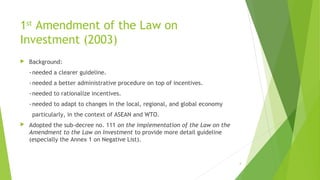
1st
Amendment of the Law on
Investment (2003)
 Background:
-needed a clearer guideline.
-needed a better administrative procedure on top of incentives.
-needed to rationalize incentives.
-needed to adapt to changes in the local, regional, and global economy
particularly, in the context of ASEAN and WTO.
 Adopted the sub-decree no. 111 on the implementation of the Law on the
Amendment to the Law on Investment to provide more detail guideline
(especially the Annex 1 on Negative List).
4
Amended Law on Investment (2003) vs.
Law on Investment (1994)
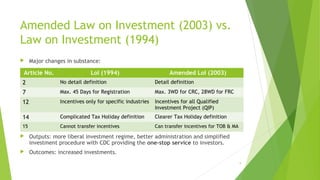
 Major changes in substance:
 Outputs: more liberal investment regime, better administration and simplified
investment procedure with CDC providing the one-stop service to investors.
 Outcomes: increased investments.
Article No. LoI (1994) Amended LoI (2003)
2 No detail definition Detail definition
7 Max. 45 Days for Registration Max. 3WD for CRC, 28WD for FRC
12 Incentives only for specific industries Incentives for all Qualified
Investment Project (QIP)
14 Complicated Tax Holiday definition Clearer Tax Holiday definition
15 Cannot transfer incentives Can transfer incentives for TOB & MA
5
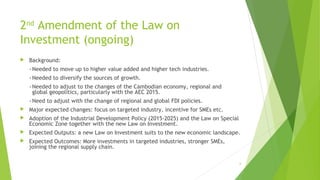
2nd
Amendment of the Law on
Investment (ongoing)
 Background:
- Needed to move up to higher value added and higher tech industries.
- Needed to diversify the sources of growth.
- Needed to adjust to the changes of the Cambodian economy, regional and
global geopolitics, particularly with the AEC 2015.
- Need to adjust with the change of regional and global FDI policies.
 Major expected changes: focus on targeted industry, incentive for SMEs etc.
 Adoption of the Industrial Development Policy (2015-2025) and the Law on Special
Economic Zone together with the new Law on Investment.
 Expected Outputs: a new Law on Investment suits to the new economic landscape.
 Expected Outcomes: More investments in targeted industries, stronger SMEs,
joining the regional supply chain.
6
Thank You for Your
Attention!
Please contact cheavuthysez@gmail.com for more information.

HE Chea Vuthy, Cambodian Investment Board, 2014 ASEAN-OECD Investment Policy Conference

  • 1.
    Investment Law Reform: theCase of Cambodia By Chea Vuthy Deputy Secretary General Cambodian Investment Board / Cambodian Special Economic Zone Board Council for the Development of Cambodia Jakarta, December 10th 2014
  • 2.
    Adoption of theLaw on Investment  Background: 1991: Paris Peace Accord to end civil war. 1993: 1st Democratic General Election organized by the UN. 1994: Adoption of the Law on Investment for development and rehabilitation under Free Market Economy.  establishment of the Council for the Development of Cambodia. 2
  • 3.
    Law on Investment(1994) Main substances of the Investment Law: - Article 7: Registration time (max. 45 days) - Article 8: Equitable treatment for all nationalities - Article 9: No nationalization - Article 10: No price control - Article 11: Free transfer of fund - Article 12 ~ 14: Investment incentives 3
  • 4.
    1st Amendment of theLaw on Investment (2003)  Background: -needed a clearer guideline. -needed a better administrative procedure on top of incentives. -needed to rationalize incentives. -needed to adapt to changes in the local, regional, and global economy particularly, in the context of ASEAN and WTO.  Adopted the sub-decree no. 111 on the implementation of the Law on the Amendment to the Law on Investment to provide more detail guideline (especially the Annex 1 on Negative List). 4
  • 5.
    Amended Law onInvestment (2003) vs. Law on Investment (1994)  Major changes in substance:  Outputs: more liberal investment regime, better administration and simplified investment procedure with CDC providing the one-stop service to investors.  Outcomes: increased investments. Article No. LoI (1994) Amended LoI (2003) 2 No detail definition Detail definition 7 Max. 45 Days for Registration Max. 3WD for CRC, 28WD for FRC 12 Incentives only for specific industries Incentives for all Qualified Investment Project (QIP) 14 Complicated Tax Holiday definition Clearer Tax Holiday definition 15 Cannot transfer incentives Can transfer incentives for TOB & MA 5
  • 6.
    2nd Amendment of theLaw on Investment (ongoing)  Background: - Needed to move up to higher value added and higher tech industries. - Needed to diversify the sources of growth. - Needed to adjust to the changes of the Cambodian economy, regional and global geopolitics, particularly with the AEC 2015. - Need to adjust with the change of regional and global FDI policies.  Major expected changes: focus on targeted industry, incentive for SMEs etc.  Adoption of the Industrial Development Policy (2015-2025) and the Law on Special Economic Zone together with the new Law on Investment.  Expected Outputs: a new Law on Investment suits to the new economic landscape.  Expected Outcomes: More investments in targeted industries, stronger SMEs, joining the regional supply chain. 6
  • 7.
    Thank You forYour Attention! Please contact cheavuthysez@gmail.com for more information.