Mainstreaming environmental and
climate change adaptation into
road projects in Cambodia:
Institutional challenges
2015 ACCARNSI Early Career Research Forum
--------------
Bunlong LENG, PhD Candidate
University of Melbourne
20-22 July 2015
1
2
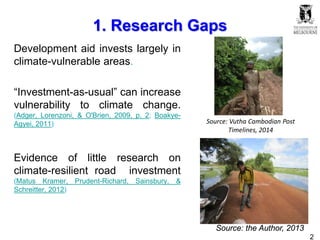
1. Research Gaps
Development aid invests largely in
climate-vulnerable areas.
“Investment-as-usual” can increase
vulnerability to climate change.
(Adger, Lorenzoni, & O'Brien, 2009, p. 2; Boakye-
Agyei, 2011)
Evidence of little research on
climate-resilient road investment
(Matus Kramer, Prudent-Richard, Sainsbury, &
Schreitter, 2012)
Source: Vutha Cambodian Post
Timelines, 2014
Source: the Author, 2013
3
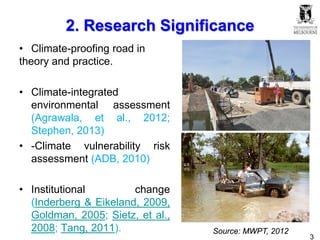
2. Research Significance
• Climate-proofing road in
theory and practice.
• Climate-integrated
environmental assessment
(Agrawala, et al., 2012;
Stephen, 2013)
• -Climate vulnerability risk
assessment (ADB, 2010)
• Institutional change
(Inderberg & Eikeland, 2009,
Goldman, 2005; Sietz, et al.,
2008; Tang, 2011). Source: MWPT, 2012
4
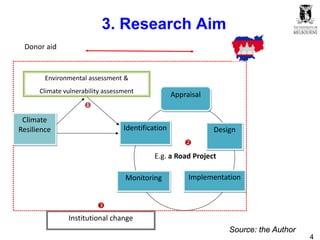
3. Research Aim
Donor aid

Institutional change

Climate
Resilience
Environmental assessment &
Climate vulnerability assessment
E.g. a Road Project
Appraisal
Design
ImplementationMonitoring
Identification

Source: the Author
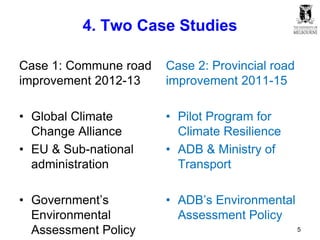
4. Two Case Studies
Case 1: Commune road
improvement 2012-13
• Global Climate
Change Alliance
• EU & Sub-national
administration
• Government’s
Environmental
Assessment Policy
Case 2: Provincial road
improvement 2011-15
• Pilot Program for
Climate Resilience
• ADB & Ministry of
Transport
• ADB’s Environmental
Assessment Policy
5
5. Environmental Assessment?
Case 1:
• No climate in its
IEE/EMP
• IEE/EMP includes
grass and tree
planting
Case2:
• Climate in its
IEE/EMP
• IEE/EMP includes
ecosystem-based
adaptation
• A debatable answer on adaptation
6
7
5. Environmental Assessment?
“Environmental Assessment 2009 covers elements
of climate change, but not on adaptation
measures.” Participant 1.6.
• Lack of coherent climate-proofing approach—
comprehensive guideline
6. What is climate resilience?
Case 1:
• Vulnerability risk
assessment (VRA) at
commune level
• Mainstream
adaptation into sub-
national (commune)
development policy
Case 2:
• Climate change
survey at community
level
• Mainstream
adaptation into road
transport policy
8
9
6. What is climate resilience?
 Ownership to government, but to follow
climate resilience criteria.
 Resource dependency—exert power, with an
ideological purpose, by supplying resources that
are depended upon by the government (Caroline
Hughes, 2009).
“Making road resilience to climate change requires
additional costs. We need donors to support ... “,
participant 49.
10
7. What are institutional challenges?
Resource dependency, decision power, & ownership
capacity:
1. “…week institutional capacity, ADB has leverage to
drive and control the project quality”. Participant
1.61
2. “…as long as we can get free grant, governments are
happy to accept anything”. Participant 1.4
3. “…government will entertain donor requirements so
that the project can move forward”. Participant 1.9
11
7. Institutional challenges?
 Resource dependency
• Fixed budget vs. higher costs—why pay
incremental cost (15%-30%)?
• Expect adaption fund. “We know the potential
risks, but …because people are waiting for
roads and government has budget limitation”.
Participant 1.11
 Decision Power
• Pressure of time and results vs. cost/benefit
with uncertainty.
• Resilience is part of risk management vs. $$
12
7. Institutional challenges?
• Information, knowledge and ownership
capacity—value-added to grassroots and all
others.
13
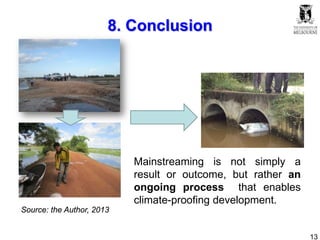
8. Conclusion
Mainstreaming is not simply a
result or outcome, but rather an
ongoing process that enables
climate-proofing development.
Source: the Author, 2013
14
Thank You
Welcome
your suggestions/comments/questions.

MainstreamingCCAin 2 road projects ACCARNSI

  • 1.
    Mainstreaming environmental and climatechange adaptation into road projects in Cambodia: Institutional challenges 2015 ACCARNSI Early Career Research Forum -------------- Bunlong LENG, PhD Candidate University of Melbourne 20-22 July 2015 1
  • 2.
    2 1. Research Gaps Developmentaid invests largely in climate-vulnerable areas. “Investment-as-usual” can increase vulnerability to climate change. (Adger, Lorenzoni, & O'Brien, 2009, p. 2; Boakye- Agyei, 2011) Evidence of little research on climate-resilient road investment (Matus Kramer, Prudent-Richard, Sainsbury, & Schreitter, 2012) Source: Vutha Cambodian Post Timelines, 2014 Source: the Author, 2013
  • 3.
    3 2. Research Significance •Climate-proofing road in theory and practice. • Climate-integrated environmental assessment (Agrawala, et al., 2012; Stephen, 2013) • -Climate vulnerability risk assessment (ADB, 2010) • Institutional change (Inderberg & Eikeland, 2009, Goldman, 2005; Sietz, et al., 2008; Tang, 2011). Source: MWPT, 2012
  • 4.
    4 3. Research Aim Donoraid  Institutional change  Climate Resilience Environmental assessment & Climate vulnerability assessment E.g. a Road Project Appraisal Design ImplementationMonitoring Identification  Source: the Author
  • 5.
    4. Two CaseStudies Case 1: Commune road improvement 2012-13 • Global Climate Change Alliance • EU & Sub-national administration • Government’s Environmental Assessment Policy Case 2: Provincial road improvement 2011-15 • Pilot Program for Climate Resilience • ADB & Ministry of Transport • ADB’s Environmental Assessment Policy 5
  • 6.
    5. Environmental Assessment? Case1: • No climate in its IEE/EMP • IEE/EMP includes grass and tree planting Case2: • Climate in its IEE/EMP • IEE/EMP includes ecosystem-based adaptation • A debatable answer on adaptation 6
  • 7.
    7 5. Environmental Assessment? “EnvironmentalAssessment 2009 covers elements of climate change, but not on adaptation measures.” Participant 1.6. • Lack of coherent climate-proofing approach— comprehensive guideline
  • 8.
    6. What isclimate resilience? Case 1: • Vulnerability risk assessment (VRA) at commune level • Mainstream adaptation into sub- national (commune) development policy Case 2: • Climate change survey at community level • Mainstream adaptation into road transport policy 8
  • 9.
    9 6. What isclimate resilience?  Ownership to government, but to follow climate resilience criteria.  Resource dependency—exert power, with an ideological purpose, by supplying resources that are depended upon by the government (Caroline Hughes, 2009). “Making road resilience to climate change requires additional costs. We need donors to support ... “, participant 49.
  • 10.
    10 7. What areinstitutional challenges? Resource dependency, decision power, & ownership capacity: 1. “…week institutional capacity, ADB has leverage to drive and control the project quality”. Participant 1.61 2. “…as long as we can get free grant, governments are happy to accept anything”. Participant 1.4 3. “…government will entertain donor requirements so that the project can move forward”. Participant 1.9
  • 11.
    11 7. Institutional challenges? Resource dependency • Fixed budget vs. higher costs—why pay incremental cost (15%-30%)? • Expect adaption fund. “We know the potential risks, but …because people are waiting for roads and government has budget limitation”. Participant 1.11  Decision Power • Pressure of time and results vs. cost/benefit with uncertainty. • Resilience is part of risk management vs. $$
  • 12.
    12 7. Institutional challenges? •Information, knowledge and ownership capacity—value-added to grassroots and all others.
  • 13.
    13 8. Conclusion Mainstreaming isnot simply a result or outcome, but rather an ongoing process that enables climate-proofing development. Source: the Author, 2013
  • 14.