Memorandum:
To: Andi Segal - Family Birthing Center Unit Manager
From: Trisda Field
Date: June 29, 2012
Re: Vocational Situation Report
Introduction
I am the Labor and Delivery Unit Clerk at Saint Charles Medical Center in Bend,
Oregon. This position is needed to assist the care providers on the unit, check-in, assess, and
admit patients to the unit, enter Doctors’ orders in the computer, and overall assist in keeping the
unit moving smoothly at all times.
Community Involvement
Saint Charles Medical Center’s Family Birthing Unit primary role in the community is to
provide round the clock care for expectant mothers and their newborn children. We go above and
beyond the call of duty to ensure our patients are comfortable and their needs are met during any
time they are in need of our services. We provide care to families in the Central Oregon area and
take pride in assisting regardless of race, class, or ability to pay. Should the unexpected
complication arise, we are ready to assist with compassion and dedication to the best possible
outcomes for both mother and baby. We work closely with the Ronald Mcdonald House and the
March of Dimes to further assist our patients needs.
Vocation Role
The role of a Unit Clerk in the hospital setting is to provide administrative and
communicative support to any given (and specific) unit of care in the hospital. This position is
very important, as the unit clerk is the first person a patient and their visitors encounter when
entering the unit, as well as the go-to person for Scrub Technicians, Certified Nursing Assistants,
Nurses, and Doctors. This position is often seen as one of the most important supporting roles in
the hospital. Unit Clerks must be able to multi-task in high stress situations while keeping a cool,
collected, and level head. They must be friendly, diligent and up-to-date in their knowledge of
several various computer programs. They must be a “People Person” as they are considered to be
the “Face of the unit”. Each unit in the hospital has various needs and requirements of their unit
clerks, therefore specific job qualifications may vary. Labor and Delivery Unit Clerks must be
able to read and understand the monitoring system used for tracking the babies’ heart rates as
well as the mother's’ contractions, know what labs are most often needed, and how to schedule
in-patient appointments for induction of labor or cesarean sections. They must understand the
medical terminology specific to Obstetrics. They must understand what a “prenatal report” is and
how to obtain it from a Doctors office.
Other Vocation Specialities
There are several other positions available in this vocational field, however, they require
more education, experience, and are not entry-level like that of the Unit Clerk. The Unit clerk is
not usually in charge of any other positions. They are almost always the lowest in the chain of
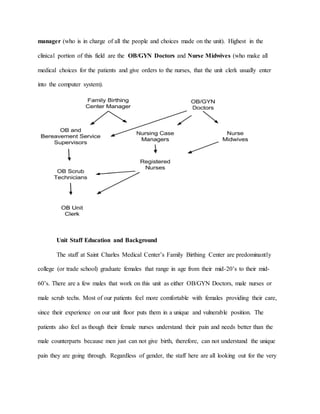
command in the hospital hierarchy. Above the unit clerk are the OB Scrub Technicians (who
assist the Doctors and Nurses during deliveries and surgeries), RegisteredNurses (who take
direct care of the patients), OB and Bereavement Service supervisors (they oversee the unit
clerks and scrub techs) Nursing Case Managers (who oversee the nurses) and the OB unit
manager (who is in charge of all the people and choices made on the unit). Highest in the
clinical portion of this field are the OB/GYN Doctors and Nurse Midwives (who make all
medical choices for the patients and give orders to the nurses, that the unit clerk usually enter
into the computer system).
Unit Staff Education and Background
The staff at Saint Charles Medical Center’s Family Birthing Center are predominantly
college (or trade school) graduate females that range in age from their mid-20’s to their mid-
60’s. There are a few males that work on this unit as either OB/GYN Doctors, male nurses or
male scrub techs. Most of our patients feel more comfortable with females providing their care,
since their experience on our unit floor puts them in a unique and vulnerable position. The
patients also feel as though their female nurses understand their pain and needs better than the
male counterparts because men just can not give birth, therefore, can not understand the unique
pain they are going through. Regardless of gender, the staff here are all looking out for the very
best interests of the mothers and their newborn children. They strive to provide the patients with
the utmost care and respect possible.
Equipment used by staff
The tools used in our unit consist of special labor and delivery beds that break apart
quickly to allow the mother to birth her child easily while the Doctors and nurses are able to get
up close to the patient's birth canal. We use machines that tracks both babies heartbeat(fetal heart
tones) and the mother's contractions to ensure that both mother and baby are safe during the
labor and delivery process. We use forceps and vacuums that assist a mother to deliver her baby
when the baby is stuck in the birth canal. There are also a variety of specialized tools used in the
operating room during surgeries. Along with these special tools that are only used in this unit, we
use tools used by all hospital units such as IV pumps and poles, patient call systems, computers
and their hard/software, telephones and fax machines.

VSRTrisdaField-FinalDraft

  • 1.
    Memorandum: To: Andi Segal- Family Birthing Center Unit Manager From: Trisda Field Date: June 29, 2012 Re: Vocational Situation Report Introduction I am the Labor and Delivery Unit Clerk at Saint Charles Medical Center in Bend, Oregon. This position is needed to assist the care providers on the unit, check-in, assess, and admit patients to the unit, enter Doctors’ orders in the computer, and overall assist in keeping the unit moving smoothly at all times. Community Involvement Saint Charles Medical Center’s Family Birthing Unit primary role in the community is to provide round the clock care for expectant mothers and their newborn children. We go above and beyond the call of duty to ensure our patients are comfortable and their needs are met during any time they are in need of our services. We provide care to families in the Central Oregon area and take pride in assisting regardless of race, class, or ability to pay. Should the unexpected complication arise, we are ready to assist with compassion and dedication to the best possible outcomes for both mother and baby. We work closely with the Ronald Mcdonald House and the March of Dimes to further assist our patients needs. Vocation Role
  • 2.
    The role ofa Unit Clerk in the hospital setting is to provide administrative and communicative support to any given (and specific) unit of care in the hospital. This position is very important, as the unit clerk is the first person a patient and their visitors encounter when entering the unit, as well as the go-to person for Scrub Technicians, Certified Nursing Assistants, Nurses, and Doctors. This position is often seen as one of the most important supporting roles in the hospital. Unit Clerks must be able to multi-task in high stress situations while keeping a cool, collected, and level head. They must be friendly, diligent and up-to-date in their knowledge of several various computer programs. They must be a “People Person” as they are considered to be the “Face of the unit”. Each unit in the hospital has various needs and requirements of their unit clerks, therefore specific job qualifications may vary. Labor and Delivery Unit Clerks must be able to read and understand the monitoring system used for tracking the babies’ heart rates as well as the mother's’ contractions, know what labs are most often needed, and how to schedule in-patient appointments for induction of labor or cesarean sections. They must understand the medical terminology specific to Obstetrics. They must understand what a “prenatal report” is and how to obtain it from a Doctors office. Other Vocation Specialities There are several other positions available in this vocational field, however, they require more education, experience, and are not entry-level like that of the Unit Clerk. The Unit clerk is not usually in charge of any other positions. They are almost always the lowest in the chain of command in the hospital hierarchy. Above the unit clerk are the OB Scrub Technicians (who assist the Doctors and Nurses during deliveries and surgeries), RegisteredNurses (who take direct care of the patients), OB and Bereavement Service supervisors (they oversee the unit clerks and scrub techs) Nursing Case Managers (who oversee the nurses) and the OB unit
  • 3.
    manager (who isin charge of all the people and choices made on the unit). Highest in the clinical portion of this field are the OB/GYN Doctors and Nurse Midwives (who make all medical choices for the patients and give orders to the nurses, that the unit clerk usually enter into the computer system). Unit Staff Education and Background The staff at Saint Charles Medical Center’s Family Birthing Center are predominantly college (or trade school) graduate females that range in age from their mid-20’s to their mid- 60’s. There are a few males that work on this unit as either OB/GYN Doctors, male nurses or male scrub techs. Most of our patients feel more comfortable with females providing their care, since their experience on our unit floor puts them in a unique and vulnerable position. The patients also feel as though their female nurses understand their pain and needs better than the male counterparts because men just can not give birth, therefore, can not understand the unique pain they are going through. Regardless of gender, the staff here are all looking out for the very
  • 4.
    best interests ofthe mothers and their newborn children. They strive to provide the patients with the utmost care and respect possible. Equipment used by staff The tools used in our unit consist of special labor and delivery beds that break apart quickly to allow the mother to birth her child easily while the Doctors and nurses are able to get up close to the patient's birth canal. We use machines that tracks both babies heartbeat(fetal heart tones) and the mother's contractions to ensure that both mother and baby are safe during the labor and delivery process. We use forceps and vacuums that assist a mother to deliver her baby when the baby is stuck in the birth canal. There are also a variety of specialized tools used in the operating room during surgeries. Along with these special tools that are only used in this unit, we use tools used by all hospital units such as IV pumps and poles, patient call systems, computers and their hard/software, telephones and fax machines.