Adventures in Seeing:
Critical Engagement with Images
Implementing Visual Literacy Standards & Guidelines
                 @ Lewis & Clark
                   Stephanie Beene
            Visual Resources Coordinator
                Lewis & Clark College
                     Portland, OR
“Viewing… is a process of searching out and understanding a
particular logic and structure, and discerning whatever it is
that makes [an object] unique.”

– Adrian Piper, “Performance and the Fetishism of the Art Object,”
Vanguard 10 (December 1981/January 1982), 16-19.
Visual Literacy: Beginning & Premise
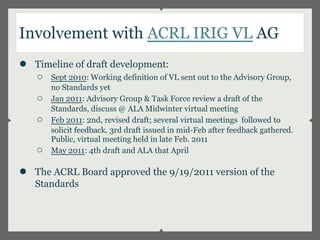
Involvement with ACRL IRIG VL AG
● The Image Research Interest Group (IRIG) formed around
  Sept 2009

●   Task Force formed between Dec 2009- March 2010 to define
    Visual Literacy and begin work on Standards & Guidelines

●   Advisory Group formed in April 2010, of which I became a
    part. Our primary role was to provide feedback to the Task
    Force through the various drafts

●   Kickoff meeting for the Task Force was at ALA, April 2010
Involvement with ACRL IRIG VL AG
●   Timeline of draft development:
    ○   Sept 2010: Working definition of VL sent out to the Advisory Group,
        no Standards yet
    ○   Jan 2011: Advisory Group & Task Force review a draft of the
        Standards, discuss @ ALA Midwinter virtual meeting
    ○   Feb 2011: 2nd, revised draft; several virtual meetings followed to
        solicit feedback. 3rd draft issued in mid-Feb after feedback gathered.
        Public, virtual meeting held in late Feb. 2011
    ○   May 2011: 4th draft and ALA that April

●   The ACRL Board approved the 9/19/2011 version of the
    Standards
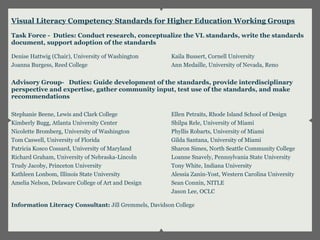
Visual Literacy Competency Standards for Higher Education Working Groups

Task Force - Duties: Conduct research, conceptualize the VL standards, write the standards
document, support adoption of the standards

Denise Hattwig (Chair), University of Washington       Kaila Bussert, Cornell University
Joanna Burgess, Reed College                           Ann Medaille, University of Nevada, Reno


Advisory Group- Duties: Guide development of the standards, provide interdisciplinary
perspective and expertise, gather community input, test use of the standards, and make
recommendations

Stephanie Beene, Lewis and Clark College               Ellen Petraits, Rhode Island School of Design
Kimberly Bugg, Atlanta University Center               Shilpa Rele, University of Miami
Nicolette Bromberg, University of Washington           Phyllis Robarts, University of Miami
Tom Caswell, University of Florida                     Gilda Santana, University of Miami
Patricia Kosco Cossard, University of Maryland         Sharon Simes, North Seattle Community College
Richard Graham, University of Nebraska-Lincoln         Loanne Snavely, Pennsylvania State University
Trudy Jacoby, Princeton University                     Tony White, Indiana University
Kathleen Lonbom, Illinois State University             Alessia Zanin-Yost, Western Carolina University
Amelia Nelson, Delaware College of Art and Design      Sean Connin, NITLE
                                                       Jason Lee, OCLC

Information Literacy Consultant: Jill Gremmels, Davidson College
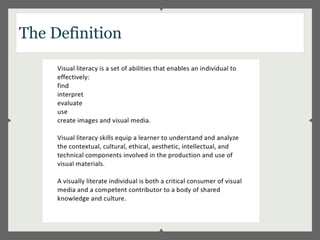
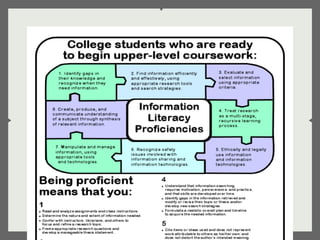
The Definition
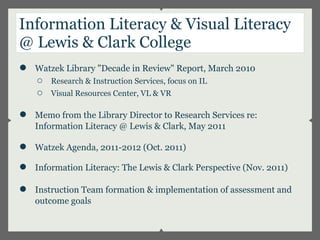
Information Literacy & Visual Literacy
@ Lewis & Clark College
●   Watzek Library "Decade in Review" Report, March 2010
    ○   Research & Instruction Services, focus on IL
    ○   Visual Resources Center, VL & VR

●   Memo from the Library Director to Research Services re:
    Information Literacy @ Lewis & Clark, May 2011

●   Watzek Agenda, 2011-2012 (Oct. 2011)

●   Information Literacy: The Lewis & Clark Perspective (Nov. 2011)

●   Instruction Team formation & implementation of assessment and
    outcome goals
Workshops @ Lewis & Clark
● Faculty Technology Institute, May 2011: Focus on Teaching
  Track: "Do you see what I see? Helping Students Critically
  Engage with Images"
  ○ ** Another VL session is planned at this year's FTI (May 2012)**


● E&D Faculty Workshop, Watzek Library: With Instruction
  Services Coordinator, Kate Rubick, & Faculty Outreach
  Librarian, Dan Kelley (Dec 2011)
  ○ ** A follow-up workshop is planned for May 2012**


● FTI activity on VL adapted for upper-level course, "Gender &
  Aesthetic Expression"(March & April 2012)
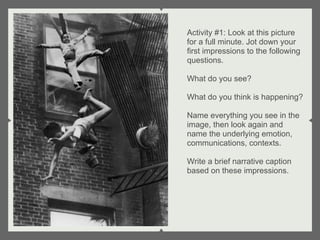
Activity #1: Look at this picture
for a full minute. Jot down your
first impressions to the following
questions.

What do you see?

What do you think is happening?

Name everything you see in the
image, then look again and
name the underlying emotion,
communications, contexts.

Write a brief narrative caption
based on these impressions.
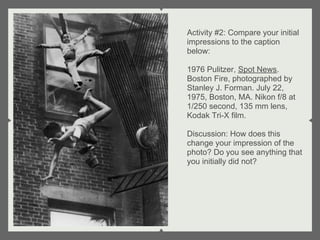
Activity #2: Compare your initial
impressions to the caption
below:

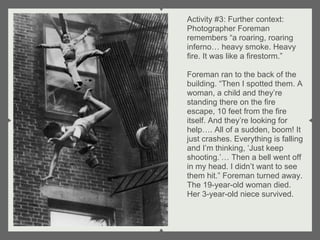
1976 Pulitzer, Spot News.
Boston Fire, photographed by
Stanley J. Forman. July 22,
1975, Boston, MA. Nikon f/8 at
1/250 second, 135 mm lens,
Kodak Tri-X film.

Discussion: How does this
change your impression of the
photo? Do you see anything that
you initially did not?
Activity #3: Further context:
Photographer Foreman
remembers “a roaring, roaring
inferno… heavy smoke. Heavy
fire. It was like a firestorm.”

Foreman ran to the back of the
building. “Then I spotted them. A
woman, a child and they’re
standing there on the fire
escape, 10 feet from the fire
itself. And they’re looking for
help…. All of a sudden, boom! It
just crashes. Everything is falling
and I’m thinking, ‘Just keep
shooting.’… Then a bell went off
in my head. I didn’t want to see
them hit.” Foreman turned away.
The 19-year-old woman died.
Her 3-year-old niece survived.
Discussion & Brainstorm
● Questions:
  ○ How did your opinion or reaction of the photograph change as the
       context deepened?
    ○ How does evaluating an image compare or contrast with evaluating a
       text?
    ○ What sort of context or information might you need in order to make
       an argument with an image?

● Brainstorm: The CRAP Analysis
       Currency
       Reliability
       Accuracy
       Perspective
            * Not just for IL
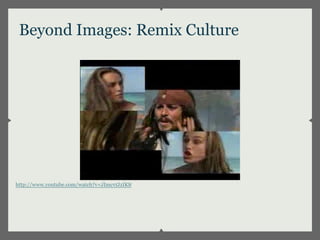
Beyond Images: Remix Culture


http://www.youtube.com/watch?v=JImcvtJzIK8
Ongoing & iterative instruction
● VL in day-to-day work
  ○ Consultations with students, faculty, and staff
  ○ @ the Reference Desk
  ○ Meetings with the Research Services Dept.
  ○ Meetings with the Instruction Team

● VL within Depts on campus
● "Visual Literacy in a Nutshell" - presentation and handout to
   Librarians' Group @ Watzek

● Addressing the question: VL with IL
  ○ How do they work together?
  ○ How are they different?
Information Literacy & Visual Literacy
"The Visual Literacy Standards were developed in the context of the
Information Literacy Competency Standards for Higher Education, and are
intended to complement the Information Literacy Standards...

Images often function as information, but they are also aesthetic and creative
objects that require additional levels of interpretation and analysis. Finding
visual materials in text-based environments requires specific types of research
skills. The use, sharing, and reproduction of visual materials also raise
particular ethical and legal considerations.

The Standards address these distinct characteristics of images and visual media
and challenge students to develop a combination of abilities related to
information literacy, visual communication, interpretation, and technology and
digital media use."

    - ACRL Visual Literacy Competency Standards for Higher Education, http:
    //www.ala.org/acrl/standards/visualliteracy
Acknowledgments, Credits & Further Reading
Lewis & Clark College
Mark Dahl, Acting Director, Aubrey R. Watzek Library
Dan Kelley, Faculty Outreach Librarian
Kate Rubick, Instruction Services Librarian
Miranda Carney-Morris, IT Consultant and Planner-Extraordinaire of the FTI

Image for VL Exercise:
Boston Fire, photographed by Stanley J. Forman. Spot News, July 22, 1975, Boston, MA.© Stanley J. Forman reproduced
with permission in Capture The Moment: The Pulitzer Prize Photographs, Updated Edition, eds. Cyma Rubin and Eric
Newton, Newseum Exh. cat. (2003: W.W. Norton), pp. 94-95.

Chart on Information Literacy Proficiencies:
Creative Commons License Attribution-Non-Commerical:
http://lemonsky.files.wordpress.com/2008/11/ilproficienciesposter.pdf

YouTube Remixed Video
"Where Has the Rum Gone?"-Remix, by DaJuggling Fool: http://www.youtube.com/watch?v=JImcvtJzIK8

Further Reading:
ACRL Visual Literacy Competency Standards & Guidelines:
(History of development)                     http://acrlvislitstandards.wordpress.com/
(Actual Standards & Guidelines):             http://www.ala.org/acrl/standards/visualliteracy

Remix Culture:
Lawrence Lessig, Blog:                       http://www.lessig.org/blog/
Lawrence Lessig on TED Talks:                http://www.ted.com/speakers/larry_lessig.html

VRA 2012, Visual Literacy Case Studies, Adventures in Seeing

  • 1.
    Adventures in Seeing: CriticalEngagement with Images Implementing Visual Literacy Standards & Guidelines @ Lewis & Clark Stephanie Beene Visual Resources Coordinator Lewis & Clark College Portland, OR
  • 2.
    “Viewing… is aprocess of searching out and understanding a particular logic and structure, and discerning whatever it is that makes [an object] unique.” – Adrian Piper, “Performance and the Fetishism of the Art Object,” Vanguard 10 (December 1981/January 1982), 16-19.
  • 3.
  • 4.
    Involvement with ACRLIRIG VL AG ● The Image Research Interest Group (IRIG) formed around Sept 2009 ● Task Force formed between Dec 2009- March 2010 to define Visual Literacy and begin work on Standards & Guidelines ● Advisory Group formed in April 2010, of which I became a part. Our primary role was to provide feedback to the Task Force through the various drafts ● Kickoff meeting for the Task Force was at ALA, April 2010
  • 5.
    Involvement with ACRLIRIG VL AG ● Timeline of draft development: ○ Sept 2010: Working definition of VL sent out to the Advisory Group, no Standards yet ○ Jan 2011: Advisory Group & Task Force review a draft of the Standards, discuss @ ALA Midwinter virtual meeting ○ Feb 2011: 2nd, revised draft; several virtual meetings followed to solicit feedback. 3rd draft issued in mid-Feb after feedback gathered. Public, virtual meeting held in late Feb. 2011 ○ May 2011: 4th draft and ALA that April ● The ACRL Board approved the 9/19/2011 version of the Standards
  • 6.
    Visual Literacy CompetencyStandards for Higher Education Working Groups Task Force - Duties: Conduct research, conceptualize the VL standards, write the standards document, support adoption of the standards Denise Hattwig (Chair), University of Washington Kaila Bussert, Cornell University Joanna Burgess, Reed College Ann Medaille, University of Nevada, Reno Advisory Group- Duties: Guide development of the standards, provide interdisciplinary perspective and expertise, gather community input, test use of the standards, and make recommendations Stephanie Beene, Lewis and Clark College Ellen Petraits, Rhode Island School of Design Kimberly Bugg, Atlanta University Center Shilpa Rele, University of Miami Nicolette Bromberg, University of Washington Phyllis Robarts, University of Miami Tom Caswell, University of Florida Gilda Santana, University of Miami Patricia Kosco Cossard, University of Maryland Sharon Simes, North Seattle Community College Richard Graham, University of Nebraska-Lincoln Loanne Snavely, Pennsylvania State University Trudy Jacoby, Princeton University Tony White, Indiana University Kathleen Lonbom, Illinois State University Alessia Zanin-Yost, Western Carolina University Amelia Nelson, Delaware College of Art and Design Sean Connin, NITLE Jason Lee, OCLC Information Literacy Consultant: Jill Gremmels, Davidson College
  • 7.
  • 8.
    Information Literacy &Visual Literacy @ Lewis & Clark College ● Watzek Library "Decade in Review" Report, March 2010 ○ Research & Instruction Services, focus on IL ○ Visual Resources Center, VL & VR ● Memo from the Library Director to Research Services re: Information Literacy @ Lewis & Clark, May 2011 ● Watzek Agenda, 2011-2012 (Oct. 2011) ● Information Literacy: The Lewis & Clark Perspective (Nov. 2011) ● Instruction Team formation & implementation of assessment and outcome goals
  • 10.
    Workshops @ Lewis& Clark ● Faculty Technology Institute, May 2011: Focus on Teaching Track: "Do you see what I see? Helping Students Critically Engage with Images" ○ ** Another VL session is planned at this year's FTI (May 2012)** ● E&D Faculty Workshop, Watzek Library: With Instruction Services Coordinator, Kate Rubick, & Faculty Outreach Librarian, Dan Kelley (Dec 2011) ○ ** A follow-up workshop is planned for May 2012** ● FTI activity on VL adapted for upper-level course, "Gender & Aesthetic Expression"(March & April 2012)
  • 11.
    Activity #1: Lookat this picture for a full minute. Jot down your first impressions to the following questions. What do you see? What do you think is happening? Name everything you see in the image, then look again and name the underlying emotion, communications, contexts. Write a brief narrative caption based on these impressions.
  • 12.
    Activity #2: Compareyour initial impressions to the caption below: 1976 Pulitzer, Spot News. Boston Fire, photographed by Stanley J. Forman. July 22, 1975, Boston, MA. Nikon f/8 at 1/250 second, 135 mm lens, Kodak Tri-X film. Discussion: How does this change your impression of the photo? Do you see anything that you initially did not?
  • 13.
    Activity #3: Furthercontext: Photographer Foreman remembers “a roaring, roaring inferno… heavy smoke. Heavy fire. It was like a firestorm.” Foreman ran to the back of the building. “Then I spotted them. A woman, a child and they’re standing there on the fire escape, 10 feet from the fire itself. And they’re looking for help…. All of a sudden, boom! It just crashes. Everything is falling and I’m thinking, ‘Just keep shooting.’… Then a bell went off in my head. I didn’t want to see them hit.” Foreman turned away. The 19-year-old woman died. Her 3-year-old niece survived.
  • 14.
    Discussion & Brainstorm ●Questions: ○ How did your opinion or reaction of the photograph change as the context deepened? ○ How does evaluating an image compare or contrast with evaluating a text? ○ What sort of context or information might you need in order to make an argument with an image? ● Brainstorm: The CRAP Analysis Currency Reliability Accuracy Perspective * Not just for IL
  • 15.
    Beyond Images: RemixCulture http://www.youtube.com/watch?v=JImcvtJzIK8
  • 16.
    Ongoing & iterativeinstruction ● VL in day-to-day work ○ Consultations with students, faculty, and staff ○ @ the Reference Desk ○ Meetings with the Research Services Dept. ○ Meetings with the Instruction Team ● VL within Depts on campus ● "Visual Literacy in a Nutshell" - presentation and handout to Librarians' Group @ Watzek ● Addressing the question: VL with IL ○ How do they work together? ○ How are they different?
  • 17.
    Information Literacy &Visual Literacy "The Visual Literacy Standards were developed in the context of the Information Literacy Competency Standards for Higher Education, and are intended to complement the Information Literacy Standards... Images often function as information, but they are also aesthetic and creative objects that require additional levels of interpretation and analysis. Finding visual materials in text-based environments requires specific types of research skills. The use, sharing, and reproduction of visual materials also raise particular ethical and legal considerations. The Standards address these distinct characteristics of images and visual media and challenge students to develop a combination of abilities related to information literacy, visual communication, interpretation, and technology and digital media use." - ACRL Visual Literacy Competency Standards for Higher Education, http: //www.ala.org/acrl/standards/visualliteracy
  • 18.
    Acknowledgments, Credits &Further Reading Lewis & Clark College Mark Dahl, Acting Director, Aubrey R. Watzek Library Dan Kelley, Faculty Outreach Librarian Kate Rubick, Instruction Services Librarian Miranda Carney-Morris, IT Consultant and Planner-Extraordinaire of the FTI Image for VL Exercise: Boston Fire, photographed by Stanley J. Forman. Spot News, July 22, 1975, Boston, MA.© Stanley J. Forman reproduced with permission in Capture The Moment: The Pulitzer Prize Photographs, Updated Edition, eds. Cyma Rubin and Eric Newton, Newseum Exh. cat. (2003: W.W. Norton), pp. 94-95. Chart on Information Literacy Proficiencies: Creative Commons License Attribution-Non-Commerical: http://lemonsky.files.wordpress.com/2008/11/ilproficienciesposter.pdf YouTube Remixed Video "Where Has the Rum Gone?"-Remix, by DaJuggling Fool: http://www.youtube.com/watch?v=JImcvtJzIK8 Further Reading: ACRL Visual Literacy Competency Standards & Guidelines: (History of development) http://acrlvislitstandards.wordpress.com/ (Actual Standards & Guidelines): http://www.ala.org/acrl/standards/visualliteracy Remix Culture: Lawrence Lessig, Blog: http://www.lessig.org/blog/ Lawrence Lessig on TED Talks: http://www.ted.com/speakers/larry_lessig.html