Hello, and thank you so much for attending this talk. I’m here representing the team
that designed and developed the Judy Chicago Research Portal.
At last year’s VRA conference, Binky Lush, the Penn State Libraries’ Manager of
Discovery, Access, and Web Services introduced the Judy Chicago Research Portal and
the partnership behind it. She talked about our experiences with collaboration,
iterative development, and improving access and discoverability for both feminist art
archives and for the collections of smaller institutions.
This year we wanted to talk about our experiences with measuring the use and
impact of the Judy Chicago Research Portal, along with our outreach strategy. We
hope that we can provide some useful ideas for other galleries, libraries, archives, and
museums to increase awareness and engage with users of their digital projects.
Measuring Impact for Sustainable
Digital Projects: Promoting the
Judy Chicago Research Portal
Linda Ballinger (she/her)
Binky Lush (she/her)
Dominique Luster (she/her)
Forough Yazdanpanah (she/her)
VRA 2024 – 9 October 2024
www.judychicagoportal.org
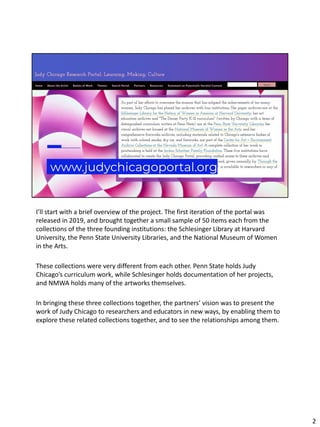
I’ll start with a brief overview of the project. The first iteration of the portal was
released in 2019, and brought together a small sample of 50 items each from the
collections of the three founding institutions: the Schlesinger Library at Harvard
University, the Penn State University Libraries, and the National Museum of Women
in the Arts.
These collections were very different from each other. Penn State holds Judy
Chicago’s curriculum work, while Schlesinger holds documentation of her projects,
and NMWA holds many of the artworks themselves.
In bringing these three collections together, the partners’ vision was to present the
work of Judy Chicago to researchers and educators in new ways, by enabling them to
explore these related collections together, and to see the relationships among them.
2
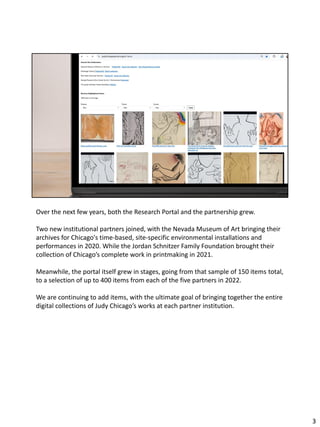
Over the next few years, both the Research Portal and the partnership grew.
Two new institutional partners joined, with the Nevada Museum of Art bringing their
archives for Chicago's time-based, site-specific environmental installations and
performances in 2020. While the Jordan Schnitzer Family Foundation brought their
collection of Chicago’s complete work in printmaking in 2021.
Meanwhile, the portal itself grew in stages, going from that sample of 150 items total,
to a selection of up to 400 items from each of the five partners in 2022.
We are continuing to add items, with the ultimate goal of bringing together the entire
digital collections of Judy Chicago’s works at each partner institution.
3
Goals for Outreach
• Ensure sustainability
• Promote intentionally in the academic community
– conference presentations
– social media outreach
• Measure impact
– website visits
– collections usage
– social media engagement
After four-plus years of developing and populating the research portal, the partners
decided to focus the next couple of years on promoting the portal and reaching new
audiences for the Judy Chicago collections at the partner institutions. This plan also
accommodated changes in priorities and capacity at some of the institutions, changes
that ranged from staffing changes to major collection moves.
The overarching goal we had for our promotion efforts was to ensure the
sustainability of the research portal, so it could be what what the founders
envisioned: a vital resource for scholars, curators, and art educators to explore the
complete works of Judy Chicago, and her role in the feminist art movement, and to
discover the connections between these works of art and documentation of the
collaborative work behind them.
4
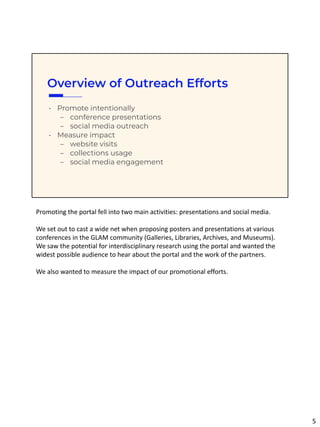
Overview of Outreach Efforts
• Promote intentionally
– conference presentations
– social media outreach
• Measure impact
– website visits
– collections usage
– social media engagement
Promoting the portal fell into two main activities: presentations and social media.
We set out to cast a wide net when proposing posters and presentations at various
conferences in the GLAM community (Galleries, Libraries, Archives, and Museums).
We saw the potential for interdisciplinary research using the portal and wanted the
widest possible audience to hear about the portal and the work of the partners.
We also wanted to measure the impact of our promotional efforts.
5
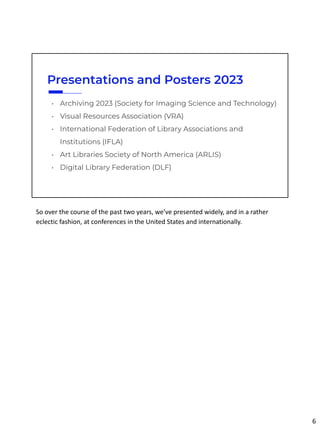
Presentations and Posters 2023
• Archiving 2023 (Society for Imaging Science and Technology)
• Visual Resources Association (VRA)
• International Federation of Library Associations and
Institutions (IFLA)
• Art Libraries Society of North America (ARLIS)
• Digital Library Federation (DLF)
So over the course of the past two years, we’ve presented widely, and in a rather
eclectic fashion, at conferences in the United States and internationally.
6
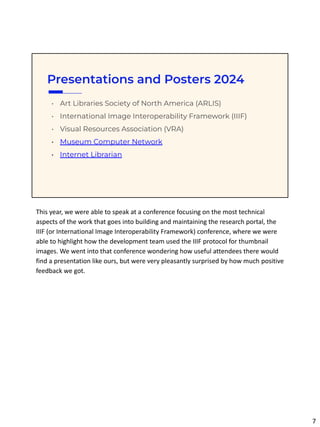
Presentations and Posters 2024
• Art Libraries Society of North America (ARLIS)
• International Image Interoperability Framework (IIIF)
• Visual Resources Association (VRA)
• Museum Computer Network
• Internet Librarian
This year, we were able to speak at a conference focusing on the most technical
aspects of the work that goes into building and maintaining the research portal, the
IIIF (or International Image Interoperability Framework) conference, where we were
able to highlight how the development team used the IIIF protocol for thumbnail
images. We went into that conference wondering how useful attendees there would
find a presentation like ours, but were very pleasantly surprised by how much positive
feedback we got.
7
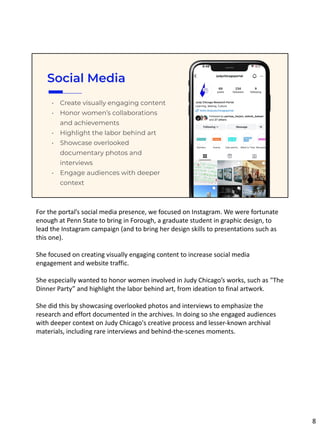
Social Media
• Create visually engaging content
• Honor women’s collaborations
and achievements
• Highlight the labor behind art
• Showcase overlooked
documentary photos and
interviews
• Engage audiences with deeper
context
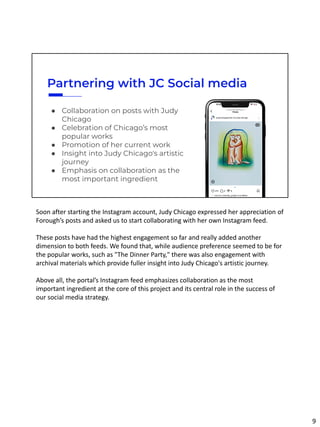
For the portal’s social media presence, we focused on Instagram. We were fortunate
enough at Penn State to bring in Forough, a graduate student in graphic design, to
lead the Instagram campaign (and to bring her design skills to presentations such as
this one).
She focused on creating visually engaging content to increase social media
engagement and website traffic.
She especially wanted to honor women involved in Judy Chicago’s works, such as "The
Dinner Party” and highlight the labor behind art, from ideation to final artwork.
She did this by showcasing overlooked photos and interviews to emphasize the
research and effort documented in the archives. In doing so she engaged audiences
with deeper context on Judy Chicago's creative process and lesser-known archival
materials, including rare interviews and behind-the-scenes moments.
8
Partnering with JC Social media
● Collaboration on posts with Judy
Chicago
● Celebration of Chicago’s most
popular works
● Promotion of her current work
● Insight into Judy Chicago's artistic
journey
● Emphasis on collaboration as the
most important ingredient
Soon after starting the Instagram account, Judy Chicago expressed her appreciation of
Forough’s posts and asked us to start collaborating with her own Instagram feed.
These posts have had the highest engagement so far and really added another
dimension to both feeds. We found that, while audience preference seemed to be for
the popular works, such as "The Dinner Party," there was also engagement with
archival materials which provide fuller insight into Judy Chicago's artistic journey.
Above all, the portal’s Instagram feed emphasizes collaboration as the most
important ingredient at the core of this project and its central role in the success of
our social media strategy.
9
Social Media Analytics
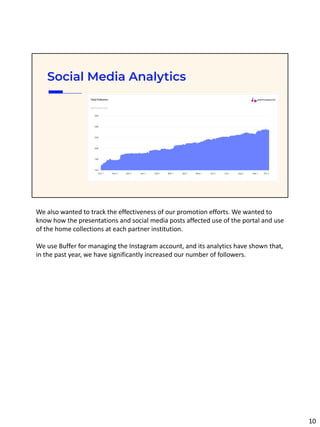
We also wanted to track the effectiveness of our promotion efforts. We wanted to
know how the presentations and social media posts affected use of the portal and use
of the home collections at each partner institution.
We use Buffer for managing the Instagram account, and its analytics have shown that,
in the past year, we have significantly increased our number of followers.
10
Social Media Analytics
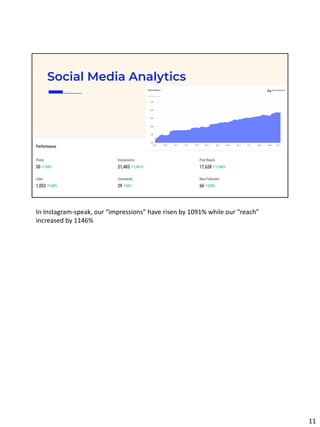
In Instagram-speak, our “impressions” have risen by 1091% while our “reach”
increased by 1146%
11
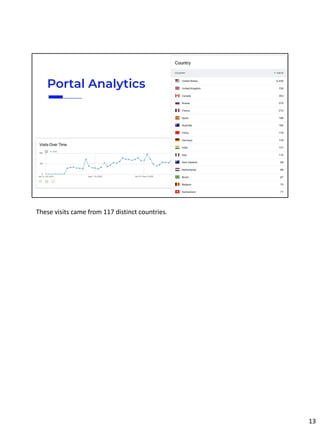
Portal Analytics
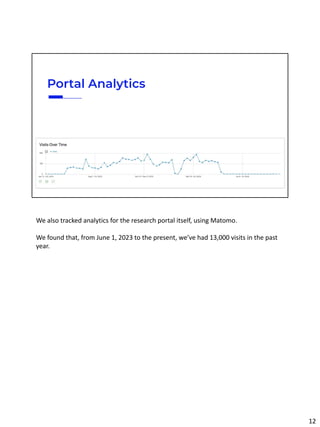
We also tracked analytics for the research portal itself, using Matomo.
We found that, from June 1, 2023 to the present, we’ve had 13,000 visits in the past
year.
12
Portal Analytics
These visits came from 117 distinct countries.
13
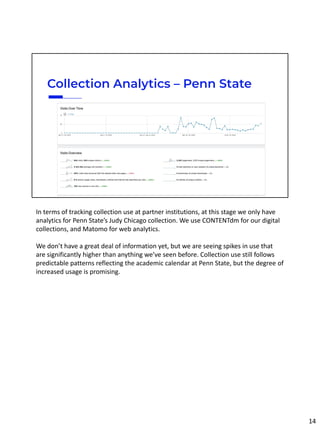
Collection Analytics – Penn State
In terms of tracking collection use at partner institutions, at this stage we only have
analytics for Penn State’s Judy Chicago collection. We use CONTENTdm for our digital
collections, and Matomo for web analytics.
We don’t have a great deal of information yet, but we are seeing spikes in use that
are significantly higher than anything we’ve seen before. Collection use still follows
predictable patterns reflecting the academic calendar at Penn State, but the degree of
increased usage is promising.
14
Future plans
● Grow social media engagement
● Track and compare portal use
● Track and compare use of partners’ collections
● Add content to the portal
○ Goal: Include all items from each institution
● Expand the collaboration with new partners
[just read slide]
15
Lessons Learned
● Social media and presentations do work to promote collections,
but it takes time to see results
● Having a dedicated social media person specifically for a project
makes a big difference
● Collecting and making sense of analytics on archival collections
is hard, but valuable
● Analytics work involves decisions about privacy versus easy to
use data
○ You get a lot of functionality from Google Analytics but pay a
lot in user privacy
[just read slide]
16
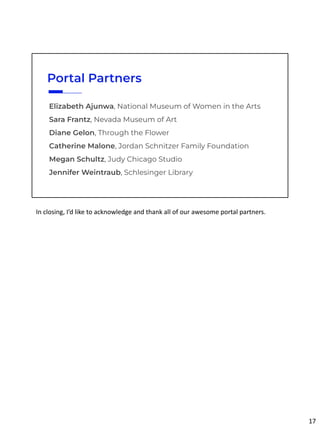
Elizabeth Ajunwa, National Museum of Women in the Arts
Sara Frantz, Nevada Museum of Art
Diane Gelon, Through the Flower
Catherine Malone, Jordan Schnitzer Family Foundation
Megan Schultz, Judy Chicago Studio
Jennifer Weintraub, Schlesinger Library
Portal Partners
In closing, I’d like to acknowledge and thank all of our awesome portal partners.
17
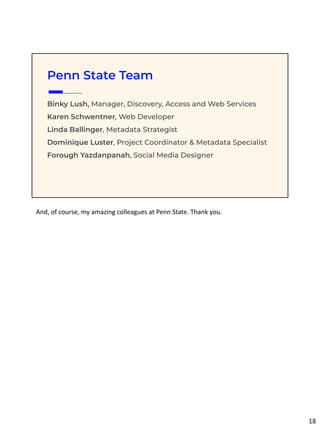
Binky Lush, Manager, Discovery, Access and Web Services
Karen Schwentner, Web Developer
Linda Ballinger, Metadata Strategist
Dominique Luster, Project Coordinator & Metadata Specialist
Forough Yazdanpanah, Social Media Designer
Penn State Team
And, of course, my amazing colleagues at Penn State. Thank you.
18

Measuring Impact for Sustainable Digital Projects

  • 1.
    Hello, and thankyou so much for attending this talk. I’m here representing the team that designed and developed the Judy Chicago Research Portal. At last year’s VRA conference, Binky Lush, the Penn State Libraries’ Manager of Discovery, Access, and Web Services introduced the Judy Chicago Research Portal and the partnership behind it. She talked about our experiences with collaboration, iterative development, and improving access and discoverability for both feminist art archives and for the collections of smaller institutions. This year we wanted to talk about our experiences with measuring the use and impact of the Judy Chicago Research Portal, along with our outreach strategy. We hope that we can provide some useful ideas for other galleries, libraries, archives, and museums to increase awareness and engage with users of their digital projects. Measuring Impact for Sustainable Digital Projects: Promoting the Judy Chicago Research Portal Linda Ballinger (she/her) Binky Lush (she/her) Dominique Luster (she/her) Forough Yazdanpanah (she/her) VRA 2024 – 9 October 2024
  • 2.
    www.judychicagoportal.org I’ll start witha brief overview of the project. The first iteration of the portal was released in 2019, and brought together a small sample of 50 items each from the collections of the three founding institutions: the Schlesinger Library at Harvard University, the Penn State University Libraries, and the National Museum of Women in the Arts. These collections were very different from each other. Penn State holds Judy Chicago’s curriculum work, while Schlesinger holds documentation of her projects, and NMWA holds many of the artworks themselves. In bringing these three collections together, the partners’ vision was to present the work of Judy Chicago to researchers and educators in new ways, by enabling them to explore these related collections together, and to see the relationships among them. 2
  • 3.
    Over the nextfew years, both the Research Portal and the partnership grew. Two new institutional partners joined, with the Nevada Museum of Art bringing their archives for Chicago's time-based, site-specific environmental installations and performances in 2020. While the Jordan Schnitzer Family Foundation brought their collection of Chicago’s complete work in printmaking in 2021. Meanwhile, the portal itself grew in stages, going from that sample of 150 items total, to a selection of up to 400 items from each of the five partners in 2022. We are continuing to add items, with the ultimate goal of bringing together the entire digital collections of Judy Chicago’s works at each partner institution. 3
  • 4.
    Goals for Outreach •Ensure sustainability • Promote intentionally in the academic community – conference presentations – social media outreach • Measure impact – website visits – collections usage – social media engagement After four-plus years of developing and populating the research portal, the partners decided to focus the next couple of years on promoting the portal and reaching new audiences for the Judy Chicago collections at the partner institutions. This plan also accommodated changes in priorities and capacity at some of the institutions, changes that ranged from staffing changes to major collection moves. The overarching goal we had for our promotion efforts was to ensure the sustainability of the research portal, so it could be what what the founders envisioned: a vital resource for scholars, curators, and art educators to explore the complete works of Judy Chicago, and her role in the feminist art movement, and to discover the connections between these works of art and documentation of the collaborative work behind them. 4
  • 5.
    Overview of OutreachEfforts • Promote intentionally – conference presentations – social media outreach • Measure impact – website visits – collections usage – social media engagement Promoting the portal fell into two main activities: presentations and social media. We set out to cast a wide net when proposing posters and presentations at various conferences in the GLAM community (Galleries, Libraries, Archives, and Museums). We saw the potential for interdisciplinary research using the portal and wanted the widest possible audience to hear about the portal and the work of the partners. We also wanted to measure the impact of our promotional efforts. 5
  • 6.
    Presentations and Posters2023 • Archiving 2023 (Society for Imaging Science and Technology) • Visual Resources Association (VRA) • International Federation of Library Associations and Institutions (IFLA) • Art Libraries Society of North America (ARLIS) • Digital Library Federation (DLF) So over the course of the past two years, we’ve presented widely, and in a rather eclectic fashion, at conferences in the United States and internationally. 6
  • 7.
    Presentations and Posters2024 • Art Libraries Society of North America (ARLIS) • International Image Interoperability Framework (IIIF) • Visual Resources Association (VRA) • Museum Computer Network • Internet Librarian This year, we were able to speak at a conference focusing on the most technical aspects of the work that goes into building and maintaining the research portal, the IIIF (or International Image Interoperability Framework) conference, where we were able to highlight how the development team used the IIIF protocol for thumbnail images. We went into that conference wondering how useful attendees there would find a presentation like ours, but were very pleasantly surprised by how much positive feedback we got. 7
  • 8.
    Social Media • Createvisually engaging content • Honor women’s collaborations and achievements • Highlight the labor behind art • Showcase overlooked documentary photos and interviews • Engage audiences with deeper context For the portal’s social media presence, we focused on Instagram. We were fortunate enough at Penn State to bring in Forough, a graduate student in graphic design, to lead the Instagram campaign (and to bring her design skills to presentations such as this one). She focused on creating visually engaging content to increase social media engagement and website traffic. She especially wanted to honor women involved in Judy Chicago’s works, such as "The Dinner Party” and highlight the labor behind art, from ideation to final artwork. She did this by showcasing overlooked photos and interviews to emphasize the research and effort documented in the archives. In doing so she engaged audiences with deeper context on Judy Chicago's creative process and lesser-known archival materials, including rare interviews and behind-the-scenes moments. 8
  • 9.
    Partnering with JCSocial media ● Collaboration on posts with Judy Chicago ● Celebration of Chicago’s most popular works ● Promotion of her current work ● Insight into Judy Chicago's artistic journey ● Emphasis on collaboration as the most important ingredient Soon after starting the Instagram account, Judy Chicago expressed her appreciation of Forough’s posts and asked us to start collaborating with her own Instagram feed. These posts have had the highest engagement so far and really added another dimension to both feeds. We found that, while audience preference seemed to be for the popular works, such as "The Dinner Party," there was also engagement with archival materials which provide fuller insight into Judy Chicago's artistic journey. Above all, the portal’s Instagram feed emphasizes collaboration as the most important ingredient at the core of this project and its central role in the success of our social media strategy. 9
  • 10.
    Social Media Analytics Wealso wanted to track the effectiveness of our promotion efforts. We wanted to know how the presentations and social media posts affected use of the portal and use of the home collections at each partner institution. We use Buffer for managing the Instagram account, and its analytics have shown that, in the past year, we have significantly increased our number of followers. 10
  • 11.
    Social Media Analytics InInstagram-speak, our “impressions” have risen by 1091% while our “reach” increased by 1146% 11
  • 12.
    Portal Analytics We alsotracked analytics for the research portal itself, using Matomo. We found that, from June 1, 2023 to the present, we’ve had 13,000 visits in the past year. 12
  • 13.
    Portal Analytics These visitscame from 117 distinct countries. 13
  • 14.
    Collection Analytics –Penn State In terms of tracking collection use at partner institutions, at this stage we only have analytics for Penn State’s Judy Chicago collection. We use CONTENTdm for our digital collections, and Matomo for web analytics. We don’t have a great deal of information yet, but we are seeing spikes in use that are significantly higher than anything we’ve seen before. Collection use still follows predictable patterns reflecting the academic calendar at Penn State, but the degree of increased usage is promising. 14
  • 15.
    Future plans ● Growsocial media engagement ● Track and compare portal use ● Track and compare use of partners’ collections ● Add content to the portal ○ Goal: Include all items from each institution ● Expand the collaboration with new partners [just read slide] 15
  • 16.
    Lessons Learned ● Socialmedia and presentations do work to promote collections, but it takes time to see results ● Having a dedicated social media person specifically for a project makes a big difference ● Collecting and making sense of analytics on archival collections is hard, but valuable ● Analytics work involves decisions about privacy versus easy to use data ○ You get a lot of functionality from Google Analytics but pay a lot in user privacy [just read slide] 16
  • 17.
    Elizabeth Ajunwa, NationalMuseum of Women in the Arts Sara Frantz, Nevada Museum of Art Diane Gelon, Through the Flower Catherine Malone, Jordan Schnitzer Family Foundation Megan Schultz, Judy Chicago Studio Jennifer Weintraub, Schlesinger Library Portal Partners In closing, I’d like to acknowledge and thank all of our awesome portal partners. 17
  • 18.
    Binky Lush, Manager,Discovery, Access and Web Services Karen Schwentner, Web Developer Linda Ballinger, Metadata Strategist Dominique Luster, Project Coordinator & Metadata Specialist Forough Yazdanpanah, Social Media Designer Penn State Team And, of course, my amazing colleagues at Penn State. Thank you. 18