Disclaimer
• Andreas Rauterkus is not a registered
investment advisor or broker/dealer. Readers
are advised that the material contained herein
should be used solely for informational
purposes. Andreas Rauterkus does not purport
to tell or suggest which investment securities
attendants should buy or sell for themselves.
You should always conduct your own research
and due diligence and obtain professional
advice before making any investment decision.
Objectives
• What is diversification?
• The key is asset allocation
• Match appropriate asset allocation to specific
financial goal
The Principle of Diversification
• combining imperfectly related assets can
produce a portfolio with less variability than the
typical individual asset
• the portion of risk that can be eliminated by
diversification is called diversifiable risk
• the portion of risk that cannot be eliminated by
diversification is called undiversifiable risk
Diversification and Portfolio Risk
• Diversification and Unsystematic (idiosyncratic) Risk
– unsystematic risk can be eliminated by diversification
– unsystematic risk = diversifiable risk
• Diversification and Systematic Risk
– systematic risk cannot be eliminated by diversification
– systematic risk = undiversifiable risk (market risk)
• Total risk = systematic risk + unsystematic risk
= undiversifiable risk + diversifiable
risk
6
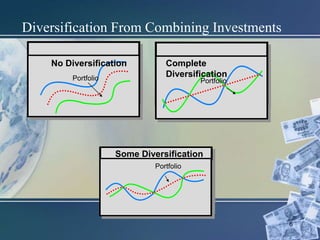
Diversification From Combining Investments
Portfolio
No Diversification
Portfolio
Complete
Diversification
Portfolio
Some Diversification
7
What Is Asset Allocation?
• Process of diversifying portfolio investments among
several investment categories to reduce investment
risk
• Example: 50% stock, 30% bonds, 20% cash assets
(e.g., Treasury bills)
• Objective: lower investment risk by reducing
portfolio volatility
• Loss in one investment may be offset by gains in
another
8
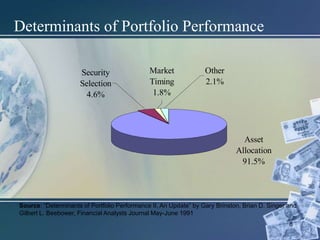
Determinants of Portfolio Performance
Asset
Allocation
91.5%
Other
2.1%
Market
Timing
1.8%
Security
Selection
4.6%
Source: ā€œDeterminants of Portfolio Performance II, An Updateā€ by Gary Brinston, Brian D. Singer and
Gilbert L. Beebower, Financial Analysts Journal May-June 1991
9
The Importance of Asset Allocation
• Asset allocation is the MOST important decision an
investor makes (i.e. different asset classes, NOT
Coke versus Pepsi)
• Asset allocation determines about 90% of the return
variation between portfolios
• This study has been repeated numerous times by
different researchers, with similar results.
10
Why Use Asset Allocation?
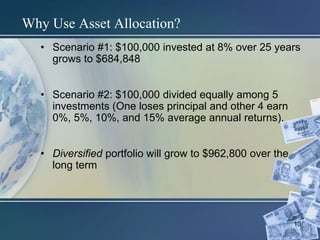
• Scenario #1: $100,000 invested at 8% over 25 years
grows to $684,848
• Scenario #2: $100,000 divided equally among 5
investments (One loses principal and other 4 earn
0%, 5%, 10%, and 15% average annual returns).
• Diversified portfolio will grow to $962,800 over the
long term
11
Factors To Consider
• Investment objective (e.g., retirement)
• Time horizon for a goal (e.g., life expectancy for
retirement)
• Amount of money you have to invest
• Your risk tolerance and experience
• Your age and net worth
12
Downside of Asset Allocation
• A diversified portfolio MAY generate a lower rate of
return when compared to a single ā€œhotā€ asset class
BUT
• You never know the ā€œhotā€ asset class in advance
• Asset allocation attempts to reduce volatility and
provide a competitive rate of return
13
Major Asset Classes
• Large company growth
stocks
• Large company value
stocks
• Small company growth
stocks
• Small company value
stocks
• Mid cap growth stocks
• Mid cap value stocks
• Foreign stocks
– Developed
– Emerging
• Bonds
– Domestic
– International
• Real estate (e.g.,
REITs)
• Cash assets (e.g.,
CDs, Treasury bills)
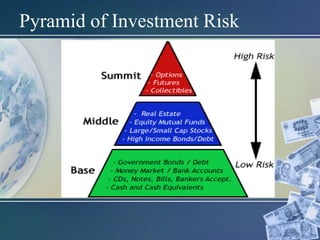
Pyramid of Investment Risk
15
The Asset Allocation Process
• Define goals and time horizon
• Assess your risk tolerance
• Identify asset mix of current portfolio
• Create target portfolio (asset model)
• Specific investment selection
• Review and rebalance portfolio
16
Other Things to Know About Asset Allocation
• Portfolio risk decreases as the # of asset classes
increases
• Best results are achieved over time
• Diversify holdings within each asset category
– Stock: different industry sectors
– Bonds: different types and maturities
17
More Asset Allocation Tips
• Stick to your asset allocation model unless personal
circumstances change
• Rebalance when asset percentages change by a
certain amount (e.g., 2%)
• Any one sector no > 10%- 30%

Smart Directions Portfolio Diversification - 2/4/2016

  • 2.
    Disclaimer • Andreas Rauterkusis not a registered investment advisor or broker/dealer. Readers are advised that the material contained herein should be used solely for informational purposes. Andreas Rauterkus does not purport to tell or suggest which investment securities attendants should buy or sell for themselves. You should always conduct your own research and due diligence and obtain professional advice before making any investment decision.
  • 3.
    Objectives • What isdiversification? • The key is asset allocation • Match appropriate asset allocation to specific financial goal
  • 4.
    The Principle ofDiversification • combining imperfectly related assets can produce a portfolio with less variability than the typical individual asset • the portion of risk that can be eliminated by diversification is called diversifiable risk • the portion of risk that cannot be eliminated by diversification is called undiversifiable risk
  • 5.
    Diversification and PortfolioRisk • Diversification and Unsystematic (idiosyncratic) Risk – unsystematic risk can be eliminated by diversification – unsystematic risk = diversifiable risk • Diversification and Systematic Risk – systematic risk cannot be eliminated by diversification – systematic risk = undiversifiable risk (market risk) • Total risk = systematic risk + unsystematic risk = undiversifiable risk + diversifiable risk
  • 6.
    6 Diversification From CombiningInvestments Portfolio No Diversification Portfolio Complete Diversification Portfolio Some Diversification
  • 7.
    7 What Is AssetAllocation? • Process of diversifying portfolio investments among several investment categories to reduce investment risk • Example: 50% stock, 30% bonds, 20% cash assets (e.g., Treasury bills) • Objective: lower investment risk by reducing portfolio volatility • Loss in one investment may be offset by gains in another
  • 8.
    8 Determinants of PortfolioPerformance Asset Allocation 91.5% Other 2.1% Market Timing 1.8% Security Selection 4.6% Source: ā€œDeterminants of Portfolio Performance II, An Updateā€ by Gary Brinston, Brian D. Singer and Gilbert L. Beebower, Financial Analysts Journal May-June 1991
  • 9.
    9 The Importance ofAsset Allocation • Asset allocation is the MOST important decision an investor makes (i.e. different asset classes, NOT Coke versus Pepsi) • Asset allocation determines about 90% of the return variation between portfolios • This study has been repeated numerous times by different researchers, with similar results.
  • 10.
    10 Why Use AssetAllocation? • Scenario #1: $100,000 invested at 8% over 25 years grows to $684,848 • Scenario #2: $100,000 divided equally among 5 investments (One loses principal and other 4 earn 0%, 5%, 10%, and 15% average annual returns). • Diversified portfolio will grow to $962,800 over the long term
  • 11.
    11 Factors To Consider •Investment objective (e.g., retirement) • Time horizon for a goal (e.g., life expectancy for retirement) • Amount of money you have to invest • Your risk tolerance and experience • Your age and net worth
  • 12.
    12 Downside of AssetAllocation • A diversified portfolio MAY generate a lower rate of return when compared to a single ā€œhotā€ asset class BUT • You never know the ā€œhotā€ asset class in advance • Asset allocation attempts to reduce volatility and provide a competitive rate of return
  • 13.
    13 Major Asset Classes •Large company growth stocks • Large company value stocks • Small company growth stocks • Small company value stocks • Mid cap growth stocks • Mid cap value stocks • Foreign stocks – Developed – Emerging • Bonds – Domestic – International • Real estate (e.g., REITs) • Cash assets (e.g., CDs, Treasury bills)
  • 14.
  • 15.
    15 The Asset AllocationProcess • Define goals and time horizon • Assess your risk tolerance • Identify asset mix of current portfolio • Create target portfolio (asset model) • Specific investment selection • Review and rebalance portfolio
  • 16.
    16 Other Things toKnow About Asset Allocation • Portfolio risk decreases as the # of asset classes increases • Best results are achieved over time • Diversify holdings within each asset category – Stock: different industry sectors – Bonds: different types and maturities
  • 17.
    17 More Asset AllocationTips • Stick to your asset allocation model unless personal circumstances change • Rebalance when asset percentages change by a certain amount (e.g., 2%) • Any one sector no > 10%- 30%