Volunteer Tutor
Orientation
The Community Reading Project
October 11, 2016
What is The Community Reading Project?
What am I being “oriented” for?
Volunteer Manual: pp. 14-19
One-on-one tutoring
More closely resembled “traditional” schooling
Meet weekly (or possibly more) during a time
and schedule determined by tutor-student
pairs
May have homework or other work outside of
class
Tutor is responsible for lesson planning and
assessments
Student must go through intake & assessment
(aka, learning testing) process
Learning is tailored to student’s abilities
Attendance at sessions is required
Time requirements and material may be more
intensive than at Reading Info Desks
Reading Info Desks
Walk-in reading help; tutor is required to do 2
sessions per month at a single location
Sites, dates and times are pre-determined;
students and volunteers must conform to
existing schedule
“Just in time” learning model: student gets just
enough information to satisfy short-term
goals
Tutor is responsible for helping students as they
appear; no extra planning outside of sessions
No formal intake required for students.
Informal assessment measures available in
Reading Help Desk kits.
Less individualized help than one-on-one
tutoring
No attendance requirements; students may
come and go to the Reading Info Desks as
needed
We want your input.
What’s the process for meeting with students?
Volunteer Manual: pp. 14-19
Importance of taking statistics
Some Best Practices
Safety
Professionalism
Communication with Program Director
Teaching Adults & Volunteer Manual
Tutor Support Resources
Teaching Adults
What makes someone an effective teacher?
What does being supportive look like?
How do our own backgrounds and experiences influence
us as we teach and learn?
Learning Challenges
Break time
What is reading? What is literacy?
Five strands of reading
https://www.youtube.com/watch?v=gtEspw_iUT0
Project: Learning and Teaching
1. Step one: As a group, read the assigned section of “Put Reading First” and discuss
(15 minutes)
2. Step two: Look through the text and write out the answers to these questions:
a. Why is _______ (phonetic awareness/phonics/fluency/etc.) important for
reading?
b. What activities can help to teach it?
3. Step three: Present your findings from Step 2 to the class (5 minutes per group)
The whole “Put Reading First” text is available online at:
https://lincs.ed.gov/publications/pdf/PRFbooklet.pdf
Element 1: Phonemic Awareness
1. Why is it important?
2. What activities can help to teach it?
3. Additional Resources
a. Put Reading First (pp. 13-16)
https://lincs.ed.gov/publications/pdf/PRFbooklet.pdf
Element 2: Phonics
1. Why is it important?
2. What activities can help to teach it?
3. Additional Resources
a. Teaching Adults Ch. 8
Element 3: Fluency
1. Why is it important?
2. What activities can help to teach it?
3. Additional Resources
a. Put Reading First pp. 29-36
b. Teaching Adults Ch. 7
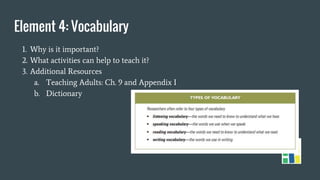
Element 4: Vocabulary
1. Why is it important?
2. What activities can help to teach it?
3. Additional Resources
a. Teaching Adults: Ch. 9 and Appendix I
b. Dictionary
Element 5: Comprehension
1. Why is it important?
2. What activities can help to teach it?
3. Additional Resources
a. Teaching Adults Ch. 10 (especially “Roadblocks” section)
b. Put Reading First pp. 51-58
Element 5: Comprehension
"...[Adult basic education] adults' knowledge about reading, or their meta-
comprehension, is more like that of children who are beginning readers. They
are less aware than good readers of strategies that can be used to monitor
comprehension, view reading as decoding as opposed to comprehending text,
and are less aware of the general structure of paragraphs and stories....
Comprehension strategies, such as how to monitor comprehension during
reading and how to determine a text's basic structure, may need to be
taught."
LINCS research: https://lincs.ed.gov/readingprofiles/MC_Text_Comprehension.htm
Teaching Reading: More In-Depth Guidance
Teaching Adults: Ch 7, 8, 9, 10
Teaching Adults: Appendix C-L
YouTube Channel:
https://www.youtube.com/channel/UCE2IxKDHD5mjWQEyfKzU1DQ
Put Reading First: https://lincs.ed.gov/publications/pdf/PRFbooklet.pdf
ProLiteracy EdNet Instructor Resources:
http://www.proliteracyednet.org/articles.asp?mcid=2&cid=24
YouTube vs. Purdue Engineering
My Point
Teaching Strategies
Workbooks
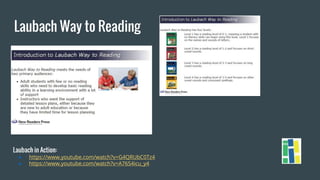
Laubach Way to Reading
Laubach in Action:
● https://www.youtube.com/watch?v=G4QRUbC0Tz4
● https://www.youtube.com/watch?v=A76S4icu_y4
Another Laubach Resource
ProLiteracyEdNet.org: “Learning to Use Laubach Way to Reading,
Laubach Way to English, and Focus on Phonics”
http://www.proliteracyednet.org/articles.asp?mcid=2&cid=24
LEA (Language Experience Activity)
Authentic Materials
Structuring Class & Lesson Planning: Think Backwards
Checking for Understanding (Assessment)
Hands-on practice
Before you leave
Fill out Volunteer Application
Indicate preference for Reading Info Desk OR 1:1 tutoring
Take a business card
Take your books
What happens next

Volunteer Tutor Orientation (Oct 11)

  • 1.
    Volunteer Tutor Orientation The CommunityReading Project October 11, 2016
  • 2.
    What is TheCommunity Reading Project?
  • 3.
    What am Ibeing “oriented” for? Volunteer Manual: pp. 14-19
  • 4.
    One-on-one tutoring More closelyresembled “traditional” schooling Meet weekly (or possibly more) during a time and schedule determined by tutor-student pairs May have homework or other work outside of class Tutor is responsible for lesson planning and assessments Student must go through intake & assessment (aka, learning testing) process Learning is tailored to student’s abilities Attendance at sessions is required Time requirements and material may be more intensive than at Reading Info Desks
  • 5.
    Reading Info Desks Walk-inreading help; tutor is required to do 2 sessions per month at a single location Sites, dates and times are pre-determined; students and volunteers must conform to existing schedule “Just in time” learning model: student gets just enough information to satisfy short-term goals Tutor is responsible for helping students as they appear; no extra planning outside of sessions No formal intake required for students. Informal assessment measures available in Reading Help Desk kits. Less individualized help than one-on-one tutoring No attendance requirements; students may come and go to the Reading Info Desks as needed
  • 6.
  • 7.
    What’s the processfor meeting with students? Volunteer Manual: pp. 14-19
  • 8.
  • 9.
    Some Best Practices Safety Professionalism Communicationwith Program Director Teaching Adults & Volunteer Manual Tutor Support Resources
  • 10.
  • 11.
    What makes someonean effective teacher? What does being supportive look like? How do our own backgrounds and experiences influence us as we teach and learn?
  • 12.
  • 13.
  • 14.
    What is reading?What is literacy?
  • 15.
    Five strands ofreading https://www.youtube.com/watch?v=gtEspw_iUT0
  • 16.
    Project: Learning andTeaching 1. Step one: As a group, read the assigned section of “Put Reading First” and discuss (15 minutes) 2. Step two: Look through the text and write out the answers to these questions: a. Why is _______ (phonetic awareness/phonics/fluency/etc.) important for reading? b. What activities can help to teach it? 3. Step three: Present your findings from Step 2 to the class (5 minutes per group) The whole “Put Reading First” text is available online at: https://lincs.ed.gov/publications/pdf/PRFbooklet.pdf
  • 17.
    Element 1: PhonemicAwareness 1. Why is it important? 2. What activities can help to teach it? 3. Additional Resources a. Put Reading First (pp. 13-16) https://lincs.ed.gov/publications/pdf/PRFbooklet.pdf
  • 18.
    Element 2: Phonics 1.Why is it important? 2. What activities can help to teach it? 3. Additional Resources a. Teaching Adults Ch. 8
  • 19.
    Element 3: Fluency 1.Why is it important? 2. What activities can help to teach it? 3. Additional Resources a. Put Reading First pp. 29-36 b. Teaching Adults Ch. 7
  • 20.
    Element 4: Vocabulary 1.Why is it important? 2. What activities can help to teach it? 3. Additional Resources a. Teaching Adults: Ch. 9 and Appendix I b. Dictionary
  • 21.
    Element 5: Comprehension 1.Why is it important? 2. What activities can help to teach it? 3. Additional Resources a. Teaching Adults Ch. 10 (especially “Roadblocks” section) b. Put Reading First pp. 51-58
  • 22.
    Element 5: Comprehension "...[Adultbasic education] adults' knowledge about reading, or their meta- comprehension, is more like that of children who are beginning readers. They are less aware than good readers of strategies that can be used to monitor comprehension, view reading as decoding as opposed to comprehending text, and are less aware of the general structure of paragraphs and stories.... Comprehension strategies, such as how to monitor comprehension during reading and how to determine a text's basic structure, may need to be taught." LINCS research: https://lincs.ed.gov/readingprofiles/MC_Text_Comprehension.htm
  • 23.
    Teaching Reading: MoreIn-Depth Guidance Teaching Adults: Ch 7, 8, 9, 10 Teaching Adults: Appendix C-L YouTube Channel: https://www.youtube.com/channel/UCE2IxKDHD5mjWQEyfKzU1DQ Put Reading First: https://lincs.ed.gov/publications/pdf/PRFbooklet.pdf ProLiteracy EdNet Instructor Resources: http://www.proliteracyednet.org/articles.asp?mcid=2&cid=24
  • 24.
    YouTube vs. PurdueEngineering
  • 25.
  • 26.
  • 27.
  • 28.
    Laubach Way toReading Laubach in Action: ● https://www.youtube.com/watch?v=G4QRUbC0Tz4 ● https://www.youtube.com/watch?v=A76S4icu_y4
  • 29.
    Another Laubach Resource ProLiteracyEdNet.org:“Learning to Use Laubach Way to Reading, Laubach Way to English, and Focus on Phonics” http://www.proliteracyednet.org/articles.asp?mcid=2&cid=24
  • 30.
  • 31.
  • 32.
    Structuring Class &Lesson Planning: Think Backwards
  • 33.
  • 34.
  • 35.
    Before you leave Fillout Volunteer Application Indicate preference for Reading Info Desk OR 1:1 tutoring Take a business card Take your books What happens next

Editor's Notes

  • #3 We help adults in Muncie/Delaware County with reading. Target native speakers reading below a 6th grade level Goal centered and learner centered Free for students Operate solely on the basis of volunteering Partners: United Way, Ross Center MAT EXAMPLE: website--partner page
  • #4 Highlight differences Other volunteer opportunities--no training required Introduce Volunteer Handbook--can answer questions HANDOUT: VOLUNTEER MANUAL, TEACHING ADULTS
  • #6 Point out chart
  • #7 These processes and procedures are new. We want to know what’s working, what isn’t, so we can make the program better.
  • #8 Outline Procedures for each--have them open Handbooks to pp 14-19 Need to give them the “what will actually happen when I show up to teach?” summary here May need more than one slide Length of commitment HANDOUT: STUDENT/VOLUNTEER CONTRACTS
  • #9 Stats help us be more effective Stats help us generate funding MAT EXAMPLE: STATS SHEET
  • #10 Safety standards Showing up on time, being respectful, etc Tutor Support Group, YouTube, ProLiteracyEdNet, Private Facebook group (created after first meeting) HANDOUT: business cards, “Teaching Adults”, Tutor Support Resources sheet
  • #12 Start with discussion
  • #13 I want us to switch gears for a moment, and think about students. Some food for thought: Dyslexia video--first five minutes: https://youtu.be/o509EudHqGc (through shoe) P. 23 in Teaching Adults, especially bottom of page 24 If you try a bunch of different teaching strategies, and nothing is working, talk to me. They may need more help than one tutor can give. We can work with Decoding Dyslexia people.
  • #14 10 minute break
  • #15 Discussion: what is reading? Reading is making meaning out of what we see. Symbolism of letters, but also the broader context of comprehension. Literacy is the ability to use printed material to function in society, achieve one’s goals, and develop one’s own knowledge and potential. The reading we’ll talk about specifically relates to making meaning out of print, but don’t forget that the big picture--beyond all the mechanics--is literacy.
  • #18 See Teacher’s Notes
  • #24 Strongly suggest that they view these materials independently after orientation I would read Ch 7-10 all the way, and utilize the appendix and the YouTube channel as needed Another great report: Put Reading First
  • #25 Question time! Last time your computer broke, did you go on YouTube and search: ‘broken motherboard’ or did you enroll in Purdue’s school of engineering so that you could really understand the computer’s electrical components and fix it that way? Neither is a wrong way to get the info. But your situation will play heavily into which route you take. Adults, as we know, need enough information to manage their situation and apply it relevantly. That’s the same whether you’re learning to read or fixing your computer.
  • #26 Not all students need the same thing. Some will need to start at the bottom, teaching phonics or even phonetic awareness, but others may not. Good news for you because it means you don’t have to be an immediate expert on every single topic. You just have to learn what it is your students need, figuring out what they need, and work together to help them to gain those needed skills. Keep it simple, introduce a few new words at a time. One teacher swears by three new words. Again, it will depend on your student.
  • #27 You’ve learned all about reading. Now, what do you do? How do you put it inot action?
  • #28 10 minutes Introduce Challenger (and re-mention Laubach) Show examples; explain where tutors can get them (and that we have them stocked at Ross and at Reading Info Desk locations) Pros & cons of using workbooks Time for hands-on practice
  • #31 15 minutes What is a LEA Pros & Cons of using LEA Demo
  • #32 10 minutes Show examples; explain where tutors can get them (and that we have them stocked at Ross and at Reading Info Desk locations) Reader Library Pros of using authentic materials Cons of using authentic materials
  • #33 Slides 30-31: 10 minutes Backwards design: FIRST, identify the goal. THEN plan the lesson.
  • #34 Alternative name for “testing” 1:1 students are formally assessed before being assigned a tutor Can use QARI assessment; copies in Reading Info Desk and at Ross Center Can do it as you go Beginning of session review Ask, ‘what did you have trouble with?’ and ‘Did you meet your goal?’ Request a more in-depth assessment RESOURCE: QARI assessment
  • #35 Give opportunity to look at materials and reading info desk set-up Point out video on YouTube that demonstrates first ABE sessions https://www.youtube.com/watch?v=ySDTcx_I4Bs https://www.youtube.com/watch?v=EGtEL000aQI https://www.youtube.com/watch?v=9qreeXoHSjA
  • #36 Fill out Volunteer Application Indicate preference for Reading Info Desk OR 1:1 tutoring Take a business card Take your books What happens next