ELECTRONIC MEDIA –
VOICE MODULATION
BY ARYAN JHAVERI
WHAT IS VOICE MODULATION ?
• Voice modulation means the fine-tuning of the pitch or tone of voice that helps the audience
clearly hear and understand the lecture, presentation, and speech delivered by a speaker.
• It is very important especially in public speaking. If you want to become an efficient speaker,
you must master the art of voice modulation. By mastering the art of voice modulation, you
can make your oral presentation or speech more interesting, understandable and memorable
to your audience.
• Those who have acquired sweet and melodious voice naturally also need to exercise their
voice for modulation, variation and professional success.
ARE YOU INTERESTED IN LEARNING VARIOUS VOICE TECHNIQUES?
CLICK HERE - Learn Voice Techniques
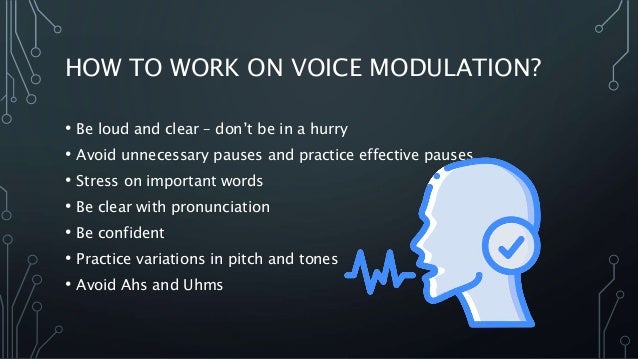
HOW TO WORK ON VOICE MODULATION?
• Be loud and clear – don’t be in a hurry
• Avoid unnecessary pauses and practice effective pauses
• Stress on important words
• Be clear with pronunciation
• Be confident
• Practice variations in pitch and tones
• Avoid Ahs and Uhms
VOICE MODULATION IN RADIO AND TV
• Decades ago, finding your broadcast voice was simple; men tried
to speak in as deep a voice as possible, while ladies wanted to
sound happy as if they'd just baked a pie. Today, such speech
sounds artificial on the air, which often makes the audience
suspicious of what's being said.
• Oprah Winfrey and Bill O'Reilly are very different people on TV, as
are Ryan Seacrest and Howard Stern on the radio. But there's
something they all have in common on the air. Vocally, they don't
sound like announcers. Regardless of whether they are reading
from a script or ad-libbing, they all sound like they're talking to
you naturally, as if they were sitting next to you having a
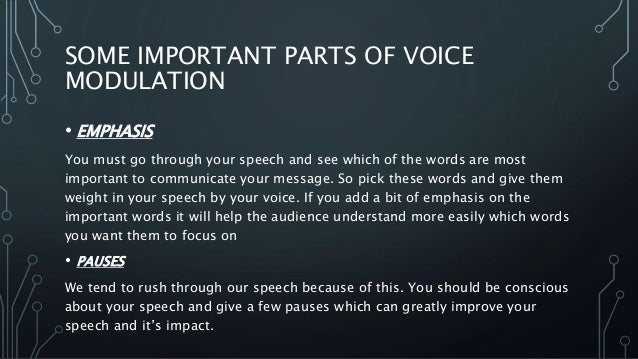
SOME IMPORTANT PARTS OF VOICE
MODULATION
• EMPHASIS
You must go through your speech and see which of the words are most
important to communicate your message. So pick these words and give them
weight in your speech by your voice. If you add a bit of emphasis on the
important words it will help the audience understand more easily which words
you want them to focus on
• PAUSES
We tend to rush through our speech because of this. You should be conscious
about your speech and give a few pauses which can greatly improve your
speech and it’s impact.
• SILENCE
If you start your speech with a moment of silence or pause after you
say something very strong it can go a long way in creating the impact
you want to be felt there among your audience. As is said, silence is
sure golden and works gold too. Silence is often underused but when
used correctly it can be amazingly powerful.
• INFLECTION
Inflection is a very important aspect in voice modulation and
tonality. If you speak at a level inflection you will sound dull and
monotonous. If you want to speak in a manner that will get you a
response from your audience or listener, you should use upward
inflection which means to end your sentence on a higher note. If you
want to state a fact or make a statement that will showcase
confidence and certainty, end your sentence on a lower
note(downward inflection).
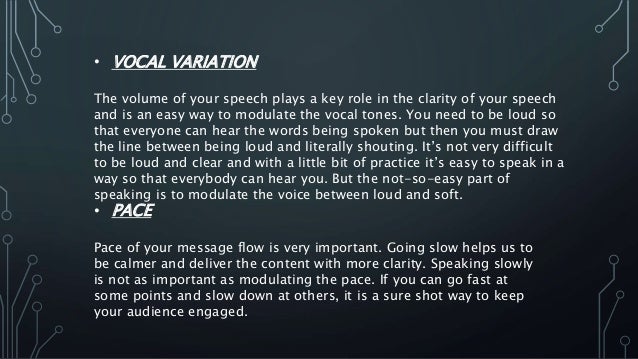
• VOCAL VARIATION
The volume of your speech plays a key role in the clarity of your speech
and is an easy way to modulate the vocal tones. You need to be loud so
that everyone can hear the words being spoken but then you must draw
the line between being loud and literally shouting. It’s not very difficult
to be loud and clear and with a little bit of practice it’s easy to speak in a
way so that everybody can hear you. But the not-so-easy part of
speaking is to modulate the voice between loud and soft.
• PACE
Pace of your message flow is very important. Going slow helps us to
be calmer and deliver the content with more clarity. Speaking slowly
is not as important as modulating the pace. If you can go fast at
some points and slow down at others, it is a sure shot way to keep
your audience engaged.
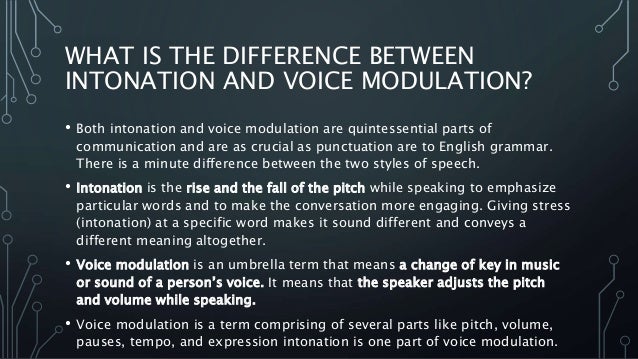
WHAT IS THE DIFFERENCE BETWEEN
INTONATION AND VOICE MODULATION?
• Both intonation and voice modulation are quintessential parts of
communication and are as crucial as punctuation are to English grammar.
There is a minute difference between the two styles of speech.
• Intonation is the rise and the fall of the pitch while speaking to emphasize
particular words and to make the conversation more engaging. Giving stress
(intonation) at a specific word makes it sound different and conveys a
different meaning altogether.
• Voice modulation is an umbrella term that means a change of key in music
or sound of a person’s voice. It means that the speaker adjusts the pitch
and volume while speaking.
• Voice modulation is a term comprising of several parts like pitch, volume,
pauses, tempo, and expression intonation is one part of voice modulation.
LEARNING VOICE TECHNIQUES CAN HELP YOU
FIND YOUR DREAM CAREER AS A HOST, RADIO
JOCKEY AND SO MUCH MORE
• When it comes to careers where your voice becomes your
identity, leaning voice modulation techniques is important.
• Therefore to help you chase your dream career as a show host,
radio jockey, emcee and much more, I present you with a
course on “Basics of Voice Techniques”
• Do follow this link to unlock the key to your dream career -
Basic Course in Voice Techniques
THANK YOU
ARYAN JHAVERI

VOICE MODULATION

  • 1.
    ELECTRONIC MEDIA – VOICEMODULATION BY ARYAN JHAVERI
  • 2.
    WHAT IS VOICEMODULATION ? • Voice modulation means the fine-tuning of the pitch or tone of voice that helps the audience clearly hear and understand the lecture, presentation, and speech delivered by a speaker. • It is very important especially in public speaking. If you want to become an efficient speaker, you must master the art of voice modulation. By mastering the art of voice modulation, you can make your oral presentation or speech more interesting, understandable and memorable to your audience. • Those who have acquired sweet and melodious voice naturally also need to exercise their voice for modulation, variation and professional success. ARE YOU INTERESTED IN LEARNING VARIOUS VOICE TECHNIQUES? CLICK HERE - Learn Voice Techniques
  • 3.
    HOW TO WORKON VOICE MODULATION? • Be loud and clear – don’t be in a hurry • Avoid unnecessary pauses and practice effective pauses • Stress on important words • Be clear with pronunciation • Be confident • Practice variations in pitch and tones • Avoid Ahs and Uhms
  • 4.
    VOICE MODULATION INRADIO AND TV • Decades ago, finding your broadcast voice was simple; men tried to speak in as deep a voice as possible, while ladies wanted to sound happy as if they'd just baked a pie. Today, such speech sounds artificial on the air, which often makes the audience suspicious of what's being said. • Oprah Winfrey and Bill O'Reilly are very different people on TV, as are Ryan Seacrest and Howard Stern on the radio. But there's something they all have in common on the air. Vocally, they don't sound like announcers. Regardless of whether they are reading from a script or ad-libbing, they all sound like they're talking to you naturally, as if they were sitting next to you having a
  • 5.
    SOME IMPORTANT PARTSOF VOICE MODULATION • EMPHASIS You must go through your speech and see which of the words are most important to communicate your message. So pick these words and give them weight in your speech by your voice. If you add a bit of emphasis on the important words it will help the audience understand more easily which words you want them to focus on • PAUSES We tend to rush through our speech because of this. You should be conscious about your speech and give a few pauses which can greatly improve your speech and it’s impact.
  • 6.
    • SILENCE If youstart your speech with a moment of silence or pause after you say something very strong it can go a long way in creating the impact you want to be felt there among your audience. As is said, silence is sure golden and works gold too. Silence is often underused but when used correctly it can be amazingly powerful. • INFLECTION Inflection is a very important aspect in voice modulation and tonality. If you speak at a level inflection you will sound dull and monotonous. If you want to speak in a manner that will get you a response from your audience or listener, you should use upward inflection which means to end your sentence on a higher note. If you want to state a fact or make a statement that will showcase confidence and certainty, end your sentence on a lower note(downward inflection).
  • 7.
    • VOCAL VARIATION Thevolume of your speech plays a key role in the clarity of your speech and is an easy way to modulate the vocal tones. You need to be loud so that everyone can hear the words being spoken but then you must draw the line between being loud and literally shouting. It’s not very difficult to be loud and clear and with a little bit of practice it’s easy to speak in a way so that everybody can hear you. But the not-so-easy part of speaking is to modulate the voice between loud and soft. • PACE Pace of your message flow is very important. Going slow helps us to be calmer and deliver the content with more clarity. Speaking slowly is not as important as modulating the pace. If you can go fast at some points and slow down at others, it is a sure shot way to keep your audience engaged.
  • 8.
    WHAT IS THEDIFFERENCE BETWEEN INTONATION AND VOICE MODULATION? • Both intonation and voice modulation are quintessential parts of communication and are as crucial as punctuation are to English grammar. There is a minute difference between the two styles of speech. • Intonation is the rise and the fall of the pitch while speaking to emphasize particular words and to make the conversation more engaging. Giving stress (intonation) at a specific word makes it sound different and conveys a different meaning altogether. • Voice modulation is an umbrella term that means a change of key in music or sound of a person’s voice. It means that the speaker adjusts the pitch and volume while speaking. • Voice modulation is a term comprising of several parts like pitch, volume, pauses, tempo, and expression intonation is one part of voice modulation.
  • 9.
    LEARNING VOICE TECHNIQUESCAN HELP YOU FIND YOUR DREAM CAREER AS A HOST, RADIO JOCKEY AND SO MUCH MORE • When it comes to careers where your voice becomes your identity, leaning voice modulation techniques is important. • Therefore to help you chase your dream career as a show host, radio jockey, emcee and much more, I present you with a course on “Basics of Voice Techniques” • Do follow this link to unlock the key to your dream career - Basic Course in Voice Techniques
  • 10.