SSILTT 2012
Teaching Vocabulary
Teaching Vocabulary
• Supports content area learning--
  concepts, ideas, connections, domain-
  specific vocabulary
• Supports literacy in general
• Mississippi has a history of low
  vocabulary achievement
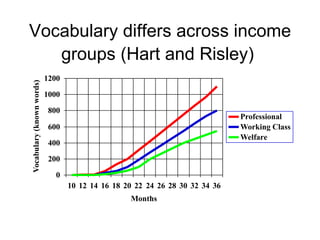
Vocabulary differs across income
   groups (Hart and Risley)
                           1200
Vocabulary (known words)


                           1000

                            800
                                                                              Professional
                            600                                               Working Class
                                                                              Welfare
                            400

                            200

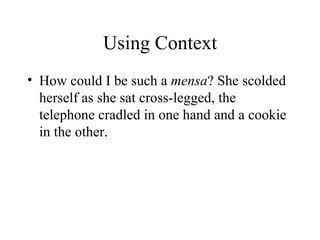
                              0
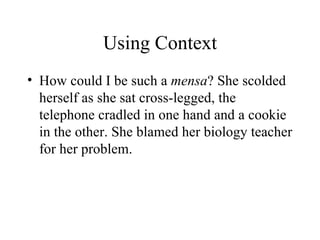
                                  10 12 14 16 18 20 22 24 26 28 30 32 34 36
                                                  Months
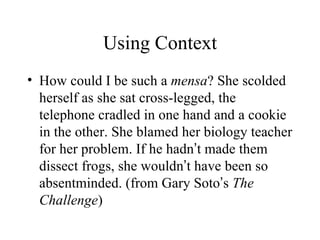
Less effective instruction:
• Memorizing definitions for 10 or 20
  words a week (or a word of the week)
  – These words don’t reappear in student talk
    or writing
  – Copying definitions

  Through incidental learning in a language
   rich environment, students can learn 17-20
   words/day, 3000 words/year
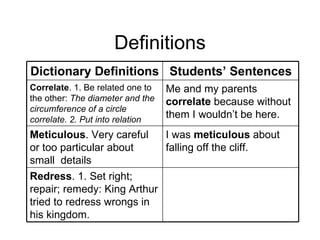
Definitions
Dictionary Definitions Students’ Sentences
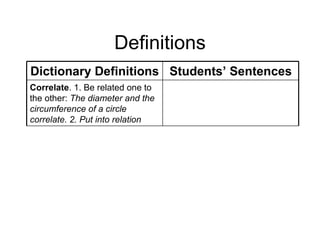
Correlate. 1. Be related one to
the other: The diameter and the
circumference of a circle
correlate. 2. Put into relation
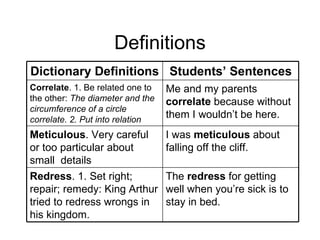
Definitions
Dictionary Definitions Students’ Sentences
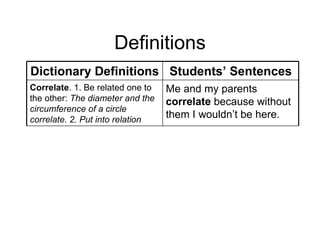
Correlate. 1. Be related one to   Me and my parents
the other: The diameter and the   correlate because without
circumference of a circle
correlate. 2. Put into relation
                                  them I wouldn’t be here.
Definitions
Dictionary Definitions Students’ Sentences
Correlate. 1. Be related one to   Me and my parents
the other: The diameter and the   correlate because without
circumference of a circle
correlate. 2. Put into relation
                                  them I wouldn’t be here.
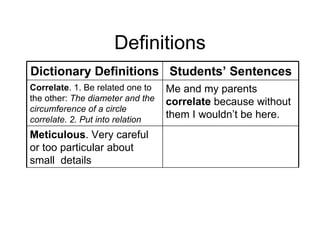
Meticulous. Very careful
or too particular about
small details
Definitions
Dictionary Definitions Students’ Sentences
Correlate. 1. Be related one to   Me and my parents
the other: The diameter and the   correlate because without
circumference of a circle
correlate. 2. Put into relation
                                  them I wouldn’t be here.
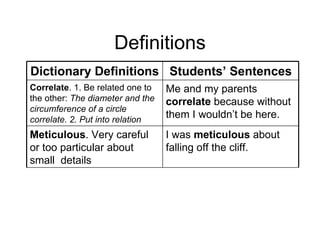
Meticulous. Very careful          I was meticulous about
or too particular about           falling off the cliff.
small details
Definitions
Dictionary Definitions Students’ Sentences
Correlate. 1. Be related one to   Me and my parents
the other: The diameter and the   correlate because without
circumference of a circle
correlate. 2. Put into relation
                                  them I wouldn’t be here.
Meticulous. Very careful    I was meticulous about
or too particular about     falling off the cliff.
small details
Redress. 1. Set right;
repair; remedy: King Arthur
tried to redress wrongs in
his kingdom.
Definitions
Dictionary Definitions Students’ Sentences
Correlate. 1. Be related one to   Me and my parents
the other: The diameter and the   correlate because without
circumference of a circle
correlate. 2. Put into relation
                                  them I wouldn’t be here.
Meticulous. Very careful          I was meticulous about
or too particular about           falling off the cliff.
small details
Redress. 1. Set right;            The redress for getting
repair; remedy: King Arthur       well when you’re sick is to
tried to redress wrongs in        stay in bed.
his kingdom.
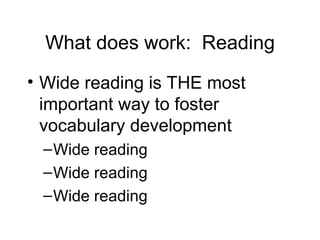
What does work: Reading
• Wide reading is THE most
  important way to foster
  vocabulary development
 – Wide reading
 – Wide reading
 – Wide reading
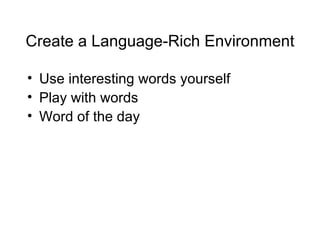
Create a Language-Rich Environment

• Use interesting words yourself
• Play with words
• Word of the day
Return their language to them
 with more interesting vocab
• I’m thirsty!    I’m _________

• It’s raining!  It’s _________

• What are we having for lunch?

• This homework stinks!
Explicit Instruction in Using
Morphemes for Structural Analysis
• Morphemes--meaningful chunks of
  words
• Morphology--study of the meaningful
  chunks of words
• Roots, affixes (suffixes and prefixes)
• How many morphemes in shoes,
  celery, polysyllabic?
Ways to teach the meanings
       of morphemes
• Word sorts (in-, un-)
• Word chains (sort polyhedron words)
• Root word/Vocabulary Trees (def is “roots”,
  branches are words that use root, twigs are
  where you heard it)
• Think of a sort you could do that focuses on
  the meanings of word parts (morphemes)
  important in your discipline (e.g., in math:
  graph means picture vs. graph means word)
• Share
Model Using Morphemes to
     Figure Out Words
• Discuss handout/procedures for a think-
  aloud
• Think out loud about how you used
  morphemes to figure out the meaning of
  a word
• Devon model
• Groups practice and share
• Discuss
Using morphemes to figure
         out words
Sometimes morphemes are all you need:

• indefatigable

 What are some key morphemes in your

               content area?
Adding in context
• Sometimes not so helpful
  She was a sartorial nightmare.


• Sometimes helpful.
  His sartorial style runs toward jeans,
   Hawaiian shirts and cowboy boots.
  The doctor prescribed me an antipruritic for
   my poison ivy.
Explicit Instruction in Using
             Context
• Model, model, model
• Demonstrate using more and more
  context
Using Context
• How could I be such a mensa?
Using Context
• How could I be such a mensa? She scolded
  herself as she sat cross-legged, the
  telephone cradled in one hand and a cookie
  in the other.
Using Context
• How could I be such a mensa? She scolded
  herself as she sat cross-legged, the
  telephone cradled in one hand and a cookie
  in the other. She blamed her biology teacher
  for her problem.
Using Context
• How could I be such a mensa? She scolded
  herself as she sat cross-legged, the
  telephone cradled in one hand and a cookie
  in the other. She blamed her biology teacher
  for her problem. If he hadn’t made them
  dissect frogs, she wouldn’t have been so
  absentminded. (from Gary Soto’s The
  Challenge)
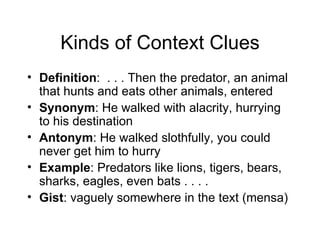
Kinds of Context Clues
• Definition: . . . Then the predator, an animal
  that hunts and eats other animals, entered
• Synonym: He walked with alacrity, hurrying
  to his destination
• Antonym: He walked slothfully, you could
  never get him to hurry
• Example: Predators like lions, tigers, bears,
  sharks, eagles, even bats . . . .
• Gist: vaguely somewhere in the text (mensa)
Teach with a think-aloud
•Think out loud. Explain your thinking to
students to model how to use context clues to
figure out the word.

•Practice it in groups. Find a difficult or likely
unfamiliar word in your text, think aloud about
how you used context to figure it out. Name the
“kind” of context clue you used.
•Share.
Look in your framework
• What morphemes are there?
• What’s a sort or other activity you could do
  to teach the meaning of one of those?
When morphemes and context won’t
  work: Using Reference Tools
• Must be a sophisticated user and know the
  first definition won’t always work
• Which definition fits the meaning of the
  sentence:
  – “Cell phones are polluting our most sacred family
    traditions such as the evening meal.”
• What “text features” do you need to know to
  use this reference tool?
• Other reference tools?
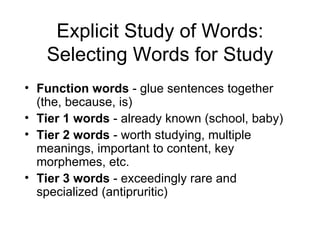
Explicit Study of Words:
   Selecting Words for Study
• Function words - glue sentences together
  (the, because, is)
• Tier 1 words - already known (school, baby)
• Tier 2 words - worth studying, multiple
  meanings, important to content, key
  morphemes, etc.
• Tier 3 words - exceedingly rare and
  specialized (antipruritic)
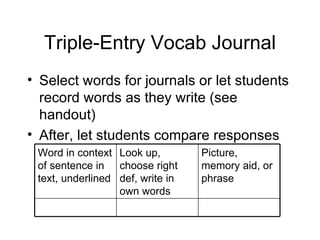
Triple-Entry Vocab Journal
• Select words for journals or let students
  record words as they write (see
  handout)
• After, let students compare responses
 Word in context Look up,         Picture,
 of sentence in choose right      memory aid, or
 text, underlined def, write in   phrase
                  own words
Word Sorts
• Conceptual word sorts:
  – Conceptually (e.g., related to nervous vs. digestive
    system, spiders vs. insects, etc.)
  – Open word sorts--students decide how to sort
    them
• There’s value in the debating
• Sort words before, during, and after
  reading/thematic study
• Think of other ways to sort words
• Sort the same set of words multiple ways
Word Chains
• Sort words according to a scale or quality
   – Synonyms for hunger, most to least
   – Put words in order according to a chemical
     process or mathematical procedure
   – Environmental consequences of different ways of
     getting energy (solar, coal, nuclear), from least to
     most harmful
• Come up with a word chain to teach words in your
  content area
Possible Sentences
• Teacher selects a few words before
  study
• Students analyze them, then create a
  “possible sentence”
• After study, students rewrite possible
  sentences based on new knowledge of
  words
                     » Janet Allen
Interactive Word Wall
• Select words for content/concept study
• List on word wall before/during/after
• Sort words according to concepts or put
  in alphabetical order--so they’re easy to
  find and useful
• USE the words throughout study
Using Interactive Word Wall
             Words
• Sort the words
• Use the words to write summaries
• Write narratives or poems using the words
  together
• Use the words in a Venn diagram
• Hold students accountable for spelling these
  words correctly in writing
• Word 20-questions or charades
• Use the words in a persuasive letter etc.
• Other ideas?
Portable Word Wall
• Individualized word walls
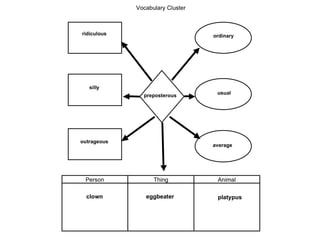
Other Graphic Organizers
• Word Web/Spider Map
• Word Scroll
• Folded flash cards-fold like a note card,
  word on front, def on top inside,
  examples on bottom inside, illustration
  on the back
• Others?
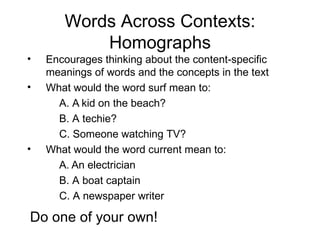
Words Across Contexts:
           Homographs
•   Encourages thinking about the content-specific
    meanings of words and the concepts in the text
•   What would the word surf mean to:
      A. A kid on the beach?
      B. A techie?
      C. Someone watching TV?
•   What would the word current mean to:
      A. An electrician
      B. A boat captain
      C. A newspaper writer

Do one of your own!
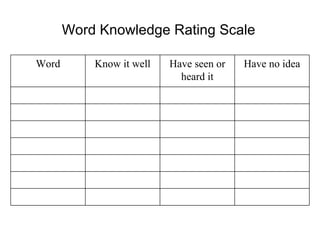
Word Knowledge Rating Scale

Word       Know it well   Have seen or   Have no idea
                            heard it
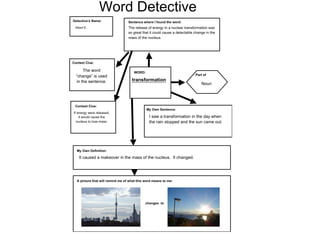
Word Detective
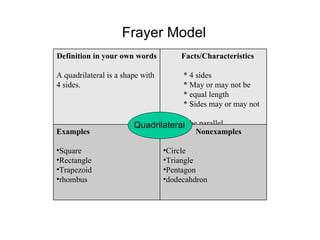
Frayer Model
Definition in your own words          Facts/Characteristics

A quadrilateral is a shape with        * 4 sides
4 sides.                               * May or may not be
                                       * equal length
                                       * Sides may or may not

                        Quadrilateral be parallel
Examples                                  Nonexamples

•Square                           •Circle
•Rectangle                        •Triangle
•Trapezoid                        •Pentagon
•rhombus                          •dodecahdron
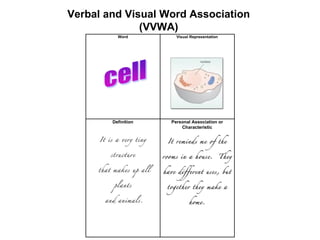
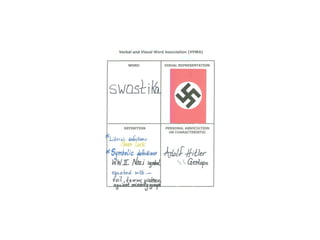
Verbal and Visual Word Association
              (VVWA)
Wrap-Up
        Re-sort words

  List all strategies so far/use
     notecards. Go through
framework and discuss which
      could be used for the
benchmarks in Competencies
              1 and 2.

Vocab ssiltt 2012 show-1

  • 1.
  • 2.
    Teaching Vocabulary • Supportscontent area learning-- concepts, ideas, connections, domain- specific vocabulary • Supports literacy in general • Mississippi has a history of low vocabulary achievement
  • 3.
    Vocabulary differs acrossincome groups (Hart and Risley) 1200 Vocabulary (known words) 1000 800 Professional 600 Working Class Welfare 400 200 0 10 12 14 16 18 20 22 24 26 28 30 32 34 36 Months
  • 4.
    Less effective instruction: •Memorizing definitions for 10 or 20 words a week (or a word of the week) – These words don’t reappear in student talk or writing – Copying definitions Through incidental learning in a language rich environment, students can learn 17-20 words/day, 3000 words/year
  • 5.
    Definitions Dictionary Definitions Students’Sentences Correlate. 1. Be related one to the other: The diameter and the circumference of a circle correlate. 2. Put into relation
  • 6.
    Definitions Dictionary Definitions Students’Sentences Correlate. 1. Be related one to Me and my parents the other: The diameter and the correlate because without circumference of a circle correlate. 2. Put into relation them I wouldn’t be here.
  • 7.
    Definitions Dictionary Definitions Students’Sentences Correlate. 1. Be related one to Me and my parents the other: The diameter and the correlate because without circumference of a circle correlate. 2. Put into relation them I wouldn’t be here. Meticulous. Very careful or too particular about small details
  • 8.
    Definitions Dictionary Definitions Students’Sentences Correlate. 1. Be related one to Me and my parents the other: The diameter and the correlate because without circumference of a circle correlate. 2. Put into relation them I wouldn’t be here. Meticulous. Very careful I was meticulous about or too particular about falling off the cliff. small details
  • 9.
    Definitions Dictionary Definitions Students’Sentences Correlate. 1. Be related one to Me and my parents the other: The diameter and the correlate because without circumference of a circle correlate. 2. Put into relation them I wouldn’t be here. Meticulous. Very careful I was meticulous about or too particular about falling off the cliff. small details Redress. 1. Set right; repair; remedy: King Arthur tried to redress wrongs in his kingdom.
  • 10.
    Definitions Dictionary Definitions Students’Sentences Correlate. 1. Be related one to Me and my parents the other: The diameter and the correlate because without circumference of a circle correlate. 2. Put into relation them I wouldn’t be here. Meticulous. Very careful I was meticulous about or too particular about falling off the cliff. small details Redress. 1. Set right; The redress for getting repair; remedy: King Arthur well when you’re sick is to tried to redress wrongs in stay in bed. his kingdom.
  • 11.
    What does work:Reading • Wide reading is THE most important way to foster vocabulary development – Wide reading – Wide reading – Wide reading
  • 12.
    Create a Language-RichEnvironment • Use interesting words yourself • Play with words • Word of the day
  • 13.
    Return their languageto them with more interesting vocab • I’m thirsty!  I’m _________ • It’s raining!  It’s _________ • What are we having for lunch? • This homework stinks!
  • 14.
    Explicit Instruction inUsing Morphemes for Structural Analysis • Morphemes--meaningful chunks of words • Morphology--study of the meaningful chunks of words • Roots, affixes (suffixes and prefixes) • How many morphemes in shoes, celery, polysyllabic?
  • 15.
    Ways to teachthe meanings of morphemes • Word sorts (in-, un-) • Word chains (sort polyhedron words) • Root word/Vocabulary Trees (def is “roots”, branches are words that use root, twigs are where you heard it) • Think of a sort you could do that focuses on the meanings of word parts (morphemes) important in your discipline (e.g., in math: graph means picture vs. graph means word) • Share
  • 16.
    Model Using Morphemesto Figure Out Words • Discuss handout/procedures for a think- aloud • Think out loud about how you used morphemes to figure out the meaning of a word • Devon model • Groups practice and share • Discuss
  • 17.
    Using morphemes tofigure out words Sometimes morphemes are all you need: • indefatigable What are some key morphemes in your content area?
  • 18.
    Adding in context •Sometimes not so helpful She was a sartorial nightmare. • Sometimes helpful. His sartorial style runs toward jeans, Hawaiian shirts and cowboy boots. The doctor prescribed me an antipruritic for my poison ivy.
  • 19.
    Explicit Instruction inUsing Context • Model, model, model • Demonstrate using more and more context
  • 20.
    Using Context • Howcould I be such a mensa?
  • 21.
    Using Context • Howcould I be such a mensa? She scolded herself as she sat cross-legged, the telephone cradled in one hand and a cookie in the other.
  • 22.
    Using Context • Howcould I be such a mensa? She scolded herself as she sat cross-legged, the telephone cradled in one hand and a cookie in the other. She blamed her biology teacher for her problem.
  • 23.
    Using Context • Howcould I be such a mensa? She scolded herself as she sat cross-legged, the telephone cradled in one hand and a cookie in the other. She blamed her biology teacher for her problem. If he hadn’t made them dissect frogs, she wouldn’t have been so absentminded. (from Gary Soto’s The Challenge)
  • 24.
    Kinds of ContextClues • Definition: . . . Then the predator, an animal that hunts and eats other animals, entered • Synonym: He walked with alacrity, hurrying to his destination • Antonym: He walked slothfully, you could never get him to hurry • Example: Predators like lions, tigers, bears, sharks, eagles, even bats . . . . • Gist: vaguely somewhere in the text (mensa)
  • 25.
    Teach with athink-aloud •Think out loud. Explain your thinking to students to model how to use context clues to figure out the word. •Practice it in groups. Find a difficult or likely unfamiliar word in your text, think aloud about how you used context to figure it out. Name the “kind” of context clue you used. •Share.
  • 26.
    Look in yourframework • What morphemes are there? • What’s a sort or other activity you could do to teach the meaning of one of those?
  • 27.
    When morphemes andcontext won’t work: Using Reference Tools • Must be a sophisticated user and know the first definition won’t always work • Which definition fits the meaning of the sentence: – “Cell phones are polluting our most sacred family traditions such as the evening meal.” • What “text features” do you need to know to use this reference tool? • Other reference tools?
  • 28.
    Explicit Study ofWords: Selecting Words for Study • Function words - glue sentences together (the, because, is) • Tier 1 words - already known (school, baby) • Tier 2 words - worth studying, multiple meanings, important to content, key morphemes, etc. • Tier 3 words - exceedingly rare and specialized (antipruritic)
  • 29.
    Triple-Entry Vocab Journal •Select words for journals or let students record words as they write (see handout) • After, let students compare responses Word in context Look up, Picture, of sentence in choose right memory aid, or text, underlined def, write in phrase own words
  • 30.
    Word Sorts • Conceptualword sorts: – Conceptually (e.g., related to nervous vs. digestive system, spiders vs. insects, etc.) – Open word sorts--students decide how to sort them • There’s value in the debating • Sort words before, during, and after reading/thematic study • Think of other ways to sort words • Sort the same set of words multiple ways
  • 31.
    Word Chains • Sortwords according to a scale or quality – Synonyms for hunger, most to least – Put words in order according to a chemical process or mathematical procedure – Environmental consequences of different ways of getting energy (solar, coal, nuclear), from least to most harmful • Come up with a word chain to teach words in your content area
  • 32.
    Possible Sentences • Teacherselects a few words before study • Students analyze them, then create a “possible sentence” • After study, students rewrite possible sentences based on new knowledge of words » Janet Allen
  • 33.
    Interactive Word Wall •Select words for content/concept study • List on word wall before/during/after • Sort words according to concepts or put in alphabetical order--so they’re easy to find and useful • USE the words throughout study
  • 34.
    Using Interactive WordWall Words • Sort the words • Use the words to write summaries • Write narratives or poems using the words together • Use the words in a Venn diagram • Hold students accountable for spelling these words correctly in writing • Word 20-questions or charades • Use the words in a persuasive letter etc. • Other ideas?
  • 35.
    Portable Word Wall •Individualized word walls
  • 36.
    Other Graphic Organizers •Word Web/Spider Map • Word Scroll • Folded flash cards-fold like a note card, word on front, def on top inside, examples on bottom inside, illustration on the back • Others?
  • 37.
    Words Across Contexts: Homographs • Encourages thinking about the content-specific meanings of words and the concepts in the text • What would the word surf mean to: A. A kid on the beach? B. A techie? C. Someone watching TV? • What would the word current mean to: A. An electrician B. A boat captain C. A newspaper writer Do one of your own!
  • 38.
    Word Knowledge RatingScale Word Know it well Have seen or Have no idea heard it
  • 39.
  • 40.
    Frayer Model Definition inyour own words Facts/Characteristics A quadrilateral is a shape with * 4 sides 4 sides. * May or may not be * equal length * Sides may or may not Quadrilateral be parallel Examples Nonexamples •Square •Circle •Rectangle •Triangle •Trapezoid •Pentagon •rhombus •dodecahdron
  • 41.
    Verbal and VisualWord Association (VVWA)
  • 44.
    Wrap-Up Re-sort words List all strategies so far/use notecards. Go through framework and discuss which could be used for the benchmarks in Competencies 1 and 2.

Editor's Notes

  • #4 Part 1
  • #12 Part 1
  • #14 Thirsty --- Bone-dry, cottonmouthed, dehydrated, parched, yearning for…, Raining – drizzling, misting, coming down in buckets, shower, sprinkle, drizzle Part 1
  • #20 Part 1
  • #21 Part 1
  • #22 Part 1
  • #23 Part 1
  • #24 Part 1
  • #29 Part 1 Function words cue a reader to the structure of a sentence, are, that, a to, the of, etc.--make spoekn languagemeanginful These 107 words (sight words) make up 50% of words in texts, and are part of oral language development--don ’ t study them Tier 1--words whose meanings students are likely to know already--clock, lunch, baby, --don ’ t study Tier 2 words--fortunate, maintaint, merchant, environment, exhale, likely to appear in a wide variety of texts fairly frequently, and in oral language. These are the words for explicit study Tier 3--irksome, pallet, retinue--very rare, appear only once or twice in a text, specific, and so can use context to figure them out Given a text, find some tier 1, 2, 2 and function words for a grade level you select
  • #32 Word Ladder Part 1
  • #39 Can be made into an anchor chart, laminated, and used repeatedly. Use for all different kinds of vocab– math (rhombus, pentagon, etc) – language (personification, hyperbole, etc) Part 1