QUS 5207 - COST CONTROL II 1S1
VALUE MANAGEMENT
(Concepts, Terms, Risks & Costs)
• Lecturer: Ms Noorhidayah Sunarti
• Group Members: Tan Sze Jing - I15008573
Cheng Jia Chun - 15008765
Lee Hui May - I14005507
WHAT IS VALUE MANAGEMENT (VM)
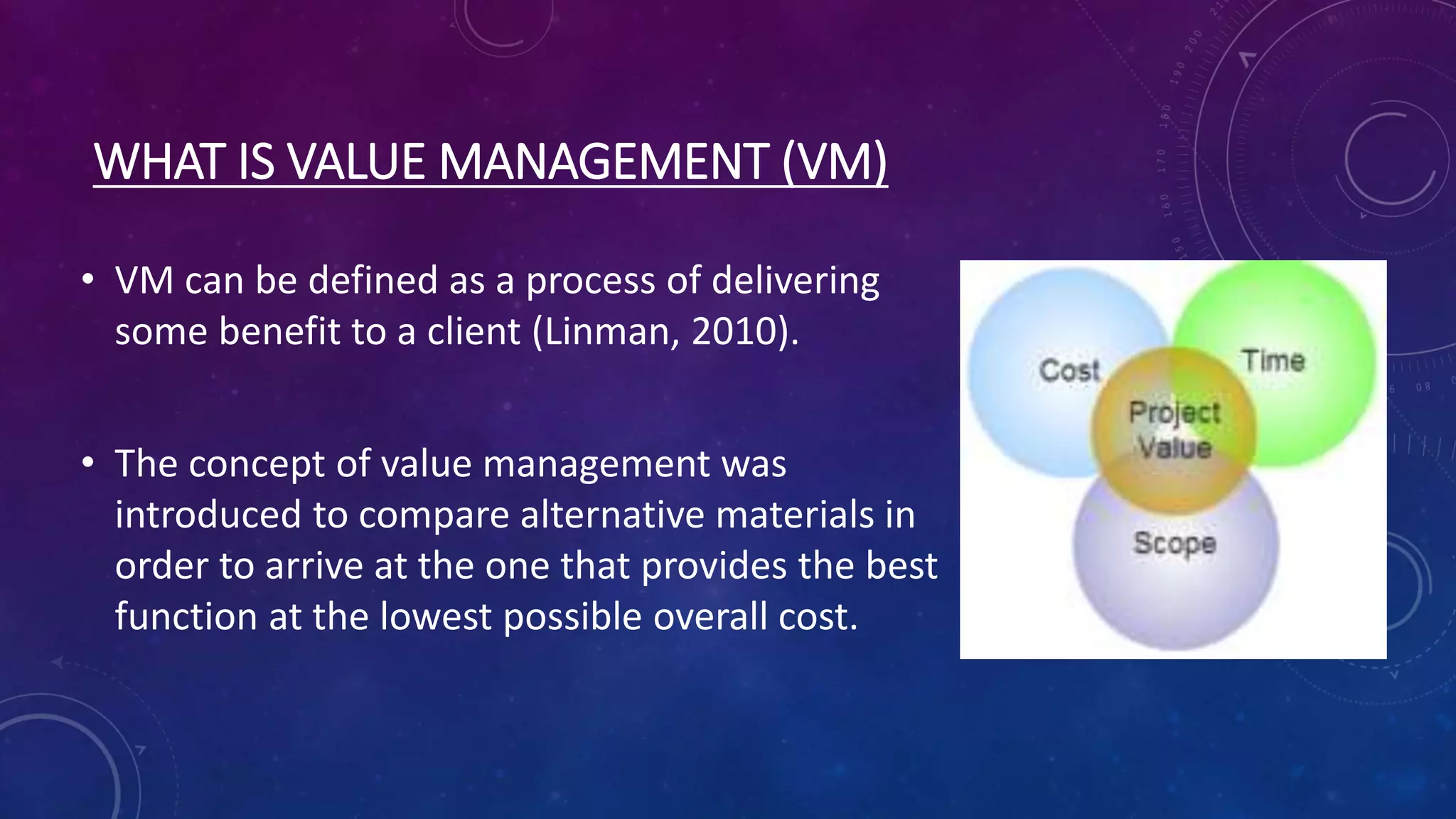
• VM can be defined as a process of delivering
some benefit to a client (Linman, 2010).
• The concept of value management was
introduced to compare alternative materials in
order to arrive at the one that provides the best
function at the lowest possible overall cost.
DEFINITION
• To examine and analyse alternative materials for the purpose of
selecting the one that provided same, better, or best function at the
least cost (Miles, 1972).
• VM is a combination of planning tools and methods to find the
optimum balance of project benefit in relation to project costs and
risks.
AIM
• The aim of value management practice is to
unify these differences in order to achieve the
project’s stated goals using minimum
resources (The Institute of Value
Management 2015)
• In other word, consists in maximizing project
value in relation to the constraints of time,
cost and quality.
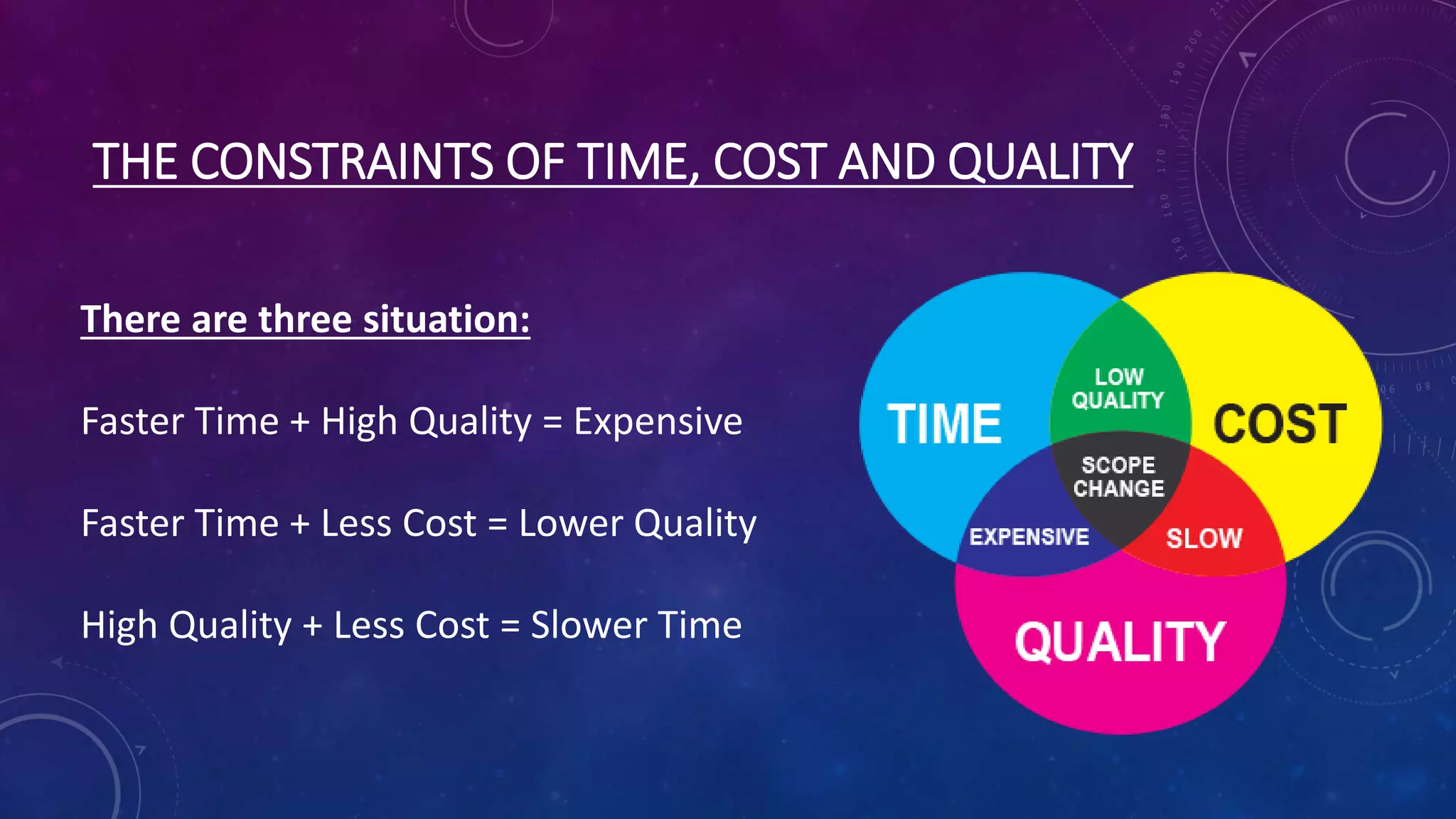
THE CONSTRAINTS OF TIME, COST AND QUALITY
There are three situation:
Faster Time + High Quality = Expensive
Faster Time + Less Cost = Lower Quality
High Quality + Less Cost = Slower Time
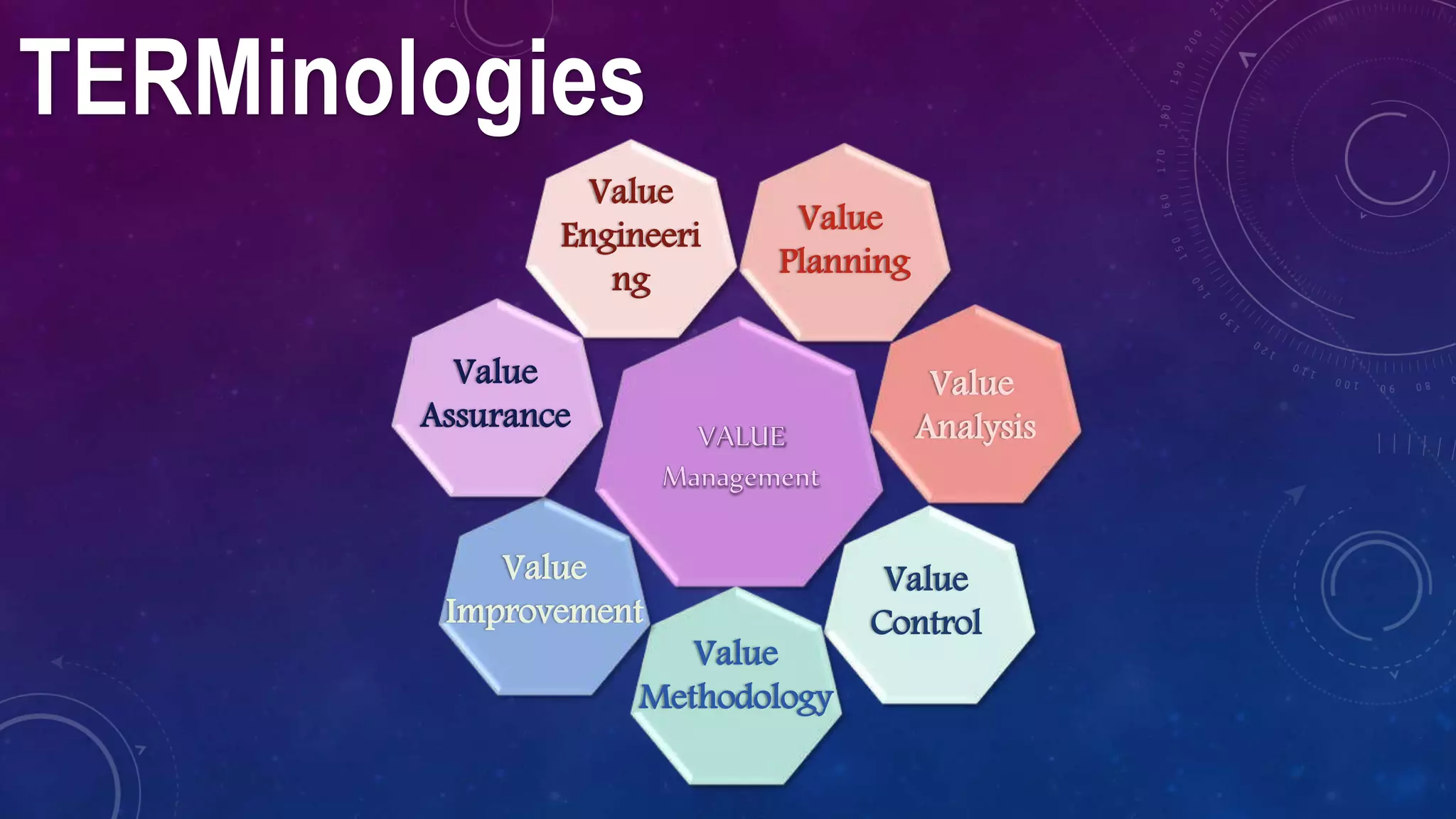
Value
Engineeri
ng
Value
Planning
Value
Analysis
Value
Control
Value
Methodology
Value
Improvement
Value
Assurance
TERMinologies
TERMINOLOGIES USED IN VALUE MANAGEMENT
Value Engineering
• The closest term to ‘value management’ is ‘value engineering’ which is described as the study of
value at the design, construction, and engineering stage of a project (Finnigan 2001).
Value Planning
• Value planning is an aspect of value management that is associated with achieving project
value during the planning stages of a project.
• Value planning is a sub-set of value control and they are both derived from the principle of
cost planning and cost control, which are common terms for management of developmental
projects.
TERMINOLOGIES USED IN VALUE MANAGEMENT
Value Analysis
• Value analysis is associated with the post-construction or completion phase, indicating that the
practice is related to the value of completed project.
Value Control
• Value control in respect to value management is concerned with managing value
throughout all stages of a project where cost control is practised.
Value Methodology
• It is applied to the process, principles and techniques adopted in the conduct and practice of value
management and it includes those practised at value planning, engineering, and analysis phases.
TERMINOLOGIES USED IN VALUE MANAGEMENT
Value Improvement
• Value Improvement (VI) is a quite powerful business tool that should not be overlooked.
• Generally known as cost reduction, VI is a more appropriate label once the overall objective is understood (Myre
and Myre, 2018).
Value Assurance
• Value Assurance is the holistic process that ensures the desired business outcomes of an initiative are
realized during execution.
• The key outcome of the value assurance process is the proof to executives and stakeholders that major
projects are on track to deliver expected outcomes (Enaxisconsulting.com, 2018).
RISK OF VM IN CONSTRUCTION
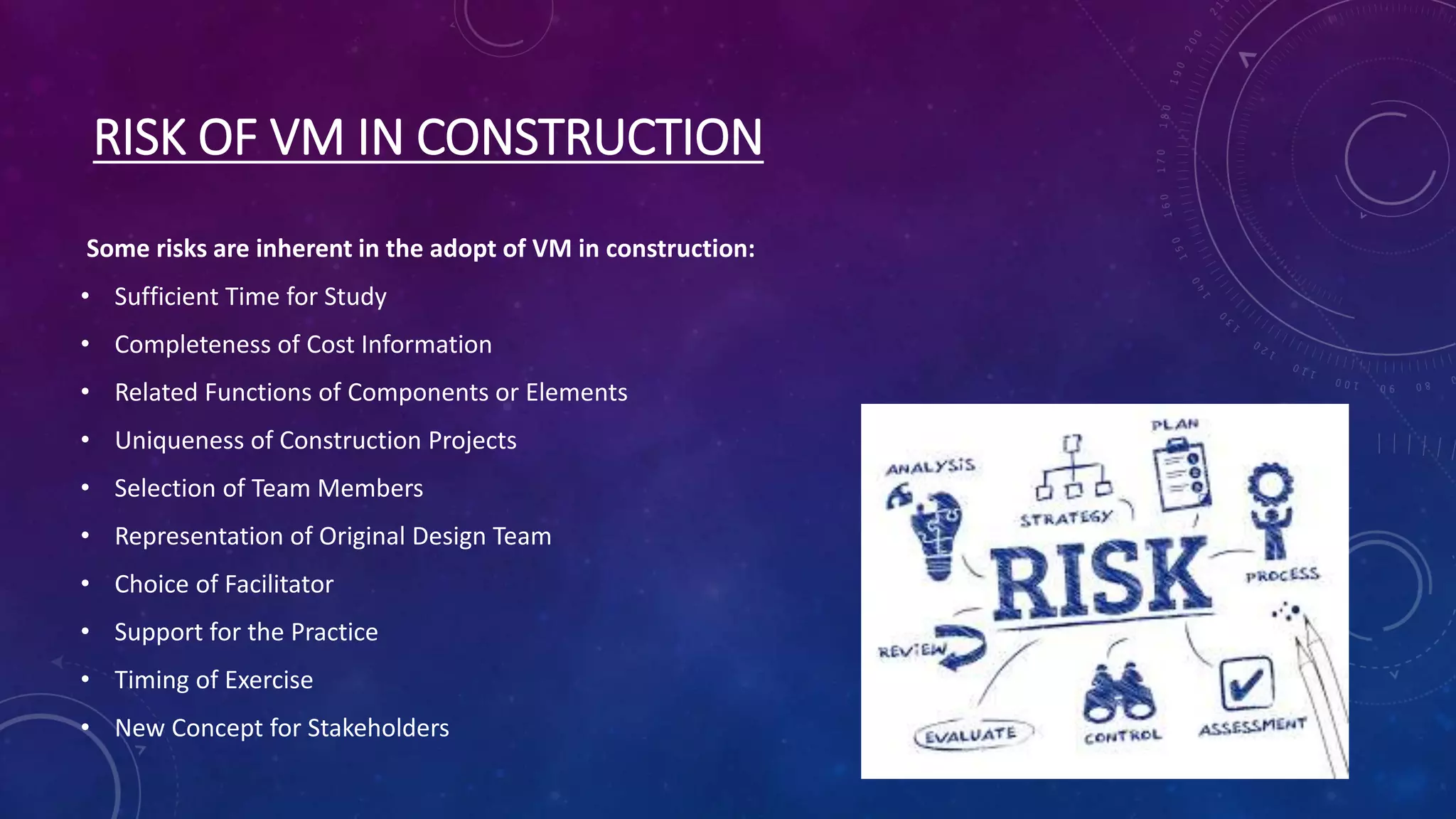
Some risks are inherent in the adopt of VM in construction:
• Sufficient Time for Study
• Completeness of Cost Information
• Related Functions of Components or Elements
• Uniqueness of Construction Projects
• Selection of Team Members
• Representation of Original Design Team
• Choice of Facilitator
• Support for the Practice
• Timing of Exercise
• New Concept for Stakeholders
RISK OF VM IN CONSTRUCTION
Sufficient Time for Study
• Adoption and acceptance of VM in the initial period is the concern over the period of time takes to complete an
exercise.
• VM participants find it is difficult to be away from their day-to-day activities for a whole week.
Completeness of Cost Information
• Lack of full and necessary information of all costs associate with an element or component.
• Difficult to predict inflation and other economic indices that affect the cost and price of materials and resources.
Related Functions of Components or Elements
• Items or elements with related function are usually difficult to quantify
• There are components or elements of building serve more than one unique function
RISK OF VM IN CONSTRUCTION
Uniqueness of Construction Projects
• The distinctiveness of a project affects the function of some elements and components of a project.
• The VM team should be able to identify the functions of various elements.
RISK OF VM IN CONSTRUCTION
Selection of Team Members
• Multi-disciplinary of team members are varied.
• The selection of wrong people may contribute nothing or negatively to the success of practice.
Representation of Original Design Team
• It is better of some existing design team members included as members of the team.
• However, this can becomes a risk if the existing team members are unwilling to agree and accept
changes to the project that arise from the exercise.
RISK OF VM IN CONSTRUCTION
Choice of Facilitator
• One of the key characteristics expected of a facilitator is the knowledge, understanding, and the
experience of a value management workshop
• The importance of a good and knowledgeable facilitator cannot be over-emphasized as the choice can
determine the success of failure of the exercise.
Support for the Practice
• The level of support from clients, statutory or regulatory bodies as well as top management staff of an
organization.
RISK OF VM IN CONSTRUCTION
Timing of the Exercise
• Choice of the right stage of a project at which to implement it.
• The right timing may depend on projects’, clients’ and other stakeholders’ characteristics.
New Concept for Stakeholders
• Initial acceptance of the practice of value management by stakeholders, especially members of the
original design team for a project.
• The conclusions and recommendations of value management exercise may not be welcomed by some
of the members.
COSTS INVOLVED IN VM
The cost involved in VM are:
• Cost of Facilitator
• Cost of Other Participants
• Cost of Venue
• Administrative Cost
• Information Gathering Cost
• Indirect and Other Costs
COSTS INVOLVED IN VM
Cost of Facilitator
• Facilitator is a professional who devoted his / her time to the success of the exercise and as such, must
be paid accordingly.
• The cost may include a professional fee, transport costs and the like.
Cost of Other Participants
• The participants are other members of the VM apart from the facilitator.
• The identified attributes affect the cost of individuals and their payment may depend on the same
factors as fir the facilitator.
• The payment method should be decided and settled before the exercise
COSTS INVOLVED IN VM
Cost of Venue
• A conductive environment with basic facilities and amenities is fundamental to conducting productive
meetings.
• The venue is expected to be good enough for members of team to be able to perform their function
without any form of hindrance.
Administrative Cost
• It is necessary to allocate cost for administration purposes.
• Include insurance, office supplies, wages and benefits of accounting staff, wages and benefits of
secretary, wages and benefits of legal personnel and where applicable.
COSTS INVOLVED IN VM
Information Gathering Cost
• Key principle of VM is the comparative analysis of alternatives.
• This implies that the more alternatives there are the more detailed information is available about them, the
better the ability of the VM team to brainstorm and identify the alternatives, using the principle of function
and cost.
Indirect and Other Costs
• Costs that are not directly associated with the actual VM exercise but are necessary in achieving the overall
goal of practice.
• Include the cost of buying equipment , the costs required in altering or changing the original or existing
design to accommodate proposals from the exercise and the general cost of following up on the
understanding and the implementation of the recommendations
REFERENCE
1. De Leeuw, C. P. (2006). Value management—The new frontier for the quantity surveyor. Paper presented at the 22nd Biennial
Conference/General Meeting on Quantity Surveying. Abuja: Nigerian Institute of Quantity Surveyors.
2. Enaxisconsulting.com. (2018). Value Assurance – Enaxis Consulting. [online] Available at: http://www.enaxisconsulting.com/services/business-
transformation/value-assurance/ [Accessed 4 Mar. 2018].
3. Finnigan, A. (2001). Value engineering. The University of Queensland. Design methods fact. Retrieved May 12, 2015, from
http://www.mech.uq.edu.au/courses/mech4551/.
4. Linman (2010). Value Management in Projects – Definition and Goals. [online] Available at: http://www.mymanagementguide.com/value-
management-in-projects-definition-and-goals/ [Accessed 4 Mar. 2018].
5. Miles, L. D. (1972). Techniques for value analysis and engineering (2nd ed.). New York: McGraw-Hill.
6. Myre, J. and Myre, J. (2018). What is Value Improvement?. [online] HIPPO ENGINEERING. Available at:
http://www.hippoengineering.com/blog/2012/1/3/what-is-value-improvement.html [Accessed 4 Mar. 2018].
7. Spark Solutions - Ruby on Rails & Spree Commerce Developers. (2015). MVP dilemma: fat vs. lean, lovable vs. laughable?. [online] Available at:
https://sparksolutions.co/2015/12/mvp-dilemma-fat-vs-lean-lovable-vs-laughable/ [Accessed 4 Mar. 2018].
8. The Institute of Value Management. (2015). What is value management? Retrieved May 12, 2016, from http://www.ivm.org.uk/what_vm.htm.

VM: CONCEPTS, TERMS, RISKS 7 COSTS

  • 1.
    QUS 5207 -COST CONTROL II 1S1 VALUE MANAGEMENT (Concepts, Terms, Risks & Costs) • Lecturer: Ms Noorhidayah Sunarti • Group Members: Tan Sze Jing - I15008573 Cheng Jia Chun - 15008765 Lee Hui May - I14005507
  • 2.
    WHAT IS VALUEMANAGEMENT (VM) • VM can be defined as a process of delivering some benefit to a client (Linman, 2010). • The concept of value management was introduced to compare alternative materials in order to arrive at the one that provides the best function at the lowest possible overall cost.
  • 3.
    DEFINITION • To examineand analyse alternative materials for the purpose of selecting the one that provided same, better, or best function at the least cost (Miles, 1972). • VM is a combination of planning tools and methods to find the optimum balance of project benefit in relation to project costs and risks.
  • 4.
    AIM • The aimof value management practice is to unify these differences in order to achieve the project’s stated goals using minimum resources (The Institute of Value Management 2015) • In other word, consists in maximizing project value in relation to the constraints of time, cost and quality.
  • 5.
    THE CONSTRAINTS OFTIME, COST AND QUALITY There are three situation: Faster Time + High Quality = Expensive Faster Time + Less Cost = Lower Quality High Quality + Less Cost = Slower Time
  • 6.
  • 7.
    TERMINOLOGIES USED INVALUE MANAGEMENT Value Engineering • The closest term to ‘value management’ is ‘value engineering’ which is described as the study of value at the design, construction, and engineering stage of a project (Finnigan 2001). Value Planning • Value planning is an aspect of value management that is associated with achieving project value during the planning stages of a project. • Value planning is a sub-set of value control and they are both derived from the principle of cost planning and cost control, which are common terms for management of developmental projects.
  • 8.
    TERMINOLOGIES USED INVALUE MANAGEMENT Value Analysis • Value analysis is associated with the post-construction or completion phase, indicating that the practice is related to the value of completed project. Value Control • Value control in respect to value management is concerned with managing value throughout all stages of a project where cost control is practised. Value Methodology • It is applied to the process, principles and techniques adopted in the conduct and practice of value management and it includes those practised at value planning, engineering, and analysis phases.
  • 9.
    TERMINOLOGIES USED INVALUE MANAGEMENT Value Improvement • Value Improvement (VI) is a quite powerful business tool that should not be overlooked. • Generally known as cost reduction, VI is a more appropriate label once the overall objective is understood (Myre and Myre, 2018). Value Assurance • Value Assurance is the holistic process that ensures the desired business outcomes of an initiative are realized during execution. • The key outcome of the value assurance process is the proof to executives and stakeholders that major projects are on track to deliver expected outcomes (Enaxisconsulting.com, 2018).
  • 10.
    RISK OF VMIN CONSTRUCTION Some risks are inherent in the adopt of VM in construction: • Sufficient Time for Study • Completeness of Cost Information • Related Functions of Components or Elements • Uniqueness of Construction Projects • Selection of Team Members • Representation of Original Design Team • Choice of Facilitator • Support for the Practice • Timing of Exercise • New Concept for Stakeholders
  • 11.
    RISK OF VMIN CONSTRUCTION Sufficient Time for Study • Adoption and acceptance of VM in the initial period is the concern over the period of time takes to complete an exercise. • VM participants find it is difficult to be away from their day-to-day activities for a whole week. Completeness of Cost Information • Lack of full and necessary information of all costs associate with an element or component. • Difficult to predict inflation and other economic indices that affect the cost and price of materials and resources. Related Functions of Components or Elements • Items or elements with related function are usually difficult to quantify • There are components or elements of building serve more than one unique function
  • 12.
    RISK OF VMIN CONSTRUCTION Uniqueness of Construction Projects • The distinctiveness of a project affects the function of some elements and components of a project. • The VM team should be able to identify the functions of various elements.
  • 13.
    RISK OF VMIN CONSTRUCTION Selection of Team Members • Multi-disciplinary of team members are varied. • The selection of wrong people may contribute nothing or negatively to the success of practice. Representation of Original Design Team • It is better of some existing design team members included as members of the team. • However, this can becomes a risk if the existing team members are unwilling to agree and accept changes to the project that arise from the exercise.
  • 14.
    RISK OF VMIN CONSTRUCTION Choice of Facilitator • One of the key characteristics expected of a facilitator is the knowledge, understanding, and the experience of a value management workshop • The importance of a good and knowledgeable facilitator cannot be over-emphasized as the choice can determine the success of failure of the exercise. Support for the Practice • The level of support from clients, statutory or regulatory bodies as well as top management staff of an organization.
  • 15.
    RISK OF VMIN CONSTRUCTION Timing of the Exercise • Choice of the right stage of a project at which to implement it. • The right timing may depend on projects’, clients’ and other stakeholders’ characteristics. New Concept for Stakeholders • Initial acceptance of the practice of value management by stakeholders, especially members of the original design team for a project. • The conclusions and recommendations of value management exercise may not be welcomed by some of the members.
  • 16.
    COSTS INVOLVED INVM The cost involved in VM are: • Cost of Facilitator • Cost of Other Participants • Cost of Venue • Administrative Cost • Information Gathering Cost • Indirect and Other Costs
  • 17.
    COSTS INVOLVED INVM Cost of Facilitator • Facilitator is a professional who devoted his / her time to the success of the exercise and as such, must be paid accordingly. • The cost may include a professional fee, transport costs and the like. Cost of Other Participants • The participants are other members of the VM apart from the facilitator. • The identified attributes affect the cost of individuals and their payment may depend on the same factors as fir the facilitator. • The payment method should be decided and settled before the exercise
  • 18.
    COSTS INVOLVED INVM Cost of Venue • A conductive environment with basic facilities and amenities is fundamental to conducting productive meetings. • The venue is expected to be good enough for members of team to be able to perform their function without any form of hindrance. Administrative Cost • It is necessary to allocate cost for administration purposes. • Include insurance, office supplies, wages and benefits of accounting staff, wages and benefits of secretary, wages and benefits of legal personnel and where applicable.
  • 19.
    COSTS INVOLVED INVM Information Gathering Cost • Key principle of VM is the comparative analysis of alternatives. • This implies that the more alternatives there are the more detailed information is available about them, the better the ability of the VM team to brainstorm and identify the alternatives, using the principle of function and cost. Indirect and Other Costs • Costs that are not directly associated with the actual VM exercise but are necessary in achieving the overall goal of practice. • Include the cost of buying equipment , the costs required in altering or changing the original or existing design to accommodate proposals from the exercise and the general cost of following up on the understanding and the implementation of the recommendations
  • 20.
    REFERENCE 1. De Leeuw,C. P. (2006). Value management—The new frontier for the quantity surveyor. Paper presented at the 22nd Biennial Conference/General Meeting on Quantity Surveying. Abuja: Nigerian Institute of Quantity Surveyors. 2. Enaxisconsulting.com. (2018). Value Assurance – Enaxis Consulting. [online] Available at: http://www.enaxisconsulting.com/services/business- transformation/value-assurance/ [Accessed 4 Mar. 2018]. 3. Finnigan, A. (2001). Value engineering. The University of Queensland. Design methods fact. Retrieved May 12, 2015, from http://www.mech.uq.edu.au/courses/mech4551/. 4. Linman (2010). Value Management in Projects – Definition and Goals. [online] Available at: http://www.mymanagementguide.com/value- management-in-projects-definition-and-goals/ [Accessed 4 Mar. 2018]. 5. Miles, L. D. (1972). Techniques for value analysis and engineering (2nd ed.). New York: McGraw-Hill. 6. Myre, J. and Myre, J. (2018). What is Value Improvement?. [online] HIPPO ENGINEERING. Available at: http://www.hippoengineering.com/blog/2012/1/3/what-is-value-improvement.html [Accessed 4 Mar. 2018]. 7. Spark Solutions - Ruby on Rails & Spree Commerce Developers. (2015). MVP dilemma: fat vs. lean, lovable vs. laughable?. [online] Available at: https://sparksolutions.co/2015/12/mvp-dilemma-fat-vs-lean-lovable-vs-laughable/ [Accessed 4 Mar. 2018]. 8. The Institute of Value Management. (2015). What is value management? Retrieved May 12, 2016, from http://www.ivm.org.uk/what_vm.htm.