VLSI DESIGN FLOW
KUNTALA DAS
7/20/2020 1@KUNTALADAS
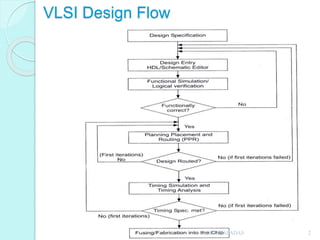
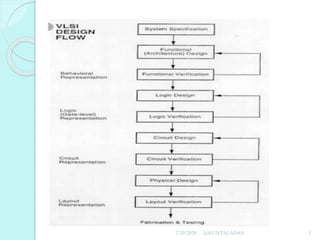
VLSI Design Flow
7/20/2020 2@KUNTALADAS
7/20/2020 3@KUNTALADAS
Design Specification
The algorithm to be implemented with
mathematical representation.
1. Number of inputs and outputs in the design
and number of bits in each of them.
2. Number of bits used in the internal
arithmetic operation.
3. Number of clock signals to be used in the
design.
4. Maximum clock frequency to be used.
5. Area of chip.
6. Power dissipation of the chip.
7/20/2020 4@KUNTALADAS
Design Entry
Design entry are of two types
Schematic Entry
Hardware description language(HDL)
Entry
In Schematic Entry circuit schematics are
drawn using GUI
The two dominant HDL are VHDL & VERILOG
Both language are used for describing digital
hardware
7/20/2020 5@KUNTALADAS
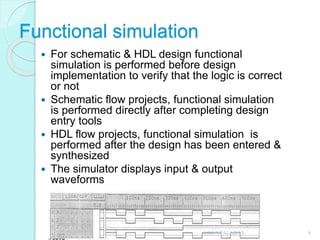
Functional simulation
 For schematic & HDL design functional
simulation is performed before design
implementation to verify that the logic is correct
or not
 Schematic flow projects, functional simulation
is performed directly after completing design
entry tools
 HDL flow projects, functional simulation is
performed after the design has been entered &
synthesized
 The simulator displays input & output
waveforms
7/20/2020 6@KUNTALADAS
Planning placement and
Routing
 This is the VLSI physical design or layout phase
 This is the process to determine the physical
location of device & make interconnection
between them.
 Partitioning is the task of dividing a ckt into sub
ckt
 Floorplanning is the step to determine the shape
of each sub ckt & pin locations
 Placement is determination of best position of
each module
 Routing is the method of interconnection of
different ckt components to minimize chip area &
wire length 7/20/2020 7@KUNTALADAS
Timing simulation
Timing simulation is done with the clock
speed as per design specification
Timing analysis is done to see the
timing performance of a ckt i.e set up &
hold times of the flip-flop
7/20/2020 8@KUNTALADAS
Fabrication into the chip
Once a chip design is complete it is
taped out for manufacturing
The masks are the geometric patterns
which are used for etching in
lithography in subsequent VLSI
fabrication
The output data of the design process
is send to foundry which manufactured
the chip using the mask
7/20/2020 9@KUNTALADAS
7/20/2020 10@KUNTALADAS
7/20/2020 11@KUNTALADAS
7/20/2020 12@KUNTALADAS
7/20/2020 13@KUNTALADAS
7/20/2020 14@KUNTALADAS

Vlsidesignflow

  • 1.
    VLSI DESIGN FLOW KUNTALADAS 7/20/2020 1@KUNTALADAS
  • 2.
  • 3.
  • 4.
    Design Specification The algorithmto be implemented with mathematical representation. 1. Number of inputs and outputs in the design and number of bits in each of them. 2. Number of bits used in the internal arithmetic operation. 3. Number of clock signals to be used in the design. 4. Maximum clock frequency to be used. 5. Area of chip. 6. Power dissipation of the chip. 7/20/2020 4@KUNTALADAS
  • 5.
    Design Entry Design entryare of two types Schematic Entry Hardware description language(HDL) Entry In Schematic Entry circuit schematics are drawn using GUI The two dominant HDL are VHDL & VERILOG Both language are used for describing digital hardware 7/20/2020 5@KUNTALADAS
  • 6.
    Functional simulation  Forschematic & HDL design functional simulation is performed before design implementation to verify that the logic is correct or not  Schematic flow projects, functional simulation is performed directly after completing design entry tools  HDL flow projects, functional simulation is performed after the design has been entered & synthesized  The simulator displays input & output waveforms 7/20/2020 6@KUNTALADAS
  • 7.
    Planning placement and Routing This is the VLSI physical design or layout phase  This is the process to determine the physical location of device & make interconnection between them.  Partitioning is the task of dividing a ckt into sub ckt  Floorplanning is the step to determine the shape of each sub ckt & pin locations  Placement is determination of best position of each module  Routing is the method of interconnection of different ckt components to minimize chip area & wire length 7/20/2020 7@KUNTALADAS
  • 8.
    Timing simulation Timing simulationis done with the clock speed as per design specification Timing analysis is done to see the timing performance of a ckt i.e set up & hold times of the flip-flop 7/20/2020 8@KUNTALADAS
  • 9.
    Fabrication into thechip Once a chip design is complete it is taped out for manufacturing The masks are the geometric patterns which are used for etching in lithography in subsequent VLSI fabrication The output data of the design process is send to foundry which manufactured the chip using the mask 7/20/2020 9@KUNTALADAS
  • 10.
  • 11.
  • 12.
  • 13.
  • 14.