Volunteer Leadership: Developing and Leading High-impact Service Projects Presented by the Montgomery County Volunteer Center  December 18, 2010
Learning Objectives Define volunteer leader Identify volunteer leader skills Assess community needs Identify your project Map your project Identify, leverage and secure resources Manage on-site logistics, resources and volunteers Wrap up the project
Name What part of Montgomery County are you from? Why here? Organize volunteers to do …? Introduce Yourself!
Volunteer Leaders Drive social change by leading well-managed, sustainable projects and programs that: Strengthen and leverage community assets Meet community needs Provide volunteers with a positive experience so that they continue their journey of service
Volunteer Leader Skills  1. Planning 2. Managing 3. Collaborating 4. Mentoring 5. Learning 6. Visioning 7. Communicating 8. Mobilizing 9. Decision Making  10. Facilitating
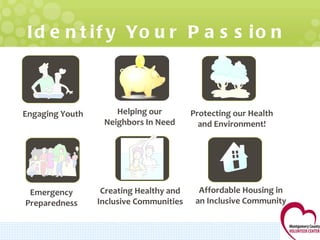
Identify Your Passion Affordable Housing in an Inclusive Community Engaging Youth Protecting our Health and Environment! Emergency Preparedness Helping our Neighbors In Need Creating Healthy and Inclusive Communities
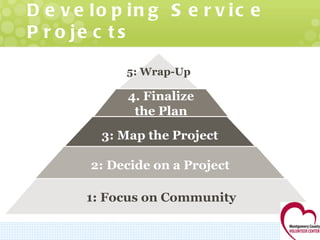
Developing Service Projects 5: Wrap-Up 3: Map the Project 2: Decide on a Project 1: Focus on Community 4. Finalize the Plan
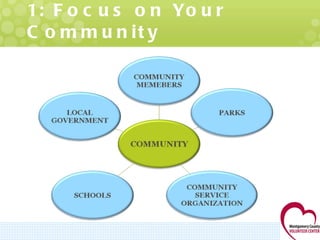
1: Focus on Your Community
Conducting a Needs Assessment What types of questions could you ask? If money were not an issue, what would you be doing that you are not doing now?  What is on your wish list? What is on your to-do list that never gets accomplished because you don’t have the time or resources? Is there a population that needs to be served that you have not been able to serve?  Is there a program that you have been wanting to start but don’t have the resources? Are there marketing, technology, financial, training or other types of skills needed to support any of your projects? Others
Research the Issue Statistics  Background Underlying causes Project ideas Community experts 2: Narrow Your Focus
 
Develop Partnerships Review potential project partners Mission Resources they offer partners Services they offer to the community Approach potential partner Define roles, outcomes and resources
Conduct a Site Visit Search for potential projects Involve key decision-makers and stakeholders Answer important questions about agency needs and how the project will impact the community and the agency Gather details about needs for potential projects, including special skills and materials Be prepared.
What is your most memorable volunteer experience? Why?
Elements of a Successful Project Consider . . . Will the project make a difference to the organization, clients, and/or community? If so how? Is the project volunteer-friendly? Will volunteers feel they have completed something worthwhile?
Decide on a Project D efine the scope and make a decision based on the following: Time  Effort Impact  Other Factors
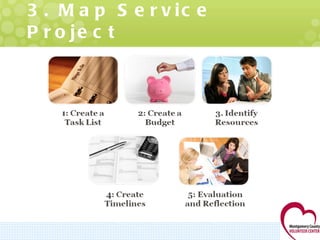
3. Map Service Project
Create a Task List Determine what you want to accomplish List assignments  Decide number of volunteers needed for each slot Prioritize goals (if necessary) according to importance
Create a Budget Outline costs associated with all tasks Keep track of all donations: Monetary In-kind services Donations
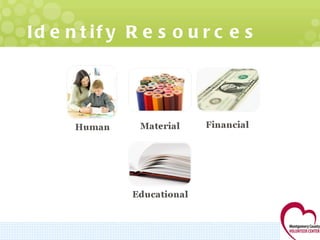
Identify Resources
Volunteers Establish volunteer needs Consider variables: Volunteer skill level Volunteer age How many? Duration of project Availability of supplies Physical space available to perform the work
Volunteer Leaders Volunteer Leaders can recruit other leaders Who are those skilled, trustworthy volunteers?  Can you delegate responsibilities and trust they will be accomplished? Engage these individuals in the planning process
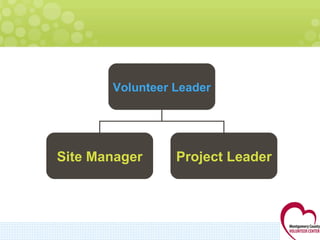
Volunteer Leader Site   Manager Project Leader
Other Volunteer Positions Write thank you cards for volunteers Pass out water, snacks, etc. Serve as guides and runners  Video or take pictures Capture volunteer quotes Safety Ambassador Create and post welcome and thank you signs throughout the service site Write stories for local newspapers and newsletter s about the event Provide childcare for volunteers Plan and play music for the day
Supplies Determine the supplies, materials, goods and services you need Strategize about types and amounts Think about partners and local groups/ businesses that can provide resources at no cost Note supplies that will need to be purchased
Educational Resources A brief overview of the issue or cause A brief overview of the location site If you are carrying out a project in a community based organization then you should invite a representative from the organization to review the following: organization’s mission core services provided to the community how volunteer support is contributing to that mission specific policies and procedures related to volunteers
Create Timelines Project planning Day of project  After project
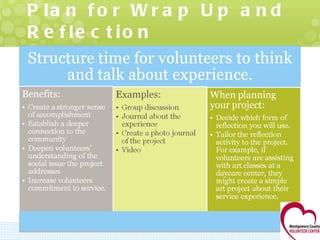
Plan for Wrap Up and Reflection
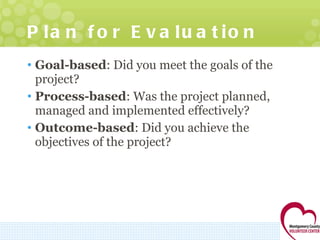
Plan for Evaluation  Goal-based : Did you meet the goals of the project? Process-based : Was the project planned, managed and implemented effectively? Outcome-based : Did you achieve the objectives of the project?
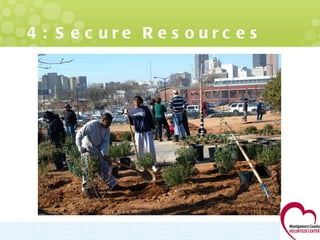
4: Secure Resources
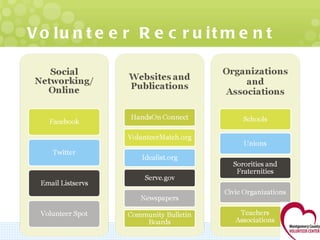
Volunteer Recruitment
Funding, Products and Services Faith groups Foundations Neighborhood associations and civic groups Nonprofits Businesses Colleges and universities
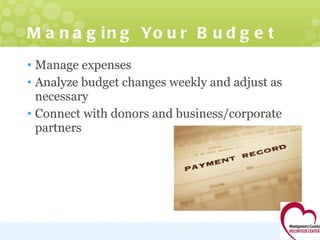
Managing Your Budget Manage expenses  Analyze budget changes weekly and adjust as necessary Connect with donors and business/corporate partners
The “Ask” Strategy Identify the correct people to contact Appeal to their needs and wants Map out a case for support Why the project is important The impact it will create Your ability to complete the project How they can be a part of the effort Be specific!
Connections that Count Start with people you know Ask people you know to engage their friends Talk personally with people to “sell” your project Know what you need and ask people how they can contribute Don’t be afraid to tap people’s emotions Try creative outreach
5: Finalize the Project Plan Address questions Finalize plans Meet with leaders Review the schedule Discuss documentation Confirm all supplies Provide food and drinks Make any final calls Pack a project kit Check on trash containers Create a fun atmosphere Check, double-check and triple-check!
Communicating with Volunteers Pre-register volunteers Provide important project details Logistics such as date, time, address, public transportation and/or parking information What to wear or not wear What to bring and what will be provided Where to check-in at the project Point of contact
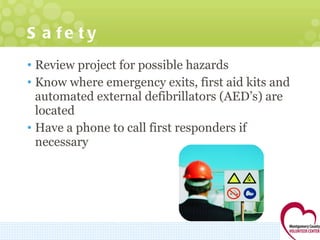
Safety Review project for possible hazards Know where emergency exits, first aid kits and automated external defibrillators (AED’s) are located Have a phone to call first responders if necessary
Contingency Planning Think through the worst-case scenarios of what could go wrong Create contingency plans for weather and other potential problems Prepare ways to expand or reduce project goals due to number of volunteers Know whom to contact in case of problems
Day of Project
Project Management At-a-glance Wear a T-shirt or something that identifies you Arrive early (at least one hour) Have all tools and materials waiting at task sites With an agency rep, provide a thorough orientation to the project Be a leader Ensure a safe project site Start clean-up at least 30 minutes before the scheduled end of the project Lead a reflection discussion/activity Ask volunteers to complete an evaluation CELEBRATE
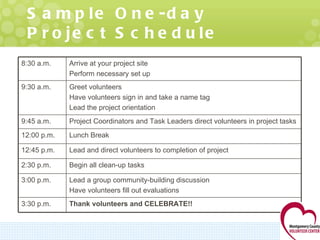
Sample One-day Project Schedule 8:30 a.m. Arrive at your project site Perform necessary set up 9:30 a.m. Greet volunteers Have volunteers sign in and take a name tag Lead the project orientation 9:45 a.m.  Project Coordinators and Task Leaders direct volunteers in project tasks 12:00 p.m. Lunch Break 12:45 p.m. Lead and direct volunteers to completion of project 2:30 p.m.  Begin all clean-up tasks 3:00 p.m. Lead a group community-building discussion Have volunteers fill out evaluations 3:30 p.m. Thank volunteers and CELEBRATE!!
Managing Time Arrive early and prepare for surprises Monitor and adjust according to the progress of the project Don’t just work hard – work smart!
Managing Volunteers
The Volunteer Experience Pre-project communication Directional signs Check-in Food/beverage Orientation Location of restrooms, water, etc. Project tasks, supplies, etc. Impact project will have on the community and on the issue
Safety Educate volunteers about safety Post signage Communicate to volunteers where the emergency exits, first aid kits and automated external defibrillators (AED’s) are located Communicate where the phones are located to call first responders if necessary  Document all incidents  Do you need a waiver?
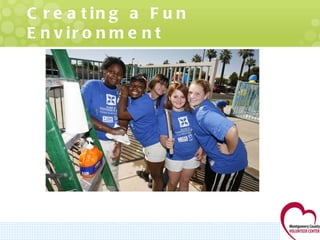
Creating a Fun Environment
Project Wrap Up
Reflection and Evaluation Lead a reflection discussion/activity Ask participants to provide evaluation feedback while on site Keep it anonymous If you can’t get immediate feedback, contact participants later Communicate results to constituents
Project Clean-up Collect and dispose of trash/recycle Break down tables/chairs and store in proper place Put away paper, pens and other supplies Take down any signs you posted Collect signed forms for your records Don’t leave any personal belongings Do a final walk-through
Recognition and Celebration Say “thank you” Give recognition in a personal way Tailor recognition to the individual Use a variety of methods Be clear about why volunteers are being recognized Continuously recognize volunteers
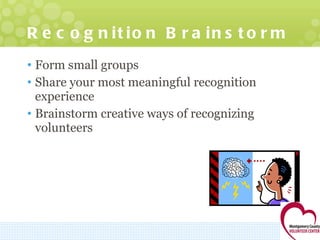
Recognition Brainstorm Form small groups Share your most meaningful recognition experience Brainstorm creative ways of recognizing volunteers
Final Report Share you impact Thank You email
Questions?
Volunteer Project Guide Evaluation
Workshop Wrap-up, Reflection and Evaluation
Three Words Share three words about what you will do as a result of today’s session
Volunteer Leader Workshop

Volunteer Leader Workshop

  • 1.
    Volunteer Leadership: Developingand Leading High-impact Service Projects Presented by the Montgomery County Volunteer Center December 18, 2010
  • 2.
    Learning Objectives Definevolunteer leader Identify volunteer leader skills Assess community needs Identify your project Map your project Identify, leverage and secure resources Manage on-site logistics, resources and volunteers Wrap up the project
  • 3.
    Name What partof Montgomery County are you from? Why here? Organize volunteers to do …? Introduce Yourself!
  • 4.
    Volunteer Leaders Drivesocial change by leading well-managed, sustainable projects and programs that: Strengthen and leverage community assets Meet community needs Provide volunteers with a positive experience so that they continue their journey of service
  • 5.
    Volunteer Leader Skills 1. Planning 2. Managing 3. Collaborating 4. Mentoring 5. Learning 6. Visioning 7. Communicating 8. Mobilizing 9. Decision Making 10. Facilitating
  • 6.
    Identify Your PassionAffordable Housing in an Inclusive Community Engaging Youth Protecting our Health and Environment! Emergency Preparedness Helping our Neighbors In Need Creating Healthy and Inclusive Communities
  • 7.
    Developing Service Projects5: Wrap-Up 3: Map the Project 2: Decide on a Project 1: Focus on Community 4. Finalize the Plan
  • 8.
    1: Focus onYour Community
  • 10.
    Conducting a NeedsAssessment What types of questions could you ask? If money were not an issue, what would you be doing that you are not doing now? What is on your wish list? What is on your to-do list that never gets accomplished because you don’t have the time or resources? Is there a population that needs to be served that you have not been able to serve? Is there a program that you have been wanting to start but don’t have the resources? Are there marketing, technology, financial, training or other types of skills needed to support any of your projects? Others
  • 11.
    Research the IssueStatistics Background Underlying causes Project ideas Community experts 2: Narrow Your Focus
  • 12.
  • 13.
    Develop Partnerships Reviewpotential project partners Mission Resources they offer partners Services they offer to the community Approach potential partner Define roles, outcomes and resources
  • 14.
    Conduct a SiteVisit Search for potential projects Involve key decision-makers and stakeholders Answer important questions about agency needs and how the project will impact the community and the agency Gather details about needs for potential projects, including special skills and materials Be prepared.
  • 15.
    What is yourmost memorable volunteer experience? Why?
  • 16.
    Elements of aSuccessful Project Consider . . . Will the project make a difference to the organization, clients, and/or community? If so how? Is the project volunteer-friendly? Will volunteers feel they have completed something worthwhile?
  • 17.
    Decide on aProject D efine the scope and make a decision based on the following: Time Effort Impact Other Factors
  • 18.
  • 19.
    Create a TaskList Determine what you want to accomplish List assignments Decide number of volunteers needed for each slot Prioritize goals (if necessary) according to importance
  • 20.
    Create a BudgetOutline costs associated with all tasks Keep track of all donations: Monetary In-kind services Donations
  • 21.
  • 22.
    Volunteers Establish volunteerneeds Consider variables: Volunteer skill level Volunteer age How many? Duration of project Availability of supplies Physical space available to perform the work
  • 23.
    Volunteer Leaders VolunteerLeaders can recruit other leaders Who are those skilled, trustworthy volunteers? Can you delegate responsibilities and trust they will be accomplished? Engage these individuals in the planning process
  • 24.
    Volunteer Leader Site Manager Project Leader
  • 25.
    Other Volunteer PositionsWrite thank you cards for volunteers Pass out water, snacks, etc. Serve as guides and runners Video or take pictures Capture volunteer quotes Safety Ambassador Create and post welcome and thank you signs throughout the service site Write stories for local newspapers and newsletter s about the event Provide childcare for volunteers Plan and play music for the day
  • 26.
    Supplies Determine thesupplies, materials, goods and services you need Strategize about types and amounts Think about partners and local groups/ businesses that can provide resources at no cost Note supplies that will need to be purchased
  • 27.
    Educational Resources Abrief overview of the issue or cause A brief overview of the location site If you are carrying out a project in a community based organization then you should invite a representative from the organization to review the following: organization’s mission core services provided to the community how volunteer support is contributing to that mission specific policies and procedures related to volunteers
  • 28.
    Create Timelines Projectplanning Day of project After project
  • 29.
    Plan for WrapUp and Reflection
  • 30.
    Plan for Evaluation Goal-based : Did you meet the goals of the project? Process-based : Was the project planned, managed and implemented effectively? Outcome-based : Did you achieve the objectives of the project?
  • 31.
  • 32.
  • 33.
    Funding, Products andServices Faith groups Foundations Neighborhood associations and civic groups Nonprofits Businesses Colleges and universities
  • 34.
    Managing Your BudgetManage expenses Analyze budget changes weekly and adjust as necessary Connect with donors and business/corporate partners
  • 35.
    The “Ask” StrategyIdentify the correct people to contact Appeal to their needs and wants Map out a case for support Why the project is important The impact it will create Your ability to complete the project How they can be a part of the effort Be specific!
  • 36.
    Connections that CountStart with people you know Ask people you know to engage their friends Talk personally with people to “sell” your project Know what you need and ask people how they can contribute Don’t be afraid to tap people’s emotions Try creative outreach
  • 37.
    5: Finalize theProject Plan Address questions Finalize plans Meet with leaders Review the schedule Discuss documentation Confirm all supplies Provide food and drinks Make any final calls Pack a project kit Check on trash containers Create a fun atmosphere Check, double-check and triple-check!
  • 38.
    Communicating with VolunteersPre-register volunteers Provide important project details Logistics such as date, time, address, public transportation and/or parking information What to wear or not wear What to bring and what will be provided Where to check-in at the project Point of contact
  • 39.
    Safety Review projectfor possible hazards Know where emergency exits, first aid kits and automated external defibrillators (AED’s) are located Have a phone to call first responders if necessary
  • 40.
    Contingency Planning Thinkthrough the worst-case scenarios of what could go wrong Create contingency plans for weather and other potential problems Prepare ways to expand or reduce project goals due to number of volunteers Know whom to contact in case of problems
  • 41.
  • 42.
    Project Management At-a-glanceWear a T-shirt or something that identifies you Arrive early (at least one hour) Have all tools and materials waiting at task sites With an agency rep, provide a thorough orientation to the project Be a leader Ensure a safe project site Start clean-up at least 30 minutes before the scheduled end of the project Lead a reflection discussion/activity Ask volunteers to complete an evaluation CELEBRATE
  • 43.
    Sample One-day ProjectSchedule 8:30 a.m. Arrive at your project site Perform necessary set up 9:30 a.m. Greet volunteers Have volunteers sign in and take a name tag Lead the project orientation 9:45 a.m. Project Coordinators and Task Leaders direct volunteers in project tasks 12:00 p.m. Lunch Break 12:45 p.m. Lead and direct volunteers to completion of project 2:30 p.m. Begin all clean-up tasks 3:00 p.m. Lead a group community-building discussion Have volunteers fill out evaluations 3:30 p.m. Thank volunteers and CELEBRATE!!
  • 44.
    Managing Time Arriveearly and prepare for surprises Monitor and adjust according to the progress of the project Don’t just work hard – work smart!
  • 45.
  • 46.
    The Volunteer ExperiencePre-project communication Directional signs Check-in Food/beverage Orientation Location of restrooms, water, etc. Project tasks, supplies, etc. Impact project will have on the community and on the issue
  • 47.
    Safety Educate volunteersabout safety Post signage Communicate to volunteers where the emergency exits, first aid kits and automated external defibrillators (AED’s) are located Communicate where the phones are located to call first responders if necessary Document all incidents Do you need a waiver?
  • 48.
    Creating a FunEnvironment
  • 49.
  • 50.
    Reflection and EvaluationLead a reflection discussion/activity Ask participants to provide evaluation feedback while on site Keep it anonymous If you can’t get immediate feedback, contact participants later Communicate results to constituents
  • 51.
    Project Clean-up Collectand dispose of trash/recycle Break down tables/chairs and store in proper place Put away paper, pens and other supplies Take down any signs you posted Collect signed forms for your records Don’t leave any personal belongings Do a final walk-through
  • 52.
    Recognition and CelebrationSay “thank you” Give recognition in a personal way Tailor recognition to the individual Use a variety of methods Be clear about why volunteers are being recognized Continuously recognize volunteers
  • 53.
    Recognition Brainstorm Formsmall groups Share your most meaningful recognition experience Brainstorm creative ways of recognizing volunteers
  • 54.
    Final Report Shareyou impact Thank You email
  • 55.
  • 56.
  • 57.
  • 58.
    Three Words Sharethree words about what you will do as a result of today’s session