VITAMIN D
Prof.(Dr) Viyatprajna
Acharya
M.D., PhD
WHAT WILL WE KNOW?
 History
 Chemistry
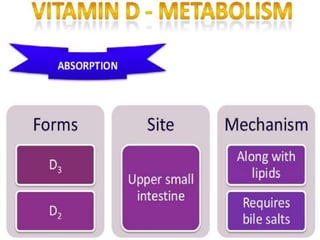
 Metabolism
 Biochemical functions
 Deficiency manifestations
 DRA
 Sources of Vitamin D
 Hypervitaminosis
GENERAL FORMAT
Vitamin
(Synonym
if any)
Chemistry Metabolic
functions
Dietary
source
RDA Deficiency
manifestations
Hypervitaminosis Other
HISTORY
 Reports on rickets- 2nd century AD
 1650- Glisson gave a classical feature of
infantile rickets
 1919- Mc Collum induced rickets in rats
by making them dietary deficient
 1931- Angus & team found D3
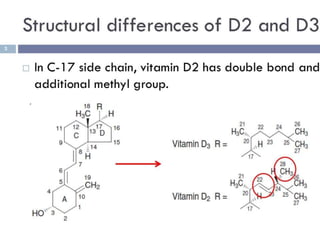
 Structure- Otto diels & Kurt Alder
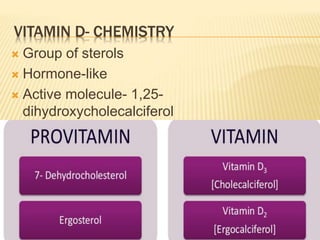
VITAMIN D- CHEMISTRY
 Group of sterols
 Hormone-like
 Active molecule- 1,25-
dihydroxycholecalciferol
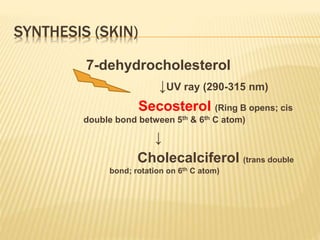
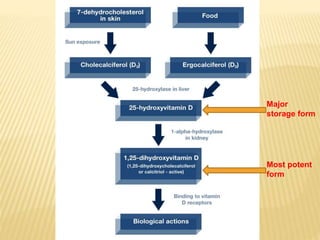
SYNTHESIS (SKIN)
7-dehydrocholesterol
↓UV ray (290-315 nm)
Secosterol (Ring B opens; cis
double bond between 5th & 6th C atom)
↓
Cholecalciferol (trans double
bond; rotation on 6th C atom)
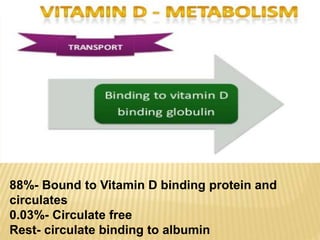
88%- Bound to Vitamin D binding protein and
circulates
0.03%- Circulate free
Rest- circulate binding to albumin
Major
storage form
Most potent
form
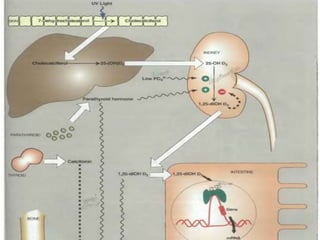
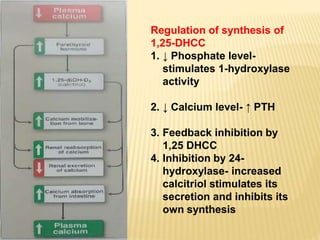
Regulation of synthesis of
1,25-DHCC
1. ↓ Phosphate level-
stimulates 1-hydroxylase
activity
2. ↓ Calcium level- ↑ PTH
3. Feedback inhibition by
1,25 DHCC
4. Inhibition by 24-
hydroxylase- increased
calcitriol stimulates its
secretion and inhibits its
own synthesis
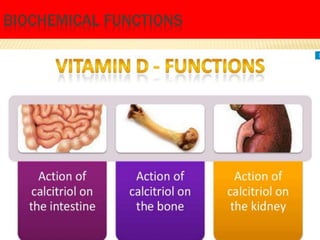
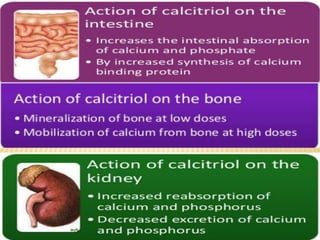
BIOCHEMICAL FUNCTIONS
OTHER FUNCTIONS
 Secretion of insulin
 Secretion of PTH and Thyroid hormones
 Inhibition of production of interleukin by
activated T-Lymphocytes
 Inhibition of Ab production by B-
lymphocytes
 Differentiation of monocyte precursor
cells
 Modulation of cell proliferation
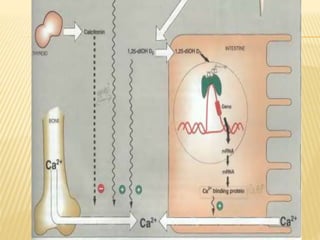
CALCIUM PHOSPHOROUS HOMEOSTATSIS
 Ca :P 1:4- 4:1
 Maintained by calcitriol, ALP, PTH, Calcitonin
 Regulation of calcitriol- Ca, P, PTH
andcalcitriol itself
 Synthesis and target organs are different
 Different target organs
 Acts through nuclear receptors like steroid
hormones
 Structure and mechanism of action similar
to steroid hormones-sterol ring
 Synthesis is feedback regulated
 Acts in conjunction with other hormones-
calcitonin & PTH
 T1/2 is short- 10 hrs; in circulation it is 2-3
weeks though.
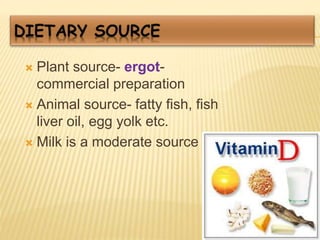
 Plant source- ergot-
commercial preparation
 Animal source- fatty fish, fish
liver oil, egg yolk etc.
 Milk is a moderate source
D/R
 Pre-school- 10 μg/ day
 Children & adults- 5-10 μg/ day
 Pregnancy & lactation – 10 μg/ day
 > 60 yrs- 15 μg/ day
little role in osteoporosis !
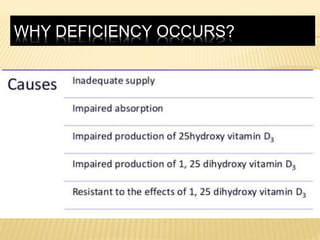
WHY DEFICIENCY OCCURS?
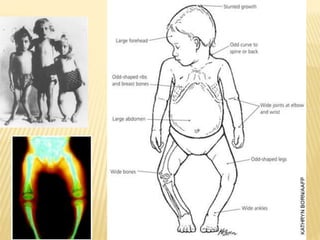
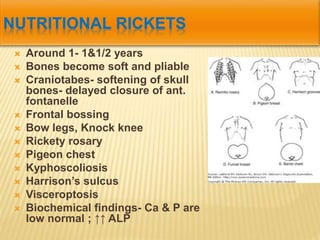
 Around 1- 1&1/2 years
 Bones become soft and pliable
 Craniotabes- softening of skull
bones- delayed closure of ant.
fontanelle
 Frontal bossing
 Bow legs, Knock knee
 Rickety rosary
 Pigeon chest
 Kyphoscoliosis
 Harrison’s sulcus
 Visceroptosis
 Biochemical findings- Ca & P are
low normal ; ↑↑ ALP
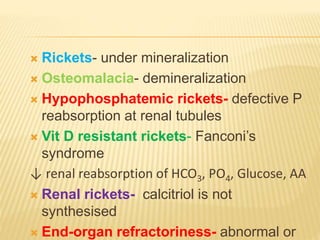
 Rickets- under mineralization
 Osteomalacia- demineralization
 Hypophosphatemic rickets- defective P
reabsorption at renal tubules
 Vit D resistant rickets- Fanconi’s
syndrome
↓ renal reabsorption of HCO3, PO4, Glucose, AA
 Renal rickets- calcitriol is not
synthesised
 End-organ refractoriness- abnormal or
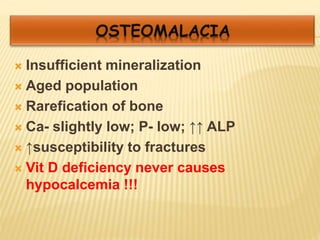
 Insufficient mineralization
 Aged population
 Rarefication of bone
 Ca- slightly low; P- low; ↑↑ ALP
 ↑susceptibility to fractures
 Vit D deficiency never causes
hypocalcemia !!!
 With Vit A cures cold and flu
 Gives good effect in COVID tt too !
 Modulatory effect on immunohemopoietic
system- helps in differentiation of cells
 Corrects anemia
 Associated with insulin resistance & DM
 Reduces risk of cancer
 Reduces risk of CVD
 Beneficial effects observed in AIDS
patients
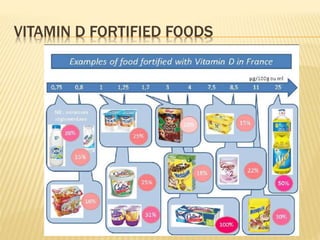
VITAMIN D FORTIFIED FOODS
CLINICAL CASE DISCUSSION
An 18 month old boy was brought to the
pediatrician with a complain of frequent diarrhoea
and stunted growth. The mother gave history that
the stool was somewhat sticky. The child was not
eating well and was late in walking. Mother also
gave history of frequent falls while walking and
swelling of forehead probably due to falls.
On examination: There were rachitic features.
Mother gave history of photosensitive rashes.
The pediatrician ordered for some tests. Serum
Calcium- normal, Phosphate- low, ALP- mildly
elevated
X-ray: Cupping of distal radius and distal femur,
More PPT on Medical Biochemistry on my
website
www.vpacharya.com