Visualising NYC
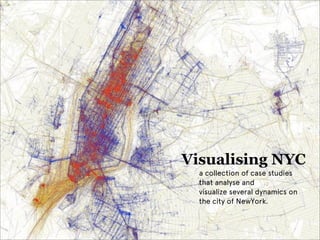
  a collection of case studies
  that analyse and
  visualize several dynamics on
  the city of NewYork.
Livehood   Livehoods reveal how the people and places of a city come together to form the dynamic character of local urban
           areas. Each dot on the map (●) represents a check-in location. Groups of nearby dots of the same color form a
link       Livehood. The shapes of Livehoods are determined by the patterns of people that check-in to them. If many of the
           same people check-in to two nearby locations, then these locations will likely be part of the same Livehood.
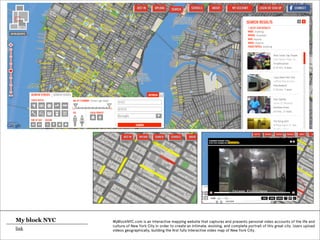
My block NYC   MyBlockNYC.com is an interactive mapping website that captures and presents personal video accounts of the life and
               culture of New York City in order to create an intimate, evolving, and complete portrait of this great city. Users upload
link           videos geographically, building the first fully interactive video map of New York City.
Here Now   This project analyzes two weeks of of checkin data collected from Foursquare and Facebook API to explore what these
           new ways of communicating can tell us about New York City.
link
Digits collected every check-in on the service for a week earlier this year, via the Foursquare “firehose.” And what did
                       they find? Broadly: The top individual spots are places like malls, airports and train stations, because so many people
A week on foursquare   filter through those locations. But the top categories are homes, offices, coffee shops and bars, even though each of
                       the individual locations in those categories gets a very small number of check-ins.
link
                       > more data analysis here
Using Flickr Geotags to Map the World’s Cities.
Flickr geotags   (You'll also notice a bit of color coding on the maps. Apparently, Fischer was able to guess that the picture taker's
                 mode of transportation--presumably using the time stamps and distance traveled between a user's pictures. He then
link             created a color code:Black is walking (less than 7mph), Red is bicycling or equivalent speed (less than 19mph), Blue is
                 motor vehicles on normal roads (less than 43mph); Green is freeways or rapid transit.)
a Twitter anatomy of a protest   Here's a visualization of mid and lower Manhattan on MayDay, 2012, plotting the when and where of tweets containing
                                 the keywords, MayDay and Occupy (representing a healthy mix of supporters, detractors, and everybody in-between).  
link                             The visual coordination of three dimensions of data: location, time, and topic, provides an up-to-the-second profile of
                                 a social event as it forms, moves, and dissipates
(a tweet focus)


           Cascade allows for precise analysis of the structures which underly sharing activity on the web.
Cascades   This first-of-its-kind tool links browsing behavior on a site to sharing activity to construct a detailed picture of how
link       information propagates through the social media space. While initially applied to New York Times stories and
           information, the tool and its underlying logic may be applied to any publisher or brand interested in understanding how
           its messages are shared.
(zoom)


                                                                                                    (a tweet focus)


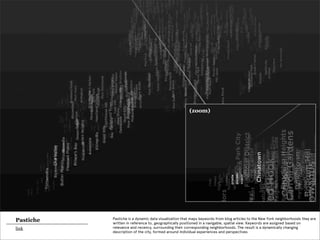
           Pastiche is a dynamic data visualization that maps keywords from blog articles to the New York neighborhoods they are
Pastiche   written in reference to, geographically positioned in a navigable, spatial view. Keywords are assigned based on
link       relevance and recency, surrounding their corresponding neighborhoods. The result is a dynamically changing
           description of the city, formed around individual experiences and perspectives
(zoom)


(zoom out)


                                                                                                              (a tweet focus)


                 By revealing the social networks present within the urban environment, Invisible Cities describes a new kind of city—a
Invisible city   city of the mind. It displays geocoded activity from online services such as Twitter and Flickr, both in real-time and in
link             aggregate. Real-time activity is represented as individual nodes that appear whenever a message or image is posted.
                 Aggregate activity is reflected in the underlying terrain: over time, the landscape warps as data is accrued, creating hills
                 and valleys representing areas with high and low densities of data.
(zoom)


                                                                                                            (a tweet focus)


                   The research, presented in late March at the annual meeting of the Association of American Geographers, locates hot
mapping the buzz   spots based on the frequency and draw of cultural happenings: film and television screenings, concerts, fashion shows,
link               gallery and theater openings, through potographs from Getty Images that chronicled flashy parties and smaller affairs
                   on both coasts for a year, beginning in March 2006.
                   The maps show the density of different types of cultural events in New York
Mapping America, every city every block   Browse local data from the Census Bureau's American
                                          Community Survey, which was conducted from 2005 to 2009.
link
NY days vs Night Popoulation   integrating Census Data + exensive information on daily activities (source is not clear)
link
(a tweet focus)


                      The Metropolitan Transportation Authority offers several pricing options for subway and bus riders. Here's a look at
NY metro card usage   where people are swiping different kinds of MetroCards, and how recent fare hikes affected their use
link
(zoom)


Stop Question and Frisk NY   NYtimes interactive visualization. New York City’s police force, in its fight against crime, has increasingly used a strategy
                             known as “stop, question and frisk,” which allows officers to stop someone based on a reasonable suspicion of crime.
link                         One expert has estimated New Yorkers are stopped at twice the national rate. The interface let users navigate the
                             number of STOPS for each neighborhood and block
Map your moves   An interactive visual exploration of where New Yorkers moved in the last decade
link
the Museum of the Pahntom city   the museum of the phantom city uses personal digital devices to transform the city into a living museum.
                                 the first tour, Other Futures, allows individual to see speculative proposals for the city of New York
link
Movement in Manhattan   Using geolocated tweets to try and see how the movement of people is affected by the urban landscape.
                        Basically, tweets sent by the same person within a 4 hour time-window were used as samples of speed and direction.
link                    These samples were used to construct a vector field representing the average flow of people within the area.
(zoom + change view)


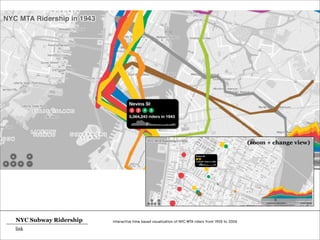
NYC Subway Ridership   Interactive time based visualization of NYC MTA riders from 1905 to 2006
link
Lost NYC Subways   Lost Subways: Abandoned Stations & Unbuilt Lines
                    Here's the current subway map overlaid with eleven subway lines that were planned but never built.
link
Travel Tube map   the map shows the travel times, in minutes, from Manhattan to stations in the region's commuter rail system dureing
                  evening rush. Each alternating ring shows how much farther you can travel in an additional 15 minutes
link
Taxi!   Taxi! is an analytical model that maps the trip data for 10,000 taxi rides over the course of 24 hours. Geographic
        location data for the origin and destination of each ride is combined with waypoint data collected from the Google
link    Maps API in order to generate a geographically accurate representation of the trip:
time to work   New York's multi-layered morning rush hour detailed by the combined pathways ferries (orange dots), commuter rail
               services, (green purple and red) and the bus services (blue) that criss-cross the city picking out its famous grid pattern
link
Snack time   Snack time: GPS trails reveal the routes taken by cycling pizza delivery riders on one Friday night in Manhattan. Each
             rider's shift lasts eight to nine hours, in which time they can deliver between 30 and 40 pizzas all over the city
link
A Peek Into Netflix Queues   Interactive Graphic by NYTimes examines maps of Netflix rental patterns, neighborhood by neighborhood, in a dozen
                             cities across USA
link

Visualizing nyc

  • 1.
    Visualising NYC a collection of case studies that analyse and visualize several dynamics on the city of NewYork.
  • 2.
    Livehood Livehoods reveal how the people and places of a city come together to form the dynamic character of local urban areas. Each dot on the map (●) represents a check-in location. Groups of nearby dots of the same color form a link Livehood. The shapes of Livehoods are determined by the patterns of people that check-in to them. If many of the same people check-in to two nearby locations, then these locations will likely be part of the same Livehood.
  • 3.
    My block NYC MyBlockNYC.com is an interactive mapping website that captures and presents personal video accounts of the life and culture of New York City in order to create an intimate, evolving, and complete portrait of this great city. Users upload link videos geographically, building the first fully interactive video map of New York City.
  • 4.
    Here Now This project analyzes two weeks of of checkin data collected from Foursquare and Facebook API to explore what these new ways of communicating can tell us about New York City. link
  • 5.
    Digits collected everycheck-in on the service for a week earlier this year, via the Foursquare “firehose.” And what did they find? Broadly: The top individual spots are places like malls, airports and train stations, because so many people A week on foursquare filter through those locations. But the top categories are homes, offices, coffee shops and bars, even though each of the individual locations in those categories gets a very small number of check-ins. link > more data analysis here
  • 6.
    Using Flickr Geotagsto Map the World’s Cities. Flickr geotags (You'll also notice a bit of color coding on the maps. Apparently, Fischer was able to guess that the picture taker's mode of transportation--presumably using the time stamps and distance traveled between a user's pictures. He then link created a color code:Black is walking (less than 7mph), Red is bicycling or equivalent speed (less than 19mph), Blue is motor vehicles on normal roads (less than 43mph); Green is freeways or rapid transit.)
  • 7.
    a Twitter anatomyof a protest Here's a visualization of mid and lower Manhattan on MayDay, 2012, plotting the when and where of tweets containing the keywords, MayDay and Occupy (representing a healthy mix of supporters, detractors, and everybody in-between).   link The visual coordination of three dimensions of data: location, time, and topic, provides an up-to-the-second profile of a social event as it forms, moves, and dissipates
  • 8.
    (a tweet focus) Cascade allows for precise analysis of the structures which underly sharing activity on the web. Cascades This first-of-its-kind tool links browsing behavior on a site to sharing activity to construct a detailed picture of how link information propagates through the social media space. While initially applied to New York Times stories and information, the tool and its underlying logic may be applied to any publisher or brand interested in understanding how its messages are shared.
  • 9.
    (zoom) (a tweet focus) Pastiche is a dynamic data visualization that maps keywords from blog articles to the New York neighborhoods they are Pastiche written in reference to, geographically positioned in a navigable, spatial view. Keywords are assigned based on link relevance and recency, surrounding their corresponding neighborhoods. The result is a dynamically changing description of the city, formed around individual experiences and perspectives
  • 10.
    (zoom) (zoom out) (a tweet focus) By revealing the social networks present within the urban environment, Invisible Cities describes a new kind of city—a Invisible city city of the mind. It displays geocoded activity from online services such as Twitter and Flickr, both in real-time and in link aggregate. Real-time activity is represented as individual nodes that appear whenever a message or image is posted. Aggregate activity is reflected in the underlying terrain: over time, the landscape warps as data is accrued, creating hills and valleys representing areas with high and low densities of data.
  • 11.
    (zoom) (a tweet focus) The research, presented in late March at the annual meeting of the Association of American Geographers, locates hot mapping the buzz spots based on the frequency and draw of cultural happenings: film and television screenings, concerts, fashion shows, link gallery and theater openings, through potographs from Getty Images that chronicled flashy parties and smaller affairs on both coasts for a year, beginning in March 2006. The maps show the density of different types of cultural events in New York
  • 12.
    Mapping America, everycity every block Browse local data from the Census Bureau's American Community Survey, which was conducted from 2005 to 2009. link
  • 13.
    NY days vsNight Popoulation integrating Census Data + exensive information on daily activities (source is not clear) link
  • 14.
    (a tweet focus) The Metropolitan Transportation Authority offers several pricing options for subway and bus riders. Here's a look at NY metro card usage where people are swiping different kinds of MetroCards, and how recent fare hikes affected their use link
  • 15.
    (zoom) Stop Question andFrisk NY NYtimes interactive visualization. New York City’s police force, in its fight against crime, has increasingly used a strategy known as “stop, question and frisk,” which allows officers to stop someone based on a reasonable suspicion of crime. link One expert has estimated New Yorkers are stopped at twice the national rate. The interface let users navigate the number of STOPS for each neighborhood and block
  • 16.
    Map your moves An interactive visual exploration of where New Yorkers moved in the last decade link
  • 17.
    the Museum ofthe Pahntom city the museum of the phantom city uses personal digital devices to transform the city into a living museum. the first tour, Other Futures, allows individual to see speculative proposals for the city of New York link
  • 18.
    Movement in Manhattan Using geolocated tweets to try and see how the movement of people is affected by the urban landscape. Basically, tweets sent by the same person within a 4 hour time-window were used as samples of speed and direction. link These samples were used to construct a vector field representing the average flow of people within the area.
  • 19.
    (zoom + changeview) NYC Subway Ridership Interactive time based visualization of NYC MTA riders from 1905 to 2006 link
  • 20.
    Lost NYC Subways Lost Subways: Abandoned Stations & Unbuilt Lines  Here's the current subway map overlaid with eleven subway lines that were planned but never built. link
  • 21.
    Travel Tube map the map shows the travel times, in minutes, from Manhattan to stations in the region's commuter rail system dureing evening rush. Each alternating ring shows how much farther you can travel in an additional 15 minutes link
  • 22.
    Taxi! Taxi! is an analytical model that maps the trip data for 10,000 taxi rides over the course of 24 hours. Geographic location data for the origin and destination of each ride is combined with waypoint data collected from the Google link Maps API in order to generate a geographically accurate representation of the trip:
  • 23.
    time to work New York's multi-layered morning rush hour detailed by the combined pathways ferries (orange dots), commuter rail services, (green purple and red) and the bus services (blue) that criss-cross the city picking out its famous grid pattern link
  • 24.
    Snack time Snack time: GPS trails reveal the routes taken by cycling pizza delivery riders on one Friday night in Manhattan. Each rider's shift lasts eight to nine hours, in which time they can deliver between 30 and 40 pizzas all over the city link
  • 25.
    A Peek IntoNetflix Queues Interactive Graphic by NYTimes examines maps of Netflix rental patterns, neighborhood by neighborhood, in a dozen cities across USA link