Information Visualization
as a Research Method in
Art History


CAA 2012 session
Introduction by Lev Manovich
              1
visualization timeline:

- development of key techniques: by 1830s
- scientific visualization: 1988-
- information visualization: 1998-
- artistic visualization: 2001-
- visualization is featured in Design and
Elastic Mind at MOMA: 2008
- Obama campaign site uses sophisticated
visualization: 2008
- visualization become ubiquitous (you have
to include in your social web site): 2011

                          2
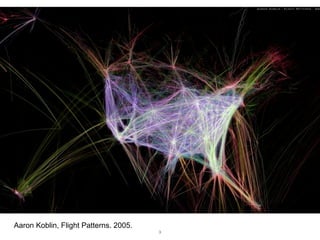
Aaron Koblin, Flight Patterns. 2005.
                                       3
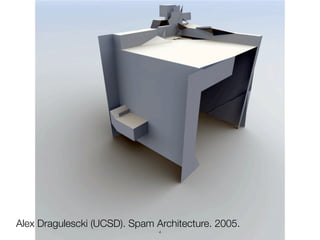
Alex Dragulescki (UCSD). Spam Architecture. 2005.
                               4
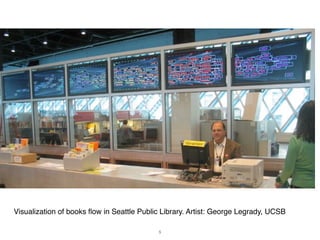
Visualization of books flow in Seattle Public Library. Artist: George Legrady, UCSB

                                           5
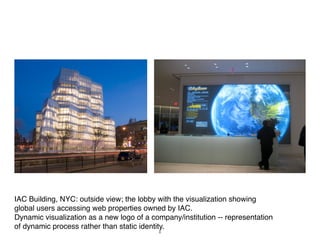
IAC Building, NYC: outside view; the lobby with the visualization showing
global users accessing web properties owned by IAC.
Dynamic visualization as a new logo of a company/institution -- representation
of dynamic process rather than static identity.
                                           6
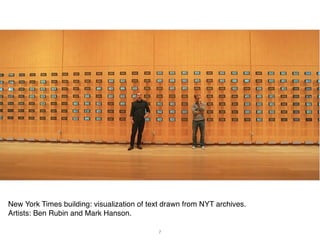
New York Times building: visualization of text drawn from NYT archives.
Artists: Ben Rubin and Mark Hanson.

                                             7
8
9
10
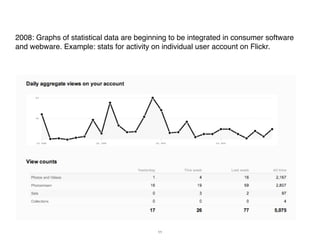
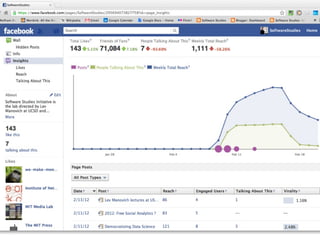
2008: Graphs of statistical data are beginning to be integrated in consumer software
and webware. Example: stats for activity on individual user account on Flickr.


                                           11
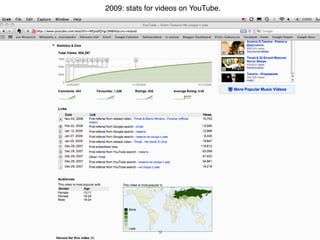
2009: stats for videos on YouTube.


               12
2009: stats for videos on YouTube.


               13
the development of “cultural visualization”:
graphing cultural patterns


                       14
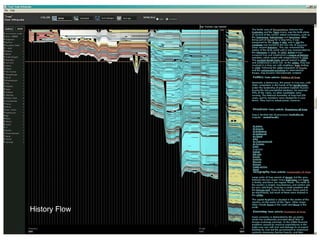
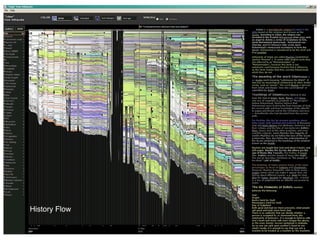
History Flow

               15
History Flow

               16
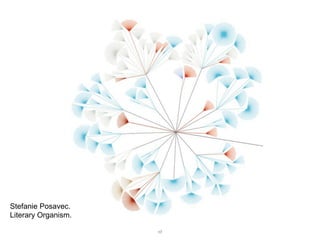
Stefanie Posavec.
Literary Organism.

                     17
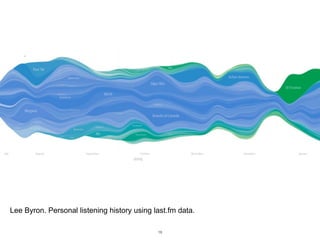
Lee Byron. Personal listening history using last.fm data.

                                             18
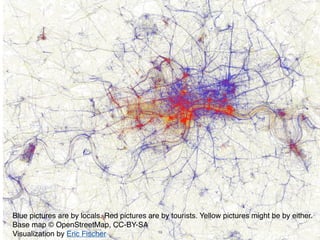
Blue pictures are by locals. Red pictures are by tourists. Yellow pictures might be by either.
Base map © OpenStreetMap, CC-BY-SA 
                                             19
Visualization by Eric Fischer
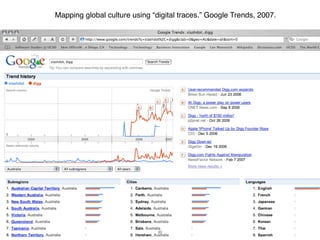
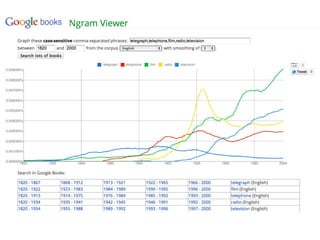
Mapping global culture using “digital traces.” Google Trends, 2007.


                               20
visualization + big cultural data:

NEH Offfice of Digital Humanities (created 3/2008)

Humanities High Performance Computing initiative:
“Humanities High-Performance Computing (HHPC) refers to the use of high-
performance machines for humanities and social science projects. Currently, only a
small number of humanities scholars are taking advantage of high-performance
computing. But just as the sciences have, over time, begun to tap the enormous
potential of HPC, the humanities are beginning to as well. Humanities scholars often
deal with large sets of unstructured data. This might take the form of historical
newspapers, books, election data, archaeological fragments, audio or video contents,
or a host of others. HHPC offers the humanist opportunities to sort through, mine,
and better understand and visualize this data.”


                                          22
January 2009:
NEH and NSF announce DIGGING INTO DATA
CHALLENGE.
Grant amounts: up to 300K USD.

"The creation of vast quantities of Internet accessible digital data and the
development of techniques for large-scale data analysis and visualization have led
to remarkable new discoveries in genetics, astronomy, and other fields, and—
importantly—connections between academic disciplinary areas."

"With books, newspapers, journals, films, artworks, and sound recordings being
digitized on a massive scale, it is possible to apply data analysis techniques to large
collections of diverse cultural heritage resources as well as scientific data. How
might these techniques help scholars use these materials to ask new questions about
and gain new insights into our world?"


                                           23
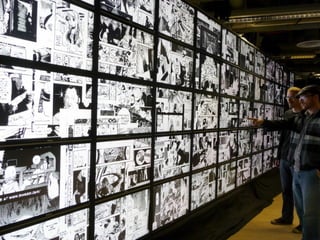
Usually visualizations of cultural data do not
show the actual objects (texts, images, etc.)
but only show patterns in metadata (dates,
names, text features, geo locations).

In our Software Studies Initiative at UCSD
(softwarestudies.com) we developed tools
to visualize the actual large collections.
Images can be sorted in a variety of ways
using both existing metadata and automatic
measurements of their visual attributes.
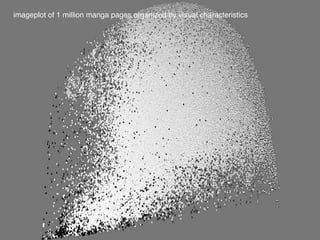
imageplot of 1 million manga pages organized by visual characteristics
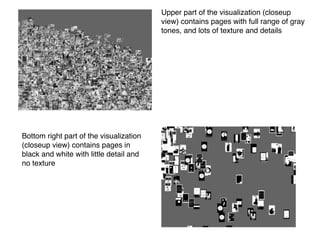
Upper part of the visualization (closeup
                                         view) contains pages with full range of gray
                                         tones, and lots of texture and details


Bottom right part of the visualization
(closeup view) contains pages in
black and white with little detail and
no texture
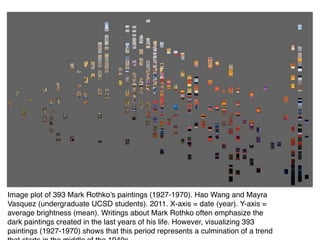
Image plot of 393 Mark Rothko’s paintings (1927-1970). Hao Wang and Mayra
Vasquez (undergraduate UCSD students). 2011. X-axis = date (year). Y-axis =
average brightness (mean). Writings about Mark Rothko often emphasize the
dark paintings created in the last years of his life. However, visualizing 393
paintings (1927-1970) shows that this period represents a culmination of a trend
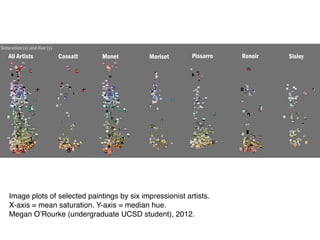
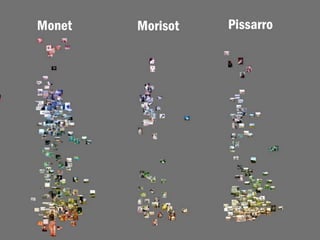
Image plots of selected paintings by six impressionist artists.
X-axis = mean saturation. Y-axis = median hue.
Megan O’Rourke (undergraduate UCSD student), 2012.
our free software tools for analyzing and
visualizing large image and video
collections, publications and projects:

softwarestudies.com

Intro to CAA 2012 session "Visualization as a Method in Art History"

  • 1.
    Information Visualization as aResearch Method in Art History CAA 2012 session Introduction by Lev Manovich 1
  • 2.
    visualization timeline: - developmentof key techniques: by 1830s - scientific visualization: 1988- - information visualization: 1998- - artistic visualization: 2001- - visualization is featured in Design and Elastic Mind at MOMA: 2008 - Obama campaign site uses sophisticated visualization: 2008 - visualization become ubiquitous (you have to include in your social web site): 2011 2
  • 3.
    Aaron Koblin, FlightPatterns. 2005. 3
  • 4.
    Alex Dragulescki (UCSD).Spam Architecture. 2005. 4
  • 5.
    Visualization of booksflow in Seattle Public Library. Artist: George Legrady, UCSB 5
  • 6.
    IAC Building, NYC:outside view; the lobby with the visualization showing global users accessing web properties owned by IAC. Dynamic visualization as a new logo of a company/institution -- representation of dynamic process rather than static identity. 6
  • 7.
    New York Timesbuilding: visualization of text drawn from NYT archives. Artists: Ben Rubin and Mark Hanson. 7
  • 8.
  • 9.
  • 10.
  • 11.
    2008: Graphs ofstatistical data are beginning to be integrated in consumer software and webware. Example: stats for activity on individual user account on Flickr. 11
  • 12.
    2009: stats forvideos on YouTube. 12
  • 13.
    2009: stats forvideos on YouTube. 13
  • 14.
    the development of“cultural visualization”: graphing cultural patterns 14
  • 15.
  • 16.
  • 17.
  • 18.
    Lee Byron. Personallistening history using last.fm data. 18
  • 19.
    Blue pictures areby locals. Red pictures are by tourists. Yellow pictures might be by either. Base map © OpenStreetMap, CC-BY-SA  19 Visualization by Eric Fischer
  • 20.
    Mapping global cultureusing “digital traces.” Google Trends, 2007. 20
  • 22.
    visualization + bigcultural data: NEH Offfice of Digital Humanities (created 3/2008) Humanities High Performance Computing initiative: “Humanities High-Performance Computing (HHPC) refers to the use of high- performance machines for humanities and social science projects. Currently, only a small number of humanities scholars are taking advantage of high-performance computing. But just as the sciences have, over time, begun to tap the enormous potential of HPC, the humanities are beginning to as well. Humanities scholars often deal with large sets of unstructured data. This might take the form of historical newspapers, books, election data, archaeological fragments, audio or video contents, or a host of others. HHPC offers the humanist opportunities to sort through, mine, and better understand and visualize this data.” 22
  • 23.
    January 2009: NEH andNSF announce DIGGING INTO DATA CHALLENGE. Grant amounts: up to 300K USD. "The creation of vast quantities of Internet accessible digital data and the development of techniques for large-scale data analysis and visualization have led to remarkable new discoveries in genetics, astronomy, and other fields, and— importantly—connections between academic disciplinary areas." "With books, newspapers, journals, films, artworks, and sound recordings being digitized on a massive scale, it is possible to apply data analysis techniques to large collections of diverse cultural heritage resources as well as scientific data. How might these techniques help scholars use these materials to ask new questions about and gain new insights into our world?" 23
  • 24.
    Usually visualizations ofcultural data do not show the actual objects (texts, images, etc.) but only show patterns in metadata (dates, names, text features, geo locations). In our Software Studies Initiative at UCSD (softwarestudies.com) we developed tools to visualize the actual large collections. Images can be sorted in a variety of ways using both existing metadata and automatic measurements of their visual attributes.
  • 26.
    imageplot of 1million manga pages organized by visual characteristics
  • 27.
    Upper part ofthe visualization (closeup view) contains pages with full range of gray tones, and lots of texture and details Bottom right part of the visualization (closeup view) contains pages in black and white with little detail and no texture
  • 28.
    Image plot of393 Mark Rothko’s paintings (1927-1970). Hao Wang and Mayra Vasquez (undergraduate UCSD students). 2011. X-axis = date (year). Y-axis = average brightness (mean). Writings about Mark Rothko often emphasize the dark paintings created in the last years of his life. However, visualizing 393 paintings (1927-1970) shows that this period represents a culmination of a trend
  • 29.
    Image plots ofselected paintings by six impressionist artists. X-axis = mean saturation. Y-axis = median hue. Megan O’Rourke (undergraduate UCSD student), 2012.
  • 31.
    our free softwaretools for analyzing and visualizing large image and video collections, publications and projects: softwarestudies.com