ARTalk Tuesday
Visual Art & Judaism
Jewish art can be
divided into categories:
folk art
such as paper-cuts
ritual art
artistic renditions of
ritual objects
art by Jews
and we’d like to add Art
about Judaism
created by non-Jews
• Tree of Life
• Shivitis
• Mizrah Plaques
• Artists
• Places
Tracy Ellyn
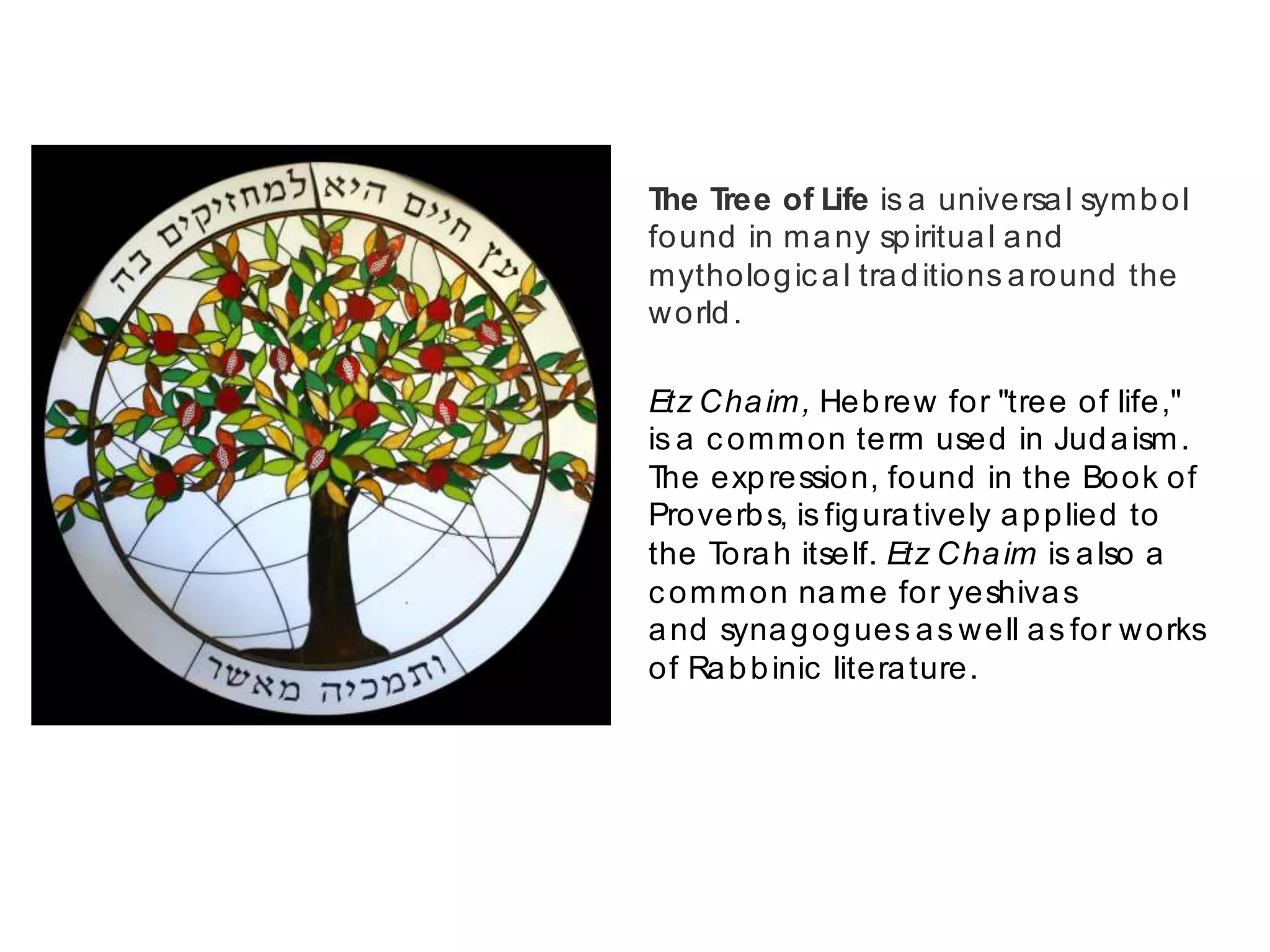
Etz Chaim, Hebrew for "tree of life,"
is a common term used in Judaism.
The expression, found in the Book of
Proverbs, is figuratively applied to
the Torah itself. Etz Chaim is also a
common name for yeshivas
and synagogues as well as for works
of Rabbinic literature.
The Tree of Life is a universal symbol
found in many spiritual and mythological
traditions around the world.
Etz Chaim, Hebrew for "tree of life,"
is a common term used in Judaism.
The expression, found in the Book of
Proverbs, is figuratively applied to
the Torah itself. Etz Chaim is also a
common name for yeshivas
and synagogues as well as for works
of Rabbinic literature.
The Tree of Life is a universal symbol
found in many spiritual and
mythological traditions around the
world.
Jewish mysticism depicts the tree of life in
the form of ten interconnected nodes, as
the central symbol of the Kabbalah. It
comprises the ten Sefirot powers in the
divine realm.
The tree of Life
has been depicted
in many forms.
The meaning is always
the same;
a pathway to a closer
relationship with God.
.
A GUIDE TO THE USE OF THE SHIVITI
by Rabbi Zalman Schachter-Shalomi
"Shiviti" comes from the sentence,
"I have set (shiviti) the Lord before me always."
Looking at a Shiviti is Name-gazing;
concentrating on the symbol of the Deity with a
focused gaze, until the distance between inside
and outside becomes obliterated, and what was
on the outside (the shiviti) becomes internalized.
Crop Many symbols and signs are
packed into this one image, and so
the practice involves taking one of
these at a time and treating it as a
doorway to awareness of the
divine.
To start, note that across the top of
the image is a line in Hebrew that
means: “Know before Whom you
stand.” Consider this a question.
Contemplate, what is the ultimate
Source in the universe? What is
the Presence that you appear
before every moment of your life?
How do you know “God”?
Shiviti HaShem l'negdi tamid
—“I place God before me
always.”
Subsequent generations
have recognized that this is a
practice. In fact, the holy is in
front of our eyes and nose
with every breath we take,
but do we see?
It takes a conscious act of
practice to renew the fresh
awareness that the Holy One
is in every moment. And the
outcome is awe.
Shivitis are painted as meditative
devices to renew the fresh
awareness that God is in every
moment. This practice is to
imprint in the mind the
impression of standing before
God. It becomes an experience,
and through continued practice
one’s awareness of God’s
presence is enhanced.
The experience or the practice
may mean something different
for each individual, but it will
always result in a discovery of
awareness.
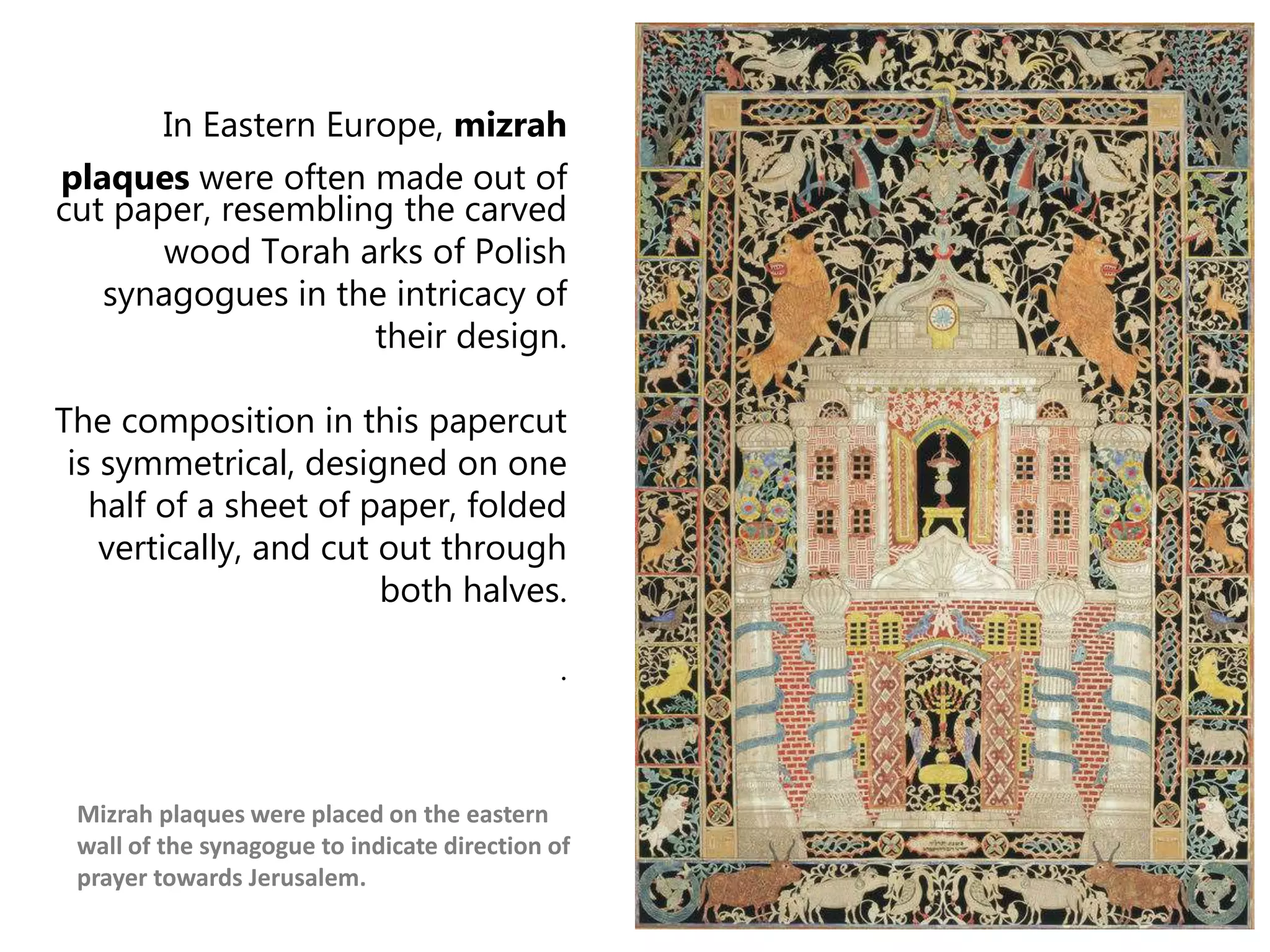
In Eastern Europe, mizrah
plaques were often made out of
cut paper, resembling the carved
wood Torah arks of Polish
synagogues in the intricacy of
their design.
The composition in this papercut
is symmetrical, designed on one
half of a sheet of paper, folded
vertically, and cut out through
both halves.
.
Mizrah plaques were placed on the eastern
wall of the synagogue to indicate direction of
prayer towards Jerusalem.
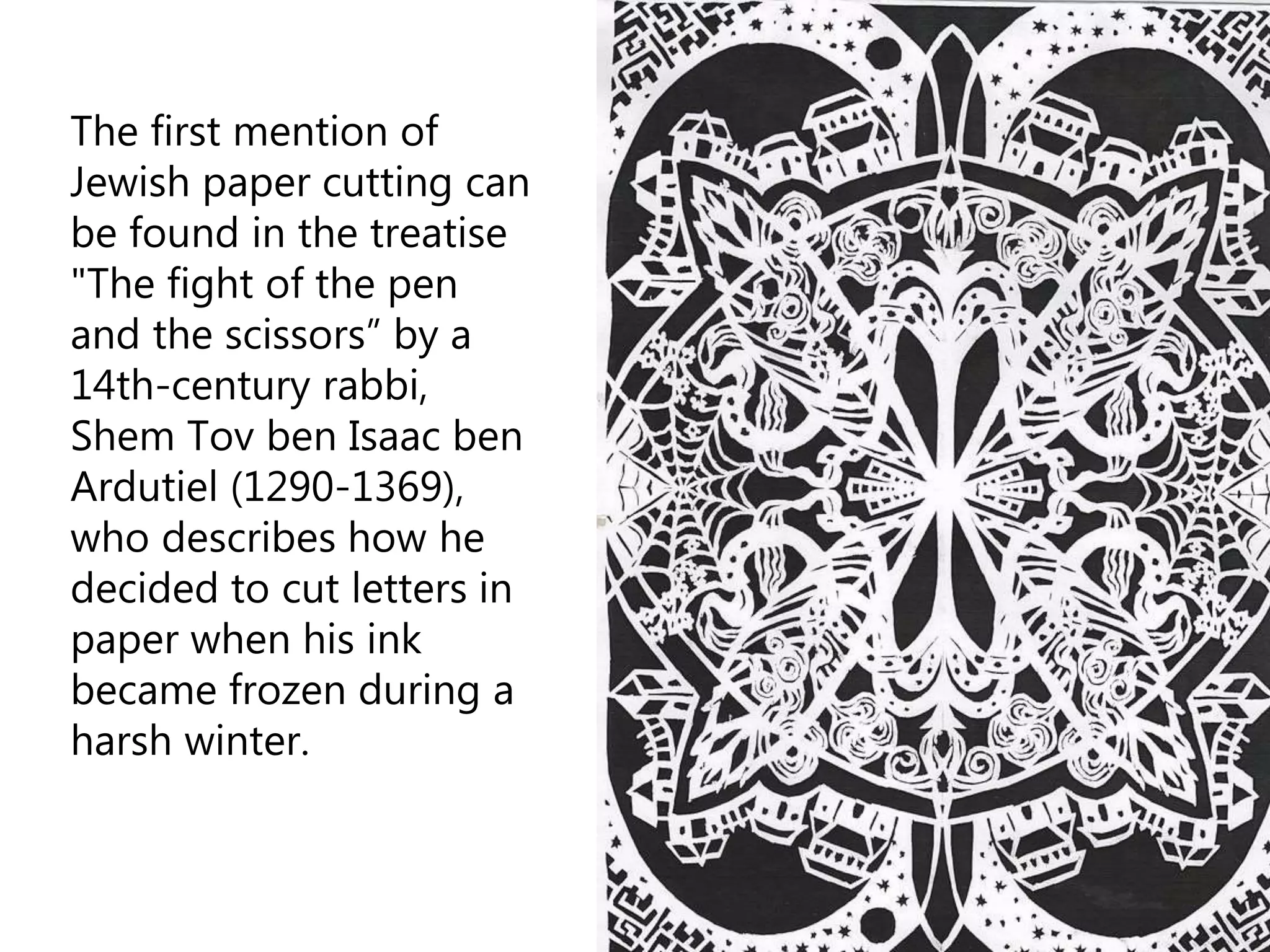
The first mention of
Jewish paper cutting can
be found in the treatise
"The fight of the pen
and the scissors” by a
14th-century rabbi,
Shem Tov ben Isaac ben
Ardutiel (1290-1369),
who describes how he
decided to cut letters in
paper when his ink
became frozen during a
harsh winter.
Papercuts were
usually mounted
on a plain or
colored paper
background to
provide a
contrasting effect.
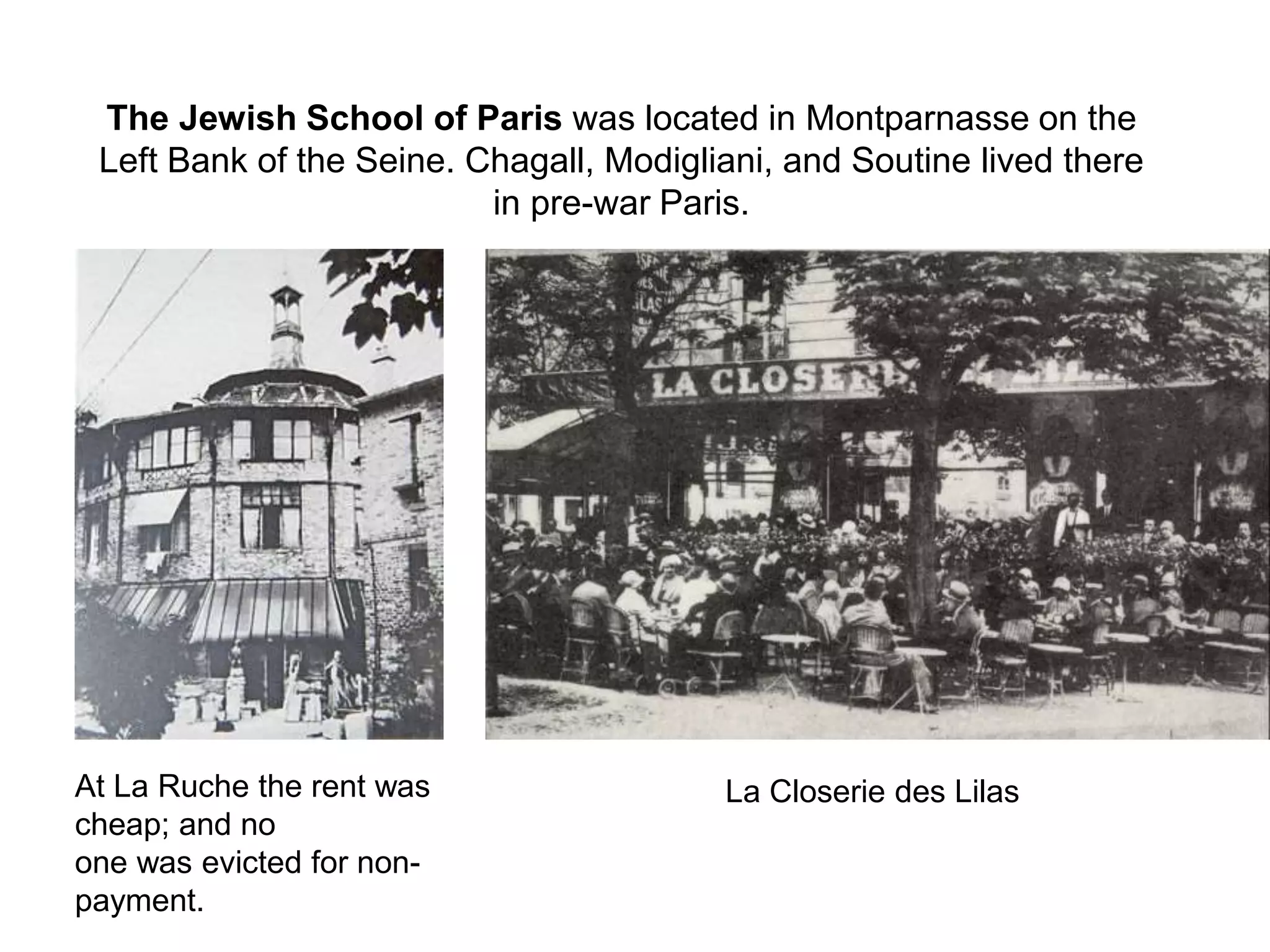
The Jewish School of Paris was located in Montparnasse on the
Left Bank of the Seine. Chagall, Modigliani, and Soutine lived there
in pre-war Paris.
At La Ruche the rent was
cheap; and no
one was evicted for non-
payment.
La Closerie des Lilas
Marc Chagall was a Russian-French artist of Belarusian Jewish
origin.
An early modernist, he was associated with several major artistic
styles (Cubism & Expressionism) and created works in a wide range
of artistic formats, including painting, drawings, book illustrations,
stained glass, stage sets, ceramic tapestries and fine art prints. “If I
were not a Jew, I would not be an artist,”
Moïche Zakharovitch Chagalov
1887 – 1985
Chaïm Soutine (1893 – 1943) was a
French painter of Lithuanian
Jewish origin. Soutine made a major
contribution to the expressionist
movement while living in Paris.
Inspired by classic painting in the
European tradition, Soutine developed
an individual style more concerned with
shape, color, and texture over
representation, which served as a
between more traditional approaches
and the developing form of Abstract
Expressionism.
Amedeo
Clemente
Modigliani
(1884 - 1920)
Italian
A painter and
sculptor,
Modigliani is
known for portraits
and nudes in a
modern style
characterized by
elongation of
faces, necks, and
figures.
During his early years in Paris, Modigliani worked at a furious pace. He was
constantly sketching, making as many as a hundred drawings a day. However,
many of his works were lost—destroyed by him as inferior, left behind in his
frequent changes of address, or given to girlfriends who did not keep them.
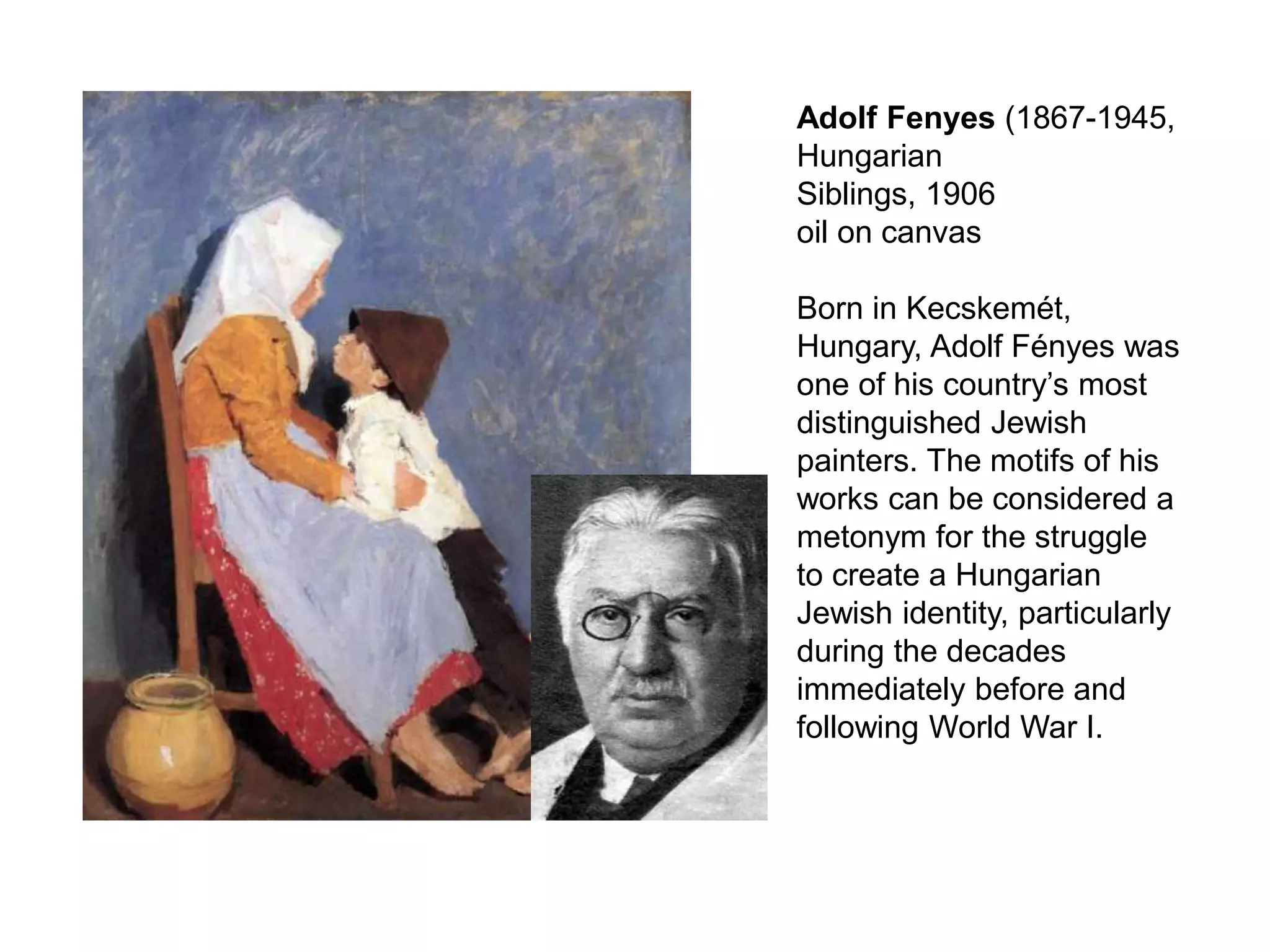
Adolf Fenyes (1867-1945,
Hungarian
Siblings, 1906
oil on canvas
Born in Kecskemét,
Hungary, Adolf Fényes was
one of his country’s most
distinguished Jewish
painters. The motifs of his
works can be considered a
metonym for the struggle
to create a Hungarian
Jewish identity, particularly
during the decades
immediately before and
following World War I.
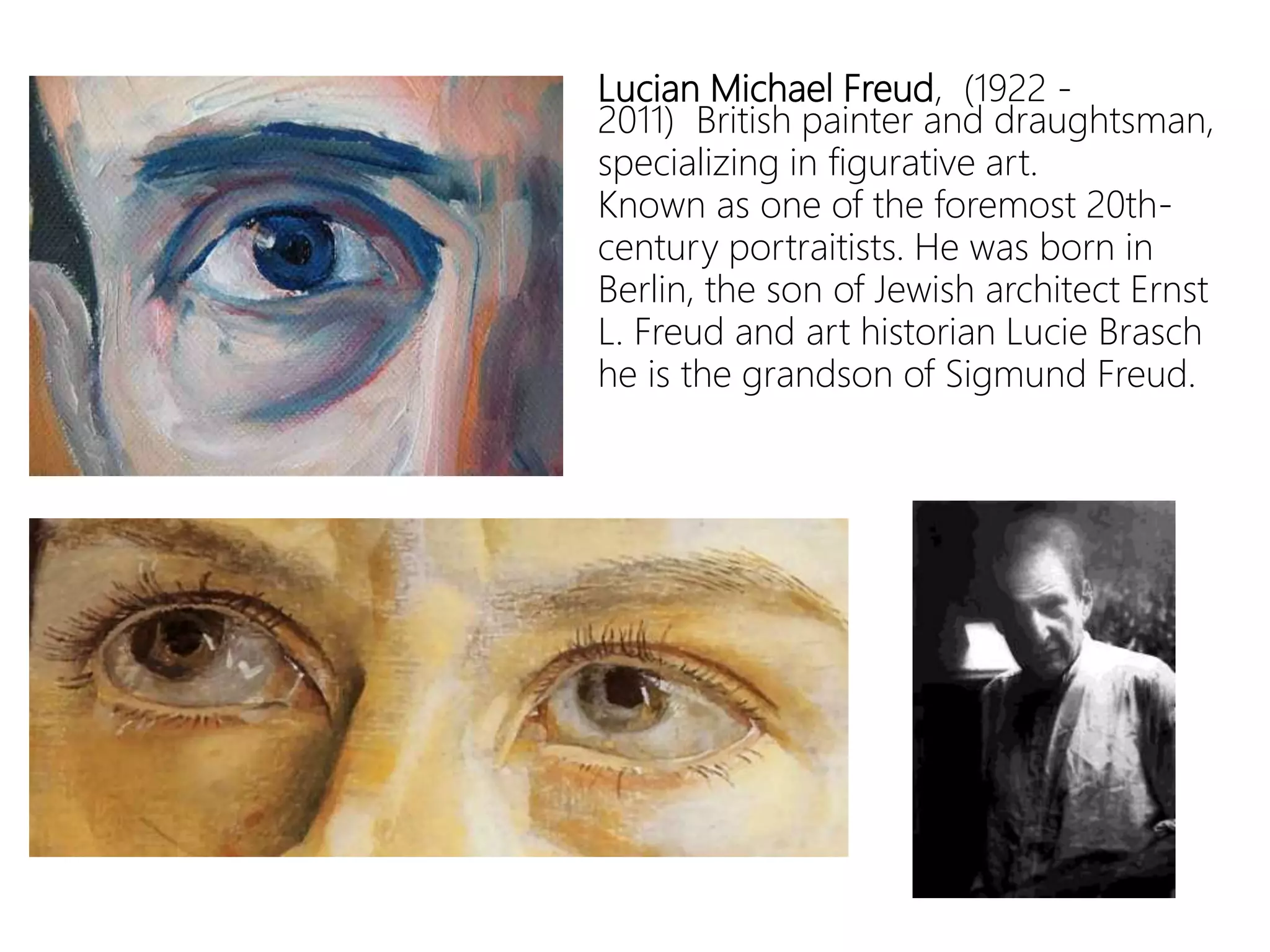
Lucian Michael Freud, (1922 -
2011) British painter and draughtsman,
specializing in figurative art.
Known as one of the foremost 20th-
century portraitists. He was born in
Berlin, the son of Jewish architect Ernst
L. Freud and art historian Lucie Brasch
he is the grandson of Sigmund Freud.
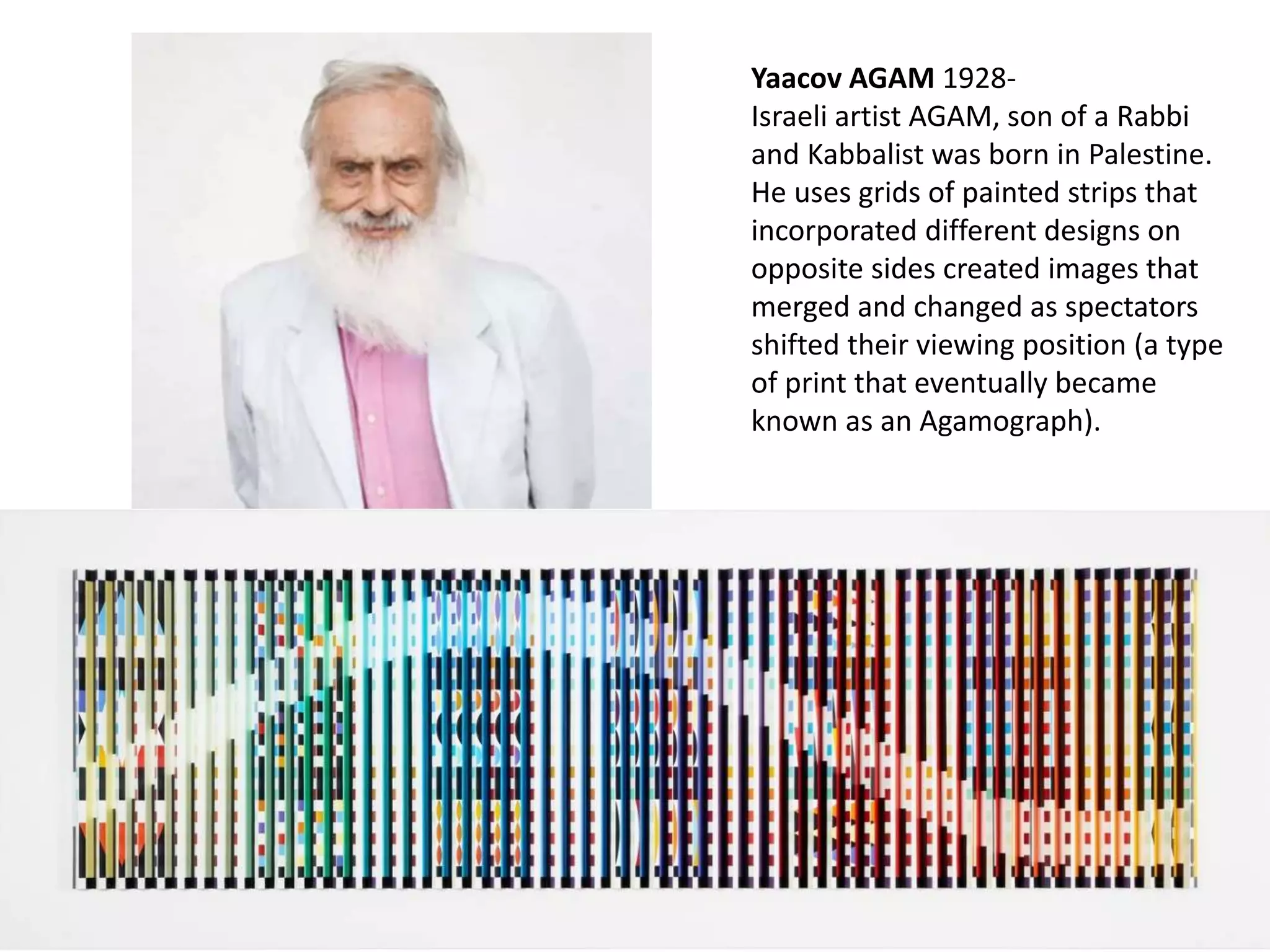
Yaacov AGAM 1928-
Israeli artist AGAM, son of a Rabbi
and Kabbalist was born in Palestine.
He uses grids of painted strips that
incorporated different designs on
opposite sides created images that
merged and changed as spectators
shifted their viewing position (a type
of print that eventually became
known as an Agamograph).
Villa Regina
Jacob’s
Ladder
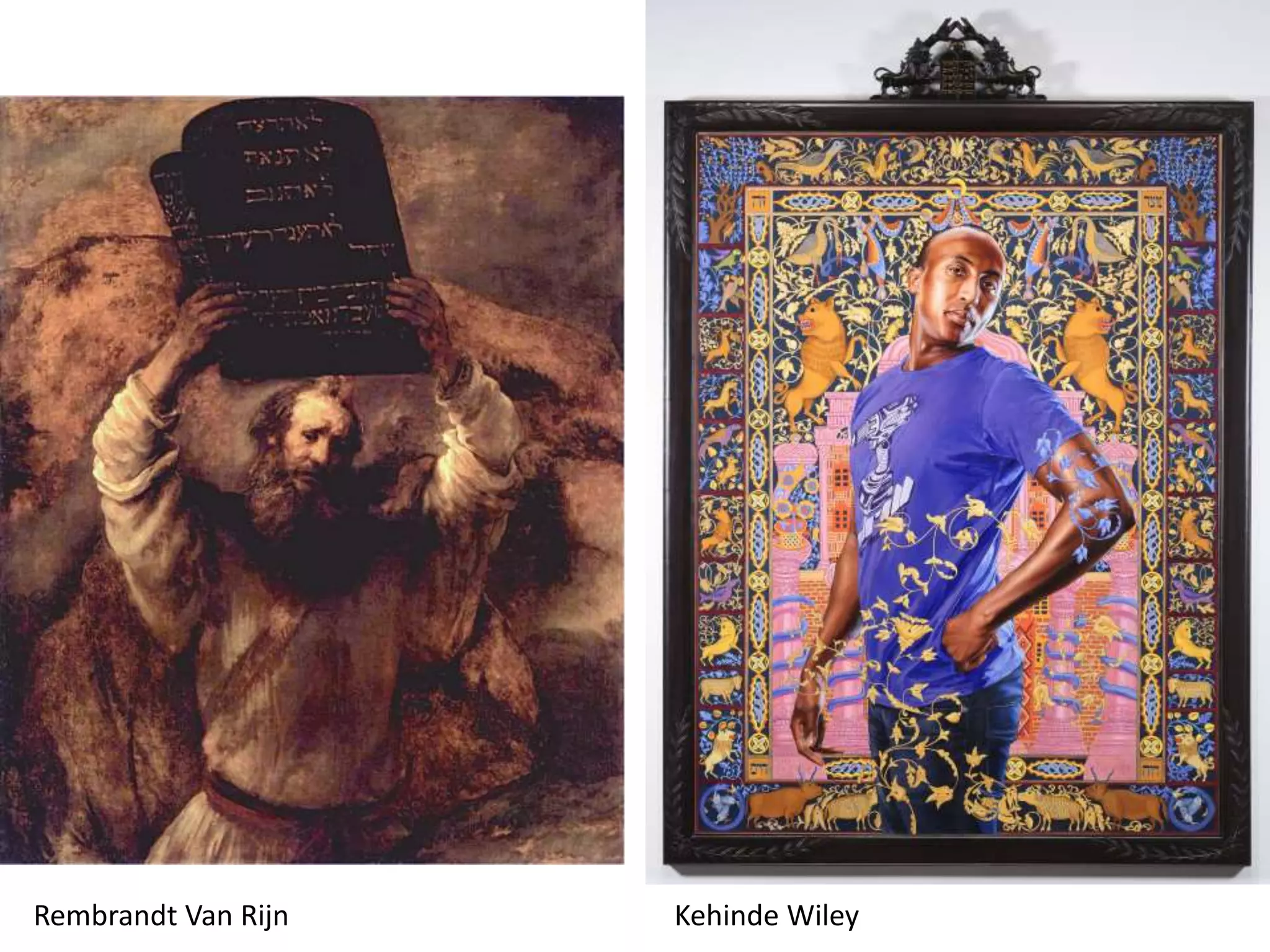
Rembrandt Van Rijn Kehinde Wiley
"The All-Seeing Eye of God Said It Was Good and He Rested." From Genesis. Tracy
Ellyn
Hadassah Medical Center – Jerusalem
https://www.tracyellyn-recentworks.com/
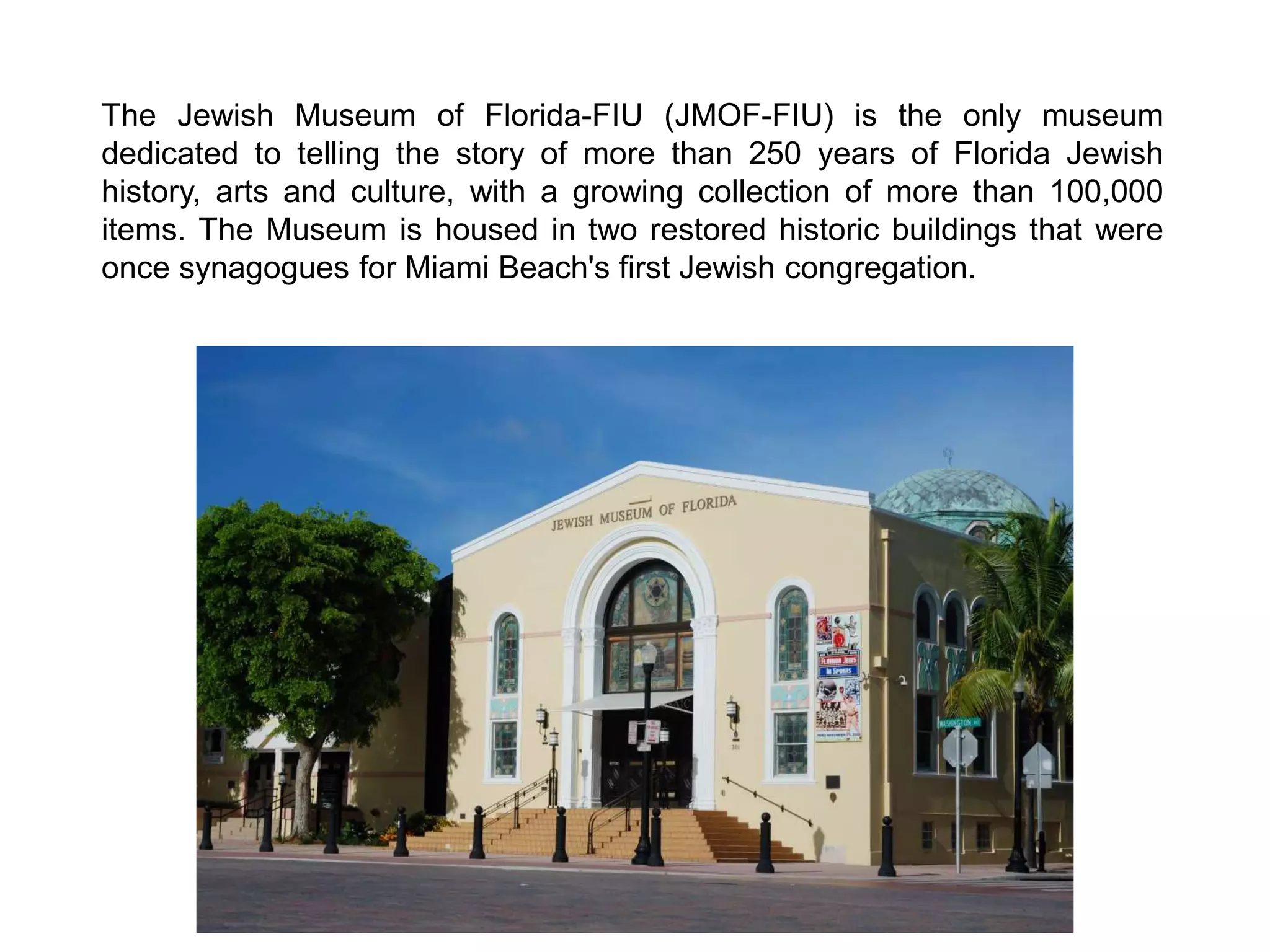
The Jewish Museum of Florida-FIU (JMOF-FIU) is the only museum
dedicated to telling the story of more than 250 years of Florida Jewish
history, arts and culture, with a growing collection of more than 100,000
items. The Museum is housed in two restored historic buildings that were
once synagogues for Miami Beach's first Jewish congregation.
Located on New York City’s Museum Mile, the Jewish Museum is a museum at
the intersection of art and Jewish culture for people of all backgrounds.
Founded in 1904, the Museum was the first institution of its kind in the United
States and one of the oldest Jewish museums in the world.
The Museum maintains a unique collection of nearly 30,000 works of art,
ceremonial objects, and media reflecting the global Jewish experience over
more than 4,000 years. Our distinguished exhibition history reveals a deep and
rich exploration of Jewish culture and identity, and includes some of the most
seminal exhibitions of the 20th and 21st centuries.
https://www.myjewishlearning.com/article/jewish-art-101/
https://www.wikiwand.com/en/Jewish_paper_cutting
https://thejewishmuseum.org/
https://en.nicetourisme.com/nice/183-musee-national-marc-chagall
https://jmof.fiu.edu/
Learn More
Virtual ARTalk Tuesday
THANKS FOR SHOWING UP!

Visual art and Judaism

  • 1.
  • 2.
    Jewish art canbe divided into categories: folk art such as paper-cuts ritual art artistic renditions of ritual objects art by Jews and we’d like to add Art about Judaism created by non-Jews
  • 3.
    • Tree ofLife • Shivitis • Mizrah Plaques • Artists • Places Tracy Ellyn
  • 5.
    Etz Chaim, Hebrewfor "tree of life," is a common term used in Judaism. The expression, found in the Book of Proverbs, is figuratively applied to the Torah itself. Etz Chaim is also a common name for yeshivas and synagogues as well as for works of Rabbinic literature. The Tree of Life is a universal symbol found in many spiritual and mythological traditions around the world. Etz Chaim, Hebrew for "tree of life," is a common term used in Judaism. The expression, found in the Book of Proverbs, is figuratively applied to the Torah itself. Etz Chaim is also a common name for yeshivas and synagogues as well as for works of Rabbinic literature. The Tree of Life is a universal symbol found in many spiritual and mythological traditions around the world.
  • 7.
    Jewish mysticism depictsthe tree of life in the form of ten interconnected nodes, as the central symbol of the Kabbalah. It comprises the ten Sefirot powers in the divine realm.
  • 8.
    The tree ofLife has been depicted in many forms. The meaning is always the same; a pathway to a closer relationship with God.
  • 10.
    . A GUIDE TOTHE USE OF THE SHIVITI by Rabbi Zalman Schachter-Shalomi "Shiviti" comes from the sentence, "I have set (shiviti) the Lord before me always." Looking at a Shiviti is Name-gazing; concentrating on the symbol of the Deity with a focused gaze, until the distance between inside and outside becomes obliterated, and what was on the outside (the shiviti) becomes internalized.
  • 11.
    Crop Many symbolsand signs are packed into this one image, and so the practice involves taking one of these at a time and treating it as a doorway to awareness of the divine. To start, note that across the top of the image is a line in Hebrew that means: “Know before Whom you stand.” Consider this a question. Contemplate, what is the ultimate Source in the universe? What is the Presence that you appear before every moment of your life? How do you know “God”?
  • 12.
    Shiviti HaShem l'negditamid —“I place God before me always.” Subsequent generations have recognized that this is a practice. In fact, the holy is in front of our eyes and nose with every breath we take, but do we see? It takes a conscious act of practice to renew the fresh awareness that the Holy One is in every moment. And the outcome is awe.
  • 13.
    Shivitis are paintedas meditative devices to renew the fresh awareness that God is in every moment. This practice is to imprint in the mind the impression of standing before God. It becomes an experience, and through continued practice one’s awareness of God’s presence is enhanced. The experience or the practice may mean something different for each individual, but it will always result in a discovery of awareness.
  • 14.
    In Eastern Europe,mizrah plaques were often made out of cut paper, resembling the carved wood Torah arks of Polish synagogues in the intricacy of their design. The composition in this papercut is symmetrical, designed on one half of a sheet of paper, folded vertically, and cut out through both halves. . Mizrah plaques were placed on the eastern wall of the synagogue to indicate direction of prayer towards Jerusalem.
  • 15.
    The first mentionof Jewish paper cutting can be found in the treatise "The fight of the pen and the scissors” by a 14th-century rabbi, Shem Tov ben Isaac ben Ardutiel (1290-1369), who describes how he decided to cut letters in paper when his ink became frozen during a harsh winter.
  • 16.
    Papercuts were usually mounted ona plain or colored paper background to provide a contrasting effect.
  • 17.
    The Jewish Schoolof Paris was located in Montparnasse on the Left Bank of the Seine. Chagall, Modigliani, and Soutine lived there in pre-war Paris. At La Ruche the rent was cheap; and no one was evicted for non- payment. La Closerie des Lilas
  • 18.
    Marc Chagall wasa Russian-French artist of Belarusian Jewish origin. An early modernist, he was associated with several major artistic styles (Cubism & Expressionism) and created works in a wide range of artistic formats, including painting, drawings, book illustrations, stained glass, stage sets, ceramic tapestries and fine art prints. “If I were not a Jew, I would not be an artist,” Moïche Zakharovitch Chagalov 1887 – 1985
  • 19.
    Chaïm Soutine (1893– 1943) was a French painter of Lithuanian Jewish origin. Soutine made a major contribution to the expressionist movement while living in Paris. Inspired by classic painting in the European tradition, Soutine developed an individual style more concerned with shape, color, and texture over representation, which served as a between more traditional approaches and the developing form of Abstract Expressionism.
  • 20.
    Amedeo Clemente Modigliani (1884 - 1920) Italian Apainter and sculptor, Modigliani is known for portraits and nudes in a modern style characterized by elongation of faces, necks, and figures. During his early years in Paris, Modigliani worked at a furious pace. He was constantly sketching, making as many as a hundred drawings a day. However, many of his works were lost—destroyed by him as inferior, left behind in his frequent changes of address, or given to girlfriends who did not keep them.
  • 21.
    Adolf Fenyes (1867-1945, Hungarian Siblings,1906 oil on canvas Born in Kecskemét, Hungary, Adolf Fényes was one of his country’s most distinguished Jewish painters. The motifs of his works can be considered a metonym for the struggle to create a Hungarian Jewish identity, particularly during the decades immediately before and following World War I.
  • 22.
    Lucian Michael Freud,(1922 - 2011) British painter and draughtsman, specializing in figurative art. Known as one of the foremost 20th- century portraitists. He was born in Berlin, the son of Jewish architect Ernst L. Freud and art historian Lucie Brasch he is the grandson of Sigmund Freud.
  • 23.
    Yaacov AGAM 1928- Israeliartist AGAM, son of a Rabbi and Kabbalist was born in Palestine. He uses grids of painted strips that incorporated different designs on opposite sides created images that merged and changed as spectators shifted their viewing position (a type of print that eventually became known as an Agamograph).
  • 24.
  • 25.
    Rembrandt Van RijnKehinde Wiley
  • 26.
    "The All-Seeing Eyeof God Said It Was Good and He Rested." From Genesis. Tracy Ellyn Hadassah Medical Center – Jerusalem https://www.tracyellyn-recentworks.com/
  • 27.
    The Jewish Museumof Florida-FIU (JMOF-FIU) is the only museum dedicated to telling the story of more than 250 years of Florida Jewish history, arts and culture, with a growing collection of more than 100,000 items. The Museum is housed in two restored historic buildings that were once synagogues for Miami Beach's first Jewish congregation.
  • 28.
    Located on NewYork City’s Museum Mile, the Jewish Museum is a museum at the intersection of art and Jewish culture for people of all backgrounds. Founded in 1904, the Museum was the first institution of its kind in the United States and one of the oldest Jewish museums in the world. The Museum maintains a unique collection of nearly 30,000 works of art, ceremonial objects, and media reflecting the global Jewish experience over more than 4,000 years. Our distinguished exhibition history reveals a deep and rich exploration of Jewish culture and identity, and includes some of the most seminal exhibitions of the 20th and 21st centuries.
  • 30.
  • 32.

Editor's Notes

  • #6 Proverbs 3:18.
  • #8 Sefirot means emanations, through which God reveals Himself/Herself.
  • #9 The tree of Life has been depicted in many forms. The meaning is always the same; a pathway to a closer relationship with God.
  • #11 King David wrote in Psalm 16:8 “Shitviti HaShem l’negdi tamid” – I place God before me always. Shivitis are painted as meditative devices to renew the fresh awareness that God is in every moment. This practice is to imprint in the mind the impression of standing before God. It becomes an experience, and through continued practice one’s awareness of Gods presence is enhanced. Marilyn and I discussed what that might mean for each of us. We cited some examples, and came away with the understanding that the experience may mean something different for each individual, and it will result in a discovery of self awareness.