
SLIDES: Allen, Christopher
(2014, May 19). “Brainstorming
through Game Creation”. Life
With Alacrity. Retrieved May
19, 2014, from http://
www.LifeWithAlacrity.com
Brainstorming
through Game
Creation
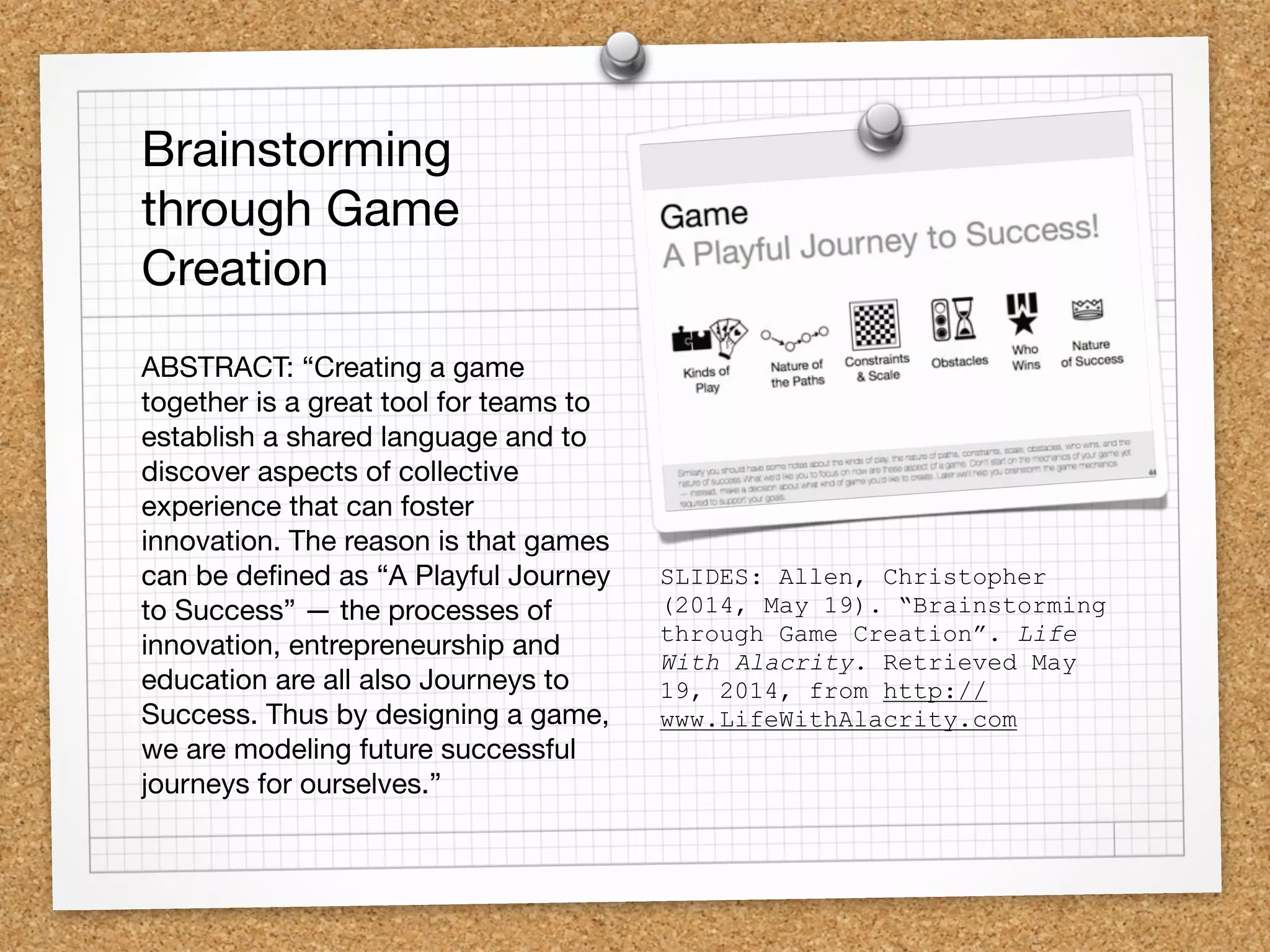
ABSTRACT: “Creating a game
together is a great tool for teams to
establish a shared language and to
discover aspects of collective
experience that can foster
innovation. The reason is that games
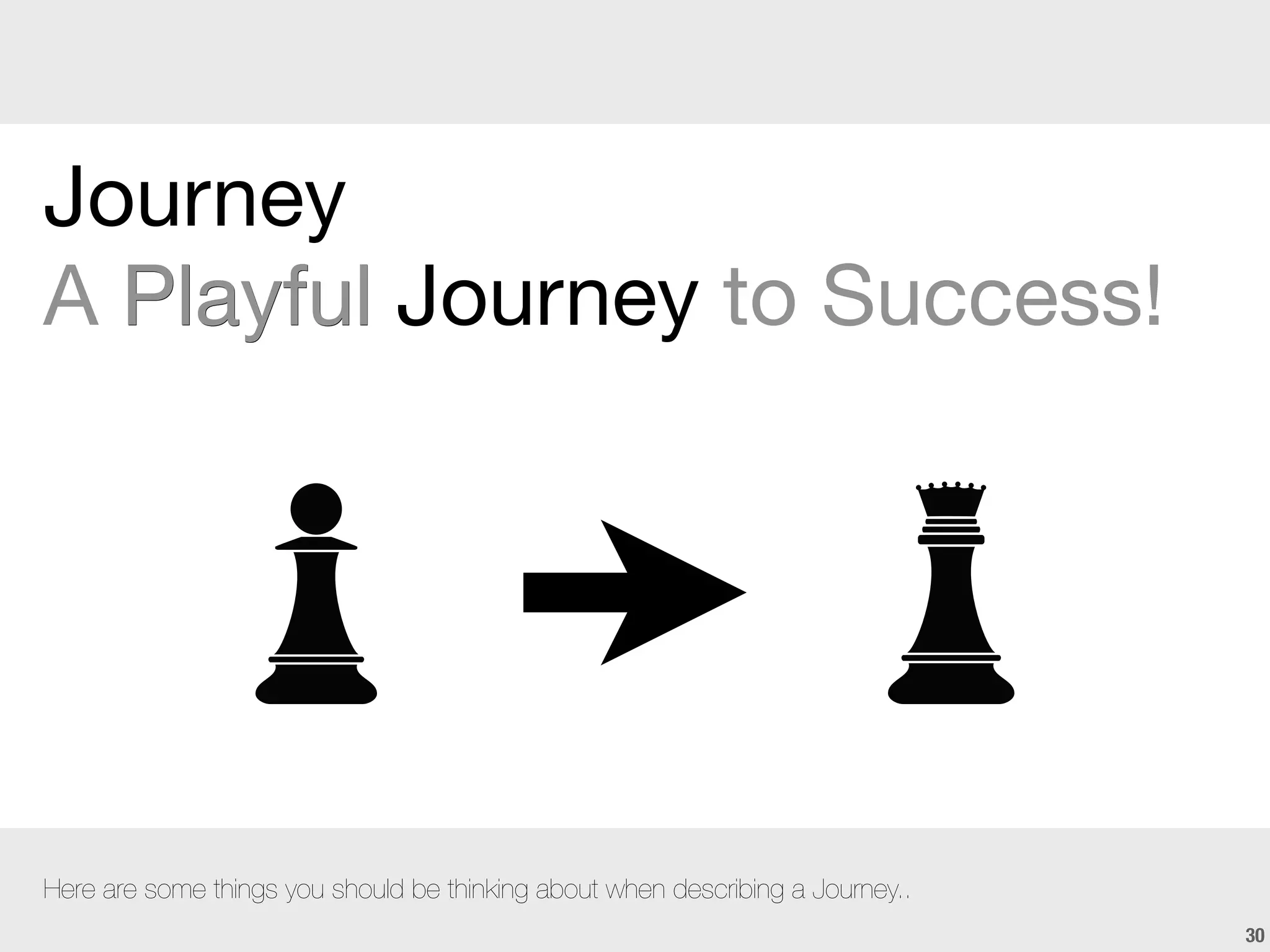
can be defined as “A Playful Journey
to Success” — the processes of
innovation, entrepreneurship and
education are all also Journeys to
Success. Thus by designing a game,
we are modeling future successful
journeys for ourselves.”
Created by Christopher Allen, ChristopherA@LIfeWithAlacrity.com. Published in blog Life With Alacrity. Text
and design ©2014 Christopher Allen and is licensed CC-BY-SA. Individual images are from The Noun
Project, are © their respective owners and are licensed under CC license.
Brainstorming through…
2
What is a
Today, as part of our brainstorming exercise, each of our teams will be creating a game. Creating these
games will give us a shared language about our different experiences, and will inspire us to discover aspects
of our collective that we might have otherwise missed.
Creating a Game
3
What is a
So to start — What, exactly, is a Game?
What is a Game?
4
What is a
So to start — What, exactly, is a Game?
What is a Game?
5
Game
Game
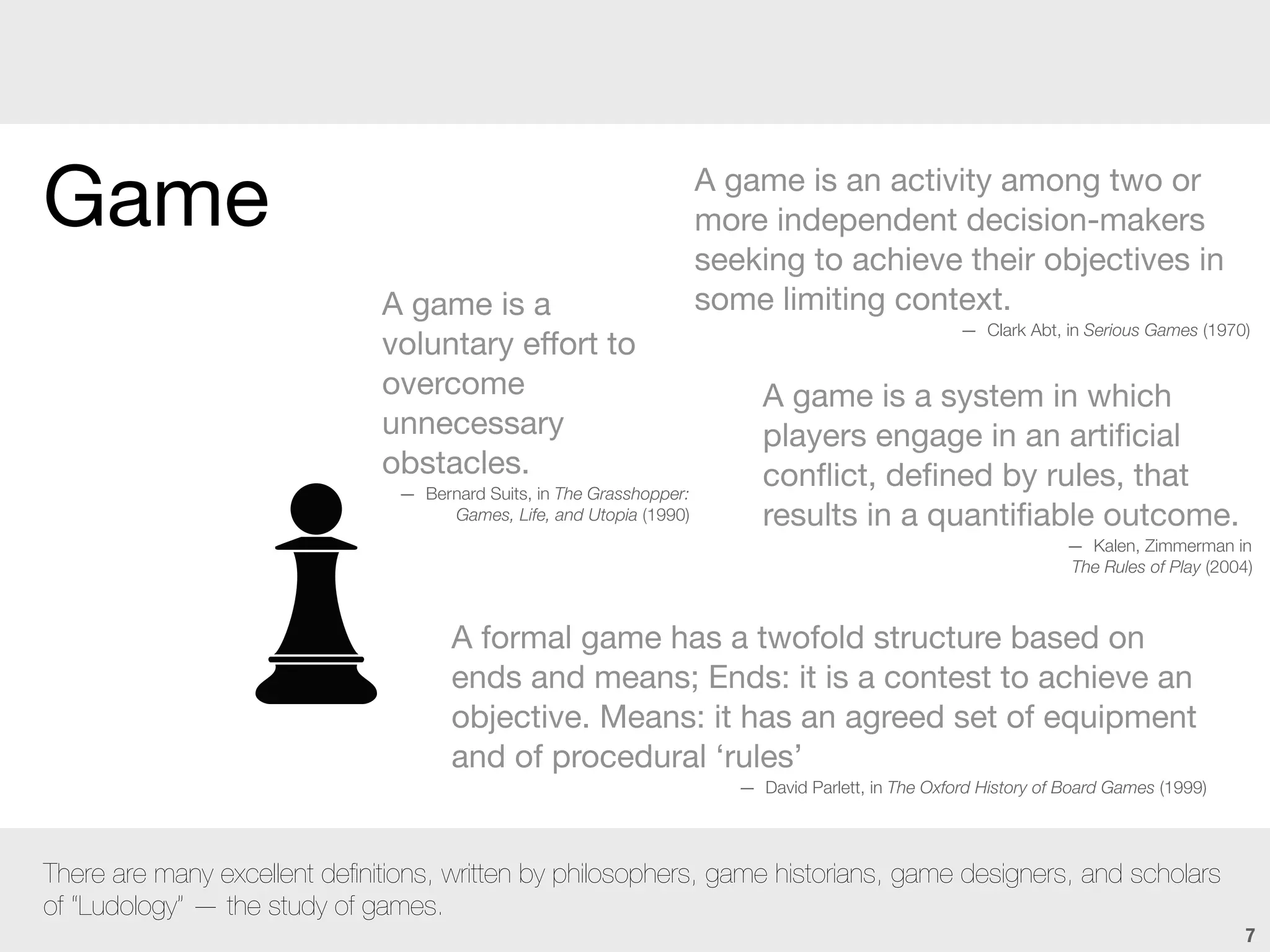
There are many excellent definitions, written by philosophers, game historians, game designers, and scholars
of “Ludology” — the study of games.
Game
6
Game
There are many excellent definitions, written by philosophers, game historians, game designers, and scholars
of “Ludology” — the study of games.
Game
7
Game
A game is a
voluntary effort to
overcome
unnecessary
obstacles.
— Bernard Suits, in The Grasshopper:
Games, Life, and Utopia (1990)
A game is an activity among two or
more independent decision-makers
seeking to achieve their objectives in
some limiting context.
— Clark Abt, in Serious Games (1970)
A game is a system in which
players engage in an artificial
conflict, defined by rules, that
results in a quantifiable outcome.
— Kalen, Zimmerman in
The Rules of Play (2004)
A formal game has a twofold structure based on
ends and means; Ends: it is a contest to achieve an
objective. Means: it has an agreed set of equipment
and of procedural ‘rules’
— David Parlett, in The Oxford History of Board Games (1999)
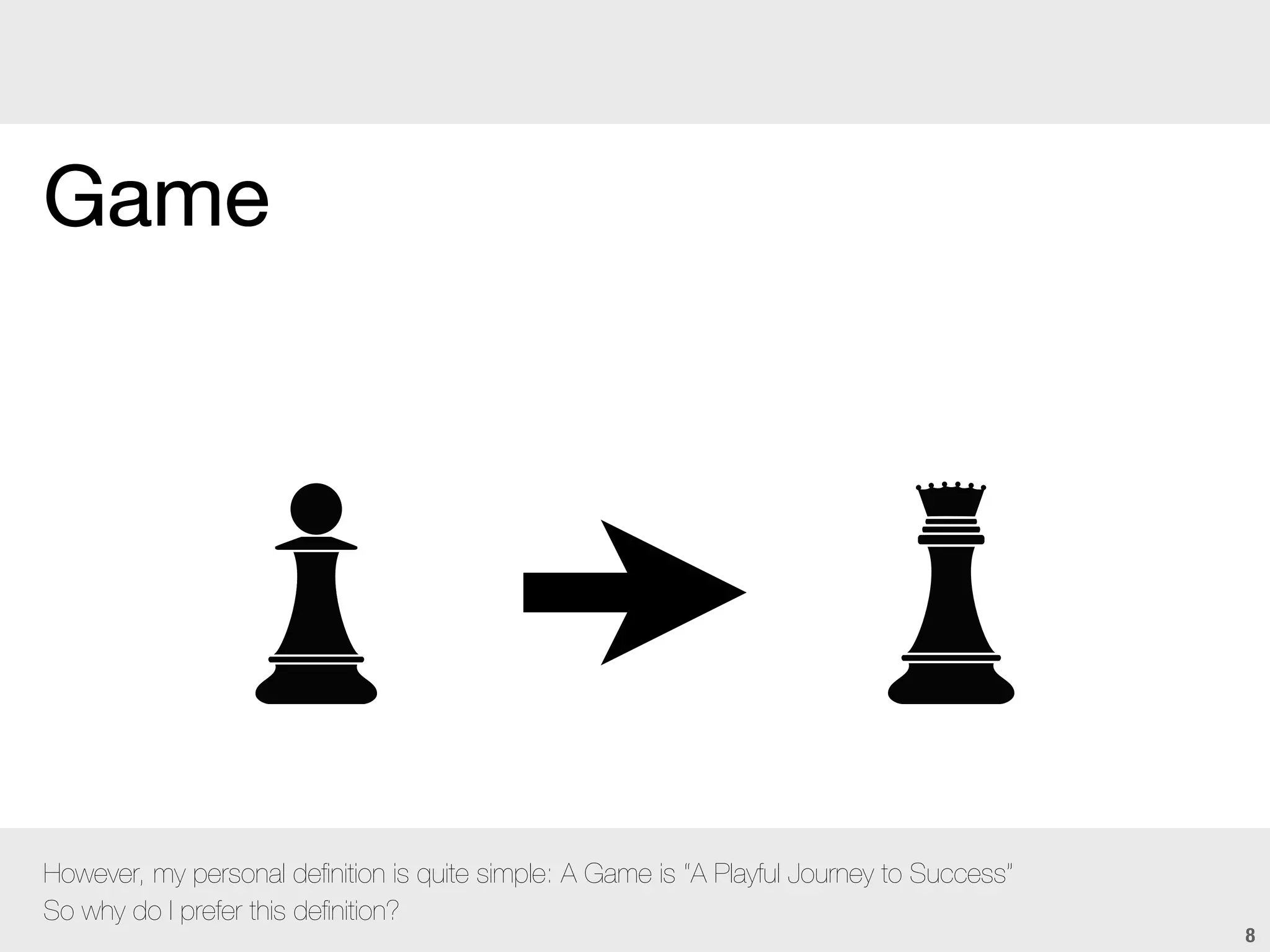
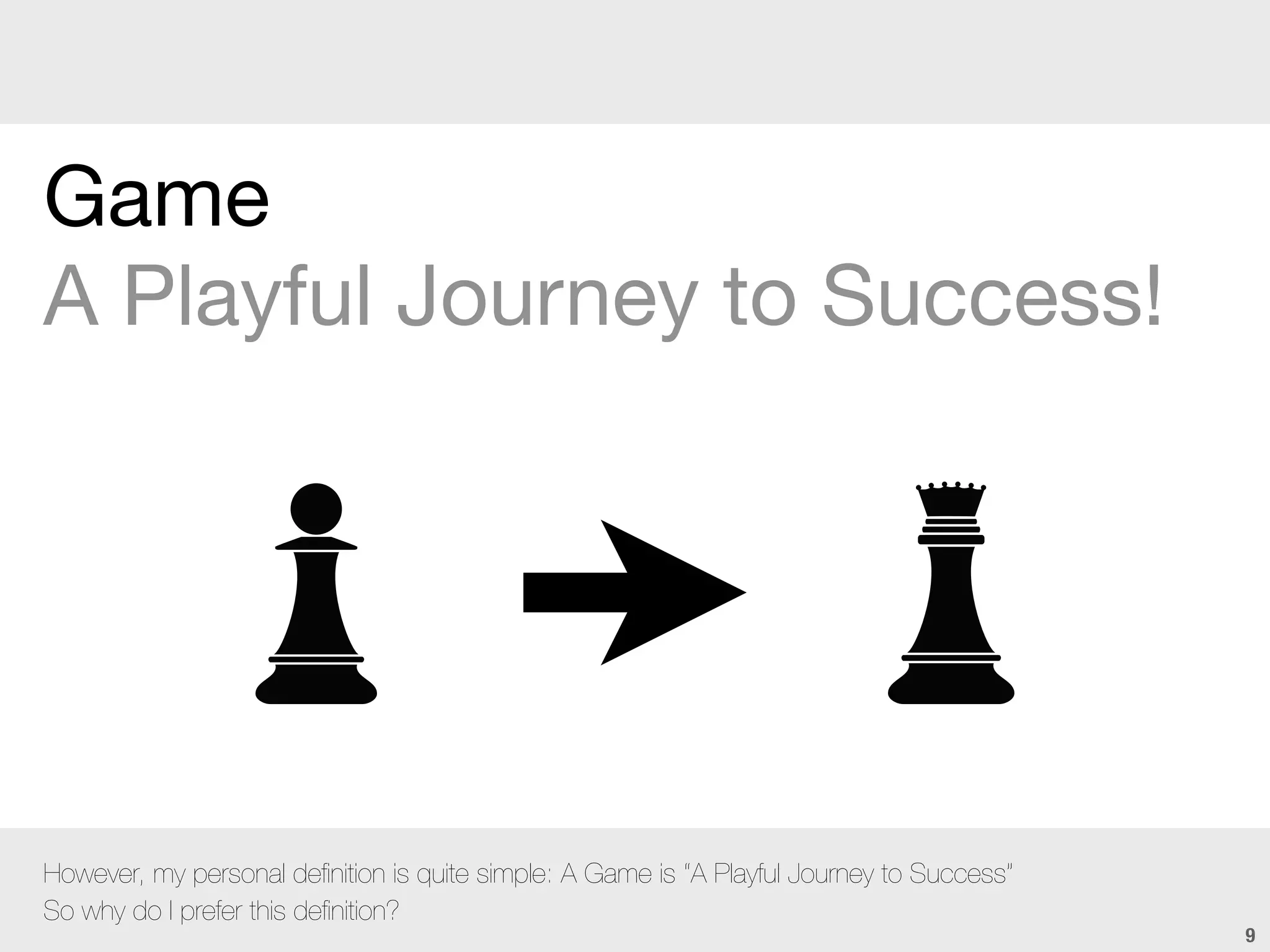
However, my personal definition is quite simple: A Game is “A Playful Journey to Success”
So why do I prefer this definition?
Game
8
Game
However, my personal definition is quite simple: A Game is “A Playful Journey to Success”
So why do I prefer this definition?
A Playful Journey to Success!
Game
9
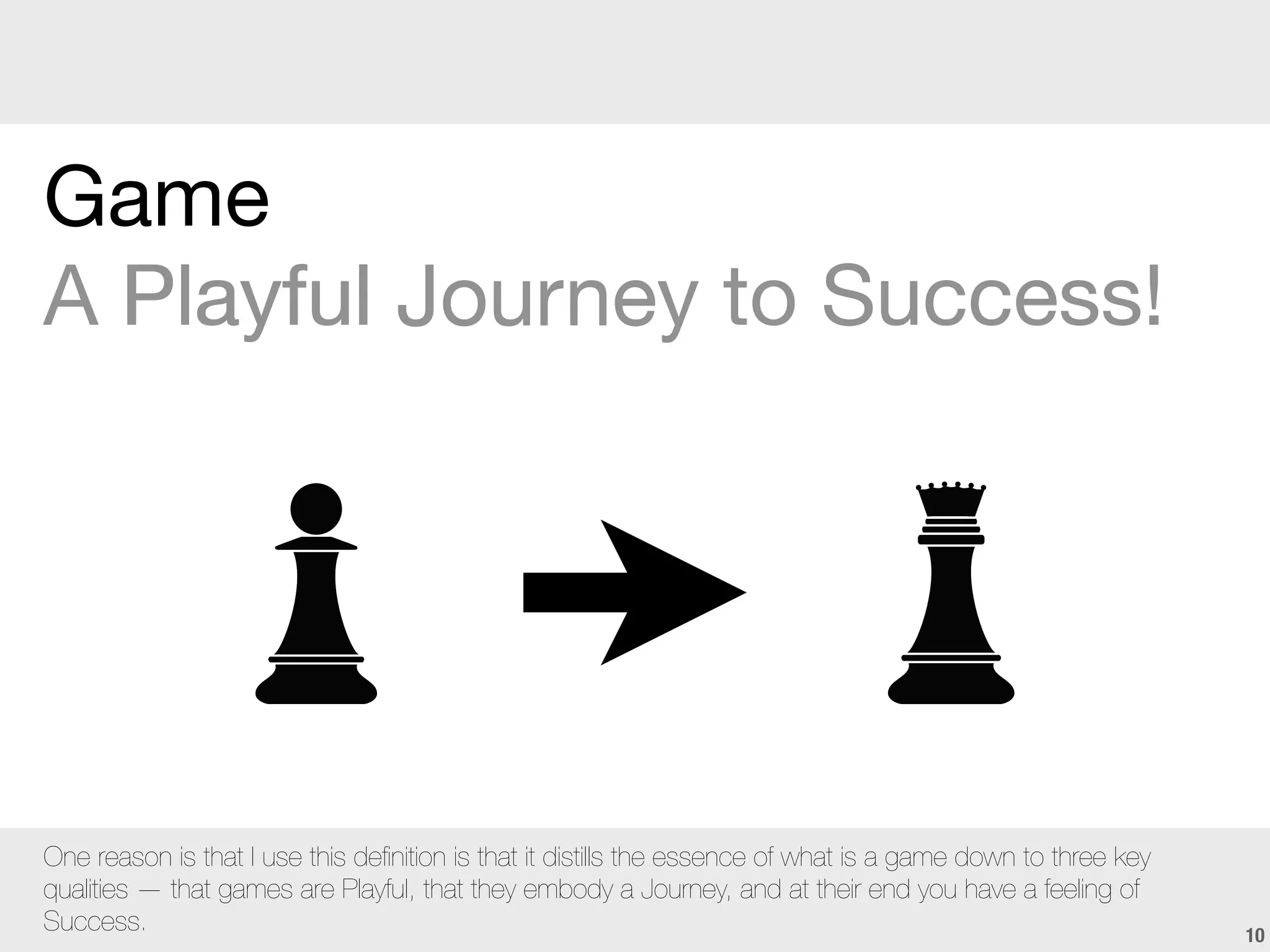
One reason is that I use this definition is that it distills the essence of what is a game down to three key
qualities — that games are Playful, that they embody a Journey, and at their end you have a feeling of
Success.
A Playful Journey to Success!
Game
10
Playful Journey Success
Also important to me, are the words that this definition leaves out.
A Playful Journey to Success!
Game
11
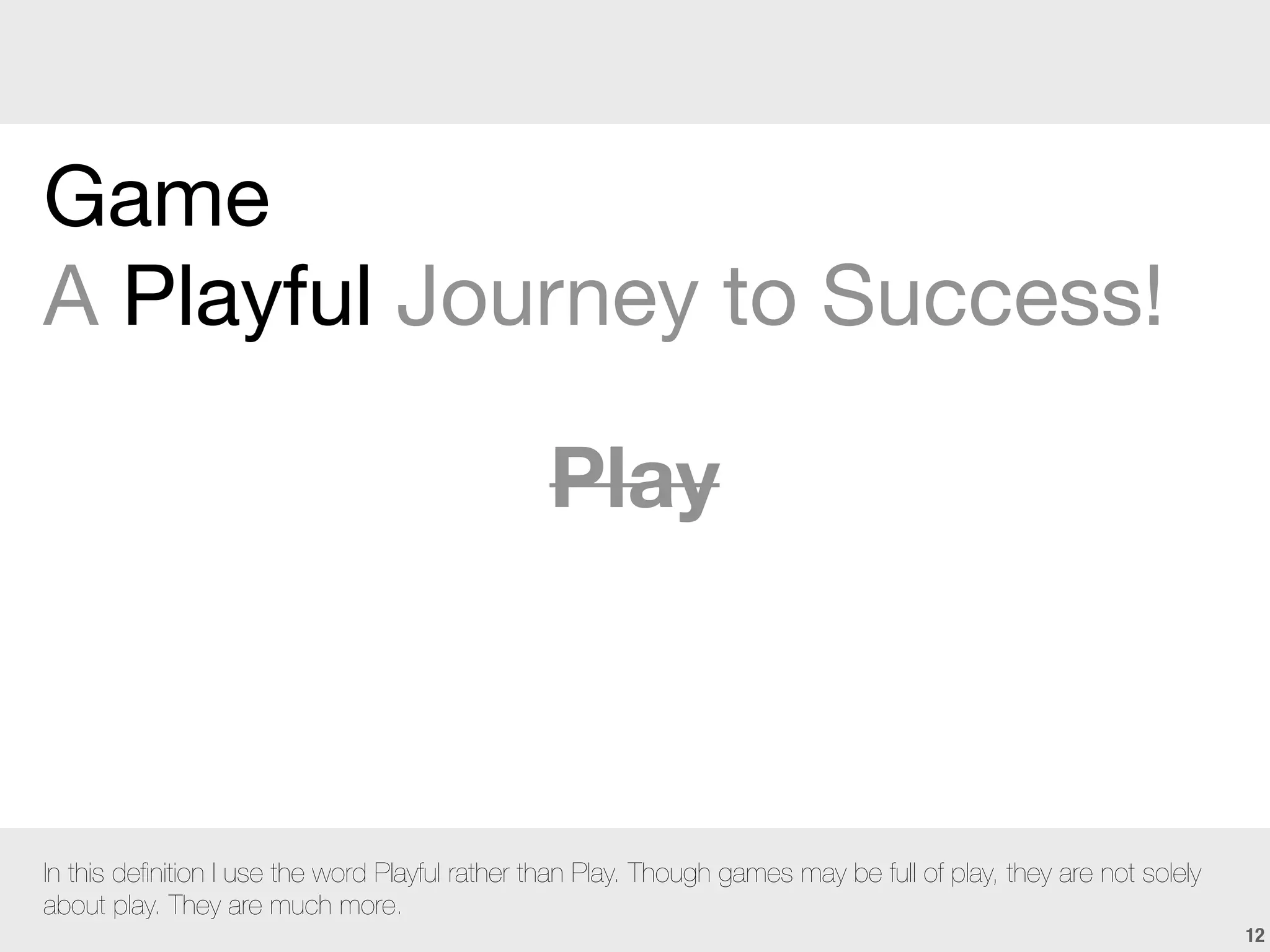
In this definition I use the word Playful rather than Play. Though games may be full of play, they are not solely
about play. They are much more.
A Playful Journey to Success!
Game
12
Playful
Play
Part of this is because games are not always fun — all games will have some form of fun, but typically some
portion of the play experience must challenge you, thus you will experience difficultly and frustration. Which is
not fun, but overcoming those challenges can be.
A Playful Journey to Success!
Game
13
Playful
Fun
Another missing word — Competition. Though competition is often important part of a game, the Journey
does not necessarily require players to compete with each other. Instead they may compete with
themselves, or against the board.
A Playful Journey to Success!
Game
14
Journey
Competition
Similarly do games don’t have to be fundamentally about conflict — there are many great games that are
about cooperation.
A Playful Journey to Success!
Game
15
Journey
Conflict
Finally, this definition avoids the word Win. Win implies that someone else looses. Winning can be an
important part of a game, but I prefer to use Success. In the best games, those who do not win still enjoy
and gain value from their play, so also share in the Success.
A Playful Journey to Success!
Game
16
Success
Win
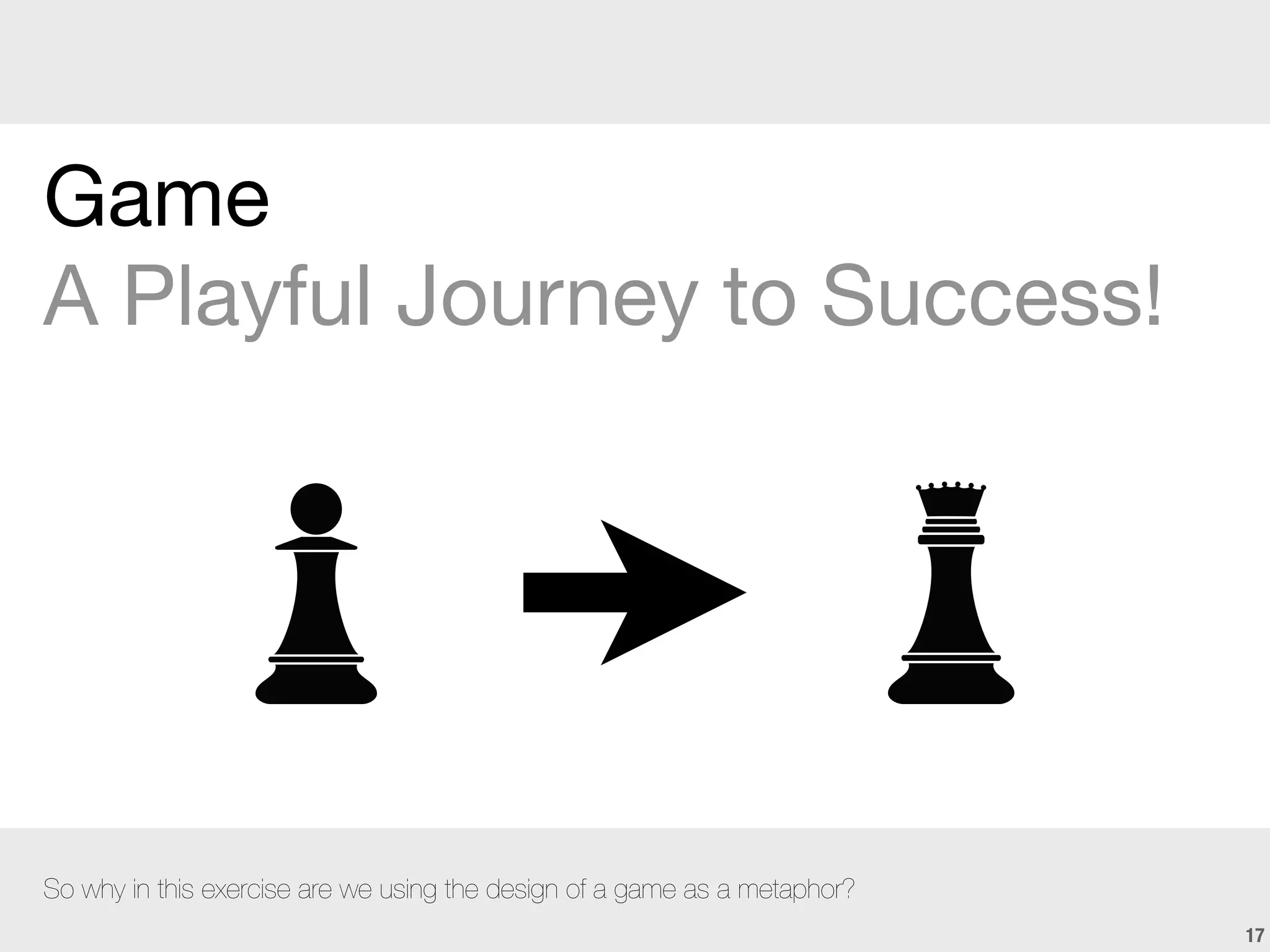
So why in this exercise are we using the design of a game as a metaphor?
A Playful Journey to Success!
Game
17
A Playful Journey to Success!
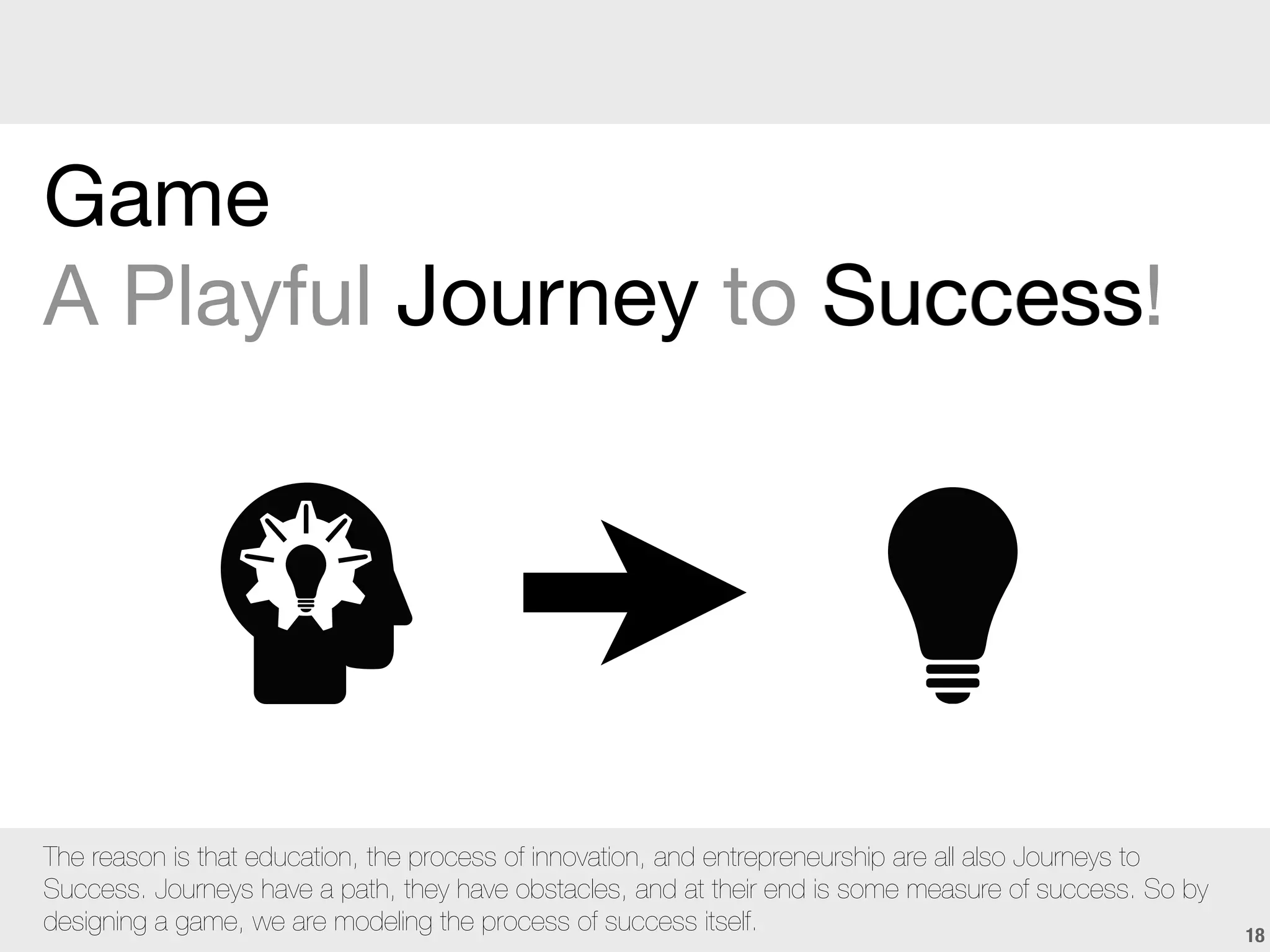
The reason is that education, the process of innovation, and entrepreneurship are all also Journeys to
Success. Journeys have a path, they have obstacles, and at their end is some measure of success. So by
designing a game, we are modeling the process of success itself.
Game
18
SuccessJourney
For the next half-hour, you will hear some stories about the Journeys. Take notes.
A Playful Journey to Success!
Game
19
SuccessJourneyPlayful
In particular listen for anything that you can use in your game design that fit into the categories of the
Playfulness, the Journey or the Success.
A Playful Journey to Success!
Game
20
SuccessJourneyPlayful
Journey
Neque porro quisquam
est qui dolorem ipsum
quia dolor sit amet,
consectetur, adipisci velit
Playful Success
Neque porro quisquam
est qui dolorem ipsum
quia dolor sit amet,
consectetur, adipisci velit
Neque porro quisquam
est qui dolorem ipsum
quia dolor sit amet,
consectetur, adipisci velit
After listening to these Journeys, we will be asking you begin the process of of brainstorming about how to
create a game. We are not asking you to create a great game — again, our goal is simulate the Journey in
the form of game to see what we learn.
A Playful Journey to Success!
Game
21
Transcript
22
Breakout:
Stories of Journeys to Success
Creating a Game
23
What is a
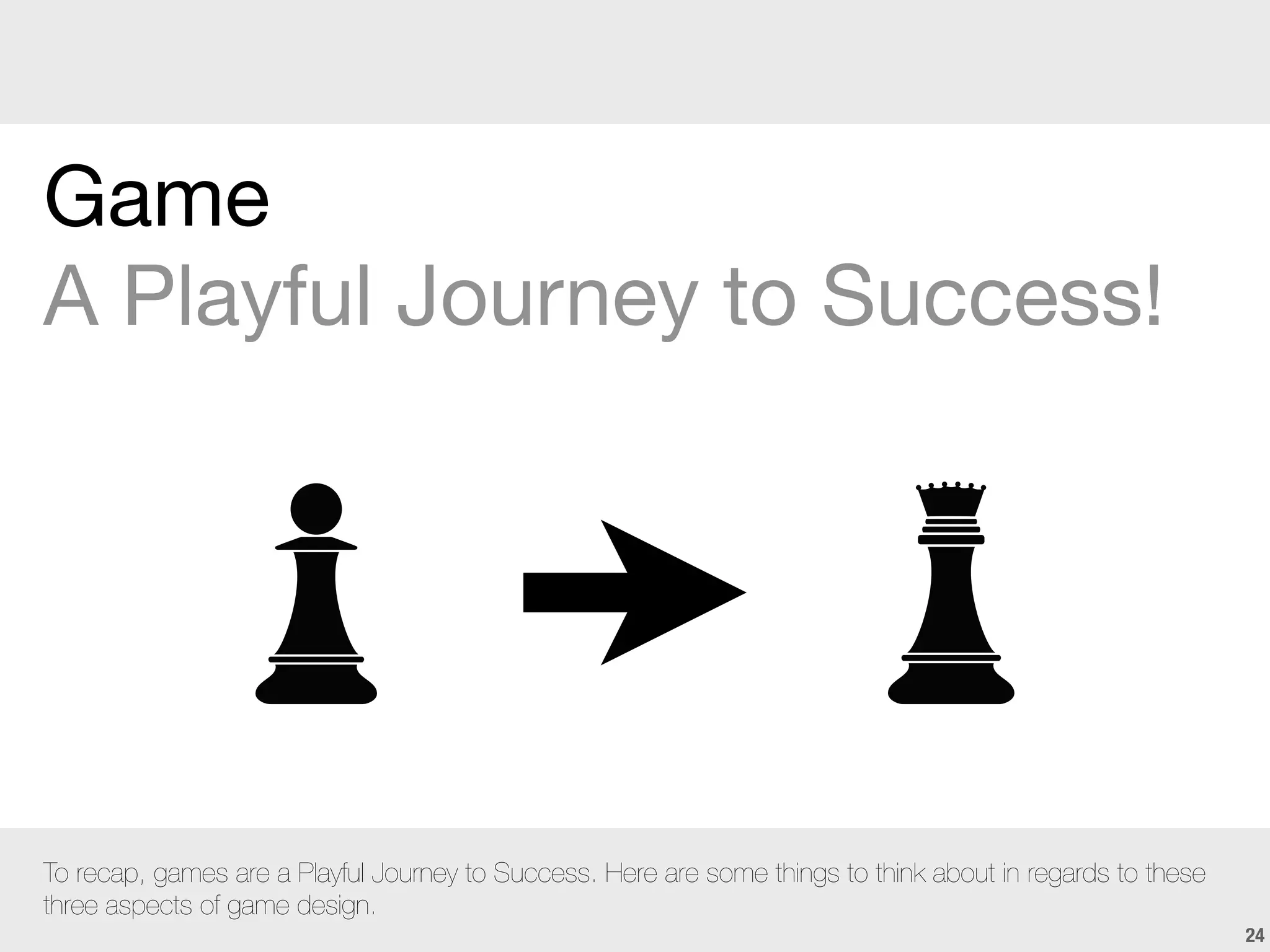
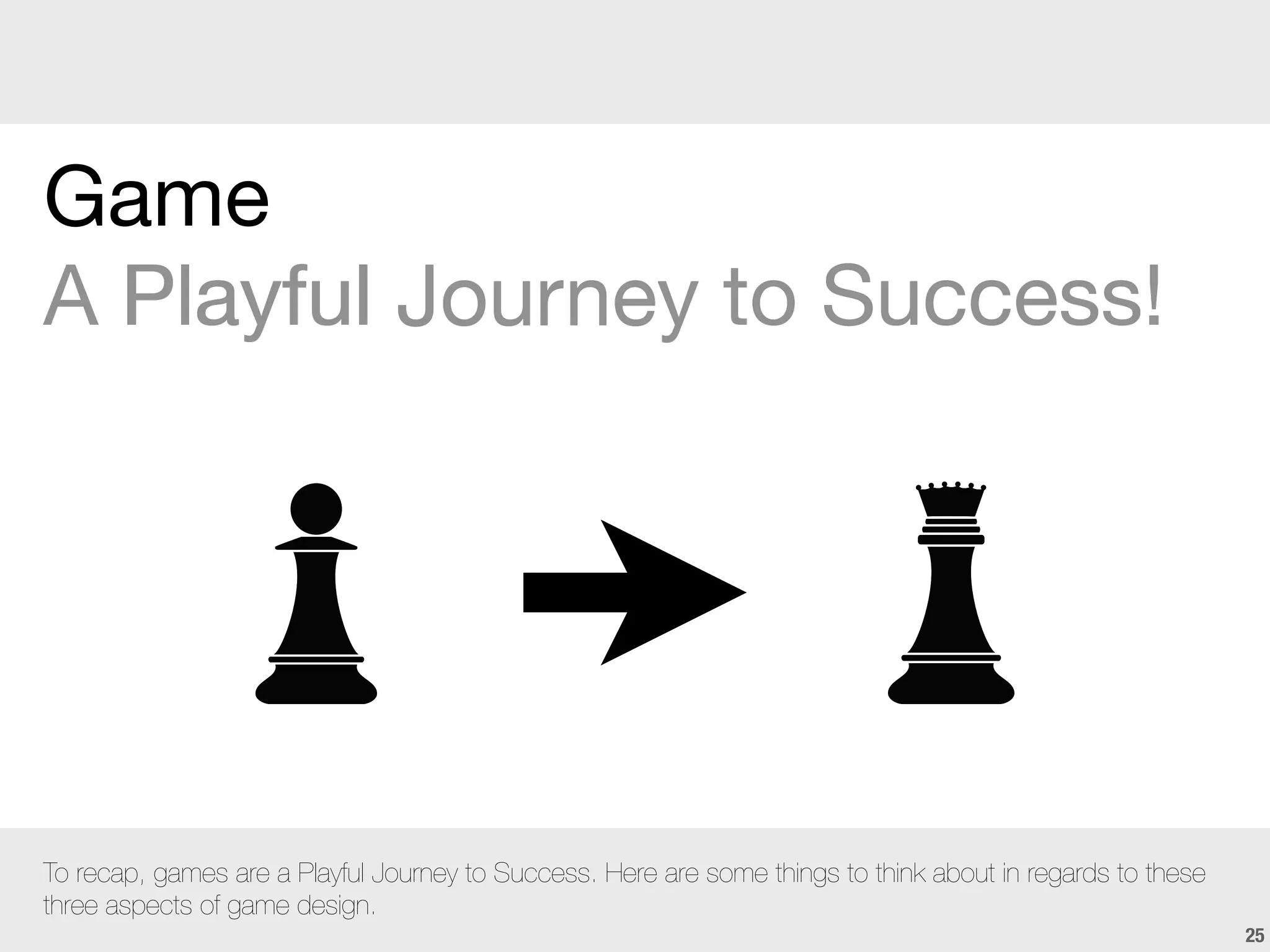
To recap, games are a Playful Journey to Success. Here are some things to think about in regards to these
three aspects of game design.
A Playful Journey to Success!
Game
24
To recap, games are a Playful Journey to Success. Here are some things to think about in regards to these
three aspects of game design.
A Playful Journey to Success!
Game
25
Playful Journey Success
PlayfulA Playful Journey to Success!
Let’s dive into the nature of of what it means to be Playful:
Playful
26
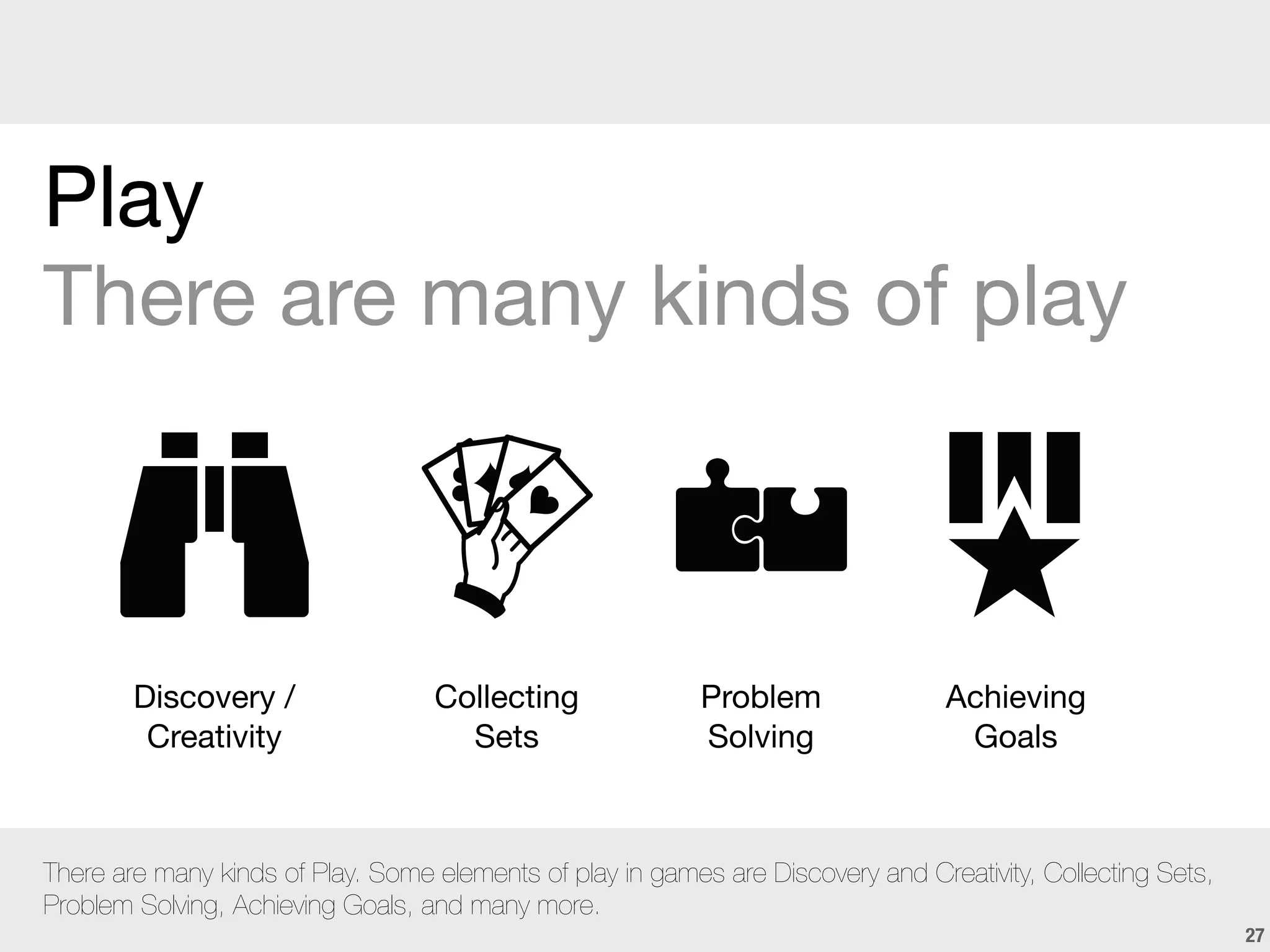
There are many kinds of Play. Some elements of play in games are Discovery and Creativity, Collecting Sets,
Problem Solving, Achieving Goals, and many more.
There are many kinds of play
Play
27
Discovery /
Creativity
Collecting
Sets
Problem
Solving
Achieving
Goals
Play
Transcript
28
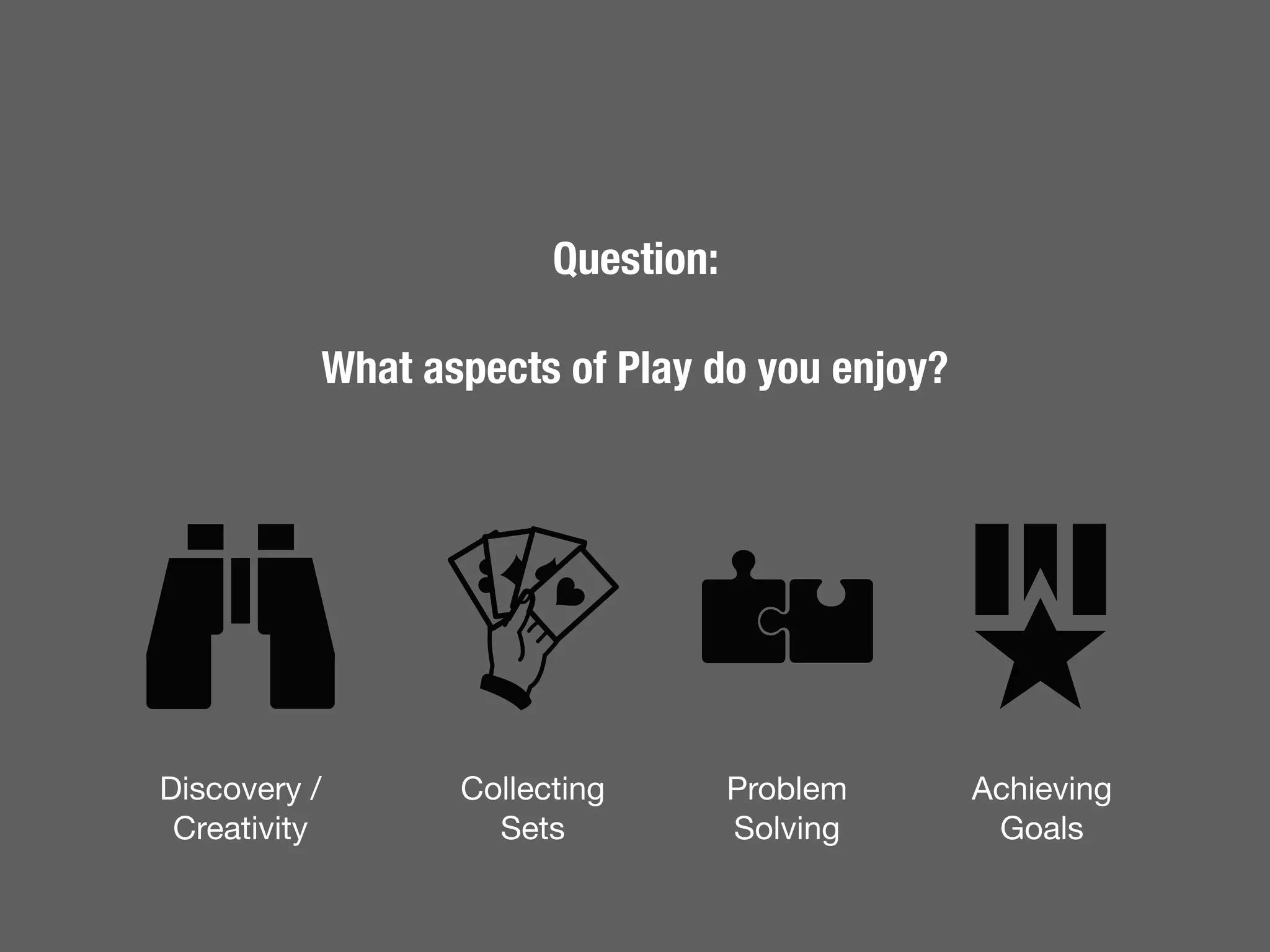
Question:
What aspects of Play do you enjoy?
Discovery /
Creativity
Collecting
Sets
Problem
Solving
Achieving
Goals
Transcript
29
Question:
What do you find Playful?
PlayfulA Playful Journey to Success!
Here are some things you should be thinking about when describing a Journey..
Journey
30
Journey
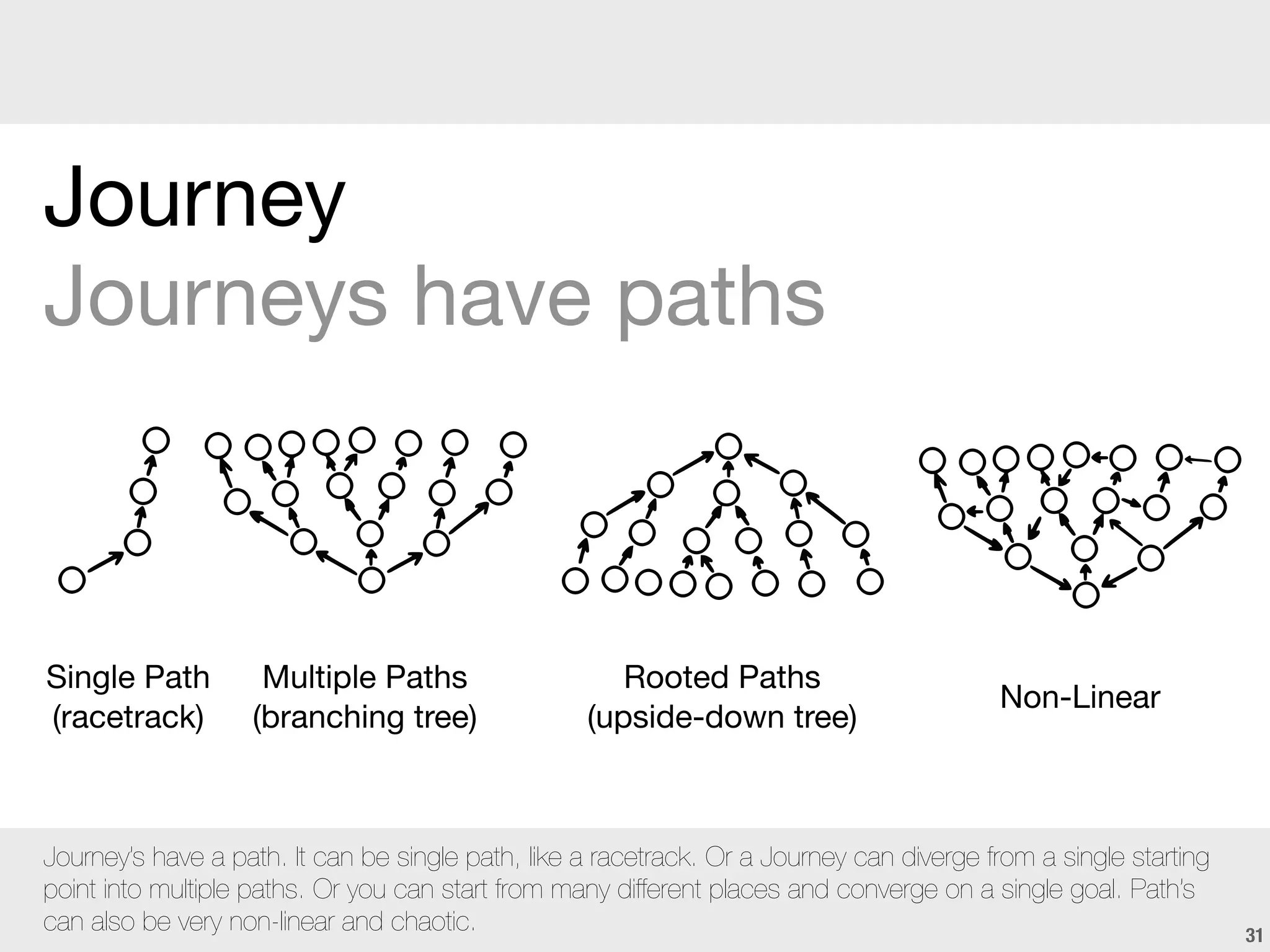
Journey’s have a path. It can be single path, like a racetrack. Or a Journey can diverge from a single starting
point into multiple paths. Or you can start from many different places and converge on a single goal. Path’s
can also be very non-linear and chaotic.
Journeys have paths
Journey
31
Single Path
(racetrack)
Multiple Paths
(branching tree)
Non-Linear
Rooted Paths
(upside-down tree)
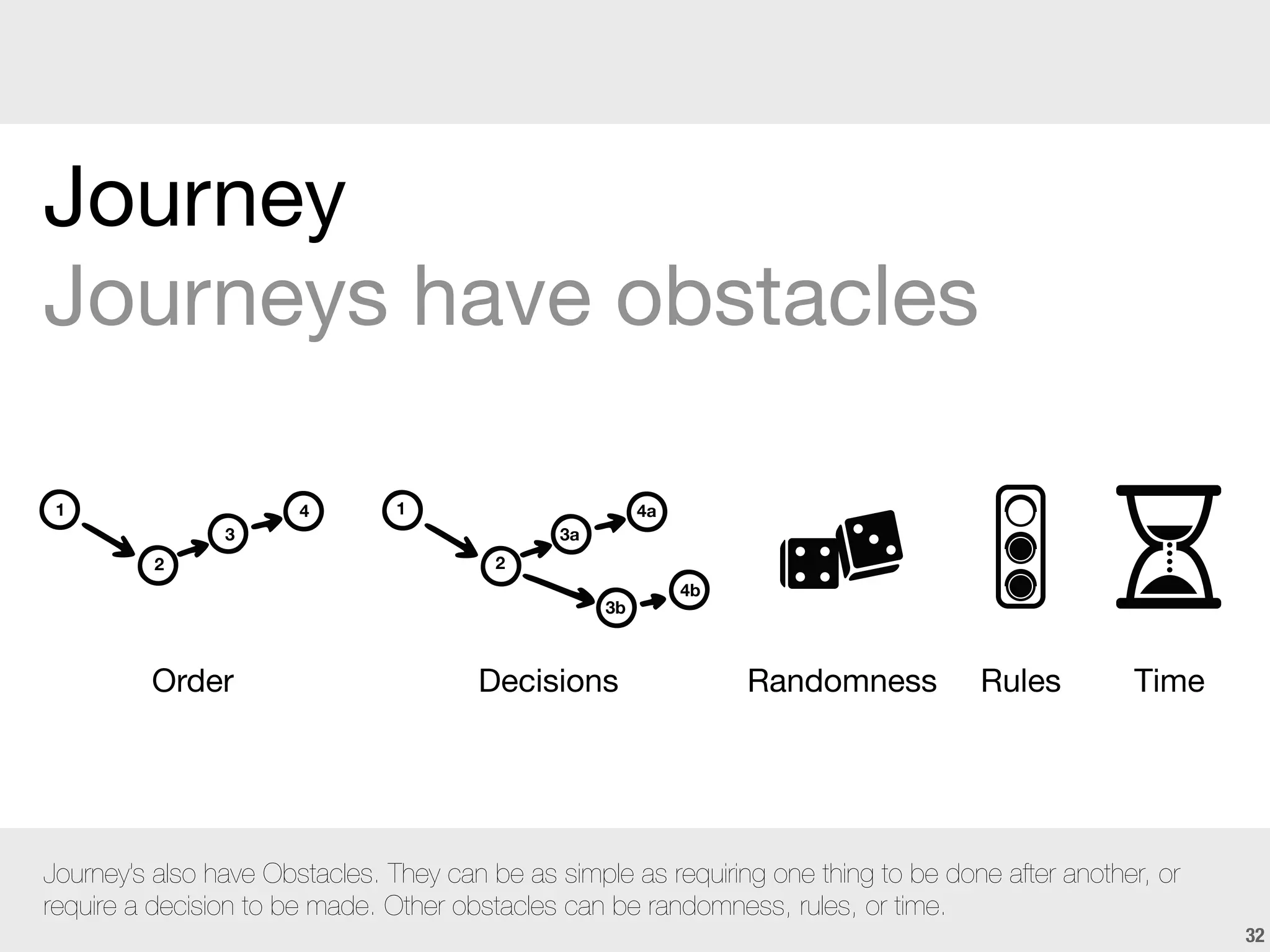
Journeys have obstacles
Journey’s also have Obstacles. They can be as simple as requiring one thing to be done after another, or
require a decision to be made. Other obstacles can be randomness, rules, or time.
Journey
32
Order Decisions
1
2
3
4 1
2
3a
3b
4a
4b
Randomness Rules Time
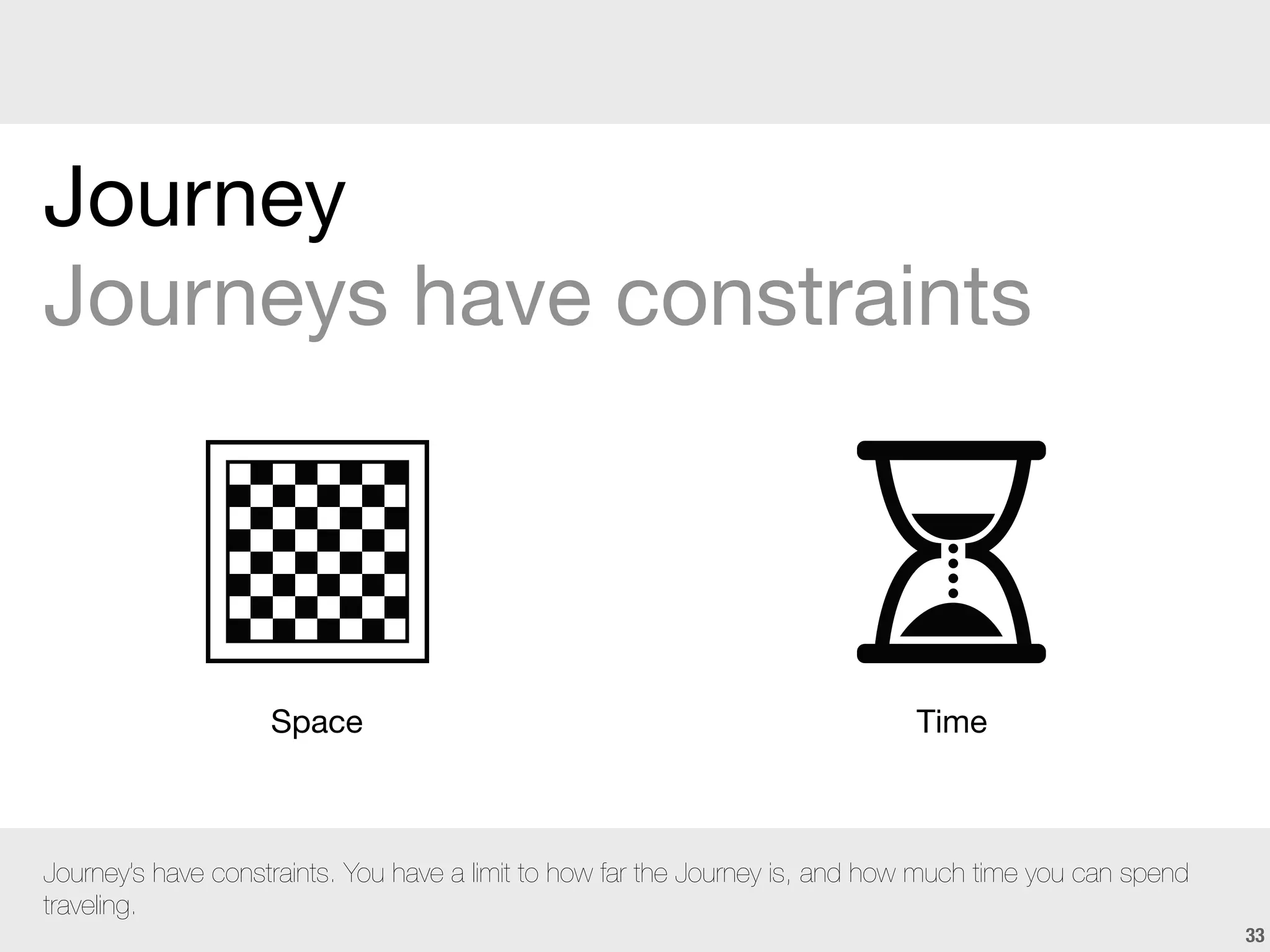
Journey’s have constraints. You have a limit to how far the Journey is, and how much time you can spend
traveling.
Journeys have constraints
Journey
33
Space Time
JourneyJourney
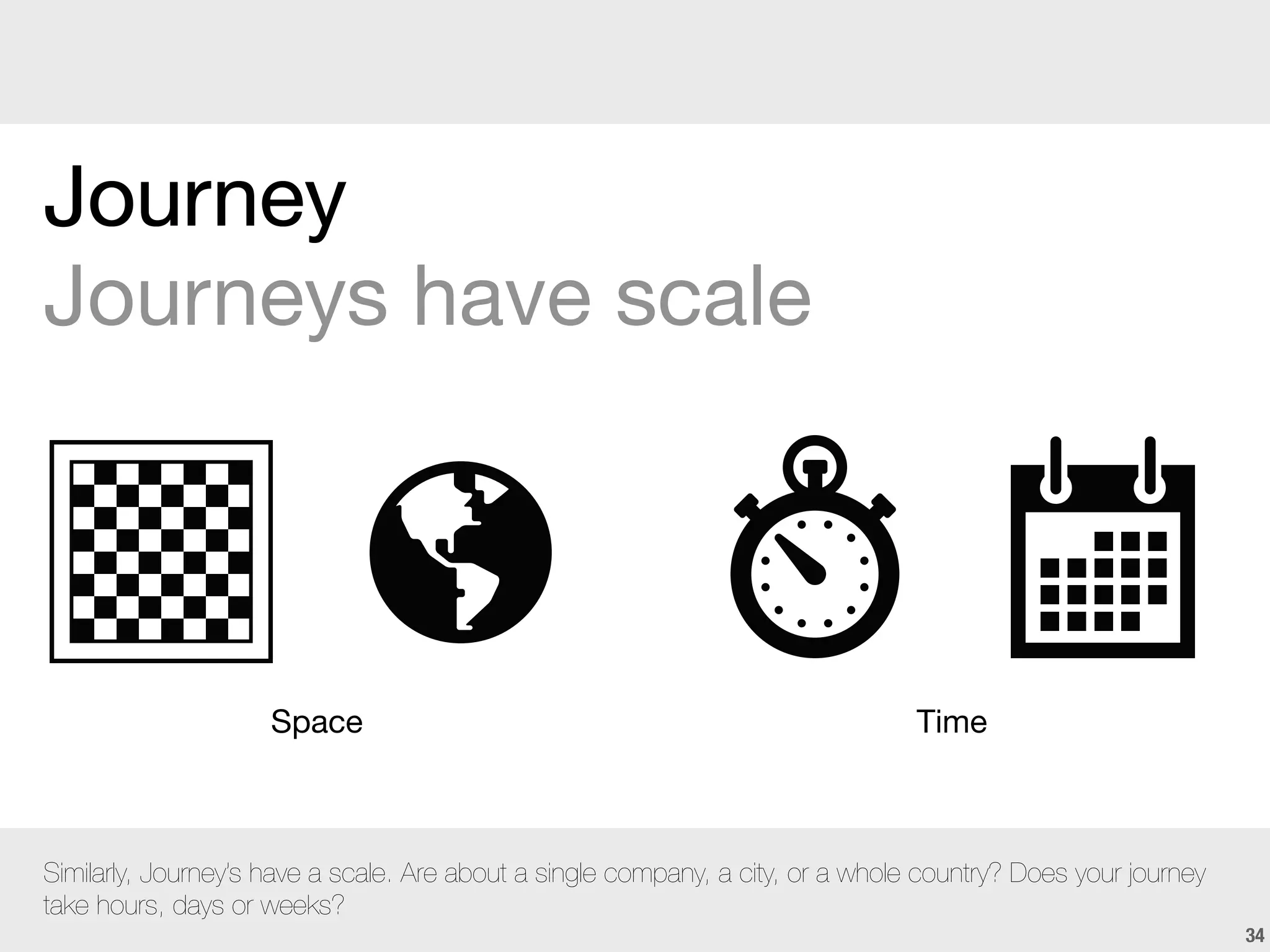
Similarly, Journey’s have a scale. Are about a single company, a city, or a whole country? Does your journey
take hours, days or weeks?
Journeys have scale
34
Space Time
Journey
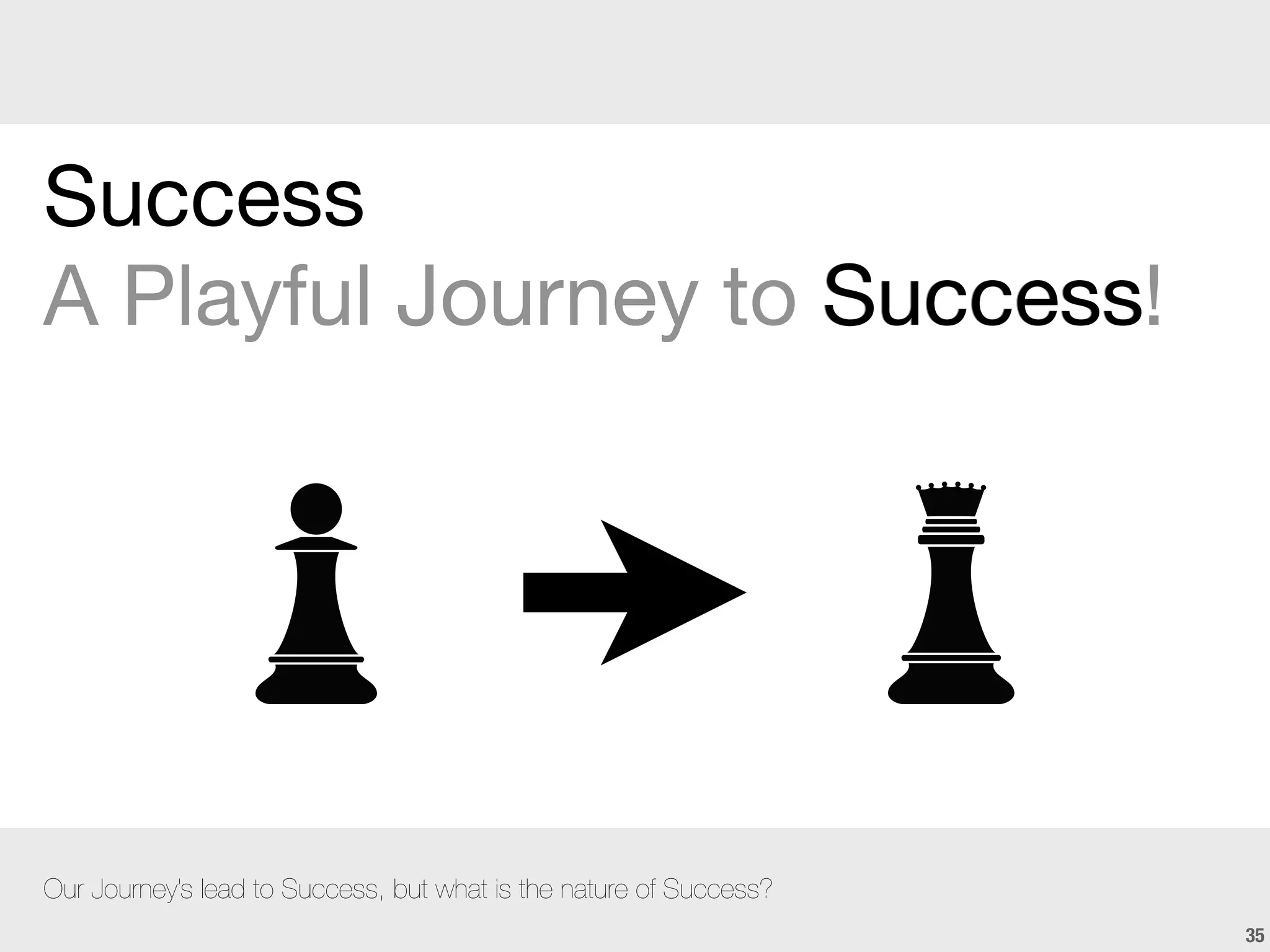
Our Journey’s lead to Success, but what is the nature of Success?
A Playful Journey to Success!
Success
35
Success
Success
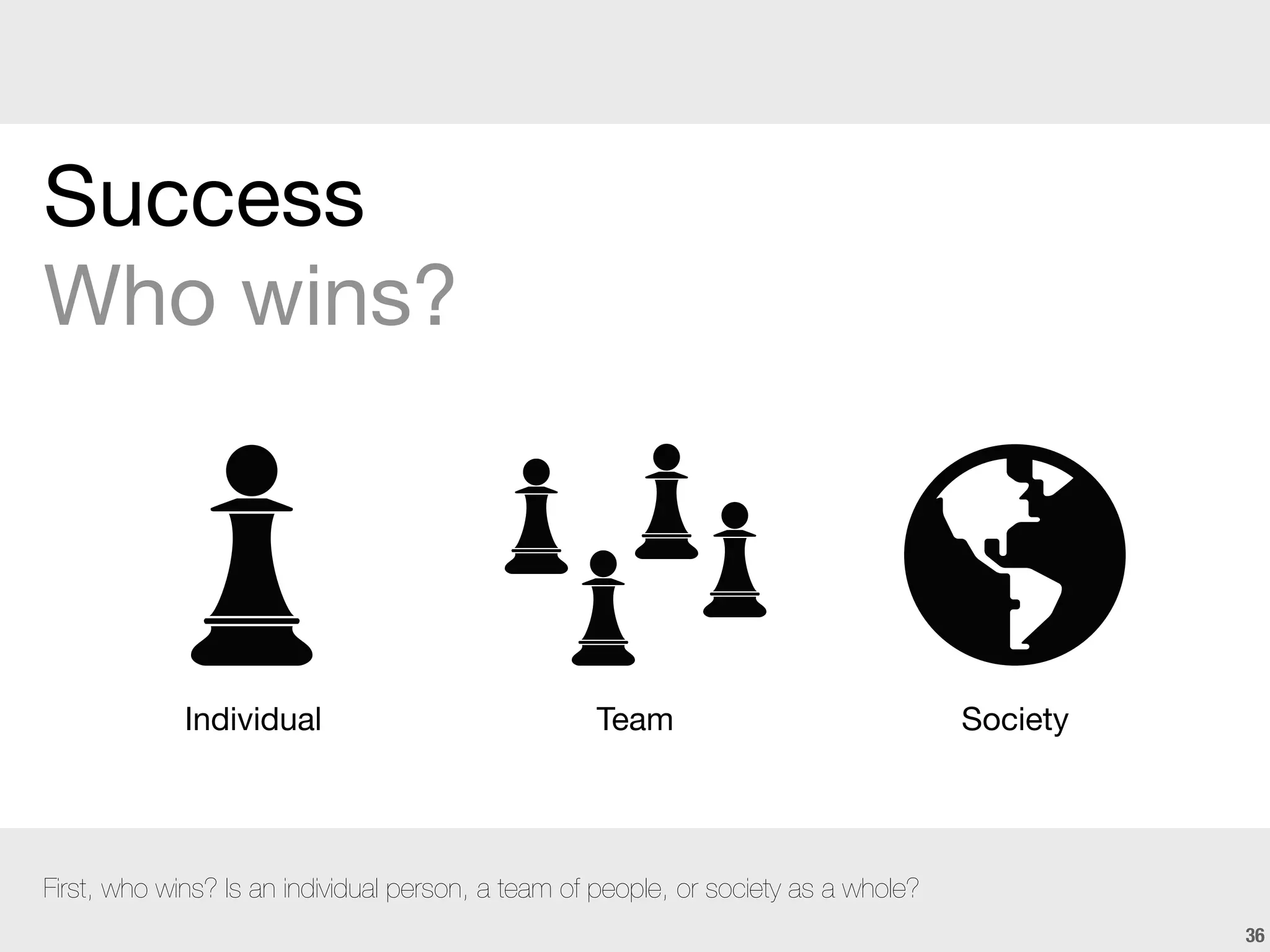
Who wins?
36
Individual Team Society
First, who wins? Is an individual person, a team of people, or society as a whole?
How do you define success?
Success
37
Learning
Perform
Skill
Make
Decision
Create
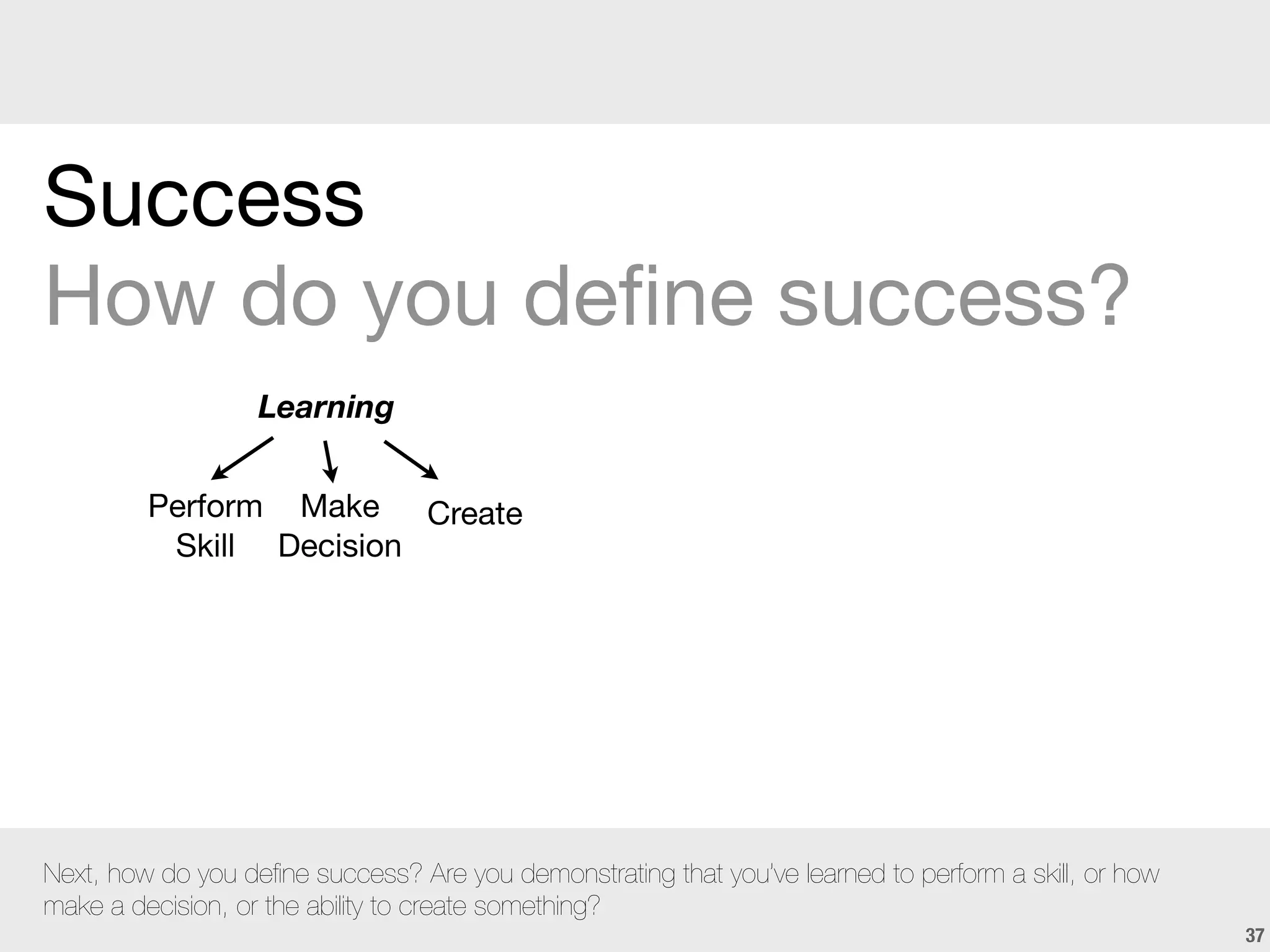
Next, how do you define success? Are you demonstrating that you’ve learned to perform a skill, or how
make a decision, or the ability to create something?
How do you define success?
Success
38
Learning
Perform
Skill
Make
Decision
Create
Metric
Score/
Statistic
Money Vote
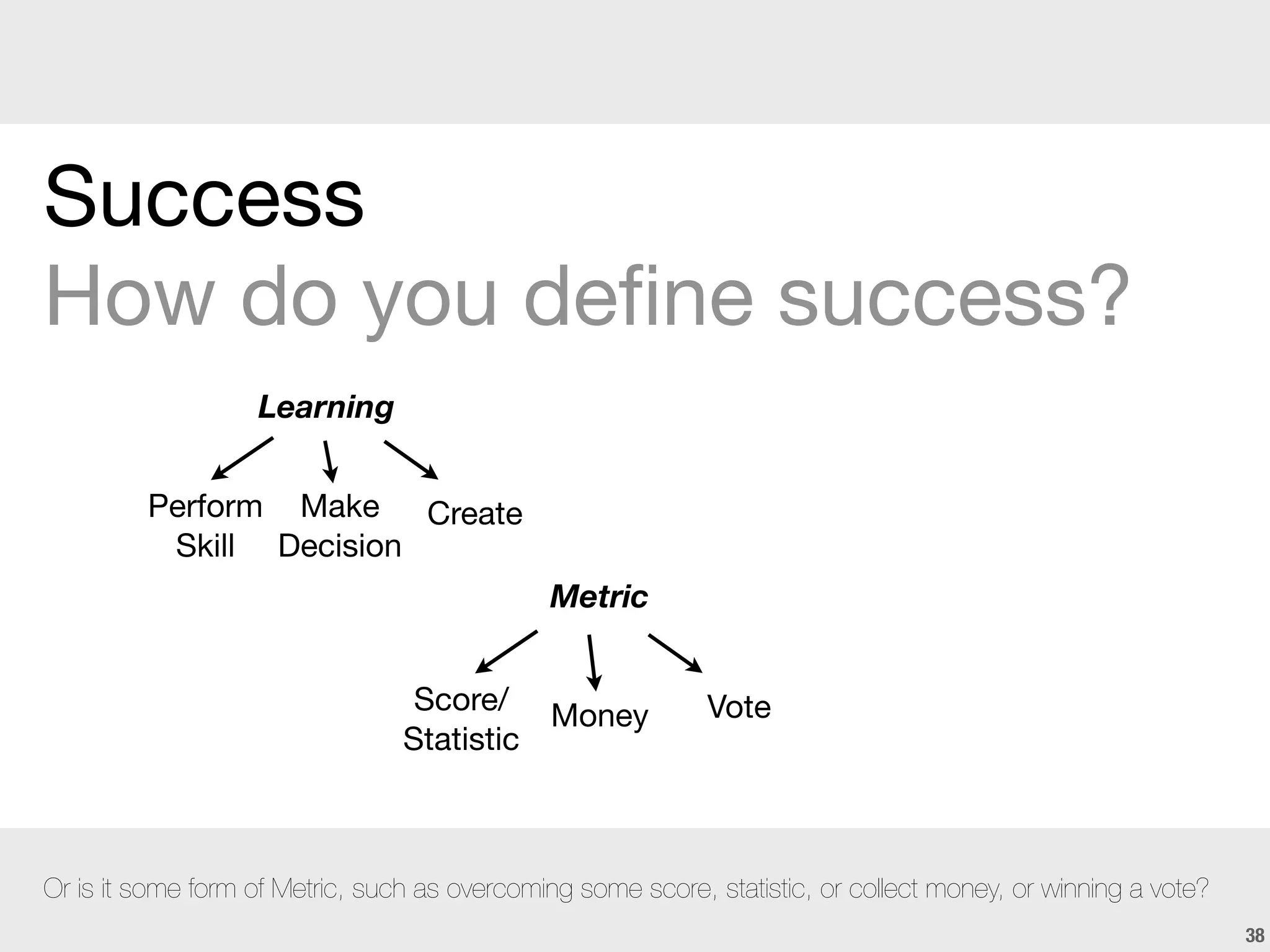
Or is it some form of Metric, such as overcoming some score, statistic, or collect money, or winning a vote?
How do you define success?
Success
39
Improvement
Personal
Overcome Rival
Aesthetic Social
Learning
Perform
Skill
Make
Decision
Create
Metric
Score/
Statistic
Money Vote
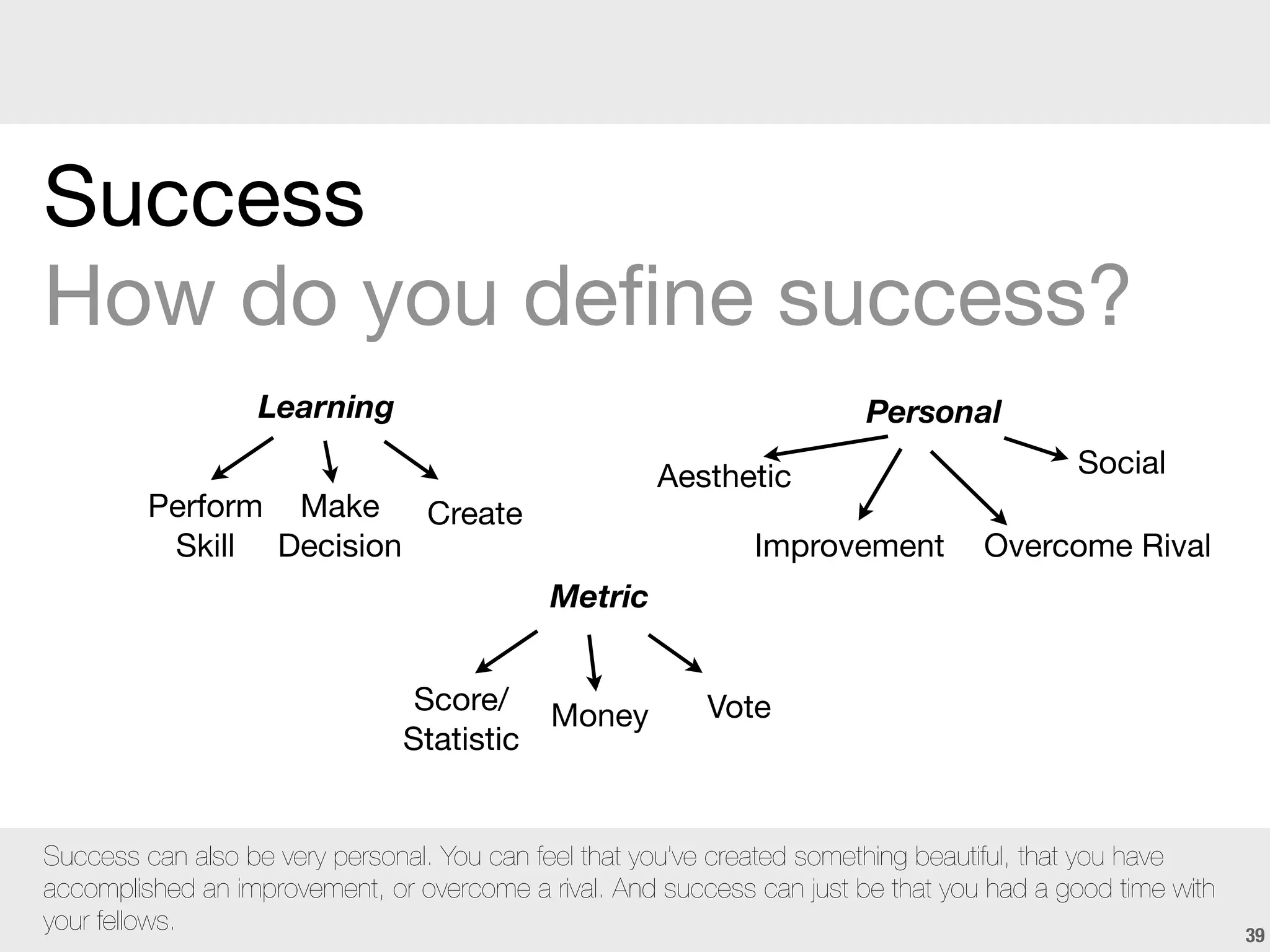
Success can also be very personal. You can feel that you’ve created something beautiful, that you have
accomplished an improvement, or overcome a rival. And success can just be that you had a good time with
your fellows.
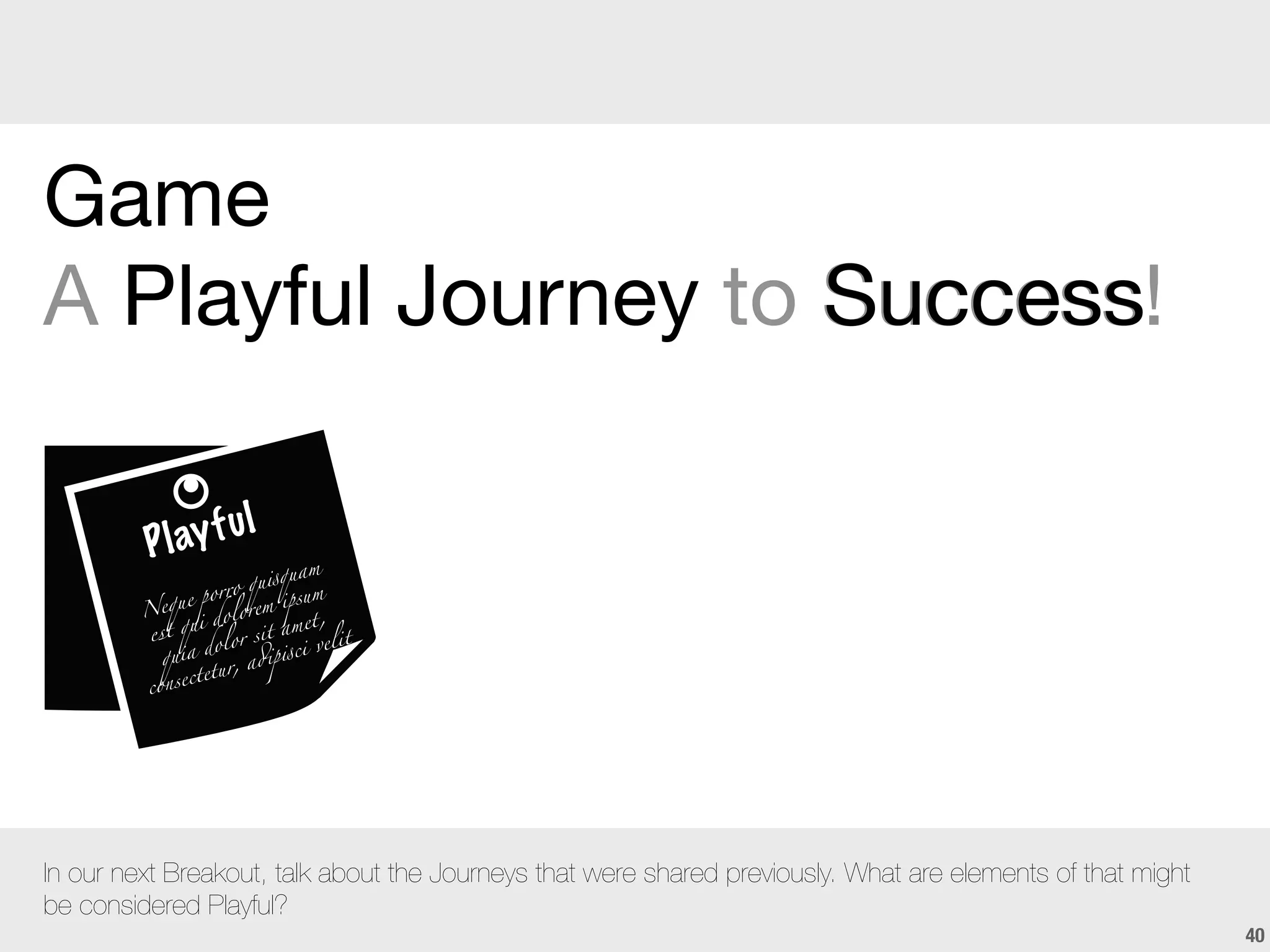
In our next Breakout, talk about the Journeys that were shared previously. What are elements of that might
be considered Playful?
A Playful Journey to Success!
Game
40
SuccessJourneyPlayful
Playful
Neque porro quisquam
est qui dolorem ipsum
quia dolor sit amet,
consectetur, adipisci velit
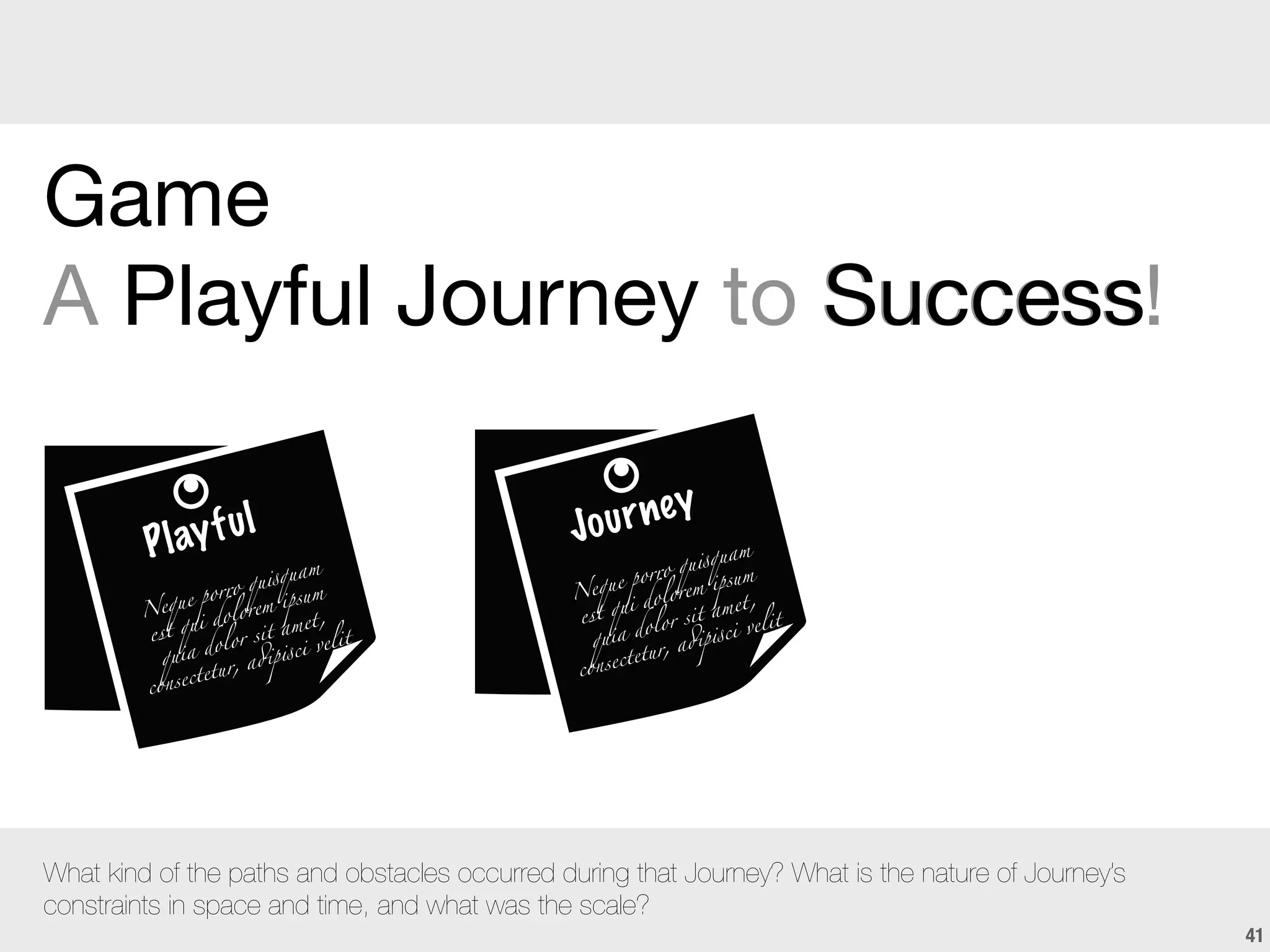
What kind of the paths and obstacles occurred during that Journey? What is the nature of Journey’s
constraints in space and time, and what was the scale?
A Playful Journey to Success!
Game
41
SuccessJourneyPlayful
Journey
Neque porro quisquam
est qui dolorem ipsum
quia dolor sit amet,
consectetur, adipisci velit
Playful
Neque porro quisquam
est qui dolorem ipsum
quia dolor sit amet,
consectetur, adipisci velit
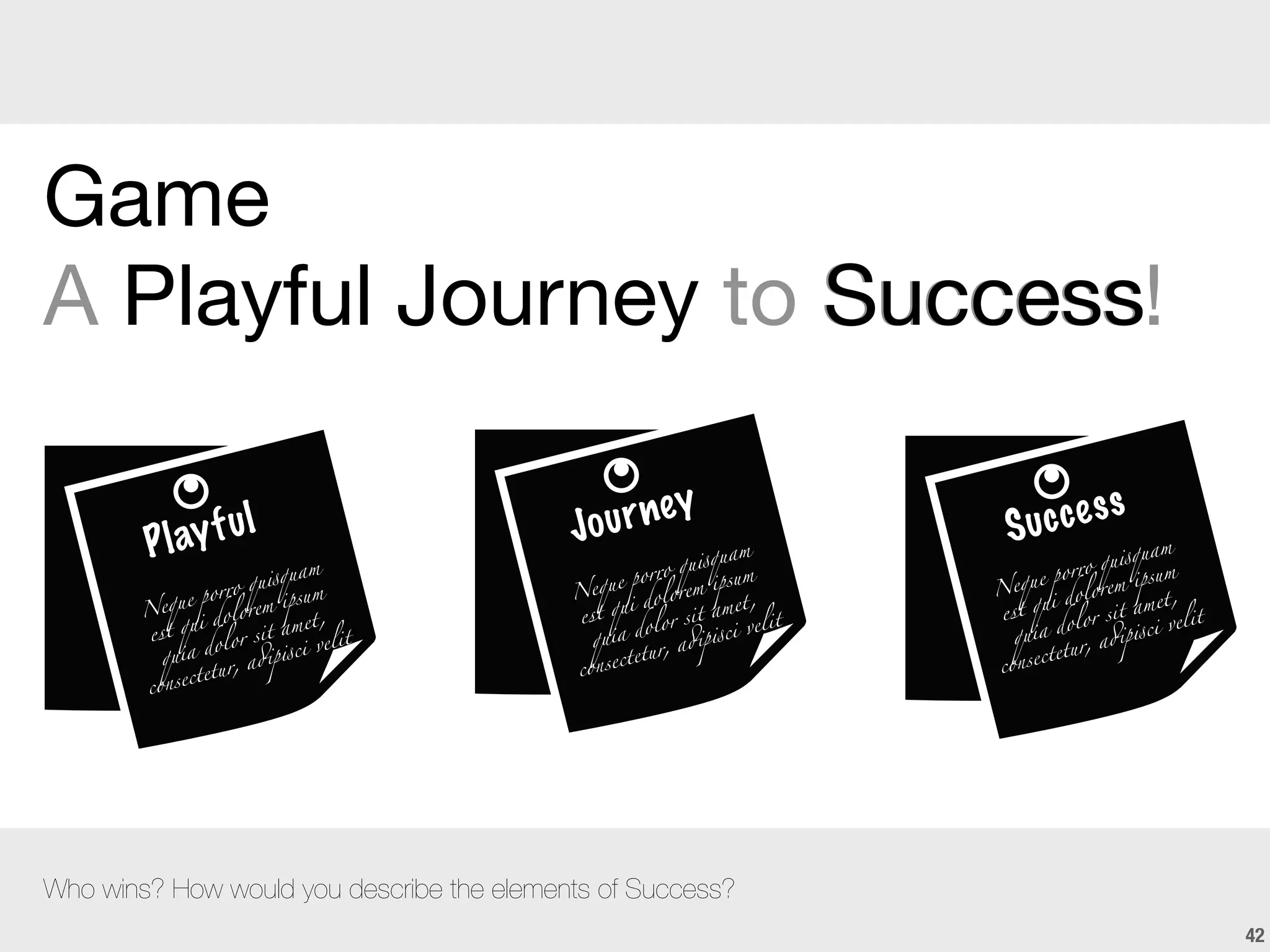
Who wins? How would you describe the elements of Success?
A Playful Journey to Success!
Game
42
SuccessJourneyPlayful
Journey
Neque porro quisquam
est qui dolorem ipsum
quia dolor sit amet,
consectetur, adipisci velit
Playful Success
Neque porro quisquam
est qui dolorem ipsum
quia dolor sit amet,
consectetur, adipisci velit
Neque porro quisquam
est qui dolorem ipsum
quia dolor sit amet,
consectetur, adipisci velit
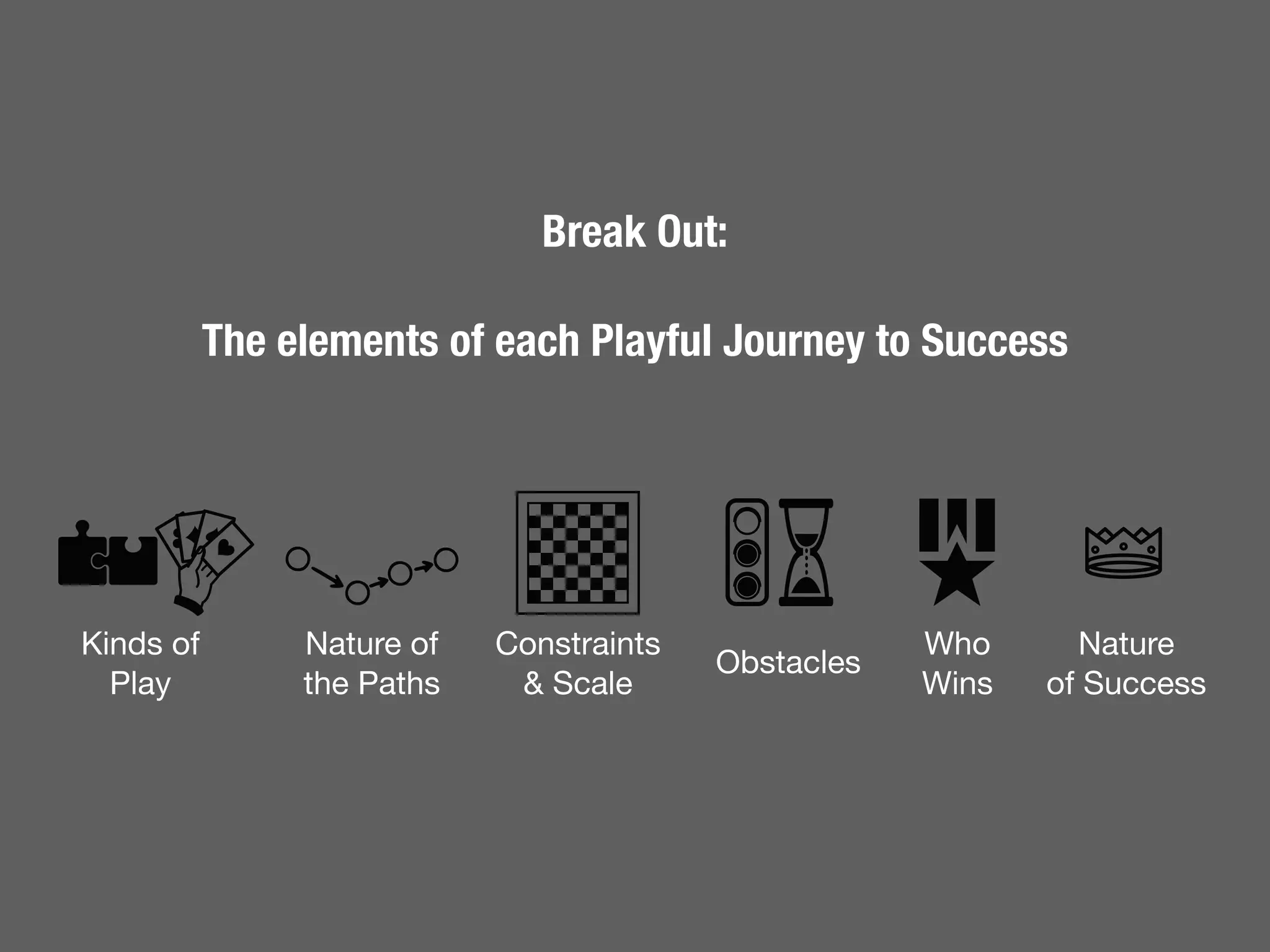
Break Out:
The elements of each Playful Journey to Success
43
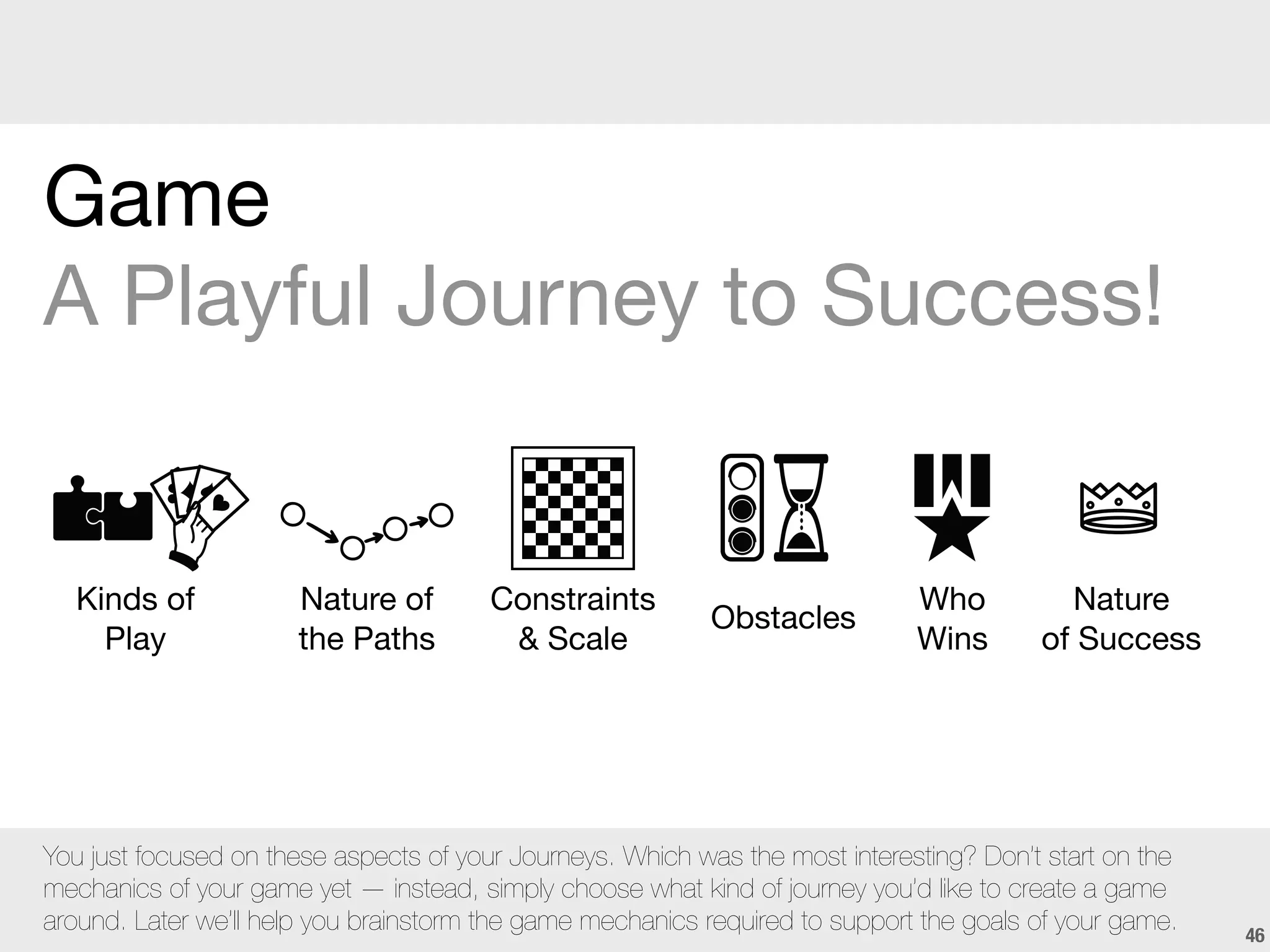
Kinds of
Play
Nature of
the Paths
Obstacles
Constraints
& Scale
Who
Wins
Nature
of Success
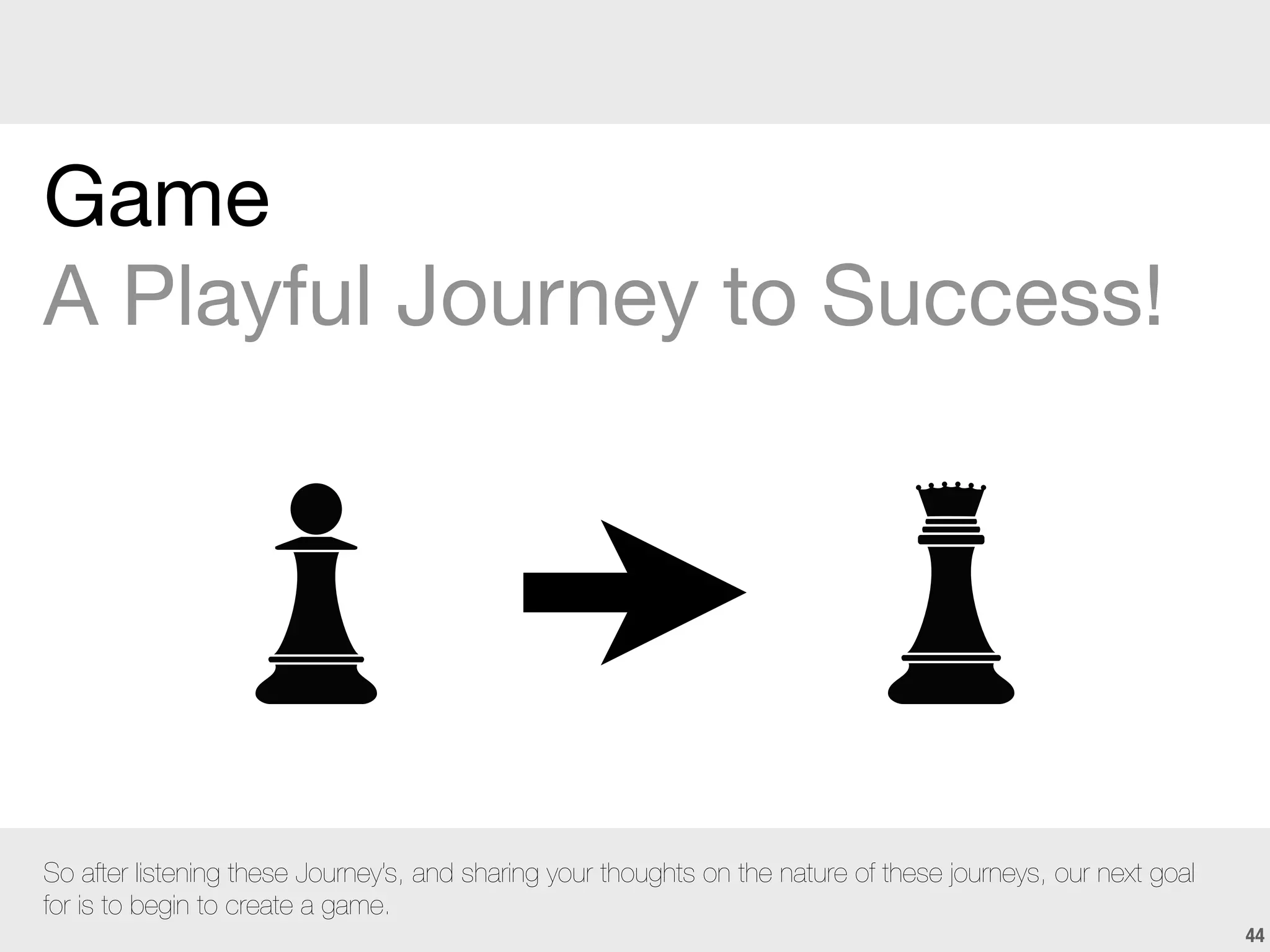
So after listening these Journey’s, and sharing your thoughts on the nature of these journeys, our next goal
for is to begin to create a game.
A Playful Journey to Success!
Game
44
A Playful Journey to Success!
You should have some notes about journeys to success that were shared earlier. Similarly you should have
some notes about the kinds of play, the elements of the journey, and the nature of success.
Game
45
Journey
Neque porro quisquam
est qui dolorem ipsum
quia dolor sit amet,
consectetur, adipisci velit
Playful Success
Neque porro quisquam
est qui dolorem ipsum
quia dolor sit amet,
consectetur, adipisci velit
Neque porro quisquam
est qui dolorem ipsum
quia dolor sit amet,
consectetur, adipisci velit
You just focused on these aspects of your Journeys. Which was the most interesting? Don’t start on the
mechanics of your game yet — instead, simply choose what kind of journey you’d like to create a game
around. Later we’ll help you brainstorm the game mechanics required to support the goals of your game.
A Playful Journey to Success!
Game
46
Kinds of
Play
Nature of
the Paths
Obstacles
Constraints
& Scale
Who
Wins
Nature
of Success
Transcript
47
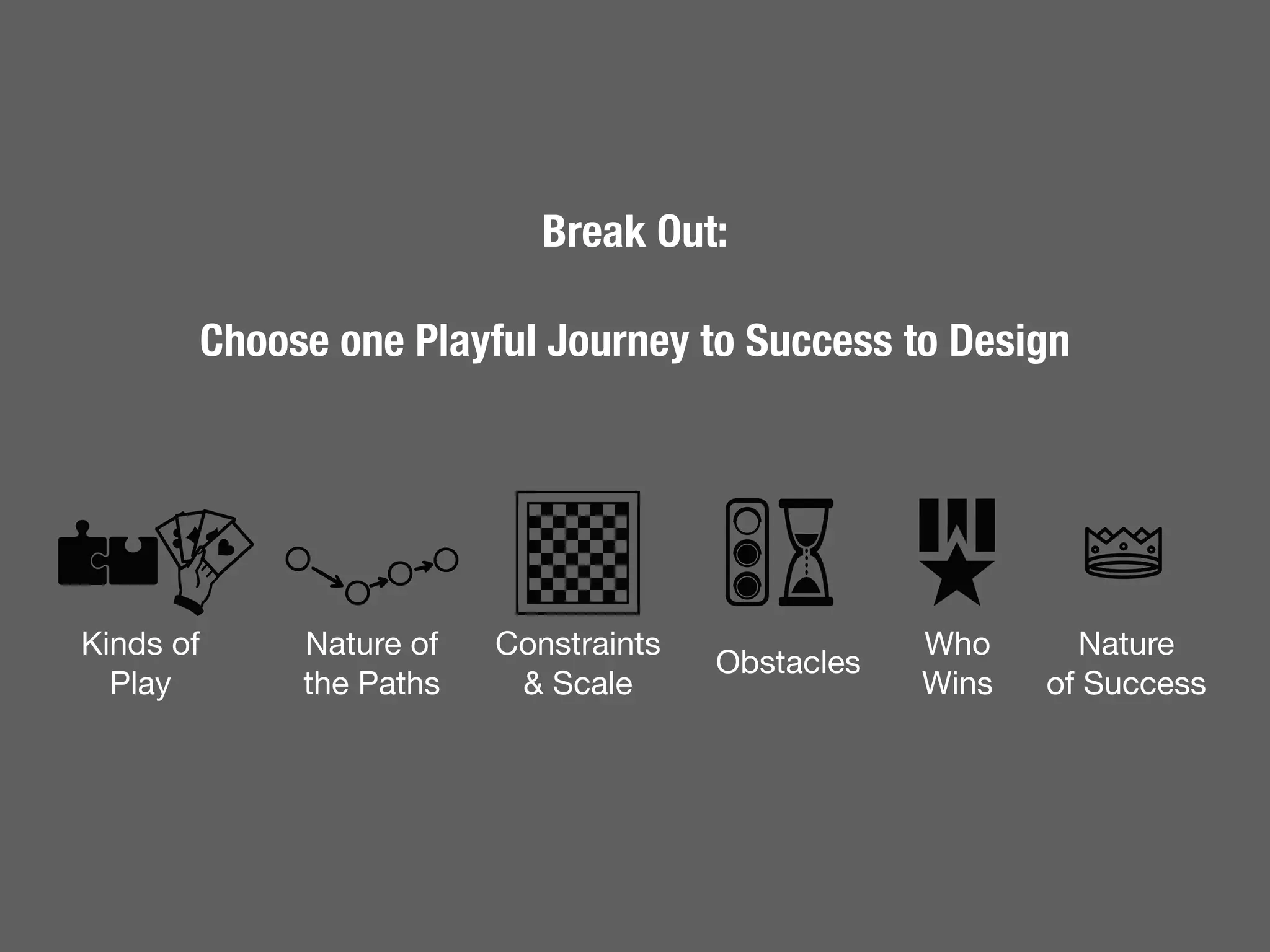
Break Out:
Choose one Playful Journey to Success to Design
Kinds of
Play
Nature of
the Paths
Obstacles
Constraints
& Scale
Who
Wins
Nature
of Success
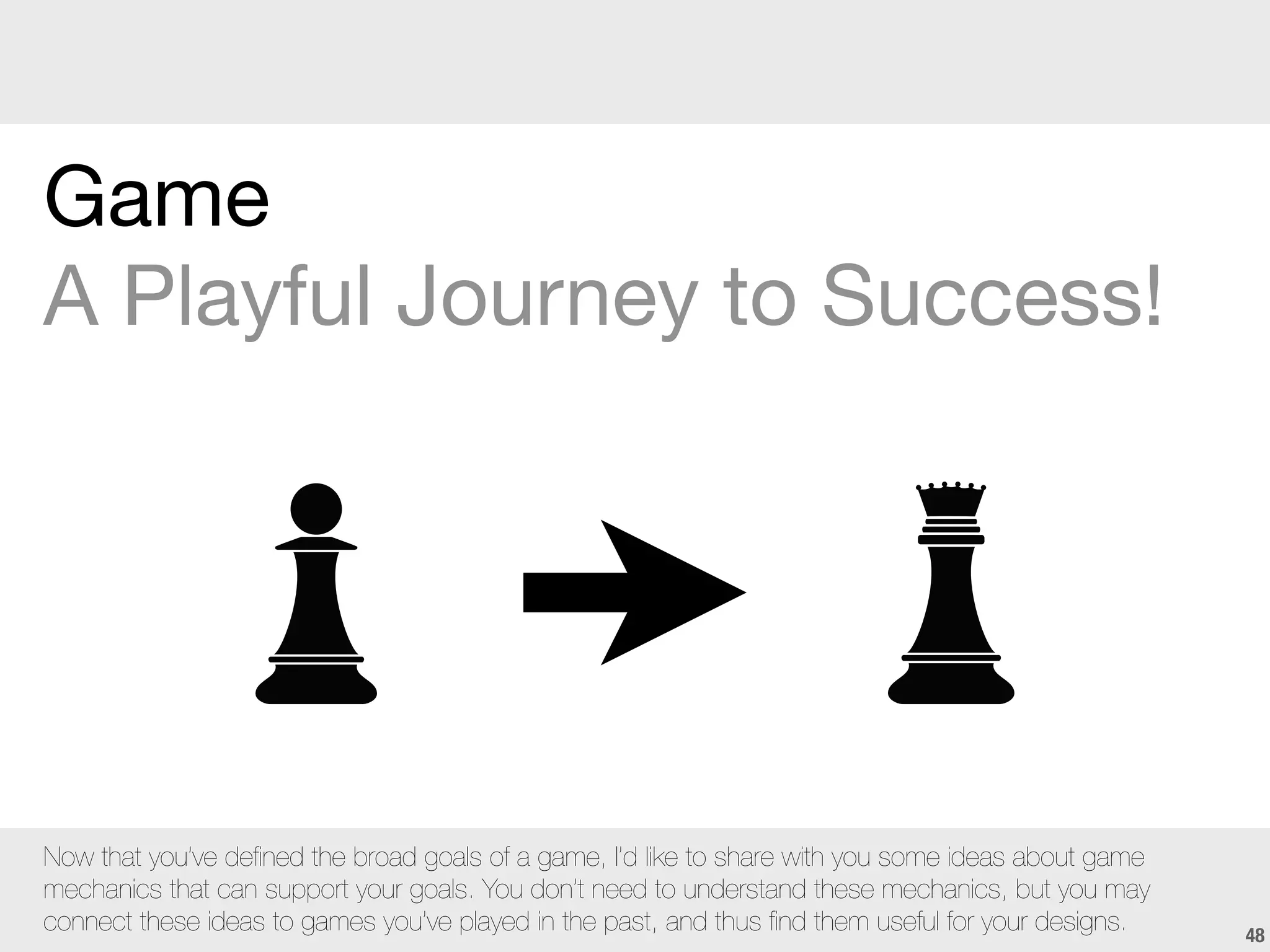
Now that you’ve defined the broad goals of a game, I’d like to share with you some ideas about game
mechanics that can support your goals. You don’t need to understand these mechanics, but you may
connect these ideas to games you’ve played in the past, and thus find them useful for your designs.
A Playful Journey to Success!
Game
48
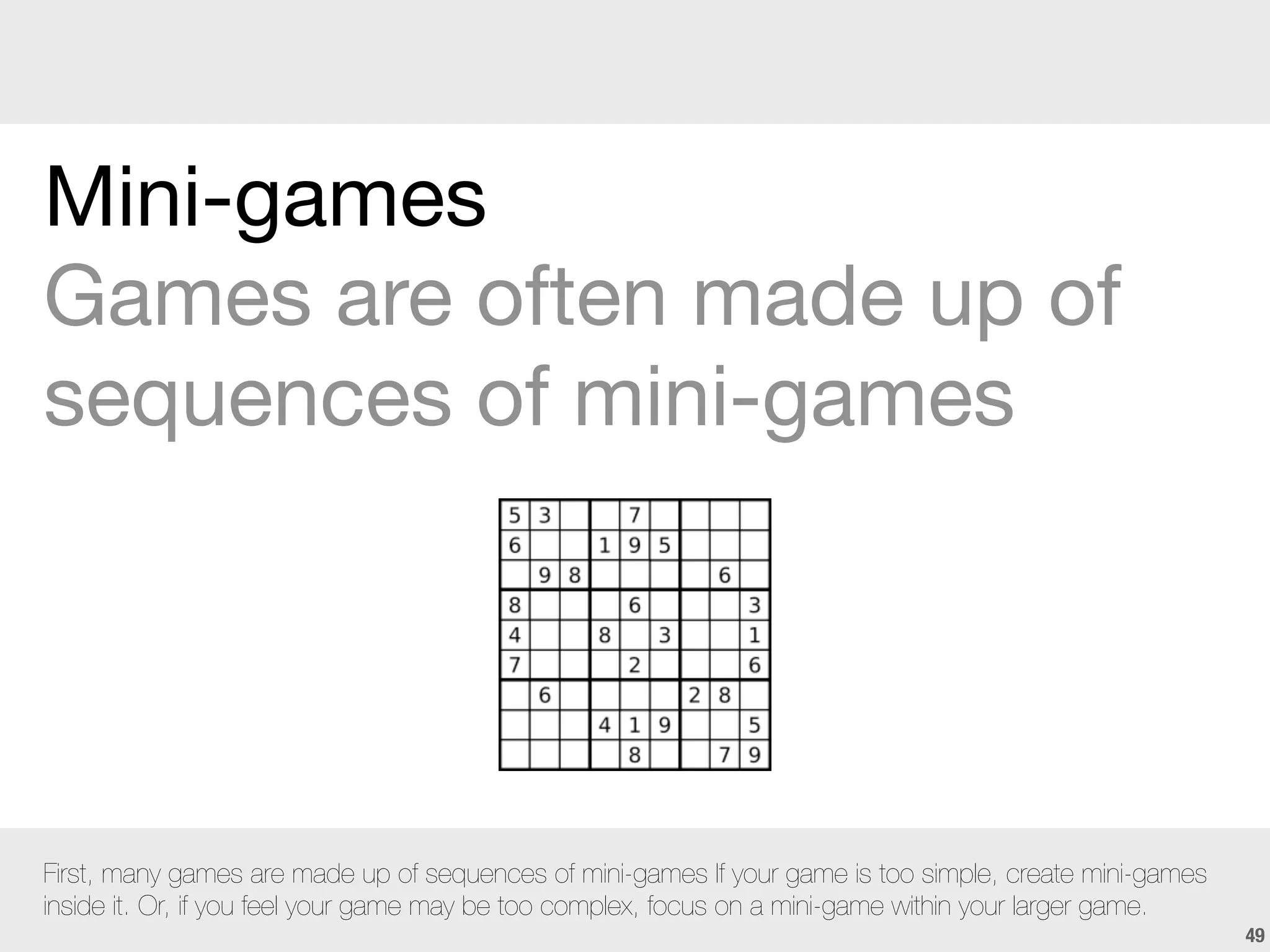
Games are often made up of
sequences of mini-games
Mini-games
49
First, many games are made up of sequences of mini-games If your game is too simple, create mini-games
inside it. Or, if you feel your game may be too complex, focus on a mini-game within your larger game.
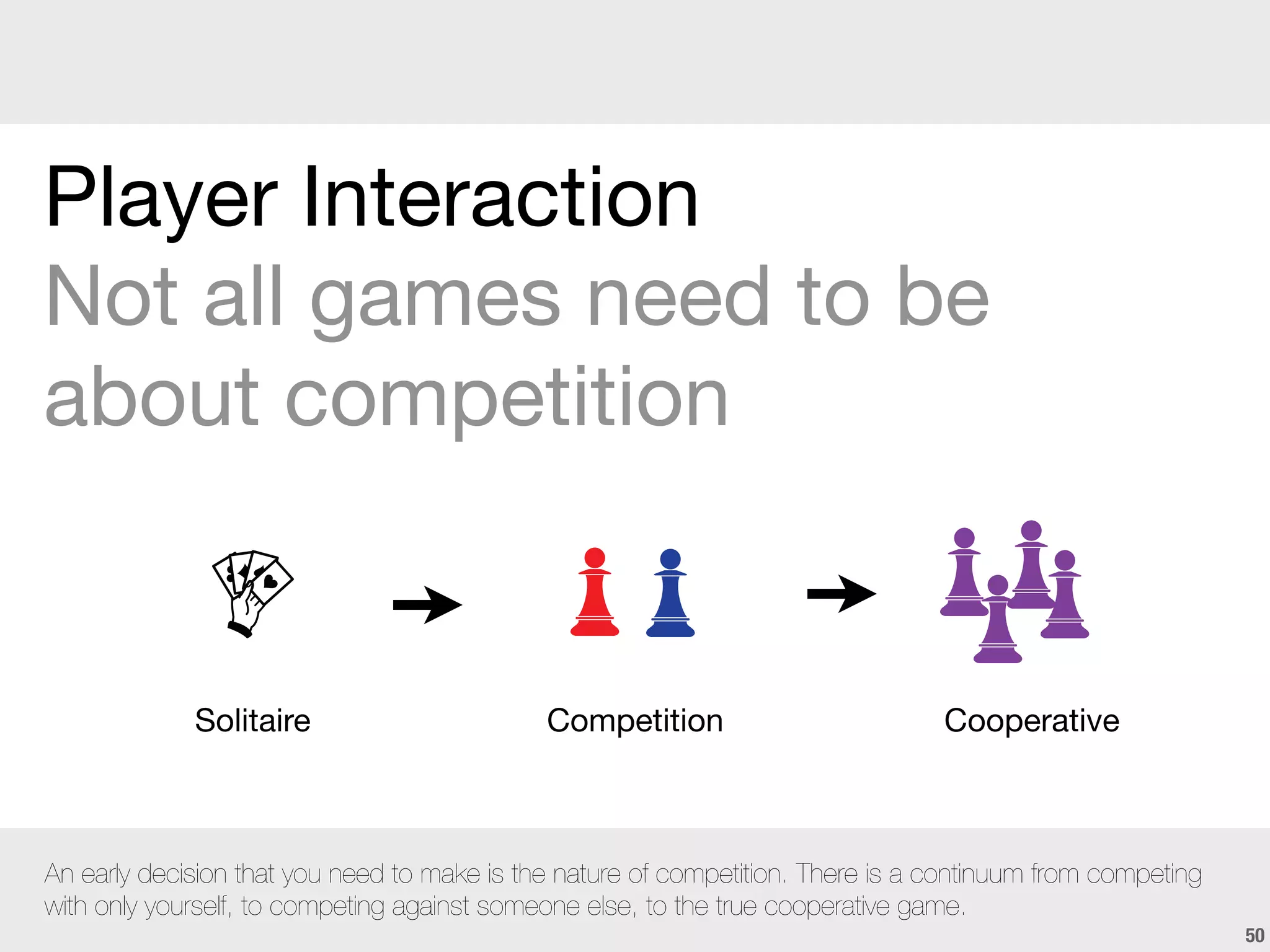
An early decision that you need to make is the nature of competition. There is a continuum from competing
with only yourself, to competing against someone else, to the true cooperative game.
Not all games need to be
about competition
Player Interaction
50
Solitaire Competition Cooperative
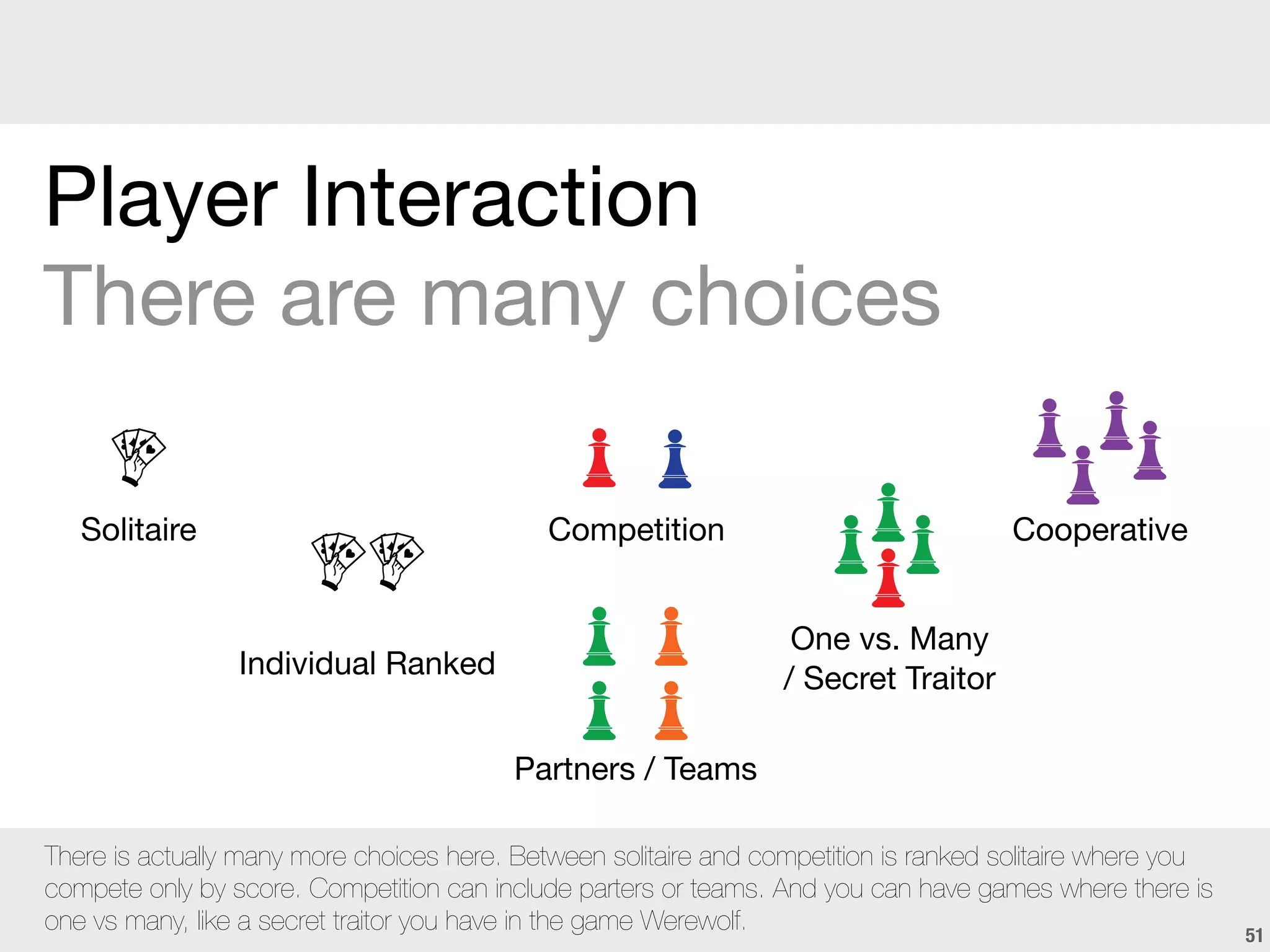
There is actually many more choices here. Between solitaire and competition is ranked solitaire where you
compete only by score. Competition can include parters or teams. And you can have games where there is
one vs many, like a secret traitor you have in the game Werewolf.
There are many choices
Player Interaction
51
Solitaire
Individual Ranked
Competition Cooperative
Partners / Teams
One vs. Many
/ Secret Traitor
Journeys have guideposts
Game Components
Journeys have guideposts. In games, we call these game components.
Guideposts
52
Game ComponentsGame Components
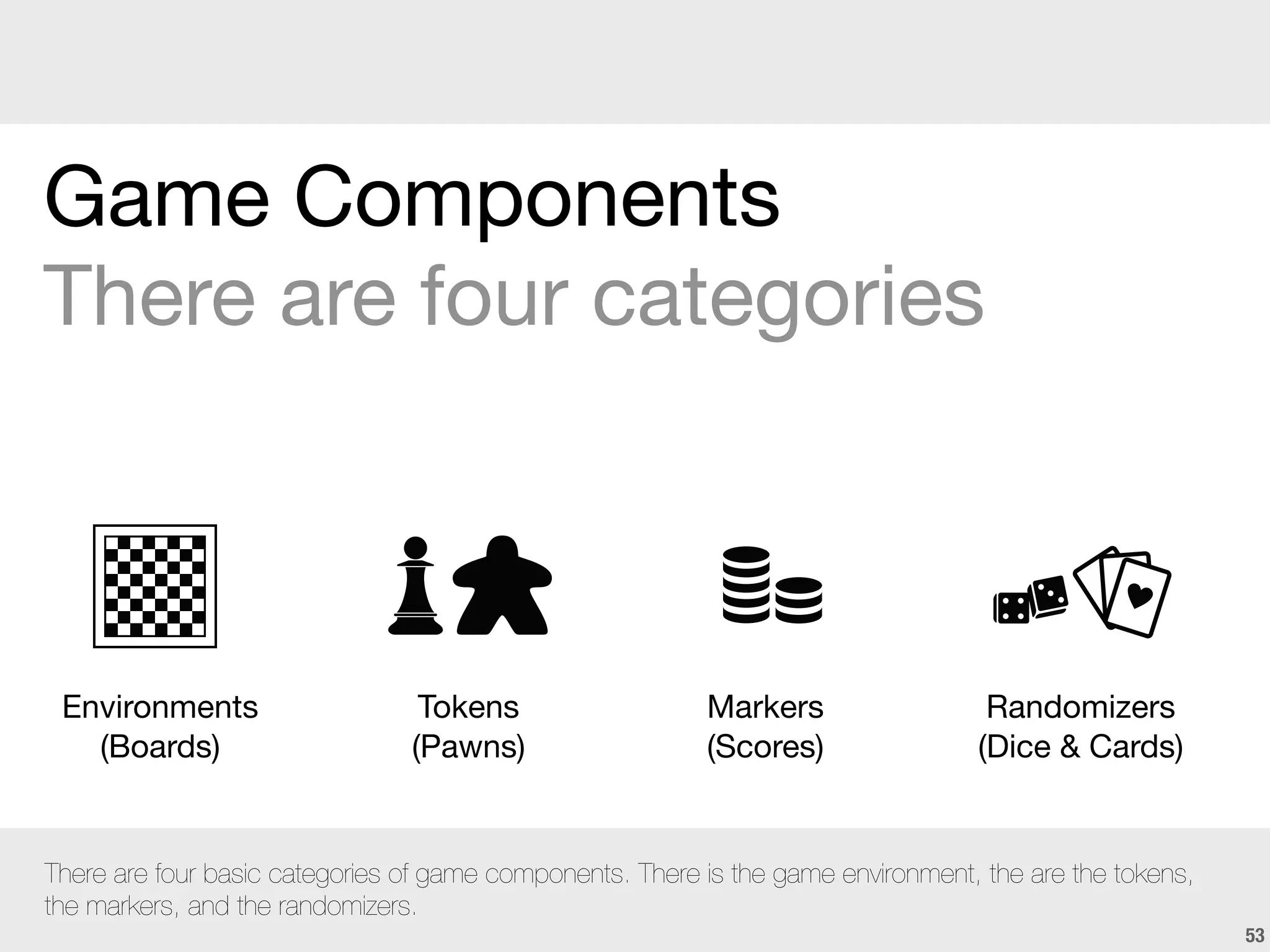
There are four basic categories of game components. There is the game environment, the are the tokens,
the markers, and the randomizers.
There are four categories
53
Tokens
(Pawns)
Markers
(Scores)
Environments
(Boards)
Randomizers
(Dice & Cards)
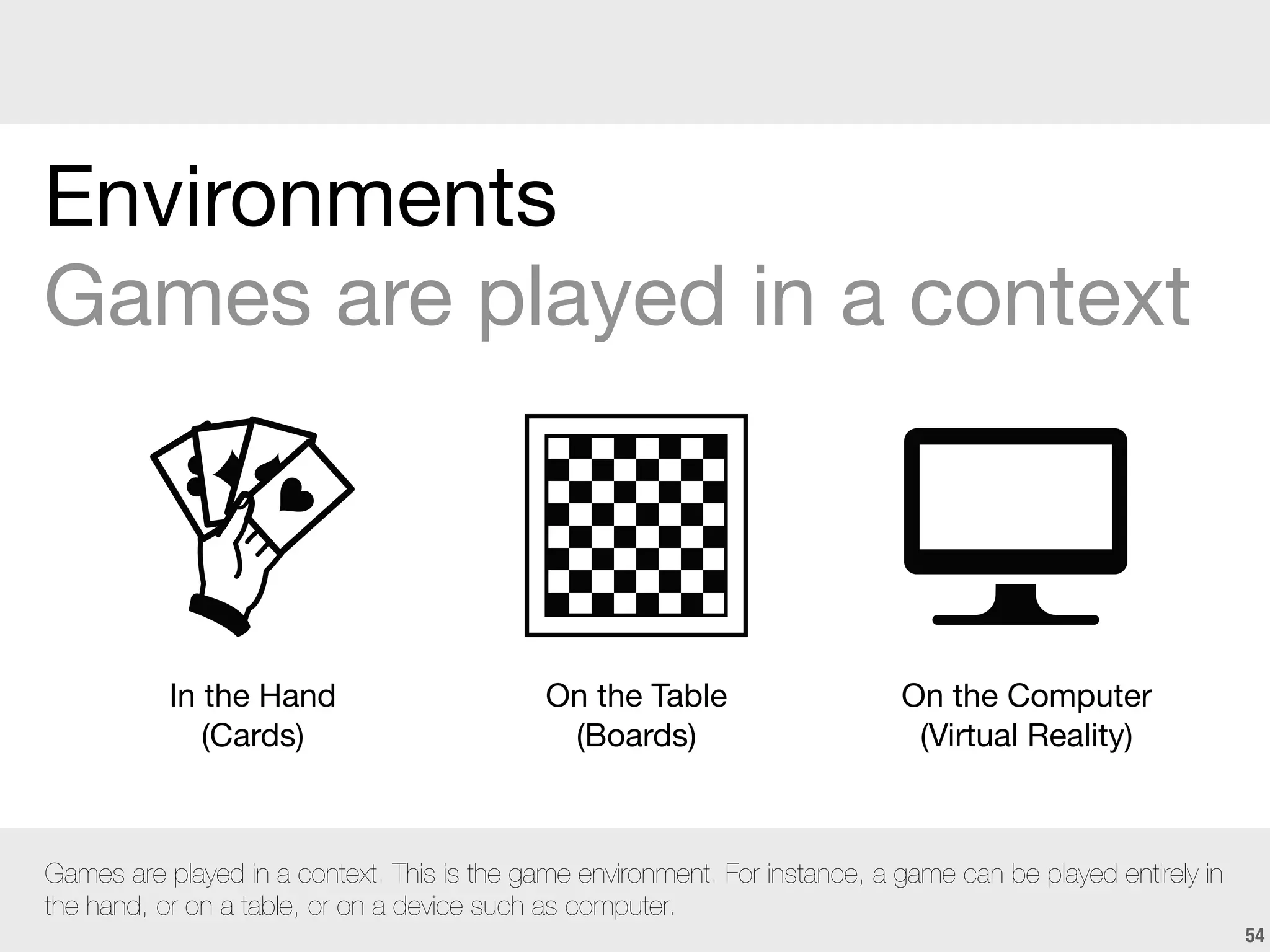
Games are played in a context. This is the game environment. For instance, a game can be played entirely in
the hand, or on a table, or on a device such as computer.
Games are played in a context
Environments
54
In the Hand
(Cards)
On the Table
(Boards)
On the Computer
(Virtual Reality)
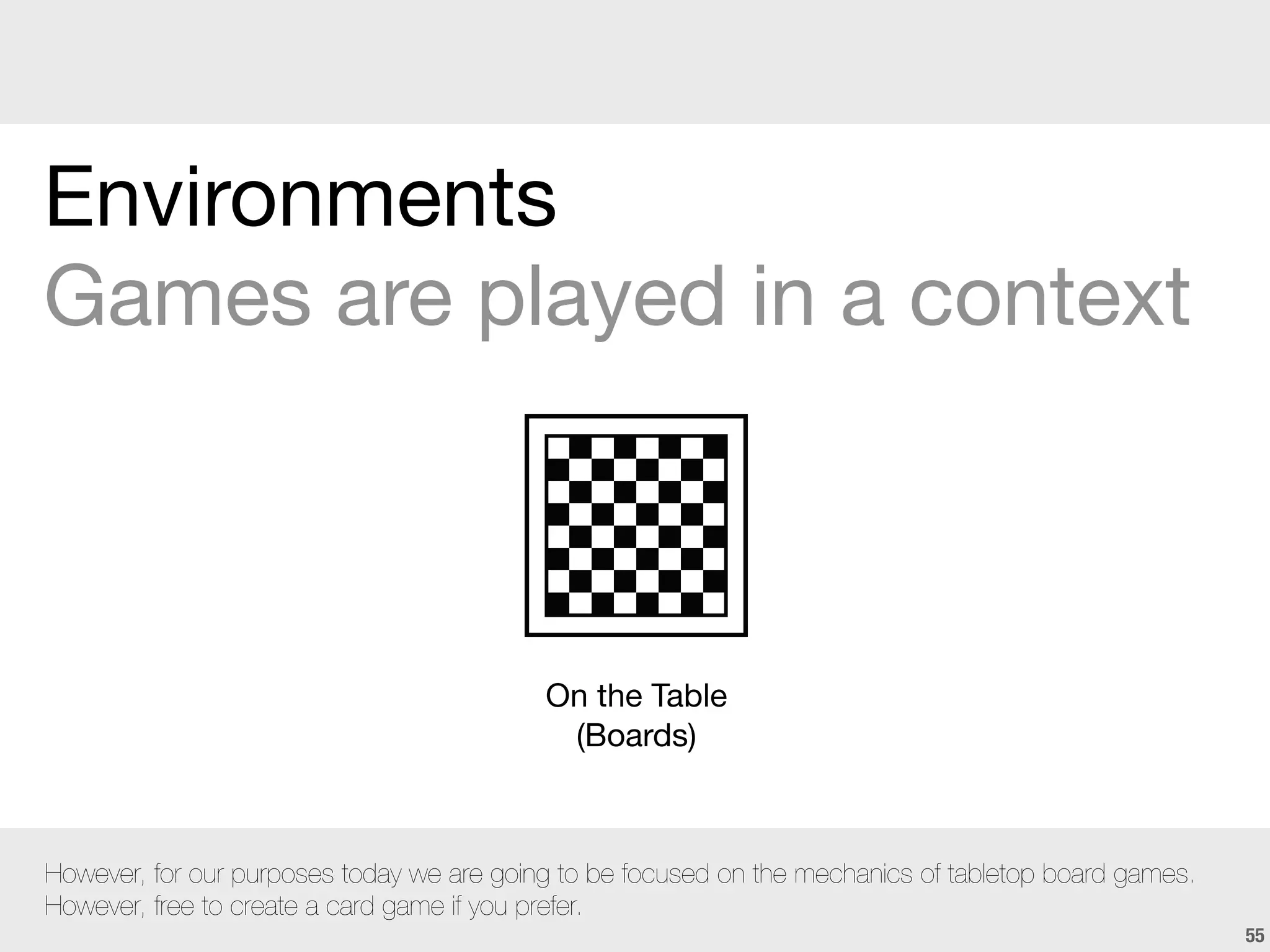
However, for our purposes today we are going to be focused on the mechanics of tabletop board games.
However, free to create a card game if you prefer.
Games are played in a context
Environments
55
On the Table
(Boards)
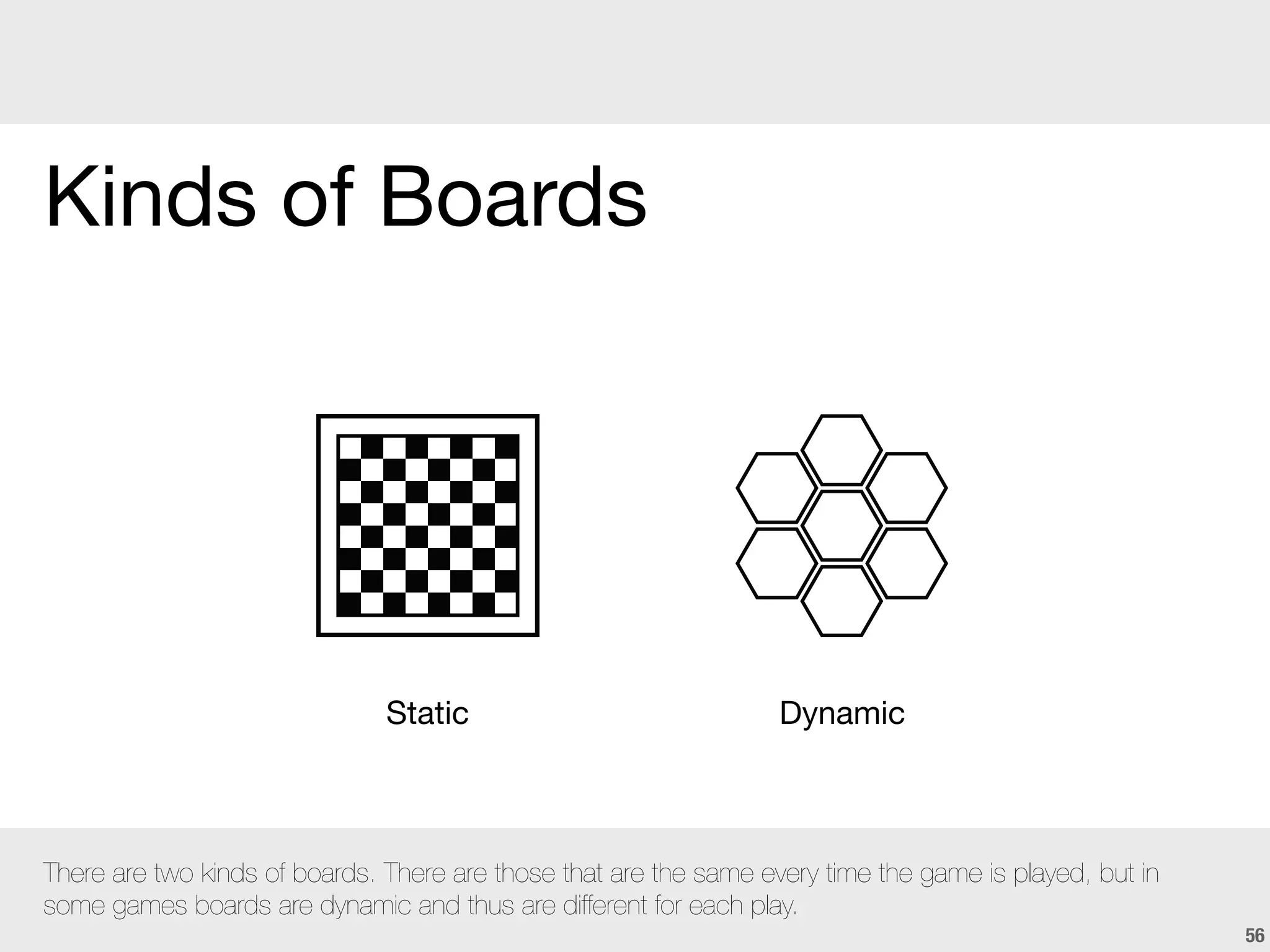
There are two kinds of boards. There are those that are the same every time the game is played, but in
some games boards are dynamic and thus are different for each play.
Kinds of Boards
56
Static Dynamic
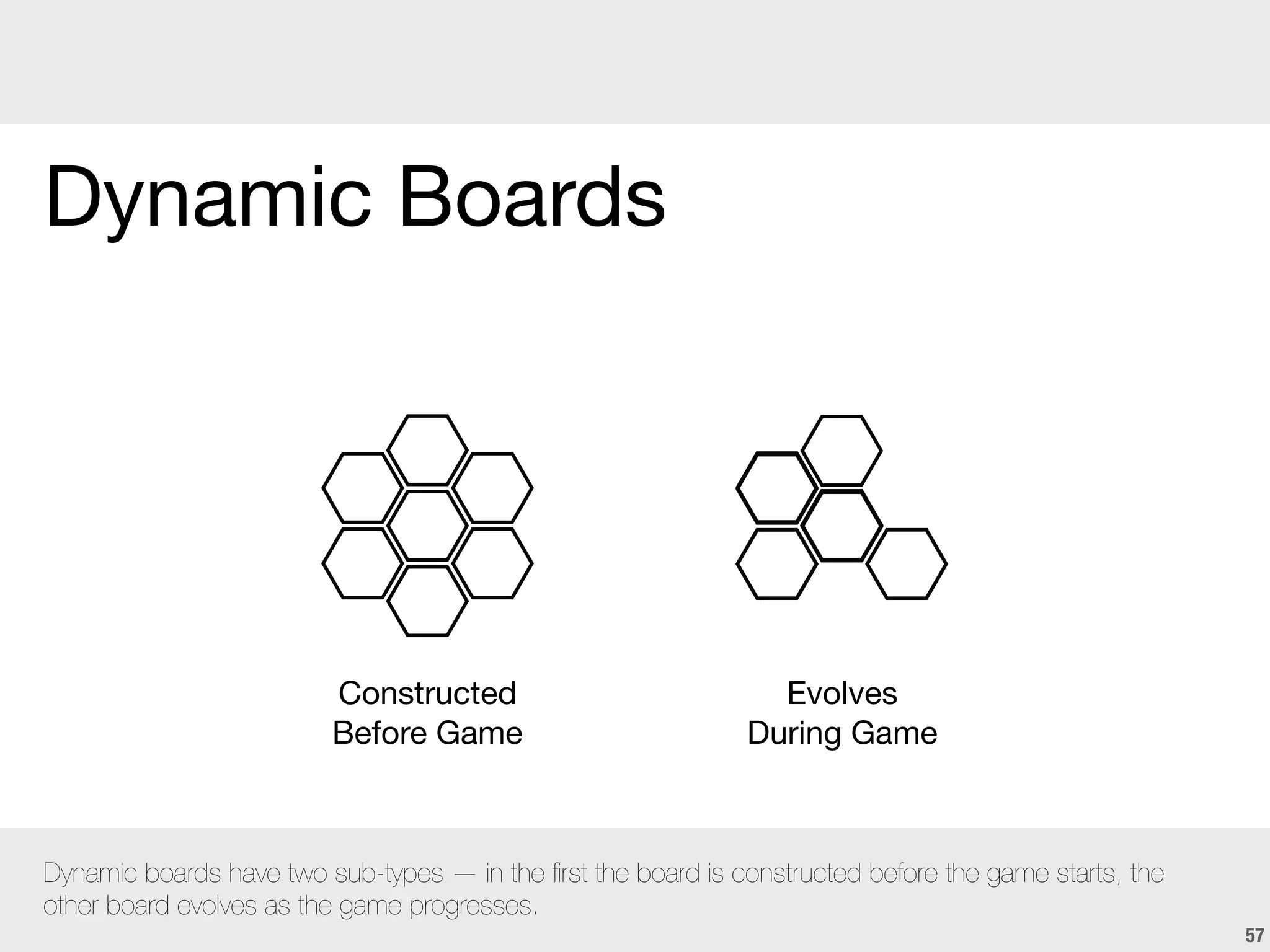
Dynamic boards have two sub-types — in the first the board is constructed before the game starts, the
other board evolves as the game progresses.
Dynamic Boards
57
Constructed
Before Game
Evolves
During Game
What you can do with a board?
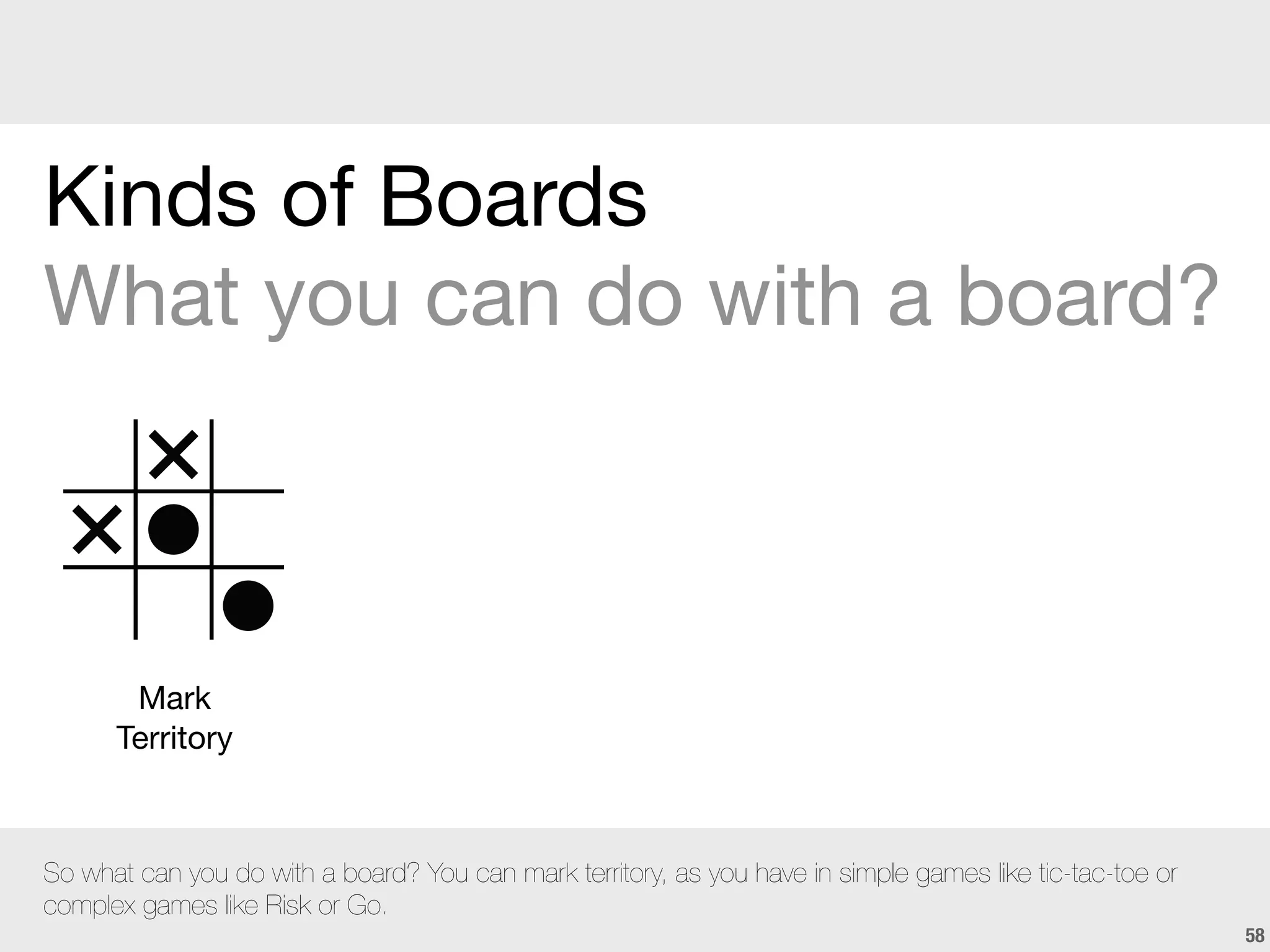
So what can you do with a board? You can mark territory, as you have in simple games like tic-tac-toe or
complex games like Risk or Go.
Kinds of Boards
58
Mark
Territory
What you can do with a board?
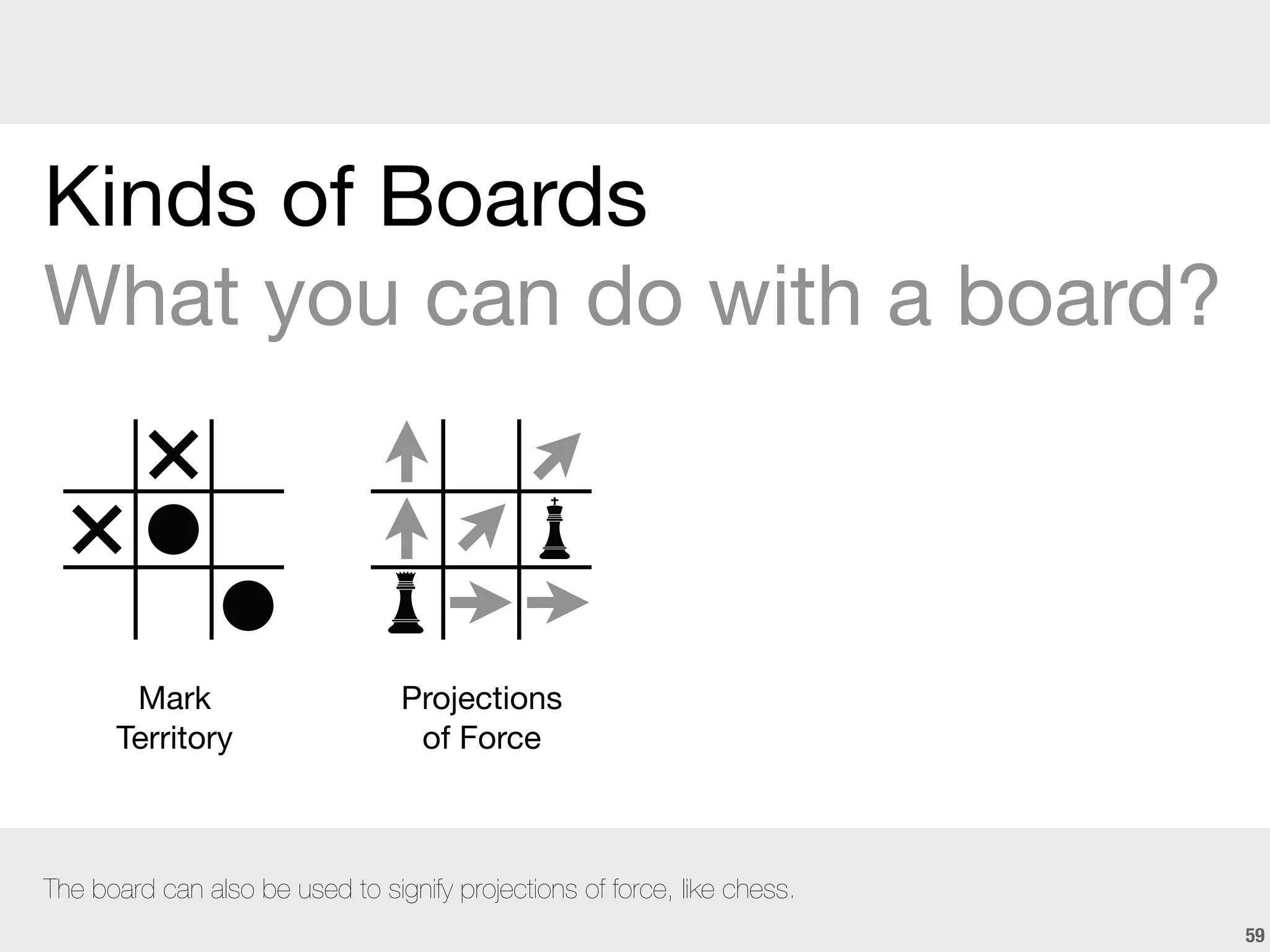
The board can also be used to signify projections of force, like chess.
Kinds of Boards
59
Mark
Territory
Projections
of Force
What you can do with a board?
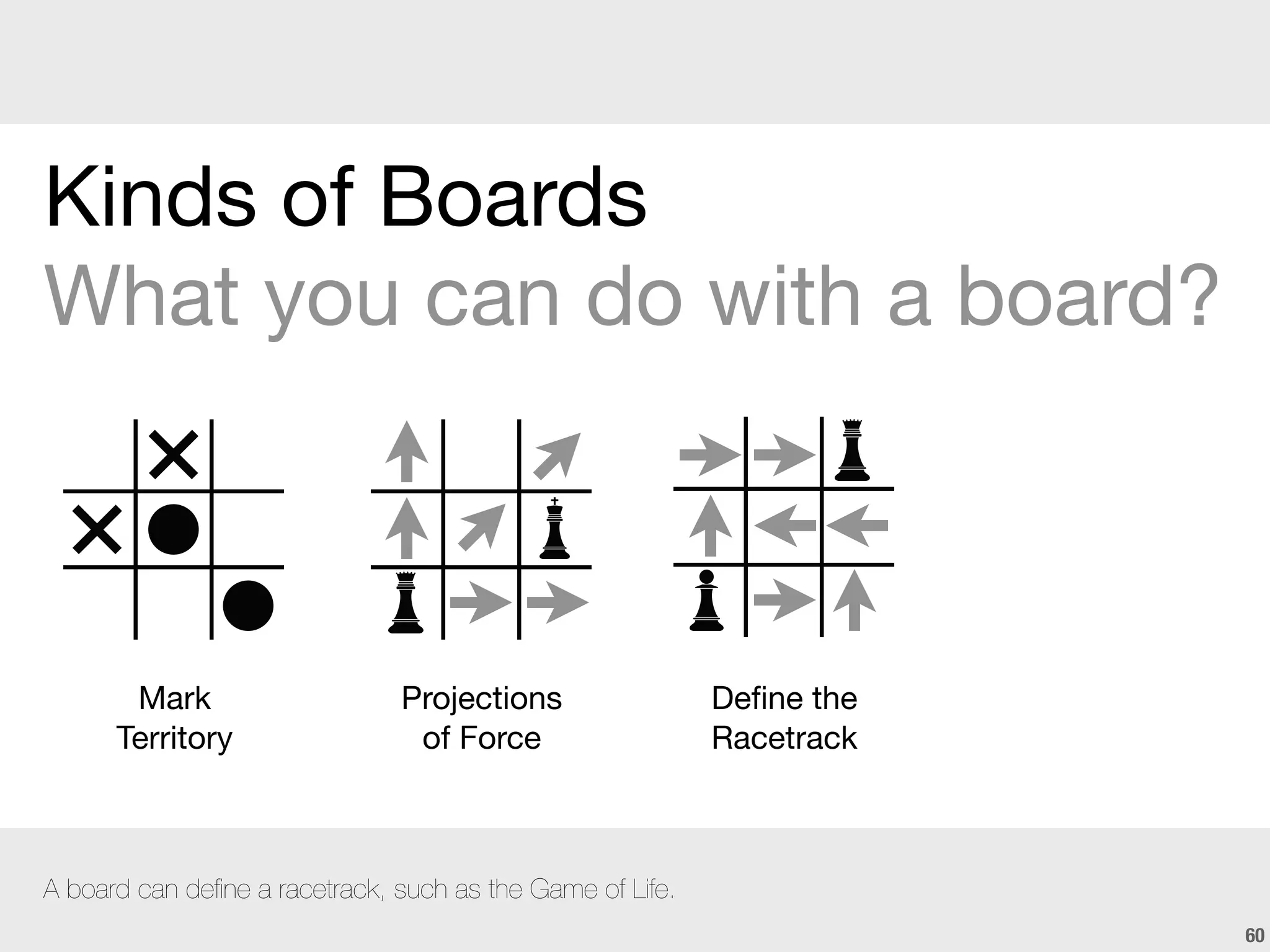
A board can define a racetrack, such as the Game of Life.
Kinds of Boards
60
Mark
Territory
Define the
Racetrack
Projections
of Force
What you can do with a board?
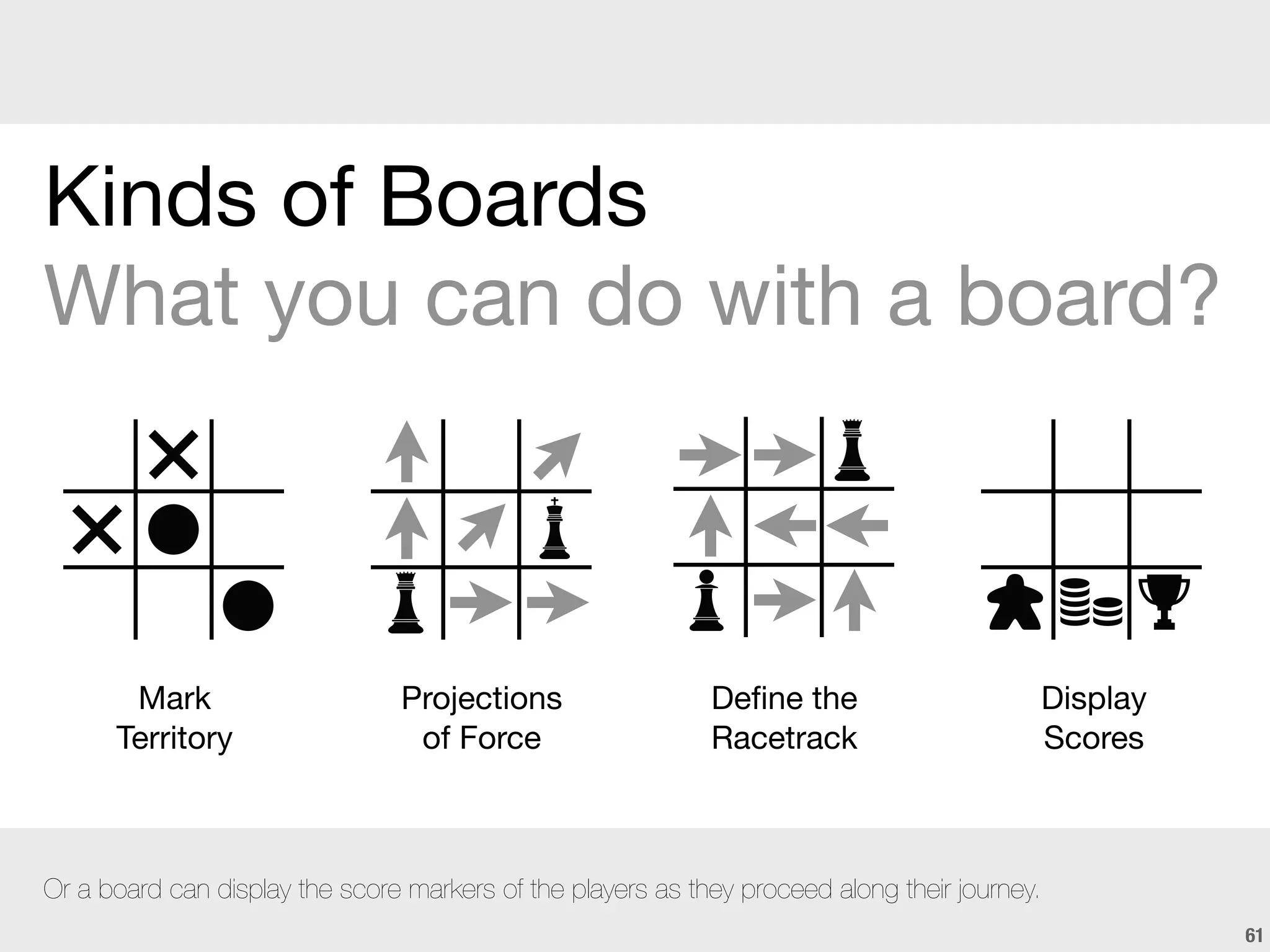
Or a board can display the score markers of the players as they proceed along their journey.
Kinds of Boards
61
Mark
Territory
Define the
Racetrack
Display
Scores
Projections
of Force
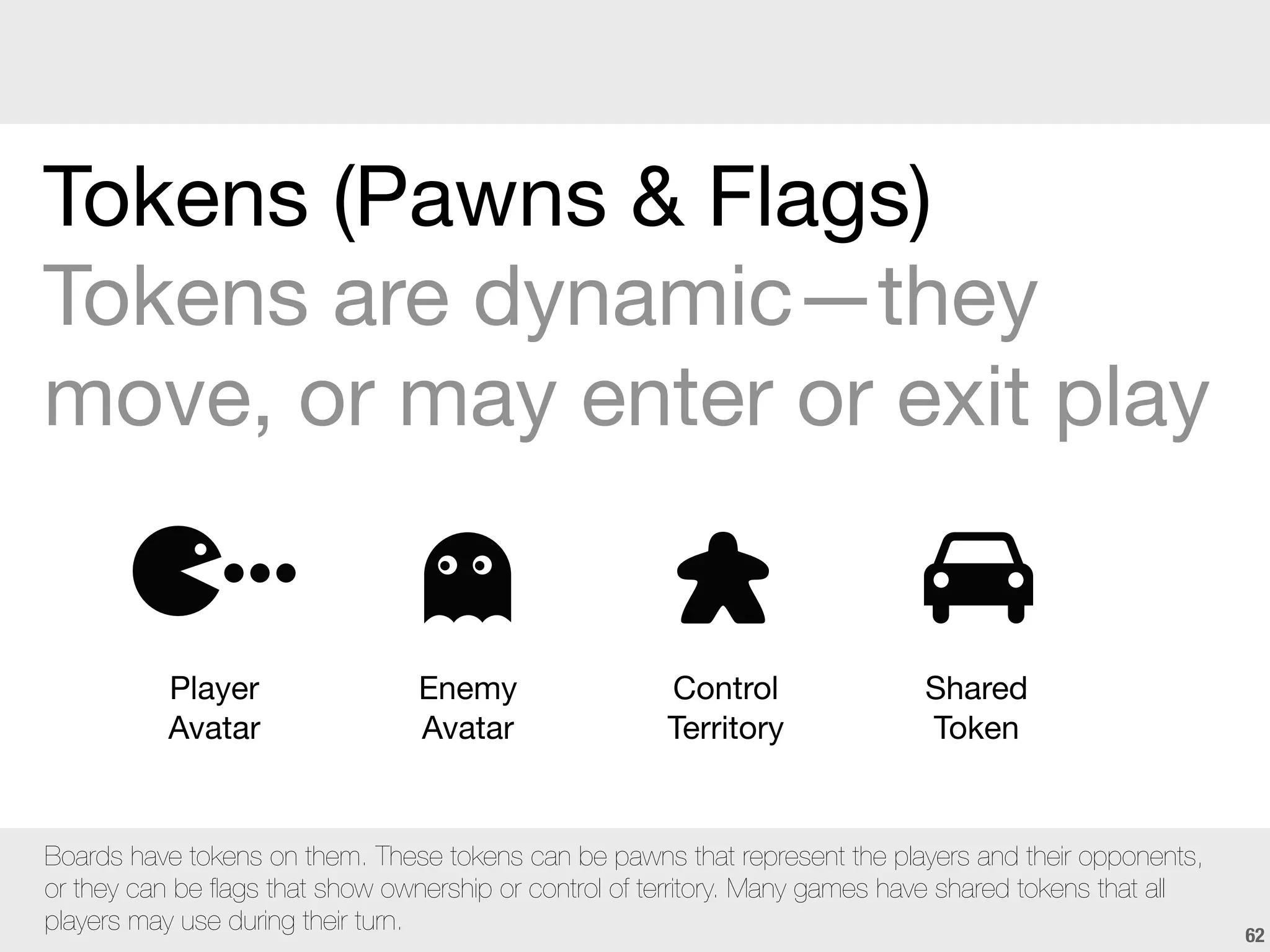
Boards have tokens on them. These tokens can be pawns that represent the players and their opponents,
or they can be flags that show ownership or control of territory. Many games have shared tokens that all
players may use during their turn.
Tokens are dynamic—they
move, or may enter or exit play
Tokens (Pawns & Flags)
62
Player
Avatar
Enemy
Avatar
Control
Territory
Shared
Token
Markers are representative for
a score, value or state
Markers (Scores & Quantities)
63
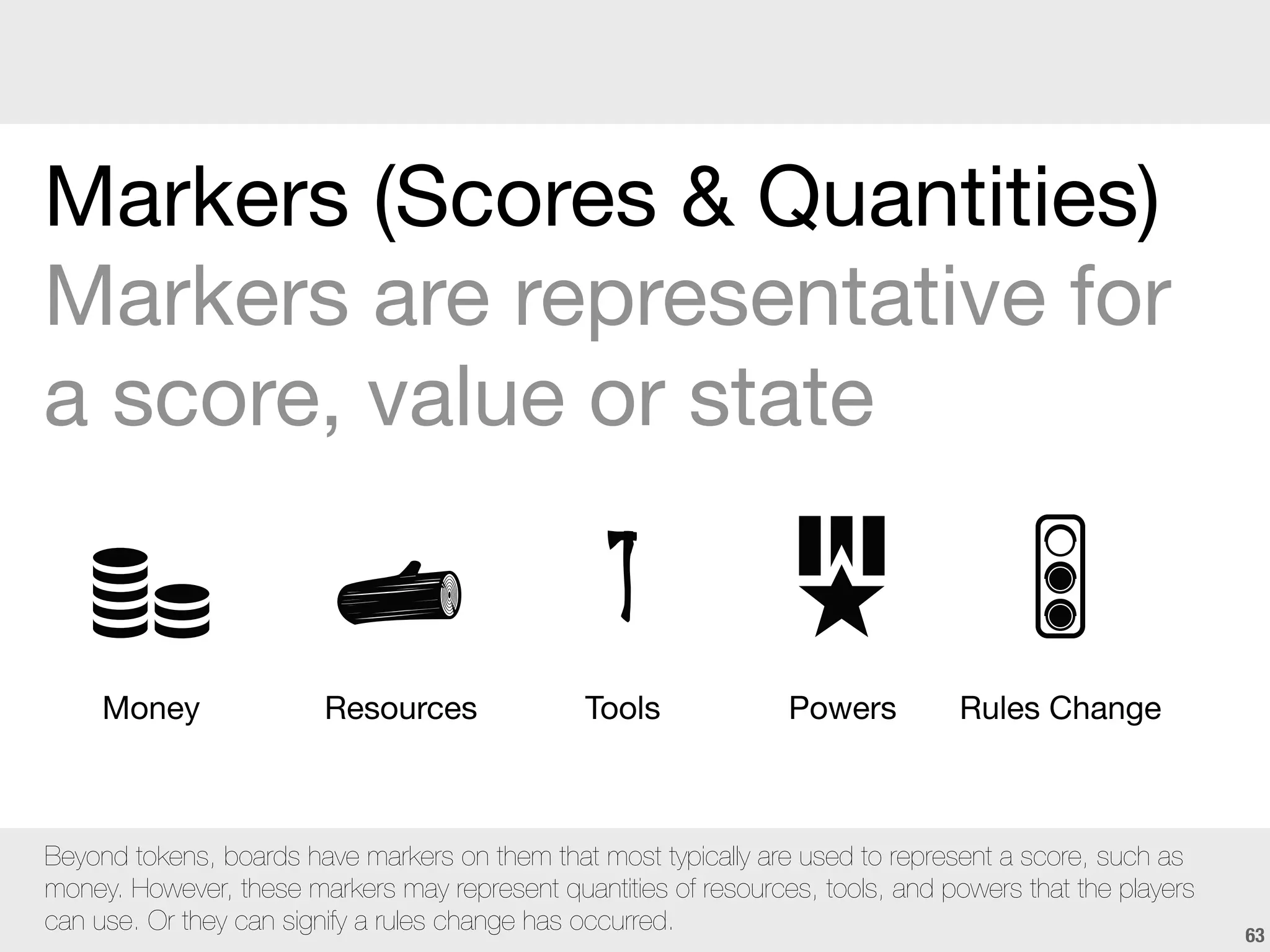
Money Resources Tools Powers Rules Change
Beyond tokens, boards have markers on them that most typically are used to represent a score, such as
money. However, these markers may represent quantities of resources, tools, and powers that the players
can use. Or they can signify a rules change has occurred.
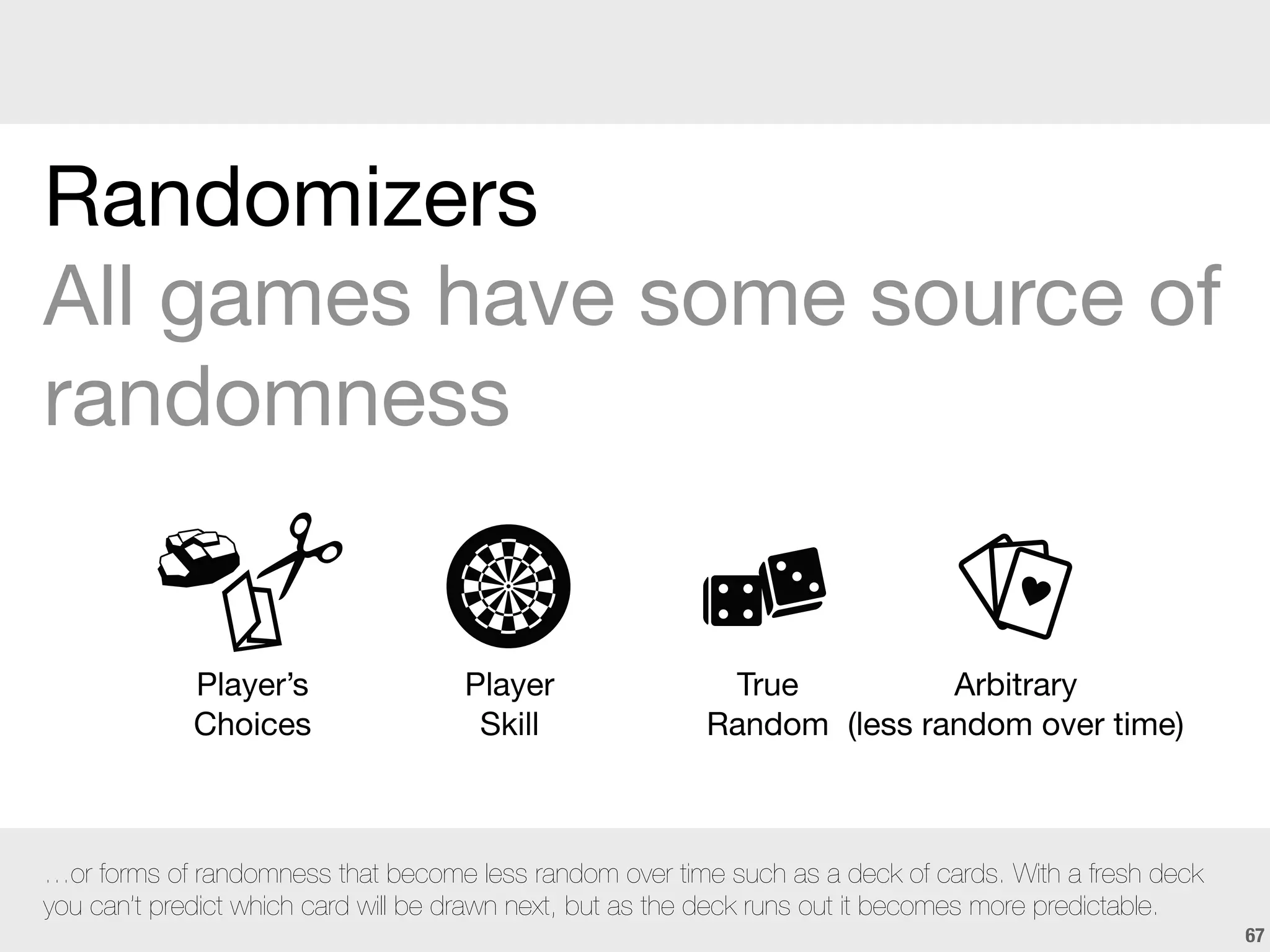
All games have some source of
randomness
Randomizers
64
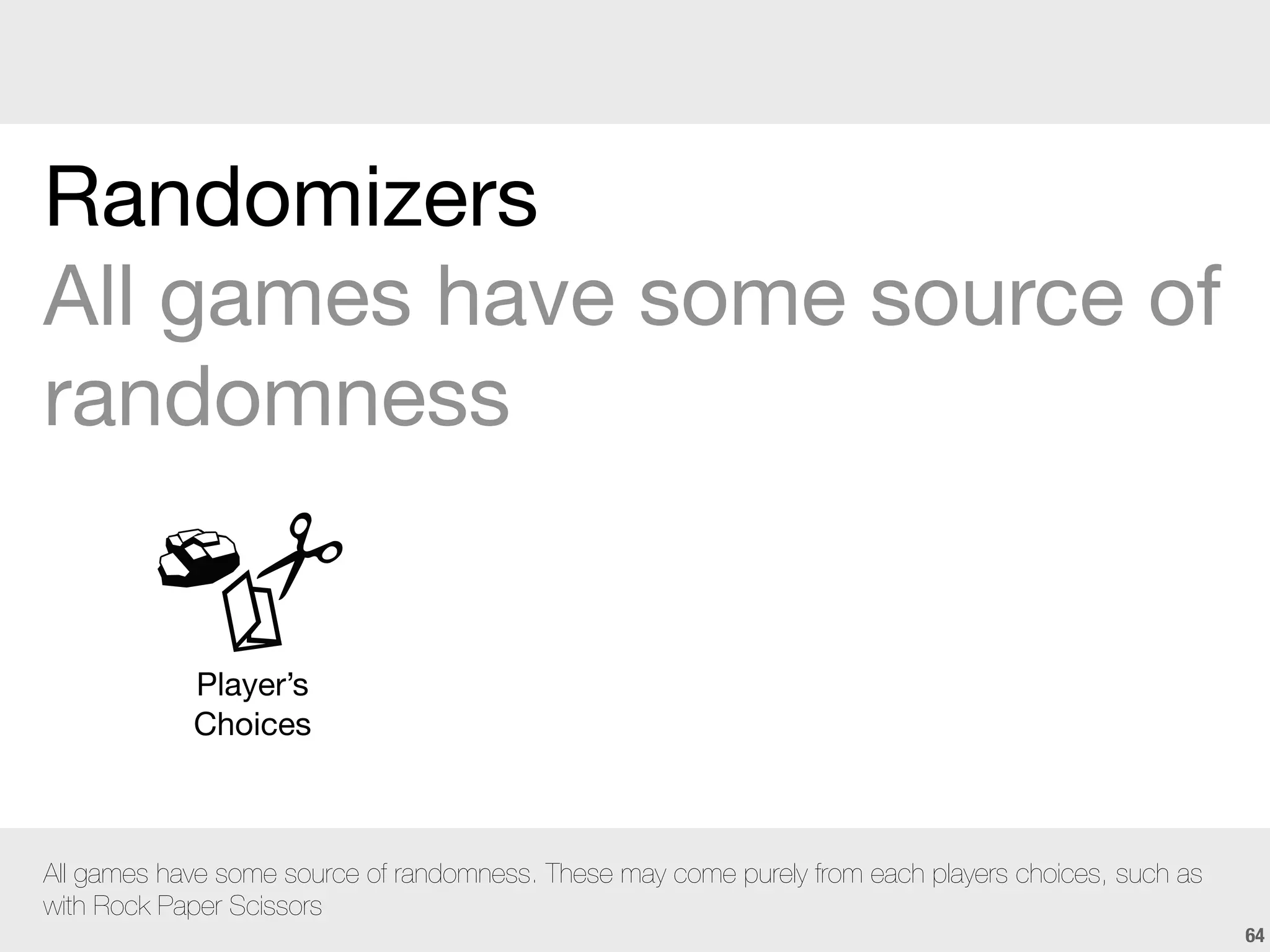
Player’s
Choices
All games have some source of randomness. These may come purely from each players choices, such as
with Rock Paper Scissors
All games have some source of
randomness
Randomizers
65
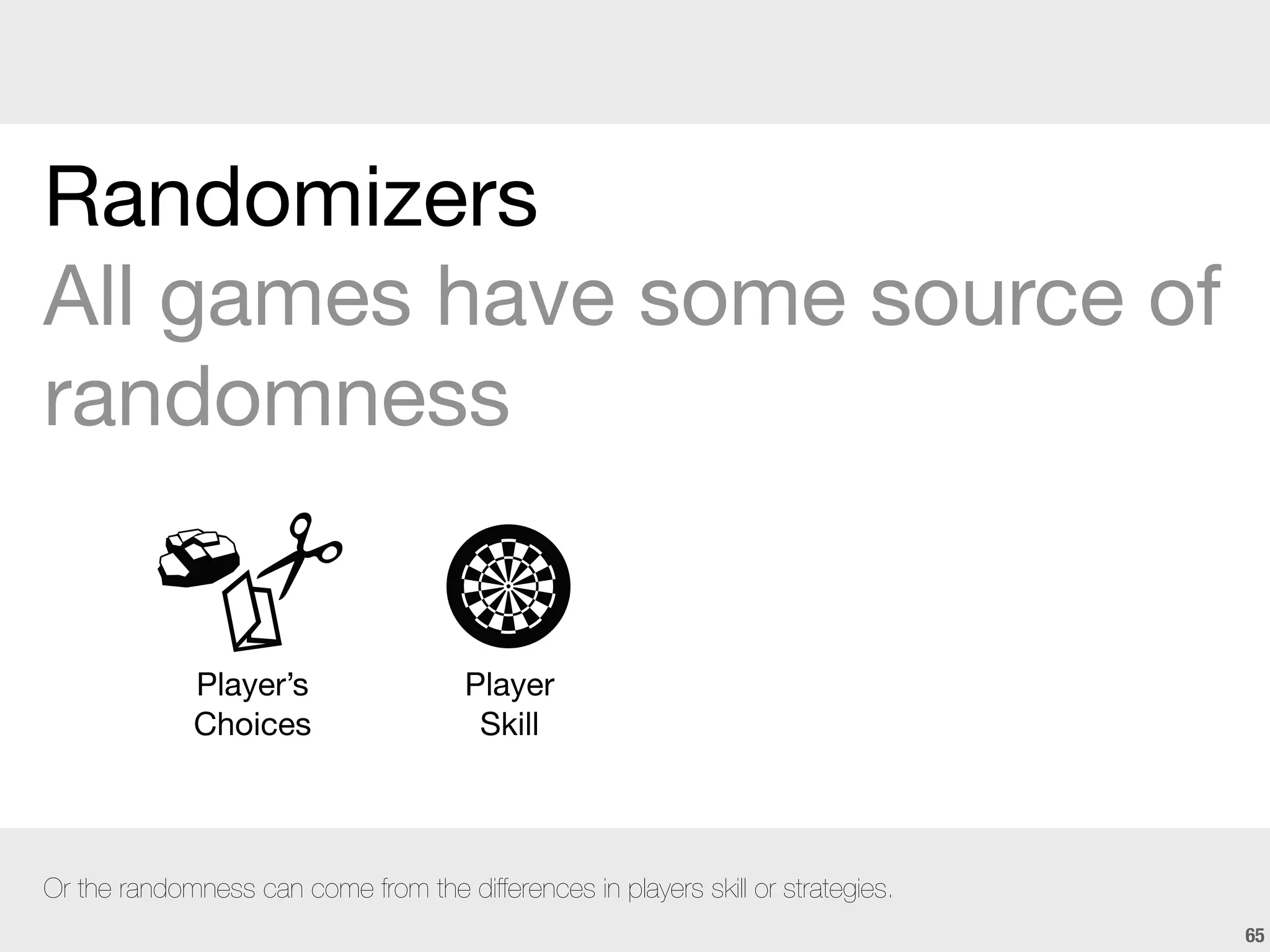
Player
Skill
Player’s
Choices
Or the randomness can come from the differences in players skill or strategies.
All games have some source of
randomness
Randomizers
66
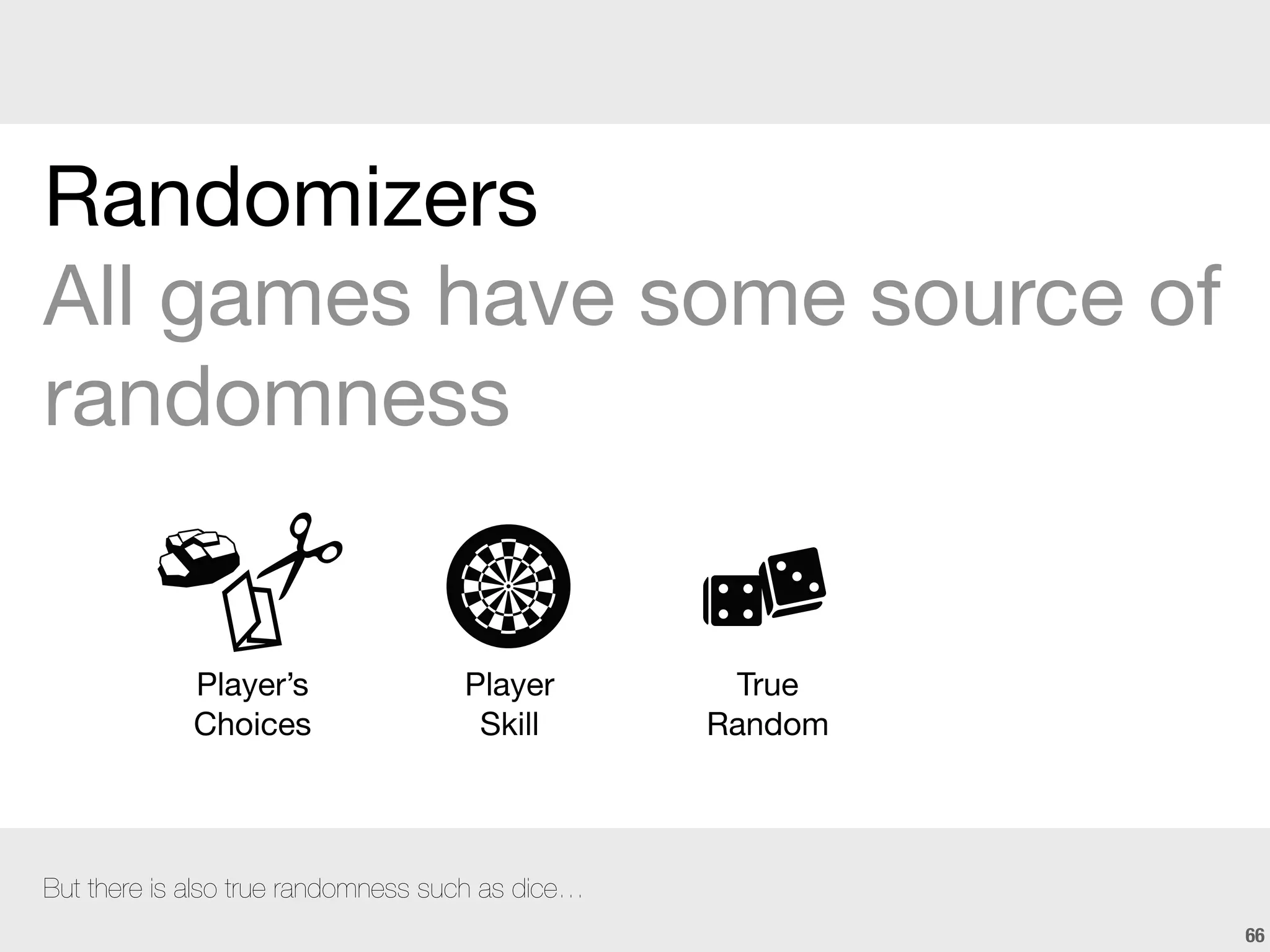
True
Random
Player
Skill
Player’s
Choices
But there is also true randomness such as dice…
All games have some source of
randomness
Randomizers
67
Arbitrary
(less random over time)
True
Random
Player
Skill
Player’s
Choices
…or forms of randomness that become less random over time such as a deck of cards. With a fresh deck
you can’t predict which card will be drawn next, but as the deck runs out it becomes more predictable.
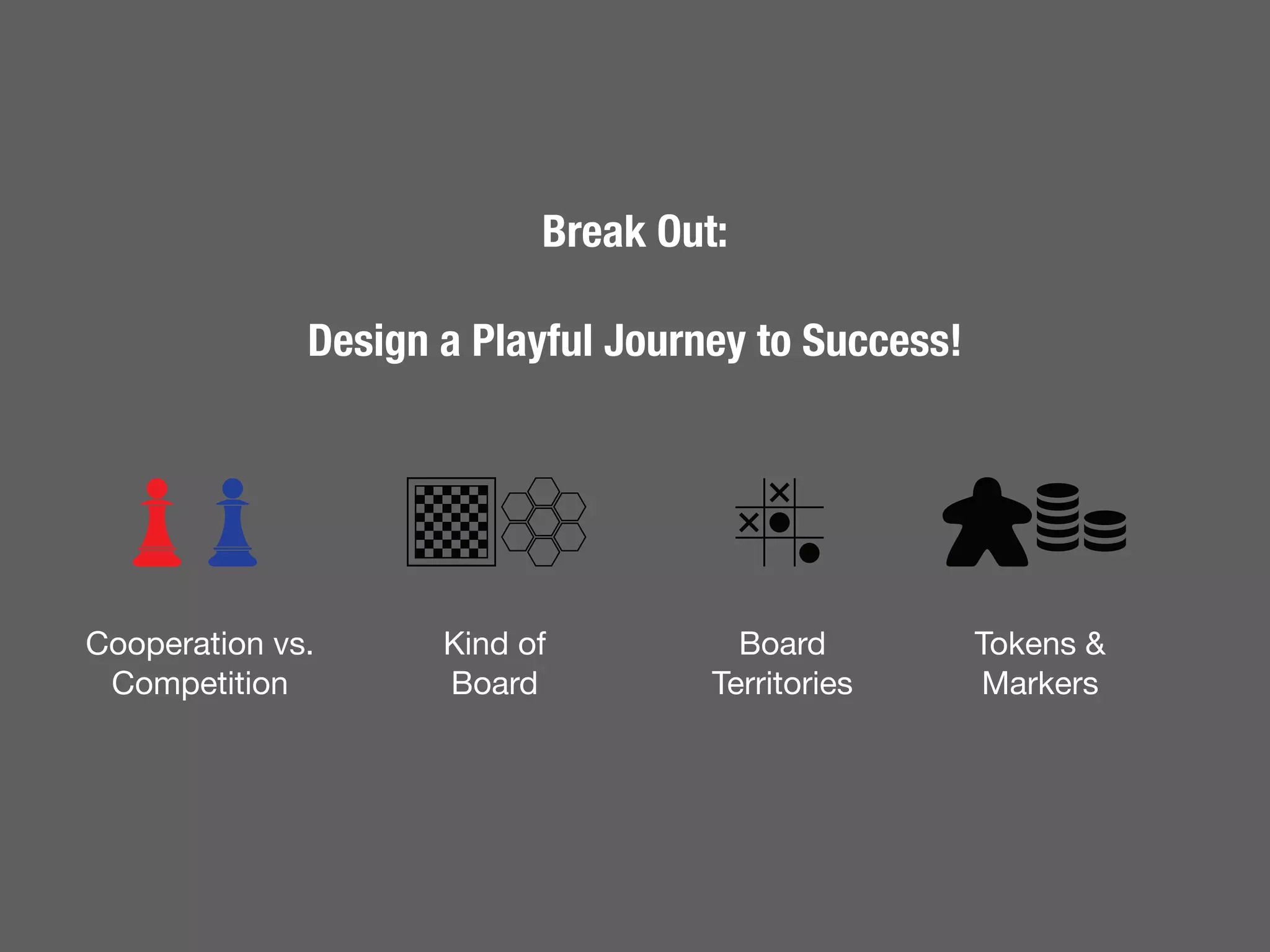
So for the next breakout, think about the the nature of cooperation vs competition in your game. Decide on
the kind of board you wish to use, what do territories on the board represent, and the nature of tokens and
markers required for your game.
A Playful Journey to Success!
Game
68
Cooperation vs.
Competition
Kind of
Board
Tokens &
Markers
Board
Territories
Break Out:
Design a Playful Journey to Success!
69
Cooperation vs.
Competition
Kind of
Board
Tokens &
Markers
Board
Territories
Transcript
70
Report Out:
Share Your Games!
Transcript
71
Discussion:
What did you discover about
Successful Journeys
by creating a Game together?

Brainstorming by Creating a Game

  • 1.
    SLIDES: Allen, Christopher (2014,May 19). “Brainstorming through Game Creation”. Life With Alacrity. Retrieved May 19, 2014, from http:// www.LifeWithAlacrity.com Brainstorming through Game Creation ABSTRACT: “Creating a game together is a great tool for teams to establish a shared language and to discover aspects of collective experience that can foster innovation. The reason is that games can be defined as “A Playful Journey to Success” — the processes of innovation, entrepreneurship and education are all also Journeys to Success. Thus by designing a game, we are modeling future successful journeys for ourselves.”
  • 2.
    Created by ChristopherAllen, ChristopherA@LIfeWithAlacrity.com. Published in blog Life With Alacrity. Text and design ©2014 Christopher Allen and is licensed CC-BY-SA. Individual images are from The Noun Project, are © their respective owners and are licensed under CC license. Brainstorming through… 2 What is a
  • 3.
    Today, as partof our brainstorming exercise, each of our teams will be creating a game. Creating these games will give us a shared language about our different experiences, and will inspire us to discover aspects of our collective that we might have otherwise missed. Creating a Game 3 What is a
  • 4.
    So to start— What, exactly, is a Game? What is a Game? 4 What is a
  • 5.
    So to start— What, exactly, is a Game? What is a Game? 5 Game Game
  • 6.
    There are manyexcellent definitions, written by philosophers, game historians, game designers, and scholars of “Ludology” — the study of games. Game 6 Game
  • 7.
    There are manyexcellent definitions, written by philosophers, game historians, game designers, and scholars of “Ludology” — the study of games. Game 7 Game A game is a voluntary effort to overcome unnecessary obstacles. — Bernard Suits, in The Grasshopper: Games, Life, and Utopia (1990) A game is an activity among two or more independent decision-makers seeking to achieve their objectives in some limiting context. — Clark Abt, in Serious Games (1970) A game is a system in which players engage in an artificial conflict, defined by rules, that results in a quantifiable outcome. — Kalen, Zimmerman in The Rules of Play (2004) A formal game has a twofold structure based on ends and means; Ends: it is a contest to achieve an objective. Means: it has an agreed set of equipment and of procedural ‘rules’ — David Parlett, in The Oxford History of Board Games (1999)
  • 8.
    However, my personaldefinition is quite simple: A Game is “A Playful Journey to Success” So why do I prefer this definition? Game 8 Game
  • 9.
    However, my personaldefinition is quite simple: A Game is “A Playful Journey to Success” So why do I prefer this definition? A Playful Journey to Success! Game 9
  • 10.
    One reason isthat I use this definition is that it distills the essence of what is a game down to three key qualities — that games are Playful, that they embody a Journey, and at their end you have a feeling of Success. A Playful Journey to Success! Game 10 Playful Journey Success
  • 11.
    Also important tome, are the words that this definition leaves out. A Playful Journey to Success! Game 11
  • 12.
    In this definitionI use the word Playful rather than Play. Though games may be full of play, they are not solely about play. They are much more. A Playful Journey to Success! Game 12 Playful Play
  • 13.
    Part of thisis because games are not always fun — all games will have some form of fun, but typically some portion of the play experience must challenge you, thus you will experience difficultly and frustration. Which is not fun, but overcoming those challenges can be. A Playful Journey to Success! Game 13 Playful Fun
  • 14.
    Another missing word— Competition. Though competition is often important part of a game, the Journey does not necessarily require players to compete with each other. Instead they may compete with themselves, or against the board. A Playful Journey to Success! Game 14 Journey Competition
  • 15.
    Similarly do gamesdon’t have to be fundamentally about conflict — there are many great games that are about cooperation. A Playful Journey to Success! Game 15 Journey Conflict
  • 16.
    Finally, this definitionavoids the word Win. Win implies that someone else looses. Winning can be an important part of a game, but I prefer to use Success. In the best games, those who do not win still enjoy and gain value from their play, so also share in the Success. A Playful Journey to Success! Game 16 Success Win
  • 17.
    So why inthis exercise are we using the design of a game as a metaphor? A Playful Journey to Success! Game 17
  • 18.
    A Playful Journeyto Success! The reason is that education, the process of innovation, and entrepreneurship are all also Journeys to Success. Journeys have a path, they have obstacles, and at their end is some measure of success. So by designing a game, we are modeling the process of success itself. Game 18 SuccessJourney
  • 19.
    For the nexthalf-hour, you will hear some stories about the Journeys. Take notes. A Playful Journey to Success! Game 19 SuccessJourneyPlayful
  • 20.
    In particular listenfor anything that you can use in your game design that fit into the categories of the Playfulness, the Journey or the Success. A Playful Journey to Success! Game 20 SuccessJourneyPlayful Journey Neque porro quisquam est qui dolorem ipsum quia dolor sit amet, consectetur, adipisci velit Playful Success Neque porro quisquam est qui dolorem ipsum quia dolor sit amet, consectetur, adipisci velit Neque porro quisquam est qui dolorem ipsum quia dolor sit amet, consectetur, adipisci velit
  • 21.
    After listening tothese Journeys, we will be asking you begin the process of of brainstorming about how to create a game. We are not asking you to create a great game — again, our goal is simulate the Journey in the form of game to see what we learn. A Playful Journey to Success! Game 21
  • 22.
  • 23.
  • 24.
    To recap, gamesare a Playful Journey to Success. Here are some things to think about in regards to these three aspects of game design. A Playful Journey to Success! Game 24
  • 25.
    To recap, gamesare a Playful Journey to Success. Here are some things to think about in regards to these three aspects of game design. A Playful Journey to Success! Game 25 Playful Journey Success
  • 26.
    PlayfulA Playful Journeyto Success! Let’s dive into the nature of of what it means to be Playful: Playful 26
  • 27.
    There are manykinds of Play. Some elements of play in games are Discovery and Creativity, Collecting Sets, Problem Solving, Achieving Goals, and many more. There are many kinds of play Play 27 Discovery / Creativity Collecting Sets Problem Solving Achieving Goals Play
  • 28.
    Transcript 28 Question: What aspects ofPlay do you enjoy? Discovery / Creativity Collecting Sets Problem Solving Achieving Goals
  • 29.
  • 30.
    PlayfulA Playful Journeyto Success! Here are some things you should be thinking about when describing a Journey.. Journey 30 Journey
  • 31.
    Journey’s have apath. It can be single path, like a racetrack. Or a Journey can diverge from a single starting point into multiple paths. Or you can start from many different places and converge on a single goal. Path’s can also be very non-linear and chaotic. Journeys have paths Journey 31 Single Path (racetrack) Multiple Paths (branching tree) Non-Linear Rooted Paths (upside-down tree)
  • 32.
    Journeys have obstacles Journey’salso have Obstacles. They can be as simple as requiring one thing to be done after another, or require a decision to be made. Other obstacles can be randomness, rules, or time. Journey 32 Order Decisions 1 2 3 4 1 2 3a 3b 4a 4b Randomness Rules Time
  • 33.
    Journey’s have constraints.You have a limit to how far the Journey is, and how much time you can spend traveling. Journeys have constraints Journey 33 Space Time
  • 34.
    JourneyJourney Similarly, Journey’s havea scale. Are about a single company, a city, or a whole country? Does your journey take hours, days or weeks? Journeys have scale 34 Space Time
  • 35.
    Journey Our Journey’s leadto Success, but what is the nature of Success? A Playful Journey to Success! Success 35 Success
  • 36.
    Success Who wins? 36 Individual TeamSociety First, who wins? Is an individual person, a team of people, or society as a whole?
  • 37.
    How do youdefine success? Success 37 Learning Perform Skill Make Decision Create Next, how do you define success? Are you demonstrating that you’ve learned to perform a skill, or how make a decision, or the ability to create something?
  • 38.
    How do youdefine success? Success 38 Learning Perform Skill Make Decision Create Metric Score/ Statistic Money Vote Or is it some form of Metric, such as overcoming some score, statistic, or collect money, or winning a vote?
  • 39.
    How do youdefine success? Success 39 Improvement Personal Overcome Rival Aesthetic Social Learning Perform Skill Make Decision Create Metric Score/ Statistic Money Vote Success can also be very personal. You can feel that you’ve created something beautiful, that you have accomplished an improvement, or overcome a rival. And success can just be that you had a good time with your fellows.
  • 40.
    In our nextBreakout, talk about the Journeys that were shared previously. What are elements of that might be considered Playful? A Playful Journey to Success! Game 40 SuccessJourneyPlayful Playful Neque porro quisquam est qui dolorem ipsum quia dolor sit amet, consectetur, adipisci velit
  • 41.
    What kind ofthe paths and obstacles occurred during that Journey? What is the nature of Journey’s constraints in space and time, and what was the scale? A Playful Journey to Success! Game 41 SuccessJourneyPlayful Journey Neque porro quisquam est qui dolorem ipsum quia dolor sit amet, consectetur, adipisci velit Playful Neque porro quisquam est qui dolorem ipsum quia dolor sit amet, consectetur, adipisci velit
  • 42.
    Who wins? Howwould you describe the elements of Success? A Playful Journey to Success! Game 42 SuccessJourneyPlayful Journey Neque porro quisquam est qui dolorem ipsum quia dolor sit amet, consectetur, adipisci velit Playful Success Neque porro quisquam est qui dolorem ipsum quia dolor sit amet, consectetur, adipisci velit Neque porro quisquam est qui dolorem ipsum quia dolor sit amet, consectetur, adipisci velit
  • 43.
    Break Out: The elementsof each Playful Journey to Success 43 Kinds of Play Nature of the Paths Obstacles Constraints & Scale Who Wins Nature of Success
  • 44.
    So after listeningthese Journey’s, and sharing your thoughts on the nature of these journeys, our next goal for is to begin to create a game. A Playful Journey to Success! Game 44
  • 45.
    A Playful Journeyto Success! You should have some notes about journeys to success that were shared earlier. Similarly you should have some notes about the kinds of play, the elements of the journey, and the nature of success. Game 45 Journey Neque porro quisquam est qui dolorem ipsum quia dolor sit amet, consectetur, adipisci velit Playful Success Neque porro quisquam est qui dolorem ipsum quia dolor sit amet, consectetur, adipisci velit Neque porro quisquam est qui dolorem ipsum quia dolor sit amet, consectetur, adipisci velit
  • 46.
    You just focusedon these aspects of your Journeys. Which was the most interesting? Don’t start on the mechanics of your game yet — instead, simply choose what kind of journey you’d like to create a game around. Later we’ll help you brainstorm the game mechanics required to support the goals of your game. A Playful Journey to Success! Game 46 Kinds of Play Nature of the Paths Obstacles Constraints & Scale Who Wins Nature of Success
  • 47.
    Transcript 47 Break Out: Choose onePlayful Journey to Success to Design Kinds of Play Nature of the Paths Obstacles Constraints & Scale Who Wins Nature of Success
  • 48.
    Now that you’vedefined the broad goals of a game, I’d like to share with you some ideas about game mechanics that can support your goals. You don’t need to understand these mechanics, but you may connect these ideas to games you’ve played in the past, and thus find them useful for your designs. A Playful Journey to Success! Game 48
  • 49.
    Games are oftenmade up of sequences of mini-games Mini-games 49 First, many games are made up of sequences of mini-games If your game is too simple, create mini-games inside it. Or, if you feel your game may be too complex, focus on a mini-game within your larger game.
  • 50.
    An early decisionthat you need to make is the nature of competition. There is a continuum from competing with only yourself, to competing against someone else, to the true cooperative game. Not all games need to be about competition Player Interaction 50 Solitaire Competition Cooperative
  • 51.
    There is actuallymany more choices here. Between solitaire and competition is ranked solitaire where you compete only by score. Competition can include parters or teams. And you can have games where there is one vs many, like a secret traitor you have in the game Werewolf. There are many choices Player Interaction 51 Solitaire Individual Ranked Competition Cooperative Partners / Teams One vs. Many / Secret Traitor
  • 52.
    Journeys have guideposts GameComponents Journeys have guideposts. In games, we call these game components. Guideposts 52
  • 53.
    Game ComponentsGame Components Thereare four basic categories of game components. There is the game environment, the are the tokens, the markers, and the randomizers. There are four categories 53 Tokens (Pawns) Markers (Scores) Environments (Boards) Randomizers (Dice & Cards)
  • 54.
    Games are playedin a context. This is the game environment. For instance, a game can be played entirely in the hand, or on a table, or on a device such as computer. Games are played in a context Environments 54 In the Hand (Cards) On the Table (Boards) On the Computer (Virtual Reality)
  • 55.
    However, for ourpurposes today we are going to be focused on the mechanics of tabletop board games. However, free to create a card game if you prefer. Games are played in a context Environments 55 On the Table (Boards)
  • 56.
    There are twokinds of boards. There are those that are the same every time the game is played, but in some games boards are dynamic and thus are different for each play. Kinds of Boards 56 Static Dynamic
  • 57.
    Dynamic boards havetwo sub-types — in the first the board is constructed before the game starts, the other board evolves as the game progresses. Dynamic Boards 57 Constructed Before Game Evolves During Game
  • 58.
    What you cando with a board? So what can you do with a board? You can mark territory, as you have in simple games like tic-tac-toe or complex games like Risk or Go. Kinds of Boards 58 Mark Territory
  • 59.
    What you cando with a board? The board can also be used to signify projections of force, like chess. Kinds of Boards 59 Mark Territory Projections of Force
  • 60.
    What you cando with a board? A board can define a racetrack, such as the Game of Life. Kinds of Boards 60 Mark Territory Define the Racetrack Projections of Force
  • 61.
    What you cando with a board? Or a board can display the score markers of the players as they proceed along their journey. Kinds of Boards 61 Mark Territory Define the Racetrack Display Scores Projections of Force
  • 62.
    Boards have tokenson them. These tokens can be pawns that represent the players and their opponents, or they can be flags that show ownership or control of territory. Many games have shared tokens that all players may use during their turn. Tokens are dynamic—they move, or may enter or exit play Tokens (Pawns & Flags) 62 Player Avatar Enemy Avatar Control Territory Shared Token
  • 63.
    Markers are representativefor a score, value or state Markers (Scores & Quantities) 63 Money Resources Tools Powers Rules Change Beyond tokens, boards have markers on them that most typically are used to represent a score, such as money. However, these markers may represent quantities of resources, tools, and powers that the players can use. Or they can signify a rules change has occurred.
  • 64.
    All games havesome source of randomness Randomizers 64 Player’s Choices All games have some source of randomness. These may come purely from each players choices, such as with Rock Paper Scissors
  • 65.
    All games havesome source of randomness Randomizers 65 Player Skill Player’s Choices Or the randomness can come from the differences in players skill or strategies.
  • 66.
    All games havesome source of randomness Randomizers 66 True Random Player Skill Player’s Choices But there is also true randomness such as dice…
  • 67.
    All games havesome source of randomness Randomizers 67 Arbitrary (less random over time) True Random Player Skill Player’s Choices …or forms of randomness that become less random over time such as a deck of cards. With a fresh deck you can’t predict which card will be drawn next, but as the deck runs out it becomes more predictable.
  • 68.
    So for thenext breakout, think about the the nature of cooperation vs competition in your game. Decide on the kind of board you wish to use, what do territories on the board represent, and the nature of tokens and markers required for your game. A Playful Journey to Success! Game 68 Cooperation vs. Competition Kind of Board Tokens & Markers Board Territories
  • 69.
    Break Out: Design aPlayful Journey to Success! 69 Cooperation vs. Competition Kind of Board Tokens & Markers Board Territories
  • 70.
  • 71.
    Transcript 71 Discussion: What did youdiscover about Successful Journeys by creating a Game together?