Download to read offline
![International Research Journal of Engineering and Technology (IRJET) e-ISSN: 2395-0056
Volume: 09 Issue: 01 | Jan 2022 www.irjet.net p-ISSN: 2395-0072
© 2022, IRJET | Impact Factor value: 7.529 | ISO 9001:2008 Certified Journal | Page 1073
VIRTUAL CLASSROOM SYSTEM
Hemant Koyande1, Abhiram Kulkarni2, Atharva Kulpe3, Ankur Ganorkar4
1-3UG student, Dept of Electronics and Telecommunication, Mumbai University, Maharashtra, India
4Assistant Professor, Dept of Electronics and Telecommunication, Mumbai University, Maharashtra, India
---------------------------------------------------------------------***----------------------------------------------------------------------
Abstract -This project is designed to develop learning
surroundings that mixes "lectures", "e-Learning", "push-type
school assignment assignments", and “online proctored
exams”, What is more. The program is tended to develop a
push-type virtual-Learning system that allowslearning witha
computer for instantly and mechanically receiving
assignments by e-mail. Not solely active students however
additionally inactive students will get assignments by e-mail.
Therefore, it is expected that a well-known and
straightforward study scenario may be created by developing
these virtual-Learning surroundings. This System, as
delineated on top of it, will cause an error-free, secure,
reliable, and quick management system. So it'll facilitate the
organization in higher utilization of resources. The
organization can maintain processed records and not
redundant entries. meaning that one needn't be distracted by
data that's not relevant, whereas having the ability tosucceed
in the knowledge. during this analysis, we tend to develop a
virtual learning system for college students and lecturers
wherever they will attend live lectures notes of the actual
lecture and additionally give recording for the longer-term
use. Additionally, it's more practical for lecturers to require
online group action and distributetheassignmentsinlinewith
every student's skill and we thus propose this push kind e-
Learning system for assignments.
Key Words: E-learning, E-mail, Homework, Assignments,
Secure, Recording, Proctored Exam.
1. INTRODUCTION
Research suggests that online literacy has been shown to
increase retention of information, and take lower time,
meaning the changes coronavirushavecausedmightbethen
to stay. While countries are at different points in their
COVID-19 infection rates, worldwide there are presently
further than1.2 a billionchildrenin186countriesaffectedby
academy closures due to the epidemic. Lately, the
conversations aiming at next-generation education have
come strongly active. The feasibility of using digital books
and E-Learning systems has steadily bettered through the
progress in information technology. Also, e-Learning is
getting popular in companies or other educational systems.
Thus, traditional classroom-Learning has the disadvantage
that it's of limited use to only those students who are able to
attend the lectures. Rather, this project is intended to make a
new e-Learning system to support all students ofaparticular
class in the institution. this project is a virtual classroom
system for students and teachers where they can attend live
lectures notes of the particular lecture and also give
recordings forfutureuse. Also,it'smoreeffectiveforteachers
to distribute the assignments according to each skill.
1.1 Problem Statement
The prospect of carrying a whole university experience
compacted into a particular device is rare to say the lowest
volume. it'll be horrifying for academe scholars United
Nations agency have simply ever noted ancient area settings.
traditionally, a degree of passivity is anticipated throughout
lectures, extensively formerly note-taking and listening,
whereas discussion with preceptors is distributed at a
defined time. on- line knowledge demands springing into
action, acceptive course material throughout a form of
transmission formats, and taking part in online exchanges
which could continue indefinitely.
2. LITERATURE SURVEY
[1] Zinah Tareq Nayyef , Sarah Faris Amer , Zena Hussain
published in the year 2018 in the International Journal of
Engineering & Technology. This work aim towards the peer-
to-peer real-time communication system that allows user to
communicate with high-speed data transmission over a
communication channel using Web-RTCtechnology,HTML5,
and Node js server address.
[2] Jasmin Paul andFelicia Jeffersonfrom"Dept.ofBiology,
Fort Vally University" published in time 2018. This study
compared the effectivenessofonlinevs.ancientinstructionin
the associate degree environmental studies category. This
study sought to compare online and F2F tutoring on three
situations — pure modality, gender, and class rank.
[3] Chun-Hung Richard Lin, Huan Zhang, Jain-Shing Liu,
ShiHuang Chen published in the time 2020. This paper is the
perpetration of a web-basedvideo conference applicationby
using WebRTC. The web-based video conferencing
application is used for meeting and chatting. in this, Rather
than using client-server centralizeddesign,themedia stream
is encrypted and management program is constructed for
managing the entry in the conference room and creating a
multi-party video conference
[4] Libron Kelmendi "Traditional Learning Versus E-
Learning” published in the year 2019 theaxisofthisresearch
paper is to compare and contrast the methods of traditional
learning in the classroom and E-Learning. The topic of this
research paper appeared while considering the constantly
growing trend of technology and as a consequence of the](https://image.slidesharecdn.com/irjet-v9i1190-220912081856-e7f5c9ee/85/VIRTUAL-CLASSROOM-SYSTEM-1-320.jpg)
![International Research Journal of Engineering and Technology (IRJET) e-ISSN: 2395-0056
Volume: 09 Issue: 01 | Jan 2022 www.irjet.net p-ISSN: 2395-0072
© 2022, IRJET | Impact Factor value: 7.529 | ISO 9001:2008 Certified Journal | Page 1073
VIRTUAL CLASSROOM SYSTEM
Hemant Koyande1, Abhiram Kulkarni2, Atharva Kulpe3, Ankur Ganorkar4
1-3UG student, Dept of Electronics and Telecommunication, Mumbai University, Maharashtra, India
4Assistant Professor, Dept of Electronics and Telecommunication, Mumbai University, Maharashtra, India
---------------------------------------------------------------------***----------------------------------------------------------------------
Abstract -This project is designed to develop learning
surroundings that mixes "lectures", "e-Learning", "push-type
school assignment assignments", and “online proctored
exams”, What is more. The program is tended to develop a
push-type virtual-Learning system that allowslearning witha
computer for instantly and mechanically receiving
assignments by e-mail. Not solely active students however
additionally inactive students will get assignments by e-mail.
Therefore, it is expected that a well-known and
straightforward study scenario may be created by developing
these virtual-Learning surroundings. This System, as
delineated on top of it, will cause an error-free, secure,
reliable, and quick management system. So it'll facilitate the
organization in higher utilization of resources. The
organization can maintain processed records and not
redundant entries. meaning that one needn't be distracted by
data that's not relevant, whereas having the ability tosucceed
in the knowledge. during this analysis, we tend to develop a
virtual learning system for college students and lecturers
wherever they will attend live lectures notes of the actual
lecture and additionally give recording for the longer-term
use. Additionally, it's more practical for lecturers to require
online group action and distributetheassignmentsinlinewith
every student's skill and we thus propose this push kind e-
Learning system for assignments.
Key Words: E-learning, E-mail, Homework, Assignments,
Secure, Recording, Proctored Exam.
1. INTRODUCTION
Research suggests that online literacy has been shown to
increase retention of information, and take lower time,
meaning the changes coronavirushavecausedmightbethen
to stay. While countries are at different points in their
COVID-19 infection rates, worldwide there are presently
further than1.2 a billionchildrenin186countriesaffectedby
academy closures due to the epidemic. Lately, the
conversations aiming at next-generation education have
come strongly active. The feasibility of using digital books
and E-Learning systems has steadily bettered through the
progress in information technology. Also, e-Learning is
getting popular in companies or other educational systems.
Thus, traditional classroom-Learning has the disadvantage
that it's of limited use to only those students who are able to
attend the lectures. Rather, this project is intended to make a
new e-Learning system to support all students ofaparticular
class in the institution. this project is a virtual classroom
system for students and teachers where they can attend live
lectures notes of the particular lecture and also give
recordings forfutureuse. Also,it'smoreeffectiveforteachers
to distribute the assignments according to each skill.
1.1 Problem Statement
The prospect of carrying a whole university experience
compacted into a particular device is rare to say the lowest
volume. it'll be horrifying for academe scholars United
Nations agency have simply ever noted ancient area settings.
traditionally, a degree of passivity is anticipated throughout
lectures, extensively formerly note-taking and listening,
whereas discussion with preceptors is distributed at a
defined time. on- line knowledge demands springing into
action, acceptive course material throughout a form of
transmission formats, and taking part in online exchanges
which could continue indefinitely.
2. LITERATURE SURVEY
[1] Zinah Tareq Nayyef , Sarah Faris Amer , Zena Hussain
published in the year 2018 in the International Journal of
Engineering & Technology. This work aim towards the peer-
to-peer real-time communication system that allows user to
communicate with high-speed data transmission over a
communication channel using Web-RTCtechnology,HTML5,
and Node js server address.
[2] Jasmin Paul andFelicia Jeffersonfrom"Dept.ofBiology,
Fort Vally University" published in time 2018. This study
compared the effectivenessofonlinevs.ancientinstructionin
the associate degree environmental studies category. This
study sought to compare online and F2F tutoring on three
situations — pure modality, gender, and class rank.
[3] Chun-Hung Richard Lin, Huan Zhang, Jain-Shing Liu,
ShiHuang Chen published in the time 2020. This paper is the
perpetration of a web-basedvideo conference applicationby
using WebRTC. The web-based video conferencing
application is used for meeting and chatting. in this, Rather
than using client-server centralizeddesign,themedia stream
is encrypted and management program is constructed for
managing the entry in the conference room and creating a
multi-party video conference
[4] Libron Kelmendi "Traditional Learning Versus E-
Learning” published in the year 2019 theaxisofthisresearch
paper is to compare and contrast the methods of traditional
learning in the classroom and E-Learning. The topic of this
research paper appeared while considering the constantly
growing trend of technology and as a consequence of the](https://image.slidesharecdn.com/irjet-v9i1190-220912081856-e7f5c9ee/75/VIRTUAL-CLASSROOM-SYSTEM-1-2048.jpg)
![International Research Journal of Engineering and Technology (IRJET) e-ISSN: 2395-0056
Volume: 09 Issue: 01 | Jan 2022 www.irjet.net p-ISSN: 2395-0072
© 2022, IRJET | Impact Factor value: 7.529 | ISO 9001:2008 Certified Journal | Page 1074
present trends, the necessity for change to the methods of
learning and teaching appears. With changes made to
methods of learning, there'll be a rise within the learning
choices, resulting in an advancement, improvement, and
progression in education. Besides the methods of traditional
learning and E-Learning, this paper will analyze the benefits
and drawbacks of those learning methods, on the training
sorts of traditional learning, which incorporates a physical
place, usually, a classroom, where students and educators or
teachers can interact and on the training sorts of E-Learning
[5] Christopher DC. Francisco and Marites C. Barcelona
published within the year 2020 at Educator Department of
Education this work aimed toward investigating the role of
Eliademy is a web-based classroom in designing an
alternate learning tool in times of emergencies. To achieve
this desire, a scrutiny interview was conducted of the
selected graduate students of La Consolacion University
Philippines who had back-to-back three trimesters of
Eliademy during the academic year 2018-2019. The results
showed that the studentswereagreeduponEliademythatit
is constantly used as an alternative tool for teaching and
learning.Thestudyshowed thatEliademycanpromotetime
management, promptness
Designing it, and Managing out
[6] Jelena Caiko, Antons patlins, Arapov Nurlan, Vladimir
Protsenko Video-conferenceCommunicationPlatformBased
on WebRTC they presented online meetingswhichshowthat
many organizations have switched to remote work via video
conferencing, but the complexity of organizing video
conferencing arises thanks to the limited number of
participants at an equivalent time, also because the need for
giantand fully equipped conference rooms.Thismaynotbea
drag for an outsized enterprise, except for a little and
medium-sized business, accessing video conferencing
facilities either requires extremely high rents or is
impossible. The goal of this text is to style and implement an
open-source video conferencing prototype that solves the
meeting challenges.
[7] Seth C. Oranburg published within the year 2020 at
Duquesne University School of Law Research this paper
provides some suggestions and comparatively quick and
straightforward strategies for distance education duringthis
time of coronavirus. While it's written from the attitude of
teaching the school of law, it is oftenappliedtoteachingother
humanities like philosophy, literature, religion, political
orientation, and other subjects that don't easily lend
themselves to charts, graphs, figures, and diagrams. This
essay includes an introductory technology section for those
technophobic faculty who are now being required to teach
online, and it concludes with five straightforward steps to
start teaching online quickly.
[8] Shivangi Dhawan published within the year 2020 in the
Department of Commerce, SGTB Khalsa College, the
University of Delhi which shows the importance of online
learning and Strengths, Weaknesses, Opportunities, and
Challenges. Also, the analysis of e-learning modes within the
time of crisis this study demonstrated the expansion of
Learning Technology start-ups during the time of epidemic
and natural disasters and includes suggestions for tutorial
institutions of the thanks to accommodating challenges
related to online learning.
3. PROPOSED SYSTEM
3.1 Aim and Objectives
The main aim of the project is to automate the task of
teachers andstudents forthe givenworkandalsoeliminate
the manual paperwork as much as possible.
3.2 Objective
Video conferencing: Using the best web
conferencing software to facilitate learner-teacher-
learner communication
Instant messaging: Allowingtyped conversationson
lower bandwidths.
Participation control: Used to enable students to
participate in virtual discussions, mute their
environment and virtually “raise” their hands.
Video Recoding: Saves the live lectures as video on
demand for later references.
End-to-Endencryption:Onlyauthorizedlearnersare
able to access the system.
Take exam and get result: Using the system it is
feasible to take the exam and get a score.
4. METHODOLOGY
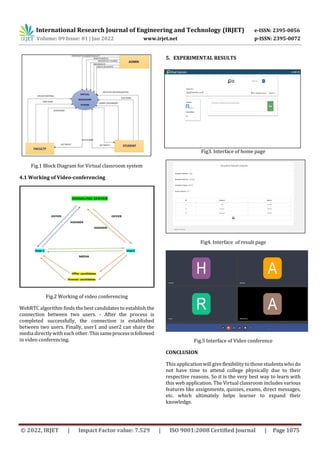
The system is designed in such a way that the admin will
firstly register the student and teacher and make a
password. Secondly,thelogincredentialsandlinktochange
password will get delivered to students’ and teacher’s
respectivemail.Aftersuccessfullychangingofpasswordthe
student and faculty can proceed to use the virtual system.](https://image.slidesharecdn.com/irjet-v9i1190-220912081856-e7f5c9ee/85/VIRTUAL-CLASSROOM-SYSTEM-2-320.jpg)
![International Research Journal of Engineering and Technology (IRJET) e-ISSN: 2395-0056
Volume: 09 Issue: 01 | Jan 2022 www.irjet.net p-ISSN: 2395-0072
© 2022, IRJET | Impact Factor value: 7.529 | ISO 9001:2008 Certified Journal | Page 1076
ACKNOWLEDGEMENT
We wish to thank our parents and friends for their support
and encouragement throughout the progress of the project
work and wewouldalso like to thankourguideProfessorMr.
Ankur Ganorkar for guiding throughout the project work.
REFERENCES
[1] Zinah Tareq Nayyef1 , Sarah Faris Amer1 , Zena Hussain
“Peer to Peer Multimedia Real-Time CommunicationSystem
based on WebRTC Technology”, Department of Computer
science, Dijlah University College, International Journal of
Engineering & Technology, 7 (2.9) (2018) 125-130.
[2] Jasmine Paul and Felicia Jefferson, “A Comparative
Analysis of Student Performance in an Online vs. Face-to-
Face Environmental Science Course From 2009 to 2016
“Department of Biology, Fort Valley State University, Fort
Valley, GA, United States, Front. ComputerSci.,12 November
2019 https://doi.org/10.3389/fcomp.2019.00007.
[3] Chun-Hung Richard Lin, 2Huan Zhang, 3 Jain-Shing
Liu, 4Shi-Huang Chen,” Implementation of Secure Web
Conferencing”, 1, 2Department of Computer Science and
Engineering, National Sun Yat-Sen University, Kaohsiung
80424, Taiwan 3Department of Computer Science and
Information Engineering, Providence University, Taichung,
43301, Taiwan 4Department of Computer Science and
Information Engineering, ShuTe University, Kaohsiung,
82445, Taiwan, 2020 2nd International Conference on
Computer Communication and the Internet.
[4] Libron Kelmendi, “TRADITIONAL LEARNING
VERSUS E-LEARNING”, 2019
[5] Christopher DC. Francisco andMaritesC.Barcelona,
“Effectiveness of an Online Classroom forFlexibleLearning”,
Educator, Department of Education,CityofMalolos,Bulacan,
Philippines, Educator, Barcelona Academy,Marilao,Bulacan,
International Journal ofAcademic MultidisciplinaryResearch
(IJAMR) ISSN: 2643-9670 Vol. 4, Issue 8, August – 2020
Pages: 100-107
[6] Jelena Caiko,Antonspatlins, ArapovNurlan,Vladimir
Protsenko, “Video-conference Communication Platform
Based on WebRTC Online meetings”,1)InstituteofIndustrial
Electronics and Electrical Engineering, FEEE Riga Technical
University Riga, Latvia Jelena.Caiko@rtu.lv 2)AntonsPatlins
Institute of Industrial ElectronicsandElectrical Engineering,
FEEE Riga Technical University Riga, Latvia
Antons.Patlins@rtu.lv
[7] Seth C. Oranburg “Distance EducationintheTimeof
Coronavirus: Quick and Easy Strategies for Professors”,
Assistant Professor of Law, Duquesne University School of
Law Research Paper No. 2020-02
[8] Shivangi Dhawan, “Online Learning: A Panacea in
the Time of COVID-19 Crisis”, Department of Commerce,
SGTB Khalsa College, UniversityofDelhi,Delhi,India,Journal
of Educational Technology Systems 2020, Vol. 49(1) 5–22
,The Author(s) 2020](https://image.slidesharecdn.com/irjet-v9i1190-220912081856-e7f5c9ee/85/VIRTUAL-CLASSROOM-SYSTEM-4-320.jpg)

This document describes a proposed virtual classroom system with the following key features: 1. It would allow students and teachers to attend live lectures and access video recordings for future use. 2. It would enable teachers to easily distribute assignments tailored to each student's skills. 3. The system is intended to create an error-free, secure, and reliable learning environment through features like end-to-end encryption and exam proctoring.


