DESIGN AND IMPLEMENTATION OF VIRTUAL LEARNING USING WEBINAR SYSTEM
SUBMITTED BY:
GROUP 116
NAME
MAT.NO
MOHAMMAD TOYIB OLARENWAJU 2020/138084CS
JAMIU AHMED RUFAI 2020/139471CS
HARUNA UMAR SANDA 2020/136342CS
SUPERVISED BY:
MR. ABDUL MALIK TURAKI
DATE OF SUBMISSION:
20TH JULY, 2022
INTRODUCTION
Virtual e- learning is a system designed to help students gain access and
acquire knowledge in any university of their choice. It can include: Enhance
face –to- face instruction (on campus, in class use of computer and the World
Wide Web (WWW), enhanced distance education (on or off campus)
individuals and group learning with both print and computer-based materials
instruction entirely on- line (individual and group learning) because of this mix
virtual classroom and text based e- learning knowledge is moving towards
every student being an e- learner at last for part of their study, whether
through learning materials, e-mail for contacting teachers/ tutors or any one of
their myriad other e-learning applications.
E-Learning has been established worldwide in response to the shortage of
health educators and the need to switch into TEAL. E-learning has several
advantages, such as encouraging students for self-directed learning and
updating the curricula. The words ‘Webinar’ is a combination of ‘web +
seminar’ which simply means a seminar over the internet. This software is a
combination of technological innovation with intelligence which helps people
to come together and collaborate effectively over the internet.
This helps the sessions to be live and interactive learning experiences. Contrasting
with a webcast, where there the communication flow is one-way[1], this offers a
two-way communication leading to greater efficiency and participation by the
audience. In this system every user has to log on to an internet site and be a part of
the presentation or seminar. Webinars have been primarily used by business
houses in the past but it has recently found way into the area of Education.
Webinars are all set to bring a revolution in the Education sector. Offering global
reach, these offer a mix of audio, video, text and other forms of live interaction.
Online learning results to learning and other supportive resources that are
available through a computer and it includes computer based training, computer
based instruction and technology. The e-learning system use text messages to
deliver information and data. Student or e-learners will be in their computer
receiving lectures as if they are in classroom. This has gone a long way helping e-
learners to acquire degree in the institution they have never seen.
Web-conference, in particular webinar, is one of the tools for acquiring knowledge
and skills by future Humanities specialists in digital learning; it is one of the
technologies of group interaction between all the participants of educational work,
which unites them in a single information environment.
The contemporary educational environment based on distance technologies can be
interpreted as a virtual developed space, which has its structure, properties,
principles of construction, interaction environment, and a system of
interconnections and relationships. Today, three models of organizing the
educational process based on distance technologies are used most widely.
The most obvious advantage of webinars is the high degree of flexibility they
grant to participants.
One of the most common technologies for web conferencing using software is
webinar, a virtual seminar that is conducted via the Internet; it is possible to
communicate with video and audio and to share data with all the participants.
The conducted analysis of scientific works showed that the concept of a webinar
(from the English web + seminar) requires clarification. The existence of different
interpretations of this concept introduced by researchers is explained by the
multidimensional nature of didactic aims that they pursued. In particular, while
W.P. McKinney considers a webinar to be a virtual seminar organized using
Internet technologies (McKinney 2017), R. Polanco-Bueno sees it as a new format
of learning, which allows holding classes in real using modern communication
technologies that ensure the transmission of audio-visual information. Usually, the
teacher holds classes in the lecture mode with the transmission of educational
materials. Feedback from students is excluded from the lecture time and takes
place in the form of chat or voice communication.
BACKGROUNG OF THE STUDY
Internet as global connection of computers sited around the world forming
huge network for information to be shared and disseminated by many millions
of people has done so well in information technology and in education so to
speak. Virtual classroom and text-based e-learning cannot be an exception.
Often time’s students experience a lot of difficult in the quest for basic
knowledge from higher institution of their choice, not for the fact that the
person doesn’t have resources to acquire them but the risk in traveling from the
said institution wherever the person might be pose problems. In order to reduce
these risks, satellite computer were established but did not solve the problem of
traveling out from one’s location to the said location in quest for knowledge.
In this regard, Federal Polytechnic, Bida compete with a of institutions, this
sometimes reduces the number of students enrollment in the school to the
above listed problems the system “virtual classroom and text based e- learning
was designed with this Federal Polytechnic Bida will have thousands of student
in which she doesn’t provide any a accommodation or any structure for and
still gain much grounds economically and student all over the world suffer less
in having any of Federal Polytechnic Bida certificate.
This is designed that before anybody can participate must register. Students
have free registration form but lecturers must provide their staff number that
tally with their surnames before they have access to registration form. One
month is giving to student to pay his/her school fees after registration to
remove his/her name from the database.
SCOPE OF THE STUDY
The project is concerned with the virtual e-learning system files that are
transferable within the net. It should be in form of text file (.txt), rich text files
(.rtf) or hypertext mark-up language file (.htmf).
STATEMENT OF THE PROBLEM
Due to the problems students find and experiences, it has never been easy for
students to acquire basic and necessary education in any institution one wishes
irrespective of the fact that the resources are there. This poses a lot of problems
sometimes they will embrace not going to school at all. It is very impossible for a
student in America or any other country coming to FPB every day for lectures
more so, it will be impossible for FPB staff going to America or any other country
where the students might be located every day to deliver lectures.
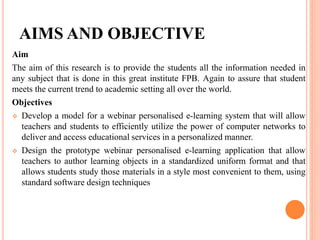
AIMS AND OBJECTIVE
Aim
The aim of this research is to provide the students all the information needed in
any subject that is done in this great institute FPB. Again to assure that student
meets the current trend to academic setting all over the world.
Objectives
 Develop a model for a webinar personalised e-learning system that will allow
teachers and students to efficiently utilize the power of computer networks to
deliver and access educational services in a personalized manner.
 Design the prototype webinar personalised e-learning application that allow
teachers to author learning objects in a standardized uniform format and that
allows students study those materials in a style most convenient to them, using
standard software design techniques
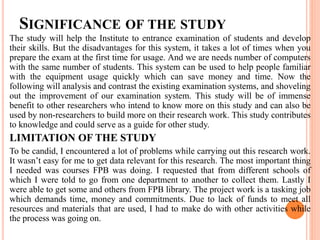
SIGNIFICANCE OF THE STUDY
The study will help the Institute to entrance examination of students and develop
their skills. But the disadvantages for this system, it takes a lot of times when you
prepare the exam at the first time for usage. And we are needs number of computers
with the same number of students. This system can be used to help people familiar
with the equipment usage quickly which can save money and time. Now the
following will analysis and contrast the existing examination systems, and shoveling
out the improvement of our examination system. This study will be of immense
benefit to other researchers who intend to know more on this study and can also be
used by non-researchers to build more on their research work. This study contributes
to knowledge and could serve as a guide for other study.
LIMITATION OF THE STUDY
To be candid, I encountered a lot of problems while carrying out this research work.
It wasn’t easy for me to get data relevant for this research. The most important thing
I needed was courses FPB was doing. I requested that from different schools of
which I were told to go from one department to another to collect them. Lastly I
were able to get some and others from FPB library. The project work is a tasking job
which demands time, money and commitments. Due to lack of funds to meet all
resources and materials that are used, I had to make do with other activities while
the process was going on.
LITERATURE REVIEW
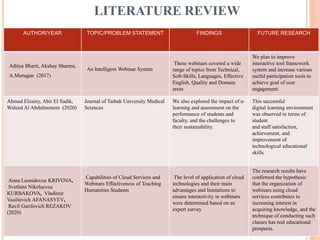
AUTHOR/YEAR TOPIC/PROBLEM STATEMENT FINDINGS FUTURE RESEARCH
Aditya Bharti, Akshay Sharma,
A.Murugan (2017)
An Intelligent Webinar System
These webinars covered a wide
range of topics from Technical,
Soft-Skills, Languages, Effective
English, Quality and Domain
areas
We plan to improve
interactive tool framework
system and increase various
useful participation tools to
achieve goal of user
engagement.
Ahmed Elzainy, Abir El Sadik,
Waleed Al Abdulmonem (2020)
Journal of Taibah University Medical
Sciences
We also explored the impact of e-
learning and assessment on the
performance of students and
faculty, and the challenges to
their sustainability.
This successful
digital learning environment
was observed in terms of
student
and staff satisfaction,
achievement, and
improvement of
technological educational
skills.
Anna Leonidovna KRIVOVA,
Svetlana Nikolaevna
KURBAKOVA, Vladimir
Vasilievich AFANASYEV,
Ravil Garifovich REZAKOV
(2020)
Capabilities of Cloud Services and
Webinars Effectiveness of Teaching
Humanities Students
The level of application of cloud
technologies and their main
advantages and limitations to
ensure interactivity in webinars
were determined based on an
expert survey
The research results have
confirmed the hypothesis
that the organization of
webinars using cloud
services contributes to
increasing interest in
acquiring knowledge, and the
technique of conducting such
classes has real educational
prospects.
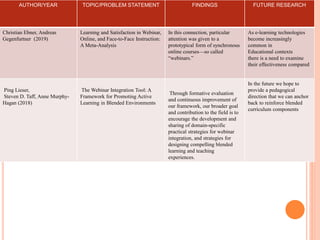
AUTHOR/YEAR TOPIC/PROBLEM STATEMENT FINDINGS FUTURE RESEARCH
Christian Ebner, Andreas
Gegenfurtner (2019)
Learning and Satisfaction in Webinar,
Online, and Face-to-Face Instruction:
A Meta-Analysis
In this connection, particular
attention was given to a
prototypical form of synchronous
online courses—so called
“webinars.”
As e-learning technologies
become increasingly
common in
Educational contexts
there is a need to examine
their effectiveness compared
Ping Lieser,
Steven D. Taff, Anne Murphy-
Hagan (2018)
The Webinar Integration Tool: A
Framework for Promoting Active
Learning in Blended Environments
Through formative evaluation
and continuous improvement of
our framework, our broader goal
and contribution to the field is to
encourage the development and
sharing of domain-specific
practical strategies for webinar
integration, and strategies for
designing compelling blended
learning and teaching
experiences.
In the future we hope to
provide a pedagogical
direction that we can anchor
back to reinforce blended
curriculum components

GROUP 116 PROJECT SLIDE.pptx

  • 1.
    DESIGN AND IMPLEMENTATIONOF VIRTUAL LEARNING USING WEBINAR SYSTEM SUBMITTED BY: GROUP 116 NAME MAT.NO MOHAMMAD TOYIB OLARENWAJU 2020/138084CS JAMIU AHMED RUFAI 2020/139471CS HARUNA UMAR SANDA 2020/136342CS SUPERVISED BY: MR. ABDUL MALIK TURAKI DATE OF SUBMISSION: 20TH JULY, 2022
  • 2.
    INTRODUCTION Virtual e- learningis a system designed to help students gain access and acquire knowledge in any university of their choice. It can include: Enhance face –to- face instruction (on campus, in class use of computer and the World Wide Web (WWW), enhanced distance education (on or off campus) individuals and group learning with both print and computer-based materials instruction entirely on- line (individual and group learning) because of this mix virtual classroom and text based e- learning knowledge is moving towards every student being an e- learner at last for part of their study, whether through learning materials, e-mail for contacting teachers/ tutors or any one of their myriad other e-learning applications. E-Learning has been established worldwide in response to the shortage of health educators and the need to switch into TEAL. E-learning has several advantages, such as encouraging students for self-directed learning and updating the curricula. The words ‘Webinar’ is a combination of ‘web + seminar’ which simply means a seminar over the internet. This software is a combination of technological innovation with intelligence which helps people to come together and collaborate effectively over the internet.
  • 3.
    This helps thesessions to be live and interactive learning experiences. Contrasting with a webcast, where there the communication flow is one-way[1], this offers a two-way communication leading to greater efficiency and participation by the audience. In this system every user has to log on to an internet site and be a part of the presentation or seminar. Webinars have been primarily used by business houses in the past but it has recently found way into the area of Education. Webinars are all set to bring a revolution in the Education sector. Offering global reach, these offer a mix of audio, video, text and other forms of live interaction. Online learning results to learning and other supportive resources that are available through a computer and it includes computer based training, computer based instruction and technology. The e-learning system use text messages to deliver information and data. Student or e-learners will be in their computer receiving lectures as if they are in classroom. This has gone a long way helping e- learners to acquire degree in the institution they have never seen. Web-conference, in particular webinar, is one of the tools for acquiring knowledge and skills by future Humanities specialists in digital learning; it is one of the technologies of group interaction between all the participants of educational work, which unites them in a single information environment. The contemporary educational environment based on distance technologies can be interpreted as a virtual developed space, which has its structure, properties, principles of construction, interaction environment, and a system of interconnections and relationships. Today, three models of organizing the educational process based on distance technologies are used most widely. The most obvious advantage of webinars is the high degree of flexibility they grant to participants.
  • 4.
    One of themost common technologies for web conferencing using software is webinar, a virtual seminar that is conducted via the Internet; it is possible to communicate with video and audio and to share data with all the participants. The conducted analysis of scientific works showed that the concept of a webinar (from the English web + seminar) requires clarification. The existence of different interpretations of this concept introduced by researchers is explained by the multidimensional nature of didactic aims that they pursued. In particular, while W.P. McKinney considers a webinar to be a virtual seminar organized using Internet technologies (McKinney 2017), R. Polanco-Bueno sees it as a new format of learning, which allows holding classes in real using modern communication technologies that ensure the transmission of audio-visual information. Usually, the teacher holds classes in the lecture mode with the transmission of educational materials. Feedback from students is excluded from the lecture time and takes place in the form of chat or voice communication.
  • 5.
    BACKGROUNG OF THESTUDY Internet as global connection of computers sited around the world forming huge network for information to be shared and disseminated by many millions of people has done so well in information technology and in education so to speak. Virtual classroom and text-based e-learning cannot be an exception. Often time’s students experience a lot of difficult in the quest for basic knowledge from higher institution of their choice, not for the fact that the person doesn’t have resources to acquire them but the risk in traveling from the said institution wherever the person might be pose problems. In order to reduce these risks, satellite computer were established but did not solve the problem of traveling out from one’s location to the said location in quest for knowledge. In this regard, Federal Polytechnic, Bida compete with a of institutions, this sometimes reduces the number of students enrollment in the school to the above listed problems the system “virtual classroom and text based e- learning was designed with this Federal Polytechnic Bida will have thousands of student in which she doesn’t provide any a accommodation or any structure for and still gain much grounds economically and student all over the world suffer less in having any of Federal Polytechnic Bida certificate. This is designed that before anybody can participate must register. Students have free registration form but lecturers must provide their staff number that tally with their surnames before they have access to registration form. One month is giving to student to pay his/her school fees after registration to remove his/her name from the database.
  • 6.
    SCOPE OF THESTUDY The project is concerned with the virtual e-learning system files that are transferable within the net. It should be in form of text file (.txt), rich text files (.rtf) or hypertext mark-up language file (.htmf). STATEMENT OF THE PROBLEM Due to the problems students find and experiences, it has never been easy for students to acquire basic and necessary education in any institution one wishes irrespective of the fact that the resources are there. This poses a lot of problems sometimes they will embrace not going to school at all. It is very impossible for a student in America or any other country coming to FPB every day for lectures more so, it will be impossible for FPB staff going to America or any other country where the students might be located every day to deliver lectures.
  • 7.
    AIMS AND OBJECTIVE Aim Theaim of this research is to provide the students all the information needed in any subject that is done in this great institute FPB. Again to assure that student meets the current trend to academic setting all over the world. Objectives  Develop a model for a webinar personalised e-learning system that will allow teachers and students to efficiently utilize the power of computer networks to deliver and access educational services in a personalized manner.  Design the prototype webinar personalised e-learning application that allow teachers to author learning objects in a standardized uniform format and that allows students study those materials in a style most convenient to them, using standard software design techniques
  • 8.
    SIGNIFICANCE OF THESTUDY The study will help the Institute to entrance examination of students and develop their skills. But the disadvantages for this system, it takes a lot of times when you prepare the exam at the first time for usage. And we are needs number of computers with the same number of students. This system can be used to help people familiar with the equipment usage quickly which can save money and time. Now the following will analysis and contrast the existing examination systems, and shoveling out the improvement of our examination system. This study will be of immense benefit to other researchers who intend to know more on this study and can also be used by non-researchers to build more on their research work. This study contributes to knowledge and could serve as a guide for other study. LIMITATION OF THE STUDY To be candid, I encountered a lot of problems while carrying out this research work. It wasn’t easy for me to get data relevant for this research. The most important thing I needed was courses FPB was doing. I requested that from different schools of which I were told to go from one department to another to collect them. Lastly I were able to get some and others from FPB library. The project work is a tasking job which demands time, money and commitments. Due to lack of funds to meet all resources and materials that are used, I had to make do with other activities while the process was going on.
  • 9.
    LITERATURE REVIEW AUTHOR/YEAR TOPIC/PROBLEMSTATEMENT FINDINGS FUTURE RESEARCH Aditya Bharti, Akshay Sharma, A.Murugan (2017) An Intelligent Webinar System These webinars covered a wide range of topics from Technical, Soft-Skills, Languages, Effective English, Quality and Domain areas We plan to improve interactive tool framework system and increase various useful participation tools to achieve goal of user engagement. Ahmed Elzainy, Abir El Sadik, Waleed Al Abdulmonem (2020) Journal of Taibah University Medical Sciences We also explored the impact of e- learning and assessment on the performance of students and faculty, and the challenges to their sustainability. This successful digital learning environment was observed in terms of student and staff satisfaction, achievement, and improvement of technological educational skills. Anna Leonidovna KRIVOVA, Svetlana Nikolaevna KURBAKOVA, Vladimir Vasilievich AFANASYEV, Ravil Garifovich REZAKOV (2020) Capabilities of Cloud Services and Webinars Effectiveness of Teaching Humanities Students The level of application of cloud technologies and their main advantages and limitations to ensure interactivity in webinars were determined based on an expert survey The research results have confirmed the hypothesis that the organization of webinars using cloud services contributes to increasing interest in acquiring knowledge, and the technique of conducting such classes has real educational prospects.
  • 10.
    AUTHOR/YEAR TOPIC/PROBLEM STATEMENTFINDINGS FUTURE RESEARCH Christian Ebner, Andreas Gegenfurtner (2019) Learning and Satisfaction in Webinar, Online, and Face-to-Face Instruction: A Meta-Analysis In this connection, particular attention was given to a prototypical form of synchronous online courses—so called “webinars.” As e-learning technologies become increasingly common in Educational contexts there is a need to examine their effectiveness compared Ping Lieser, Steven D. Taff, Anne Murphy- Hagan (2018) The Webinar Integration Tool: A Framework for Promoting Active Learning in Blended Environments Through formative evaluation and continuous improvement of our framework, our broader goal and contribution to the field is to encourage the development and sharing of domain-specific practical strategies for webinar integration, and strategies for designing compelling blended learning and teaching experiences. In the future we hope to provide a pedagogical direction that we can anchor back to reinforce blended curriculum components