Achieving the MDGs and beyond:  the importance of national ownership and capacities Viroj Tangcharoensathien International Health Policy Program,  Ministry of Public Health, Thailand
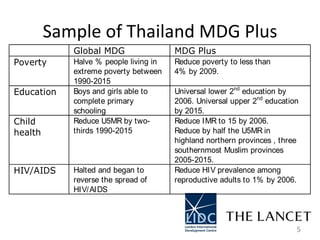
Thailand MDG achievement  Early 2000s, almost all MDG targets were achieved  In 2004 MDG review, engaging multi-stakeholders, a concept of MDG Plus was introduced,  Move beyond--making global MDG target as “point of departure” instead of “end point”;  Plans, strategies and targets of line ministries form national MDG Plus targets, and approved by Cabinet  Bottom up and engagement creates ownership and commitments  Equity concerns  Beyond national average: ensure equitable achievement, focusing  poorer geographical areas, Muslim communities
Why health MDG were achieved? Sustainable health-system development.  Wide geographical coverage of functioning primary health care Heavy investment in health delivery infrastructure  Production and deployment of health workforce  Improve financial risk protection, ensuring better access to care  Synergistic contributions from other sectors  Universal education move from 1 ry  to 2 nd  free education  High level of female literacy rate and decreasing gender gap, Poverty reduction and improved living standards  Better access to information and social services: transportation and communications
Why sustainable HSD? Political and financial commitments to health  Policy formulation influenced by pro-poor, pro-rural and universality ideologies  Continuity of policies by successive governments  Rapid economic growth though slow progress in Gini  Improved institutional capacities  Generating evidence to guide upstream decision, downstream implementation and reprogramming,  Effective interface between evidence and policy decisions  Implementation capacities  Pragmatism, pilot and scale up of innovations  Street level bureaucrats’ capacity and effectiveness in translating health policy to implementation, M&E
Sample of Thailand MDG Plus
Why MDG Plus agenda?  Sub-national evidences  Political concerns: equity, national security  Infrastructure favourable to move beyond global MDG  Economic, health, education, agriculture  Intersectoral engagement and actions
What’s beyond 2015?  Sustaining MDG Plus achievements  Maintain  multisectoral actions of human development  Embracing holistic, equity, national ownership, community participation, financial and programmatic sustainability  Emerging national agenda Chronic non-communicable diseases: a national agenda  Social determinant of ill health  International trade and impact on health

Viroj tangcharoensathien

  • 1.
    Achieving the MDGsand beyond: the importance of national ownership and capacities Viroj Tangcharoensathien International Health Policy Program, Ministry of Public Health, Thailand
  • 2.
    Thailand MDG achievement Early 2000s, almost all MDG targets were achieved In 2004 MDG review, engaging multi-stakeholders, a concept of MDG Plus was introduced, Move beyond--making global MDG target as “point of departure” instead of “end point”; Plans, strategies and targets of line ministries form national MDG Plus targets, and approved by Cabinet Bottom up and engagement creates ownership and commitments Equity concerns Beyond national average: ensure equitable achievement, focusing poorer geographical areas, Muslim communities
  • 3.
    Why health MDGwere achieved? Sustainable health-system development. Wide geographical coverage of functioning primary health care Heavy investment in health delivery infrastructure Production and deployment of health workforce Improve financial risk protection, ensuring better access to care Synergistic contributions from other sectors Universal education move from 1 ry to 2 nd free education High level of female literacy rate and decreasing gender gap, Poverty reduction and improved living standards Better access to information and social services: transportation and communications
  • 4.
    Why sustainable HSD?Political and financial commitments to health Policy formulation influenced by pro-poor, pro-rural and universality ideologies Continuity of policies by successive governments Rapid economic growth though slow progress in Gini Improved institutional capacities Generating evidence to guide upstream decision, downstream implementation and reprogramming, Effective interface between evidence and policy decisions Implementation capacities Pragmatism, pilot and scale up of innovations Street level bureaucrats’ capacity and effectiveness in translating health policy to implementation, M&E
  • 5.
  • 6.
    Why MDG Plusagenda? Sub-national evidences Political concerns: equity, national security Infrastructure favourable to move beyond global MDG Economic, health, education, agriculture Intersectoral engagement and actions
  • 7.
    What’s beyond 2015? Sustaining MDG Plus achievements Maintain multisectoral actions of human development Embracing holistic, equity, national ownership, community participation, financial and programmatic sustainability Emerging national agenda Chronic non-communicable diseases: a national agenda Social determinant of ill health International trade and impact on health