Virgin Group
LÂM YẾN ĐÌNH
NGUYỄN THỊ THU HÀ
NGÔ THỊ HỒNG HẠNH
PHẠM BÁ TRUNG
NGUYỄN VIỆT KHUÊ
Content
1. Background information, historical information of the company
2. Company mission, vision
3. Business Model and Business strategies
4. SWOT analysis
5. Problems the company face
6. Solutions
7. Lessons
INTRODUCTION
 Virgin’s one of the largest private company in the
UK, annual sales of about 5 billion pounds
 Founder: Richard Branson
 The largest enterprises Virgin Atlantic -
international airline
INTRODUCTION
 In 2002, 200+ company, approximately 50,000
employees in 29 countries dominate many sectors:
financial services, aviation, railways, multimedia,
retail sales outlets ....
 The image and his personal imprint is most
evident and become as a model in 1997 for a
campaign advertising Apple computers: "THINK
DIFFERENCE" + export appointments in one
film American comedy "FRIENDS"
Historical
HISTORICAL INFORMATION
MISSION, VISION
Mission Statement
 The company’s vision is to be the shopper victor, by delivering
brand values, which are: value for currency, superior quality,
dazzling customer service, pioneering, competitively testing and
fun.; to provide a quality service by motivating employees and to
assist and examine consumer feedback for nonstop enhancement
of the customer's experience through improvement; to create
products and services that make the customer’s life more
enjoyable (Virgin Group, 2012).
MISSION, VISION
Vision Statement
 Virgin vision can be defined by words of Richard Branson
(1997). “We are planning a global presence in travel, mobile
communications, entertainment retailing and music. We are in
exciting markets which are set to benefit considerably from
technological developments in distribution and fulfillment. I
believe that Virgin has the opportunity to be in the top 20 of
global brands.
BUSINESS MODEL & STRATEGIES
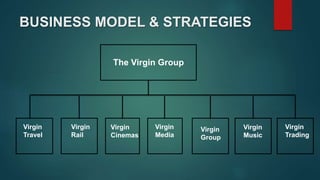
The Virgin Group
Virgin
Travel
Virgin
Rail
Virgin
Cinemas
Virgin
Media
Virgin
Group
Virgin
Music
Virgin
Trading
BUSINESS MODEL & STRATEGIES
 ‘A branded venture capital house'
 A structure of loosely linked autonomous units run by self-
managed teams that use a common brand name
 There was little sense of management hierarchy and a
minimum of corporate bureaucracy
 Each business or group of businesses ran its own affairs but
they were tied together through a degree of shared ownership
and shared values.
BUSINESS MODEL & STRATEGIES
 “The brand is the single most important asset that we have; our
ultimate objective is to establish it as a major global name. That
means that we need to have a number of core businesses with
global potential”
 Before entering a new market, it was thoroughly researched to
decide whether Virgin could offer something truly different
BUSINESS MODEL & STRATEGIES
The management style:
 Decentralized decision making
 Emphasis on autonomous business level decision making and
responsibility for their own development.
 With businesses scattered across a wide range of industries
and markets, the approach was largely hands-off.
 Within the business units, Branson adopted his own personal
style of management.
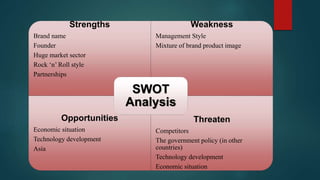
Strengths
Brand name
Founder
Huge market sector
Rock ‘n’ Roll style
Partnerships
Weakness
Management Style
Mixture of brand product image
Opportunities
Economic situation
Technology development
Asia
Threaten
Competitors
The government policy (in other
countries)
Technology development
Economic situation
SWOT
Analysis
Problem
 2003, in Virgin Express profit, these had
slumped in the third quarter.
 2000 Branson folded his loss making UK
clothing line.
 Virgin Trains, Cross Country and West Coast
lines were ranked 23rd and 24th out of 25
train operating franchises.
 At the end of 2000 Virgin Rail failed to win
the East Coast main line franchise.
Problem
 12/ 2003, there was a public offering of
shares in low-cost Virgin Blue.
 January 2004 also saw rumors that Branson
would float Virgin Mobile.
=> Rumors that it signified a cash crisis for
Virgin
Solution
 A £2.2bn investment on a fleet of 75 new
high-speed trains was aimed.
 By 2002 Virgin Rail was reporting profits.
Solution
Sold off
 UK and Irish cinema houses
 Virgin Music
 49 per cent stake in Virgin Atlantic
 Virgin Sun, a short-haul package holiday
business
Solution
‘Every year I suspect we'll sell five businesses
in a given country, but we'll replace five. We
don’t buy companies, we start them from
scratch. The way we manage to grow
companies is by selling those we have built and
established am the years.’ - Branson
Lesson
 Business Model
 Business Strategies
 Management Style
Thank For Listening

Virgin analysis

  • 1.
    Virgin Group LÂM YẾNĐÌNH NGUYỄN THỊ THU HÀ NGÔ THỊ HỒNG HẠNH PHẠM BÁ TRUNG NGUYỄN VIỆT KHUÊ
  • 2.
    Content 1. Background information,historical information of the company 2. Company mission, vision 3. Business Model and Business strategies 4. SWOT analysis 5. Problems the company face 6. Solutions 7. Lessons
  • 3.
    INTRODUCTION  Virgin’s oneof the largest private company in the UK, annual sales of about 5 billion pounds  Founder: Richard Branson  The largest enterprises Virgin Atlantic - international airline
  • 4.
    INTRODUCTION  In 2002,200+ company, approximately 50,000 employees in 29 countries dominate many sectors: financial services, aviation, railways, multimedia, retail sales outlets ....  The image and his personal imprint is most evident and become as a model in 1997 for a campaign advertising Apple computers: "THINK DIFFERENCE" + export appointments in one film American comedy "FRIENDS"
  • 5.
  • 6.
  • 7.
    MISSION, VISION Mission Statement The company’s vision is to be the shopper victor, by delivering brand values, which are: value for currency, superior quality, dazzling customer service, pioneering, competitively testing and fun.; to provide a quality service by motivating employees and to assist and examine consumer feedback for nonstop enhancement of the customer's experience through improvement; to create products and services that make the customer’s life more enjoyable (Virgin Group, 2012).
  • 8.
    MISSION, VISION Vision Statement Virgin vision can be defined by words of Richard Branson (1997). “We are planning a global presence in travel, mobile communications, entertainment retailing and music. We are in exciting markets which are set to benefit considerably from technological developments in distribution and fulfillment. I believe that Virgin has the opportunity to be in the top 20 of global brands.
  • 9.
    BUSINESS MODEL &STRATEGIES The Virgin Group Virgin Travel Virgin Rail Virgin Cinemas Virgin Media Virgin Group Virgin Music Virgin Trading
  • 10.
    BUSINESS MODEL &STRATEGIES  ‘A branded venture capital house'  A structure of loosely linked autonomous units run by self- managed teams that use a common brand name  There was little sense of management hierarchy and a minimum of corporate bureaucracy  Each business or group of businesses ran its own affairs but they were tied together through a degree of shared ownership and shared values.
  • 11.
    BUSINESS MODEL &STRATEGIES  “The brand is the single most important asset that we have; our ultimate objective is to establish it as a major global name. That means that we need to have a number of core businesses with global potential”  Before entering a new market, it was thoroughly researched to decide whether Virgin could offer something truly different
  • 12.
    BUSINESS MODEL &STRATEGIES The management style:  Decentralized decision making  Emphasis on autonomous business level decision making and responsibility for their own development.  With businesses scattered across a wide range of industries and markets, the approach was largely hands-off.  Within the business units, Branson adopted his own personal style of management.
  • 13.
    Strengths Brand name Founder Huge marketsector Rock ‘n’ Roll style Partnerships Weakness Management Style Mixture of brand product image Opportunities Economic situation Technology development Asia Threaten Competitors The government policy (in other countries) Technology development Economic situation SWOT Analysis
  • 14.
    Problem  2003, inVirgin Express profit, these had slumped in the third quarter.  2000 Branson folded his loss making UK clothing line.  Virgin Trains, Cross Country and West Coast lines were ranked 23rd and 24th out of 25 train operating franchises.  At the end of 2000 Virgin Rail failed to win the East Coast main line franchise.
  • 15.
    Problem  12/ 2003,there was a public offering of shares in low-cost Virgin Blue.  January 2004 also saw rumors that Branson would float Virgin Mobile. => Rumors that it signified a cash crisis for Virgin
  • 16.
    Solution  A £2.2bninvestment on a fleet of 75 new high-speed trains was aimed.  By 2002 Virgin Rail was reporting profits.
  • 17.
    Solution Sold off  UKand Irish cinema houses  Virgin Music  49 per cent stake in Virgin Atlantic  Virgin Sun, a short-haul package holiday business
  • 18.
    Solution ‘Every year Isuspect we'll sell five businesses in a given country, but we'll replace five. We don’t buy companies, we start them from scratch. The way we manage to grow companies is by selling those we have built and established am the years.’ - Branson
  • 19.
    Lesson  Business Model Business Strategies  Management Style
  • 20.