Malaria
By Mulugeta A.(MD,INTERNIST)
“Humanity has but three great enemies: Fever, famine, and
war; of these by far the greatest, by far the most terrible, is
fever.”
—William Osler, 1896
• learning objectives
• understand the burden of the disease
• know the pathogenesis and clinical featuers
• able to identify the severity featuers
• able to approach a febrile patient
• Outlines
• Introduction
• Epidimplogy
• Etiology
• Pathogenesis and life cycle
• Clinical manifsations and lab findings
• DDx
• Overview on management
• Prevention
Introduction
• Malaria
• is a protozoan disease transmitted by the bite of infected female Anopheles
mosquitoes.
• characterized by paroxysms of fever, chills, sweats, fatigue, anemia, and
splenomegaly
• The most important of the parasitic diseases of humans
• preventable and treatable
• malaria is transmitted in 91 countries containing 3 billion people and causes
~1200 deaths each day.
• Mortality rates have decreased dramatically over the past 15 yrs
cont..
• Malaria was eliminated from the United States, Canada, Europe, and
Russia >50 years ago
• but ts prevalence rose in many parts of the tropics
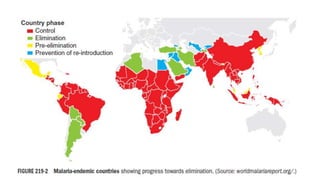
• An increasing number of countries are now targeting malaria
elimination
• threatened by increasing resistance to antimalarial drugs and insecticides
• remains a heavy burden on tropical communities, a threat to
nonendemic countries, and a danger to travelers
Epidemology
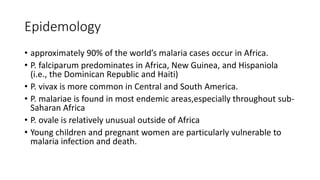
• approximately 90% of the world’s malaria cases occur in Africa.
• P. falciparum predominates in Africa, New Guinea, and Hispaniola
(i.e., the Dominican Republic and Haiti)
• P. vivax is more common in Central and South America.
• P. malariae is found in most endemic areas,especially throughout sub-
Saharan Africa
• P. ovale is relatively unusual outside of Africa
• Young children and pregnant women are particularly vulnerable to
malaria infection and death.
epid...
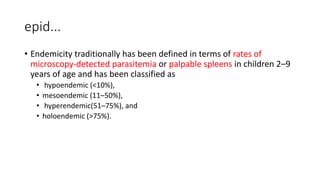
• Endemicity traditionally has been defined in terms of rates of
microscopy-detected parasitemia or palpable spleens in children 2–9
years of age and has been classified as
• hypoendemic (<10%),
• mesoendemic (11–50%),
• hyperendemic(51–75%), and
• holoendemic (>75%).
Etiology and Pathogenesis
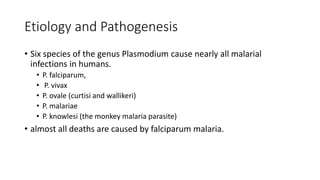
• Six species of the genus Plasmodium cause nearly all malarial
infections in humans.
• P. falciparum,
• P. vivax
• P. ovale (curtisi and wallikeri)
• P. malariae
• P. knowlesi (the monkey malaria parasite)
• almost all deaths are caused by falciparum malaria.
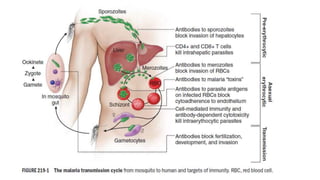
• Human infection begins when a female anopheline mosquito
inoculates plasmodial sporozoites from its salivary glands during a
blood meal
• carried rapidly via the bloodstream to the liver
• invade hepatic parenchymal cells and begin a period of asexual
reproduction.
• amplification process (known as intrahepatic or preerythrocytic
schizogony)
• a single sporozoite may produce from 10,000 to >30,000 daughter
merozoites
• The swollen infected liver cells eventually burst,discharging motile
merozoites into the bloodstream
• merozoites then invade red blood cells (RBCs) to become trophozoites
and multiply six- to twentyfold every 48 h
• In P. vivax and P. ovale infections, a proportion of the intrahepatic
forms do not divide immediately but remain inert for a period ranging
from 2 weeks to ≥1 year.
• Attachment of merozoites to erythrocytes is mediated
• several specific erythrocyte surface receptors.
• erythrocyte binding antigen 175 and glycophorin A.
• merozoite reticulocyte-binding protein homologue 5 (PfRh5) plays a critical
role binding to red cell basigin (CD147, EMMPRIN).
• The Duffy blood-group antigen Fya or Fyb plays an important role in invasion.
• Most West Africans and peoplewith origins in that region carry the Duffy-negative FyFy
phenotype
• P. knowlesi also invades Duffy-positive human RBCs preferentially.
• Multiple nuclear divisions have taken place (schizogony or merogony)
• The infected RBC then ruptures to release 6–30 daughter merozoites
• disease in human beings is caused by the direct effects of the asexual
parasite—RBC invasion and destruction—and by the host’s reaction.
• Some of the blood-stage parasites develop into morphologically
distinct, longer-lived sexual forms (gametocytes) that can transmit
malaria.
• After being ingested in the blood meal of a biting female anopheline
mosquito, the male and female gametocytes fuse to form a zygote in
the insect’s midgut.
This zygote matures into an ookinete, which penetrates and encysts in
the mosquito’s gut wall
Contd.
• Monitoring:
• Parasitemia +Hct every 6-12 hrs
• Exchange transfusion
• parasite density>10%
• patient has altered mental status
• non–volume overload pulmonary edema
• If Hct <20% transfussion
• Blood glucose every 4-6 hours
• RFT daily
19
Malaria ppt c-1.pptx

Malaria ppt c-1.pptx

  • 1.
  • 2.
    “Humanity has butthree great enemies: Fever, famine, and war; of these by far the greatest, by far the most terrible, is fever.” —William Osler, 1896
  • 3.
    • learning objectives •understand the burden of the disease • know the pathogenesis and clinical featuers • able to identify the severity featuers • able to approach a febrile patient
  • 4.
    • Outlines • Introduction •Epidimplogy • Etiology • Pathogenesis and life cycle • Clinical manifsations and lab findings • DDx • Overview on management • Prevention
  • 5.
    Introduction • Malaria • isa protozoan disease transmitted by the bite of infected female Anopheles mosquitoes. • characterized by paroxysms of fever, chills, sweats, fatigue, anemia, and splenomegaly • The most important of the parasitic diseases of humans • preventable and treatable • malaria is transmitted in 91 countries containing 3 billion people and causes ~1200 deaths each day. • Mortality rates have decreased dramatically over the past 15 yrs
  • 6.
    cont.. • Malaria waseliminated from the United States, Canada, Europe, and Russia >50 years ago • but ts prevalence rose in many parts of the tropics • An increasing number of countries are now targeting malaria elimination • threatened by increasing resistance to antimalarial drugs and insecticides • remains a heavy burden on tropical communities, a threat to nonendemic countries, and a danger to travelers
  • 8.
    Epidemology • approximately 90%of the world’s malaria cases occur in Africa. • P. falciparum predominates in Africa, New Guinea, and Hispaniola (i.e., the Dominican Republic and Haiti) • P. vivax is more common in Central and South America. • P. malariae is found in most endemic areas,especially throughout sub- Saharan Africa • P. ovale is relatively unusual outside of Africa • Young children and pregnant women are particularly vulnerable to malaria infection and death.
  • 9.
    epid... • Endemicity traditionallyhas been defined in terms of rates of microscopy-detected parasitemia or palpable spleens in children 2–9 years of age and has been classified as • hypoendemic (<10%), • mesoendemic (11–50%), • hyperendemic(51–75%), and • holoendemic (>75%).
  • 11.
    Etiology and Pathogenesis •Six species of the genus Plasmodium cause nearly all malarial infections in humans. • P. falciparum, • P. vivax • P. ovale (curtisi and wallikeri) • P. malariae • P. knowlesi (the monkey malaria parasite) • almost all deaths are caused by falciparum malaria.
  • 12.
    • Human infectionbegins when a female anopheline mosquito inoculates plasmodial sporozoites from its salivary glands during a blood meal • carried rapidly via the bloodstream to the liver • invade hepatic parenchymal cells and begin a period of asexual reproduction. • amplification process (known as intrahepatic or preerythrocytic schizogony)
  • 13.
    • a singlesporozoite may produce from 10,000 to >30,000 daughter merozoites • The swollen infected liver cells eventually burst,discharging motile merozoites into the bloodstream • merozoites then invade red blood cells (RBCs) to become trophozoites and multiply six- to twentyfold every 48 h • In P. vivax and P. ovale infections, a proportion of the intrahepatic forms do not divide immediately but remain inert for a period ranging from 2 weeks to ≥1 year.
  • 14.
    • Attachment ofmerozoites to erythrocytes is mediated • several specific erythrocyte surface receptors. • erythrocyte binding antigen 175 and glycophorin A. • merozoite reticulocyte-binding protein homologue 5 (PfRh5) plays a critical role binding to red cell basigin (CD147, EMMPRIN). • The Duffy blood-group antigen Fya or Fyb plays an important role in invasion. • Most West Africans and peoplewith origins in that region carry the Duffy-negative FyFy phenotype • P. knowlesi also invades Duffy-positive human RBCs preferentially.
  • 15.
    • Multiple nucleardivisions have taken place (schizogony or merogony) • The infected RBC then ruptures to release 6–30 daughter merozoites • disease in human beings is caused by the direct effects of the asexual parasite—RBC invasion and destruction—and by the host’s reaction. • Some of the blood-stage parasites develop into morphologically distinct, longer-lived sexual forms (gametocytes) that can transmit malaria.
  • 16.
    • After beingingested in the blood meal of a biting female anopheline mosquito, the male and female gametocytes fuse to form a zygote in the insect’s midgut. This zygote matures into an ookinete, which penetrates and encysts in the mosquito’s gut wall
  • 19.
    Contd. • Monitoring: • Parasitemia+Hct every 6-12 hrs • Exchange transfusion • parasite density>10% • patient has altered mental status • non–volume overload pulmonary edema • If Hct <20% transfussion • Blood glucose every 4-6 hours • RFT daily 19