VIRAL HEPATITIS
INTRODUCTION
1. Viral hepatitis refers to a group of infectious
diseases that affect the liver, causing
inflammation and potentially leading to various
liver-related health issues. These infections are
primarily caused by several different viruses,
each categorized by a specific letter (A, B, C, D,
and E), with each type having unique
characteristics and modes of transmission.
DEFINITION
Viral hepatitis is an infection that
causes liver inflammation and damage.
TYPES
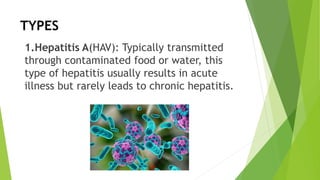
1.Hepatitis A(HAV): Typically transmitted
through contaminated food or water, this
type of hepatitis usually results in acute
illness but rarely leads to chronic hepatitis.
 2.Hepatitis B (HBV): Transmitted through
contact with infected blood, sexual
contact, or from mother to child during
childbirth.
 3.Hepatitis C (HCV): Mainly spread through
contact with infected blood, often through
sharing needles or other drug paraphernalia
 4.Hepatitis D (HDV): A rare form that only
affects individuals with Hepatitis B and is
transmitted through contact with infected
blood or other body fluids.
 3.Hepatitis E (HEV): Often spread through
contaminated water, especially in areas
with poor sanitation.
EPIDERMOLOGICAL FACTORS
AGENT
 ) RESERVOIR OF INFECTION: The human cases are the only reservoir of
infection.
 ) PERIOD OF INFECTIVITY: The risk of transmitting HAV is greatest from
2 weeks before to 1 week after the onset of jaundice.
 ) INFECTIVE MATERIAL: Mainly man’s faeces.
 ) VIRUS EXCRETION: HAV is excreted in the faeces for about 2 weeks
before onset of jaundice and for up to 2 weeks thereafter.
 > Host factors

 a) AGE: Infection with HAV is more frequent among
children than in adults. However, people from all ages
may be infected if susceptible.
 B) SEX: Both sexes are equally susceptible.
 C) IMMUNITY: Immunity after attack probably lasts for
life.

ENVIRONMENTAL FACTORS
occur throughout the year.
■ In India the disease tends to be associated with
periods of heavy rainfall.
INCUBATION PERIOD
10-50 days (usually 25 to 30 days).
MODE OF TRANSMISSION
A) FAECAL-ORAL ROUTE: Major route of
transmission. –By contaminated water, food or milk.
B) PARENTERAL ROUTE (Rarely):
-By blood and blood products or by skin penetration
through contaminated needles.
C) SEXUAL TRANSMISSION:
-May occur mainly among homosexual men because
of oral-anal contact.
PATHOPHYSIOLOGY
DIAGNOSIS
1. Demonstration of Virus in feces, blood, bile: By:
Immunoelectron microscopy
2. Virus Isolation:
3. Detection of Antibody :By ELISA
4. Biochemical tests:
i) Alanine aminotransferase (ALT)
ii) Bilirubin
iii) Protein
5. Molecular Diagnosis: RT PCR of feces

Presentation.pptx

  • 1.
  • 2.
    INTRODUCTION 1. Viral hepatitisrefers to a group of infectious diseases that affect the liver, causing inflammation and potentially leading to various liver-related health issues. These infections are primarily caused by several different viruses, each categorized by a specific letter (A, B, C, D, and E), with each type having unique characteristics and modes of transmission.
  • 3.
    DEFINITION Viral hepatitis isan infection that causes liver inflammation and damage.
  • 4.
    TYPES 1.Hepatitis A(HAV): Typicallytransmitted through contaminated food or water, this type of hepatitis usually results in acute illness but rarely leads to chronic hepatitis.
  • 5.
     2.Hepatitis B(HBV): Transmitted through contact with infected blood, sexual contact, or from mother to child during childbirth.
  • 6.
     3.Hepatitis C(HCV): Mainly spread through contact with infected blood, often through sharing needles or other drug paraphernalia
  • 7.
     4.Hepatitis D(HDV): A rare form that only affects individuals with Hepatitis B and is transmitted through contact with infected blood or other body fluids.
  • 8.
     3.Hepatitis E(HEV): Often spread through contaminated water, especially in areas with poor sanitation.
  • 9.
  • 10.
    AGENT  ) RESERVOIROF INFECTION: The human cases are the only reservoir of infection.  ) PERIOD OF INFECTIVITY: The risk of transmitting HAV is greatest from 2 weeks before to 1 week after the onset of jaundice.  ) INFECTIVE MATERIAL: Mainly man’s faeces.  ) VIRUS EXCRETION: HAV is excreted in the faeces for about 2 weeks before onset of jaundice and for up to 2 weeks thereafter.
  • 11.
     > Hostfactors   a) AGE: Infection with HAV is more frequent among children than in adults. However, people from all ages may be infected if susceptible.  B) SEX: Both sexes are equally susceptible.  C) IMMUNITY: Immunity after attack probably lasts for life. 
  • 12.
    ENVIRONMENTAL FACTORS occur throughoutthe year. ■ In India the disease tends to be associated with periods of heavy rainfall.
  • 13.
    INCUBATION PERIOD 10-50 days(usually 25 to 30 days).
  • 14.
    MODE OF TRANSMISSION A)FAECAL-ORAL ROUTE: Major route of transmission. –By contaminated water, food or milk. B) PARENTERAL ROUTE (Rarely): -By blood and blood products or by skin penetration through contaminated needles. C) SEXUAL TRANSMISSION: -May occur mainly among homosexual men because of oral-anal contact.
  • 15.
  • 16.
    DIAGNOSIS 1. Demonstration ofVirus in feces, blood, bile: By: Immunoelectron microscopy 2. Virus Isolation: 3. Detection of Antibody :By ELISA 4. Biochemical tests: i) Alanine aminotransferase (ALT) ii) Bilirubin iii) Protein 5. Molecular Diagnosis: RT PCR of feces