Bayar Baloch
2019/052
Group F
VIRAL HEPATITIS
Objectives
● Define Viral Hepatitis
● Causes of Viral Hepatitis
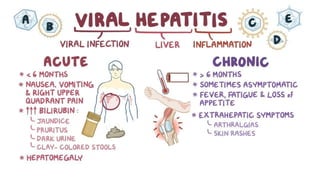
● Classify Different Types of Viral Hepatitis (Acute vs Chronic)
● Differentiate between types of Acute Viral Hepatitis (A & E)
● Differentiate between types of Chronic Viral Hepatitis (B, C, & D)
VIRAL HEPATITIS
Viral hepatitis is a systemic disease
with primary inflammation of the liver
cause by different viruses.
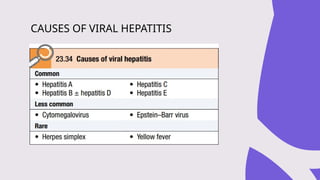
CAUSES OF VIRAL HEPATITIS
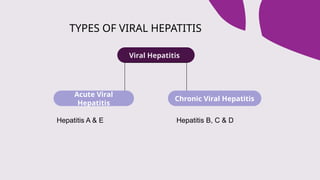
TYPES OF VIRAL HEPATITIS
Viral Hepatitis
Chronic Viral Hepatitis
Acute Viral
Hepatitis
Hepatitis A & E Hepatitis B, C & D
01
ACUTE HEPATITIS
(Hepatitis A & E)
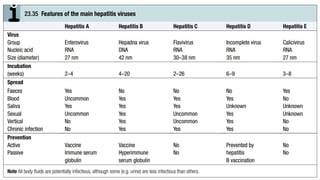
Organism: The hepatitis A virus (HAV) belongs to the
picornavirus group of enteroviruses.
Incubation Period: 2- 4 weeks
Mode of Transmission: faecal-oral route
Population at Risk:
Children
Low-socio economic area (poor sanitation and over
crowding)
Prisoners
HEPATITIS A
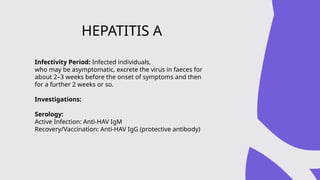
Infectivity Period: Infected individuals,
who may be asymptomatic, excrete the virus in faeces for
about 2–3 weeks before the onset of symptoms and then
for a further 2 weeks or so.
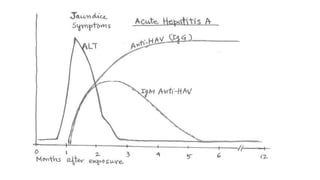
Investigations:
Serology:
Active Infection: Anti-HAV IgM
Recovery/Vaccination: Anti-HAV IgG (protective antibody)
HEPATITIS A
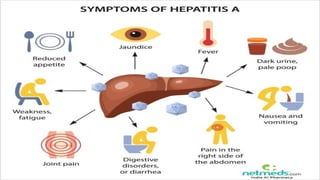
Silent/Subclinical: Asymptomatic
Classic Presentation: Occurs in 3 phases:
Prodromal phase:
● Headache
● Myalgia
● Arthralgia
● nausea and anorexia
Icteric phase:
● Jaundice
● Dark urine
● Pale stool
● Abdominal pain
Recovery phase
HEPATITIS A
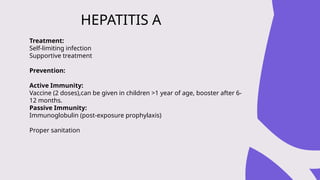
Treatment:
Self-limiting infection
Supportive treatment
Prevention:
Active Immunity:
Vaccine (2 doses),can be given in children >1 year of age, booster after 6-
12 months.
Passive Immunity:
Immunoglobulin (post-exposure prophylaxis)
Proper sanitation
HEPATITIS A
HEPATITIS E
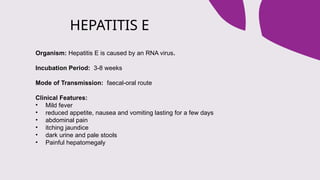
Organism: Hepatitis E is caused by an RNA virus.
Incubation Period: 3-8 weeks
Mode of Transmission: faecal-oral route
Clinical Features:
• Mild fever
• reduced appetite, nausea and vomiting lasting for a few days
• abdominal pain
• itching jaundice
• dark urine and pale stools
• Painful hepatomegaly
HEPATITIS E
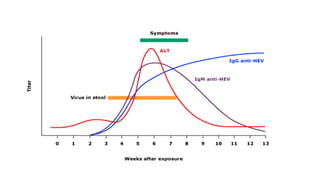
Investigations:
Serology:
Active Infection: Anti-HEV IgM
Hepatitis E differs from hepatitis A in that infection during pregnancy is
associated with the development of acute liver failure, which has a
high mortality.
Treatment:
Self-limiting infection
Supportive treatment
02
CHRONIC HEPATITIS
(Hepatitis B, C, & D)
HEPATITIS B
Organism: The hepatitis B virus (HBV) is a DNA virus that
belongs to the Hepadna group.
Incubation Period: 4- 20 weeks
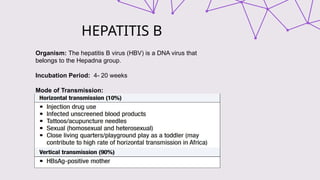
Mode of Transmission:
HEPATITIS B
Clinical Features:
Acute Infection:
• Fever
• jaundice .
• Painful hepatomegaly.
• Elevated serum transaminases (ALT>>AST).
• Followed by recovery.
• Can progress to fulminant hepatitis in <1% cases
HEPATITIS B
Clinical Features:
Chronic Infection:
Usually asymptomatic.
90% of the infected babies and infants will develop a
chronic hepatitis B infection.
Complications:
Hepatocellular carcinoma
Cirrhosis
Hepatitis is one of the most common causes of
chronic liver disease and hepatocellular carcinoma
world-wide.
HEPATITIS B
Investigations
HEPATITIS B
Treatment:
The goals of treatment are HBeAg seroconversion, reduction in HBV-DNA and
normalisation of the LFTs.
Acute Infection:
Treatment is supportive with monitoring for acute liver failure, which occurs in less than
1% of cases.
Full recovery occurs in 90–95% of adults following acute HBV infection.
The remaining 5–10% develop a chronic infection which usually continues for life,
HEPATITIS B
Chronic Infection:
Medical Treatment:
Nucleoside-nucleotide antiviral agents Entecavir or Lamivudine (1st line agents
Pegylated interferon Alpha (PEG INF-alpha)
Surgical Treatment:
Liver transplant
Prevention:
• Active: Recombinant vaccine (at birth, 1-month, after 6 months).
• Passive: Immune globulins.
• Use of sterilized needles
• Proper screening of blood before transfusion.
• Avoid unprotected sexual contact.
HEPATITIS D
Organism: The hepatitis D virus (HDV) is an RNA-defective
virus.
Incubation Period: 6-9 weeks
Mode of Transmission: Parenteral
Infection with HDV arises in following setting:
● Co-infection by HDV & HBV
● Super-infection of chronic HBV carriers by HDV
Management:
Effective management of hepatitis B effectively prevents
hepatitis D.
HEPATITIS C
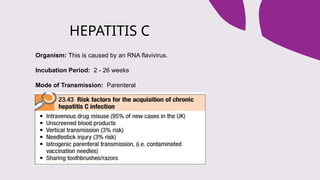
Organism: This is caused by an RNA flavivirus.
Incubation Period: 2 - 26 weeks
Mode of Transmission: Parenteral
HEPATITIS C
Clinical Features:
Acute Infection:
80% is subclinical, only 10-20% is symptomatic any may cause:
• Fatigue
• Muscle pain
• Joint pain
Jaundice and complications of portal hypertension typically occur
only when the disease progresses to cirrhosis.
Chronic Infection:
Chronic hepatitis occurs in 80% of patients
Cirrhosis occurs in 20% of chronic infection within 20 years.
Hepatocellular carcinoma develops in 2-5% of patients with
cirrhosis.
HEPATITIS C
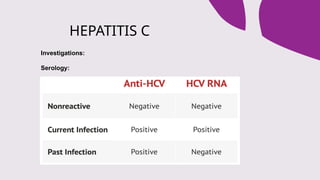
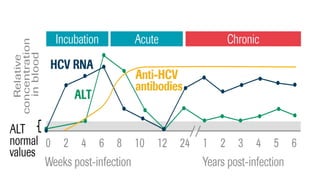
Investigations:
Serology:
HEPATITIS C
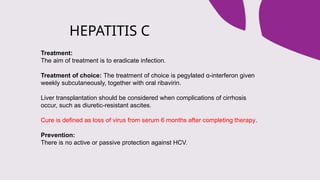
Treatment:
The aim of treatment is to eradicate infection.
Treatment of choice: The treatment of choice is pegylated α-interferon given
weekly subcutaneously, together with oral ribavirin.
Liver transplantation should be considered when complications of cirrhosis
occur, such as diuretic-resistant ascites.
Cure is defined as loss of virus from serum 6 months after completing therapy.
Prevention:
There is no active or passive protection against HCV.
References
• https://www.who.int/health-topics/hepatitis
• https://www.cdc.gov/hepatitis/abc/index.htm
• https://www.hopkinsmedicine.org/health/conditions-and-diseases/hepatitis
• Robbins Basic Pathology (10th Edition), Chapter 16 Liver and Gallbladder,
General Features of Liver Disease
Thank You

Viral Hepatitis presentation ( Medicine )

  • 1.
  • 2.
    Objectives ● Define ViralHepatitis ● Causes of Viral Hepatitis ● Classify Different Types of Viral Hepatitis (Acute vs Chronic) ● Differentiate between types of Acute Viral Hepatitis (A & E) ● Differentiate between types of Chronic Viral Hepatitis (B, C, & D)
  • 3.
    VIRAL HEPATITIS Viral hepatitisis a systemic disease with primary inflammation of the liver cause by different viruses.
  • 4.
    CAUSES OF VIRALHEPATITIS
  • 5.
    TYPES OF VIRALHEPATITIS Viral Hepatitis Chronic Viral Hepatitis Acute Viral Hepatitis Hepatitis A & E Hepatitis B, C & D
  • 7.
  • 8.
    Organism: The hepatitisA virus (HAV) belongs to the picornavirus group of enteroviruses. Incubation Period: 2- 4 weeks Mode of Transmission: faecal-oral route Population at Risk: Children Low-socio economic area (poor sanitation and over crowding) Prisoners HEPATITIS A
  • 9.
    Infectivity Period: Infectedindividuals, who may be asymptomatic, excrete the virus in faeces for about 2–3 weeks before the onset of symptoms and then for a further 2 weeks or so. Investigations: Serology: Active Infection: Anti-HAV IgM Recovery/Vaccination: Anti-HAV IgG (protective antibody) HEPATITIS A
  • 11.
    Silent/Subclinical: Asymptomatic Classic Presentation:Occurs in 3 phases: Prodromal phase: ● Headache ● Myalgia ● Arthralgia ● nausea and anorexia Icteric phase: ● Jaundice ● Dark urine ● Pale stool ● Abdominal pain Recovery phase HEPATITIS A
  • 13.
    Treatment: Self-limiting infection Supportive treatment Prevention: ActiveImmunity: Vaccine (2 doses),can be given in children >1 year of age, booster after 6- 12 months. Passive Immunity: Immunoglobulin (post-exposure prophylaxis) Proper sanitation HEPATITIS A
  • 14.
    HEPATITIS E Organism: HepatitisE is caused by an RNA virus. Incubation Period: 3-8 weeks Mode of Transmission: faecal-oral route Clinical Features: • Mild fever • reduced appetite, nausea and vomiting lasting for a few days • abdominal pain • itching jaundice • dark urine and pale stools • Painful hepatomegaly
  • 15.
    HEPATITIS E Investigations: Serology: Active Infection:Anti-HEV IgM Hepatitis E differs from hepatitis A in that infection during pregnancy is associated with the development of acute liver failure, which has a high mortality. Treatment: Self-limiting infection Supportive treatment
  • 17.
  • 18.
    HEPATITIS B Organism: Thehepatitis B virus (HBV) is a DNA virus that belongs to the Hepadna group. Incubation Period: 4- 20 weeks Mode of Transmission:
  • 19.
    HEPATITIS B Clinical Features: AcuteInfection: • Fever • jaundice . • Painful hepatomegaly. • Elevated serum transaminases (ALT>>AST). • Followed by recovery. • Can progress to fulminant hepatitis in <1% cases
  • 20.
    HEPATITIS B Clinical Features: ChronicInfection: Usually asymptomatic. 90% of the infected babies and infants will develop a chronic hepatitis B infection. Complications: Hepatocellular carcinoma Cirrhosis Hepatitis is one of the most common causes of chronic liver disease and hepatocellular carcinoma world-wide.
  • 21.
  • 22.
    HEPATITIS B Treatment: The goalsof treatment are HBeAg seroconversion, reduction in HBV-DNA and normalisation of the LFTs. Acute Infection: Treatment is supportive with monitoring for acute liver failure, which occurs in less than 1% of cases. Full recovery occurs in 90–95% of adults following acute HBV infection. The remaining 5–10% develop a chronic infection which usually continues for life,
  • 23.
    HEPATITIS B Chronic Infection: MedicalTreatment: Nucleoside-nucleotide antiviral agents Entecavir or Lamivudine (1st line agents Pegylated interferon Alpha (PEG INF-alpha) Surgical Treatment: Liver transplant Prevention: • Active: Recombinant vaccine (at birth, 1-month, after 6 months). • Passive: Immune globulins. • Use of sterilized needles • Proper screening of blood before transfusion. • Avoid unprotected sexual contact.
  • 24.
    HEPATITIS D Organism: Thehepatitis D virus (HDV) is an RNA-defective virus. Incubation Period: 6-9 weeks Mode of Transmission: Parenteral Infection with HDV arises in following setting: ● Co-infection by HDV & HBV ● Super-infection of chronic HBV carriers by HDV Management: Effective management of hepatitis B effectively prevents hepatitis D.
  • 25.
    HEPATITIS C Organism: Thisis caused by an RNA flavivirus. Incubation Period: 2 - 26 weeks Mode of Transmission: Parenteral
  • 26.
    HEPATITIS C Clinical Features: AcuteInfection: 80% is subclinical, only 10-20% is symptomatic any may cause: • Fatigue • Muscle pain • Joint pain Jaundice and complications of portal hypertension typically occur only when the disease progresses to cirrhosis. Chronic Infection: Chronic hepatitis occurs in 80% of patients Cirrhosis occurs in 20% of chronic infection within 20 years. Hepatocellular carcinoma develops in 2-5% of patients with cirrhosis.
  • 27.
  • 29.
    HEPATITIS C Treatment: The aimof treatment is to eradicate infection. Treatment of choice: The treatment of choice is pegylated α-interferon given weekly subcutaneously, together with oral ribavirin. Liver transplantation should be considered when complications of cirrhosis occur, such as diuretic-resistant ascites. Cure is defined as loss of virus from serum 6 months after completing therapy. Prevention: There is no active or passive protection against HCV.
  • 31.
    References • https://www.who.int/health-topics/hepatitis • https://www.cdc.gov/hepatitis/abc/index.htm •https://www.hopkinsmedicine.org/health/conditions-and-diseases/hepatitis • Robbins Basic Pathology (10th Edition), Chapter 16 Liver and Gallbladder, General Features of Liver Disease
  • 32.

Editor's Notes

  • #26 Initial symptoms of hepatitis C are often extra hepatic