Child Growth & development
Lecturer: Mr - Dahir Abdiwali
Lecture: HEPATITIS
Semester: FIVE
Faculty :Health sciences
Department: nursing
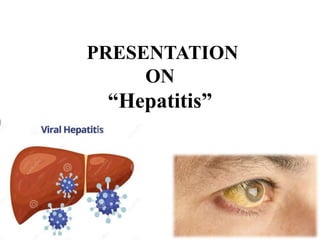
PRESENTATION
ON
“Hepatitis”
Specific objectives
At the end of this session, students will be able to:
• Introduce Hepatitis.
• State the facts related to Hepatitis
• Enumerate the classification of Hepatitis
• the types of viral hepatitis
• Describe the mode of transmission of Hepatitis.
• Explain the patho-physiology of Hepatitis
INTRODUCTION
 Liver is the largest organ of the human body.
 It weights 1.2-1.5 kg in the adult.
 It is the chemical factory of the body.
 It performs multiple functions which are essential
for life.
 It has enormous reserve capacity and marvelous
regenerating power
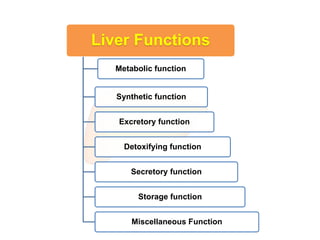
Liver Functions
Metabolic function
Synthetic function
Excretory function
Detoxifying function
Secretory function
Storage function
Miscellaneous Function
Introduction
• The word “hepatitis” comes from the ancient
Greek word “hepar” meaning liver and
English word “itis” meaning inflammation.
• Hepatitis is the widespread inflammation of
liver cells resulting from viral or bacterial
infection, drugs, alcohol or chemicals toxic to
the liver and some metabolic and vascular
disorders.
Facts related
to
Hepatitis
WORLD
• About 2.3 billion people of the world are infected
with one or more of the hepatitis viruses.
• Viral hepatitis results in around 1.4 million deaths
each year, HBV and HCV are responsible for about
90% of these fatalities, whilst the remaining 10% of
fatalities are caused by other hepatitis viruses.
• Globally, only 1.5 million clinical cases of HAV are
reported annually while the rate of infection is much
higher.
Cont…
• Approximately one-third of the World’s population
have been infected with HBV.
• Around 5% of this population are chronic carriers
and a quarter of these carriers develop serious liver
diseases such as chronic hepatitis, cirrhosis and
hepatic carcinoma.
• Every year, 7,80,000 HBV-related deaths are
documented around the globe.
-World Journal of Clinical Cases (2018)
Classification
• Viral Hepatitis
• Bacterial Hepatitis
• Toxic and drug-induced hepatitis
• Alcoholic hepatitis
• Autoimmune hepatitis
Cont…
• Viral hepatitis is the most common type of hepatitis
worldwide.
• Bacterial hepatitis: bacterial infection of the liver results
in pyogenic liver abscesses, acute hepatitis, .
• Toxic and drug-induced hepatitis
• Many chemical agents, including medications, industrial
toxins, and dietary supplements, can cause hepatitis.
Cont…
Alcoholic hepatitis
• Excessive alcohol consumption is a significant cause
of hepatitis and is the most common cause of
cirrhosis.
Autoimmune hepatitis
• It is a chronic disease caused by an abnormal immune
response against liver cells. Formerly called lupoid
hepatitis.
Types of viral hepatitis
• Hepatitis A
• Hepatitis B
• Hepatitis C
• Hepatitis D
• Hepatitis E
Stages of Hepatitis Infection
• The various clinical patterns and pathologic
consequences of different hepatotropic viruses
can be considered under the following
headings:
i) Carrier state
ii) Asymptomatic infection
iii) Acute hepatitis
iv) Chronic hepatitis
v) Fulminant hepatitis (Submassive to massive
necrosis)
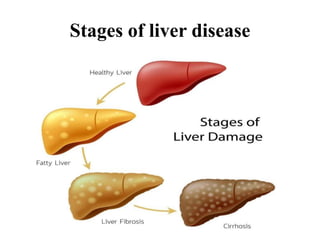
Stages of liver disease
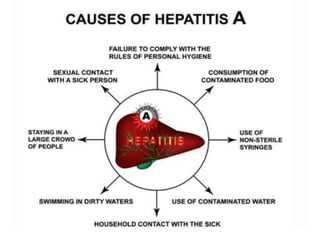
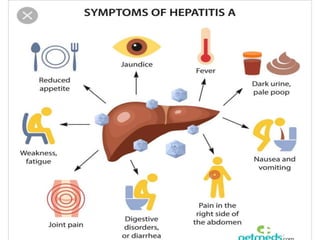
Hepatitis A (Infectious hepatitis)
Etiology:
Hepatitis A virus (HAV).
HAV is a RNA virus of Entero virus family.
Incubation period:
15-50 days (average 28 days)
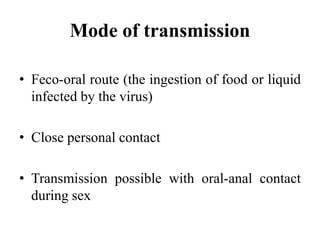
Mode of transmission
• Feco-oral route (the ingestion of food or liquid
infected by the virus)
• Close personal contact
• Transmission possible with oral-anal contact
during sex
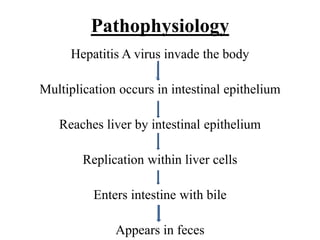
Pathophysiology
Hepatitis A virus invade the body
Multiplication occurs in intestinal epithelium
Reaches liver by intestinal epithelium
Replication within liver cells
Enters intestine with bile
Appears in feces
Diagnosis
History taking
Physical examination
Biochemical test: Bilirubin, protein and
alanine aminotransferase
Stool examination.
Treatment
• During acute stage, provide adequate bed rest
and nutritious diet to the patient.
• Anorexia can be managed by giving small,
frequent meals and supplemented IV fluids
with glucose
• Most people recover completely
• No medicine or treatment to make it go away.
• Prevention
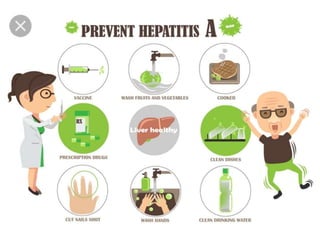
• Good personal hygiene
• Environmental sanitation
• Administration of immunoglobulin : Give this Hepatitis
A vaccine within two weeks of exposure. Passive
immunity is produced after 6-8 weeks.
Immunoglobulin suppress over the symptoms of this
disease.
• Pre-exposure prophylaxis for people age 2 and older
who are traveling to or working in developing countries
should strongly consider the Hepatitis A vaccine.
Hepatitis B
• Hepatitis B, also known as Serum hepatitis.
• It is a serious disease that infect the liver and
can cause life long infection, cirrhosis, liver
scarring , liver cancer, liver failure and death.
• Etiology: Hepatitis B virus (HBV).
HBV is a double shelled DNA virus of
enterovirus family.
Cont..
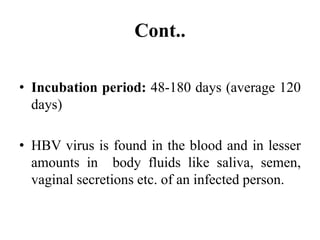
• Incubation period: 48-180 days (average 120
days)
• HBV virus is found in the blood and in lesser
amounts in body fluids like saliva, semen,
vaginal secretions etc. of an infected person.
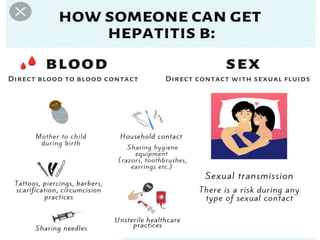
• Mode of transmission:
• Hepatitis B is mainly transmitted by,
• Unprotected sex with an infected person
• Sharing needles with an infected person
• Tattooing and piercing with tools that were not sterilized
• Sharing personal items such as razors or toothbrushes with
an infected person
• Mothers can inoculate the baby during the birth process
• Accidental needle pricks
• Blood transfusion
• Hemodialysis
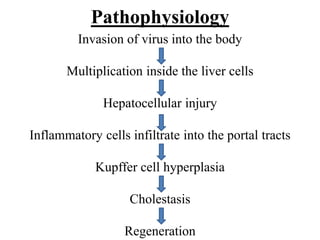
Pathophysiology
Invasion of virus into the body
Multiplication inside the liver cells
Hepatocellular injury
Inflammatory cells infiltrate into the portal tracts
Kupffer cell hyperplasia
Cholestasis
Regeneration
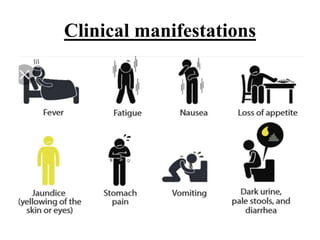
Clinical manifestations
Diagnosis
 History taking
 Physical examination
• Serological tests: Enzyme Linked Immunosorbant
Assay (ELISA)
• Biochemical test
Treatment
• The aim of the treatment is to stop viral
replication, reduce liver damage, and improve
the quality of life. Eradication of the virus is
rare.
• Following measures can be implemented,
 Physical rest
 Psychological rest
Adequate nutrition-
Drug therapy:
• Alpha-interferone IV TDS to decrease
inflammation
• Antiviral drugs:
-Lamivudine (Epivir HBV) and
-Adefovir dipivoxil (Hepsera) orally
• Immunomodulating drugs:
-Oral ribavirin ( Virazol )
• Antiemetics to control vomiting
Hepatitis C
• Also known as non A, non B Hepatitis
previously.
• Etiology: Hepatitis C virus (HCV). HCV is a
RNA virus of enterovirus family.
• Incubation period: 14-180 days
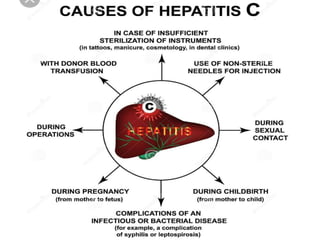
• Mode of transmission: Same as Hepatitis B
Pathophysiology
• HCV is a virus that is carried in the blood
stream to the liver.
• It can then affect and damage the liver.
• This virus can also affect other parts of the
body such as digestive, nervous and immune
system.
Diagnosis
• History taking
• Physical examination
• Detection of antibody:
- Enzyme Linked Immunosorbant Assay
(ELISA)
• Anti-HCV antibody in acute infection
• Does not provide immunity to virus
Cont…
• Polymerase chain reaction (PCR) to detect
the virus.
• Liver function tests
• Ultrasound scan
• Liver biopsy
Treatment
• The main aim of treatment is to clear the HCV
virus from the body and prevent severe
damage leading to cirrhosis.
• The treatment consists of combination of two
different medicines
- PEGylated interferon (peginterferone)
- Ribavirin , fights virus
• Liver transplant- for advanced cirrhosis
• Avoid alcohol and follow good diet
Prevention
• Avoid sharing any injecting equipment
• Practice safe sex
• Avoid sharing personal items that may be
contaminated with blood, eg. Razor
• Donor screening for blood and tissue products
• No vaccine exists for HCV.
Hepatitis D
• Also known as delta virus. Unlike the other
forms, hepatitis D cannot be contracted on its
own. It can be contracted only if a person is
already infected with hepatitis B.
• Etiology: Hepatitis D virus (HDV). HDV is a
RNA virus of enterovirus family.
• Mode of transmission:
Blood or body fluids as with HBV.
• Incubation period: 14-56 days
Clinical manifestations
• The symptoms of hepatitis B and hepatitis D
are similar. The common symptoms include:
- Jaundice, joint pain, abdominal pain, vomiting,
loss of appetite, dark urine, fatigue
• Hepatitis D can also cause the symptoms of
hepatitis B to worsen or appear in those who
have been infected but have not yet developed
symptoms.
Diagnosis
• History taking
• Physical examination
• Detection of antibody:
- Enzyme Linked Immunosorbant Assay (ELISA)
• Anti-HDV antibody in acute infection
• Does not provide immunity to virus
• Polymerase chain reaction (PCR) to detect the
virus.
• Liver function tests
Treatment
• Currently there are no known treatments for
acute or chronic hepatitis D.
• Chronic HDV is treated with alpha interferone
in practice.
• Antiviral medications do not seem to be very
effective in treating hepatitis D.
Prevention
• Preventing HBV also prevents HDV.
• It is recommended that all persons be vaccinated
for Hep. B.
• Standard precautions for all the patients in the
health care setting.
• Avoid contact with infected blood, contaminated
needles and an infected person’s personal items.
• No vaccine exists for HDV.
Hepatitis E
• Etiology: Hepatitis E virus (HEV).
HEV is a RNA virus of enterovirus family.
• Incubation period:15-60 days
• It is usually a self-limiting, and resolves within
4-6 weeks.
• HEV is more severe in pregnant women,
especially in the third trimester.
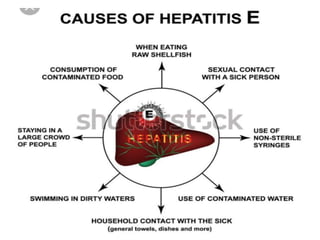
Mode of transmission
• Feco-oral route due to fecal contamination of
drinking water.
• Eating contaminated raw shellfish
• Ingestion of products derived from infected
animals.
Clinical manifestations
• Symptoms are similar to Hepatitis A infection,
which includes,
- Jaundice, anorexia, hepatomegaly, abdominal
pain and tenderness, nausea and vomiting and
fever.
Diagnosis
• History taking
• Physical examination
• Detection of antibody:
- Enzyme Linked Immunosorbant Assay (ELISA)
• Anti-HEV antibody in acute infection
• Once infected with HEV, the person is immune to
virus
• Reverse transcriptase polymerase chain
reaction (RT-PCR) to detect the virus.
• Liver function tests
Treatment
• Treatment with immunoglobulin immediately
after exposure within two weeks of exposure.
• Usually self-limiting, no treatment required.
• Hospitalization is required in case of
fulminant hepatitis and for infected pregnant
women.
• Avoid alcohol
• Symptomatic treatment of flu-like illness
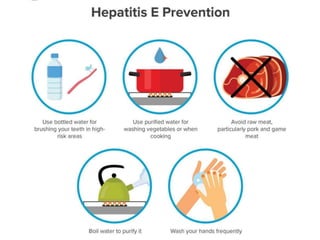
• Prevention
• Hepatitis E vaccine is usually available for
people 2 years or older.
• Maintaining safe water supply
• Establishing proper disposal systems to
eliminate sanitary waste.
Any queries ???
Post Test
1) Answer the following questions.
1. the types of viral hepatitis ?
2. Describe the mode of transmission of Hepatitis ?
3. Define Hepatitis ?
4. What did you understand about the lesson ?
5. In your opinion ,what advice would you give
To a person with hepatitis since you are a
medical student ?
Summary
Reference
• Retrieved from
https://www.cdc.gov/mmwr/volumes/67/rr/rr6701a1.htm
on 19 june, 2021
• Retrieved from
https://www.who.int/occupational_health/activities/5pepgui
d.pdf on 19 june, 2021
• Retrieved from
https://emedicine.medscape.com/article/775507-
treatment#d15 on 19 june, 2021
uterine fibroids presentation power point

uterine fibroids presentation power point

  • 1.
    Child Growth &development Lecturer: Mr - Dahir Abdiwali Lecture: HEPATITIS Semester: FIVE Faculty :Health sciences Department: nursing
  • 2.
  • 3.
    Specific objectives At theend of this session, students will be able to: • Introduce Hepatitis. • State the facts related to Hepatitis • Enumerate the classification of Hepatitis • the types of viral hepatitis • Describe the mode of transmission of Hepatitis. • Explain the patho-physiology of Hepatitis
  • 4.
    INTRODUCTION  Liver isthe largest organ of the human body.  It weights 1.2-1.5 kg in the adult.  It is the chemical factory of the body.  It performs multiple functions which are essential for life.  It has enormous reserve capacity and marvelous regenerating power
  • 5.
    Liver Functions Metabolic function Syntheticfunction Excretory function Detoxifying function Secretory function Storage function Miscellaneous Function
  • 6.
    Introduction • The word“hepatitis” comes from the ancient Greek word “hepar” meaning liver and English word “itis” meaning inflammation. • Hepatitis is the widespread inflammation of liver cells resulting from viral or bacterial infection, drugs, alcohol or chemicals toxic to the liver and some metabolic and vascular disorders.
  • 7.
  • 8.
    WORLD • About 2.3billion people of the world are infected with one or more of the hepatitis viruses. • Viral hepatitis results in around 1.4 million deaths each year, HBV and HCV are responsible for about 90% of these fatalities, whilst the remaining 10% of fatalities are caused by other hepatitis viruses. • Globally, only 1.5 million clinical cases of HAV are reported annually while the rate of infection is much higher.
  • 9.
    Cont… • Approximately one-thirdof the World’s population have been infected with HBV. • Around 5% of this population are chronic carriers and a quarter of these carriers develop serious liver diseases such as chronic hepatitis, cirrhosis and hepatic carcinoma. • Every year, 7,80,000 HBV-related deaths are documented around the globe. -World Journal of Clinical Cases (2018)
  • 10.
    Classification • Viral Hepatitis •Bacterial Hepatitis • Toxic and drug-induced hepatitis • Alcoholic hepatitis • Autoimmune hepatitis
  • 11.
    Cont… • Viral hepatitisis the most common type of hepatitis worldwide. • Bacterial hepatitis: bacterial infection of the liver results in pyogenic liver abscesses, acute hepatitis, . • Toxic and drug-induced hepatitis • Many chemical agents, including medications, industrial toxins, and dietary supplements, can cause hepatitis.
  • 12.
    Cont… Alcoholic hepatitis • Excessivealcohol consumption is a significant cause of hepatitis and is the most common cause of cirrhosis. Autoimmune hepatitis • It is a chronic disease caused by an abnormal immune response against liver cells. Formerly called lupoid hepatitis.
  • 13.
    Types of viralhepatitis • Hepatitis A • Hepatitis B • Hepatitis C • Hepatitis D • Hepatitis E
  • 14.
    Stages of HepatitisInfection • The various clinical patterns and pathologic consequences of different hepatotropic viruses can be considered under the following headings: i) Carrier state ii) Asymptomatic infection iii) Acute hepatitis iv) Chronic hepatitis v) Fulminant hepatitis (Submassive to massive necrosis)
  • 15.
  • 16.
    Hepatitis A (Infectioushepatitis) Etiology: Hepatitis A virus (HAV). HAV is a RNA virus of Entero virus family. Incubation period: 15-50 days (average 28 days)
  • 18.
    Mode of transmission •Feco-oral route (the ingestion of food or liquid infected by the virus) • Close personal contact • Transmission possible with oral-anal contact during sex
  • 19.
    Pathophysiology Hepatitis A virusinvade the body Multiplication occurs in intestinal epithelium Reaches liver by intestinal epithelium Replication within liver cells Enters intestine with bile Appears in feces
  • 21.
    Diagnosis History taking Physical examination Biochemicaltest: Bilirubin, protein and alanine aminotransferase Stool examination.
  • 22.
    Treatment • During acutestage, provide adequate bed rest and nutritious diet to the patient. • Anorexia can be managed by giving small, frequent meals and supplemented IV fluids with glucose • Most people recover completely • No medicine or treatment to make it go away.
  • 23.
    • Prevention • Goodpersonal hygiene • Environmental sanitation • Administration of immunoglobulin : Give this Hepatitis A vaccine within two weeks of exposure. Passive immunity is produced after 6-8 weeks. Immunoglobulin suppress over the symptoms of this disease. • Pre-exposure prophylaxis for people age 2 and older who are traveling to or working in developing countries should strongly consider the Hepatitis A vaccine.
  • 24.
    Hepatitis B • HepatitisB, also known as Serum hepatitis. • It is a serious disease that infect the liver and can cause life long infection, cirrhosis, liver scarring , liver cancer, liver failure and death. • Etiology: Hepatitis B virus (HBV). HBV is a double shelled DNA virus of enterovirus family.
  • 25.
    Cont.. • Incubation period:48-180 days (average 120 days) • HBV virus is found in the blood and in lesser amounts in body fluids like saliva, semen, vaginal secretions etc. of an infected person.
  • 26.
    • Mode oftransmission: • Hepatitis B is mainly transmitted by, • Unprotected sex with an infected person • Sharing needles with an infected person • Tattooing and piercing with tools that were not sterilized • Sharing personal items such as razors or toothbrushes with an infected person • Mothers can inoculate the baby during the birth process • Accidental needle pricks • Blood transfusion • Hemodialysis
  • 27.
    Pathophysiology Invasion of virusinto the body Multiplication inside the liver cells Hepatocellular injury Inflammatory cells infiltrate into the portal tracts Kupffer cell hyperplasia Cholestasis Regeneration
  • 28.
  • 29.
    Diagnosis  History taking Physical examination • Serological tests: Enzyme Linked Immunosorbant Assay (ELISA) • Biochemical test
  • 30.
    Treatment • The aimof the treatment is to stop viral replication, reduce liver damage, and improve the quality of life. Eradication of the virus is rare. • Following measures can be implemented,  Physical rest  Psychological rest Adequate nutrition-
  • 31.
    Drug therapy: • Alpha-interferoneIV TDS to decrease inflammation • Antiviral drugs: -Lamivudine (Epivir HBV) and -Adefovir dipivoxil (Hepsera) orally • Immunomodulating drugs: -Oral ribavirin ( Virazol ) • Antiemetics to control vomiting
  • 33.
    Hepatitis C • Alsoknown as non A, non B Hepatitis previously. • Etiology: Hepatitis C virus (HCV). HCV is a RNA virus of enterovirus family. • Incubation period: 14-180 days • Mode of transmission: Same as Hepatitis B
  • 35.
    Pathophysiology • HCV isa virus that is carried in the blood stream to the liver. • It can then affect and damage the liver. • This virus can also affect other parts of the body such as digestive, nervous and immune system.
  • 36.
    Diagnosis • History taking •Physical examination • Detection of antibody: - Enzyme Linked Immunosorbant Assay (ELISA) • Anti-HCV antibody in acute infection • Does not provide immunity to virus
  • 37.
    Cont… • Polymerase chainreaction (PCR) to detect the virus. • Liver function tests • Ultrasound scan • Liver biopsy
  • 38.
    Treatment • The mainaim of treatment is to clear the HCV virus from the body and prevent severe damage leading to cirrhosis. • The treatment consists of combination of two different medicines - PEGylated interferon (peginterferone) - Ribavirin , fights virus • Liver transplant- for advanced cirrhosis • Avoid alcohol and follow good diet
  • 39.
    Prevention • Avoid sharingany injecting equipment • Practice safe sex • Avoid sharing personal items that may be contaminated with blood, eg. Razor • Donor screening for blood and tissue products • No vaccine exists for HCV.
  • 40.
    Hepatitis D • Alsoknown as delta virus. Unlike the other forms, hepatitis D cannot be contracted on its own. It can be contracted only if a person is already infected with hepatitis B. • Etiology: Hepatitis D virus (HDV). HDV is a RNA virus of enterovirus family. • Mode of transmission: Blood or body fluids as with HBV. • Incubation period: 14-56 days
  • 41.
    Clinical manifestations • Thesymptoms of hepatitis B and hepatitis D are similar. The common symptoms include: - Jaundice, joint pain, abdominal pain, vomiting, loss of appetite, dark urine, fatigue • Hepatitis D can also cause the symptoms of hepatitis B to worsen or appear in those who have been infected but have not yet developed symptoms.
  • 42.
    Diagnosis • History taking •Physical examination • Detection of antibody: - Enzyme Linked Immunosorbant Assay (ELISA) • Anti-HDV antibody in acute infection • Does not provide immunity to virus • Polymerase chain reaction (PCR) to detect the virus. • Liver function tests
  • 43.
    Treatment • Currently thereare no known treatments for acute or chronic hepatitis D. • Chronic HDV is treated with alpha interferone in practice. • Antiviral medications do not seem to be very effective in treating hepatitis D.
  • 44.
    Prevention • Preventing HBValso prevents HDV. • It is recommended that all persons be vaccinated for Hep. B. • Standard precautions for all the patients in the health care setting. • Avoid contact with infected blood, contaminated needles and an infected person’s personal items. • No vaccine exists for HDV.
  • 45.
    Hepatitis E • Etiology:Hepatitis E virus (HEV). HEV is a RNA virus of enterovirus family. • Incubation period:15-60 days • It is usually a self-limiting, and resolves within 4-6 weeks. • HEV is more severe in pregnant women, especially in the third trimester.
  • 47.
    Mode of transmission •Feco-oral route due to fecal contamination of drinking water. • Eating contaminated raw shellfish • Ingestion of products derived from infected animals.
  • 48.
    Clinical manifestations • Symptomsare similar to Hepatitis A infection, which includes, - Jaundice, anorexia, hepatomegaly, abdominal pain and tenderness, nausea and vomiting and fever.
  • 49.
    Diagnosis • History taking •Physical examination • Detection of antibody: - Enzyme Linked Immunosorbant Assay (ELISA) • Anti-HEV antibody in acute infection • Once infected with HEV, the person is immune to virus • Reverse transcriptase polymerase chain reaction (RT-PCR) to detect the virus. • Liver function tests
  • 50.
    Treatment • Treatment withimmunoglobulin immediately after exposure within two weeks of exposure. • Usually self-limiting, no treatment required. • Hospitalization is required in case of fulminant hepatitis and for infected pregnant women. • Avoid alcohol • Symptomatic treatment of flu-like illness
  • 51.
    • Prevention • HepatitisE vaccine is usually available for people 2 years or older. • Maintaining safe water supply • Establishing proper disposal systems to eliminate sanitary waste.
  • 52.
  • 53.
    Post Test 1) Answerthe following questions. 1. the types of viral hepatitis ? 2. Describe the mode of transmission of Hepatitis ? 3. Define Hepatitis ? 4. What did you understand about the lesson ? 5. In your opinion ,what advice would you give To a person with hepatitis since you are a medical student ?
  • 54.
  • 55.
    Reference • Retrieved from https://www.cdc.gov/mmwr/volumes/67/rr/rr6701a1.htm on19 june, 2021 • Retrieved from https://www.who.int/occupational_health/activities/5pepgui d.pdf on 19 june, 2021 • Retrieved from https://emedicine.medscape.com/article/775507- treatment#d15 on 19 june, 2021

Editor's Notes