Violent Programming Effects on Young Viewers
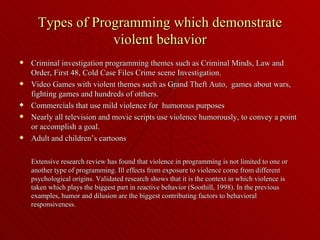
Types of Programming which demonstrate violent behavior Criminal investigation programming themes such as Criminal Minds, Law and Order, First 48, Cold Case Files Crime scene Investigation. Video Games with violent themes such as Grand Theft Auto,  games about wars, fighting games and hundreds of otthers. Commercials that use mild violence for  humorous purposes Nearly all television and movie scripts use violence humorously, to convey a point or accomplish a goal. Adult and children’s cartoons Extensive research review has found that violence in programming is not limited to one or another type of programming. Ill effects from exposure to violence come from different psychological origins. Validated research shows that it is the context in which violence is taken which plays the biggest part in reactive behavior (Soothill, 1998). In the previous examples, humor and dilusion are the biggest contributing factors to behavioral responsiveness.
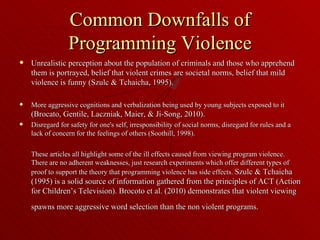
Common Downfalls of Programming Violence Unrealistic perception about the population of criminals and those who apprehend them is portrayed, belief that violent crimes are societal norms, belief that mild violence is funny   (Szulc & Tchaicha, 1995).   More aggressive cognitions and verbalization being used by young subjects exposed to it  (Brocato, Gentile, Laczniak, Maier, & Ji-Song, 2010). Disregard  for safety for one's self, irresponsibility of social norms, disregard for rules and a lack of concern for the feelings of others  (Soothill, 1998). These articles all highlight some of the ill effects caused from viewing program violence. There are no adherent weaknesses, just research experiments which offer different types of proof to support the theory that programming violence has side effects.  Szulc & Tchaicha (1995) is a solid source of information gathered from the principles of ACT (Action for Children’s Television). Brocoto et al. (2010) demonstrates that violent viewing spawns more aggressive word selection than the non violent programs.
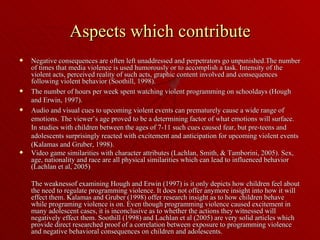
Aspects which contribute Negative consequences are often left unaddressed and perpetrators go unpunished.The number of times that media violence is used humorously or to accomplish a task. Intensity of the violent acts, perceived reality of such acts, graphic content involved and consequences following violent behavior (Soothill, 1998). The number of hours per week spent watching violent programming on schooldays (Hough and Erwin, 1997).  Audio and visual cues to upcoming violent events can prematurely cause a wide range of emotions. The viewer’s age proved to be a determining factor of what emotions will surface. In studies with children between the ages of 7-11 such cues caused fear, but pre-teens and adolescents surprisingly reacted with excitement and anticipation for upcoming violent events (Kalamas and Gruber, 1998).  Video game similarities with character attributes (Lachlan, Smith, & Tamborini, 2005). Sex, age, nationality and race are all physical similarities which can lead to influenced behavior (Lachlan et al, 2005) The weaknessof examining Hough and Erwin (1997) is it only depicts how children feel about the need to regulate programming violence. It does not offer anymore insight into how it will effect them. Kalamas and Gruber (1998) offer research insight as to how children behave while programing violence is on. Even though programming violence caused excitement in many adolescent cases, it is inconclusive as to whether the actions they witnessed will negatively effect them. Soothill (1998) and Lachlan et al (2005) are very solid articles which provide direct researched proof of a correlation between exposure to programming violence and negative behavioral consequences on children and adolescents.
Severe Effects from Violence in Programming Sexual deviance, teen pregnancy, Sexually Transmitted Diseases (The Journal of Psychosocial Nursing and Mental Health Services, 1999)  Unhealthy eating habits, nightmares,insomnia, low social activity, religious disbelief or disbelief in God (Eth, 2002) These sources are incredibly strong with no weaknesses.The Journal of Psychosocial Nursing and Mental Health Services (1999) depicts the relationship between sexually deviant teenage girls and the violence portrayed towards women in the programming watch. The participants of this study consisted of 240 sexually deviant female teens, and more than half of them were pregnant at the time. Nearly 50 % of the television they watched displayed extreme violence towards women, or depicted women as sex objects, and 70 % of the programming they watched had violent themes.  Spencer Eth (2002) conducted research on post traumatic stress caused by vieweing the real-life violence portrayed from television exposure to the 9/11 attacks on the world trade center in 2001. Conclusive evidence shows a relationship between hours of news exposure children attended, and the number of stress reported symptoms.
References Anonymous Writer (1990). Television violence.  Nature,  346(6282), 302-302. Retrieved from  http://search.proquest.com/docview/204433557?accountid=34899   Anonymous Writer (1999). Sexual risk taking and its link to television violence.  Journal of Psychosocial Nursing & Mental Health Services,  37(2), 13-13. Retrieved from  http://search.proquest.com/docview/225549287?accountid=34899 Brocato, E. D., Gentile, D. A., Laczniak, R. N., Maier, J. A., & Ji-Song, M. (2010). Television Commercial Violence: Potential effects on children.  Journal of Advertising, 39 (4), 95-107. Retrieved from  http://search.proquest.com/docview/860002375?accountid=34899 Hough, K., & Erwin, P. (1997). Children's attitudes toward violence on television.  The Journal of Psychology, 131 (4), 411-415. Retrieved from  http://search.proquest.com/docview/213817781?accountid=34899   Kalamas, A., & Gruber, M. (1998). Electrodermal responses to implied versus actual violence on television.  The Journal of General Psychology, 125 (1), 31-37. Retrieved from  http://search.proquest.com/docview/213636989?accountid=34899   Lachlan, K., Smith, S., & Tamborini, R. (2005). Models for aggressive behavior: The attributes of violent characters in popular video games.  Communication Studies, 56 (4), 313-329. Retrieved from  http://search.proquest.com/docview/233193822?accountid=34899 Soothill, K. (1998). National television violence study, volume 1.  Criminal Behavior and Mental Health : CBMH, 8 (3), 227-227. Retrieved from  http://search.proquest.com/docview/214899182?accountid=34899   Soothill, K. (1998). National television violence study, volume 2.  Criminal Behavior and Mental Health : CBMH, 8 (3), 229-229. Retrieved from  http://search.proquest.com/docview/214917236?accountid=34899   Spencer Eth, S. (2002). Television viewing as risk factor.  Psychiatry, 65 (4), 301-3. Retrieved from  http://search.proquest.com/docview/220156495?accountid=34899   Szulc, P., & Tchaicha, J. (1995). A public policy perspective on televised violence and youth: From a conversation with Peggy Charren.  Harvard Educational Review, 65 (2), 282-282. Retrieved from  http://search.proquest.com/docview/212331716?accountid=34899

Violent Programming Powerpoint

  • 1.
  • 2.
    Types of Programmingwhich demonstrate violent behavior Criminal investigation programming themes such as Criminal Minds, Law and Order, First 48, Cold Case Files Crime scene Investigation. Video Games with violent themes such as Grand Theft Auto, games about wars, fighting games and hundreds of otthers. Commercials that use mild violence for humorous purposes Nearly all television and movie scripts use violence humorously, to convey a point or accomplish a goal. Adult and children’s cartoons Extensive research review has found that violence in programming is not limited to one or another type of programming. Ill effects from exposure to violence come from different psychological origins. Validated research shows that it is the context in which violence is taken which plays the biggest part in reactive behavior (Soothill, 1998). In the previous examples, humor and dilusion are the biggest contributing factors to behavioral responsiveness.
  • 3.
    Common Downfalls ofProgramming Violence Unrealistic perception about the population of criminals and those who apprehend them is portrayed, belief that violent crimes are societal norms, belief that mild violence is funny (Szulc & Tchaicha, 1995). More aggressive cognitions and verbalization being used by young subjects exposed to it (Brocato, Gentile, Laczniak, Maier, & Ji-Song, 2010). Disregard for safety for one's self, irresponsibility of social norms, disregard for rules and a lack of concern for the feelings of others (Soothill, 1998). These articles all highlight some of the ill effects caused from viewing program violence. There are no adherent weaknesses, just research experiments which offer different types of proof to support the theory that programming violence has side effects. Szulc & Tchaicha (1995) is a solid source of information gathered from the principles of ACT (Action for Children’s Television). Brocoto et al. (2010) demonstrates that violent viewing spawns more aggressive word selection than the non violent programs.
  • 4.
    Aspects which contributeNegative consequences are often left unaddressed and perpetrators go unpunished.The number of times that media violence is used humorously or to accomplish a task. Intensity of the violent acts, perceived reality of such acts, graphic content involved and consequences following violent behavior (Soothill, 1998). The number of hours per week spent watching violent programming on schooldays (Hough and Erwin, 1997). Audio and visual cues to upcoming violent events can prematurely cause a wide range of emotions. The viewer’s age proved to be a determining factor of what emotions will surface. In studies with children between the ages of 7-11 such cues caused fear, but pre-teens and adolescents surprisingly reacted with excitement and anticipation for upcoming violent events (Kalamas and Gruber, 1998). Video game similarities with character attributes (Lachlan, Smith, & Tamborini, 2005). Sex, age, nationality and race are all physical similarities which can lead to influenced behavior (Lachlan et al, 2005) The weaknessof examining Hough and Erwin (1997) is it only depicts how children feel about the need to regulate programming violence. It does not offer anymore insight into how it will effect them. Kalamas and Gruber (1998) offer research insight as to how children behave while programing violence is on. Even though programming violence caused excitement in many adolescent cases, it is inconclusive as to whether the actions they witnessed will negatively effect them. Soothill (1998) and Lachlan et al (2005) are very solid articles which provide direct researched proof of a correlation between exposure to programming violence and negative behavioral consequences on children and adolescents.
  • 5.
    Severe Effects fromViolence in Programming Sexual deviance, teen pregnancy, Sexually Transmitted Diseases (The Journal of Psychosocial Nursing and Mental Health Services, 1999) Unhealthy eating habits, nightmares,insomnia, low social activity, religious disbelief or disbelief in God (Eth, 2002) These sources are incredibly strong with no weaknesses.The Journal of Psychosocial Nursing and Mental Health Services (1999) depicts the relationship between sexually deviant teenage girls and the violence portrayed towards women in the programming watch. The participants of this study consisted of 240 sexually deviant female teens, and more than half of them were pregnant at the time. Nearly 50 % of the television they watched displayed extreme violence towards women, or depicted women as sex objects, and 70 % of the programming they watched had violent themes. Spencer Eth (2002) conducted research on post traumatic stress caused by vieweing the real-life violence portrayed from television exposure to the 9/11 attacks on the world trade center in 2001. Conclusive evidence shows a relationship between hours of news exposure children attended, and the number of stress reported symptoms.
  • 6.
    References Anonymous Writer(1990). Television violence. Nature, 346(6282), 302-302. Retrieved from http://search.proquest.com/docview/204433557?accountid=34899 Anonymous Writer (1999). Sexual risk taking and its link to television violence. Journal of Psychosocial Nursing & Mental Health Services, 37(2), 13-13. Retrieved from http://search.proquest.com/docview/225549287?accountid=34899 Brocato, E. D., Gentile, D. A., Laczniak, R. N., Maier, J. A., & Ji-Song, M. (2010). Television Commercial Violence: Potential effects on children. Journal of Advertising, 39 (4), 95-107. Retrieved from http://search.proquest.com/docview/860002375?accountid=34899 Hough, K., & Erwin, P. (1997). Children's attitudes toward violence on television. The Journal of Psychology, 131 (4), 411-415. Retrieved from http://search.proquest.com/docview/213817781?accountid=34899 Kalamas, A., & Gruber, M. (1998). Electrodermal responses to implied versus actual violence on television. The Journal of General Psychology, 125 (1), 31-37. Retrieved from http://search.proquest.com/docview/213636989?accountid=34899 Lachlan, K., Smith, S., & Tamborini, R. (2005). Models for aggressive behavior: The attributes of violent characters in popular video games. Communication Studies, 56 (4), 313-329. Retrieved from http://search.proquest.com/docview/233193822?accountid=34899 Soothill, K. (1998). National television violence study, volume 1. Criminal Behavior and Mental Health : CBMH, 8 (3), 227-227. Retrieved from http://search.proquest.com/docview/214899182?accountid=34899 Soothill, K. (1998). National television violence study, volume 2. Criminal Behavior and Mental Health : CBMH, 8 (3), 229-229. Retrieved from http://search.proquest.com/docview/214917236?accountid=34899 Spencer Eth, S. (2002). Television viewing as risk factor. Psychiatry, 65 (4), 301-3. Retrieved from http://search.proquest.com/docview/220156495?accountid=34899 Szulc, P., & Tchaicha, J. (1995). A public policy perspective on televised violence and youth: From a conversation with Peggy Charren. Harvard Educational Review, 65 (2), 282-282. Retrieved from http://search.proquest.com/docview/212331716?accountid=34899