A company  whose securities  are traded on a stock exchange  and can be bought and sold by anyone. Public companies  are strictly regulated, and are required by law to publish their complete and true financial position so that investors  can determine the true worth  of its stock  ( shares ) Also called publicly held company.
  Indian Oil Corporation   Reliance Industries . Bharat Petroleum Corporation Hindustan Petroleum Corporation Oil and Natural Gas Corporation Steel Authority of India Limited   NTPC   Tata Motors   Tata Steel   Sterilite Industries
A PLC is a company that is owned by at least two people and offers it shares to be bought by anyone within the public. When a company is registered as a PLC it is done so under the provisions of the Companies Act 1980. The company's name has to include either the words "Public Limited Company" or the initials PLC after the company name.
1.  Reliance Industries Limited 2 .   Tata Consultancy Services (TCS) 3.  Infosys Technologies Ltd 4.  Wipro Limited 5.  Bharti Tele-Ventures Limited 6.  ITC Limited 7.  Hindustan Lever Limited 8.  ICICI Bank Limited 9.  Housing Development Finance Corp. Ltd. 10. TATA Steel Limited
11.  Ranbaxy Laboratories Limited 12.  HDFC Bank Ltd 13.  Tata Motors Limited 14.  Larsen & Toubro Limited (L&T) 15.  Satyam Computer Services Ltd. 16.  Maruti Udyog Limited 17.  Bajaj Auto Ltd. 18.  HCL Technologies Ltd. 19.  Hero Honda Motors Limited 20.  Hindalco Industries Ltd
The meaning of "limited government" is most easily grasped in contrast to the doctrine of the Divine Right of Kings. Under that doctrine, the king, and by extension his entire government, held unlimited sovereignty over its subjects. The king could do what he wanted to do to whomever he wanted to it whenever he chose. Limited government exists where some effective limits restrict governmental power.
Indian oil Reliance industries Bharat petroleum State bank of India Hindustan industries
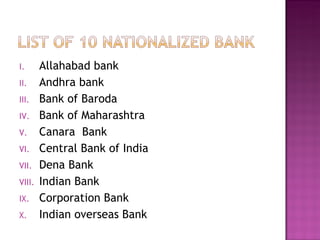
Allahabad bank Andhra bank Bank of Baroda Bank of Maharashtra Canara  Bank Central Bank of India Dena Bank  Indian Bank Corporation Bank Indian overseas Bank
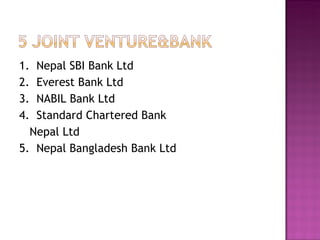
1.  Nepal SBI Bank Ltd 2.  Everest Bank Ltd 3.  NABIL Bank Ltd 4.  Standard Chartered Bank  Nepal Ltd 5.  Nepal Bangladesh Bank Ltd
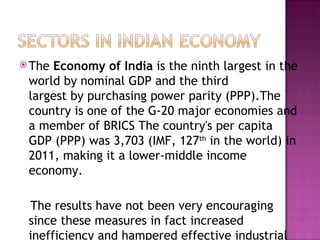
The  Economy of India  is the ninth largest in the world by nominal GDP and the third largest by purchasing power parity (PPP).The country is one of the G-20 major economies and a member of BRICS The country's per capita GDP (PPP) was 3,703 (IMF, 127 th  in the world) in 2011, making it a lower-middle income economy. The results have not been very encouraging since these measures in fact increased inefficiency and hampered effective industrial growth.
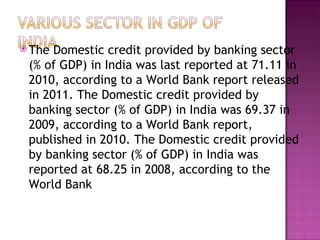
The Domestic credit provided by banking sector (% of GDP) in India was last reported at 71.11 in 2010, according to a World Bank report released in 2011. The Domestic credit provided by banking sector (% of GDP) in India was 69.37 in 2009, according to a World Bank report, published in 2010. The Domestic credit provided by banking sector (% of GDP) in India was reported at 68.25 in 2008, according to the World Bank
. Domestic credit provided by the banking sector includes all credit to various sectors on a gross basis, with the exception of credit to the central government, which is net. The banking sector includes monetary authorities and deposit money banks, as well as other banking institutions where data are available (including institutions that do not accept transferable deposits but do incur such liabilities as time and savings deposits). 
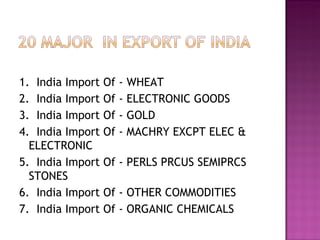
1.  India Import Of - WHEAT 2.  India Import Of - ELECTRONIC GOODS 3.  India Import Of - GOLD 4.  India Import Of - MACHRY EXCPT ELEC & ELECTRONIC 5.  India Import Of - PERLS PRCUS SEMIPRCS STONES 6.  India Import Of - OTHER COMMODITIES 7.  India Import Of - ORGANIC CHEMICALS
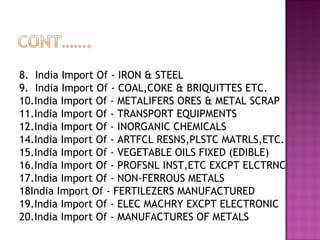
8.  India Import Of - IRON & STEEL 9.  India Import Of - COAL,COKE & BRIQUITTES ETC. 10.India Import Of - METALIFERS ORES & METAL SCRAP 11.India Import Of - TRANSPORT EQUIPMENTS 12.India Import Of - INORGANIC CHEMICALS 14.India Import Of - ARTFCL RESNS,PLSTC MATRLS,ETC. 15.India Import Of - VEGETABLE OILS FIXED (EDIBLE) 16.India Import Of - PROFSNL INST,ETC EXCPT ELCTRNC 17.India Import Of - NON-FERROUS METALS 18India Import Of - FERTILEZERS MANUFACTURED 19.India Import Of - ELEC MACHRY EXCPT ELECTRONIC 20.India Import Of - MANUFACTURES OF METALS
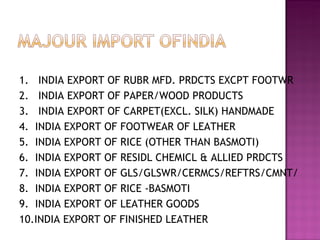
1.  INDIA EXPORT OF RUBR MFD. PRDCTS EXCPT FOOTWR 2.  INDIA EXPORT OF PAPER/WOOD PRODUCTS 3.  INDIA EXPORT OF CARPET(EXCL. SILK) HANDMADE 4.  INDIA EXPORT OF FOOTWEAR OF LEATHER 5.  INDIA EXPORT OF RICE (OTHER THAN BASMOTI) 6.  INDIA EXPORT OF RESIDL CHEMICL & ALLIED PRDCTS 7.  INDIA EXPORT OF GLS/GLSWR/CERMCS/REFTRS/CMNT/ 8.  INDIA EXPORT OF RICE -BASMOTI 9.  INDIA EXPORT OF LEATHER GOODS 10.INDIA EXPORT OF FINISHED LEATHER
This entry records a country's net trade in goods and services, plus net earnings from rents, interest, profits, and dividends, and net transfer payments (such as pension funds and worker remittances) to and from the rest of the world during the period specified. These figures are calculated on an exchange rate basis, i.e., not in purchasing power parity (PPP) terms. Current Account Balance:  -$51.78 billion (2010 est.)  -$25.92 billion (2009 est.)
In economics, the  current account  is one of the two primary components of the balance of payments, the other being the  capital account . The current account balance is one of two major measures of the nature of a country's foreign trade (the other being the net capital outflow). A current account surplus increases a country's net foreign assets by the corresponding amount, and a current account deficit does the reverse.
The Government of India, Ministry of Commerce and Industry announced Annual Supplement 2010-2011 to the Foreign Trade Policy 2009-2014 released. Offline mode Facility for DES and EPCG Schemes has been introduced.  on 23rd August 2010 for the period 2010-2011, earlier this policy known as Export Import (Exim) Policy
After five years foreign trade policy needs amendments in general, aims at developing export potential, improving export performance, encouraging foreign trade and creating favorable balance of payments position. 

Vinita sharma

  • 1.
  • 2.
    A company  whose securities  aretraded on a stock exchange  and can be bought and sold by anyone. Public companies  are strictly regulated, and are required by law to publish their complete and true financial position so that investors  can determine the true worth  of its stock  ( shares ) Also called publicly held company.
  • 3.
      Indian OilCorporation   Reliance Industries . Bharat Petroleum Corporation Hindustan Petroleum Corporation Oil and Natural Gas Corporation Steel Authority of India Limited   NTPC   Tata Motors   Tata Steel   Sterilite Industries
  • 4.
    A PLC isa company that is owned by at least two people and offers it shares to be bought by anyone within the public. When a company is registered as a PLC it is done so under the provisions of the Companies Act 1980. The company's name has to include either the words "Public Limited Company" or the initials PLC after the company name.
  • 5.
    1. RelianceIndustries Limited 2 . Tata Consultancy Services (TCS) 3. Infosys Technologies Ltd 4. Wipro Limited 5. Bharti Tele-Ventures Limited 6. ITC Limited 7. Hindustan Lever Limited 8. ICICI Bank Limited 9. Housing Development Finance Corp. Ltd. 10. TATA Steel Limited
  • 6.
    11. RanbaxyLaboratories Limited 12. HDFC Bank Ltd 13. Tata Motors Limited 14. Larsen & Toubro Limited (L&T) 15. Satyam Computer Services Ltd. 16. Maruti Udyog Limited 17. Bajaj Auto Ltd. 18. HCL Technologies Ltd. 19. Hero Honda Motors Limited 20. Hindalco Industries Ltd
  • 7.
    The meaning of"limited government" is most easily grasped in contrast to the doctrine of the Divine Right of Kings. Under that doctrine, the king, and by extension his entire government, held unlimited sovereignty over its subjects. The king could do what he wanted to do to whomever he wanted to it whenever he chose. Limited government exists where some effective limits restrict governmental power.
  • 8.
    Indian oil Relianceindustries Bharat petroleum State bank of India Hindustan industries
  • 9.
    Allahabad bank Andhrabank Bank of Baroda Bank of Maharashtra Canara Bank Central Bank of India Dena Bank Indian Bank Corporation Bank Indian overseas Bank
  • 10.
    1. NepalSBI Bank Ltd 2. Everest Bank Ltd 3. NABIL Bank Ltd 4. Standard Chartered Bank Nepal Ltd 5. Nepal Bangladesh Bank Ltd
  • 11.
    The  Economy ofIndia  is the ninth largest in the world by nominal GDP and the third largest by purchasing power parity (PPP).The country is one of the G-20 major economies and a member of BRICS The country's per capita GDP (PPP) was 3,703 (IMF, 127 th  in the world) in 2011, making it a lower-middle income economy. The results have not been very encouraging since these measures in fact increased inefficiency and hampered effective industrial growth.
  • 12.
    The Domestic creditprovided by banking sector (% of GDP) in India was last reported at 71.11 in 2010, according to a World Bank report released in 2011. The Domestic credit provided by banking sector (% of GDP) in India was 69.37 in 2009, according to a World Bank report, published in 2010. The Domestic credit provided by banking sector (% of GDP) in India was reported at 68.25 in 2008, according to the World Bank
  • 13.
    . Domestic creditprovided by the banking sector includes all credit to various sectors on a gross basis, with the exception of credit to the central government, which is net. The banking sector includes monetary authorities and deposit money banks, as well as other banking institutions where data are available (including institutions that do not accept transferable deposits but do incur such liabilities as time and savings deposits). 
  • 14.
    1. IndiaImport Of - WHEAT 2. India Import Of - ELECTRONIC GOODS 3. India Import Of - GOLD 4. India Import Of - MACHRY EXCPT ELEC & ELECTRONIC 5. India Import Of - PERLS PRCUS SEMIPRCS STONES 6. India Import Of - OTHER COMMODITIES 7. India Import Of - ORGANIC CHEMICALS
  • 15.
    8. IndiaImport Of - IRON & STEEL 9. India Import Of - COAL,COKE & BRIQUITTES ETC. 10.India Import Of - METALIFERS ORES & METAL SCRAP 11.India Import Of - TRANSPORT EQUIPMENTS 12.India Import Of - INORGANIC CHEMICALS 14.India Import Of - ARTFCL RESNS,PLSTC MATRLS,ETC. 15.India Import Of - VEGETABLE OILS FIXED (EDIBLE) 16.India Import Of - PROFSNL INST,ETC EXCPT ELCTRNC 17.India Import Of - NON-FERROUS METALS 18India Import Of - FERTILEZERS MANUFACTURED 19.India Import Of - ELEC MACHRY EXCPT ELECTRONIC 20.India Import Of - MANUFACTURES OF METALS
  • 16.
    1. INDIAEXPORT OF RUBR MFD. PRDCTS EXCPT FOOTWR 2. INDIA EXPORT OF PAPER/WOOD PRODUCTS 3. INDIA EXPORT OF CARPET(EXCL. SILK) HANDMADE 4. INDIA EXPORT OF FOOTWEAR OF LEATHER 5. INDIA EXPORT OF RICE (OTHER THAN BASMOTI) 6. INDIA EXPORT OF RESIDL CHEMICL & ALLIED PRDCTS 7. INDIA EXPORT OF GLS/GLSWR/CERMCS/REFTRS/CMNT/ 8. INDIA EXPORT OF RICE -BASMOTI 9. INDIA EXPORT OF LEATHER GOODS 10.INDIA EXPORT OF FINISHED LEATHER
  • 17.
    This entry recordsa country's net trade in goods and services, plus net earnings from rents, interest, profits, and dividends, and net transfer payments (such as pension funds and worker remittances) to and from the rest of the world during the period specified. These figures are calculated on an exchange rate basis, i.e., not in purchasing power parity (PPP) terms. Current Account Balance:  -$51.78 billion (2010 est.)  -$25.92 billion (2009 est.)
  • 18.
    In economics, the  currentaccount  is one of the two primary components of the balance of payments, the other being the capital account . The current account balance is one of two major measures of the nature of a country's foreign trade (the other being the net capital outflow). A current account surplus increases a country's net foreign assets by the corresponding amount, and a current account deficit does the reverse.
  • 19.
    The Government ofIndia, Ministry of Commerce and Industry announced Annual Supplement 2010-2011 to the Foreign Trade Policy 2009-2014 released. Offline mode Facility for DES and EPCG Schemes has been introduced.  on 23rd August 2010 for the period 2010-2011, earlier this policy known as Export Import (Exim) Policy
  • 20.
    After five yearsforeign trade policy needs amendments in general, aims at developing export potential, improving export performance, encouraging foreign trade and creating favorable balance of payments position.