VINE
DISEASE
S
INTRODUCTION:
For winemakers, grapevine diseases can be
devastating.
Unfortunately, there are many kinds of vine diseases
that thrive in all sorts of conditions.
Bacteria and fungi cause the most common grapevine
diseases. Insects can also spread disease and
damage roots.
Environmental conditions can trigger fungi
development that wreaks havoc on grapevines in
vineyards.
The grapevine diseases that can spoil your favorite
would-be wine.
COMMON VINE
DISEASES
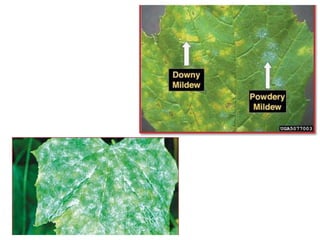
1. Oidium (Powdery
mildew)
2. Mildew (Downy
mildew)
3. Grey Rot
4. Noble Rot
5. Phylloxera Vastatrix
6. Coulure
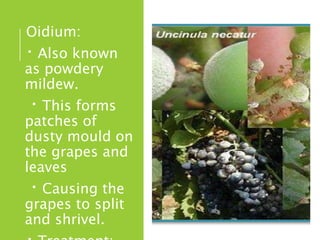
Oidium:
Also known
as powdery
mildew.
This forms
patches of
dusty mould on
the grapes and
leaves
Causing the
grapes to split
and shrivel.
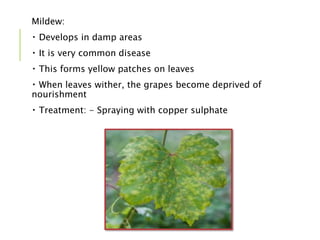
Mildew:
Develops in damp areas
It is very common disease
This forms yellow patches on leaves
When leaves wither, the grapes become deprived of
nourishment
Treatment: - Spraying with copper sulphate
Grey Rot:
Also termed as Pourriture grise
this can be malevolent (ill-disposed) or benevolent (beneficial)
in most regions, at a certain time of year, it producesa grey mould
which destroys colour pigmentation in
black grapes and gives an unpleasant taste to wine
Treatment:- Anti rot spraying
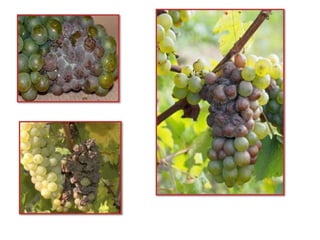
Noble Rot:
Also termed as pourriture noble
benevolent (beneficial) for wine makers
the very same fungus as grey rot called botrytis cinerea
produces wonderful sweet wines
when conditions are favorable as morning haze followed
by hot sunny afternoons
This causes spores to form on the outer skins which feed
on
the water within the grapes,
it reduces the juice to a quarter of its volume
As water diminishes, it concentrates the sugar and other
nutrients
grapes shrivel at this condition & take on a rotting
appearance
grapes are harvested in late September through October
Eg. Chateau d’Yquem
Phylloxera:
Unfortunately vines have one great weakness – they have no
resistance to the aphid phylloxera (Greek word for dry leaf)
These small yellow insects puncture the roots of the vine and
form galls on the underside of the Leaves
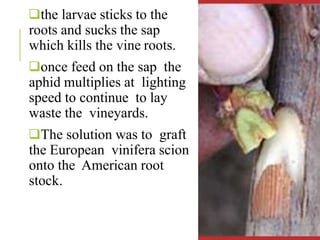
the larvae sticks to the
roots and sucks the sap
which kills the vine roots.
once feed on the sap the
aphid multiplies at lighting
speed to continue to lay
waste the vineyards.
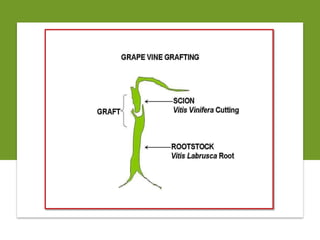
The solution was to graft
the European vinifera scion
onto the American root
stock.
Coulure:
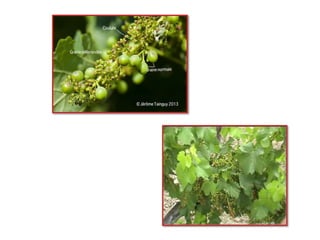
 Coulure is typically the result of unfavourable weather conditions
and vine metabolism that causes either the grapevine flowers not to
pollinate, so they do not becomes berries, or the tiny berries fall
 Coulure is triggered by periods of cold, cloudy, wet weather or very
high out-of-season temperatures. The condition most often occurs in
the spring (during the flowering stage). It also occurs in vines that
have low sugar levels; flowers stay closed and are not fertilized.
Thus the vines are not pollinated as the grape fails to develop and
falls off soon after they form.
 The yield of a vine with coulure will decrease substantially.
STORAGE OF WINE
Keep it cool
Heat is enemy number one for wine. Temperatures higher than 70° F will age
a wine more quickly than is usually desirable. And if it gets much hotter,
your wine may get “cooked,” resulting in flat aromas and flavors. The ideal
temperature range is between 45° F and 65° F (and 55° F is often cited as
close to perfect), though this isn’t an exact science. Don’t fret too much if
your storage runs a couple degrees warmer, as long as you’re opening the
bottles within a few years from their release.
But not too cool
Keeping wines in your household refrigerator is fine for up to a couple
months, but it’s not a good bet for the longer term. The average fridge
temperature falls well below 45° F to safely store perishable foods, and the
lack of moisture could eventually dry out corks, which might allow air to
seep into the bottles and damage the wine. Also, don’t keep your wine
somewhere it could freeze (an unheated garage in winter, forgotten for
hours in the freezer). If the liquid starts turning to ice, it could expand
enough to push the cork out.
STORAGE OF WINE
3.Steady as she goes
More important than worrying about achieving a perfect 55° F is avoiding the
landmines of rapid, extreme or frequent temperature swings. On top of cooked
flavors, the expansion and contraction of the liquid inside the bottle might push the
cork out or cause seepage. Aim for consistency, but don’t get paranoid about minor
temperature fluctuations; wines may see worse in transit from the winery to the
store. (Even if heat has caused wine to seep out past the cork, that doesn’t always
mean the wine is ruined. There’s no way to know until you open it—it could still be
delicious.)
4. Turn the lights off
Light, especially sunlight, can pose a potential problem for long-term storage. The
sun’s UV rays can degrade and prematurely age wine. One of the reasons why
vintners use colored glass bottles? They’re like sunglasses for wine. Light from
household bulbs probably won’t damage the wine itself, but can fade your labels in
the long run. Incandescent bulbs may be a bit safer than fluorescent bulbs, which
do emit very small amounts of ultraviolet light
Don't sweat the humidity
Conventional wisdom says that wines should be stored at an ideal humidity level of 70
percent. The theory goes that dry air will dry out the corks, which would let air into the bottle
and spoil the wine. Yes, this does happen, but unless you live in a desert or in arctic
conditions, it probably won’t happen to you. (Or if you’re laying down bottles for 10 or more
years, but then we’re back to the matter of professional storage.) Anywhere between 50
percent and 80 percent humidity is considered safe, and placing a pan of water in your
storage area can improve conditions. Conversely, extremely damp conditions can promote
mold. This won’t affect a properly sealed wine, but can damage the labels. A dehumidifier
can fix that.
6. See things sideways :Traditionally, bottles have been stored on their sides in order to
keep the liquid up against the cork, which theoretically should keep the cork from drying out.
If you’re planning on drinking these bottles in the near- to mid-term, or if the bottles have
alternative closures (screwcaps, glass or plastic corks), this is not necessary. We will say
this, however: Horizontal racking is a space-efficient way to store your bottles, and it
definitely can’t harm your wines.
7. Not a whole lot of shaking : There are theories that vibration could damage wine in
the long term by speeding up the chemical reactions in the liquid. Some serious
collectors fret about even the subtle vibrations caused by electronic appliances, though
there’s little evidence documenting the impacts of this. Significant vibrations could
possibly disturb the sediment in older wines and keep them from settling, potentially
making them unpleasantly gritty. Unless you live above a train station or are hosting rock
concerts, is this likely to be a problem for your short-term storage? No. (But don’t go
shaking your wines like a Super Bowl MVP about to spray a bottle of Champagne
around the locker room.)
GLASSWARE FOR
WINE
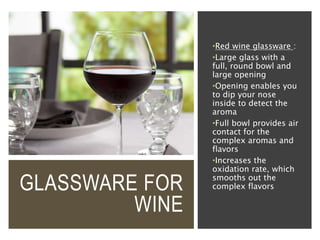
•Red wine glassware :
•Large glass with a
full, round bowl and
large opening
•Opening enables you
to dip your nose
inside to detect the
aroma
•Full bowl provides air
contact for the
complex aromas and
flavors
•Increases the
oxidation rate, which
smooths out the
complex flavors
WHITE WINE
GLASSES
Below are the typical
characteristics of a white
wine glass:
•Bowl is more u-shaped and
upright than a red wine
glass
•Slightly smaller bowl than
red wine glass
•The shape enhances and
preserves aromas while also
maintaining the wine’s cool
temperature
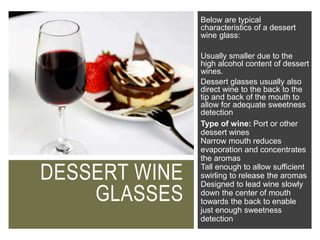
DESSERT WINE
GLASSES
Below are typical
characteristics of a dessert
wine glass:
Usually smaller due to the
high alcohol content of dessert
wines.
Dessert glasses usually also
direct wine to the back to the
tip and back of the mouth to
allow for adequate sweetness
detection
Type of wine: Port or other
dessert wines
Narrow mouth reduces
evaporation and concentrates
the aromas
Tall enough to allow sufficient
swirling to release the aromas
Designed to lead wine slowly
down the center of mouth
towards the back to enable
just enough sweetness
detection
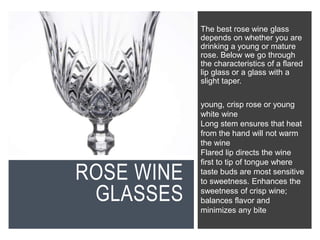
ROSE WINE
GLASSES
The best rose wine glass
depends on whether you are
drinking a young or mature
rose. Below we go through
the characteristics of a flared
lip glass or a glass with a
slight taper.
young, crisp rose or young
white wine
Long stem ensures that heat
from the hand will not warm
the wine
Flared lip directs the wine
first to tip of tongue where
taste buds are most sensitive
to sweetness. Enhances the
sweetness of crisp wine;
balances flavor and
minimizes any bite
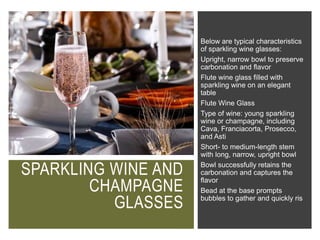
SPARKLING WINE AND
CHAMPAGNE
GLASSES
Below are typical characteristics
of sparkling wine glasses:
Upright, narrow bowl to preserve
carbonation and flavor
Flute wine glass filled with
sparkling wine on an elegant
table
Flute Wine Glass
Type of wine: young sparkling
wine or champagne, including
Cava, Franciacorta, Prosecco,
and Asti
Short- to medium-length stem
with long, narrow, upright bowl
Bowl successfully retains the
carbonation and captures the
flavor
Bead at the base prompts
bubbles to gather and quickly ris
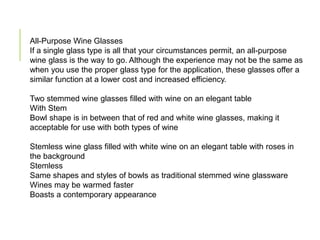
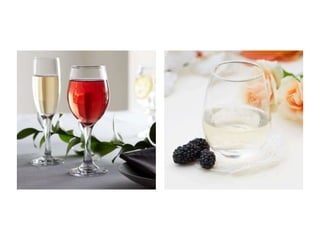
All-Purpose Wine Glasses
If a single glass type is all that your circumstances permit, an all-purpose
wine glass is the way to go. Although the experience may not be the same as
when you use the proper glass type for the application, these glasses offer a
similar function at a lower cost and increased efficiency.
Two stemmed wine glasses filled with wine on an elegant table
With Stem
Bowl shape is in between that of red and white wine glasses, making it
acceptable for use with both types of wine
Stemless wine glass filled with white wine on an elegant table with roses in
the background
Stemless
Same shapes and styles of bowls as traditional stemmed wine glassware
Wines may be warmed faster
Boasts a contemporary appearance
Vinediseases  & glassware

Vinediseases & glassware

  • 1.
  • 2.
    INTRODUCTION: For winemakers, grapevinediseases can be devastating. Unfortunately, there are many kinds of vine diseases that thrive in all sorts of conditions. Bacteria and fungi cause the most common grapevine diseases. Insects can also spread disease and damage roots. Environmental conditions can trigger fungi development that wreaks havoc on grapevines in vineyards. The grapevine diseases that can spoil your favorite would-be wine.
  • 3.
    COMMON VINE DISEASES 1. Oidium(Powdery mildew) 2. Mildew (Downy mildew) 3. Grey Rot 4. Noble Rot 5. Phylloxera Vastatrix 6. Coulure
  • 4.
    Oidium: Also known as powdery mildew. Thisforms patches of dusty mould on the grapes and leaves Causing the grapes to split and shrivel.
  • 5.
    Mildew: Develops in dampareas It is very common disease This forms yellow patches on leaves When leaves wither, the grapes become deprived of nourishment Treatment: - Spraying with copper sulphate
  • 7.
    Grey Rot: Also termedas Pourriture grise this can be malevolent (ill-disposed) or benevolent (beneficial) in most regions, at a certain time of year, it producesa grey mould which destroys colour pigmentation in black grapes and gives an unpleasant taste to wine Treatment:- Anti rot spraying
  • 8.
    Noble Rot: Also termedas pourriture noble benevolent (beneficial) for wine makers the very same fungus as grey rot called botrytis cinerea produces wonderful sweet wines when conditions are favorable as morning haze followed by hot sunny afternoons This causes spores to form on the outer skins which feed on the water within the grapes, it reduces the juice to a quarter of its volume As water diminishes, it concentrates the sugar and other nutrients grapes shrivel at this condition & take on a rotting appearance grapes are harvested in late September through October Eg. Chateau d’Yquem
  • 10.
    Phylloxera: Unfortunately vines haveone great weakness – they have no resistance to the aphid phylloxera (Greek word for dry leaf) These small yellow insects puncture the roots of the vine and form galls on the underside of the Leaves
  • 11.
    the larvae sticksto the roots and sucks the sap which kills the vine roots. once feed on the sap the aphid multiplies at lighting speed to continue to lay waste the vineyards. The solution was to graft the European vinifera scion onto the American root stock.
  • 13.
    Coulure:  Coulure istypically the result of unfavourable weather conditions and vine metabolism that causes either the grapevine flowers not to pollinate, so they do not becomes berries, or the tiny berries fall  Coulure is triggered by periods of cold, cloudy, wet weather or very high out-of-season temperatures. The condition most often occurs in the spring (during the flowering stage). It also occurs in vines that have low sugar levels; flowers stay closed and are not fertilized. Thus the vines are not pollinated as the grape fails to develop and falls off soon after they form.  The yield of a vine with coulure will decrease substantially.
  • 15.
    STORAGE OF WINE Keepit cool Heat is enemy number one for wine. Temperatures higher than 70° F will age a wine more quickly than is usually desirable. And if it gets much hotter, your wine may get “cooked,” resulting in flat aromas and flavors. The ideal temperature range is between 45° F and 65° F (and 55° F is often cited as close to perfect), though this isn’t an exact science. Don’t fret too much if your storage runs a couple degrees warmer, as long as you’re opening the bottles within a few years from their release. But not too cool Keeping wines in your household refrigerator is fine for up to a couple months, but it’s not a good bet for the longer term. The average fridge temperature falls well below 45° F to safely store perishable foods, and the lack of moisture could eventually dry out corks, which might allow air to seep into the bottles and damage the wine. Also, don’t keep your wine somewhere it could freeze (an unheated garage in winter, forgotten for hours in the freezer). If the liquid starts turning to ice, it could expand enough to push the cork out.
  • 16.
    STORAGE OF WINE 3.Steadyas she goes More important than worrying about achieving a perfect 55° F is avoiding the landmines of rapid, extreme or frequent temperature swings. On top of cooked flavors, the expansion and contraction of the liquid inside the bottle might push the cork out or cause seepage. Aim for consistency, but don’t get paranoid about minor temperature fluctuations; wines may see worse in transit from the winery to the store. (Even if heat has caused wine to seep out past the cork, that doesn’t always mean the wine is ruined. There’s no way to know until you open it—it could still be delicious.) 4. Turn the lights off Light, especially sunlight, can pose a potential problem for long-term storage. The sun’s UV rays can degrade and prematurely age wine. One of the reasons why vintners use colored glass bottles? They’re like sunglasses for wine. Light from household bulbs probably won’t damage the wine itself, but can fade your labels in the long run. Incandescent bulbs may be a bit safer than fluorescent bulbs, which do emit very small amounts of ultraviolet light
  • 17.
    Don't sweat thehumidity Conventional wisdom says that wines should be stored at an ideal humidity level of 70 percent. The theory goes that dry air will dry out the corks, which would let air into the bottle and spoil the wine. Yes, this does happen, but unless you live in a desert or in arctic conditions, it probably won’t happen to you. (Or if you’re laying down bottles for 10 or more years, but then we’re back to the matter of professional storage.) Anywhere between 50 percent and 80 percent humidity is considered safe, and placing a pan of water in your storage area can improve conditions. Conversely, extremely damp conditions can promote mold. This won’t affect a properly sealed wine, but can damage the labels. A dehumidifier can fix that. 6. See things sideways :Traditionally, bottles have been stored on their sides in order to keep the liquid up against the cork, which theoretically should keep the cork from drying out. If you’re planning on drinking these bottles in the near- to mid-term, or if the bottles have alternative closures (screwcaps, glass or plastic corks), this is not necessary. We will say this, however: Horizontal racking is a space-efficient way to store your bottles, and it definitely can’t harm your wines.
  • 18.
    7. Not awhole lot of shaking : There are theories that vibration could damage wine in the long term by speeding up the chemical reactions in the liquid. Some serious collectors fret about even the subtle vibrations caused by electronic appliances, though there’s little evidence documenting the impacts of this. Significant vibrations could possibly disturb the sediment in older wines and keep them from settling, potentially making them unpleasantly gritty. Unless you live above a train station or are hosting rock concerts, is this likely to be a problem for your short-term storage? No. (But don’t go shaking your wines like a Super Bowl MVP about to spray a bottle of Champagne around the locker room.)
  • 19.
    GLASSWARE FOR WINE •Red wineglassware : •Large glass with a full, round bowl and large opening •Opening enables you to dip your nose inside to detect the aroma •Full bowl provides air contact for the complex aromas and flavors •Increases the oxidation rate, which smooths out the complex flavors
  • 20.
    WHITE WINE GLASSES Below arethe typical characteristics of a white wine glass: •Bowl is more u-shaped and upright than a red wine glass •Slightly smaller bowl than red wine glass •The shape enhances and preserves aromas while also maintaining the wine’s cool temperature
  • 21.
    DESSERT WINE GLASSES Below aretypical characteristics of a dessert wine glass: Usually smaller due to the high alcohol content of dessert wines. Dessert glasses usually also direct wine to the back to the tip and back of the mouth to allow for adequate sweetness detection Type of wine: Port or other dessert wines Narrow mouth reduces evaporation and concentrates the aromas Tall enough to allow sufficient swirling to release the aromas Designed to lead wine slowly down the center of mouth towards the back to enable just enough sweetness detection
  • 22.
    ROSE WINE GLASSES The bestrose wine glass depends on whether you are drinking a young or mature rose. Below we go through the characteristics of a flared lip glass or a glass with a slight taper. young, crisp rose or young white wine Long stem ensures that heat from the hand will not warm the wine Flared lip directs the wine first to tip of tongue where taste buds are most sensitive to sweetness. Enhances the sweetness of crisp wine; balances flavor and minimizes any bite
  • 23.
    SPARKLING WINE AND CHAMPAGNE GLASSES Beloware typical characteristics of sparkling wine glasses: Upright, narrow bowl to preserve carbonation and flavor Flute wine glass filled with sparkling wine on an elegant table Flute Wine Glass Type of wine: young sparkling wine or champagne, including Cava, Franciacorta, Prosecco, and Asti Short- to medium-length stem with long, narrow, upright bowl Bowl successfully retains the carbonation and captures the flavor Bead at the base prompts bubbles to gather and quickly ris
  • 24.
    All-Purpose Wine Glasses Ifa single glass type is all that your circumstances permit, an all-purpose wine glass is the way to go. Although the experience may not be the same as when you use the proper glass type for the application, these glasses offer a similar function at a lower cost and increased efficiency. Two stemmed wine glasses filled with wine on an elegant table With Stem Bowl shape is in between that of red and white wine glasses, making it acceptable for use with both types of wine Stemless wine glass filled with white wine on an elegant table with roses in the background Stemless Same shapes and styles of bowls as traditional stemmed wine glassware Wines may be warmed faster Boasts a contemporary appearance