
Wine
 By the end of this session you will be able to
understand
 Wine producing countries
 Grapes variety
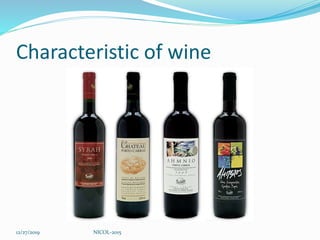
 Characteristic of wine
12/27/2019 NICOL-2015
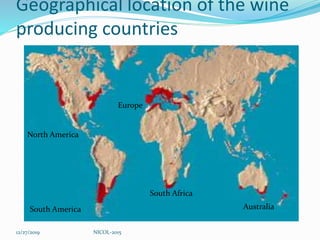
Geographical location of the wine
producing countries
South America
North America
Europe
South Africa
Australia
12/27/2019 NICOL-2015
 North America:
California
Washington
New York
 South America:
Argentina
Chile
12/27/2019 NICOL-2015
 Europe:
France
Germany
Spain
Italy
New Zealand
12/27/2019 NICOL-2015
 South Africa:
Swartland
Paarl
Constatia
Elgin
 Australia
12/27/2019 NICOL-2015
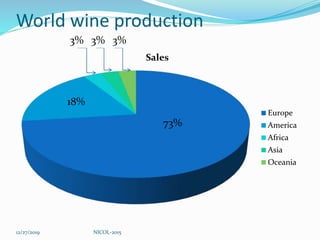
 73% of wines in the world are produced in the European
countries located around north of the Mediterranean Sea
due to suitable climate conditions for viticulture.
 Generally the winemaking or grape growing regions fall
into 2 temperate climatic zone which is 10 C to 20 C annual
Isotherms.
 That’s why the Iceland such as Poland, Denmark, Sweden,
Finland and Norway do not produce any wines.
 The best wines of Europe come mainly from France, Italy,
Spain, Portugal and Australia since these regions have
suitable climate and soil conditions for viticulture.
However, France is undoubtedly sets the lead in wine
making and world’s largest producer of wines. It has the
perfect soil and weather to produce the best grapes and
consequently wine of excellence.
12/27/2019 NICOL-2015
 The major wine regions of France are as follow.
 Bordeaux
 Burgundy
 Champagne
 Cotes du Rhone
 Val de Loire
 Alsace
 Beaujolais etc.
 Today the wine producing trade has been rapidly fascinated
worldwide where ever the suitable conditions exist for
cultivation of vines and become important crop in many
regions of the world.
12/27/2019 NICOL-2015
World wine production
Sales
Europe
America
Africa
Asia
Oceania
73%
18%
3% 3% 3%
12/27/2019 NICOL-2015
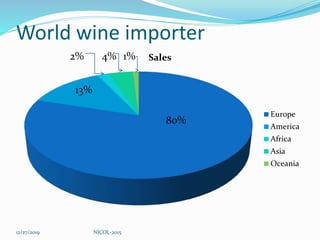
World wine importer
Sales
Europe
America
Africa
Asia
Oceania
13%
2% 4% 1%
80%
12/27/2019 NICOL-2015
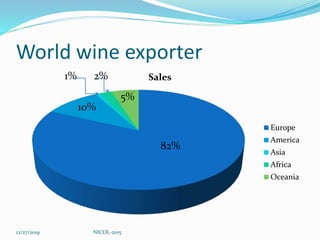
World wine exporter
Sales
Europe
America
Asia
Africa
Oceania
82%
10%
5%
1% 2%
12/27/2019 NICOL-2015
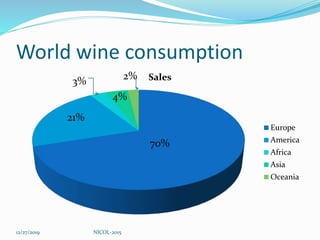
World wine consumption
Sales
Europe
America
Africa
Asia
Oceania
70%
21%
3%
4%
2%
12/27/2019 NICOL-2015
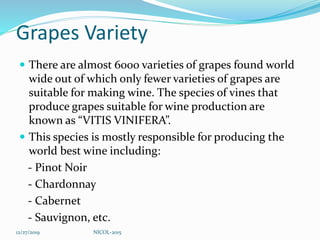
Grapes Variety
 There are almost 6000 varieties of grapes found world
wide out of which only fewer varieties of grapes are
suitable for making wine. The species of vines that
produce grapes suitable for wine production are
known as “VITIS VINIFERA”.
 This species is mostly responsible for producing the
world best wine including:
- Pinot Noir
- Chardonnay
- Cabernet
- Sauvignon, etc.
12/27/2019 NICOL-2015
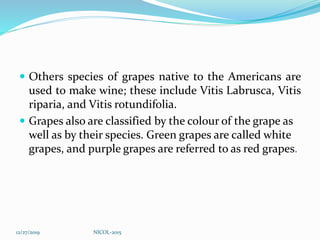
 Others species of grapes native to the Americans are
used to make wine; these include Vitis Labrusca, Vitis
riparia, and Vitis rotundifolia.
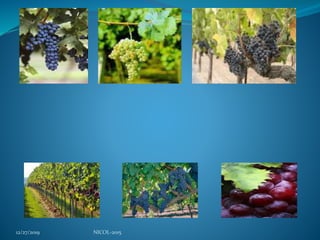
 Grapes also are classified by the colour of the grape as
well as by their species. Green grapes are called white
grapes, and purple grapes are referred to as red grapes.
12/27/2019 NICOL-2015
 White Grapes
Chardonnay – Burgundy, California, Australia,
Champagne
Pinot Gris – Alsace
Riesling – Germany, Alsace
Chenin Blanc – Loire Valley, California
Gewurztraminer - Alsace
Sauvignon Blance – Loire Valley, Bordeaux, California
Semillon – Bordeaux, Australia
12/27/2019 NICOL-2015
 Red Grapes
Cabernet Sauvignon-Bordeaux, California, Chile
Merlot – Bordeaux, California
Pinot Noir- Burgundy, California, Champagne
Syrah – Rhône Valley, Australia
Zinfandel- California
12/27/2019 NICOL-2015
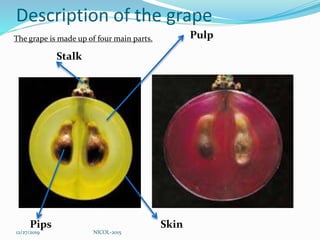
Description of the grape
Stalk
Pulp
Pips Skin
The grape is made up of four main parts.
12/27/2019 NICOL-2015
 Pulp: The pulp produces the grape juice
known as ‘Must’ in France and ‘Mosto’ in
Italy and Spain.
 In wine the juice from the grape provides
the water content and fruit flavours which
come from sugars and acids.
 It also supplies the sugar required for the
fermentation process.
12/27/2019 NICOL-2015
 Skin: used for wine making plays a vital role in
providing colour and tannin to a wine.
 This is because the juice “Must” of the fresh or pulp of
all grapes is colourless. Another important substance
found in grape skin is tannin.
 This natural preservation allows some wines,
especially red wines to mature and age for decades.
 This skins are also covered in a waxy substance called
‘Bloom’ which contains a reserve of naturally
occurring wild yeast that are important in the
fermentation process.
12/27/2019 NICOL-2015
 Pips: The pips or seeds of the grapes contain both
tannins and oils.
 These tend to give the wine an unpleasantly bitter
flavour and so they removed and discarded during the
vinification.
 Stalk: the stalk is usually removed by an ‘egrappoir’
before the grapes are crushed or pressed. Previously
the stalks were left on the grapes for red wines and this
increased the tannin content of the wine and for more
ageing.
12/27/2019 NICOL-2015
Characteristic of wine
12/27/2019 NICOL-2015
Body
Texture
Tannin
Bouquet
Mouth
12/27/2019 NICOL-2015
History of Viticulture
 The history of viticulture is closely related to the history of
wine with evidence of man cultivating wild grapes to make
wine dating as far back as the 5000 BC.
 There is evidence that some of the earliest domestication of
Vitis vinifera occurred in the area of the modern day
country Georgia.
 Viticulture is a science and practiced of growing grapes. It
carries out the care of vines and their fruits.
 A person who is expert in growing grapes is known as
viticulturist or vineyard manager. He has the knowledge
about cultivating the grapes.
 He is the one who is responsible for harvesting good quality
and quantity of grapes, choosing the land, suitable climatic
condition, harvesting time etc.
12/27/2019 NICOL-2015
 Vines are perennial plants and generally can go on
producing their crops for several decades. The crops
from plants younger than four years are not suitable for
winemaking as they lack concentration of flavors and
many winemakers will not use the corps of plant
younger than 8 years as this is when the crops achieve
the require quality.
 As vines reach 40th to 50th year the tendency is toward
increasingly flavored and higher quality but smaller
crops.
12/27/2019 NICOL-2015
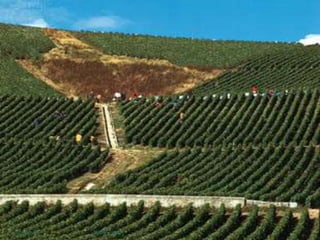
 Viticulture can be done manually or mechanically.
Though it requires more manpower in manual way, it
gives quality grapes than in comparison to mechanical
way.
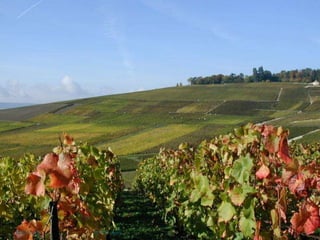
 For viticulture landscape is also very important. It can
be done on a steep as well as on a plane land.
12/27/2019 NICOL-2015
The Soil
 Grapes prefer deep, well drained soils. If the soil is not too
wet that will generally produce great concentration of
flavour within the grapes and quality of grapes.
 Rocky soil are the best for vines to grow and produce good
quality of grapes because the vines will push its roots
downwards and able to abstract many more required
elements and minerals for plant. Thus good vine soil is its
lack of plant nutrition.
 Soil of average fertility is best, as too rich a soil promotes
abundant vegetative growth at the expense of fruit
production. Grapes prefer slightly acid soils.
12/27/2019 NICOL-2015
 The other common characteristic of all vine growing
soils is their capacity to retain heat. Stony soil are
particularly suitable because the heat they absorb
during the day is diffused again at night. In the same
way, dark coloured soils absorb the sun’s rays more
easily.
12/27/2019 NICOL-2015
Climate and location
 Vines grow best at latitude of 30-50 degree north and
30-50 degree south.
 Conditions with too little sunlight results in un
ripened grapes. Which eventually produce wines,
which are very acidic and low in alcohol. However, too
much sunlight is also similarly destructive as it deprive
the wine of the acidity which is highly required to
produce white wine for freshness value.
 Temperature between 50 – 90 degree F
 Warmth and sunshine to bloom to produce adequate
sugar to turn into alcohol
12/27/2019 NICOL-2015
How is Viticulture Effected
 Hazard arises due to poor weather or unsuitable soil.
 Vine growing can be adversely affected by the number
of pest and diseases
Pest :
- Phylloxera : It is a bacteria and fungus that
destroy the root.
- Grape Moth: It kind of caterpillar attacking
the buds.
- Red and Yellow Spider: Infects the leaves and
lessen the vegetative growth.
- Nematodes: Microscopic worms that attack
the roots.
- Birds and animals.
12/27/2019 NICOL-2015
 Disease:
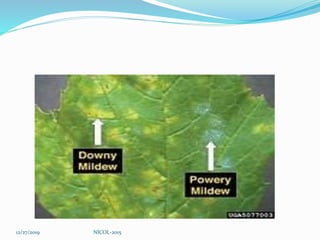
- Mildew/ Powery Mildew: Develops on all
green part of the vines attacking the vine
and the grapes
- Downy Mildew: Attacking the green parts of
the vines and convert into yellow that cause the
leaves to drop.
- Rot: This fungal disease is spread by damp
humid condition which can cause loss of
color in the vine.
- Long Term disease: Which
effect the wood and destroy the whole vine
growth
12/27/2019 NICOL-2015
Vinification
 By the end of this session you will be able to
understand
 What is Vinification ?
 The process of Vinification
12/27/2019 NICOL-2015
What is Vinification?
 The vinification is the process of winemaking that began with
selection of the grapes and ending with bottling. The science of
wine making is known as oenology and a person who makes
wine is traditionally known as winemaker or Vintner. The quality
of the wine is highly depend on the quality of the grapes used to
make it and the quality of the grapes further governed by,
 Variety
 Soil
 Climate
 It can be divided into two categories.
 Still wine production (without carbonation)
 Sparkling wine production (with carbonation)
 Write the history of viticulture ? Explain the components that
can affect the viticulture process.
12/27/2019 NICOL-2015
The process of winemaking
There are 10 processes of vinification:
 Harvesting
 Destemming or removal of stalks
 Pressing
 Fermentation
 Aging
 Fining
 Blending
 Bottling & corking
 Maturing
 Labeling & storing
12/27/2019 NICOL-2015
Harvesting:
 It’s the time when the grapes are completely ripe and it’s ready to pick
from vineyards.
 The grapes are required to cut with great care during the harvesting to
avoid damaged or rotten which result spoilage of wine.
 Harvesting plays an important role in retaining fruit flavors in the
wine. If the grapes are harvested on a warm day, the resulting extracted
juice or “MUST” will tend to create a wine with considerable less fruit
characters.
 Therefore winemakers use techniques such as refrigerated trucks to
cool the harvested grapes.
 It can be done manually or mechanically however the manually
method is highly preferred coz. The good selection of the grapes can
be done.
12/27/2019 NICOL-2015
 Vineyards on flat terrain may use mechanical
harvesters, those on hilly terrain are force to use
manpower to hand pick the grapes.
 The right balances of sugar and acidity at the time of
harvesting are preferred.
 Grapes are plucked when the grape bloom natural
yeast on the skin.
 So quality is more important than quantity.
12/27/2019 NICOL-2015
Distemming or removal of stalks:
 This is the process where the stalks of the grapes are
removed.
 The winemaker must decide it the stalks are to be partially
or totally removed from the grapes
 If no stalks are desired a crusher stemmer is use to remove
the stalks before cursing the grapes. This stalks contain
high amount of tannins and are added only when tannic
styles of wines are being created.
12/27/2019 NICOL-2015
Pressing:
 This is a technique use to describe the extraction of grape juice
required for fermantation.
 The grapes are washed and crushed to extract the juice called
MUST. Most of the MUST is used for wine, but some of it may
be fermented for distillation for brandy and sherry.
 The wine—maker uses a hydrometer to measure the specific
gravity of the MUST which indicates the sugar content and thus
the alcoholic content.
 For every gram of sugar that is converted, about half a gram of alcohol ,
 So to achieve a 12% alcohol concentration, the must should contain about
24% sugars.
 The procedure is necessary as there are laws in most countries
which specify the minimum alcoholic strength of wines.
 These laws allow the wine makers to add small quantities of
sugar if the MUST show insufficient alcoholic potential. This
process is called ‘Capitalization’.
12/27/2019 NICOL-2015
 At this stage, if red wine has to be made, the skin of red
grapes are allowed to come in contact with the juice which
gets the color from the skins of red grapes.
 In case of white wines, the skin is separated immediately.
 Rose wines are made by allowing the skins of red grapes to
come in contact for a short while with the juice to get the
pink color
12/27/2019 NICOL-2015
Fermentation:
 The first thing vinters do before fermentation is to add sulphur
dioxide (SO₂) to the MUST.
 It prevents air from oxidizing the juice and converting the
alcohol into vinegar.
 It also kills wild yeasts present on the skin of grapes.
 Fermentation is a process of adding wine yeast (technically
known as Saccharomyces Ellipsoideus) to fresh grapes juice to
convert the natural sugar in grape to ethyl alcohol.
 The process of fermentation often generates heat naturally.
When fermenting white wines, this heat is not desirable and
temperature control system are used to draw off the heat.
 For red wines, the temperature is typically 22 to 25 °C, and for white
wines 15 to 18 °C.
 High temperature can destroy the delicate fruit flavors and
aromas which is much desired when making white wines.
12/27/2019 NICOL-2015
 The fermentation process will stop when the alcohol
content reached 15% because the alcohol at this point
kills the remaining yeast.
12/27/2019 NICOL-2015
 Aging:
 Aging of wines is the storage of wines that takes place after
fermentation, but before bottling in the cold area.
 During this period, unwanted materials in the wine settle
to the bottom of the casks as sediments or as ‘Lees’.
 The wine is transferred into another container to separate
the lees and this process called racking.
 This removes acidity and helps getting better color.
12/27/2019 NICOL-2015
 Aging of wines can be done in oak, huge oak vats or these days
stainless steel vats may be used.
 When fermented and aged in stainless steel vats the wine tends
to be very fruity in style, fresh tasting.
 Oak ageing brings tannins, colour, flavour and aromas to a wine.
Oak ageing is generally used for wines that are higher quality as
the barrels cost 1000 to 1200 $ and only used once.
 Aging is done in winters and bottling is done in summer for
most wines.
 After aging the wines, experts make a final judgment to
determine whether the wine is good, great or exceptional.
12/27/2019 NICOL-2015
Fining
 The fining process allows the winemakers to produce a clearer more brilliant
wine. It is a process that removes certain microscopic particles that could cloud
the wine.
 Fining agents plays vital role during the fining process .The winemakers decide
on which fining agents are used and these may defer from product to product
and even batch to batch.
 The mixture is added to the wine from the top of the vat and allowed to slowly
settle to the bottom. This process converts the cloudy wine into clear “fine”
wine.
Fining Agent:
 Gelatin
 White part of egg
 Bladder of Sturgeon fish
 Bulls blood
 Betonies - a volcanic clay-based filter
 Gelatin has been used in winemaking for centuries and is recognized as a
traditional method for wine fining, or clarifying. It is also the most commonly
used agent to reduce the tannin content. Generally no gelatin remains in the
wine because it reacts with the wine components, as it clarifies, and forms a
sediment which is removed by filtration prior to bottling.
12/27/2019 NICOL-2015
Blending:
 Once the wines are obtained the cellar master or winemaker
decided on blending. During this process different batches of
wine can be mixed before bottling in order to achieve the desired
taste. These adjustments can be as simple as adjusting acid or
tannin levels and to achieve a consistent taste.
 The blending method is also known as “Cuvee” in French.
 Blanding allows winemakers to create a wine that has the
characteristics in terms of bouquet, body and texture.
 This is an art that requires considerable experience, judgment and
sensitivity.
12/27/2019 NICOL-2015
 A wine lacking in tannin can be blended with another
wine having excess of tannin, thus producing a very
good wine. This process also ensures a consistent
quality.
12/27/2019 NICOL-2015
 Bottling and Corking:
 During the bottling a final dose of sulfite is added to help
preserve the wine and prevent unwanted fermentation in the
bottle.
 The bottles are cleaned and dried with hot air.
 The bottles are often colored to prevent the wine from being
affected by light.
 Bottles of different shapes are used to traditionally signify
different wines and wine growing region.
 The wine is bottled and a cork is placed into form a seal.
 The final step is adding capsule to the top of the bottle to
protect cork from pest and moulds which is then heated for a
tight seal.
12/27/2019 NICOL-2015
 Corks derive from Cork Oak, with the majority from the
Quercus suber tree of Portugal.
 It can easily and naturally create a seal in a bottleneck
because it can compress to fit into small areas, and then
grow to create a custom seal to the bottle.
 Some cheaper cork varieties are difficult to open and
reduce or spoilt wine’s original aroma.
 Now, more and more wineries use plastic screw caps,
synthetic corks, or “vino-seals” (corks made of plastic or
glass) to ensure that wine taste does not alter due to the
cork.
 Alternative corks are also used to ensure that too much air
does not enter the wine bottle.
12/27/2019 NICOL-2015
 Maturing:
 Maturing also known as BOTTLE AGING. It is very
important in order to uphold its taste and essence.
 Red wines in general can bottle age in homes for 2-10 years,
or even much longer depending on the origin and structure
of the wine. Most white wines do not need time to age,
although can be stored for a maximum of three years.
 Bottle aging permits more maturation of the wine and for
the oak barrel’s flavors (in red wines) and the natural fruit
flavors to mix. Bottle aging also slowly allows for more
controlled oxidization and enhance the wine character.
 Wines aged in the casks, matured in the bottle for up to 15
yrs, are known as great wines.
12/27/2019 NICOL-2015
Labeling and storage:
 The label on a wine bottle carries a lot of information about
the wine. It includes
 The country where the wine was made
 Alcoholic content
 The region in which the wine was made
 The name and address of the shippers
 The quantity of wine in the bottle.
 For storage, traditionally the wines are stored in
underground cellars. It should not be too dry or too moist.
Light and shaking should be avoided.
12/27/2019 NICOL-2015
Storage of wine
 Wine is alive and ever changing product and it deserves all
the care necessary to ensure its proper development. The
following guidelines below allow wines to mature in an
ideal condition.
 Cool and constant temperatures
 Lay bottles on their sides
 Low Humidity
 Darkness
 Ventilation
 No vibrations
 Organization
12/27/2019 NICOL-2015
 The cellar must be cool and kept at constant temperature of 12 C – 14 C for table
wine and 10 C- 11 C for sparkling wine.
 The wine should be stored horizontally and cases stacked on their sides
ensuring the corks remain moist and thus fully airtight.
 High humidity can be considered as high rick zone for the wine. The excessive
humidity can be damage the wine.
 If wine bottles in the cellar are removed from their cases or cartons they should
be stored rack.
 The wine should be always store in dark place since the light plays vital role to
increase the temperature and spoilt the wine.
 A well ventilated storage space is essential. Wine cellar must be very clean free
from excessive moisture, strong sunlight vibration heat and strong odors.
 The use of bin numbers and wine tags allows for easy access and stock checking
without disturbing other bottle.
 Inspect the stored bottles regularly to check that corks are not leaking.
12/27/2019 NICOL-2015
Food and Wine
 Pairing food and wine is like selecting successful partnerships.
Selecting right wine for right food plays an important role to
enhance the customers dining experience. However, there are no
specific rules to pairing wine with food. It depends on individual
preferences since all humans have different perception of taste
and smells.
 Basic principal of pairing food and wine:
 Red meat with Red wine
 White meat with white wine
 Red meats which are generally stronger tasting compare to white
meat
 Match a simple wine with a simple dish and complex wines with
more complex foods such as full flavored or rich food with full
bodied wine.
12/27/2019 NICOL-2015
 Make sure that you start with lightest wine, and always
serve a white before red, a dry wine before a sweet one,
and a young wine before and old one.
 Pay careful consideration to the aromas and tastes of
both the wine and the dish.
 The most important thing is to be innovative and to
try, test, experiment and discuss.
12/27/2019 NICOL-2015
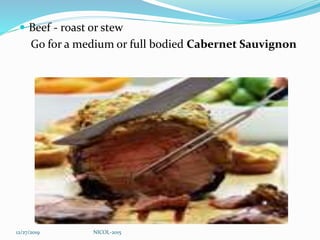
 Beef - roast or stew
Go for a medium or full bodied Cabernet Sauvignon
12/27/2019 NICOL-2015
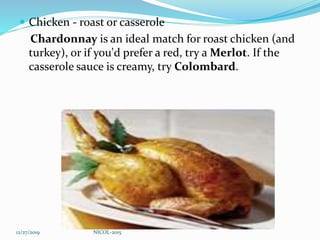
 Chicken - roast or casserole
Chardonnay is an ideal match for roast chicken (and
turkey), or if you'd prefer a red, try a Merlot. If the
casserole sauce is creamy, try Colombard.
12/27/2019 NICOL-2015
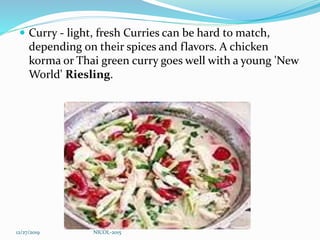
 Curry - light, fresh Curries can be hard to match,
depending on their spices and flavors. A chicken
korma or Thai green curry goes well with a young 'New
World' Riesling.
12/27/2019 NICOL-2015
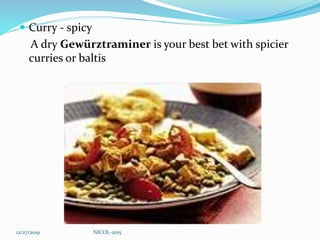
 Curry - spicy
A dry Gewürztraminer is your best bet with spicier
curries or baltis
12/27/2019 NICOL-2015
Wine tasting
 The wine tasting is an analysis of particular wine by the
sense to determine good or bad quality. The points to be
considered when tasting wine are:
 Colour – Dark or Light
 Clarity – Cloudy or Cristal clear
 Bouquet – aroma in the glass or bottle
 Tannin – The dryness of wine
 Acidity – Sourness of wine
 Weight – The heaviness of wine
 Aroma – Taste in mouth – Fruit, spices, wood etc
 Finish - The taste remain in mouth after swallowing the
wine
12/27/2019 NICOL-2015
 There are three sense to be used during wine tasting:
Sight – Indicating the colour and clarity of the wine
Smell – Determines the aroma and bouquet of the
wine
Taste- Allows detection of sweetness, tannin, acidity
and weight.
12/27/2019 NICOL-2015
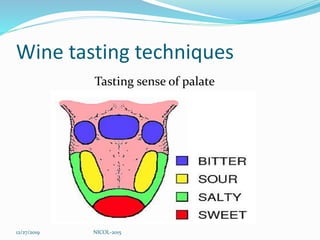
Wine tasting techniques
Tasting sense of palate
12/27/2019 NICOL-2015
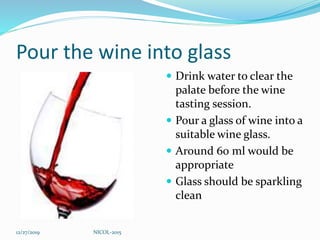
Pour the wine into glass
 Drink water to clear the
palate before the wine
tasting session.
 Pour a glass of wine into a
suitable wine glass.
 Around 60 ml would be
appropriate
 Glass should be sparkling
clean
12/27/2019 NICOL-2015
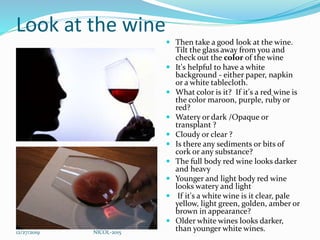
Look at the wine
 Then take a good look at the wine.
Tilt the glass away from you and
check out the color of the wine
 It's helpful to have a white
background - either paper, napkin
or a white tablecloth.
 What color is it? If it's a red wine is
the color maroon, purple, ruby or
red?
 Watery or dark /Opaque or
transplant ?
 Cloudy or clear ?
 Is there any sediments or bits of
cork or any substance?
 The full body red wine looks darker
and heavy
 Younger and light body red wine
looks watery and light
 If it's a white wine is it clear, pale
yellow, light green, golden, amber or
brown in appearance?
 Older white wines looks darker,
than younger white wines.12/27/2019 NICOL-2015
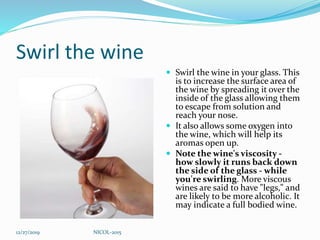
Swirl the wine
 Swirl the wine in your glass. This
is to increase the surface area of
the wine by spreading it over the
inside of the glass allowing them
to escape from solution and
reach your nose.
 It also allows some oxygen into
the wine, which will help its
aromas open up.
 Note the wine's viscosity -
how slowly it runs back down
the side of the glass - while
you're swirling. More viscous
wines are said to have "legs," and
are likely to be more alcoholic. It
may indicate a full bodied wine.
12/27/2019 NICOL-2015
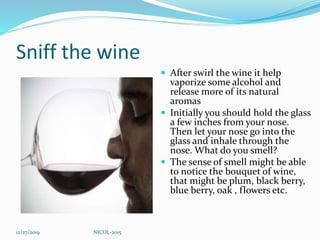
Sniff the wine
 After swirl the wine it help
vaporize some alcohol and
release more of its natural
aromas
 Initially you should hold the glass
a few inches from your nose.
Then let your nose go into the
glass and inhale through the
nose. What do you smell?
 The sense of smell might be able
to notice the bouquet of wine,
that might be plum, black berry,
blue berry, oak , flowers etc.
12/27/2019 NICOL-2015
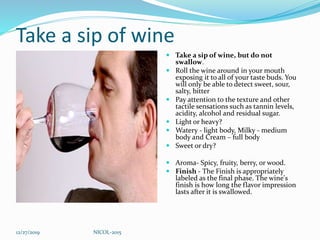
Take a sip of wine
 Take a sip of wine, but do not
swallow.
 Roll the wine around in your mouth
exposing it to all of your taste buds. You
will only be able to detect sweet, sour,
salty, bitter
 Pay attention to the texture and other
tactile sensations such as tannin levels,
acidity, alcohol and residual sugar.
 Light or heavy?
 Watery - light body, Milky - medium
body and Cream – full body
 Sweet or dry?
 Aroma- Spicy, fruity, berry, or wood.
 Finish - The Finish is appropriately
labeled as the final phase. The wine's
finish is how long the flavor impression
lasts after it is swallowed.
12/27/2019 NICOL-2015

Wine 2

  • 1.
    Wine  By theend of this session you will be able to understand  Wine producing countries  Grapes variety  Characteristic of wine 12/27/2019 NICOL-2015
  • 2.
    Geographical location ofthe wine producing countries South America North America Europe South Africa Australia 12/27/2019 NICOL-2015
  • 3.
     North America: California Washington NewYork  South America: Argentina Chile 12/27/2019 NICOL-2015
  • 4.
  • 5.
  • 6.
     73% ofwines in the world are produced in the European countries located around north of the Mediterranean Sea due to suitable climate conditions for viticulture.  Generally the winemaking or grape growing regions fall into 2 temperate climatic zone which is 10 C to 20 C annual Isotherms.  That’s why the Iceland such as Poland, Denmark, Sweden, Finland and Norway do not produce any wines.  The best wines of Europe come mainly from France, Italy, Spain, Portugal and Australia since these regions have suitable climate and soil conditions for viticulture. However, France is undoubtedly sets the lead in wine making and world’s largest producer of wines. It has the perfect soil and weather to produce the best grapes and consequently wine of excellence. 12/27/2019 NICOL-2015
  • 7.
     The majorwine regions of France are as follow.  Bordeaux  Burgundy  Champagne  Cotes du Rhone  Val de Loire  Alsace  Beaujolais etc.  Today the wine producing trade has been rapidly fascinated worldwide where ever the suitable conditions exist for cultivation of vines and become important crop in many regions of the world. 12/27/2019 NICOL-2015
  • 8.
  • 9.
  • 10.
  • 11.
  • 12.
    Grapes Variety  Thereare almost 6000 varieties of grapes found world wide out of which only fewer varieties of grapes are suitable for making wine. The species of vines that produce grapes suitable for wine production are known as “VITIS VINIFERA”.  This species is mostly responsible for producing the world best wine including: - Pinot Noir - Chardonnay - Cabernet - Sauvignon, etc. 12/27/2019 NICOL-2015
  • 13.
     Others speciesof grapes native to the Americans are used to make wine; these include Vitis Labrusca, Vitis riparia, and Vitis rotundifolia.  Grapes also are classified by the colour of the grape as well as by their species. Green grapes are called white grapes, and purple grapes are referred to as red grapes. 12/27/2019 NICOL-2015
  • 14.
  • 15.
     White Grapes Chardonnay– Burgundy, California, Australia, Champagne Pinot Gris – Alsace Riesling – Germany, Alsace Chenin Blanc – Loire Valley, California Gewurztraminer - Alsace Sauvignon Blance – Loire Valley, Bordeaux, California Semillon – Bordeaux, Australia 12/27/2019 NICOL-2015
  • 16.
     Red Grapes CabernetSauvignon-Bordeaux, California, Chile Merlot – Bordeaux, California Pinot Noir- Burgundy, California, Champagne Syrah – Rhône Valley, Australia Zinfandel- California 12/27/2019 NICOL-2015
  • 17.
    Description of thegrape Stalk Pulp Pips Skin The grape is made up of four main parts. 12/27/2019 NICOL-2015
  • 18.
     Pulp: Thepulp produces the grape juice known as ‘Must’ in France and ‘Mosto’ in Italy and Spain.  In wine the juice from the grape provides the water content and fruit flavours which come from sugars and acids.  It also supplies the sugar required for the fermentation process. 12/27/2019 NICOL-2015
  • 19.
     Skin: usedfor wine making plays a vital role in providing colour and tannin to a wine.  This is because the juice “Must” of the fresh or pulp of all grapes is colourless. Another important substance found in grape skin is tannin.  This natural preservation allows some wines, especially red wines to mature and age for decades.  This skins are also covered in a waxy substance called ‘Bloom’ which contains a reserve of naturally occurring wild yeast that are important in the fermentation process. 12/27/2019 NICOL-2015
  • 20.
     Pips: Thepips or seeds of the grapes contain both tannins and oils.  These tend to give the wine an unpleasantly bitter flavour and so they removed and discarded during the vinification.  Stalk: the stalk is usually removed by an ‘egrappoir’ before the grapes are crushed or pressed. Previously the stalks were left on the grapes for red wines and this increased the tannin content of the wine and for more ageing. 12/27/2019 NICOL-2015
  • 21.
  • 22.
  • 23.
    History of Viticulture The history of viticulture is closely related to the history of wine with evidence of man cultivating wild grapes to make wine dating as far back as the 5000 BC.  There is evidence that some of the earliest domestication of Vitis vinifera occurred in the area of the modern day country Georgia.  Viticulture is a science and practiced of growing grapes. It carries out the care of vines and their fruits.  A person who is expert in growing grapes is known as viticulturist or vineyard manager. He has the knowledge about cultivating the grapes.  He is the one who is responsible for harvesting good quality and quantity of grapes, choosing the land, suitable climatic condition, harvesting time etc. 12/27/2019 NICOL-2015
  • 24.
     Vines areperennial plants and generally can go on producing their crops for several decades. The crops from plants younger than four years are not suitable for winemaking as they lack concentration of flavors and many winemakers will not use the corps of plant younger than 8 years as this is when the crops achieve the require quality.  As vines reach 40th to 50th year the tendency is toward increasingly flavored and higher quality but smaller crops. 12/27/2019 NICOL-2015
  • 25.
     Viticulture canbe done manually or mechanically. Though it requires more manpower in manual way, it gives quality grapes than in comparison to mechanical way.  For viticulture landscape is also very important. It can be done on a steep as well as on a plane land. 12/27/2019 NICOL-2015
  • 26.
  • 27.
  • 28.
  • 29.
    The Soil  Grapesprefer deep, well drained soils. If the soil is not too wet that will generally produce great concentration of flavour within the grapes and quality of grapes.  Rocky soil are the best for vines to grow and produce good quality of grapes because the vines will push its roots downwards and able to abstract many more required elements and minerals for plant. Thus good vine soil is its lack of plant nutrition.  Soil of average fertility is best, as too rich a soil promotes abundant vegetative growth at the expense of fruit production. Grapes prefer slightly acid soils. 12/27/2019 NICOL-2015
  • 30.
     The othercommon characteristic of all vine growing soils is their capacity to retain heat. Stony soil are particularly suitable because the heat they absorb during the day is diffused again at night. In the same way, dark coloured soils absorb the sun’s rays more easily. 12/27/2019 NICOL-2015
  • 31.
    Climate and location Vines grow best at latitude of 30-50 degree north and 30-50 degree south.  Conditions with too little sunlight results in un ripened grapes. Which eventually produce wines, which are very acidic and low in alcohol. However, too much sunlight is also similarly destructive as it deprive the wine of the acidity which is highly required to produce white wine for freshness value.  Temperature between 50 – 90 degree F  Warmth and sunshine to bloom to produce adequate sugar to turn into alcohol 12/27/2019 NICOL-2015
  • 32.
    How is ViticultureEffected  Hazard arises due to poor weather or unsuitable soil.  Vine growing can be adversely affected by the number of pest and diseases Pest : - Phylloxera : It is a bacteria and fungus that destroy the root. - Grape Moth: It kind of caterpillar attacking the buds. - Red and Yellow Spider: Infects the leaves and lessen the vegetative growth. - Nematodes: Microscopic worms that attack the roots. - Birds and animals. 12/27/2019 NICOL-2015
  • 33.
     Disease: - Mildew/Powery Mildew: Develops on all green part of the vines attacking the vine and the grapes - Downy Mildew: Attacking the green parts of the vines and convert into yellow that cause the leaves to drop. - Rot: This fungal disease is spread by damp humid condition which can cause loss of color in the vine. - Long Term disease: Which effect the wood and destroy the whole vine growth 12/27/2019 NICOL-2015
  • 34.
  • 35.
    Vinification  By theend of this session you will be able to understand  What is Vinification ?  The process of Vinification 12/27/2019 NICOL-2015
  • 36.
    What is Vinification? The vinification is the process of winemaking that began with selection of the grapes and ending with bottling. The science of wine making is known as oenology and a person who makes wine is traditionally known as winemaker or Vintner. The quality of the wine is highly depend on the quality of the grapes used to make it and the quality of the grapes further governed by,  Variety  Soil  Climate  It can be divided into two categories.  Still wine production (without carbonation)  Sparkling wine production (with carbonation)  Write the history of viticulture ? Explain the components that can affect the viticulture process. 12/27/2019 NICOL-2015
  • 37.
    The process ofwinemaking There are 10 processes of vinification:  Harvesting  Destemming or removal of stalks  Pressing  Fermentation  Aging  Fining  Blending  Bottling & corking  Maturing  Labeling & storing 12/27/2019 NICOL-2015
  • 38.
    Harvesting:  It’s thetime when the grapes are completely ripe and it’s ready to pick from vineyards.  The grapes are required to cut with great care during the harvesting to avoid damaged or rotten which result spoilage of wine.  Harvesting plays an important role in retaining fruit flavors in the wine. If the grapes are harvested on a warm day, the resulting extracted juice or “MUST” will tend to create a wine with considerable less fruit characters.  Therefore winemakers use techniques such as refrigerated trucks to cool the harvested grapes.  It can be done manually or mechanically however the manually method is highly preferred coz. The good selection of the grapes can be done. 12/27/2019 NICOL-2015
  • 39.
     Vineyards onflat terrain may use mechanical harvesters, those on hilly terrain are force to use manpower to hand pick the grapes.  The right balances of sugar and acidity at the time of harvesting are preferred.  Grapes are plucked when the grape bloom natural yeast on the skin.  So quality is more important than quantity. 12/27/2019 NICOL-2015
  • 40.
    Distemming or removalof stalks:  This is the process where the stalks of the grapes are removed.  The winemaker must decide it the stalks are to be partially or totally removed from the grapes  If no stalks are desired a crusher stemmer is use to remove the stalks before cursing the grapes. This stalks contain high amount of tannins and are added only when tannic styles of wines are being created. 12/27/2019 NICOL-2015
  • 41.
    Pressing:  This isa technique use to describe the extraction of grape juice required for fermantation.  The grapes are washed and crushed to extract the juice called MUST. Most of the MUST is used for wine, but some of it may be fermented for distillation for brandy and sherry.  The wine—maker uses a hydrometer to measure the specific gravity of the MUST which indicates the sugar content and thus the alcoholic content.  For every gram of sugar that is converted, about half a gram of alcohol ,  So to achieve a 12% alcohol concentration, the must should contain about 24% sugars.  The procedure is necessary as there are laws in most countries which specify the minimum alcoholic strength of wines.  These laws allow the wine makers to add small quantities of sugar if the MUST show insufficient alcoholic potential. This process is called ‘Capitalization’. 12/27/2019 NICOL-2015
  • 42.
     At thisstage, if red wine has to be made, the skin of red grapes are allowed to come in contact with the juice which gets the color from the skins of red grapes.  In case of white wines, the skin is separated immediately.  Rose wines are made by allowing the skins of red grapes to come in contact for a short while with the juice to get the pink color 12/27/2019 NICOL-2015
  • 43.
    Fermentation:  The firstthing vinters do before fermentation is to add sulphur dioxide (SO₂) to the MUST.  It prevents air from oxidizing the juice and converting the alcohol into vinegar.  It also kills wild yeasts present on the skin of grapes.  Fermentation is a process of adding wine yeast (technically known as Saccharomyces Ellipsoideus) to fresh grapes juice to convert the natural sugar in grape to ethyl alcohol.  The process of fermentation often generates heat naturally. When fermenting white wines, this heat is not desirable and temperature control system are used to draw off the heat.  For red wines, the temperature is typically 22 to 25 °C, and for white wines 15 to 18 °C.  High temperature can destroy the delicate fruit flavors and aromas which is much desired when making white wines. 12/27/2019 NICOL-2015
  • 44.
     The fermentationprocess will stop when the alcohol content reached 15% because the alcohol at this point kills the remaining yeast. 12/27/2019 NICOL-2015
  • 45.
     Aging:  Agingof wines is the storage of wines that takes place after fermentation, but before bottling in the cold area.  During this period, unwanted materials in the wine settle to the bottom of the casks as sediments or as ‘Lees’.  The wine is transferred into another container to separate the lees and this process called racking.  This removes acidity and helps getting better color. 12/27/2019 NICOL-2015
  • 46.
     Aging ofwines can be done in oak, huge oak vats or these days stainless steel vats may be used.  When fermented and aged in stainless steel vats the wine tends to be very fruity in style, fresh tasting.  Oak ageing brings tannins, colour, flavour and aromas to a wine. Oak ageing is generally used for wines that are higher quality as the barrels cost 1000 to 1200 $ and only used once.  Aging is done in winters and bottling is done in summer for most wines.  After aging the wines, experts make a final judgment to determine whether the wine is good, great or exceptional. 12/27/2019 NICOL-2015
  • 47.
    Fining  The finingprocess allows the winemakers to produce a clearer more brilliant wine. It is a process that removes certain microscopic particles that could cloud the wine.  Fining agents plays vital role during the fining process .The winemakers decide on which fining agents are used and these may defer from product to product and even batch to batch.  The mixture is added to the wine from the top of the vat and allowed to slowly settle to the bottom. This process converts the cloudy wine into clear “fine” wine. Fining Agent:  Gelatin  White part of egg  Bladder of Sturgeon fish  Bulls blood  Betonies - a volcanic clay-based filter  Gelatin has been used in winemaking for centuries and is recognized as a traditional method for wine fining, or clarifying. It is also the most commonly used agent to reduce the tannin content. Generally no gelatin remains in the wine because it reacts with the wine components, as it clarifies, and forms a sediment which is removed by filtration prior to bottling. 12/27/2019 NICOL-2015
  • 48.
    Blending:  Once thewines are obtained the cellar master or winemaker decided on blending. During this process different batches of wine can be mixed before bottling in order to achieve the desired taste. These adjustments can be as simple as adjusting acid or tannin levels and to achieve a consistent taste.  The blending method is also known as “Cuvee” in French.  Blanding allows winemakers to create a wine that has the characteristics in terms of bouquet, body and texture.  This is an art that requires considerable experience, judgment and sensitivity. 12/27/2019 NICOL-2015
  • 49.
     A winelacking in tannin can be blended with another wine having excess of tannin, thus producing a very good wine. This process also ensures a consistent quality. 12/27/2019 NICOL-2015
  • 50.
     Bottling andCorking:  During the bottling a final dose of sulfite is added to help preserve the wine and prevent unwanted fermentation in the bottle.  The bottles are cleaned and dried with hot air.  The bottles are often colored to prevent the wine from being affected by light.  Bottles of different shapes are used to traditionally signify different wines and wine growing region.  The wine is bottled and a cork is placed into form a seal.  The final step is adding capsule to the top of the bottle to protect cork from pest and moulds which is then heated for a tight seal. 12/27/2019 NICOL-2015
  • 51.
     Corks derivefrom Cork Oak, with the majority from the Quercus suber tree of Portugal.  It can easily and naturally create a seal in a bottleneck because it can compress to fit into small areas, and then grow to create a custom seal to the bottle.  Some cheaper cork varieties are difficult to open and reduce or spoilt wine’s original aroma.  Now, more and more wineries use plastic screw caps, synthetic corks, or “vino-seals” (corks made of plastic or glass) to ensure that wine taste does not alter due to the cork.  Alternative corks are also used to ensure that too much air does not enter the wine bottle. 12/27/2019 NICOL-2015
  • 52.
     Maturing:  Maturingalso known as BOTTLE AGING. It is very important in order to uphold its taste and essence.  Red wines in general can bottle age in homes for 2-10 years, or even much longer depending on the origin and structure of the wine. Most white wines do not need time to age, although can be stored for a maximum of three years.  Bottle aging permits more maturation of the wine and for the oak barrel’s flavors (in red wines) and the natural fruit flavors to mix. Bottle aging also slowly allows for more controlled oxidization and enhance the wine character.  Wines aged in the casks, matured in the bottle for up to 15 yrs, are known as great wines. 12/27/2019 NICOL-2015
  • 53.
    Labeling and storage: The label on a wine bottle carries a lot of information about the wine. It includes  The country where the wine was made  Alcoholic content  The region in which the wine was made  The name and address of the shippers  The quantity of wine in the bottle.  For storage, traditionally the wines are stored in underground cellars. It should not be too dry or too moist. Light and shaking should be avoided. 12/27/2019 NICOL-2015
  • 54.
    Storage of wine Wine is alive and ever changing product and it deserves all the care necessary to ensure its proper development. The following guidelines below allow wines to mature in an ideal condition.  Cool and constant temperatures  Lay bottles on their sides  Low Humidity  Darkness  Ventilation  No vibrations  Organization 12/27/2019 NICOL-2015
  • 55.
     The cellarmust be cool and kept at constant temperature of 12 C – 14 C for table wine and 10 C- 11 C for sparkling wine.  The wine should be stored horizontally and cases stacked on their sides ensuring the corks remain moist and thus fully airtight.  High humidity can be considered as high rick zone for the wine. The excessive humidity can be damage the wine.  If wine bottles in the cellar are removed from their cases or cartons they should be stored rack.  The wine should be always store in dark place since the light plays vital role to increase the temperature and spoilt the wine.  A well ventilated storage space is essential. Wine cellar must be very clean free from excessive moisture, strong sunlight vibration heat and strong odors.  The use of bin numbers and wine tags allows for easy access and stock checking without disturbing other bottle.  Inspect the stored bottles regularly to check that corks are not leaking. 12/27/2019 NICOL-2015
  • 56.
    Food and Wine Pairing food and wine is like selecting successful partnerships. Selecting right wine for right food plays an important role to enhance the customers dining experience. However, there are no specific rules to pairing wine with food. It depends on individual preferences since all humans have different perception of taste and smells.  Basic principal of pairing food and wine:  Red meat with Red wine  White meat with white wine  Red meats which are generally stronger tasting compare to white meat  Match a simple wine with a simple dish and complex wines with more complex foods such as full flavored or rich food with full bodied wine. 12/27/2019 NICOL-2015
  • 57.
     Make surethat you start with lightest wine, and always serve a white before red, a dry wine before a sweet one, and a young wine before and old one.  Pay careful consideration to the aromas and tastes of both the wine and the dish.  The most important thing is to be innovative and to try, test, experiment and discuss. 12/27/2019 NICOL-2015
  • 58.
     Beef -roast or stew Go for a medium or full bodied Cabernet Sauvignon 12/27/2019 NICOL-2015
  • 59.
     Chicken -roast or casserole Chardonnay is an ideal match for roast chicken (and turkey), or if you'd prefer a red, try a Merlot. If the casserole sauce is creamy, try Colombard. 12/27/2019 NICOL-2015
  • 60.
     Curry -light, fresh Curries can be hard to match, depending on their spices and flavors. A chicken korma or Thai green curry goes well with a young 'New World' Riesling. 12/27/2019 NICOL-2015
  • 61.
     Curry -spicy A dry Gewürztraminer is your best bet with spicier curries or baltis 12/27/2019 NICOL-2015
  • 62.
    Wine tasting  Thewine tasting is an analysis of particular wine by the sense to determine good or bad quality. The points to be considered when tasting wine are:  Colour – Dark or Light  Clarity – Cloudy or Cristal clear  Bouquet – aroma in the glass or bottle  Tannin – The dryness of wine  Acidity – Sourness of wine  Weight – The heaviness of wine  Aroma – Taste in mouth – Fruit, spices, wood etc  Finish - The taste remain in mouth after swallowing the wine 12/27/2019 NICOL-2015
  • 63.
     There arethree sense to be used during wine tasting: Sight – Indicating the colour and clarity of the wine Smell – Determines the aroma and bouquet of the wine Taste- Allows detection of sweetness, tannin, acidity and weight. 12/27/2019 NICOL-2015
  • 64.
    Wine tasting techniques Tastingsense of palate 12/27/2019 NICOL-2015
  • 65.
    Pour the wineinto glass  Drink water to clear the palate before the wine tasting session.  Pour a glass of wine into a suitable wine glass.  Around 60 ml would be appropriate  Glass should be sparkling clean 12/27/2019 NICOL-2015
  • 66.
    Look at thewine  Then take a good look at the wine. Tilt the glass away from you and check out the color of the wine  It's helpful to have a white background - either paper, napkin or a white tablecloth.  What color is it? If it's a red wine is the color maroon, purple, ruby or red?  Watery or dark /Opaque or transplant ?  Cloudy or clear ?  Is there any sediments or bits of cork or any substance?  The full body red wine looks darker and heavy  Younger and light body red wine looks watery and light  If it's a white wine is it clear, pale yellow, light green, golden, amber or brown in appearance?  Older white wines looks darker, than younger white wines.12/27/2019 NICOL-2015
  • 67.
    Swirl the wine Swirl the wine in your glass. This is to increase the surface area of the wine by spreading it over the inside of the glass allowing them to escape from solution and reach your nose.  It also allows some oxygen into the wine, which will help its aromas open up.  Note the wine's viscosity - how slowly it runs back down the side of the glass - while you're swirling. More viscous wines are said to have "legs," and are likely to be more alcoholic. It may indicate a full bodied wine. 12/27/2019 NICOL-2015
  • 68.
    Sniff the wine After swirl the wine it help vaporize some alcohol and release more of its natural aromas  Initially you should hold the glass a few inches from your nose. Then let your nose go into the glass and inhale through the nose. What do you smell?  The sense of smell might be able to notice the bouquet of wine, that might be plum, black berry, blue berry, oak , flowers etc. 12/27/2019 NICOL-2015
  • 69.
    Take a sipof wine  Take a sip of wine, but do not swallow.  Roll the wine around in your mouth exposing it to all of your taste buds. You will only be able to detect sweet, sour, salty, bitter  Pay attention to the texture and other tactile sensations such as tannin levels, acidity, alcohol and residual sugar.  Light or heavy?  Watery - light body, Milky - medium body and Cream – full body  Sweet or dry?  Aroma- Spicy, fruity, berry, or wood.  Finish - The Finish is appropriately labeled as the final phase. The wine's finish is how long the flavor impression lasts after it is swallowed. 12/27/2019 NICOL-2015