Understanding Vikar
(विकार को समझना)
The word ‘Vikar’ has been used in many different context in our
Indian Scriptures. We try to explore many references and evolve an
understanding with reference to different original writings and
commentaries thereof.
Overview
The word ‘Vikar’ which if we try to google gives its meaning as ‘disorder’. But when
we try to explore it usage in Indian scriptures, we find that it has been used
frequently to mean ‘modifications’ or ‘changes’. Exploring its meaning in Sanskrit we
find its origin is based on two words ‘Vivartan” and “Aakar” meaning
“Transformation” and “Shape”. The word ‘Vivartan’ is also used for diffraction in
Hindi Science books. In most of the vedic and vedant literature its use in this context
as meaning ‘change’ is rather quite consistent. Gradually in post vedic literature its
negative connotation has evolved and has been often used in context of evils, sins or
disorders also. We present to you the use of word ‘Vikar’ in context of etymology in
‘vedangas’, For ‘Sthool Sharir’ by Shankaracharya, For “Avikari Aatma” in Gitta, For
‘Kshetra’ in Gita and as an equivalent word for ‘Six Ripus’ in some other texts.
To prepare this presentation following references have been used:
- Nirukta (Vedanga) by Rishi Yasya
- Tattvabodh by Adhi Shankaracharya
- Shrimad Bhagawad Gita (Commentary by Shri RamukhDas)
- Shrimad Bhagawad Gita (Commentary and Translation by Swami Sivananda)
- Vairagya Dindima by Adi Shankaracharya
- Shri Ram Charit Manas by Goswami Tulsidas
- As indicative reference Chanakya Niti Sutras, Bhavishya Puran, Guru Granth Sahib &
Bible
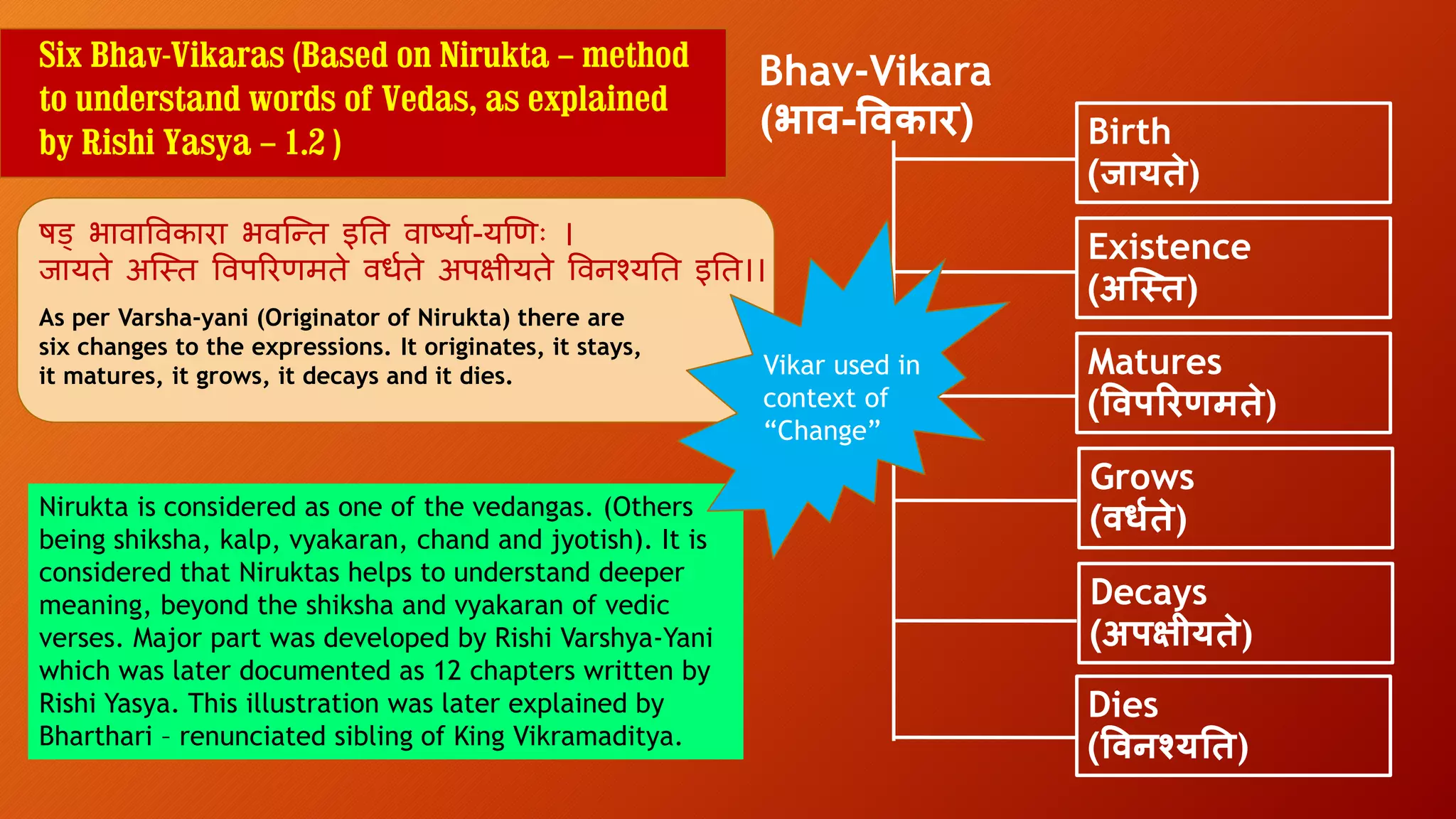
Birth
(जायते)
षड् भािाविकारा भिन्ति इति िार्ष्ाा-्ण िः ।
जा्िे अन्ति विपरर मिे िर्ािे अपक्षी्िे विनश््ति इति।।
Six Bhav-Vikaras (Based on Nirukta – method
to understand words of Vedas, as explained
by Rishi Yasya – 1.2 )
Nirukta is considered as one of the vedangas. (Others
being shiksha, kalp, vyakaran, chand and jyotish). It is
considered that Niruktas helps to understand deeper
meaning, beyond the shiksha and vyakaran of vedic
verses. Major part was developed by Rishi Varshya-Yani
which was later documented as 12 chapters written by
Rishi Yasya. This illustration was later explained by
Bharthari – renunciated sibling of King Vikramaditya.
Bhav-Vikara
(भाव-ववकार)
Existence
(अस्तत)
Matures
(ववपररणमते)
Grows
(वर्धते)
Decays
(अपक्षीयते)
Dies
(ववनश्यतत)
Vikar used in
context of
“Change”
As per Varsha-yani (Originator of Nirukta) there are
six changes to the expressions. It originates, it stays,
it matures, it grows, it decays and it dies.
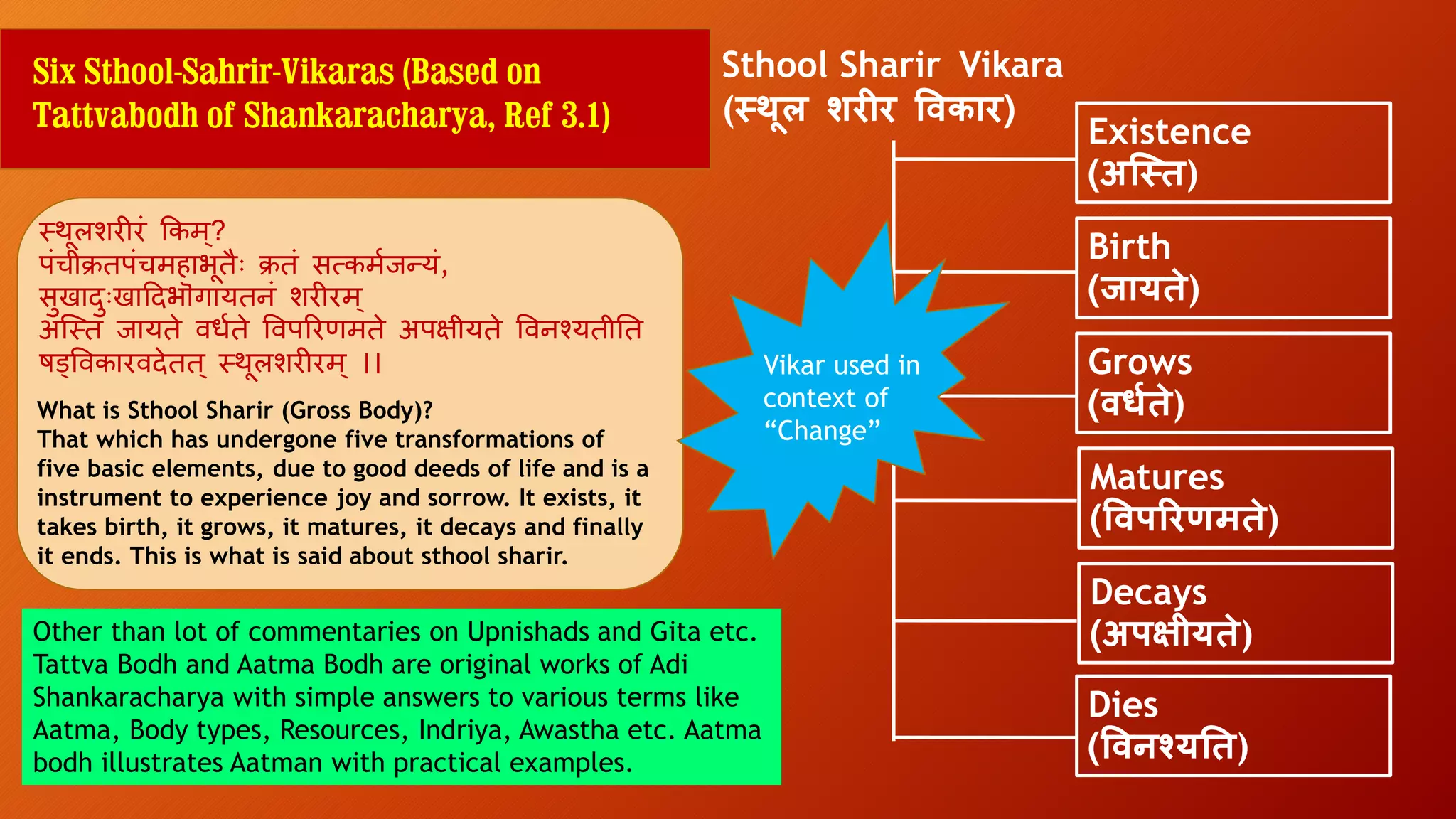
Existence
(अस्तत)
तथूलशरीरं ककम्?
पंचीक्रिपंचमहाभूििः क्रिं सत्कमाजत्ं,
सुखादुिःखाददभॊगा्िनं शरीरम्
अन्ति जा्िे िर्ािे विपरर मिे अपक्षी्िे विनश््िीति
षड्विकारिदेिि् तथूलशरीरम् ।।
Six Sthool-Sahrir-Vikaras (Based on
Tattvabodh of Shankaracharya, Ref 3.1)
Other than lot of commentaries on Upnishads and Gita etc.
Tattva Bodh and Aatma Bodh are original works of Adi
Shankaracharya with simple answers to various terms like
Aatma, Body types, Resources, Indriya, Awastha etc. Aatma
bodh illustrates Aatman with practical examples.
Sthool Sharir Vikara
(तथूल शरीर ववकार)
Birth
(जायते)
Grows
(वर्धते)
Matures
(ववपररणमते)
Decays
(अपक्षीयते)
Dies
(ववनश्यतत)
Vikar used in
context of
“Change”
What is Sthool Sharir (Gross Body)?
That which has undergone five transformations of
five basic elements, due to good deeds of life and is a
instrument to experience joy and sorrow. It exists, it
takes birth, it grows, it matures, it decays and finally
it ends. This is what is said about sthool sharir.
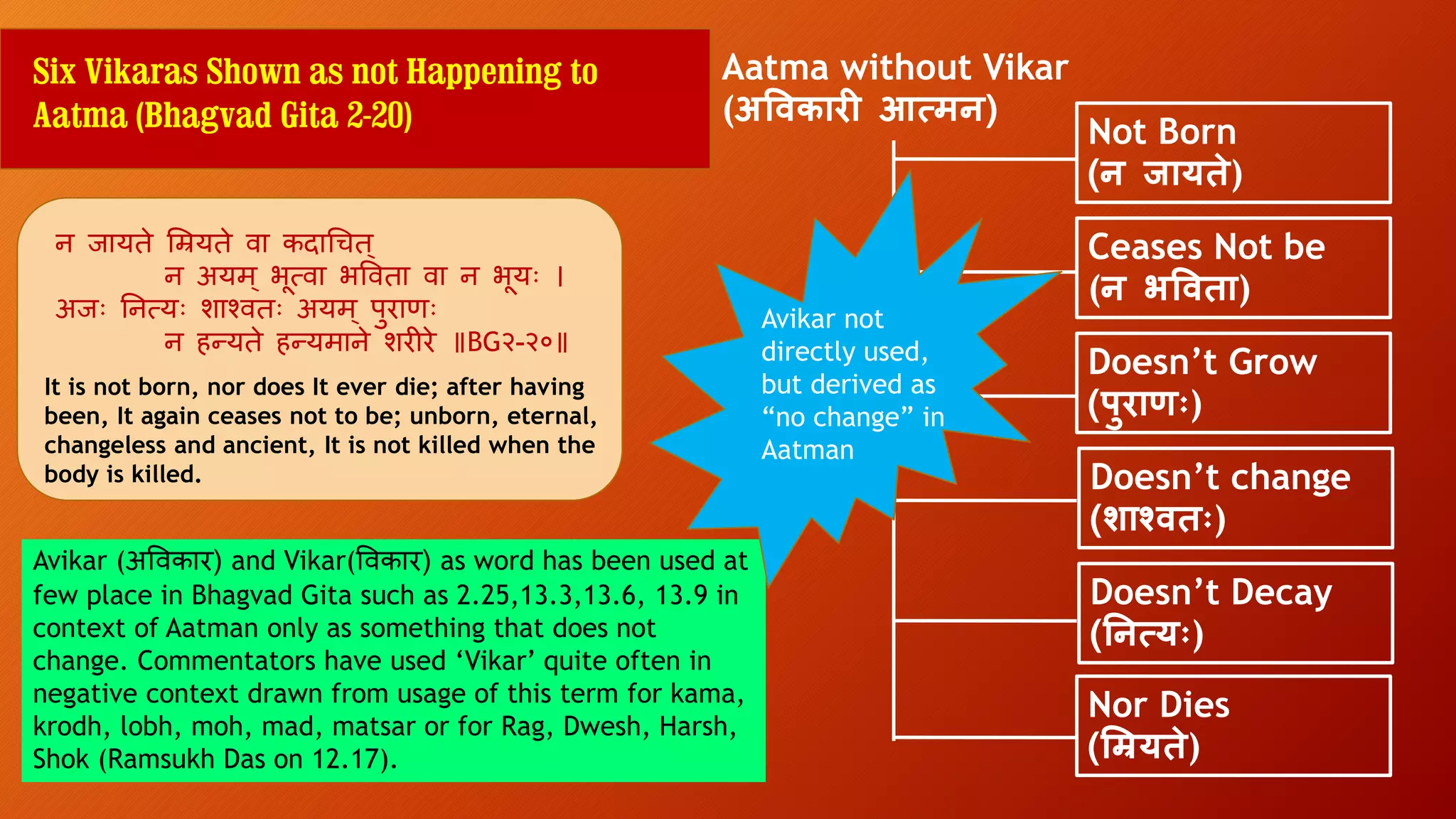
Not Born
(न जायते)
न जा्िे म्रि्िे िा कदाचचि्
न अ्म् भूत्िा भवििा िा न भू्िः ।
अजिः तनत््िः शाश्िििः अ्म् पुरा िः
न हत्िे हत्माने शरीरे ॥BG२-२०॥
Six Vikaras Shown as not Happening to
Aatma (Bhagvad Gita 2-20)
Avikar (अविकार) and Vikar(विकार) as word has been used at
few place in Bhagvad Gita such as 2.25,13.3,13.6, 13.9 in
context of Aatman only as something that does not
change. Commentators have used ‘Vikar’ quite often in
negative context drawn from usage of this term for kama,
krodh, lobh, moh, mad, matsar or for Rag, Dwesh, Harsh,
Shok (Ramsukh Das on 12.17).
Aatma without Vikar
(अववकारी आत्मन)
Ceases Not be
(न भववता)
Doesn’t Grow
(पुराणः)
Doesn’t change
(शाश्वतः)
Doesn’t Decay
(तनत्यः)
Nor Dies
(म्रियते)
Avikar not
directly used,
but derived as
“no change” in
Aatman
It is not born, nor does It ever die; after having
been, It again ceases not to be; unborn, eternal,
changeless and ancient, It is not killed when the
body is killed.
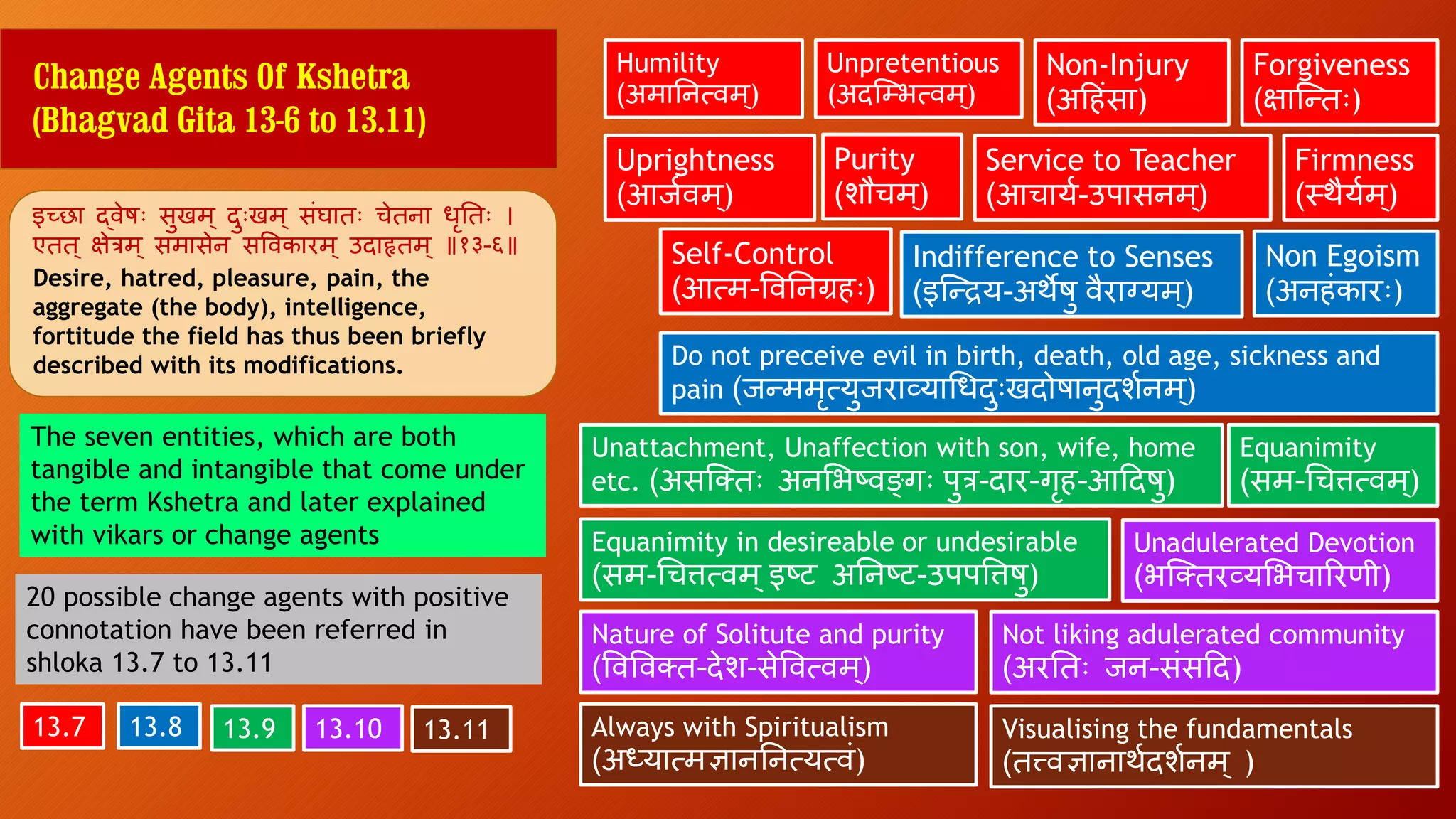
Humility
(अमातनत्िम ्)
इच्छा द्िेषिः सुखम् दुिःखम् संघाििः चेिना र्ृतििः ।
एिि् क्षेत्रम् समासेन सविकारम् उदाहृिम् ॥१३-६॥
Change Agents Of Kshetra
(Bhagvad Gita 13-6 to 13.11)
The seven entities, which are both
tangible and intangible that come under
the term Kshetra and later explained
with vikars or change agents
Unpretentious
(अदन्भभत्िम्)
Forgiveness
(क्षान्तििः)
Uprightness
(आजािम्)
Service to Teacher
(आचा्ा-उपासनम ्)
Desire, hatred, pleasure, pain, the
aggregate (the body), intelligence,
fortitude the field has thus been briefly
described with its modifications.
Purity
(शौचम ्)
Firmness
(तथ्ाम्)
Self-Control
(आत्म-वितनग्रहिः)
Indifference to Senses
(इन्ति्-अथेषु िराग्य्म ्)
Non Egoism
(अनहंकारिः)
Non-Injury
(अदहंसा)
Do not preceive evil in birth, death, old age, sickness and
pain (जतममृत््ुजराव््ाचर्दुिःखदोषानुदशानम ्)
Unattachment, Unaffection with son, wife, home
etc. (असन््ििः अनम्रभर्षिङ्गिः पुत्र-दार-गृह-आददषु)
Equanimity
(सम-चचत्तत्िम ्)
Equanimity in desireable or undesirable
(सम-चचत्तत्िम ्इर्षट अतनर्षट-उपपवत्तषु)
Unadulerated Devotion
(भन््िरव््म्रभचारर ी)
Nature of Solitute and purity
(विवि्ि-देश-सेवित्िम ्)
Not liking adulerated community
(अरतििः जन-संसदद)
Always with Spiritualism
(अध््ात्मज्ञानतनत््त्िं)
Visualising the fundamentals
(ित्त्िज्ञानाथादशानम ् )
20 possible change agents with positive
connotation have been referred in
shloka 13.7 to 13.11
13.7 13.8 13.9 13.10 13.11
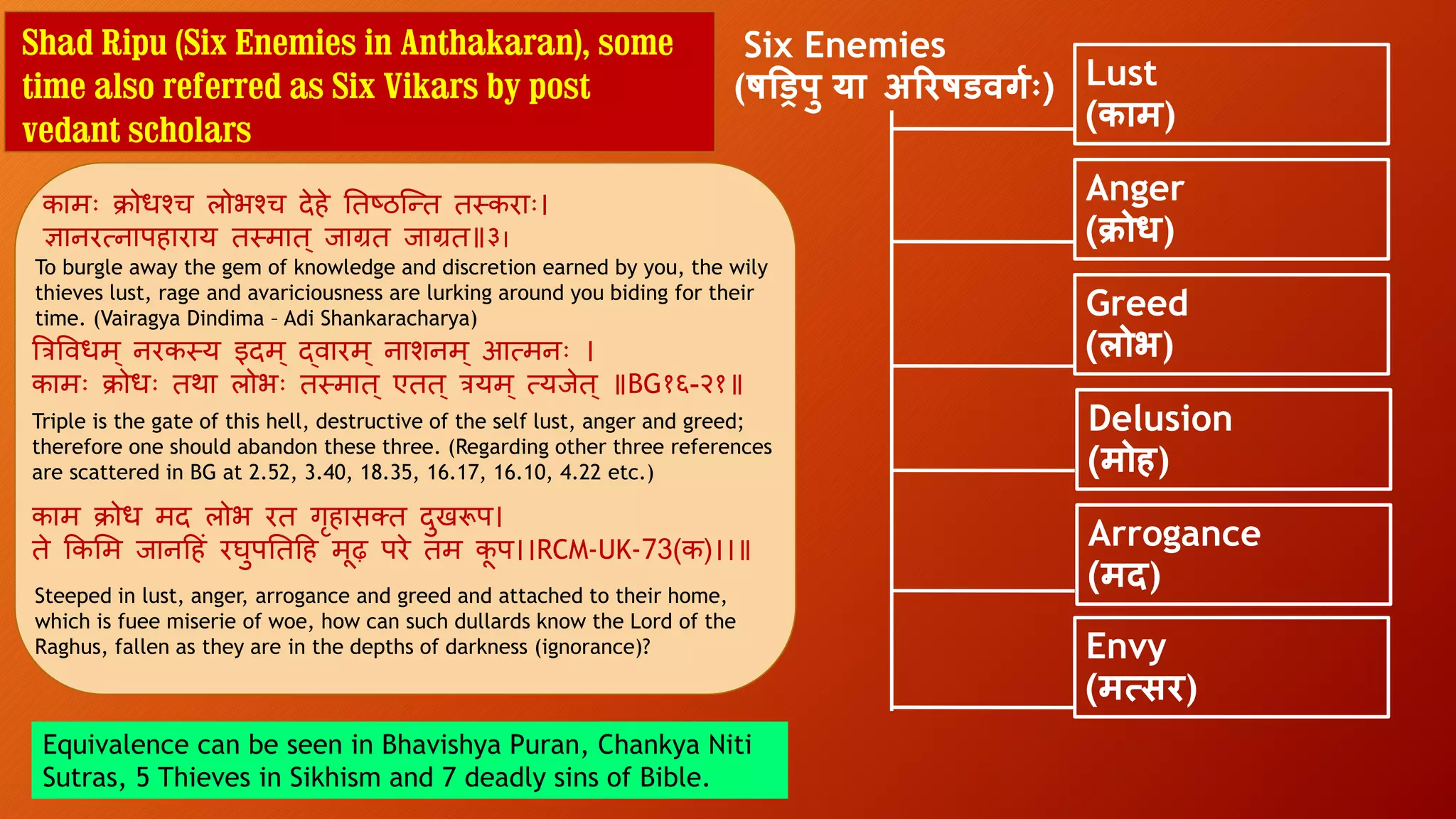
Lust
(काम)
कामिः क्रोर्श्च लोभश्च देहे तिर्षठन्ति ितकरािः।
ज्ञानरत्नापहारा् ितमाि् जाग्रि जाग्रि॥३।
Shad Ripu (Six Enemies in Anthakaran), some
time also referred as Six Vikars by post
vedant scholars
Equivalence can be seen in Bhavishya Puran, Chankya Niti
Sutras, 5 Thieves in Sikhism and 7 deadly sins of Bible.
Six Enemies
(षड्रिपु या अररषडवर्धः)
Anger
(क्रोर्)
Greed
(लोभ)
Delusion
(मोह)
Arrogance
(मद)
Envy
(मत्सर)
To burgle away the gem of knowledge and discretion earned by you, the wily
thieves lust, rage and avariciousness are lurking around you biding for their
time. (Vairagya Dindima – Adi Shankaracharya)
त्रत्रविर्म् नरकत् इदम् द्िारम् नाशनम् आत्मनिः ।
कामिः क्रोर्िः िथा लोभिः ितमाि् एिि् त्र्म् त््जेि् ॥BG१६-२१॥
Triple is the gate of this hell, destructive of the self lust, anger and greed;
therefore one should abandon these three. (Regarding other three references
are scattered in BG at 2.52, 3.40, 18.35, 16.17, 16.10, 4.22 etc.)
काम क्रोर् मद लोभ रि गृहास्ि दुखरूप।
िे ककम्रम जानदहं रघुपतिदह मूढ़ परे िम क
ू प।।RCM-UK-73(क)।।॥
Steeped in lust, anger, arrogance and greed and attached to their home,
which is fuee miserie of woe, how can such dullards know the Lord of the
Raghus, fallen as they are in the depths of darkness (ignorance)?

Vikars (विकार) explained in Vedic and Modern Context

  • 1.
    Understanding Vikar (विकार कोसमझना) The word ‘Vikar’ has been used in many different context in our Indian Scriptures. We try to explore many references and evolve an understanding with reference to different original writings and commentaries thereof.
  • 2.
    Overview The word ‘Vikar’which if we try to google gives its meaning as ‘disorder’. But when we try to explore it usage in Indian scriptures, we find that it has been used frequently to mean ‘modifications’ or ‘changes’. Exploring its meaning in Sanskrit we find its origin is based on two words ‘Vivartan” and “Aakar” meaning “Transformation” and “Shape”. The word ‘Vivartan’ is also used for diffraction in Hindi Science books. In most of the vedic and vedant literature its use in this context as meaning ‘change’ is rather quite consistent. Gradually in post vedic literature its negative connotation has evolved and has been often used in context of evils, sins or disorders also. We present to you the use of word ‘Vikar’ in context of etymology in ‘vedangas’, For ‘Sthool Sharir’ by Shankaracharya, For “Avikari Aatma” in Gitta, For ‘Kshetra’ in Gita and as an equivalent word for ‘Six Ripus’ in some other texts. To prepare this presentation following references have been used: - Nirukta (Vedanga) by Rishi Yasya - Tattvabodh by Adhi Shankaracharya - Shrimad Bhagawad Gita (Commentary by Shri RamukhDas) - Shrimad Bhagawad Gita (Commentary and Translation by Swami Sivananda) - Vairagya Dindima by Adi Shankaracharya - Shri Ram Charit Manas by Goswami Tulsidas - As indicative reference Chanakya Niti Sutras, Bhavishya Puran, Guru Granth Sahib & Bible
  • 3.
    Birth (जायते) षड् भािाविकारा भिन्तिइति िार्ष्ाा-्ण िः । जा्िे अन्ति विपरर मिे िर्ािे अपक्षी्िे विनश््ति इति।। Six Bhav-Vikaras (Based on Nirukta – method to understand words of Vedas, as explained by Rishi Yasya – 1.2 ) Nirukta is considered as one of the vedangas. (Others being shiksha, kalp, vyakaran, chand and jyotish). It is considered that Niruktas helps to understand deeper meaning, beyond the shiksha and vyakaran of vedic verses. Major part was developed by Rishi Varshya-Yani which was later documented as 12 chapters written by Rishi Yasya. This illustration was later explained by Bharthari – renunciated sibling of King Vikramaditya. Bhav-Vikara (भाव-ववकार) Existence (अस्तत) Matures (ववपररणमते) Grows (वर्धते) Decays (अपक्षीयते) Dies (ववनश्यतत) Vikar used in context of “Change” As per Varsha-yani (Originator of Nirukta) there are six changes to the expressions. It originates, it stays, it matures, it grows, it decays and it dies.
  • 4.
    Existence (अस्तत) तथूलशरीरं ककम्? पंचीक्रिपंचमहाभूििः क्रिंसत्कमाजत्ं, सुखादुिःखाददभॊगा्िनं शरीरम् अन्ति जा्िे िर्ािे विपरर मिे अपक्षी्िे विनश््िीति षड्विकारिदेिि् तथूलशरीरम् ।। Six Sthool-Sahrir-Vikaras (Based on Tattvabodh of Shankaracharya, Ref 3.1) Other than lot of commentaries on Upnishads and Gita etc. Tattva Bodh and Aatma Bodh are original works of Adi Shankaracharya with simple answers to various terms like Aatma, Body types, Resources, Indriya, Awastha etc. Aatma bodh illustrates Aatman with practical examples. Sthool Sharir Vikara (तथूल शरीर ववकार) Birth (जायते) Grows (वर्धते) Matures (ववपररणमते) Decays (अपक्षीयते) Dies (ववनश्यतत) Vikar used in context of “Change” What is Sthool Sharir (Gross Body)? That which has undergone five transformations of five basic elements, due to good deeds of life and is a instrument to experience joy and sorrow. It exists, it takes birth, it grows, it matures, it decays and finally it ends. This is what is said about sthool sharir.
  • 5.
    Not Born (न जायते) नजा्िे म्रि्िे िा कदाचचि् न अ्म् भूत्िा भवििा िा न भू्िः । अजिः तनत््िः शाश्िििः अ्म् पुरा िः न हत्िे हत्माने शरीरे ॥BG२-२०॥ Six Vikaras Shown as not Happening to Aatma (Bhagvad Gita 2-20) Avikar (अविकार) and Vikar(विकार) as word has been used at few place in Bhagvad Gita such as 2.25,13.3,13.6, 13.9 in context of Aatman only as something that does not change. Commentators have used ‘Vikar’ quite often in negative context drawn from usage of this term for kama, krodh, lobh, moh, mad, matsar or for Rag, Dwesh, Harsh, Shok (Ramsukh Das on 12.17). Aatma without Vikar (अववकारी आत्मन) Ceases Not be (न भववता) Doesn’t Grow (पुराणः) Doesn’t change (शाश्वतः) Doesn’t Decay (तनत्यः) Nor Dies (म्रियते) Avikar not directly used, but derived as “no change” in Aatman It is not born, nor does It ever die; after having been, It again ceases not to be; unborn, eternal, changeless and ancient, It is not killed when the body is killed.
  • 6.
    Humility (अमातनत्िम ्) इच्छा द्िेषिःसुखम् दुिःखम् संघाििः चेिना र्ृतििः । एिि् क्षेत्रम् समासेन सविकारम् उदाहृिम् ॥१३-६॥ Change Agents Of Kshetra (Bhagvad Gita 13-6 to 13.11) The seven entities, which are both tangible and intangible that come under the term Kshetra and later explained with vikars or change agents Unpretentious (अदन्भभत्िम्) Forgiveness (क्षान्तििः) Uprightness (आजािम्) Service to Teacher (आचा्ा-उपासनम ्) Desire, hatred, pleasure, pain, the aggregate (the body), intelligence, fortitude the field has thus been briefly described with its modifications. Purity (शौचम ्) Firmness (तथ्ाम्) Self-Control (आत्म-वितनग्रहिः) Indifference to Senses (इन्ति्-अथेषु िराग्य्म ्) Non Egoism (अनहंकारिः) Non-Injury (अदहंसा) Do not preceive evil in birth, death, old age, sickness and pain (जतममृत््ुजराव््ाचर्दुिःखदोषानुदशानम ्) Unattachment, Unaffection with son, wife, home etc. (असन््ििः अनम्रभर्षिङ्गिः पुत्र-दार-गृह-आददषु) Equanimity (सम-चचत्तत्िम ्) Equanimity in desireable or undesirable (सम-चचत्तत्िम ्इर्षट अतनर्षट-उपपवत्तषु) Unadulerated Devotion (भन््िरव््म्रभचारर ी) Nature of Solitute and purity (विवि्ि-देश-सेवित्िम ्) Not liking adulerated community (अरतििः जन-संसदद) Always with Spiritualism (अध््ात्मज्ञानतनत््त्िं) Visualising the fundamentals (ित्त्िज्ञानाथादशानम ् ) 20 possible change agents with positive connotation have been referred in shloka 13.7 to 13.11 13.7 13.8 13.9 13.10 13.11
  • 7.
    Lust (काम) कामिः क्रोर्श्च लोभश्चदेहे तिर्षठन्ति ितकरािः। ज्ञानरत्नापहारा् ितमाि् जाग्रि जाग्रि॥३। Shad Ripu (Six Enemies in Anthakaran), some time also referred as Six Vikars by post vedant scholars Equivalence can be seen in Bhavishya Puran, Chankya Niti Sutras, 5 Thieves in Sikhism and 7 deadly sins of Bible. Six Enemies (षड्रिपु या अररषडवर्धः) Anger (क्रोर्) Greed (लोभ) Delusion (मोह) Arrogance (मद) Envy (मत्सर) To burgle away the gem of knowledge and discretion earned by you, the wily thieves lust, rage and avariciousness are lurking around you biding for their time. (Vairagya Dindima – Adi Shankaracharya) त्रत्रविर्म् नरकत् इदम् द्िारम् नाशनम् आत्मनिः । कामिः क्रोर्िः िथा लोभिः ितमाि् एिि् त्र्म् त््जेि् ॥BG१६-२१॥ Triple is the gate of this hell, destructive of the self lust, anger and greed; therefore one should abandon these three. (Regarding other three references are scattered in BG at 2.52, 3.40, 18.35, 16.17, 16.10, 4.22 etc.) काम क्रोर् मद लोभ रि गृहास्ि दुखरूप। िे ककम्रम जानदहं रघुपतिदह मूढ़ परे िम क ू प।।RCM-UK-73(क)।।॥ Steeped in lust, anger, arrogance and greed and attached to their home, which is fuee miserie of woe, how can such dullards know the Lord of the Raghus, fallen as they are in the depths of darkness (ignorance)?