FACULTY OF ENGINEERING
DEPARTMENT OF CIVIL AND STRUCTURAL ENGINEERING
KKKA6424
INTELLIGENT URBAN TRAFFIC CONTROL SYSTEM
Prof. Dr. Riza Atiq Abdullah O.K. Rahmat
TASK (5) VIDEO / IMAGE PROCESSING
PREPARED BY:
WAEL SAAD HAMEEDI
P71062
INTRODUCTION TO VIDEO / IMAGE PROCESSING
WHAT IS VIDEO / IMAGE PROCESSING ?
Image processing is a method to convert an image into digital form and perform some
operations on it, in order to get an enhanced image or to extract some useful information
from it. It is a type of signal dispensation in which input is image, like video frame or
photograph and output may be image or characteristics associated with that image.
Usually Image Processing system includes treating images as two dimensional signals while
applying already set signal processing methods to them.
It is among rapidly growing technologies today, with its applications in various aspects of a
business. Image Processing forms core research area within engineering and computer
science disciplines too.
Image processing basically includes the following three steps :
 Importing the image with optical scanner or by digital photography.
 Analyzing and manipulating the image which includes data compression and image
enhancement and spotting patterns that are not to human eyes like satellite
photographs.
 Output is the last stage in which result can be altered image or report that is based on
image analysis.
PURPOSE OF IMAGE PROCESSING ?
The purpose of image processing is divided into 5 groups. They are:
1. Visualization - Observe the objects that are not visible.
2. Image sharpening and restoration - To create a better image.
3. Image retrieval - Seek for the image of interest.
4. Measurement of pattern – Measures various objects in an image.
5. Image Recognition – Distinguish the objects in an image.
Types
The two types of methods used for Image Processing are Analog and Digital Image
Processing. Analog or visual techniques of image processing can be used for the hard copies
like printouts and photographs. Image analysts use various fundamentals of interpretation
while using these visual techniques. The image processing is not just confined to area that
has to be studied but on knowledge of analyst. Association is another important tool in
image processing through visual techniques. So analysts apply a combination of personal
knowledge and collateral data to image processing.
Digital Processing techniques help in manipulation of the digital images by using
computers. As raw data from imaging sensors from satellite platform contains deficiencies.
To get over such flaws and to get originality of information, it has to undergo various phases
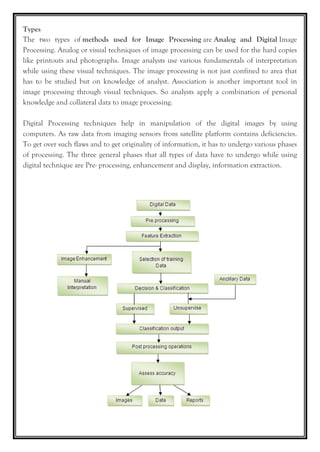
of processing. The three general phases that all types of data have to undergo while using
digital technique are Pre- processing, enhancement and display, information extraction.
WHAT IS THE APLICATIONS OF VIDEO / IMAGE PROCESSING ?
Applications
1. Intelligent Transportation Systems – This technique can be used in Automatic
number plate recognition and Traffic sign recognition.
2. Remote Sensing – For this application, sensors capture the pictures of the earth’s
surface in remote sensing satellites or multi – spectral scanner which is mounted on an
aircraft. These pictures are processed by transmitting it to the Earth station. Techniques
used to interpret the objects and regions are used in flood control, city planning, resource
mobilization, agricultural production monitoring, etc.
3. Moving object tracking – This application enables to measure motion parameters and
acquire visual record of the moving object. The different types of approach to track an
object are:
 Motion based tracking
 Recognition based tracking
4. Defense surveillance – Aerial surveillance methods are used to continuously keep an
eye on the land and oceans. This application is also used to locate the types and formation
of naval vessels of the ocean surface. The important duty is to divide the various objects
present in the water body part of the image. The different parameters such as length,
breadth, area, perimeter, compactness are set up to classify each of divided objects. It is
important to recognize the distribution of these objects in different directions that are east,
west, north, south, northeast, northwest, southeast and south west to explain all possible
formations of the vessels. We can interpret the entire oceanic scenario from the spatial
distribution of these objects.
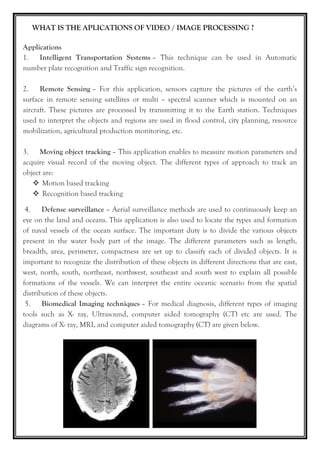
5. Biomedical Imaging techniques – For medical diagnosis, different types of imaging
tools such as X- ray, Ultrasound, computer aided tomography (CT) etc are used. The
diagrams of X- ray, MRI, and computer aided tomography (CT) are given below.
Some of the applications of Biomedical imaging applications are as follows:
 Heart disease identification– The important diagnostic features such as size of the heart
and its shape are required to know in order to classify the heart diseases. To improve the
diagnosis of heart diseases, image analysis techniques are employed to radiographic
images.
 Lung disease identification – In X- rays, the regions that appear dark contain air while
region that appears lighter are solid tissues. Bones are more radio opaque than tissues.
The ribs, the heart, thoracic spine, and the diaphragm that separates the chest cavity from
the abdominal cavity are clearly seen on the X-ray film.
 Digital mammograms – This is used to detect the breast tumour. Mammograms can be
analyzed using Image processing techniques such as segmentation, shape analysis, contrast
enhancement, feature extraction, etc.
6. Automatic Visual Inspection System – This application improves the quality and
productivity of the product in the industries.
 Automatic inspection of incandescent lamp filaments – This involves examination of
the bulb manufacturing process. Due to no uniformity in the pitch of the wiring in the
lamp, the filament of the bulb gets fused within a short duration. In this application, a
binary image slice of the filament is created from which the silhouette of the filament
is fabricated. Silhouettes are analyzed to recognize the non uniformity in the pitch of
the wiring in the lamp. This system is being used by the General Electric Corporation.
 Automatic surface inspection systems – In metal industries it is essential to detect the
flaws on the surfaces. For instance, it is essential to detect any kind of aberration on
the rolled metal surface in the hot or cold rolling mills in a steel plant. Image
processing techniques such as texture identification, edge detection, fractal analysis etc
are used for the detection.
 Faulty component identification – This application identifies the faulty components
in electronic or electromechanical systems. Higher amount of thermal energy is
generated by these faulty components. The Infra-red images are produced from the
distribution of thermal energies in the assembly. The faulty components can be
identified by analyzing the Infra-red images.
WHAT IS PIXEL ANALYSIS ?
The measurement for resolution is Pixels Per Foot (PPF). A pixel, or picture element, is
defined as the smallest piece of information in an image, usually in the form of a dot. As a
rule of thumb, the minimum number of pixels to recognize faces is 40 PPF; the minimum
number for reading license plates is 80 PPF. Distance from the camera also plays a part. If
the subject is far away from the camera, it will be a smaller portion of the overall image; that
means fewer pixels are available, so resolution will suffer.
Why is higher resolution more costly? PPF is a one-dimensional measure, but pictures are
two dimensional. The number of pixels in a picture is proportional to the square of the PPF.
That means the 40 PPF needed to recognize a face is actually 40x40, or 1600 pixels (a face is
roughly one square foot in area). To display the 80 PPF that permits license plate readability,
the same picture must be 80x80, or 6400 pixels. The more pixels, the more information to
be sent over the network, and that means more bandwidth.
AREA OF INTEREST
CCTV Cameras are video cameras located along the freeway corridors that send video
images to the traffic management center where there are monitors and operators, who view
them.
The traffic images can be used to verify traffic accidents or congestion and can sometimes
even assist in determining appropriate resources for incident clearance (i.e., fire trucks,
ambulance, tow trucks, etc.).
CCTV cameras are affordable, effective, and are proven to provide valuable information
that can save time. The preferable style includes pan, tilt zoom (PTZ) features so that the
operator can zoom in on a specific incident or, pan out for a view of the traffic queue. TMC
operators can make a visual check of field conditions at a reported site. The operator can
move the nearest camera to focus on the area of interest to verify the incident then check
the nature of the incident and severity, make recommendations and finally, observe the
progress of incident response and clearance. Cameras are often used to check the message
displayed on changeable message signs.
CCTV cameras are most effective for use in traffic incident management if they are
deployed along corridors or at intersections where there are high volumes of traffic or
frequent incidents.
THANK YOU

Video / Image Processing ( ITS / Task 5 ) done by Wael Saad Hameedi / P71062

  • 1.
    FACULTY OF ENGINEERING DEPARTMENTOF CIVIL AND STRUCTURAL ENGINEERING KKKA6424 INTELLIGENT URBAN TRAFFIC CONTROL SYSTEM Prof. Dr. Riza Atiq Abdullah O.K. Rahmat TASK (5) VIDEO / IMAGE PROCESSING PREPARED BY: WAEL SAAD HAMEEDI P71062
  • 2.
    INTRODUCTION TO VIDEO/ IMAGE PROCESSING WHAT IS VIDEO / IMAGE PROCESSING ? Image processing is a method to convert an image into digital form and perform some operations on it, in order to get an enhanced image or to extract some useful information from it. It is a type of signal dispensation in which input is image, like video frame or photograph and output may be image or characteristics associated with that image. Usually Image Processing system includes treating images as two dimensional signals while applying already set signal processing methods to them. It is among rapidly growing technologies today, with its applications in various aspects of a business. Image Processing forms core research area within engineering and computer science disciplines too. Image processing basically includes the following three steps :  Importing the image with optical scanner or by digital photography.  Analyzing and manipulating the image which includes data compression and image enhancement and spotting patterns that are not to human eyes like satellite photographs.  Output is the last stage in which result can be altered image or report that is based on image analysis. PURPOSE OF IMAGE PROCESSING ? The purpose of image processing is divided into 5 groups. They are: 1. Visualization - Observe the objects that are not visible. 2. Image sharpening and restoration - To create a better image. 3. Image retrieval - Seek for the image of interest. 4. Measurement of pattern – Measures various objects in an image. 5. Image Recognition – Distinguish the objects in an image.
  • 3.
    Types The two typesof methods used for Image Processing are Analog and Digital Image Processing. Analog or visual techniques of image processing can be used for the hard copies like printouts and photographs. Image analysts use various fundamentals of interpretation while using these visual techniques. The image processing is not just confined to area that has to be studied but on knowledge of analyst. Association is another important tool in image processing through visual techniques. So analysts apply a combination of personal knowledge and collateral data to image processing. Digital Processing techniques help in manipulation of the digital images by using computers. As raw data from imaging sensors from satellite platform contains deficiencies. To get over such flaws and to get originality of information, it has to undergo various phases of processing. The three general phases that all types of data have to undergo while using digital technique are Pre- processing, enhancement and display, information extraction.
  • 4.
    WHAT IS THEAPLICATIONS OF VIDEO / IMAGE PROCESSING ? Applications 1. Intelligent Transportation Systems – This technique can be used in Automatic number plate recognition and Traffic sign recognition. 2. Remote Sensing – For this application, sensors capture the pictures of the earth’s surface in remote sensing satellites or multi – spectral scanner which is mounted on an aircraft. These pictures are processed by transmitting it to the Earth station. Techniques used to interpret the objects and regions are used in flood control, city planning, resource mobilization, agricultural production monitoring, etc. 3. Moving object tracking – This application enables to measure motion parameters and acquire visual record of the moving object. The different types of approach to track an object are:  Motion based tracking  Recognition based tracking 4. Defense surveillance – Aerial surveillance methods are used to continuously keep an eye on the land and oceans. This application is also used to locate the types and formation of naval vessels of the ocean surface. The important duty is to divide the various objects present in the water body part of the image. The different parameters such as length, breadth, area, perimeter, compactness are set up to classify each of divided objects. It is important to recognize the distribution of these objects in different directions that are east, west, north, south, northeast, northwest, southeast and south west to explain all possible formations of the vessels. We can interpret the entire oceanic scenario from the spatial distribution of these objects. 5. Biomedical Imaging techniques – For medical diagnosis, different types of imaging tools such as X- ray, Ultrasound, computer aided tomography (CT) etc are used. The diagrams of X- ray, MRI, and computer aided tomography (CT) are given below.
  • 5.
    Some of theapplications of Biomedical imaging applications are as follows:  Heart disease identification– The important diagnostic features such as size of the heart and its shape are required to know in order to classify the heart diseases. To improve the diagnosis of heart diseases, image analysis techniques are employed to radiographic images.  Lung disease identification – In X- rays, the regions that appear dark contain air while region that appears lighter are solid tissues. Bones are more radio opaque than tissues. The ribs, the heart, thoracic spine, and the diaphragm that separates the chest cavity from the abdominal cavity are clearly seen on the X-ray film.  Digital mammograms – This is used to detect the breast tumour. Mammograms can be analyzed using Image processing techniques such as segmentation, shape analysis, contrast enhancement, feature extraction, etc. 6. Automatic Visual Inspection System – This application improves the quality and productivity of the product in the industries.  Automatic inspection of incandescent lamp filaments – This involves examination of the bulb manufacturing process. Due to no uniformity in the pitch of the wiring in the lamp, the filament of the bulb gets fused within a short duration. In this application, a binary image slice of the filament is created from which the silhouette of the filament is fabricated. Silhouettes are analyzed to recognize the non uniformity in the pitch of the wiring in the lamp. This system is being used by the General Electric Corporation.  Automatic surface inspection systems – In metal industries it is essential to detect the flaws on the surfaces. For instance, it is essential to detect any kind of aberration on the rolled metal surface in the hot or cold rolling mills in a steel plant. Image processing techniques such as texture identification, edge detection, fractal analysis etc are used for the detection.  Faulty component identification – This application identifies the faulty components in electronic or electromechanical systems. Higher amount of thermal energy is generated by these faulty components. The Infra-red images are produced from the distribution of thermal energies in the assembly. The faulty components can be identified by analyzing the Infra-red images.
  • 6.
    WHAT IS PIXELANALYSIS ? The measurement for resolution is Pixels Per Foot (PPF). A pixel, or picture element, is defined as the smallest piece of information in an image, usually in the form of a dot. As a rule of thumb, the minimum number of pixels to recognize faces is 40 PPF; the minimum number for reading license plates is 80 PPF. Distance from the camera also plays a part. If the subject is far away from the camera, it will be a smaller portion of the overall image; that means fewer pixels are available, so resolution will suffer. Why is higher resolution more costly? PPF is a one-dimensional measure, but pictures are two dimensional. The number of pixels in a picture is proportional to the square of the PPF. That means the 40 PPF needed to recognize a face is actually 40x40, or 1600 pixels (a face is roughly one square foot in area). To display the 80 PPF that permits license plate readability, the same picture must be 80x80, or 6400 pixels. The more pixels, the more information to be sent over the network, and that means more bandwidth.
  • 7.
    AREA OF INTEREST CCTVCameras are video cameras located along the freeway corridors that send video images to the traffic management center where there are monitors and operators, who view them. The traffic images can be used to verify traffic accidents or congestion and can sometimes even assist in determining appropriate resources for incident clearance (i.e., fire trucks, ambulance, tow trucks, etc.). CCTV cameras are affordable, effective, and are proven to provide valuable information that can save time. The preferable style includes pan, tilt zoom (PTZ) features so that the operator can zoom in on a specific incident or, pan out for a view of the traffic queue. TMC operators can make a visual check of field conditions at a reported site. The operator can move the nearest camera to focus on the area of interest to verify the incident then check the nature of the incident and severity, make recommendations and finally, observe the progress of incident response and clearance. Cameras are often used to check the message displayed on changeable message signs. CCTV cameras are most effective for use in traffic incident management if they are deployed along corridors or at intersections where there are high volumes of traffic or frequent incidents.
  • 8.