Videoconferencing Rich Phelps TSM602 Session One
What is Video Conferencing? A videoconference is a set of interactive telecommunications technologies which allow two or more locations to interact via two way audio and video transmissions simultaneously.  Will also see video conferencing referred to as visual collaboration and a type of groupware. Groupware – is a technology that integrates work on a single project by multiple concurrent users.
Benefits to Video Conferencing Can improve work quality Increase productivity Reduce costs $$$$ Improves communication Groups can meet more frequently Critical meetings can be convened in less time More faculty and staff can be involved
Video Conference Components Camera - to capture and send video from your local endpoint. Video Display - to display video received from remote endpoints. Microphone - to capture and send audio from your local endpoint. Speakers - to play audio received from remote endpoints. Broadband Connectivity – to exchange data packets between stations. All Videoconferencing systems have key pieces that make up a system. The components required for a videoconference system include:
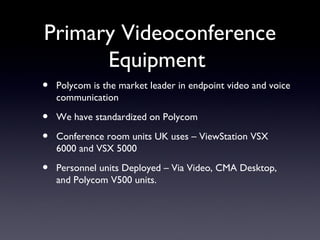
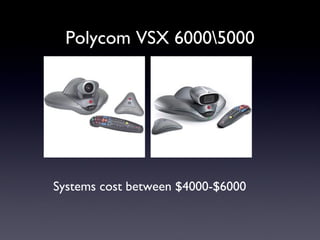
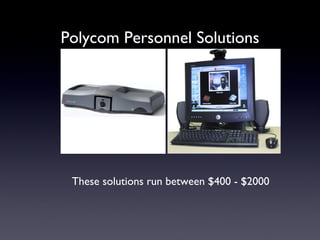
Primary Videoconference Equipment  Polycom is the market leader in endpoint video and voice communication We have standardized on Polycom Conference room units UK uses – ViewStation VSX 6000 and VSX 5000 Personnel units Deployed – Via Video, CMA Desktop, and Polycom V500 units.
Polycom VSX 6000\5000 Systems cost between $4000-$6000
Polycom Personnel Solutions These solutions run between $400 - $2000
Codec, Coder-Decoder Videoconference hardware codes the outgoing video and audio signals and decodes the incoming signals. Prior to transmission, the codec converts analog signals to digital signals and compresses. Incoming audio and video must be decompressed and converted from digital back to analog. Makes the audio/video data “small enough” to be practical for sending real time data over a network connection.
Real-time Transport Protocol Developed in 1996 by IETF Adopted as a standard in 1998 Transmits packets over UDP Media Stream – Separate RTP connection What RTP doesn’t guarantee
H.323 and H.264 H.323 – Video Compression standard that allows a wide variety of videoconferencing systems to communicate over TCP/IP networks. H.264 – A refinement of H.323 standard that allows for high quality sound and picture with less bandwidth than H.323 standard.
Components to support H.323 and H.264 Terminals Gateways Gatekeepers MCU – Multipoint Control Units
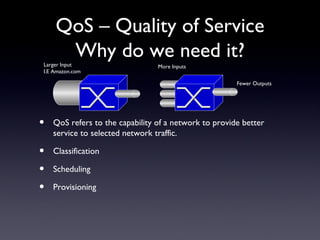
QoS – Quality of Service Why do we need it? QoS refers to the capability of a network to provide better service to selected network traffic.  Classification Scheduling Provisioning Larger Input I.E Amazon.com Fewer Outputs More Inputs

Video Conferencing

  • 1.
  • 2.
    What is VideoConferencing? A videoconference is a set of interactive telecommunications technologies which allow two or more locations to interact via two way audio and video transmissions simultaneously. Will also see video conferencing referred to as visual collaboration and a type of groupware. Groupware – is a technology that integrates work on a single project by multiple concurrent users.
  • 3.
    Benefits to VideoConferencing Can improve work quality Increase productivity Reduce costs $$$$ Improves communication Groups can meet more frequently Critical meetings can be convened in less time More faculty and staff can be involved
  • 4.
    Video Conference ComponentsCamera - to capture and send video from your local endpoint. Video Display - to display video received from remote endpoints. Microphone - to capture and send audio from your local endpoint. Speakers - to play audio received from remote endpoints. Broadband Connectivity – to exchange data packets between stations. All Videoconferencing systems have key pieces that make up a system. The components required for a videoconference system include:
  • 5.
    Primary Videoconference Equipment Polycom is the market leader in endpoint video and voice communication We have standardized on Polycom Conference room units UK uses – ViewStation VSX 6000 and VSX 5000 Personnel units Deployed – Via Video, CMA Desktop, and Polycom V500 units.
  • 6.
    Polycom VSX 6000\5000Systems cost between $4000-$6000
  • 7.
    Polycom Personnel SolutionsThese solutions run between $400 - $2000
  • 8.
    Codec, Coder-Decoder Videoconferencehardware codes the outgoing video and audio signals and decodes the incoming signals. Prior to transmission, the codec converts analog signals to digital signals and compresses. Incoming audio and video must be decompressed and converted from digital back to analog. Makes the audio/video data “small enough” to be practical for sending real time data over a network connection.
  • 9.
    Real-time Transport ProtocolDeveloped in 1996 by IETF Adopted as a standard in 1998 Transmits packets over UDP Media Stream – Separate RTP connection What RTP doesn’t guarantee
  • 10.
    H.323 and H.264H.323 – Video Compression standard that allows a wide variety of videoconferencing systems to communicate over TCP/IP networks. H.264 – A refinement of H.323 standard that allows for high quality sound and picture with less bandwidth than H.323 standard.
  • 11.
    Components to supportH.323 and H.264 Terminals Gateways Gatekeepers MCU – Multipoint Control Units
  • 12.
    QoS – Qualityof Service Why do we need it? QoS refers to the capability of a network to provide better service to selected network traffic. Classification Scheduling Provisioning Larger Input I.E Amazon.com Fewer Outputs More Inputs