Table Contents
 Definition
 Why Robotic Surgery
 Types of Robotic Surgery
 Advantages of Robotic Surgery
 Conclusion
2
Definition
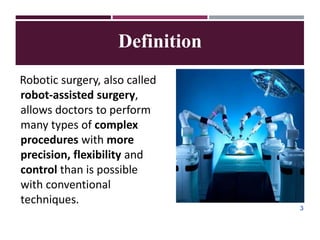
Robotic surgery, also called
robot-assisted surgery,
allows doctors to perform
many types of complex
procedures with more
precision, flexibility and
control than is possible
with conventional
techniques.
3
Why Robotic Surgery?
• Surgeons who use the robotic system find that
for many procedures it enhances precision,
flexibility and control during the operation and
allows them to better see the site, compared
with traditional techniques.
• Using robotic surgery, surgeons can perform
delicate and complex procedures that may be
difficult or impossible with other methods.
●●●
4
Why Robotic Surgery?
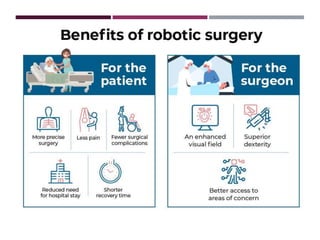
Often, robotic surgery makes minimally invasive
surgery possible. The benefits of minimally invasive
surgery include:
• Fewer complications, such as surgical site
infection
• Less pain and blood loss
• Shorter hospital stay and quicker recovery
• Smaller, less noticeable scars
●●●
5
Types of Robotic Surgery
• Robotic kidney surgery might be required when
one kidney or a part of a kidney needs to be
removed.
• In traditional open surgery, a large incision, up to
eight inches, might be required in order for the
surgery to be performed.
●●●
6
Types of Robotic Surgery
• Robotic gynaecological surgery means less
pain after surgery and lesser blood loss. In
traditional surgery, there is significant pain
involved in any gynaecological surgery and
there is usually physical trauma connected to
the surgery as well.
• Moreover, large incisions are made in open
surgery and this means longer recovery
process.
●●●
7
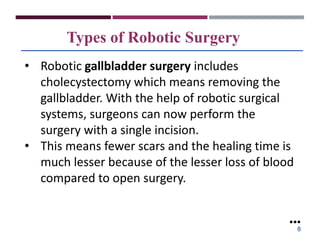
Types of Robotic Surgery
• Robotic gallbladder surgery includes
cholecystectomy which means removing the
gallbladder. With the help of robotic surgical
systems, surgeons can now perform the
surgery with a single incision.
• This means fewer scars and the healing time is
much lesser because of the lesser loss of blood
compared to open surgery.
●●●
8
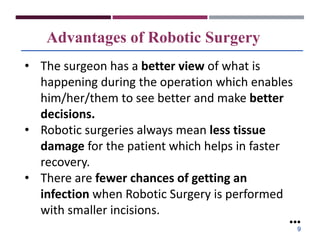
Advantages of Robotic Surgery
• The surgeon has a better view of what is
happening during the operation which enables
him/her/them to see better and make better
decisions.
• Robotic surgeries always mean less tissue
damage for the patient which helps in faster
recovery.
• There are fewer chances of getting an
infection when Robotic Surgery is performed
with smaller incisions.
●●●
9
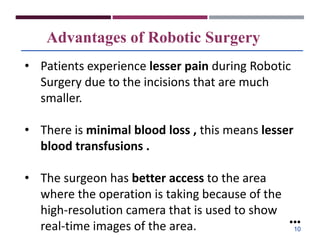
Advantages of Robotic Surgery
• Patients experience lesser pain during Robotic
Surgery due to the incisions that are much
smaller.
• There is minimal blood loss , this means lesser
blood transfusions .
• The surgeon has better access to the area
where the operation is taking because of the
high-resolution camera that is used to show
real-time images of the area. ●●●
10
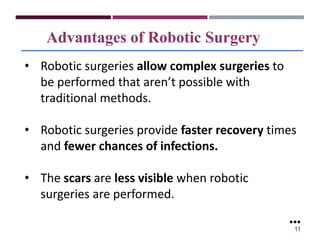
Advantages of Robotic Surgery
• Robotic surgeries allow complex surgeries to
be performed that aren’t possible with
traditional methods.
• Robotic surgeries provide faster recovery times
and fewer chances of infections.
• The scars are less visible when robotic
surgeries are performed.
●●●
11
12
Conclusion
 Robotic surgery, also called robot-assisted
surgery, allows doctors to perform many types of
complex procedures with more precision,
flexibility and control than is possible with
conventional techniques.
13
REFERENCES
• Google.com
• Wikipedia.org
• Studymafia.org
• Slidespanda.com

robotic-surgery.pptx

  • 2.
    Table Contents  Definition Why Robotic Surgery  Types of Robotic Surgery  Advantages of Robotic Surgery  Conclusion 2
  • 3.
    Definition Robotic surgery, alsocalled robot-assisted surgery, allows doctors to perform many types of complex procedures with more precision, flexibility and control than is possible with conventional techniques. 3
  • 4.
    Why Robotic Surgery? •Surgeons who use the robotic system find that for many procedures it enhances precision, flexibility and control during the operation and allows them to better see the site, compared with traditional techniques. • Using robotic surgery, surgeons can perform delicate and complex procedures that may be difficult or impossible with other methods. ●●● 4
  • 5.
    Why Robotic Surgery? Often,robotic surgery makes minimally invasive surgery possible. The benefits of minimally invasive surgery include: • Fewer complications, such as surgical site infection • Less pain and blood loss • Shorter hospital stay and quicker recovery • Smaller, less noticeable scars ●●● 5
  • 6.
    Types of RoboticSurgery • Robotic kidney surgery might be required when one kidney or a part of a kidney needs to be removed. • In traditional open surgery, a large incision, up to eight inches, might be required in order for the surgery to be performed. ●●● 6
  • 7.
    Types of RoboticSurgery • Robotic gynaecological surgery means less pain after surgery and lesser blood loss. In traditional surgery, there is significant pain involved in any gynaecological surgery and there is usually physical trauma connected to the surgery as well. • Moreover, large incisions are made in open surgery and this means longer recovery process. ●●● 7
  • 8.
    Types of RoboticSurgery • Robotic gallbladder surgery includes cholecystectomy which means removing the gallbladder. With the help of robotic surgical systems, surgeons can now perform the surgery with a single incision. • This means fewer scars and the healing time is much lesser because of the lesser loss of blood compared to open surgery. ●●● 8
  • 9.
    Advantages of RoboticSurgery • The surgeon has a better view of what is happening during the operation which enables him/her/them to see better and make better decisions. • Robotic surgeries always mean less tissue damage for the patient which helps in faster recovery. • There are fewer chances of getting an infection when Robotic Surgery is performed with smaller incisions. ●●● 9
  • 10.
    Advantages of RoboticSurgery • Patients experience lesser pain during Robotic Surgery due to the incisions that are much smaller. • There is minimal blood loss , this means lesser blood transfusions . • The surgeon has better access to the area where the operation is taking because of the high-resolution camera that is used to show real-time images of the area. ●●● 10
  • 11.
    Advantages of RoboticSurgery • Robotic surgeries allow complex surgeries to be performed that aren’t possible with traditional methods. • Robotic surgeries provide faster recovery times and fewer chances of infections. • The scars are less visible when robotic surgeries are performed. ●●● 11
  • 12.
  • 13.
    Conclusion  Robotic surgery,also called robot-assisted surgery, allows doctors to perform many types of complex procedures with more precision, flexibility and control than is possible with conventional techniques. 13
  • 14.
    REFERENCES • Google.com • Wikipedia.org •Studymafia.org • Slidespanda.com