VIBRATION ABSORPTION
•We have learned that an effective way to passively control
vibration is through the usage of a "vibration absorber".
•A typical vibration absorber is a single-DOF
spring/mass/dashpot system that is attached to a vibration
body.
•The stiffness and mass of the absorber are designed in
order to produce an "anti-resonance" in the total system
response.
•For a single-DOF system, the absorber is "tuned" to match
its natural frequency with the natural frequency of the
original system. With this choice:
• An anti-resonance is produced at the natural
frequency of the original system.
• The larger the mass of the absorber the larger the
bandwidth between the resonances of the
absorbed system.
• Typically light damping is desirable in order to
minimize the response at the operating frequency.
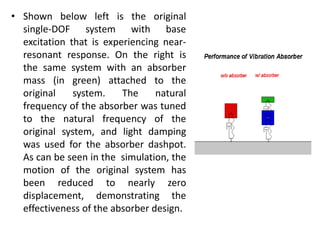
• Shown below left is the original
single-DOF system with base
excitation that is experiencing near-
resonant response. On the right is
the same system with an absorber
mass (in green) attached to the
original system. The natural
frequency of the absorber was tuned
to the natural frequency of the
original system, and light damping
was used for the absorber dashpot.
As can be seen in the simulation, the
motion of the original system has
been reduced to nearly zero
displacement, demonstrating the
effectiveness of the absorber design.
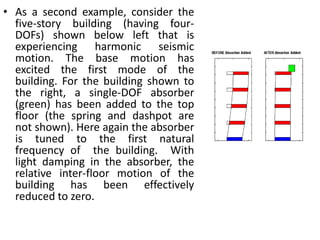
• As a second example, consider the
five-story building (having four-
DOFs) shown below left that is
experiencing harmonic seismic
motion. The base motion has
excited the first mode of the
building. For the building shown to
the right, a single-DOF absorber
(green) has been added to the top
floor (the spring and dashpot are
not shown). Here again the absorber
is tuned to the first natural
frequency of the building. With
light damping in the absorber, the
relative inter-floor motion of the
building has been effectively
reduced to zero.
vibration absorber.pptx

vibration absorber.pptx

  • 1.
    VIBRATION ABSORPTION •We havelearned that an effective way to passively control vibration is through the usage of a "vibration absorber". •A typical vibration absorber is a single-DOF spring/mass/dashpot system that is attached to a vibration body. •The stiffness and mass of the absorber are designed in order to produce an "anti-resonance" in the total system response. •For a single-DOF system, the absorber is "tuned" to match its natural frequency with the natural frequency of the original system. With this choice:
  • 2.
    • An anti-resonanceis produced at the natural frequency of the original system. • The larger the mass of the absorber the larger the bandwidth between the resonances of the absorbed system. • Typically light damping is desirable in order to minimize the response at the operating frequency.
  • 3.
    • Shown belowleft is the original single-DOF system with base excitation that is experiencing near- resonant response. On the right is the same system with an absorber mass (in green) attached to the original system. The natural frequency of the absorber was tuned to the natural frequency of the original system, and light damping was used for the absorber dashpot. As can be seen in the simulation, the motion of the original system has been reduced to nearly zero displacement, demonstrating the effectiveness of the absorber design.
  • 4.
    • As asecond example, consider the five-story building (having four- DOFs) shown below left that is experiencing harmonic seismic motion. The base motion has excited the first mode of the building. For the building shown to the right, a single-DOF absorber (green) has been added to the top floor (the spring and dashpot are not shown). Here again the absorber is tuned to the first natural frequency of the building. With light damping in the absorber, the relative inter-floor motion of the building has been effectively reduced to zero.