Presentation
on
HEAT TRANSFER
submitted by: Aaditya soni
b.tech(mechanical)
It is the form of energy that could be transfer
from one system to another.
Heat is never contained in a body.
Associated with the motion of molecules.
.
Heat transfer is the exchange of thermal
energy between physical systems.
Temperature difference is its driving force.
Always occur from higher temperature region
to lower temperature region.
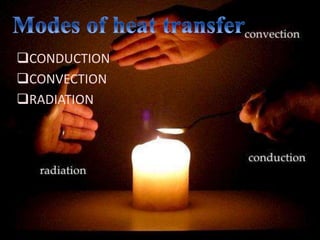
CONDUCTION
CONVECTION
RADIATION
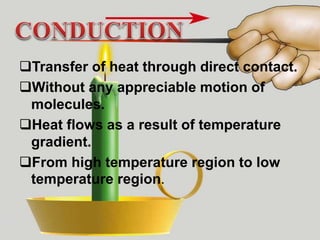
Transfer of heat through direct contact.
Without any appreciable motion of
molecules.
Heat flows as a result of temperature
gradient.
From high temperature region to low
temperature region.
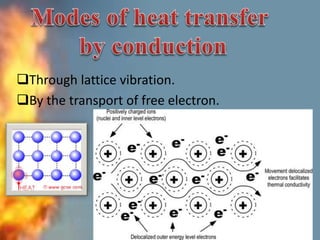
Through lattice vibration.
By the transport of free electron.
STEADY STATE CONDUCTION
TRANSIENT CONDUCTION
RELATIVISTIC CONDUCTION
QUANTUM CONDUCTION
 Some materials conduct heat better than others.
Materials that transfer heat well are called
conductors.
Metals are usually good conductors.
Wood, paper and plastic are not.
Materials that stop the transfer of heat are called
insulators (styrofoam, wool, fiberglass).
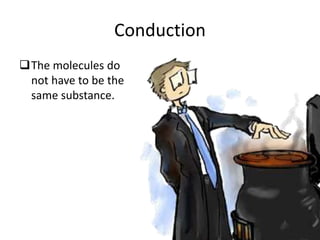
Conduction
The molecules do
not have to be the
same substance.
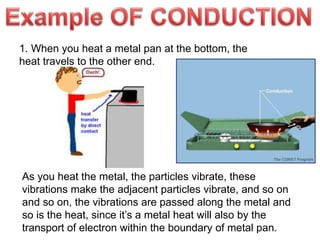
1. When you heat a metal pan at the bottom, the
heat travels to the other end.
As you heat the metal, the particles vibrate, these
vibrations make the adjacent particles vibrate, and so on
and so on, the vibrations are passed along the metal and
so is the heat, since it’s a metal heat will also by the
transport of electron within the boundary of metal pan.
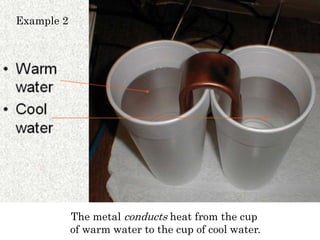
Example 2
The metal conducts heat from the cup
of warm water to the cup of cool water.
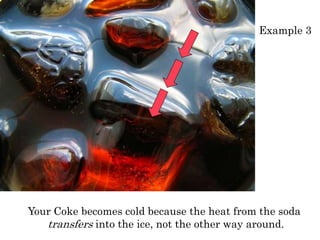
Your Coke becomes cold because the heat from the soda
transfers into the ice, not the other way around.
Example 3
Convection
• Heat transfer by convection is the transfer of
heat through the fluid (liquids and gases)
movement of currents.
Types of CONVECTION
NATURAL CONVECTION
FORCED CONVECTION
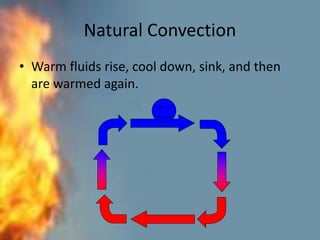
Natural Convection
• Warm fluids rise, cool down, sink, and then
are warmed again.
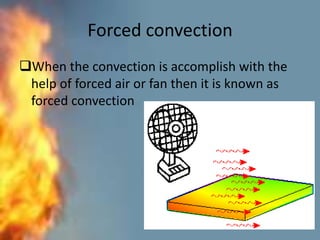
Forced convection
When the convection is accomplish with the
help of forced air or fan then it is known as
forced convection
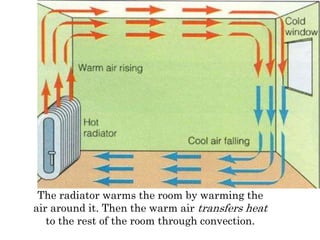
The radiator warms the room by warming the
air around it. Then the warm air transfers heat
to the rest of the room through convection.
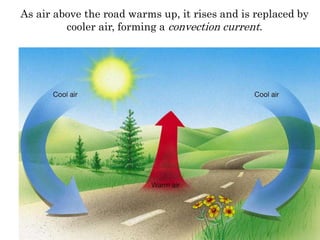
As air above the road warms up, it rises and is replaced by
cooler air, forming a convection current.
Radiation
Heat transfer by radiation is the transfer of heat through
electromagnetic waves.
In the bandwidth of between 0.1 to 100 micro meter.
Radiation
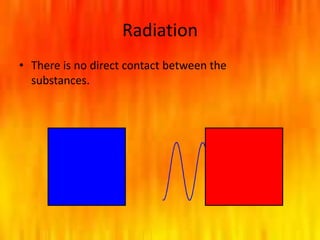
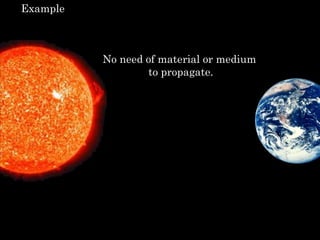
• There is no direct contact between the
substances.
No need of material or medium
to propagate.
Example
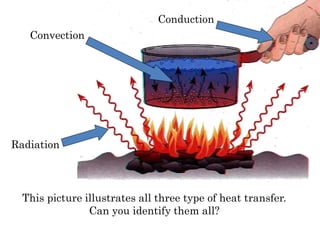
This picture illustrates all three type of heat transfer.
Can you identify them all?
Conduction
Radiation
Convection
In nuclear power stations
Fast dissipation of heat in engines(Fins)
Heat transfer through composite walls
Architecture.
Heat exchangers.
Cooling techniques.
References
JP HOLLMAN (HEAT TRANSFER)
TECHMAX
IIN
Thank you
folks!
ANY QUESTIONS?

VGVHBHBH

  • 1.
    Presentation on HEAT TRANSFER submitted by:Aaditya soni b.tech(mechanical)
  • 2.
    It is theform of energy that could be transfer from one system to another. Heat is never contained in a body. Associated with the motion of molecules.
  • 3.
    . Heat transfer isthe exchange of thermal energy between physical systems. Temperature difference is its driving force. Always occur from higher temperature region to lower temperature region.
  • 4.
  • 5.
    Transfer of heatthrough direct contact. Without any appreciable motion of molecules. Heat flows as a result of temperature gradient. From high temperature region to low temperature region.
  • 6.
    Through lattice vibration. Bythe transport of free electron.
  • 7.
    STEADY STATE CONDUCTION TRANSIENTCONDUCTION RELATIVISTIC CONDUCTION QUANTUM CONDUCTION
  • 8.
     Some materialsconduct heat better than others. Materials that transfer heat well are called conductors. Metals are usually good conductors. Wood, paper and plastic are not. Materials that stop the transfer of heat are called insulators (styrofoam, wool, fiberglass).
  • 9.
    Conduction The molecules do nothave to be the same substance.
  • 10.
    1. When youheat a metal pan at the bottom, the heat travels to the other end. As you heat the metal, the particles vibrate, these vibrations make the adjacent particles vibrate, and so on and so on, the vibrations are passed along the metal and so is the heat, since it’s a metal heat will also by the transport of electron within the boundary of metal pan.
  • 11.
    Example 2 The metalconducts heat from the cup of warm water to the cup of cool water.
  • 12.
    Your Coke becomescold because the heat from the soda transfers into the ice, not the other way around. Example 3
  • 13.
    Convection • Heat transferby convection is the transfer of heat through the fluid (liquids and gases) movement of currents.
  • 14.
    Types of CONVECTION NATURALCONVECTION FORCED CONVECTION
  • 15.
    Natural Convection • Warmfluids rise, cool down, sink, and then are warmed again.
  • 16.
    Forced convection When theconvection is accomplish with the help of forced air or fan then it is known as forced convection
  • 17.
    The radiator warmsthe room by warming the air around it. Then the warm air transfers heat to the rest of the room through convection.
  • 18.
    As air abovethe road warms up, it rises and is replaced by cooler air, forming a convection current.
  • 19.
    Radiation Heat transfer byradiation is the transfer of heat through electromagnetic waves. In the bandwidth of between 0.1 to 100 micro meter.
  • 20.
    Radiation • There isno direct contact between the substances.
  • 21.
    No need ofmaterial or medium to propagate. Example
  • 22.
    This picture illustratesall three type of heat transfer. Can you identify them all? Conduction Radiation Convection
  • 23.
    In nuclear powerstations Fast dissipation of heat in engines(Fins) Heat transfer through composite walls Architecture. Heat exchangers. Cooling techniques.
  • 24.
    References JP HOLLMAN (HEATTRANSFER) TECHMAX IIN
  • 25.
  • 26.