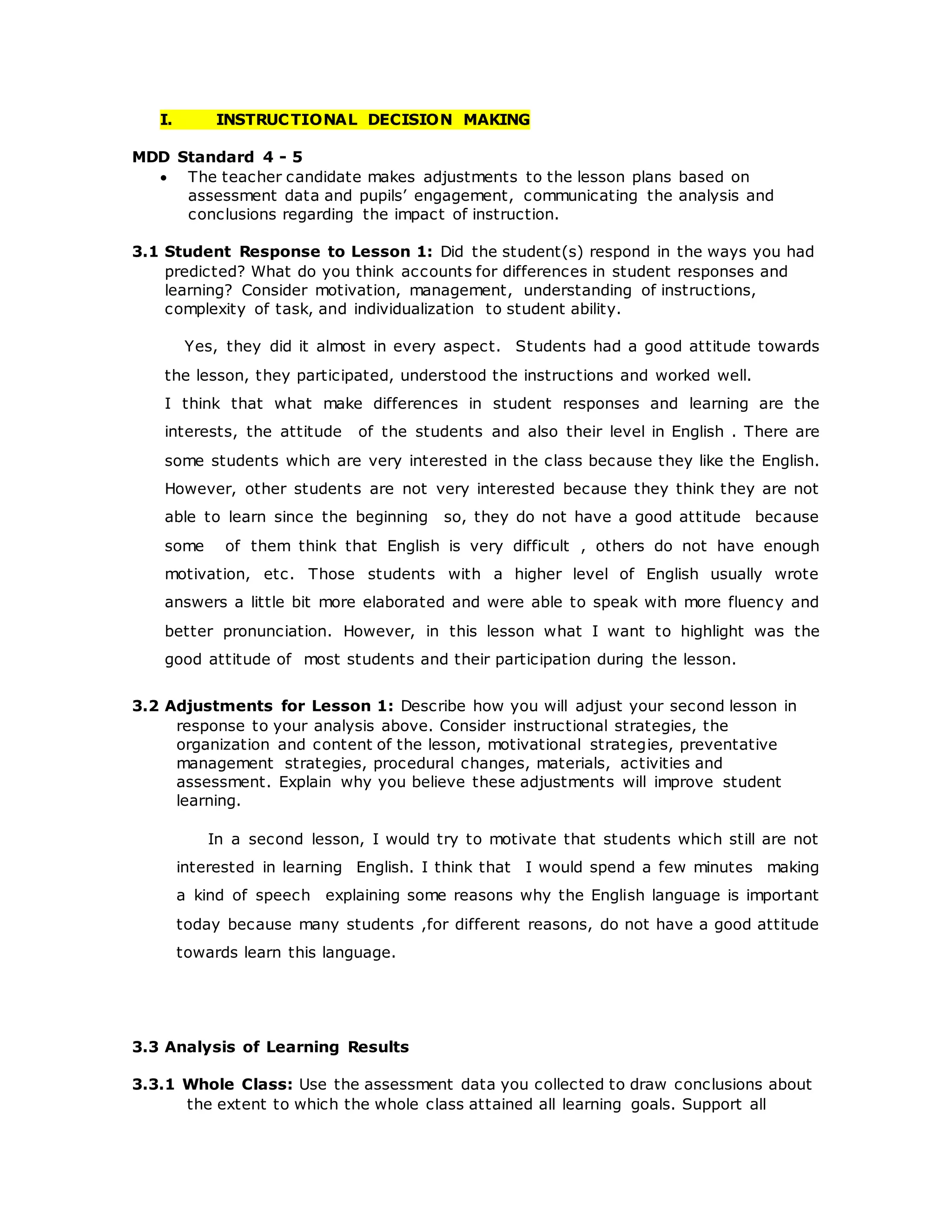
I. INSTRUCTIONAL DECISION MAKING
MDD Standard 4 - 5
 The teacher candidate makes adjustments to the lesson plans based on
assessment data and pupils’ engagement, communicating the analysis and
conclusions regarding the impact of instruction.
3.1 Student Response to Lesson 1: Did the student(s) respond in the ways you had
predicted? What do you think accounts for differences in student responses and
learning? Consider motivation, management, understanding of instructions,
complexity of task, and individualization to student ability.
Yes, they did it almost in every aspect. Students had a good attitude towards
the lesson, they participated, understood the instructions and worked well.
I think that what make differences in student responses and learning are the
interests, the attitude of the students and also their level in English . There are
some students which are very interested in the class because they like the English.
However, other students are not very interested because they think they are not
able to learn since the beginning so, they do not have a good attitude because
some of them think that English is very difficult , others do not have enough
motivation, etc. Those students with a higher level of English usually wrote
answers a little bit more elaborated and were able to speak with more fluency and
better pronunciation. However, in this lesson what I want to highlight was the
good attitude of most students and their participation during the lesson.
3.2 Adjustments for Lesson 1: Describe how you will adjust your second lesson in
response to your analysis above. Consider instructional strategies, the
organization and content of the lesson, motivational strategies, preventative
management strategies, procedural changes, materials, activities and
assessment. Explain why you believe these adjustments will improve student
learning.
In a second lesson, I would try to motivate that students which still are not
interested in learning English. I think that I would spend a few minutes making
a kind of speech explaining some reasons why the English language is important
today because many students ,for different reasons, do not have a good attitude
towards learn this language.
3.3 Analysis of Learning Results
3.3.1 Whole Class: Use the assessment data you collected to draw conclusions about
the extent to which the whole class attained all learning goals. Support all
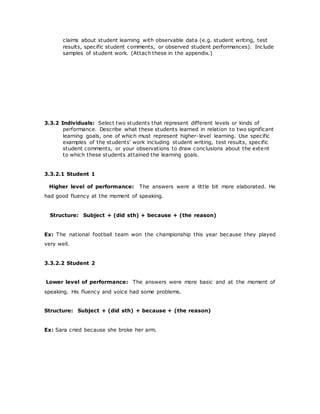
claims about student learning with observable data (e.g. student writing, test
results, specific student comments, or observed student performances). Include
samples of student work. (Attach these in the appendix.)
3.3.2 Individuals: Select two students that represent different levels or kinds of
performance. Describe what these students learned in relation to two significant
learning goals, one of which must represent higher-level learning. Use specific
examples of the students' work including student writing, test results, specific
student comments, or your observations to draw conclusions about the extent
to which these students attained the learning goals.
3.3.2.1 Student 1
Higher level of performance: The answers were a little bit more elaborated. He
had good fluency at the moment of speaking.
Structure: Subject + (did sth) + because + (the reason)
Ex: The national football team won the championship this year because they played
very well.
3.3.2.2 Student 2
Lower level of performance: The answers were more basic and at the moment of
speaking. His fluency and voice had some problems.
Structure: Subject + (did sth) + because + (the reason)
Ex: Sara cried because she broke her arm.
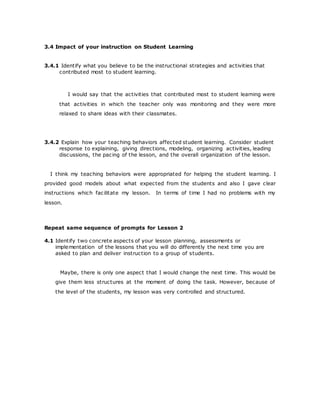
3.4 Impact of your instruction on Student Learning
3.4.1 Identify what you believe to be the instructional strategies and activities that
contributed most to student learning.
I would say that the activities that contributed most to student learning were
that activities in which the teacher only was monitoring and they were more
relaxed to share ideas with their classmates.
3.4.2 Explain how your teaching behaviors affected student learning. Consider student
response to explaining, giving directions, modeling, organizing activities, leading
discussions, the pacing of the lesson, and the overall organization of the lesson.
I think my teaching behaviors were appropriated for helping the student learning. I
provided good models about what expected from the students and also I gave clear
instructions which facilitate my lesson. In terms of time I had no problems with my
lesson.
Repeat same sequence of prompts for Lesson 2
4.1 Identify two concrete aspects of your lesson planning, assessments or
implementation of the lessons that you will do differently the next time you are
asked to plan and deliver instruction to a group of students.
Maybe, there is only one aspect that I would change the next time. This would be
give them less structures at the moment of doing the task. However, because of
the level of the students, my lesson was very controlled and structured.

Versión abreviada mdd 4 5

  • 1.
    I. INSTRUCTIONAL DECISIONMAKING MDD Standard 4 - 5  The teacher candidate makes adjustments to the lesson plans based on assessment data and pupils’ engagement, communicating the analysis and conclusions regarding the impact of instruction. 3.1 Student Response to Lesson 1: Did the student(s) respond in the ways you had predicted? What do you think accounts for differences in student responses and learning? Consider motivation, management, understanding of instructions, complexity of task, and individualization to student ability. Yes, they did it almost in every aspect. Students had a good attitude towards the lesson, they participated, understood the instructions and worked well. I think that what make differences in student responses and learning are the interests, the attitude of the students and also their level in English . There are some students which are very interested in the class because they like the English. However, other students are not very interested because they think they are not able to learn since the beginning so, they do not have a good attitude because some of them think that English is very difficult , others do not have enough motivation, etc. Those students with a higher level of English usually wrote answers a little bit more elaborated and were able to speak with more fluency and better pronunciation. However, in this lesson what I want to highlight was the good attitude of most students and their participation during the lesson. 3.2 Adjustments for Lesson 1: Describe how you will adjust your second lesson in response to your analysis above. Consider instructional strategies, the organization and content of the lesson, motivational strategies, preventative management strategies, procedural changes, materials, activities and assessment. Explain why you believe these adjustments will improve student learning. In a second lesson, I would try to motivate that students which still are not interested in learning English. I think that I would spend a few minutes making a kind of speech explaining some reasons why the English language is important today because many students ,for different reasons, do not have a good attitude towards learn this language. 3.3 Analysis of Learning Results 3.3.1 Whole Class: Use the assessment data you collected to draw conclusions about the extent to which the whole class attained all learning goals. Support all
  • 2.
    claims about studentlearning with observable data (e.g. student writing, test results, specific student comments, or observed student performances). Include samples of student work. (Attach these in the appendix.) 3.3.2 Individuals: Select two students that represent different levels or kinds of performance. Describe what these students learned in relation to two significant learning goals, one of which must represent higher-level learning. Use specific examples of the students' work including student writing, test results, specific student comments, or your observations to draw conclusions about the extent to which these students attained the learning goals. 3.3.2.1 Student 1 Higher level of performance: The answers were a little bit more elaborated. He had good fluency at the moment of speaking. Structure: Subject + (did sth) + because + (the reason) Ex: The national football team won the championship this year because they played very well. 3.3.2.2 Student 2 Lower level of performance: The answers were more basic and at the moment of speaking. His fluency and voice had some problems. Structure: Subject + (did sth) + because + (the reason) Ex: Sara cried because she broke her arm.
  • 3.
    3.4 Impact ofyour instruction on Student Learning 3.4.1 Identify what you believe to be the instructional strategies and activities that contributed most to student learning. I would say that the activities that contributed most to student learning were that activities in which the teacher only was monitoring and they were more relaxed to share ideas with their classmates. 3.4.2 Explain how your teaching behaviors affected student learning. Consider student response to explaining, giving directions, modeling, organizing activities, leading discussions, the pacing of the lesson, and the overall organization of the lesson. I think my teaching behaviors were appropriated for helping the student learning. I provided good models about what expected from the students and also I gave clear instructions which facilitate my lesson. In terms of time I had no problems with my lesson. Repeat same sequence of prompts for Lesson 2 4.1 Identify two concrete aspects of your lesson planning, assessments or implementation of the lessons that you will do differently the next time you are asked to plan and deliver instruction to a group of students. Maybe, there is only one aspect that I would change the next time. This would be give them less structures at the moment of doing the task. However, because of the level of the students, my lesson was very controlled and structured.