VERNACULAR ARCHITECTURE
A Case Of Ziro Village, Arunachal Pradesh.
Sub- ELECTIVES
By- Karan Kothari
LOCATION
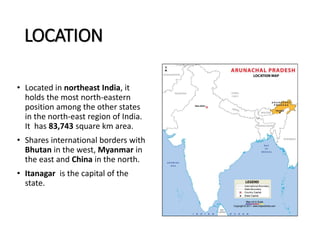
• Located in northeast India, it
holds the most north-eastern
position among the other states
in the north-east region of India.
It has 83,743 square km area.
• Shares international borders with
Bhutan in the west, Myanmar in
the east and China in the north.
• Itanagar is the capital of the
state.
LAND USE
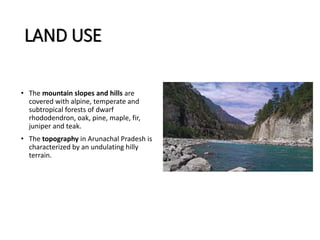
• The mountain slopes and hills are
covered with alpine, temperate and
subtropical forests of dwarf
rhododendron, oak, pine, maple, fir,
juniper and teak.
• The topography in Arunachal Pradesh is
characterized by an undulating hilly
terrain.
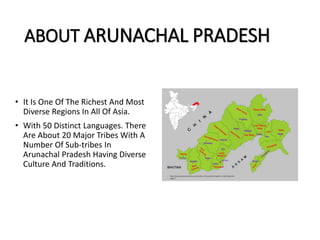
ABOUT ARUNACHAL PRADESH
• It Is One Of The Richest And Most
Diverse Regions In All Of Asia.
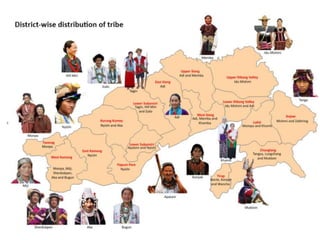
• With 50 Distinct Languages. There
Are About 20 Major Tribes With A
Number Of Sub-tribes In
Arunachal Pradesh Having Diverse
Culture And Traditions.
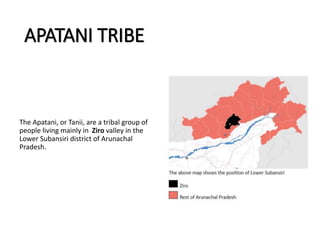
APATANI TRIBE
The Apatani, or Tanii, are a tribal group of
people living mainly in Ziro valley in the
Lower Subansiri district of Arunachal
Pradesh.
CLIMATE
• On MACRO-
Due to the topographical diversity, the climate in
Arunachal Pradesh ranges from sub-tropical to
temperate depending upon the altitude. The
regions in the lower belts of the state experience
hot and humid climates, with a maximum
temperature in the foothills reaching up to 40 °C
(during the summer). The average temperature in
this region in winter ranges from 15° to 21 °C
while that during the monsoon season remains
between 22° and 30 °C.
• Arunachal Pradesh receives heavy rainfall of
2,000 to 4,100 mm annually, most of it
between May and September.
OCCUPATION
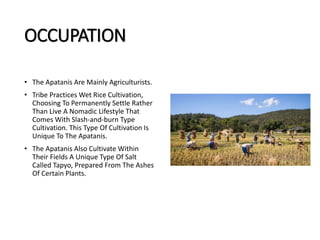
• The Apatanis Are Mainly Agriculturists.
• Tribe Practices Wet Rice Cultivation,
Choosing To Permanently Settle Rather
Than Live A Nomadic Lifestyle That
Comes With Slash-and-burn Type
Cultivation. This Type Of Cultivation Is
Unique To The Apatanis.
• The Apatanis Also Cultivate Within
Their Fields A Unique Type Of Salt
Called Tapyo, Prepared From The Ashes
Of Certain Plants.
OCCUPATION
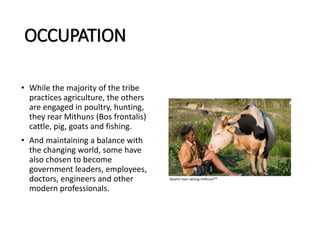
• While the majority of the tribe
practices agriculture, the others
are engaged in poultry, hunting,
they rear Mithuns (Bos frontalis)
cattle, pig, goats and fishing.
• And maintaining a balance with
the changing world, some have
also chosen to become
government leaders, employees,
doctors, engineers and other
modern professionals.
LIFESTYLE
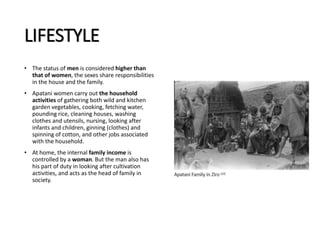
• The status of men is considered higher than
that of women, the sexes share responsibilities
in the house and the family.
• Apatani women carry out the household
activities of gathering both wild and kitchen
garden vegetables, cooking, fetching water,
pounding rice, cleaning houses, washing
clothes and utensils, nursing, looking after
infants and children, ginning (clothes) and
spinning of cotton, and other jobs associated
with the household.
• At home, the internal family income is
controlled by a woman. But the man also has
his part of duty in looking after cultivation
activities, and acts as the head of family in
society.
CULTURE
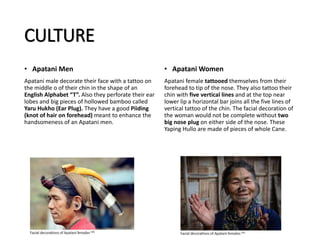
• Apatani Men
Apatani male decorate their face with a tattoo on
the middle o of their chin in the shape of an
English Alphabet “T”. Also they perforate their ear
lobes and big pieces of hollowed bamboo called
Yaru Hukho (Ear Plug). They have a good Piiding
(knot of hair on forehead) meant to enhance the
handsomeness of an Apatani men.
• Apatani Women
Apatani female tattooed themselves from their
forehead to tip of the nose. They also tattoo their
chin with five vertical lines and at the top near
lower lip a horizontal bar joins all the five lines of
vertical tattoo of the chin. The facial decoration of
the woman would not be complete without two
big nose plug on either side of the nose. These
Yaping Hullo are made of pieces of whole Cane.
RELIGION
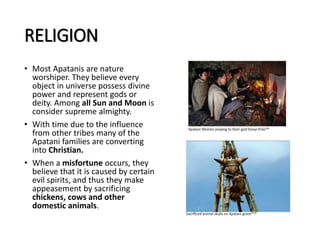
• Most Apatanis are nature
worshiper. They believe every
object in universe possess divine
power and represent gods or
deity. Among all Sun and Moon is
consider supreme almighty.
• With time due to the influence
from other tribes many of the
Apatani families are converting
into Christian.
• When a misfortune occurs, they
believe that it is caused by certain
evil spirits, and thus they make
appeasement by sacrificing
chickens, cows and other
domestic animals.
APATANI ARCHITECTURE
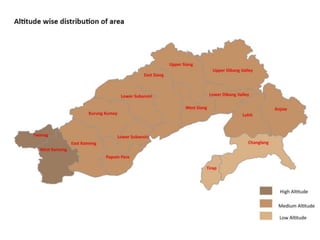
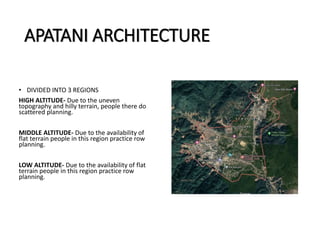
• DIVIDED INTO 3 REGIONS
HIGH ALTITUDE- Due to the uneven
topography and hilly terrain, people there do
scattered planning.
MIDDLE ALTITUDE- Due to the availability of
flat terrain people in this region practice row
planning.
LOW ALTITUDE- Due to the availability of flat
terrain people in this region practice row
planning.
APATANI ARCHITECTURE
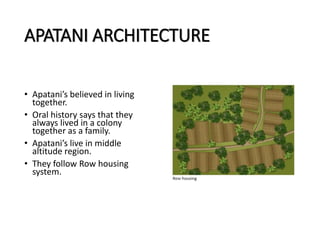
• Apatani’s believed in living
together.
• Oral history says that they
always lived in a colony
together as a family.
• Apatani’s live in middle
altitude region.
• They follow Row housing
system.
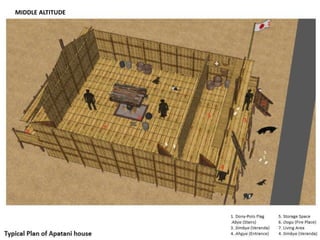
MIDDLE ALTITUDE
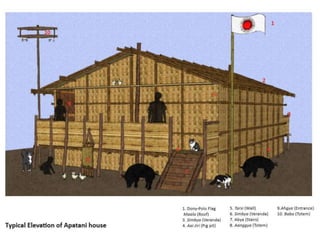
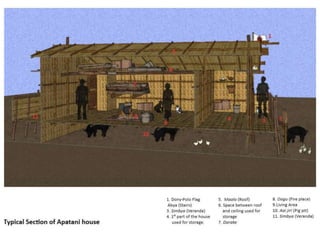
ELEMENTS OF APATANI HOUSE
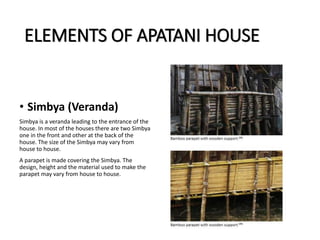
• Simbya (Veranda)
Simbya is a veranda leading to the entrance of the
house. In most of the houses there are two Simbya
one in the front and other at the back of the
house. The size of the Simbya may vary from
house to house.
A parapet is made covering the Simbya. The
design, height and the material used to make the
parapet may vary from house to house.
ELEMENTS OF APATANI HOUSE
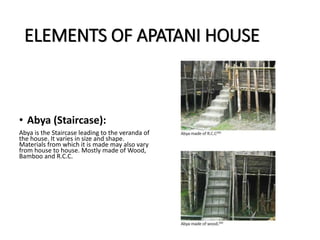
• Abya (Staircase):
Abya is the Staircase leading to the veranda of
the house. It varies in size and shape.
Materials from which it is made may also vary
from house to house. Mostly made of Wood,
Bamboo and R.C.C.
ELEMENTS OF APATANI HOUSE
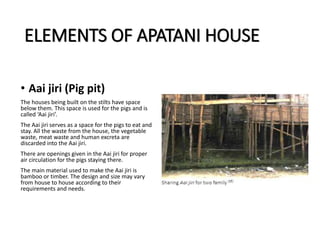
• Aai jiri (Pig pit)
The houses being built on the stilts have space
below them. This space is used for the pigs and is
called ‘Aai jiri’.
The Aai jiri serves as a space for the pigs to eat and
stay. All the waste from the house, the vegetable
waste, meat waste and human excreta are
discarded into the Aai jiri.
There are openings given in the Aai jiri for proper
air circulation for the pigs staying there.
The main material used to make the Aai jiri is
bamboo or timber. The design and size may vary
from house to house according to their
requirements and needs.
ELEMENTS OF APATANI HOUSE
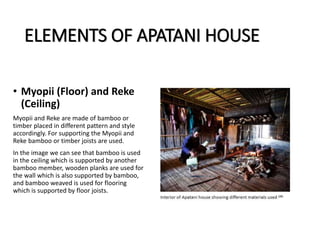
• Myopii (Floor) and Reke
(Ceiling)
Myopii and Reke are made of bamboo or
timber placed in different pattern and style
accordingly. For supporting the Myopii and
Reke bamboo or timber joists are used.
In the image we can see that bamboo is used
in the ceiling which is supported by another
bamboo member, wooden planks are used for
the wall which is also supported by bamboo,
and bamboo weaved is used for flooring
which is supported by floor joists.
ELEMENTS OF APATANI HOUSE
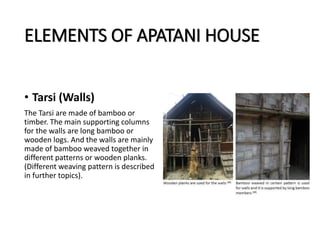
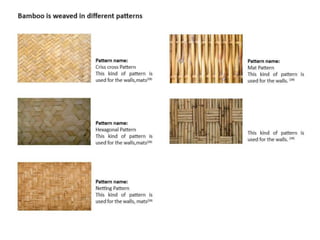
• Tarsi (Walls)
The Tarsi are made of bamboo or
timber. The main supporting columns
for the walls are long bamboo or
wooden logs. And the walls are mainly
made of bamboo weaved together in
different patterns or wooden planks.
(Different weaving pattern is described
in further topics).
ELEMENTS OF APATANI HOUSE
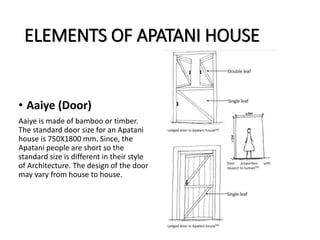
• Aaiye (Door)
Aaiye is made of bamboo or timber.
The standard door size for an Apatani
house is 750X1800 mm. Since, the
Apatani people are short so the
standard size is different in their style
of Architecture. The design of the door
may vary from house to house.
ELEMENTS OF APATANI HOUSE
• Window
There are no windows in a typical Apatani house. The only source of light and
ventilation were the doors.
ELEMENTS OF APATANI HOUSE
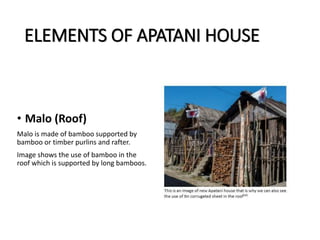
• Malo (Roof)
Malo is made of bamboo supported by
bamboo or timber purlins and rafter.
Image shows the use of bamboo in the
roof which is supported by long bamboos.
ELEMENTS OF APATANI HOUSE
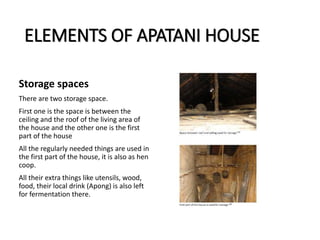
Storage spaces
There are two storage space.
First one is the space is between the
ceiling and the roof of the living area of
the house and the other one is the first
part of the house
All the regularly needed things are used in
the first part of the house, it is also as hen
coop.
All their extra things like utensils, wood,
food, their local drink (Apong) is also left
for fermentation there.
ELEMENTS OF APATANI HOUSE
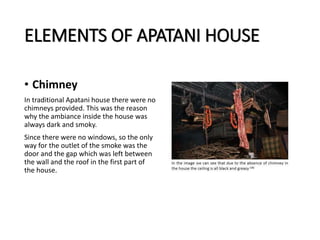
• Chimney
In traditional Apatani house there were no
chimneys provided. This was the reason
why the ambiance inside the house was
always dark and smoky.
Since there were no windows, so the only
way for the outlet of the smoke was the
door and the gap which was left between
the wall and the roof in the first part of
the house.
BIBLOGRAPHY
http://www.earthscapes.in/assets/monograph-3-
apatani-tribal-architecture.pdf

Vernacular architecture

  • 1.
    VERNACULAR ARCHITECTURE A CaseOf Ziro Village, Arunachal Pradesh. Sub- ELECTIVES By- Karan Kothari
  • 2.
    LOCATION • Located innortheast India, it holds the most north-eastern position among the other states in the north-east region of India. It has 83,743 square km area. • Shares international borders with Bhutan in the west, Myanmar in the east and China in the north. • Itanagar is the capital of the state.
  • 3.
    LAND USE • Themountain slopes and hills are covered with alpine, temperate and subtropical forests of dwarf rhododendron, oak, pine, maple, fir, juniper and teak. • The topography in Arunachal Pradesh is characterized by an undulating hilly terrain.
  • 5.
    ABOUT ARUNACHAL PRADESH •It Is One Of The Richest And Most Diverse Regions In All Of Asia. • With 50 Distinct Languages. There Are About 20 Major Tribes With A Number Of Sub-tribes In Arunachal Pradesh Having Diverse Culture And Traditions.
  • 7.
    APATANI TRIBE The Apatani,or Tanii, are a tribal group of people living mainly in Ziro valley in the Lower Subansiri district of Arunachal Pradesh.
  • 8.
    CLIMATE • On MACRO- Dueto the topographical diversity, the climate in Arunachal Pradesh ranges from sub-tropical to temperate depending upon the altitude. The regions in the lower belts of the state experience hot and humid climates, with a maximum temperature in the foothills reaching up to 40 °C (during the summer). The average temperature in this region in winter ranges from 15° to 21 °C while that during the monsoon season remains between 22° and 30 °C. • Arunachal Pradesh receives heavy rainfall of 2,000 to 4,100 mm annually, most of it between May and September.
  • 9.
    OCCUPATION • The ApatanisAre Mainly Agriculturists. • Tribe Practices Wet Rice Cultivation, Choosing To Permanently Settle Rather Than Live A Nomadic Lifestyle That Comes With Slash-and-burn Type Cultivation. This Type Of Cultivation Is Unique To The Apatanis. • The Apatanis Also Cultivate Within Their Fields A Unique Type Of Salt Called Tapyo, Prepared From The Ashes Of Certain Plants.
  • 10.
    OCCUPATION • While themajority of the tribe practices agriculture, the others are engaged in poultry, hunting, they rear Mithuns (Bos frontalis) cattle, pig, goats and fishing. • And maintaining a balance with the changing world, some have also chosen to become government leaders, employees, doctors, engineers and other modern professionals.
  • 11.
    LIFESTYLE • The statusof men is considered higher than that of women, the sexes share responsibilities in the house and the family. • Apatani women carry out the household activities of gathering both wild and kitchen garden vegetables, cooking, fetching water, pounding rice, cleaning houses, washing clothes and utensils, nursing, looking after infants and children, ginning (clothes) and spinning of cotton, and other jobs associated with the household. • At home, the internal family income is controlled by a woman. But the man also has his part of duty in looking after cultivation activities, and acts as the head of family in society.
  • 12.
    CULTURE • Apatani Men Apatanimale decorate their face with a tattoo on the middle o of their chin in the shape of an English Alphabet “T”. Also they perforate their ear lobes and big pieces of hollowed bamboo called Yaru Hukho (Ear Plug). They have a good Piiding (knot of hair on forehead) meant to enhance the handsomeness of an Apatani men. • Apatani Women Apatani female tattooed themselves from their forehead to tip of the nose. They also tattoo their chin with five vertical lines and at the top near lower lip a horizontal bar joins all the five lines of vertical tattoo of the chin. The facial decoration of the woman would not be complete without two big nose plug on either side of the nose. These Yaping Hullo are made of pieces of whole Cane.
  • 13.
    RELIGION • Most Apatanisare nature worshiper. They believe every object in universe possess divine power and represent gods or deity. Among all Sun and Moon is consider supreme almighty. • With time due to the influence from other tribes many of the Apatani families are converting into Christian. • When a misfortune occurs, they believe that it is caused by certain evil spirits, and thus they make appeasement by sacrificing chickens, cows and other domestic animals.
  • 14.
    APATANI ARCHITECTURE • DIVIDEDINTO 3 REGIONS HIGH ALTITUDE- Due to the uneven topography and hilly terrain, people there do scattered planning. MIDDLE ALTITUDE- Due to the availability of flat terrain people in this region practice row planning. LOW ALTITUDE- Due to the availability of flat terrain people in this region practice row planning.
  • 15.
    APATANI ARCHITECTURE • Apatani’sbelieved in living together. • Oral history says that they always lived in a colony together as a family. • Apatani’s live in middle altitude region. • They follow Row housing system.
  • 16.
  • 19.
    ELEMENTS OF APATANIHOUSE • Simbya (Veranda) Simbya is a veranda leading to the entrance of the house. In most of the houses there are two Simbya one in the front and other at the back of the house. The size of the Simbya may vary from house to house. A parapet is made covering the Simbya. The design, height and the material used to make the parapet may vary from house to house.
  • 20.
    ELEMENTS OF APATANIHOUSE • Abya (Staircase): Abya is the Staircase leading to the veranda of the house. It varies in size and shape. Materials from which it is made may also vary from house to house. Mostly made of Wood, Bamboo and R.C.C.
  • 21.
    ELEMENTS OF APATANIHOUSE • Aai jiri (Pig pit) The houses being built on the stilts have space below them. This space is used for the pigs and is called ‘Aai jiri’. The Aai jiri serves as a space for the pigs to eat and stay. All the waste from the house, the vegetable waste, meat waste and human excreta are discarded into the Aai jiri. There are openings given in the Aai jiri for proper air circulation for the pigs staying there. The main material used to make the Aai jiri is bamboo or timber. The design and size may vary from house to house according to their requirements and needs.
  • 22.
    ELEMENTS OF APATANIHOUSE • Myopii (Floor) and Reke (Ceiling) Myopii and Reke are made of bamboo or timber placed in different pattern and style accordingly. For supporting the Myopii and Reke bamboo or timber joists are used. In the image we can see that bamboo is used in the ceiling which is supported by another bamboo member, wooden planks are used for the wall which is also supported by bamboo, and bamboo weaved is used for flooring which is supported by floor joists.
  • 23.
    ELEMENTS OF APATANIHOUSE • Tarsi (Walls) The Tarsi are made of bamboo or timber. The main supporting columns for the walls are long bamboo or wooden logs. And the walls are mainly made of bamboo weaved together in different patterns or wooden planks. (Different weaving pattern is described in further topics).
  • 25.
    ELEMENTS OF APATANIHOUSE • Aaiye (Door) Aaiye is made of bamboo or timber. The standard door size for an Apatani house is 750X1800 mm. Since, the Apatani people are short so the standard size is different in their style of Architecture. The design of the door may vary from house to house.
  • 26.
    ELEMENTS OF APATANIHOUSE • Window There are no windows in a typical Apatani house. The only source of light and ventilation were the doors.
  • 27.
    ELEMENTS OF APATANIHOUSE • Malo (Roof) Malo is made of bamboo supported by bamboo or timber purlins and rafter. Image shows the use of bamboo in the roof which is supported by long bamboos.
  • 28.
    ELEMENTS OF APATANIHOUSE Storage spaces There are two storage space. First one is the space is between the ceiling and the roof of the living area of the house and the other one is the first part of the house All the regularly needed things are used in the first part of the house, it is also as hen coop. All their extra things like utensils, wood, food, their local drink (Apong) is also left for fermentation there.
  • 29.
    ELEMENTS OF APATANIHOUSE • Chimney In traditional Apatani house there were no chimneys provided. This was the reason why the ambiance inside the house was always dark and smoky. Since there were no windows, so the only way for the outlet of the smoke was the door and the gap which was left between the wall and the roof in the first part of the house.
  • 30.