Reported Verbs
SAY and TELL
Verb SAY (past simple and past participle
said) is used to:
•to indicate who speaks the words quoted between
inverted commas in direct speech.
‘There’s going to be a parents’ meeting
next Moday’, the principal said.
REMEMBER: SAY is followed by the preposition TO
when the person to whom the thing is said is
expressed.
‘You are right’, he said to me.
• introduce reported speech, when the person to
whom the thing is said is not expressed. Between a main
clause containing the verb say and the secondary
clause, we can use the conjuction that.
The weather forecast says (that) it will be
sunny tomorrow.
Mr Brown said (that) he had moved to his
new office the week before.
The verb say is used in the following
expressions:
say a word, say yes, say no, say thank you, say please,
say hello / goodbye, say something.
Say thank you to everybody before
you leave.
Don’t say a word. Someone may be listening.
iSLCollective.co
Verb TELL (past simple and past participle told)
is used to:
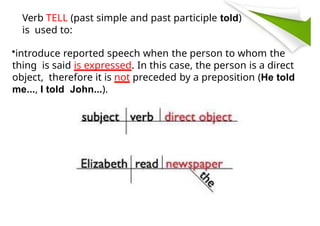
•introduce reported speech when the person to whom the
thing is said is expressed. In this case, the person is a direct
object, therefore it is not preceded by a preposition (He told
me..., I told John...).
A main clause containing the verb tell can
be followed by:
-A secondary clause introduced by the conjuction that,
which is often just implied.
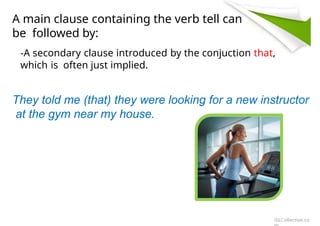
They told me (that) they were looking for a new instructor
at the gym near my house.
iSLCollective.co
- A verb in the infinitive (to... / not
to...)
She told me to wait for a while.
I told everybody not to come late.
iSLCollective.co
When both the person to whom the thing is said and a direct
object are present, the double object structure is used:
person +
object
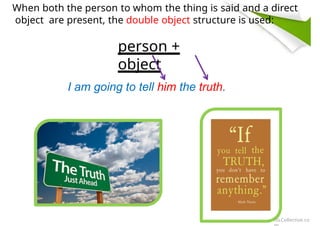
I am going to tell him the truth.
iSLCollective.co
The verb tell is used in the following
exressions:
tell a lie / lies, tell the truth, tell a story, tell the time, tell someone’s
fortune, tell the difference, tell someone about something.
Don’t tell me a lie. I can tell the difference between
a liar and someone who is telling the truth.
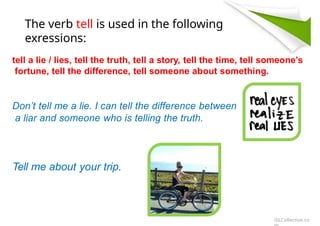
Tell me about your trip.
iSLCollective.co
THANK YOU FOR YOUR
ATTENTION!!! 
iSLCollective.co

VERBS SAY AND TELL - THE DIFFERENCE .pptx

  • 1.
  • 2.
    Verb SAY (pastsimple and past participle said) is used to: •to indicate who speaks the words quoted between inverted commas in direct speech. ‘There’s going to be a parents’ meeting next Moday’, the principal said. REMEMBER: SAY is followed by the preposition TO when the person to whom the thing is said is expressed. ‘You are right’, he said to me.
  • 3.
    • introduce reportedspeech, when the person to whom the thing is said is not expressed. Between a main clause containing the verb say and the secondary clause, we can use the conjuction that. The weather forecast says (that) it will be sunny tomorrow. Mr Brown said (that) he had moved to his new office the week before.
  • 4.
    The verb sayis used in the following expressions: say a word, say yes, say no, say thank you, say please, say hello / goodbye, say something. Say thank you to everybody before you leave. Don’t say a word. Someone may be listening. iSLCollective.co
  • 5.
    Verb TELL (pastsimple and past participle told) is used to: •introduce reported speech when the person to whom the thing is said is expressed. In this case, the person is a direct object, therefore it is not preceded by a preposition (He told me..., I told John...).
  • 6.
    A main clausecontaining the verb tell can be followed by: -A secondary clause introduced by the conjuction that, which is often just implied. They told me (that) they were looking for a new instructor at the gym near my house. iSLCollective.co
  • 7.
    - A verbin the infinitive (to... / not to...) She told me to wait for a while. I told everybody not to come late. iSLCollective.co
  • 8.
    When both theperson to whom the thing is said and a direct object are present, the double object structure is used: person + object I am going to tell him the truth. iSLCollective.co
  • 9.
    The verb tellis used in the following exressions: tell a lie / lies, tell the truth, tell a story, tell the time, tell someone’s fortune, tell the difference, tell someone about something. Don’t tell me a lie. I can tell the difference between a liar and someone who is telling the truth. Tell me about your trip. iSLCollective.co
  • 10.
    THANK YOU FORYOUR ATTENTION!!!  iSLCollective.co