Contemporary Museum and Gallery Education practices:
Local Communities meet Global Narratives, May 22-23, 2015
Vera Boneva
TO LEARN AND CREATE AMONG THE TREASURES:
INNOVATIVE EDUCATIONAL PRACTICES OF BULGARIAN MUSEUMS
Bulgaria
 110,994 sq km territory
 7.4 million inhabitants
 EU member from 2007
 Sofia – capital city
 Plovdiv – 2019 EU
capital of culture
 Eastern Orthodoxy –
traditional religion
(85% of population)
 214 state and 4 private
museums
 32 archeological
reserves
 9 UNESCO
Heritage Sites
Five museum/gallery plots from Bulgaria
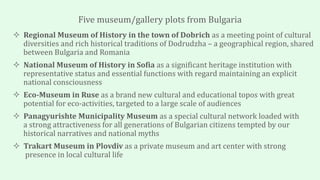
 Regional Museum of History in the town of Dobrich as a meeting point of cultural
diversities and rich historical traditions of Dodrudzha – a geographical region, shared
between Bulgaria and Romania
 National Museum of History in Sofia as a significant heritage institution with
representative status and essential functions with regard maintaining an explicit
national consciousness
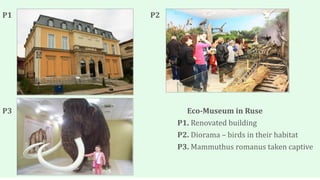
 Eco-Museum in Ruse as a brand new cultural and educational topos with great
potential for eco-activities, targeted to a large scale of audiences
 Panagyurishte Municipality Museum as a special cultural network loaded with
a strong attractiveness for all generations of Bulgarian citizens tempted by our
historical narratives and national myths
 Trakart Museum in Plovdiv as a private museum and art center with strong
presence in local cultural life
P1 P2
Regional Museum of History – Dobrich
P1. Ex-Romanian Casino – Museum of Modern History
P2. Presentation of a book
about Romania in the Yordan Yovkov Museum
P3. Replica of a Revival Bulgarian schoolroom –
popular space for educational activities
P3
P1 P3
P2
National History Museum – Sofia
P1. Main building of the Museum
P2. Permanent exhibition
P3. A future judge
in the museum workshop
Eurovision Museum Exhibiting Europe – EMEE project
 The aim of the EMEE-project is to make museums more accessible in many ways:
with an innovative and interdisciplinary approach developed by history didactics
the project wants to re-interpret museum objects and put them into
a broader context of national and transnational history.
 The EMEE project is supposed to be realised by a European trans-sectional
consortium, led by the University of Augsburg - Germany (Chair of History Didactics)
and composed by excellent partners from Bulgaria (National History Museum),
France (Université Paris-Est Créteil, Chair for technology, design and visual arts),
Germany-Stuttgart (Atelier Brückner), Italy (Università degli Studi Roma Tre),
Portugal (Museu Nacional de Arqueologia), Slovenia (National Museum
of Contemporary History) and Austria (monochrom Kunstverein).
 The project develops innovative and creative concepts (tools) to realize the
‘change of perspective’ as the key to ‘Europeanisation’ of museum work.
These concepts are provided online and on a trial base in the Eurovision Labs
of all participating partners. Internet site: www.museums-exhibiting-europe.de
P1 P2
P3 Eco-Museum in Ruse
P1. Renovated building
P2. Diorama – birds in their habitat
P3. Mammuthus romanus taken captive
P1 P3
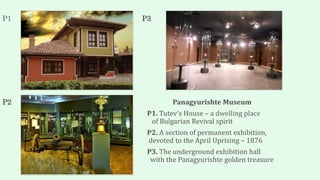
P2 Panagyurishte Museum
P1. Tutev’s House – a dwelling place
of Bulgarian Revival spirit
P2. A section of permanent exhibition,
devoted to the April Uprising – 1876
P3. The underground exhibition hall
with the Panagyurishte golden treasure
P1 P3
P2 Trakart Museum in Plovdiv
P1. In situ Roma mosaics with a part of
permanent exhibition
P2. Disabled people creating mosaics
in the Trakart Center
P3. Childrenʼs songs and dances into the Museum
P
The End

To learn and create among the treasures

  • 1.
    Contemporary Museum andGallery Education practices: Local Communities meet Global Narratives, May 22-23, 2015 Vera Boneva TO LEARN AND CREATE AMONG THE TREASURES: INNOVATIVE EDUCATIONAL PRACTICES OF BULGARIAN MUSEUMS
  • 2.
    Bulgaria  110,994 sqkm territory  7.4 million inhabitants  EU member from 2007  Sofia – capital city  Plovdiv – 2019 EU capital of culture  Eastern Orthodoxy – traditional religion (85% of population)  214 state and 4 private museums  32 archeological reserves  9 UNESCO Heritage Sites
  • 3.
    Five museum/gallery plotsfrom Bulgaria  Regional Museum of History in the town of Dobrich as a meeting point of cultural diversities and rich historical traditions of Dodrudzha – a geographical region, shared between Bulgaria and Romania  National Museum of History in Sofia as a significant heritage institution with representative status and essential functions with regard maintaining an explicit national consciousness  Eco-Museum in Ruse as a brand new cultural and educational topos with great potential for eco-activities, targeted to a large scale of audiences  Panagyurishte Municipality Museum as a special cultural network loaded with a strong attractiveness for all generations of Bulgarian citizens tempted by our historical narratives and national myths  Trakart Museum in Plovdiv as a private museum and art center with strong presence in local cultural life
  • 4.
    P1 P2 Regional Museumof History – Dobrich P1. Ex-Romanian Casino – Museum of Modern History P2. Presentation of a book about Romania in the Yordan Yovkov Museum P3. Replica of a Revival Bulgarian schoolroom – popular space for educational activities P3
  • 5.
    P1 P3 P2 National HistoryMuseum – Sofia P1. Main building of the Museum P2. Permanent exhibition P3. A future judge in the museum workshop
  • 6.
    Eurovision Museum ExhibitingEurope – EMEE project  The aim of the EMEE-project is to make museums more accessible in many ways: with an innovative and interdisciplinary approach developed by history didactics the project wants to re-interpret museum objects and put them into a broader context of national and transnational history.  The EMEE project is supposed to be realised by a European trans-sectional consortium, led by the University of Augsburg - Germany (Chair of History Didactics) and composed by excellent partners from Bulgaria (National History Museum), France (Université Paris-Est Créteil, Chair for technology, design and visual arts), Germany-Stuttgart (Atelier Brückner), Italy (Università degli Studi Roma Tre), Portugal (Museu Nacional de Arqueologia), Slovenia (National Museum of Contemporary History) and Austria (monochrom Kunstverein).  The project develops innovative and creative concepts (tools) to realize the ‘change of perspective’ as the key to ‘Europeanisation’ of museum work. These concepts are provided online and on a trial base in the Eurovision Labs of all participating partners. Internet site: www.museums-exhibiting-europe.de
  • 7.
    P1 P2 P3 Eco-Museumin Ruse P1. Renovated building P2. Diorama – birds in their habitat P3. Mammuthus romanus taken captive
  • 8.
    P1 P3 P2 PanagyurishteMuseum P1. Tutev’s House – a dwelling place of Bulgarian Revival spirit P2. A section of permanent exhibition, devoted to the April Uprising – 1876 P3. The underground exhibition hall with the Panagyurishte golden treasure
  • 9.
    P1 P3 P2 TrakartMuseum in Plovdiv P1. In situ Roma mosaics with a part of permanent exhibition P2. Disabled people creating mosaics in the Trakart Center P3. Childrenʼs songs and dances into the Museum P
  • 10.