
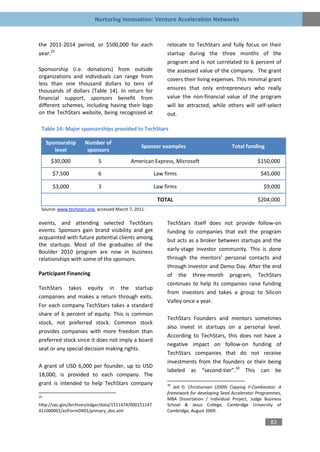
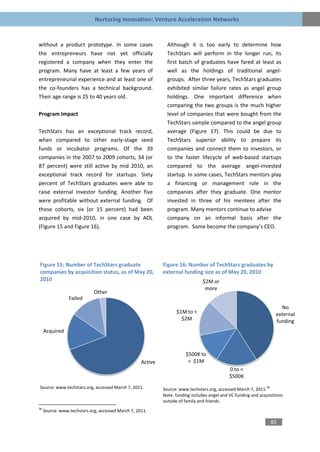
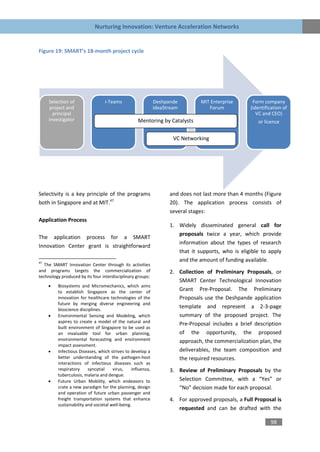

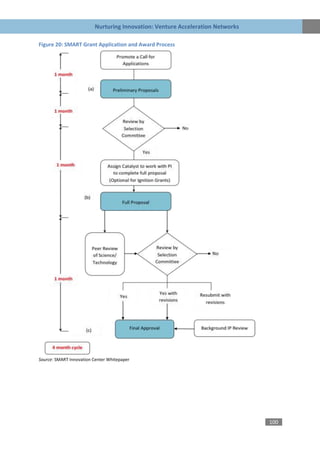
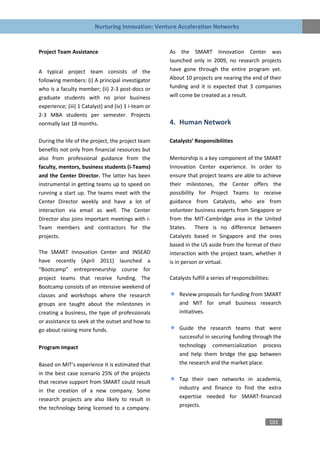
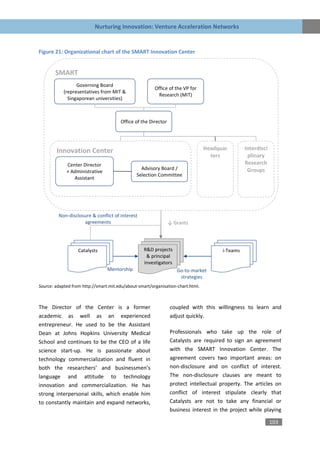
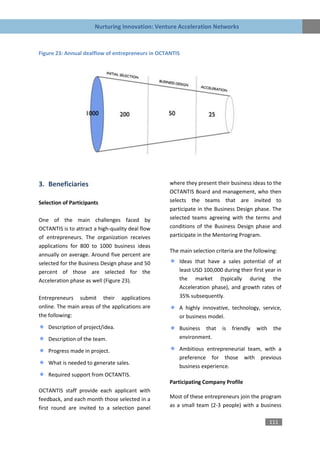
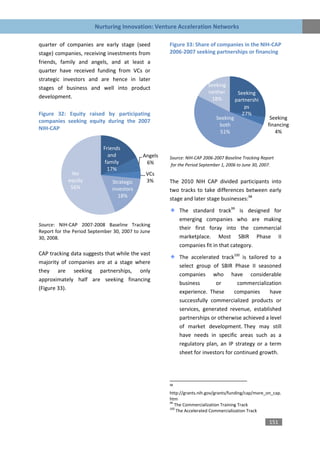
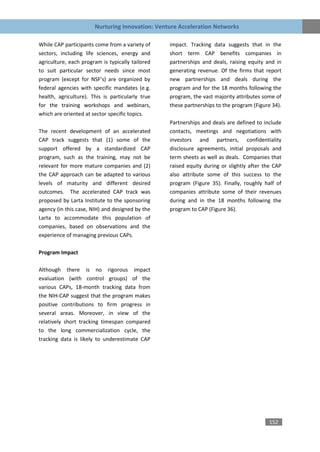
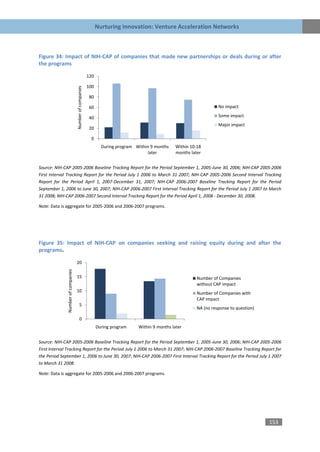
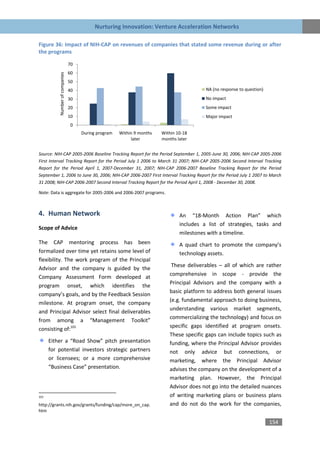
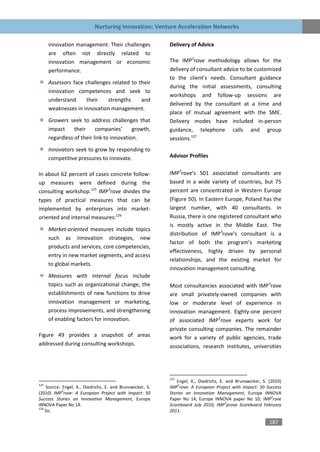
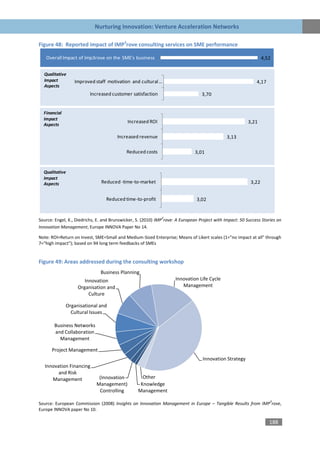
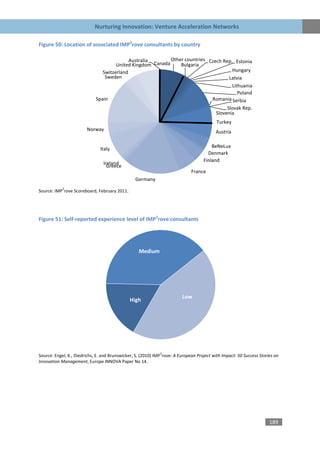
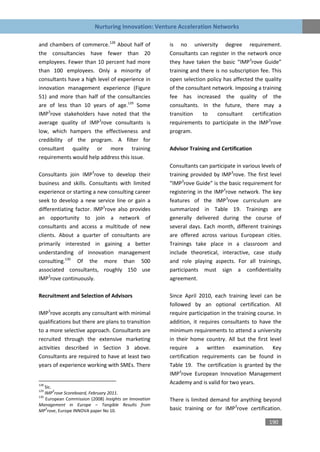
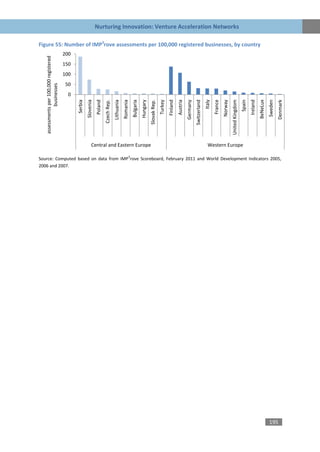
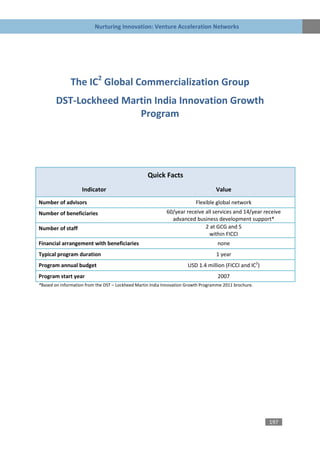

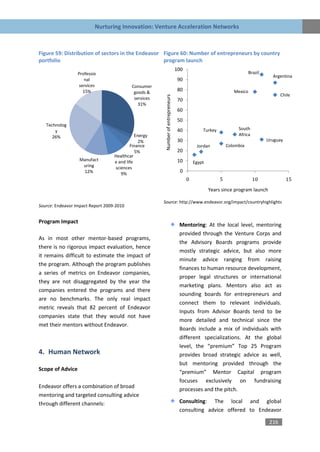
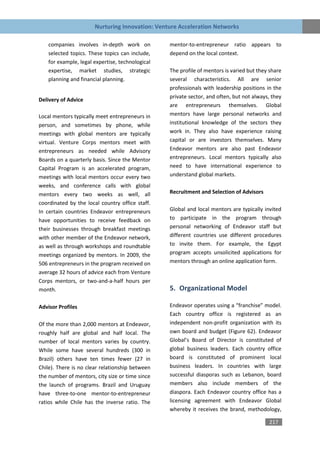
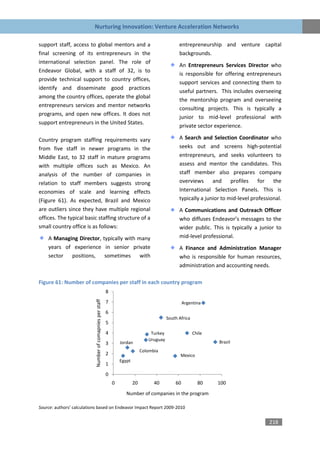
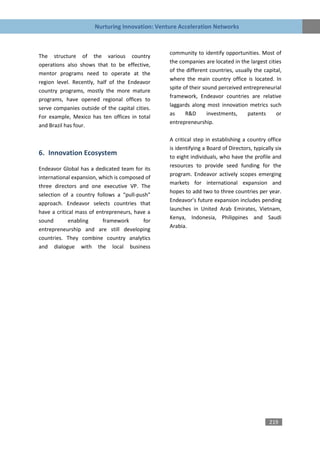



Nurturing Innovation: Venture Acceleration Networks


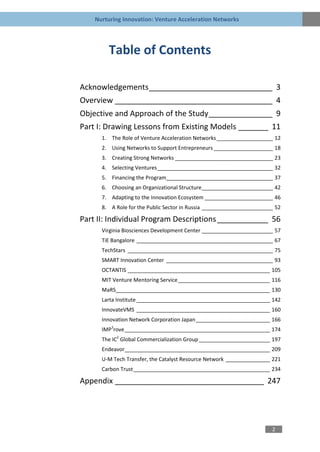
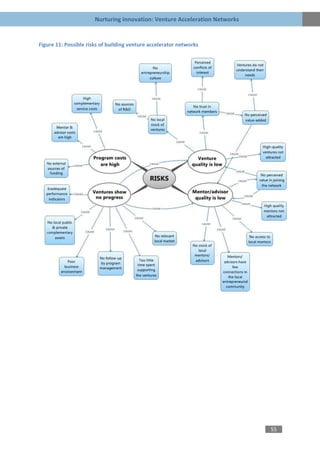
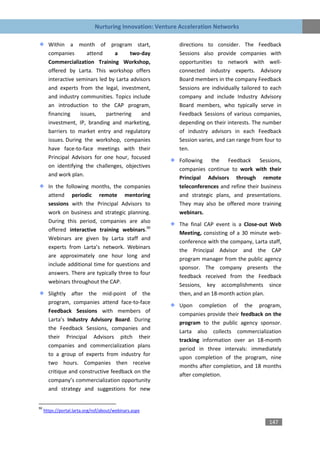
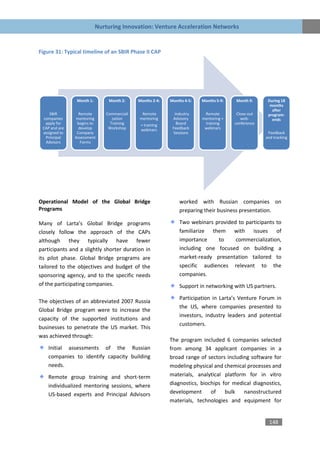
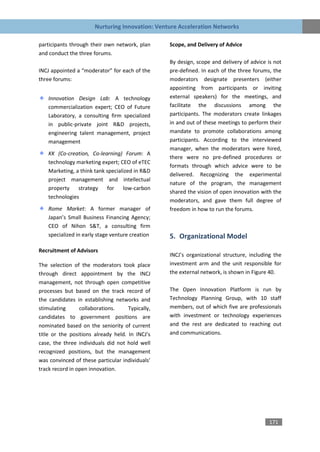
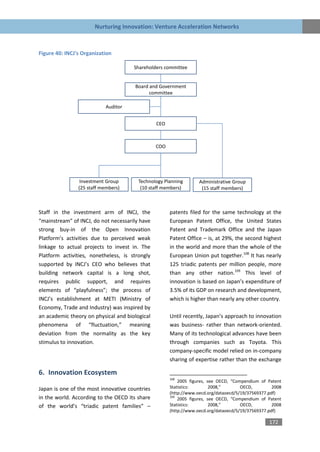
        Table of Contents

Acknowledgements _____________________________ 3
Overview _____________________________________ 4
Objective and Approach of the Study _______________ 9
Part I: Drawing Lessons from Existing Models _______ 11
      1. The Role of Venture Acceleration Networks ___________________ 12
      2. Using Networks to Support Entrepreneurs ____________________ 18
      3. Creating Strong Networks _________________________________ 23
      4. Selecting Ventures _______________________________________ 32
      5. Financing the Program____________________________________ 37
      6. Choosing an Organizational Structure ________________________ 42
      7. Adapting to the Innovation Ecosystem _______________________ 46
      8. A Role for the Public Sector in Russia ________________________ 52

Part II: Individual Program Descriptions ____________ 56
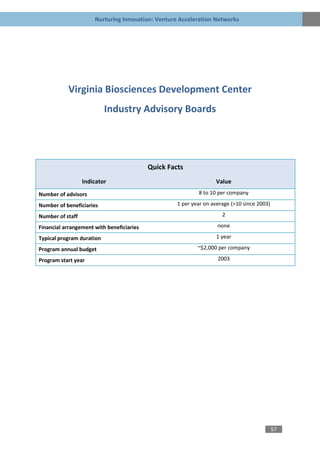
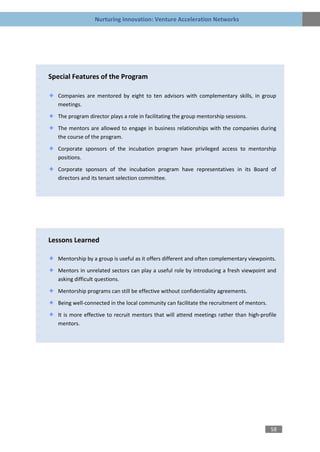
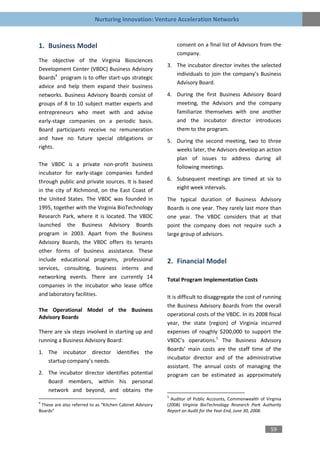
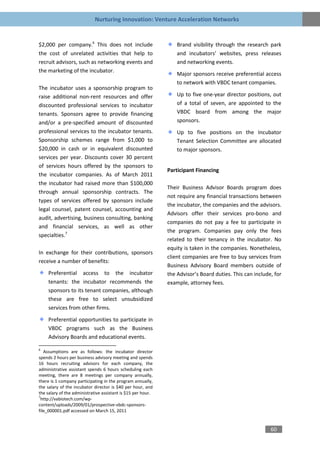
      Virginia Biosciences Development Center ________________________ 57
      TiE Bangalore ______________________________________________ 67
      TechStars _________________________________________________ 75
      SMART Innovation Center ____________________________________ 93
      OCTANTIS ________________________________________________ 105
      MIT Venture Mentoring Service _______________________________ 116
      MaRS____________________________________________________ 130
      Larta Institute _____________________________________________ 142
      InnovateVMS _____________________________________________ 160
      Innovation Network Corporation Japan _________________________ 166
      IMP3rove _________________________________________________ 174
      The IC2 Global Commercialization Group ________________________ 197
      Endeavor_________________________________________________ 209
      U-M Tech Transfer, the Catalyst Resource Network _______________ 221
      Carbon Trust ______________________________________________ 234

Appendix ___________________________________ 247


                                                                       2
Nurturing Innovation: Venture Acceleration Networks


Acknowledgements
This report was prepared for the Russian Venture
Company by a World Bank team led by Jean-Louis
Racine in collaboration with Alistair Brett, Doina
Cebotari, Juan Julio Gutierrez, Naoto Kanehira,
Lawrence Kay, Anthony Lambkin, Sebastián Melin,
Florian Theus, Christina Tippmann, Alina Tourkova,
and Yanina Yermakova.

The team would like to thank Leonid Levkovitch-
Masluk of Russian Venture Company who provided
important guidance and shared his invaluable
knowledge. The team is also grateful to Sophie
Sirtaine (World Bank Sector Manager), Pedro Alba
(World Bank Country Director), Alfred Watkins (World
Bank) and Bob Hodgson (Zernike UK) for comments
received on the draft. The team would like to thank
Yevgeny Kuznetsov (World Bank) for comments on the
case studies. Finally, the team is grateful to Zenaida
Kalinger (World Bank) for her support in putting the
report together and Rodrigo de Castro (World Bank)
for the cover design.

The team would also like to thank all of the staff
members, mentors, consultants, clients and
beneficiary entrepreneurs of the venture acceleration
networks who generously gave offered their time for
interviews. In particular, the team would like to thank
Sidney Burback (IC2), Pete Peters (Innovate VMS),
Dave Raval (Carbon Trust), Sayaka Iwase (INC Japan),
Howard Califano (SMART Innovation Center), Don
Duval (MaRS), Ravindranath. P (TiE Bangalore), Dave
Geary (Endeavor), Carlos Gutierrez and Rohit Shukla
(Larta Institute), Jerome Smith (MIT VMS), Eva
Diedrichs and Sabine Brunswicker (IMP3rove), Wes
Hufstetter (University of Michigan Catalyst Resource
Network), Jenny Boyd and Nicole Glaros (TechStars),
and Richard Caro (Acceleration Coop).


                                                          3
Nurturing Innovation: Venture Acceleration Networks


                                                  management and technical talent from the
Overview                                          labor force with the appropriate businesses.
                                                  They match service providers with potential
                                                  new clients. And finally, they help create a
                                                  culture of entrepreneurship by exposing
Roles
                                                  entrepreneurs to role models and by fostering
                                                  the social capital that accelerates the exchange
Venture acceleration networks consist of
                                                  of knowledge, ideas and deals in the
experienced, skilled and well-connected
                                                  community.
individuals who provide hands-on support to
entrepreneurs. They help propel viable
                                                  Common Threads
business ideas to the market place by
accelerating the regeneration of ideas and
                                                  Venture acceleration network programs have
connecting entrepreneurs to the market. They
                                                  several basic features in common. In their
achieve this by:
                                                  current form they are all very recent, having
   Educating entrepreneurs through on-the-        appeared only in the past decade, initially in
   job training on a broad range of practical     the United States, although less structured
   skills related to the business growth.         variations existed before. They are organized
   Connecting entrepreneurs to        markets,    around a professionally-staffed nucleus,
   capital, customers, partners,      experts,    typically supported by a core network of
   information and role models        through     mentors or brokers, and an extended network
   introductions, brokering and by    creating    of service providers and technical experts.
   bonds of trust and credibility.                Often, they offer learning and networking
                                                  events for the entrepreneurs and their
   Validating business ideas through strategic
                                                  communities of mentors, brokers, service
   advice and direction, and by creating a
                                                  providers and experts. They typically include
   supportive environment for business
                                                  some level of screening, tied to the
   development experiments. Validation
                                                  entrepreneur’s affiliation, the venture’s profile
   provides the critical value-added of
                                                  or its potential for success. None of the
   venture acceleration networks. It builds on
                                                  programs are financed to any significant extent
   the two other pillars, educating and
                                                  through upfront user fees.
   connecting, to help ideas fail early, often
   and inexpensively.
                                                  Approach
The impact of venture acceleration network
programs extends beyond the entrepreneurs         Around this set of common features, venture
they serve directly to the wider community of     acceleration networks experiment with a wide
entrepreneurs, investors, and business service    range     of   approaches    to    financing,
providers. They provide investment-ready or       management, network creation, selectivity,
screened opportunities for potential investors.   service delivery and structure. Three main
They reduce public and private resources          approaches emerge from this variety,
invested in nonviable business ideas by           although most of the programs do not fall
accelerating their path to failure through        neatly into any single category. A first
market validation. They help match                approach aims to commercialize technology


                                                                                               4
Nurturing Innovation: Venture Acceleration Networks


projects for short-term payoffs (e.g. creating     financials, and relatively open in structure and
spin-offs). A second approach aims to build a      timeline.
local self-sustainable innovation ecosystem
with broad medium to long-term payoffs (e.g.       Programs aiming to build innovation-related
creating linkages in the entrepreneurship          consultancy markets do not aspire to pick
community). A third approach aims to foster a      winners but to help businesses grow by
market for innovation-related services by          connecting them to qualified and vetted
building capacity, transparency and efficiency     commercial sources of support. They follow a
in the service provider market, and raising        “hands-off”     approach    to     supporting
awareness among SMEs.                              entrepreneurs, creating analytical tools, and
                                                   training qualification tools to support
Programs aiming to foster short-term R&D           innovation-related consultancy, and by
commercialization select technology projects       marketing the network. Hence, they generally
on the basis of their (assumed) technical and      operate with small teams. Their light-touch
market potential. They often include funding       approach means that their models are easily
for feasibility testing. Some rely on full-time    scalable, although they are also less rich in
professional mentors and brokers to provide        content.
bare-bones project teams with rapid and
dedicated support. Because they target             Success Factors
technologies that are not yet fully out of the
lab, they also focus on team-building, bringing    Experiments with venture acceleration
in management talent from the outside to           networks highlight many success factors.
complement the technical talent of the project     Critical factors include:
team. These many roles make these programs             The programs are managed by highly-
relatively staff and resource-intensive. To            networked “magnetic” individual who are
minimize costs these programs are structured           able to attract mentors, business services
around clear milestones and timelines.                 providers, experts and ventures by virtue
                                                       of their position in the business
Programs aiming to build innovation                    community.         They are well-known
ecosystems select projects on the basis of their       overachiever entrepreneurs and business
venture teams, and their perceived capacity to         leaders with significant convening power.
benefit from the program and create high-
impact ventures. Many have elements of self-           The programs start with small “high-
selection whereby unfit entrepreneurs are              value” networks with very limited
made to opt out of the programs. The                   numbers of high-quality entrepreneurial
programs focus on building the skills of the           teams and mentors. High-quality networks
venture team, recognizing this as a long-term          can be self-perpetuating.
investment for society. The programs also              The programs select mentors who value
focus on nurturing and leveraging external             their participation in the networks beyond
mentor and advisory networks to support the            immediate financial reward. They are
ventures, rather than rely on in-house capacity.       motivated by giving-back to their
They are light-weight in terms of staffing and         communities, networking with ventures
                                                       and other mentors, potential investment


                                                                                               5
Nurturing Innovation: Venture Acceleration Networks


positions in the ventures and potential       Challenges
management positions. Mentors who
derive personal satisfaction from their       Venture acceleration network experiments
involvements are “sticky” and stay            highlight a multitude of challenges. Some face
connected with the program and with the       challenges linked to the environments where
ventures. Giving flexibility to mentors and   they operate. Where there is no local pipeline
entrepreneurs to select each other creates    of coachable ventures or of mentors with the
long-lasting relationships and thus expands   right mix of skills, experience and connections,
the size and sustainability of an             programs do not succeed. Programs also face
entrepreneurship network.                     an uphill challenge where there is no local
                                              access to complementary forms of public and
The programs offer consulting services
                                              private support, financial and other.
and match-making as a package with
mentoring, not as standalone services. This
                                              Some venture acceleration networks also
ensures that the ventures seek relevant
                                              suffer from design issues. Common problems
consulting services and are well-prepared
                                              are linked to top-down match-making of
before prospective meetings. Mentors act
                                              mentors and entrepreneurs, which typically
as gateways or network hubs to other
                                              leads to a mismatch, poor screening of
forms of support and as connectors.
                                              mentors and advisors, and building programs
The programs ensure that non-performing       based on pure financial incentives for advisors.
entrepreneurs are filtered out. This is
either done through extensive screening       The Role of the Public Sector
processes or by admitting a wide pool of
ventures and putting indirect pressure on     Venture acceleration networks can address a
non-performers to self-select out during      number of market and system failures that
the course of the program.                    hamper innovation and entrepreneurship.
                                              These market failures are linked to the
The programs actively manage trust. They
                                              transaction costs, search costs and information
achieve this by setting and enforcing clear
                                              asymmetries that lead to a less-than-optimal
guidelines      and     expectations    for
                                              amount of innovation-related services supplied
entrepreneurs and advisors. In addition,
                                              and sold on the market. They are also linked to
they leverage personal networks in tight-
                                              the positive externalities of investing in the
knit entrepreneurial communities with
                                              skills of an investee, since part of those skills
abundant social capital, where ethical
                                              will be captured by future investors. The
violations would cause reputational risk.
                                              system failures are linked to capabilities
Where there is no such community, they
                                              failures -i.e. inadequacies in entrepreneurs’
use self-policing through mentor groups.
                                              abilities to act in their own best interest - and
Programs supporting ventures far from         framework failures related to cultural and
relevant markets, sources of financing and    social norms.
specialized knowledge build bridges to
relevant global networks.                     The public sector can help address these gaps
                                              by supporting venture acceleration network
                                              experiments. Venture acceleration network


                                                                                           6
Nurturing Innovation: Venture Acceleration Networks


programs grow in different ways, require
different institutional structures and serve
different functions depending on the local
context. Hence there is no single approach to
building these programs and only through
experimentation can effective models be
identified.

The public sector can ensure that it quickly
converges to appropriate models by
supporting existing network initiatives and
partnering with regional stakeholders to
create new ones. Support can come in the
form of facilitating partnerships between
relevant stakeholders, providing financing on a
competitive basis, and creating mechanisms
for programs to adopt good practices and learn
from one another.


                                                                             7
Nurturing Innovation: Venture Acceleration Networks


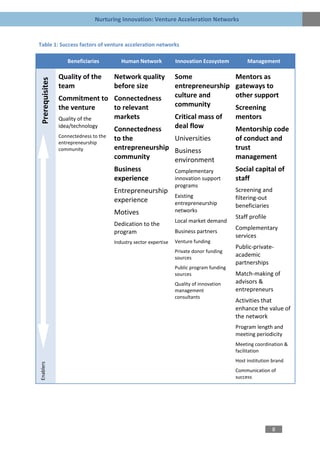
Table 1: Success factors of venture acceleration networks

                    Beneficiaries          Human Network            Innovation Ecosystem          Management

                 Quality of the         Network quality             Some                     Mentors as
 Prerequisites


                 team                   before size                 entrepreneurship         gateways to
                 Commitment to Connectedness                        culture and              other support
                 the venture    to relevant                         community                Screening
                 Quality of the markets                             Critical mass of         mentors
                 idea/technology
                                        Connectedness               deal flow                Mentorship code
                 Connectedness to the
                 entrepreneurship
                                        to the           Universities                        of conduct and
                 community              entrepreneurship Business                            trust
                                        community        environment                         management
                                        Business         Complementary                       Social capital of
                                        experience       innovation support                  staff
                                                                    programs
                                        Entrepreneurship                                     Screening and
                                                                    Existing                 filtering-out
                                        experience                  entrepreneurship         beneficiaries
                                        Motives                     networks
                                                                                             Staff profile
                                                                    Local market demand
                                        Dedication to the
                                                                                             Complementary
                                        program                     Business partners
                                                                                             services
                                        Industry sector expertise   Venture funding
                                                                                             Public-private-
                                                                    Private donor funding
                                                                    sources
                                                                                             academic
                                                                                             partnerships
                                                                    Public program funding
                                                                    sources                  Match-making of
                                                                    Quality of innovation    advisors &
                                                                    management               entrepreneurs
                                                                    consultants
                                                                                             Activities that
                                                                                             enhance the value of
                                                                                             the network
                                                                                             Program length and
                                                                                             meeting periodicity
                                                                                             Meeting coordination &
                                                                                             facilitation
                                                                                             Host institution brand
Enablers


                                                                                             Communication of
                                                                                             success


                                                                                                             8
Nurturing Innovation: Venture Acceleration Networks


   Objective and
Approach of the Study
The objective of this report is to understand the role,
operational models and identify good practices of
programs that seek to accelerate innovative
entrepreneurship by managing, nurturing and
leveraging social and business networks. This report is
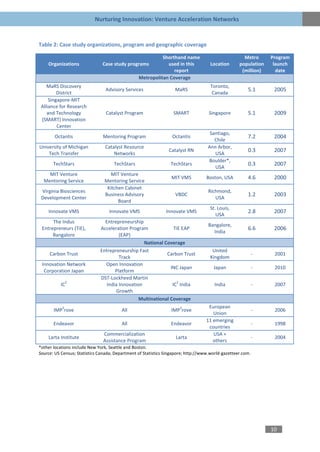
based on 15 case studies of venture acceleration
network programs spanning 43 countries (Table 2).
The general findings are presented in Part I while the
individual case studies can be found in Part II. The
conclusion suggests next steps for operationalizing a
venture acceleration network in Russia.

The basic selection criteria for the case studies were
that the programs rely on networks to help
entrepreneurs innovate. The 15 case studies were
selected so that as a whole, they represented
programs with:
    Sufficient track record to observe their output,
    understand their impact and draw lessons from
    the challenges they faced.
    A wide variety of business models.

    Distinct innovation ecosystems, in terms of their
    geography, enabling environment and supportive
    institutions.
    Serve ventures in a variety of sectors and growth
    stages.


                                                          9
Nurturing Innovation: Venture Acceleration Networks


Table 2: Case study organizations, program and geographic coverage

                                                           Shorthand name                            Metro      Program
    Organizations              Case study programs           used in this            Location      population    launch
                                                                report                              (million)     date
                                                 Metropolitan Coverage
    MaRS Discovery                                                                   Toronto,
                                 Advisory Services                 MaRS                                5.1       2005
         District                                                                     Canada
     Singapore-MIT
 Alliance for Research
    and Technology               Catalyst Program                 SMART             Singapore          5.1       2009
 (SMART) Innovation
         Center
                                                                                    Santiago,
       Octantis                Mentoring Program                  Octantis                             7.2       2004
                                                                                      Chile
University of Michigan          Catalyst Resource                                  Ann Arbor,
                                                                Catalyst RN                            0.3       2007
    Tech Transfer                   Networks                                          USA
                                                                                   Boulder*,
       TechStars                     TechStars                   TechStars                             0.3       2007
                                                                                      USA
    MIT Venture                    MIT Venture
                                                                 MIT VMS           Boston, USA         4.6       2000
  Mentoring Service             Mentoring Service
                                 Kitchen Cabinet
 Virginia Biosciences                                                               Richmond,
                                Business Advisory                  VBDC                                1.2       2003
 Development Center                                                                    USA
                                      Board
                                                                                    St. Louis,
    Innovate VMS                  Innovate VMS                 Innovate VMS                            2.8       2007
                                                                                       USA
      The Indus                 Entrepreneurship
                                                                                    Bangalore,
 Entrepreneurs (TiE),         Acceleration Program              TiE EAP                                6.6       2006
                                                                                      India
      Bangalore                        (EAP)
                                                  National Coverage
                              Entrepreneurship Fast                                   United
     Carbon Trust                                           Carbon Trust                                    -    2001
                                       Track                                         Kingdom
 Innovation Network             Open Innovation
                                                              INC Japan               Japan                 -    2010
  Corporation Japan                  Platform
                              DST-Lockheed Martin
               2                                                  2
          IC                     India Innovation              IC India                India                -    2007
                                      Growth
                                                Multinational Coverage
           3                                                          3             European
       IMP rove                          All                     IMP rove                                   -    2006
                                                                                      Union
                                                                                   11 emerging
       Endeavor                          All                     Endeavor                                   -    1998
                                                                                    countries
                               Commercialization                                      USA +
    Larta Institute                                                Larta                                    -    2004
                               Assistance Program                                     others
*other locations include New York, Seattle and Boston.
Source: US Census; Statistics Canada; Department of Statistics Singapore; http://www.world-gazetteer.com.


                                                                                                                10
Nurturing Innovation: Venture Acceleration Networks


                                                network members (MaRS). These internal
                                                network members can be mobilized quickly
                                                and intensively when a need arises, and are
                                                usually pro-active, acting as “project scouts”
  1. The Role of Venture                        within a research institution. At the other
                                                extreme, one program, IMP3rove, adopts a
     Acceleration                               hands-off approach to network facilitation by
     Networks                                   creating incentives to join a network in the
                                                form of standardization of service offerings,
                                                professional certifications and market visibility.
                                                In between those two extremes lie programs
Key findings
                                                that draw individuals from existing networks –
                                                either from social networks (TechStars) or
     Venture acceleration networks address
                                                alumni networks (MIT VMS) – and formalize
     market gaps associated with skills,
                                                them into networks that serve their specific
     transaction costs, resource efficiency
                                                objectives. Where there are no such pre-
     and network externalities.
                                                existing networks to draw from, other
                                                programs assemble and manage new external
                                                networks. New networks are necessary in
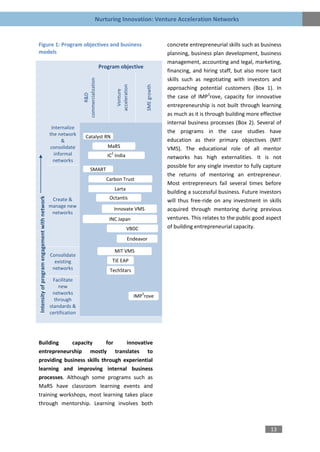
Objectives                                      communities where the entrepreneurship
                                                community is not dense (Octantis), and where
The venture acceleration networks in the case   the networks need to span vast geographic
studies can be classified according to their    areas (INC Japan nationally, and Endeavor
objectives (Figure 1). A first category of      globally).
programs        helps     accelerate      the
commercialization of technology issued from     Addressing Market and System Failures
R&D, often still at the pre-venture stage
(Catalyst RN). A second category focuses on     The programs in the case studies play the
accelerating the growth of early stage          following four roles in promoting innovation
ventures, hence on “commercializing”            and entrepreneurship:
entrepreneurs rather than commercializing
                                                    Improve entrepreneurial capacity through
R&D (TechStars). Yet, a third focuses on
                                                    experiential learning.
accelerating growth in revenue-generating
small and medium enterprises (SMEs)                 Reduce transaction costs and improve
(IMP3rove). Many serve more than one of             search efficiency between entrepreneurs
these objectives.                                   and the resources they need to succeed.

                                                    Increase public and private resource
Programs vary in their level of engagement
                                                    efficiency by helping business ideas fail
with network creation, coordination and
                                                    early, often and inexpensively.
management. At one extreme some programs
focus on building strong internal pools of          Leverage    network    externalities  by
professionalized mentors, brokers and               expanding and strengthening networks.
advisors, who they complement with external


                                                                                             12
Nurturing Innovation: Venture Acceleration Networks


Figure 1: Program objectives and business                                                                                       concrete entrepreneurial skills such as business
models                                                                                                                          planning, business plan development, business
                                                                                                                                management, accounting and legal, marketing,
                                                                                   Program objective
                                                                                                                                financing, and hiring staff, but also more tacit
                                                                                                                                skills such as negotiating with investors and

                                                               commercialization


                                                                                             acceleration


                                                                                                                   SME growth
                                                                                                                                approaching potential customers (Box 1). In


                                                                                               Venture
                                                                    R&D

                                                                                                                                the case of IMP3rove, capacity for innovative
                                                                                                                                entrepreneurship is not built through learning
                                                                                                                                as much as it is through building more effective
                                                                                                                                internal business processes (Box 2). Several of
                                                Internalize
                                               the network
                                                                                                                                the programs in the case studies have
                                                                 Catalyst RN
                                                     &                                                                          education as their primary objectives (MIT
                                               consolidate                            MaRS                                      VMS). The educational role of all mentor
                                                 informal                               2
                                                                                      IC India                                  networks has high externalities. It is not
                                                 networks
                                                                                                                                possible for any single investor to fully capture
                                                                       SMART
                                                                                                                                the returns of mentoring an entrepreneur.
                                                                                     Carbon Trust
                                                                                                                                Most entrepreneurs fail several times before
                                                                                            Larta
                                                                                                                                building a successful business. Future investors
                                                                                       Octantis
Intensity of program engagement with network


                                                Create &                                                                        will thus free-ride on any investment in skills
                                               manage new
                                                                                            Innovate VMS                        acquired through mentoring during previous
                                                networks
                                                                                       INC Japan                                ventures. This relates to the public good aspect
                                                                                                      VBDC                      of building entrepreneurial capacity.

                                                                                                       Endeavor

                                                                                         MIT VMS
                                               Consolidate                                   VV
                                                 existing                               TiE EAP
                                                networks                               TechStars
                                                 Facilitate
                                                   new
                                                 networks                                                      3
                                                                                                            IMP rove
                                                 through
                                               standards &
                                               certification


Building     capacity       for    innovative
entrepreneurship mostly translates to
providing business skills through experiential
learning and improving internal business
processes. Although some programs such as
MaRS have classroom learning events and
training workshops, most learning takes place
through mentorship. Learning involves both


                                                                                                                                                                            13
Nurturing Innovation: Venture Acceleration Networks


Box 1: Building entrepreneurial capacity               Box 2: Building innovative capacity through
through experiential learning.                         management consulting.

Brendan McNaughton is the founder and chief            Perficable is a metal-cutter and manufacturer of
technical officer of Lifemagnetics, a biotechnology    metal parts for cars, furniture and general
firm spun out of his research at the University of     appliances based in Spain. It was founded in 1999.
                                                                                3
Michigan with the help of Catalyst RN. The             Before it approached IMP rove its objective was to
company has five employees. It is currently            become more innovative so that it could expand
commercializing       technology     for    bacteria   into new industries.
identification and measurement of patient
responses to antibiotics, which will help doctors      Perficable had several industry niches that it
                                                                                          3
target treatments at patients more quickly.            wanted to target and joined IMP rove for the help
                                                       it could provide in improving its internal processes
In establishing Lifemagnetics Brendan required         for encouraging and managing innovation.
                                                            3
substantial help with starting and managing the        IMP rove highlighted two areas for improvement:
business, and then getting connected to people         the creation of an innovation plan and the need
with the expertise and experience he needed to         for collection and analysis of customer feedback in
grow the company. Catalyst RN helped with              order to improve customer satisfaction. The first
                                                                        3
Brendan’s and Lifemagnetics’ development in both       issue that IMP rove thus helped with was the
of these areas.                                        specification of problems that needed solving.

While he was at the university Brendan was             To try and improve Perficable’s processes in these
                                                                       3
guided by a mentor (who eventually became              two areas, IMP rove helped the firm to develop an
Lifemagnetics’ CEO), and then a business start-up      innovation plan that involved all the staff and
specialist who helped him to write a business plan     explored the generation, development and
and assess the potential market for his research.      evaluation of innovative ideas. In order to improve
                                                                                              3
He was then connected to consultants and other         the flow of customer feedback, IMP rove helped
experts who were central to the formation of the       Perficable to both manage and analyze the client
business and management of the technology.             responses that they were receiving but previously
                                                       not managing adequately.
Catalyst RN also helped Brendan to find vital
sources of funding at each stage of the                The innovation and feedback management plans
commercialization process. At the start he             are still being implemented but it is hoped that
received USD 150,000 through two funds at the          they will have several important effects,
University of Michigan that enabled the                particularly in Perficable’s ability to encourage the
technology to be prototyped. The network then          creation, selection and marketization of innovative
connected him to the Walter Coulter Foundation,        ideas. It is also hoped that Perficable will soon
which gave him a total grant of USD 350,000 over       have customer satisfaction strategies in place that
three years for support in growing the business.       are based on customer feedback.
Finally, the network introduced him to a venture
capitalist, which has invested in the firm.            Source: Engel, K., Diedrichs, E. and Brunswicker, S.
                                                                  3
                                                       (2010) IMP rove: A European Project with Impact: 50
Source: Interview with Brendan McNaughton.             Success Stories on Innovation Management, Europe
                                                       INNOVA Paper No 14.


                                                                                                       14
Nurturing Innovation: Venture Acceleration Networks


Reducing transaction costs implies connecting      improve them or abandon them. They also
entrepreneurs with relevant and trusted            allow for entrepreneurs to quickly recognize
resources      (e.g.     lawyers,  consultants,    their own failure if they do not have the
investors, business partners, potential            required willingness or ability to take their
employees, potential customers). Transaction       ventures to the market. Importantly, they help
costs can be deal-breakers between early-          governments minimize the public resources
stage ventures and the external resources they     spent on supporting ventures and business
need to succeed. Entrepreneurs with limited        ideas that do not have a future in the market.
experience do not know what types of               A comprehensive study of new business
resources they need, how to formulate their        development in the United States over a 50
needs, and who to trust. The same may hold         year period found that 3,000 ideas only lead to
true for SMEs in the area of innovation            one market success.1 The role of the program
management. From their viewpoints the              is hence to reduce the time and resources
providers of “resources” see early-stage           spent on the 2,999 ideas that never make it to
ventures and SMEs as a very fragmented             the market. They help business ideas fail early,
market that requires prohibitive business          often and inexpensively.
development costs. Moreover, there are
information asymmetries due to the lack of         Market validation plays a particularly
efficient market signals: investors, business      important role for young firms and new
partners and customers cannot easily               markets. Young firms do not have the start-up
distinguish promising opportunities from poor      capital or time for careful market research (Box
opportunities.       All    programs     include   3). And for disruptive innovation, classical
mechanisms to reduce transaction costs. Some       approaches to market research are often not
are passive (IMP3rove’s consultant database)       very informative since the markets to be
while others are active (IC2’s brokers).           researched do not yet exist. Rather what is
Programs centering around mentors ensure           needed is testing the idea quickly to have
that transaction costs are minimized on both       market judgment from individuals with unique
the supply and demand sides. For example,          abilities to “interpret” the market. This may
they will only connect a venture to a trusted      include talking to potential customers,
investor if and when the venture is investment-    investors, peers and experts at an early stage,
ready.                                             which can be accelerated by tapping into a
                                                   mentor’s network to help identify potential
Rapid market validation leads to increased         customers and markets.
public and private resource efficiency. The
role of the programs is to continuously connect    Resource efficiency is best exemplified by the
entrepreneurs to resources (experienced            “sounding boards” in the program cases
entrepreneurs, industry leaders, potential         studies. These groups of individuals provide
customers, potential investors, technical          earnest and rapid feedback to entrepreneurs.
experts, consultants, etc.) that can provide       These boards are different from the typical
them with rapid feedback on their business         advisory boards that individual companies
ideas and on their ventures. The programs          have.
allow entrepreneurs to limit the time and          1
                                                     Stevens G and Burley J. (1997) 3,000 Raw Ideas = 1
resources they spend on bad ideas, and             commercial Success , Industrial Research Institute.


                                                                                                  15
Nurturing Innovation: Venture Acceleration Networks


                                                            roles stated above on a sustained basis. Social
Box 3: Market validation versus market
research                                                    networks help entrepreneurs improve their
                                                            skills, reduce their transaction costs and
    In a seminal study on the origin and evolution of       validate their ideas. Mentors are the key
    the fastest growing businesses in the United States     gateway to entrepreneurial networks. They
    Amar Bidhé found that they often employ fast-           develop the trust relationships with their
    paced strategies of opportunistic adaptation based
                                                            mentees that are required for network entry.
    on rapid market validation: “Entrepreneurs who
                                                            As network members themselves, mentors
    start uncertain businesses with limited funds have
                                                            epitomize the benefits of leveraging networks:
    little reason to devote much effort to prior
    planning and research. They cannot afford to            they sometimes keep their roles as mentors
    spend much time or money on the research; the           after the program, they sometimes invest in
    modest likely profits doesn’t merit much; and, the      their mentees, they sometimes join their
    high uncertainty of the business limits its value.      ventures as managers, and they sometimes
                                                            help them broker relationships with investors,
    Sketchy planning and high uncertainty requires          customers, business partners or service
    entrepreneurs to adapt to many unanticipated            providers. In programs with mentors in
    problems and opportunities. One entrepreneur
                                                            residence, such as the University of Michigan
    likens the process of starting a new business to
                                                            Catalyst Resource Network, a mentor will
    jumping from rock to rock up a stream rather than
                                                            frequently serve as the start-up company’s
    constructing the Golden Gate Bridge from a
    detailed blueprint. Often, to borrow from Elster’s      “acting CEO”.
    discussion of biological evolution, entrepreneurs
    adapt to unexpected circumstances in an                 Impact
    “opportunistic fashion: their response derives
    from a spur of the moment calculation made with         The rationale for venture acceleration
    the intention of maximizing immediate cash-flow.        networks is grounded on market failures, and
    Capital-constrained entrepreneurs cannot afford         studies on angel investing suggest that
    to sacrifice short term cash for long term profits.
                                                            mentoring has a positive effect on investment
    They have to play rapid-fire pinball rather than a
                                                            returns (Box 4), but there has yet to be a
    strategic game of chess.”
                                                            rigorous evaluation of their economic impact.
    Source: Amar Bidhé (2000) The Origin and Evolution of   Only a few of the programs in the case studies
    New Businesses.                                         make any attempt to measure impact. Larta is
                                                            the only program to publish its impact
Leveraging networking externalities implies                 assessments. They suggest that the programs
absorbing entrepreneurs into high-value                     do make contributions to the progress of the
networks. Social networks can be difficult to               venture in several areas. These include forming
penetrate for newcomer entrepreneurs, even                  new partnerships and deals, raising investment
in dense and highly-connected clusters such as              and raising revenue. Anecdotal evidence from
Silicon Valley.2 Connections to entrepreneurial             the case studies suggests that many of the
networks help to achieve the three program                  entrepreneurs benefited in similar ways from
                                                            other programs.
2
   There are now numerous “bridging organizations” in
Silicon Valley whose role is to connect outsider
entrepreneurs or inexperienced entrepreneurs to
relevant networks.


                                                                                                      16
Nurturing Innovation: Venture Acceleration Networks


Box 4: The effect of mentoring on angel investment returns

Attracting investment is a key part of the growth of any startup, but so is the expertise that it can draw on.
Entrepreneurs negotiating the stages of founding and developing a business can benefit substantially from the
advice of experienced investors, hence the potential effects of mentoring during angel funding and other early-
stage investments. A recent study examined some of the effects of this mentoring on the performance of startups
that had attracted angel investment in the United Kingdom.

The study examined the activities of angels in 31 investment groups. It specifically looked at the exits they had
made from their investments, mostly from the year 2000 onwards. There was substantial knowledge in the group,
as the median level of experience of investing was five years while the median number of years spent with a large
company was 13. In the sample there were just over 1,000 separate investments with 406 exits. The average
investment size per investor was £42,000 and the average number of investments was six. The median pre-
investment valuation of the firms that received money was £875,000 while the mean was £1.7 million.

Among the investors in the sample more entrepreneurial experience was significantly correlated with better
investment outcomes. In particular, those who had been involved in three or more ventures were less likely to
lose money and were better able to make several-fold returns on their investments. Furthermore, angels who
made investments in areas in which they had already had prior involvement were also much less likely to see
their investments fail. This suggests that acuity for spotting and then guiding the growth of a venture is important
to its success. In places where there are few entrepreneurs with much depth of expertise it thus makes sense for
the ones who do to provide much-needed mentoring.

The study examined both the amount of due-diligence performed by the investors and the level of involvement
they took in their investments. The study found that investments where the investor had spent at least 20 hours
of due diligence were much less likely to fail (another study in the US found that investments that were subject to
more than 20 hours of due diligence showed an overall return of 5.9 times while those subject to less than 20
hours showed an overall return of 1.1 times). Therefore, mentors, if given the time to properly work with a
venture, can use their expertise to investigate its fundamentals and provide commensurately detailed and useful
advice.

The study also found some interesting results for investor involvement. It found that board membership, where
appropriate, had strong positive effects on outcomes, as did regular involvement with the venture. The 40% of
passive investors in the sample experienced more failures than the active investors, and the more active an
investor was in terms of frequency of interaction the more likely the investment was to have a positive outcome
(in the US study, investors who interacted with the managers of a venture a few times a month recorded an
overall investment return multiple of 3.7 times; those who only interacted a few times a year produced an overall
multiple of 1.3 times).

All of this evidence would suggest that more involvement is always better than less, if it were not for the results
where angels had taken management roles. However, in the UK study, the 13% of investments where this had
happened enjoyed significantly poorer returns. Clearly, this would suggest that the involvement of an
experienced mentor can contribute substantially to the growth of a venture, but that the degree of involvement
needs to be managed appropriately.

Source: Wiltbank RE, Siding with the Angels: Business Angel Investing – Promising Outcomes and Effective Strategies, NESTA,
2009. Wiltbank R and Boeker W, Returns to Angel Investors in Groups, 2007.


                                                                                                                 17
Nurturing Innovation: Venture Acceleration Networks


                                                   roles but emphasize one over the others (Table
  2. Using Networks to                             4).

     Support                                       Figure 2: Overlapping roles in venture
     Entrepreneurs                                 acceleration networks


                                                                Sounding boards
Key findings
                                                                                          Service
                                                                                         providers
   To manage trust and expectations,
   programs clearly differentiate mentors
   from service providers.
                                                                   Mentors
   Brokers are of limited efficacy unless
   complemented with mentoring roles.
   Mentors act as gateways to other forms of                     Brokers / Connectors

   support and as connectors.

   Mentors from the wider business
                                                   Table 3: Relationships between advisor roles,
   community are more likely to sustain and        profiles and incentives
   evolve their relationships with their
   mentees than full-time professional                 Role     Typical profile       Main incentives
   mentors.
                                                    Sounding   A variety of       Giving-back,
                                                    board      industry           entrepreneurial
                                                               expertise          excitement, keeping up
                                                                                  with tech. trends,
Individual Roles within the Networks                                              investments, business
                                                                                  opportunities
The case studies reveal the existence of the        Service    Specialized        Business opportunities,
four roles displayed in Figure 2: mentors,          provider   expert             salary, fees
brokers, service providers and sounding             Broker /  Business        Salary, fees,
boards. As shown in the figure, although            Connector development     entrepreneurial
network members can serve several of these                    professional,   excitement
                                                              management
roles simultaneously or consecutively, this is                consultant with
not the case of mentors and service providers.                strong networks
Mentors do not serve as either current or           Mentor     Serial             Giving-back,
prospective service providers (i.e. receiving                  entrepreneur       entrepreneurial
                                                               with strong        excitement, keeping up
upfront payment for a service) for the
                                                               networks           with technology, angel
companies. Table 3 summarizes the typical                                         investing, management
profile and incentives of the different roles in                                  roles
the networks. Most networks combine a mix of


                                                                                                 18
Nurturing Innovation: Venture Acceleration Networks


Sounding     boards     validate     or   deny     Table 4: Program network roles
assumptions made by the ventures and
                                                                                  Network roles
provide strategic insight. The role of sounding
boards is played to at least some extent by


                                                                                  providers
                                                                       Sounding
                                                       Programs


                                                                                                          Mentors
                                                                                                Brokers
                                                                                  Service
                                                                       boards
most advisors in the programs. A key function
of mentors is to act as sounding boards. But
the relationship of a sounding board with an         Carbon Trust
entrepreneur need not be as deep and                 Catalyst RN
sustained as with a mentor. Sounding boards          Endeavor
                                                       2
                                                     IC India
can provide valuable business or technical               3
                                                     IMP rove
feedback while having limited interactions with      INC Japan
entrepreneurs. Many entrepreneurs in Larta’s         Innovate VMS
programs consider the Industry Feedback              Larta
Session, which occurs only once during the           MaRS
                                                     MIT VMS
course of a program, the highlight of the
                                                     Octantis
program. During these sessions individuals           SMART
from a wide range of backgrounds ranging             TechStars
from IP lawyers to industry experts provide          TiE EAP
                                                     VBDC
group feedback on the entrepreneur’s business
strategy. VBDC’s Business Advisory Boards          Network focus: ■ = primary, ■ = secondary.

meet with the entrepreneurs for as little as six
times per year for 90 minutes. Throughout the      Service providers provide a wide range of
TechStars      program,      ventures      have    services and have arm’s length relationships
opportunities to setup meetings and network        with companies. Two programs, IMP3rove and
with individuals who provide them with             Carbon Trust, are entirely dedicated to
targeted feedback on their business ideas.         fostering relationships between service
Most are successful entrepreneurs or               providers and companies. Other service
represent companies in related sectors.            providers span areas ranging from law to
                                                   banking, technology validation, marketing and
                                                   graphic design. In the case of MaRS and IC2,
                                                   some of the business services providers are
                                                   part of the program staff. The program staff
                                                   and mentors often play a key role in
                                                   connecting early stage ventures to trusted
                                                   resources and helping them articulate their
                                                   demands.      Without     proper    references,
                                                   inexperienced entrepreneurs can easily fall
                                                   prey to disreputable service providers.

                                                   The role of brokers (or connectors) is to orient
                                                   and introduce the companies to individuals
                                                   with relevant value added. In most case
                                                   studies the program management staff play


                                                                                                          19
Nurturing Innovation: Venture Acceleration Networks


the role of brokers, by matching companies        as management. Marketing, IPR, etc., through
with appropriate mentors, service providers       learning by doing, rather than form curricula.
and investors. In the case of Carbon Trust,       And their final closely related role is
subcontracted consulting companies connect        psychosocial support. This relates to value
the ventures with trusted service providers       systems, self-worth, personal advice and issues
while the staff connect them to sources of        of interpersonal relationships. In the city of
capital. Brokers seldom appear in a pure form     Austin in the United States, the IC2 mentors
in the case studies. Connections to relevant      coach Mexican entrepreneurs of the techBA on
individuals often comes tied with coaching on     the cultural side of doing business in the US.
why and how to approach them. In the case of      Many mentors report this as the largest
the IC2 India program, US-based brokers           challenge for innovative ventures entering the
prepare Indian entrepreneurs for meetings,        US market. Finally, mentors act as role mentor
attend the meetings with them and offer           and help further a local culture of
feedback after each meeting. Endeavor’s           entrepreneurship.
Mentor Capital Program is dedicated to
connecting        middle-income       country     Some part-time mentors continue their
entrepreneurs to sources of capital but as its    relationships with their mentees after the
name indicates, includes a predominant            course of the programs, through continued
mentoring component. The need for brokers         mentoring, as angel investors or in
also depends on the accessibility of local        management        positions.     Often,    when
resources. InnovateVMS for example operates       mentorship is not done as a full-time
in a mid-sized town with a very strong tight      occupation, such as in IC2 or MaRS, the interest
knit networked community where everyone           of the mentor in the venture goes beyond the
knows everyone. Brokers, as a separate group,     life of the program. Many keep an informal
are not needed.                                   relationship with the mentee, thus raising the
                                                  value-for-money of the program. In the case of
Mentors have the broadest roles, acting as        TechStars, one of the mentors invested in at
sounding boards and brokers, and bringing in      least two companies over a few years. Some
knowledge and psychosocial support. While         mentors view the mentorship program as a
they act as sounding boards by challenging the    “very-long     interview”     for    prospective
entrepreneur’s assumptions, they do not judge     investments. In other cases, the entrepreneurs
their business ideas but rather guide them        realize the value-added of the mentors and
through the idea validation process through       invite them to join their companies in
repetitive interactions. As one mentored          management positions. However, in none of
entrepreneurs stated “it’s good to bounce         the case studies were any of these outcomes
ideas off experienced people.” As brokers, they   explicit objectives of the programs. To the
generally draw from their social networks to      contrary, most programs made efforts not to
make appropriate introductions. This leads to a   raise the expectations of the ventures as to the
reputational stake in the quality of the          future role of the mentors in their companies.
entrepreneur. In this way mentors are much        Ventures are often discouraged from
more than advisors or coaches. They are           proactively seeking investments from their
trusted collaborators. As educators, they help    mentors in order to maintain a relationship of
build the mentee’s competencies in areas such     trust.


                                                                                             20
Nurturing Innovation: Venture Acceleration Networks


In their networks, each program relies on a                        market relationships with the ventures they
different mix of sounding boards, service                          serve in the form of either service fees or
providers, brokers and mentors. Each of these                      equity stakes. The case studies show that the
has a different expected impact on the                             most effective mentor-mentee relationships
entrepreneur (Table 5).                                            are guided by social norms (Box 5), although
                                                                   mentors often have professional (i.e. non-
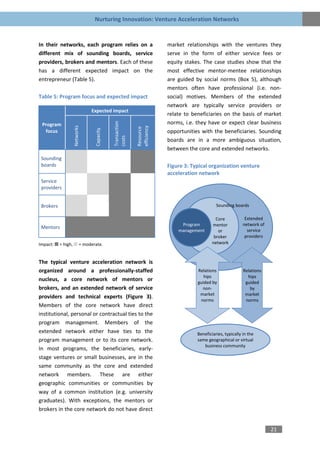
Table 5: Program focus and expected impact                         social) motives. Members of the extended
                                                                   network are typically service providers or
                            Expected impact
                                                                   relate to beneficiaries on the basis of market
                                                                   norms, i.e. they have or expect clear business
                                        Transaction
 Program
                 Networks


                                                      efficiency
                                                      Resource
                             Capacity


  focus                                                            opportunities with the beneficiaries. Sounding
                                        costs


                                                                   boards are in a more ambiguous situation,
                                                                   between the core and extended networks.
 Sounding
 boards                                                            Figure 3: Typical organization venture
                                                                   acceleration network
 Service
 providers


 Brokers                                                                                 Sounding boards

                                                                                         Core            Extended
                                                                        Program        mentor           network of
 Mentors
                                                                       management         or              service
                                                                                        broker           providers
Impact: ■ = high, ■ = moderate.                                                        network


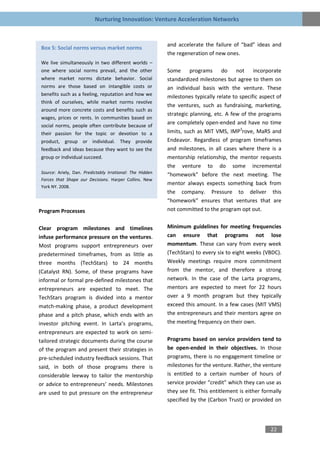
The typical venture acceleration network is
organized around a professionally-staffed                                      Relations                Relations
                                                                                  hips                    hips
nucleus, a core network of mentors or                                          guided by                 guided
brokers, and an extended network of service                                      non-                      by
                                                                                market                   market
providers and technical experts (Figure 3).
                                                                                norms                    norms
Members of the core network have direct
institutional, personal or contractual ties to the
program management. Members of the
extended network either have ties to the                                       Beneficiaries, typically in the
program management or to its core network.                                     same geographical or virtual
                                                                                  business community
In most programs, the beneficiaries, early-
stage ventures or small businesses, are in the
same community as the core and extended
network members. These are either
geographic communities or communities by
way of a common institution (e.g. university
graduates). With exceptions, the mentors or
brokers in the core network do not have direct


                                                                                                                     21
Nurturing Innovation: Venture Acceleration Networks


                                                          and accelerate the failure of “bad” ideas and
Box 5: Social norms versus market norms
                                                          the regeneration of new ones.
We live simultaneously in two different worlds –
one where social norms prevail, and the other             Some programs do not incorporate
where market norms dictate behavior. Social               standardized milestones but agree to them on
norms are those based on intangible costs or              an individual basis with the venture. These
benefits such as a feeling, reputation and how we         milestones typically relate to specific aspect of
think of ourselves, while market norms revolve
                                                          the ventures, such as fundraising, marketing,
around more concrete costs and benefits such as
                                                          strategic planning, etc. A few of the programs
wages, prices or rents. In communities based on
social norms, people often contribute because of
                                                          are completely open-ended and have no time
their passion for the topic or devotion to a              limits, such as MIT VMS, IMP3rove, MaRS and
product, group or individual. They provide                Endeavor. Regardless of program timeframes
feedback and ideas because they want to see the           and milestones, in all cases where there is a
group or individual succeed.                              mentorship relationship, the mentor requests
                                                          the venture to do some incremental
Source: Ariely, Dan. Predictably Irrational: The Hidden   “homework” before the next meeting. The
Forces that Shape our Decisions. Harper Collins. New
                                                          mentor always expects something back from
York NY. 2008.
                                                          the company. Pressure to deliver this
                                                          “homework” ensures that ventures that are
Program Processes                                         not committed to the program opt out.


Clear program milestones and timelines                    Minimum guidelines for meeting frequencies
infuse performance pressure on the ventures.              can ensure that programs not lose
Most programs support entrepreneurs over                  momentum. These can vary from every week
predetermined timeframes, from as little as               (TechStars) to every six to eight weeks (VBDC).
three months (TechStars) to 24 months                     Weekly meetings require more commitment
(Catalyst RN). Some, of these programs have               from the mentor, and therefore a strong
informal or formal pre-defined milestones that            network. In the case of the Larta programs,
entrepreneurs are expected to meet. The                   mentors are expected to meet for 22 hours
TechStars program is divided into a mentor                over a 9 month program but they typically
match-making phase, a product development                 exceed this amount. In a few cases (MIT VMS)
phase and a pitch phase, which ends with an               the entrepreneurs and their mentors agree on
investor pitching event. In Larta’s programs,             the meeting frequency on their own.
entrepreneurs are expected to work on semi-
tailored strategic documents during the course            Programs based on service providers tend to
of the program and present their strategies in            be open-ended in their objectives. In those
pre-scheduled industry feedback sessions. That            programs, there is no engagement timeline or
said, in both of those programs there is                  milestones for the venture. Rather, the venture
considerable leeway to tailor the mentorship              is entitled to a certain number of hours of
or advice to entrepreneurs’ needs. Milestones             service provider “credit” which they can use as
are used to put pressure on the entrepreneur              they see fit. This entitlement is either formally
                                                          specified by the (Carbon Trust) or provided on


                                                                                                      22
Nurturing Innovation: Venture Acceleration Networks


an ad-hoc basis by the program (TechStars,
Larta).

Matching entrepreneurs with several mentors
can offer a broader variety of perspectives              3. Creating Strong
and connections than a single mentor, and
creates checks and balances on conflicts of
                                                            Networks
interest. SMART Singapore assigns two
mentors per venture, MIT VMS assigns three to
four while VBDC finds that eight to ten is an          Key findings
optimal number. In the case of TechStars there
is typically a lead mentor, who spends more               Networks built around highly-networked
time with the venture, and non-lead mentors,              individuals and prestigious institutions
who only meet occasionally. MIT VMS and                   result in network member commitment
VBDC offer group mentoring sessions, whereby              and in longer-lasting bonds.
entrepreneurs meet with several mentors
                                                          Networks built on financial compensation
simultaneously.         This      ensures       that
                                                          can be rapidly mobilized but their internal
entrepreneurs benefit from discussions from
                                                          bonds are ephemeral and trust can be
mentors who do not agree on certain points.
                                                          lower.
Some       entrepreneurs       expressed       their
confusions when faced with differing opinions             Successful networks start small and high-
among mentors, but also acknowledged the                  quality and progressively build attracting
benefits of different viewpoints. Importantly,            power.
meeting in groups can help protect
entrepreneurs from conflicts of interest. In
groups, mentors are subject to peer pressure           Features of Attractive Networks
and less likely to try to exploit their position for
unethical gains, such as selling a service to the      To be effective, programs need to create
mentor or investing in a competing company.            strong networks that are attractive to both
Assigning multiple mentors also increases the          their members and the entrepreneurs they
chances that ventures will be left with some           serve. Networks need to have a high enough
mentorship if mentors are too busy to attend           value proposition to attract high-quality
many meetings. VBDC assigns eight to ten               members and keep them engaged. The case
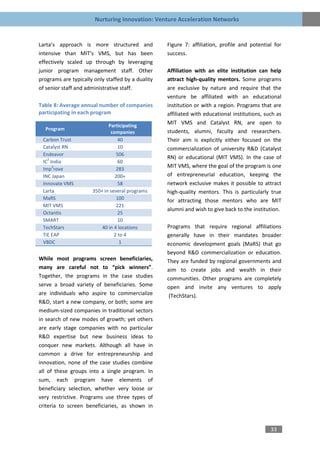
mentors per venture knowing that only 70               studies reveal a variety of strategies (Table 6):
percent will likely attend any particular
meeting. But large groups can also introduce               Remunerating network members: Most
rigidities in the program due to coordination              examined programs do not remunerate
problems. For this reason VBDC schedules a                 their external network members, and
minimum of only six mentor sessions per year.              when they do it is for a fee that falls short
                                                           of the actual value of their time. Larta and
                                                           Octantis compensate their mentors. In the
                                                           case of Larta, a possible reason is the tight
                                                           time constraints under which programs


                                                                                                   23
Nurturing Innovation: Venture Acceleration Networks


operate under government contracts. As          the ground up, programs that benefit from
soon as they win a contract Larta must          one can generally create a more attractive
rapidly mobilize mentors to serve               and hence selective network. For example,
hundreds of firms and are accountable for       being associated with the MIT brand offers
their mentors vis-à-vis their government        an attractive value proposition to mentors.
clients. This is not the case for programs      Over several decades TiE has built up an
such as MIT VMS where mentors do not            exclusive “by-invitation-only” brand. In
commit to specific hours spent with the         new EU member states, consultants were
ventures. Remuneration is also required         also attracted to the “EU” branding that
for service providers who are expected to       they could leverage by participating in the
conduct research or analytical work for the     IMP3rove network.
ventures (Carbon Trust, Catalyst RN). It is
                                                Leveraging local social capital: Some of the
also used to quickly build up a network and
                                                networks that have the greatest attractive
its beneficiaries up to a critical mass.
                                                power have at their core highly-connected
During its startup phase, IMP3rove paid
                                                super-achiever “champions”, typically the
consultants to conduct assessments and
                                                founder or manager of the program. They
short consultations with enterprises. As for
                                                have social and business roles in their
full-time mentors and brokers, they are
                                                communities that bestow upon them
always paid at market rates (MaRS, IC2).
                                                significant social capital and hence the
Sounding boards are never paid as their
                                                capacity to mobilize a network. They play
strength lies in being completely
                                                the roles of mentors, connectors, brokers,
independent and representing potential
                                                sounding boards, business partners,
business     partners,    customers     and
                                                investors and sometimes even politicians
investors.
                                                in their local communities. TechStars and
Offering networking opportunities: Many         its four founders is a case in point.
of the programs, specifically those that are    Accumulating this type of social capital can
rooted in local communities, attract their      be easier in tight-knit entrepreneurial
members by offering them networking             communities such as Boulder, the home of
opportunities with other mentors and            TechStars. To a lesser extent, most other
service providers. MIT VMS hosts periodic       mentor programs in the case studies
meetings for all of the mentors. TiE hosts      leverage an internal champion’s social
networking events for its members. Many         capital. As social capital often diminishes
of Endeavor’s local mentors are attracted       with geographic distances, it is more
by the prospect of networking with its          difficult to leverage beyond local
global mentors who are global business          community networks.
leaders. The value of networking is highest
                                                Providing access to unique ventures:
when the network is exclusive and
                                                Mentors tend to be more willing to work
associated with a prestigious brand name
                                                with promising ventures that have a
or a network “champion”, which connects
                                                chance to succeed, i.e. ventures with
to the next point.
                                                unique market or technological value
Leveraging a prestigious brand: Although a      propositions. One reason is that mentors
high-value brand is difficult to build from     put their own reputation at stake by


                                                                                       24
Nurturing Innovation: Venture Acceleration Networks


connecting their mentees within own            Table 6: Strategies to build a mentor/advisor
social networks. A second is that unique       network
ventures offer opportunities for learning
                                                                                       Strategies
about new markets and technologies. A


                                                               Remuneration
third is that mentors derive more


                                                                                      Social capital


                                                                                                                              Networking
                                                                                                                  Customers
                                                  Program
excitement from the prospect of success.


                                                                                                       Ventures


                                                                                                                                           Learning
                                                                              Brand
And a fourth is that some mentors are
interested in investing or taking up
management positions in high-potential          Carbon Trust
                                                Catalyst RN
ventures. All of the programs hence have
                                                Endeavor
some amount of selectivity with their             2
                                                IC India
ventures. Sounding boards typically have            3
                                                IMP rove
some of the same interests as mentors, for      INC Japan
example finding new ventures to invest in.      Innovate VMS
                                                Larta
Service providers may also have incentives
                                                MaRS
to lock-in relationships with promising         MIT VMS
ventures that will grow to become their         Octantis
customers in the future, which relates to       SMART
                                                TechStars
the next point.
                                                TiE EAP
Providing access to customers: When             VBDC
service providers are included in the
network, it is always the case that they are   Market Relationships in Human Networks
drawn by potential customers. This is not
the case for mentors. Sounding board           The case studies reveal that upfront financial
members may also be in search of               compensation is not sufficient to build strong
customers, but this does not appear to         mentor or sounding board networks. Mentors
typically be their primary intentions.         who see value from networking within their
                                               entrepreneurial community do not need
Offering learning opportunities: some of
                                               additional financial incentives. Moreover, the
the programs enhance the attractiveness
                                               introduction of financial compensations limits
of    their    networks      by     offering
                                               the sustainability of the mentor-mentee
entrepreneurship or innovation-related
                                               relationship. When the mentor-mentee
learning opportunities to their participants
                                               relationship is predominantly based on market-
through short training courses and
                                               norms the relationship can weaken when the
presentations. This is the case of TiE and
                                               program comes to an end and financial
IMP3rove.
                                               rewards are terminated. At the far end of the
                                               financial compensation spectrum are mentors
                                               and brokers who are employed by a program
                                               on a full-time basis. In such cases, the
                                               relationship with the firm seldom outlasts the
                                               program. In the case of MaRS, professional
                                               mentors occasionally left for other careers,


                                                                                                                                                 25
Nurturing Innovation: Venture Acceleration Networks


leaving the ventures “orphaned” during some       reputational risk in the mentor’s or brokers
time.                                             business networks. However, this bottom-up
                                                  approach is not easily scalable in the short run.
Sounding boards do not expect to commit
much time –their marginal costs of                Network Development Typologies
participation in the program are low - and do
not expect fees. In fact, the most effective      The case studies bring out three approaches to
sounding boards have genuine interests in the     developing venture acceleration networks.
ventures they are advising as networking,
                                                      “Personality-driven” networks: regional,
learning and investment opportunities.
                                                      bottom up, pro-bono program guided by
                                                      social norms, often coupled with
In contrast, service providers expect to have
                                                      professional motives.
or to develop commercial relationships with
the companies. Developing a mentor network            “Institution-driven” networks: regional,
and a service provider network require very           institution-based program guided by social
different approaches. To services providers,          norms, often coupled with professional
small businesses –and to an even greater              motives.
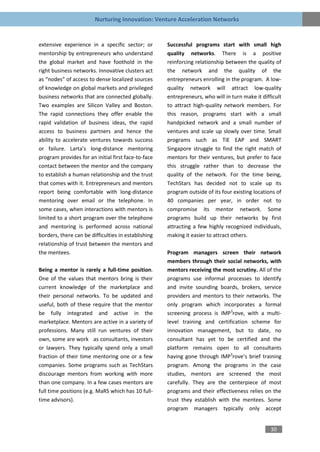
extent early stage ventures- represent a              “Market-driven” networks: national and
fragmented market that imposes high business          transnational, top-down program guided
development       costs.     For     innovation       by market norms.
management consultants, the costs of
                                                  Most programs       use   elements     of   each
“educating” SME clients to stimulate demand
                                                  approach.
are prohibitive. Thus, service providers have
high incentives to reduce their search costs
and transaction costs by joining a network that   Personality-driven networks have at their
offers them ready access to clients.              core highly-networked individuals who are
                                                  champions for the programs. These
Building an effective network of service          champions have high-standing as business
providers is easier to achieve although less      leaders or successful entrepreneurs in their
                                                  regional communities, inspire trust, and have
scalable through trusted referrals than
                                                  significant social capital (Box 6) to draw from.
through standardization and certification.
Demand       for    innovation    management      The exemplary “personality-driven” network is
consultant training and certification can be      TechStars. The co-founders are prominent
                                                  entrepreneurs and investors in the tight-knit
weak without first building a critical mass of
                                                  Boulder, USA business community. They draw
demand from enterprises. Conversely, opening
a network to un-vetted service providers          members of their mentor and service provider
decreases the overall attractiveness of the       network from their close primary social
                                                  network and trusted referrals from that
network. The case studies suggest that
referrals from trusted mentors and brokers are    network (Figure 4). The network is sufficiently
effective at connecting entrepreneurs to          interconnected to be self-policing. Any
                                                  violation of trust or unethical behavior via the
trusted service providers. They are more likely
to guide entrepreneurs towards service            mentees will be socially sanctioned. The
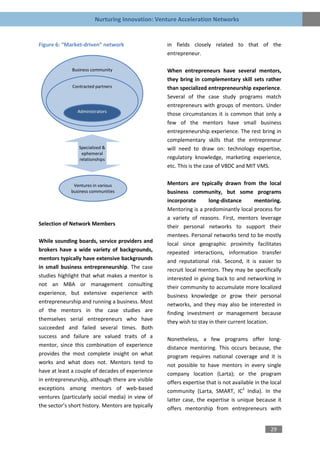
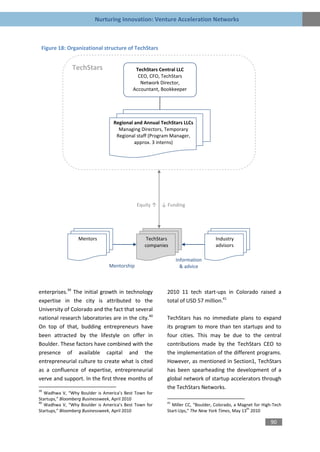
providers that match their needs and face a       quantity and quality of the members and inter-


                                                                                              26
Nurturing Innovation: Venture Acceleration Networks


linkages in the network, and the credibility of                  relationships are typically long-lasting,
the network “champion” makes participation                       extending beyond the life of the venture
in network activities such as mentoring and                      program. Unlike in fee-based market
advising an attractive prospect. Hence,                          relationships, mentors invest themselves as
relationships between the mentors and                            partners of the ventures.
ventures in the program become network
relationships and benefit from its high level of
embedded social capital. As such, these


 Box 6: Entrepreneurship and social capital

 Social capital is a concept that refers to the value derived from connections within and between social networks.
 These relationships are built on mutual belonging and trust. Benefits from social capital are derived through the
 goodwill that members of networks feel toward each other.

 The question of whether entrepreneurs are more likely to succeed if they have access to greater resources and
 information has been extensively studied – for the social capital field this has meant looking at the connections
 that entrepreneurs have to networks of people who have been in business, are party to knowledge on a sector
 that might be useful, or can provide connections to financiers. Studies have shown that the personal networks
 that entrepreneurs can draw on add “external resources” to the “internal resources” of ambition and ideas that
 they already have.

 One prominent theory divides the relationships that provide these extra resources into three types: structural,
 relational and cognitive. The structural aspect is essentially the ability that entrepreneurs have to access things
 through a network. The more access and the bigger or more extensive the network, the better it is. The
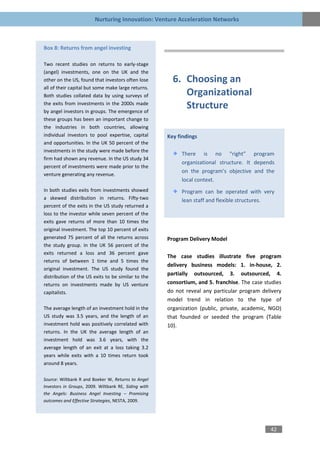
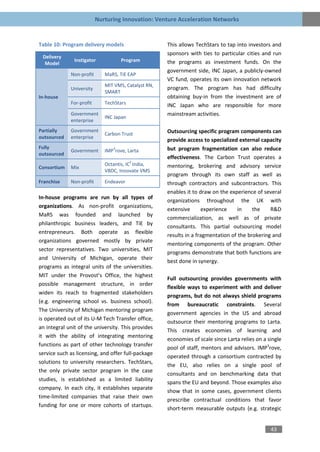
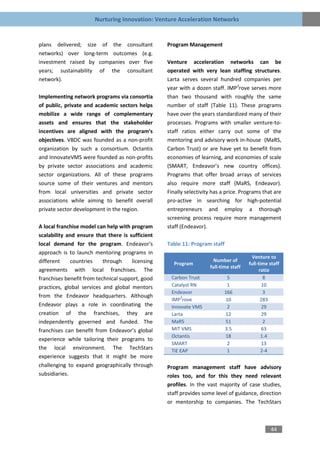
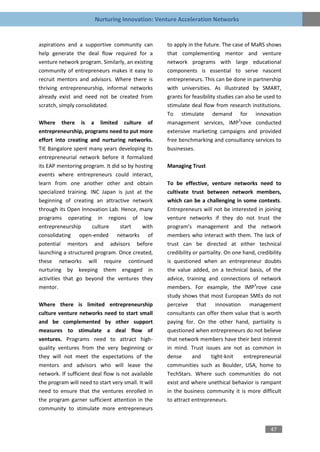
 relational aspect refers to the quality of the relationships in that network – how much mutual respect, trust and
 friendliness there is between the people involved. Finally, these networks are changed by the extent of shared
 norms and ideas – the cognitive aspect. A good example of this is the tolerance of entrepreneurial spirit and the
 risks attached to it. The more it is accepted the more a network is likely to be open to failure.

 Interestingly, some studies have found that these factors work together in certain ways and that some of them
 might benefit particular types of entrepreneurs more than others. For example, there is evidence to suggest that
 budding entrepreneurs need to first start using their ties, then to start contributing to the norms and views of
 their network, and by doing so develop bonds of trust with people who can provide valuable support.
 Furthermore, high-tech entrepreneurs have been found to gain substantially from relationships and networks
 that have strong, trusting connections which give them the access to information and knowledge that they need.

 Sources: Putnam, Robert. Bowling alone: Collapse and Revival of American Community. Simon & Schuster, New York NY.
 2000. Ferragina, Emanuele, “A new concept generated from an old idea. Rethinking Social Capital in relation to income
 inequalities,” Barnett Papers in Social Research, University of Oxford, 2009. Ostgaard TA and Birley S, “Personal Networks and
 Firm Competitive Strategy: A Strategic or Coincidental Match,” Journal of Business Venturing, 9, pp 281-305, 1994. Nahapiet J
 and Ghoshal S, “Social Capital, Intellectual Capital and the Organizational Advantage,” Academy of Management Review,
 23(2), pp 242-266, 1998. Liao J and Welsch H, “Roles of Social Capital in Venture Creation: Key Dimensions and Research
 Implications,” Journal of Small Business Management, 43 (4), pp 345-362, 2005.


                                                                                                                      27
Nurturing Innovation: Venture Acceleration Networks


Figure 4: “Personality-driven” network             mentees in the same communities they create
                                                   sustained relationship (Figure 5).

           Secondary social network                Figure 5: “Institution-driven” network

        Exclusive primary social network
                                                              Exclusive formal business network
               Highly-networked                                 with a clear value proposition
                  “magnetic”                                            created ex-ante
                  champions

                                                                          Well-networked
                                                                         champions + brand
                                                                          name institution

                    Deep &
                   sustained
                 relationships

                                                          Ephemeral                      Sustained
                                                         relationships                 relationships

             Ventures in the same
             business community

                                                           Ventures in                Ventures in the
                                                       different business             same business
                                                          communities                  community
Institution-driven networks have at their core
organizations that confer a sense of social
prestige and a common identity among its
                                                   Market-driven networks rely on direct
members. This is at the root of their attractive
                                                   financial incentives to attract individuals and
power. Universities can create rallying points
                                                   entice them to support entrepreneurs. They
for networks. Loyal alumni sometimes engage
                                                   typically involve establishing contractual
in activities such as offering personal
                                                   relationships with disparate individuals based
recommendations, participating in alumni
                                                   on consultancy fees and salaries (Figure 6).
functions and in some countries providing
                                                   These networks become guided by market-
financial support based on strong continuing
                                                   norms rather than social norms and are more
feelings of association with the institution.
                                                   ephemeral than the personality-driven and
This is the case of the MIT VMS program. It
                                                   institution-driven networks. These networks
attracts alumni who have a sense of virtual
                                                   are useful for programs that need to mobilize
community and non-alumni who wish to be
                                                   individuals who do not share a common
associated with the university for a variety of
                                                   geography or institutions, or highly-specialized
reasons      (prestige,   culture,     exclusive
                                                   expertise. The Carbon Trust Catalyst Program is
networking opportunities, etc.). TiE, the global
                                                   an example of a market-driven network. The
South Asian entrepreneur organization, has
                                                   program hires contractors who help guide and
created a sense of exclusivity through its
                                                   direct entrepreneurs to subcontracting service
invitation-only network, long before it
                                                   providers nationwide.
formalized its mentor program in Bangalore.
When these networks pair mentors and


                                                                                                        28
Nurturing Innovation: Venture Acceleration Networks


Figure 6: “Market-driven” network                   in fields closely related to that of the
                                                    entrepreneur.

              Business community                    When entrepreneurs have several mentors,
                                                    they bring in complementary skill sets rather
              Contracted partners                   than specialized entrepreneurship experience.
                                                    Several of the case study programs match
                                                    entrepreneurs with groups of mentors. Under
                Administrators
                                                    those circumstances it is common that only a
                                                    few of the mentors have small business
                                                    entrepreneurship experience. The rest bring in
                                                    complementary skills that the entrepreneur
                 Specialized &                      will need to draw on: technology expertise,
                  ephemeral
                 relationships                      regulatory knowledge, marketing experience,
                                                    etc. This is the case of VBDC and MIT VMS.


              Ventures in various                   Mentors are typically drawn from the local
             business communities                   business community, but some programs
                                                    incorporate       long-distance       mentoring.
                                                    Mentoring is a predominantly local process for
                                                    a variety of reasons. First, mentors leverage
Selection of Network Members                        their personal networks to support their
                                                    mentees. Personal networks tend to be mostly
While sounding boards, service providers and        local since geographic proximity facilitates
brokers have a wide variety of backgrounds,         repeated interactions, information transfer
mentors typically have extensive backgrounds        and reputational risk. Second, it is easier to
in small business entrepreneurship. The case        recruit local mentors. They may be specifically
studies highlight that what makes a mentor is       interested in giving back to and networking in
not an MBA or management consulting                 their community to accumulate more localized
experience, but extensive experience with           business knowledge or grow their personal
entrepreneurship and running a business. Most       networks, and they may also be interested in
of the mentors in the case studies are              finding investment or management because
themselves serial entrepreneurs who have            they wish to stay in their current location.
succeeded and failed several times. Both
success and failure are valued traits of a          Nonetheless, a few programs offer long-
mentor, since this combination of experience        distance mentoring. This occurs because, the
provides the most complete insight on what          program requires national coverage and it is
works and what does not. Mentors tend to            not possible to have mentors in every single
have at least a couple of decades of experience     company location (Larta); or the program
in entrepreneurship, although there are visible     offers expertise that is not available in the local
exceptions among mentors of web-based               community (Larta, SMART, IC2 India). In the
ventures (particularly social media) in view of     latter case, the expertise is unique because it
the sector’s short history. Mentors are typically   offers mentorship from entrepreneurs with


                                                                                                  29
Nurturing Innovation: Venture Acceleration Networks


extensive experience in a specific sector; or        Successful programs start with small high
mentorship by entrepreneurs who understand           quality networks. There is a positive
the global market and have foothold in the           reinforcing relationship between the quality of
right business networks. Innovative clusters act     the network and the quality of the
as “nodes” of access to dense localized sources      entrepreneurs enrolling in the program. A low-
of knowledge on global markets and privileged        quality network will attract low-quality
business networks that are connected globally.       entrepreneurs, who will in turn make it difficult
Two examples are Silicon Valley and Boston.          to attract high-quality network members. For
The rapid connections they offer enable the          this reason, programs start with a small
rapid validation of business ideas, the rapid        handpicked network and a small number of
access to business partners and hence the            ventures and scale up slowly over time. Small
ability to accelerate ventures towards success       programs such as TiE EAP and SMART
or failure. Larta’s long-distance mentoring          Singapore struggle to find the right match of
program provides for an initial first face-to-face   mentors for their ventures, but prefer to face
contact between the mentor and the company           this struggle rather than to decrease the
to establish a human relationship and the trust      quality of the network. For the time being,
that comes with it. Entrepreneurs and mentors        TechStars has decided not to scale up its
report being comfortable with long-distance          program outside of its four existing locations of
mentoring over email or the telephone. In            40 companies per year, in order not to
some cases, when interactions with mentors is        compromise its mentor network. Some
limited to a short program over the telephone        programs build up their networks by first
and mentoring is performed across national           attracting a few highly recognized individuals,
borders, there can be difficulties in establishing   making it easier to attract others.
relationship of trust between the mentors and
the mentees.                                         Program managers screen their network
                                                     members through their social networks, with
Being a mentor is rarely a full-time position.       mentors receiving the most scrutiny. All of the
One of the values that mentors bring is their        programs use informal processes to identify
current knowledge of the marketplace and             and invite sounding boards, brokers, service
their personal networks. To be updated and           providers and mentors to their networks. The
useful, both of these require that the mentor        only program which incorporates a formal
be fully integrated and active in the                screening process is IMP3rove, with a multi-
marketplace. Mentors are active in a variety of      level training and certification scheme for
professions. Many still run ventures of their        innovation management, but to date, no
own, some are work as consultants, investors         consultant has yet to be certified and the
or lawyers. They typically spend only a small        platform remains open to all consultants
fraction of their time mentoring one or a few        having gone through IMP3rove’s brief training
companies. Some programs such as TechStars           program. Among the programs in the case
discourage mentors from working with more            studies, mentors are screened the most
than one company. In a few cases mentors are         carefully. They are the centerpiece of most
full time positions (e.g. MaRS which has 10 full-    programs and their effectiveness relies on the
time advisors).                                      trust they establish with the mentees. Some
                                                     program managers typically only accept


                                                                                                 30
Nurturing Innovation: Venture Acceleration Networks


mentees who they know personally or are              independent party. As small firms, they do not
recommended by a trusted source (TechStars).         often understand their needs or what types of
At MIT VMS, new mentors are accepted by              consultants are right for them. This match-
invitation only from existing mentors, who put       making role is played by the subcontractors in
their reputation at stake. At TiE EAP, mentors       the Carbon Trust program.
are selected from among the Charter Members
of the TiE network, which is by invitation of        When well managed, larger networks are
existing Charter Members only. In mentor-            more effective, but there is no optimal size.
based programs, the mentors themselves               Networks range from fewer than 10 people
typically play a role in referring the               (VBDC) to several hundreds (TechStars and
entrepreneurs to their trusted personal              IMP3rove) (Table 7). In general, the larger the
network of service providers.                        network-to-beneficiary ratio the easier it is to
                                                     find a right match between a network member
Match-making of mentors and mentees is               and a company, a critical success factor for
critical to a program’s effectiveness and is         mentor networks. Programs find it difficult to
best achieved through an iterative process. All      grow a large network without compromising
mentor-based programs match mentors from             on quality. Thus IMP3rove’s large network
within their networks with entrepreneurs on          suffers from uneven consultant quality while
the basis of their profiles. Mentors are typically   TechStars cites growing the network to be a
asked for their preferences first. In several        barrier to scaling up its program.
programs they are free to turn down
companies they do not wish to work with              Table 7: Size of network in each program
(TechStars, VBDC). Several programs do not
                                                                            Number of
provide      many      mentor      options     to                                          Network/ben
                                                        Program            people in the
                                                                                           eficiary ratio
entrepreneurs and this is reflected by uneven                                network
satisfaction among mentees. Several programs         Carbon Trust            variable        variable
consider mentor-matching to be the                   Catalyst RN             variable        variable
                                                     Endeavor                 >2000          up to 4*
centerpiece of their effectiveness. In effect,         2
                                                     IC India                variable        variable
personal chemistry plays an important part of            3
                                                     IMP rove                  501             0.18
the productivity of the relationship. In both TiE    INC Japan               variable        variable
EAP and TechStars ventures meet with many            Innovate VMS              140             2.4
mentors for several weeks before establishing        Larta                     54**            0.15
                                                     MaRS                       70             0.7
a mutually-agreed relationship with a mentor.
                                                     MIT VMS                   140             0.64
TechStars refers to this process as “mentor-         Octantis                  200               8
dating”.                                             SMART                      20               2
                                                     TechStars                 278*            6.95
Small firms often need external match-making         TiE EAP                    40            10-20
with consultants, due to a lack of                   VBDC                     8 - 10          8 - 10
                                                     *varies by country
understanding of the market. Although the            **core mentors only
IMP3rove program allows firms to select from
within a descriptive database of consultants,        Network to beneficiary ratios vary across
some small firms express the need to be              programs, but this is partly due to network
actively matched to the right consultant by an       utilization rates. While certain programs such


                                                                                                    31
Nurturing Innovation: Venture Acceleration Networks


as TechStars and Octantis retain a continuous
large pool of networks, from which some will
be much more engaged in the program than
others at different times, other programs
operate on a just-in-time network basis. This is     4. Selecting Ventures
the case of VBDC and SMART, where mentors
are recruited from the local community as
needs arise. Some programs, such as Larta and
                                                   Key findings
IMP3rove have very small annual network-to-
beneficiary ratios (Table 7). This means that
                                                         Many programs avoid picking winners
network members need to be engaged with
                                                         but include mechanisms to help non-
more than one company throughout the year,
                                                         performers self-select out.
sometimes serving multiple companies at a
time. In order to readily secure network                 For programs focusing on R&D
members for large numbers of companies                   commercialization, picking the “right”
these programs need to include strong                    technology is as important as the
incentives in their models. Both rely at least           team. For programs involving early-
partially on market norms. Larta’s mentors are           stage ventures, picking the right team
paid and IMP3rove’s consultants expect                   is more important.
immediate business opportunities from their
involvement in the program.

                                                   The number of companies in a program varies
                                                   considerably with the program’s business
                                                   model. It varies from one per year to several
                                                   hundreds per year (Table 8). “High touch”
                                                   programs that involve a high degree of support
                                                   and coordination from management staff tend
                                                   to have fewer participants. This is the case of
                                                   TechStars, where the program staff interacts
                                                   with startups on a weekly basis, organizes
                                                   networking and educational events, and
                                                   monitors startups to ensure that they reach
                                                   key milestones. The IC2 India program is also of
                                                   limited size, as it involves heavy business
                                                   development and coaching by program
                                                   advisors. In contrast, many ventures enrolled
                                                   in the MIT VMS have never met the
                                                   management staff and schedule meetings with
                                                   their mentors at their own pace. IMP3rove’s
                                                   approach is to act as a network enabler rather
                                                   than a network manager, it is hands-off and
                                                   automated, and is hence able to scale up.


                                                                                              32
Nurturing Innovation: Venture Acceleration Networks


Larta’s approach is more structured and            Figure 7: affiliation, profile and potential for
intensive than MIT’s VMS, but has been             success.
effectively scaled up through by leveraging
junior program management staff. Other             Affiliation with an elite institution can help
programs are typically only staffed by a duality   attract high-quality mentors. Some programs
of senior staff and administrative staff.          are exclusive by nature and require that the
                                                   venture be affiliated with an educational
Table 8: Average annual number of companies        institution or with a region. Programs that are
participating in each program                      affiliated with educational institutions, such as
                             Participating
                                                   MIT VMS and Catalyst RN, are open to
  Program                                          students, alumni, faculty and researchers.
                              companies
 Carbon Trust                     40               Their aim is explicitly either focused on the
 Catalyst RN                      10               commercialization of university R&D (Catalyst
 Endeavor                        506
   2                                               RN) or educational (MIT VMS). In the case of
 IC India                         60
     3
 Imp rove                        283
                                                   MIT VMS, where the goal of the program is one
 INC Japan                      200+               of entrepreneurial education, keeping the
 Innovate VMS                     58               network exclusive makes it possible to attract
 Larta                350+ in several programs     high-quality mentors. This is particularly true
 MaRS                            100               for attracting those mentors who are MIT
 MIT VMS                         221
                                                   alumni and wish to give back to the institution.
 Octantis                         25
 SMART                            10
 TechStars                40 in 4 locations        Programs that require regional affiliations
 TiE EAP                        2 to 4             generally have in their mandates broader
 VBDC                              1               economic development goals (MaRS) that go
                                                   beyond R&D commercialization or education.
While most programs screen beneficiaries,          They are funded by regional governments and
many are careful not to “pick winners”.            aim to create jobs and wealth in their
Together, the programs in the case studies         communities. Other programs are completely
serve a broad variety of beneficiaries. Some       open and invite any ventures to apply
are individuals who aspire to commercialize         (TechStars).
R&D, start a new company, or both; some are
medium-sized companies in traditional sectors
in search of new modes of growth; yet others
are early stage companies with no particular
R&D expertise but new business ideas to
conquer new markets. Although all have in
common a drive for entrepreneurship and
innovation, none of the case studies combine
all of these groups into a single program. In
sum, each program have elements of
beneficiary selection, whether very loose or
very restrictive. Programs use three types of
criteria to screen beneficiaries, as shown in


                                                                                               33
Nurturing Innovation: Venture Acceleration Networks


Figure 7: Criteria used to screen beneficiaries   focus is to prepare technology projects before
                                                  they enter the market, rather than to help
     1. Affiliation                               entrepreneurs face the brutal realities of the
                                                  market. TechStars focuses on very early stage
                e.g. Regional (Innovate VMS),     ventures, most of which do not yet have angel
                  institutional (Catalyst RN),
                                                  funding. Many TechStars ventures consist of a
                        open (TechStars)
                                                  team of aspiring entrepreneurs who have yet
                                                  to even register their companies. In contrast
                                                  to SMART and Catalyst RN, TechStars
         2. Profile
                                                  entrepreneurs are fully dedicated to their
                e.g. Pre-formation (SMART),       ventures, and are hence fully “immersed” in
                biosciences (VBDC), revenue-
                                                  the market. Still, other programs such as VBDC
                   generating (Endeavor)
                                                  are only open to revenue-generating
                                                  companies. This is a requirement for paying for
                                                  VBDC’s incubation services. Endeavor supports
            3. Potential for success
                                                  firms that have already proven that they are
                                    2             “winners” with existing growth and revenue
                 e.g. Technology (IC India),
                  entrepreneur (TechStars)        streams of more than USD 1 million per year.
                                                  One program, MIT VMS, tends to be open to
                                                  early stage ventures at a broader range of
                                                  development stages. This is aligned with the
                                                  program’s objective to serve the entire MIT
Programs are generally tailored to specific       community, and provides a broader reach to
firm profiles. All case study programs are        MIT alumni who may one day help replenish
designed for particular venture profiles.         MIT’s endowment fund.
IMP3rove stands out as being the only program
that addresses the needs of companies in their    Among the programs addressing early stage
later phases of development only. The             ventures, some focus on single sectors. In the
program excludes companies that are less than     case of VBDC and Carbon Trust, focus sectors
two years old. This is linked to the different    reflect the strategic priorities of their
nature of support required for early stage        sponsoring national and regional governments
companies that are still validating their         (biosciences and low-carbon technologies).
business models and learning general              VBDC’s focus on a single sector is also based on
entrepreneurship skills from more mature          its stakeholders’ aim to build a regional
companies that are searching for a growth         innovation cluster. TechStars focuses on web-
“algorithm” through strategic planning.           based and software ventures, mostly due to
                                                  the background of the program’s founders and
Most programs addressing early stage ventures     the incubation aspect of TechStars, which
are focused on a particular stage of their        groups ventures under one roof with ample
development. In the case of SMART and             opportunities to interact. As a three-month
Catalyst RN, the technology at the core of the    program, TechStars is also more suitable to the
business idea is still in the laboratory. Their   fast pace of ventures that aim to create new
                                                  markets from existing technologies (i.e. ICT)


                                                                                             34
Nurturing Innovation: Venture Acceleration Networks


than the long development time and capital              added. For programs that are funded by
requirements associated with the development            investors (TechStars), only successful
of entirely new technologies. Web-based                 ventures will yield financial returns.
ventures are also particularly well suited for a
                                                        The second motivation is to attract high
short time to market since they do not rely on
                                                        quality mentors and advisors in their
a putting together complex supply chains.
                                                        networks. In most programs, with the
Several programs are specifically tailored to
                                                        possible exception of IMP3rove, mentors
R&D-based ventures (Larta, IC2 India)
                                                        and advisors are attracted to the program
associated with their R&D commercialization
                                                        because of opportunities to work with
roles. Others have a mix of R&D and non-R&D
                                                        entrepreneurs who are highly motivated,
ventures (Octantis). Programs that focus on
                                                        are eager to learn, have business ideas that
specific sectors are able to support their
                                                        can help keep them keep abreast of latest
ventures with a smaller pool of mentors, since
                                                        technology trends, and offer potential
they do not need to span as broad a range of
                                                        opportunities for a management or
expertise.
                                                        investment position in a successful firm.
                                                        These factors explain why many innovation
The beneficiaries of programs concerning early
                                                        acceleration programs are eager to focus
stage ventures tend to have a limited amount
                                                        on potential winners.
of entrepreneurial experience. They mostly do
not have either the skills or network to start
                                                    Programs have two focus points for actively
and grow successful ventures. Nonetheless,
                                                    picking potential winners: the technology and
even entrepreneurs with several years of
                                                    the team. Programs focused on R&D
experience can benefit. One TechStars
                                                    commercialization or “technology push”
entrepreneur was starting his second venture
                                                    (SMART, Larta, Carbon Trust, IC2 India)
and yet attributed significant value to the
                                                    examine first and foremost the technology and
program.
                                                    its market potential. Programs focused on
                                                    creating new markets (TechStars, Endeavor)
Most of the programs aim to support
                                                    tend to put much more emphasis on the
companies with the highest potential for
                                                    entrepreneurial team. The business idea is
success. Some of the programs are engaged in
                                                    important, but secondary. Teams that show
“picking winners”, others actively try to attract
                                                    the ability to “interpret” the market and
and retain winners through self-selection,
                                                    execute their business strategies are selected.
while others yet are open to all firms.
                                                    Endeavor’s multi-stage interview process is
Programs have two motivations for supporting
                                                    highly involved and can last up to a year.
ventures that will become successful.
    The first motivation is to secure the           Some programs aim to attract ventures with
    reputation of the program from among its        the highest prospects for success but do not
    financial sponsors and investors. For           actively select them among applicants because
    programs that are funded through public         of either a mandate to serve their constituents
    sources or private donations (MaRS,             (MaRS) or, in addition to this, a belief that it is
    InnovateVMS) successful ventures can be         impossible to pick winners (MIT VMS). MIT
    used as a reflection of the program’s value     VMS accepts any venture that “is legal and


                                                                                                  35
Nurturing Innovation: Venture Acceleration Networks


does not defy the laws of physics”.                                   Horizon    3     opportunities    include
Nonetheless, MIT VMS already has an                                   technologies or markets that have not yet
important quality screening filter in the form of                     been created.
an institutional affiliation with MIT. MaRS
accepts all ventures but their mentors apply        Figure 8: Opportunity horizons of the
“tough love” from the very beginning of the         programs
program, assigning demanding tasks to


                                                                                       New market
ventures between mentor meetings. Ventures
                                                                                                                     TechStars
that are unable or unwilling to complete this
“homework” generally do not see a point in                                                                            TiE EAP,
                                                                                                                    INC Japan,
remaining in the program and opt-out on their                                                                                   SMART,
                                                                                                                     Octantis,


                                                      Knowledge of market
                                                                                                                                Catalyst
own. If needed, mentors can discuss this with                                                                          VBDC,       RN,


                                                                            Existing market not
ventures and advise them to discontinue the                                                                          MIT VMS,     Larta.


                                                                               served by the
                                                                                                                  Innovate VMS, Carbon


                                                                                 enterprise
program. Nonetheless, these programs still                                                                             MaRS       Trust
have minimum filters. Ventures that have not                                                                         Endeavor   IC2 India

demonstrated a minimum level of prior effort
in establishing a business concept are turned                               Existing market                         3
                                                                                                                 IMP rove
                                                                             served by the
down.                                                                          enterprise


In the case of IMP3rove, there is no attempt to
screen firms. The program’s value is enhanced                                                       Horizon: 1          2           3
with the number of firms taking the innovation                                      Existing                         Existing        New
management assessment, since this increases                                     technology used                  technology not   technology
                                                                                     by the                        used by the
the benchmarking database and creates a                                            enterprise                       enterprise
larger pool of demand that can attract                                                                     Knowledge of technology
consultants to the platform.
                                                    All of the programs are uniquely tailored to
So how should program beneficiaries be              ventures tackling horizon 3 opportunities, with
screened? The answer depends on the                 the exception of IMP3rove, which serves a
objectives of the program. The opportunity          broader set of enterprises (Figure 8). A
space for innovation can be divided into three      fundamental difference between IMP3rove and
horizons:                                           other programs is that while IMP3rove is
    Horizon     1    opportunities    include       focused on helping companies with internal
    technologies already used by the                processes to create a favorable environment
    enterprise and markets already served by        for innovation, the other programs focus on
    that enterprise.                                external processes to accelerate the validation
                                                    of new market and technology ideas. This
    Horizon     2    opportunities    include
                                                    second group of programs focus on companies
    technologies not yet used by the
                                                    that do not yet have many, or any, internal
    enterprise and markets not yet served by
                                                    processes to improve. They help ideas fail
    that enterprise.
                                                    early, quickly and inexpensively. The case
                                                    studies reveal that the quickest way to
                                                    accelerate market validation is by focusing on


                                                                                                                                        36
Nurturing Innovation: Venture Acceleration Networks


ventures that emphasize creating new markets
rather than new technologies (TechStars).
When      programs     are    dedicated      to
commercializing new technologies, the                5. Financing the
potential payoffs can be higher due to higher
market entry barriers, but the process takes            Program
longer and ventures do not have the flexibility
to completely reinvent themselves since they
are wedded to a technology (SMART, Carbon          Key findings
Trust). Most programs operate somewhere in
the middle, promoting ventures that seek                 Program costs can be very low for
opportunities in either new markets or new               minimalist programs.
technologies.
                                                         It is not clear that programs can
                                                         become financially-sustainable on the
The case studies show that network programs
                                                         basis of returns from equity stakes of
can accommodate a broad range of sectors.
                                                         beneficiaries.
When programs screen for specific sectors, this
is typically related to a higher-level objective         Most     programs,   even  private
related to strategic priorities. The TechStars           programs, rely heavily on public
model shows that mentor programs are                     subsidies, private donations and
particularly well-suited for fast-paced sectors          corporate sponsorships.
such as ICT with limited supply chains, low
capital requirements and that rely on creating
new markets.
                                                   Program Costs

The case studies also show that screening
                                                   Program costs vary highly, from a few
beneficiaries can help attract higher quality
                                                   thousand to tens of thousands USD per year
mentors, and hence enhance the value of the
                                                   (Table 9). Costs vary mainly on the basis of the
program for beneficiaries and stakeholders.
                                                   amount of required program management
This can be done by requiring an affiliation
                                                   attention. “High touch” programs such as
with a prestigious university, by selecting
                                                   TechStars tend to be much more expensive
ventures on the basis of their technology (a
                                                   than “light touch” programs such as Larta or
risky approach), by selecting ventures on the
                                                   than “hands-off” programs such as IMP3rove.
basis of the entrepreneurial team, or by
allowing ventures to self-select. Publicly-
                                                   IMP3rove differentiates itself from other
managed programs do not have a history of
                                                   models in its low marginal costs per
being successful at picking winners. For these
                                                   participating company. The vast majority of
programs institutional affiliation and self-
                                                   costs are fixed costs related to the initial
selection are more suitable options. In all
                                                   development of the online platform and the
cases, recruiting ventures that are local –at
                                                   initial population of the benchmarking
least for the duration of the program- can
                                                   database. The marketing of the program and
facilitate the creation of stronger networks.
                                                   training of consultants are the only variable


                                                                                              37
Nurturing Innovation: Venture Acceleration Networks


costs. Once it is able to reach a critical mass        Participation fees are rarely a financing
and stir up demand from SMEs and                       option. In very few of the case studies are
consultants, IMP3rove can be expected to run           early stage ventures asked to pay program
at a rather low annual cost.                           participation fees, and when they are, these
                                                       are very low and reimbursed by public support
Table 9: Program cost estimates                        measures. Ventures, even those recognizing
     Program              Average cost per
                                                       the high value added of the programs,
                        venture (USD 1000’s)           generally expressed their reluctance for paying
  Carbon Trust                 115                     program fees for two reasons: the first being
  Endeavor                     32*                     that early stage ventures do not typically have
    2
  IC India                     23-100
      3                                                the revenues or access to credit to pay for such
  IMP rove                     ~3**
  Larta                        4 to 13
                                                       programs; and the second being that for many
  MIT VMS                      2                       ventures the precise value added of mentoring
  Octantis                     2.4                     is that it was not based on pure market
  TechStars                    40-60                   relationships but on social norms and trust.
  VBDC                         2                       Some ventures expressed discomfort with the
*varies by country
**marginal costs are estimated to be much lower        prospect of paying for a mentor program, or
                                                       paying mentors directly, on the premise that it
Sources of Funding                                     would reduce the transparency of the
                                                       relationship with mentors by introducing
The case studies show that financial self-             doubts onto their and the program’s ulterior
sustainability for a standalone venture                motives (i.e. moral hazard). While ventures
acceleration network program is not a trivial          showed reluctance to pay for the programs, in
task. Almost all programs rely on some form of         some cases, they were willing to incur out-of-
financial or in-kind subsidies or support from         pocket costs associated with the program, such
or from their parent institution (Catalyst RN).        as travel.
Principal sources of funding include:
    Subsidies from, or contracts with, public          In contrast to early stage venture programs,
    sources (Larta, IMP3rove), from partnering         the only network program for mature
    universities (Octantis) and donations from         companies among the case studies, IMP3rove,
    philanthropists (MIT VMS, Endeavor).               requires that participating firms pay
                                                       consultants. Yet, the program recognizes that
    Sponsorships from (typically private)
                                                       willingness to pay for innovation management
    organizations in return for brand visibility
                                                       consulting is very low among SMEs and
    or privileged role in the program (VBDC).
                                                       institutes various incentives such as free
    Cross-subsidies from other activities              innovation assessments to lure in companies.
    performed by the host organization (MIT            Participating consultants also recognize this
    VMS).                                              low market demand and generally offer SMEs a
    Returns from equity            investments    in   free initial working session following the
    ventures (TechStars).                              innovation assessment. In order to attract
                                                       sufficient demand for the program in its initial
    External investors (TechStars).                    development stage, IMP3rove also subsidized
                                                       consulting sessions. IMP3rove has also found it


                                                                                                  38
Nurturing Innovation: Venture Acceleration Networks


difficult to raise revenue through training and     Corporate sponsorships can also be used
certification services and remains dependent        creatively to complement operational
on EU subsidies to date.                            budgets. Sponsorships differ from donations in
                                                    that sponsors typically expect to something in
Subsidies and donations account for the lion’s      return. Sponsors include private individuals as
share of most program budgets. All of the           well as organizations such as companies.
programs associated with universities received      Several programs offer an array of sponsorship
at least in-kind subsidies from the host            schemes, ranging from several thousand USD
institution (free rent for MIT VMS) and in some     to several tens of thousands of USD (TechStars,
cases outright financial subsidies (Catalyst RN).   VBDC). Sponsors typically benefit from added
In some cases, programs receive subsidies           visibility (e.g. logos on the website) and access
from universities with which they collaborate       to ventures during social and networking
(Octantis). Regional programs such as VBDC          events. In the case of VBDC, sponsors
and MaRS received most of their funding from        participate in the governance of the program
public subsidies. Endeavor raises significant       and in selection committees. Both TechStars
funding from private donations and from their       and VBDC accept in-kind sponsorships through
board member contributions. Both MIT VMS            business services. In the program case studies,
and MaRS were launched with seed capital            sponsors only covered a small share of total
from private individuals.                           costs.

Cross subsidies from other activities can be        Returns from equity investments in ventures
useful supplements. Some programs are able          are an option rejected by some programs and
to draw from revenues generated from non-           embraced by others. Several programs and
mentoring activities. A notable example is TiE      ventures made moral hazard arguments with
EAP which receives no public subsidies and          regards to equity stakes in ventures. In effect,
functions autonomously, although a pool of          in many cases, an investor’s profit-maximizing
angel investors and venture capitalists have        strategies are not aligned with the investee’s
pledged support to EAP. Its revenues are            (Box 7). Hence, many of the programs (MIT
largely covered through monthly membership          VMS, Larta) prohibit mentors from taking
fees. Members, who include seasoned                 equity in the firms during the course of the
entrepreneurs, have access to a wide range of       program. Their aim is to protect inexperienced
entrepreneurship training, networking and           ventures from predatory investors wishing to
mentoring opportunities which they are willing      exploit their trusted mentorship positions to
to pay for. Because TiE membership is by            their individual benefit. However, no program
invitation only, the network’s exclusivity          prevents mentors from investing in the
increases its value. In contrast to the other       ventures if they recuse themselves from
programs, TiE’s formal mentoring program in         mentoring the venture or once the venture has
Bangalore, TiE EAP, grew out of the TiE             exited the program. Only one program, TiE
network, and not vice versa. Both MIT VMS           EAP, is based on mentor equity stakes in the
and MaRS also draw revenues from consulting         ventures. This program is still relatively new
services when they support the development          and in its second year experienced difficulties
of other mentoring programs.                        in matching mentors and ventures, so it is
                                                    unclear whether this is a viable business


                                                                                                39
Nurturing Innovation: Venture Acceleration Networks


model. In another program, TechStars,                 regions with existing strong communities of
although mentors are prohibited from                  entrepreneurship such as Boulder, the home of
investing in the ventures, the program itself         TechStars.
took 6 percent of common stock equity stakes
in participating ventures. TechStars has at least
                                                       Box 7: Investor motives and venture growth
broken-even on its 2007 program through
investment returns from. Subsequent years              There are scenarios where angel investors may
have not generated as many exits but this              advise their invested companies to take decisions
could be largely a function of the global              that will not favor the company in the long run.
financial crisis which imploded the US angel           Consider the case of an angel investor advising an
and venture capital (VC) markets.                      investee on seeking additional capital at time tcapital.
                                                       The angel investor may believe that additional
                                                       capital will allow the company to grow faster and
External investors can help raise financing
                                                       improve its chances of exit (line b in the chart) but
when the program takes venture equity                  may still advise against it to maximize his or her
stakes. TechStars’ equity stakes in its ventures       individual profit at a greater risk (line a in the
opens up a source of funding that is                   chart). If the investor advises the company against
unavailable to other program: private capital.         seeking additional capital at time tcapital, his or her
TechStars raises funding for each of its               equity will be worth v 1 investor at time texit. If instead,
programs from private investors. The founders          the investor advises the company to seek
of TechStars invest in the program using their         additional capital and a new investor dilutes the
personal wealth, but funding is also raised            angel’s equity share in half, the angel’s equity at
                                                       time texit will be worth ½ v 2 investors which is less than
from external investors. These investors are
                                                       v 1 investor.
not disclosed to the public.

                                                             Investor
Should a venture network aim for self-
                                                               value                           b. Growth with
financing without donations or subsidies?                                                      capital from 2
Most of the programs in the case studies                   V2 investors                           investors

where      not     financially    self-sustainable.
      3
IMP rove, in spite of very low marginal costs is           V1 investor
still not self-sustainable after more than four         ½ V2 investors
                                                                                               a. Growth with
years of operations. TechStars was at least                                                    capital from 1
                                                                                                   investor
profitable for one of its first four years, but the
financial crisis and the typical holding time for                               tcapital                 texit
angel investments obscures whether this will
                                                                                            Time
be so in the long run. TiE EAP’s self-
sustainability relies on being embedded in a
unique and highly successful global                   Whether the program’s aim is to be financially
entrepreneurship network. It is also a very           self-sustainable - i.e. free of in-kind or financial
small program so the network can absorb its           subsidies or cross-subsidies - should be a
costs. In sum, there is no overwhelming               reflection of both its objectives and the
evidence that any standalone venture                  innovation ecosystem in which it operates.
acceleration network programs can be self-
sustainable, let alone outside of innovative


                                                                                                             40
Nurturing Innovation: Venture Acceleration Networks


Several program objectives are not compatible      is limited social capital or trust within the
with self-sustainability:                          business community. One place to look for
                                                   hints on types of returns to expect from equity
    The more upstream a program operates in
                                                   stakes are angel groups, although not all angel
    the innovation process the lower the share
                                                   groups have structured mentoring processes
    of private returns with respect to social
                                                   and they often invest in ventures that are at
    returns, due to the well-known
                                                   later stages than some of the men programs in
    externalities associated with innovation.
                                                   the case studies. Data from studies of angel
    Hence, it is likely that on average, network
                                                   groups in the US and the UK show that more
    programs aiming to commercialize R&D
                                                   than half of the investments result in a loss.
    from research institutions cannot be
                                                   Only a small share of exits result in
    structured to turn a profit.
                                                   considerable returns, and only after a long
    Programs that are open and serve an            holding period (Box 8). Hence, venture
    educational function are unlikely to reach     acceleration networks hoping to rely on equity
    self-sustainability. Although MIT VMS is the   revenues to self-finance should have large
    most explicit about serving an educational     investment portfolios and patient capital.
    function, most of the other programs           Nonetheless, it is too early to judge whether
    inherently do so and hence generate            this is a viable strategy. And in most countries,
    substantial learning externalities that        investment returns to angel investing are likely
    cannot be captured by the investor.            to be much lower than in the US and UK.
    Entrepreneurs participating in mentor
    programs will have acquired stronger
    entrepreneurship skills and stronger
    networks that will ultimately benefit
    investors in any subsequent ventures they
    decide to launch, without passing on these
    learning and networking costs to those
    investors.

If a program aims to be financially self-
sustainable without grants or donations, equity
stakes appears to be the only option to
explore. The case studies suggest that raising
funding from participation fees is not realistic
and that commercial sponsorships can only
cover a small fraction of costs.

The case studies also suggest that some
programs and entrepreneurs are uneasy about
equity stakes, so equity stakes could result in
lower demand for the program and hence a
lower quality of participants. This may be
particularly true in environments where there


                                                                                               41
Nurturing Innovation: Venture Acceleration Networks


Box 8: Returns from angel investing

Two recent studies on returns to early-stage
(angel) investments, one on the UK and the
other on the US, found that investors often lose        6. Choosing an
all of their capital but some make large returns.
Both studies collated data by using surveys of             Organizational
the exits from investments in the 2000s made
by angel investors in groups. The emergence of
                                                           Structure
these groups has been an important change to
the industries in both countries, allowing
individual investors to pool expertise, capital       Key findings
and opportunities. In the UK 50 percent of the
investments in the study were made before the
                                                           There is no “right” program
firm had shown any revenue. In the US study 34
                                                           organizational structure. It depends
percent of investments were made prior to the
                                                           on the program’s objective and the
venture generating any revenue.
                                                           local context.
In both studies exits from investments showed              Program can be operated with very
a skewed distribution in returns. Fifty-two                lean staff and flexible structures.
percent of the exits in the US study returned a
loss to the investor while seven percent of the
exits gave returns of more than 10 times the
original investment. The top 10 percent of exits
generated 75 percent of all the returns across        Program Delivery Model
the study group. In the UK 56 percent of the
exits returned a loss and 36 percent gave
                                                      The case studies illustrate five program
returns of between 1 time and 5 times the
                                                      delivery business models: 1. in-house, 2.
original investment. The US study found the
distribution of the US exits to be similar to the
                                                      partially outsourced, 3. outsourced, 4.
returns on investments made by US venture             consortium, and 5. franchise. The case studies
capitalists.                                          do not reveal any particular program delivery
                                                      model trend in relation to the type of
The average length of an investment hold in the       organization (public, private, academic, NGO)
US study was 3.5 years, and the length of an          that founded or seeded the program (Table
investment hold was positively correlated with        10).
returns. In the UK the average length of an
investment hold was 3.6 years, with the
average length of an exit at a loss taking 3.2
years while exits with a 10 times return took
around 8 years.

Source: Wiltbank R and Boeker W, Returns to Angel
Investors in Groups, 2009. Wiltbank RE, Siding with
the Angels: Business Angel Investing – Promising
outcomes and Effective Strategies, NESTA, 2009.


                                                                                               42
Nurturing Innovation: Venture Acceleration Networks


Table 10: Program delivery models                    This allows TechStars to tap into investors and
                                                     sponsors with ties to particular cities and run
 Delivery
               Instigator           Program          the programs as investment funds. On the
  Model
                                                     government side, INC Japan, a publicly-owned
             Non-profit      MaRS, TiE EAP
                                                     VC fund, operates its own innovation network
                             MIT VMS, Catalyst RN,
             University                              program. The program has had difficulty
                             SMART
In-house                                             obtaining buy-in from the investment are of
             For-profit      TechStars               INC Japan who are responsible for more
             Government                              mainstream activities.
                             INC Japan
             enterprise
Partially    Government                              Outsourcing specific program components can
                             Carbon Trust
outsourced   enterprise
                                                     provide access to specialized external capacity
Fully                           3                    but program fragmentation can also reduce
             Government      IMP rove, Larta
outsourced
                                                     effectiveness. The Carbon Trust operates a
                                         2
                             Octantis, IC India,     mentoring, brokering and advisory service
Consortium   Mix
                             VBDC, Innovate VMS
                                                     program through its own staff as well as
Franchise    Non-profit      Endeavor                through contractors and subcontractors. This
                                                     enables it to draw on the experience of several
In-house programs are run by all types of
                                                     organizations throughout the UK with
organizations. As non-profit organizations,
                                                     extensive      experience     in    the    R&D
MaRS was founded and launched by
                                                     commercialization, as well as of private
philanthropic business leaders, and TiE by
                                                     consultants. This partial outsourcing model
entrepreneurs. Both operate as flexible
                                                     results in a fragmentation of the brokering and
organizations governed mostly by private
                                                     mentoring components of the program. Other
sector representatives. Two universities, MIT
                                                     programs demonstrate that both functions are
and University of Michigan, operate their
                                                     best done in synergy.
programs as integral units of the universities.
MIT under the Provost’s Office, the highest
                                                     Full outsourcing provides governments with
possible management structure, in order
                                                     flexible ways to experiment with and deliver
widen its reach to fragmented stakeholders
                                                     programs, but do not always shield programs
(e.g. engineering school vs. business school).
                                                     from bureaucratic constraints. Several
The University of Michigan mentoring program
                                                     government agencies in the US and abroad
is operated out of its U-M Tech Transfer office,
                                                     outsource their mentoring programs to Larta.
an integral unit of the university. This provides
                                                     This creates economies of learning and
it with the ability of integrating mentoring
                                                     economies of scale since Larta relies on a single
functions as part of other technology transfer
                                                     pool of staff, mentors and advisors. IMP3rove,
service such as licensing, and offer full-package
                                                     operated through a consortium contracted by
solutions to university researchers. TechStars,
                                                     the EU, also relies on a single pool of
the only private sector program in the case
                                                     consultants and on benchmarking data that
studies, is established as a limited liability
                                                     spans the EU and beyond. Those examples also
company. In each city, it establishes separate
                                                     show that in some cases, government clients
time-limited companies that raise their own
                                                     prescribe contractual conditions that favor
funding for one or more cohorts of startups.
                                                     short-term measurable outputs (e.g. strategic


                                                                                                 43
Nurturing Innovation: Venture Acceleration Networks


plans delivered; size of the consultant           Program Management
networks) over long-term outcomes (e.g.
investment raised by companies over five          Venture acceleration networks can be
years; sustainability of the consultant           operated with very lean staffing structures.
network).                                         Larta serves several hundred companies per
                                                  year with a dozen staff. IMP3rove serves more
Implementing network programs via consortia       than two thousand with roughly the same
of public, private and academic sectors helps     number of staff (Table 11). These programs
mobilize a wide range of complementary            have over the years standardized many of their
assets and ensures that the stakeholder           processes. Programs with smaller venture-to-
incentives are aligned with the program’s         staff ratios either carry out some of the
objectives. VBDC was founded as a non-profit      mentoring and advisory work in-house (MaRS,
organization by such a consortium. Octantis       Carbon Trust) or are have yet to benefit from
and InnovateVMS were founded as non-profits       economies of learning, and economies of scale
by private sector associations and academic       (SMART, Endeavor’s new country offices).
sector organizations. All of these programs       Programs that offer broad arrays of services
source some of their ventures and mentors         also require more staff (MaRS, Endeavor).
from local universities and private sector        Finally selectivity has a price. Programs that are
associations while aiming to benefit overall      pro-active in searching for high-potential
private sector development in the region.         entrepreneurs and employ a thorough
                                                  screening process require more management
A local franchise model can help with program     staff (Endeavor).
scalability and ensure that there is sufficient
local demand for the program. Endeavor’s          Table 11: Program staff
approach is to launch mentoring programs in
                                                                                       Venture to
different     countries    through    licensing                       Number of
                                                    Program                           full-time staff
                                                                    full-time staff
agreements with local franchises. The                                                       ratio
franchises benefit from technical support, good    Carbon Trust             5                 8
practices, global services and global mentors      Catalyst RN              1                 10
                                                   Endeavor                166                3
from the Endeavor headquarters. Although               3
                                                   IMP rove                10                283
Endeavor plays a role in coordinating the          Innovate VMS             2                 29
creation of the franchises, they are               Larta                   12                 29
independently governed and funded. The             MaRS                    51                 2
franchises can benefit from Endeavor’s global      MIT VMS                 3.5                63
                                                   Octantis                18                1.4
experience while tailoring their programs to
                                                   SMART                    2                 13
the local environment. The TechStars               TiE EAP                  1                2-4
experience suggests that it might be more
challenging to expand geographically through      Program management staff have advisory
subsidiaries.                                     roles too, and for this they need relevant
                                                  profiles. In the vast majority of case studies,
                                                  staff provides some level of guidance, direction
                                                  or mentorship to companies. The TechStars


                                                                                                44
Nurturing Innovation: Venture Acceleration Networks


management spends significant amounts of          mentoring     sessions.     “Personality-driven”
time providing feedback to companies on their     programs, where mentors and service
business ideas and pitch. Larta’s senior          providers come from the trusted primary and
management staff act as mentors to some of        secondary networks of program “champions”
the ventures in their programs. In some           also reduce unethical behavior because of
programs, staff act as facilitators during the    reputational risks. Programs where mentoring
mentoring sessions (VBDC, Octantis). These        is done virtually found it beneficial to at least
roles require some level of experience with       have initial meetings between mentor and
entrepreneurship and business. Typically, the     mentees conducted face-to-face. Finally, when
head of the program is an experienced former      these instruments are not available some
serial entrepreneur, investor or business         organizations manage risk through non-
leader. Like the mentors, few of the staff have   compete agreements and non-disclosure
formal      educational     backgrounds      in   agreements.
entrepreneurship. They gain their knowhow
through experiential learning.

An important function of               program
management is to manage trust with
mentors. The success of a mentor program is
largely related to the “chemistry” established
between mentors and their venture mentees.
In one case, a Russian entrepreneur mentored
over the telephone from another country was
suspicious that the mentor wanted to “steal”
his technology because the mentor was
advising on foreign licensing arrangements
over foreign direct investment as a market
entry strategy. Inexperienced entrepreneurs
are particularly prone to manipulation by
unscrupulous service providers (e.g. lawyers)
and mentors and are also more likely to
disclose little about their company, even when
this could generate useful feedback. Program
managers and mentors report that it is
important to establish clear rules that set
expectations between mentors and mentees
straight. The MIT VMS Guiding Principles, for
example, prevent mentors from actively selling
services to ventures. Careful match-making
processes in which both the mentors and
mentees play a role also creates more trustful
relationships. Some programs such as VBDC
and MIT create self-policing through group


                                                                                              45
Nurturing Innovation: Venture Acceleration Networks


                                                              indicators hide regional variations. One
                                                              TechStars entrepreneur believed that one
                                                              factor behind his success was the type of
                                                              support    he    gained   from   Boulder’s
    7. Adapting to the                                        entrepreneurial community. In his city of
                                                              origin, Chicago, he would have been
       Innovation                                             encouraged to work for a large established
       Ecosystem                                              company instead.

                                                              Figure 9: Global Entrepreneurship              and
                                                              Development Sub-Indices
Key findings
                                                              Entrepreneurial Activities
                                                                  1
       Venture        acceleration network
       programs cannot function effectively
                                                                0.5
       without a number of complementary
       local factors.                                             0
       Creating networks that act as bridges
       to relevant markets can help
       overcome certain local innovation
       ecosystem gaps.                                        Entrepreneurial Attitude
                                                                  1


                                                                0.5

Entrepreneurship Culture
                                                                  0

The culture of high-impact entrepreneurship
varies widely across countries and regions. A
culture of high-impact entrepreneurship is                    Entrepreneurial Aspirations
revealed by high growth potential start-up                      1.0
activity, a population’s favorable attitude to
entrepreneurship,       and      entrepreneurial                0.5

aspirations of growth, innovativeness and                       0.0
internalization.3 Entrepreneurship activity,
attitude and aspiration indicators are shown
for several countries associated with the case
studies as well as for Russia in Figure 9. These              Source: Acs, Z. J. and Szerb, L. (2010) The Global
                                                              Entrepreneurship and Development Index (GEDI), Paper
                                                              presented at the DRUID Summer Conference 2010.
3
  Donna J. Kelley, Niels Bosma, José Ernesto Amorós
(2011) Global Entrepreneurship Monitor – 2010 Global          Venture acceleration networks are easier to
Report.                                                       launch where there is an existing culture of
Acs, Z. J. and Szerb, L. (2010) The Global Entrepreneurship
and Development Index (GEDI), Paper presented at the          entrepreneurship.    High    entrepreneurial
DRUID Summer Conference 2010.


                                                                                                             46
Nurturing Innovation: Venture Acceleration Networks


aspirations and a supportive community can           to apply in the future. The case of MaRS shows
help generate the deal flow required for a           that complementing mentor and venture
venture network program. Similarly, an existing      network programs with large educational
community of entrepreneurs makes it easy to          components is essential to serve nascent
recruit mentors and advisors. Where there is         entrepreneurs. This can be done in partnership
thriving entrepreneurship, informal networks         with universities. As illustrated by SMART,
already exist and need not be created from           grants for feasibility studies can also be used to
scratch, simply consolidated.                        stimulate deal flow from research institutions.
                                                     To stimulate demand for innovation
Where there is a limited culture of                  management services, IMP3rove conducted
entrepreneurship, programs need to put more          extensive marketing campaigns and provided
effort into creating and nurturing networks.         free benchmarking and consultancy services to
TiE Bangalore spent many years developing its        businesses.
entrepreneurial network before it formalized
its EAP mentoring program. It did so by hosting      Managing Trust
events where entrepreneurs could interact,
learn from one another other and obtain              To be effective, venture networks need to
specialized training. INC Japan is just at the       cultivate trust between network members,
beginning of creating an attractive network          which can be a challenging in some contexts.
through its Open Innovation Lab. Hence, many         Entrepreneurs will not be interested in joining
programs operating in regions of low                 venture networks if they do not trust the
entrepreneurship       culture   start    with       program’s management and the network
consolidating open-ended networks of                 members who interact with them. The lack of
potential mentors and advisors before                trust can be directed at either technical
launching a structured program. Once created,        credibility or partiality. On one hand, credibility
these networks will require continued                is questioned when an entrepreneur doubts
nurturing by keeping them engaged in                 the value added, on a technical basis, of the
activities that go beyond the ventures they          advice, training and connections of network
mentor.                                              members. For example, the IMP3rove case
                                                     study shows that most European SMEs do not
Where there is limited entrepreneurship              perceive that innovation management
culture venture networks need to start small         consultants can offer them value that is worth
and be complemented by other support                 paying for. On the other hand, partiality is
measures to stimulate a deal flow of                 questioned when entrepreneurs do not believe
ventures. Programs need to attract high-             that network members have their best interest
quality ventures from the very beginning or          in mind. Trust issues are not as common in
they will not meet the expectations of the           dense       and     tight-knit    entrepreneurial
mentors and advisors who will leave the              communities such as Boulder, USA, home to
network. If sufficient deal flow is not available    TechStars. Where such communities do not
the program will need to start very small. It will   exist and where unethical behavior is rampant
need to ensure that the ventures enrolled in         in the business community it is more difficult
the program garner sufficient attention in the       to attract entrepreneurs.
community to stimulate more entrepreneurs


                                                                                                   47
Nurturing Innovation: Venture Acceleration Networks


In communities where trust is limited,             learn and share ideas than companies who
programs can use a combination of formal           almost by definition have profit-
and informal trust management mechanisms:          maximizing objectives.

   Start small. Building trust relationships is    Use many-on-one mentoring.            Group
   easier to foster when groups are small.         mentoring, whereby several mentors have
   Information disseminates faster and at          group meetings with one entrepreneur
   higher levels in small groups – including       facilitates self-policing for breach of trust
   information about breach of trust.              among mentors, especially if the program
                                                   also encourages networking among
   Screen network participants through
                                                   mentors (VBDC). Involving program staff in
   personal social networks.        Program
                                                   mentoring sessions can also have the same
   managers and staff members can start by
                                                   effect.
   drawing from their close social networks
   for mentors and advisors. However,              Generate user and peer feedback. Several
   although program staff may have higher          programs ask entrepreneurs to evaluate
   trust in network members, additional steps      their mentors and service providers. A
   will be needed to ensure that program           different approach is used by Acceleration
   beneficiaries develop the same perception       Coop, a company not covered in the case
   of trust.                                       studies, which has formalized selection
                                                   criteria and a peer-review process for
   Actively and patiently build relationships:
                                                   mentors and experts in its network (Box 9).
   Programs can create spaces of trust by
   organizing networking events where              Develop a code-of-conduct. Guidelines on
   network members and beneficiaries can           what type of behavior is and is not
   interact on an informal basis. TechStars        acceptable      by   the     mentor    and
   organizes networking dinners for example.       entrepreneur are a useful starting point in
   Building relationships takes time and           establishing a comfort level of trust.
   cannot be done over a single meeting.
                                                   Non-disclosure agreements. NDAs are
   Give entrepreneurs a say in who they            used by some of the programs. Although
   wish to work with. Entrepreneurs are less       NDAs are legally binding their value may be
   likely to be apprehensive when they             more symbolic than practical in the case of
   participate in the selection of their           small entrepreneurs. Startups may not
   mentors or consultants. TechStars gives         have the time or resources to successfully
   them a month to get to know different           engage in legal pursuits.
   mentors before they select a lead mentor.
                                                   Training and certification.          Several
   Carbon Trust works with entrepreneurs to
                                                   programs have very basic training to
   select appropriate consultants.
                                                   ensure that mentors abide to a minimum
   Link people and not firms. Entrepreneurs        standard of quality. One program,
   cannot build personal relationships with        IMP3rove has more in-depth training for
   firms, only with people. Networks can           consultants. Consultant certification is also
   hence maximize trust by involving               theoretically possible, and widely used in
   individuals rather than “impersonal”            other management domains such as
   companies. People may be more willing to        quality system management, although


                                                                                           48
Nurturing Innovation: Venture Acceleration Networks


  significant marketing of the certification is                Cautiously experiment with mentor
  required to reach a critical mass of brand                   equity shares and mentor payment. The
  recognition.                                                 effect of equity shares and payment on
                                                               trust may vary by culture. In several of the
  Clearly differentiate mentors from service
                                                               US programs mentors are prohibited to
  providers. In all cases mentors were
                                                               hold equity to ensure that they placed the
  discouraged from attempting to sell
                                                               entrepreneur’s interest before their own.
  “additional” services to entrepreneurs.
                                                               In India, the Bangalore TiE program follows
                                                               the opposite strategy, although its success
                                                               is difficult to measure.


Box 9: Building trust through structured peer and user review mechanisms.

The Acceleration Co-op is a mix between the mentor and advisor models used by startup organizations,
the consulting approach used by typical management consulting companies, and an agency-based
method of matching clients to the right advisors. The Acceleration Co-op selects its experts through
“crowd” assessment, which means that knowledgeable people from certain fields have their expertise and
achievements judged by other experts. This use of peer recognition is designed to inculcate greater trust
from clients in the Co-op advisors that they work with. Clients are also allowed to gradually select the
experts they want through narrowing down from all of the experts on offer.

The Acceleration Co-op accepts self-certified experts. However, to make sure it gets the right people, the
Co-op filters the experts in several stages. A prospective expert must first have a publicly available
biography that outlines his or her background. He or she can then be assigned to different quality levels,
depending on the strength of recognition for their achievements from their peers. The highest level
experts are certified as having the experience and knowledge to be a part of a company board. The
Acceleration Co-op views this approach as both increasing the quality of advice on offer and in inculcating
trust among clients that their potential advisors have been selected against the standards that prevail in
given sectors.

The “crowd” approach is also used in client selection of experts. Clients can start a “dialog with experts”
through the web-based platform when they want to discuss the broad aspects of a project. In doing so
they can start their consultation by drawing on the input of all the Co-op experts in a relevant area, but
also by starting with the general idea of the project clients avoid having to give away an uncomfortable
level of detail too soon. After this group consultation clients can then select the experts they want to work
with and through several rounds of interaction gradually select those they most trust and who have the
right knowledge. The Acceleration Co-op sees this as central to both the right matching of expertise with
clients, and development of trust among clients that they are working with appropriately knowledgeable
people.

Source: www.accelerationcoop.com and interview with the founder.


                                                                                                          49
Nurturing Innovation: Venture Acceleration Networks


Complementary Assets                                            Without the right complementary assets a
                                                                venture acceleration network is not a panacea
An established local base of R&D-oriented                       for regional economic development. Some
universities can help facilitate the growth of                  useful complementary assets include an
venture acceleration networks. They can                         enabling business environment attractive to VC
contribute on the support side through their                    funding (Table 12), universities and local
alumni networks and educational resources,                      market demand for innovation. And while
and through the demand side through alumni,                     venture acceleration networks are regional,
R&D projects, students and researchers. At                      their spillovers are more widespread. The case
both MIT VMS and Catalyst RN, university                        of TechStars suggests that even in a city with a
alumni play the roles of both mentors and                       well-established entrepreneurship culture such
beneficiaries of the mentoring services. Both                   as Boulder, USA, half of the program graduates
universities have strong alumni networks that                   had moved away to other locations offering
the programs can draw from. And although                        more financing or business opportunities. The
many ventures do not rely on university R&D                     same behavior can be expected of successful
but on recombining existing technologies (e.g.                  companies from “second market” cities in
most TechStars and Endeavor ventures),                          middle-income countries, who will gravitate
university R&D is a source of ventures in most                  towards more globally-connected innovation
of the case studies. Regions with more R&D are                  hubs.
likely to benefit (Figure 10).
                                                                Table 12: Global Venture Capital and Private
Figure 10: R&D expenditures as a share of                       Equity Country Attractiveness Index 2011
gross regional or domestic products                             Ranking

                                                                          Country                      Ranking
  Massachusetts
                                                                 United States                             1
       Michigan
  St. Petersburg                                                 United Kingdom                            2
           Japan                                                 Canada                                    3
       Colorado                                                  Singapore                                 4
      Singapore                                                  Japan                                     6
         Virginia                                                Germany                                  10
         Ontario
                                                                 Chile                                    29
        Moscow
 United Kingdom                                                  India                                    30
        Missouri                                                 Poland                                   36
           Texas                                                 Russia                                   41
          Russia                                                Source: Groh, A., Liechtenstein, H. and Lieser, K. (2011)
            India                                               Global Venture Capital and Private Equity Country
            Chile                                               Attractiveness Index 2011 Ranking, IESE Business School,
                                                                University of Navarra.
                    0        2         4        6           8
                                    % GDP                       Regions that lack complementary assets can
                                                                still benefit from venture acceleration
Source: UNESCO Statistics; Statistics Canada; US National
Science Foundation; US Census Bureau; Russian Federal           networks by building bridges with other
State Statistics Service. Data is for 2004-2008.                markets, through, for example, global mentor
                                                                and broker networks (IC2 India). The case


                                                                                                                   50
Nurturing Innovation: Venture Acceleration Networks


studies show that social capital is more easily
                                                    Box 10: Building bridges to the US market for
generated at the local level and that it is hence   an Indian biomedical entrepreneur
easier to create and nurture networks locally.
Thus, most programs operate at the regional         Dr. Jairaj Kumar is the founder and Managing
level. The example of SMART in Singapore            Director of CGN Research Labs, a company that
illustrates that even in a global hub of            manufactures medical devices which use infra-red
                                                    technology to image inflammatory pain and
technology and business finding mentors, with
                                                    diagnose early stage cancer.
relevant knowledge and connections for highly
specialized R&D locally, can be difficult. For
                                                    Dr. Kumar was a university researcher and the
this reason, SMART pairs venture teams with         program helped him to quickly understand how to
both local and foreign mentors. Octantis in         run a business. After winning an award for his
Chile draws some of its mentors from existing       medical invention in 2009 he was approached by
diaspora networks. Larta, Endeavor and IC2          Philips but did not know how to respond. He
connect ventures with mentors and brokers in        joined the India Innovation Growth Program
                                                                   2
the US, where there is high demand for              supported by IC in 2010.
innovative products and expertise to draw             2
                                                    IC gave Dr. Kumar a two-week entrepreneurship
from (Box 10). The benefits of these “global
                                                    training workshop which schooled him in the
bridges” goes beyond finding business partners
                                                    basics of running a business, including attracting
and finance. They are largely about connecting
                                                    investment and product commercialization. Dr.
individuals who are deeply embedded in the          Kumar’s technology was also assessed using IC ’s
                                                                                                    2

relevant innovation networks and can provide        proprietary Quicklook method, which analyzed the
the rapid market validation that would be           commercial potential of his research. The program
difficult to obtain elsewhere. Nonetheless,         also allocated Dr. Kumar a US-based broker who
these networks are much more difficult to           coached him through his meetings with experts,
maintain than local networks since network          financiers and potential customers in the US.
members do not interact with one another
                                                    The program connected Dr. Kumar with markets
outside their program functions.
                                                    and expertise that he would never have been able
                                                    to reach otherwise. Through these connections
                                                    and the assistance of a broker he was able to
                                                    convert his university research into a marketable
                                                    product and a viable business. CGN now employs
                                                    50 people in India and has annual revenues of USD
                                                    10 million.

                                                    Source: Interview with Jairaj Kumar.


                                                                                                 51
Nurturing Innovation: Venture Acceleration Networks


                                                    and self-sustainable networks throughout the
                                                    country.

                                                    There is a rationale for public sector
  8. A Role for the Public                          intervention to support venture acceleration
                                                    network experiments in Russia. Russia already
     Sector in Russia                               has incipient informal and formal mentoring
                                                    and advisory initiatives, the challenge is to take
                                                    them to the point where they can have
                                                    demonstration effects and catalyze new ones.
Key findings                                        Y-Combinator, the US-based pioneer venture
                                                    accelerator, launched in 2005 and now
      In spite of existing private sector           imitated throughout the US, is a case in point.
      venture acceleration network efforts          Some examples in Russia include StartupPoint
      in Russia, there is still a clear rationale   founded in 2008, Glavstart founded in 2010,
      for state support in their further            and Runet Labs which will launch is launching
      development.                                  its first program in 2011. All of these initiatives
                                                    are led by private entrepreneurs. These
      The first step to structuring a state
                                                    budding initiatives raise questions about the
      support     program     for    venture
                                                    rationale for public sector intervention in the
      accelerating network is to clarify its
                                                    creation of venture acceleration networks.
      objectives:      short-term        R&D
                                                    There are three points to consider to address
      commercialization,          sustainable
                                                    this issue:
      entrepreneurship networks, or market
      for innovation-related services.                  In view of the public spillovers of building
                                                        entrepreneurial skills, fostering network
                                                        linkages in entrepreneurial communities,
                                                        and creating an entrepreneurial culture,
Venture acceleration networks can help fill             the private sector will under-invest in
important entrepreneurship gaps in Russia’s             Russia, as they will in other countries.
innovation ecosystem. Russia has a large pool
of high-skilled labor, large base of universities       Private sector venture acceleration
and research institutions, and a government             initiatives in Russia and other countries are
committed to innovation, as demonstrated by             mainly in the ICT sector. As illustrated by
its support of initiatives such as Skolkovo, RVC        the TechStars case study, the ICT sector
and RusNano. High-impact knowledge-driven               benefits from fast product turnaround
entrepreneurship is largely missing from the            times, which can be incubated faster than
mix. Venture acceleration networks can                  biotech for example, low capital intensity,
address      the     entrepreneurial    capacity,       which requires lower upfront early-stage
connection –national and global – and market            investments, and simple supply chains in
validation challenges that remain barriers to           the case of web-based technologies. All of
entrepreneurship. Surmounting these barriers            these factors also provide ventures to
can help spur a culture of entrepreneurship             more easily reinvent themselves during the
                                                        market validation process. In Russia, web-


                                                                                                  52
Nurturing Innovation: Venture Acceleration Networks


    based ventures benefit from a large               range of local private sector and university
    Russian-speaking internet market. Public          stakeholders. One question for the public
    sector support in Russia is likely to be          sector to address will be whether to support
    needed in sectors that do not share these         in-house university programs such as Catalyst
    characteristics of the ICT sector.                RN, or support those that serve a critical mass
                                                      of universities such as Innovate VMS and
    While mentor networks exist, the market
                                                      MaRS. In an environment of limited deal flow,
    for specialized innovation management
                                                      the latter approach may be more suitable. One
    consultants and experts is still fragmented
                                                      challenge to R&D commercialization programs
    and underdeveloped. Demand is low and
                                                      will be their global nature. Any mentor,
    the quality of service providers is uneven.
                                                      advisor, broker or sounding board will need to
    Helping increase transparency in the
                                                      be plugged into the global innovation networks
    market can drive up quality, decrease
                                                      to be effective. Here, one option is to
    search costs and stimulate demand. These
                                                      outsource the global networking aspects of the
    are public goods.
                                                      program (Larta, IC2).

The exact role of the public sector in
                                                      To foster sustainable entrepreneurship
supporting venture acceleration networks
                                                      networks, the role of the public sector is to
depends on its strategic objectives. If the
                                                      facilitate existing experiments and incite the
public sector’s objective is to spur the
                                                      creation of new ones. Given the nature of self-
commercialization of R&D in the short run, its
                                                      sustaining networks, a “light” touch of the
role is to create a comprehensive set of
                                                      public sector will be warranted. In the case
support measures around the selected
                                                      studies, only the Carbon Trust and INC Japan’s
technology projects. If its objective is to build a
                                                      networks are created and managed by central
strong innovation ecosystem for the long run
                                                      governments. Neither of these has shown any
its role is to support entrepreneurial capacity
                                                      evidence of spurring self-sustainable networks.
and the creation of self-sustainable networks.
                                                      The Carbon Trust is based on contracting and
If its objective is to develop markets for
                                                      sub-contracting relationships between network
innovation-related consultancy, its role is to
                                                      members, hence does not foster the type of
build and help differentiate service provider
                                                      social capital observed in successful networks
capacity and stimulate demand in the market
                                                      where support and interactions occur without
place.
                                                      financial compensation. The INC Japan
                                                      initiative was launched only one year ago. The
To foster the short term commercialization of
                                                      case studies suggest that an effective role of
R&D the government can supporting existing
                                                      the government can be to support bottom-up
efforts, launch new efforts through consortia
                                                      private sector or academic initiatives rather
or outsource their implementation. MaRS is
                                                      than to create and manage a network. This
an example of regional and federal
                                                      could be achieved using two strategies:
governments providing financial support to a
private-sector initiative without playing a role         Creating networks of existing programs to
in its governance. VBDC operates as a non-               foster learning and diffusion of good
profit launched by regional and municipal                practices (the TechStars Network model).
governments and its board includes a broader


                                                                                                53
Nurturing Innovation: Venture Acceleration Networks


   Spurring new program initiatives by                 -   External support measures.
   facilitating coordination between potential
                                                     Select target market and its needs.
   program champions (Endeavor’s franchise
   model).                                           Examine options for nurturing a network.

In both cases, creating linkages with global         Assess feasibility of different funding
markets will be required.                            models and organizational structures.

                                                     Identify program output and outcome
To foster markets for innovation-related             indicators and establish monitoring
consultancy and advisory services the                system.
government can leverage existing personnel
                                                     Create a business plan.
training and certification systems (IMP3rove
and others) and stimulate demand for
                                                  While careful planning can enhance a network
innovation among SMEs. Leveraging existing
                                                  program’s chances of success, there are still
schemes will require partnerships with the
                                                  risks to be mitigated (Figure 11). Many of
organizations managing those schemes.
                                                  these risks can be mitigated by drawing on
Schemes can be appropriately adapted to
                                                  lessons learned from the case studies. Table 1
different segments of the Russian market.
                                                  at the beginning of the report suggests some
International experience (e.g. US and UK
                                                  prerequisites for building venture acceleration
technology extension programs) shows that
                                                  networks and possible enablers of success,
stimulating demand for innovation among
                                                  which are detailed in the report. Since every
SMEs will require tackling information and
                                                  innovation ecosystem is different it is not
knowledge gaps first, before financial gaps. To
                                                  possible to predict - even with good planning –
be effective any market-demand program must
                                                  the likelihood of success of a venture network
include       pro-active    awareness-raising,
                                                  program. Programs will need to retain the
demonstration, benchmarking, and service
                                                  flexibility to experiment with these success
sampling schemes.
                                                  factors.

For local players intending to launch venture
acceleration networks, the following steps
can be used:

   Determine program objective.

   Identify and assess program champions
   (individuals and institutions) and explore
   consortium approach.

   Evaluate feasibility of building program
   around existing initiatives.

   Identify and understand market demand.

   Examine innovation ecosystem gaps and
   requirements for complementary
     -   Program services.


                                                                                            54
Nurturing Innovation: Venture Acceleration Networks


Figure 11: Possible risks of building venture accelerator networks


                                                                             55
Nurturing Innovation: Venture Acceleration Networks


           Virginia Biosciences Development Center
                           Industry Advisory Boards


                                           Quick Facts
                  Indicator                                        Value
Number of advisors                                          8 to 10 per company

Number of beneficiaries                             1 per year on average (>10 since 2003)

Number of staff                                                       2

Financial arrangement with beneficiaries                            none

Typical program duration                                           1 year

Program annual budget                                       ~$2,000 per company

Program start year                                                  2003


                                                                                             57
Nurturing Innovation: Venture Acceleration Networks


Special Features of the Program

   Companies are mentored by eight to ten advisors with complementary skills, in group
   meetings.
   The program director plays a role in facilitating the group mentorship sessions.

   The mentors are allowed to engage in business relationships with the companies during
   the course of the program.

   Corporate sponsors of the incubation program have privileged access to mentorship
   positions.

   Corporate sponsors of the incubation program have representatives in its Board of
   directors and its tenant selection committee.


Lessons Learned

   Mentorship by a group is useful as it offers different and often complementary viewpoints.
   Mentors in unrelated sectors can play a useful role by introducing a fresh viewpoint and
   asking difficult questions.

   Mentorship programs can still be effective without confidentiality agreements.
   Being well-connected in the local community can facilitate the recruitment of mentors.

   It is more effective to recruit mentors that will attend meetings rather than high-profile
   mentors.


                                                                                            58
Nurturing Innovation: Venture Acceleration Networks


1. Business Model                                              consent on a final list of Advisors from the
                                                               company.
The objective of the Virginia Biosciences
                                                           3. The incubator director invites the selected
Development Center (VBDC) Business Advisory
                                                              individuals to join the company’s Business
Boards4 program is to offer start-ups strategic
                                                              Advisory Board.
advice and help them expand their business
networks. Business Advisory Boards consist of              4. During the first Business Advisory Board
groups of 8 to 10 subject matter experts and                  meeting, the Advisors and the company
entrepreneurs who meet with and advise                        familiarize themselves with one another
early-stage companies on a periodic basis.                    and the incubator director introduces
Board participants receive no remuneration                    them to the program.
and have no future special obligations or                  5. During the second meeting, two to three
rights.                                                       weeks later, the Advisors develop an action
                                                              plan of issues to address during all
The VBDC is a private non-profit business                     following meetings.
incubator for early-stage companies funded
through public and private sources. It is based            6. Subsequent meetings are timed at six to
in the city of Richmond, on the East Coast of                 eight week intervals.
the United States. The VBDC was founded in                 The typical duration of Business Advisory
1995, together with the Virginia BioTechnology             Boards is one year. They rarely last more than
Research Park, where it is located. The VBDC               one year. The VBDC considers that at that
launched the Business Advisory Boards                      point the company does not require such a
program in 2003. Apart from the Business                   large group of advisors.
Advisory Boards, the VBDC offers its tenants
other forms of business assistance. These
include educational programs, professional                 2. Financial Model
services, consulting, business interns and
networking events. There are currently 14                  Total Program Implementation Costs
companies in the incubator who lease office
and laboratory facilities.                                 It is difficult to disaggregate the cost of running
                                                           the Business Advisory Boards from the overall
The Operational Model of the Business
Advisory Boards                                            operational costs of the VBDC. In its 2008 fiscal
                                                           year, the state (region) of Virginia incurred
There are six steps involved in starting up and            expenses of roughly $200,000 to support the
running a Business Advisory Board:                         VBDC’s operations.5 The Business Advisory
                                                           Boards’ main costs are the staff time of the
1. The incubator director identifies the
                                                           incubator director and of the administrative
   startup company’s needs.
                                                           assistant. The annual costs of managing the
2. The incubator director identifies potential             program can be estimated as approximately
   Board members, within his personal
   network and beyond, and obtains the
                                                           5
                                                             Auditor of Public Accounts, Commonwealth of Virginia
4
 These are also referred to as “Kitchen Cabinet Advisory   (2008) Virginia BioTechnology Research Park Authority
Boards”                                                    Report on Audit for the Year End, June 30, 2008.


                                                                                                            59
Nurturing Innovation: Venture Acceleration Networks


$2,000 per company.6 This does not include                        Brand visibility through the research park
the cost of unrelated activities that help to                     and incubators’ websites, press releases
recruit advisors, such as networking events and                   and networking events.
the marketing of the incubator.
                                                                  Major sponsors receive preferential access
                                                                  to network with VBDC tenant companies.
The incubator uses a sponsorship program to
raise additional non-rent resources and offer                     Up to five one-year director positions, out
discounted professional services to incubator                     of a total of seven, are appointed to the
tenants. Sponsors agree to provide financing                      VBDC board from among the major
and/or a pre-specified amount of discounted                       sponsors.
professional services to the incubator tenants.                   Up to five positions on the Incubator
Sponsorship schemes range from $1,000 to                          Tenant Selection Committee are allocated
$20,000 in cash or in equivalent discounted                       to major sponsors.
services per year. Discounts cover 30 percent
of services hours offered by the sponsors to
                                                              Participant Financing
the incubator companies. As of March 2011
the incubator had raised more than $100,000
                                                              Their Business Advisor Boards program does
through annual sponsorship contracts. The
                                                              not require any financial transactions between
types of services offered by sponsors include
                                                              the incubator, the companies and the advisors.
legal counsel, patent counsel, accounting and
                                                              Advisors offer their services pro-bono and
audit, advertising, business consulting, banking
                                                              companies do not pay a fee to participate in
and financial services, as well as other
                                                              the program. Companies pay only the fees
specialties.7
                                                              related to their tenancy in the incubator. No
                                                              equity is taken in the companies. Nonetheless,
In exchange for their contributions, sponsors
                                                              client companies are free to buy services from
receive a number of benefits:
                                                              Business Advisory Board members outside of
     Preferential access to the incubator                     the Advisor’s Board duties. This can include, for
     tenants: the incubator recommends the                    example, attorney fees.
     sponsors to its tenant companies, although
     these are free to select unsubsidized
     services from other firms.

     Preferential opportunities to participate in
     VBDC programs such as the Business
     Advisory Boards and educational events.

6
   Assumptions are as follows: the incubator director
spends 2 hours per business advisory meeting and spends
16 hours recruiting advisors for each company, the
administrative assistant spends 6 hours scheduling each
meeting, there are 8 meetings per company annually,
there is 1 company participating in the program annually,
the salary of the incubator director is $40 per hour, and
the salary of the administrative assistant is $15 per hour.
7
 http://vabiotech.com/wp-
content/uploads/2009/01/prospective-vbdc-sponsors-
file_000001.pdf accessed on March 15, 2011


                                                                                                          60
Nurturing Innovation: Venture Acceleration Networks


Table 13: Major sponsorships provided to the VBDC

Sponsorship        Number of
                                                        Sponsor examples                             Total funding
   level            sponsors
  $20,000                 3                                      Law firms                                $60,000

  $10,000                 4              Accounting, law and business consulting firms                    $40,000

  $1,000-                                 Business and engineering consulting, law and                     $7,000-
                          7
   5,000                                             business services firms                                35,000

                                                                                                        $107,000-
                                                                  TOTAL
                                                                                                          135,000
Source: http://vabiotech.com/commercialization/virginia-biosciences-development-center/our-sponsors/, accessed March 15,
2011.

                                                             participates in the program.8 Generally, these
3. Beneficiaries                                             companies are in their first year in the
                                                             incubator. The program is less relevant to
Recruitment and Selection of Participants                    experienced entrepreneurs. Nonetheless, the
                                                             incubator tenants are all generally revenue-
Participation in the Business Advisory Boards                generating companies or have investors since
program is only open to companies that are                   they are required to pay their incubator lease.
admitted in the VBDC incubator. Incubator                    Some are very early stage while others have
company selection is based on a rolling                      been established for several years. Three of
application process. The prospective tenant                  the 14 were already in the incubator as far
provides a written application and makes a                   back as 2003.9
formal presentation at a bi-monthly Tenant
Selection Committee Meeting. Applications are                All companies participating in the program are
selected on the basis of space requirements,                 in the biosciences sector. Most offer scientific
detailed company information, business plan,                 services and customized solutions and a few
financial statements, future revenue streams,                are conducting and commercializing R&D.
projected milestones and required services
from the VBDC. The VBDC gives preference to                  Program Impact
high-growth companies in the healthcare
marketplace. Applicants are notified of their                It is not possible to disaggregate the impact of
acceptance to the program within one week of                 the Business Advisory Boards from that of the
their presentation.                                          incubator altogether. Moreover, the type and
                                                             depth of support offered by the incubator
Participating Company Profile
                                                             8
                                                                  More     than   10    in    total   since    2003.
Only    VBDC     companies    with    limited                http://vabiotech.com/commercialization/virginia-
                                                             biosciences-development-center/business-advisory-
entrepreneurial experience participate in the                boards/ accessed March 17, 2010.
                                                             9
Business Advisory Boards program. On,
                                                             http://replay.waybackmachine.org/20030820143830/htt
average, only one company per year                           p://www.vabiotech.com/bioincubator/incubator_compa
                                                             nies.html


                                                                                                               61
Nurturing Innovation: Venture Acceleration Networks


varies with the needs of the tenant companies.     The agenda of the first two Board meetings are
Most do not participate in the Business            predetermined in the program, while agenda
Advisory Boards program. So far, the 68            for the following meetings depend on the
current and past VBDC companies have               more specific needs of the companies. The first
collectively raised more than $170 million in      meeting includes an icebreaker for all of the
grants and capital, and three are now publicly     participants to meet each other, as well as an
traded.                                            introduction to the program and program
                                                   guidelines by the incubator director. The
                                                   meeting also includes a business plan
4. Human Network                                   presentation by the founders of the startup
                                                   company. Advisors do not yet provide any
Scope of Advice                                    feedback on the business plan. During the
                                                   second meeting, typically two three weeks
Business Advisory Boards offer companies the       later, the company discusses its progress since
type of advice that boards of directors would      the last meeting, and the Board provides
offer in large companies. This includes solving    feedback on the business plan. Each Advisor is
issues that are strategic for the company (e.g.    asked to provide one positive aspect of the
how to commercialize a technology). They help      business plan, as well as an area of concern
companies develop action plans to work             (e.g. the company is pursuing the wrong
through their challenges. They also help           market). From this discussion, two to four key
companies network. The Business Advisory           issues are identified and become the topic of
Boards make introductions and help connect         the next meetings.
the companies to relevant business contacts.
                                                   Advisor Profiles10
Delivery of Advice
                                                   Each Business Advisory Board includes a mix of
An individual Business Advisory Board is           skills that are likely to be relevant to a specific
assembled for each company. Meetings are           company. A Board is typically constituted of
typically attended by three-quarters of the        eight to ten people with the following
Board members. Advisors are asked to commit        profiles:11
to attending at least six meetings per year. The        Service providers
incubator director, with the consent of the
                                                        - An attorney.
company, appoints a chair for each Board who
leads the meetings, while the incubator                 - An investment banker or venture
director himself facilitates the meetings.                capitalist.

                                                        - An investment consultant
The eight to ten members of a Business
Advisory Board meet with the company they               Managers
are advising as a group for 90 minutes every six        - An experienced entrepreneur.
to eight weeks. The frequency of the meetings
is established according to the needs of the       10
                                                      Creating and Managing a Client-Mentoring Program
company. The time and place of each meeting        (2007) NBIA Webinar, David Lohr.
                                                   11
                                                      Creating and Managing a Client-Mentoring Program
is determined by the Board.                        (2007) NBIA Webinar, David Lohr.


                                                                                                 62
Nurturing Innovation: Venture Acceleration Networks


     - The CEO of a high-technology based             broader community. When the Business
       company.                                       Advisory Boards were first launched in 2003,
                                                      the incubator director relied mainly on
     - The CEO of a manufacturing company.
                                                      recruiting Advisors from his personal network,
     Others                                           the network of the research park director and
     - A reimbursement expert from the                from among the VBDC’s sponsors. Only
       pharmaceutical industry, if relevant.          individuals within this close network were
                                                      invited. Since then, the director has recruited
     - A dean from the Engineering school.
                                                      Advisors from a much broader network. Some
                                                      prospective Advisors hear about the program
In addition, each Business Advisory Board             through word of mouth, and approach the
includes a “strategic thinker” who is not in a        director to participate. Some are recruited by
relevant industry sector and does not offer any       approaching large companies in the region, as
particular expertise but can contribute a fresh       well as higher education institutions. The
point of view. These individuals are more likely      incubator director serves on a number of
to ask difficult or creative question and prevent     organizations’ boards in the community,
“silo thinking” in the group.                         including businesses, and uses these
                                                      organizations to promote the Business
The level of involvement of the Advisors with         Advisory Boards. In other cases, the Advisors
the VBDC varies but they generally serve on no        are recommended by members of a Business
more than one Business Advisory Board. In             Advisory Board who feel that they are missing
some cases they serve on different Boards year        a skill set. Another source of Advisors are job
after year. Advisors are permitted to invest in       seekers who approach the incubator for career
the companies they advise as well as to engage        opportunities and are redirected to the
in commercial activities with them outside of         Business Advisory Boards.
the scope of their work in the Boards. Advisors
are free to withdraw from the Board at any            The incubator director recruits from among the
time.                                                 prospective Advisors through individual
                                                      meetings where he presents them with short
In general, the constitution of the Business          documents on Business Advisory Boards.
Advisory Boards is not made available to the          Advisors must commit to attending at least six
public by the tenant companies. This is               Board meetings per year. Advisors that are
discouraged by the incubator since the                more likely to attend meetings are given
Advisors are volunteers. However, most                preference over high-profile advisors who may
incubator companies use this information in           not attend many meetings. The director also
their fundraising pitches.                            discusses the company to be mentored with
                                                      the prospective Advisor to understand the fit
Recruitment and Selection of Advisors12               and level of interest. Typically, 80 to 90 percent
                                                      of invitations to serve in a Business Advisory
Advisors are recruited from the incubator             Board are accepted.
director’s personal network as well as from the

12
                                                      The incubator director initiates and
   Creating and Managing a Client-Mentoring Program
(2007) NBIA Webinar, David Lohr.                      coordinates the assignment of Advisors to the


                                                                                                   63
Nurturing Innovation: Venture Acceleration Networks


Business Advisory Board. As a first step, the            Partnership Authority (who is also the
director identifies a tenant company’s needs.            Research Park’s President and CEO), and
This is done on the basis of the entrance                includes representatives from the university,
application form, of the entrance interview and          corporate sponsors and venture capital.
of an orientation meeting when the company
joins the incubator. During this process the             The VBDC and its Business Advisory Board
director also identifies skill sets that are lacking     program are operated with a very lean staff.
in the company. As a second step, the                    The staff consists of the incubator director and
incubator director discusses the required skill          an administrative assistant. The VBDC director
set of the Business Advisory Board with the              has a scientific educational background in
company. After reaching an agreement with                addition to an MBA, and has worked in
the company on the required skill sets, the              industry for most of his career, including in
incubator director identifies a list of 10 to 12         leadership positions. He is also on the board of
people who could serve on the Business                   directors of several local companies.
Advisory Board. As a third step, the company
reviews the director’s recommendations and               There are no financial or confidentiality legal
agrees on who to invite. Once 8 to 10 members            implications for participating companies and
agree to serve on the Business Advisory Board            Advisors (Figure 12). The Advisors work on an
the incubator director selects a chair, with the         entirely pro-bono basis. Discussions are held
approval of the company.                                 with the companies and Advisors to explain
                                                         that the entrepreneurs have the ultimate
                                                         responsibility for any decision, that Advisors
5. Organizational Model                                  have no liability exposure and do not negotiate
                                                         directly on behalf of the company. There are
The VBDC is a private non-profit organization            no confidentiality agreements, which the VBDC
whose mandate is to provide administrative               consider      as    introducing    unnecessary
support to start-up biotechnology companies.             complexity and administrative burdens.14 The
It was founded by the Virginia BioTechnology             incubator director verbally requests the
Research Park, where it resides. The Virginia            Advisors to keep all information discussed
Biotechnology Research Park itself is a non-             during the meetings confidential. The only
profit organization founded by the Virginia              contract between the various parties is the
state (regional) government, the city of                 tenancy contract between the companies and
Richmond and the Virginia Commonwealth                   the incubator, which specifies the tenant
University. The Virginia BioTechnology                   company’s incubation activities.
Research Partnership Authority is a
government agency tasked with financing the              6. Innovation Ecosystem
construction of the Park and contracting goods
                                                         The VBDC is located in the Virginia
and services.13 The Board of Directors of the
                                                         BioTechnology Research Park in the city of
VBDC is chaired by the Executive Director of
                                                         Richmond, a small city of 204,000 people
the    Virginia    BioTechnology      Research
                                                         roughly 150km South of Washington D.C. The
13
  Auditor of Public Accounts, Commonwealth of Virginia
                                                         14
(2008) Virginia BioTechnology Research Park Authority       Creating and Managing a Client-Mentoring Program
Report on Audit for the Year End, June 30, 2008.         (2007) NBIA Webinar, David Lohr.


                                                                                                       64
Nurturing Innovation: Venture Acceleration Networks


Park harbors more than 60 life science
companies,        research    institutes    and
state/federal labs, employing over 2,000
scientists, engineers and researchers. The Park
is adjacent to a medical campus of Virginia
Commonwealth University, one of the
country’s largest university-affiliated teaching
hospitals. The University is a major research
center, with more than $200 million of
sponsored research annually. There are two
other technology parks nearby with larger
companies.15
Nonetheless, Richmond is not among the
country’s leading biosciences cluster or
innovation cluster. There are no top tier
universities within the metropolitan area. The
city is classified within the “Shrinking pool”
area of the McKinsey innovation cluster map.


15
     http://vabiotech.com/about/about-the-park/


                                                                                   65
Nurturing Innovation: Venture Acceleration Networks


Figure 12: Organizational structure of the VBDC


       VBDC                     Board of Directors
                       (government + sponsors + research
                        park + university representatives)


                              Executive Director +
                                   Executive
                                 Administrator


             Sponsorship
              contracts


                                            Tailored
         Sponsors                          incubator         Business
                                             tenant          Advisory
                                            contract          Boards


   Subsidized and                                              Mentorship
   non-subsidized                Early-stage
  business services              companies


                                                                             66
Nurturing Innovation: Venture Acceleration Networks


                                    TiE Bangalore
             Entrepreneurship Acceleration Program


                                           Quick Facts
                  Indicator                                         Value
Number of advisor                                    40 active mentors (total pool of 100)

Number of beneficiaries                                     2-4 selected per year

Number of staff                                                       1

Financial arrangement with beneficiaries        Mentors take 1-5% equity on case-by-case basis

Typical program duration                                        12-24 months

Program start year                                                  2006


                                                                                             67
Nurturing Innovation: Venture Acceleration Networks


Special Features of the Program

   Leverages an existing network of members.
   Provides a structured approach to pairing entrepreneurs with mentors.
   Mentors are compensated with equity in company.

   Companies which mentors have invested in have high success rates.

   Most mentor-mentee relationships are continued beyond program duration.

   TiE Bangalore is part of an international network.


Lessons Learned

   Young entrepreneurs need more than capital – they need experience and advice. This is
   especially the case in India where cultures vary in village-to-village and therefore
   experience in understanding India’s diverse market is crucial.

   Mentorship increases the success of the entrepreneur but the mentor-mentee relationship
   must have the right chemistry. Finding the right match is difficult. Some entrepreneurs
   have taken months to find the right mentor and in some cases, have failed to secure a
   suitable mentor.
   To understand expectations and roles and to avoid possible conflicts of interest, a
   memorandum of understanding (MoU) is negotiated and signed between mentor and
   mentee before mentoring begins. Given each situation is unique, the MoU is designed on a
   case-by-case basis.

   The provision of equity ownership in companies helps motivate mentors to become more
   actively involved in companies however the relationship is more than monetary. Mentors
   give their time as they are eager to impart their experience to the entrepreneurial
   community. However this means they also have their own reputations to uphold which is
   more valuable than the small equity stake they take in the company.

   The success of the program is based on the quality of the “innovation ecosystem” in
   Bangalore, including entrepreneurs, mentors and investors. As the TiE network grows, so
   does the pool of available mentors and entrepreneurs which in turn contributes to the
   success of the EAP.


                                                                                        68
Nurturing Innovation: Venture Acceleration Networks


                                                  Operational Model of the EAP
1. Business model
Program Background                                TiE leverages its network of charter members
                                                  consisting of experienced entrepreneurs and
The Indus Entrepreneurs (TiE) is a global not-    senior management professionals, and pairs
for-profit organization which aims to promote     them with promising high-growth business
entrepreneurship through advice, networking       ideas. The entrepreneurs behind these
and mentoring. It provides a platform to          businesses are often young and lack the
support an ecosystem for entrepreneurship by      experience to transform their ideas into
facilitating linkages between entrepreneurs,      scalable businesses. The EAP is designed to
investors, mentors and professionals. The         accelerate the growth of these ideas by
Bangalore, India chapter was founded in the       ensuring high-potential entrepreneurs and
year 2000 and is part of a wider network of       matched with the required mentoring
over 15,000 members in 53 cities (15 of which     expertise. This is achieved by the following
are in India). TiE Bangalore offers a number of   process (Figure 13):
services, in addition mentoring, including
                                                     TiE advertises the EAP program both within
conferences, networking events, training and
                                                     and outside its network via its website,
education. TiE also supports targeted programs
                                                     newsletters, conferences and other events.
for specific groups as women entrepreneurs
                                                     The application process is held annually
and clean technologies.
                                                     with entrepreneurs invited to present their
Program Overview                                     ideas in a “Business Plan Executive
                                                     Summary” involving eight key questions
Building on the success of TiE in India and the      (See Annex).
emergence of a flourishing technology sector
                                                     The TiE board reviews the applications and
in Bangalore, in 2006, TiE created the
                                                     creates a long-list of candidates who are
Entrepreneurship Acceleration Program (EAP).
                                                     invited to prepare a full business plan.
The motivation behind the EAP was to
formalize the less structured approach to TiE        The pool of applicants is further reduced
Bangalore’s existing mentoring program.              by the board based on the full business
Sharing similarities with Toronto’s TiEQuest         plan    submissions    and     short-listed
program, the EAP is a systematic vetting             candidates are invited to prepare 30
process to match aspiring entrepreneurs with         minute presentations for a face-to-face
seasoned mentors. TiE acts as a facilitator by       pitch with a panel of judges and an
identifying the most promising entrepreneur,         audience of mentors, angel investors and
pairing them with an appropriate mentor              VCs.
within its network. The result is the                Judges then select the final entrepreneurs
establishment of a more formalized and active        who are chosen as EAP beneficiaries.
relationship between mentor and mentee,              Mentors at the event have the opportunity
which translates into a higher success rate for      of    meeting     with     the    selected
businesses seeking to secure follow-on funding       entrepreneurs directly.
from qualified investors.


                                                                                           69
Nurturing Innovation: Venture Acceleration Networks


Figure 13: Typical process of the EAP


    Call for
                                                     Beneficiaries                                               Mentorship
 applications:                     Short-list: 30                       Mentor        12-24 months   Follow-on
                 Long-list: Full                    identified and                                               continues
 Business plan                        minute                         identified and     of formal     funding
                 business plan                      introduced to                                                 beyond
     exec                          presentation                       MOU signed       mentoring      secured
                                                       mentors                                                    program
   summary


                                                                     of the company and therefore its ability to
     The list of winners is circulated to the
                                                                     raise follow-on funding from investors
     wider community of charter members and
                                                                     including mentors, angels, VCs and other
     mentors by email and at events. TiE also
                                                                     institutions. The program’s success is also
     uses its database to identify mentors with
                                                                     defined by:
     specific sectoral experience. Entrepreneurs
     arrange meetings with a number of                                     Number of quality applications received
     mentors until the best match is identified.
                                                                           Time taken to find mentor match
     Typically it takes 2 to 3 meetings with a
     mentor for an agreement to be reached.                                Growth in memberships, network and
                                                                           broader entrepreneurial community
     A memorandum of understanding (MOU)
     is then signed between mentor and
     mentee outlining the roles, expectations
     and responsibilities and any financial                          2. Financial Model
     arrangement between the two parties.
                                                                     Program Costs
     Mentors and mentees meet at least once a
     month and once every quarter with the TiE
                                                                     It is difficult to disaggregate the cost of running
     board. The formal mentoring process
                                                                     the TiE EAP program from the rest of the
     usually takes between 12-24 months or
                                                                     Bangalore TiE budget. Although a major cost of
     until follow-on funding is secured by the
                                                                     TiE consists of the salary of the staff member
     business,     however     most     mentor
                                                                     managing the program, TiE EAP’s effectiveness
     relationships continue beyond the scope of
                                                                     relies on “externalities” generated by the many
     the program.
                                                                     activities organized by the TiE network in
                                                                     Bangalore.
Program Success
                                                                     Participant Financing
The success of the program is measured
primarily by a) the successful pairing of an                         TiE sustains its operations via membership
entrepreneur and mentor and b) by the growth                         fees. There are two membership structures:


                                                                                                                    70
Nurturing Innovation: Venture Acceleration Networks


    a) Regular membership: Consisting of              Capability of team to execute the business
       entrepreneurs and junior professionals         plan.
       at approximately USD 100 per year.
                                                      Fitment towards known criteria of angel
    b) Charter members: Consisting of                 investors (tech area of focus, geographic
       experiences/seasoned entrepreneurs             focus, etc.).
       and senior level professions at
                                                      Probability of exciting a VC to invest in 18-
       approximately USD 300 per year.
                                                      24 months.

Participating in the EAP is free for              In 2010, 80 companies applied for the EAP by
entrepreneurs however mentors are provided        submitting a business plan executive summary.
with equity ownership in the entrepreneurs’       About half of these were asked to provide a full
business in exchange for their time and advice.   plan with 22 being selected to prepare a
This typically ranges from 1-5% depending on      presentation in front of TiE judges. Of these,
the type of business and the level of             four were selected for the program. In this
engagement offered by the mentor. The             way, the EAP acts as an attrition process for
percentage equity is negotiated and outlined in   entrepreneurs so that mentors are presented
the MOU signed between the mentor and             with the best and most promising ideas. The
mentee. Mentors also sometimes invest in the      selection of the mentor is facilitated by TiE
companies they advise for an additional equity    however it is the responsibility of the
stake. However this is not expected by the        entrepreneur and mentor to find the best
entrepreneur as an outcome of participating in    match and agree on the terms of the
the EAP. This financing typically ranges from     relationship.
USD 100-250k. Follow-on investment in EAP
companies by angels and VCs is upward of USD      Participating Company Profile
1m.
                                                  Potential beneficiaries of the EAP are
                                                  entrepreneurs       at    various   levels     of
                                                  sophistication and scale. Some have only ideas
3. Beneficiaries
                                                  that are at the pre-company stage, while
                                                  others already have operating businesses. The
Selection of Participants
                                                  selection process forces entrepreneurs to
                                                  refine and narrow their thinking on the type of
Beneficiary entrepreneurs of the EAP are
                                                  mentoring and thus mentor that would best
selected via a competitive application process.
                                                  suit their idea, growth plans and personality.
The criteria for final EAP selection are as
                                                  Program Impact
follows:
    Quality of the entrepreneurial team.          Limited information is available on impact
    Magnitude of the opportunity being            results. As mentioned above, the criteria for
    addressed.                                    success for the program includes a) the
                                                  successful matching of mentors and mentees
    Uniqueness and maturity of the idea.
                                                  and b) the ability of the company to grow and
                                                  secure further funding support. These two are


                                                                                              71
Nurturing Innovation: Venture Acceleration Networks


often inextricably linked given that in many       account for the cultural disparities between
cases the mentors act as the angels who            India’s many villages.
financially support the company.
                                                   Delivery of Advice
The model for the EAP has proved successful in
a number of cases. Of the 15 companies that        While TiE recommends that mentors meet
have qualified for the EAP over the last four      with entrepreneurs at least once a month
years, about half survived and three to four       many mentors meet with entrepreneurs on a
have grown significantly. However the overall      more regular basis. Given that TiE Bangalore’s
results have been mixed. In some cases,            member base is local, this facilitates the ability
entrepreneurs were not successful in finding       of mentors to meet with mentees face-to-face.
right mentor match. In other cases                 However the specific expectations and
entrepreneurs were not able to secure follow-      guidelines on the delivery of advice are
on funding while others failed because             negotiated between entrepreneur and mentor
partners parted ways or the business simply        on a case-by-case basis and outlined in the
did not gain significant traction in the market.   MoU. These clear expectations and guidelines
Many of these factors however are outside the      of the relationship also help avoid any conflicts
control of TiE who maintains that the EAP          of interest given mentors have an equity
facilitates linkages to increase and/or            ownership in the companies they advise. In
accelerate the growth of a company, but this       one situation, the entrepreneur’s business
does not translate into success on all             operated in a similar market to the mentor’s
occasions.                                         own company. While this provided the
                                                   opportunity for creating synergies between the
                                                   two companies, the MoU helped define the
4. Human Network
                                                   operating relationship to avoid any potential
                                                   future conflicts of interest. The TiE board also
Scope of Advice
                                                   maintains oversight throughout the EAP by
                                                   meeting with the entrepreneur and mentor
There is no limit to the scope of the services
                                                   every quarter. Mentors are also encouraged to
provided by mentors however TiE aims to link
                                                   keep TiE informed of key progress and
entrepreneurs’ needs with the sectoral
                                                   milestones via email.
background and skills of the mentor. An
example of services provided by mentors can
                                                   Advisor Profiles
include anything from market research,
business strategy, human resourcing, to more
                                                   As previously mentioned, mentors are charter
hands-on roles such as active management,
                                                   members of TiE Bangalore who are typically
seed funding and in some cases, sharing
                                                   seasoned       entrepreneurs      or     senior
overheads such as administrative support and
                                                   professionals (Box 11). They are invited by TiE
office space. Mentors also assist young
                                                   to be charter members and potential mentors.
entrepreneurs in navigating the contextual
                                                   Mentors are often accomplished business
challenges in India including understanding
                                                   people who wish to spend their time and
how to structure delivery models that can
                                                   resources giving back to the community.
                                                   Although they negotiate a small equity stake in


                                                                                                72
Nurturing Innovation: Venture Acceleration Networks


the companies, the relationship with the
                                                      Box    11:  Mentor    profile: Muki
entrepreneurs is more than economical. By             Regunathan, Founder and CEO, Pepper
sharing in the success of the companies they          Square
advise, mentors also build their own                  Muki Regunathan founded several companies
reputation and are often asked to coach or            since 2001 including Pepper Square, a full
partake in events beyond TiE and the EAP.             service digital media and design company
                                                      based in India. He has a passion for assisting
Recruitment of Advisors                               other entrepreneurs and has a vision of
                                                      helping create 1,000,000 entrepreneurs in
TiE uses its network of charter members to            India: “There is a need for small and medium
connect successful EAP entrepreneurs with             enterprises (SMEs) in India to bridge the gap
                                                      between small and large industries as
mentors. This is done both formally via the EAP
                                                      creativeness in larger companies is limited.”
pitch event and informally through other TiE
                                                      Via the EAP, Muki Regunathan has mentored
networking events, emails and personal
                                                      creative design platform start-up, Jade
connections. TiE’s database of charter                Magnet, whose entpreneurs, Sitashwa and
members also organizes potential mentors by           Manik are very appreciative of his guidance:
area of experience and interest so that a better      “Muki has given very hands-on and active
match can be made with entrepreneurs.                 mentoring. We attend meetings with him
                                                      regulalry to not only understand the industry
                                                      better, but also how he does business.” Muki
                                                      Regunathan has also invested his own money
5. Organizational Model
                                                      in Jade Magnet and continues to mentor
                                                      Sitashwa and Manik beyond the EAP.
TiE has a global structure that feeds down into
the specific TiE chapters around the world. At
the very top there is a Board of Trustees, under   The Bangalore chapter of TiE is organized
which there are five Global Committees each        through three layers: an overall management
headed by someone from the Board. These            team, a group of directors and managers, and a
deal with the central functions of the             handful of committees. The management team
organization, such as governance, finance,         consists of the President, the Secretary and the
chapter support and new initiatives.               Treasurer. Below them are the six directors
                                                   and managers, some of whom have direct
For the day-to-day running of the organization     responsibility for issues such as membership
there is a Global Management level which           and finance. There is then a Membership
consists of a CEO; Directors of chapter support    Committee, a Programs Committee, a
and “Global Systems”; managers with                Mentoring Committee, a Communication
responsibilities for finance and administration,   Committee and a Sponsorship Committee.
and communications and chapter support; and        Most of these are headed by people not
an administrator.                                  already involved with the management of the
                                                   chapter. The TiE EAP program has a single staff
                                                   member.


                                                                                                 73
Nurturing Innovation: Venture Acceleration Networks


6. Innovation Ecosytem                         cases, EAP beneficiaries have contacted TiE
                                               members in other countries to facilitate
The Bangalore TiE chapter works in             activities abroad including advice on market
cooperation with other chapters across the     entry opportunities. TiE also acts as a platform
world. TiE’s members actively participate in   for the sharing of best practice. Therefore the
regional and international conferences and     EAP program has benefited from the
workshops and are encouraged to connect        experiences of similar programs globally such
with members in other chapters. In some        as Toronto’s TiEQuest.


                                                                                          74
Nurturing Innovation: Venture Acceleration Networks


                                          TechStars


                                             Quick Facts
                     Indicator                                           Value
Number of advisors                                       278 mentors + 28 advisors (in 4 cities)
Number of beneficiaries                                        30 in 2010 (68 since 2007)
Number of staff                                  8 core part-time staff + approximately 16 contractual
                                                              short-term staff in all 4 cities
Financial arrangement with beneficiaries        TechStars receives 6% equity and startups up to $18,000
Typical program duration                                               3 months
Program annual budget                                            $400,000 to $600,000
Program start year                                                       2007
Note: Data as of March 2011.


                                                                                                   75
Nurturing Innovation: Venture Acceleration Networks


Special Features of the Program

   The program takes equity in startups in return for mentorship, seed funding, and facilities.

   The program is highly structured.

   Startup entrepreneurs interact with a large number of mentors and advisors over a short
   amount of time (three months).

   The focus of the program is on networking as much as it is on mentorship.

   The program includes a practical educational component.

   Highly competitive startup selective process.
   The program’s management plays a key role in the delivery of advice.

   The program leverages networking among its participants and with program alumni.


                                                                                             76
Nurturing Innovation: Venture Acceleration Networks


Lessons Learned

  The quality of the mentors drives the quality of the entrepreneurs and vice versa. Effective
  mentors have experience in both starting businesses and angel investing.

  The reputation and network of a startup accelerator’s founder plays a significant role in
  the success of the program.

  It is not clear that a venture accelerator mentorship program can be scaled-up without
  comprising its quality.

  The success of a mentorship program relies on a strong sense of community among
  entrepreneurs.
  It is possible to run a successful and tight mentorship program without contractual or
  confidentiality agreements between the host organization, mentors and beneficiary
  companies.
  A successful venture accelerator can have a positive effect on the local culture of
  entrepreneurship.

  There is no formula for identifying high-potential startups but the profile of the startup
  team plays a greater role than the idea of technology on which the business is based.
  Selecting startups is both science and art and relies on the experience of a mentor
  program’s manager.

  Establishing early success through exits can lead to a strong brand for the mentor
  program, which in turn attracts better mentors and entrepreneurs.

  A startup accelerator mentorship program needs to be long enough for founders to
  develop demo products and pitch it by the end of the program.

  Matching companies with appropriate mentors is a long and iterative process.


                                                                                           77
Nurturing Innovation: Venture Acceleration Networks


1. Business model                                   for early stage businesses with limited
                                                    resources.
Program Overview
                                                    To its founders and investors, the main
TechStars is a for-profit “startup accelerator”16
                                                    business value of TechStars is to provide
that aims to invest in and accelerate the
                                                    support to startups in batches for efficiency
development of very early stage companies to
                                                    and to leverage the local and national business
a point where they can secure angel or venture
                                                    communities. In contrast, angel investors and
capital financing, be acquired or grow to
                                                    seed funds need to provide mentoring and
profitability. To achieve this, TechStars offers
                                                    networking support to their companies on an
startups mentorship, an extensive network of
                                                    individual basis. TechStars also provides its
business contacts and an opportunity to pitch
                                                    founders and investors with an opportunity to
their business ideas to investors. It offers
                                                    source a high-quality deal flow for their
educational sessions, some basic business
                                                    personal angel investing or as part of their
services, a small grant to cover living expenses
                                                    venture capital firms. They are able to interact
and working space. TechStars offers this
                                                    closely with and review a number of startups
support over three-month programs each year
                                                    during the course of the program. TechStars
in several cities in the United States. Ten
                                                    founders also gain satisfaction from the non-
startups are selected in each location through
                                                    financial rewards of “giving-back” to the
a very competitive process. In each city,
                                                    community and improving the local
TechStars relies on a network of more than 50
                                                    entrepreneurial ecosystem. The success of
mentors to provide support to the startups.
                                                    TechStars has increased the local and national
TechStars is an intensive experience and
                                                    visibility of its founders in business and political
requires a significant amount of personal effort
                                                    communities.17
from the startup founders to meet the
program’s milestones.
                                                    Background of TechStars

To entrepreneurs, the value added of
                                                    TechStars was launched in 2006 and ran its
TechStars is to provide ready access to an
                                                    first program in the small city of Boulder,
extended community of key individuals during
                                                    Colorado in 2007.18 Since then, it has launched
a very limited timeframe. These individuals
                                                    programs in Boston, Seattle and New York. The
offer “know-who”, “know-what” and “know-
                                                    TechStars founders include its current CEO and
how”. Importantly, they offer sounding boards
                                                    three other serial entrepreneurs/early-stage
to startups, helping them continuously refine
                                                    investors from the Boulder area. The four
and even reinvent their business ideas. New
                                                    founders are highly successful and well known
entrepreneurs do not often have access to
                                                    in the Boulder area and even nationally.
these individuals through their existing social
and business network. The time associated
                                                     In January 2011, TechStars launched the
with identifying, connecting and leveraging
                                                    TechStars Network, a global network of
relevant individuals can be an important cost
                                                    independently   owned     and    operated

                                                    17
                                                      This need not imply that this was their initial intention
16                                                  18
   Also known as a “venture accelerator” or “seed      The greater Boulder metropolitan area has slightly less
accelerator”                                        than 300,000 residents.

                                                                                                         78
Nurturing Innovation: Venture Acceleration Networks


organizations that operate startup accelerators              They are often for-profit.
along the same line as TechStars.19 Its purpose
                                                             Their program timeline is much shorter
is to provide networking, training and support
                                                             with clear milestones.
opportunities to startup accelerators. Twenty
member accelerators have jointed the
TechStars Network.                                      The Operational Model of TechStars


At the time TechStars was launched, there was           TechStars offers free facilities and business
only a handful of startup accelerators in the           services to its startups in city centers of its four
United States functioning along the intensive-          locations. The facilities provide the startups
mentorship seed fund model, notwithstanding             with common office space, meeting space,
university venture accelerators which have a            lounge space, and utilities. The startups are
greater focus on technology transfer. There are         nonetheless free to work from home or from
now more than 60 venture accelerators and               coffee shops if they wish. Through its sponsors,
this number is growing continuously. Y-                 TechStars also offers startups a number of free
Combinator, launched in Silicon Valley in 2005,         services, including webhosting, media public
is arguably the pioneer of the startup                  relations and legal council.21
accelerator approach espoused by TechStars
and others in the United States and beyond. Y-          TechStars operates according to a fairly well
Combinator operates in continuous three-                structured model when compared to other
month program cycles and has funded more                mentorship programs. A few months before a
than 250 startups to date. Unlike TechStars, it         program starts, TechStars accepts applications
does not offer companies office space.20                from entrepreneurs. Early applicants are
TechStars and has now become one of the                 invited to spend a day interacting with
most developed startup accelerator programs             TechStars staff, mentors and alumni in the
outside of Y-Combinator.                                TechStars premises. Finalists are accepted to
                                                        the three-month program. TechStars facilitates
Startup accelerators differ from traditional            mentorship and networking through three
business incubation programs in that:                   channels: social events with speakers (a few
                                                        times a week), educational presentations on
     Their primary focus is on intensive
                                                        specific topics, and meetings with mentors.
     mentoring and networking.
                                                        The three-month programs can be divided into
     They do not charge rent or fees.                   mentor-matching, product development and
                                                        pitch phases (Figure 14):
     They do not always offer work space.
                                                               Mentor-matching: during the first month
     They provide small grants to cover living
                                                               an important focus of the program is on
     expenses.
                                                               matching startups with appropriate
     They take a small amount of equity.                       mentors and offering them continuous
                                                               feedback on their business ideas through
19
  http://www.techstars.org/network/
20                                                             networking. The first month, startups
   Jed D. Christiansen (2009) Copying Y-Combinator: A
framework for developing Seed Accelerator Programmes,
MBA Dissertation / Individual Project, Judge Business
                                                        21
School & Jesus College, Cambridge University of           http://www.techstars.org/details/ accessed oin March
Cambridge, August 2009.                                 17, 2010

                                                                                                         79
Nurturing Innovation: Venture Acceleration Networks


interact with as many as 30 to 40                   refine the five minute pitch that each
different individuals, with whom they               startup will have to give on Investor and
can discuss their business ideas and                Demo Day. Both the mentors and
receive feedback. These individuals                 TechStars staff help the startups refine
including TechStars mentors, TechStars              their pitch. Investor and Demo Day is the
alumni, local investors, as well as people          culmination of the program, where
from outside the local business                     startups pitch to groups of investors
community, executives from large                    from all over the country over a half-day
technology-based       companies      (e.g.         event. Roughly half of the investors are
Google, Facebook and Yahoo) and                     angels and the other half VCs. This group
mentors from other TechStars locations.             is equally divided between local and non-
During half-hour meetings with mentors,             local investors. In 2010, over 400
startup teams pitch their ideas (the first          investors attended the TechStars
month this is typically a 30 second pitch),         Investor and Demo Days, 22 of which 260
receive feedback and discuss ways in                in Boulder alone.23
which the mentors could help them.
During the first month, startup founders      Throughout the program, the TechStars
can have two such meetings per day.           Managing Directors and CEO have weekly half-
These meetings provide opportunities          hour meetings with each startup to follow up
for the startup founders and the mentors      on their progress and ensure their needs are
to get acquainted. Startup teams then         met. They encourage the startups to keep up
identify which mentors they would like        with the milestones of the program. There is
to work with during the rest of the           no daily schedule to follow apart from
program. If these one to two individuals,     attending the educational and networking
they become the “lead mentors”.               events. Companies can work on their products
TechStars Managing Directors follow-up        or on other activities from wherever and
closely on which mentors the startups         whenever they wish, but the program
have met and plan to meet and match           milestones impose significant pressure to
startups with more mentors if necessary.      demonstrate progress.

Getting the product ready: During the
second month, TechStars continues to
offer the same activities as in the first
month, but the focus of the program
shifts to getting the product ready for
demonstration. This entails a lot of
software programming work for the
startup teams, but the teams continue to
have networking and mentor meetings.
The Managing Directors monitor the
startups’ progress and provide feedback.
                                              22
                                                 http://www.techstars.org/demo-day accessed in March
Refining the pitch: During the third          12, 2011.
                                              23
month, the focus of the program is to             http://www.techstars.org/thefounders accessed in
                                              March 14, 2011.

                                                                                               80
Nurturing Innovation: Venture Acceleration Networks


Figure 14: Typical TechStars timeline


      January         February            March             May              June               July             Early
     Applications       Early           -TechStars         Mentor          Getting the      Refining the        August
        open          application        for a Day         matching         product            pitch            Investor
                       deadline         -Application                         ready                             Demo Day
                                          deadline
                                         - Finalists
        Applications: >2000               notified                     3-month program: 40 startups


Note: data estimates are shown for the entire                 TechStars is a for-profit company and finances
program for 2011.                                             its operations through investors and sponsors.
                                                              Investors include the TechStars founders26 as
                                                              well as external parties. There is a different mix
2. Financial Model
                                                              of investors in each of TechStars’ four locations
                                                              (New York, Boston, Seattle and Boulder). These
Total Program Implementation Costs
                                                              include angel investors, some of which are
                                                              CEOs of publicly listed technology-based
A TechStars program is estimated to cost
                                                              companies, as well as VC funds.27 In 2010, its
between $400,000 and $600,000 per year to
                                                              second year of operation, TechStars Boston
run in each city. This includes renting facilities
                                                              raised $450,000.28 It has raised $2 million for
for the program, hosting events, office
supplies, utilities, part-time staff and
management costs, and startup grants. This
amounts to $40,000 to $60,000 per company.
This amount is much smaller than the average                  Financing,” University of Maryland working paper, 2008,
angel investment of USD 174,000 in the United                 p9
                                                              26

States, let alone the average VC deal of USD                  http://www.startupaddict.com/blog/startups/interview-
4.3 million.24 25                                             with-david-cohen-techstars/2447
                                                              27

                                                              http://www.masshightech.com/stories/2010/03/08/daily
                                                              55-Techstars-Boston-adds-450K-outlines-incubator-
24
   National Venture Capital Association, Yearbook 2011,       progress.html accessed March 11, 2011
                                                              28
National Venture Capital Association, 2011, p24
25
   Goldfarb B, Hoberg G, Kirsch D and Triantis A, “Does       http://www.sec.gov/Archives/edgar/data/1486945/0001
Angel Participation Matter? An Analysis of Early Venture      48694510000002/xslFormDX01/primary_doc.xml

                                                                                                               81
Nurturing Innovation: Venture Acceleration Networks


the 2011-2014 period, or $500,000 for each                  relocate to TechStars and fully focus on their
year.29                                                     startup during the three months of the
                                                            program and is not correlated to 6 percent of
Sponsorship (i.e. donations) from outside                   the assessed value of the company. The grant
organizations and individuals can range from                covers their living expenses. This minimal grant
less than one thousand dollars to tens of
thousands of dollars (Table 14). In return for              ensures that only entrepreneurs who really
financial support, sponsors benefit from                    value the non-financial value of the program
different schemes, including having their logo              will be attracted, while others will self-select
on the TechStars website, being recognized at               out.

 Table 14: Major sponsorships provided to TechStars

     Sponsorship     Number of
                                                 Sponsor examples                         Total funding
        level         sponsors
      $30,000               5               American Express, Microsoft                               $150,000

       $7,500               6                          Law firms                                       $45,000

       $3,000               3                          Law firms                                        $9,000

                                                        TOTAL                                         $204,000
 Source: www.techstars.org, accessed March 7, 2011.

events, and attending selected TechStars                    TechStars itself does not provide follow-on
events. Sponsors gain brand visibility and get              funding to companies that exit the program
acquainted with future potential clients among              but acts as a broker between startups and the
the startups. Most of the graduates of the
Boulder 2010 program are now in business                    early-stage investor community. This is done
relationships with some of the sponsors.                    through the mentors’ personal contacts and
                                                            through Investor and Demo Day. After the end
Participant Financing                                       of the three-month program, TechStars
                                                            continues to help its companies raise funding
TechStars takes equity in the startup
                                                            from investors and takes a group to Silicon
companies and makes a return through exits.
                                                            Valley once a year.
For each company TechStars takes a standard
share of 6 percent of equity. This is common
                                                            TechStars Founders and mentors sometimes
stock, not preferred stock. Common stock
                                                            also invest in startups on a personal level.
provides companies with more freedom than
                                                            According to TechStars, this does not have a
preferred stock since it does not imply a board
                                                            negative impact on follow-on funding of
seat or any special decision making rights.
                                                            TechStars companies that do not receive
                                                            investments from the founders or their being
A grant of USD 6,000 per founder, up to USD
                                                            labeled as “second-tier”.30 This can be
18,000, is provided to each company. The
grant is intended to help TechStars company                 30
                                                               Jed D. Christiansen (2009) Copying Y-Combinator: A
                                                            framework for developing Seed Accelerator Programmes,
29
                                                            MBA Dissertation / Individual Project, Judge Business
http://sec.gov/Archives/edgar/data/1511474/000151147        School & Jesus College, Cambridge University of
411000001/xslFormDX01/primary_doc.xml                       Cambridge, August 2009.

                                                                                                            82
Nurturing Innovation: Venture Acceleration Networks


attributed to the investor community’s                  investment to expect. The average length of an
understanding of the limited resources and              investment hold by US angel groups is 3.5
specific investment profile requirements of             years and exits with superior returns tend to
angel investors. In contrast, a VC-backed seed          be held longer (eight years for ten times
fund would have more trouble securing follow-           returns),33 so it is too early to draw conclusions
on funding for portfolio companies not                  from the return on investment of TechStars
invested by its VC parent. Lack of follow-on            which started with a small sample of 10
investment by a VC parent with significant              companies barely four years ago. As of May
resources would create a stronger negative              2010, TechStars retained equity in at least 27
signal in the investor community.                       companies that still have the potential to
                                                        produce phenomenal returns or no returns at
Program Return-on-Investment                            all. Moreover, the significant implosion of the
                                                        VC market in the United States during the
In the short term, TechStars appears to have            current global financial crisis obfuscates the
been turning a profit. As of May 201031, five of        full potential profitability of TechStars during
the ten companies from the first, 2007 round            periods of macroeconomic stability.
of the program had been acquired, two were
otherwise still operating, one had produced
another venture and two had failed outright.            3. Beneficiaries
Four of the five companies have been acquired
for more than USD 2 million. There is very little       Selection of Participants
public information on how much the acquired
companies were bought for and thus what                 Joining the TechStars program is very
TechStars’ equity in each of them would have            competitive. The selection process starts with
been valued at, but according to the TechStars          an online application. The online application
CEO the 2007 and 2008 rounds had turned a               requires basic information on the company,
profit by September 2010.32 In effect, the              including its function - supported by a video of
worst case scenario assumption would be that            the entrepreneur - why it is unique,
four TechStars companies were acquired for              competitors, its business model and on the
barely more than USD 2 million, yielding a total        founders (see Appendix for the full
acquisition volume of slightly more than USD 8          questionnaire). The application process does
million. TechStars’ six percent equity share in         not require a business plan. More than 2,000
each would hence be valued at USD 480,000               teams have applied for 2011 and 40 will be
which would enable the 2007 program to                  selected (ten per TechStars program location)
break even.                                             or a 2 percent yield rate. This yield rate lies
                                                        between that of angel investors (between 3
There is no rationale for extrapolating the             and 5 percent) and that of the VC sector (1
existing returns of 2007 to subsequent years.           percent) in the United States.34 35 TechStars
TechStars is relatively young so it is still too
early to make firm conclusions on returns on
                                                        33
                                                           Wiltbank R and Boeker W, Returns to Angel Investors in
                                                        Groups, 2007
31                                                      34
  http://www.techstars.org/results/                        MIT Entrepreneurship Center, Venture Support Systems
32
   http://gigaom.com/2010/09/16/qa-techstars-founder-   Project: Angel Investors, MIT Entrepreneurship Center,
david-cohen/                                            2000, p 35

                                                                                                           83
Nurturing Innovation: Venture Acceleration Networks


receives an increasing number of applications            in itself is not the main focus of the selection
each year. Applications are accepted over a six          process but rather the thinking and effort that
week period a few months before the start of             lies behind. In some cases, TechStars startups
the program. Figure 14 above displays a typical          completely rethink their business idea during
application timeline for the Boulder program.            the program.

The TechStars selection process has several              Participating Company Profile
stages. Applications are first reviewed and
shortlisted by the TechStars management team             The vast majority of TechStars companies are
and by TechStars’ investors. Shortlisted                 centered around web-based or software
applicants that meet an “early-application”              applications. Many are social media
deadline are invited to take part in an event            companies. The program’s sectoral focus
held at each TechStars location and entitled             broadly     reflects   the    entrepreneurial
“TechStars For A Day”. There, applicants take            backgrounds of the four TechStars founders as
part in various activities and network with              well as the growing market for web
TechStars mentors, staff and alumni. They                applications. The program’s focus on web
attend information sessions, lectures, discuss           applications and software offers several
their applications and obtain feedback on their          advantages:
business ideas. TechStars For A Day is an
                                                             These are not capital intensive sectors and
opportunity for TechStars staff to observe the
                                                             do not require important resources at
applicants in a typical TechStars setting and
                                                             launch.
interview them informally. After this event,
TechStars Managing Directors continue to                     Supply chains are simple, with companies
communicate with top applicants over email to                often interacting directly with customers
gain a better understanding of their potential               through a web platform.
as entrepreneurs and their ability to leverage               Prototypes can be developed over a short
the program (e.g. willingness to learn and                   period, which keeps the program short and
assimilate feedback constructively). In some                 limits the time demand on mentors.
cases, TechStars staff will hold an additional           TechStars companies originate from different
short meeting with the applicants before the             locations around the United States but each
final selection.                                         TechStars location tends to draw more
                                                         applicants from their region. About half of the
Startups are principally selected on the basis of        funded companies are local to the TechStars
the startup team, and to a lesser extent by              program.
their market and their business idea. Teams
must have the potential to launch a business             Most TechStars companies are still at very
with national or global reach. TechStars                 early stages of development when they enter
focuses on the team’s dedication, mix of                 the program. They are generally still in stages
business, technical and other skills, and the            of generating, validating and revising business
readiness of the prototype. The business idea            ideas and have not yet secured angel financing
                                                         or hired staff. They typically consist of two or
35                                                       three co-founders working on their first or
  National Venture Capital Association, Yearbook 2011,
National Venture Capital Association, 2011, p7           second company. Many enter the program

                                                                                                    84
Nurturing Innovation: Venture Acceleration Networks


without a product prototype. In some cases                     Although it is too early to determine how
the entrepreneurs have not yet officially                      TechStars will perform in the longer run, its
registered a company when they enter the                       first batch of graduates have fared at least as
program. Many have at least a few years of                     well as the holdings of traditional angel-
entrepreneurial experience and at least one of                 groups. After three years, TechStars graduates
the co-founders has a technical background.                    exhibited similar failure rates as angel group
Their age range is 25 to 40 years old.                         holdings. One important difference when
                                                               comparing the two groups is the much higher
Program Impact                                                 level of companies that were bought from the
                                                               TechStars sample compared to the angel group
TechStars has an exceptional track record,                     average (Figure 17). This could be due to
when compared to other early-stage seed                        TechStars superior ability to prepare its
funds or incubator programs. Of the 39                         companies and connect them to investors, or
companies in the 2007 to 2009 cohorts, 34 (or                  to the faster lifecycle of web-based startups
87 percent) were still active by mid 2010, an                  compared to the average angel-invested
exceptional track record for startups. Sixty                   startup. In some cases, TechStars mentors play
percent of TechStars graduates were able to                    a financing or management role in the
raise external investor funding. Another five                  companies after they graduate. One mentor
were profitable without external funding. Of                   invested in three of his mentees after the
those cohorts, six (or 15 percent) had been                    program. Many mentors continue to advise
acquired by mid-2010, in one case by AOL                       company on an informal basis after the
(Figure 15 and Figure 16).                                     program. Some become the company’s CEO.


Figure 15: Number of TechStars graduate                      Figure 16: Number of TechStars graduates by
companies by acquisition status, as of May 20,               external funding size as of May 20, 2010
2010                                                                            $2M or
                                                                                 more
                             Other
                 Failed
                                                                                                                        No
                                                                   $1M to <                                           external
                                                                     $2M                                              funding
     Acquired


                                                                        $500K to
                                                    Active               < $1M
                                                                                              0 to <
                                                                                              $500K
Source: www.techstars.org, accessed March 7, 2011.           Source: www.techstars.org, accessed March 7, 2011.
                                                                                                                36

                                                             Note: funding includes angel and VC funding and acquisitions
                                                             outside of family and friends.
36
     Source: www.techstars.org, accessed March 7, 2011.

                                                                                                                     85
Nurturing Innovation: Venture Acceleration Networks


Figure 17: Outcome after three years of holding investments in TechStars and angel group-invested
companies in the United States


                    50
                    40
      % portfolio


                    30
                    20                                                                              TechStars

                    10
                                                                                                    Angel-funded
                         0


Source: Angel Investment Performance Project at the Kauffman Foundation, 2009; www.techstars.org.


The impact of TechStars is shared between the
local community and for the wider national
                                                             4. Human Network
economy. By mid 2010, approximately half of
the Boulder TechStars graduates remained in                  Scope of Advice
that city, while others had returned to their
cities of origin or to other locations. Limited              TechStars mentors play three roles with the
evidence from the Boston program suggests                    startups:
that the company retention rate is higher than                    They provide basic business advice to
in Boulder. This can be presumably attributed                     companies (e.g. with the pitch, the
to the fact that Boston is a high-tech cluster                    business model, dealing with proprietary
with a very developed VC market while                             technology, finding financing).
Boulder is much smaller and with a minimal VC
                                                                  They introduce them to potential sources
market. Companies that originate from
                                                                  of knowledge, business partners, clients
another city and end up staying in the
                                                                  and investors.
TechStars program’s city often do so after
creating rich business networks and have                          They act as sounding boards for the
raised investments in that city. From a policy                    startups, allowing them to continuously
perspective, any community sponsoring a                           redefine their business through rapid
TechStars-type program outside of an existing                     feedback, particularly during the first
leading high-tech cluster cannot expect to reap                   month of the program.
the full benefits. There are extra-regional
spillovers.


                                                                                                                86
Nurturing Innovation: Venture Acceleration Networks


With feedback from the mentors, startups are          day. Mentors are discouraged from becoming
able to deliver strong pitches on Investor and        the lead mentor of more than one company at
Demo Day. The pitches include personal                a time. Companies also continue to meet other
stories, are visual and engaging, include a           mentors during the rest of the program, as
strong product demonstration to walk the              required, in an ad-hoc way.
audience through the problem and solutions
and a well articulated and clear structure.           Mentoring sessions do not follow a prescribed
                                                      structure. During these sessions, startups
Startups also receive more targeted and               update mentors on their progress, mentors
specialized advice from mentors and business          provide them with feedback and with
leaders through educational sessions and              recommendations for next steps.
informal networking events. Topics range from
legal issues, investor financing, public relations,   Educational sessions are conducted quite
marketing, pricing strategy, hiring and many          informally, often over dinner. Presenters
others. In some cases, TechStars helps                include entrepreneurs, investors, legal experts
companies create and submit company                   or local startups. Some sessions are conducted
formation documents and investor documents.           in the premises of local technology-based
This can help protect first-time entrepreneurs        companies. The sessions take place in the early
from making early mistakes that will have             evening and include time for the startups to
costly repercussions in the future.                   interact with the various mentors, advisors and
                                                      speakers.
Delivery of Advice
                                                      Advisor Profiles
As discussed above in Section 1, startup teams
are matched with mentors in an iterative way          Almost all of TechStars’ 278 listed mentors (60
during the first month of the program. Initial        for the Boulder program) are highly-
meetings are facilitated by the TechStars             experienced        and      successful     serial
Managing Directors, on the basis of the startup       entrepreneurs, typically of web-based or
and mentor’s profiles. However, the vast              software companies. Many are also partners in
majority of companies do not end up working           VC funds or early-stage venture funds.
with these initial mentors. Ultimately, startups      TechStars also has a list of 28 Advisors with
founders will select mentors on the basis of the      similar profiles, and in some cases backgrounds
“chemistry” between the two parties. Mentors          in large companies such as Google. Most of
are also free to express their preferences for        these mentors and advisors are highly
certain companies and to refuse to work with          successful and well-known in their business
particular companies. By the end of the first         communities. They have a diverse mix of
month of “mentor-dating” TechStars formally           educational backgrounds that reflects the
assigns one or two “lead mentors” to each             makeup of software entrepreneurs in the
company. They will meet with the companies            United States, some with degrees in liberal
for about one hour per week for the remainder         arts, others in physical sciences, others in
of the program. Some lead mentors will put in         computer science and law degrees. In addition,
more time with the company. In one case a             many have MBAs.
mentor met with a company practically every

                                                                                                  87
Nurturing Innovation: Venture Acceleration Networks


Apart from the mentors, TechStars brings in an      the TechStars startups and of some of the
entire community of human resources during          other mentors serving in the program.
the course of the program. These include
graphic designers, lawyers and accountants.
Throughout      the     program     they     give
                                                    5. Organizational Model
presentations, after which they are also
accessible to startups for questions. In contrast
                                                    TechStars is established as a limited liability
to the mentors, their interest is more in finding
                                                    company.37 In each city, the vehicle for the
new clients.
                                                    program is a limited liability company that
                                                    raises its own funding for one or more cohorts
Apart from external mentors and advisors, the
                                                    of startups. In some cases fundraising is done
TechStars management, including its CEO,
                                                    on an annual basis, in which case a new
provides a lot of advice to companies
                                                    TechStars company is registered as a one-year
throughout the program.
                                                    vehicle. In others cases, a TechStars location
                                                    raises funding for a multi-year period (e.g. four
Recruitment and Selection of Advisors
                                                    years). Each location’s program is run
                                                    independently with its own management
The TechStars Managing Directors and
                                                    structures, has fine-tuned its own model and
founders recruit mentors from their social
                                                    has its own network of TechStars mentors. The
networks      through     informal    processes.
                                                    three-month programs of each location are
Typically, the Managing Directors either
                                                    spaced out over the year so as to limit their
already know the mentor directly or they are
                                                    overlap.
referred to by a trusted source in their social
networks. The typical selection process is quite
                                                    Considering its scale, media visibility and
informal, consisting of a short discussion with
                                                    impact, TechStars has a very lean staffing
the mentor and due diligence through the
                                                    structure. There are eight continuous staff
internet and references. Mentors are selected
                                                    members: the CEO, the CFO, four Managing
for their extensive entrepreneurial experience.
                                                    Directors (one for each city), an accountant, a
Academic credentials do not play an important
                                                    bookkeeper, the TechStars Network Director.
role in the selection of mentors. TechStars also
                                                    In addition, each TechStars location is staffed
selects mentors on the basis of whether their
                                                    by a temporary Program Manager and
interests are aligned with TechStars’. TechStars
                                                    approximately three interns during the course
prefers mentors who are motivated by giving
                                                    of the program (Figure 18). Interns are unpaid
back to their community, deal-flow evaluation,
                                                    and are typically graduate students in MBA or
looking      for      new      entrepreneurship
                                                    Law programs. Their tasks range from
opportunities, staying abreast of technology,
                                                    organizing events, meetings, taking notes, and
and networking with other mentors and
                                                    helping companies with different tasks.
startups. Mentors looking to develop
relationships with companies in view of selling
                                                    The management and founders of TechStars
their services are not accepted. In view of
                                                    have backgrounds as startup entrepreneurs
TechStars’ growing popularity TechStars now
                                                    and most of them are also early-stage
receives hundreds of mentor requests.
Mentors are attracted by the high-quality of        37
                                                         TechStars Central LLC

                                                                                                88
Nurturing Innovation: Venture Acceleration Networks


investors. Most have founded several                      execution” over “ideas”. Moreover, TechStars
companies and mentored many startups. Their               staff and mentors would run a high
backgrounds contribute to the success of the              reputational risk if they were to disclose any
program, since they need to be able to identify           information acquired from the startup
talented founders, guide them throughout the              companies, given that they all operate in tight
program and connect them with appropriate                 regional entrepreneurship and investor
individuals.                                              communities.

With the possible exception of the TechStars
CEO and the TechStars Network Director, other
                                                          6. Innovation Ecosystem
managers and staff members do not work on a
full time basis year-round. Most of TechStars’
                                                          The four TechStars programs operate in cities
management is also engaged in managing
                                                          with           relatively         well-developed
other early-stage venture funds or in angel
                                                          entrepreneurship environments and cultures
investing and work with TechStars on a full-
                                                          but still considered as “second markets” for
time basis for five to six months of the year.
                                                          startups when compared to Silicon Valley,
This includes the three months of the summer
                                                          which concentrates half of the country’s VC
program and two to three months before the
                                                          investments. New York, Boston and Seattle
program, selecting companies and mentors,
                                                          hold the bulk of the US VC market outside of
finding sponsors and planning the program. At
                                                          California. Boulder stands out from the rest in
the end of the program, they typically spend a
                                                          that it only harbors a single early stage VC firm,
few hours a week over one or two months
                                                          is a small-sized city and does not have as many
helping graduate companies raise funding.
                                                          industrial and academic technology-based
They do not receive salaries, but equity.38
                                                          assets. It is home to a good public university,
                                                          but not an MIT or Columbia University.
The relationships between TechStars, the
startups and the mentors are kept simple.
                                                          In spite of Boulder’s small size and “second-
There are no contracts, MoUs or NDAs
                                                          market” status, it offers entrepreneurs a
between TechStars and the mentors or
                                                          supportive entrepreneurial culture that
between the mentors and the companies.
                                                          contributes to TechStars success. At the center
There are no contractual agreements, MoUs or
                                                          of this entrepreneurial culture is a strong
NDAs between the startups and TechStars
                                                          community of software entrepreneurs and
either. There are only verbal commitments
                                                          investors, which creates the required
between the different parties to participate in
                                                          framework for a broad and solid mentor
the three-month TechStars program. TechStars
                                                          network.      Boulder’s       recent      startup
does not encourage its startups to disclose its
                                                          phenomenon can be attributed to several
trade secrets but the effectiveness of the
                                                          factors. Importantly, it has the highest number
program relies on sharing a fair amount of
                                                          of software engineers per capita in the United
information on the business idea. This is part of
                                                          States and a substantial proportion of its
the TechStars approach of valuing “idea
                                                          workforce is involved in technology
38
                        http://blogs.reuters.com/small-
business/2010/11/18/techstars-founder-predicts-
accelerator-implosion/

                                                                                                       89
Nurturing Innovation: Venture Acceleration Networks


 Figure 18: Organizational structure of TechStars


               TechStars                    TechStars Central LLC
                                             CEO, CFO, TechStars
                                              Network Director,
                                           Accountant, Bookkeeper


                                  Regional and Annual TechStars LLCs
                                    Managing Directors, Temporary
                                   Regional staff (Program Manager,
                                           approx. 3 interns)


                                             Equity ↑ ↓ Funding


                  Mentors                        TechStars                      Industry
                                                companies                       advisors

                                                              Information
                                Mentorship                      & advice


enterprises.39 The initial growth in technology          2010 11 tech start-ups in Colorado raised a
expertise in the city is attributed to the               total of USD 57 million.41
University of Colorado and the fact that several
national research laboratories are in the city.40        TechStars has no immediate plans to expand
On top of that, budding entrepreneurs have               its program to more than ten startups and to
been attracted by the lifestyle on offer in              four cities. This may be due to the central
Boulder. These factors have combined with the            contributions made by the TechStars CEO to
presence of available capital and the                    the implementation of the different programs.
entrepreneurial culture to create what is cited          However, as mentioned in Section1, TechStars
as a confluence of expertise, entrepreneurial            has been spearheading the development of a
verve and support. In the first three months of          global network of startup accelerators through
                                                         the TechStars Networks.
39
   Wadhwa V, “Why Boulder is America’s Best Town for
Startups,” Bloomberg Businessweek, April 2010
40                                                       41
   Wadhwa V, “Why Boulder is America’s Best Town for       Miller CC, “Boulder, Colorado, a Magnet for High-Tech
                                                                                               th
Startups,” Bloomberg Businessweek, April 2010            Start-Ups,” The New York Times, May 13 2010

                                                                                                          90
Nurturing Innovation: Venture Acceleration Networks


                                   Appendix to the TechStars Case Study


The TechStars Application Process

Source: www.techstars.org, accessed on March 9, 2011

PROGRAM

Which program(s) would you like us to consider you for? *
   - New York City
   - Boston
   - Boulder
   - Seattle

PERSONAL INFO

What's your name? *

What's your email address? *
Specify only one


What's your phone number? *

YOUR COMPANY

Where is your team based, geographically? *
Please enter a zip code if in the US, otherwise enter a city and country name.


What will the name of your company be? *

If you have a web site or demo/prototype, what's the URL? *
URL only.


Describe what your company does in 140 characters or less
(don't worry, we won't tweet it)


In more detail, what will your company do or make? *
It's strongly encouraged but not required that you send a 3-5 minute video explaining your company. You may also include a
URL here.


What's new, interesting, or different about what your company will do? *

                                                                                                                    91
Nurturing Innovation: Venture Acceleration Networks


Please provide information on current or likely competitors. Include key differentiators.*

Explain how the company will make money.*

Tell us about each founder *
(include their role, skills, education level, schools, past companies, past projects/URLs, etc)


What are some things that the team (or its members) have built on the web? *
Please provide URLs and brief descriptions.


Can each of the founders attend the entirety of the program, or do some of you have other
obligations during the timeframe of the program. *
Please elaborate


Have you already taken any outside investment? *
Please describe if so.


Why should we choose your company? *

Where did you hear about TechStars?


                                                                                                  92
Nurturing Innovation: Venture Acceleration Networks


                           SMART Innovation Center
                                 Catalyst Program


                                           Quick Facts
                  Indicator                                       Value
Number of advisors                                                 26

Number of beneficiaries                                        26 projects

Number of staff                                                     2

Financial arrangement with beneficiaries                 Up to USD 202,000 grants

Typical program duration                                     Up to 18 months

Program annual budget                                              N.A.

Program start year                                                2009


                                                                                    93
Nurturing Innovation: Venture Acceleration Networks


Special Features of the Program

   Research teams are mentored by 1-2 advisors with complementary skills, in face-to-face
   meetings or via video or teleconference calls.

   Research teams benefit from partnerships with INSEAD and Chicago Business Schools for
   the development of go-to-market strategies.

   Research teams benefit from the alliance with MIT through exposure to US entrepreneurs
   and venture capitalists.

   The program director plays an important role in facilitating group mentoring sessions.

   The program plays an active role in recruiting CEOs to lead newly-formed companies.
   Business mentors help researchers prepare grant proposals.


Lessons Learned

   Mentorship is useful even at a distance, as long as the mentors and the mentees are able
   to communicate on an as-needed basis.
   Creation of partnerships with strong research and innovation centers as well as venture
   capital communities from abroad, particularly in the US, can be a powerful catalyst for the
   development of the local innovation ecosystem.

   Mentors can be recruited as volunteers even from abroad if a clear structure for the
   engagement is created and opportunities for networking offered.

   Alignment between catalysts, the research team and the Center Director with regards to
   project milestones and project monitoring are essential for a successful incubation and
   commercialization project.


                                                                                            94
Nurturing Innovation: Venture Acceleration Networks

                                                   Deshpande        Center     for  Technological
1. Business Model
                                                   Innovation at MIT. Its main aim is to help
The objective of the Catalyst Program offered      researchers and their post-docs and graduate
by the Singapore MIT Alliance for Research         students commercialize their technology by
and Technology (SMART) Innovation Center is        licensing it to an existing company or spinning
to help research teams accelerate their            out a new company. The Innovation Center’s
technologies’ migration from the laboratory        key activities in this regard can be
to the marketplace. The Catalyst Program           summarized as select, direct and connect:
achieves this objective by pairing research               Select: identify potentially game-changing
projects with volunteer business experts from             technologies and researchers and develop
the same field over a period of 18 months on              initial go-to-market strategies.
average and by making available funding of up
                                                          Direct: provide additional research
to $202,000. The range of technologies
                                                          funding in order to adjust research efforts
includes primarily, though it is not limited to,
                                                          towards commercially better-suitable
biotechnology,        biomedical        devices,
                                                          direction.
information technology, new materials,
nanotechnology and energy innovations                     Connect: immerse the researchers into
                                                          the network of venture capitalists and
The government of Singapore has spent the                 entrepreneurs and enable the realization
last 10 years to build up a research base “from           of opportunities.
scratch,” by dedicating $6 billion42 to research
funding through the National Research              Similar to the Deshpande Center, the SMART
Foundation (NRF) and establishing the              Innovation Center has several programs,
A*STAR research facility. In order to further      which facilitate the implementation of these
promote research and encourage science-            activities:
industry      collaboration,     building     on
Singapore’s successful research, the NRF           a. Grant Program
partnered with MIT and established SMART in
2007. SMART is the first entity in the Campus      The Grant Program offers three types of
for Research Excellence and Technological          funding to SMART researchers and also to
Enterprise (CREATE) being developed by NRF.        faculty at all Singapore Universities and
It is also MIT’s first and only research center    Research Institutes, namely: Innovation,
outside the United States. SMART was an            Ignition and Explorer grants. Since inception,
outcome the Singapore government’s effort          the SMART Innovation Center has financed 26
to position the country at the forefront of        projects.
technological innovation and facilitate the
                                                        (i) Explorer Grants (up to $40,500)43 are
transition towards a knowledge economy.
                                                            envisaged to assist individual students
In 2009, SMART created its own Innovation                   or student groups, with their faculty
Center, which is modeled after the                          mentor, explore further development
                                                            and commercialization of innovative
42
   The Government of Singapore has invested to              work originated by the student(s) for a
date between SGD 6 and 8 billion into developing
                                                   43
its research capabilities.                              Explorer Grants amount to SGD 50,000 per project.

                                                                                                       95
Nurturing Innovation: Venture Acceleration Networks

         period of 6-12 months. So far, they have      might be assigned to project teams later in
         been offered to develop only web-             the project cycle, depending on the team’s
         based applications.                           readiness and needs. The Innovation Center
                                                       currently has a roster of 60 catalysts in
     (ii) Ignition Grants (up to $40,500)44 are
                                                       Singapore and five at MIT.
          offered for faculty-initiated research for
          very early proof-of-principal work.
                                                       c. Educational Program
     (iii) Innovation Grants (up to $202,000)45
           are designed to de-risk the technology      The Educational Program offers short courses
           by developing prototypes or conducting      on     entrepreneurship    and   innovation
           proof-of-concept experiments and to         leadership. A “Bootcamp” was launched in
           determine a go-to-market strategy for       April 2011 and it will become mandatory for
           the products or services being              all project teams who benefit from SMART
           developed. The innovation grants are        Innovation Center Ignition or Innovation
           offered      to     faculty    (principal   grants.
           investigators) and their research teams,
           which include post-docs and sometimes       Furthermore, the SMART Innovation Center
           graduate students. The end product of       offers recipients of Ignition and Innovation
           the innovation grant is a well-defined      grants the opportunity to work closely with
           business opportunity conducive to start-    business school students. In collaboration
           up company formation or to licensing to     with INSEAD and Chicago GSB (both global
           a commercial firm. The funding is           top-ranked business schools with campuses in
           offered for a period of 18 months.          Singapore), the SMART Innovation Center has
                                                       developed an “i-Teams” project, whereby
b. Catalyst Program                                    business school students are partnered with
                                                       SMART Innovation Center-funded projects
The Catalyst Program aims to provide
                                                       and work together on developing go-to-
mentoring      services    to     the    young
                                                       market strategies. The end product of the i-
entrepreneurs. “Catalysts” are volunteers
                                                       Teams is a PowerPoint presentation that
either from Singapore or from the Boston
                                                       summarizes one of three types of
entrepreneurial community who help assess
                                                       recommendations:       company     formation,
ideas, identify the most effective paths to
                                                       licensing and modification in research
commercialization and assist the research
                                                       priorities (or even “give up” in some cases).
teams in setting direction. They are involved
                                                       SMART Innovation Center-funded projects
in one or at most two grant-funded projects
                                                       have benefited already from the support of 10
and interact with each research team on a
                                                       i-Teams since 2009. The business school
regular basis to help establish a go-to-market
                                                       students have been primarily from INSEAD,
strategy. Each team that receives funding
                                                       Singapore Management University and
from the SMART Innovation Center is
                                                       National University of Singapore.
expected to work with a Catalyst. Catalysts

                                                       The Center also promotes networking with
44
  Ignition Grants amount to SGD 50,000 per project.    relevant enterprises from the Cambridge,
45
   Innovation Grants amount to SGD 250,000 per
project.                                               Massachusetts     area,  which   includes

                                                                                               96
Nurturing Innovation: Venture Acceleration Networks

presentations at the Deshpande “IdeaStream”              the Grant Program, described above. The
event or participation in discussions at the             Center accepts proposals for funding twice a
MIT Enterprise Forum. The MIT Enterprise                 year, and receives 15 applications per year,
Forum, part of the MIT Alumni Association, is            from which only 5-6 projects are selected. The
a platform for connecting technology                     type of grant that is awarded, whether
entrepreneurs and the communities in which               Innovation or Explorer, depends on the stage
they reside. It offers over 400 educational and          of development of the research project. The
networking events across its 28 chapters                 grant is used to pay for the salaries of post-
globally.                                                doc and graduate students and external
                                                         experts or consultants. Although the grant is
The SMART Innovation Center “Flow of                     meant to direct researchers to an
Project Development” is depicted in Figure               entrepreneurial phase, the Innovation Center
19. Projects that are selected through a                 maintains it as an academic grant (as opposed
competitive process (the selection process is            to a commercial investment) to create a safe
described in Section 3), are managed by the              environment for researchers. It is difficult to
research teams with the help of the assigned             disaggregate the costs of the Catalyst
Catalysts. Projects are supervised by the                Program since it is managed by the same staff
Center Director to ensure that the teams                 and in the same premises as the other
meet milestones established in the Grant                 program components.
approval process to de-risk the technology,
produce prototypes, conduct proof-of-
concept experiments and formulate a go-to-               3. Beneficiaries
market technology. The end goal of the
SMART Innovation Center is to accelerate                 During the last 3 years since inception, the
research projects to the stage of maturity               SMART Innovation Center has reviewed over
where a company can be formed or a license               70 proposals and has funded 26 projects.
identified. Company formation will be                    Usually, applications come from local
achieved by identifying VC in Singapore or               universities, such as National University of
Boston, and by bringing in a CEO.                        Singapore, Nanyang Technological University,
                                                         the local Polytechnics, Singapore Institute of
                                                         Management,        Singapore    Management
                                                         University,     Singapore    University     of
2. Financial Model
                                                         Technology and Design, SMART as well as
                                                         from MIT, when faculty members conduct
The SMART Innovation Center is granted                   joint research with Singapore. The MIT
$1.62 million46 per year from SMART, which               Deshpande Center on which SMART is based
itself receives funding from the National                has evaluated over 500 proposals to date
Research Foundation of Singapore. These                  since creation and funded over 85 proposals.
funds cover the costs of funding and running             Of the proposals that received funding, 23
                                                         resulted in new companies being formed and
46
  The SMART Innovation Center has received SGD 10        in raising successfully venture capital.
million for the period 2009-2014, which amounts to SGD
2 million per year for its various programs and the
administration of the Center.

                                                                                                   97
Nurturing Innovation: Venture Acceleration Networks


Figure 19: SMART’s 18-month project cycle


     Selection of                i-Teams                     Deshpande         MIT Enterprise       Form company
     project and                                             IdeaStream           Forum            (identification of
       principal                                                                                      VC and CEO)
     investigator                                  Mentoring by Catalysts                             or licence


                                                                     VC Networking


Selectivity is a key principle of the programs                     and does not last more than 4 months (Figure
both in Singapore and at MIT.47                                    20). The application process consists of
                                                                   several stages:
Application Process
                                                                   1. Widely disseminated general call for
                                                                      proposals twice a year, which provide
The application process for a SMART
                                                                      information about the types of research
Innovation Center grant is straightforward
                                                                      that it supports, who is eligible to apply
47
                                                                      and the amount of funding available.
   The SMART Innovation Center through its activities
and programs targets the commercialization of                      2. Collection of Preliminary Proposals, or
technology produced by its four interdisciplinary groups:
                                                                      SMART Center Technological Innovation
        Biosystems and Micromechanics, which aims
         to establish Singapore as the center of
                                                                      Grant Pre-Proposal. The Preliminary
         innovation for healthcare technologies of the                Proposals use the Deshpande application
         future by merging diverse engineering and
         bioscience disciplines.
                                                                      template and represent a 2-3-page
        Environmental Sensing and Modeling, which                    summary of the proposed project. The
         aspires to create a model of the natural and
                                                                      Pre-Proposal includes a brief description
         built environment of Singapore to be used as
         an invaluable tool for urban planning,                       of the opportunity, the proposed
         environmental forecasting and environment                    approach, the commercialization plan, the
         impact assessment.
        Infectious Diseases, which strives to develop a              deliverables, the team composition and
         better understanding of the pathogen-host                    the required resources.
         interactions of infectious diseases such as
         respiratory     syncytial    virus,    influenza,         3. Review of Preliminary Proposals by the
         tuberculosis, malaria and dengue.
        Future Urban Mobility, which endeavors to                    Selection Committee, with a “Yes” or
         crate a new paradigm for the planning, design                “No” decision made for each proposal.
         and operation of future urban passenger and
         freight transportation systems that enhance               4. For approved proposals, a Full Proposal is
         sustainability and societal well-being.
                                                                      requested and can be drafted with the

                                                                                                            98
Nurturing Innovation: Venture Acceleration Networks

   help of a Catalyst. The Full Proposal           Director, several Catalysts and faculty
   involves scoping the critical proof-of-         members from MIT and SMART as well as
   concept development and outlining the           a few government officials, followed by a
   go-to-market strategy. The Deshpande            Q&A.
   Center’s application template is used as a
                                                7. Decision of the Selection Committee to:
   basis for the SMART Center Technological
                                                   approve, approve with revisions, ask the
   Innovation Grant Full Proposal.
                                                   project team to resubmit during the next
5. Peer review of the Full Proposal at MIT or      grant cycle with proposed revisions, or
   SMART by independent investigators as           reject the proposal.
   well as by a team of Catalysts who come
                                                8. Final     Clearance     of     background
   from the industry.
                                                   Intellectual Property (IP) and preparation
6. Presentation by the research team and           of an annual budget and milestones for
   the faculty member to the Selection             final administrative approval by the
   Committee, which includes the Center            Center Director.


                                                                                        99
Nurturing Innovation: Venture Acceleration Networks

Figure 20: SMART Grant Application and Award Process


Source: SMART Innovation Center Whitepaper


                                                                               100
Nurturing Innovation: Venture Acceleration Networks


Project Team Assistance                              As the SMART Innovation Center was
                                                     launched only in 2009, no research projects
A typical project team consists of the               have gone through the entire program yet.
following members: (i) A principal investigator      About 10 projects are nearing the end of their
who is a faculty member; (ii) 2-3 post-docs or       funding and it is expected that 3 companies
graduate students with no prior business             will come be created as a result.
experience; (iii) 1 Catalyst) and (iv) 1 i-team or
2-3 MBA students per semester. Projects
normally last 18 months.                             4. Human Network

During the life of the project, the project team     Catalysts’ Responsibilities
benefits not only from financial resources but
also from professional guidance from the             Mentorship is a key component of the SMART
faculty, mentors, business students (i-Teams)        Innovation Center experience. In order to
and the Center Director. The latter has been         ensure that project teams are able to achieve
instrumental in getting teams up to speed on         their milestones, the Center offers the
running a start up. The teams meet with the          possibility for Project Teams to receive
Center Director weekly and have a lot of             guidance from Catalysts, who are from
interaction via email as well. The Center            volunteer business experts from Singapore or
Director also joins important meetings with i-       from the MIT-Cambridge area in the United
Team members and contractors for the                 States. There is no difference between
projects.                                            Catalysts based in Singapore and the ones
                                                     based in the US aside from the format of their
The SMART Innovation Center and INSEAD               interaction with the project team, whether it
have recently (April 2011) launched a                is in person or virtual.
“Bootcamp” entrepreneurship course for
project teams that receive funding. The              Catalysts fulfill a series of responsibilities:
Bootcamp consists of an intensive weekend of
classes and workshops where the research                 Review proposals for funding from SMART
groups are taught about the milestones in                and MIT for small business research
creating a business, the type of professionals           initiatives.
or assistance to seek at the outset and how to
go about raising more funds.                             Guide the research teams that were
                                                         successful in securing funding through the
Program Impact                                           technology commercialization process
                                                         and help them bridge the gap between
Based on MIT’s experience it is estimated that           the research and the market place.
in the best case scenario 25% of the projects
that receive support from SMART could result             Tap their own networks in academia,
in the creation of a new company. Some                   industry and finance to find the extra
research projects are also likely to result in           expertise needed for SMART-financed
the technology being licensed to a company.              projects.

                                                                                                   101
Nurturing Innovation: Venture Acceleration Networks

    Provide feedback to i-Teams on their            Professionals get involved with the SMART
    presentations with the pitch to the             Innovation Center as Catalysts primarily
    finance community for start up funding.         because they are interested in learning about
                                                    the technology pipeline. Should technologies
Ideally, teams would be offered two Catalysts.      become commercially viable, many of them
However, in reality, some teams receive one,        would give up their roles as Catalysts and
others two, others none at all, depending on        would get involved in the new venture as
the technology at hand and the current roster       either partners or investors. The SMART
of Catalysts. To date, it has proved more           Innovation Center also provides good
difficult to identify Catalysts in Singapore than   opportunities to Catalysts for networking and
in the US, because of the small size of the         meeting professionals from an array of
market and the novelty of the role.                 industries.

Research teams normally interact with their         The matching between the research groups
Catalysts every two to four weeks, depending        and the Catalysts is done on the basis of the
on the needs of the project. The location of        project needs and the technical expertise of
the Catalyst is not considered important by         the Catalysts. It is typically the SMART
the project teams or by SMART management.           Innovation Center, and namely the Center
The distance with the US can be overcome            Director, that does the pairing. There is
through conference calls or Skype chats. Also,      flexibility built into the system, should the
US-based Catalysts travel to Singapore twice        initial matching not work out.
per year for a period of 2 weeks at a time to
meet with the teams in person. On average
Catalysts spend between 10 and 20 hours per         5. Organizational Model
month per project.

                                                    The SMART Innovation Center is an operating
Catalyst Profiles and Selection Process
                                                    unit within SMART, both of which are based in
                                                    Singapore. SMART itself is a not-for-profit
The professionals who play the role of
                                                    Limited Corporation, owned by a single
Catalysts are usually serial entrepreneurs, or
                                                    shareholder, which is MIT. The Innovation
people who have had extensive experience in
                                                    Center is run with a very lean staff. The staff
a specific industry or in venture capital. They
                                                    consists of the Center Director and an
tend to come from the Singapore or
                                                    Administrative Assistant. The Director follows
Cambridge chapters of the MIT Enterprise
                                                    closely the progress of each project and
Forum (about 1,000 MIT alumni between the
                                                    provides advice and connections to the
two chapters) as well as from the TiE (Indian
                                                    project teams. The SMART Innovation Center
Entrepreneurs’ organization), which has a
                                                    has an Advisory Board, which includes a mix
large chapter in Singapore, although no
                                                    of venture capitalists, entrepreneurs,
formal agreement with SMART. Catalysts are
                                                    academics and government representatives
usually identified at venture community
                                                    and helps select and oversee projects (Figure
meetings or through references from current
                                                    21).
members of the SMART network. There is also
an online application process for Catalysts.

                                                                                             102
Nurturing Innovation: Venture Acceleration Networks


Figure 21: Organizational chart of the SMART Innovation Center


        SMART
                  Governing Board
                                                        Office of the VP for
            (representatives from MIT &
                                                          Research (MIT)
              Singaporean universities)


                                       Office of the Director


        Innovation Center                                                        Headquar        Interdisci
                                                                                   ters           plinary
             Center Director                                                                     Research
                                                 Advisory Board /                                 Groups
             + Administrative
                                               Selection Committee
                Assistant


         Non-disclosure & conflict of interest
                    agreements                                  ↓ Grants


                   Catalysts                       R&D projects                        i-Teams
                                                    & principal
                                                   investigators
                                 Mentorship                        Go-to-market
                                                                    strategies
Source: adapted from http://smart.mit.edu/about-smart/organisation-chart.html.


The Director of the Center is a former                          coupled with this willingness to learn and
academic as well as an experienced                              adjust quickly.
entrepreneur. He used to be the Assistant
Dean at Johns Hopkins University Medical                        Professionals who take up the role of
School and continues to be the CEO of a life                    Catalysts are required to sign an agreement
science start-up. He is passionate about                        with the SMART Innovation Center. The
technology commercialization and fluent in                      agreement covers two important areas: on
both the researchers’ and businessmen’s                         non-disclosure and on conflict of interest.
language and attitude to technology                             The non-disclosure clauses are meant to
innovation and commercialization. He has                        protect intellectual property. The articles on
strong interpersonal skills, which enable him                   conflict of interest stipulate clearly that
to constantly maintain and expand networks,                     Catalysts are not to take any financial or
                                                                business interest in the project while playing

                                                                                                              103
Nurturing Innovation: Venture Acceleration Networks

this role. Should they be interested to pursue
a different type of engagement with the
project, they would have to step down as
Catalysts.


6. Innovation Ecosystem

Singapore has created an environment
conducive to fostering innovation and to
attracting entrepreneurs. The regulatory
environment is supportive of business
creation, with Singapore ranking 4th (out of
183 countries) on the World Bank’s Starting a
Business Indicator.48 There are also many tax
benefits for start-ups, among the most
notable ones being 0% corporate income tax
for start-ups and a low 17% individual income
tax. It also provides state of the art facilities
for technology start-ups.

There is abundant funding for later stage
companies.      Temasek,   a    state-owned
investment company, provides annually USD 1
billion49 into the venture capital industry.
However, there is a funding gap for projects
after the angel stage, which the SMART
Innovation Center is trying to fill in by
connecting project teams with the Boston-
based VC community.

The main challenges to the technology
innovation community are presented by the
shortage of professional management talent
for early-stage companies and also by the
absence of an entrepreneurial community in
the Singaporean academia.


48
 http://doingbusiness.org/data/exploreeconomies/sing
apore
49
     S$1.5billlion

                                                                                104
Nurturing Innovation: Venture Acceleration Networks


                                       OCTANTIS
                              Mentoring Program


                                           Quick Facts
                  Indicator                                        Value
Number of advisors                                                   200

Number of beneficiaries                                           25 / year

Number of staff                                                  18 FT / 2 PT

Financial arrangement with beneficiaries                      10% equity option
                                                    + venture pays a USD 2,400 service fee
Typical program duration                                        8 –10 months

Program annual budget                                        USD 2,400 / venture

Program start year                                                  2004


                                                                                         105
Nurturing Innovation: Venture Acceleration Networks


Special Features of the Program

   The program has reached out to Chilean executives and entrepreneurs around the world
   and incorporated Chilean diaspora in the Mentoring Program.

   It offers a two-stage support process in which ventures who successfully go through a first
   business planning phase supported by mentoring, are then eligible for further support
   through an implementation phase.
   The program charges entrepreneurs a small participation fee, takes equity warrant, but
   makes grant funding available to entrepreneurs on a competitive basis.

   OCTANTIS is an initiative of academic and private sector organizations, and receives some
   public support from the government.

   Each program participant is assigned a program staff member who facilitates their support
   activities and participates in mentorship meetings with entrepreneurs and external
   mentors.


Lessons Learned

   Prestigious academic and private sector partners can boost the credibility of a mentoring
   program within the business community and help attract high value mentors.

   Communicating success cases early on in the program can attract deal flow and generate
   credibility.

   Creating effective mentoring relationships based on trust and mutual benefit rely on the
   mentor and mentee’s consent to work together, as well as on monitoring their
   relationship.

   In a country with a highly stratified social economic structure, where access to high-level
   executives is difficult for most aspiring entrepreneurs, mentors play an important role in
   helping entrepreneurs reach their full potential through social networks.

   Selecting ¨coachable¨ entrepreneurs who take advice constructively is key to the success
   of a mentoring program.


                                                                                           106
Nurturing Innovation: Venture Acceleration Networks


1. Business Model
                                                  Operational Model
Program Overview
                                                  The Business Design phase of OCTANTIS
The OCTANTIS Mentoring Program forms part         includes two sub phases, Discovery and
of an 8 to 10 month Business Design phase to      Opportunity50, and Deepening Opportunity51 ,
support early-stage ventures. The program         throughout which the following support is
helps entrepreneurs improve their business        provided (Figure 22):
ideas and develop their business plans which
                                                       Hands-on support: Generates evidence to
they subsequently implement in a follow-up
                                                       validate business ideas and decrease
Acceleration program.
                                                       levels     of    uncertainty       around
                                                       segmentation of clients, client needs, and
The Program’s supports entrepreneurs
                                                       value of the innovation in the consumer
through external mentors who act as role
                                                       context.
models and help validate business ideas by
asking relevant and difficult questions.               Discussion panels: Group or individual
Mentors. They bring support through                    meetings with potential clients and
connections with their own networks,                   people from industry as well as potential
strategic direction, and credibility. The              partners with the objective of initiating
Mentoring Program has been designed to                 conversations that will allow the business
operate in the Chilean business ecosystem,             to develop. At the end of these meetings
where creating and developing a high growth            the entrepreneur will have enough
business requires connections to exclusive             feedback to decide the next steps of the
social networks.                                       venture.

                                                       Peer-to-Peer     (P2P)   activities:  The
Background on the OCTANTIS                             objective is for entrepreneurs to interact
                                                       among each other and stimulate their
Three stakeholders founded the OCTANTIS                reciprocal support in the development
Business Accelerator in 2003: Universidad              and use of business networks.
Adolfo Ibanez, IGT (a consultancy firm) and
                                                        Workshops: These are practical sessions
CEO (a non-profit organization composed of
                                                       oriented towards establishing a common
entrepreneurs in the ICT and biotechnology
                                                       business       language         between
industries). OCTANTIS, provides value added
                                                       entrepreneurial teams and OCTANTIS,
to entrepreneurs on a networking model
                                                       related to the design of the business
basis, but the incubator does not offer any
                                                       model, construction of the strategy and
physical space. Participating entrepreneurs,
                                                       start-up phase (prototype, evidence,
who are selected for their innovative business
ideas and high growth potential, are given
access to customers, partners, smart money        50
                                                     The main focus of the Discovery sub-phase is on
(angel     investors),   mentoring,      serial   collecting evidence to show that there is a promising
                                                  business opportunity.
entrepreneurs,            peer-entrepreneurs,     51
                                                     The main focus of the Deepening Opportunity sub-
government grants, venture capital, and other     phase is to develop a business plan that is aligned with
                                                  the market and can be implemented in the Acceleration
necessary resources to grow their business.       phase.

                                                                                                   107
Nurturing Innovation: Venture Acceleration Networks

Figure 22: The OCTANTIS 8 to 10 month Business Design phase


  Selection          Discovery and Opportunity                   Deepening Opportunity         Selection of
      of                                                                                       ventures for
  ventures         Workshops and P2P activities: prototype, evidence, opportunity, strategy,   Acceleration
     for                                                                                          phase
  Business                                      financial, etc.
   Design
   phase                    Hands-on activities: interviews, meetings and research


                                       Mentorship Program: 6 sessions


                                                              who facilitates the mentoring process and
    opportunity,    strategy,     financial      and
                                                              other services provided to the venture. When
    others).
                                                              a start-up is first accepted to the OCTANTIS
    Evaluation panels: Consist of formal                      program, the entrepreneurial trainer is
    presentations of the state of progress of                 responsible for making a short list of possible
    the business before the OCTANTIS board                    mentors who fit the needs of the start-up
    and team. During the Business Design                      with the help of the rest of the OCTANTIS
    phase there are two presentations. The                    team. The entrepreneurial trainer runs this list
    first during the second month includes                    by the entrepreneur for feedback and selects
    the opportunity as well as evidence and                   an order in which the mentors will be
    prototype. The second during the fifth                    contacted. The entrepreneurial trainer then
    month includes key aspects of the                         contacts the possible mentor, provides basic
    business plan (e.g. business model,                       information on the start-up and invites them
    business strategy, marketing plan, and                    to participate in the program. If the mentor
    financials).                                              has not participated in the program before,
    Mentoring Program: Support by a mentor,                   he/she receives a general description of the
    typically during six sessions throughout                  program and the role and main
    the Business Design phase.                                responsibilities of a mentor.

                                                              As a next step, a meeting is organized
At the beginning of the business design phase
                                                              between the mentor and the entrepreneurial
each entrepreneurial team is assigned an
                                                              team, in which both parties get to know each
entrepreneurial “trainer”, a staff member
                                                              other and decide whether they wish to work

                                                                                                         108
Nurturing Innovation: Venture Acceleration Networks

together. The meeting involves the mentor,               mentor and mentee are encouraged to
mentee, entrepreneurial trainer and an                   agree on their future business
OCTANTIS staff member close to the mentor.               relationship, this may take the form of an
If the mentor and mentee decide not to work              advisory board member, investor,
together after their initial meeting, the                mentor, or other.
entrepreneurial trainer reaches out to the
next mentor in the list and repeats the initial   After completion of the Business Design
process.                                          phase, the most promising entrepreneurs are
                                                  selected to move onto the OCTANTIS
                                                  Acceleration phase, which provides further
When both mentor and mentee have decided
                                                  support. Very few entrepreneurs enter the
to work together they agree on approximately
                                                  Acceleration phase directly. Entrepreneurs
six meetings (typically on a monthly basis),
                                                  that already have a business plan can enter a
each of 1.5 to 2 hours long. The
                                                  fast track Business Design program and in one
entrepreneurial trainer accompanies the
                                                  to three months move onto the Acceleration
mentor and mentee in these meetings.
                                                  phase. The Mentoring Program is only offered
                                                  at the Business Design phase. In the
During these six meetings the mentor places a
                                                  Acceleration phase OCTANTIS continues to
strong focus on clients and action, networking
                                                  provide strategic guidance and connections to
and business relations and emotional aspects
                                                  the venture through advisory boards. Boards
(motivation, optimism and ambition). The role
                                                  meet monthly and board members are
of the mentor consists of guidance in the
                                                  awarded a one percent equity warrant for
design of the business plan of the
                                                  their participation. Board members are often
entrepreneurs.
                                                  mentors or other individuals with relevant
                                                  industry experience.
OCTANTIS provides the following general
guidelines for the Mentoring Program:

    In case the mentor has a conflict of          2. Financial Model
    interest       associated  with     the
    entrepreneurs or the business, this           Program Implementation Costs
    situation must be cleared up during the
    first session.                                The operational costs of the Business Design
                                                  phase are approximately USD 2,40052 per
    Each mentor should not work with more
                                                  venture. This also include the costs of
    than one entrepreneur at a time.
                                                  meeting rooms booked at OCTANTIS partner
    Mentor and mentee/entrepreneur must           institution Universidad Adolfo Ibáñez,
    agree mutually to work together.              although these are provided as an in-kind
    The entrepreneur is responsible for taking    contribution by the University as part of their
    notes at each session and submitting          partnership arrangements with OCTANTIS. In
    these to the mentor and also OCTANTIS.        addition, within the Business Design phase,

    If a positive relationship develops during
    the course of the mentoring sessions, the
                                                  52
                                                       CLP 1,200,000

                                                                                              109
Nurturing Innovation: Venture Acceleration Networks

OCTANTIS pays mentors a symbolic amount of          Innova Chile has developed a Seed Capital
USD 10053 (CLP 50,000) per session.                 Fund to provide grants to innovative
                                                    companies. OCTANTIS, as one of the
The “fixed” costs of the Mentoring Program          organizations contracted to administer this
are mainly related to the time associated to        fund, identifies grantees from among
networking and reaching out to business             companies in its Business Design phase.
networks and contacts from partners to raise        Financial support is implemented in two
awareness about the program and also set up         phases: USD 10,000 as a first stage, to carry
informational meetings about the program.           out market studies, validation of business
These activities are embedded in the                ideas, client prospecting, basically the
everyday work of the staff.                         business plan development (this stage
                                                    coincides with the Business Design phase of
Participant Financing                               OCTANTIS). This grant funding may be used to
                                                    cover the mentor’s costs. A second phase of
OCTANTIS requires a service fee and an equity       seed capital of USD 80,000 covers the
warrant from entrepreneurs. The full cost of        implementation of the business plan over a 12
the Business Design phase (USD 2,400) is paid       month period.
for as a program fee by the entrepreneurs
themselves. Roughly 20 percent of                   If the entrepreneur does not receive funding
entrepreneurs have been able to secure              from the Innova Chile Seed Capital Fund,
grants from different government (CORFO,            payments must be made through other
Ministry of Economics, others) or multilateral      funding/grant options (CONICYT56, CORFO,
organizations (Inter-American Development           Ministry of Economics, others) or directly out
Bank, Corporacion Andina de Fomento54,              of the entrepreneur’s pocket.
World Bank/infoDev, others) to cover their
service fees. OCTANTIS offers flexible              OCTANTIS has reached a point where it can
payment options, such as 1, 6, 8 or 10              cover its costs on an annual basis. Revenues
installments. On top of the service fee,            are distributed in the following manner: 1/3
OCTANTIS takes equity warrants of 10                seed capital grant funding from Innova Chile,
percent. To date OCTANTIS has not received          1/3 service fees and 1/3 special projects.57
revenues from this stream.

Ventures participating in the Business Design
phase are eligible to apply for a public seed
funding grant program administered by
OCTANTIS on behalf of the government. The
Chilean Economic Development Agency55
(CORFO) runs the Innova Chile initiative,
which aims to finance and support
entrepreneurship and innovation in Chile.
                                                    56
                                                      http://www.conicyt.cl/
53                                                  57
   CLP 50,000                                         Special projects include grants and funds related to
54
   http://www.caf.com/                              entrepreneurship from organizations such as infoDev,
55
   http://www.corfo.cl/                             CORFO, CAF and others.

                                                                                                    110
Nurturing Innovation: Venture Acceleration Networks


Figure 23: Annual dealflow of entrepreneurs in OCTANTIS


3. Beneficiaries                                   where they present their business ideas to the
                                                   OCTANTIS Board and management, who then
Selection of Participants                          selects the teams that are invited to
                                                   participate in the Business Design phase. The
One of the main challenges faced by                selected teams agreeing with the terms and
OCTANTIS is to attract a high-quality deal flow    conditions of the Business Design phase and
of entrepreneurs. The organization receives        participate in the Mentoring Program.
applications for 800 to 1000 business ideas
                                                   The main selection criteria are the following:
annually on average. Around five percent are
selected for the Business Design phase and 50          Ideas that have a sales potential of at
percent of those are selected for the                  least USD 100,000 during their first year in
Acceleration phase as well (Figure 23).                the market (typically during the
                                                       Acceleration phase), and growth rates of
Entrepreneurs submit their applications                35% subsequently.
online. The main areas of the applications are         A highly innovative, technology, service,
the following:                                         or business model.
    Description of project/idea.                       Business that     is   friendly   with    the
    Description of the team.                           environment.

    Progress made in project.                          Ambitious entrepreneurial team, with a
                                                       preference for those with previous
    What is needed to generate sales.
                                                       business experience.
    Required support from OCTANTIS.
                                                   Participating Company Profile
OCTANTIS staff provide each applicant with
feedback, and each month those selected in a       Most of these entrepreneurs join the program
first round are invited to a selection panel       as a small team (2-3 people) with a business

                                                                                                111
Nurturing Innovation: Venture Acceleration Networks

idea, no established business entity and in        On average approximately 25 entrepreneurs
need of funds. They are mainly professionals       are supported each year through OCTANTIS
from Santiago over 35 years old. Very few          Mentoring Program in the past 6 operating
have past entrepreneurial experience.              years. These start-ups go through the
                                                   different early stages of their venture
When OCTANTIS was first launched it did not        operations while creating their own network
focus on any industrial sector in particular due   that will be the key tool to use to develop and
to a lack of critical mass of enterprises to       grow their business. Impact is generally
generate sufficient deal flow. After a few         measured through revenues and investment
years of operation, some trends have               figures of the participant start-ups.
emerged and IT and biosciences have become
more prominent among supported projects.           Although results have been positive, efforts
The IT sector already had a critical mass of       should be made to have a more organized
startups in Santiago, and the OCTANTIS Board       control and monitoring of the business
made a deliberate decision to support              mentors, also to have periodical gatherings to
biosciences due to its high-growth                 maintain them engaged with the accelerator,
expectations. Other examples of sectors            because at any given time there are not more
include food technology and design.                than 25-30 mentors working at the same
                                                   time.
Program Impact

Since 2003, OCTANTIS has achieved the              4. Human Network
following results:
                                                   Scope of Advice
    More than        5,000    business     ideas
    evaluated.                                     Mentors are asked to develop the following
    Supported more than 300 projects.              business practices among entrepreneurs:

    80 new companies created.                          Develop an offer: the ability to listen,
                                                       offer, sell and satisfy clients.
    60 active entrepreneurial initiatives in our
    portfolio.                                         Anticipate and adapt to change:
                                                       anticipate and transform the economic,
    12 international patents in process.
                                                       technological and cultural changes of
    Around USD 30 million in aggregate sales           clients, competitors and the environment
    of OCTANTIS companies.                             into opportunities.
    USD 4.3 million in seed capital (Innova            Create relations: integrate social networks
    Chile public funding) and angel                    for opportunities that strengthen the
    investment    (private  funding)     for           entrepreneur’s capacity in diverse areas
    OCTANTIS companies.                                (commercial,       financial,   productive,
    International network of contacts that             innovation and branding).
    includes collaboration efforts and                 Produce efficacy and quality: create
    alliances with Latin America, Spain,               commitment networks that assure the
    Australia, United States, among others.            fulfillment of commitments with a

                                                                                            112
Nurturing Innovation: Venture Acceleration Networks

    standard of quality and profitability that     Mentors from the diaspora are successful
    will maintain the entrepreneur in the          Chilean businessmen/women who often hope
    market.                                        to become involved in business relationships
                                                   when they return to Chile. The new
    Cultivate emotional strength: cultivate
                                                   entrepreneurs supported by OCTANTIS may
    emotional predispositions that assure
                                                   bring new business opportunities to the
    effective action in positive and negative
                                                   diaspora members who bring to the new
    situations, avoiding the smoothness of
                                                   entrepreneurs an international perspective
    success and the resentment of failure.
                                                   from the early stages of their business.
Delivery of Advice
                                                   Mentors usually have over 10 years executive
Once the entrepreneur is in the Business           experience in a specific industry and/or
Design phase, the mentor and mentee agree          similar experience building and shaping new
to meet typically on a monthly basis. These        start-ups.
meetings are scheduled by OCTANTIS and
have a duration of 1.5 to 2 hrs. When mentors      Recruitment of Advisors
are finished with a specific team they are
encouraged to become more involved with            When a new startup requires a mentor,
the start-up under future terms that are out       OCTANTIS first attempts to identify one in its
of the scope of the Mentoring Program.             existing pool of 200 mentors. If there is not a
Mentors remain in the OCTANTIS business            good fit, it searches outside of its network,
network and if interested may be called upon       thereby further expanding its network.
for further opportunities with other
entrepreneurial teams.                             The main partners of OCTANTIS played a
                                                   critical role in the initial recruitment of
Advisor Profiles                                   mentors. Their prestige opened many doors.
                                                   CEO is an organization of entrepreneurs in ICT
OCTANTIS has a pool of approximately 200           and biotechnology who are committed to
mentors. These are alumni from Universidad         supporting other entrepreneurs, through
Adolfo Ibanez, members from the CEO                activities such as mentoring. Universidad
(partner of OCTANTIS) group of entrepreneurs       Adolfo Ibanez is a leading business school,
mentioned previously, general networks from        and its alumni are high-level executives in the
the OCTANTIS staff and members of the              most important companies in Chile.
Chilean diaspora. In its early stages, OCTANTIS
mainly recruited mentors from its three            OCTANTIS has also reached out to
stakeholder organizations (University, IGT and     Outplacement organizations for experienced
CEO). Over time the pool of mentors has            executives that are looking to get involved in
expanded, mainly through staff contacts from       business through diverse paths (mentoring,
events,      conferences         and     others,   investing, others). An important step towards
recommendations of current mentors, and            reaching out to the Chilean diaspora has been
general networks that have been formed by          working with ChileGlobal58 an organization for
the OCTANTIS.
                                                   58
                                                        http://www.chileglobal.org/

                                                                                            113
Nurturing Innovation: Venture Acceleration Networks

Chilean diaspora - mainly in the US.              The OCTANTIS staff is multidisciplinary and
ChileGlobal has established networks to           includes 18 people from diverse professional
identify Chileans interested in supporting        backgrounds. This enables the program to
start-ups in Chile.                               deal with growth entrepreneurs come from a
                                                  wide scope of industries and backgrounds.
Recruitment is done by staff with individuals     The CEO of OCTANTIS has an industrial
that have the potential of participating as a     engineering background, with diplomas in
mentor in the Mentoring Program, OCTANTIS         coaching and human resources. The
occasionally receives requests to participate     leadership style is horizontal and based on
in the program as a mentor and these are          personal responsibilities and delegation
attended individually.                            schemes. The board of directors is composed
                                                  of six members, two from each partner
                                                  organization (CEO, Universidad Adolfo Ibanez
5. Organizational Model                           and Consulting firm IGT).


OCTANTIS is legally part of the Universidad       Entrepreneurs who enter the OCTANTIS
Adolfo Ibanez, which is the legal entity.         program sign a proposal and a contract that
OCTANTIS intends to form a separate non-          contains the terms and conditions of the
profit corporation in the future. It is divided   Business Design phase as well as payment
into four major organizational areas:             arrangements and intention of equity warrant
                                                  yield. There are no non-disclosure or conflict
    1) Business Design: works with the
                                                  of interest agreements.
       entrepreneurs to design a consistent
       growth vision and develop a world-
       class business plan.
                                                  6. Innovation Ecosystem
    2) Business    Acceleration:   provides
       entrepreneurs with more support to         Chile has a population of approximately 17
       achieve business growth (advisory          million inhabitants, with six million
       boards, strengthened entrepreneurial       concentrated in the metropolitan area of
       teams, access to potential investors,      Santiago where OCTANTIS is located. GDP has
       etc.) and implement their business         made rapid progress in its economic
       plans.                                     development in the past few decades, and
    3) Operations & Finance.                      had a growth rate of 5.3 percent in 2010. The
                                                  Chilean economy ranks 30th out of 132 nations
    4) International linkages, which works        in the Global Competitiveness Index 2010-
       closely with 1) and 2) in order to         2011. Chile has a very efficient goods and
       assure that every entrepreneur             labor markets (28th and 44th, respectively) and
       develops an international scope as         a relatively sophisticated financial markets
       well as to insert innovative companies
                                                  (41st). The country also has solid
       into foreign business environments to
                                                  macroeconomic         policies    (27th      for
       accelerate their growths.
                                                  macroeconomic stability) and transparent
                                                  institutions (28th). On the downside, Chile
                                                  needs improvement in its innovation

                                                                                            114
Nurturing Innovation: Venture Acceleration Networks

potential, an important component for this is
the countries quality of educational system
(ranked 101st for primary education and 45th
for higher education).

As far as Starting a Business in Chile,
according to the Doing Business Report 2011
it takes 8 procedures, 22 days and represents
6,8% of income per capita as opposed to
Australia where it takes 2 procedures, 2 days
and represents 0.7% of income per capita.
Efforts in reducing times for starting up a
business as well as closing them are necessary
to give more dynamism to the entrepreneurial
culture.

According to Global Entrepreneurship
Monitor59 (GEM) about 16.8% of the adult
population is involved directly or indirectly in
initial stages of entrepreneurial activities.
Most      opportunities     are    based     on
differentiation and less so on innovation. Also,
most entrepreneurs are looking for nationally
centered businesses, which have lower
potential of growth. A main challenge for
OCTANTIS has been to attract high growth
potential     entrepreneurship.      Moreover,
contrary to high-income economies, less than
half of the country’s R&D is performed in the
private sector.


59
     http://www.gemchile.cl/

                                                                                     115
Nurturing Innovation: Venture Acceleration Networks


                     MIT Venture Mentoring Service


                                           Quick Facts
                  Indicator                                           Value
Number of advisors                                                140 mentors
Number of beneficiaries                             900+ entrepreneur groups, 80+ start-ups
Number of staff                                      3.5 FT (paid), several PT volunteer staff
Financial arrangement with beneficiaries      Mentoring service is provided to beneficiaries for free
Typical program duration                          Mentoring period varies; up to 7 years so far
Program annual budget                           Estimated at USD 500,000 or USD 2,000/venture
Program start year                                                    2000


                                                                                             116
Nurturing Innovation: Venture Acceleration Networks


Special Features of the Program

   Voluntary, free mentoring services with lean, low-cost management structure.

   Accessible to ventures at any stage of development, in any types of activities.
   Long-term engagement and flexible format adapted to the evolving needs of ventures.

   Focus on educating entrepreneurs, not on immediate wealth creation.

   Internal guidelines and peer pressure mechanisms to minimize mentors’ conflict of
   interests.
   Referral-based, “prestigious” mentor network, autonomously attracting high profile
   mentors.


Lessons Learned

   It is possible to run a mentoring program with some level of success without picking
   winners.

   Low cost, self-sustainability, scalability can be achieved by cultivating and attracting
   mentors to a prestigious network.

   The success of VMS depends on the presence of MIT and the Boston innovation cluster.
   VMS cannot thrive in a vacuum but MIT can thrive without a formal mentoring program.
   It is difficult to assess the impact of a mentor program with an educational objective since
   most of the skills acquired by the entrepreneurs are tacit and difficult to measure.

   A flexible program structure and format can help address the needs of different types of
   mentors.


                                                                                           117
Nurturing Innovation: Venture Acceleration Networks


1. Business Model                               Background on MIT VMS

                                                MIT VMS was initially proposed in 1997, and
Program Overview
                                                launched in 2000 after a few years of
MIT VMS (Venture Mentoring Service) is a        contemplation and adjustment by an MIT
voluntary-based, education-oriented, non-       alum and an MIT professor.60 It formalized a
selective mentoring program with more than      practice of informally matching prospective
10 years of history in operation. VMS’s         entrepreneurs     with    communities     of
mission statement is as follows:                experienced professionals that had existed
                                                long before at MIT. The VMS network started
   “MIT VMS is an educational program,          with a founding group of seven mentors. In
   based on the belief that a fledgling         2000, VMS enrolled 20 venture teams and
   business is far more likely to thrive        provided advice through 21 mentors. It has
   when an entrepreneur with an idea            since then rapidly expanded, but appears to
   can draw on the advice and guidance          be approaching steady state since the past
   of a group of mentors with proven            couple of years (Figure 24, Figure 25).
   skill and experience. Through active         Programs in many universities and
   support of entrepreneurs, MIT VMS            municipalities (e.g. MaRS, InnovateVMS)
   contributes to the entrepreneurship          consider MIT VMS to be a model of best
   education of the MIT Community,              practices and have tried to adopt its design
   strengthens MIT’s role as a leader in        principles.
   innovation, and helps to broaden
   MIT’s base of potential financial
   support.”

The VMS program is administratively flexible
while philosophically strict – while guiding
principles are imposed and potential breaches
are actively monitored, the relationships
between mentors and ventures is not rigidly
structured in terms of the number of mentors
assigned to each venture, the frequency and
format of meetings, the type of the advice
provided, and so on. These evolve over time
and the mentors are assigned to ventures as
long as ventures wish.                          60
                                                   In 1997 Former MIT provost Robert Brown suggested
                                                a meeting between Alec Dingee, an MIT Sloan School of
                                                Management alum, and MIT Professor David H. Staelin,
                                                the two who later became the co-founders of MIT VMS.
                                                While an initial proposal was made to establish VMS as a
                                                joint venture between MIT Sloan School and Engineering
                                                schools, with the MIT Entrepreneurship Center expected
                                                to be its host, it took until 2000 to decide key people
                                                and funding, and VMS’s formal structure directly under
                                                MIT               office          of             provost.
                                                (http://web.mit.edu/vms/about_vms.html)

                                                                                                  118
Nurturing Innovation: Venture Acceleration Networks

Figure 24: Number of MIT VMS mentors                       Figure 25: Number of Ventures Enrolled and
                                                           Launched
                        150                                                       300
    number of mentors


                                                                                  250
                        100                                                       200


                                                             number of ventures
                                                                                  150
                        50                                                        100
                                                                                   50
                         0
                                                                                    0
                          2000   2004     2008
                                                                                    2000             2005          2010
                                   year
                                                                                                     year
                                                                                           Ventures Enrolled
Source: MIT VMS presentation.
                                                                                           Launched/Executing Ventures


                                                           Source: MIT VMS presentation.

VMS’ growth is largely on “auto-pilot”. It                 Ventures do not pay or surrender equity to
relies exclusively on references and word of               participate in MIT VMS. Operational costs are
mouth for recruitment of volunteer mentors                 financed through the founders’ seed funds,
and participating ventures, and on mentors’                donations, sponsorships and consulting
self-discipline, culture of “giving back” and              activities. Mentors offer advice to ventures
non-financial incentives (e.g. reputations                 for free.
among peer mentors, opportunities of
satisfactory engagements with ventures) for                MIT VMS attracts mentors through the
their involvement in the program.                          “prestige value” of being affiliated with its
                                                           exclusive network. New mentors are recruited
Operational Model of MIT VMS                               only through referrals of existing mentors.
                                                           This is designed to ensure the quality of
MIT VMS’s approach to mentoring services                   mentors since referring mentors puts their
follows four principles:                                   own reputations at stake.

    The services are free and have no strings
                                                           MIT VMS gives mentoring relationships
    attached.
                                                           particular flexibility. Mentoring relationships
    The advice is unbiased and mentors must                can continue for several years, as long as the
    follow clear guidelines.                               venture wishes, offering different type of
    The advice is educational and about                    advice depending on the developmental
    guiding entrepreneurs rather than                      stages of the business.
    directing them.
                                                           Strict guidelines for mentors
    MIT VMS does not exist to pick winners.

                                                           The features that managers of the VMS
Free Services
                                                           program consider critical to its success is the
                                                           trust relationship between ventures and

                                                                                                                  119
Nurturing Innovation: Venture Acceleration Networks

mentors. “Guiding Principles,” drafted by the    often at a stage where they have only very
founders, discussed with the deans and           preliminary start-up ideas, and through the
faculty members and approved by MIT’s            mentoring process, they may decide to give
General Counsel, are designed to ensure          up the idea rather than rush to establish a
relationships of trust.                          new company. MIT VMS treats this as a part
                                                 of an educational process, which is why the
   Mentors and entrepreneurs are subject to
                                                 guideline asks “students shall be encouraged
   MIT rules and regulations.
                                                 to stay in school”.
   Student entrepreneurs are encouraged to
   finish their studies.                         Not picking winners
   Mentors are prohibited from investing in
   ventures that they are also advising.         MIT VMS does not either focus on specific
                                                 sectors or set targets in promoting specific
   Further consulting roles for the mentors
                                                 thematic areas. The enrolled ventures span
   must only arise through solicitation from
                                                 across a broad range of activities, not limited
   the venture.
                                                 to research-oriented, technology-driven start-
   MIT VMS and mentors must respect the          ups but also including retail services and not-
   sensitivity of proprietary information and    for-profit or social enterprises.
   maintain its confidentiality.

   Mentors must be vigilant           towards    Consulting services
   potential conflicts of interest.
                                                 Since 2007, in addition to mentoring of MIT-
These principles aim to eliminate any            affiliated ventures, MIT VMS also provides
potential conflict of interests, keeping         fee-based advisory services, called “Outreach
mentors from associating any of their advice     Services”, to organizations that intend to
with their commercial or personal career         establish similar mentoring programs. Its
interests.                                       service menu includes:

                                                     3-days workshop (USD 20,000 for up to 5
Educational                                          participants, who must include the key
                                                     individuals responsible individuals for
As clarified in its Mission Statement, MIT VMS       operating the new mentoring service).
aims to advance MIT’s mission in
entrepreneurship education. VMS managers             A half-day workshop (USD 1,500 per
see the focus of mentoring as being on               person)
“developing entrepreneurial leaders, not             Customized on-site support by VMS
developing enterprises.” The underlying              professionals (fee varies).
premise is that by having the opportunity to
use the skills and knowledge of a business
                                                 Examples of countries that have designed
mentor, an entrepreneur with a good idea will
                                                 mentoring services with VMS’s help include:
be better able to navigate the often daunting
                                                 Canada, Chile, Colombia, the Netherlands and
prospects of competition, financial planning
                                                 Switzerland.
and the like that are all part of starting a
business. Ventures entering the programs are

                                                                                          120
Nurturing Innovation: Venture Acceleration Networks

                                                           and their access to the network of peer
2. Financial Model                                         mentors, “taking care of the mentors” is one
                                                           of the critical elements for the program’s
Program Implementation Costs                               sustainability. Food, drinks and parking,
                                                           incurred from monthly mentor meetings, are
VMS management estimate the three largest                  therefore non-negligible cost components.
program cost components to be:
                                                           MIT VMS draws revenues from:
     Staff costs.
                                                               Founders’ seed funds.
     Food and        drinks     for   the    mentors
     meetings.                                                 Donations / Sponsorships, mostly from
                                                               wealthy individuals from MIT’s alumni
     Parking for mentors meetings.
                                                               network.

Rough estimates61 indicate that MIT VMS’s                      Consulting    services   (the    Outreach
operating budget is at most USD 500,000 or                     Program).
USD 2,000 per venture per year.
                                                           Participant Financing
Most of the staff works on the management
of the program on a voluntary basis. Staff                 The beneficiary ventures do not incur any
costs cover 3.5 full-time equivalent                       costs for participating in the program.
(Operations Manager, Office Manager,                       Entrepreneurs’ response to the question
Venture Advisor x1.5). The office is housed                “have you paid for VMS service if it were not
within MIT’s administrative buildings, and                 free?” during a focus group were nuanced.
provided at no cost by the university. MIT                 The group mostly agreed that they would not
VMS also enjoys non-financial benefits from                pay for mentoring. Some suggested that
being under MIT’s Provost Office: monthly                  interactions with paid mentors would involve
mentor meetings take place in what is                      totally different mindset, with a much higher
considered to be one of the most prestigious               commitment level. Others believed that
conference rooms in MIT, directly under MIT’s              paying a mentor would negatively affect trust
famous “dome,” imparting on the program                    by turning a social relationship into a market
and its affiliated mentors a definite sense of             relationship.
high stature.

Because mentors’ incentives to participate                 3. Beneficiaries
largely rest on the quality of their experiences
                                                           Selection of Participants
61
  While MIT VMS budget is not disclosed, MIT discloses
salary      bands       of     administrative      staff   The only requirement to the applicants is that
(http://web.mit.edu/hr/compensation/salary_admin.ht
ml). Assuming that the Venture Advisors, with 25 and 35    at least one member of the team should be an
years of experience respectively, are at a high grade      MIT affiliate (e.g. student, faculty, staff,
while Operations Manager and Office Manager are at a
middle level, 3.5 FTE can be estimated to be between       alumni). As clarified in the guiding principle
USD 300,000 to USD 400,000. Food, drinks and parking       “do not pick winners” no criteria is applied in
for monthly meeting with 80+ attendants are estimated
to cost $800 to $1,000 per month.                          terms of the type of venture’s activities, as

                                                                                                    121
Nurturing Innovation: Venture Acceleration Networks

long as the proposed idea “is legal and does          VMS for several years. Ed Roberts, an MIT
not deny the law of physics.” The application         professor and the founder of MIT
can be turned down if “the idea is not well           Entrepreneurship Center, a separate program,
defined yet,” but the interviewed manager             describes this dynamics as follows:
indicated that the screening is not necessarily
rigorous. During recent years, VMS has                     “Prospective entrepreneurs often
accepted 10 to 15 venture teams per month.                 come to VMS at very early stages in
                                                           their idea process—usually before
Program candidates            follow    the   steps        there is a business plan, a strategy
described below:                                           and revenue model, a team, or any
                                                           funding.
       Complete and submit a questionnaire62 to
       provide basic information about the team
                                                           The VMS staff and volunteers don’t
       and the venture or the idea the team is
                                                           screen to pick winners; rather, VMS’s
       pursuing.
                                                           mission is to use any plausible idea as
       The program’s “intake specialist” contacts          the focus for education on the
       the entrepreneur and conducts a phone               venture creation process. The process
       interview.                                          of forming a viable company can take
       Once accepted, the entrepreneur signs a             anywhere from a few months to as
       form agreeing to abide by the VMS rules             much as five years. Eighty-eight new
       and principles.                                     companies, or more than 17 percent
                                                           of the ventures that have signed up as
       A team of mentors is assigned to the
                                                           VMS “clients,” already had formed
       entrepreneur, and the first mentoring
                                                           operating companies by mid-2007.
       session is scheduled.

                                                           Ultimately, many of the prospective
Participating Venture Profile
                                                           entrepreneurs find their ideas are not
                                                           practical as ventures, but they have
Participating companies or teams vary both in
                                                           learned      much     about      being
terms of their nature of business and their
                                                           entrepreneurs and forming ventures.
stage of development. Many are located
                                                           Some of them return with another
around MIT, and 40 percent of the teams are
                                                           venture concept that does turn into a
comprised of MIT students. As of the end of
                                                           company. The ventures served during
2010, more than 70 ventures are launched
                                                           the first seven years of VMS have
and executed among the 220 ventures
                                                           raised total funding that significantly
enrolled in the program. This means two-
                                                           exceeds $350 million. This includes
thirds of the enrolled firms could be expected
                                                           venture      capital    and       angel
to establish a company in the future.
                                                           investments, grants, and other seed
                                                           capital.” 63
Many teams participate with immature ideas,
some just give up, and others go on to
establish companies and continue to engage            63

                                                      http://entrepreneurship.mit.edu/sites/default/files/files
62
     http://web.mit.edu/vms/VIF%20Form.doc            /Entrepreneurial_Impact_The_Role_of_MIT.pdf

                                                                                                         122
Nurturing Innovation: Venture Acceleration Networks

Program Impact                                             that were important for them to launch start-
                                                           up companies. The study suggests that VMS’s
Evaluating the impact of MIT VMS is not                    influence on the entrepreneurs’ start-up
straightforward. One may argue that the                    decisions have been almost negligible (Table
more than 70 companies established and the                 15). VMS was only established in 2000 and the
USD 350 million of funds raised by ventures in             survey was conducted in 2003, so a visible
the program attest to the program’s impact.                influence of MIT VMS can be expected. This
However, there is no counterfactual to isolate             might or might not be a valid argument. As a
the impact of the program. There is no way of              comparison, influences of other key
knowing to what extent in Cambridge’s                      components of MIT’s innovation ecosystem
thriving VC, angel investing, technology and               are shown in Table 16.
entrepreneurial community the same
entrepreneurs would not have established the               MIT Enterprise Forum started its key activity
same companies and raised the same amount                  called “Startup Clinic” in 1982, the Technology
of funding without mentoring 64                            Licensing Office was established in 1985, the
                                                           Business Plan Competition in 1990 (as a USD
A more modest question would concern the                   10K Business Plan Competition; expanded to
educational effect of the program rather than              USD 50K in 1996, and to USD 100K
its impact on the entrepreneur’s start-up                  afterwards), and the Entrepreneurship Center
decision and its connection to relevant                    in 1996. These programs and institutions have
mentors: i.e. did the mentoring through VMS                affected not only current MIT students but
help entrepreneurs make better informed                    also alumni who had graduated decades
decisions, or even more broadly, learn about               earlier to make start-up decisions.
entrepreneurial processes, as VMS states in
its mission? While participating entrepreneurs             The single strongest source of influence on
and other stakeholders indicate that the                   start-up   decisions    has   been     MIT’s
beneficiaries’ appreciation of their mentors               Entrepreneurial Network, which is creates
vary, this in itself is also not a determining             connection among MIT affiliates. One
factor of the program’s quality. VMS casts a               hypothesis is that entrepreneurs have found
wide net and is not selective of its ventures,             mentors through MIT’s network even without
and some of the prospective entrepreneurs in               formal arrangement for mentor matching.
the program may simply not be willing or able
to accept the mentors’ advice constructively.
Start-up decision and mentor link-up effects

In a report on the entrepreneurial impact of
MIT, Ed Roberts conducted a survey of MIT
alumni entrepreneurs, regarding the factors


64
   Directly addressing this question usually involve
randomizing both recipients (treatment group) and non-
recipient (control group) with comparable attributes and
conducting econometric analysis, which this report does
not intend to describe.

                                                                                                    123
Nurturing Innovation: Venture Acceleration Networks

Table 15: VMS's influence on start-up decisions
Proportion Rating University Factors as Important in Venture Founding


Graduation Decade                             1950s           1960s         1970s          1980s      1990s
                                              (N=73)          (N=111)       (N=147)        (N=144)    (N=145)

Venture Mentoring Service                     0%              1%            0%             0%         1%

Source: Robert, E. and Eesley, C. (2009) Entrepreneurial Impact: The Role of MIT.


Table 16: Other programs' influence on start-up decisions
Proportion Rating University and Alumni Factors as Important in Venture Founding (%)

Graduation Decade                       1950s          1960s          1970s          1980s      1990s
                                        (N=73)         (N=111)        (N=147)        (N=144)    (N=145)

Alumni Regional Clubs                   5%             5%             3%             12%        3%

MIT Enterprise Forum                    7%             16%            15%            22%        9%

Technology Licensing Office             1%             0%             2%             4%         11%

MIT Business Plan Competition           0%             1%             0%             3%         30%

MIT Entrepreneurship Center             3%             1%             2%             1%         12%

MIT’s Entrepreneurial Network           26%            25%            32%            40%        50%

Source: Robert, E. and Eesley, C. (2009) Entrepreneurial Impact: The Role of MIT.


Educational effects                                              survive the        immediate   1-2   months
                                                                 challenges.
VMS entrepreneurs expressed mixed views on
                                                                 “Homework” that mentors give adds
the program’s actual benefits. Positive views
                                                                 certain external pressure to the team and
included:
                                                                 helps impose discipline.
    Mentors’ opinions are invaluable for
                                                                 Mentors connect us to additional
    “reality check” of the ideas.
                                                                 mentors, potential deals, investors.
    Mentors serve as “sounding board,”
    giving chances to practice “how do I                     Negative or reserved views included:
    convince her?”                                               The quality of the mentors varies – among
    The “tactical” advice is useful, based on                    our five mentors, two are now critical for
    mentors’ rich experiences, on how to                         our company, but the other three add
                                                                 little value.

                                                                                                        124
Nurturing Innovation: Venture Acceleration Networks

    Frequent disagreements       among    the    access to a network of peer mentors. VMS
    mentors confuse us.                          makes every effort to “feed and entertain
                                                 mentors” by hosting monthly meetings,
    Connections, advice, homework seem to
                                                 disseminating information updates on
    come at random.
                                                 ventures, and bringing in new mentors on
                                                 board.

4. Human Network                                 VMS does not proactively reach out to alumni
                                                 pool or other mentor candidates. The
Advisor Profiles
                                                 program expects current mentors’ positive
                                                 experiences to attract new mentors through
Among the more than 140 mentors in the
                                                 word of mouth. Mentors describe their
mentor pool, around on hundred are actively
                                                 motivations to join as follows:
engaged as part of mentoring team(s). Around
80 mentors participate in the monthly mentor         Invited by a friend, attracted to getting to
meeting organized by VMS.                            know interesting MIT start-ups.
                                                     Enriching and educational experience by
The professional backgrounds of the mentors          helping the younger generation.
span many technical and sectoral domains.
Many mentors are not experienced serial              Connecting to talented people as peer
entrepreneurs but have, or had, management           mentors.
positions in industry. Some have legal
backgrounds and one is a retired business        Once recommended by an existing member of
journalist. The two most senior mentors –the     the mentor network, mentor candidates are
two Co-Directors –both have corporate            interviewed to make sure that their
background: one has 37 years of experience in    motivations are not to look for new jobs or for
DuPont and other chemical companies, and         new investment project. VMS reports that it
the other has 35 years of experience in          does not often turn down candidates.
management consulting. Although the age
and gender mix of mentors is diverse, there is   Once admitted, new mentors go through brief
a bias towards older individuals. MIT            training activities (e.g. guiding principles,
affiliation is not required although many of     introduction to the VMS intranet system,
the mentors are MIT alumni.                      coaching techniques, etc.) and are asked to
                                                 subscribe, in writing, to the VMS Guiding
Recruitment of Advisors                          Principles. Particular emphasis is placed on
                                                 minimizing potential conflict of interests and
One of the key roles of VMS is to foster a       protecting entrepreneurs’ interests, in order
mentor community. Recruitment of the             to provide objective, third-party advice free
mentors is done only through referrals, to       from any personal agenda. Potential
give the network a status of exclusivity.        investments by mentors need to go through
Motivation for joining is not only to enjoy      pre-defined procedures. As stated in the
interactions with interesting ventures and       guiding principle, “any initiative pertaining to
“give back to the community,” but also to gain   an operational or consulting role for a mentor
                                                 must come from the venture.” The mentors

                                                                                           125
Nurturing Innovation: Venture Acceleration Networks

are not allowed to approach ventures with                   mentors two weeks before the
any interests other than helping and advising.              monthly meeting
                                                        2. 10-15 new ventures are enrolled per
Because mentoring is done in teams of
                                                           month, and the mentors select
mentors, VMS expects that “self policing”
                                                           ventures they are interested in
through peer pressure will help avoid conflicts
                                                           mentoring. Typically, 3-4 mentors
of interest. In a few cases, proper procedures
                                                           form a team for one venture, but the
were followed and mentors formally stepped
                                                           actual number of mentors vary (e.g.
out of their mentoring relationship before
                                                           20 self-nomination when “Clocky65”
taking board or management positions in the
                                                           came out)
companies that they initially mentored.
                                                        3. Typically, entrepreneurs present their
Mentors are matched to ventures by                         idea or business plan to the mentors
expressing their preferences to the VMS                    during their first meeting, and the
program. In some cases, the composition of                 mentors help them define a roadmap
the venture team changes as the venture                    and immediate priorities
grows and faces different types of challenges           4. Mentors set some “homework,” to be
that require different types of expertise.                 completed by the entrepreneur by
                                                           the next meeting. The contents of the
Delivery of Advice                                         homework and advice also vary, and
                                                           typically evolve depending on the
The scope and contents of the mentoring                    stage of the development of ventures
sessions are flexible, left to the mutual                  (e.g. dealing with intellectual property
agreement between mentors and ventures,                    issues, marketing products, forming a
and change with the changing needs of the                  company, financing, forming a
ventures. Mentoring sessions can cover                     management         team,     identifying
brushing up or “reality test” of business plans,           potential leads, etc
making connection to potential customers,
                                                        5. The frequency of the meetings is
managing the team, or any other needs that
                                                           based on the entrepreneurs’ needs
the venture may face. Mentor meeting
                                                           and the mentors’ availability.)
schedules with ventures range from every two
weeks to twice a year for older ventures.               6. Mentors stay with the venture as long
Mentors are mostly based in the Cambridge                  as the venture wishes. Longest
Massachusetts area where MIT is located, and               mentoring relationship by now is 7
mentoring sessions take place face to face.                years.
                                                        7. One mentor plays the role of lead
The steps involved in the mentoring process                mentor to make sure the mentors
are as follows:                                            team best serve the needs of the
    1. The VMS office compiles updates of                  entrepreneur and reconfigure mentor
       all ventures every month, and                       team when needed
       disseminate this information to all
                                                   65
                                                     An alarm clock that hides away to force the user to
                                                   wake up; http://www.media.mit.edu/press/clocky/

                                                                                                  126
Nurturing Innovation: Venture Acceleration Networks

                                                  The five staff levels, Director, Co-Director,
                                                  Operations Manager, Office Manager and
5. Organizational Model                           Venture Advisor are a combination of full- and
                                                  part-time positions.66 The Director is part-time
VMS is not an independent legal entity but is     and is responsible for presenting VMS to MIT
a unit of the university, situated directly       and outside bodies; assignment of mentors;
under MIT’s Provost Office, the highest level     assessment of new mentors; development
of MIT’s management, and is governed and          projects; and the chairing of staff meetings,
managed through two layers of committees,         the operations committee and the monthly
which include an Operations Committee, an         review sessions. The Co-Directors can act as
Executive Committee. It has a lean                substitutes for the Director. The Co-Director
organizational structure, with two full-time      positions are part-time and filled by
staff members and several former mentors,         volunteers, appointed by the Director. Their
volunteer and part-time staff. Figure 26          function is to give mentors with unusual or
shows the organizational structure of the         particularly valuable skills and knowledge a
program.                                          more elevated position that allows them to
                                                  lead ad-hoc developments at VMS. They are
The Operations Committee is responsible for
                                                  also tasked with managing VMS’ relationships
representing the interests of MIT and meets
                                                  with early-stage investors, and to direct the
on behalf of the Provost whenever it needs to
                                                  VMS Outreach Project.
discuss VMS’ overall operations. It consists of
the VMS Director; the Deans of the School of
                                                  The Operations Manager is equivalent to a
Engineering, School of Science and Sloan
                                                  Chief Operating Officer and must possess
School of Management; the MIT Associate
                                                  administrative skills and the ability to manage
Provost; the Vice President for Research; the
                                                  people. Core tasks include assessment of
MIT Treasurer; the VMS Co-Founders; and, as
                                                  entrepreneurs      applying     for     services;
an ex-officio member, the VMS Operations
                                                  organization of contact between mentors,
Manager.
                                                  entrepreneurs and staff; management of
                                                  venture reviews; financial management; and
The Executive Committee meets on a periodic
                                                  support of the mentor network. He is
basis to discuss VMS’ activities, direction and
                                                  supported by a full-time, paid Office Manager
financing. It consists of the VMS Chairman,
                                                  who is responsible for directing day-to-day
the VMS Co-Founders, the Director, the Co-
                                                  office procedures; maintaining VMS’ data and
Directors and the Operations Manager. VMS
                                                  records on mentors and ventures; plus
staff – the Director, the Co-Directors, the
                                                  arrangements for the monthly review
Operations Manager, the Office Manager and
                                                  meetings, networking events and mentoring
the Venture Advisors – meet every week to
                                                  meetings.
consider VMS’ day-to-day operations and its
monthly review agenda. Once a month, the
staff use one of these meeting to review all of
the ventures.
                                                  66
                                                     The professional backgrounds of the current staff
                                                  members are fully described in MIT VMS’s website:
                                                  http://web.mit.edu/vms/about_vms.html#staff

                                                                                                127
Nurturing Innovation: Venture Acceleration Networks

Figure 26: Organizational structure of VMS


               MIT                        MIT Office of the Provost

                                                                              VMS Operations Committee
                                                                                 VMS Director + MIT
                                                                                   representatives


                                          VMS Executive Committee
                                                 Chairman
                                        VMS Co-Founder + Management


                                                    VMS Staff
                                             1 PT volunteer Director
                                          2 PT volunteer Co-Directors
                                         1 FT paid Operations Manager
                                           2 FT paid Venture Advisors
                                            1 FT paid Office Manager


                                                        Mentor-mentee
                                                         coordination

                                                  Signed forms
                                                agreeing to rules
                                                 and principles


                                  Mentors                           Venture
                                                                     teams


                                               Mentorship

Note: FT = full-time, PT = part-time.

Venture Advisors are paid staff and provide                  needs of the Operations Manager and Office
the first point of contact between                           Manager. Venture Advisors have extensive
entrepreneurs and VMS. They have specific                    entrepreneurial experience.
duties pertaining to this, such as the
introduction of applicants to VMS operations
and assessment of their needs and suitability;               6. Innovation Ecosystem
creating reports on new ventures and
presenting them at the monthly review                        VMS benefits from the surrounding MIT
sessions; organizing mentors for new projects                environment, its entrepreneurial culture, VCs
while playing the role of an interim mentor                  concentrated in the neighborhood, and
until a suitable mentor is found; and                        several other MIT institutions supporting
supporting the technical and administrative                  innovative entrepreneurs. Other mutually

                                                                                                     128
Nurturing Innovation: Venture Acceleration Networks

complementary programs at MIT (e.g.
Deshpande Center, MIT Enterprise Forum,
Entrepreneurship Center, etc) are described in
a recently published report.67

Interviews with MIT’s internal stakeholders
and the managers of these programs
indicated that these institutions host their
own mentoring programs. For example,
Deshpande        Center,      a      technology
commercialization and incubation facility
under the School of Engineering, provides
grants to MIT’s research projects close to a
commercialization      stage,    and      offers
mentoring programs to the recipients of
grants. While MIT VMS does not “pick
winners” but provides mentoring to any
venture teams in need, Deshpande Center’s
mentoring is naturally selective. The
experiences that mentors bring are almost
exclusively from technology start-ups, while
the backgrounds of VMS’s mentors are more
diverse (e.g. corporate executives).

These other mentoring programs may
compete with MIT VMS when going after
potential     funding    sources,    attracting
promising venture ideas, or recruiting
mentors. According to an observer heavily
involved in the MIT entrepreneurial
community, this type of competition benefits
entrepreneurs. Entrepreneurs have diverse
needs for mentoring, depending on the stage
of ventures’ development, field of business,
or level of technological differentiation.
Facing competition, programs attempt to
differentiate, and entrepreneurs self-select to
enroll in the programs that appear most
suitable and beneficial.

67
   Entrepreneurial Impact: The Role of MIT, Edward B.
Roberts       and      Charles      Eesley     (2009)
(http://www.kauffman.org/uploadedFiles/MIT_impact_f
ull_report.pdf)

                                                                                129
Nurturing Innovation: Venture Acceleration Networks


                                           MaRS


                                           Quick Facts
                  Indicator                                        Value
Number of advisors                                  10 full time + 60 part time volunteers
Number of beneficiaries                                       640 (100 active)
Number of staff                                                      51
Financial arrangement with beneficiaries                  Up to USD 50,000 grant
Typical program duration                                  Not defined / continuous
Program annual budget                             USD 29 million (including other programs)
Program start year                                                  2005


                                                                                             130
Nurturing Innovation: Venture Acceleration Networks


Special Features of the Program

   Staffed with full time and part-time advisors, research experts and other staff members
   offering full-fledged, integrated services (mentorship, well equipped incubation facilities,
   market intelligence and consulting, educational programs, commercialization grant, talent
   management).

   High level of public funding requirements for supporting services (USD 130 million from
   the official launch in 2005 to 2008).


Lessons Learned

   The organization’s launch by a well respected group of champions from the local business
   community and its ties with local universities were instrumental in its exceptional
   mobilization of public resources and support.

   Nascent entrepreneurs need educational programs in addition to advisory support.
   Full-time staff advisors do not develop the long-lasting informal relationships with
   ventures that external mentors do.

   It can be difficult to extend the reach of an entrepreneurship mentorship and advisory
   support program beyond a wider municipal area.


                                                                                            131
Nurturing Innovation: Venture Acceleration Networks


1. Business Model                                   purchase an old hospital building. MaRS has a
                                                    large 70,000 square meter facility at the
Program Overview                                    center of Toronto, close to the country’s
                                                    leading teaching hospitals and three major
The Advisory Services are at the core of MaRS’
                                                    universities, and just minutes from Canada’s
service offerings. They constitute the first
                                                    financial center and provincial government
point of entry for any client wishing to access
                                                    districts. The renovated building that used to
other offered services. Ventures that join the
                                                    be a hospital now functions as an incubation
MaRS program are assigned an group of
                                                    center, provides office and laboratory space,
advisors who guide them as they grow their
                                                    and hosts a wide range of services including
companies and direct them to the relevant
                                                    advisory services through mentors.
MaRS research, educational and financing
programs. Advisors are a combination of
                                                    The tenants collocating in the MaRS facility
internal full-time staff, part time staff, and
                                                    include more than 60 companies, ranging
volunteers. MaRS has 650 clients in its
                                                    from information technology, life science and
portfolio, of which 100 are active clients of its
                                                    health care, advanced materials, clean tech to
Advisory Services.
                                                    social innovation. Tenants include a mix of
                                                    start-up and well-established R&D-intensive
Advisors meet with ventures in group of three
                                                    companies such as GE and GlaxoSmithKline,
to four, including one lead advisor. Meeting
                                                    as well as a dozen retail outlets. Apart from its
frequencies are based on the needs of the
                                                    advisory services MaRS provides its tenant
company but typically occur once a month.
                                                    and off-site clients research, education,
Advisory services are offered as a part of an
                                                    capital, and talent management services:
integrated program. For novice entrepreneurs
these     includes     class-type   seminars        1. Research
(Entrepreneurship 101), more intense and                MaRS Market Intelligence provides its
intimate series of lectures once a week, over           clients access to various external market
10 weeks addressing the business and                    research resources and services at no
entrepreneurship cycle, and one-on-one                  cost. The resources accessible include:
relationships with advisors. There is no
                                                        - News archives and company databases
program graduation timeline and companies
                                                          (e.g. Factiva, Thomson, Datamonitor).
can benefit from the program as long as they
wish.                                                   - Industry and technology trend reports
                                                          (e.g. Frost & Sullivan, IDC, Lux
Background on MaRS                                        Research).

                                                        - Surveys and forecasts (e.g. Forrester,
MaRS is a not-for-profit entity located in                Profound).
Toronto, Canada, whose mission is to “help
                                                        - Patent databases (e.g. Innography,
create successful global business from
                                                          TotalPatents).
Canada’s science, technology and social
innovation.” It was founded in the year 2000            - Deal flow databases (e.g. Venture
by a group of prominent Canadian                          Source, MedTrack).
businessmen who pooled resources to


                                                                                               132
Nurturing Innovation: Venture Acceleration Networks

     Information specialists, eight staff                   types of specific funding instruments
     members with industry expertise (e.g. IT,              include:
     software, telecom, pharmaceuticals,
                                                            -   Project funding: up to USD 20,00071
     healthcare, biotech, clean tech) at MaRS
                                                                for intellectual property strategy,
     help clients take advantage of these
                                                                validation of primary market research.
     research sources to study market, identify
     customers, focus R&D efforts.                          - Investment Accelerator Fund: up to USD
                                                              50,00072 for early stage technology
     MaRS also publishes proprietary industry
                                                              development and commercialization.
     reports68    tailored    to      Ontario
     entrepreneurs.                                         The mandate of these seed funds is not to
                                                            make a financial return but to fill the gap
                                                            in funding and encourage private
2. Education
                                                            matching funds. Although funding
     MaRS Learning Programs provide                         commitment by private investors is not a
     educational services with online and                   pre-condition for these public funds,
     classroom    courses69   designed     to               MaRS maintains relationships with angels,
     encourage innovation, collaboration and                venture capitalists and private equity
     knowledge. Examples of courses include:                organizations in Canada, and advises the
     - Entrepreneurship        101:  teaching               clients to raise funds from these sources.
       essential knowledge for entrepreneurs,
       covering starting and growing a                 4. Talent Management
       company,        finance,     marketing,
                                                            MaRS is now piloting talent management
       intellectual property, etc.
                                                            services to help client companies find
     - Best practices series: Industry specialists          CEOs, marketing specialists, etc.
       present cases and lessons on strategy
       and operations of start-up firms.               MaRS also operates the Innovation Consulting
                                                       Group, codifying and conveying lessons
     - Emerging technology series: experts
                                                       learned and advising other entities attempting
       present new technological trends and
                                                       to establish a similar incubation center. Two
       business applications.
                                                       to three MaRS staff work with interested
     Some courses have             300    to   400     institutional clients and provide fee-based
     participants per week.                            services.73 Given its high visibility, delegations
                                                       from China, India and other countries often
3. Capital                                             visit the MaRS facility.

     MaRS administers a public seed funding of
     approximately USD 10 million70 per year,
     financed by the Province of Ontario. Two


68                                                     71
           http://www.marsdd.com/news-insights/mars-      CAD 20,000
                                                       72
reports/                                                  CAD 50,000
69                                                     73
                 http://www.marsdd.com/working-with-      To the inquiry of additional interviews to mentors and
mars/education/                                        beneficiaries, the interviewed VP of advisory suggested
70
   CAD 10 million                                      to set up a project in this scheme

                                                                                                         133
Nurturing Innovation: Venture Acceleration Networks


2. Financial Model                                 A breakdown of the MaRS 2009 revenues –
                                                   totaling USD 24 million76 suggests that
MaRS generates most of its operating revenue       operational costs are less reliant on
by renting office, lab and meeting space to        government subsidies than the initial capital
companies. Facilities also absorb an important     investments, but provincial subsidies still
share of the organization’s costs. Substantial     account for 40 percent of income (.b). Rental
upfront capital investment was required to         income is the main income category,
acquire and renovate the facility. In addition     accounting for slightly more than half of
to the costs of facilities, MaRS incurs large      revenues. Most advisory, research and
costs for running its “high-touch” labor-          educational programs are provided to
intensive advisory, research, educational and      entrepreneurs at no cost and hence do not
capital programs.                                  generate much income (Figure 27b).

Revenues                                           Expenditures


Since its foundation, MaRS has covered most        MaRS expenditures amounted to USD 29
of its costs through public subsidies. Two-        million in 2009. The largest share of operating
thirds have come from the federal and              expenses was covered by center and program
provincial governments, and the rest mostly        costs, as well as occupancy costs (Figure 28).
from rental income and private donations           Operating costs include salaries of managers,
(Figure 27a). MaRS was initiated through           of internal advisors, of market intelligence
private donations that leveraged a significant     information specialists, market research
amount of public co-financing. The                 databases, full or part-time lecturers for the
organization was founded by 12 businessmen         educational services, in addition to
who pooled funding to purchase an old              educational materials, events and gatherings,
hospital building. Public sources then             maintenance of the facilities, utilities and
contributed approximately USD 69 million74.        administrative expenses. The organization has
Major public contributors of start-up funding      51 professional staff – mostly highly-skilled
included:75                                        and full-time – paid at highly competitive
                                                   market rates (Table 17). Staff salaries add up
     The Federal Government.
                                                   to USD 4.3 million. 77
     The (provincial) Ontario Government.
                                                   The “Capital” fund of USD 10 million78 per
     The Ontario Innovation Trust.
                                                   year, is not included in MaRS’ institutional
     The         Toronto     Biotechnology         budget. The Fund is a separate entity,
     Commercialization Centre (a business          managed by MaRS but delivered by ONE
     incubator).                                   (Ontario Network of Excellence), a
     The City of Toronto (in kind).                collaborative network of organizations across

     The University of Toronto.


                                                   76
                                                      CAD 24 million
74                                                 77
   CAD 100 million in the year 2000                   http://www.cra-arc.gc.ca
75                                                 78
   http://www.marsdd.com/aboutmars/founders/          CAD 10 million

                                                                                            134
Nurturing Innovation: Venture Acceleration Networks


Figure 27: MaRS revenue sources

                      a. 2002 to 2009
                                                                                         b. 2009
                               Sale of
                                                                                              Sale of
                             goods and
                                                                                            goods and
                              servicesRental                                                 services
            Donations            3% income                                      Donations       2%
               8%                       23%                                        2%


       Provincial
          and                                                    Povincial
        federal                                                                                          Rental
                                                                governme                                income
       governme                                                     nt
           nts                                                                                            55%
                                                                   41%
          66%


Source: http://www.cra-arc.gc.ca


Figure 28: MaRS operational costs in 2009

                                         Amortization of     Office supplies and
                    Interest and bank   capitalized assets        expenses
                         charges                3%                   3%
                           4%                                       Travel and vehicle
                                                                        expenses
                                                                            1%
                           Professional and                                     Centre costs and
                            consulting fees                                      program costs
                                 10%                                                  39%


                                Salaries &
                              compensation
                                   15%
                                                   Occupancy costs
                                                        25%
Source: http://www.cra-arc.gc.ca

Ontario, designed to help commercialize                              3. Beneficiaries
ideas.79 80
                                                                     Selection of Participants

                                                                     The Advisory Services selection process is
                                                                     simple, entailing only a one-page application
                                                                     form with fairly informal follow-up discussion
                                                                     with a representative from MaRS. The
79
     http://www.marsdd.com/aboutmars/partners/iaf/                   selection process includes three steps:
80
     http://www.oneinnovation.ca/en/Home.aspx

                                                                                                              135
Nurturing Innovation: Venture Acceleration Networks


Table 17: MaRS Discovery District management compensations

                      Position                                    Salary (CAD$)
  Chief Executive Officer                                             436,625
  Chief Financial Officer                                             215,000
  Vice President, Community Investment                                251,720
  Vice President, Real Estate                                         195,000
  Vice President, Partner Programs                                    160,881
  Vice President, Advisory Services                                   149,907
  Managing Director, Market Readiness Program                         182,474
  Director, Collaboration Centre                                      166,600
  Director, Communications                                            133,315
  Director, Market Intelligence                                       115,441
  Director, Operations                                                110,725
  Director, Partner Programs                                          101,050
  Practice Lead, Advisory Services                                    177,390
  Practice Lead, Advisory Services                                    167,500
  Practice Lead, Advisory Services                                    103,126
  Senior Advisor, Advisory Services                                   162,740
Note: on December 31, 2010, 1 CAD = USD 0.9999
Source: http://www.fin.gov.on.ca/en/publications/salarydisclosure/2010/otherp10.html

                                                                  discovery meetings entrepreneur are
    Step 1: The venture completes the MaRS
                                                                  asked to do some “homework” before the
    Discovery Document. This is an online
                                                                  next session. Entrepreneurs who are not
    form which provides general information                       willing or able to complete the tasks, drop
    on the company, team, finances and                            out after this first meeting.
    market, and the kind of help required by
                                                                  Step 3: The ventures enter an on-going
    the venture. Eligibility criteria for
                                                                  engagement with MaRS, whereby it is
    participating in the Advisory Services
                                                                  connected with a team of advisors,
    include being:
                                                                  provided market intelligence, guided to a
    - An early-stage science and technology                       learning program, etc.
      or innovative social purpose venture.

    - Based and wholly                owned     and           Participating Company Profile
      operational in Ontario.
                                                              There are approximately 640 companies in
    Step 2: During a Discovery Meeting an
                                                              the client portfolio of MaRS Advisory Services,
    assigned advisor meets the team to
                                                              out of which 100 are currently active clients.
    review business plan and goals, develop a
                                                              Two-thirds of the companies are from the
    plan and offer resources to move forward.
                                                              greater Toronto community, and the rest is
    Step 2 is used as a “triage” process
                                                              from within three to four hours of distance.
    through which the applying firms are
                                                              The vast majority ( >90%) are not tenants in
    filtered through self-selection. During
                                                              the MaRS facility.

                                                                                                       136
Nurturing Innovation: Venture Acceleration Networks


Figure 29: MaRS Participating Company Profile

                                                             Materials and
                                                              advanced
                        Life sciences and                    manufacturing
                            healthcare                           3%
                               17%


                                                                              ICT
                                                                              44%


                        Cleantech
                           18%

                                            Social purpose
                                                 18%

Source: MaRS – An Overview, July 2010

The level of entrepreneurship experience                         entrepreneurs.81 The full results of the
among beneficiaries is fairly limited. Most of                   feedback survey are not published so it is also
the entrepreneurs are from the private sector,                   difficult to understand these metrics in
but some are also professors, researchers or                     context.
graduate      students    from     neighboring
universities. Many have recently graduated                       Anecdotal evidence from MaRS entrepreneurs
from engineering masters or doctoral                             suggests that at least some have found the
program and have developed interesting                           program to be extremely beneficial at the
applications they would like to commercialize.                   onset of their company’s growth. MaRS
                                                                 provided vision support, business know-how,
Client ventures are segmented by practices                       and strategic discussions to              shape
(Figure 29). MaRS clients vary from teams of                     entrepreneurs’ understanding of the market
entrepreneurs which have not yet formally                        and the potential of their product or service in
registered their companies to start-ups with                     that market space. After this initial formation
several years of history.                                        stage, however, some commented that MaRS’
                                                                 support was no longer sufficient to provide
Program Impact                                                   additional growth.

The impact of MaRS is unknown because it
publishes very few relevant performance                          4. External Advisor Network
metrics. A 2009 client feedback survey
awarded MaRS an average score of 4 out of 5                      Scope and Delivery of Advice
in the metrics “understands my challenges”,
“helped move my business forward” and                            The underlying philosophy of MaRS service
“provided valuable advice”. In that survey, 90                   offerings is that, advisory services are not
percent of MaRS clients indicated they would                     enough for nascent entrepreneurs who also
recommend MaRS services to other                                 81
                                                                      MaRS – An Overview, July 2010

                                                                                                           137
Nurturing Innovation: Venture Acceleration Networks

need educational programs. MaRS provides            leave MaRS if serious abuse of the system is
advisory, research and educational services.        found.
These are combined with other resources
such as peer-to-peer sessions and CEO                MaRS advisors typically meet with companies
breakfasts to help early-stage entrepreneurs        at least once a month. In 2009, 550 clients
acquire the skills, information, connections,       received on average 14 hours of advice, or
motivation and confidence it takes to grow a        about slightly more than one hour per
business.                                           month.82 However, averages are misleading
                                                    since companies vary in their utilization of the
MaRS entrepreneurs are assigned advisors            program. One company reported scheduling
who meets with them regularly to guide them         five meetings with their advisor over a two-
through the MaRS programs and to growing            week period at one point. The first meetings
their businesses. Advisory teams consist of         are initiated by the lead advisor, but
one lead advisor and two to three supporting        subsequent ones can be by the companies
advisors who are identified and selected by         themselves. Meetings are based on need.
the lead advisor based on the needs of the          Meetings between advisors and beneficiaries
venture. Companies reported that throughout         are driven by need rather than a structured
their    interactions     with      MaRS     they   schedule. Often can be more formal with the
accumulated additional advisors, either by          beneficiaries and the supporting advisors, or
informally meeting them at networking               can be over drinks with just the lead.
sessions in MaRS and presenting/pitching            Meetings take place more often in the
their ideas, or by formally requesting advice in    beginning of the beneficiary’s journey.
a specific area (such as fundraising). Some         There is no set program duration. Some
companies reported working with five to eight       entrepreneurs still receive support from the
advisors at a time, at full or part-time basis.     Advisory Services program after three years
                                                    into their engagement with MaRS.
Advice spans every aspect of growing an
early-stage business, including business            There is no mandatory reporting to MaRS
planning, sales and marketing, financing and        from the advisors regarding the progress of
pitch presentations, human resources, IP,           the beneficiaries. Several attempts have been
financial management, etc. MaRS advisors            made to formalize it, but it is viewed as an
also help companies apply for government            additional layer of bureaucracy. There are
grants, and connect them with potential             informal channels of reporting, but they
investors and hires. Beneficiaries are given        remain optional and are via the new intranet.
regular “homework” assignments by the
advisor, which they are expected to complete,       MaRS Research Services provide market
and follow-up meetings are often begun with         intelligence on a variety of topics such as
discussing progress of this assignment.             industry, competitors, market, potential
Advisors can either decide not to work with         investors and partners, intellectual property
the beneficiary due to lack of seriousness          and best business practices. MaRS is able to
from beneficiary or incongruence, or even           deliver these services by leveraging its access
recommend that the company be asked to
                                                    82
                                                         MaRS – An Overview, July 2010

                                                                                              138
Nurturing Innovation: Venture Acceleration Networks

to 18 business publication and database tools,
covering topics such as industry research,             The volunteer advisors are often retired
patents, deal flows and management practice.           entrepreneurs. Some of their motives to
                                                       participating in the program include personal
In 2009 and 2010, MaRS responded to 530                gratification, professional networking, and
requests from clients. MaRS also provides              further personal learning and understanding
these research services to the Ontario                 of the entrepreneurship process.
Commercialization Network, a federally-
supported program.83                                   Ventures are distributed among the four
                                                       different “practices” of the MaRS Advisory
Educational programs, the third component of           Services according to their sector:
MaRS’ non-financial services, includes a
                                                           Advanced materials and engineering /
combination of classroom lectures, online
                                                           Cleantech.
learning   courses,    online    information,
conferences and working groups covering                    Information technology, communications
many        aspects      of        early-stage             and entertainment.
entrepreneurship.     In      2009,     MaRS               Life sciences and health care.
programmed         or      delivered        73
entrepreneurship educational events with a                 Social innovation.
cumulative attendance of 7,800 people. 84
                                                       The four MaRS staff who heads these
One course, Entrepreneurship 101, has 1,800
                                                       practices, the “Practice Leads”, also take the
students registered.
                                                       roles of advisors for some of the client
                                                       companies. These four Practice Leads have a
MaRS also organizes “angel breakfasts” where
                                                       mix of backgrounds, although mostly with an
ventures can practice their pitch. They allow
                                                       engineering education and have held top
the companies to showcase themselves,
                                                       positions in firms and other organizations.
practice their pitch, as well as expand their
                                                       Two have founded their own companies. All
network, which may help with securing
                                                       internal and external volunteer advisors have
funding down the line. Nonetheless, they
                                                       either functional or industry expertise. Typical
rarely lead to direct investment by the angels
                                                       backgrounds of the advisors include:
into the companies.
                                                           Leadership roles in established technology
Advisor Profiles                                           companies, in finance, operations,
                                                           strategy.
The Advisory Services are delivered through a              Performing management functions of
pool of mentors in the following three                     corporate R&D.
different categories:
                                                           Professional consulting working with
       10 full time advisors                               particular industry sectors or functional
       8-10 part-time advisors                             areas.

       50 part-time volunteer advisors.                    Series of entrepreneurial experiences.
                                                       There are regular monthly practice area
83
84
     MaRS – An Overview, July 2010                     sessions that are three hours long where all
     MaRS – An Overview, July 2010

                                                                                                 139
Nurturing Innovation: Venture Acceleration Networks

advisors of a particular practice group get         the organization, and the four Vice Presidents
together and discuss current as well as future      (VP of Business Services, VP of Talent, VP of
cases, or approaches, there is no formal            Real Estate, and VP of Partner Programs)
training program for advisors. The learning is      oversee the work of Directors and Practice
done on-the-job.                                    Leads in specific areas (Cleantech, Social
                                                    Innovation, Market Intelligence, etc). Advisors
Recruitment of Advisors                             are distributed under these practices and
                                                    have NDAs with MaRS, as do the beneficiaries
Advisers are only recruited through referrals.      (Figure 30).
The external advisors undergo a screening
process, usually in a form of an interview with
five to six program staff from MaRS. Their          6. Innovation Ecosystem
past    entrepreneurship       experience     is
evaluated and assessed.                             Toronto is Canada's largest city and home to a
                                                    population of about 2.6 million people.
Match-making of advisors and ventures is            Toronto ranked 12 in among the top cities to
made on the basis of the information in the         live, work and play in the Innovation Cities
company’s application form. Because a               Top 100 Index. The greater Toronto area is
number of the advisors are paid staff and not       Canada’s centre for ICT research and
doing it as a side-occupation, there is a certain   development, and that the sector is enjoying
level of turnover of advisors at MaRS when          sustained growth and high employment. 85 In
the staff leaves MaRS for private sector jobs.      McKinsey’s innovation cluster map (see
This can lead to a company “changing hands”         Appendix), Toronto is described as a “Silent
and being left without an advisor for a period      Lake”, with a moderately diverse pool of
of a time.                                          patents and moderately-low growth in
                                                    patenting, only slightly above Moscow’s
                                                    growth, but starting from a large number of
5. Organizational Model                             patents. Toronto’s “Discovery District”, where
                                                    MaRS is located, is a research-oriented
MaRS Discovery District is a not-for-profit         neighborhood, with R&D activities worth USD
corporation. It is governed by a Board of           1.5 billion per year within a 5 minutes walk.
Directors of mostly CEOs and Presidents of          The commercial outcome of R&D in Toronto,
leading private sector representatives in the       however, has been limited. The city’s R&D
Toronto area, as well as university managers.       only generates $30-40 million per year in
For example, the Chair of the Board is the CEO      revenues according to MaRS.
and President of RBC, the largest bank in
Canada. The Vice Chair is on the board of           In terms of business support, Toronto enjoys a
several companies and held the positions of         wide array of programs geared to support the
Deputy Prime Minister and Minister in               development of certain sector, including
previous federal administrations. The CEO of        innovative sectors such as Biomedical
MaRS has previous experience managing an            Operations, Creative Industries, Information
early stage venture capital fund and founding
several companies. The CEO and CFO head             85
                                                         http://www.toronto.ca/progress/index.htm

                                                                                                    140
Nurturing Innovation: Venture Acceleration Networks

and      Communications          technology,
Manufacturing, and Tourism Attractions.


Figure 30: MaRS Organizational Structure


                    MaRS                       Board of Directors


                                                 CEO and CFO


                                                    4 VPs


                                                                4 Practice
                                 8 Directors
                                                                  Leads


                                    Staff                      Staff advisors


                                                                                               Coordination
                                                       NDAs                Advice &
                                                                                                 & NDAs
                                                                          connections


                                                                  MaRS                  Volunteer
                                                                companies                advisors
                                        Research,
                                       information
                                       & education                         Advice &
                                                                          connections


Note: In some cases multiple positions are assigned to a single individual. NDA = non-disclosure agreement.


                                                                                                         141
Nurturing Innovation: Venture Acceleration Networks


                                   Larta Institute
             Commercialization Assistance Program
                          and Global Bridge Program


                                           Quick Facts
                  Indicator                                           Value
Number of advisors                                            54 Principal Advisors
Number of beneficiaries                      Currently more than 350 in CAPs + more in Global Bridge
Number of staff                                                       15 FT
Financial arrangement with beneficiaries     CAP participants are all funded by SBIR/STTR innovation
                                                      grants. Firms pay for CAP travel costs.
Typical program duration                                       CAP = 7-10 months
Program annual budget                                      NIH-CAP budget: $1 million
Program start year                                     First CAP initiatives started in 2004


                                                                                               142
Nurturing Innovation: Venture Acceleration Networks


Special Features of the Program

   Tailored Industry Advisory Boards across a variety of sectors that provide market-based
   feedback and new contacts to companies.
   Highly structured mentoring process with market-relevant deliverables, yet tailored based
   on company maturity level.

   Sector-specific approach for some programs

   Formalized categories of mentors, advisors and partners.

   Mentors and expert advisors are remunerated by the program.
   Custom-built program tracking portal to provide insight into progress of each
   entrepreneur, updates on the mentor-company exchanges, and address entrepreneur
   needs in real-time.

   Post-program company tracking system, with established metrics to measure quantitative
   and qualitative commercialization activities and outcomes.

   Cross-border mentoring for US market entry.


                                                                                         143
Nurturing Innovation: Venture Acceleration Networks


Lessons Learned

  Companies appear to derive significant value from the networking opportunities provided
  by the program.

  The success of a venture advisory program is highly dependent on the breadth and depth
  of the program’s network. This includes both informal and formal networks that take years
  to develop. The programs’ alumni companies can also contribute to the growth of the
  network.

  Company feedback sessions with Larta’s Industry Advisory Board provide a fresh
  perspective on the companies’ business strategies and allows them to network with
  representatives from leading companies. They allow companies to get the undivided
  attention of industry experts with relevant backgrounds. These exchanges, together with
  personal introductions from the company mentors, have proven much more useful to
  companies than venture forums and traditional modular training.
  Technology-based startups need advisors with top-notch expertise, most of which is
  acquired through decades of experience.

  A critical mass of mentoring hours is required to provide value added advice to companies.

  Remunerating mentors enables programs to rapidly mobilize them for government
  programs running under tight time constraints, and to commit mentors to specific
  deliverables. However, incentives to emphasize on formal deliverables to the sponsoring
  agency should not take the mentor’s focus away from the participating companies’ needs.

  Tracking of program participants after the program enables government agencies to
  provide evidence on the program’s impact and continuously fine-tune the program.


                                                                                         144
Nurturing Innovation: Venture Acceleration Networks


1. Business Model                                           number of CAP participants are firms that
                                                            have been awarded a second round of SBIR
                                                            funding (Phase II) covering R&D that is past
Program Overview
                                                            the technical and commercial feasibility stage.
Larta has developed and manages two main                    However, some CAP programs cover SBIR’s
types of mentorship-based programs for                      Phase I of funding, which supports feasibility
technology commercialization and innovation                 studies. Each year, more than 350 companies
for various government clients:                             participate in Larta’s National Institutes of
                                                            Health (NIH), US Department of Agriculture
     The    Commercialization               Assistance      (USDA) and National Science Foundation
     Program (CAP) in the US.                               (NSF) CAPs.87 Larta’s first CAP dates from
     Global BridgeTM         programs       in    other     2004.
     countries.
                                                            Larta has also managed several mentor-based
The objectives of both programs are to                      Global Bridge programs outside of the US,
advance the market-readiness and investment                 including in Russia, Malaysia, New Zealand,
profile of early-stage entrepreneurs in R&D-                Korea, Hong Kong, and Canada. The Global
based ventures. The programs aim to turn                    Bridge programs are similar to the CAP
concepts and early stage-IP with unclear                    programs, customized to the particular
market potential to commercial ready                        country and firm profile, but an added
businesses, with validated IP and clear market              objective typically includes connecting
potential. Support is offered in the form of                participating companies to the US market.
customized mentoring, training seminars,
industry introductions, showcase events and                 In 2007, Larta in collaboration with The U.S.
industry research. At the center of Larta’s                 Industry Coalition (USIC) and the Foundation
approach are the connections that are                       for Russian American Economic Cooperation
established between the emerging companies                  (FRAEC), designed a Russia Global Bridge
and relevant people, capital and resources.                 program,     an    abbreviated    two-month
                                                            mentorship program designed for emerging
CAPs are typically offered to firms receiving               companies from Russia who were trained to
support from the US Small Business                          present at a Larta-produced event in the
Innovation Research (SBIR)86 program. A large               U.S.—the Venture Forum. This brief program
                                                            was funded by the Global Initiatives for
                                                            Proliferation Prevention Program (GIPP) of
86
    The Small Business Innovation research (SBIR)           the U.S. Department of Energy's National
program is a set-aside program (2.5% of an agency's         Nuclear Security Administration.
extramural budget) for domestic small business
concerns to engage in research and development that
has the potential for commercialization. Currently,
eleven Federal agencies participate in the SBIR program:
the Departments of Health and Human Services (DHHS),
Agriculture (USDA), Commerce (DOC), Defense (DOD),
Education (DoED), Energy (DOE), Homeland Security
(DHS), and Transportation (DOT); the Environmental          http://grants.nih.gov/grants/funding/sbirsttr_programs.
Protection Agency (EPA), the National Aeronautics and       htm).
                                                            87
Space Administration (NASA), and the National Science          Other Larta CAPs include the Defense Advanced
Foundation                                        (NSF).(   Research Project Agency

                                                                                                             145
Nurturing Innovation: Venture Acceleration Networks

Background on Larta
                                                  Some CAPs, such as those offered by NIH,
Larta was founded in 1993 as a private non-       offer two program tracks adapted to different
profit organization in the United States. Its     types of firms. The standard track88 applies to
mission is to improve the transition of           most of the eligible SBIR Phase II companies
scientific and technological breakthroughs        and spans 10 months. Some SBIR Phase II
from the laboratory to the marketplace. Its       CAPs offer an accelerated track89 tailored to a
activities are focused on developing and          select group of seasoned companies who
deploying commercialization programs. Larta       have        considerable     business        or
has also organized periodic venture forums        commercialization experience. It is shorter,
for the investment community and                  only 2 to 3 months long, and focuses on more
entrepreneurs. Larta is a networked               targeted barriers to commercialization. The
organization, meaning that it has a small core    standard CAP system has been formalized
of full time staff but leverages extensive        over time to include several distinct phases,
formal and informal networks of partners who      as shown in Figure 31.
support their activities. These include
                                                         The application process for CAP varies.
entrepreneurs,       universities,     industry
                                                         While in some programs it is open to all
executives, experts and investors, mostly in
                                                         SBIR Phase II companies (e.g. USDA) in
the United States, but also in other countries.
                                                         others there is a selective application
Larta’s clients mostly include government
                                                         process for a limited number of slots (e.g.
agencies in the US and abroad. Organizations
                                                         NIH).
that have managed other programs for the US
government include Foresight Science and                 Companies that are selected for the
Technology, and Dawnbreaker, two US                      program are then assigned to individual
companies.                                               Principal Advisors (i.e. mentors) by Larta
                                                         staff on the basis of the Principal Advisor’s
Operational Model of the Commercialization               expertise and background and the ranking
Assistance Program (CAP)                                 of companies they would prefer to
                                                         mentor.
Larta’s CAPs have the following core                     Companies and their Principal Advisors
elements, all of which provide participants              have preliminary remote mentoring
with exposure to potential partners and                  sessions, over the phone, to discuss the
investors:                                               issues the company would like to work on.
    Training     through    workshops      and           On the basis of these discussions and of
    interactive webinars.                                the company application form, the
                                                         Principal    Advisors     complete     an
    One-on-one mentorship with an assigned
                                                         assessment of the company. The
    “Principal Advisor.”
                                                         assessment describes company needs,
    Access to just-in-time industry experts.             gaps       and      deficiencies,    and
                                                         commercialization strategy goals.
    Feedback from “Advisory Boards”,
    comprised of innovation experts, industry
    representatives and entrepreneurs.            88
                                                       The Commercialization Training Track
                                                  89
                                                       The Accelerated Commercialization Track

                                                                                                 146
Nurturing Innovation: Venture Acceleration Networks

       Within a month of program start,                    directions to consider. The Feedback
       companies        attend    a      two-day           Sessions also provide companies with
       Commercialization Training Workshop,                opportunities to network with well-
       offered by Larta. This workshop offers              connected industry experts. Advisory
       interactive seminars led by Larta advisors          Board members in the company Feedback
       and experts from the legal, investment,             Sessions are individually tailored to each
       and industry communities. Topics include            company and include Industry Advisory
       an introduction to the CAP program,                 Board members, who typically serve in
       financing     issues,   partnering    and           Feedback Sessions of various companies,
       investment, IP, branding and marketing,             depending on their interests. The number
       barriers to market entry and regulatory             of industry advisors in each Feedback
       issues. During the workshop, companies              Session varies, and can range from four to
       have face-to-face meetings with their               ten.
       Principal Advisors for one hour, focused
                                                           Following the Feedback Sessions,
       on identifying the challenges, objectives
                                                           companies continue to work with their
       and work plan.
                                                           Principal Advisors through remote
       In the following months, the companies              teleconferences and refine their business
       attend periodic remote mentoring                    and strategic plans, and presentations.
       sessions with the Principal Advisors to             They may also be offered more training
       work on business and strategic planning.            webinars.
       During this period, companies are also
                                                           The final CAP event is a Close-out Web
       offered interactive training webinars.90
                                                           Meeting, consisting of a 30 minute web-
       Webinars are given by Larta staff and
                                                           conference with the company, Larta staff,
       experts from Larta’s network. Webinars
                                                           the Principal Advisor and the CAP
       are approximately one hour long and
                                                           program manager from the public agency
       include additional time for questions and
                                                           sponsor. The company presents the
       answers. There are typically three to four
                                                           feedback received from the Feedback
       webinars throughout the CAP.
                                                           Sessions, key accomplishments since
       Slightly after the mid-point of the                 then, and an 18-month action plan.
       program, companies attend face-to-face
                                                           Upon completion of the program,
       Feedback Sessions with members of
                                                           companies provide their feedback on the
       Larta’s Industry Advisory Board. During
                                                           program to the public agency sponsor.
       the Feedback Sessions, companies and
                                                           Larta also collects commercialization
       their Principal Advisors pitch their
                                                           tracking information over an 18-month
       companies and commercialization plans
                                                           period in three intervals: immediately
       to a group of experts from industry for
                                                           upon completion of the program, nine
       two hours. Companies then receive
                                                           months after completion, and 18 months
       critique and constructive feedback on the
                                                           after completion.
       company’s commercialization opportunity
       and strategy and suggestions for new


90
     https://portal.larta.org/nsf/about/webinars.aspx

                                                                                               147
Nurturing Innovation: Venture Acceleration Networks


Figure 31: Typical timeline of an SBIR Phase II CAP


                Month 1:       Month 2:     Months 2-4:   Months 4-5:   Months 5-9:   Month 9:      During 18
                                                                                                     months
                                                                                                      after
     SBIR        Remote       Commerciali    Remote         Industry     Remote        Close-out    program:
  companies    mentoring         zation     mentoring      Advisory     mentoring +      web-         ends
   apply for    begins to       Training     + training      Board       training     conference
 CAP and are     develop       Workshop      webinars      Feedback      webinars
 assigned to    Company                                    Sessions                                 Feedback
   Principal   Assessment                                                                          and tracking
   Advisors       Forms


Operational Model of the Global Bridge                        worked with Russian companies on
Programs                                                      preparing their business presentation.

Many of Larta’s Global Bridge programs                        Two webinars provided to participants to
closely follow the approach of the CAPs                       familiarize them with issues of
although they typically have fewer                            importance    to     commercialization,
participants and a slightly shorter duration in               including one focused on building a
its pilot phase. Global Bridge programs are                   market-ready presentation tailored to
tailored to the objectives and budget of the                  specific audiences relevant to the
sponsoring agency, and to the specific needs                  companies.
of the participating companies.                               Support in networking with US partners.

                                                              Participation in Larta’s Venture Forum in
The objectives of an abbreviated 2007 Russia
                                                              the US, where companies presented to
Global Bridge program were to increase the
                                                              investors, industry leaders and potential
capacity of the supported institutions and
                                                              customers.
businesses to penetrate the US market. This
was achieved through:
                                                          The program included 6 companies selected
    Initial assessments of the Russian                    from among 34 applicant companies in a
    companies to identify capacity building               broad range of sectors including software for
    needs.                                                modeling physical and chemical processes and
    Remote group training and short-term                  materials, analytical platform for in vitro
    individualized mentoring sessions, where              diagnostics, biochips for medical diagnostics,
    US-based experts and Principal Advisors               development      of    bulk   nanostructured
                                                          materials, technologies and equipment for


                                                                                                    148
Nurturing Innovation: Venture Acceleration Networks

high-rate electron-beam evaporation and                from the agency’s administrative budget for
deposition,                                            the SBIR program. Larta’s program
                                                       management costs per company allocated by
Program Assessments                                    SBIR CAP agencies can vary from $4,000 per
                                                       company for a light-weight 6-month Phase I
The success of the program is measured by a            programs to US$13,000 for 9-month Phase II
positive change along the following                    programs,92 and to up to USD 20,000 per
dimensions:91                                          company in other CAP programs,93 not
                                                       excluding travel and other direct costs. The
     Partnership and deal related activities
                                                       cost depends on the level of intensity of the
     Revenue                                           program and amount of effort involved. In
     Funding via equity investment, banking or         2009, the case of the NIH SBIR program, this
     other/alternative financing                       CAP program management, excluding agency
                                                       staff costs, amounted to 0.6 percent of SBIR
     Growth in employment
                                                       Phase II awards.94 Since these budgets,
     Acquisitions                                      number of participants and timelines are
                                                       determined by the agency, Larta’s CAP
Program outcome is monitored by Larta                  programs must be individually designed. For
during the course of post-program tracking             Global Bridge Programs, Larta’s model
phase through questionnaires to former                 includes cost coverage for Larta consulting
program participants. Questionnaires assess            with key stakeholders on the current
both actual changes along the above                    innovation ecosystem, aligning a CAP effort
dimensions and the respondents’ perception             with long-term economic development/policy
of the impact of CAP on these changes.                 objectives, and outreach to secure
Tracking reports are prepared by Larta using           participating entrepreneurs in a CAP. Larta
the data collected by the questionnaires               Principal Advisors are paid for a fixed number
during the 18-month period. In view of the             of consulting hours.
long-cycles involved in commercializing R&D,
there is general agreement among program               Participant Financing
stakeholders that the program’s impact
assessment could be improved by making                 Participating CAP companies are SBIR Phase II
additional resources available for longer              and Phase I grant awardees. Phase I provides
tracking periods.
                                                       92
                                                          In 2009, Larta was awarded a contract of US$404,000
                                                       for approximately 100 firms participating in the NSF
                                                       Phase I CAP over 6 months. In 2007, Larta was awarded
2. Financial Model                                     a contract of US$900,000 for 71 firms participating in
                                                       the NIH Phase II CAP over 9 months
                                                       (www.USAspending.gov,
Program Implementation Costs                           http://www.healthnews.org/news/2009/08/larta-
                                                       institute-wins-national-science-foundation-nsf-contract,
                                                       NIH-CAP 2007-2008 Baseline Tracking Report for the
Larta is generally provided a flat management          period September 1, 2007 to June 30, 2008)
                                                       93
                                                          Based on information obtained from Larta.
fee for CAPs from sponsor agencies, drawn              94
                                                          In 2009, Larta was award a contract of US$960,000 for
                                                       the NIH-CAP. NIH SBIR Phase II awards amounted to US$
91
  NIH-CAP 2007-2008 Baseline Tracking Report for the   158.3            million         (www.USAspending.gov,
Period September 30, 2007 to June 30, 2008.            http://grants.nih.gov/grants/Funding/award_data.htm)

                                                                                                        149
Nurturing Innovation: Venture Acceleration Networks

companies with up to US$ 150,000 over six              The selection process of SBIR firms for
months and Phase II with up to US$1 million            participation in CAP varies with each federal
over two years.                                        agency. In some cases, there is a formal
                                                       application. For example, the NIH selects
Companies can enroll in the program free of            proposals based on the ability of the
charge. However, companies are responsible             companies to identify their key areas of
for travel and lodging expenses associated             support in their applications. In recent years,
with      the   Commercialization     Training         of the approximately 250 NIH SBIR Phase II
Workshop and Feedback Sessions, which are              companies, roughly 80 have participated in
eligible expenses under their SBIR awards.             the CAP annually. In other federal agencies,
                                                       such as NSF, enrollment is open to all willing
                                                       SBIRs in the relevant Phase of the SBIR
                                                       program. Yet, in other agencies, such as the
3. Beneficiaries
                                                       USDA, enrollment in the CAP has been made
                                                       mandatory for all Phase II awardees since
Selection of Participants
                                                       2009. Given that CAP is limited to a closed
                                                       group of participants none of the federal
Companies participating in CAP are selected
                                                       agencies need to market the program
through the rigorous evaluation process
                                                       extensively. The CAP is advertised to SBIR
associated with SBIR. SBIR awards are made
                                                       awardees through emails.
to small US businesses that demonstrate their
ability to perform innovative R&D that
                                                       Participating Company Profile
responds to the needs of a sponsoring Federal
agency and which has commercial potential.
                                                       CAPs include a broad scope of SBIR firms, in
CAPs were designed for SBIR grant awardees,
                                                       different growth stages, although most are
mostly Phase II awardees and in some
                                                       early stage firms with limited entrepreneurial
agencies Phase I awardees. Hence, at
                                                       experience and no products or IP in the
minimum, CAP firms have gone through the
                                                       market. In the 2007 program, roughly one
Phase I process, which in 2009 selected 18
                                                       third of NIH-CAP participants had no revenue
percent of proposals from companies.95 Most
                                                       from sales of products and services during the
CAP participants are Phase II awardees and
                                                       9-month program period. Only one-fifth had
must go through another round of selection,
                                                       sales revenues exceeding US$ 1 million. The
having demonstrated the feasibility of their
                                                       largest sources of total revenue of NIH-CAP
project in Phase I. In the case of the NIH SBIR
                                                       participants were R&D grants and contracts,
program, only one-third of applicant
                                                       accounting for 69% of total revenue.97 Since
companies who completed Phase I were
                                                       no equity data is available for companies
selected for follow-up Phase II funding and
                                                       entering the CAP, information on equity
were thus eligible to participate in CAP.96
                                                       raised by companies over the course of a CAP
                                                       program must be used as an imperfect proxy
                                                       for their growth stage (Figure 32).Data from
                                                       the 2007 NIH-CAP suggests that at least a
95
     http://www.ssti.org/Digest/Tables/051910t.htm
96                                                     97
                                                         NIH-CAP 2007-2008 Baseline Tracking Report for the
http://grants.nih.gov/grants/Funding/award_data.htm    Period September 30, 2007 to June 30, 2008.

                                                                                                     150
Nurturing Innovation: Venture Acceleration Networks

quarter of companies are early stage (seed           Figure 33: Share of companies in the NIH-CAP
stage) companies, receiving investments from         2006-2007 seeking partnerships or financing
friends, family and angels, and at least a
quarter have received funding from VCs or
strategic investors and are hence in later
                                                                       Seeking
stages of business and well into product
                                                                       neither        Seeking
development.                                                            18%          partnershi
                                                                                         ps
Figure 32: Equity raised by participating                                               27%
                                                                           Seeking                    Seeking
companies seeking equity during the 2007
                                                                            both                     financing
NIH-CAP
                                                                            51%                         4%

                           Friends
                             and            Angels   Source: NIH-CAP 2006-2007 Baseline Tracking Report
                            family           6%       for the Period September 1, 2006 to June 30, 2007.
                             17%
              No                              VCs
            equity             Strategic      3%     The 2010 NIH CAP divided participants into
             56%               investors             two tracks to take differences between early
                                 18%
                                                     stage and later stage businesses:98

                                                          The standard track99 is designed for
                                                          emerging companies who are making
Source: NIH-CAP 2007-2008 Baseline Tracking
                                                          their first foray into the commercial
Report for the Period September 30, 2007 to June
30, 2008.                                                 marketplace. Most SBIR Phase II
                                                          companies fit in that category.
CAP tracking data suggests that while the vast
                                                          The accelerated track100 is tailored to a
majority of companies are at a stage where
                                                          select group of SBIR Phase II seasoned
they are seeking partnerships, only
                                                          companies who have considerable
approximately half are seeking financing
                                                          business        or       commercialization
(Figure 33).
                                                          experience. These       companies     have
                                                          successfully commercialized products or
                                                          services, generated revenue, established
                                                          partnerships or otherwise achieved a level
                                                          of market development. They may still
                                                          have needs in specific areas such as a
                                                          regulatory plan, an IP strategy or a term
                                                          sheet for investors for continued growth.


                                                     98

                                                     http://grants.nih.gov/grants/funding/cap/more_on_cap.
                                                     htm
                                                     99
                                                        The Commercialization Training Track
                                                     100
                                                         The Accelerated Commercialization Track

                                                                                                     151
Nurturing Innovation: Venture Acceleration Networks

While CAP participants come from a variety of     impact. Tracking data suggests that in the
sectors, including life sciences, energy and      short term CAP benefits companies in
agriculture, each program is typically tailored   partnerships and deals, raising equity and in
to suit particular sector needs since most        generating revenue. Of the firms that report
program (except for NSF’s) are organized by       new partnerships and deals during the
federal agencies with specific mandates (e.g.     program and for the 18 months following the
health, agriculture). This is particularly true   program, the vast majority attributes some of
for the training workshops and webinars,          these partnerships to the program (Figure 34).
which are oriented at sector specific topics.
                                                  Partnerships and deals are defined to include
The recent development of an accelerated          contacts, meetings and negotiations with
CAP track suggests that (1) some of the           investors and partners, confidentiality
support offered by a standardized CAP             disclosure agreements, initial proposals and
program, such as the training, may not be         term sheets as well as deals. Companies that
relevant for more mature companies and (2)        raised equity during or slightly after the CAP
the CAP approach can be adapted to various        also attribute some of this success to the
levels of maturity and different desired          program (Figure 35). Finally, roughly half of
outcomes. The accelerated CAP track was           companies attribute some of their revenues
proposed by Larta Institute to the sponsoring     during and in the 18 months following the
agency (in this case, NIH) and designed by the    program to CAP (Figure 36).
Larta to accommodate this population of
companies, based on observations and the
experience of managing previous CAPs.

Program Impact

Although there is no rigorous impact
evaluation (with control groups) of the
various CAPs, 18-month tracking data from
the NIH-CAP suggest that the program makes
positive contributions to firm progress in
several areas. Moreover, in view of the
relatively short tracking timespan compared
to the long commercialization cycle, the
tracking data is likely to underestimate CAP


                                                                                          152
Nurturing Innovation: Venture Acceleration Networks


Figure 34: Impact of NIH-CAP of companies that made new partnerships or deals during or after
the programs

                                                          120

                                                          100
                                    Number of companies


                                                          80

                                                          60                                                           No impact

                                                          40                                                           Some impact
                                                                                                                       Major impact
                                                          20

                                                           0
                                                                  During program Within 9 months   Within 10-18
                                                                                      later        months later


Source: NIH-CAP 2005-2006 Baseline Tracking Report for the Period September 1, 2005-June 30, 2006; NIH-CAP 2005-2006
First Interval Tracking Report for the Period July 1 2006 to March 31 2007; NIH-CAP 2005-2006 Second Interval Tracking
Report for the Period April 1, 2007-December 31, 2007; NIH-CAP 2006-2007 Baseline Tracking Report for the Period
September 1, 2006 to June 30, 2007; NIH-CAP 2006-2007 First Interval Tracking Report for the Period July 1 2007 to March
31 2008; NIH-CAP 2006-2007 Second Interval Tracking Report for the Period April 1, 2008 - December 30, 2008.

Note: Data is aggregate for 2005-2006 and 2006-2007 programs.


Figure 35: Impact of NIH-CAP on companies seeking and raising equity during and after the
programs.

                                    20
              Number of companies


                                    15                                                                       Number of Companies
                                                                                                             without CAP impact
                                    10                                                                       Number of Companies with
                                                                                                             CAP impact
                                           5
                                                                                                             NA (no response to question)

                                           0
                                                                During program    Within 9 months later


Source: NIH-CAP 2005-2006 Baseline Tracking Report for the Period September 1, 2005-June 30, 2006; NIH-CAP 2005-2006
First Interval Tracking Report for the Period July 1 2006 to March 31 2007; NIH-CAP 2006-2007 Baseline Tracking Report for
the Period September 1, 2006 to June 30, 2007; NIH-CAP 2006-2007 First Interval Tracking Report for the Period July 1 2007
to March 31 2008.

Note: Data is aggregate for 2005-2006 and 2006-2007 programs.


                                                                                                                                            153
Nurturing Innovation: Venture Acceleration Networks

Figure 36: Impact of NIH-CAP on revenues of companies that stated some revenue during or after
the programs

                                70
                                60
          Number of companies


                                50
                                40                                                        NA (no response to question)

                                30                                                        No impact
                                20                                                        Some impact
                                10                                                        Major impact
                                0
                                     During program   Within 9 months   Within 10-18
                                                           later        months later


Source: NIH-CAP 2005-2006 Baseline Tracking Report for the Period September 1, 2005-June 30, 2006; NIH-CAP 2005-2006
First Interval Tracking Report for the Period July 1 2006 to March 31 2007; NIH-CAP 2005-2006 Second Interval Tracking
Report for the Period April 1, 2007-December 31, 2007; NIH-CAP 2006-2007 Baseline Tracking Report for the Period
September 1, 2006 to June 30, 2006; NIH-CAP 2006-2007 First Interval Tracking Report for the Period July 1 2007 to March
31 2008; NIH-CAP 2006-2007 Second Interval Tracking Report for the Period April 1, 2008 - December 30, 2008.

Note: Data is aggregate for 2005-2006 and 2006-2007 programs.


4. Human Network                                                                An “18-Month Action Plan” which
                                                                                includes a list of strategies, tasks and
Scope of Advice
                                                                                milestones with a timeline.
The CAP mentoring process has been                                              A quad chart to promote the company’s
formalized over time yet retains some level of                                  technology assets.
flexibility. The work program of the Principal
                                                                            These deliverables – all of which are rather
Advisor and the company is guided by the
                                                                           comprehensive in scope - provide the
Company Assessment Form developed at
                                                                           Principal Advisors and the company with a
program onset, which identifies the
                                                                           basic platform to address both general issues
company’s goals, and by the Feedback Session
                                                                           (e.g. fundamental approach to doing business,
milestone. At program onset, the company
                                                                           understanding various market segments,
and Principal Advisor select final deliverables
                                                                           commercializing the technology) and focus on
from among a “Management Toolkit”
                                                                           specific gaps identified at program onsets.
consisting of:101
                                                                           These specific gaps can include topics such as
      Either a “Road Show” pitch presentation                              funding, where the Principal Advisor provides
      for potential investors strategic partners                           not only advice but connections, or
      or licensees; or a more comprehensive                                marketing, where the Principal Advisor
      “Business Case” presentation.                                        advises the company on the development of a
                                                                           marketing plan. However, the Principal
                                                                           Advisor does not go into the detailed nuances
101                                                                        of writing marketing plans or business plans
http://grants.nih.gov/grants/funding/cap/more_on_cap.                      and do not do the work for the companies,
htm

                                                                                                                         154
Nurturing Innovation: Venture Acceleration Networks

they only advise, guide and assist. When very
specific expertise is required the Principal      Box 12: Advice to             a   Global    Bridge
Advisors can call on industry experts from        participant in Russia
Larta’s network.
                                                  A biotech company spun out of a Russian
                                                  research institution participated in the Larta
A typical Principal Advisor coaching session
                                                  Global Bridge program in 2007. At the time of
does not have a formal structure but is           the Global Bridge program the company
typically initiated by a discussion of the key    already had a good portfolio of intellectual
issues faced by the company. The                  property at different stages of development
entrepreneur and the Principal Advisor then       and managing this intellectual property had
discuss how these should be addressed, and        become a central part of the management
develop a plan of action. At the next meeting     team's work. The company was manufacturing
the company reports the progress achieved in      its products and had customers.

addressing the key issues. Box 12 documents
the experience of a Russian company with a        The company’s main goal in participating in the
Global Bridge program modeled after the           program was to learn how to promote their
CAP.                                              products in European and US markets. The
                                                  company was not interested in financial
Delivery of Advice                                support as they had received several grants
                                                  from the Russian government. But they were
Principal Advisors meet on a regular basis        looking for partners who could help them sell
with the companies. CAP offers Phase II SBIR      their products in global markets.
companies 22 hours of coaching sessions with
the Principal Advisor, over a nine month
                                                  The company was assigned a mentor from the
period. In reality, most Principal Advisors
                                                  US who interacted with them through
provide more than 22 hours of time to their
                                                  videoconferences, by telephone, and in person
companies. Several program stakeholders           at the end of the program. The company found
mentioned that the program could benefit          it useful to have advisor from the US to better
from more mentoring time. Meeting                 understand      the    nature     of     business
regularity is determined by the Principal         relationships in that market. The company
Advisor and the company, and is usually once      considered the program to be very useful.
or twice per month. Industry experts are          Through the program, they: (i) understood how
called upon for advice on specific issues.        to negotiate with foreign partners; (ii) learned
                                                  how to present their products; (iii) realized that
                                                  the main weakness of their company was the
As already mentioned, coaching sessions are
                                                  lack of marketing, and that they did not know
typically done remotely over the phone, with
                                                  how to sell their product; (iv) determined the
the exception of the face-to-face meeting         value of the company.
during the Commercialization Training
Workshop at the beginning of the program.
The remote coaching approach is imposed by
the fact that CAP companies are distributed
across the country. Mentors are also
distributed across the country.

                                                                                                155
Nurturing Innovation: Venture Acceleration Networks

Advisor Profiles                                  generally based in the United States,
                                                  although, representing the country’s elite
As already mentioned, there are three             technology base, they come from different
categories of external advisors:                  national backgrounds. US-based CAPs and
                                                  international Global Bridge programs rely on
    Principal Advisors who provide one-on-
                                                  the same pool of mentors. New mentor
    one mentorship to the companies
                                                  recruitment is a continuing activity either
    throughout the entire program.
                                                  through the direct efforts of Larta Institute as
    Industry experts who provide just-in-time     well as the reputation of the program, which
    advice.                                       draws solicitations from potential mentors
    Advisory Boards who the companies meet        throughout the year.
    with during the Feedback Sessions.            Principal Advisors are motivated to join the
                                                  Larta network for a variety of reasons;
                                                  depending on their profile. Intellectual
Principal Advisors have a broad range of
                                                  stimulation is a common reason. The Larta
backgrounds but have a few traits in common.
                                                  programs enable them to get a privileged
They typically have experience in small
                                                  view of the innovation pipeline and builds up
businesses and expertise in a particular
                                                  their expertise in their sectors. In some cases
sector. Most have several decades of practical
                                                  Principal Advisors continues a relationship
experience        with        business       or
                                                  with a company after a program ends. This
entrepreneurship. They generally have strong
                                                  can take the form of a paid consultancy, of a
scientific and commercial educational
                                                  position in the company’s board of directors
qualifications. Most have earned MBAs and
                                                  or of a position as an executive in the
some have PhDs in scientific fields. Some of
                                                  company.
the Principal Advisors are serial entrepreneurs
and are managing startups while also
                                                  Industry experts who provide just-in-time
mentoring in CAPs. In sum, Principal Advisors
                                                  specialized advice also have a variety of
have the profiles of individuals who would be
                                                  backgrounds but typically work in the
suited for the Board of Advisors of a small
                                                  business services industry, either as individual
technology-based business. Most Principal
                                                  consultants and lawyers, or part of a firm.
Advisors have been with Larta for four years
                                                  They specialize in either specific industries,
or more and initiated upon their recruitment
                                                  intellectual property, market research,
through an immersion into Larta’s
                                                  marketing, investment, law or the regulatory
methodology and approach to the CAP and
                                                  framework. They also have at least 15 to 20
deliverables. Over the years, as a result of
                                                  years of experience in their fields.
program efficiencies, this set of orientation
materials for Principal Advisors have been
                                                  Advisory Board members are representatives
condensed into a short Webinar session,
                                                  of large companies operating in different
which is provided to new Principal Advisor
                                                  technology-based sectors (Figure 37). They
candidates. Most repeat their engagements
                                                  typically have positions that provide them
with Larta and have fine-tuned their
                                                  with a broad view of the technological
mentoring skills over time. There is little
                                                  landscape in their sectors.
turnover in Principal Advisors. They are


                                                                                            156
Nurturing Innovation: Venture Acceleration Networks


Figure 37: Members of Larta’s 2010-2011 Industry Advisory Board


    Chemicals/Mat               Electronics/IT/          Life Science              Agriculture
    erials/                     Software                 •Abbott                   •BASF
    Cleantech                   •Boeing                  •Allergan                 •Cargill
    •Ashland Corp.              •Honda Strategic         •BD Ventures              •ADM
    •BASF                        Venturing               •Biogen IDEC              •Monsanto
    •Boeing                     •Philips Healthcare      •Boehringer Ingelheim     •Morrison &
    •Chisso Corp.               •Sharp Corporation       •Genentech                 Foerster
    •Dow Chemical               •TechNavi, LLC           •Genzyme                  •Nelson Gibson
    •Honda Strategic            •Texas Instruments       •Johnson & Johnson         (formerly with
     Venturing                  •Schlumberger                                       John Deere)
                                                         •Life Technologies
    •Procter & Gamble           •Motorola                                          •Nestle
                                                         •Medtronic
    •Sekisui Integrated                                                            •Syngenta
                                                         •Merck
     Research                                            •Novo Nordisk
    •SEMPRA Energy                                       •Pfizer
    •Sharp                                               •Philips Health care
     Corporation                                         •RCT Bioventures
    •Texas                                               •Siemens Ventures
     Instruments
                                                         •Takeda
    •Schlumberger
    •3M


    Source: Larta document provided to the World Bank.


Recruitment of Advisors
                                                         5. Organizational Model
Most of these are recruited through Larta’s
extensive social and business network, which             Each CAP is designed and overseen by senior
has been developed over 17 years. In some                Larta executives and implemented by a Larta
cases, Principal Advisors are recruited through          Program Manager. Depending on its size and
formal mechanisms outside of Larta’s                     complexity, the management of a CAP may be
networks. In all cases, Larta selects advisors           a full time job or the Larta Program Manager
on the basis of personal recommendations                 may be managing several other Larta activities
from trusted members of their network.                   at the same time. The roles of the Larta
                                                         Program Manager are to identify and contract
                                                         Principal Advisors from within and outside the
                                                         existing Larta network, match them with the

                                                                                                     157
Nurturing Innovation: Venture Acceleration Networks

appropriate companies, and supervise their         companies to supervise the timeliness and
mentoring activities through monthly or            quality of the program. The agency CAP
quarterly calls to the companies. Program          Program       Managers        have     mainly
managers also have a role in fine-tuning the       administrative functions and leave the
programs, for example by developing new            content and delivery of the program to Larta.
methodologies for program deliverables.
Finally, Larta Program Managers coordinate         Larta contracts Principal Advisors for
the delivery of the workshops and webinars,        individual CAPs. At the start of each CAP,
inviting various experts on topics of interest     Principal Advisors are assigned to different
to the companies.                                  companies. The number of companies
                                                   mentored by each Principal Advisor varies but
Larta’s senior management staff have a mix of      can range from just three to more than ten
backgrounds in the public and private sectors,     for the very ambitious Principal Advisors.
but with significant experience in technology
commercialization. Program managers that           Figure 38 illustrates the organizational
oversee the day-to-day management of CAPs          structure and contractual relationships of a
are typically mid-level level staff with several   CAP program. Larta signs confidentiality
years of experience. They are supported by         agreements with each company. As
more junior Program Associates.                    highlighted in Figure 38 there are no
                                                   contractual relationships or NDAs between
On the sponsoring agency side (e.g. NIH, NSF,      the companies and the various groups of
USDA), each SBIR program department                advisors that interact with them directly. CAPs
appoints a CAP Program Manager. The                provide companies with training and coaching
agency’s CAP Program Manager is responsible        on information disclosure issues. The
for tendering and managing the CAP contract,       companies’ information disclosure strategy is
and managing day-to-day interactions with          part of the business approach they develop
the Larta Program Manager and participating        throughout the program.


                                                                                            158
Nurturing Innovation: Venture Acceleration Networks

Figure 38: Organizational structure of a CAP program

                            Larta Senior           Larta                          Sponsoring
                            Management                                            government
                                                              Contract              agency


                              Larta CAP                      Coordination              Agency CAP
                               Program                                                  Program
                              Manager                                                   Manager


              NDAs
                                                                                           Larta Advisory
                                                                                               Board

                 SBIR
               companies


                                      Larta Principal      Coordination        Larta industry
                                         Advisors                                 experts


6. Innovation Ecosystem                                    An      important      difference     between
                                                           participating companies in the US CAP and in
Most companies participating in Larta’s                    the Global Bridge programs has been the
programs are SBIR awardees based in the US.                need to increase coaching on processes and
They are located all over the country but                  language       related      to      technology
roughly half of all SBIR firms are concentrated            commercialization for certain companies in
in just five US states with dynamic technology             emerging economies. In the case of the Russia
clusters.102 This undoubtedly increases those              Global Bridge, participating firms were judged
firms’ chance of success and their ability to              by Principal Advisors to be as technologically
leverage Larta’s extended network, much of                 competitive as SBIR firms in the US CAPs.
which tends to concentrate in technology-
dense regions.


102
      http://www.nsf.gov/statistics

                                                                                                    159
Nurturing Innovation: Venture Acceleration Networks


                                    InnovateVMS


                                           Quick Facts
                  Indicator                                           Value
Number of advisors                                         140 (of which 115 are active)

Number of beneficiaries                                    114 (of which 58 are active)

Number of staff                                          2 FT and a couple of PT/volunteer

Financial arrangement with beneficiaries                     No financial arrangement

Typical program duration                                           Not defined

Program annual budget                                             Not disclosed

Program start year                                                     2007


                                                                                             160
Nurturing Innovation: Venture Acceleration Networks


Special Features of the Program

   The program is located in a tightly-knit local business community where “everyone knows
   everyone else”. This helps new businesses to find investment.

   The Innovate St Louis President has an extensive local network which provides help to
   InnovateVMS mentored ventures.

   The program provides mentored ventures with a group of senior business advisers with
   whom they can exchange ideas and discuss problems.

   The program helps mentored ventures to find customer contracts and investors - including
   among InnovateVMS mentors themselves.


Lessons Learned

   It can be difficult to get volunteer mentors to provide consistent help.

   Mentors are often too “arms-length” and do not become sufficiently involved to prepare
   new ventures for investment.
   The mentored firms need to drive and motivate the mentors.

   Program growth can be difficult without closer relationships with universities.

   It is best to handle potential conflict of interest issues, such as when a mentor becomes an
   investor, clearly and openly.


                                                                                            161
Nurturing Innovation: Venture Acceleration Networks


1. Business Model
Background on InnovateVMS                           postings, and connections to local service
                                                    providers such as lawyers, accountants, and
InnovateVMS is a mentoring service for              consultants through its website. Through
entrepreneurs in St. Louis, Missouri, United        InnovateVMS it also gives access to free
States. It operates under the umbrella of           mentoring       services,   focused     on     IT
Innovate St. Louis, founded in 2007 as part of      entrepreneurs. The second service is St Louis
an initiative from the St. Louis Regional           SourceLink, started in 2008, which provides a
Chamber and Growth Association aimed at             platform to connect local not-for-profit
developing the startup and entrepreneurial          organizations. It provides help with advocacy,
culture in St. Louis. Innovate St. Louis’ mission   tax services, training and technical assistance.
is to “…educate innovators, entrepreneurs
and the public about how great ideas become         Program Overview
viable business endeavors and to better
collaborate and help build the entrepreneurial      InnovateVMS provides its free mentoring
eco-system necessary to make the greater St         service through the voluntary participation of
Louis region an international hub of                experienced entrepreneurs in St. Louis. It
innovation and entrepreneurship.”                   replicates the benchmark MIT VMS model and
                                                    aims to “…promote entrepreneurship
The aim of InnovateVMS is to provide free           education and leadership through team-based
entrepreneurship education and guidance for         mentoring of innovative new ventures at no
new ventures in the St. Louis area through          cost. by experienced serial entrepreneurs and
team-based mentoring. It also helps not-for-        business persons within the metropolitan St
profit organizations develop and become             Louis area.” The first mentoring meeting took
more technologically savvy. MIT VMS and the         place in June 2007, with 5 ventures enrolling
Kaufman Foundation helped to create                 under the assistance of 18 mentors. By 2010,
InnovateVMS as a part of their rollout of MIT       the number of the ventures assisted had
VMS’ model in different parts of the US.            grown to 114, of which 58 were active, and
Philadelphia and Kansas were also part of the       the mentor pool had expanded to 140, of
rollout, but the St. Louis chapter is the only      which 115 were active.
one that remains. The program nurtures
innovative entrepreneurship through a “one          The first step in the mentoring process is for a
stop shop” service.                                 mentor to be partnered with a new venture
                                                    during an initial mentor meeting. Two to
In addition to InnovateVMS, Innovate St. Louis      three weeks later there is a two-hour follow-
provides local entrepreneurs with two               up session between the entrepreneur and the
services. The first is the St Louis IT              mentor. This follow-up session is the first in a
Entrepreneur Network (ITEN), which was              series of mentoring sessions, each of which is
started in 2008 in collaboration with the           meant to produce an action plan. These
Information Technology Coalition, another           action plans involve “homework” for the
local entrepreneurs’ association. ITEN              entrepreneur, such as studying the
publishes local IT industry news updates, job       competition, registering the venture and

                                                                                               162
Nurturing Innovation: Venture Acceleration Networks

setting-up an accounting system. These are        3. Beneficiaries
meant to be small, tactical, steps. Once the
venture has completed 70% of the tasks,           Participating Company Profile
there is another mentoring session.
                                                  The program has assisted 114 ventures
                                                  through the help of 140 mentors over the
2. Financial Model                                past three-and-a-half years. Eighty-five
                                                  ventures and 115 mentors are currently
Program Implementation Costs                      active. Roughly one-third of the ventures
                                                  come from the six partner universities.
Donations are critical to the program.            Another third are brought in by mentors,
InnovateVMS originally received USD 100K          while the remaining one third find out about
from AT&T, a telecommunications company,          the     program       through     newspapers,
USD 100K from Amrod, a local utility              presentations and associations. In most cases
company, and USD 50K from its parent              the ventures come to InnovateVMS at a very
organization, Innovate St Louis. Its two full-    early stage in their development. A “venture”
time staff are InnovateVMS’ main operational      can sometimes just be an entrepreneur
expense. There are also ad-hoc costs              without a team, and often without a business
associated with hosting mentor meetings. All      plan. Through the mentoring process the
these costs are met by donations. Both            entrepreneurs make gradual steps toward
individual and corporate donors, including        incorporation of their companies and
local investors and foundations, provide          commercialization of their ideas.
support.
                                                  The sectors helped by InnovateVMS can vary
InnovateVMS also partners with 6 universities     considerably. Hi-tech is not always dominant,
around St. Louis, both to raise donations and     while manufacturing often counts for a small
to source venture ideas and teams. One of the     handful of ventures. Two such manufacturing
universities gives a significant contribution     firms assisted by the InnovateVMS program
while the others give less than USD 2,000.        were Titanova, a machine shop that uses
                                                  lasers instead of tools to cut metal parts; and
Regional Finance Sources                          Yurbuds, which makes earphones that are
                                                  designed not to fall out when used by
There are 14 venture capital funds in St. Louis   athletes. Yurbuds now has its products in
with over USD 1 billion under management.         over 700 stores.
They operate in the plant and medical
sciences,      advanced        manufacturing,     Even if a venture is not in the hi-tech sector it
information technology, transportation and        is still likely to be innovative. For example,
distribution, and financial services sectors.     one venture uses UV light in children’s books
About half of this venture capital is dedicated   to provide clues to the text. Ventures may
to biotech. There are also two regional angel     also have a strong potential for growth –
funds providing early-stage capital of around     possibly in, say, the lifestyle sector – even
USD 2 million.                                    though they may not be based on advanced


                                                                                             163
Nurturing Innovation: Venture Acceleration Networks

Figure 39: sector composition of mentored ventures

                                       Green / Clean   Manufacturing,
                                        Energy, 4%         3%
                          Technology, 8%
                                                                           Consumer
                                                                        Product / retail,
                                                                             32%
                    Social Services
                   (not-for-profit),
                         11%


                      Healthcare, 20%
                                                                   E-Commerce /
                                                                   Software, 22%


Table 18: results of the ventures mentored (USD millions)

                       2007              2008          2009               2010              Total
Ventures at                              36%           60%                47%               -
commercial
stage
Debt raised            USD 0.1           USD 0.6       USD 1.1            USD 2.2           USD 4.0
Equity raised          USD 0             USD 1.6       USD 3.3            USD 5.1           USD 10.0
Grants                 USD 0             USD 0.2       USD 1.8            USD 1.1           USD 3.1
Donations (not-        USD 0             USD 0.6       USD 0.4            USD 1.1           USD 2.1
for-profit)
All funds raised       USD 0.1           USD 2.9       USD 6.5            USD 9.5           USD 19.0
Sales                  USD 0.1           USD 1.1       USD 4.6            USD 7.4           USD 13.2
Employees              50                86            314                440               -
Annual payroll         -                 USD 3.4       USD 5.7            USD 5.6           USD 14.7

technology. Figure 39 shows the breakdown                 investment and created 440 jobs. It has also
of mentored ventures by sector.                           produced many companies that now operate
                                                          in the St. Louis area.
Program Impact

It is difficult to assess the impact of
InnovateVMS as it has not been going for very
long. However, by 2010 the ventures that it
had helped had raised USD 19 million in


                                                                                                       164
Nurturing Innovation: Venture Acceleration Networks


4. Human Network
Advisor Profiles                                  6. Innovation Ecosystem

The mentors are often serial entrepreneurs        St Louis has a population of just over 300,000.
who want to give something back to St. Louis.     Greater St. Louis has a population of 2.8
They are mostly male and have expertise in        million, meaning it is the largest urban area in
fields such as finance, marketing and             Missouri, the 15th-largest in the United
management. Half of them are still in business    States. The region has suffered from
and half are retired. They collect at the         significant economic problems in recent
monthly mentor meetings hosted by                 decades, hence the motivation for more
InnovateVMS. These meetings include time          entrepreneurialism in different sectors.
set aside for informal networking, but
concentrate      on    venture        updates,    There are three research universities in the
dissemination of information on ventures          region. The largest is Washington University,
seeking mentoring, and 45-minute sessions         St Louis, a private research university
where ventures must present their ideas and       considered to be one of the top 10 private
answer questions about what they intend to        research universities in the US. In 2010 the
do. There are also presentations from             university received USD 700 million in federal
speakers who might be from different              research funds with some 76% from the
industries, the development agencies or the       Federal Government (about average for US
regional chambers of commerce.                    research universities). Income from licensing
                                                  runs at some USD 11 million annually. The
InnovateVMS is not as strict about conflicts of   university produces an insignificant amount of
interest as its model, MIT VMS. Mentors are       spin-offs.
allowed to join the company they have
mentored after the end of their mentoring.        The local economy is considered to be risk
For example, some mentors become                  averse, without a tradition of high risk start-
investors, join the board of a venture, or        ups and no serial entrepreneurs. Health and
become the CEO. MIT VMS emphasizes                bio-energy, taking advantage of Washington
education while Innovate St Louis, as its         University in St Louis’s Federal Government
mission states, concentrates on contributing      research support, are the most likely areas of
to the local entrepreneurial ecosystem.           new business formation. However, St Louis is
                                                  not among the top ten bioscience clusters in
                                                  the US.
5. Organizational Model
                                                  The Information Technology Coalition also
InnovateVMS operates under its parent             regularly holds the Emerging Technology
organization, Innovate St. Louis, which           Forum. It presents the latest. technological
manages the finances and other such key           advances in the region and encourages
management tasks. InnovateVMS has two             greater networking between entrepreneurs.
full-time employees, one of whom only works
with non-profits, and one volunteer who
works for two days a week.

                                                                                            165
Nurturing Innovation: Venture Acceleration Networks


             Innovation Network Corporation Japan


                                           Quick Facts
                  Indicator                                        Value
Number of advisors                                3 moderators + participants peer reviewing

Number of beneficiaries                                             200+

Number of staff                                      10 partly dedicated to the program

Financial arrangement with beneficiaries                  No financial arrangement

Typical program duration                                         Not defined

Program annual budget                                           Not disclosed

Program start year                                                  2010


                                                                                          166
Nurturing Innovation: Venture Acceleration Networks


Special Features of the Program

   Relatively low cost structure; free service for beneficiaries, only part time staff cost.
   Intention to fill the pipeline for internal investment arm, though not realized yet.

   Parallel multiple program design dependent on designated moderators’ strengths and
   networks.

   Promotes peer       learning    among     the   participants,   rather    than    distinguishing
   mentor/mentee.
   Focus on “intrapreneurship” e.g. leveraging financial, technological and human assets
   within established enterprises to promote innovative business creation through spin-offs
   or within existing organizational structures through partnerships that may evolve into joint
   ventures.


Lessons Learned

   A unit responsible for external networks, attached to an VC/PE investment fund, naturally
   faces internal tensions from the “mainstream” investment side which tends to pursue
   quick transactions, due to uncertain contribution to the pipeline, less established
   methodologies, longer timeframe to materialize results. Senior management’s
   sponsorship and endorsement is critical to sustain such efforts.
   Opportunities and bottlenecks within the location’s innovation and entrepreneurship
   contexts should guide the appropriate target of the operational model of publicly funded
   programs. The organization has responded to Japanese “highly innovative but minimally
   entrepreneurial” environment by attempting to identify and connect underutilized
   corporate resources (middle aged talent, ideas, technologies) rather than stimulating
   young talent at universities.

   Public programs’ appeal to potential participants, without direct financial support to
   beneficiaries, or indirect but perceivable benefits (e.g. subsidized consulting), might
   depend on government’s credibility. In Japan, the existing relatively cooperative
   relationships between the government and businesses have set this foundation.


                                                                                               167
Nurturing Innovation: Venture Acceleration Networks


1. Business Model                                            KK (Co-creation, Co-learning) Forum

Program Overview                                             - Target audience: large companies and
INCJ describes the objective and approach of                   research universities.
its Open Innovation Platform as follows:                     - Format: monthly meetings.

                                                             - Non disclosure agreement: required.
         “To promote open innovation *…+, it is
         critically important to identify new                - Participation format: present emerging
         combinations of technologies and                      technologies and discuss potential
         know-how, currently fragmented and                    partnerships     and     large   scale
         distributed across the boundaries of                  demonstration projects.
         incumbent organizations, and to turn                Rome Market:
         them into new products or services in
                                                             - Target audience: anyone interested
         growing markets. INCJ is set out to
         create an environment in which such                 - Format: monthly meetings.
         innovation processes can take place                 - Non disclosure              agreement:         not
         autonomously, by bringing together                    required.
         experts from different industries and
         organizations who will collaborate                  - Match start-ups, angel investors, VCs
         and generate new value-add. More                      and consultants through the monthly
         specifically, INCJ plans to engage                    meetings.
         moderators who connects and
                                                       Background     on            Innovation         Network
         cultivates a variety of talents, and will
                                                       Corporation Japan
         start new business development
         activities with the members that the          Innovation Network Corporation Japan (INCJ)
         coordinators will organize.” 103              is a publicly-owned venture capital fund104 in
                                                       Japan. INCJ was founded in 2009, with about
Open Innovation Platform consists of three             USD 1 billion of managed fund (80 percent of
“forums” intended to serve different kinds of          which from the government) and USD 8 billion
the target participants.                               government guarantee. To avoid “mission
      Innovation Design Lab                            creep” while maintaining the focus on long
                                                       term investment, the legislation sets INCJ’s
      - Target audience: managers from small
                                                       duration at 15 years.
        and large companies.
      - Format: monthly meetings.                      In response to Japan’s current level of
                                                       development of VC/PE, INCJ has identified the
      - Non disclosure agreement: required.
                                                       three areas in which publicly-funded
      - Participation format: exchange ideas,
        stimulate        discussions      on           104
                                                           INCJ in principle is a venture fund that invest directly
        commercialization opportunities.               in businesses than a fund of funds; the only exception of
                                                       the entities invested by INCJ that is not a business entity
                                                       is LSIP fund; INCJ intends to invest up to USD 1 billion in
103
         Available       only     in       Japanese:   LSIP, in which private pharmaceutical companies are
http://www.incj.co.jp/PDF/20100331-2.pdf               also invited to make matching investment

                                                                                                            168
Nurturing Innovation: Venture Acceleration Networks

investment can stimulate private sector                       entrepreneurship should be a key
growth:                                                       focus in the long term.
      Intellectual-property-driven early stage              Technology driven spin-off/carve-out106
      inception                                             from large enterprises and management
                                                            restructuring
      - In INCJ’s view, domestic VC firms have
        developed reasonably well in Japan,                 - While there are visible demands for
        but public support can still be justified             capital and expertise in private equity
        through “patent pools” where                          investing, the private sector funds in
        discoveries in corporate or university                Japan are still emerging and oftentimes
        laboratories often do not capture their               not established enough for mega
        full commercialization potential, due                 transactions.
        to the intertwined nature of IP in some
                                                            - INCJ is becoming a visible investor in
        sectors (e.g. “blocking patents” in
                                                              technology-driven firms.
        materials/clean-tech, “stacking patent”
        in life science).                             Rather than formalizing a mentorship
      - INCJ     recently     announced       the     program,     INCJ     contracts    external
        establishment of LSIP Fund (Life-             “moderators” and allows them design their
        Science Intellectual Property Platform        own formats and contents of the meetings
        Fund), Japan’s first IP fund, to invest in    between the moderators and participants, in
        intellectual properties from companies        which participants interact and hopefully
        and research institutions, bundle them        develop new venture ideas.
        to increase their commercial value,
        then license out to stimulate creation
        of “blockbuster” products.                    2. Financial model
      - INCJ also attempts to cooperate with          Program Implementation Costs
        Japan     branch    of    Intellectual
                 105
        Ventures , while the exact terms are          All the expenses related to the activities of
        not determined yet.                           Open Innovation Platform are covered by
                                                      INCJ’s budget. The participants and
      Start-up formation and SME growth               supporters are on a voluntary basis. INCJ does
      - Regarding entrepreneurship, INCJ sees         not disclose its budget or cost structure.
        the Japanese situation as almost
        similar to Russia’s in terms of the
        maturity    level    of   technology          3. Beneficiaries
        entrepreneurship.                             Participating Company Profile

      - INCJ’s management believes that
                                                      Beneficiaries for the three forums participate
        fostering external networks and
                                                      with very different profiles and motivations:
        deepening ecosystem conducive to

105                                                   106
    A specialized investment firm managing patent        A type of transaction in which a parent company sells
portfolio, which Bill Gates is heavily involved in:   a minority share of a subsidiary business but still
http://www.intellectualventures.com                   controls majority shareholding

                                                                                                       169
Nurturing Innovation: Venture Acceleration Networks

Innovation Design Lab                                  consultants show up for monthly
                                                       meetings
- Participants consist of about 20 middle
  managers from companies who have                  - In the meetings three start-up
  seed technologies or initial ideas but              companies present their business
  face difficulties in business building              plans, triggering “business plan clinic”
  efforts within their organizations.                 sessions107.      Motivations        for
                                                      participants are more like loose-end
- They are highly motivated to share the
                                                      networking and deal seeking.
  ideas and seek new insights through
  interacting with experts and also
                                              Direct interview arrangement to the
  others who face similar situation in
                                              beneficiaries could not be made, since INCJ
  their respective organizations
                                              does not disclose the names of the
- Even though this activity is titled “open   participating companies or individuals due to
  innovation,” participants are expected      the non-disclosure arrangements.
  to share ideas proprietary to their
  organizations, therefore they are           Program Impact
  required to obtain from their
  superiors’    approval,     sign     non-   All of the three forums are in an experimental
  disclosure agreement, and understand        stage, and their results are yet to be seen. No
  and agree on the INCJ’s code of             resulting partnerships or contracts have been
  conduct.                                    announced. The contents of the on-going
KK (Co-creation, Co-learning) Forum           exchanges are subject to confidentiality
                                              agreement and cannot be shared by INCJ.
- About 20 companies. As opposed to           INCJ’s management reports that the
  Innovation     Design    Lab    where
                                              participating individuals are extremely
  participants are motivated individuals,     “energized” since they tend to be restricted in
  participants of KK Forum tend to            fully exploring their venture ideas in their own
  formally         represent        their     organizations while the participation in the
  companies/organizations, and are
                                              forums “frees them up.”
  oftentimes not individuals but teams,
  including members on IP office and
  due diligence
                                              4. External Advisor Network
- The way meetings are organized is
  intended to be conducive to forming         Advisor Profiles
  partnerships and joint projects among
  the participating companies                 There is no clear distinction, in terms of how
Rome Market                                   INCJ incentivize the participants, between the
                                              beneficiaries and advisors. INCJ directly
- Participation is open (e.g. no              engage the three moderators, through part-
  requirement for NDA) and now 200            time contract, who respectively recruit
  members have registered, out of which
                                              107
  70-80, including start-ups, angel               The format is similar to MIT Enterprise Forum:
                                              http://www.kauffman.org/uploadedFiles/MIT_impact_f
  investors,   VCs,    mentors     and        ull_report.pdf

                                                                                          170
Nurturing Innovation: Venture Acceleration Networks

participants through their own network, plan      Scope, and Delivery of Advice
and conduct the three forums.
                                                  By design, scope and delivery of advice is not
INCJ appointed a “moderator” for each of the      pre-defined. In each of the three forums, the
three forums:                                     moderators designate presenters (either
                                                  appointing from participants or inviting
    Innovation Design Lab: A technology           external speakers) for the meetings, and
    commercialization expert; CEO of Future       facilitate the discussions among the
    Laboratory, a consulting firm specialized     participants. The moderators create linkages
    in public-private joint R&D projects,         in and out of these meetings to perform their
    engineering talent management, project        mandate to promote collaborations among
    management                                    participants. According to the interviewed
                                                  manager, when the moderators were hired,
    KK (Co-creation, Co-learning) Forum: A
                                                  there were no pre-defined procedures or
    technology marketing expert; CEO of eTEC
                                                  formats through which advice were to be
    Marketing, a think tank specialized in R&D
                                                  delivered. Recognizing the experimental
    project management and intellectual
                                                  nature of the program, the management
    property    strategy    for    low-carbon
                                                  shared the vision of open innovation with the
    technologies
                                                  moderators, and gave them full degree of
    Rome Market: A former manager of              freedom in how to run the forums.
    Japan’s Small Business Financing Agency;
    CEO of Nihon S&T, a consulting firm
    specialized in early stage venture creation   5. Organizational Model
Recruitment of Advisors
                                                  INCJ’s organizational structure, including the
The selection of the moderators took place        investment arm and the unit responsible for
through direct appointment by the INCJ            the external network, is shown in Figure 40.
management, not through open competitive
processes but based on the track record of        The Open Innovation Platform is run by
the candidates in establishing networks and       Technology Planning Group, with 10 staff
stimulating      collaborations.     Typically,   members, out of which five are professionals
candidates to government positions are            with investment or technology experiences
nominated based on the seniority of current       and the rest are dedicated to reaching out
title or the positions already held. In INCJ’s    and communications.
case, the three individuals did not hold well
recognized positions, but the management
was convinced of these particular individuals’
track record in open innovation.


                                                                                           171
Nurturing Innovation: Venture Acceleration Networks


Figure 40: INCJ's Organization

                                      Shareholders committee


                                      Board and Government
                                            committee

                           Auditor


                                                CEO


                                                COO


                 Investment Group       Technology Planning        Administrative Group
                (25 staff members)       (10 staff members)         (15 staff members)


Staff in the investment arm of INCJ, the              patents filed for the same technology at the
“mainstream” of INCJ, do not necessarily have         European Patent Office, the United States
strong buy-in of the Open Innovation                  Patent and Trademark Office and the Japan
Platform’s activities due to perceived weak           Patent Office – is, at 29%, the second highest
linkage to actual projects to invest in. The          in the world and more than the whole of the
Platform activities, nonetheless, is strongly         European Union put together.108 It has nearly
supported by INCJ’s CEO who believes that             125 triadic patents per million people, more
building network capital is a long shot,              than any other nation.109 This level of
requires public support, and requires                 innovation is based on Japan’s expenditure of
elements of “playfulness”; the process of             3.5% of its GDP on research and development,
INCJ’s establishment at METI (Ministry of             which is higher than nearly any other country.
Economy, Trade and Industry) was inspired by
an academic theory on physical and biological         Until recently, Japan’s approach to innovation
phenomena of “fluctuation,” meaning                   was business- rather than network-oriented.
deviation from the normality as the key               Many of its technological advances have been
stimulus to innovation.                               through companies such as Toyota. This
                                                      company-specific model relied on in-company
                                                      sharing of expertise rather than the exchange

6. Innovation Ecosystem
                                                      108
                                                          2005 figures, see OECD, “Compendium of Patent
Japan is one of the most innovative countries         Statistics:        2008,”       OECD,         2008
                                                      (http://www.oecd.org/dataoecd/5/19/37569377.pdf)
in the world. According to the OECD its share         109
                                                          2005 figures, see OECD, “Compendium of Patent
of the world’s “triadic patent families” –            Statistics:        2008,”       OECD,         2008
                                                      (http://www.oecd.org/dataoecd/5/19/37569377.pdf)

                                                                                                  172
Nurturing Innovation: Venture Acceleration Networks

of specialized knowledge between experts                   For the past ten years the Japanese
and specialized institutes.110 Furthermore,                government has been trying to change the
much of Japan’s innovation focus has                       innovation ecosystem. It created the Council
traditionally been on manufactures rather                  for Science and Technology in 2001, which is
than software and other products. This focus               tasked with co-coordinating efforts to meet
and the traditional structure behind it have               the objective of making Japan an advanced
been unable to compete strongly in the                     science- and technology-orientated nation, as
lucrative markets for software and internet                specified by the 1995 Basic Law on Science
services.111                                               and Technology. Since 2001 it has produced
                                                           three Basic Plans for Science and Technology,
There are several reasons why Japan’s                      each of which has had broad targets for
innovation ecosystem has been unable to                    making Japan more innovative and
produce competitors in these fields.                       entrepreneurial. The latest, which runs from
Importantly, links between firms or research               2006 to 2010, aims to develop more of a
institutes and universities are weak.                      knowledge-based economy through skill
Furthermore, Japan’ universities are not                   development,       greater     mobility     for
producing as many doctoral students in                     researchers, bigger roles for universities and
relevant fields as their OECD peers. Japan also            stronger competition in research funding.113
suffers from having few foreign companies
and a low number of foreign workers in its
workforce. Finally, the environment for
attracting early-stage capital is weak.112


110
    OECD, OECD Economic Surveys: Japan, OECD, July
2006, p 128
111
    Dujarric R and Hagiu A, “Capitalizing on Innovation:
The Case of Japan,” Harvard Business School, working
                                                           113
paper, 2009                                                   OECD, OECD Economic Surveys: Japan, OECD, July
112
    OECD, OECD Economic Surveys: Japan, OECD, July         2006; Government of Japan, Science and Technology
2006                                                       Basic Plan, Government of Japan, 2006

                                                                                                      173
Nurturing Innovation: Venture Acceleration Networks


                                           IMP3rove


                                             Quick Facts
                     Indicator                                            Value
Number of advisors                                                   501 consultants

Number of beneficiaries                                                   2826

Number of staff                                                        10 Full-time

Financial arrangement with beneficiaries         Free initial assessments and initial consulting sessions.

Typical program duration                                             No set duration

Program annual budget                                                1 million euros

Program start year                                                        2006
Note: Data as of February 2011.


                                                                                                 174
Nurturing Innovation: Venture Acceleration Networks


Special Features of the Program

   Large-scale effort to develop the innovation management consultancy market across
   multiple countries.

   A standardized European innovation management assessment methodology for small and
   medium enterprises. The methodology covers both internal processes and external
   performance.

   An innovation management analysis tool to benchmark enterprises across sizes, sectors
   and countries.

   Training and certification for innovation management consultants.


                                                                                     175
Nurturing Innovation: Venture Acceleration Networks


Lessons Learned

  Demand for innovation management consulting from SMEs is weak and rolling out a
  program to develop this market requires substantial efforts in implementation and
  marketing. The most effective marketing channels are existing personal relationships.

  Demand for innovation management consultant certification is weak among SMEs, so is
  demand for more than basic training.

  The quality of innovation management SME consultants in Europe is generally low.

  An innovation management assessment, consulting, training and networking program is
  not likely to attract high-quality consultants unless there is a measure of selectivity.
  Consultant quality has a high impact on program success.

  An important enabler of the SME innovation consulting market could be a more pro-active
  match-making process between enterprises and consultants.
  For most SMEs a self-assessment innovation management tool is of limited effectiveness.
  Consultant guidance during this stage is required and increase chances for follow-up
  consulting sessions. Moreover, some SMEs are reluctant to provide company information
  online for confidentiality reasons.
  Creating a financially-sustainable innovation management training, certification,
  assessment and consulting program is a long-term endeavor.
  A standardized innovation assessment methodology can facilitate marketing of innovation
  management services and serve as an effective tool to assess SME strengths and
  weaknesses.

  Although rigorous evidence is still lacking, the standardized approach to innovation
  management assessments shows it has the potential to increase SME economic
  performance.


                                                                                       176
Nurturing Innovation: Venture Acceleration Networks

                                                           The IMP3rove process consists of three steps
1. Business Model
                                                           shown in Figure 41. To support this process,
Program Overview                                           the role of the IMP3rove program has been to:

                                                                Develop and administer online tools for
IMP3rove is an innovation management                            innovation management assessments and
consulting program initiated and funded by                      consulting.
the European Union which has been deployed
                                                                Develop and administer training and
across the EU and in several other countries.
                                                                certification programs for consultants.
At the core of the IMP3rove lies an innovation
management assessment methodology which                         Develop an international network of
provides an indication of a company’s                           independent innovation management
competitiveness and sustainable growth, and                     consultants who are trained in the
the extent to which .the company’s                              IMP3rove methodology.
innovation       management        capabilities
contribute to these objectives. The program                The Operational Model of IMP3rove
was developed and is managed by a
consortium consisting of AT Kearney and                    The IMP3rove Assessment and Online Platform
Fraunhofer IAO.
                                                           At the heart of IMP3rove is the online
The objective of IMP3rove is to increase the               assessment tool – the first step of the
adoption     of   innovation   management                  program - which requires the company to
techniques in European enterprises, and                    respond to questions about its performance
particularly small and medium enterprises                  along two themes:
(SMEs). The program aims to achieve this by:
                                                                Outputs of innovation management (e.g.
    Enhancing the quality of innovation                         growth, time-to-market).
    management consultants.
                                                                Internal processes that foster innovation,
    Enhancing transparency in the innovation                    a root/cause analysis, which provides
    management consulting market.                               factors behind the strengths and
                                                                weaknesses       of     the      company.


Figure 41: Steps of the IMP3rove process


   Online or assisted IMP3rove
  assessments and root/cause                Consultant workshop                     Follow-up consulting
             analysis                      -> innovation management                     ->detailed actions
                                                    roadmap                     ->long-term impact review (after 9
      -> benchmarking report
                                                  (several hours)                            months)
          (several hours)


                                                                                                         177
Nurturing Innovation: Venture Acceleration Networks

The assessments can be performed by the
                                                       Box 13: A European Standard for Innovation
company on its own as a self-assessment or             Management?
with the guidance of a consultant selected by
                                                       In 2008, Europe’s regional standardization
the company from IMP3rove‘s online network.            body, CEN, created the Technical Committee
IMP3rove has found that consultant-assisted            on Innovation Management (CEN/TC 389) in
assessments significantly improve the quality          which 15 countries are represented. The
                                                       objective of the Technical Committee is the
of the responses and provides the
                                                       “standardization      of      tools,    methods,
opportunity for the consultant to discuss the
                                                       approaches, processes, that allows companies
questions with the company. Responding to              and organizations to establish and develop
the questionnaires typically lasts three to six        their innovation management, including all
hours. Assessments are generally completed             kinds of innovation and all the related aspects,
                                                       as well as the relations with R&D activities and
by the company’s CEO, or by teams of staff                                              115
                                                       with other innovation drivers.” Its focus is on
who together have enough knowledge of the
                                                       SMEs. The Technical Committee includes six
company functions to address the different             working groups: Collaboration and Creativity
questions. In some cases, consultants hold             Management,         Innovation       Management
assessment workshops in which several                  System, Innovation Management Assessment,
                                                       Design     Thinking,     Intellectual   Property
companies complete the questionnaires
                                                       Management and Strategic Intelligence
simultaneously.114 The IMP3rove assessment
                                                       Management. Stakeholders in the Technical
methodology and the consulting IMP3rove                Committee       include    consultants,    SMEs,
approach are based on the holistic view of             technology centers, innovation centers and
innovation management reflected in AT                  universities. The Technical Committee used the
                                                           3
                                                       IMP rove methodology as one of their starting
Kearney’s “House of Innovation” (Figure 42).
                                                       points. It is also studying 20 other existing
It covers innovation strategy, organization and
                                                       European systems and standards in the area of
culture, innovation life cycle processes and           research and innovation, but none of these
enabling factors. IMP3rove has taken steps to          have a comprehensive treatment of innovation
                                                                                      3
integrate its systematic approach into a               management (see the IMP rove Case Study
                                                       Appendix for a list).
European standard in the past couple of
years. The development of such as standard             While the European Commission initially
has faced a number of challenges (Box 13).             promoted a mandate to develop a standard on
                                                       innovation management, this initiative faced
                                                       opposition by SME associations. SMEs opposed
                                                       a potential standard on the basis that it could
                                                       give     rise  to     mandatory    certification
                                                       requirements. Some European governments
                                                       also opposed the standard on the basis that
                                                       they already had national standards for
                                                       research and innovation. As a result, the
                                                       Technical Committee will not develop
                                                       standards but recommendations for good
                                                       practices, and there will be no associated
                                                       certification scheme. The first technical
                                                       specifications will be published between 2013
                                                       and 2015.
114
  European Commission (2008) Insights on Innovation
                                                      115
Management in Europe – Tangible Results from                CEN/TC 389 No 31 Business Plan, 2009-12-1, Version
  3
MP rove, Europe INNOVA paper No 10.                   2.

                                                                                                        178
Nurturing Innovation: Venture Acceleration Networks

Figure 42: The AT Kearney House of Innovation


Source: https://www.improve-innovation.eu accessed on March 3, 2011.


The Benchmarking Report                           step in the consulting process. The output of
                                                  this workshop is a roadmap to address
The online assessment tool generates
                                                  innovation management performance on the
benchmarking reports immediately after the
online questionnaires have been completed.        basis of the benchmarking report and a
The report benchmarks the company’s               discussion of strengths and weaknesses, and
performance along the five dimensions of          recommendations         for    improvements.
innovation management and performance.            Consultant workshops typically last several
Benchmarking can be performed across firms
                                                  hours. The roadmap can be prepared at a very
in different sectors, sizes and countries.
Companies are benchmarked against the             high level or include more detailed objectives
average in their selected class and against       and concrete deliverables. Again, the
“growth champions”, who represent the top         consultant is selected entirely by the SME
10 percent performers in that class with the      from the list of associated consultants which
highest valuable growth. Figure 43 shows an       includes basic information on each consultant
example of the benchmarking at the most
aggregate level, along the five dimensions.       as well as their IMP3rove credentials. At the
The remainder of the approximately 100-page       end of the workshop, the consultant uploads
assessment report delves into more details        meeting minutes in the IMP3rove platform.
into the performance along these five             The IMP3rove platform triggers a second
aggregate dimensions.
                                                  IMP3rove process 12 months after the
Consultant Workshops                              consultant workshop to assess long-term
                                                  impact.
Following the initial assessment, a company
can opt for a consultant workshop, the first


                                                                                          179
Nurturing Innovation: Venture Acceleration Networks

Figure 43: Example of a company’s overall innovation performance profile


Source: https://www.improve-innovation.eu accessed on March 3, 2011.


Impact Evaluations                                            IMP3rove periodically conducts case studies to
                                                              gain further insight on the program’s impact.
IMP3rove measures its impact through                          In 2010 an analysis of 50 case studies was
periodic email questionnaires sent to SMEs                    prepared by IMP3rove.116 Each case study is
and consultants, which are triggered by                       structured according to a standardized model
different program milestones. Immediately                     in order to more easily retrieve and compare
after the consultant workshop SMEs and                        findings:
consultants are automatically requested
                                                                    Company profile.
feedback regarding the online platform and
the value of IMP3rove. SMEs also provide                            Company’s challenge.
feedback on the consultant services. After                          A qualitative assessments of the IMP3rove
nine months, the SME and consultants are                            benchmarking results.
emailed another feedback questionnaire on
                                                                    The qualitative impact of IMP3rove on the
the business impact of IMP3rove. These
                                                                    company.
feedback questionnaires are centered around
both intermediary and final impacts:                          The Development of IMP3rove
    Impact on internal            practices     and
    measures taken.                                           IMP3rove was developed and tested over a
                                                              two year period, but has been in constant
    Impact on economic performance.
                                                              development until then. The program was
    Impact on consultant skills, business
    development and client relationship.                      116
                                                                 Source: Engel, K., Diedrichs, E. and Brunswicker, S.
                                                                         3
                                                              (2010) IMP rove: A European Project with Impact: 50
                                                              Success Stories on Innovation Management, Europe
                                                              INNOVA Paper No 14.

                                                                                                               180
Nurturing Innovation: Venture Acceleration Networks

launched in 2006 with an assessment of SME
innovation management consulting needs and
                                                   Box 14: Why the EU’s innovation
assessment tools in the EU (Box 14). The study     management consulting market is
was used to understand the market and guide        underdeveloped
IMP3rove’s design. It found weak demand for
                                                                     3
                                                   In 2006, the IMP rove program conducted a
innovation management consulting among
                                                   study of the innovation management market
SMEs and an uneven quality of services. It also
                                                   for SMEs. The assessment points to some
found that existing innovation management
                                                   clues to the underdeveloped of the innovation
self-assessment tools were largely specialized     management consultancy market among
to a narrow area of innovation. IMP3rove‘s         European SMEs. It finds that SMEs in the EU
aim was to cover a greater depth and scope         do not know what to expect from innovation
than existing innovation management                management consultancies and that they do
assessments.                                       not see benefits from the support they
                                                   receive from consultancies. This translates to
Designing and testing IMP3rove and collecting      limited demand for innovation management
                                                   consulting.
sufficient benchmarking data for meaningful
innovation performance assessments was a
                                                   The most successful consultancies proactively
lengthy process (Figure 44). Pilot runs were
                                                   invite SMEs to workshops in which they
first performed in 85 SMEs to fine-tune the        demonstrate their expertise. The study finds
methodology, followed by a field test of 1500      that most consultancies offer a narrow scope
SMEs that went through the IMP3rove process        of innovation management services, not all of
(online       assessment->report->consultant       which are relevant to all SMEs. Moreover,
workshop) in 25 EU countries before the            most consultancies do not have a formalized
program was more widely disseminated. A            structured     approach      to    innovation
range of stakeholders were involved in the         management or monitoring of results and
                                                   therefore have difficulty learning from their
development of the program, including
                                                   experience and improving their processes.
consultancies, business associations and
                                                   The study finds highly varied quality among
enterprise development agencies. The final
                                                   innovation consultancies. Most of their
stage in 2009 involved the dissemination of        deliverables are recommendations and high-
the program through marketing and                  level action plans with limited follow-up or
communication       activities.  The    latest     impact monitoring. These are not very useful
development in the program involved a              to SMEs, who expect hands-on and ready-to-
certification   scheme       for  consultants      use action plans.
introduced in early 2010.
                                                   Source: Diedrichs, E., Engel, K. and Wagner, K.
                                                   (2006)    European     Innovation   Management
                                                   Landscape: Assessment of current practices in
                                                   Innovation Management Consulting Approaches
                                                   and Self-Assessment Tools in Europe to define the
                                                   requirements for future “best practices”, Europe
                                                   INNOVA paper No. 2.


                                                                                                181
Nurturing Innovation: Venture Acceleration Networks

Figure 44: The IMP3rove program development timeline


         2006                     2007-2008                  2009                         2010
  Program Development          - Program testing    Program dissemination          Certification scheme
                                                                                         launched
                                - Benchmarking
                                   database


2. Financial Model                                 2006 were of EUR 2,132.117 Assuming that the
                                                   2006-2009 period represents fixed costs of
Total Program Implementation Costs                 building up the model and database to a
                                                   critical mass, the marginal costs of the
IMP3rove is mainly funded by European Union
                                                   program in 2010 were approximately of EUR
subsidies. The first four years of the program
                                                   417 per SME.118
(2006-2009) were entirely funded by the
European Commission at a total cost of EUR 5
                                                   Participant Financing
million. This covered the program’s
development,          administration       and
                                                   During its four-year launch phase IMP3rove
dissemination costs by the AT Kearney
                                                   offered a number of financial incentives for
consortium as well as subsidies to consulting
                                                   consultants to participate in the program.
service providers for providing assessment
                                                   Most of these incentives have been phased
services and consulting workshops.
                                                   out as IMP3rove strives to transition to
                                                   financially sustainable business model.
During the field test, National Coordinators
                                                   Financial arrangements between the program,
were hired for recruiting and supporting
                                                   consultants and participating SMEs in the
SMEs. During the 2010 to 2011 period, the
                                                   various activities of the program are
European Commission will provide EUR 2
                                                   described below:
million to cover 65% of the costs of the
program, with the remainder mainly covered               Consultant        registration,     training,
by ten organizations which are interested in             certification: Consultant registration in
adding entries into the database, as well as by          the IMP3rove network is free of charge
AT Kearney and Fraunhofer IAO.                           but initial training is required in order to
                                                         register. During the first phase of the
IMP3rove has been a relatively low cost                  program up to 2009, all consultant
program, even when factoring in its                      trainings were free of charge. Currently,
development costs. Assuming that program           117
                                                       EUR 6 million / 2,813 SMEs as of January 2011.
running costs were of EUR 1 million in 2010,                  3
                                                   Source: IMP rove Scoreboard January 2011.
                                                   118
the average costs per SME served were since            5 months/12 months x EUR 1 million / 1000 SMEs.
                                                   Based on August-December 2010 data. Source:
                                                       3                                3
                                                   IMP rove Scoreboard July 2010, IMP rove Scoreboard
                                                   January 2011.

                                                                                                 182
Nurturing Innovation: Venture Acceleration Networks

      the first level IMP3rove course (IMP3rove          generally reluctant    to       pay     for
      Guide) has a fee of EUR 1,250. Fees for            management consultant.
      the three subsequent levels range from
                                                         Follow up consulting: The costs
      EUR 1,500 to EUR 6,800. Total training
                                                         associated with follow-up consulting
      fees for all levels add up to EUR 13,150.
                                                         taking place after the workshop are the
      The quality of the consultants has
                                                         full responsibility of the consultant and
      improved since training fees have been
                                                         the SME client. IMP3rove does not play an
      introduced. IMP3rove has recently
                                                         active role during this stage of the
      launched a temporary program to offer
                                                         program.
      free training to consultants who complete
      a predetermined number of assisted SME
      assessments.119 At the end of each
      training module an optional exam can be        3. Beneficiaries
      taken to obtain IMP3rove certification, at
                                                     Recruitment and Selection of Participants
      a cost varying from EUR 50 to 500.
      Initial assessments: The use of the online     There are minimum requirements for SMEs to
      innovation management assessment tool          participate in the IMP3rove assessment. The
      and the benchmarking reports are free of       program is generally open to all companies
      charge to all enterprises. During the first    with the exception of very early stage firms.
      phase of the program IMP3rove provided         Any company with 5 to 999 employees and a
      consultants with financial incentives of       minimum of two years in business are
      approximately EUR 2,000 per company to         qualified to register. The minimum number of
      encourage them to conduct initial              five people is linked to methodology’s
      assessments with the first 1,500 SMEs in       requirements to separate innovation tasks
      the database. In some cases, regional          within a company. The minimum of two years
      innovation agencies are providing              in business is required for benchmarking the
      consultants with financial incentives. In      company’s growth, which is a core
      Poland      and    Serbia,    government       component of the IMP3rove assessment.
      innovation support program financed the
      implementation of IMP3rove in SMEs. In         Recruitment of SMEs has been achieved
      Serbia the aim was 150 companies.              through extensive marketing activities and
      Consulting Workshops: The consulting           has been most effective through personal
      workshop is not subsidized by IMP3rove.        relationships. In view of low general demand
      Consultant fees are negotiated between         for innovation management consulting
      the consultants and the SMEs. Many             services among SMEs, marketing is a
      consultants provide this workshop at no        centerpiece of the IMP3rove program. As
      cost to the SME for business development       discussed in Section 1, only a small number of
      purposes. This can be an effective             SMEs see any value in strengthening their
      approach since SMEs in Europe are              innovation management practices and the
                                                     potential benefits of hiring consultants are
                                                     unclear to them. To help market the program
119
      http://www.europe-innova.eu/web/guest/home/-   during its first phase of operation (2006-2009)
/journal_content/56/10136/361599

                                                                                               183
Nurturing Innovation: Venture Acceleration Networks

IMP3rove hired 13 National Coordinators in            Figure 45: Evolution of the number of
different European countries. The team                assessments and experts
reached out to a broad set of stakeholder
groups likely to have access to SMEs in                3000
Europe. These included chambers of                     2500
commerce, Innovation Relay Centers (IRCs),
                                                       2000
business associations, universities, public
agencies      and      incubators.    National         1500

Coordinators also reached out to their own             1000
client base. The IMP3rove team developed
                                                        500
information      packaged     and    delivered
presentations, workshops, speeches, articles               0


                                                                                 Oct-08
                                                                        Jun-08


                                                                                                   Jun-09
                                                                                                            Oct-09


                                                                                                                              Jun-10
                                                                                                                                       Oct-10
                                                               Feb-08


                                                                                          Feb-09


                                                                                                                     Feb-10


                                                                                                                                                 Feb-11
across Europe, and identified partners who
could link to IMP3rove’s website. In some
countries, professional marketing agencies
were used. Through this process, IMP3rove                                  Number of SME Assessments
observed that to be most effective, outreach
to consultants and SMES needs to be                                        Number of registered experts
conducted by individuals who really
understand and are able to carry out the              Source: European Commission (2008) Insights on
                                                      Innovation Management in Europe – Tangible Results
IMP3rove, not just “sales people”. In general,                 3
                                                      from MP rove; Engel, K., Diedrichs, E. and Brunswicker,
                                                                   3
the most effective channel to recruit SMEs            S. (2010) IMP rove: A European Project with Impact: 50
                                                      Success Stories on Innovation Management, Europe
consisted     of    the    existing   personal
                                                      INNOVA Paper No 14, Europe INNOVA paper No 10;
relationships of consultants and business                  3                               3
                                                      IMP rove Scoreboard July 2010; IMP rove Scoreboard
associations.120 Significant marketing efforts        February 2011.
                                                      INNOVA Paper No 14, Europe INNOVA paper No 10;
remain to be made as IMP3rove is not yet well              3                                  3
                                                      IMP rove Scoreboard July 2010; IMP rove Scoreboard
known by SMEs and consultants in the EU.              February 2011.
                                                            3                                 3
                                                       IMP rove Scoreboard July 2010; IMP rove Scoreboard
                                                      February 2011.
There has been a steady growth in the                 INNOVA Paper No 14, Europe INNOVA paper No 10;
                                                           3                                  3
                                                      IMP rove Scoreboard July 2010; IMP rove Scoreboard
number of SME assessments, even after                 February 2011.
consulting sessions subsidies were phased
out. Figure 45 shows that after the extensive
marketing campaign ended in 2009 the                  Participating Company Profile
number of assessment continued to increase            IMP3rove states that the program is best used
by almost 1000.                                       by companies that are already innovative. This
                                                      covers new products as well as processes and
                                                      organizational models.

                                                      The characteristics of IMP3rove SMEs vary
                                                      widely but they tend to be small enterprises.
120
                                                      Half of the SMEs in the program had fewer
  European Commission (2008) Insights on Innovation
Management in Europe – Tangible Results from          than 20 staff. They are concentrated in
  3
MP rove, Europe INNOVA paper No 10.

                                                                                                                                                184
Nurturing Innovation: Venture Acceleration Networks

sectors with moderate to high levels of                      surveyed SMEs reported that they would
knowledge-intensity (such as knowledge-                      choose an IMP3rove consultant for another
intensive services and ICT) but also include a               assignment.123
small number of firms in low-tech sectors
such as food and textiles (Figure 46).                             Program impact on              the    economic
                                                                   performance of SMEs
Program Impact
                                                             On average, SMEs find that the program had
Feedback from SMEs and consultants suggests                  some impact on factors related to economic
that IMP3rove may (i) help stimulate the                     performance. One year after the completion
market      for    innovation     management                 of the IMP3rove assessment SMEs report the
consulting and (ii) enhance the economic                     most prevalent impact to be improved staff
performance of some SMEs. To date,                           motivation and cultural readiness for
IMP3rove’s impact assessments are mainly                     innovation, although it is difficult to tie this
based on the opinions of the SMEs and                        directly to economic performance. On
consultants. Given the lack of rigorous long                 financial and time-related aspects, SMEs
term evaluations of IMP3rove’s impact at this                reported on average a moderate impact of
early stage in the program these can only be                 the program (Figure 48).
treated as tentative conclusions.

      Program impact on the market for                       4. Human Network
      innovation management consulting
                                                             Scope of Advice
Consultants report that IMP3rove has                         The scope of advice provided by IMP3rove
enhanced their business development efforts.                 varies from targeted to holistic, as a function
The program may stimulate business                           of their clients’ challenges. The scope of the
development by enhancing the effectiveness
                                                             IMP3rove assessment tool is holistic and
of consultants. Almost 80 percent of surveyed
                                                             includes innovation strategy, innovation
consultants believe that the program allows                  organization and culture, innovation life cycle
them to quickly identify the strengths and
                                                             management and innovation enablers.
weaknesses of SMEs.121 More than half see                    IMP3rove groups firms into four categories
IMP3rove as expanding both business                          according to the challenges they expect to
development and their competencies.122
                                                             tackle with the program:124
Consultants also mostly report that IMP3rove
helps them create stronger relationships with                      Skill Developers focus on developing their
with SMEs (Figure 47). And more than half of                       managerial skills or educating their staff in
121
    Consultants that selected a value of 4 or higher on a
                                                             123
Likert-scale (1=”not at all” through 7 = “fully”). Source:       Source: Engel, K., Diedrichs, E. and Brunswicker, S.
                                                                         3
Engel, K., Diedrichs, E. and Brunswicker, S. (2010)          (2010) IMP rove: A European Project with Impact: 50
     3
IMP rove: A European Project with Impact: 50 Success         Success Stories on Innovation Management, Europe
Stories on Innovation Management, Europe INNOVA              INNOVA Paper No 14.
                                                             124
Paper No 14.                                                     Source: Engel, K., Diedrichs, E. and Brunswicker, S.
122                                                                       3
    European Commission (2008) Insights on Innovation        (2010) IMP rove: A European Project with Impact: 50
Management in Europe – Tangible Results from                 Success Stories on Innovation Management, Europe
     3
IMP rove, Europe INNOVA paper No 10.                         INNOVA Paper No 14.

                                                                                                              185
Nurturing Innovation: Venture Acceleration Networks


Figure 46: Distribution of SMEs in the IMP3rove program.
              Industry sector                       Size (No. of employees)                              Firm age

                                BioTech/
                                Pharma/
           Food/ Bev            Chemical
 Textile
                                                           101-     >250
                                                           250                                                >25
                                                                                                             years
                                 ICT/
                              Electrical/            21-                                         11-25
     Knowledg                  Optical
         e-                                          100                                         years                    <5
     intensive                                                                                                           years
      services          Mach/                                                                               6-10
                                                                              <20
                        Equip.                                                                              years
                         (plant
                        constr)

 Space/
Aeronauti
cs/Autom
 asation
             3
Source: IMP rove Scoreboard, February 2011.


Figure 47: Impact of IMP3rove on long-term client relationship
“Did the IMP3rove approach support you in strengthening your client relationship?”
                                                      1 (not at
                                                         all) 2
                                                                     3
                                   7 (fully)

                                                                                4


                                        6


                                                                     5

                                                              3
Source: Engel, K., Diedrichs, E. and Brunswicker, S. (2010) IMP rove: A European Project with Impact: 50 Success Stories on
Innovation Management, Europe INNOVA Paper No 14.
                                    3
Note: Percentage of answers of IMP rove consultants in 9 month post-consultation feedback on a Likert Scale of 1 to 7.


                                                                                                                     186
Nurturing Innovation: Venture Acceleration Networks

      innovation management. Their challenges              Delivery of Advice
      are often not directly related to
      innovation management or economic                    The IMP3rove methodology allows for the
      performance.                                         delivery of consultant advice to be customized
                                                           to the client’s needs. Consultant guidance
      Assessors face challenges related to their
                                                           during the initial assessments, consulting
      innovation competences and seek to
                                                           workshops and follow-up sessions are
      understand     their    strengths     and
                                                           delivered by the consultant at a time and
      weaknesses in innovation management.
                                                           place of mutual agreement with the SME.
      Growers seek to address challenges that              Delivery modes have included in-person
      impact     their     companies’      growth,         guidance, telephone calls and group
      regardless of their link to innovation.              sessions.127
      Innovators seek to grow by responding to
      competitive pressures to innovate.                   Advisor Profiles


In about 62 percent of cases concrete follow-              IMP3rove’s 501 associated consultants are
up measures were defined during the                        based in a wide variety of countries, but 75
consulting workshop.125 IMP3rove divides the               percent are concentrated in Western Europe
types of practical measures that can be                    (Figure 50). In Eastern Europe, Poland has the
implemented by enterprises into market-                    largest number, with 40 consultants. In
oriented and internal measures:126                         Russia, there is one registered consultant who
                                                           is mostly active in the Middle East. The
      Market-oriented measures include topics
                                                           distribution of IMP3rove’s consultant is a
      such as innovation strategies, new
                                                           factor of both the program’s marketing
      products and services, core competencies,
                                                           effectiveness, highly driven by personal
      entry in new market segments, and access
                                                           relationships, and the existing market for
      to global markets.
                                                           innovation management consulting.
      Measures with internal focus include
      topics such as organizational change, the            Most consultancies associated with IMP3rove
      establishments of new functions to drive             are small privately-owned companies with
      innovation management or marketing,                  low or moderate level of experience in
      process improvements, and strengthening              innovation management. Eighty-one percent
      of enabling factors for innovation.                  of associated IMP3rove experts work for
                                                           private consulting companies. The remainder
Figure 49 provides a snapshot of areas                     work for a variety of public agencies, trade
addressed during consulting workshops.                     associations, research institutes, universities


                                                           127
                                                              Engel, K., Diedrichs, E. and Brunswicker, S. (2010)
125                                                            3
    Source: Engel, K., Diedrichs, E. and Brunswicker, S.   IMP rove: A European Project with Impact: 50 Success
            3
(2010) IMP rove: A European Project with Impact: 50        Stories on Innovation Management, Europe INNOVA
                                                                                                            3
Success Stories on Innovation Management, Europe           Paper No 14, Europe INNOVA paper No 10; IMP rove
                                                                                       3
INNOVA Paper No 14.                                        Scoreboard July 2010; IMP prove Scoreboard February
126
    Sic.                                                   2011.

                                                                                                           187
Nurturing Innovation: Venture Acceleration Networks

Figure 48: Reported impact of IMP3rove consulting services on SME performance

   Overall Impact of Imp3rove on the SME's business                                                               4,52


  Qualitative
  Impact          Improved staff motivation and cultural …                                                    4,17
  Aspects
     Series1
                         Increased customer satisfaction                          3,70


  Financial
  Impact
                                             Increased ROI                                                3,21
  Aspects

     Series1                           Increased revenue                                       3,13

                                            Reduced costs                      3,01


  Qualitative
  Impact
  Aspects                      Reduced -time-to-market                                                     3,22
     Series1
                                  Reduced time-to-profit                        3,02


                                                              3
Source: Engel, K., Diedrichs, E. and Brunswicker, S. (2010) IMP rove: A European Project with Impact: 50 Success Stories on
Innovation Management, Europe INNOVA Paper No 14.

Note: ROI=Return on Invest, SME=Small and Medium-Sized Enterprise; Means of Likert scales (1="no impact at all" through
7="high impact"); based on 94 long term feedbacks of SMEs


Figure 49: Areas addressed during the consulting workshop
                               Business Planning
                      Innovation                                     Innovation Life Cycle
                   Organisation and                                     Management
                        Culture

              Organisational and
                Cultural Issues

       Business Networks
       and Collaboration
         Management

      Project Management
                                                                                   Innovation Strategy
   Innovation Financing
         and Risk
      Management              (Innovation           Other
                             Management)           Knowledge
                              Controlling         Management
                                                                                                                     3
Source: European Commission (2008) Insights on Innovation Management in Europe – Tangible Results from IMP rove,
Europe INNOVA paper No 10.

                                                                                                                     188
Nurturing Innovation: Venture Acceleration Networks

Figure 50: Location of associated IMP3rove consultants by country

                                            Australia       Other countries Czech Rep. Estonia
                                      United Kingdom Canada     Bulgaria
                                Switzerland                                           Hungary
                                 Sweden                                             Latvia
                                                                                                 Lithuania
                                                                                                    Poland
                             Spain                                                       Romania Serbia
                                                                                               Slovak Rep.
                                                                                          Slovenia
                                                                                           Turkey
                        Norway                                                            Austria

                                                                                        BeNeLux
                               Italy
                                                                                      Denmark
                                                                                    Finland
                                 Ireland
                                   Greece
                                                                              France
                                                 Germany
            3
Source: IMP rove Scoreboard, February 2011.


Figure 51: Self-reported experience level of IMP3rove consultants


                                                   Medium


                                                                         Low
                                              High


                                                              3
Source: Engel, K., Diedrichs, E. and Brunswicker, S. (2010) IMP rove: A European Project with Impact: 50 Success Stories on
Innovation Management, Europe INNOVA Paper No 14.


                                                                                                                      189
Nurturing Innovation: Venture Acceleration Networks

and chambers of commerce.128 About half of              is no university degree requirement.
the consultancies have fewer than 20                    Consultants can register in the network once
employees. Fewer than 10 percent had more               they have taken the basic “IMP3rove Guide”
than 100 employees. Only a minority of                  training and there is no subscription fee. This
consultants have a high level of experience in          open selection policy has affected the quality
innovation management experience (Figure                of the consultant network. Imposing a training
51) and more than half of the consultancies             fee has increased the quality of the
are of less than 10 years of age.129 Some               consultants. In the future, there may a
IMP3rove stakeholders have noted that the               transition    to    consultant     certification
average quality of IMP3rove consultants is              requirements to participate in the IMP3rove
low, which hampers the effectiveness and                program.
credibility of the program. A filter for
consultant quality or more training                     Advisor Training and Certification
requirements would help address this issue.
                                                        Consultants can participate in various levels of
                         3
Consultants join IMP rove to develop their              training provided by IMP3rove. The first level
business and skills. Consultants with limited           “IMP3rove Guide” is the basic requirement for
experience or starting a new consulting career          registering in the IMP3rove network. The key
seek to develop a new service line or gain a            features of the IMP3rove curriculum are
differentiating factor. IMP3rove also provides          summarized in Table 19. Trainings are
an opportunity to join a network of                     generally delivered during the course of
consultants and access a multitude of new               several days. Each month, different trainings
clients. About a quarter of consultants are             are offered across various European cities.
primarily interested in gaining a better                Trainings take place in a classroom and
understanding of innovation management                  include theoretical, interactive, case study
consulting.130 Of the more than 500                     and role playing aspects. For all trainings,
associated consultants, roughly 150 use                 participants must sign a confidentiality
IMP3rove continuously.                                  agreement.

Recruitment and Selection of Advisors                   Since April 2010, each training level can be
                                                        followed by an optional certification. All
IMP3rove accepts any consultant with minimal            require participation in the training course. In
qualifications but there are plans to transition        addition, it requires consultants to have the
to a more selective approach. Consultants are           minimum requirements to attend a university
recruited through the extensive marketing               in their home country. All but the first level
activities described in Section 3 above.                require a written examination. Key
Consultants are required to have at least two           certification requirements can be found in
years of experience working with SMEs. There            Table 19. The certification is granted by the
                                                        IMP3rove European Innovation Management
128
                                                        Academy and is valid for two years.
    Sic.
129      3
    IMP rove Scoreboard, February 2011.
130
    European Commission (2008) Insights on Innovation   There is limited demand for anything beyond
Management in Europe – Tangible Results from
     3
MP rove, Europe INNOVA paper No 10.                     basic training or for IMP3rove certification.

                                                                                                  190
Nurturing Innovation: Venture Acceleration Networks

Currently, consultants have only registered in             with    limited qualifications may            be
“Guide” level trainings and none has obtained              discouraged from taking examinations. Finally,
certification. This could be due to the fact that          the certification scheme is still relatively new
certification is not required to join the                  and may not yet serve as an effective
IMP3rove network and that consultants do not               branding mechanism for consultants.
value deeper knowledge in innovation
management, or that they value a different
type of knowledge. Moreover, consultants

Table 19: IMP3rove training and certification schemes

   IMP3rove                 Main pre-requisites                    Training               Certification
     Level                                                   Days      Fee (€)   Requirements             Fee (€)
Guide             - 2 years of experience rendering          1.5       1,250     - Completion of the      50
                                                                                       3
                    services to SMEs                                               IMP rove
                  - Currently involved in an innovation                            assessment in one
                    project                                                        SME
                  - Registration of an SME interested in
                            3
                    the IMP rove assessment
Expert I          - 2 years of experience rendering          2         1,500     - Written test           200
                    innovation management services to                            - Application of
                    SMEs                                                              3
                                                                                   IMP rove consulting
                  - Guide level                                                    approach to 3 SMEs
                                                                                 - Case studies
Expert II         - 2 years of experience rendering          3         2,600     - Written test           200
                    innovation management services to                            - Application of
                    SMEs                                                              3
                                                                                   IMP rove consulting
                  - Expert I level                                                 approach to 3 SMEs
                                                                                 - Case studies
Auditor           - 5 years of experience rendering          7         6,800     - Written test           500
                    innovation management consulting                             - Application of 3
                    services to SMEs                                               certification
                                      3
                  - Application of IMP rove consulting                             workshops
                    approach to 6 SMEs                                           - Case study
                  - Expert II level
Source: https://www.improve-innovation.eu as of March 2, 2011.


5. Organizational Model                                    Germany. This “Global Coordination Team”
                                                           consists of approximately ten full-time staff (
In spite of the scale and reach of its network             Figure 52). The staff have backgrounds in
IMP3rove is administered by a relatively small             innovation management consulting in AT
team at AT Kearney (a global consulting firm)              Kearney and backgrounds in applied
and Fraunhofer IAO (a branch of an                         innovation management research and
autonomous public research institution) in                 consulting in Fraunhofer IAO. A European
                                                           Commission Project Officer has oversight of

                                                                                                          191
Nurturing Innovation: Venture Acceleration Networks

the program but it is entirely outsourced to                         Develop and maintain the online
the AT Kearney-Fraunhofer IAO consortium,                            assessment tool and consultant database.
initially through a four-year contract, and
                                                                     Monitor the impact of the program and
subsequently through a two-year contract.
                                                                     adjust the model.

The European Commission finances the                                 Promote the program and recruit partner
program, owns the IMP3rove trademark and                             organizations (consultants, universities,
owns the intellectual property of the                                etc.).
benchmarking database. The main tasks of                             Conduct innovation management studies
the Global Coordination Team are to:                                 on the basis of benchmarking results.
   Train and certify consultants.

Figure 52: Organizational structure of IMP3rove


                                         European Commission,
                                        DG Enterprise and Industry


                                                        Contract


     IMP3rove Global
     Coordination Team
                                              AT Kearney &
                                             Fraunhofer IAO


                                                    Contract
     Training, certification, listing               during the
                                                    field test                                    Benchmarking
       on website (and initially                                                                  data, technical
         consulting subsidies)                                   National                          support and
                               Training fees & training        Coordinators                          training
                                    confidentiality
                                      agreement                                      Promotion
                                                   Promotion
               Consultants
                                                                         Promotion


                                                          Promotion
                                                                                             Business
                                                                                          organizations,
             Contract                                                                     governments,
       (typically only after                   Client SMEs                            financial institutions,
      the initial consultant                                                               universities.
                                                                      Promotion
            workshop)


                                                                                                                192
Nurturing Innovation: Venture Acceleration Networks

                                                            activity. IMP3rove has created a working
During the field test stage of the program                  group, mostly made up of consultants, to help
(1500 SMEs) 13 “National Coordinators” were                 design the Academy and explore financial
contracted to promote and disseminate the                   sustainability options.
program in their countries among consultants,
enterprise development agencies, business
organizations, governments and financial                    6. Innovation Ecosystem
institutions. These National Coordinators
consisted of consulting firms, enterprise                   SMEs from a wide variety of countries in and
development agencies and universities.                      around Europe have conducted IMP3rove
IMP3rove “partners”131 must be trained to                   assessments and there is no indication of
deliver the IMP3rove methodology at the first               greater uptaking in either Western or Eastern
level (“Guide”). But the program does not                   Europe. Although large Western European
have any contracts with these consultants                   economies such as Germany, France and the
besides the confidentiality agreements signed               United Kingdom exhibit the largest numbers
prior to the training sessions. There are also              of assessments, several Eastern European
other organizations associated with IMP3rove                countries such as Serbia and Poland are not
on     a    non-contractual     basis.   These              far behind (Figure 53). In fact, IMP3rove’s
organizations are government entities,                      market patterns appear similar in Western
financial institutions and intermediaries who               and Eastern Europe. IMP3rove consultants
make use of services such as technical support              have offered similar orders of magnitudes of
and training, as well as access to the                      assessments in Western and Eastern Europe
benchmarking database.                                      (Figure 54). Moreover, the program’s market
                                                            penetration seems to be roughly equal in
SME clients of the program interact with the                Western and Eastern Europe (Figure 55).
IMP3rove     online    platform    and   the                Thus, the larger number of IMP3rove
independent consultants directly. They have                 assessments taking place in Western Europe
no need to interface with either the Global                 can be attributed to market size. In Russia,
Coordination Team. In some cases the                        although one consulting firm has become an
National Coordinators are consultants                       IMP3rove partner and another is a candidate,
themselves, so they interact with SMEs.                     no enterprise has undergone a guided
                                                            assessment, likely due to the program’s lack
By 2012, when the current EU contract comes                 of local marketing activities. Consultants in
to an end, IMP3rove’s objective is to transfer              both Russia and the EU generally agree that
the program to a new independent body, the                  SMEs generally do not see a value for
European Innovation Management Academy,                     innovation management consulting services.
a cooperative of consultants. This new body                 Without outreach and marketing demand
would run IMP3rove as a sustainable business                remains weak.

131
   There are two types of partnerships. An elite group of
users called “Club Members” who commit to using
IMP3rove with a minimal number of SME, and a group
of “Partners” who comprise trained consultants as well
as other types of organizations associated with the
program.

                                                                                                    193
Nurturing Innovation: Venture Acceleration Networks


Figure 53: Distribution of assessments by country
                                                                 Australia            Other countries Czech Rep.
                                                                             Canada       Bulgaria              Estonia
                                                 United Kingdom
                                                                                                                 Hungary
                                                                                                            Latvia
                                             Switzerland
                                               Sweden                                               Poland Lithuania
                                                                                                        Romania
                                               Spain
                                                                                                       Serbia
                                            Norway                                                     Slovak Rep.
                                                                                                       Slovenia
                                                                                                      Turkey
                                               Italy                                                  Austria

                                               Ireland                                              BeNeLux
                                                 Greece                                            Denmark
                                                                                                 Finland
                                                       Germany
                                                                                 France

                                       3
Source: IMP rove Scoreboard, February 2011.


Figure 54: Average number of assessments per consultant by country
                                       30
   Average number of assessments per


                                       25
                                       20
                                       15
                                       10
              consultant


                                        5
                                        0
                                                       France


                                                 Switzerland
                                                      Canada


                                                    Hungary
                                                   Lithuania
                                                    Australia


                                                        Latvia


                                                      Greece


                                                        Spain
                                             Other countries


                                                  Czech Rep.

                                                     Bulgaria
                                                    Romania


                                                      Finland


                                                    Denmark
                                                       Poland

                                                      Estonia


                                                         Italy
                                                    BeNeLux


                                                      Ireland
                                                     Sweden

                                                      Austria
                                                       Turkey


                                                     Slovenia


                                                     Norway
                                             United Kingdom


                                                   Germany


                                               Other        Central and Eastern Europe                     Western Europe
                                             countries

                                                                     3
Source: Computed based on data from IMP rove Scoreboard, February 2011.


                                                                                                                            194
Nurturing Innovation: Venture Acceleration Networks

Figure 55: Number of IMP3rove assessments per 100,000 registered businesses, by country
                                        200
   assessments per 100,000 registered

                                        150
                                        100
                                         50
              businesses


                                          0
                                                       Slovenia


                                                                                                                                                                                                      Italy
                                                                                                    Romania
                                                                  Poland


                                                                                        Lithuania


                                                                                                                                                                                                                                                         Ireland
                                                                                                                         Hungary


                                                                                                                                                          Finland


                                                                                                                                                                                                              France


                                                                                                                                                                                                                                                                   BeNeLux
                                                                                                                                   Slovak Rep.
                                                                                                                                                 Turkey


                                                                                                                                                                    Austria


                                                                                                                                                                                                                       Norway
                                              Serbia


                                                                                                                                                                              Germany


                                                                                                                                                                                                                                                 Spain
                                                                                                              Bulgaria


                                                                                                                                                                                        Switzerland


                                                                                                                                                                                                                                United Kingdom
                                                                           Czech Rep.


                                                                                                                                                                                                                                                                                      Denmark
                                                                                                                                                                                                                                                                             Sweden
                                                            Central and Eastern Europe                                                                                                                  Western Europe

                                                                                                          3
Source: Computed based on data from IMP rove Scoreboard, February 2011 and World Development Indicators 2005,
2006 and 2007.


                                                                                                                                                                                                                                                                             195
Nurturing Innovation: Venture Acceleration Networks


Appendix to the IMP3rove Case Study

Relevant research and innovation standards published in European countries:132

                (ES) UNE 166000:2006 – Research, Development and Innovation (R&D&i) Management:
                Terminology and definitions.
                (ES) UNE 166001:2006 – Research, Development and Innovation (R&D&i) Management:
                R&D&i project requirements.
                (ES) UNE 166002:2006 – Research, Development and Innovation (R&D&i) Management:
                R&D&i Management System Requirements.
                (ES) UNE 166006 EX:2006 – Research, Development and Innovation (R&D&i)
                Management: Technology Watch System. (Under revision, new version to be published in
                March 2011)
                 (FR) FD X50-551:2003 – Research-sector quality - Recommendations for organising and
                conducting a research activity in project mode, particularly with the framework of a
                network.
                (FR) FD X50-901:1991 – Project management and innovation. Memorandum for the use
                of the actors of an innovation project.
                 (FR) FD X50-550:2001 – Research quality approach - General principles and
                recommendations.
                (FR) GA X50-552:2004 – Quality management systems - Implementation guide for ISO
                9001 within research units - Specificities of the research activity and implementation
                examples from ISO 9001.
                 (FR) XP X 50-053:1998 – Watch services - Watch services and watch system introduction
                services.
                (PT) NP 4456:2007 – Management of Research, Development and Innovation (RDI).
                Terminology and definitions of RDI activities.
                (PT) NP 4458:2007 – Management of Research, Development and Innovation (RDI).
                Requirements for a RDI project.
                (PT) NP 4457:2007 – Management of Research, Development and Innovation (RDI).
                Management system requirements of RDI.
                (UK) BS 7802:1995 – Glossary of terms used in operational research.
                 (UK) BS 7000-1:2008 – Design management systems. Part 1: Guide to managing
                innovation.


132
      CEN/TC 389 No 31 Business Plan, 2009-12-1, Version 2.

                                                                                                 196
Nurturing Innovation: Venture Acceleration Networks


               The IC2 Global Commercialization Group
        DST-Lockheed Martin India Innovation Growth
                        Program


                                                   Quick Facts
                    Indicator                                                      Value
Number of advisors                                                        Flexible global network
Number of beneficiaries                                     60/year receive all services and 14/year receive
                                                              advanced business development support*
Number of staff                                                             2 at GCG and 5
                                                                              within FICCI
Financial arrangement with beneficiaries                                            none
Typical program duration                                                           1 year
Program annual budget                                                 USD 1.4 million (FICCI and IC2)
Program start year                                                                  2007
*Based on information from the DST – Lockheed Martin India Innovation Growth Programme 2011 brochure.


                                                                                                        197
Nurturing Innovation: Venture Acceleration Networks


Special Features of the Program

   The program focuses on formal training, proprietary methodologies and brokering, and to
   a lesser extent on mentoring.

   A standardized technology commercialization assessment methodology is used as a
   screening tool and facilitates the transfer of good practices across commercialization
   institutions.

   GCG programs aim to transfer commercialization capacity to partner organizations
   through training, mentoring, and joint delivery of programs.

   GCG can leverage a global network of experts through various programs.


Lessons Learned

   In most cases the most important factor for start-ups is not access to capital, but access to
   the right people (consultants, mentors, business partners).
   Differences in business culture create significant obstacles for foreign entrepreneurs to
   penetrate the US market, particularly in places with unique entrepreneurial cultures such
   as Austin, Texas.
   Technology commercialization screening needs to consider the global potential of a
   product at an early stage.

   A “tournament” approach whereby projects compete for successive phases of funding can
   maximize the chance of supporting the best projects while not “picking winners” at the
   onset.

   Six months of in-kind business development support may not be long enough to deal with
   inexperienced entrepreneurs.


                                                                                            198
Nurturing Innovation: Venture Acceleration Networks


1. Business Model                                    support from FICCI and IC2 over a one-year
                                                     period.
Program Overview
                                                     Background on the Institution
The Global Commercialization Group (GCG) is
a division of the IC² Institute, of the University
                                                     History and development of IC2
of Texas at Austin that supports technology
commercialization and SME innovation
                                                     IC² was founded in 1977 at the University of
programs worldwide. It leverage IC²’s know-
                                                     Texas at Austin (UT) as an independent entity
how, networks, and experience to incubate
                                                     for the analysis and support of technology
high-tech ventures, accelerate high-tech
                                                     commercialization and technology-based
regional growth, and create centers of
                                                     venture creation. It later became part of the
knowledge that contribute to the growth of
                                                     university’s business school.
entrepreneurs and high-tech companies.

                                                     IC² and the Austin innovation ecology are
One of GCG’s main functions is to identify
                                                     success stories that owe much to the
innovative          technologies            with
                                                     visionary Dr. George Kozmetsky (1917-2003).
commercialization potential and help to
                                                     Dr Kozmetsky was Dean of the College of
commercialize them, by training, coaching
                                                     Business Administration and the Graduate
and advising innovators and by brokering
                                                     School of Business. A lifelong educator and
deals with partner organizations, largely in the
                                                     entrepreneur, he was a co-founder and
US market but also in many other countries.
                                                     former Executive Vice President of Teledyne,
This case study focuses on the Lockheed
                                                     Inc., and served as a mentor and champion of
Martin India Innovation Growth program,
                                                     high technology entrepreneurs including
which is representative of the GCG approach.
                                                     Michael Dell of the DELL Corporation.
The Case Study Appendix describes the
TechBA-Austin Mexican startup accelerator,
                                                     IC² hosts the Austin Technology Incubator
another type of GCG engagement.
                                                     (ATI) to provide strategic assistance to
                                                     technology entrepreneurs and the “Master of
The India Innovation Growth program was
                                                     Science in Technology Commercialization”
launched in 2007 as a joint initiative of the
                                                     (MSTC) degree program (now part of the
Indian government Department of Science
                                                     McCombs School of Business) to train new
and      Technology,     Lockheed      Martin
                                                     entrepreneurs. To create a deeper and
Corporation (a US-based defense company),
                                                     broader network for it to drawn on, the
IC2, the Indo-US Science and Technology
                                                     Institute also runs the IC² Institute Global
Forum, and the Federation of Indian
                                                     Fellows program (50 percent of whom are
Chambers of Commerce and Industry (FICCI).
                                                     abroad and 50 percent in the US), the Visiting
FICCI is an association of more than 300,000
                                                     Scholar program, and international research
Indian companies of all sizes. The program
                                                     projects, while GCG has deployed lessons
takes in a new batch of technology projects
                                                     learned around the world and established
from Indian teams each year, which compete
                                                     networks and nurtured partners to
for successive rounds of commercialization
                                                     commercialize      promising      technology

                                                                                             199
Nurturing Innovation: Venture Acceleration Networks

ventures. Dr. Kozmetsky also founded the          technical support to partner technology
Capital Forum Program and brought together        commercialization institutions. There is no
people who had money in the city as an angel      “one size fits all” model for engaging partners.
investor network with those who needed it.        Each engagement with a partner institution is
                                                  different and context-specific. However, it
IC2 founded the GCG in 2004. Since then, the      typically draws from commercialization
GCG has worked with regional policy makers,       methodologies developed by IC². One major
educational institutions, and local and           proprietary methodology is QuickLook. Its
international investors to promote venture        output is a 50 to 60 page expert-generated
growth      and     accelerate   sustainable      report that assesses the commercialization
technology-based economic development.            potential of a technology. It can be used as a
GCG has worked in 12 countries and current        screening process for shortlisting promising
projects range from the Americas to Asia and      technologies. It is usually performed by IC2
the Middle East (see annex).                      experts.

“Think-do” Approach                               The India Innovation Growth program can be
                                                  separated in several stages (Figure 56). It
The IC² Institute is engaged in both              starts with an application process, open to
methodological research activities and in         teams in public, private or academic
implementing these methodologies. Concepts        institutions with technologies that to
for open-ended solutions are developed and        commercialize.       Shortlisted     companies
discussed. The most promising are taken           participate in a short commercialization
forward and tested in various situations. A set   training workshop where they undergo
of best practices is then developed. These        screening      interviews.     After     further
best practices become formulated in               shortlisting, remaining participants receive a
publications, coursework and methods which        QuickLook assessment and participate in
are disseminated globally. The results,           more advanced entrepreneurship training.
failures,   challenges,    successes,      and    Finalist who make it through a final round of
                       2
experiences inform IC ‘s research and helps       selection are offered in-kind business
fine-tune and alter methods.                      development support by FICCI and IC2 in India,
                                                  the US and worldwide, depending on the
Operational Model                                 technology’s commercialization potential as
                                                  well as the entrepreneurs’ interest. Internal
GCG’s general approach is to search for           staff and external consultants from both
technologies that have potential for              institutions provide brokering, mentoring and
commercialization and help deploy them,           advisory support to the project teams, helping
mainly in the US market, but also globally. Its   them to connect with relevant partners,
global strategy is to build capacity in other     customers,       experts       or     investors.
countries through training, mentorship and


                                                                                            200
Nurturing Innovation: Venture Acceleration Networks

Figure 56: The 2011 India Innovation Growth program process


      Application and       Commercializa               Quicklook           Entrepreneurship            Business
        selection           tion workshop                reports               workshops              development
         process                (3 days)
                                                                                                        support
                                                                                  (2 weeks)
         (6 months)                                                                                     (6 months)


      ~900 applications        60 projects                          30 projects                         14 projects


Source: Partly based on information from the DST – Lockheed Martin India Innovation Growth Programme 2011 brochure.


2. Financial Model                                            for their own national and international travel
                                                              costs during the business development phase
The GCG finances its operations through the                   with FICCI and IC2.
university budget and contracts with private
companies, governments and donor agencies.
GCG has helped to implement a number of
                                                              3. Beneficiaries
programs funded by Lockheed Martin,133
                                                              Selection of Participants
including in Poland, Chile and India. Most of
GCG’s program costs cover staffing (the 17
                                                              The selection process is done through a
full-time employees). GCG’s offices are
                                                              competitive stage gate process. In 2011, the
housed in the university so it does not pay
                                                              program received 914 applications over a
rent.
                                                              three-month period, out of which 60 were
                                                              nominated by subject matter experts from IC2
The USD 1.4 million annual cost of the India                  and FICCI over another three month period.
Innovation Growth program is split between                    The nominated projects participate in a three-
the Indian Department of Science and                          day commercialization workshop. At the end
Technology and Lockheed Martin. The main                      of the workshop, project teams present a 10
costs include FICCI and IC2 staff. Participating              minute pitch followed by 10 minutes feedback
companies do not receive any financial                        and a 10 minute decision debate with an
awards from the program nor do they pay                       expert panel of IC2 and FICCI experts. The
participation fees. They are expected to pay                  panel selects 30 companies to proceed to the
                                                              next stage of the program and undergo the IC2
133                                                           QuickLook commercialization assessment
   Lockheed Martin is a defense company engaged in
the research, design, development, and integration of         report. Following more commercialization
advanced technology systems, products and services.

                                                                                                              201
Nurturing Innovation: Venture Acceleration Networks

training, 14 out of the 30 teams will be                     The program covers a wide range of sectors.
selected by an international panel of judges to              Between 2007 and 2009, together,
move forward to the program’s business                       pharmaceuticals and healthcare, energy and
development assistance phase. Out of 914                     utilities, technology and services, and
initial applicants, these 14 projects represent              aerospace and defense accounted for more
a 2 percent selection rate.                                  than half of the nominated technologies. The
                                                             rest combined a mix of agriculture,
Participants Profiles                                        manufacturing and services sectors. 134

The majority of the organizations which                      Program Impact
developed the awarded technologies in the
India Innovation Growth program during                       It is difficult to assess the impact of the
2007-2010 were small-to-medium scale                         program given the short time span since the
enterprises (SMEs) but still rather early stage.             first batch of companies and the lack of a
Such organizations constituted 39 percent of                 control group or precise beneficiary survey
the total awardees during the same period.                   data. According to aggregate data from a
This is followed by start-ups which developed                feedback survey, the 240 projects supported
31 percent of the total awarded technologies                 between 2007 and 2010, have generated USD
during 2007-2010. Universities, government                   75 million in revenues and commercialized
laboratories and pre-startups combined,                      130 technologies in the past 4 years. The
represented the remaining 30 percent (Figure                 cumulative revenue generated by the selected
57). According to IC2 most projects selected                 technology participants amounted to around
for business development assistance are at a                 USD 75 million135 between 2007 and 2010.
too early stage of development to be
presented to investors. Rather they are in
better positions to benefit from connections
with new partners, consultants and mentors.

Figure 57: Awarded projects by organization type in the 2007-2010 India Innovation Growth
programs
                             Government
                           laboratories, 8%
                         Pre start-up, 8%
                                                                        Existing SME,
                   Institutions and                                          39%
                   universities, 14%


                                    Start-up, 31%
Source: Datamonitor (2010) Impact Analysis Report-Synopsis, DST-Lockheed Martin India Innovation Growth Programme.
                                                             134
                                                                 Datamonitor (2010) Impact Analysis Report-Synopsis,
                                                             DST-Lockheed Martin India Innovation Growth
                                                             Programme.
                                                             135
                                                                 INR 350 crores

                                                                                                              202
Nurturing Innovation: Venture Acceleration Networks

One example of the technologies that have          of workshops. These workshops are described
been developed was the Mico ATM in 2008,           as “mini-MBAs” and delve deeper into
which is a small ATM that can be operated          technology commercialization strategies,
remotely through mobile technology. With           venture     formation,     venture   finance,
the help of the program, the company               technology marketing, competitive technical
presented the technology to leading banks in       strategies and presentation skills. They are
India, which have now adopted it, and deploy       also given by IC2 faculty.
the Mico ATMs in disaster-prone areas so that
people can still get cash when infrastructure is   The 14 finalists receive support in the form of
damaged.                                           mentorship and brokering from IC2 and FICCI
                                                   staff, as well as advice from independent
                                                   consultants. The scope of advice provided to
4. Human Network                                   the project teams encompasses a wide range
                                                   of business topics, including how to approach
Scope of Advice                                    business partners, customers, consultants and
                                                   investors, as well as on understanding
The three-day workshop provided to the 60          competition and localization strategies. The
nominated project teams offers a “business         actual service package depends on the
101” on technology commercialization               specific needs of the team.
strategies for entrepreneurs. The workshop is
taught by IC2 faculty members, including from      In terms of brokering, IC² and FICCI try to
the GCG, who travel to India. They draw from       connect the entrepreneurs with people all
their experience with the IC2 Masters program      over the world. These connections might be
at the University of Texas at Austin, as well as   with leading technology specialists in the US;
their own experiences as entrepreneurs. The        potential customers; angel investors; large
workshop covers a wide variety of                  equity funds; partners to help him with
management knowledge and skills such as            regulatory approval; and government officials.
how to raise funding, how to take a product        Project teams receive coaching from their IC²
to market and how to make a pitch to               and FICCI mentors before any meetings.
investors. Project teams also work on their        Mentors attend meeting passively with the
pitch and receive feedback. During the             project teams and provide them with
workshop, participants are introduced to IC2’s     feedback afterwards.
QuickLook       process,      its   technology
commercialization methodology. IC2 experts         Delivery of Advice
prepare 50-60 page QuickLook reports for
each of the 30 shortlisted project team,           Mentoring and brokering is done both in
offering      them       insight    on      the    person and virtually. Once the roughly 14
commercialization      potential    of    their    finalists have been selected for business
technology.                                        development support, IC2 experts meet with
                                                   them in India for a couple of weeks in order to
A second training phase is offered to the 30       better understand their technologies and
short-listed project teams through two weeks       their needs. Project teams that have more
                                                   potential and interest in the Indian market are

                                                                                            203
Nurturing Innovation: Venture Acceleration Networks

generally supported by FICCI, while those with      Besides its staff in Austin, IC² has a global
global potential and interest are supported by      informal and formal network of brokers,
IC2. FICCI and IC² set up phone meetings with       mentors and consultant, owing to its various
prospective partners and the technology             international programs: the IC² Institute
teams. If there is mutual interest they then        Global Fellows program, the Visiting Scholar
schedule a presentation. They moderate each         program, international research projects, and
step of the business development process.           GCG. The Global Fellows network is made up
FICCI attends all the meetings with the             of 160 people across the world, including
technology teams.                                   politicians, academics and people from the
                                                    private sector. The network’s activities
Advisor Profiles                                    include providing entry to countries for IC² to
                                                    build up programs; writing publications;
IC2 draws on GCG business development               meeting once a year to exchange the latest
experts and its graduate program faculty to         ideas and practices; conducting fee-for-
train and support teams in the program. GCG         service consultancy work. The incentives are
staff as well as the advisors that work with the    clear for the fellows: visibility, access to a
companies generally have a business                 global network, and a flow of deals that they
development background and experience               can work with.
with a particular industry (Box 15). They are
often entrepreneurs or were before joining          FICCI has a full-time team of 30 people
the program.                                        working on business prospecting and
                                                    technology commercialization. Of these, 5
                                                    work on the India Innovation Growth
Box 15: A profile of a GCG business
                                                    Program. These people have been trained by
development expert
                                                    IC² on commercialization. They are mostly
Jim Booth has over 20 years of engineering,         staff who already worked at FICCI before the
sales, and marketing experience within the
                                                    program started and do not have much
semiconductor/IT      industry.    Mr.     Booth
                                                    industry experience. FICCI also relies on
developed strategic and tactical sales plans for
a broad range of software companies, including
                                                    consultants to do more specialized tasks. They
Synopsis and Cadence, in targeting leaders          have worked with more than 1,500 in total.
within the PC marketplace. He spent 15 years        Some of the consultants obtain success fees if
in leadership positions with both broad based       the company they help commercializes the
semiconductor manufacturers and startups. He        technology. They hire them on a just-in-time
has a Bachelor’s degree in engineering and an       basis. There is no fixed pool of consultants.
MBA from the University of Texas at Austin.
                                  2
Mr. Booth was attracted to IC through his           Recruitment of Advisors
affiliation with the university and his interests
in working with innovators and new
                                                2   IC²   employs      a    dedicated    business
technology. He has been working with the IC
team since 2005.
                                                    development team and has Consultants
                                                    working with IC2 are either recruited through
                                                    informal networks or by finding them on the
                                                    internet and LinkedIn.


                                                                                             204
Nurturing Innovation: Venture Acceleration Networks

                                                          Prepare      QuickLook         technology
5. Organizational Model                                   commercialization reports.
                                                          Help commercialize the technologies
There are five partners in the India Innovation           worldwide (but mainly in the US).
Growth program: IC², Lockheed Martin, FICCI,
                                                          Monitor the program to make sure
Indo-US Science & Technology Forum, and
                                                          processes are being followed;
India’s Department of Science and
Technology. FICCI and IC² are the two                 There is no NDA requirement between the
implementing partners.                                project teams, the partner institutions and
                                                      the consultants. IC² advises project teams not
The program is headed by a Program Director           to disclose all of their information. Project
from the FICCI Center for Technology                  teams finalists that are selected for business
Commercialization. FICCI’s role in the program        development support sign an engagement
is to:                                                contract with the program.
    Organize the application process and
    identify technologies in India.

    Perform the initial scan of technologies          6. Innovation Ecosystem
    using an IC2 template.
                                                      Austin has a very entrepreneurial community
    Participate in     the    short    listing   of   which plays an important role in the relatively
    technologies.                                     small-sized city. The culture in the city is
    Help commercialize the technologies in            conducive to entrepreneurialism. People are
    India.                                            very helpful and understand the idea of
                                                      making connections and nurturing networks.
The GCG has 17 full time employees. Two of            For example, consultants often initially give
its employees are dedicated to the India              their advice for free and advice in general is
Innovation Growth program: one program                often readily available. The University of
manager, and one business development                 Texas at Austin is also a highly-ranked
manager     responsible      for    screening,        university in the US, notably in the areas of
supporting and connecting entrepreneurs. In           science and engineering.
addition, GCG relies on external part-time ad-
hoc consultants.                                      Austin has provided a definitive case model
                                                      for research on innovative clusters. One
It has a Memorandum of Understanding with             successful ingredient was the location of
FICCI as well as a contract for the                   major technology-based firms. The first was
implementation of the program. The role of            MCC, which offered pre-competitive research.
IC2 is to:                                            The government had to change anti-trust
    Provide initial training to FICCI staff.          legislation to make it legal, and thus possible
                                                      for it to move to Austin. In 1988, when the
    Provide training workshops to project             city was selected for the semiconductor
    teams.                                            industry’s     new    research     consortium,
                                                      Sematech, both Austin and Texas were outbid

                                                                                               205
Nurturing Innovation: Venture Acceleration Networks

by several other contending cities and states
over financial incentives. However, Sematech
officials chose Austin because of the rare
community effort put forth by Austin’s public
and private sectors and the coordinated vision
for a high-tech future that they
presented. This community effort was not
merely a parade prepared for the sake of
securing Sematech’s interest. Rather, it was a
concentrated effort on the part of regional
champions to collectively promote a high-tech
future for Austin. Another influential
technology company, Bechtel, was also
attracted to the city. With two major
companies in Austin, a virtuous cycle began.
IC2‘s founder, George Kozmetsky, was one of
the regional champions to make it happen,
and IC² was his chosen tool.


                                                                             206
Nurturing Innovation: Venture Acceleration Networks


                                                 startups in Mexico before bringing them to
                       2
Appendix to the IC Case Study                    Austin. When the startups arrive in Austin
                                                 they meet with TechBA business advisors who
                                                 help them with research into suitable US
The TechBA Austin Mexican Startup                markets. These advisors then provide
Accelerator                                      connections to firms and people with more
                                                 comprehensive knowledge of these markets,
The objective of the TechBA-Austin program is    so that the startups might gain more insight
to accelerate the growth of innovative           into the possibilities of commercializing their
Mexican start-ups in foreign markets,            products and services in the US. Apart from
particularly the United States. It aims to       providing information on the possibilities of
achieve this by connecting them to sources of    market entry, this support helps with the
mentorship, advice, services and partners in     adjustment process that many Mexican
Austin, Texas. TechBA brings representatives     entrepreneurs need to go through as they
of Mexican startups to Austin and provides       learn to adapt to the business culture in the
them with office space and support. Sixteen      US. The final role played by the business
Mexican business representatives are in          advisor is to connect the startups with
residence at any one time. Each company          consultants who might be able to help them
participates in the program for approximately    with their market entry. These consultants are
12 months. Over the past six years TechBA        identified through personal networks and are
has helped 60 Mexican companies enter the        not paid by TechBA. They are often willing to
US market. Tech-BA is embedded in ATI, IC²’s     work for free for a short period in order to
business incubator.                              gain more information about the market,
                                                 generate contacts and gain access to business
TechBA is financed by the Mexican Ministry of    opportunities. After that first period they
Economy via a university contract with the       might negotiate a contract with the given
United States-Mexico Foundation for Science      startup. The program also provides extensive
(FUMEC) but aims to become more self-            assistance with housing, insurance, and access
reliable in the future. Its main program costs   to immigration attorneys. There is also a
are staff, which includes both the TechBA        TechBA advisory board of lawyers and other
manager and the IC2 business development         professionals which give feedback to
staff. The startups that take part must pay      companies.
small fees which are redirected from TechBA
to the Mexican Government. On top of these       The program for the early-stage firms starts
fees they pay for their relocation costs from    with TechBA staff traveling through Mexico in
Mexico to Austin.                                order to select the most promising startups.
                                                 These startups then spend a week in Austin
TechBA operates two programs, one for early-     learning how businesses can enter the US
stage firms and the other for more mature        market, and meet with TechBA alumni. After
firms. For the latter a typical engagement       this the startups return to Mexico for three
cycle starts with the identification and         months in order to develop a business plan
competition-based selection of suitable          that is sophisticated enough for financiers and

                                                                                          207
Nurturing Innovation: Venture Acceleration Networks

the US market. Finally, there are three days in   organization relies on a diverse range of
Austin when the entrepreneurs receives            people. The five business advisors it employs
training on making sales and pitching to          are contracted from IC² and are either drawn
investors, and receive access to a business       from a particular industry or have close
expo which includes much of the Austin            connections to it. They have substantial
business community.                               experience of the US and Mexican markets.
                                                  They also have access to a network of
TechBA in Austin is run by two Mexicans who       business people in order to develop sales and
are primarily tasked with looking for and         marketing strategies.
attracting companies to the program, but the


                                                                                          208
Nurturing Innovation: Venture Acceleration Networks


                                           Endeavor


                                            Quick Facts
               Indicator                                             Value

Number of advisors                                       2,000+ global and local mentors

Number of beneficiaries                                       506 in 11 countries

Number of staff                                                166 in 11 countries

Financial arrangement with beneficiaries    Varies by country. In some countries ventures pay monthly
                                                  fee and surrender 1-2% of equity to Endeavor.
Typical program duration                                 Not defined for most programs.
                                                    Mentor Capital Program: typically 2 months
                                                         Top 25 Program: 24-28 months.
Program annual budget                                    USD 14 million global expenses
                                                          USD 32,000 / company (2009)
Program start year                                                    1998


                                                                                             209
Nurturing Innovation: Venture Acceleration Networks


Special Features of the Program

   A global headquarters launches independent programs in different countries through a
   franchise model, licensing its methodology, providing technical support, and participating
   in the entrepreneur selection process.
   Entrepreneurs benefit from mentoring and advisory support networks that are anchored
   both locally and globally.

   Highly resource and time-intensive entrepreneur identification and selection process.
   Multiple screening stages at the local and global levels over many months.

   Services through pro-bono consulting partners, such as Price Waterhouse Coopers and
   Boston Consulting Group.

   Premium global mentoring and support programs for the most promising entrepreneurs
   admitted in the program.

   Open to revenue-generating companies only, hence not suitable for early-stage
   companies.


Lessons Learned

   Access to a global network of business people and potential investors provides a strong
   incentive for entrepreneurs and mentors to belong and in some cases pay membership
   fees to Endeavor.

   Raising capital in emerging economies is more likely in local or regional markets rather
   than from the US or UK. Tapping US and UK Venture Capital requires building long term
   relationships.

   Endeavor country programs need to adapt their approach to their local context.

   It is possible to create a self-sustainable mentor network program without public
   subsidies, but it relies on enlisting top global business leaders and extensive
   communication and fundraising activities.

   Even in a medium-size country such as Mexico it is difficult to serve firms outside the city
   in which the program office is located. Mentor networks have a regional reach.

   There are economies of scale and learning in building mentor networks.

   Once a mentor network is assembled, it is important to keep mentors engaged or they will
   leave the network.


                                                                                            210
Nurturing Innovation: Venture Acceleration Networks


1. Business Model                                  Brazil and Uruguay (2000), Mexico (2001),
                                                   South Africa (2004), Colombia and Turkey
Program Overview                                   (2006), Jordan (2009), Egypt (2010) and
                                                   Lebanon (2011).
Endeavor is a US-based non-profit
organization that supports “high-impact            The founders envisioned high-impact
entrepreneurship”         in     middle-income     entrepreneurship as the key to sustained
countries. It does so through mentor               economic growth, and identified several
networks, advisory boards, consultant              barriers to entrepreneurs’ growth in emerging
support, entrepreneurship training and             market: cost of failure, lack of role models,
entrepreneurship events. Endeavor operates         limited management expertise, lack of
through a “franchise” model where each             contacts or mentors, lack of trust, and limited
country operation is its own independent           access to smart capital. Endeavor is meant to
organization and has a licensing agreement         address these barriers by identifying highly
with Endeavor Global, the headquarters. Each       promising entrepreneurs and accelerating
country program has its own staff and offers       their growth through mentorship networks
its own set of semi-standardized Endeavor          and strategic advice.
programs, including the VentureCorps local
mentoring program, as well as its own              Operational Model
idiosyncratic programs. Hence, there is some
level of flexibility in the model. On a            Endeavor entrepreneurs are offered a wide
competitive basis, companies that are part of      range of services offered at both the local and
the various local programs can also benefit        global levels. Once an entrepreneur is
from programs administered by Endeavor             admitted into the program, services are
Global, such as the global mentoring and           accessed on an ad hoc basis. There is no clear
consulting services from individuals and           program structure, milestones or timeline.
organizations based in the US and Europe.
Participation in Endeavor programs is              At the local level, entrepreneurs have access
competitive. While each country program            to mentorship networks, advisory boards
initiates and manages its own selection            made      up     of     volunteer    mentors,
process, the last stage in the selection process   entrepreneurship workshops, networking
involves a competition among candidate             events and promotion of the companies in the
entrepreneurs from all Endeavor countries          media.
and an international review panel managed
by Endeavor Global.                                Endeavor entrepreneurs also have access to a
                                                   set of Endeavor “Global Entrepreneur
Background on Endeavor                             Services”:

                                                       Talent Support Programs involve MBA
Endeavor was conceptualized in 1997 as a               students from leading US and European
mentor network program specialized in                  institutions as well as executives from
emerging markets. It was formally launched in          leading consulting firms, who guide
Argentina and Chile in 1998. The programs              Endeavor entrepreneurs on strategy,
then expanded to other countries, including

                                                                                            211
Nurturing Innovation: Venture Acceleration Networks

   operations, financing projects and provide          The Top 25 Program provides high-touch,
   research services through “internships” or          customized services to the highest impact
   projects of several months to one year              Endeavor entrepreneurs, and aims to help
   long.                                               them generate annual revenues of USD
                                                       100 million or greater. Entrepreneurs are
   Global       Connections:      Endeavor
                                                       assigned to a global mentor, a global
   Entrepreneurs connect to the Endeavor
                                                       mentor council, customized workshops,
   network through a needs-based approach
                                                       marketing and awareness support and
   to receive mentoring, strategic advice,
                                                       financial guidance through tailored road
   introductions, and media exposure.
                                                       shows and introductions. The program is
   EndeavorNET: Launched in 2010,                      24 to 48 months long.
   Endeavor’s private social network links
   the     Endeavor     community       of
   entrepreneurs, mentors, VentureCorps,        2. Financial Model
   board members, and staff.
                                                Program Implementation Costs
Top Endeavor entrepreneurs can also be
selected for participation in two “premium”     The required budget for each Endeavor
global programs:                                country office varies. Each office has its own
                                                budget, including Endeavor’s Global Offices,
   The Mentor Capital Program helps top
                                                its headquarters in the United States.
   Endeavor entrepreneurs raise capital
                                                Endeavor’s worldwide aggregate expenditures
   through a hands-on boot camp
                                                amounted to USD 13 million in 2009.
   cumulating in a pitch forum to top local
                                                Endeavor Global had the largest costs, worth
   and global investors. The program is two-
                                                USD 5.8 million, followed by the Brazil office
   months long, involves periodic meetings
                                                with USD 1.8 million of expenses. Jordan has
   and calls with local and global mentors.
                                                the smallest budget with USD 252,000 of
   The Endeavor country office coordinates
                                                expenses.136 Endeavor’s global operations
   the schedules. The program’s role is to
                                                imply annual expenditures of almost USD
   connect      entrepreneurs     with   real
                                                32,000 on a per company basis. At the
   institutional investors who provide honest
                                                individual country there is a decreasing
   feedback and serve as a practice runs for
                                                relationship between per company cost, and
   future real pitches. While initially the
                                                years since program launch and number of
   Mentor Capital Program was focused on
                                                participating companies (Figure 58). This
   raising funding from the US, this proved
                                                suggests strong economies of scale or
   difficult due to geographic preferences of
                                                economies of learning. Most of the program
   institutional investors. The program has
                                                costs cover staff salaries.
   expanded its target to regional investors
   as well. Endeavor entrepreneurs in each
   country must receive the country office’s
   approval to participate in the Mentor
   Capital Program.

                                                136
                                                      Endeavor Impact Report 2009-2010

                                                                                           212
Nurturing Innovation: Venture Acceleration Networks


Figure 58: Country program expenditures per company
                                                        40,000


                       Expenditures per company (USD)
                                                        35,000        Egypt

                                                        30,000
                                                                      Turkey
                                                        25,000                  Colombia
                                                        20,000                               Mexico
                                                                       Jordan                                   Brazil
                                                                                        South Africa
                                                        15,000
                                                                        Uruguay                        Chile
                                                        10,000
                                                                                              Argentina
                                                         5,000

                                                            -
                                                                 0     20         40         60           80   100
                                                                     Number of companies in the program

Source: authors’ calculations using Endeavor Impact Report 2009-2010


Program Financing                                                                      Endeavor country programs also have equity
                                                                                       “give-back” policies whereby participating
The vast majority of program income is from                                            entrepreneurs surrender one to two percent
private     donations.      These      include                                         of their equity to Endeavor on either a
contributions from private individuals,                                                mandatory or voluntary basis (Table 20). In
corporate sponsors and country office board                                            some cases the equity ownership is split
members. In Egypt, the annual contribution                                             between the country office and Endeavor
requirement for board members is between                                               Global.
USD 25,000 and 50,000. Some country offices
have fundraising events. In Uruguay, an
annual gala dinner brings in one third of total
                                                                                       3. Beneficiaries
revenues.
                                                                                       Selection of Participants
Some Endeavor country programs have
instituted monthly or annual fees for mentors                                          Entrepreneurs are selected through a
and entrepreneurs, but these constitute a                                              competitive, multi-step process over a 12 to
small share of revenues. In Turkey, for                                                18 month period. The first interview stages
example, they account for 10 percent of                                                are conducted by Endeavor country staff and
revenues. Fees vary by country. For example,                                           mentors (Table 21). The final selection stage is
in Uruguay the annual fee for Endeavor                                                 an International Review Panel via which
entrepreneurs is USD 4,000, and mentors are                                            entrepreneurs from different countries
charged USD 12,000 annually.                                                           compete. There is no quota based on country
                                                                                       of origin so it is theoretically possible that


                                                                                                                                 213
Nurturing Innovation: Venture Acceleration Networks


Table 20: Approach to entrepreneur equity stakes in different Endeavor programs

Country                      Equity model
Argentina                    2% voluntary commitment of equity
Brazil                       2% mandatory commitment of equity
Chile                        2% voluntary commitment of equity on an exit basis
Colombia                     2% voluntary donation of equity or incremental revenues
Mexico                       1% mandatory commitment of equity for cash -outs
South Africa                 2% commitment of equity or profits annually
Uruguay                      2% mandatory commitment of equity participants of premium programs.
                             1.5% is retained by Endeavor Uruguay and 0.5% by Endeavor Global.
Source: Endeavor Impact Report 2009-2010 and interviews.


Endeavor country offices find themselves                   relationship between program age and
without a successful candidate during some                 number of companies, suggesting that
selection cycles. Between January 2009 and                 programs started small but were able to gain
June 2010 there were eight International                   traction.
Review Panels, roughly one every two
months. The International Review Panel also                Endeavor companies represent a wide range
serves as a feedback mechanism for                         of sectors, but knowledge-intensive sectors
candidates. On average, each panel has 18                  such as ICT are overrepresented (Figure 59).
members. From among the candidates that                    In 2009, three-quarters of Endeavor firms
enter the initial review stage, four percent are           invested in R&D. On average, each Endeavor
selected to become Endeavor Entrepreneurs.                 firm has filed or is filing 1.6 patents.
This is within the three to five percent yield
rate of angel investors in the United States.137           Companies admitted to the Endeavor
There is no sector preference. Selection                   program are typically past their early stages of
criteria are focused on the company’s                      growth and are already generating income.
business prospects and the entrepreneurial
                                                           Firms generating beyond USD 1 million are
team (Table 21).
                                                           given preference (there is also generally an
                                                           upper limit of USD 15 million). The income-
Participating Company Profile
                                                           generation requirement shields Endeavor
                                                           from some risk since in most Endeavor
There is a total of 506 companies currently
                                                           countries there is virtually no angel investor
participating in Endeavor programs. The
                                                           or VC market.
smallest and most recent program, Lebanon,
just launched in 2011, has only three
companies, while the largest program in the
largest country, Brazil, launched in 2000, has
95. Figure 60 shows a roughly linear

137
    MIT Entrepreneurship Center, Venture Support
Systems Project: Angel Investors, MIT Entrepreneurship
Center, 2000, p 35

                                                                                                     214
Nurturing Innovation: Venture Acceleration Networks

Table 21: Endeavor selection process stages and corresponding number of candidates from
January 2009 to June 2010

                                                                                                         Number of
                                          Selection Stage                                             candidates at the
                                                                                                           stage

  1. Identification of candidates through online applications, pro-active research by Endeavor
     staff and recommendations from the Endeavor network. The online application process is
                                                                                                            N.A.
     straightforward. It includes common information that would be found in a typical business
     plan.

  2. Initial screening by Endeavor staff to ensure that the candidates comply with the basic
     program pre-selection criteria. Pre-selection business criteria include:

         a.   A registered business
         b. A minimum income stream (typically > USD 1 million).                                            N.A.
         c.   Past growth and existing opportunities for major growth.
         d. Innovation that leads to a sustainable competitive advantage.
         e.   Scalability and potential for high growth.

  3. Initial interview of one hour by Endeavor country staff to get to know the candidate,
     understand the business. In addition to the business viability the purpose of the interview is
                                                                                                           2,653
     to gauge the entrepreneur’s energy, passion and vision, role model potential, values, ethics
     and capacity to benefit from the program.

  4. Second opinion interviews: five to seven mentors with relevant industry or functional
     expertise, conduct separate interviews to assess business strategy, growth potential,                  553
     personal qualities.

  5. Local selection panel: 10 to 15 mentors and local board members conduct interviews.                    242

  6. Final review: a managing director from another Endeavor office conduct an interview and a
     finance expert reviews company financials. There are four to five international panels                 N.A.
     annually.

  7. International selection panel: An panel of international business leaders and Board members
                                                                                                            159
     from various Endeavor offices make a final selection through a unanimous vote.

    Selected Endeavor companies                                                                              70

Source: Endeavor Impact Report 2009-2010; http://www.endeavor.org/model/ourmodel/select.


                                                                                                            215
Nurturing Innovation: Venture Acceleration Networks


Figure 59: Distribution of sectors in the Endeavor Figure 60: Number of entrepreneurs by country
portfolio                                          program launch
                                                                                   100
                  Professio                                                                                              Brazil
                                                                                                                                    Argentina
                      nal                                                           90
                   services                 Consumer
                     15%                     goods &
                                                                                    80                           Mexico
                                                                                                                                         Chile


                                                         Number of entrepreneurs
                                             services                               70
                                               31%
                                                                                    60
                                                                                    50
   Technolog
       y                                                                            40           Turkey            South
      26%                                     Energy                                                               Africa
                                                2%                                  30                                            Uruguay
                                           Finance                                            Jordan          Colombia
                                              5%                                    20
                                   Healthcar
                   Manufact        e and life                                       10       Egypt
                    uring          sciences
                    12%                                                              0
                                      9%
                                                                                         0                5                 10              15
                                                                                                     Years since program launch

                                                        Source: http://www.endeavor.org/impact/countryhighlights
Source: Endeavor Impact Report 2009-2010


Program Impact
                                                                                    Mentoring: At the local level, mentoring
                                                                                    provided through the Venture Corps and
As in most other mentor-based programs,
                                                                                    the Advisory Boards programs provide
there is no rigorous impact evaluation, hence
                                                                                    mostly strategic advice, but also more
it remains difficult to estimate the impact of
                                                                                    minute advice ranging from raising
the program. Although the program publishes
                                                                                    finances to human resource development,
a series of metrics on Endeavor companies,
                                                                                    proper legal structures or international
they are not disaggregated by the year the
                                                                                    marketing plans. Mentors also act as
companies entered the programs and there
                                                                                    sounding boards for entrepreneurs and
are no benchmarks. The only real impact
                                                                                    connect them to relevant individuals.
metric reveals that 82 percent of Endeavor
                                                                                    Inputs from Advisor Boards tend to be
companies state that they would not have
                                                                                    more detailed and technical since the
met their mentors without Endeavor.
                                                                                    Boards include a mix of individuals with
                                                                                    different specializations. At the global
                                                                                    level, the “premium” Top 25 Program
4. Human Network                                                                    provides broad strategic advice as well,
                                                                                    but mentoring provided through the
Scope of Advice
                                                                                    “premium” Mentor Capital program
                                                                                    focuses exclusively on fundraising
Endeavor offers a combination of broad
                                                                                    processes and the pitch.
mentoring and targeted consulting advice
through different channels:                                                         Consulting: The local and global
                                                                                    consulting advice offered to Endeavor

                                                                                                                                   216
Nurturing Innovation: Venture Acceleration Networks

    companies involves in-depth work on           mentor-to-entrepreneur ratio appears to
    selected topics. These topics can include,    depend on the local context.
    for example, legal expertise, technological
    expertise, market studies, strategic          The profile of mentors is varied but they share
    planning and financial planning.              several characteristics. All are senior
                                                  professionals with leadership positions in the
                                                  private sector, and often, but not always, they
Delivery of Advice
                                                  are entrepreneurs themselves. Global
Local mentors typically meet entrepreneurs in     mentors have large personal networks and
person, and sometimes by phone, while             institutional knowledge of the sectors they
meetings with global mentors are typically        work in. They also have experience raising
virtual. Venture Corps mentors meet with          capital or are investors themselves. Many
entrepreneurs as needed while Advisory            Endeavor mentors are also past Endeavor
Boards on a quarterly basis. Since the Mentor     entrepreneurs. Local mentors typically also
Capital Program is an accelerated program,        need to have international experience to
meetings with local mentors occur every two       understand global markets.
weeks, and conference calls with global
mentors every two weeks as well, all              Recruitment and Selection of Advisors
coordinated by the local country office staff.
In certain countries Endeavor entrepreneurs       Global and local mentors are typically invited
have opportunities to receive feedback on         to participate in the program through
their businesses through breakfast meetings       personal networking of Endeavor staff but
with other member of the Endeavor network,        different countries use different procedures
as well as through workshops and roundtable       to invite them. For example, the Egypt
meetings organized by mentors. In 2009, the       program accepts unsolicited applications for
506 entrepreneurs in the program received on      mentors through an online application form.
average 32 hours of advice each from Venture
Corps mentors, or two-and-a-half hours per
month.                                            5. Organizational Model

Advisor Profiles                                  Endeavor operates using a “franchise” model.
                                                  Each country office is registered as an
Of the more than 2,000 mentors at Endeavor,       independent non-profit organization with its
roughly half are global and half local. The       own board and budget (Figure 62). Endeavor
number of local mentors varies by country.        Global’s Board of Director is constituted of
While some have several hundreds (300 in          global business leaders. Each country office
Brazil) others have ten times fewer (27 in        board is constituted of prominent local
Chile). There is no clear relationship between    business leaders. In countries with large
the number of mentors, city size or time since    successful diasporas such as Lebanon, board
the launch of programs. Brazil and Uruguay        members also include members of the
have three-to-one mentor-to-entrepreneur          diaspora. Each Endeavor country office has a
ratios while Chile has the inverse ratio. The     licensing agreement with Endeavor Global
                                                  whereby it receives the brand, methodology,

                                                                                           217
Nurturing Innovation: Venture Acceleration Networks

support staff, access to global mentors and a                                                      entrepreneurship and venture capital
final screening of its entrepreneurs in the                                                        backgrounds.
international selection panel. The role of
                                                                                                   An Entrepreneurs Services Director who
Endeavor Global, with a staff of 32, is to
                                                                                                   is responsible for offering entrepreneurs
provide technical support to country offices,
                                                                                                   support services and connecting them to
identify and disseminate good practices
                                                                                                   useful partners. This includes overseeing
among the country offices, operate the global
                                                                                                   the mentorship program and overseeing
entrepreneurs services and mentor networks
                                                                                                   consulting projects. This is typically a
programs, and open new offices. It does not
                                                                                                   junior to mid-level professional with
support entrepreneurs in the United States.
                                                                                                   private sector experience.

Country program staffing requirements vary                                                         A Search and Selection Coordinator who
from five staff in newer programs in the                                                           seeks out and screens high-potential
Middle East, to 32 staff in mature programs                                                        entrepreneurs, and seeks volunteers to
with multiple offices such as Mexico. An                                                           assess and mentor the candidates. This
analysis of the number of companies in                                                             staff member also prepares company
relation to staff members suggests strong                                                          overviews and profiles             for the
economies of scale and learning effects                                                            International Selection Panels. This is
(Figure 61). As expected, Brazil and Mexico                                                        typically a junior to mid-level professional.
are outliers since they have multiple regional                                                     A Communications and Outreach Officer
offices. The typical basic staffing structure of a                                                 who diffuses Endeavor’s messages to the
small country office is as follows:                                                                wider public. This is typically a junior to
    A Managing Director, typically with many                                                       mid-level professional.
    years of experience in senior private                                                          A Finance and Administration Manager
    sector positions, sometimes          with                                                      who is responsible for human resources,
                                                                                                   administration and accounting needs.

Figure 61: Number of companies per staff in each country program
                                                           8
                           Number of comapnies per staff


                                                           7                                          Argentina
                                                           6
                                                                                             South Africa
                                                           5
                                                           4                        Turkey                  Chile
                                                                                   Uruguay
                                                           3       Jordan                                           Brazil
                                                                                Colombia
                                                           2                                        Mexico
                                                                   Egypt
                                                           1
                                                           0
                                                               0           20         40         60           80    100
                                                                      Number of companies in the program

Source: authors’ calculations based on Endeavor Impact Report 2009-2010


                                                                                                                                          218
Nurturing Innovation: Venture Acceleration Networks


                                                 community to identify opportunities. Most of
The structure of the various country
                                                 the companies are located in the largest cities
operations also shows that to be effective,
                                                 of the different countries, usually the capital,
mentor programs need to operate at the
                                                 where the main country office is located. In
region level. Recently, half of the Endeavor
                                                 spite of their sound perceived entrepreneurial
country programs, mostly the more mature
                                                 framework, Endeavor countries are relative
programs, have opened regional offices to
                                                 laggards along most innovation metrics such
serve companies outside of the capital cities.
                                                 as     R&D       investments,    patents     or
For example, Mexico has ten offices in total
                                                 entrepreneurship.
and Brazil has four.

                                                 A critical step in establishing a country office
                                                 is identifying a Board of Directors, typically six
6. Innovation Ecosystem                          to eight individuals, who have the profile and
                                                 resources to provide seed funding for the
Endeavor Global has a dedicated team for its
                                                 program. Endeavor actively scopes emerging
international expansion, which is composed of
                                                 markets for international expansion and
three directors and one executive VP. The
                                                 hopes to add two to three countries per year.
selection of a country follows a “pull-push”
                                                 Endeavor’s future expansion includes pending
approach. Endeavor selects countries that
                                                 launches in United Arab Emirates, Vietnam,
have a critical mass of entrepreneurs, have a
                                                 Kenya, Indonesia, Philippines and Saudi
sound        enabling     framework       for
                                                 Arabia.
entrepreneurship and are still developing
countries. They combine country analytics
and dialogue with the local business


                                                                                             219
Nurturing Innovation: Venture Acceleration Networks


Figure 62: Organizational structure of Endeavor


       Endeavor            Endeavor Global Board of
       Global                     Directors
                                                                           Coordination
       Offices

                              Endeavor Global
                           Management & Staff (32)
                                                                                         Global
                                                                   Global              consultants
                                                                  mentors              & students
                                 Licensing                                               teams
                                agreement


    Endeavor             Country Board of
    Country                 Directors                                     Mentorship
    Offices                                                                                 Advice
    (11)                                                         In some cases            & research
                      Country Management &
                                                                    fees and
                               Staff
                                                                     equity


                                                Local                           Endeavor
                                             consultants                       companies
                                                               Advice
                                                             & research
                Coordination


                                             Local mentors
                                                                     Mentorship


                                                                                                       220
Nurturing Innovation: Venture Acceleration Networks


 U-M Tech Transfer, the Catalyst Resource Network and
   the Mentor-in-Residence Program, University of
                       Michigan


                                           Quick Facts
                  Indicator                                          Value
Number of advisors                                                     20

Number of beneficiaries                                  30-50 very early stage startups

Number of staff                               30 in total, including 5 PT mentors and 1 FT person in
                                                                         CRN
Financial arrangement with beneficiaries               Mix of licensing and sales royalties

Typical program duration                        2-24 months, unstructured and tailored to need

Program annual budget                               USD 6 million through internal revenues

Program start year                                     UMTT since 1980, MIRP since 2007


                                                                                              221
Nurturing Innovation: Venture Acceleration Networks


Special Features of the Program

   Concentrates on converting academic research findings – technological discoveries – into
   commercial products.

   Provides a “single window” through which university faculty can access all of the
   commercialization support services on offer.

   Has a mentor-in-residence system where mentors are tasked with finding, examining and
   commercializing viable technology research and inventions.

   Consultants are given the chance to become part of a given startup’s management team.

   Focuses on very early stage evaluations and in narrowing down to a pool of potentially
   successful companies as quickly as possible. These startups then receive extensive mentoring.


Lessons Learned

   Integrating mentoring and other entrepreneur-related services into one unit, U-M Tech
   Transfer, may be a good way of commercializing the university’s inventions and research,
   especially where there are incentives for university faculty to become entrepreneurs.
   In an academic environment a proactive approach to finding and commercializing technology
   through mentors-in-residence is key.
   Offering consultants with industry-specific skills the chance to join the management team of a
   given startup may be a good way to attract good consultants to an area.

   Mentoring is all about people, so it is important to engage people who have created or
   managed a startup.

   Startups should be mentored as early as possible so that they can be killed quickly if they are
   unlikely to succeed.

   An initial University of Michigan fund for translational research did not succeed because the
   reviewers were only faculty and staff from the university. Such funds must have external
   reviewers with business expertise.


                                                                                             222
Nurturing Innovation: Venture Acceleration Networks


1. Business Model                                    CRN was created because UM researchers did
                                                     not have access to people in Michigan who
Program Overview                                     could provide expert help in the licensing or
                                                     development of startups that is needed for
U-M Tech Transfer (UMTT) is the University of
                                                     technology commercialization. By creating a
Michigan’s (UM) umbrella program for
                                                     network, it was hoped that relevant and
commercializing the research findings of its
                                                     available specialists could be brought together
faculty. It consists of the Office of Technology
                                                     to support UM’s aim to bring more of its
Transfer (OTT) and an offshoot, OTT-North. OTT
                                                     research findings to market.
operates several sub-programs that encourage
faculty staff to consider the commercialization
                                                     A key part of CRN is the Mentor-in-Residence
of their discoveries, assist in the process of
                                                     Program. It maintains a small handful of
commercialization, introduce experienced
                                                     experienced entrepreneurs on the UM campus
entrepreneurs to the budding startups spun out
                                                     who assist startups spun out of UM technology
by UM, and draw existing firms in to work with
                                                     to establish themselves, target the right
UM on the market potential of its work.
                                                     markets and grow as quickly as possible. The
                                                     mentors volunteer their time and work on a
OTT works by sifting through discoveries and
                                                     range of projects.
technology with commercial potential as quickly
as possible, and then concentrating resources
                                                     OTT has several staff who are specialists in the
on the ones most likely to succeed. Rather than
                                                     licensing and patenting of technology, but it has
having a wide purview that gives attention to
                                                     a specific department, the Venture Center,
many potential successes, it focuses on the
                                                     which contains business formation specialists
small handful of research findings that are likely
                                                     who help UM startups to get going. They work
to    hit market.       These     findings     are
                                                     alongside any mentors that are involved in a
commercialized either by licensing the
                                                     project. The Venture Center also has the
technology to an existing firm or through the
                                                     Venture Accelerator, which was founded in
creation of a startup that will carry the
                                                     2011 to give more help to UM startups in their
technology to market. Every year OTT makes
                                                     pursuit of growth. Further support for UM’s
over 100 patent applications, facilitates around
                                                     technology commercialization efforts come
90 license agreements, and spins out
                                                     from the National Advisory Board, which helps
approximately ten startups.
                                                     to guide overall UM policy towards
                                                     commercialization and Ann Arbor Spark, a
One of the most important sub-programs is the
                                                     regional development organization.
Catalyst Resource Network (CRN). It maintains a
database of mentors, industry experts,               Background on UMTT
consultants, alumni and potential startup
managers who can facilitate the transition of        UMTT, established in 1980, used to provide
research findings by UM faculty into marketable      matching (mentors, experts) on an ad-hoc basis,
products. This database, or network, is on hand      but formalized the mentoring service four years
to provide assistance and mentoring to any           ago. The head of UMTT was crucial to its
project that has the potential to get to market.     development. He came to the Michigan, Ann
                                                                                              223
Nurturing Innovation: Venture Acceleration Networks

Arbor area 13 years ago with a background in         300 ideas are reviewed each year and 30-50
the auto industry. The most important                potential startups are chosen; from there,
challenge in Michigan at the time was the            around ten startups are launched. The chosen
failure of potentially successful technology         startups receive business advice and are helped
produced by the university to make it to             to develop business plans. The selection process
market, as no ecosystem existed. His vision was      is geared towards making early-stage
to nurture the local community and at the same       evaluations and in narrowing down the pool of
time attract world-class people. Furthermore,        potential firms very quickly. The best ones then
he wanted people to stay in Michigan and             have attention focused upon them.
senior business people to re-invest in the
community.                                           OTT tries to ensure that researchers are aware
                                                     of the options available to them in developing
How was UMTT developed? First, UM looked at          the commercial potential of their research. Staff
its core expertise, which was technology             are trained to assist with questions related to
research. Recognizing that its researchers           marketability; funding sources; commercial
needed help to commercialize their findings, it      partners; patenting and other protection
fashioned a strategy to bolster its research-to-     methods; startup considerations; and university
market efforts. Active creation of an                policies and procedures. The OTT team provides
entrepreneurial environment was deemed               researchers with a licensing specialist supported
necessary because the state’s economy was so         by internal legal assistance and, if a new
dependent on the troubled car-building               business startup is being considered, a new
industry. The strategy was twofold. First, UMTT      business formation specialist as well.
was created in order to facilitate the transfer of
technology from UM departments to the                The process of commercialization proceeds
marketplace. Second, a regional business             through several stages, some of which work
development agency, Ann Arbor SPARK, was             simultaneously or at different times according
created to bring firms to the area.                  to the needs of the particular startup. The first
                                                     stage takes place when a contact is made
In 2011, OTT created the Venture Accelerator to      between researchers and OTT staff, including
provide even more support for startups at UM.        the mentors-in-residence and experts from
It gives space at minimal cost to startup            CRN. Here, the discovery or technology, as well
companies headed by faculty entrepreneurs            as the later stages of commercialization, are
and others in Pfizer’s former two-million-           discussed. A confidential “invention report” is
square-foot facility in Ann Arbor. It aims to        then written, which outlines the commercial
speed up the commercialization of potentially        potential of the product and starts the process
profitable research discoveries. This year there     of transferring the given technology from
were five startup firms in the program.              laboratory to marketplace. The report is
                                                     confidential and all sponsors, such as the
Operational Model                                    government, industry or a foundation, are
                                                     notified.
OTT starts the process of technology
commercialization as soon as a researcher            An analyst from OTT then reviews the invention
makes an approach with an invention. Around          report, conducts any necessary patent searches

                                                                                              224
Nurturing Innovation: Venture Acceleration Networks

and further assesses the product’s potential for            the advancement of the technology, and makes
commercialization. This review may lead to                  other business investments to develop the
changes to the invention and recommendations                product or service. This step may entail further
may be made as to whether it should be                      development, regulatory approvals, sales and
licensed to an existing firm or be the focus for a          marketing, support, training, and other
new company. This review takes between one                  activities. The inventor may have an
week and three months.                                      opportunity to participate in additional research
                                                            and/or consulting.
The inventor's involvement in the licensing                 OTT business formation specialists may assist in
process is very important. It is often the                  planning, creating and funding the startup once
inventor's knowledge, contacts, sustained                   its technology has been assessed for
effort, and ongoing interactions with his                   commercial potential. If a startup has been
technical counterparts in the potential licensee            created in order to commercialize the discovery
that closes deals and helps turn the invention              then the mentors-in-residence, together with
into a product. Licensing is a team approach                the CRN, may identify consultants to provide
involving both OTT and the inventor. When the               further help (Box 16).
licensing route is chosen, the licensee continues

Box 16: The path of two UM ventures

  Compendia Bioscience

  The first steps towards creating the Compendia Bioscience were taken when the CRN manager contacted a
  consultant over the potential that could be generated by findings from a life science researcher. After
  meetings between the consultant and the researcher, the researcher agreed with the university that it would
  work with the consultant. The consultant thus entered into a contract with OTT that tasked him with working
  on product development.

  The consultant analyzed the commercial potential of the product and helped to create a business plan.
  Through taking part in fundraising alongside OTT he managed to generate USD 25,000 from Ann Arbor SPARK
  to fund further consulting. The consultant also assisted with the appointment of the management team.

  GeneVivo

  GeneVivo’s founder spotted a commercial opportunity and took entrepreneurial classes at Michigan’s MBA
  program in order to develop his idea. He subsequently won the university’s internal competition for student
  entrepreneurs, which made him eligible for the Ann Arbor SPARK boot camp. This initial success gave him the
  chance to present at the New Enterprise Forum.

  At the New Enterprise Forum, the same consultant that was involved with Compendia Bioscience was
  operating on a pro-bono basis and became connected with the founder. The consultant then convinced Ann
  Arbor SPARK to support the company and used their funding to provide GeneVivo with help in developing a
  business plan and market research.

  The technology was licensed from OTT. Once the consultant joined the startup as CEO he was reasonably
  successful in raising funds, which may have been due to the fact that potential customers were already lined
  up. However, the company encountered a scientific problem and the product was not developed as planned.
                                                                                                        225
Nurturing Innovation: Venture Acceleration Networks


The progress of the potential commercialization     part of the management of a startup. There are
initially depends on the attitude of the member     full-time mentors, as well as part-time mentors
of faculty. Some faculty members do not want        who are contracted on demand. OTT uses the
to be distracted from research and shun the         depth of experience of the mentors-in-
opportunity to develop a business, while others     residence to improve its ability to spot early-
are more open, particularly if they already have    stage commercialization opportunities and to
commercial interests. Sometimes, the faculty        expand UM’s new business ventures. The
member will carry on with their original            mentors also help to expand CRN’s connections
research and the idea will be pursued by their      with entrepreneurs, consultants and potential
post doctoral students.                             managers. Having on-site mentors is necessary
                                                    because staff in publicly funded universities
For inventions that have the potential to obtain    have less freedom to start companies than their
a patent, OTT works with a patent attorney and      peers in privately funded universities so need
researcher to determine the likelihood of           the regular attentions of pro-active mentors.
obtaining a patent. The patent attorneys also
help with analysis of the potential of the
invention and how it can be best exploited for      2. Financial Model
commercial gain. There is then a marketing
stage when OTT employees contact potential          Funding Sources
licensees. There may be several firms that
express an interest and non-disclosure              In principle, UMTT is funded from the
agreements are often signed with interested         university’s budget, but OTT generates a lot of
firms so that they can gain more access to the      its cash flow through revenues from the
discovery.                                          businesses it supports and by tapping into state
                                                    and national funds. It also owns all of the
Where more than one firm are interested in          inventions it deals with and thus the intellectual
commercializing the invention, OTT will identify    property too. In total, through a mixture of
the most appropriate partner. The choice            startup-generated revenue, and a fund for
depends on several factors: 1) ability to           mentoring, marketing and office space it
commercialize; 2) ability to obtain or provide      generates a total of USD 6 million in revenue.
funding to support the enterprise; 3) likelihood    UM is effective at attracting state and regional
of using its other assets during product            funds, and leverages them internally and
commercialization; and 4) the provision of          externally through matching funds. It is among
technical and management personnel. Reaching        the top four universities in the United States for
a final agreement also depends on the extent of     receiving research grants and was one of nine
any existing relationship; the willingness of the   universities to recently receive a grant from the
researchers to work with the licensee; and the      Wallace A. Coulter Foundation, which provides
licensee’s satisfaction with the license terms      USD 580,000 each year for a period of five
imposed by OTT.                                     years. Each university that received a grant
                                                    from the Wallace A. Coulter Foundation
The main role of CRN is to connect UM’s             established a committee of stakeholders to
budding entrepreneurs to consultants and            oversee the commercialization of research
experts with the aim of eventually making them      findings. The stakeholders include the
                                                                                               226
Nurturing Innovation: Venture Acceleration Networks

Biomedical Engineering Department Chair and           10,000 and USD 20,000 for a consultant to write
representatives from the medical school, OTT,         a business plan, help with marketing or
and the business school as well as                    generally assist the startup. These fees are paid
entrepreneurs and local venture capitalists.          out of state funds channeled through UMTT.
                                                      Full-time OTT employees such as Senior
UMTT has also created a Gap Fund. "Gap                Business Formation Specialists cannot invest in
funding" is a term applied to a pool of resources     any startups they work with as doing so is
within the university for funding the early           regarded as a conflict of interest.
commercialization activities of technologies
with strong market potential. Gap Funding             Participant Financing
provides commercial validation for technologies
or projects beyond the point where traditional        Startups must pay for the services they receive,
research funding is available or appropriate. It is   although the amount they pay greatly depends
available to projects based on UM technologies        on their type and stage of development. For
which are under active management by the              example, OTT receives compensation through
Venture Center.        Dozens of successful           the licensing of a product if that route is chosen
companies have been launched from UM based            for commercialization, while more mature firms
on technology that was commercialized with            generate royalties for the university. However,
the help of gap funding.                              for the very youngest startups there is only a
                                                      small licensing fee and royalties can be deferred
Program Costs                                         for between five and ten years.

The experts that CRN draws on are crucial to
the work of OTT, but are remunerated in a
                                                      3. Beneficiaries
variety of ways. Mentors and consultants are
meant to have “skin in the game”, meaning that
                                                      Selection of Participants
their interest should be in more than just a
short-term assignment. Mentors are unpaid,
                                                      The identification of potential innovations is the
but around 50 percent of them eventually work
                                                      first step in the selection process. Researchers
for the company they have mentored. They
                                                      and inventors are then encouraged to write
thus have long-term financial incentives to fully
                                                      reports about the work that they are doing and
engage with the UM startups. Some of the best
                                                      to make a business case for their product. The
CEOs for the startups have been found this way.
                                                      reports are then assessed by a panel who work
                                                      to identify the business prospects for the
Consultants are paid, but not during the first
                                                      invention. The evaluation process, which may
few stages of their work. During the initial steps
                                                      lead to a broadening or refinement of the
of consultation they are not allowed to receive
                                                      discovery, guides strategy on whether the
any money from the companies they are
                                                      potential product will be licensed to an existing
advising. The initial contact is allowed to evolve
                                                      company or used to create a startup. The
through the consultant representing the
                                                      evaluation stage takes between one week and
startups to investors and searching for
                                                      three months.
management expertise, into a formal
arrangement that involves the charging of fees.
After a while, OTT may pay between USD
                                                                                                227
Nurturing Innovation: Venture Acceleration Networks

Participating Company Profile                      Business formation experts and mentors from
                                                   CRN play key roles in the first contact with an
The main purpose of OTT is to create a flow of     inventor as they analyze the potential of a
“venture quality” deals. A considerable number     technological discovery. There are five mentors
of inventions and technologies are licensed out    who work for three days a week and operate
to established companies, but about 10 startups    closely with the business formation team. Non-
per year are created and mentored. They are        disclosure agreements are sometimes signed
often from the life sciences sector but clean      between mentors and mentees, although
technology inventions are also becoming more       conflict of interest stipulations are flexible and
common.                                            the mentors are aware of the importance of any
                                                   perception that there is a conflict of interest.
Program Impact
                                                   OTT matches budding UM entrepreneurs to
Despite the challenging economic climate, OTT      mentors and experts within the university, as
continues to demonstrate progress. During the      well as external consultants. The mentors and
2009/2010 fiscal year it received 290 new          experts volunteer but must have a strong
inventions, entered into 97 agreements and         technical or business backgrounds. The ideal
produced 10 startups, thus matching its record     mentor understands the details of a particular
in 2008/2009. Since 2001 OTT has helped to         invention and can discuss its development with
launch 93 new startup ventures. Table 22           whichever researcher has invented it, but can
shows OTT’s performance between 2004 and           also translate the invention into a viable
2010.                                              product.

Many inventions are created and patents            Consultants are often local entrepreneurs with
issued, but only a small number of them are        extensive business experience. They are paid at
commercialized by OTT. This may be related to      a market rate. In order to facilitate growth in
the fact that there is only a small pool of        the startups, OTT is supportive of consultants
capable managers in the region. The lack of        joining the company that they were originally
local venture capital may also explain why more    hired to help.
startups are not created. About 25 percent of
all startups leave the area after they graduate.   Scope of advice and advisor profiles
OTT would have to allow more to do so if it
wanted to enlarge the startup pipeline.            The OTT team consists of seasoned
                                                   professionals     with   significant     industry
                                                   experience     in    technology      assessment,
4. Human Network                                   protection, marketing, and licensing. They work
                                                   closely with UM researchers to license
The time required to help a startup develop        technologies to commercial partners. OTT also
varies by case. It can take anything from two to   has seasoned legal advisers, marketing
24 months and is not conducted in a structured     professionals, and administrative resources to
manner. Each company receives substantial          draw on as a way of enhancing its ability to
attention from OTT and its mentors, but the        create opportunities and in engaging with
point at which a company graduates depends         business and venture partners.
on when it receives external investment.
                                                                                             228
Nurturing Innovation: Venture Acceleration Networks


Table 22: OTT performance, 2004-2010

                                     2004      2005      2006      2007       2008       2009      2010
Royalties (USD millions)               9.2     13.4      10.8       12.8       12.5      15.1       17.5
Equity Sales (USD millions)            2.5        3.3     9.6          0       12.5       3.2       22.3
Disclosures                           285       287       288        329       306        350          290
U.S. Patent Applications              135       130       136        144       132        151          153
U.S. Patent Issued                     74         80       79         87        75         72           82
License/Option Agreements              73         86       97         91        91         78           97
Inventions in Agreements              129       119       191        175       141        121          154
New Business Startups                  13          7        9          7        13          8           10


The Venture Center – a part of OTT – has a              plans, assisting with grant proposals, creating
team of business formation professionals who            market entry plans, looking for staff and
can accelerate promising startup venture ideas          monitoring progress. Mentors typically engage
and connect these opportunities with                    with a variety of projects, depending on their
entrepreneurs and the venture community.                interests. They can be assigned between four
They provide hands-on assistance to help plan           and six projects at any one time and often
and launch new businesses based on UM-                  spend around three years as a mentor-in-
researched technology. This assistance can              residence, reporting to the full-time OTT staff.
include product evaluation, business plan
writing, and assistance in locating funding and         To avoid any real or perceived conflict of
the startup team.                                       interest, mentors are not actively involved with
                                                        ventures where they have any financial stake
The mentors-in-residence are selected not only          and are required to disclose any relationships
by qualifications and references, but also              with companies that are likely competitors for
according to their ability to contribute to a           OTT ventures. Mentors are also required to
balance of backgrounds and diversity of                 maintain strict confidentiality with regards to
expertise among the existing mentors. OTT               OTT business ventures and intellectual
assesses potential mentors for their knowledge          property.
of technology commercialization and their
experience of management in early-stage                 Consultants play a different role to mentors,
companies and, in particular, their knowledge           not least because they are paid. They are tasked
of regional startup resources such as potential         with developing the startup within the given
managers.                                               resource constraints and using their expertise
                                                        to guide the appropriate commercialization of
Mentors must also be willing to help expand             the product.
OTT’s business formation capacity through
sharing their business contacts. They are               Delivery of Advice
required to make time commitments to the
program and be experienced in raising capital.          There is no set structure for the delivery and
Mentors provide a wide range of advice. They            receipt of advice. Mentors may start
can be asked for help with developing business          approaching faculty members when a product is

                                                                                                 229
Nurturing Innovation: Venture Acceleration Networks

close to commercialization, and frequently            single window and combines the licensing and
become a given startup’s “Acting CEO”. From           mentoring services on offer. This approach is
here, they can give between four and 32 hours         different from that available at places such as
a month to the startup, lasting for up to two         MIT, which benefit from a stronger entrepre-
years.                                                neurial culture and can offer sometimes
                                                      complementary,      sometimes       overlapping,
Recruitment of Advisors                               services.

Good advisors are hard to find. They are often        The “single window” approach also gives UM
found in diverse areas of Michigan and are            the ability to monitor department research for
accessed through the CRN. This access happens         its commercial potential. This helps with the
through efforts to tap the alumni base, and           university’s drive to push technology out into
through the local business community, the             the market and means that the faculty does not
members of which can often provide general            encounter trouble through starting firms in a
help and guidance on who to look for.                 public university.

Attraction to the network is based on the             OTT has around 30 staff members. They are
quality of the local area and the offer of            primarily divided between the licensing and
potential work. The latter is particularly            business     formation    (Venture       Center)
important as consultants and experts are often        departments, but also contain the legal advisors
attracted to the pipeline of projects and the         and administrative staff (Figure 63). In the
chance that they might be involved in the             licensing department there is a director, two
management of a startup.                              associate directors, two senior licensing
                                                      specialists, and three further licensing
The network of mentors is more formal than it         specialists. The Venture Center is divided
previously was. Potential mentors must now            between business formation specialists and
pay a fee to enter because the network has, due       mentors-in-residence.
to its success, evolved from its original idea. The
attraction for mentors is that they get to give       CRN and the work of the mentors is
back to their alma mater, but also that they gain     coordinated through a member of staff in OTT.
the opportunity to work with dynamic startups.        The member of staff maintains the database of
OTT has found that mentors are more effective         contacts that underpins the connections that
in the role they play then consultants or             CRN makes between UM entrepreneurs and
consulting firms as their level of expertise can      external experts. CRN’s close affiliation with the
be useful and, in some cases, the mentors are         Venture Center and licensing department
motivated enough to come out of retirement in         means it can stay in touch with the type of
order to take part of the venture.                    experts that are needed.

                                                      There are two hubs for external agents to
5. Organizational Model                               connect     with    UM     over      commercial
                                                      opportunities. The first, the Business
UM concentrates on offering a “single window”         Engagement Center, provides industry with
approach to its services. OTT operates as this        straightforward access to all of the university’s

                                                                                                230
Nurturing Innovation: Venture Acceleration Networks

           Figure 63: OTT organizational chart


                                                    President’s Office


                     Engineering                    Vice President for              Life Sciences
                     Department                         Research                    Department


                                                       Executive
                                                      Director OTT
                                                                            TTO U-M
                      Administration


                                                                  Legal
                              Licensing                           2 Associate General
                    1 Director                                    Counsel
                    2 Associate Director
National            2 Senior Licensing Specialist                                                            Business
Advisory            3 Licensing specialist                                                                 Engagement
 Board                                                                                                        Center


                              Catalyst
                              Resource                                Business Formation
                              Network                              1 Associate Director
                                                                   3 Sr Business Formation
                               1 Staff                             Specialist
                                                                   5 Mentors-in-residence


                                                                                                      Code of Conduct
                                                               NDAs                                      and NDAs


                      Consultants/Experts                   Startups             Companies/Licenses


                                         Mentorship + Potential
                                            Management


                                                                                                               231
Nurturing Innovation: Venture Acceleration Networks

resources, technology and expertise. It builds     which provides support through education,
partnerships with the business community to        consulting services, funding and development
advance the university’s education, research,      support for entrepreneurialism in the region.
economic development and service missions.         UM has also begun to offer a postgraduate
These partnerships typically involve firms         program on entrepreneurship, weekly coffee
supporting faculty research, university provided   meetings for researchers and successful
training programs for business people, or the      entrepreneurs.
use of student design projects in solutions to
business problems. The second, The Michigan        There are some local organizations such as the
Venture Center, was recently created as a          non-profit New Enterprise Forum (NEF) which
“front door” through which entrepreneurs and       was founded in 1986 and tries to help
firms can access all of the services offered by    entrepreneurs grow their businesses. It
OTT.                                               connects entrepreneurs to management
                                                   expertise, capital and potential venture
The National Advisory Board was founded in         partners, mentors and business services.
2002 and helps to shape the university’s
approach to commercialization and technology       There is an attempt to create “pockets of
transfer. It contains representatives from         innovation” in order to broadcast successes and
industry, venture capital, government, offices     to recruit talent. To help with this, a University
from other universities that are also pursuing     Research Corridor has recently been created to
commercialization of their research, and           leverage the intellectual capital of Michigan’s
entrepreneurs.                                     three public research universities (Michigan
                                                   State University, the University of Michigan and
                                                   Wayne State University), to build knowledge
6. Innovation Ecosystem                            economy businesses and find the research
                                                   activity that feeds new enterprise, educates the
The business environment in Michigan is            workforce and develops new industries.
challenging. The economic downturn has             Thankfully, an increasing number of venture
caused problems in the state and state funding     capitalists are starting to get attracted to the
has been cut for several areas important to        state. Recently, startups Health Media and
business development. Furthermore, the             Handylabs, which both came out of UM
venture capital industry does not have a strong    attracted venture capital from state and
local presence. Combined, these issues make        national sources. Credit Suisse oversaw the
founding and running startups difficult.           investments, which included USD 95 million
                                                   from the Venture Michigan Fund (VMF) and
OTT has tried to develop the investment            USD 109 million from the 21st Century
environment by attracting the companies and        Investment Fund. The respective fund managers
non-profit organizations who can provide           were very good in combining these investments
assistance to early-stage firms. It provides       in syndicates of out-of-state investors. USD 30
yearly events for investors, entrepreneurs and     million of the VMF money has been reinvested
mentors. Consequently, they have been able to      in 11 state companies, with co-investors
partner with some pivotal organizations such as    matching that money by a ratio of 6.2 to one.
the Michigan Venture Capital Association and       USD 31 million of the 21st Century money has
create new connections with Ann Arbor SPARK
                                                                                             232
Nurturing Innovation: Venture Acceleration Networks

been invested in 12 state companies, with co-
investments leveraged at a 5.5 to one ratio.


                                                                           233
Nurturing Innovation: Venture Acceleration Networks


                                      Carbon Trust
                    Entrepreneurship Fast Track Program


                                           Quick Facts
                    Indicator                                         Value
Number of advisors                             6 program contractors (10 full-time program staff in
                                                  total) supported by subcontracted consultants
Number of beneficiaries                      40 in 2010, 100 for networking services and 300 in total
                                                                    since 2001
Number of staff                                           5 full-time in the Carbon Trust
Financial arrangement with beneficiaries      Grants of up to USD 114,000138 in consulting services +
                                                   up to USD 812,000139 for research projects
Typical program duration                                          Up to 2 years
Program annual budget                              USD 4.9 million140 for disbursement in 2011
Program start year                            2010 in its current form, and since 2001 in other forms


138
    GBP 70,000
139
    GBP 500,000
140
    GBP 3 million
                                                                                              234
Nurturing Innovation: Venture Acceleration Networks


Special Features of the Program

   Package of services offered at the national level a) networking for investment and investment
   pitch efforts b) commercial advice (c) grants. Sub-contracting model for commercial advice
   through partner incubators/program contractors who mobilize local consultant networks.

   Service delivery distributed among national and regional agents: general advice and
   mentoring by The Carbon Trust and its program contractors, and specialized services by
   subcontracting consultants.
   Both societal and economical criteria are used to support companies: reducing carbon
   emissions and boosting technology and innovation.


Lessons Learned

   A subcontracting model minimizes the need to build up internal specialized advisory
   capabilities and can leverage other organizations’ existing networks.

   A subcontracting model can be used to stimulate the market for consultants. Subcontracted
   consultants are willing to work at slightly below market price for opportunities to expand their
   markets.

   In the United Kingdom, there is only a handful of specialized companies with the capabilities
   to act as program contractors for a technology commercialization program.

   Separating fund-raising from mentoring functions between different service providers can
   reduces its efficacy.

   Early-stage ventures face difficulties in identifying their consulting needs. To be successful, a
   program based on external consultants needs the internal capabilities to help ventures
   understand their challenges and connect them with relevant services and consultants.

   Programs that offer separate highly specialized services cannot always make a venture
   investment-ready.

   Public venture support programs need to be closely linked to sources of additional public and
   private finance or ventures may experience a financing gap – the familiar “valley of death” –
   following initial development services.


                                                                                              235
Nurturing Innovation: Venture Acceleration Networks


1. Business Model                                             contractors (Carbon Trust corporate clients
                                                              as     entrepreneurs’       supply     chain
Program Overview                                              partners/customers) through 1) high-level
                                                              events with investors, 2) conferences and 3)
The objective of the Carbon Trust’s                           a time-intensive individual brokerage on a
Entrepreneurship Fast Track Program is to                     one-on-one basis.
foster the commercialization of low carbon
technologies in the United Kingdom by                     After offering its services in separate programs
accelerating start-ups and supporting SMEs                in the past, The Carbon Trust has consolidated
working in this sector. The Entrepreneurs Fast            them into a single customized package in 2010.
Track Program offers advice, grants and                   The new institution of the program was being
networking services during a two year period:             informed by a needs study of 400 relevant firms
       Advice: The Carbon Trust refer early-stage         (Figure 64).
       companies to their program contractors.
                                                          Background on the Carbon Trust
       The contractors provide strategic and
       business development consultancy, advice           The Carbon Trust is a not-for-profit entity
       on corporate finance, legal advice,                created and funded by the government of the
       management team recruitment and                    United Kingdom to promote the transition to a
       mentoring,     market       research     and       low carbon economy by working with the
       engagement and guidance on intellectual            private and public sectors.         In 2000, it
       property protection. The Carbon Trust              established its VC company Carbon Trust
       provides up to USD 114K141 of advisory             Venture Capital , a USD 75 million fund, which it
       support per accepted start-up/spin-out             invests - leveraged with other private funding -
       company, paid directly to the incubator            into the UK’s clean energy technology industry,
       partners/program contractors for services          and provides start-ups with up to 50 percent in
       provided to the company being incubated.           equity.
       The amount varies with the beneficiary’s
       needs and their capacity to absorb the             The Carbon Trust virtual incubator was
       provided knowledge. The consulting fees            established in 2001. Its objective is to offer
       are paid from the Carbon Trust to its              broad-based services to technology-based
       program contractors, who administer the            companies in the United Kingdom. One reason
       funding and recruit service providers for the      for the government’s focus on supporting the
       companies.                                         clean-tech and low-carbon sectors was their
       Grants: The Carbon Trust provides matching         overlap with a broad range of other sectors and
       funds of USD 33,000 to USD 812,000142 for          regions. So far, the UK has seen the rise of
       research projects (e.g. 60% Carbon Trust,          strong technology-based companies, but they
       40% from companies)                                are localized in clusters such as in Cambridge
                                                          where networks formed, and/or in a specific
       Networking: The Carbon Trust connects
                                                          sector such as in biosciences. Carbon Trust’s
       entrepreneurs with VCs and program
                                                          role is to perform “technology landscaping”
141
                                                          whereby IP that has a commercial potential is
      GBP 70,000
142
      GBP 20,000 to 500,000                               brought to the market through advisory and
                                                                                                   236
Nurturing Innovation: Venture Acceleration Networks


Figure 64: Carbon Trust Survey of the needs of low carbon ventures and SMEs


Source: Presentation, Dave Raval, Head of Fast Track Initiative, Carbon Trust Wales Annual Conference & Exhibition
07 December 2010


financial support to companies regardless of the             invested in a joint clean technology fund with
region.                                                      the government of Qatar.

The Carbon Trust has two main programs. One                  Operational Model
is the Entrepreneurships Fast Track Program.
The other program, the Tech Business                         The Entrepreneurship Fast Track program uses
Accelerator, is much larger in scale. It runs                different operational models in its different
competitions, funds start-ups with up to USD 13              services. The application process, though, is
million143 in 4 years.                                       standardized and the successful candidate
                                                             companies have access to the whole package of
Recently, the Carbon Trust has been seeking to               services.
partner with other institutions, networks and
experts. Carbon Trust’s has closed a partnership             Commercial Advice is offered through
with two Chinese state-owned enterprises to                  commercial and technical consultancy services
form a JV to invest in energy efficiency                     up to a value of USD 114,000.144 The Carbon
technologies in China. Carbon Trust has also                 Trust does not directly hire individual external
                                                             advisors; it contracts the administration of

143                                                          144
      GBP 8 million                                                GBP 70,000
                                                                                                          237
Nurturing Innovation: Venture Acceleration Networks

external advisors to six contractors which                   Networking opportunities are provided with
include university technology transfer offices,              investors and industry partners through the
technology commercialization consulting firms                Carbon Trust. Carbon Trust staff administers
and venture capitalists: ANGLE, CLT, Isis                    this part directly. For networking purposes,
Innovation, Conduit Partners, E-Synergy and                  especially related to VC, Carbon Trust relies
The Technology Partnership (TTP). The                        both on internal staff as well as on consultants.
contractors receive service fees from the                    Some of the examples of how Carbon Trust’s
Carbon Trust and provide services to the                     network has helped organizations in the past
beneficiary companies. These contractors are                 include:
responsible for identifying the needs of the
                                                                  Introductions   to    suitable               potential
companies, translate them into advisory
                                                                  customers – corporate and SME.
services, and connect the companies to
specialized consultants through a consensual                      Facilitation with potential partners.
process. The program recognizes that                              Press     opportunities    with              national,
entrepreneurs may not have the skills and                         international and trade press.
experience to determine from the outset the
                                                                  Introductions to suitable investors.
range of analysis and coaching they need in
order to make their company investment-ready,                     Involvement in our investor and corporate
one of the program’s objective. The typical                       showcases and forums.
process of working with and obtaining advisory                    Involvement in Carbon Trust and industry
support from Carbon Trust is shown in Figure                      events, debates and consultations.
65.

Figure 65: Phases of the Entrepreneurship Fast Track program


  Application &    1-day business        Structured             Strategic           Agree work           Commercial
    selection         analysis         assessment of         review session         plan – up to           support
     process                             the firm's               with             USD 114 k per       + business plan
                                          needs for           entrepreneur           company               support
                                           growth              and carbon
                                                                  trust                                  + networking

  2-5 weeks                   Up to 2 years; from point that commercial support is being provided, 18 months


                                                                                                                 238
Nurturing Innovation: Venture Acceleration Networks

Grant funding is also administered by the             The program is currently fully funded by the UK
Carbon Trust staff for R&D projects of up to          government. In 2010 and 2011, USD 3.2 and 4.9
USD 812,000145 and up to 60 percent of project        million146 respectively are at the program’s
costs.                                                disposal for disbursement for grants.

The different roles in the process can be             In view of prospective cuts in public funding,
summarized as follows:                                the Carbon Trust is seeking deals with private
                                                      corporate entities to co-finance its programs.
       Original counterpart in application process:
                                                      The Carbon Trust’s value proposition is to
       Carbon Trust staff.
                                                      increase the deal flow for large corporations by
       Initial detailed telephone conversation on     helping to make start-ups market-and
       the program: program contractor or             corporate-ready. Large corporations do not
       outsourced consultant (within or outside       typically have the capacity to engage with early
       Carbon Trust).                                 stage ventures. It is not clear at this point
       Company selection: Carbon Trust staff.         whether Carbon Trust will achieve this
                                                      objective.
       Research grant administration: Carbon
       Trust staff.
                                                      The Carbon Trust compensates its program
       Broad venture strategy: Carbon Trust staff.    contractors through a multi-tiered scheme: a)
       Advice and connection with specialized         Contractors receive compensation for each
       consultants: program contractor.               company they support e.g. a flat fee of around
                                                      USD 16,000147; b) contractors are compensated
       Specialized advisory and         consulting
                                                      for phone calls answered during the application
       services: subcontractors.
                                                      process; c) contractors receive the venture
       Networking, specifically linking up with VC    advisory funding to administer (up to USD
       and finance: Carbon Trust staff or             114,000148) as lieu of payment for the
       consultant.                                    consulting services they subcontract d)
                                                      contractors with equity funds may also invest in
                                                      the beneficiary companies –there is no clause in
2. Financial Model                                    the contract with Carbon Trust which would
                                                      forbid this. Publicly-funded programs such as
Program Implementation Costs
                                                      the Carbon Trust contribute to varying shares of
The largest cost components of                  the   the different contractor’s revenues. For some
Entrepreneurship Fast Track program are:              public funding constitutes the main source of
                                                      revenues, for others only a small portion.
       Staff costs.
                                                      Contractors also benefit from the program by
       Costs associated with organizing networking    expanding their networks of investors and
       events.                                        consultants, as well as the visibility they acquire
       Costs associated with organizing meetings      from the program.149 Contractors pay the
       with companies and the program
                                                      146
       contractors.                                       GBP 2 and 3 million
                                                      147
                                                          GBP 10,000
                                                      148
                                                          GBP 70,000
                                                      149
                                                          Other temporary public partners for TTP eg were UK
145
      GBP 500,000                                     National Health Service (NHS), and Ofcom, the
                                                                                                    239
Nurturing Innovation: Venture Acceleration Networks

specialized consultants at around market-rate             contractor, out of which 150 will complete an
or in some cases below market-rate.                       application form. In 2010, the Entrepreneurship
Consultants benefit by being connected to new             Fast Track Program supported 40 companies.
potential SME clients.                                    The application process can be seen in (Figure
                                                          66).
Participant Financing
                                                          After the last stage of Figure 66 Carbon Trust
The Entrepreneurship Fast Track services are              staff and experts hold an iterative set of
free to the selected companies. Ten percent of            meetings with the company, after which a
start-ups in the Fast Track Program eventually            decision is taken to admit the company into the
receive funding from the Carbon Trust Venture             program or not. The two main selection criteria
Capital. All start-ups in Fast Track program sign         include:
a clause that makes them eligible for VC
                                                                Good business proposition.
investment. Contractors are permitted invest in
the beneficiary companies they work with,                       Value for reducing carbon footprint.
although this rarely happens.
                                                          Participating Company Profile

3. Beneficiaries                                          The program targets a variety of ventures that
                                                          fall under a list of priority technologies,150 with
Selection of Participants
                                                          a preference for innovative start-ups:

The Carbon Trust markets and advertises the                     Corporate spin-outs.
Entrepreneurship Fast Track program in various
ways: its program contractors; universities; its
networks of investors and companies; its
website; government agencies such as the Small
and Medium-Sized Program and the Ministry of
                                                          150
                                                              Priority technology list for applications based in
Economy.
                                                          England:
                                                                Biogas
The selection process involves a series of                      Biomass (heat and CHP, power, power with CCS)
                                                                Buildings (heating, ventilation and air
discussions, online applications and interviews.
                                                                    conditioning, lighting systems, materials and
The application process takes between two to                        design)
five weeks. An important component of the                       CCS (coal fired, gas fired, industry CCS, CO2
                                                                    transport and storage)
selection process consists of conversations,                    Electricity grid (efficient transmission, grid
either by phone or in person, between the                           connection and balance of system, smart
                                                                    distribution grid)
Carbon Trust and applicants. Roughly 15
                                                                Energy storage (electrical, thermal)
percent of companies expressing initial interest                Fuel cells (large power and small power)
in the program are selected. Out of 700                         Heat distribution
applicants in the first stage (phone call), 400 will            Heat pumps (air source and ground source)
                                                                Hydrogen (energy storage, fuel cell vehicles,
have phone discussion with Fast Track program                       production)
                                                                Marine renewables (wave, tidal range - barrage
Independent regulator and competition authority for the             and lagoons, tidal stream)
UK communications industries                                    Offshore wind
                                                                Solar hot water heating
                                                                                                         240
Nurturing Innovation: Venture Acceleration Networks

Figure 66: The Entrepreneurship Fast Track application process


                    • 100% of applicants.
                    • A general discussion to give entrepreneurs an indication of their eligibility to apply
 Call to the Carbon and to respond to questions. If the venture is eligible its details are passe on to
  Trust customer     one of the program contractors.
        center


                      • Approximately 80% of applicants.
                      • A technical and commercial tleephone discussion to give entrepreneurs an
   Discussion with     indication of the likely success of their application.
    Carbon Trust
     contractor


                      • Approximately 60% of applicants.
                      • A 3 to 4 page form application covering questions of a technical and commercial
 Conpletion of the     nature, including impact on carbon emissions.
 application form


                      • Approximately 50% of applicants.
                      • A 45 minute interview in person or by phone by one technical reviewer and one
                       commercial reviewer.
      Interview


                      • Approximately 15% of applicants.
                      • An assessment of the venture as well as potentially a road-mapping session with
    Free business      Carbon Trust, destined to identify gaps and propose areas to support.
       analysis


Source: adapted from http://www.carbontrust.co.uk/emerging-technologies/fast-track/how-to-apply/pages/how-to-apply.aspx


    Universities, research institutes and their                     Commercially-oriented projects not yet
    start-ups.                                                      oriented in a dedicated company, but
                                                                    where there is potential for company
    Small and micro businesses.
                                                                    formation or licenses.
    Overseas organizations willing to relocate
    to the UK.
                                                                                                               241
Nurturing Innovation: Venture Acceleration Networks

The Carbon Trust also supports established                    Does the R&D of early-stage start-ups have
SMEs if they have innovative products. Relative               clear outcomes such as patents or licensing
to startups, more mature SME have better                      deals.
knowledge of their markets. The program’s
focuses its assistance to SMEs on R&D-related
                                                        The Carbon Trust employs key performance
issues. SMEs are also assisted with connections
                                                        indicators with its 6 program contractors. The
to investors and in preparing their pitch.
                                                        Carbon Trust will also require a program
                                                        assessment.
Program Impact

In 2009 and 2010, the Entrepreneurship Fast
                                                        4. Human Network
Track program has supported grants to 19
companies directly and advice support to 24
                                                        Scope of Advice
companies through its incubator partners. In
the past decade, one hundred companies have             Under the program’s commercial advisory
benefited from The Carbon Trust’s networking            service business line, the type of advice varies
service and have raised USD 471 million151 in VC        from company to company, and also depends
and joint development funding so far. Often,            on whether the maturity of the company. In
consultants in the program are retained by the          general, the most important need and request
beneficiary companies after the program has             is business advice. Other services most
ended.                                                  demanded        by       companies      include:
                                                        capital/finance – connecting them to financiers,
However, there are reports that raising capital         and preparing them for the pitch, and market
via the Carbon Fund Entrepreneurship Fast               assessments from independent technical
Track program has been difficult. Some start-           expertise –often a prerequisite for VC
ups have received specialized services from the         investment. The Program’s advertised range of
program but found themselves not fully                  advice includes:152
equipped and prepared for making a high-
quality investment pitch, and insufficiently                  “Advising on patenting and intellectual
linked to potential future investors. A failed                property strategies.
attempt to secure further funding through the                 Prioritizing markets and providing advice on
Carbon Trust can reportedly influence                         how to enter them.
investment decisions by outside investors.
                                                              Building capable management teams.

The Carbon Trust assesses its impact through                  Help finding customers, partners and
the following criteria:                                       investors.

       Additional private financing raised.                   Developing an investor ready business plan
                                                              and pitch – this is often done in cooperation
       Increase in sales.
                                                              with The Carbon Trust which runs courses.
       Do they make their first revenues?
                                                              Boosting marketing and PR capabilities.


                                                        152
                                                                         http://www.carbontrust.co.uk/emerging-
151
      GBP 290 million                                   technologies/fast-track/pages/default.aspx
                                                                                                       242
Nurturing Innovation: Venture Acceleration Networks

       Providing expert engineering, modeling and             the best suitable consultant from the
       product development.                                   contractor’s network to carry out the
                                                              task. Depending on the service, this can
       Developing supply chain strategy.
                                                              require     technical     (engineering,
       Meeting product tests and regulations.                 scientific) expertise or business
       Assistance with scale-up for manufacture.”             expertise.

                                                          3) The consultant is then hired and carries
When working with a company, contractors                     out the specific advisory service.
generally perform an initial validation of the
technology. They usually do not fund or help to       In most cases, the grant is not fully disbursed at
fundraise for the prototyping phase, and hence        the beginning. Rather, through a continuous
are not part of the technical development             process of meetings with the contractor and
phase.                                                identifying tangible ways/services forward
                                                      based on emerging issues.
Delivery of Advice
                                                      The engagements are of a maximum duration of
The grant for advisory services can take a value      18 months, and can cover a wide range of
of up to USD 114,000153 and can be disbursed          meetings, depending on the number and type
in various stages according to the evolving           of advisory services implemented through the
needs of the beneficiary company. The first           grant. ANGLE has supported roughly 40
trench is decided upon by Carbon Trust, the           companies, and is the longest serving
subsequent trenches of disbursement are               contractor of The Carbon Trust.
disbursed by Carbon Trust to the partner
incubator based on perceived demand from the          Advisor Profiles
partner incubator and the company. The
delivery of advice is based on a three-stage          Program       contractors    are     organizations
process:                                              specialized in technology commercialization and
       1) Staff from the program contractor           early-stage ventures (Box 17). Program
          organizations have iterative meetings       contractor organization staff are well versed in
          with the entrepreneurs to understand        both technology development and product
          their needs and understand their            development and commercialization services,
          technologies. Often, entrepreneurs do       and have good people skills. The contractors
          not know what to focus on first, and        employ a range of technical (engineering,
          how      to      commercialize      their   scientific) staff and business staff which engage
          technologies. As a first entry point        with the benefitting firms.
          he/she may demand an assessment of
                                                      Consultants who are hired by the contractors
          the strength of their technologies.
                                                      are experts who span a wide variety of technical
       2) Once a specific advisory product is         and business fields. Most work in the private
          identified and agreed upon, a               sector have extensive industry experience.
          collaborative and consensual effort is
          made together with the firm to identify

153
      GBP 70,000
                                                                                                243
Nurturing Innovation: Venture Acceleration Networks


      Box 17: Profile of two Entrepreneurship Fast Track incubators/contractors

      Founded in 1994, ANGLE focuses on the commercialization of technology and the development of technology-
      based industry. ANGLE creates, develops and advises technology businesses on its own behalf and for its
      clients. ANGLE's specialist Management services business provides support on a fee-for-service basis to major
      clients around the world involved in incubation, IP commercialization, SME innovation and growth and the
      operation of science and technology parks. ANGLE also owns a portfolio of company holdings with high
      growth potential in the medical and technology sectors. ANGLE seeks to retain a substantial shareholding in
      these companies with a view to ongoing returns from dividend, milestone, royalty and capital returns.

      TTP has specialized over the years in providing cutting-edge technology (product) development and related
      consulting services. On the technology side, TTP provides fee-for-service consulting for technology in a wide
      range of sectors – from embedded technology in the dynamic, growing global market for digital broadcast TV,
      radio and multimedia services delivered to mobile devices, to electronics, sensors microdevices, optics and
      providing specialist knowledge in software and systems development. On the product development side, TTP
      spans also a wide range of sectors, stemming from consumer products to healthcare, communications,
      printing and industrial products. TTP operates internationally, with much of their business outside the UK.
      They are particularly active in continental Europe, the USA and the Far East. Product Development Consulting:
      the integrated technology and commercial branches of TTP offers a distinct advantage: the breadth and depth
      of their scientific, engineering and business capability, all of which is brought to bear for every project; that
      makes them combine three aspects: they have deep knowledge of current advances in technology; they
      understand the commercial implications of its exploitation for the business; they have the engineering and
      project management skills to develop and deliver your new products. TTP does projects not only in UK, but
      also wider Europe and the US.

  Source: http://www.angletechnology.com/; http://www.ttpgroup.com/carbontrust/;
  http://www.ttpgroup.com/carbontrust/background.htm. & information based on interviews


Recruitment of Advisors                                            the entrepreneur to recruit the best candidate.
                                                                   Consultants are hired on an as-needed basis
Program contractors were identified through a
                                                                   and the consultant networks of the program
public procurement process. Contracts are
                                                                   contractor institutions are rather fluid. In many
usually for a two years time period with a one
                                                                   cases consultants continue working directly
year possible extension. ANGLE’s first contract
                                                                   with start-ups after their initial contact through
had a potential total maximum value of USD 1.5
                                                                   The Carbon Trust and drop out of the
million.154 The actual value of the contract
                                                                   contractor’s available network temporarily.
depends on the number of companies which
                                                                   ANGLE for instance depended mostly on “arms
ANGLE supports.155
                                                                   length” consultants.

The program contractors are responsible for
finding the right consultants to perform the                       5. Organizational Model
different support tasks. They do this jointly with
                                                                   A small team of five people within The Carbon
154
      GBP 900,000                                                  Trust runs the Entrepreneurship Fast Track
155
                                                                   program (Figure 67). With its current
http://miranda.hemscott.com/ir/agl/pdf/Carbon_Trust.pd
f                                                                  operational demand, staff is stretched to its
                                                                                                          244
Nurturing Innovation: Venture Acceleration Networks

limit, and the program reports requiring one to      As the UK market still does not have expertise
two more staff for an ideal work flow delivery.      in every technology niche, and consultants and
The contractors add another 10 full-time staff       investors in part are lacking the right skill set,
to the program.                                      The Carbon Trust is now trying to reach out
                                                     more to other program contractors and
    Profile of internal staff: broad range of
                                                     incubation providers in Germany and
    technology experts; Business director; Head
                                                     Scandinavia to learn from them and program
    of Research program; marketing specialist
                                                     partner with them. It is also reaching out to the
    Profile of program contractors: knowledge        US market.
    in VC; experience in commercializing
    technology; a good network and
    consultants; experience in R&D; engage
    well with people (soft skill).

The assessment of program contractors is done
based on criteria of how much deal flow is
created for companies. Program contractors
have to deliver regular business reports with
key performance indicators to The Carbon
Trust. The Carbon Trust also follows up with the
entrepreneurs to obtain feedback on the
contractors.


6. Innovation Ecosystem
By focusing on low carbon and clean technology
companies, and acting as a “virtual” incubator,
the Carbon Trust aims to break through the
“patchy” situation in the UK where supportive
innovation institutions are localized and based
in isolated sectors and regions. Nonetheless, all
of the program contractors are clustered in the
South and South-East of the UK. This is related
to the availability of high-quality of contractors
in the UK. In view of the specific nature of the
technology commercialization activities of the
program, only about 10 entities in the UK really
qualify as program contractors.


                                                                                               245
Nurturing Innovation: Venture Acceleration Networks

Figure 67: Organizational structure of the Entrepreneurship Fast Track Program


       Carbon Trust
                           Carbon Trust management


            Other          Entrepreneurship Fast Track
          programs                  team (5)
                                                                    Fundraising


                                 Contract


    6 Contractors
                             Contractor
                            management


                     Entrepreneurship Fast Track                             Ventures
                           staff (10 total)
                                                           Mentorship


                                                                        Advice
                                  Contract
                                                                    & information
                                                     Individual
                                                    consultants


                                                                                        246
Nurturing Innovation: Venture Acceleration Networks


Appendix


Case study program location on the McKinsey innovation cluster map and Russian city comparators.


Source: adapted from http://whatmatters.mckinseydigital.com/flash/innovation_clusters/.


                                                                                            247
Venture Acceleration Networks Report Oct11

Venture Acceleration Networks Report Oct11

  • 2.
    Nurturing Innovation: VentureAcceleration Networks Table of Contents Acknowledgements _____________________________ 3 Overview _____________________________________ 4 Objective and Approach of the Study _______________ 9 Part I: Drawing Lessons from Existing Models _______ 11 1. The Role of Venture Acceleration Networks ___________________ 12 2. Using Networks to Support Entrepreneurs ____________________ 18 3. Creating Strong Networks _________________________________ 23 4. Selecting Ventures _______________________________________ 32 5. Financing the Program____________________________________ 37 6. Choosing an Organizational Structure ________________________ 42 7. Adapting to the Innovation Ecosystem _______________________ 46 8. A Role for the Public Sector in Russia ________________________ 52 Part II: Individual Program Descriptions ____________ 56 Virginia Biosciences Development Center ________________________ 57 TiE Bangalore ______________________________________________ 67 TechStars _________________________________________________ 75 SMART Innovation Center ____________________________________ 93 OCTANTIS ________________________________________________ 105 MIT Venture Mentoring Service _______________________________ 116 MaRS____________________________________________________ 130 Larta Institute _____________________________________________ 142 InnovateVMS _____________________________________________ 160 Innovation Network Corporation Japan _________________________ 166 IMP3rove _________________________________________________ 174 The IC2 Global Commercialization Group ________________________ 197 Endeavor_________________________________________________ 209 U-M Tech Transfer, the Catalyst Resource Network _______________ 221 Carbon Trust ______________________________________________ 234 Appendix ___________________________________ 247 2
  • 3.
    Nurturing Innovation: VentureAcceleration Networks Acknowledgements This report was prepared for the Russian Venture Company by a World Bank team led by Jean-Louis Racine in collaboration with Alistair Brett, Doina Cebotari, Juan Julio Gutierrez, Naoto Kanehira, Lawrence Kay, Anthony Lambkin, Sebastián Melin, Florian Theus, Christina Tippmann, Alina Tourkova, and Yanina Yermakova. The team would like to thank Leonid Levkovitch- Masluk of Russian Venture Company who provided important guidance and shared his invaluable knowledge. The team is also grateful to Sophie Sirtaine (World Bank Sector Manager), Pedro Alba (World Bank Country Director), Alfred Watkins (World Bank) and Bob Hodgson (Zernike UK) for comments received on the draft. The team would like to thank Yevgeny Kuznetsov (World Bank) for comments on the case studies. Finally, the team is grateful to Zenaida Kalinger (World Bank) for her support in putting the report together and Rodrigo de Castro (World Bank) for the cover design. The team would also like to thank all of the staff members, mentors, consultants, clients and beneficiary entrepreneurs of the venture acceleration networks who generously gave offered their time for interviews. In particular, the team would like to thank Sidney Burback (IC2), Pete Peters (Innovate VMS), Dave Raval (Carbon Trust), Sayaka Iwase (INC Japan), Howard Califano (SMART Innovation Center), Don Duval (MaRS), Ravindranath. P (TiE Bangalore), Dave Geary (Endeavor), Carlos Gutierrez and Rohit Shukla (Larta Institute), Jerome Smith (MIT VMS), Eva Diedrichs and Sabine Brunswicker (IMP3rove), Wes Hufstetter (University of Michigan Catalyst Resource Network), Jenny Boyd and Nicole Glaros (TechStars), and Richard Caro (Acceleration Coop). 3
  • 4.
    Nurturing Innovation: VentureAcceleration Networks management and technical talent from the Overview labor force with the appropriate businesses. They match service providers with potential new clients. And finally, they help create a culture of entrepreneurship by exposing Roles entrepreneurs to role models and by fostering the social capital that accelerates the exchange Venture acceleration networks consist of of knowledge, ideas and deals in the experienced, skilled and well-connected community. individuals who provide hands-on support to entrepreneurs. They help propel viable Common Threads business ideas to the market place by accelerating the regeneration of ideas and Venture acceleration network programs have connecting entrepreneurs to the market. They several basic features in common. In their achieve this by: current form they are all very recent, having Educating entrepreneurs through on-the- appeared only in the past decade, initially in job training on a broad range of practical the United States, although less structured skills related to the business growth. variations existed before. They are organized Connecting entrepreneurs to markets, around a professionally-staffed nucleus, capital, customers, partners, experts, typically supported by a core network of information and role models through mentors or brokers, and an extended network introductions, brokering and by creating of service providers and technical experts. bonds of trust and credibility. Often, they offer learning and networking events for the entrepreneurs and their Validating business ideas through strategic communities of mentors, brokers, service advice and direction, and by creating a providers and experts. They typically include supportive environment for business some level of screening, tied to the development experiments. Validation entrepreneur’s affiliation, the venture’s profile provides the critical value-added of or its potential for success. None of the venture acceleration networks. It builds on programs are financed to any significant extent the two other pillars, educating and through upfront user fees. connecting, to help ideas fail early, often and inexpensively. Approach The impact of venture acceleration network programs extends beyond the entrepreneurs Around this set of common features, venture they serve directly to the wider community of acceleration networks experiment with a wide entrepreneurs, investors, and business service range of approaches to financing, providers. They provide investment-ready or management, network creation, selectivity, screened opportunities for potential investors. service delivery and structure. Three main They reduce public and private resources approaches emerge from this variety, invested in nonviable business ideas by although most of the programs do not fall accelerating their path to failure through neatly into any single category. A first market validation. They help match approach aims to commercialize technology 4
  • 5.
    Nurturing Innovation: VentureAcceleration Networks projects for short-term payoffs (e.g. creating financials, and relatively open in structure and spin-offs). A second approach aims to build a timeline. local self-sustainable innovation ecosystem with broad medium to long-term payoffs (e.g. Programs aiming to build innovation-related creating linkages in the entrepreneurship consultancy markets do not aspire to pick community). A third approach aims to foster a winners but to help businesses grow by market for innovation-related services by connecting them to qualified and vetted building capacity, transparency and efficiency commercial sources of support. They follow a in the service provider market, and raising “hands-off” approach to supporting awareness among SMEs. entrepreneurs, creating analytical tools, and training qualification tools to support Programs aiming to foster short-term R&D innovation-related consultancy, and by commercialization select technology projects marketing the network. Hence, they generally on the basis of their (assumed) technical and operate with small teams. Their light-touch market potential. They often include funding approach means that their models are easily for feasibility testing. Some rely on full-time scalable, although they are also less rich in professional mentors and brokers to provide content. bare-bones project teams with rapid and dedicated support. Because they target Success Factors technologies that are not yet fully out of the lab, they also focus on team-building, bringing Experiments with venture acceleration in management talent from the outside to networks highlight many success factors. complement the technical talent of the project Critical factors include: team. These many roles make these programs The programs are managed by highly- relatively staff and resource-intensive. To networked “magnetic” individual who are minimize costs these programs are structured able to attract mentors, business services around clear milestones and timelines. providers, experts and ventures by virtue of their position in the business Programs aiming to build innovation community. They are well-known ecosystems select projects on the basis of their overachiever entrepreneurs and business venture teams, and their perceived capacity to leaders with significant convening power. benefit from the program and create high- impact ventures. Many have elements of self- The programs start with small “high- selection whereby unfit entrepreneurs are value” networks with very limited made to opt out of the programs. The numbers of high-quality entrepreneurial programs focus on building the skills of the teams and mentors. High-quality networks venture team, recognizing this as a long-term can be self-perpetuating. investment for society. The programs also The programs select mentors who value focus on nurturing and leveraging external their participation in the networks beyond mentor and advisory networks to support the immediate financial reward. They are ventures, rather than rely on in-house capacity. motivated by giving-back to their They are light-weight in terms of staffing and communities, networking with ventures and other mentors, potential investment 5
  • 6.
    Nurturing Innovation: VentureAcceleration Networks positions in the ventures and potential Challenges management positions. Mentors who derive personal satisfaction from their Venture acceleration network experiments involvements are “sticky” and stay highlight a multitude of challenges. Some face connected with the program and with the challenges linked to the environments where ventures. Giving flexibility to mentors and they operate. Where there is no local pipeline entrepreneurs to select each other creates of coachable ventures or of mentors with the long-lasting relationships and thus expands right mix of skills, experience and connections, the size and sustainability of an programs do not succeed. Programs also face entrepreneurship network. an uphill challenge where there is no local access to complementary forms of public and The programs offer consulting services private support, financial and other. and match-making as a package with mentoring, not as standalone services. This Some venture acceleration networks also ensures that the ventures seek relevant suffer from design issues. Common problems consulting services and are well-prepared are linked to top-down match-making of before prospective meetings. Mentors act mentors and entrepreneurs, which typically as gateways or network hubs to other leads to a mismatch, poor screening of forms of support and as connectors. mentors and advisors, and building programs The programs ensure that non-performing based on pure financial incentives for advisors. entrepreneurs are filtered out. This is either done through extensive screening The Role of the Public Sector processes or by admitting a wide pool of ventures and putting indirect pressure on Venture acceleration networks can address a non-performers to self-select out during number of market and system failures that the course of the program. hamper innovation and entrepreneurship. These market failures are linked to the The programs actively manage trust. They transaction costs, search costs and information achieve this by setting and enforcing clear asymmetries that lead to a less-than-optimal guidelines and expectations for amount of innovation-related services supplied entrepreneurs and advisors. In addition, and sold on the market. They are also linked to they leverage personal networks in tight- the positive externalities of investing in the knit entrepreneurial communities with skills of an investee, since part of those skills abundant social capital, where ethical will be captured by future investors. The violations would cause reputational risk. system failures are linked to capabilities Where there is no such community, they failures -i.e. inadequacies in entrepreneurs’ use self-policing through mentor groups. abilities to act in their own best interest - and Programs supporting ventures far from framework failures related to cultural and relevant markets, sources of financing and social norms. specialized knowledge build bridges to relevant global networks. The public sector can help address these gaps by supporting venture acceleration network experiments. Venture acceleration network 6
  • 7.
    Nurturing Innovation: VentureAcceleration Networks programs grow in different ways, require different institutional structures and serve different functions depending on the local context. Hence there is no single approach to building these programs and only through experimentation can effective models be identified. The public sector can ensure that it quickly converges to appropriate models by supporting existing network initiatives and partnering with regional stakeholders to create new ones. Support can come in the form of facilitating partnerships between relevant stakeholders, providing financing on a competitive basis, and creating mechanisms for programs to adopt good practices and learn from one another. 7
  • 8.
    Nurturing Innovation: VentureAcceleration Networks Table 1: Success factors of venture acceleration networks Beneficiaries Human Network Innovation Ecosystem Management Quality of the Network quality Some Mentors as Prerequisites team before size entrepreneurship gateways to Commitment to Connectedness culture and other support the venture to relevant community Screening Quality of the markets Critical mass of mentors idea/technology Connectedness deal flow Mentorship code Connectedness to the entrepreneurship to the Universities of conduct and community entrepreneurship Business trust community environment management Business Complementary Social capital of experience innovation support staff programs Entrepreneurship Screening and Existing filtering-out experience entrepreneurship beneficiaries Motives networks Staff profile Local market demand Dedication to the Complementary program Business partners services Industry sector expertise Venture funding Public-private- Private donor funding sources academic partnerships Public program funding sources Match-making of Quality of innovation advisors & management entrepreneurs consultants Activities that enhance the value of the network Program length and meeting periodicity Meeting coordination & facilitation Host institution brand Enablers Communication of success 8
  • 9.
    Nurturing Innovation: VentureAcceleration Networks Objective and Approach of the Study The objective of this report is to understand the role, operational models and identify good practices of programs that seek to accelerate innovative entrepreneurship by managing, nurturing and leveraging social and business networks. This report is based on 15 case studies of venture acceleration network programs spanning 43 countries (Table 2). The general findings are presented in Part I while the individual case studies can be found in Part II. The conclusion suggests next steps for operationalizing a venture acceleration network in Russia. The basic selection criteria for the case studies were that the programs rely on networks to help entrepreneurs innovate. The 15 case studies were selected so that as a whole, they represented programs with: Sufficient track record to observe their output, understand their impact and draw lessons from the challenges they faced. A wide variety of business models. Distinct innovation ecosystems, in terms of their geography, enabling environment and supportive institutions. Serve ventures in a variety of sectors and growth stages. 9
  • 10.
    Nurturing Innovation: VentureAcceleration Networks Table 2: Case study organizations, program and geographic coverage Shorthand name Metro Program Organizations Case study programs used in this Location population launch report (million) date Metropolitan Coverage MaRS Discovery Toronto, Advisory Services MaRS 5.1 2005 District Canada Singapore-MIT Alliance for Research and Technology Catalyst Program SMART Singapore 5.1 2009 (SMART) Innovation Center Santiago, Octantis Mentoring Program Octantis 7.2 2004 Chile University of Michigan Catalyst Resource Ann Arbor, Catalyst RN 0.3 2007 Tech Transfer Networks USA Boulder*, TechStars TechStars TechStars 0.3 2007 USA MIT Venture MIT Venture MIT VMS Boston, USA 4.6 2000 Mentoring Service Mentoring Service Kitchen Cabinet Virginia Biosciences Richmond, Business Advisory VBDC 1.2 2003 Development Center USA Board St. Louis, Innovate VMS Innovate VMS Innovate VMS 2.8 2007 USA The Indus Entrepreneurship Bangalore, Entrepreneurs (TiE), Acceleration Program TiE EAP 6.6 2006 India Bangalore (EAP) National Coverage Entrepreneurship Fast United Carbon Trust Carbon Trust - 2001 Track Kingdom Innovation Network Open Innovation INC Japan Japan - 2010 Corporation Japan Platform DST-Lockheed Martin 2 2 IC India Innovation IC India India - 2007 Growth Multinational Coverage 3 3 European IMP rove All IMP rove - 2006 Union 11 emerging Endeavor All Endeavor - 1998 countries Commercialization USA + Larta Institute Larta - 2004 Assistance Program others *other locations include New York, Seattle and Boston. Source: US Census; Statistics Canada; Department of Statistics Singapore; http://www.world-gazetteer.com. 10
  • 12.
    Nurturing Innovation: VentureAcceleration Networks network members (MaRS). These internal network members can be mobilized quickly and intensively when a need arises, and are usually pro-active, acting as “project scouts” 1. The Role of Venture within a research institution. At the other extreme, one program, IMP3rove, adopts a Acceleration hands-off approach to network facilitation by Networks creating incentives to join a network in the form of standardization of service offerings, professional certifications and market visibility. In between those two extremes lie programs Key findings that draw individuals from existing networks – either from social networks (TechStars) or Venture acceleration networks address alumni networks (MIT VMS) – and formalize market gaps associated with skills, them into networks that serve their specific transaction costs, resource efficiency objectives. Where there are no such pre- and network externalities. existing networks to draw from, other programs assemble and manage new external networks. New networks are necessary in Objectives communities where the entrepreneurship community is not dense (Octantis), and where The venture acceleration networks in the case the networks need to span vast geographic studies can be classified according to their areas (INC Japan nationally, and Endeavor objectives (Figure 1). A first category of globally). programs helps accelerate the commercialization of technology issued from Addressing Market and System Failures R&D, often still at the pre-venture stage (Catalyst RN). A second category focuses on The programs in the case studies play the accelerating the growth of early stage following four roles in promoting innovation ventures, hence on “commercializing” and entrepreneurship: entrepreneurs rather than commercializing Improve entrepreneurial capacity through R&D (TechStars). Yet, a third focuses on experiential learning. accelerating growth in revenue-generating small and medium enterprises (SMEs) Reduce transaction costs and improve (IMP3rove). Many serve more than one of search efficiency between entrepreneurs these objectives. and the resources they need to succeed. Increase public and private resource Programs vary in their level of engagement efficiency by helping business ideas fail with network creation, coordination and early, often and inexpensively. management. At one extreme some programs focus on building strong internal pools of Leverage network externalities by professionalized mentors, brokers and expanding and strengthening networks. advisors, who they complement with external 12
  • 13.
    Nurturing Innovation: VentureAcceleration Networks Figure 1: Program objectives and business concrete entrepreneurial skills such as business models planning, business plan development, business management, accounting and legal, marketing, Program objective financing, and hiring staff, but also more tacit skills such as negotiating with investors and commercialization acceleration SME growth approaching potential customers (Box 1). In Venture R&D the case of IMP3rove, capacity for innovative entrepreneurship is not built through learning as much as it is through building more effective internal business processes (Box 2). Several of Internalize the network the programs in the case studies have Catalyst RN & education as their primary objectives (MIT consolidate MaRS VMS). The educational role of all mentor informal 2 IC India networks has high externalities. It is not networks possible for any single investor to fully capture SMART the returns of mentoring an entrepreneur. Carbon Trust Most entrepreneurs fail several times before Larta building a successful business. Future investors Octantis Intensity of program engagement with network Create & will thus free-ride on any investment in skills manage new Innovate VMS acquired through mentoring during previous networks INC Japan ventures. This relates to the public good aspect VBDC of building entrepreneurial capacity. Endeavor MIT VMS Consolidate VV existing TiE EAP networks TechStars Facilitate new networks 3 IMP rove through standards & certification Building capacity for innovative entrepreneurship mostly translates to providing business skills through experiential learning and improving internal business processes. Although some programs such as MaRS have classroom learning events and training workshops, most learning takes place through mentorship. Learning involves both 13
  • 14.
    Nurturing Innovation: VentureAcceleration Networks Box 1: Building entrepreneurial capacity Box 2: Building innovative capacity through through experiential learning. management consulting. Brendan McNaughton is the founder and chief Perficable is a metal-cutter and manufacturer of technical officer of Lifemagnetics, a biotechnology metal parts for cars, furniture and general firm spun out of his research at the University of appliances based in Spain. It was founded in 1999. 3 Michigan with the help of Catalyst RN. The Before it approached IMP rove its objective was to company has five employees. It is currently become more innovative so that it could expand commercializing technology for bacteria into new industries. identification and measurement of patient responses to antibiotics, which will help doctors Perficable had several industry niches that it 3 target treatments at patients more quickly. wanted to target and joined IMP rove for the help it could provide in improving its internal processes In establishing Lifemagnetics Brendan required for encouraging and managing innovation. 3 substantial help with starting and managing the IMP rove highlighted two areas for improvement: business, and then getting connected to people the creation of an innovation plan and the need with the expertise and experience he needed to for collection and analysis of customer feedback in grow the company. Catalyst RN helped with order to improve customer satisfaction. The first 3 Brendan’s and Lifemagnetics’ development in both issue that IMP rove thus helped with was the of these areas. specification of problems that needed solving. While he was at the university Brendan was To try and improve Perficable’s processes in these 3 guided by a mentor (who eventually became two areas, IMP rove helped the firm to develop an Lifemagnetics’ CEO), and then a business start-up innovation plan that involved all the staff and specialist who helped him to write a business plan explored the generation, development and and assess the potential market for his research. evaluation of innovative ideas. In order to improve 3 He was then connected to consultants and other the flow of customer feedback, IMP rove helped experts who were central to the formation of the Perficable to both manage and analyze the client business and management of the technology. responses that they were receiving but previously not managing adequately. Catalyst RN also helped Brendan to find vital sources of funding at each stage of the The innovation and feedback management plans commercialization process. At the start he are still being implemented but it is hoped that received USD 150,000 through two funds at the they will have several important effects, University of Michigan that enabled the particularly in Perficable’s ability to encourage the technology to be prototyped. The network then creation, selection and marketization of innovative connected him to the Walter Coulter Foundation, ideas. It is also hoped that Perficable will soon which gave him a total grant of USD 350,000 over have customer satisfaction strategies in place that three years for support in growing the business. are based on customer feedback. Finally, the network introduced him to a venture capitalist, which has invested in the firm. Source: Engel, K., Diedrichs, E. and Brunswicker, S. 3 (2010) IMP rove: A European Project with Impact: 50 Source: Interview with Brendan McNaughton. Success Stories on Innovation Management, Europe INNOVA Paper No 14. 14
  • 15.
    Nurturing Innovation: VentureAcceleration Networks Reducing transaction costs implies connecting improve them or abandon them. They also entrepreneurs with relevant and trusted allow for entrepreneurs to quickly recognize resources (e.g. lawyers, consultants, their own failure if they do not have the investors, business partners, potential required willingness or ability to take their employees, potential customers). Transaction ventures to the market. Importantly, they help costs can be deal-breakers between early- governments minimize the public resources stage ventures and the external resources they spent on supporting ventures and business need to succeed. Entrepreneurs with limited ideas that do not have a future in the market. experience do not know what types of A comprehensive study of new business resources they need, how to formulate their development in the United States over a 50 needs, and who to trust. The same may hold year period found that 3,000 ideas only lead to true for SMEs in the area of innovation one market success.1 The role of the program management. From their viewpoints the is hence to reduce the time and resources providers of “resources” see early-stage spent on the 2,999 ideas that never make it to ventures and SMEs as a very fragmented the market. They help business ideas fail early, market that requires prohibitive business often and inexpensively. development costs. Moreover, there are information asymmetries due to the lack of Market validation plays a particularly efficient market signals: investors, business important role for young firms and new partners and customers cannot easily markets. Young firms do not have the start-up distinguish promising opportunities from poor capital or time for careful market research (Box opportunities. All programs include 3). And for disruptive innovation, classical mechanisms to reduce transaction costs. Some approaches to market research are often not are passive (IMP3rove’s consultant database) very informative since the markets to be while others are active (IC2’s brokers). researched do not yet exist. Rather what is Programs centering around mentors ensure needed is testing the idea quickly to have that transaction costs are minimized on both market judgment from individuals with unique the supply and demand sides. For example, abilities to “interpret” the market. This may they will only connect a venture to a trusted include talking to potential customers, investor if and when the venture is investment- investors, peers and experts at an early stage, ready. which can be accelerated by tapping into a mentor’s network to help identify potential Rapid market validation leads to increased customers and markets. public and private resource efficiency. The role of the programs is to continuously connect Resource efficiency is best exemplified by the entrepreneurs to resources (experienced “sounding boards” in the program cases entrepreneurs, industry leaders, potential studies. These groups of individuals provide customers, potential investors, technical earnest and rapid feedback to entrepreneurs. experts, consultants, etc.) that can provide These boards are different from the typical them with rapid feedback on their business advisory boards that individual companies ideas and on their ventures. The programs have. allow entrepreneurs to limit the time and 1 Stevens G and Burley J. (1997) 3,000 Raw Ideas = 1 resources they spend on bad ideas, and commercial Success , Industrial Research Institute. 15
  • 16.
    Nurturing Innovation: VentureAcceleration Networks roles stated above on a sustained basis. Social Box 3: Market validation versus market research networks help entrepreneurs improve their skills, reduce their transaction costs and In a seminal study on the origin and evolution of validate their ideas. Mentors are the key the fastest growing businesses in the United States gateway to entrepreneurial networks. They Amar Bidhé found that they often employ fast- develop the trust relationships with their paced strategies of opportunistic adaptation based mentees that are required for network entry. on rapid market validation: “Entrepreneurs who As network members themselves, mentors start uncertain businesses with limited funds have epitomize the benefits of leveraging networks: little reason to devote much effort to prior planning and research. They cannot afford to they sometimes keep their roles as mentors spend much time or money on the research; the after the program, they sometimes invest in modest likely profits doesn’t merit much; and, the their mentees, they sometimes join their high uncertainty of the business limits its value. ventures as managers, and they sometimes help them broker relationships with investors, Sketchy planning and high uncertainty requires customers, business partners or service entrepreneurs to adapt to many unanticipated providers. In programs with mentors in problems and opportunities. One entrepreneur residence, such as the University of Michigan likens the process of starting a new business to Catalyst Resource Network, a mentor will jumping from rock to rock up a stream rather than frequently serve as the start-up company’s constructing the Golden Gate Bridge from a detailed blueprint. Often, to borrow from Elster’s “acting CEO”. discussion of biological evolution, entrepreneurs adapt to unexpected circumstances in an Impact “opportunistic fashion: their response derives from a spur of the moment calculation made with The rationale for venture acceleration the intention of maximizing immediate cash-flow. networks is grounded on market failures, and Capital-constrained entrepreneurs cannot afford studies on angel investing suggest that to sacrifice short term cash for long term profits. mentoring has a positive effect on investment They have to play rapid-fire pinball rather than a returns (Box 4), but there has yet to be a strategic game of chess.” rigorous evaluation of their economic impact. Source: Amar Bidhé (2000) The Origin and Evolution of Only a few of the programs in the case studies New Businesses. make any attempt to measure impact. Larta is the only program to publish its impact Leveraging networking externalities implies assessments. They suggest that the programs absorbing entrepreneurs into high-value do make contributions to the progress of the networks. Social networks can be difficult to venture in several areas. These include forming penetrate for newcomer entrepreneurs, even new partnerships and deals, raising investment in dense and highly-connected clusters such as and raising revenue. Anecdotal evidence from Silicon Valley.2 Connections to entrepreneurial the case studies suggests that many of the networks help to achieve the three program entrepreneurs benefited in similar ways from other programs. 2 There are now numerous “bridging organizations” in Silicon Valley whose role is to connect outsider entrepreneurs or inexperienced entrepreneurs to relevant networks. 16
  • 17.
    Nurturing Innovation: VentureAcceleration Networks Box 4: The effect of mentoring on angel investment returns Attracting investment is a key part of the growth of any startup, but so is the expertise that it can draw on. Entrepreneurs negotiating the stages of founding and developing a business can benefit substantially from the advice of experienced investors, hence the potential effects of mentoring during angel funding and other early- stage investments. A recent study examined some of the effects of this mentoring on the performance of startups that had attracted angel investment in the United Kingdom. The study examined the activities of angels in 31 investment groups. It specifically looked at the exits they had made from their investments, mostly from the year 2000 onwards. There was substantial knowledge in the group, as the median level of experience of investing was five years while the median number of years spent with a large company was 13. In the sample there were just over 1,000 separate investments with 406 exits. The average investment size per investor was £42,000 and the average number of investments was six. The median pre- investment valuation of the firms that received money was £875,000 while the mean was £1.7 million. Among the investors in the sample more entrepreneurial experience was significantly correlated with better investment outcomes. In particular, those who had been involved in three or more ventures were less likely to lose money and were better able to make several-fold returns on their investments. Furthermore, angels who made investments in areas in which they had already had prior involvement were also much less likely to see their investments fail. This suggests that acuity for spotting and then guiding the growth of a venture is important to its success. In places where there are few entrepreneurs with much depth of expertise it thus makes sense for the ones who do to provide much-needed mentoring. The study examined both the amount of due-diligence performed by the investors and the level of involvement they took in their investments. The study found that investments where the investor had spent at least 20 hours of due diligence were much less likely to fail (another study in the US found that investments that were subject to more than 20 hours of due diligence showed an overall return of 5.9 times while those subject to less than 20 hours showed an overall return of 1.1 times). Therefore, mentors, if given the time to properly work with a venture, can use their expertise to investigate its fundamentals and provide commensurately detailed and useful advice. The study also found some interesting results for investor involvement. It found that board membership, where appropriate, had strong positive effects on outcomes, as did regular involvement with the venture. The 40% of passive investors in the sample experienced more failures than the active investors, and the more active an investor was in terms of frequency of interaction the more likely the investment was to have a positive outcome (in the US study, investors who interacted with the managers of a venture a few times a month recorded an overall investment return multiple of 3.7 times; those who only interacted a few times a year produced an overall multiple of 1.3 times). All of this evidence would suggest that more involvement is always better than less, if it were not for the results where angels had taken management roles. However, in the UK study, the 13% of investments where this had happened enjoyed significantly poorer returns. Clearly, this would suggest that the involvement of an experienced mentor can contribute substantially to the growth of a venture, but that the degree of involvement needs to be managed appropriately. Source: Wiltbank RE, Siding with the Angels: Business Angel Investing – Promising Outcomes and Effective Strategies, NESTA, 2009. Wiltbank R and Boeker W, Returns to Angel Investors in Groups, 2007. 17
  • 18.
    Nurturing Innovation: VentureAcceleration Networks roles but emphasize one over the others (Table 2. Using Networks to 4). Support Figure 2: Overlapping roles in venture Entrepreneurs acceleration networks Sounding boards Key findings Service providers To manage trust and expectations, programs clearly differentiate mentors from service providers. Mentors Brokers are of limited efficacy unless complemented with mentoring roles. Mentors act as gateways to other forms of Brokers / Connectors support and as connectors. Mentors from the wider business Table 3: Relationships between advisor roles, community are more likely to sustain and profiles and incentives evolve their relationships with their mentees than full-time professional Role Typical profile Main incentives mentors. Sounding A variety of Giving-back, board industry entrepreneurial expertise excitement, keeping up with tech. trends, Individual Roles within the Networks investments, business opportunities The case studies reveal the existence of the Service Specialized Business opportunities, four roles displayed in Figure 2: mentors, provider expert salary, fees brokers, service providers and sounding Broker / Business Salary, fees, boards. As shown in the figure, although Connector development entrepreneurial network members can serve several of these professional, excitement management roles simultaneously or consecutively, this is consultant with not the case of mentors and service providers. strong networks Mentors do not serve as either current or Mentor Serial Giving-back, prospective service providers (i.e. receiving entrepreneur entrepreneurial with strong excitement, keeping up upfront payment for a service) for the networks with technology, angel companies. Table 3 summarizes the typical investing, management profile and incentives of the different roles in roles the networks. Most networks combine a mix of 18
  • 19.
    Nurturing Innovation: VentureAcceleration Networks Sounding boards validate or deny Table 4: Program network roles assumptions made by the ventures and Network roles provide strategic insight. The role of sounding boards is played to at least some extent by providers Sounding Programs Mentors Brokers Service boards most advisors in the programs. A key function of mentors is to act as sounding boards. But the relationship of a sounding board with an Carbon Trust entrepreneur need not be as deep and Catalyst RN sustained as with a mentor. Sounding boards Endeavor 2 IC India can provide valuable business or technical 3 IMP rove feedback while having limited interactions with INC Japan entrepreneurs. Many entrepreneurs in Larta’s Innovate VMS programs consider the Industry Feedback Larta Session, which occurs only once during the MaRS MIT VMS course of a program, the highlight of the Octantis program. During these sessions individuals SMART from a wide range of backgrounds ranging TechStars from IP lawyers to industry experts provide TiE EAP VBDC group feedback on the entrepreneur’s business strategy. VBDC’s Business Advisory Boards Network focus: ■ = primary, ■ = secondary. meet with the entrepreneurs for as little as six times per year for 90 minutes. Throughout the Service providers provide a wide range of TechStars program, ventures have services and have arm’s length relationships opportunities to setup meetings and network with companies. Two programs, IMP3rove and with individuals who provide them with Carbon Trust, are entirely dedicated to targeted feedback on their business ideas. fostering relationships between service Most are successful entrepreneurs or providers and companies. Other service represent companies in related sectors. providers span areas ranging from law to banking, technology validation, marketing and graphic design. In the case of MaRS and IC2, some of the business services providers are part of the program staff. The program staff and mentors often play a key role in connecting early stage ventures to trusted resources and helping them articulate their demands. Without proper references, inexperienced entrepreneurs can easily fall prey to disreputable service providers. The role of brokers (or connectors) is to orient and introduce the companies to individuals with relevant value added. In most case studies the program management staff play 19
  • 20.
    Nurturing Innovation: VentureAcceleration Networks the role of brokers, by matching companies as management. Marketing, IPR, etc., through with appropriate mentors, service providers learning by doing, rather than form curricula. and investors. In the case of Carbon Trust, And their final closely related role is subcontracted consulting companies connect psychosocial support. This relates to value the ventures with trusted service providers systems, self-worth, personal advice and issues while the staff connect them to sources of of interpersonal relationships. In the city of capital. Brokers seldom appear in a pure form Austin in the United States, the IC2 mentors in the case studies. Connections to relevant coach Mexican entrepreneurs of the techBA on individuals often comes tied with coaching on the cultural side of doing business in the US. why and how to approach them. In the case of Many mentors report this as the largest the IC2 India program, US-based brokers challenge for innovative ventures entering the prepare Indian entrepreneurs for meetings, US market. Finally, mentors act as role mentor attend the meetings with them and offer and help further a local culture of feedback after each meeting. Endeavor’s entrepreneurship. Mentor Capital Program is dedicated to connecting middle-income country Some part-time mentors continue their entrepreneurs to sources of capital but as its relationships with their mentees after the name indicates, includes a predominant course of the programs, through continued mentoring component. The need for brokers mentoring, as angel investors or in also depends on the accessibility of local management positions. Often, when resources. InnovateVMS for example operates mentorship is not done as a full-time in a mid-sized town with a very strong tight occupation, such as in IC2 or MaRS, the interest knit networked community where everyone of the mentor in the venture goes beyond the knows everyone. Brokers, as a separate group, life of the program. Many keep an informal are not needed. relationship with the mentee, thus raising the value-for-money of the program. In the case of Mentors have the broadest roles, acting as TechStars, one of the mentors invested in at sounding boards and brokers, and bringing in least two companies over a few years. Some knowledge and psychosocial support. While mentors view the mentorship program as a they act as sounding boards by challenging the “very-long interview” for prospective entrepreneur’s assumptions, they do not judge investments. In other cases, the entrepreneurs their business ideas but rather guide them realize the value-added of the mentors and through the idea validation process through invite them to join their companies in repetitive interactions. As one mentored management positions. However, in none of entrepreneurs stated “it’s good to bounce the case studies were any of these outcomes ideas off experienced people.” As brokers, they explicit objectives of the programs. To the generally draw from their social networks to contrary, most programs made efforts not to make appropriate introductions. This leads to a raise the expectations of the ventures as to the reputational stake in the quality of the future role of the mentors in their companies. entrepreneur. In this way mentors are much Ventures are often discouraged from more than advisors or coaches. They are proactively seeking investments from their trusted collaborators. As educators, they help mentors in order to maintain a relationship of build the mentee’s competencies in areas such trust. 20
  • 21.
    Nurturing Innovation: VentureAcceleration Networks In their networks, each program relies on a market relationships with the ventures they different mix of sounding boards, service serve in the form of either service fees or providers, brokers and mentors. Each of these equity stakes. The case studies show that the has a different expected impact on the most effective mentor-mentee relationships entrepreneur (Table 5). are guided by social norms (Box 5), although mentors often have professional (i.e. non- Table 5: Program focus and expected impact social) motives. Members of the extended network are typically service providers or Expected impact relate to beneficiaries on the basis of market norms, i.e. they have or expect clear business Transaction Program Networks efficiency Resource Capacity focus opportunities with the beneficiaries. Sounding costs boards are in a more ambiguous situation, between the core and extended networks. Sounding boards Figure 3: Typical organization venture acceleration network Service providers Brokers Sounding boards Core Extended Program mentor network of Mentors management or service broker providers Impact: ■ = high, ■ = moderate. network The typical venture acceleration network is organized around a professionally-staffed Relations Relations hips hips nucleus, a core network of mentors or guided by guided brokers, and an extended network of service non- by market market providers and technical experts (Figure 3). norms norms Members of the core network have direct institutional, personal or contractual ties to the program management. Members of the extended network either have ties to the Beneficiaries, typically in the program management or to its core network. same geographical or virtual business community In most programs, the beneficiaries, early- stage ventures or small businesses, are in the same community as the core and extended network members. These are either geographic communities or communities by way of a common institution (e.g. university graduates). With exceptions, the mentors or brokers in the core network do not have direct 21
  • 22.
    Nurturing Innovation: VentureAcceleration Networks and accelerate the failure of “bad” ideas and Box 5: Social norms versus market norms the regeneration of new ones. We live simultaneously in two different worlds – one where social norms prevail, and the other Some programs do not incorporate where market norms dictate behavior. Social standardized milestones but agree to them on norms are those based on intangible costs or an individual basis with the venture. These benefits such as a feeling, reputation and how we milestones typically relate to specific aspect of think of ourselves, while market norms revolve the ventures, such as fundraising, marketing, around more concrete costs and benefits such as strategic planning, etc. A few of the programs wages, prices or rents. In communities based on social norms, people often contribute because of are completely open-ended and have no time their passion for the topic or devotion to a limits, such as MIT VMS, IMP3rove, MaRS and product, group or individual. They provide Endeavor. Regardless of program timeframes feedback and ideas because they want to see the and milestones, in all cases where there is a group or individual succeed. mentorship relationship, the mentor requests the venture to do some incremental Source: Ariely, Dan. Predictably Irrational: The Hidden “homework” before the next meeting. The Forces that Shape our Decisions. Harper Collins. New mentor always expects something back from York NY. 2008. the company. Pressure to deliver this “homework” ensures that ventures that are Program Processes not committed to the program opt out. Clear program milestones and timelines Minimum guidelines for meeting frequencies infuse performance pressure on the ventures. can ensure that programs not lose Most programs support entrepreneurs over momentum. These can vary from every week predetermined timeframes, from as little as (TechStars) to every six to eight weeks (VBDC). three months (TechStars) to 24 months Weekly meetings require more commitment (Catalyst RN). Some, of these programs have from the mentor, and therefore a strong informal or formal pre-defined milestones that network. In the case of the Larta programs, entrepreneurs are expected to meet. The mentors are expected to meet for 22 hours TechStars program is divided into a mentor over a 9 month program but they typically match-making phase, a product development exceed this amount. In a few cases (MIT VMS) phase and a pitch phase, which ends with an the entrepreneurs and their mentors agree on investor pitching event. In Larta’s programs, the meeting frequency on their own. entrepreneurs are expected to work on semi- tailored strategic documents during the course Programs based on service providers tend to of the program and present their strategies in be open-ended in their objectives. In those pre-scheduled industry feedback sessions. That programs, there is no engagement timeline or said, in both of those programs there is milestones for the venture. Rather, the venture considerable leeway to tailor the mentorship is entitled to a certain number of hours of or advice to entrepreneurs’ needs. Milestones service provider “credit” which they can use as are used to put pressure on the entrepreneur they see fit. This entitlement is either formally specified by the (Carbon Trust) or provided on 22
  • 23.
    Nurturing Innovation: VentureAcceleration Networks an ad-hoc basis by the program (TechStars, Larta). Matching entrepreneurs with several mentors can offer a broader variety of perspectives 3. Creating Strong and connections than a single mentor, and creates checks and balances on conflicts of Networks interest. SMART Singapore assigns two mentors per venture, MIT VMS assigns three to four while VBDC finds that eight to ten is an Key findings optimal number. In the case of TechStars there is typically a lead mentor, who spends more Networks built around highly-networked time with the venture, and non-lead mentors, individuals and prestigious institutions who only meet occasionally. MIT VMS and result in network member commitment VBDC offer group mentoring sessions, whereby and in longer-lasting bonds. entrepreneurs meet with several mentors Networks built on financial compensation simultaneously. This ensures that can be rapidly mobilized but their internal entrepreneurs benefit from discussions from bonds are ephemeral and trust can be mentors who do not agree on certain points. lower. Some entrepreneurs expressed their confusions when faced with differing opinions Successful networks start small and high- among mentors, but also acknowledged the quality and progressively build attracting benefits of different viewpoints. Importantly, power. meeting in groups can help protect entrepreneurs from conflicts of interest. In groups, mentors are subject to peer pressure Features of Attractive Networks and less likely to try to exploit their position for unethical gains, such as selling a service to the To be effective, programs need to create mentor or investing in a competing company. strong networks that are attractive to both Assigning multiple mentors also increases the their members and the entrepreneurs they chances that ventures will be left with some serve. Networks need to have a high enough mentorship if mentors are too busy to attend value proposition to attract high-quality many meetings. VBDC assigns eight to ten members and keep them engaged. The case mentors per venture knowing that only 70 studies reveal a variety of strategies (Table 6): percent will likely attend any particular meeting. But large groups can also introduce Remunerating network members: Most rigidities in the program due to coordination examined programs do not remunerate problems. For this reason VBDC schedules a their external network members, and minimum of only six mentor sessions per year. when they do it is for a fee that falls short of the actual value of their time. Larta and Octantis compensate their mentors. In the case of Larta, a possible reason is the tight time constraints under which programs 23
  • 24.
    Nurturing Innovation: VentureAcceleration Networks operate under government contracts. As the ground up, programs that benefit from soon as they win a contract Larta must one can generally create a more attractive rapidly mobilize mentors to serve and hence selective network. For example, hundreds of firms and are accountable for being associated with the MIT brand offers their mentors vis-à-vis their government an attractive value proposition to mentors. clients. This is not the case for programs Over several decades TiE has built up an such as MIT VMS where mentors do not exclusive “by-invitation-only” brand. In commit to specific hours spent with the new EU member states, consultants were ventures. Remuneration is also required also attracted to the “EU” branding that for service providers who are expected to they could leverage by participating in the conduct research or analytical work for the IMP3rove network. ventures (Carbon Trust, Catalyst RN). It is Leveraging local social capital: Some of the also used to quickly build up a network and networks that have the greatest attractive its beneficiaries up to a critical mass. power have at their core highly-connected During its startup phase, IMP3rove paid super-achiever “champions”, typically the consultants to conduct assessments and founder or manager of the program. They short consultations with enterprises. As for have social and business roles in their full-time mentors and brokers, they are communities that bestow upon them always paid at market rates (MaRS, IC2). significant social capital and hence the Sounding boards are never paid as their capacity to mobilize a network. They play strength lies in being completely the roles of mentors, connectors, brokers, independent and representing potential sounding boards, business partners, business partners, customers and investors and sometimes even politicians investors. in their local communities. TechStars and Offering networking opportunities: Many its four founders is a case in point. of the programs, specifically those that are Accumulating this type of social capital can rooted in local communities, attract their be easier in tight-knit entrepreneurial members by offering them networking communities such as Boulder, the home of opportunities with other mentors and TechStars. To a lesser extent, most other service providers. MIT VMS hosts periodic mentor programs in the case studies meetings for all of the mentors. TiE hosts leverage an internal champion’s social networking events for its members. Many capital. As social capital often diminishes of Endeavor’s local mentors are attracted with geographic distances, it is more by the prospect of networking with its difficult to leverage beyond local global mentors who are global business community networks. leaders. The value of networking is highest Providing access to unique ventures: when the network is exclusive and Mentors tend to be more willing to work associated with a prestigious brand name with promising ventures that have a or a network “champion”, which connects chance to succeed, i.e. ventures with to the next point. unique market or technological value Leveraging a prestigious brand: Although a propositions. One reason is that mentors high-value brand is difficult to build from put their own reputation at stake by 24
  • 25.
    Nurturing Innovation: VentureAcceleration Networks connecting their mentees within own Table 6: Strategies to build a mentor/advisor social networks. A second is that unique network ventures offer opportunities for learning Strategies about new markets and technologies. A Remuneration third is that mentors derive more Social capital Networking Customers Program excitement from the prospect of success. Ventures Learning Brand And a fourth is that some mentors are interested in investing or taking up management positions in high-potential Carbon Trust Catalyst RN ventures. All of the programs hence have Endeavor some amount of selectivity with their 2 IC India ventures. Sounding boards typically have 3 IMP rove some of the same interests as mentors, for INC Japan example finding new ventures to invest in. Innovate VMS Larta Service providers may also have incentives MaRS to lock-in relationships with promising MIT VMS ventures that will grow to become their Octantis customers in the future, which relates to SMART TechStars the next point. TiE EAP Providing access to customers: When VBDC service providers are included in the network, it is always the case that they are Market Relationships in Human Networks drawn by potential customers. This is not the case for mentors. Sounding board The case studies reveal that upfront financial members may also be in search of compensation is not sufficient to build strong customers, but this does not appear to mentor or sounding board networks. Mentors typically be their primary intentions. who see value from networking within their entrepreneurial community do not need Offering learning opportunities: some of additional financial incentives. Moreover, the the programs enhance the attractiveness introduction of financial compensations limits of their networks by offering the sustainability of the mentor-mentee entrepreneurship or innovation-related relationship. When the mentor-mentee learning opportunities to their participants relationship is predominantly based on market- through short training courses and norms the relationship can weaken when the presentations. This is the case of TiE and program comes to an end and financial IMP3rove. rewards are terminated. At the far end of the financial compensation spectrum are mentors and brokers who are employed by a program on a full-time basis. In such cases, the relationship with the firm seldom outlasts the program. In the case of MaRS, professional mentors occasionally left for other careers, 25
  • 26.
    Nurturing Innovation: VentureAcceleration Networks leaving the ventures “orphaned” during some reputational risk in the mentor’s or brokers time. business networks. However, this bottom-up approach is not easily scalable in the short run. Sounding boards do not expect to commit much time –their marginal costs of Network Development Typologies participation in the program are low - and do not expect fees. In fact, the most effective The case studies bring out three approaches to sounding boards have genuine interests in the developing venture acceleration networks. ventures they are advising as networking, “Personality-driven” networks: regional, learning and investment opportunities. bottom up, pro-bono program guided by social norms, often coupled with In contrast, service providers expect to have professional motives. or to develop commercial relationships with the companies. Developing a mentor network “Institution-driven” networks: regional, and a service provider network require very institution-based program guided by social different approaches. To services providers, norms, often coupled with professional small businesses –and to an even greater motives. extent early stage ventures- represent a “Market-driven” networks: national and fragmented market that imposes high business transnational, top-down program guided development costs. For innovation by market norms. management consultants, the costs of Most programs use elements of each “educating” SME clients to stimulate demand approach. are prohibitive. Thus, service providers have high incentives to reduce their search costs and transaction costs by joining a network that Personality-driven networks have at their offers them ready access to clients. core highly-networked individuals who are champions for the programs. These Building an effective network of service champions have high-standing as business providers is easier to achieve although less leaders or successful entrepreneurs in their regional communities, inspire trust, and have scalable through trusted referrals than significant social capital (Box 6) to draw from. through standardization and certification. Demand for innovation management The exemplary “personality-driven” network is consultant training and certification can be TechStars. The co-founders are prominent entrepreneurs and investors in the tight-knit weak without first building a critical mass of Boulder, USA business community. They draw demand from enterprises. Conversely, opening a network to un-vetted service providers members of their mentor and service provider decreases the overall attractiveness of the network from their close primary social network and trusted referrals from that network. The case studies suggest that referrals from trusted mentors and brokers are network (Figure 4). The network is sufficiently effective at connecting entrepreneurs to interconnected to be self-policing. Any violation of trust or unethical behavior via the trusted service providers. They are more likely to guide entrepreneurs towards service mentees will be socially sanctioned. The providers that match their needs and face a quantity and quality of the members and inter- 26
  • 27.
    Nurturing Innovation: VentureAcceleration Networks linkages in the network, and the credibility of relationships are typically long-lasting, the network “champion” makes participation extending beyond the life of the venture in network activities such as mentoring and program. Unlike in fee-based market advising an attractive prospect. Hence, relationships, mentors invest themselves as relationships between the mentors and partners of the ventures. ventures in the program become network relationships and benefit from its high level of embedded social capital. As such, these Box 6: Entrepreneurship and social capital Social capital is a concept that refers to the value derived from connections within and between social networks. These relationships are built on mutual belonging and trust. Benefits from social capital are derived through the goodwill that members of networks feel toward each other. The question of whether entrepreneurs are more likely to succeed if they have access to greater resources and information has been extensively studied – for the social capital field this has meant looking at the connections that entrepreneurs have to networks of people who have been in business, are party to knowledge on a sector that might be useful, or can provide connections to financiers. Studies have shown that the personal networks that entrepreneurs can draw on add “external resources” to the “internal resources” of ambition and ideas that they already have. One prominent theory divides the relationships that provide these extra resources into three types: structural, relational and cognitive. The structural aspect is essentially the ability that entrepreneurs have to access things through a network. The more access and the bigger or more extensive the network, the better it is. The relational aspect refers to the quality of the relationships in that network – how much mutual respect, trust and friendliness there is between the people involved. Finally, these networks are changed by the extent of shared norms and ideas – the cognitive aspect. A good example of this is the tolerance of entrepreneurial spirit and the risks attached to it. The more it is accepted the more a network is likely to be open to failure. Interestingly, some studies have found that these factors work together in certain ways and that some of them might benefit particular types of entrepreneurs more than others. For example, there is evidence to suggest that budding entrepreneurs need to first start using their ties, then to start contributing to the norms and views of their network, and by doing so develop bonds of trust with people who can provide valuable support. Furthermore, high-tech entrepreneurs have been found to gain substantially from relationships and networks that have strong, trusting connections which give them the access to information and knowledge that they need. Sources: Putnam, Robert. Bowling alone: Collapse and Revival of American Community. Simon & Schuster, New York NY. 2000. Ferragina, Emanuele, “A new concept generated from an old idea. Rethinking Social Capital in relation to income inequalities,” Barnett Papers in Social Research, University of Oxford, 2009. Ostgaard TA and Birley S, “Personal Networks and Firm Competitive Strategy: A Strategic or Coincidental Match,” Journal of Business Venturing, 9, pp 281-305, 1994. Nahapiet J and Ghoshal S, “Social Capital, Intellectual Capital and the Organizational Advantage,” Academy of Management Review, 23(2), pp 242-266, 1998. Liao J and Welsch H, “Roles of Social Capital in Venture Creation: Key Dimensions and Research Implications,” Journal of Small Business Management, 43 (4), pp 345-362, 2005. 27
  • 28.
    Nurturing Innovation: VentureAcceleration Networks Figure 4: “Personality-driven” network mentees in the same communities they create sustained relationship (Figure 5). Secondary social network Figure 5: “Institution-driven” network Exclusive primary social network Exclusive formal business network Highly-networked with a clear value proposition “magnetic” created ex-ante champions Well-networked champions + brand name institution Deep & sustained relationships Ephemeral Sustained relationships relationships Ventures in the same business community Ventures in Ventures in the different business same business communities community Institution-driven networks have at their core organizations that confer a sense of social prestige and a common identity among its Market-driven networks rely on direct members. This is at the root of their attractive financial incentives to attract individuals and power. Universities can create rallying points entice them to support entrepreneurs. They for networks. Loyal alumni sometimes engage typically involve establishing contractual in activities such as offering personal relationships with disparate individuals based recommendations, participating in alumni on consultancy fees and salaries (Figure 6). functions and in some countries providing These networks become guided by market- financial support based on strong continuing norms rather than social norms and are more feelings of association with the institution. ephemeral than the personality-driven and This is the case of the MIT VMS program. It institution-driven networks. These networks attracts alumni who have a sense of virtual are useful for programs that need to mobilize community and non-alumni who wish to be individuals who do not share a common associated with the university for a variety of geography or institutions, or highly-specialized reasons (prestige, culture, exclusive expertise. The Carbon Trust Catalyst Program is networking opportunities, etc.). TiE, the global an example of a market-driven network. The South Asian entrepreneur organization, has program hires contractors who help guide and created a sense of exclusivity through its direct entrepreneurs to subcontracting service invitation-only network, long before it providers nationwide. formalized its mentor program in Bangalore. When these networks pair mentors and 28
  • 29.
    Nurturing Innovation: VentureAcceleration Networks Figure 6: “Market-driven” network in fields closely related to that of the entrepreneur. Business community When entrepreneurs have several mentors, they bring in complementary skill sets rather Contracted partners than specialized entrepreneurship experience. Several of the case study programs match entrepreneurs with groups of mentors. Under Administrators those circumstances it is common that only a few of the mentors have small business entrepreneurship experience. The rest bring in complementary skills that the entrepreneur Specialized & will need to draw on: technology expertise, ephemeral relationships regulatory knowledge, marketing experience, etc. This is the case of VBDC and MIT VMS. Ventures in various Mentors are typically drawn from the local business communities business community, but some programs incorporate long-distance mentoring. Mentoring is a predominantly local process for a variety of reasons. First, mentors leverage Selection of Network Members their personal networks to support their mentees. Personal networks tend to be mostly While sounding boards, service providers and local since geographic proximity facilitates brokers have a wide variety of backgrounds, repeated interactions, information transfer mentors typically have extensive backgrounds and reputational risk. Second, it is easier to in small business entrepreneurship. The case recruit local mentors. They may be specifically studies highlight that what makes a mentor is interested in giving back to and networking in not an MBA or management consulting their community to accumulate more localized experience, but extensive experience with business knowledge or grow their personal entrepreneurship and running a business. Most networks, and they may also be interested in of the mentors in the case studies are finding investment or management because themselves serial entrepreneurs who have they wish to stay in their current location. succeeded and failed several times. Both success and failure are valued traits of a Nonetheless, a few programs offer long- mentor, since this combination of experience distance mentoring. This occurs because, the provides the most complete insight on what program requires national coverage and it is works and what does not. Mentors tend to not possible to have mentors in every single have at least a couple of decades of experience company location (Larta); or the program in entrepreneurship, although there are visible offers expertise that is not available in the local exceptions among mentors of web-based community (Larta, SMART, IC2 India). In the ventures (particularly social media) in view of latter case, the expertise is unique because it the sector’s short history. Mentors are typically offers mentorship from entrepreneurs with 29
  • 30.
    Nurturing Innovation: VentureAcceleration Networks extensive experience in a specific sector; or Successful programs start with small high mentorship by entrepreneurs who understand quality networks. There is a positive the global market and have foothold in the reinforcing relationship between the quality of right business networks. Innovative clusters act the network and the quality of the as “nodes” of access to dense localized sources entrepreneurs enrolling in the program. A low- of knowledge on global markets and privileged quality network will attract low-quality business networks that are connected globally. entrepreneurs, who will in turn make it difficult Two examples are Silicon Valley and Boston. to attract high-quality network members. For The rapid connections they offer enable the this reason, programs start with a small rapid validation of business ideas, the rapid handpicked network and a small number of access to business partners and hence the ventures and scale up slowly over time. Small ability to accelerate ventures towards success programs such as TiE EAP and SMART or failure. Larta’s long-distance mentoring Singapore struggle to find the right match of program provides for an initial first face-to-face mentors for their ventures, but prefer to face contact between the mentor and the company this struggle rather than to decrease the to establish a human relationship and the trust quality of the network. For the time being, that comes with it. Entrepreneurs and mentors TechStars has decided not to scale up its report being comfortable with long-distance program outside of its four existing locations of mentoring over email or the telephone. In 40 companies per year, in order not to some cases, when interactions with mentors is compromise its mentor network. Some limited to a short program over the telephone programs build up their networks by first and mentoring is performed across national attracting a few highly recognized individuals, borders, there can be difficulties in establishing making it easier to attract others. relationship of trust between the mentors and the mentees. Program managers screen their network members through their social networks, with Being a mentor is rarely a full-time position. mentors receiving the most scrutiny. All of the One of the values that mentors bring is their programs use informal processes to identify current knowledge of the marketplace and and invite sounding boards, brokers, service their personal networks. To be updated and providers and mentors to their networks. The useful, both of these require that the mentor only program which incorporates a formal be fully integrated and active in the screening process is IMP3rove, with a multi- marketplace. Mentors are active in a variety of level training and certification scheme for professions. Many still run ventures of their innovation management, but to date, no own, some are work as consultants, investors consultant has yet to be certified and the or lawyers. They typically spend only a small platform remains open to all consultants fraction of their time mentoring one or a few having gone through IMP3rove’s brief training companies. Some programs such as TechStars program. Among the programs in the case discourage mentors from working with more studies, mentors are screened the most than one company. In a few cases mentors are carefully. They are the centerpiece of most full time positions (e.g. MaRS which has 10 full- programs and their effectiveness relies on the time advisors). trust they establish with the mentees. Some program managers typically only accept 30
  • 31.
    Nurturing Innovation: VentureAcceleration Networks mentees who they know personally or are independent party. As small firms, they do not recommended by a trusted source (TechStars). often understand their needs or what types of At MIT VMS, new mentors are accepted by consultants are right for them. This match- invitation only from existing mentors, who put making role is played by the subcontractors in their reputation at stake. At TiE EAP, mentors the Carbon Trust program. are selected from among the Charter Members of the TiE network, which is by invitation of When well managed, larger networks are existing Charter Members only. In mentor- more effective, but there is no optimal size. based programs, the mentors themselves Networks range from fewer than 10 people typically play a role in referring the (VBDC) to several hundreds (TechStars and entrepreneurs to their trusted personal IMP3rove) (Table 7). In general, the larger the network of service providers. network-to-beneficiary ratio the easier it is to find a right match between a network member Match-making of mentors and mentees is and a company, a critical success factor for critical to a program’s effectiveness and is mentor networks. Programs find it difficult to best achieved through an iterative process. All grow a large network without compromising mentor-based programs match mentors from on quality. Thus IMP3rove’s large network within their networks with entrepreneurs on suffers from uneven consultant quality while the basis of their profiles. Mentors are typically TechStars cites growing the network to be a asked for their preferences first. In several barrier to scaling up its program. programs they are free to turn down companies they do not wish to work with Table 7: Size of network in each program (TechStars, VBDC). Several programs do not Number of provide many mentor options to Network/ben Program people in the eficiary ratio entrepreneurs and this is reflected by uneven network satisfaction among mentees. Several programs Carbon Trust variable variable consider mentor-matching to be the Catalyst RN variable variable Endeavor >2000 up to 4* centerpiece of their effectiveness. In effect, 2 IC India variable variable personal chemistry plays an important part of 3 IMP rove 501 0.18 the productivity of the relationship. In both TiE INC Japan variable variable EAP and TechStars ventures meet with many Innovate VMS 140 2.4 mentors for several weeks before establishing Larta 54** 0.15 MaRS 70 0.7 a mutually-agreed relationship with a mentor. MIT VMS 140 0.64 TechStars refers to this process as “mentor- Octantis 200 8 dating”. SMART 20 2 TechStars 278* 6.95 Small firms often need external match-making TiE EAP 40 10-20 with consultants, due to a lack of VBDC 8 - 10 8 - 10 *varies by country understanding of the market. Although the **core mentors only IMP3rove program allows firms to select from within a descriptive database of consultants, Network to beneficiary ratios vary across some small firms express the need to be programs, but this is partly due to network actively matched to the right consultant by an utilization rates. While certain programs such 31
  • 32.
    Nurturing Innovation: VentureAcceleration Networks as TechStars and Octantis retain a continuous large pool of networks, from which some will be much more engaged in the program than others at different times, other programs operate on a just-in-time network basis. This is 4. Selecting Ventures the case of VBDC and SMART, where mentors are recruited from the local community as needs arise. Some programs, such as Larta and Key findings IMP3rove have very small annual network-to- beneficiary ratios (Table 7). This means that Many programs avoid picking winners network members need to be engaged with but include mechanisms to help non- more than one company throughout the year, performers self-select out. sometimes serving multiple companies at a time. In order to readily secure network For programs focusing on R&D members for large numbers of companies commercialization, picking the “right” these programs need to include strong technology is as important as the incentives in their models. Both rely at least team. For programs involving early- partially on market norms. Larta’s mentors are stage ventures, picking the right team paid and IMP3rove’s consultants expect is more important. immediate business opportunities from their involvement in the program. The number of companies in a program varies considerably with the program’s business model. It varies from one per year to several hundreds per year (Table 8). “High touch” programs that involve a high degree of support and coordination from management staff tend to have fewer participants. This is the case of TechStars, where the program staff interacts with startups on a weekly basis, organizes networking and educational events, and monitors startups to ensure that they reach key milestones. The IC2 India program is also of limited size, as it involves heavy business development and coaching by program advisors. In contrast, many ventures enrolled in the MIT VMS have never met the management staff and schedule meetings with their mentors at their own pace. IMP3rove’s approach is to act as a network enabler rather than a network manager, it is hands-off and automated, and is hence able to scale up. 32
  • 33.
    Nurturing Innovation: VentureAcceleration Networks Larta’s approach is more structured and Figure 7: affiliation, profile and potential for intensive than MIT’s VMS, but has been success. effectively scaled up through by leveraging junior program management staff. Other Affiliation with an elite institution can help programs are typically only staffed by a duality attract high-quality mentors. Some programs of senior staff and administrative staff. are exclusive by nature and require that the venture be affiliated with an educational Table 8: Average annual number of companies institution or with a region. Programs that are participating in each program affiliated with educational institutions, such as Participating MIT VMS and Catalyst RN, are open to Program students, alumni, faculty and researchers. companies Carbon Trust 40 Their aim is explicitly either focused on the Catalyst RN 10 commercialization of university R&D (Catalyst Endeavor 506 2 RN) or educational (MIT VMS). In the case of IC India 60 3 Imp rove 283 MIT VMS, where the goal of the program is one INC Japan 200+ of entrepreneurial education, keeping the Innovate VMS 58 network exclusive makes it possible to attract Larta 350+ in several programs high-quality mentors. This is particularly true MaRS 100 for attracting those mentors who are MIT MIT VMS 221 alumni and wish to give back to the institution. Octantis 25 SMART 10 TechStars 40 in 4 locations Programs that require regional affiliations TiE EAP 2 to 4 generally have in their mandates broader VBDC 1 economic development goals (MaRS) that go beyond R&D commercialization or education. While most programs screen beneficiaries, They are funded by regional governments and many are careful not to “pick winners”. aim to create jobs and wealth in their Together, the programs in the case studies communities. Other programs are completely serve a broad variety of beneficiaries. Some open and invite any ventures to apply are individuals who aspire to commercialize (TechStars). R&D, start a new company, or both; some are medium-sized companies in traditional sectors in search of new modes of growth; yet others are early stage companies with no particular R&D expertise but new business ideas to conquer new markets. Although all have in common a drive for entrepreneurship and innovation, none of the case studies combine all of these groups into a single program. In sum, each program have elements of beneficiary selection, whether very loose or very restrictive. Programs use three types of criteria to screen beneficiaries, as shown in 33
  • 34.
    Nurturing Innovation: VentureAcceleration Networks Figure 7: Criteria used to screen beneficiaries focus is to prepare technology projects before they enter the market, rather than to help 1. Affiliation entrepreneurs face the brutal realities of the market. TechStars focuses on very early stage e.g. Regional (Innovate VMS), ventures, most of which do not yet have angel institutional (Catalyst RN), funding. Many TechStars ventures consist of a open (TechStars) team of aspiring entrepreneurs who have yet to even register their companies. In contrast to SMART and Catalyst RN, TechStars 2. Profile entrepreneurs are fully dedicated to their e.g. Pre-formation (SMART), ventures, and are hence fully “immersed” in biosciences (VBDC), revenue- the market. Still, other programs such as VBDC generating (Endeavor) are only open to revenue-generating companies. This is a requirement for paying for VBDC’s incubation services. Endeavor supports 3. Potential for success firms that have already proven that they are 2 “winners” with existing growth and revenue e.g. Technology (IC India), entrepreneur (TechStars) streams of more than USD 1 million per year. One program, MIT VMS, tends to be open to early stage ventures at a broader range of development stages. This is aligned with the program’s objective to serve the entire MIT Programs are generally tailored to specific community, and provides a broader reach to firm profiles. All case study programs are MIT alumni who may one day help replenish designed for particular venture profiles. MIT’s endowment fund. IMP3rove stands out as being the only program that addresses the needs of companies in their Among the programs addressing early stage later phases of development only. The ventures, some focus on single sectors. In the program excludes companies that are less than case of VBDC and Carbon Trust, focus sectors two years old. This is linked to the different reflect the strategic priorities of their nature of support required for early stage sponsoring national and regional governments companies that are still validating their (biosciences and low-carbon technologies). business models and learning general VBDC’s focus on a single sector is also based on entrepreneurship skills from more mature its stakeholders’ aim to build a regional companies that are searching for a growth innovation cluster. TechStars focuses on web- “algorithm” through strategic planning. based and software ventures, mostly due to the background of the program’s founders and Most programs addressing early stage ventures the incubation aspect of TechStars, which are focused on a particular stage of their groups ventures under one roof with ample development. In the case of SMART and opportunities to interact. As a three-month Catalyst RN, the technology at the core of the program, TechStars is also more suitable to the business idea is still in the laboratory. Their fast pace of ventures that aim to create new markets from existing technologies (i.e. ICT) 34
  • 35.
    Nurturing Innovation: VentureAcceleration Networks than the long development time and capital added. For programs that are funded by requirements associated with the development investors (TechStars), only successful of entirely new technologies. Web-based ventures will yield financial returns. ventures are also particularly well suited for a The second motivation is to attract high short time to market since they do not rely on quality mentors and advisors in their a putting together complex supply chains. networks. In most programs, with the Several programs are specifically tailored to possible exception of IMP3rove, mentors R&D-based ventures (Larta, IC2 India) and advisors are attracted to the program associated with their R&D commercialization because of opportunities to work with roles. Others have a mix of R&D and non-R&D entrepreneurs who are highly motivated, ventures (Octantis). Programs that focus on are eager to learn, have business ideas that specific sectors are able to support their can help keep them keep abreast of latest ventures with a smaller pool of mentors, since technology trends, and offer potential they do not need to span as broad a range of opportunities for a management or expertise. investment position in a successful firm. These factors explain why many innovation The beneficiaries of programs concerning early acceleration programs are eager to focus stage ventures tend to have a limited amount on potential winners. of entrepreneurial experience. They mostly do not have either the skills or network to start Programs have two focus points for actively and grow successful ventures. Nonetheless, picking potential winners: the technology and even entrepreneurs with several years of the team. Programs focused on R&D experience can benefit. One TechStars commercialization or “technology push” entrepreneur was starting his second venture (SMART, Larta, Carbon Trust, IC2 India) and yet attributed significant value to the examine first and foremost the technology and program. its market potential. Programs focused on creating new markets (TechStars, Endeavor) Most of the programs aim to support tend to put much more emphasis on the companies with the highest potential for entrepreneurial team. The business idea is success. Some of the programs are engaged in important, but secondary. Teams that show “picking winners”, others actively try to attract the ability to “interpret” the market and and retain winners through self-selection, execute their business strategies are selected. while others yet are open to all firms. Endeavor’s multi-stage interview process is Programs have two motivations for supporting highly involved and can last up to a year. ventures that will become successful. The first motivation is to secure the Some programs aim to attract ventures with reputation of the program from among its the highest prospects for success but do not financial sponsors and investors. For actively select them among applicants because programs that are funded through public of either a mandate to serve their constituents sources or private donations (MaRS, (MaRS) or, in addition to this, a belief that it is InnovateVMS) successful ventures can be impossible to pick winners (MIT VMS). MIT used as a reflection of the program’s value VMS accepts any venture that “is legal and 35
  • 36.
    Nurturing Innovation: VentureAcceleration Networks does not defy the laws of physics”. Horizon 3 opportunities include Nonetheless, MIT VMS already has an technologies or markets that have not yet important quality screening filter in the form of been created. an institutional affiliation with MIT. MaRS accepts all ventures but their mentors apply Figure 8: Opportunity horizons of the “tough love” from the very beginning of the programs program, assigning demanding tasks to New market ventures between mentor meetings. Ventures TechStars that are unable or unwilling to complete this “homework” generally do not see a point in TiE EAP, INC Japan, remaining in the program and opt-out on their SMART, Octantis, Knowledge of market Catalyst own. If needed, mentors can discuss this with VBDC, RN, Existing market not ventures and advise them to discontinue the MIT VMS, Larta. served by the Innovate VMS, Carbon enterprise program. Nonetheless, these programs still MaRS Trust have minimum filters. Ventures that have not Endeavor IC2 India demonstrated a minimum level of prior effort in establishing a business concept are turned Existing market 3 IMP rove served by the down. enterprise In the case of IMP3rove, there is no attempt to screen firms. The program’s value is enhanced Horizon: 1 2 3 with the number of firms taking the innovation Existing Existing New management assessment, since this increases technology used technology not technology by the used by the the benchmarking database and creates a enterprise enterprise larger pool of demand that can attract Knowledge of technology consultants to the platform. All of the programs are uniquely tailored to So how should program beneficiaries be ventures tackling horizon 3 opportunities, with screened? The answer depends on the the exception of IMP3rove, which serves a objectives of the program. The opportunity broader set of enterprises (Figure 8). A space for innovation can be divided into three fundamental difference between IMP3rove and horizons: other programs is that while IMP3rove is Horizon 1 opportunities include focused on helping companies with internal technologies already used by the processes to create a favorable environment enterprise and markets already served by for innovation, the other programs focus on that enterprise. external processes to accelerate the validation of new market and technology ideas. This Horizon 2 opportunities include second group of programs focus on companies technologies not yet used by the that do not yet have many, or any, internal enterprise and markets not yet served by processes to improve. They help ideas fail that enterprise. early, quickly and inexpensively. The case studies reveal that the quickest way to accelerate market validation is by focusing on 36
  • 37.
    Nurturing Innovation: VentureAcceleration Networks ventures that emphasize creating new markets rather than new technologies (TechStars). When programs are dedicated to commercializing new technologies, the 5. Financing the potential payoffs can be higher due to higher market entry barriers, but the process takes Program longer and ventures do not have the flexibility to completely reinvent themselves since they are wedded to a technology (SMART, Carbon Key findings Trust). Most programs operate somewhere in the middle, promoting ventures that seek Program costs can be very low for opportunities in either new markets or new minimalist programs. technologies. It is not clear that programs can become financially-sustainable on the The case studies show that network programs basis of returns from equity stakes of can accommodate a broad range of sectors. beneficiaries. When programs screen for specific sectors, this is typically related to a higher-level objective Most programs, even private related to strategic priorities. The TechStars programs, rely heavily on public model shows that mentor programs are subsidies, private donations and particularly well-suited for fast-paced sectors corporate sponsorships. such as ICT with limited supply chains, low capital requirements and that rely on creating new markets. Program Costs The case studies also show that screening Program costs vary highly, from a few beneficiaries can help attract higher quality thousand to tens of thousands USD per year mentors, and hence enhance the value of the (Table 9). Costs vary mainly on the basis of the program for beneficiaries and stakeholders. amount of required program management This can be done by requiring an affiliation attention. “High touch” programs such as with a prestigious university, by selecting TechStars tend to be much more expensive ventures on the basis of their technology (a than “light touch” programs such as Larta or risky approach), by selecting ventures on the than “hands-off” programs such as IMP3rove. basis of the entrepreneurial team, or by allowing ventures to self-select. Publicly- IMP3rove differentiates itself from other managed programs do not have a history of models in its low marginal costs per being successful at picking winners. For these participating company. The vast majority of programs institutional affiliation and self- costs are fixed costs related to the initial selection are more suitable options. In all development of the online platform and the cases, recruiting ventures that are local –at initial population of the benchmarking least for the duration of the program- can database. The marketing of the program and facilitate the creation of stronger networks. training of consultants are the only variable 37
  • 38.
    Nurturing Innovation: VentureAcceleration Networks costs. Once it is able to reach a critical mass Participation fees are rarely a financing and stir up demand from SMEs and option. In very few of the case studies are consultants, IMP3rove can be expected to run early stage ventures asked to pay program at a rather low annual cost. participation fees, and when they are, these are very low and reimbursed by public support Table 9: Program cost estimates measures. Ventures, even those recognizing Program Average cost per the high value added of the programs, venture (USD 1000’s) generally expressed their reluctance for paying Carbon Trust 115 program fees for two reasons: the first being Endeavor 32* that early stage ventures do not typically have 2 IC India 23-100 3 the revenues or access to credit to pay for such IMP rove ~3** Larta 4 to 13 programs; and the second being that for many MIT VMS 2 ventures the precise value added of mentoring Octantis 2.4 is that it was not based on pure market TechStars 40-60 relationships but on social norms and trust. VBDC 2 Some ventures expressed discomfort with the *varies by country **marginal costs are estimated to be much lower prospect of paying for a mentor program, or paying mentors directly, on the premise that it Sources of Funding would reduce the transparency of the relationship with mentors by introducing The case studies show that financial self- doubts onto their and the program’s ulterior sustainability for a standalone venture motives (i.e. moral hazard). While ventures acceleration network program is not a trivial showed reluctance to pay for the programs, in task. Almost all programs rely on some form of some cases, they were willing to incur out-of- financial or in-kind subsidies or support from pocket costs associated with the program, such or from their parent institution (Catalyst RN). as travel. Principal sources of funding include: Subsidies from, or contracts with, public In contrast to early stage venture programs, sources (Larta, IMP3rove), from partnering the only network program for mature universities (Octantis) and donations from companies among the case studies, IMP3rove, philanthropists (MIT VMS, Endeavor). requires that participating firms pay consultants. Yet, the program recognizes that Sponsorships from (typically private) willingness to pay for innovation management organizations in return for brand visibility consulting is very low among SMEs and or privileged role in the program (VBDC). institutes various incentives such as free Cross-subsidies from other activities innovation assessments to lure in companies. performed by the host organization (MIT Participating consultants also recognize this VMS). low market demand and generally offer SMEs a Returns from equity investments in free initial working session following the ventures (TechStars). innovation assessment. In order to attract sufficient demand for the program in its initial External investors (TechStars). development stage, IMP3rove also subsidized consulting sessions. IMP3rove has also found it 38
  • 39.
    Nurturing Innovation: VentureAcceleration Networks difficult to raise revenue through training and Corporate sponsorships can also be used certification services and remains dependent creatively to complement operational on EU subsidies to date. budgets. Sponsorships differ from donations in that sponsors typically expect to something in Subsidies and donations account for the lion’s return. Sponsors include private individuals as share of most program budgets. All of the well as organizations such as companies. programs associated with universities received Several programs offer an array of sponsorship at least in-kind subsidies from the host schemes, ranging from several thousand USD institution (free rent for MIT VMS) and in some to several tens of thousands of USD (TechStars, cases outright financial subsidies (Catalyst RN). VBDC). Sponsors typically benefit from added In some cases, programs receive subsidies visibility (e.g. logos on the website) and access from universities with which they collaborate to ventures during social and networking (Octantis). Regional programs such as VBDC events. In the case of VBDC, sponsors and MaRS received most of their funding from participate in the governance of the program public subsidies. Endeavor raises significant and in selection committees. Both TechStars funding from private donations and from their and VBDC accept in-kind sponsorships through board member contributions. Both MIT VMS business services. In the program case studies, and MaRS were launched with seed capital sponsors only covered a small share of total from private individuals. costs. Cross subsidies from other activities can be Returns from equity investments in ventures useful supplements. Some programs are able are an option rejected by some programs and to draw from revenues generated from non- embraced by others. Several programs and mentoring activities. A notable example is TiE ventures made moral hazard arguments with EAP which receives no public subsidies and regards to equity stakes in ventures. In effect, functions autonomously, although a pool of in many cases, an investor’s profit-maximizing angel investors and venture capitalists have strategies are not aligned with the investee’s pledged support to EAP. Its revenues are (Box 7). Hence, many of the programs (MIT largely covered through monthly membership VMS, Larta) prohibit mentors from taking fees. Members, who include seasoned equity in the firms during the course of the entrepreneurs, have access to a wide range of program. Their aim is to protect inexperienced entrepreneurship training, networking and ventures from predatory investors wishing to mentoring opportunities which they are willing exploit their trusted mentorship positions to to pay for. Because TiE membership is by their individual benefit. However, no program invitation only, the network’s exclusivity prevents mentors from investing in the increases its value. In contrast to the other ventures if they recuse themselves from programs, TiE’s formal mentoring program in mentoring the venture or once the venture has Bangalore, TiE EAP, grew out of the TiE exited the program. Only one program, TiE network, and not vice versa. Both MIT VMS EAP, is based on mentor equity stakes in the and MaRS also draw revenues from consulting ventures. This program is still relatively new services when they support the development and in its second year experienced difficulties of other mentoring programs. in matching mentors and ventures, so it is unclear whether this is a viable business 39
  • 40.
    Nurturing Innovation: VentureAcceleration Networks model. In another program, TechStars, regions with existing strong communities of although mentors are prohibited from entrepreneurship such as Boulder, the home of investing in the ventures, the program itself TechStars. took 6 percent of common stock equity stakes in participating ventures. TechStars has at least Box 7: Investor motives and venture growth broken-even on its 2007 program through investment returns from. Subsequent years There are scenarios where angel investors may have not generated as many exits but this advise their invested companies to take decisions could be largely a function of the global that will not favor the company in the long run. financial crisis which imploded the US angel Consider the case of an angel investor advising an and venture capital (VC) markets. investee on seeking additional capital at time tcapital. The angel investor may believe that additional capital will allow the company to grow faster and External investors can help raise financing improve its chances of exit (line b in the chart) but when the program takes venture equity may still advise against it to maximize his or her stakes. TechStars’ equity stakes in its ventures individual profit at a greater risk (line a in the opens up a source of funding that is chart). If the investor advises the company against unavailable to other program: private capital. seeking additional capital at time tcapital, his or her TechStars raises funding for each of its equity will be worth v 1 investor at time texit. If instead, programs from private investors. The founders the investor advises the company to seek of TechStars invest in the program using their additional capital and a new investor dilutes the personal wealth, but funding is also raised angel’s equity share in half, the angel’s equity at time texit will be worth ½ v 2 investors which is less than from external investors. These investors are v 1 investor. not disclosed to the public. Investor Should a venture network aim for self- value b. Growth with financing without donations or subsidies? capital from 2 Most of the programs in the case studies V2 investors investors where not financially self-sustainable. 3 IMP rove, in spite of very low marginal costs is V1 investor still not self-sustainable after more than four ½ V2 investors a. Growth with years of operations. TechStars was at least capital from 1 investor profitable for one of its first four years, but the financial crisis and the typical holding time for tcapital texit angel investments obscures whether this will Time be so in the long run. TiE EAP’s self- sustainability relies on being embedded in a unique and highly successful global Whether the program’s aim is to be financially entrepreneurship network. It is also a very self-sustainable - i.e. free of in-kind or financial small program so the network can absorb its subsidies or cross-subsidies - should be a costs. In sum, there is no overwhelming reflection of both its objectives and the evidence that any standalone venture innovation ecosystem in which it operates. acceleration network programs can be self- sustainable, let alone outside of innovative 40
  • 41.
    Nurturing Innovation: VentureAcceleration Networks Several program objectives are not compatible is limited social capital or trust within the with self-sustainability: business community. One place to look for hints on types of returns to expect from equity The more upstream a program operates in stakes are angel groups, although not all angel the innovation process the lower the share groups have structured mentoring processes of private returns with respect to social and they often invest in ventures that are at returns, due to the well-known later stages than some of the men programs in externalities associated with innovation. the case studies. Data from studies of angel Hence, it is likely that on average, network groups in the US and the UK show that more programs aiming to commercialize R&D than half of the investments result in a loss. from research institutions cannot be Only a small share of exits result in structured to turn a profit. considerable returns, and only after a long Programs that are open and serve an holding period (Box 8). Hence, venture educational function are unlikely to reach acceleration networks hoping to rely on equity self-sustainability. Although MIT VMS is the revenues to self-finance should have large most explicit about serving an educational investment portfolios and patient capital. function, most of the other programs Nonetheless, it is too early to judge whether inherently do so and hence generate this is a viable strategy. And in most countries, substantial learning externalities that investment returns to angel investing are likely cannot be captured by the investor. to be much lower than in the US and UK. Entrepreneurs participating in mentor programs will have acquired stronger entrepreneurship skills and stronger networks that will ultimately benefit investors in any subsequent ventures they decide to launch, without passing on these learning and networking costs to those investors. If a program aims to be financially self- sustainable without grants or donations, equity stakes appears to be the only option to explore. The case studies suggest that raising funding from participation fees is not realistic and that commercial sponsorships can only cover a small fraction of costs. The case studies also suggest that some programs and entrepreneurs are uneasy about equity stakes, so equity stakes could result in lower demand for the program and hence a lower quality of participants. This may be particularly true in environments where there 41
  • 42.
    Nurturing Innovation: VentureAcceleration Networks Box 8: Returns from angel investing Two recent studies on returns to early-stage (angel) investments, one on the UK and the other on the US, found that investors often lose 6. Choosing an all of their capital but some make large returns. Both studies collated data by using surveys of Organizational the exits from investments in the 2000s made by angel investors in groups. The emergence of Structure these groups has been an important change to the industries in both countries, allowing individual investors to pool expertise, capital Key findings and opportunities. In the UK 50 percent of the investments in the study were made before the There is no “right” program firm had shown any revenue. In the US study 34 organizational structure. It depends percent of investments were made prior to the on the program’s objective and the venture generating any revenue. local context. In both studies exits from investments showed Program can be operated with very a skewed distribution in returns. Fifty-two lean staff and flexible structures. percent of the exits in the US study returned a loss to the investor while seven percent of the exits gave returns of more than 10 times the original investment. The top 10 percent of exits generated 75 percent of all the returns across Program Delivery Model the study group. In the UK 56 percent of the exits returned a loss and 36 percent gave The case studies illustrate five program returns of between 1 time and 5 times the delivery business models: 1. in-house, 2. original investment. The US study found the distribution of the US exits to be similar to the partially outsourced, 3. outsourced, 4. returns on investments made by US venture consortium, and 5. franchise. The case studies capitalists. do not reveal any particular program delivery model trend in relation to the type of The average length of an investment hold in the organization (public, private, academic, NGO) US study was 3.5 years, and the length of an that founded or seeded the program (Table investment hold was positively correlated with 10). returns. In the UK the average length of an investment hold was 3.6 years, with the average length of an exit at a loss taking 3.2 years while exits with a 10 times return took around 8 years. Source: Wiltbank R and Boeker W, Returns to Angel Investors in Groups, 2009. Wiltbank RE, Siding with the Angels: Business Angel Investing – Promising outcomes and Effective Strategies, NESTA, 2009. 42
  • 43.
    Nurturing Innovation: VentureAcceleration Networks Table 10: Program delivery models This allows TechStars to tap into investors and sponsors with ties to particular cities and run Delivery Instigator Program the programs as investment funds. On the Model government side, INC Japan, a publicly-owned Non-profit MaRS, TiE EAP VC fund, operates its own innovation network MIT VMS, Catalyst RN, University program. The program has had difficulty SMART In-house obtaining buy-in from the investment are of For-profit TechStars INC Japan who are responsible for more Government mainstream activities. INC Japan enterprise Partially Government Outsourcing specific program components can Carbon Trust outsourced enterprise provide access to specialized external capacity Fully 3 but program fragmentation can also reduce Government IMP rove, Larta outsourced effectiveness. The Carbon Trust operates a 2 Octantis, IC India, mentoring, brokering and advisory service Consortium Mix VBDC, Innovate VMS program through its own staff as well as Franchise Non-profit Endeavor through contractors and subcontractors. This enables it to draw on the experience of several In-house programs are run by all types of organizations throughout the UK with organizations. As non-profit organizations, extensive experience in the R&D MaRS was founded and launched by commercialization, as well as of private philanthropic business leaders, and TiE by consultants. This partial outsourcing model entrepreneurs. Both operate as flexible results in a fragmentation of the brokering and organizations governed mostly by private mentoring components of the program. Other sector representatives. Two universities, MIT programs demonstrate that both functions are and University of Michigan, operate their best done in synergy. programs as integral units of the universities. MIT under the Provost’s Office, the highest Full outsourcing provides governments with possible management structure, in order flexible ways to experiment with and deliver widen its reach to fragmented stakeholders programs, but do not always shield programs (e.g. engineering school vs. business school). from bureaucratic constraints. Several The University of Michigan mentoring program government agencies in the US and abroad is operated out of its U-M Tech Transfer office, outsource their mentoring programs to Larta. an integral unit of the university. This provides This creates economies of learning and it with the ability of integrating mentoring economies of scale since Larta relies on a single functions as part of other technology transfer pool of staff, mentors and advisors. IMP3rove, service such as licensing, and offer full-package operated through a consortium contracted by solutions to university researchers. TechStars, the EU, also relies on a single pool of the only private sector program in the case consultants and on benchmarking data that studies, is established as a limited liability spans the EU and beyond. Those examples also company. In each city, it establishes separate show that in some cases, government clients time-limited companies that raise their own prescribe contractual conditions that favor funding for one or more cohorts of startups. short-term measurable outputs (e.g. strategic 43
  • 44.
    Nurturing Innovation: VentureAcceleration Networks plans delivered; size of the consultant Program Management networks) over long-term outcomes (e.g. investment raised by companies over five Venture acceleration networks can be years; sustainability of the consultant operated with very lean staffing structures. network). Larta serves several hundred companies per year with a dozen staff. IMP3rove serves more Implementing network programs via consortia than two thousand with roughly the same of public, private and academic sectors helps number of staff (Table 11). These programs mobilize a wide range of complementary have over the years standardized many of their assets and ensures that the stakeholder processes. Programs with smaller venture-to- incentives are aligned with the program’s staff ratios either carry out some of the objectives. VBDC was founded as a non-profit mentoring and advisory work in-house (MaRS, organization by such a consortium. Octantis Carbon Trust) or are have yet to benefit from and InnovateVMS were founded as non-profits economies of learning, and economies of scale by private sector associations and academic (SMART, Endeavor’s new country offices). sector organizations. All of these programs Programs that offer broad arrays of services source some of their ventures and mentors also require more staff (MaRS, Endeavor). from local universities and private sector Finally selectivity has a price. Programs that are associations while aiming to benefit overall pro-active in searching for high-potential private sector development in the region. entrepreneurs and employ a thorough screening process require more management A local franchise model can help with program staff (Endeavor). scalability and ensure that there is sufficient local demand for the program. Endeavor’s Table 11: Program staff approach is to launch mentoring programs in Venture to different countries through licensing Number of Program full-time staff full-time staff agreements with local franchises. The ratio franchises benefit from technical support, good Carbon Trust 5 8 practices, global services and global mentors Catalyst RN 1 10 Endeavor 166 3 from the Endeavor headquarters. Although 3 IMP rove 10 283 Endeavor plays a role in coordinating the Innovate VMS 2 29 creation of the franchises, they are Larta 12 29 independently governed and funded. The MaRS 51 2 franchises can benefit from Endeavor’s global MIT VMS 3.5 63 Octantis 18 1.4 experience while tailoring their programs to SMART 2 13 the local environment. The TechStars TiE EAP 1 2-4 experience suggests that it might be more challenging to expand geographically through Program management staff have advisory subsidiaries. roles too, and for this they need relevant profiles. In the vast majority of case studies, staff provides some level of guidance, direction or mentorship to companies. The TechStars 44
  • 45.
    Nurturing Innovation: VentureAcceleration Networks management spends significant amounts of mentoring sessions. “Personality-driven” time providing feedback to companies on their programs, where mentors and service business ideas and pitch. Larta’s senior providers come from the trusted primary and management staff act as mentors to some of secondary networks of program “champions” the ventures in their programs. In some also reduce unethical behavior because of programs, staff act as facilitators during the reputational risks. Programs where mentoring mentoring sessions (VBDC, Octantis). These is done virtually found it beneficial to at least roles require some level of experience with have initial meetings between mentor and entrepreneurship and business. Typically, the mentees conducted face-to-face. Finally, when head of the program is an experienced former these instruments are not available some serial entrepreneur, investor or business organizations manage risk through non- leader. Like the mentors, few of the staff have compete agreements and non-disclosure formal educational backgrounds in agreements. entrepreneurship. They gain their knowhow through experiential learning. An important function of program management is to manage trust with mentors. The success of a mentor program is largely related to the “chemistry” established between mentors and their venture mentees. In one case, a Russian entrepreneur mentored over the telephone from another country was suspicious that the mentor wanted to “steal” his technology because the mentor was advising on foreign licensing arrangements over foreign direct investment as a market entry strategy. Inexperienced entrepreneurs are particularly prone to manipulation by unscrupulous service providers (e.g. lawyers) and mentors and are also more likely to disclose little about their company, even when this could generate useful feedback. Program managers and mentors report that it is important to establish clear rules that set expectations between mentors and mentees straight. The MIT VMS Guiding Principles, for example, prevent mentors from actively selling services to ventures. Careful match-making processes in which both the mentors and mentees play a role also creates more trustful relationships. Some programs such as VBDC and MIT create self-policing through group 45
  • 46.
    Nurturing Innovation: VentureAcceleration Networks indicators hide regional variations. One TechStars entrepreneur believed that one factor behind his success was the type of support he gained from Boulder’s 7. Adapting to the entrepreneurial community. In his city of origin, Chicago, he would have been Innovation encouraged to work for a large established Ecosystem company instead. Figure 9: Global Entrepreneurship and Development Sub-Indices Key findings Entrepreneurial Activities 1 Venture acceleration network programs cannot function effectively 0.5 without a number of complementary local factors. 0 Creating networks that act as bridges to relevant markets can help overcome certain local innovation ecosystem gaps. Entrepreneurial Attitude 1 0.5 Entrepreneurship Culture 0 The culture of high-impact entrepreneurship varies widely across countries and regions. A culture of high-impact entrepreneurship is Entrepreneurial Aspirations revealed by high growth potential start-up 1.0 activity, a population’s favorable attitude to entrepreneurship, and entrepreneurial 0.5 aspirations of growth, innovativeness and 0.0 internalization.3 Entrepreneurship activity, attitude and aspiration indicators are shown for several countries associated with the case studies as well as for Russia in Figure 9. These Source: Acs, Z. J. and Szerb, L. (2010) The Global Entrepreneurship and Development Index (GEDI), Paper presented at the DRUID Summer Conference 2010. 3 Donna J. Kelley, Niels Bosma, José Ernesto Amorós (2011) Global Entrepreneurship Monitor – 2010 Global Venture acceleration networks are easier to Report. launch where there is an existing culture of Acs, Z. J. and Szerb, L. (2010) The Global Entrepreneurship and Development Index (GEDI), Paper presented at the entrepreneurship. High entrepreneurial DRUID Summer Conference 2010. 46
  • 47.
    Nurturing Innovation: VentureAcceleration Networks aspirations and a supportive community can to apply in the future. The case of MaRS shows help generate the deal flow required for a that complementing mentor and venture venture network program. Similarly, an existing network programs with large educational community of entrepreneurs makes it easy to components is essential to serve nascent recruit mentors and advisors. Where there is entrepreneurs. This can be done in partnership thriving entrepreneurship, informal networks with universities. As illustrated by SMART, already exist and need not be created from grants for feasibility studies can also be used to scratch, simply consolidated. stimulate deal flow from research institutions. To stimulate demand for innovation Where there is a limited culture of management services, IMP3rove conducted entrepreneurship, programs need to put more extensive marketing campaigns and provided effort into creating and nurturing networks. free benchmarking and consultancy services to TiE Bangalore spent many years developing its businesses. entrepreneurial network before it formalized its EAP mentoring program. It did so by hosting Managing Trust events where entrepreneurs could interact, learn from one another other and obtain To be effective, venture networks need to specialized training. INC Japan is just at the cultivate trust between network members, beginning of creating an attractive network which can be a challenging in some contexts. through its Open Innovation Lab. Hence, many Entrepreneurs will not be interested in joining programs operating in regions of low venture networks if they do not trust the entrepreneurship culture start with program’s management and the network consolidating open-ended networks of members who interact with them. The lack of potential mentors and advisors before trust can be directed at either technical launching a structured program. Once created, credibility or partiality. On one hand, credibility these networks will require continued is questioned when an entrepreneur doubts nurturing by keeping them engaged in the value added, on a technical basis, of the activities that go beyond the ventures they advice, training and connections of network mentor. members. For example, the IMP3rove case study shows that most European SMEs do not Where there is limited entrepreneurship perceive that innovation management culture venture networks need to start small consultants can offer them value that is worth and be complemented by other support paying for. On the other hand, partiality is measures to stimulate a deal flow of questioned when entrepreneurs do not believe ventures. Programs need to attract high- that network members have their best interest quality ventures from the very beginning or in mind. Trust issues are not as common in they will not meet the expectations of the dense and tight-knit entrepreneurial mentors and advisors who will leave the communities such as Boulder, USA, home to network. If sufficient deal flow is not available TechStars. Where such communities do not the program will need to start very small. It will exist and where unethical behavior is rampant need to ensure that the ventures enrolled in in the business community it is more difficult the program garner sufficient attention in the to attract entrepreneurs. community to stimulate more entrepreneurs 47
  • 48.
    Nurturing Innovation: VentureAcceleration Networks In communities where trust is limited, learn and share ideas than companies who programs can use a combination of formal almost by definition have profit- and informal trust management mechanisms: maximizing objectives. Start small. Building trust relationships is Use many-on-one mentoring. Group easier to foster when groups are small. mentoring, whereby several mentors have Information disseminates faster and at group meetings with one entrepreneur higher levels in small groups – including facilitates self-policing for breach of trust information about breach of trust. among mentors, especially if the program also encourages networking among Screen network participants through mentors (VBDC). Involving program staff in personal social networks. Program mentoring sessions can also have the same managers and staff members can start by effect. drawing from their close social networks for mentors and advisors. However, Generate user and peer feedback. Several although program staff may have higher programs ask entrepreneurs to evaluate trust in network members, additional steps their mentors and service providers. A will be needed to ensure that program different approach is used by Acceleration beneficiaries develop the same perception Coop, a company not covered in the case of trust. studies, which has formalized selection criteria and a peer-review process for Actively and patiently build relationships: mentors and experts in its network (Box 9). Programs can create spaces of trust by organizing networking events where Develop a code-of-conduct. Guidelines on network members and beneficiaries can what type of behavior is and is not interact on an informal basis. TechStars acceptable by the mentor and organizes networking dinners for example. entrepreneur are a useful starting point in Building relationships takes time and establishing a comfort level of trust. cannot be done over a single meeting. Non-disclosure agreements. NDAs are Give entrepreneurs a say in who they used by some of the programs. Although wish to work with. Entrepreneurs are less NDAs are legally binding their value may be likely to be apprehensive when they more symbolic than practical in the case of participate in the selection of their small entrepreneurs. Startups may not mentors or consultants. TechStars gives have the time or resources to successfully them a month to get to know different engage in legal pursuits. mentors before they select a lead mentor. Training and certification. Several Carbon Trust works with entrepreneurs to programs have very basic training to select appropriate consultants. ensure that mentors abide to a minimum Link people and not firms. Entrepreneurs standard of quality. One program, cannot build personal relationships with IMP3rove has more in-depth training for firms, only with people. Networks can consultants. Consultant certification is also hence maximize trust by involving theoretically possible, and widely used in individuals rather than “impersonal” other management domains such as companies. People may be more willing to quality system management, although 48
  • 49.
    Nurturing Innovation: VentureAcceleration Networks significant marketing of the certification is Cautiously experiment with mentor required to reach a critical mass of brand equity shares and mentor payment. The recognition. effect of equity shares and payment on trust may vary by culture. In several of the Clearly differentiate mentors from service US programs mentors are prohibited to providers. In all cases mentors were hold equity to ensure that they placed the discouraged from attempting to sell entrepreneur’s interest before their own. “additional” services to entrepreneurs. In India, the Bangalore TiE program follows the opposite strategy, although its success is difficult to measure. Box 9: Building trust through structured peer and user review mechanisms. The Acceleration Co-op is a mix between the mentor and advisor models used by startup organizations, the consulting approach used by typical management consulting companies, and an agency-based method of matching clients to the right advisors. The Acceleration Co-op selects its experts through “crowd” assessment, which means that knowledgeable people from certain fields have their expertise and achievements judged by other experts. This use of peer recognition is designed to inculcate greater trust from clients in the Co-op advisors that they work with. Clients are also allowed to gradually select the experts they want through narrowing down from all of the experts on offer. The Acceleration Co-op accepts self-certified experts. However, to make sure it gets the right people, the Co-op filters the experts in several stages. A prospective expert must first have a publicly available biography that outlines his or her background. He or she can then be assigned to different quality levels, depending on the strength of recognition for their achievements from their peers. The highest level experts are certified as having the experience and knowledge to be a part of a company board. The Acceleration Co-op views this approach as both increasing the quality of advice on offer and in inculcating trust among clients that their potential advisors have been selected against the standards that prevail in given sectors. The “crowd” approach is also used in client selection of experts. Clients can start a “dialog with experts” through the web-based platform when they want to discuss the broad aspects of a project. In doing so they can start their consultation by drawing on the input of all the Co-op experts in a relevant area, but also by starting with the general idea of the project clients avoid having to give away an uncomfortable level of detail too soon. After this group consultation clients can then select the experts they want to work with and through several rounds of interaction gradually select those they most trust and who have the right knowledge. The Acceleration Co-op sees this as central to both the right matching of expertise with clients, and development of trust among clients that they are working with appropriately knowledgeable people. Source: www.accelerationcoop.com and interview with the founder. 49
  • 50.
    Nurturing Innovation: VentureAcceleration Networks Complementary Assets Without the right complementary assets a venture acceleration network is not a panacea An established local base of R&D-oriented for regional economic development. Some universities can help facilitate the growth of useful complementary assets include an venture acceleration networks. They can enabling business environment attractive to VC contribute on the support side through their funding (Table 12), universities and local alumni networks and educational resources, market demand for innovation. And while and through the demand side through alumni, venture acceleration networks are regional, R&D projects, students and researchers. At their spillovers are more widespread. The case both MIT VMS and Catalyst RN, university of TechStars suggests that even in a city with a alumni play the roles of both mentors and well-established entrepreneurship culture such beneficiaries of the mentoring services. Both as Boulder, USA, half of the program graduates universities have strong alumni networks that had moved away to other locations offering the programs can draw from. And although more financing or business opportunities. The many ventures do not rely on university R&D same behavior can be expected of successful but on recombining existing technologies (e.g. companies from “second market” cities in most TechStars and Endeavor ventures), middle-income countries, who will gravitate university R&D is a source of ventures in most towards more globally-connected innovation of the case studies. Regions with more R&D are hubs. likely to benefit (Figure 10). Table 12: Global Venture Capital and Private Figure 10: R&D expenditures as a share of Equity Country Attractiveness Index 2011 gross regional or domestic products Ranking Country Ranking Massachusetts United States 1 Michigan St. Petersburg United Kingdom 2 Japan Canada 3 Colorado Singapore 4 Singapore Japan 6 Virginia Germany 10 Ontario Chile 29 Moscow United Kingdom India 30 Missouri Poland 36 Texas Russia 41 Russia Source: Groh, A., Liechtenstein, H. and Lieser, K. (2011) India Global Venture Capital and Private Equity Country Chile Attractiveness Index 2011 Ranking, IESE Business School, University of Navarra. 0 2 4 6 8 % GDP Regions that lack complementary assets can still benefit from venture acceleration Source: UNESCO Statistics; Statistics Canada; US National Science Foundation; US Census Bureau; Russian Federal networks by building bridges with other State Statistics Service. Data is for 2004-2008. markets, through, for example, global mentor and broker networks (IC2 India). The case 50
  • 51.
    Nurturing Innovation: VentureAcceleration Networks studies show that social capital is more easily Box 10: Building bridges to the US market for generated at the local level and that it is hence an Indian biomedical entrepreneur easier to create and nurture networks locally. Thus, most programs operate at the regional Dr. Jairaj Kumar is the founder and Managing level. The example of SMART in Singapore Director of CGN Research Labs, a company that illustrates that even in a global hub of manufactures medical devices which use infra-red technology to image inflammatory pain and technology and business finding mentors, with diagnose early stage cancer. relevant knowledge and connections for highly specialized R&D locally, can be difficult. For Dr. Kumar was a university researcher and the this reason, SMART pairs venture teams with program helped him to quickly understand how to both local and foreign mentors. Octantis in run a business. After winning an award for his Chile draws some of its mentors from existing medical invention in 2009 he was approached by diaspora networks. Larta, Endeavor and IC2 Philips but did not know how to respond. He connect ventures with mentors and brokers in joined the India Innovation Growth Program 2 the US, where there is high demand for supported by IC in 2010. innovative products and expertise to draw 2 IC gave Dr. Kumar a two-week entrepreneurship from (Box 10). The benefits of these “global training workshop which schooled him in the bridges” goes beyond finding business partners basics of running a business, including attracting and finance. They are largely about connecting investment and product commercialization. Dr. individuals who are deeply embedded in the Kumar’s technology was also assessed using IC ’s 2 relevant innovation networks and can provide proprietary Quicklook method, which analyzed the the rapid market validation that would be commercial potential of his research. The program difficult to obtain elsewhere. Nonetheless, also allocated Dr. Kumar a US-based broker who these networks are much more difficult to coached him through his meetings with experts, maintain than local networks since network financiers and potential customers in the US. members do not interact with one another The program connected Dr. Kumar with markets outside their program functions. and expertise that he would never have been able to reach otherwise. Through these connections and the assistance of a broker he was able to convert his university research into a marketable product and a viable business. CGN now employs 50 people in India and has annual revenues of USD 10 million. Source: Interview with Jairaj Kumar. 51
  • 52.
    Nurturing Innovation: VentureAcceleration Networks and self-sustainable networks throughout the country. There is a rationale for public sector 8. A Role for the Public intervention to support venture acceleration network experiments in Russia. Russia already Sector in Russia has incipient informal and formal mentoring and advisory initiatives, the challenge is to take them to the point where they can have demonstration effects and catalyze new ones. Key findings Y-Combinator, the US-based pioneer venture accelerator, launched in 2005 and now In spite of existing private sector imitated throughout the US, is a case in point. venture acceleration network efforts Some examples in Russia include StartupPoint in Russia, there is still a clear rationale founded in 2008, Glavstart founded in 2010, for state support in their further and Runet Labs which will launch is launching development. its first program in 2011. All of these initiatives are led by private entrepreneurs. These The first step to structuring a state budding initiatives raise questions about the support program for venture rationale for public sector intervention in the accelerating network is to clarify its creation of venture acceleration networks. objectives: short-term R&D There are three points to consider to address commercialization, sustainable this issue: entrepreneurship networks, or market for innovation-related services. In view of the public spillovers of building entrepreneurial skills, fostering network linkages in entrepreneurial communities, and creating an entrepreneurial culture, Venture acceleration networks can help fill the private sector will under-invest in important entrepreneurship gaps in Russia’s Russia, as they will in other countries. innovation ecosystem. Russia has a large pool of high-skilled labor, large base of universities Private sector venture acceleration and research institutions, and a government initiatives in Russia and other countries are committed to innovation, as demonstrated by mainly in the ICT sector. As illustrated by its support of initiatives such as Skolkovo, RVC the TechStars case study, the ICT sector and RusNano. High-impact knowledge-driven benefits from fast product turnaround entrepreneurship is largely missing from the times, which can be incubated faster than mix. Venture acceleration networks can biotech for example, low capital intensity, address the entrepreneurial capacity, which requires lower upfront early-stage connection –national and global – and market investments, and simple supply chains in validation challenges that remain barriers to the case of web-based technologies. All of entrepreneurship. Surmounting these barriers these factors also provide ventures to can help spur a culture of entrepreneurship more easily reinvent themselves during the market validation process. In Russia, web- 52
  • 53.
    Nurturing Innovation: VentureAcceleration Networks based ventures benefit from a large range of local private sector and university Russian-speaking internet market. Public stakeholders. One question for the public sector support in Russia is likely to be sector to address will be whether to support needed in sectors that do not share these in-house university programs such as Catalyst characteristics of the ICT sector. RN, or support those that serve a critical mass of universities such as Innovate VMS and While mentor networks exist, the market MaRS. In an environment of limited deal flow, for specialized innovation management the latter approach may be more suitable. One consultants and experts is still fragmented challenge to R&D commercialization programs and underdeveloped. Demand is low and will be their global nature. Any mentor, the quality of service providers is uneven. advisor, broker or sounding board will need to Helping increase transparency in the be plugged into the global innovation networks market can drive up quality, decrease to be effective. Here, one option is to search costs and stimulate demand. These outsource the global networking aspects of the are public goods. program (Larta, IC2). The exact role of the public sector in To foster sustainable entrepreneurship supporting venture acceleration networks networks, the role of the public sector is to depends on its strategic objectives. If the facilitate existing experiments and incite the public sector’s objective is to spur the creation of new ones. Given the nature of self- commercialization of R&D in the short run, its sustaining networks, a “light” touch of the role is to create a comprehensive set of public sector will be warranted. In the case support measures around the selected studies, only the Carbon Trust and INC Japan’s technology projects. If its objective is to build a networks are created and managed by central strong innovation ecosystem for the long run governments. Neither of these has shown any its role is to support entrepreneurial capacity evidence of spurring self-sustainable networks. and the creation of self-sustainable networks. The Carbon Trust is based on contracting and If its objective is to develop markets for sub-contracting relationships between network innovation-related consultancy, its role is to members, hence does not foster the type of build and help differentiate service provider social capital observed in successful networks capacity and stimulate demand in the market where support and interactions occur without place. financial compensation. The INC Japan initiative was launched only one year ago. The To foster the short term commercialization of case studies suggest that an effective role of R&D the government can supporting existing the government can be to support bottom-up efforts, launch new efforts through consortia private sector or academic initiatives rather or outsource their implementation. MaRS is than to create and manage a network. This an example of regional and federal could be achieved using two strategies: governments providing financial support to a private-sector initiative without playing a role Creating networks of existing programs to in its governance. VBDC operates as a non- foster learning and diffusion of good profit launched by regional and municipal practices (the TechStars Network model). governments and its board includes a broader 53
  • 54.
    Nurturing Innovation: VentureAcceleration Networks Spurring new program initiatives by - External support measures. facilitating coordination between potential Select target market and its needs. program champions (Endeavor’s franchise model). Examine options for nurturing a network. In both cases, creating linkages with global Assess feasibility of different funding markets will be required. models and organizational structures. Identify program output and outcome To foster markets for innovation-related indicators and establish monitoring consultancy and advisory services the system. government can leverage existing personnel Create a business plan. training and certification systems (IMP3rove and others) and stimulate demand for While careful planning can enhance a network innovation among SMEs. Leveraging existing program’s chances of success, there are still schemes will require partnerships with the risks to be mitigated (Figure 11). Many of organizations managing those schemes. these risks can be mitigated by drawing on Schemes can be appropriately adapted to lessons learned from the case studies. Table 1 different segments of the Russian market. at the beginning of the report suggests some International experience (e.g. US and UK prerequisites for building venture acceleration technology extension programs) shows that networks and possible enablers of success, stimulating demand for innovation among which are detailed in the report. Since every SMEs will require tackling information and innovation ecosystem is different it is not knowledge gaps first, before financial gaps. To possible to predict - even with good planning – be effective any market-demand program must the likelihood of success of a venture network include pro-active awareness-raising, program. Programs will need to retain the demonstration, benchmarking, and service flexibility to experiment with these success sampling schemes. factors. For local players intending to launch venture acceleration networks, the following steps can be used: Determine program objective. Identify and assess program champions (individuals and institutions) and explore consortium approach. Evaluate feasibility of building program around existing initiatives. Identify and understand market demand. Examine innovation ecosystem gaps and requirements for complementary - Program services. 54
  • 55.
    Nurturing Innovation: VentureAcceleration Networks Figure 11: Possible risks of building venture accelerator networks 55
  • 57.
    Nurturing Innovation: VentureAcceleration Networks Virginia Biosciences Development Center Industry Advisory Boards Quick Facts Indicator Value Number of advisors 8 to 10 per company Number of beneficiaries 1 per year on average (>10 since 2003) Number of staff 2 Financial arrangement with beneficiaries none Typical program duration 1 year Program annual budget ~$2,000 per company Program start year 2003 57
  • 58.
    Nurturing Innovation: VentureAcceleration Networks Special Features of the Program Companies are mentored by eight to ten advisors with complementary skills, in group meetings. The program director plays a role in facilitating the group mentorship sessions. The mentors are allowed to engage in business relationships with the companies during the course of the program. Corporate sponsors of the incubation program have privileged access to mentorship positions. Corporate sponsors of the incubation program have representatives in its Board of directors and its tenant selection committee. Lessons Learned Mentorship by a group is useful as it offers different and often complementary viewpoints. Mentors in unrelated sectors can play a useful role by introducing a fresh viewpoint and asking difficult questions. Mentorship programs can still be effective without confidentiality agreements. Being well-connected in the local community can facilitate the recruitment of mentors. It is more effective to recruit mentors that will attend meetings rather than high-profile mentors. 58
  • 59.
    Nurturing Innovation: VentureAcceleration Networks 1. Business Model consent on a final list of Advisors from the company. The objective of the Virginia Biosciences 3. The incubator director invites the selected Development Center (VBDC) Business Advisory individuals to join the company’s Business Boards4 program is to offer start-ups strategic Advisory Board. advice and help them expand their business networks. Business Advisory Boards consist of 4. During the first Business Advisory Board groups of 8 to 10 subject matter experts and meeting, the Advisors and the company entrepreneurs who meet with and advise familiarize themselves with one another early-stage companies on a periodic basis. and the incubator director introduces Board participants receive no remuneration them to the program. and have no future special obligations or 5. During the second meeting, two to three rights. weeks later, the Advisors develop an action plan of issues to address during all The VBDC is a private non-profit business following meetings. incubator for early-stage companies funded through public and private sources. It is based 6. Subsequent meetings are timed at six to in the city of Richmond, on the East Coast of eight week intervals. the United States. The VBDC was founded in The typical duration of Business Advisory 1995, together with the Virginia BioTechnology Boards is one year. They rarely last more than Research Park, where it is located. The VBDC one year. The VBDC considers that at that launched the Business Advisory Boards point the company does not require such a program in 2003. Apart from the Business large group of advisors. Advisory Boards, the VBDC offers its tenants other forms of business assistance. These include educational programs, professional 2. Financial Model services, consulting, business interns and networking events. There are currently 14 Total Program Implementation Costs companies in the incubator who lease office and laboratory facilities. It is difficult to disaggregate the cost of running the Business Advisory Boards from the overall The Operational Model of the Business Advisory Boards operational costs of the VBDC. In its 2008 fiscal year, the state (region) of Virginia incurred There are six steps involved in starting up and expenses of roughly $200,000 to support the running a Business Advisory Board: VBDC’s operations.5 The Business Advisory Boards’ main costs are the staff time of the 1. The incubator director identifies the incubator director and of the administrative startup company’s needs. assistant. The annual costs of managing the 2. The incubator director identifies potential program can be estimated as approximately Board members, within his personal network and beyond, and obtains the 5 Auditor of Public Accounts, Commonwealth of Virginia 4 These are also referred to as “Kitchen Cabinet Advisory (2008) Virginia BioTechnology Research Park Authority Boards” Report on Audit for the Year End, June 30, 2008. 59
  • 60.
    Nurturing Innovation: VentureAcceleration Networks $2,000 per company.6 This does not include Brand visibility through the research park the cost of unrelated activities that help to and incubators’ websites, press releases recruit advisors, such as networking events and and networking events. the marketing of the incubator. Major sponsors receive preferential access to network with VBDC tenant companies. The incubator uses a sponsorship program to raise additional non-rent resources and offer Up to five one-year director positions, out discounted professional services to incubator of a total of seven, are appointed to the tenants. Sponsors agree to provide financing VBDC board from among the major and/or a pre-specified amount of discounted sponsors. professional services to the incubator tenants. Up to five positions on the Incubator Sponsorship schemes range from $1,000 to Tenant Selection Committee are allocated $20,000 in cash or in equivalent discounted to major sponsors. services per year. Discounts cover 30 percent of services hours offered by the sponsors to Participant Financing the incubator companies. As of March 2011 the incubator had raised more than $100,000 Their Business Advisor Boards program does through annual sponsorship contracts. The not require any financial transactions between types of services offered by sponsors include the incubator, the companies and the advisors. legal counsel, patent counsel, accounting and Advisors offer their services pro-bono and audit, advertising, business consulting, banking companies do not pay a fee to participate in and financial services, as well as other the program. Companies pay only the fees specialties.7 related to their tenancy in the incubator. No equity is taken in the companies. Nonetheless, In exchange for their contributions, sponsors client companies are free to buy services from receive a number of benefits: Business Advisory Board members outside of Preferential access to the incubator the Advisor’s Board duties. This can include, for tenants: the incubator recommends the example, attorney fees. sponsors to its tenant companies, although these are free to select unsubsidized services from other firms. Preferential opportunities to participate in VBDC programs such as the Business Advisory Boards and educational events. 6 Assumptions are as follows: the incubator director spends 2 hours per business advisory meeting and spends 16 hours recruiting advisors for each company, the administrative assistant spends 6 hours scheduling each meeting, there are 8 meetings per company annually, there is 1 company participating in the program annually, the salary of the incubator director is $40 per hour, and the salary of the administrative assistant is $15 per hour. 7 http://vabiotech.com/wp- content/uploads/2009/01/prospective-vbdc-sponsors- file_000001.pdf accessed on March 15, 2011 60
  • 61.
    Nurturing Innovation: VentureAcceleration Networks Table 13: Major sponsorships provided to the VBDC Sponsorship Number of Sponsor examples Total funding level sponsors $20,000 3 Law firms $60,000 $10,000 4 Accounting, law and business consulting firms $40,000 $1,000- Business and engineering consulting, law and $7,000- 7 5,000 business services firms 35,000 $107,000- TOTAL 135,000 Source: http://vabiotech.com/commercialization/virginia-biosciences-development-center/our-sponsors/, accessed March 15, 2011. participates in the program.8 Generally, these 3. Beneficiaries companies are in their first year in the incubator. The program is less relevant to Recruitment and Selection of Participants experienced entrepreneurs. Nonetheless, the incubator tenants are all generally revenue- Participation in the Business Advisory Boards generating companies or have investors since program is only open to companies that are they are required to pay their incubator lease. admitted in the VBDC incubator. Incubator Some are very early stage while others have company selection is based on a rolling been established for several years. Three of application process. The prospective tenant the 14 were already in the incubator as far provides a written application and makes a back as 2003.9 formal presentation at a bi-monthly Tenant Selection Committee Meeting. Applications are All companies participating in the program are selected on the basis of space requirements, in the biosciences sector. Most offer scientific detailed company information, business plan, services and customized solutions and a few financial statements, future revenue streams, are conducting and commercializing R&D. projected milestones and required services from the VBDC. The VBDC gives preference to Program Impact high-growth companies in the healthcare marketplace. Applicants are notified of their It is not possible to disaggregate the impact of acceptance to the program within one week of the Business Advisory Boards from that of the their presentation. incubator altogether. Moreover, the type and depth of support offered by the incubator Participating Company Profile 8 More than 10 in total since 2003. Only VBDC companies with limited http://vabiotech.com/commercialization/virginia- biosciences-development-center/business-advisory- entrepreneurial experience participate in the boards/ accessed March 17, 2010. 9 Business Advisory Boards program. On, http://replay.waybackmachine.org/20030820143830/htt average, only one company per year p://www.vabiotech.com/bioincubator/incubator_compa nies.html 61
  • 62.
    Nurturing Innovation: VentureAcceleration Networks varies with the needs of the tenant companies. The agenda of the first two Board meetings are Most do not participate in the Business predetermined in the program, while agenda Advisory Boards program. So far, the 68 for the following meetings depend on the current and past VBDC companies have more specific needs of the companies. The first collectively raised more than $170 million in meeting includes an icebreaker for all of the grants and capital, and three are now publicly participants to meet each other, as well as an traded. introduction to the program and program guidelines by the incubator director. The meeting also includes a business plan 4. Human Network presentation by the founders of the startup company. Advisors do not yet provide any Scope of Advice feedback on the business plan. During the second meeting, typically two three weeks Business Advisory Boards offer companies the later, the company discusses its progress since type of advice that boards of directors would the last meeting, and the Board provides offer in large companies. This includes solving feedback on the business plan. Each Advisor is issues that are strategic for the company (e.g. asked to provide one positive aspect of the how to commercialize a technology). They help business plan, as well as an area of concern companies develop action plans to work (e.g. the company is pursuing the wrong through their challenges. They also help market). From this discussion, two to four key companies network. The Business Advisory issues are identified and become the topic of Boards make introductions and help connect the next meetings. the companies to relevant business contacts. Advisor Profiles10 Delivery of Advice Each Business Advisory Board includes a mix of An individual Business Advisory Board is skills that are likely to be relevant to a specific assembled for each company. Meetings are company. A Board is typically constituted of typically attended by three-quarters of the eight to ten people with the following Board members. Advisors are asked to commit profiles:11 to attending at least six meetings per year. The Service providers incubator director, with the consent of the - An attorney. company, appoints a chair for each Board who leads the meetings, while the incubator - An investment banker or venture director himself facilitates the meetings. capitalist. - An investment consultant The eight to ten members of a Business Advisory Board meet with the company they Managers are advising as a group for 90 minutes every six - An experienced entrepreneur. to eight weeks. The frequency of the meetings is established according to the needs of the 10 Creating and Managing a Client-Mentoring Program company. The time and place of each meeting (2007) NBIA Webinar, David Lohr. 11 Creating and Managing a Client-Mentoring Program is determined by the Board. (2007) NBIA Webinar, David Lohr. 62
  • 63.
    Nurturing Innovation: VentureAcceleration Networks - The CEO of a high-technology based broader community. When the Business company. Advisory Boards were first launched in 2003, the incubator director relied mainly on - The CEO of a manufacturing company. recruiting Advisors from his personal network, Others the network of the research park director and - A reimbursement expert from the from among the VBDC’s sponsors. Only pharmaceutical industry, if relevant. individuals within this close network were invited. Since then, the director has recruited - A dean from the Engineering school. Advisors from a much broader network. Some prospective Advisors hear about the program In addition, each Business Advisory Board through word of mouth, and approach the includes a “strategic thinker” who is not in a director to participate. Some are recruited by relevant industry sector and does not offer any approaching large companies in the region, as particular expertise but can contribute a fresh well as higher education institutions. The point of view. These individuals are more likely incubator director serves on a number of to ask difficult or creative question and prevent organizations’ boards in the community, “silo thinking” in the group. including businesses, and uses these organizations to promote the Business The level of involvement of the Advisors with Advisory Boards. In other cases, the Advisors the VBDC varies but they generally serve on no are recommended by members of a Business more than one Business Advisory Board. In Advisory Board who feel that they are missing some cases they serve on different Boards year a skill set. Another source of Advisors are job after year. Advisors are permitted to invest in seekers who approach the incubator for career the companies they advise as well as to engage opportunities and are redirected to the in commercial activities with them outside of Business Advisory Boards. the scope of their work in the Boards. Advisors are free to withdraw from the Board at any The incubator director recruits from among the time. prospective Advisors through individual meetings where he presents them with short In general, the constitution of the Business documents on Business Advisory Boards. Advisory Boards is not made available to the Advisors must commit to attending at least six public by the tenant companies. This is Board meetings per year. Advisors that are discouraged by the incubator since the more likely to attend meetings are given Advisors are volunteers. However, most preference over high-profile advisors who may incubator companies use this information in not attend many meetings. The director also their fundraising pitches. discusses the company to be mentored with the prospective Advisor to understand the fit Recruitment and Selection of Advisors12 and level of interest. Typically, 80 to 90 percent of invitations to serve in a Business Advisory Advisors are recruited from the incubator Board are accepted. director’s personal network as well as from the 12 The incubator director initiates and Creating and Managing a Client-Mentoring Program (2007) NBIA Webinar, David Lohr. coordinates the assignment of Advisors to the 63
  • 64.
    Nurturing Innovation: VentureAcceleration Networks Business Advisory Board. As a first step, the Partnership Authority (who is also the director identifies a tenant company’s needs. Research Park’s President and CEO), and This is done on the basis of the entrance includes representatives from the university, application form, of the entrance interview and corporate sponsors and venture capital. of an orientation meeting when the company joins the incubator. During this process the The VBDC and its Business Advisory Board director also identifies skill sets that are lacking program are operated with a very lean staff. in the company. As a second step, the The staff consists of the incubator director and incubator director discusses the required skill an administrative assistant. The VBDC director set of the Business Advisory Board with the has a scientific educational background in company. After reaching an agreement with addition to an MBA, and has worked in the company on the required skill sets, the industry for most of his career, including in incubator director identifies a list of 10 to 12 leadership positions. He is also on the board of people who could serve on the Business directors of several local companies. Advisory Board. As a third step, the company reviews the director’s recommendations and There are no financial or confidentiality legal agrees on who to invite. Once 8 to 10 members implications for participating companies and agree to serve on the Business Advisory Board Advisors (Figure 12). The Advisors work on an the incubator director selects a chair, with the entirely pro-bono basis. Discussions are held approval of the company. with the companies and Advisors to explain that the entrepreneurs have the ultimate responsibility for any decision, that Advisors 5. Organizational Model have no liability exposure and do not negotiate directly on behalf of the company. There are The VBDC is a private non-profit organization no confidentiality agreements, which the VBDC whose mandate is to provide administrative consider as introducing unnecessary support to start-up biotechnology companies. complexity and administrative burdens.14 The It was founded by the Virginia BioTechnology incubator director verbally requests the Research Park, where it resides. The Virginia Advisors to keep all information discussed Biotechnology Research Park itself is a non- during the meetings confidential. The only profit organization founded by the Virginia contract between the various parties is the state (regional) government, the city of tenancy contract between the companies and Richmond and the Virginia Commonwealth the incubator, which specifies the tenant University. The Virginia BioTechnology company’s incubation activities. Research Partnership Authority is a government agency tasked with financing the 6. Innovation Ecosystem construction of the Park and contracting goods The VBDC is located in the Virginia and services.13 The Board of Directors of the BioTechnology Research Park in the city of VBDC is chaired by the Executive Director of Richmond, a small city of 204,000 people the Virginia BioTechnology Research roughly 150km South of Washington D.C. The 13 Auditor of Public Accounts, Commonwealth of Virginia 14 (2008) Virginia BioTechnology Research Park Authority Creating and Managing a Client-Mentoring Program Report on Audit for the Year End, June 30, 2008. (2007) NBIA Webinar, David Lohr. 64
  • 65.
    Nurturing Innovation: VentureAcceleration Networks Park harbors more than 60 life science companies, research institutes and state/federal labs, employing over 2,000 scientists, engineers and researchers. The Park is adjacent to a medical campus of Virginia Commonwealth University, one of the country’s largest university-affiliated teaching hospitals. The University is a major research center, with more than $200 million of sponsored research annually. There are two other technology parks nearby with larger companies.15 Nonetheless, Richmond is not among the country’s leading biosciences cluster or innovation cluster. There are no top tier universities within the metropolitan area. The city is classified within the “Shrinking pool” area of the McKinsey innovation cluster map. 15 http://vabiotech.com/about/about-the-park/ 65
  • 66.
    Nurturing Innovation: VentureAcceleration Networks Figure 12: Organizational structure of the VBDC VBDC Board of Directors (government + sponsors + research park + university representatives) Executive Director + Executive Administrator Sponsorship contracts Tailored Sponsors incubator Business tenant Advisory contract Boards Subsidized and Mentorship non-subsidized Early-stage business services companies 66
  • 67.
    Nurturing Innovation: VentureAcceleration Networks TiE Bangalore Entrepreneurship Acceleration Program Quick Facts Indicator Value Number of advisor 40 active mentors (total pool of 100) Number of beneficiaries 2-4 selected per year Number of staff 1 Financial arrangement with beneficiaries Mentors take 1-5% equity on case-by-case basis Typical program duration 12-24 months Program start year 2006 67
  • 68.
    Nurturing Innovation: VentureAcceleration Networks Special Features of the Program Leverages an existing network of members. Provides a structured approach to pairing entrepreneurs with mentors. Mentors are compensated with equity in company. Companies which mentors have invested in have high success rates. Most mentor-mentee relationships are continued beyond program duration. TiE Bangalore is part of an international network. Lessons Learned Young entrepreneurs need more than capital – they need experience and advice. This is especially the case in India where cultures vary in village-to-village and therefore experience in understanding India’s diverse market is crucial. Mentorship increases the success of the entrepreneur but the mentor-mentee relationship must have the right chemistry. Finding the right match is difficult. Some entrepreneurs have taken months to find the right mentor and in some cases, have failed to secure a suitable mentor. To understand expectations and roles and to avoid possible conflicts of interest, a memorandum of understanding (MoU) is negotiated and signed between mentor and mentee before mentoring begins. Given each situation is unique, the MoU is designed on a case-by-case basis. The provision of equity ownership in companies helps motivate mentors to become more actively involved in companies however the relationship is more than monetary. Mentors give their time as they are eager to impart their experience to the entrepreneurial community. However this means they also have their own reputations to uphold which is more valuable than the small equity stake they take in the company. The success of the program is based on the quality of the “innovation ecosystem” in Bangalore, including entrepreneurs, mentors and investors. As the TiE network grows, so does the pool of available mentors and entrepreneurs which in turn contributes to the success of the EAP. 68
  • 69.
    Nurturing Innovation: VentureAcceleration Networks Operational Model of the EAP 1. Business model Program Background TiE leverages its network of charter members consisting of experienced entrepreneurs and The Indus Entrepreneurs (TiE) is a global not- senior management professionals, and pairs for-profit organization which aims to promote them with promising high-growth business entrepreneurship through advice, networking ideas. The entrepreneurs behind these and mentoring. It provides a platform to businesses are often young and lack the support an ecosystem for entrepreneurship by experience to transform their ideas into facilitating linkages between entrepreneurs, scalable businesses. The EAP is designed to investors, mentors and professionals. The accelerate the growth of these ideas by Bangalore, India chapter was founded in the ensuring high-potential entrepreneurs and year 2000 and is part of a wider network of matched with the required mentoring over 15,000 members in 53 cities (15 of which expertise. This is achieved by the following are in India). TiE Bangalore offers a number of process (Figure 13): services, in addition mentoring, including TiE advertises the EAP program both within conferences, networking events, training and and outside its network via its website, education. TiE also supports targeted programs newsletters, conferences and other events. for specific groups as women entrepreneurs The application process is held annually and clean technologies. with entrepreneurs invited to present their Program Overview ideas in a “Business Plan Executive Summary” involving eight key questions Building on the success of TiE in India and the (See Annex). emergence of a flourishing technology sector The TiE board reviews the applications and in Bangalore, in 2006, TiE created the creates a long-list of candidates who are Entrepreneurship Acceleration Program (EAP). invited to prepare a full business plan. The motivation behind the EAP was to formalize the less structured approach to TiE The pool of applicants is further reduced Bangalore’s existing mentoring program. by the board based on the full business Sharing similarities with Toronto’s TiEQuest plan submissions and short-listed program, the EAP is a systematic vetting candidates are invited to prepare 30 process to match aspiring entrepreneurs with minute presentations for a face-to-face seasoned mentors. TiE acts as a facilitator by pitch with a panel of judges and an identifying the most promising entrepreneur, audience of mentors, angel investors and pairing them with an appropriate mentor VCs. within its network. The result is the Judges then select the final entrepreneurs establishment of a more formalized and active who are chosen as EAP beneficiaries. relationship between mentor and mentee, Mentors at the event have the opportunity which translates into a higher success rate for of meeting with the selected businesses seeking to secure follow-on funding entrepreneurs directly. from qualified investors. 69
  • 70.
    Nurturing Innovation: VentureAcceleration Networks Figure 13: Typical process of the EAP Call for Beneficiaries Mentorship applications: Short-list: 30 Mentor 12-24 months Follow-on Long-list: Full identified and continues Business plan minute identified and of formal funding business plan introduced to beyond exec presentation MOU signed mentoring secured mentors program summary of the company and therefore its ability to The list of winners is circulated to the raise follow-on funding from investors wider community of charter members and including mentors, angels, VCs and other mentors by email and at events. TiE also institutions. The program’s success is also uses its database to identify mentors with defined by: specific sectoral experience. Entrepreneurs arrange meetings with a number of Number of quality applications received mentors until the best match is identified. Time taken to find mentor match Typically it takes 2 to 3 meetings with a mentor for an agreement to be reached. Growth in memberships, network and broader entrepreneurial community A memorandum of understanding (MOU) is then signed between mentor and mentee outlining the roles, expectations and responsibilities and any financial 2. Financial Model arrangement between the two parties. Program Costs Mentors and mentees meet at least once a month and once every quarter with the TiE It is difficult to disaggregate the cost of running board. The formal mentoring process the TiE EAP program from the rest of the usually takes between 12-24 months or Bangalore TiE budget. Although a major cost of until follow-on funding is secured by the TiE consists of the salary of the staff member business, however most mentor managing the program, TiE EAP’s effectiveness relationships continue beyond the scope of relies on “externalities” generated by the many the program. activities organized by the TiE network in Bangalore. Program Success Participant Financing The success of the program is measured primarily by a) the successful pairing of an TiE sustains its operations via membership entrepreneur and mentor and b) by the growth fees. There are two membership structures: 70
  • 71.
    Nurturing Innovation: VentureAcceleration Networks a) Regular membership: Consisting of Capability of team to execute the business entrepreneurs and junior professionals plan. at approximately USD 100 per year. Fitment towards known criteria of angel b) Charter members: Consisting of investors (tech area of focus, geographic experiences/seasoned entrepreneurs focus, etc.). and senior level professions at Probability of exciting a VC to invest in 18- approximately USD 300 per year. 24 months. Participating in the EAP is free for In 2010, 80 companies applied for the EAP by entrepreneurs however mentors are provided submitting a business plan executive summary. with equity ownership in the entrepreneurs’ About half of these were asked to provide a full business in exchange for their time and advice. plan with 22 being selected to prepare a This typically ranges from 1-5% depending on presentation in front of TiE judges. Of these, the type of business and the level of four were selected for the program. In this engagement offered by the mentor. The way, the EAP acts as an attrition process for percentage equity is negotiated and outlined in entrepreneurs so that mentors are presented the MOU signed between the mentor and with the best and most promising ideas. The mentee. Mentors also sometimes invest in the selection of the mentor is facilitated by TiE companies they advise for an additional equity however it is the responsibility of the stake. However this is not expected by the entrepreneur and mentor to find the best entrepreneur as an outcome of participating in match and agree on the terms of the the EAP. This financing typically ranges from relationship. USD 100-250k. Follow-on investment in EAP companies by angels and VCs is upward of USD Participating Company Profile 1m. Potential beneficiaries of the EAP are entrepreneurs at various levels of sophistication and scale. Some have only ideas 3. Beneficiaries that are at the pre-company stage, while others already have operating businesses. The Selection of Participants selection process forces entrepreneurs to refine and narrow their thinking on the type of Beneficiary entrepreneurs of the EAP are mentoring and thus mentor that would best selected via a competitive application process. suit their idea, growth plans and personality. The criteria for final EAP selection are as Program Impact follows: Quality of the entrepreneurial team. Limited information is available on impact Magnitude of the opportunity being results. As mentioned above, the criteria for addressed. success for the program includes a) the successful matching of mentors and mentees Uniqueness and maturity of the idea. and b) the ability of the company to grow and secure further funding support. These two are 71
  • 72.
    Nurturing Innovation: VentureAcceleration Networks often inextricably linked given that in many account for the cultural disparities between cases the mentors act as the angels who India’s many villages. financially support the company. Delivery of Advice The model for the EAP has proved successful in a number of cases. Of the 15 companies that While TiE recommends that mentors meet have qualified for the EAP over the last four with entrepreneurs at least once a month years, about half survived and three to four many mentors meet with entrepreneurs on a have grown significantly. However the overall more regular basis. Given that TiE Bangalore’s results have been mixed. In some cases, member base is local, this facilitates the ability entrepreneurs were not successful in finding of mentors to meet with mentees face-to-face. right mentor match. In other cases However the specific expectations and entrepreneurs were not able to secure follow- guidelines on the delivery of advice are on funding while others failed because negotiated between entrepreneur and mentor partners parted ways or the business simply on a case-by-case basis and outlined in the did not gain significant traction in the market. MoU. These clear expectations and guidelines Many of these factors however are outside the of the relationship also help avoid any conflicts control of TiE who maintains that the EAP of interest given mentors have an equity facilitates linkages to increase and/or ownership in the companies they advise. In accelerate the growth of a company, but this one situation, the entrepreneur’s business does not translate into success on all operated in a similar market to the mentor’s occasions. own company. While this provided the opportunity for creating synergies between the two companies, the MoU helped define the 4. Human Network operating relationship to avoid any potential future conflicts of interest. The TiE board also Scope of Advice maintains oversight throughout the EAP by meeting with the entrepreneur and mentor There is no limit to the scope of the services every quarter. Mentors are also encouraged to provided by mentors however TiE aims to link keep TiE informed of key progress and entrepreneurs’ needs with the sectoral milestones via email. background and skills of the mentor. An example of services provided by mentors can Advisor Profiles include anything from market research, business strategy, human resourcing, to more As previously mentioned, mentors are charter hands-on roles such as active management, members of TiE Bangalore who are typically seed funding and in some cases, sharing seasoned entrepreneurs or senior overheads such as administrative support and professionals (Box 11). They are invited by TiE office space. Mentors also assist young to be charter members and potential mentors. entrepreneurs in navigating the contextual Mentors are often accomplished business challenges in India including understanding people who wish to spend their time and how to structure delivery models that can resources giving back to the community. Although they negotiate a small equity stake in 72
  • 73.
    Nurturing Innovation: VentureAcceleration Networks the companies, the relationship with the Box 11: Mentor profile: Muki entrepreneurs is more than economical. By Regunathan, Founder and CEO, Pepper sharing in the success of the companies they Square advise, mentors also build their own Muki Regunathan founded several companies reputation and are often asked to coach or since 2001 including Pepper Square, a full partake in events beyond TiE and the EAP. service digital media and design company based in India. He has a passion for assisting Recruitment of Advisors other entrepreneurs and has a vision of helping create 1,000,000 entrepreneurs in TiE uses its network of charter members to India: “There is a need for small and medium connect successful EAP entrepreneurs with enterprises (SMEs) in India to bridge the gap between small and large industries as mentors. This is done both formally via the EAP creativeness in larger companies is limited.” pitch event and informally through other TiE Via the EAP, Muki Regunathan has mentored networking events, emails and personal creative design platform start-up, Jade connections. TiE’s database of charter Magnet, whose entpreneurs, Sitashwa and members also organizes potential mentors by Manik are very appreciative of his guidance: area of experience and interest so that a better “Muki has given very hands-on and active match can be made with entrepreneurs. mentoring. We attend meetings with him regulalry to not only understand the industry better, but also how he does business.” Muki Regunathan has also invested his own money 5. Organizational Model in Jade Magnet and continues to mentor Sitashwa and Manik beyond the EAP. TiE has a global structure that feeds down into the specific TiE chapters around the world. At the very top there is a Board of Trustees, under The Bangalore chapter of TiE is organized which there are five Global Committees each through three layers: an overall management headed by someone from the Board. These team, a group of directors and managers, and a deal with the central functions of the handful of committees. The management team organization, such as governance, finance, consists of the President, the Secretary and the chapter support and new initiatives. Treasurer. Below them are the six directors and managers, some of whom have direct For the day-to-day running of the organization responsibility for issues such as membership there is a Global Management level which and finance. There is then a Membership consists of a CEO; Directors of chapter support Committee, a Programs Committee, a and “Global Systems”; managers with Mentoring Committee, a Communication responsibilities for finance and administration, Committee and a Sponsorship Committee. and communications and chapter support; and Most of these are headed by people not an administrator. already involved with the management of the chapter. The TiE EAP program has a single staff member. 73
  • 74.
    Nurturing Innovation: VentureAcceleration Networks 6. Innovation Ecosytem cases, EAP beneficiaries have contacted TiE members in other countries to facilitate The Bangalore TiE chapter works in activities abroad including advice on market cooperation with other chapters across the entry opportunities. TiE also acts as a platform world. TiE’s members actively participate in for the sharing of best practice. Therefore the regional and international conferences and EAP program has benefited from the workshops and are encouraged to connect experiences of similar programs globally such with members in other chapters. In some as Toronto’s TiEQuest. 74
  • 75.
    Nurturing Innovation: VentureAcceleration Networks TechStars Quick Facts Indicator Value Number of advisors 278 mentors + 28 advisors (in 4 cities) Number of beneficiaries 30 in 2010 (68 since 2007) Number of staff 8 core part-time staff + approximately 16 contractual short-term staff in all 4 cities Financial arrangement with beneficiaries TechStars receives 6% equity and startups up to $18,000 Typical program duration 3 months Program annual budget $400,000 to $600,000 Program start year 2007 Note: Data as of March 2011. 75
  • 76.
    Nurturing Innovation: VentureAcceleration Networks Special Features of the Program The program takes equity in startups in return for mentorship, seed funding, and facilities. The program is highly structured. Startup entrepreneurs interact with a large number of mentors and advisors over a short amount of time (three months). The focus of the program is on networking as much as it is on mentorship. The program includes a practical educational component. Highly competitive startup selective process. The program’s management plays a key role in the delivery of advice. The program leverages networking among its participants and with program alumni. 76
  • 77.
    Nurturing Innovation: VentureAcceleration Networks Lessons Learned The quality of the mentors drives the quality of the entrepreneurs and vice versa. Effective mentors have experience in both starting businesses and angel investing. The reputation and network of a startup accelerator’s founder plays a significant role in the success of the program. It is not clear that a venture accelerator mentorship program can be scaled-up without comprising its quality. The success of a mentorship program relies on a strong sense of community among entrepreneurs. It is possible to run a successful and tight mentorship program without contractual or confidentiality agreements between the host organization, mentors and beneficiary companies. A successful venture accelerator can have a positive effect on the local culture of entrepreneurship. There is no formula for identifying high-potential startups but the profile of the startup team plays a greater role than the idea of technology on which the business is based. Selecting startups is both science and art and relies on the experience of a mentor program’s manager. Establishing early success through exits can lead to a strong brand for the mentor program, which in turn attracts better mentors and entrepreneurs. A startup accelerator mentorship program needs to be long enough for founders to develop demo products and pitch it by the end of the program. Matching companies with appropriate mentors is a long and iterative process. 77
  • 78.
    Nurturing Innovation: VentureAcceleration Networks 1. Business model for early stage businesses with limited resources. Program Overview To its founders and investors, the main TechStars is a for-profit “startup accelerator”16 business value of TechStars is to provide that aims to invest in and accelerate the support to startups in batches for efficiency development of very early stage companies to and to leverage the local and national business a point where they can secure angel or venture communities. In contrast, angel investors and capital financing, be acquired or grow to seed funds need to provide mentoring and profitability. To achieve this, TechStars offers networking support to their companies on an startups mentorship, an extensive network of individual basis. TechStars also provides its business contacts and an opportunity to pitch founders and investors with an opportunity to their business ideas to investors. It offers source a high-quality deal flow for their educational sessions, some basic business personal angel investing or as part of their services, a small grant to cover living expenses venture capital firms. They are able to interact and working space. TechStars offers this closely with and review a number of startups support over three-month programs each year during the course of the program. TechStars in several cities in the United States. Ten founders also gain satisfaction from the non- startups are selected in each location through financial rewards of “giving-back” to the a very competitive process. In each city, community and improving the local TechStars relies on a network of more than 50 entrepreneurial ecosystem. The success of mentors to provide support to the startups. TechStars has increased the local and national TechStars is an intensive experience and visibility of its founders in business and political requires a significant amount of personal effort communities.17 from the startup founders to meet the program’s milestones. Background of TechStars To entrepreneurs, the value added of TechStars was launched in 2006 and ran its TechStars is to provide ready access to an first program in the small city of Boulder, extended community of key individuals during Colorado in 2007.18 Since then, it has launched a very limited timeframe. These individuals programs in Boston, Seattle and New York. The offer “know-who”, “know-what” and “know- TechStars founders include its current CEO and how”. Importantly, they offer sounding boards three other serial entrepreneurs/early-stage to startups, helping them continuously refine investors from the Boulder area. The four and even reinvent their business ideas. New founders are highly successful and well known entrepreneurs do not often have access to in the Boulder area and even nationally. these individuals through their existing social and business network. The time associated In January 2011, TechStars launched the with identifying, connecting and leveraging TechStars Network, a global network of relevant individuals can be an important cost independently owned and operated 17 This need not imply that this was their initial intention 16 18 Also known as a “venture accelerator” or “seed The greater Boulder metropolitan area has slightly less accelerator” than 300,000 residents. 78
  • 79.
    Nurturing Innovation: VentureAcceleration Networks organizations that operate startup accelerators They are often for-profit. along the same line as TechStars.19 Its purpose Their program timeline is much shorter is to provide networking, training and support with clear milestones. opportunities to startup accelerators. Twenty member accelerators have jointed the TechStars Network. The Operational Model of TechStars At the time TechStars was launched, there was TechStars offers free facilities and business only a handful of startup accelerators in the services to its startups in city centers of its four United States functioning along the intensive- locations. The facilities provide the startups mentorship seed fund model, notwithstanding with common office space, meeting space, university venture accelerators which have a lounge space, and utilities. The startups are greater focus on technology transfer. There are nonetheless free to work from home or from now more than 60 venture accelerators and coffee shops if they wish. Through its sponsors, this number is growing continuously. Y- TechStars also offers startups a number of free Combinator, launched in Silicon Valley in 2005, services, including webhosting, media public is arguably the pioneer of the startup relations and legal council.21 accelerator approach espoused by TechStars and others in the United States and beyond. Y- TechStars operates according to a fairly well Combinator operates in continuous three- structured model when compared to other month program cycles and has funded more mentorship programs. A few months before a than 250 startups to date. Unlike TechStars, it program starts, TechStars accepts applications does not offer companies office space.20 from entrepreneurs. Early applicants are TechStars and has now become one of the invited to spend a day interacting with most developed startup accelerator programs TechStars staff, mentors and alumni in the outside of Y-Combinator. TechStars premises. Finalists are accepted to the three-month program. TechStars facilitates Startup accelerators differ from traditional mentorship and networking through three business incubation programs in that: channels: social events with speakers (a few times a week), educational presentations on Their primary focus is on intensive specific topics, and meetings with mentors. mentoring and networking. The three-month programs can be divided into They do not charge rent or fees. mentor-matching, product development and pitch phases (Figure 14): They do not always offer work space. Mentor-matching: during the first month They provide small grants to cover living an important focus of the program is on expenses. matching startups with appropriate They take a small amount of equity. mentors and offering them continuous feedback on their business ideas through 19 http://www.techstars.org/network/ 20 networking. The first month, startups Jed D. Christiansen (2009) Copying Y-Combinator: A framework for developing Seed Accelerator Programmes, MBA Dissertation / Individual Project, Judge Business 21 School & Jesus College, Cambridge University of http://www.techstars.org/details/ accessed oin March Cambridge, August 2009. 17, 2010 79
  • 80.
    Nurturing Innovation: VentureAcceleration Networks interact with as many as 30 to 40 refine the five minute pitch that each different individuals, with whom they startup will have to give on Investor and can discuss their business ideas and Demo Day. Both the mentors and receive feedback. These individuals TechStars staff help the startups refine including TechStars mentors, TechStars their pitch. Investor and Demo Day is the alumni, local investors, as well as people culmination of the program, where from outside the local business startups pitch to groups of investors community, executives from large from all over the country over a half-day technology-based companies (e.g. event. Roughly half of the investors are Google, Facebook and Yahoo) and angels and the other half VCs. This group mentors from other TechStars locations. is equally divided between local and non- During half-hour meetings with mentors, local investors. In 2010, over 400 startup teams pitch their ideas (the first investors attended the TechStars month this is typically a 30 second pitch), Investor and Demo Days, 22 of which 260 receive feedback and discuss ways in in Boulder alone.23 which the mentors could help them. During the first month, startup founders Throughout the program, the TechStars can have two such meetings per day. Managing Directors and CEO have weekly half- These meetings provide opportunities hour meetings with each startup to follow up for the startup founders and the mentors on their progress and ensure their needs are to get acquainted. Startup teams then met. They encourage the startups to keep up identify which mentors they would like with the milestones of the program. There is to work with during the rest of the no daily schedule to follow apart from program. If these one to two individuals, attending the educational and networking they become the “lead mentors”. events. Companies can work on their products TechStars Managing Directors follow-up or on other activities from wherever and closely on which mentors the startups whenever they wish, but the program have met and plan to meet and match milestones impose significant pressure to startups with more mentors if necessary. demonstrate progress. Getting the product ready: During the second month, TechStars continues to offer the same activities as in the first month, but the focus of the program shifts to getting the product ready for demonstration. This entails a lot of software programming work for the startup teams, but the teams continue to have networking and mentor meetings. The Managing Directors monitor the startups’ progress and provide feedback. 22 http://www.techstars.org/demo-day accessed in March Refining the pitch: During the third 12, 2011. 23 month, the focus of the program is to http://www.techstars.org/thefounders accessed in March 14, 2011. 80
  • 81.
    Nurturing Innovation: VentureAcceleration Networks Figure 14: Typical TechStars timeline January February March May June July Early Applications Early -TechStars Mentor Getting the Refining the August open application for a Day matching product pitch Investor deadline -Application ready Demo Day deadline - Finalists Applications: >2000 notified 3-month program: 40 startups Note: data estimates are shown for the entire TechStars is a for-profit company and finances program for 2011. its operations through investors and sponsors. Investors include the TechStars founders26 as well as external parties. There is a different mix 2. Financial Model of investors in each of TechStars’ four locations (New York, Boston, Seattle and Boulder). These Total Program Implementation Costs include angel investors, some of which are CEOs of publicly listed technology-based A TechStars program is estimated to cost companies, as well as VC funds.27 In 2010, its between $400,000 and $600,000 per year to second year of operation, TechStars Boston run in each city. This includes renting facilities raised $450,000.28 It has raised $2 million for for the program, hosting events, office supplies, utilities, part-time staff and management costs, and startup grants. This amounts to $40,000 to $60,000 per company. This amount is much smaller than the average Financing,” University of Maryland working paper, 2008, angel investment of USD 174,000 in the United p9 26 States, let alone the average VC deal of USD http://www.startupaddict.com/blog/startups/interview- 4.3 million.24 25 with-david-cohen-techstars/2447 27 http://www.masshightech.com/stories/2010/03/08/daily 55-Techstars-Boston-adds-450K-outlines-incubator- 24 National Venture Capital Association, Yearbook 2011, progress.html accessed March 11, 2011 28 National Venture Capital Association, 2011, p24 25 Goldfarb B, Hoberg G, Kirsch D and Triantis A, “Does http://www.sec.gov/Archives/edgar/data/1486945/0001 Angel Participation Matter? An Analysis of Early Venture 48694510000002/xslFormDX01/primary_doc.xml 81
  • 82.
    Nurturing Innovation: VentureAcceleration Networks the 2011-2014 period, or $500,000 for each relocate to TechStars and fully focus on their year.29 startup during the three months of the program and is not correlated to 6 percent of Sponsorship (i.e. donations) from outside the assessed value of the company. The grant organizations and individuals can range from covers their living expenses. This minimal grant less than one thousand dollars to tens of thousands of dollars (Table 14). In return for ensures that only entrepreneurs who really financial support, sponsors benefit from value the non-financial value of the program different schemes, including having their logo will be attracted, while others will self-select on the TechStars website, being recognized at out. Table 14: Major sponsorships provided to TechStars Sponsorship Number of Sponsor examples Total funding level sponsors $30,000 5 American Express, Microsoft $150,000 $7,500 6 Law firms $45,000 $3,000 3 Law firms $9,000 TOTAL $204,000 Source: www.techstars.org, accessed March 7, 2011. events, and attending selected TechStars TechStars itself does not provide follow-on events. Sponsors gain brand visibility and get funding to companies that exit the program acquainted with future potential clients among but acts as a broker between startups and the the startups. Most of the graduates of the Boulder 2010 program are now in business early-stage investor community. This is done relationships with some of the sponsors. through the mentors’ personal contacts and through Investor and Demo Day. After the end Participant Financing of the three-month program, TechStars continues to help its companies raise funding TechStars takes equity in the startup from investors and takes a group to Silicon companies and makes a return through exits. Valley once a year. For each company TechStars takes a standard share of 6 percent of equity. This is common TechStars Founders and mentors sometimes stock, not preferred stock. Common stock also invest in startups on a personal level. provides companies with more freedom than According to TechStars, this does not have a preferred stock since it does not imply a board negative impact on follow-on funding of seat or any special decision making rights. TechStars companies that do not receive investments from the founders or their being A grant of USD 6,000 per founder, up to USD labeled as “second-tier”.30 This can be 18,000, is provided to each company. The grant is intended to help TechStars company 30 Jed D. Christiansen (2009) Copying Y-Combinator: A framework for developing Seed Accelerator Programmes, 29 MBA Dissertation / Individual Project, Judge Business http://sec.gov/Archives/edgar/data/1511474/000151147 School & Jesus College, Cambridge University of 411000001/xslFormDX01/primary_doc.xml Cambridge, August 2009. 82
  • 83.
    Nurturing Innovation: VentureAcceleration Networks attributed to the investor community’s investment to expect. The average length of an understanding of the limited resources and investment hold by US angel groups is 3.5 specific investment profile requirements of years and exits with superior returns tend to angel investors. In contrast, a VC-backed seed be held longer (eight years for ten times fund would have more trouble securing follow- returns),33 so it is too early to draw conclusions on funding for portfolio companies not from the return on investment of TechStars invested by its VC parent. Lack of follow-on which started with a small sample of 10 investment by a VC parent with significant companies barely four years ago. As of May resources would create a stronger negative 2010, TechStars retained equity in at least 27 signal in the investor community. companies that still have the potential to produce phenomenal returns or no returns at Program Return-on-Investment all. Moreover, the significant implosion of the VC market in the United States during the In the short term, TechStars appears to have current global financial crisis obfuscates the been turning a profit. As of May 201031, five of full potential profitability of TechStars during the ten companies from the first, 2007 round periods of macroeconomic stability. of the program had been acquired, two were otherwise still operating, one had produced another venture and two had failed outright. 3. Beneficiaries Four of the five companies have been acquired for more than USD 2 million. There is very little Selection of Participants public information on how much the acquired companies were bought for and thus what Joining the TechStars program is very TechStars’ equity in each of them would have competitive. The selection process starts with been valued at, but according to the TechStars an online application. The online application CEO the 2007 and 2008 rounds had turned a requires basic information on the company, profit by September 2010.32 In effect, the including its function - supported by a video of worst case scenario assumption would be that the entrepreneur - why it is unique, four TechStars companies were acquired for competitors, its business model and on the barely more than USD 2 million, yielding a total founders (see Appendix for the full acquisition volume of slightly more than USD 8 questionnaire). The application process does million. TechStars’ six percent equity share in not require a business plan. More than 2,000 each would hence be valued at USD 480,000 teams have applied for 2011 and 40 will be which would enable the 2007 program to selected (ten per TechStars program location) break even. or a 2 percent yield rate. This yield rate lies between that of angel investors (between 3 There is no rationale for extrapolating the and 5 percent) and that of the VC sector (1 existing returns of 2007 to subsequent years. percent) in the United States.34 35 TechStars TechStars is relatively young so it is still too early to make firm conclusions on returns on 33 Wiltbank R and Boeker W, Returns to Angel Investors in Groups, 2007 31 34 http://www.techstars.org/results/ MIT Entrepreneurship Center, Venture Support Systems 32 http://gigaom.com/2010/09/16/qa-techstars-founder- Project: Angel Investors, MIT Entrepreneurship Center, david-cohen/ 2000, p 35 83
  • 84.
    Nurturing Innovation: VentureAcceleration Networks receives an increasing number of applications in itself is not the main focus of the selection each year. Applications are accepted over a six process but rather the thinking and effort that week period a few months before the start of lies behind. In some cases, TechStars startups the program. Figure 14 above displays a typical completely rethink their business idea during application timeline for the Boulder program. the program. The TechStars selection process has several Participating Company Profile stages. Applications are first reviewed and shortlisted by the TechStars management team The vast majority of TechStars companies are and by TechStars’ investors. Shortlisted centered around web-based or software applicants that meet an “early-application” applications. Many are social media deadline are invited to take part in an event companies. The program’s sectoral focus held at each TechStars location and entitled broadly reflects the entrepreneurial “TechStars For A Day”. There, applicants take backgrounds of the four TechStars founders as part in various activities and network with well as the growing market for web TechStars mentors, staff and alumni. They applications. The program’s focus on web attend information sessions, lectures, discuss applications and software offers several their applications and obtain feedback on their advantages: business ideas. TechStars For A Day is an These are not capital intensive sectors and opportunity for TechStars staff to observe the do not require important resources at applicants in a typical TechStars setting and launch. interview them informally. After this event, TechStars Managing Directors continue to Supply chains are simple, with companies communicate with top applicants over email to often interacting directly with customers gain a better understanding of their potential through a web platform. as entrepreneurs and their ability to leverage Prototypes can be developed over a short the program (e.g. willingness to learn and period, which keeps the program short and assimilate feedback constructively). In some limits the time demand on mentors. cases, TechStars staff will hold an additional TechStars companies originate from different short meeting with the applicants before the locations around the United States but each final selection. TechStars location tends to draw more applicants from their region. About half of the Startups are principally selected on the basis of funded companies are local to the TechStars the startup team, and to a lesser extent by program. their market and their business idea. Teams must have the potential to launch a business Most TechStars companies are still at very with national or global reach. TechStars early stages of development when they enter focuses on the team’s dedication, mix of the program. They are generally still in stages business, technical and other skills, and the of generating, validating and revising business readiness of the prototype. The business idea ideas and have not yet secured angel financing or hired staff. They typically consist of two or 35 three co-founders working on their first or National Venture Capital Association, Yearbook 2011, National Venture Capital Association, 2011, p7 second company. Many enter the program 84
  • 85.
    Nurturing Innovation: VentureAcceleration Networks without a product prototype. In some cases Although it is too early to determine how the entrepreneurs have not yet officially TechStars will perform in the longer run, its registered a company when they enter the first batch of graduates have fared at least as program. Many have at least a few years of well as the holdings of traditional angel- entrepreneurial experience and at least one of groups. After three years, TechStars graduates the co-founders has a technical background. exhibited similar failure rates as angel group Their age range is 25 to 40 years old. holdings. One important difference when comparing the two groups is the much higher Program Impact level of companies that were bought from the TechStars sample compared to the angel group TechStars has an exceptional track record, average (Figure 17). This could be due to when compared to other early-stage seed TechStars superior ability to prepare its funds or incubator programs. Of the 39 companies and connect them to investors, or companies in the 2007 to 2009 cohorts, 34 (or to the faster lifecycle of web-based startups 87 percent) were still active by mid 2010, an compared to the average angel-invested exceptional track record for startups. Sixty startup. In some cases, TechStars mentors play percent of TechStars graduates were able to a financing or management role in the raise external investor funding. Another five companies after they graduate. One mentor were profitable without external funding. Of invested in three of his mentees after the those cohorts, six (or 15 percent) had been program. Many mentors continue to advise acquired by mid-2010, in one case by AOL company on an informal basis after the (Figure 15 and Figure 16). program. Some become the company’s CEO. Figure 15: Number of TechStars graduate Figure 16: Number of TechStars graduates by companies by acquisition status, as of May 20, external funding size as of May 20, 2010 2010 $2M or more Other Failed No $1M to < external $2M funding Acquired $500K to Active < $1M 0 to < $500K Source: www.techstars.org, accessed March 7, 2011. Source: www.techstars.org, accessed March 7, 2011. 36 Note: funding includes angel and VC funding and acquisitions outside of family and friends. 36 Source: www.techstars.org, accessed March 7, 2011. 85
  • 86.
    Nurturing Innovation: VentureAcceleration Networks Figure 17: Outcome after three years of holding investments in TechStars and angel group-invested companies in the United States 50 40 % portfolio 30 20 TechStars 10 Angel-funded 0 Source: Angel Investment Performance Project at the Kauffman Foundation, 2009; www.techstars.org. The impact of TechStars is shared between the local community and for the wider national 4. Human Network economy. By mid 2010, approximately half of the Boulder TechStars graduates remained in Scope of Advice that city, while others had returned to their cities of origin or to other locations. Limited TechStars mentors play three roles with the evidence from the Boston program suggests startups: that the company retention rate is higher than They provide basic business advice to in Boulder. This can be presumably attributed companies (e.g. with the pitch, the to the fact that Boston is a high-tech cluster business model, dealing with proprietary with a very developed VC market while technology, finding financing). Boulder is much smaller and with a minimal VC They introduce them to potential sources market. Companies that originate from of knowledge, business partners, clients another city and end up staying in the and investors. TechStars program’s city often do so after creating rich business networks and have They act as sounding boards for the raised investments in that city. From a policy startups, allowing them to continuously perspective, any community sponsoring a redefine their business through rapid TechStars-type program outside of an existing feedback, particularly during the first leading high-tech cluster cannot expect to reap month of the program. the full benefits. There are extra-regional spillovers. 86
  • 87.
    Nurturing Innovation: VentureAcceleration Networks With feedback from the mentors, startups are day. Mentors are discouraged from becoming able to deliver strong pitches on Investor and the lead mentor of more than one company at Demo Day. The pitches include personal a time. Companies also continue to meet other stories, are visual and engaging, include a mentors during the rest of the program, as strong product demonstration to walk the required, in an ad-hoc way. audience through the problem and solutions and a well articulated and clear structure. Mentoring sessions do not follow a prescribed structure. During these sessions, startups Startups also receive more targeted and update mentors on their progress, mentors specialized advice from mentors and business provide them with feedback and with leaders through educational sessions and recommendations for next steps. informal networking events. Topics range from legal issues, investor financing, public relations, Educational sessions are conducted quite marketing, pricing strategy, hiring and many informally, often over dinner. Presenters others. In some cases, TechStars helps include entrepreneurs, investors, legal experts companies create and submit company or local startups. Some sessions are conducted formation documents and investor documents. in the premises of local technology-based This can help protect first-time entrepreneurs companies. The sessions take place in the early from making early mistakes that will have evening and include time for the startups to costly repercussions in the future. interact with the various mentors, advisors and speakers. Delivery of Advice Advisor Profiles As discussed above in Section 1, startup teams are matched with mentors in an iterative way Almost all of TechStars’ 278 listed mentors (60 during the first month of the program. Initial for the Boulder program) are highly- meetings are facilitated by the TechStars experienced and successful serial Managing Directors, on the basis of the startup entrepreneurs, typically of web-based or and mentor’s profiles. However, the vast software companies. Many are also partners in majority of companies do not end up working VC funds or early-stage venture funds. with these initial mentors. Ultimately, startups TechStars also has a list of 28 Advisors with founders will select mentors on the basis of the similar profiles, and in some cases backgrounds “chemistry” between the two parties. Mentors in large companies such as Google. Most of are also free to express their preferences for these mentors and advisors are highly certain companies and to refuse to work with successful and well-known in their business particular companies. By the end of the first communities. They have a diverse mix of month of “mentor-dating” TechStars formally educational backgrounds that reflects the assigns one or two “lead mentors” to each makeup of software entrepreneurs in the company. They will meet with the companies United States, some with degrees in liberal for about one hour per week for the remainder arts, others in physical sciences, others in of the program. Some lead mentors will put in computer science and law degrees. In addition, more time with the company. In one case a many have MBAs. mentor met with a company practically every 87
  • 88.
    Nurturing Innovation: VentureAcceleration Networks Apart from the mentors, TechStars brings in an the TechStars startups and of some of the entire community of human resources during other mentors serving in the program. the course of the program. These include graphic designers, lawyers and accountants. Throughout the program they give 5. Organizational Model presentations, after which they are also accessible to startups for questions. In contrast TechStars is established as a limited liability to the mentors, their interest is more in finding company.37 In each city, the vehicle for the new clients. program is a limited liability company that raises its own funding for one or more cohorts Apart from external mentors and advisors, the of startups. In some cases fundraising is done TechStars management, including its CEO, on an annual basis, in which case a new provides a lot of advice to companies TechStars company is registered as a one-year throughout the program. vehicle. In others cases, a TechStars location raises funding for a multi-year period (e.g. four Recruitment and Selection of Advisors years). Each location’s program is run independently with its own management The TechStars Managing Directors and structures, has fine-tuned its own model and founders recruit mentors from their social has its own network of TechStars mentors. The networks through informal processes. three-month programs of each location are Typically, the Managing Directors either spaced out over the year so as to limit their already know the mentor directly or they are overlap. referred to by a trusted source in their social networks. The typical selection process is quite Considering its scale, media visibility and informal, consisting of a short discussion with impact, TechStars has a very lean staffing the mentor and due diligence through the structure. There are eight continuous staff internet and references. Mentors are selected members: the CEO, the CFO, four Managing for their extensive entrepreneurial experience. Directors (one for each city), an accountant, a Academic credentials do not play an important bookkeeper, the TechStars Network Director. role in the selection of mentors. TechStars also In addition, each TechStars location is staffed selects mentors on the basis of whether their by a temporary Program Manager and interests are aligned with TechStars’. TechStars approximately three interns during the course prefers mentors who are motivated by giving of the program (Figure 18). Interns are unpaid back to their community, deal-flow evaluation, and are typically graduate students in MBA or looking for new entrepreneurship Law programs. Their tasks range from opportunities, staying abreast of technology, organizing events, meetings, taking notes, and and networking with other mentors and helping companies with different tasks. startups. Mentors looking to develop relationships with companies in view of selling The management and founders of TechStars their services are not accepted. In view of have backgrounds as startup entrepreneurs TechStars’ growing popularity TechStars now and most of them are also early-stage receives hundreds of mentor requests. Mentors are attracted by the high-quality of 37 TechStars Central LLC 88
  • 89.
    Nurturing Innovation: VentureAcceleration Networks investors. Most have founded several execution” over “ideas”. Moreover, TechStars companies and mentored many startups. Their staff and mentors would run a high backgrounds contribute to the success of the reputational risk if they were to disclose any program, since they need to be able to identify information acquired from the startup talented founders, guide them throughout the companies, given that they all operate in tight program and connect them with appropriate regional entrepreneurship and investor individuals. communities. With the possible exception of the TechStars CEO and the TechStars Network Director, other 6. Innovation Ecosystem managers and staff members do not work on a full time basis year-round. Most of TechStars’ The four TechStars programs operate in cities management is also engaged in managing with relatively well-developed other early-stage venture funds or in angel entrepreneurship environments and cultures investing and work with TechStars on a full- but still considered as “second markets” for time basis for five to six months of the year. startups when compared to Silicon Valley, This includes the three months of the summer which concentrates half of the country’s VC program and two to three months before the investments. New York, Boston and Seattle program, selecting companies and mentors, hold the bulk of the US VC market outside of finding sponsors and planning the program. At California. Boulder stands out from the rest in the end of the program, they typically spend a that it only harbors a single early stage VC firm, few hours a week over one or two months is a small-sized city and does not have as many helping graduate companies raise funding. industrial and academic technology-based They do not receive salaries, but equity.38 assets. It is home to a good public university, but not an MIT or Columbia University. The relationships between TechStars, the startups and the mentors are kept simple. In spite of Boulder’s small size and “second- There are no contracts, MoUs or NDAs market” status, it offers entrepreneurs a between TechStars and the mentors or supportive entrepreneurial culture that between the mentors and the companies. contributes to TechStars success. At the center There are no contractual agreements, MoUs or of this entrepreneurial culture is a strong NDAs between the startups and TechStars community of software entrepreneurs and either. There are only verbal commitments investors, which creates the required between the different parties to participate in framework for a broad and solid mentor the three-month TechStars program. TechStars network. Boulder’s recent startup does not encourage its startups to disclose its phenomenon can be attributed to several trade secrets but the effectiveness of the factors. Importantly, it has the highest number program relies on sharing a fair amount of of software engineers per capita in the United information on the business idea. This is part of States and a substantial proportion of its the TechStars approach of valuing “idea workforce is involved in technology 38 http://blogs.reuters.com/small- business/2010/11/18/techstars-founder-predicts- accelerator-implosion/ 89
  • 90.
    Nurturing Innovation: VentureAcceleration Networks Figure 18: Organizational structure of TechStars TechStars TechStars Central LLC CEO, CFO, TechStars Network Director, Accountant, Bookkeeper Regional and Annual TechStars LLCs Managing Directors, Temporary Regional staff (Program Manager, approx. 3 interns) Equity ↑ ↓ Funding Mentors TechStars Industry companies advisors Information Mentorship & advice enterprises.39 The initial growth in technology 2010 11 tech start-ups in Colorado raised a expertise in the city is attributed to the total of USD 57 million.41 University of Colorado and the fact that several national research laboratories are in the city.40 TechStars has no immediate plans to expand On top of that, budding entrepreneurs have its program to more than ten startups and to been attracted by the lifestyle on offer in four cities. This may be due to the central Boulder. These factors have combined with the contributions made by the TechStars CEO to presence of available capital and the the implementation of the different programs. entrepreneurial culture to create what is cited However, as mentioned in Section1, TechStars as a confluence of expertise, entrepreneurial has been spearheading the development of a verve and support. In the first three months of global network of startup accelerators through the TechStars Networks. 39 Wadhwa V, “Why Boulder is America’s Best Town for Startups,” Bloomberg Businessweek, April 2010 40 41 Wadhwa V, “Why Boulder is America’s Best Town for Miller CC, “Boulder, Colorado, a Magnet for High-Tech th Startups,” Bloomberg Businessweek, April 2010 Start-Ups,” The New York Times, May 13 2010 90
  • 91.
    Nurturing Innovation: VentureAcceleration Networks Appendix to the TechStars Case Study The TechStars Application Process Source: www.techstars.org, accessed on March 9, 2011 PROGRAM Which program(s) would you like us to consider you for? * - New York City - Boston - Boulder - Seattle PERSONAL INFO What's your name? * What's your email address? * Specify only one What's your phone number? * YOUR COMPANY Where is your team based, geographically? * Please enter a zip code if in the US, otherwise enter a city and country name. What will the name of your company be? * If you have a web site or demo/prototype, what's the URL? * URL only. Describe what your company does in 140 characters or less (don't worry, we won't tweet it) In more detail, what will your company do or make? * It's strongly encouraged but not required that you send a 3-5 minute video explaining your company. You may also include a URL here. What's new, interesting, or different about what your company will do? * 91
  • 92.
    Nurturing Innovation: VentureAcceleration Networks Please provide information on current or likely competitors. Include key differentiators.* Explain how the company will make money.* Tell us about each founder * (include their role, skills, education level, schools, past companies, past projects/URLs, etc) What are some things that the team (or its members) have built on the web? * Please provide URLs and brief descriptions. Can each of the founders attend the entirety of the program, or do some of you have other obligations during the timeframe of the program. * Please elaborate Have you already taken any outside investment? * Please describe if so. Why should we choose your company? * Where did you hear about TechStars? 92
  • 93.
    Nurturing Innovation: VentureAcceleration Networks SMART Innovation Center Catalyst Program Quick Facts Indicator Value Number of advisors 26 Number of beneficiaries 26 projects Number of staff 2 Financial arrangement with beneficiaries Up to USD 202,000 grants Typical program duration Up to 18 months Program annual budget N.A. Program start year 2009 93
  • 94.
    Nurturing Innovation: VentureAcceleration Networks Special Features of the Program Research teams are mentored by 1-2 advisors with complementary skills, in face-to-face meetings or via video or teleconference calls. Research teams benefit from partnerships with INSEAD and Chicago Business Schools for the development of go-to-market strategies. Research teams benefit from the alliance with MIT through exposure to US entrepreneurs and venture capitalists. The program director plays an important role in facilitating group mentoring sessions. The program plays an active role in recruiting CEOs to lead newly-formed companies. Business mentors help researchers prepare grant proposals. Lessons Learned Mentorship is useful even at a distance, as long as the mentors and the mentees are able to communicate on an as-needed basis. Creation of partnerships with strong research and innovation centers as well as venture capital communities from abroad, particularly in the US, can be a powerful catalyst for the development of the local innovation ecosystem. Mentors can be recruited as volunteers even from abroad if a clear structure for the engagement is created and opportunities for networking offered. Alignment between catalysts, the research team and the Center Director with regards to project milestones and project monitoring are essential for a successful incubation and commercialization project. 94
  • 95.
    Nurturing Innovation: VentureAcceleration Networks Deshpande Center for Technological 1. Business Model Innovation at MIT. Its main aim is to help The objective of the Catalyst Program offered researchers and their post-docs and graduate by the Singapore MIT Alliance for Research students commercialize their technology by and Technology (SMART) Innovation Center is licensing it to an existing company or spinning to help research teams accelerate their out a new company. The Innovation Center’s technologies’ migration from the laboratory key activities in this regard can be to the marketplace. The Catalyst Program summarized as select, direct and connect: achieves this objective by pairing research Select: identify potentially game-changing projects with volunteer business experts from technologies and researchers and develop the same field over a period of 18 months on initial go-to-market strategies. average and by making available funding of up Direct: provide additional research to $202,000. The range of technologies funding in order to adjust research efforts includes primarily, though it is not limited to, towards commercially better-suitable biotechnology, biomedical devices, direction. information technology, new materials, nanotechnology and energy innovations Connect: immerse the researchers into the network of venture capitalists and The government of Singapore has spent the entrepreneurs and enable the realization last 10 years to build up a research base “from of opportunities. scratch,” by dedicating $6 billion42 to research funding through the National Research Similar to the Deshpande Center, the SMART Foundation (NRF) and establishing the Innovation Center has several programs, A*STAR research facility. In order to further which facilitate the implementation of these promote research and encourage science- activities: industry collaboration, building on Singapore’s successful research, the NRF a. Grant Program partnered with MIT and established SMART in 2007. SMART is the first entity in the Campus The Grant Program offers three types of for Research Excellence and Technological funding to SMART researchers and also to Enterprise (CREATE) being developed by NRF. faculty at all Singapore Universities and It is also MIT’s first and only research center Research Institutes, namely: Innovation, outside the United States. SMART was an Ignition and Explorer grants. Since inception, outcome the Singapore government’s effort the SMART Innovation Center has financed 26 to position the country at the forefront of projects. technological innovation and facilitate the (i) Explorer Grants (up to $40,500)43 are transition towards a knowledge economy. envisaged to assist individual students In 2009, SMART created its own Innovation or student groups, with their faculty Center, which is modeled after the mentor, explore further development and commercialization of innovative 42 The Government of Singapore has invested to work originated by the student(s) for a date between SGD 6 and 8 billion into developing 43 its research capabilities. Explorer Grants amount to SGD 50,000 per project. 95
  • 96.
    Nurturing Innovation: VentureAcceleration Networks period of 6-12 months. So far, they have might be assigned to project teams later in been offered to develop only web- the project cycle, depending on the team’s based applications. readiness and needs. The Innovation Center currently has a roster of 60 catalysts in (ii) Ignition Grants (up to $40,500)44 are Singapore and five at MIT. offered for faculty-initiated research for very early proof-of-principal work. c. Educational Program (iii) Innovation Grants (up to $202,000)45 are designed to de-risk the technology The Educational Program offers short courses by developing prototypes or conducting on entrepreneurship and innovation proof-of-concept experiments and to leadership. A “Bootcamp” was launched in determine a go-to-market strategy for April 2011 and it will become mandatory for the products or services being all project teams who benefit from SMART developed. The innovation grants are Innovation Center Ignition or Innovation offered to faculty (principal grants. investigators) and their research teams, which include post-docs and sometimes Furthermore, the SMART Innovation Center graduate students. The end product of offers recipients of Ignition and Innovation the innovation grant is a well-defined grants the opportunity to work closely with business opportunity conducive to start- business school students. In collaboration up company formation or to licensing to with INSEAD and Chicago GSB (both global a commercial firm. The funding is top-ranked business schools with campuses in offered for a period of 18 months. Singapore), the SMART Innovation Center has developed an “i-Teams” project, whereby b. Catalyst Program business school students are partnered with SMART Innovation Center-funded projects The Catalyst Program aims to provide and work together on developing go-to- mentoring services to the young market strategies. The end product of the i- entrepreneurs. “Catalysts” are volunteers Teams is a PowerPoint presentation that either from Singapore or from the Boston summarizes one of three types of entrepreneurial community who help assess recommendations: company formation, ideas, identify the most effective paths to licensing and modification in research commercialization and assist the research priorities (or even “give up” in some cases). teams in setting direction. They are involved SMART Innovation Center-funded projects in one or at most two grant-funded projects have benefited already from the support of 10 and interact with each research team on a i-Teams since 2009. The business school regular basis to help establish a go-to-market students have been primarily from INSEAD, strategy. Each team that receives funding Singapore Management University and from the SMART Innovation Center is National University of Singapore. expected to work with a Catalyst. Catalysts The Center also promotes networking with 44 Ignition Grants amount to SGD 50,000 per project. relevant enterprises from the Cambridge, 45 Innovation Grants amount to SGD 250,000 per project. Massachusetts area, which includes 96
  • 97.
    Nurturing Innovation: VentureAcceleration Networks presentations at the Deshpande “IdeaStream” the Grant Program, described above. The event or participation in discussions at the Center accepts proposals for funding twice a MIT Enterprise Forum. The MIT Enterprise year, and receives 15 applications per year, Forum, part of the MIT Alumni Association, is from which only 5-6 projects are selected. The a platform for connecting technology type of grant that is awarded, whether entrepreneurs and the communities in which Innovation or Explorer, depends on the stage they reside. It offers over 400 educational and of development of the research project. The networking events across its 28 chapters grant is used to pay for the salaries of post- globally. doc and graduate students and external experts or consultants. Although the grant is The SMART Innovation Center “Flow of meant to direct researchers to an Project Development” is depicted in Figure entrepreneurial phase, the Innovation Center 19. Projects that are selected through a maintains it as an academic grant (as opposed competitive process (the selection process is to a commercial investment) to create a safe described in Section 3), are managed by the environment for researchers. It is difficult to research teams with the help of the assigned disaggregate the costs of the Catalyst Catalysts. Projects are supervised by the Program since it is managed by the same staff Center Director to ensure that the teams and in the same premises as the other meet milestones established in the Grant program components. approval process to de-risk the technology, produce prototypes, conduct proof-of- concept experiments and formulate a go-to- 3. Beneficiaries market technology. The end goal of the SMART Innovation Center is to accelerate During the last 3 years since inception, the research projects to the stage of maturity SMART Innovation Center has reviewed over where a company can be formed or a license 70 proposals and has funded 26 projects. identified. Company formation will be Usually, applications come from local achieved by identifying VC in Singapore or universities, such as National University of Boston, and by bringing in a CEO. Singapore, Nanyang Technological University, the local Polytechnics, Singapore Institute of Management, Singapore Management University, Singapore University of 2. Financial Model Technology and Design, SMART as well as from MIT, when faculty members conduct The SMART Innovation Center is granted joint research with Singapore. The MIT $1.62 million46 per year from SMART, which Deshpande Center on which SMART is based itself receives funding from the National has evaluated over 500 proposals to date Research Foundation of Singapore. These since creation and funded over 85 proposals. funds cover the costs of funding and running Of the proposals that received funding, 23 resulted in new companies being formed and 46 The SMART Innovation Center has received SGD 10 in raising successfully venture capital. million for the period 2009-2014, which amounts to SGD 2 million per year for its various programs and the administration of the Center. 97
  • 98.
    Nurturing Innovation: VentureAcceleration Networks Figure 19: SMART’s 18-month project cycle Selection of i-Teams Deshpande MIT Enterprise Form company project and IdeaStream Forum (identification of principal VC and CEO) investigator Mentoring by Catalysts or licence VC Networking Selectivity is a key principle of the programs and does not last more than 4 months (Figure both in Singapore and at MIT.47 20). The application process consists of several stages: Application Process 1. Widely disseminated general call for proposals twice a year, which provide The application process for a SMART information about the types of research Innovation Center grant is straightforward that it supports, who is eligible to apply 47 and the amount of funding available. The SMART Innovation Center through its activities and programs targets the commercialization of 2. Collection of Preliminary Proposals, or technology produced by its four interdisciplinary groups: SMART Center Technological Innovation  Biosystems and Micromechanics, which aims to establish Singapore as the center of Grant Pre-Proposal. The Preliminary innovation for healthcare technologies of the Proposals use the Deshpande application future by merging diverse engineering and bioscience disciplines. template and represent a 2-3-page  Environmental Sensing and Modeling, which summary of the proposed project. The aspires to create a model of the natural and Pre-Proposal includes a brief description built environment of Singapore to be used as an invaluable tool for urban planning, of the opportunity, the proposed environmental forecasting and environment approach, the commercialization plan, the impact assessment.  Infectious Diseases, which strives to develop a deliverables, the team composition and better understanding of the pathogen-host the required resources. interactions of infectious diseases such as respiratory syncytial virus, influenza, 3. Review of Preliminary Proposals by the tuberculosis, malaria and dengue.  Future Urban Mobility, which endeavors to Selection Committee, with a “Yes” or crate a new paradigm for the planning, design “No” decision made for each proposal. and operation of future urban passenger and freight transportation systems that enhance 4. For approved proposals, a Full Proposal is sustainability and societal well-being. requested and can be drafted with the 98
  • 99.
    Nurturing Innovation: VentureAcceleration Networks help of a Catalyst. The Full Proposal Director, several Catalysts and faculty involves scoping the critical proof-of- members from MIT and SMART as well as concept development and outlining the a few government officials, followed by a go-to-market strategy. The Deshpande Q&A. Center’s application template is used as a 7. Decision of the Selection Committee to: basis for the SMART Center Technological approve, approve with revisions, ask the Innovation Grant Full Proposal. project team to resubmit during the next 5. Peer review of the Full Proposal at MIT or grant cycle with proposed revisions, or SMART by independent investigators as reject the proposal. well as by a team of Catalysts who come 8. Final Clearance of background from the industry. Intellectual Property (IP) and preparation 6. Presentation by the research team and of an annual budget and milestones for the faculty member to the Selection final administrative approval by the Committee, which includes the Center Center Director. 99
  • 100.
    Nurturing Innovation: VentureAcceleration Networks Figure 20: SMART Grant Application and Award Process Source: SMART Innovation Center Whitepaper 100
  • 101.
    Nurturing Innovation: VentureAcceleration Networks Project Team Assistance As the SMART Innovation Center was launched only in 2009, no research projects A typical project team consists of the have gone through the entire program yet. following members: (i) A principal investigator About 10 projects are nearing the end of their who is a faculty member; (ii) 2-3 post-docs or funding and it is expected that 3 companies graduate students with no prior business will come be created as a result. experience; (iii) 1 Catalyst) and (iv) 1 i-team or 2-3 MBA students per semester. Projects normally last 18 months. 4. Human Network During the life of the project, the project team Catalysts’ Responsibilities benefits not only from financial resources but also from professional guidance from the Mentorship is a key component of the SMART faculty, mentors, business students (i-Teams) Innovation Center experience. In order to and the Center Director. The latter has been ensure that project teams are able to achieve instrumental in getting teams up to speed on their milestones, the Center offers the running a start up. The teams meet with the possibility for Project Teams to receive Center Director weekly and have a lot of guidance from Catalysts, who are from interaction via email as well. The Center volunteer business experts from Singapore or Director also joins important meetings with i- from the MIT-Cambridge area in the United Team members and contractors for the States. There is no difference between projects. Catalysts based in Singapore and the ones based in the US aside from the format of their The SMART Innovation Center and INSEAD interaction with the project team, whether it have recently (April 2011) launched a is in person or virtual. “Bootcamp” entrepreneurship course for project teams that receive funding. The Catalysts fulfill a series of responsibilities: Bootcamp consists of an intensive weekend of classes and workshops where the research Review proposals for funding from SMART groups are taught about the milestones in and MIT for small business research creating a business, the type of professionals initiatives. or assistance to seek at the outset and how to go about raising more funds. Guide the research teams that were successful in securing funding through the Program Impact technology commercialization process and help them bridge the gap between Based on MIT’s experience it is estimated that the research and the market place. in the best case scenario 25% of the projects that receive support from SMART could result Tap their own networks in academia, in the creation of a new company. Some industry and finance to find the extra research projects are also likely to result in expertise needed for SMART-financed the technology being licensed to a company. projects. 101
  • 102.
    Nurturing Innovation: VentureAcceleration Networks Provide feedback to i-Teams on their Professionals get involved with the SMART presentations with the pitch to the Innovation Center as Catalysts primarily finance community for start up funding. because they are interested in learning about the technology pipeline. Should technologies Ideally, teams would be offered two Catalysts. become commercially viable, many of them However, in reality, some teams receive one, would give up their roles as Catalysts and others two, others none at all, depending on would get involved in the new venture as the technology at hand and the current roster either partners or investors. The SMART of Catalysts. To date, it has proved more Innovation Center also provides good difficult to identify Catalysts in Singapore than opportunities to Catalysts for networking and in the US, because of the small size of the meeting professionals from an array of market and the novelty of the role. industries. Research teams normally interact with their The matching between the research groups Catalysts every two to four weeks, depending and the Catalysts is done on the basis of the on the needs of the project. The location of project needs and the technical expertise of the Catalyst is not considered important by the Catalysts. It is typically the SMART the project teams or by SMART management. Innovation Center, and namely the Center The distance with the US can be overcome Director, that does the pairing. There is through conference calls or Skype chats. Also, flexibility built into the system, should the US-based Catalysts travel to Singapore twice initial matching not work out. per year for a period of 2 weeks at a time to meet with the teams in person. On average Catalysts spend between 10 and 20 hours per 5. Organizational Model month per project. The SMART Innovation Center is an operating Catalyst Profiles and Selection Process unit within SMART, both of which are based in Singapore. SMART itself is a not-for-profit The professionals who play the role of Limited Corporation, owned by a single Catalysts are usually serial entrepreneurs, or shareholder, which is MIT. The Innovation people who have had extensive experience in Center is run with a very lean staff. The staff a specific industry or in venture capital. They consists of the Center Director and an tend to come from the Singapore or Administrative Assistant. The Director follows Cambridge chapters of the MIT Enterprise closely the progress of each project and Forum (about 1,000 MIT alumni between the provides advice and connections to the two chapters) as well as from the TiE (Indian project teams. The SMART Innovation Center Entrepreneurs’ organization), which has a has an Advisory Board, which includes a mix large chapter in Singapore, although no of venture capitalists, entrepreneurs, formal agreement with SMART. Catalysts are academics and government representatives usually identified at venture community and helps select and oversee projects (Figure meetings or through references from current 21). members of the SMART network. There is also an online application process for Catalysts. 102
  • 103.
    Nurturing Innovation: VentureAcceleration Networks Figure 21: Organizational chart of the SMART Innovation Center SMART Governing Board Office of the VP for (representatives from MIT & Research (MIT) Singaporean universities) Office of the Director Innovation Center Headquar Interdisci ters plinary Center Director Research Advisory Board / Groups + Administrative Selection Committee Assistant Non-disclosure & conflict of interest agreements ↓ Grants Catalysts R&D projects i-Teams & principal investigators Mentorship Go-to-market strategies Source: adapted from http://smart.mit.edu/about-smart/organisation-chart.html. The Director of the Center is a former coupled with this willingness to learn and academic as well as an experienced adjust quickly. entrepreneur. He used to be the Assistant Dean at Johns Hopkins University Medical Professionals who take up the role of School and continues to be the CEO of a life Catalysts are required to sign an agreement science start-up. He is passionate about with the SMART Innovation Center. The technology commercialization and fluent in agreement covers two important areas: on both the researchers’ and businessmen’s non-disclosure and on conflict of interest. language and attitude to technology The non-disclosure clauses are meant to innovation and commercialization. He has protect intellectual property. The articles on strong interpersonal skills, which enable him conflict of interest stipulate clearly that to constantly maintain and expand networks, Catalysts are not to take any financial or business interest in the project while playing 103
  • 104.
    Nurturing Innovation: VentureAcceleration Networks this role. Should they be interested to pursue a different type of engagement with the project, they would have to step down as Catalysts. 6. Innovation Ecosystem Singapore has created an environment conducive to fostering innovation and to attracting entrepreneurs. The regulatory environment is supportive of business creation, with Singapore ranking 4th (out of 183 countries) on the World Bank’s Starting a Business Indicator.48 There are also many tax benefits for start-ups, among the most notable ones being 0% corporate income tax for start-ups and a low 17% individual income tax. It also provides state of the art facilities for technology start-ups. There is abundant funding for later stage companies. Temasek, a state-owned investment company, provides annually USD 1 billion49 into the venture capital industry. However, there is a funding gap for projects after the angel stage, which the SMART Innovation Center is trying to fill in by connecting project teams with the Boston- based VC community. The main challenges to the technology innovation community are presented by the shortage of professional management talent for early-stage companies and also by the absence of an entrepreneurial community in the Singaporean academia. 48 http://doingbusiness.org/data/exploreeconomies/sing apore 49 S$1.5billlion 104
  • 105.
    Nurturing Innovation: VentureAcceleration Networks OCTANTIS Mentoring Program Quick Facts Indicator Value Number of advisors 200 Number of beneficiaries 25 / year Number of staff 18 FT / 2 PT Financial arrangement with beneficiaries 10% equity option + venture pays a USD 2,400 service fee Typical program duration 8 –10 months Program annual budget USD 2,400 / venture Program start year 2004 105
  • 106.
    Nurturing Innovation: VentureAcceleration Networks Special Features of the Program The program has reached out to Chilean executives and entrepreneurs around the world and incorporated Chilean diaspora in the Mentoring Program. It offers a two-stage support process in which ventures who successfully go through a first business planning phase supported by mentoring, are then eligible for further support through an implementation phase. The program charges entrepreneurs a small participation fee, takes equity warrant, but makes grant funding available to entrepreneurs on a competitive basis. OCTANTIS is an initiative of academic and private sector organizations, and receives some public support from the government. Each program participant is assigned a program staff member who facilitates their support activities and participates in mentorship meetings with entrepreneurs and external mentors. Lessons Learned Prestigious academic and private sector partners can boost the credibility of a mentoring program within the business community and help attract high value mentors. Communicating success cases early on in the program can attract deal flow and generate credibility. Creating effective mentoring relationships based on trust and mutual benefit rely on the mentor and mentee’s consent to work together, as well as on monitoring their relationship. In a country with a highly stratified social economic structure, where access to high-level executives is difficult for most aspiring entrepreneurs, mentors play an important role in helping entrepreneurs reach their full potential through social networks. Selecting ¨coachable¨ entrepreneurs who take advice constructively is key to the success of a mentoring program. 106
  • 107.
    Nurturing Innovation: VentureAcceleration Networks 1. Business Model Operational Model Program Overview The Business Design phase of OCTANTIS The OCTANTIS Mentoring Program forms part includes two sub phases, Discovery and of an 8 to 10 month Business Design phase to Opportunity50, and Deepening Opportunity51 , support early-stage ventures. The program throughout which the following support is helps entrepreneurs improve their business provided (Figure 22): ideas and develop their business plans which Hands-on support: Generates evidence to they subsequently implement in a follow-up validate business ideas and decrease Acceleration program. levels of uncertainty around segmentation of clients, client needs, and The Program’s supports entrepreneurs value of the innovation in the consumer through external mentors who act as role context. models and help validate business ideas by asking relevant and difficult questions. Discussion panels: Group or individual Mentors. They bring support through meetings with potential clients and connections with their own networks, people from industry as well as potential strategic direction, and credibility. The partners with the objective of initiating Mentoring Program has been designed to conversations that will allow the business operate in the Chilean business ecosystem, to develop. At the end of these meetings where creating and developing a high growth the entrepreneur will have enough business requires connections to exclusive feedback to decide the next steps of the social networks. venture. Peer-to-Peer (P2P) activities: The Background on the OCTANTIS objective is for entrepreneurs to interact among each other and stimulate their Three stakeholders founded the OCTANTIS reciprocal support in the development Business Accelerator in 2003: Universidad and use of business networks. Adolfo Ibanez, IGT (a consultancy firm) and Workshops: These are practical sessions CEO (a non-profit organization composed of oriented towards establishing a common entrepreneurs in the ICT and biotechnology business language between industries). OCTANTIS, provides value added entrepreneurial teams and OCTANTIS, to entrepreneurs on a networking model related to the design of the business basis, but the incubator does not offer any model, construction of the strategy and physical space. Participating entrepreneurs, start-up phase (prototype, evidence, who are selected for their innovative business ideas and high growth potential, are given access to customers, partners, smart money 50 The main focus of the Discovery sub-phase is on (angel investors), mentoring, serial collecting evidence to show that there is a promising business opportunity. entrepreneurs, peer-entrepreneurs, 51 The main focus of the Deepening Opportunity sub- government grants, venture capital, and other phase is to develop a business plan that is aligned with the market and can be implemented in the Acceleration necessary resources to grow their business. phase. 107
  • 108.
    Nurturing Innovation: VentureAcceleration Networks Figure 22: The OCTANTIS 8 to 10 month Business Design phase Selection Discovery and Opportunity Deepening Opportunity Selection of of ventures for ventures Workshops and P2P activities: prototype, evidence, opportunity, strategy, Acceleration for phase Business financial, etc. Design phase Hands-on activities: interviews, meetings and research Mentorship Program: 6 sessions who facilitates the mentoring process and opportunity, strategy, financial and other services provided to the venture. When others). a start-up is first accepted to the OCTANTIS Evaluation panels: Consist of formal program, the entrepreneurial trainer is presentations of the state of progress of responsible for making a short list of possible the business before the OCTANTIS board mentors who fit the needs of the start-up and team. During the Business Design with the help of the rest of the OCTANTIS phase there are two presentations. The team. The entrepreneurial trainer runs this list first during the second month includes by the entrepreneur for feedback and selects the opportunity as well as evidence and an order in which the mentors will be prototype. The second during the fifth contacted. The entrepreneurial trainer then month includes key aspects of the contacts the possible mentor, provides basic business plan (e.g. business model, information on the start-up and invites them business strategy, marketing plan, and to participate in the program. If the mentor financials). has not participated in the program before, Mentoring Program: Support by a mentor, he/she receives a general description of the typically during six sessions throughout program and the role and main the Business Design phase. responsibilities of a mentor. As a next step, a meeting is organized At the beginning of the business design phase between the mentor and the entrepreneurial each entrepreneurial team is assigned an team, in which both parties get to know each entrepreneurial “trainer”, a staff member other and decide whether they wish to work 108
  • 109.
    Nurturing Innovation: VentureAcceleration Networks together. The meeting involves the mentor, mentor and mentee are encouraged to mentee, entrepreneurial trainer and an agree on their future business OCTANTIS staff member close to the mentor. relationship, this may take the form of an If the mentor and mentee decide not to work advisory board member, investor, together after their initial meeting, the mentor, or other. entrepreneurial trainer reaches out to the next mentor in the list and repeats the initial After completion of the Business Design process. phase, the most promising entrepreneurs are selected to move onto the OCTANTIS Acceleration phase, which provides further When both mentor and mentee have decided support. Very few entrepreneurs enter the to work together they agree on approximately Acceleration phase directly. Entrepreneurs six meetings (typically on a monthly basis), that already have a business plan can enter a each of 1.5 to 2 hours long. The fast track Business Design program and in one entrepreneurial trainer accompanies the to three months move onto the Acceleration mentor and mentee in these meetings. phase. The Mentoring Program is only offered at the Business Design phase. In the During these six meetings the mentor places a Acceleration phase OCTANTIS continues to strong focus on clients and action, networking provide strategic guidance and connections to and business relations and emotional aspects the venture through advisory boards. Boards (motivation, optimism and ambition). The role meet monthly and board members are of the mentor consists of guidance in the awarded a one percent equity warrant for design of the business plan of the their participation. Board members are often entrepreneurs. mentors or other individuals with relevant industry experience. OCTANTIS provides the following general guidelines for the Mentoring Program: In case the mentor has a conflict of 2. Financial Model interest associated with the entrepreneurs or the business, this Program Implementation Costs situation must be cleared up during the first session. The operational costs of the Business Design phase are approximately USD 2,40052 per Each mentor should not work with more venture. This also include the costs of than one entrepreneur at a time. meeting rooms booked at OCTANTIS partner Mentor and mentee/entrepreneur must institution Universidad Adolfo Ibáñez, agree mutually to work together. although these are provided as an in-kind The entrepreneur is responsible for taking contribution by the University as part of their notes at each session and submitting partnership arrangements with OCTANTIS. In these to the mentor and also OCTANTIS. addition, within the Business Design phase, If a positive relationship develops during the course of the mentoring sessions, the 52 CLP 1,200,000 109
  • 110.
    Nurturing Innovation: VentureAcceleration Networks OCTANTIS pays mentors a symbolic amount of Innova Chile has developed a Seed Capital USD 10053 (CLP 50,000) per session. Fund to provide grants to innovative companies. OCTANTIS, as one of the The “fixed” costs of the Mentoring Program organizations contracted to administer this are mainly related to the time associated to fund, identifies grantees from among networking and reaching out to business companies in its Business Design phase. networks and contacts from partners to raise Financial support is implemented in two awareness about the program and also set up phases: USD 10,000 as a first stage, to carry informational meetings about the program. out market studies, validation of business These activities are embedded in the ideas, client prospecting, basically the everyday work of the staff. business plan development (this stage coincides with the Business Design phase of Participant Financing OCTANTIS). This grant funding may be used to cover the mentor’s costs. A second phase of OCTANTIS requires a service fee and an equity seed capital of USD 80,000 covers the warrant from entrepreneurs. The full cost of implementation of the business plan over a 12 the Business Design phase (USD 2,400) is paid month period. for as a program fee by the entrepreneurs themselves. Roughly 20 percent of If the entrepreneur does not receive funding entrepreneurs have been able to secure from the Innova Chile Seed Capital Fund, grants from different government (CORFO, payments must be made through other Ministry of Economics, others) or multilateral funding/grant options (CONICYT56, CORFO, organizations (Inter-American Development Ministry of Economics, others) or directly out Bank, Corporacion Andina de Fomento54, of the entrepreneur’s pocket. World Bank/infoDev, others) to cover their service fees. OCTANTIS offers flexible OCTANTIS has reached a point where it can payment options, such as 1, 6, 8 or 10 cover its costs on an annual basis. Revenues installments. On top of the service fee, are distributed in the following manner: 1/3 OCTANTIS takes equity warrants of 10 seed capital grant funding from Innova Chile, percent. To date OCTANTIS has not received 1/3 service fees and 1/3 special projects.57 revenues from this stream. Ventures participating in the Business Design phase are eligible to apply for a public seed funding grant program administered by OCTANTIS on behalf of the government. The Chilean Economic Development Agency55 (CORFO) runs the Innova Chile initiative, which aims to finance and support entrepreneurship and innovation in Chile. 56 http://www.conicyt.cl/ 53 57 CLP 50,000 Special projects include grants and funds related to 54 http://www.caf.com/ entrepreneurship from organizations such as infoDev, 55 http://www.corfo.cl/ CORFO, CAF and others. 110
  • 111.
    Nurturing Innovation: VentureAcceleration Networks Figure 23: Annual dealflow of entrepreneurs in OCTANTIS 3. Beneficiaries where they present their business ideas to the OCTANTIS Board and management, who then Selection of Participants selects the teams that are invited to participate in the Business Design phase. The One of the main challenges faced by selected teams agreeing with the terms and OCTANTIS is to attract a high-quality deal flow conditions of the Business Design phase and of entrepreneurs. The organization receives participate in the Mentoring Program. applications for 800 to 1000 business ideas The main selection criteria are the following: annually on average. Around five percent are selected for the Business Design phase and 50 Ideas that have a sales potential of at percent of those are selected for the least USD 100,000 during their first year in Acceleration phase as well (Figure 23). the market (typically during the Acceleration phase), and growth rates of Entrepreneurs submit their applications 35% subsequently. online. The main areas of the applications are A highly innovative, technology, service, the following: or business model. Description of project/idea. Business that is friendly with the Description of the team. environment. Progress made in project. Ambitious entrepreneurial team, with a preference for those with previous What is needed to generate sales. business experience. Required support from OCTANTIS. Participating Company Profile OCTANTIS staff provide each applicant with feedback, and each month those selected in a Most of these entrepreneurs join the program first round are invited to a selection panel as a small team (2-3 people) with a business 111
  • 112.
    Nurturing Innovation: VentureAcceleration Networks idea, no established business entity and in On average approximately 25 entrepreneurs need of funds. They are mainly professionals are supported each year through OCTANTIS from Santiago over 35 years old. Very few Mentoring Program in the past 6 operating have past entrepreneurial experience. years. These start-ups go through the different early stages of their venture When OCTANTIS was first launched it did not operations while creating their own network focus on any industrial sector in particular due that will be the key tool to use to develop and to a lack of critical mass of enterprises to grow their business. Impact is generally generate sufficient deal flow. After a few measured through revenues and investment years of operation, some trends have figures of the participant start-ups. emerged and IT and biosciences have become more prominent among supported projects. Although results have been positive, efforts The IT sector already had a critical mass of should be made to have a more organized startups in Santiago, and the OCTANTIS Board control and monitoring of the business made a deliberate decision to support mentors, also to have periodical gatherings to biosciences due to its high-growth maintain them engaged with the accelerator, expectations. Other examples of sectors because at any given time there are not more include food technology and design. than 25-30 mentors working at the same time. Program Impact Since 2003, OCTANTIS has achieved the 4. Human Network following results: Scope of Advice More than 5,000 business ideas evaluated. Mentors are asked to develop the following Supported more than 300 projects. business practices among entrepreneurs: 80 new companies created. Develop an offer: the ability to listen, offer, sell and satisfy clients. 60 active entrepreneurial initiatives in our portfolio. Anticipate and adapt to change: anticipate and transform the economic, 12 international patents in process. technological and cultural changes of Around USD 30 million in aggregate sales clients, competitors and the environment of OCTANTIS companies. into opportunities. USD 4.3 million in seed capital (Innova Create relations: integrate social networks Chile public funding) and angel for opportunities that strengthen the investment (private funding) for entrepreneur’s capacity in diverse areas OCTANTIS companies. (commercial, financial, productive, International network of contacts that innovation and branding). includes collaboration efforts and Produce efficacy and quality: create alliances with Latin America, Spain, commitment networks that assure the Australia, United States, among others. fulfillment of commitments with a 112
  • 113.
    Nurturing Innovation: VentureAcceleration Networks standard of quality and profitability that Mentors from the diaspora are successful will maintain the entrepreneur in the Chilean businessmen/women who often hope market. to become involved in business relationships when they return to Chile. The new Cultivate emotional strength: cultivate entrepreneurs supported by OCTANTIS may emotional predispositions that assure bring new business opportunities to the effective action in positive and negative diaspora members who bring to the new situations, avoiding the smoothness of entrepreneurs an international perspective success and the resentment of failure. from the early stages of their business. Delivery of Advice Mentors usually have over 10 years executive Once the entrepreneur is in the Business experience in a specific industry and/or Design phase, the mentor and mentee agree similar experience building and shaping new to meet typically on a monthly basis. These start-ups. meetings are scheduled by OCTANTIS and have a duration of 1.5 to 2 hrs. When mentors Recruitment of Advisors are finished with a specific team they are encouraged to become more involved with When a new startup requires a mentor, the start-up under future terms that are out OCTANTIS first attempts to identify one in its of the scope of the Mentoring Program. existing pool of 200 mentors. If there is not a Mentors remain in the OCTANTIS business good fit, it searches outside of its network, network and if interested may be called upon thereby further expanding its network. for further opportunities with other entrepreneurial teams. The main partners of OCTANTIS played a critical role in the initial recruitment of Advisor Profiles mentors. Their prestige opened many doors. CEO is an organization of entrepreneurs in ICT OCTANTIS has a pool of approximately 200 and biotechnology who are committed to mentors. These are alumni from Universidad supporting other entrepreneurs, through Adolfo Ibanez, members from the CEO activities such as mentoring. Universidad (partner of OCTANTIS) group of entrepreneurs Adolfo Ibanez is a leading business school, mentioned previously, general networks from and its alumni are high-level executives in the the OCTANTIS staff and members of the most important companies in Chile. Chilean diaspora. In its early stages, OCTANTIS mainly recruited mentors from its three OCTANTIS has also reached out to stakeholder organizations (University, IGT and Outplacement organizations for experienced CEO). Over time the pool of mentors has executives that are looking to get involved in expanded, mainly through staff contacts from business through diverse paths (mentoring, events, conferences and others, investing, others). An important step towards recommendations of current mentors, and reaching out to the Chilean diaspora has been general networks that have been formed by working with ChileGlobal58 an organization for the OCTANTIS. 58 http://www.chileglobal.org/ 113
  • 114.
    Nurturing Innovation: VentureAcceleration Networks Chilean diaspora - mainly in the US. The OCTANTIS staff is multidisciplinary and ChileGlobal has established networks to includes 18 people from diverse professional identify Chileans interested in supporting backgrounds. This enables the program to start-ups in Chile. deal with growth entrepreneurs come from a wide scope of industries and backgrounds. Recruitment is done by staff with individuals The CEO of OCTANTIS has an industrial that have the potential of participating as a engineering background, with diplomas in mentor in the Mentoring Program, OCTANTIS coaching and human resources. The occasionally receives requests to participate leadership style is horizontal and based on in the program as a mentor and these are personal responsibilities and delegation attended individually. schemes. The board of directors is composed of six members, two from each partner organization (CEO, Universidad Adolfo Ibanez 5. Organizational Model and Consulting firm IGT). OCTANTIS is legally part of the Universidad Entrepreneurs who enter the OCTANTIS Adolfo Ibanez, which is the legal entity. program sign a proposal and a contract that OCTANTIS intends to form a separate non- contains the terms and conditions of the profit corporation in the future. It is divided Business Design phase as well as payment into four major organizational areas: arrangements and intention of equity warrant yield. There are no non-disclosure or conflict 1) Business Design: works with the of interest agreements. entrepreneurs to design a consistent growth vision and develop a world- class business plan. 6. Innovation Ecosystem 2) Business Acceleration: provides entrepreneurs with more support to Chile has a population of approximately 17 achieve business growth (advisory million inhabitants, with six million boards, strengthened entrepreneurial concentrated in the metropolitan area of teams, access to potential investors, Santiago where OCTANTIS is located. GDP has etc.) and implement their business made rapid progress in its economic plans. development in the past few decades, and 3) Operations & Finance. had a growth rate of 5.3 percent in 2010. The Chilean economy ranks 30th out of 132 nations 4) International linkages, which works in the Global Competitiveness Index 2010- closely with 1) and 2) in order to 2011. Chile has a very efficient goods and assure that every entrepreneur labor markets (28th and 44th, respectively) and develops an international scope as a relatively sophisticated financial markets well as to insert innovative companies (41st). The country also has solid into foreign business environments to macroeconomic policies (27th for accelerate their growths. macroeconomic stability) and transparent institutions (28th). On the downside, Chile needs improvement in its innovation 114
  • 115.
    Nurturing Innovation: VentureAcceleration Networks potential, an important component for this is the countries quality of educational system (ranked 101st for primary education and 45th for higher education). As far as Starting a Business in Chile, according to the Doing Business Report 2011 it takes 8 procedures, 22 days and represents 6,8% of income per capita as opposed to Australia where it takes 2 procedures, 2 days and represents 0.7% of income per capita. Efforts in reducing times for starting up a business as well as closing them are necessary to give more dynamism to the entrepreneurial culture. According to Global Entrepreneurship Monitor59 (GEM) about 16.8% of the adult population is involved directly or indirectly in initial stages of entrepreneurial activities. Most opportunities are based on differentiation and less so on innovation. Also, most entrepreneurs are looking for nationally centered businesses, which have lower potential of growth. A main challenge for OCTANTIS has been to attract high growth potential entrepreneurship. Moreover, contrary to high-income economies, less than half of the country’s R&D is performed in the private sector. 59 http://www.gemchile.cl/ 115
  • 116.
    Nurturing Innovation: VentureAcceleration Networks MIT Venture Mentoring Service Quick Facts Indicator Value Number of advisors 140 mentors Number of beneficiaries 900+ entrepreneur groups, 80+ start-ups Number of staff 3.5 FT (paid), several PT volunteer staff Financial arrangement with beneficiaries Mentoring service is provided to beneficiaries for free Typical program duration Mentoring period varies; up to 7 years so far Program annual budget Estimated at USD 500,000 or USD 2,000/venture Program start year 2000 116
  • 117.
    Nurturing Innovation: VentureAcceleration Networks Special Features of the Program Voluntary, free mentoring services with lean, low-cost management structure. Accessible to ventures at any stage of development, in any types of activities. Long-term engagement and flexible format adapted to the evolving needs of ventures. Focus on educating entrepreneurs, not on immediate wealth creation. Internal guidelines and peer pressure mechanisms to minimize mentors’ conflict of interests. Referral-based, “prestigious” mentor network, autonomously attracting high profile mentors. Lessons Learned It is possible to run a mentoring program with some level of success without picking winners. Low cost, self-sustainability, scalability can be achieved by cultivating and attracting mentors to a prestigious network. The success of VMS depends on the presence of MIT and the Boston innovation cluster. VMS cannot thrive in a vacuum but MIT can thrive without a formal mentoring program. It is difficult to assess the impact of a mentor program with an educational objective since most of the skills acquired by the entrepreneurs are tacit and difficult to measure. A flexible program structure and format can help address the needs of different types of mentors. 117
  • 118.
    Nurturing Innovation: VentureAcceleration Networks 1. Business Model Background on MIT VMS MIT VMS was initially proposed in 1997, and Program Overview launched in 2000 after a few years of MIT VMS (Venture Mentoring Service) is a contemplation and adjustment by an MIT voluntary-based, education-oriented, non- alum and an MIT professor.60 It formalized a selective mentoring program with more than practice of informally matching prospective 10 years of history in operation. VMS’s entrepreneurs with communities of mission statement is as follows: experienced professionals that had existed long before at MIT. The VMS network started “MIT VMS is an educational program, with a founding group of seven mentors. In based on the belief that a fledgling 2000, VMS enrolled 20 venture teams and business is far more likely to thrive provided advice through 21 mentors. It has when an entrepreneur with an idea since then rapidly expanded, but appears to can draw on the advice and guidance be approaching steady state since the past of a group of mentors with proven couple of years (Figure 24, Figure 25). skill and experience. Through active Programs in many universities and support of entrepreneurs, MIT VMS municipalities (e.g. MaRS, InnovateVMS) contributes to the entrepreneurship consider MIT VMS to be a model of best education of the MIT Community, practices and have tried to adopt its design strengthens MIT’s role as a leader in principles. innovation, and helps to broaden MIT’s base of potential financial support.” The VMS program is administratively flexible while philosophically strict – while guiding principles are imposed and potential breaches are actively monitored, the relationships between mentors and ventures is not rigidly structured in terms of the number of mentors assigned to each venture, the frequency and format of meetings, the type of the advice provided, and so on. These evolve over time and the mentors are assigned to ventures as long as ventures wish. 60 In 1997 Former MIT provost Robert Brown suggested a meeting between Alec Dingee, an MIT Sloan School of Management alum, and MIT Professor David H. Staelin, the two who later became the co-founders of MIT VMS. While an initial proposal was made to establish VMS as a joint venture between MIT Sloan School and Engineering schools, with the MIT Entrepreneurship Center expected to be its host, it took until 2000 to decide key people and funding, and VMS’s formal structure directly under MIT office of provost. (http://web.mit.edu/vms/about_vms.html) 118
  • 119.
    Nurturing Innovation: VentureAcceleration Networks Figure 24: Number of MIT VMS mentors Figure 25: Number of Ventures Enrolled and Launched 150 300 number of mentors 250 100 200 number of ventures 150 50 100 50 0 0 2000 2004 2008 2000 2005 2010 year year Ventures Enrolled Source: MIT VMS presentation. Launched/Executing Ventures Source: MIT VMS presentation. VMS’ growth is largely on “auto-pilot”. It Ventures do not pay or surrender equity to relies exclusively on references and word of participate in MIT VMS. Operational costs are mouth for recruitment of volunteer mentors financed through the founders’ seed funds, and participating ventures, and on mentors’ donations, sponsorships and consulting self-discipline, culture of “giving back” and activities. Mentors offer advice to ventures non-financial incentives (e.g. reputations for free. among peer mentors, opportunities of satisfactory engagements with ventures) for MIT VMS attracts mentors through the their involvement in the program. “prestige value” of being affiliated with its exclusive network. New mentors are recruited Operational Model of MIT VMS only through referrals of existing mentors. This is designed to ensure the quality of MIT VMS’s approach to mentoring services mentors since referring mentors puts their follows four principles: own reputations at stake. The services are free and have no strings MIT VMS gives mentoring relationships attached. particular flexibility. Mentoring relationships The advice is unbiased and mentors must can continue for several years, as long as the follow clear guidelines. venture wishes, offering different type of The advice is educational and about advice depending on the developmental guiding entrepreneurs rather than stages of the business. directing them. Strict guidelines for mentors MIT VMS does not exist to pick winners. The features that managers of the VMS Free Services program consider critical to its success is the trust relationship between ventures and 119
  • 120.
    Nurturing Innovation: VentureAcceleration Networks mentors. “Guiding Principles,” drafted by the often at a stage where they have only very founders, discussed with the deans and preliminary start-up ideas, and through the faculty members and approved by MIT’s mentoring process, they may decide to give General Counsel, are designed to ensure up the idea rather than rush to establish a relationships of trust. new company. MIT VMS treats this as a part of an educational process, which is why the Mentors and entrepreneurs are subject to guideline asks “students shall be encouraged MIT rules and regulations. to stay in school”. Student entrepreneurs are encouraged to finish their studies. Not picking winners Mentors are prohibited from investing in ventures that they are also advising. MIT VMS does not either focus on specific sectors or set targets in promoting specific Further consulting roles for the mentors thematic areas. The enrolled ventures span must only arise through solicitation from across a broad range of activities, not limited the venture. to research-oriented, technology-driven start- MIT VMS and mentors must respect the ups but also including retail services and not- sensitivity of proprietary information and for-profit or social enterprises. maintain its confidentiality. Mentors must be vigilant towards Consulting services potential conflicts of interest. Since 2007, in addition to mentoring of MIT- These principles aim to eliminate any affiliated ventures, MIT VMS also provides potential conflict of interests, keeping fee-based advisory services, called “Outreach mentors from associating any of their advice Services”, to organizations that intend to with their commercial or personal career establish similar mentoring programs. Its interests. service menu includes: 3-days workshop (USD 20,000 for up to 5 Educational participants, who must include the key individuals responsible individuals for As clarified in its Mission Statement, MIT VMS operating the new mentoring service). aims to advance MIT’s mission in entrepreneurship education. VMS managers A half-day workshop (USD 1,500 per see the focus of mentoring as being on person) “developing entrepreneurial leaders, not Customized on-site support by VMS developing enterprises.” The underlying professionals (fee varies). premise is that by having the opportunity to use the skills and knowledge of a business Examples of countries that have designed mentor, an entrepreneur with a good idea will mentoring services with VMS’s help include: be better able to navigate the often daunting Canada, Chile, Colombia, the Netherlands and prospects of competition, financial planning Switzerland. and the like that are all part of starting a business. Ventures entering the programs are 120
  • 121.
    Nurturing Innovation: VentureAcceleration Networks and their access to the network of peer 2. Financial Model mentors, “taking care of the mentors” is one of the critical elements for the program’s Program Implementation Costs sustainability. Food, drinks and parking, incurred from monthly mentor meetings, are VMS management estimate the three largest therefore non-negligible cost components. program cost components to be: MIT VMS draws revenues from: Staff costs. Founders’ seed funds. Food and drinks for the mentors meetings. Donations / Sponsorships, mostly from wealthy individuals from MIT’s alumni Parking for mentors meetings. network. Rough estimates61 indicate that MIT VMS’s Consulting services (the Outreach operating budget is at most USD 500,000 or Program). USD 2,000 per venture per year. Participant Financing Most of the staff works on the management of the program on a voluntary basis. Staff The beneficiary ventures do not incur any costs cover 3.5 full-time equivalent costs for participating in the program. (Operations Manager, Office Manager, Entrepreneurs’ response to the question Venture Advisor x1.5). The office is housed “have you paid for VMS service if it were not within MIT’s administrative buildings, and free?” during a focus group were nuanced. provided at no cost by the university. MIT The group mostly agreed that they would not VMS also enjoys non-financial benefits from pay for mentoring. Some suggested that being under MIT’s Provost Office: monthly interactions with paid mentors would involve mentor meetings take place in what is totally different mindset, with a much higher considered to be one of the most prestigious commitment level. Others believed that conference rooms in MIT, directly under MIT’s paying a mentor would negatively affect trust famous “dome,” imparting on the program by turning a social relationship into a market and its affiliated mentors a definite sense of relationship. high stature. Because mentors’ incentives to participate 3. Beneficiaries largely rest on the quality of their experiences Selection of Participants 61 While MIT VMS budget is not disclosed, MIT discloses salary bands of administrative staff The only requirement to the applicants is that (http://web.mit.edu/hr/compensation/salary_admin.ht ml). Assuming that the Venture Advisors, with 25 and 35 at least one member of the team should be an years of experience respectively, are at a high grade MIT affiliate (e.g. student, faculty, staff, while Operations Manager and Office Manager are at a middle level, 3.5 FTE can be estimated to be between alumni). As clarified in the guiding principle USD 300,000 to USD 400,000. Food, drinks and parking “do not pick winners” no criteria is applied in for monthly meeting with 80+ attendants are estimated to cost $800 to $1,000 per month. terms of the type of venture’s activities, as 121
  • 122.
    Nurturing Innovation: VentureAcceleration Networks long as the proposed idea “is legal and does VMS for several years. Ed Roberts, an MIT not deny the law of physics.” The application professor and the founder of MIT can be turned down if “the idea is not well Entrepreneurship Center, a separate program, defined yet,” but the interviewed manager describes this dynamics as follows: indicated that the screening is not necessarily rigorous. During recent years, VMS has “Prospective entrepreneurs often accepted 10 to 15 venture teams per month. come to VMS at very early stages in their idea process—usually before Program candidates follow the steps there is a business plan, a strategy described below: and revenue model, a team, or any funding. Complete and submit a questionnaire62 to provide basic information about the team The VMS staff and volunteers don’t and the venture or the idea the team is screen to pick winners; rather, VMS’s pursuing. mission is to use any plausible idea as The program’s “intake specialist” contacts the focus for education on the the entrepreneur and conducts a phone venture creation process. The process interview. of forming a viable company can take Once accepted, the entrepreneur signs a anywhere from a few months to as form agreeing to abide by the VMS rules much as five years. Eighty-eight new and principles. companies, or more than 17 percent of the ventures that have signed up as A team of mentors is assigned to the VMS “clients,” already had formed entrepreneur, and the first mentoring operating companies by mid-2007. session is scheduled. Ultimately, many of the prospective Participating Venture Profile entrepreneurs find their ideas are not practical as ventures, but they have Participating companies or teams vary both in learned much about being terms of their nature of business and their entrepreneurs and forming ventures. stage of development. Many are located Some of them return with another around MIT, and 40 percent of the teams are venture concept that does turn into a comprised of MIT students. As of the end of company. The ventures served during 2010, more than 70 ventures are launched the first seven years of VMS have and executed among the 220 ventures raised total funding that significantly enrolled in the program. This means two- exceeds $350 million. This includes thirds of the enrolled firms could be expected venture capital and angel to establish a company in the future. investments, grants, and other seed capital.” 63 Many teams participate with immature ideas, some just give up, and others go on to establish companies and continue to engage 63 http://entrepreneurship.mit.edu/sites/default/files/files 62 http://web.mit.edu/vms/VIF%20Form.doc /Entrepreneurial_Impact_The_Role_of_MIT.pdf 122
  • 123.
    Nurturing Innovation: VentureAcceleration Networks Program Impact that were important for them to launch start- up companies. The study suggests that VMS’s Evaluating the impact of MIT VMS is not influence on the entrepreneurs’ start-up straightforward. One may argue that the decisions have been almost negligible (Table more than 70 companies established and the 15). VMS was only established in 2000 and the USD 350 million of funds raised by ventures in survey was conducted in 2003, so a visible the program attest to the program’s impact. influence of MIT VMS can be expected. This However, there is no counterfactual to isolate might or might not be a valid argument. As a the impact of the program. There is no way of comparison, influences of other key knowing to what extent in Cambridge’s components of MIT’s innovation ecosystem thriving VC, angel investing, technology and are shown in Table 16. entrepreneurial community the same entrepreneurs would not have established the MIT Enterprise Forum started its key activity same companies and raised the same amount called “Startup Clinic” in 1982, the Technology of funding without mentoring 64 Licensing Office was established in 1985, the Business Plan Competition in 1990 (as a USD A more modest question would concern the 10K Business Plan Competition; expanded to educational effect of the program rather than USD 50K in 1996, and to USD 100K its impact on the entrepreneur’s start-up afterwards), and the Entrepreneurship Center decision and its connection to relevant in 1996. These programs and institutions have mentors: i.e. did the mentoring through VMS affected not only current MIT students but help entrepreneurs make better informed also alumni who had graduated decades decisions, or even more broadly, learn about earlier to make start-up decisions. entrepreneurial processes, as VMS states in its mission? While participating entrepreneurs The single strongest source of influence on and other stakeholders indicate that the start-up decisions has been MIT’s beneficiaries’ appreciation of their mentors Entrepreneurial Network, which is creates vary, this in itself is also not a determining connection among MIT affiliates. One factor of the program’s quality. VMS casts a hypothesis is that entrepreneurs have found wide net and is not selective of its ventures, mentors through MIT’s network even without and some of the prospective entrepreneurs in formal arrangement for mentor matching. the program may simply not be willing or able to accept the mentors’ advice constructively. Start-up decision and mentor link-up effects In a report on the entrepreneurial impact of MIT, Ed Roberts conducted a survey of MIT alumni entrepreneurs, regarding the factors 64 Directly addressing this question usually involve randomizing both recipients (treatment group) and non- recipient (control group) with comparable attributes and conducting econometric analysis, which this report does not intend to describe. 123
  • 124.
    Nurturing Innovation: VentureAcceleration Networks Table 15: VMS's influence on start-up decisions Proportion Rating University Factors as Important in Venture Founding Graduation Decade 1950s 1960s 1970s 1980s 1990s (N=73) (N=111) (N=147) (N=144) (N=145) Venture Mentoring Service 0% 1% 0% 0% 1% Source: Robert, E. and Eesley, C. (2009) Entrepreneurial Impact: The Role of MIT. Table 16: Other programs' influence on start-up decisions Proportion Rating University and Alumni Factors as Important in Venture Founding (%) Graduation Decade 1950s 1960s 1970s 1980s 1990s (N=73) (N=111) (N=147) (N=144) (N=145) Alumni Regional Clubs 5% 5% 3% 12% 3% MIT Enterprise Forum 7% 16% 15% 22% 9% Technology Licensing Office 1% 0% 2% 4% 11% MIT Business Plan Competition 0% 1% 0% 3% 30% MIT Entrepreneurship Center 3% 1% 2% 1% 12% MIT’s Entrepreneurial Network 26% 25% 32% 40% 50% Source: Robert, E. and Eesley, C. (2009) Entrepreneurial Impact: The Role of MIT. Educational effects survive the immediate 1-2 months challenges. VMS entrepreneurs expressed mixed views on “Homework” that mentors give adds the program’s actual benefits. Positive views certain external pressure to the team and included: helps impose discipline. Mentors’ opinions are invaluable for Mentors connect us to additional “reality check” of the ideas. mentors, potential deals, investors. Mentors serve as “sounding board,” giving chances to practice “how do I Negative or reserved views included: convince her?” The quality of the mentors varies – among The “tactical” advice is useful, based on our five mentors, two are now critical for mentors’ rich experiences, on how to our company, but the other three add little value. 124
  • 125.
    Nurturing Innovation: VentureAcceleration Networks Frequent disagreements among the access to a network of peer mentors. VMS mentors confuse us. makes every effort to “feed and entertain mentors” by hosting monthly meetings, Connections, advice, homework seem to disseminating information updates on come at random. ventures, and bringing in new mentors on board. 4. Human Network VMS does not proactively reach out to alumni pool or other mentor candidates. The Advisor Profiles program expects current mentors’ positive experiences to attract new mentors through Among the more than 140 mentors in the word of mouth. Mentors describe their mentor pool, around on hundred are actively motivations to join as follows: engaged as part of mentoring team(s). Around 80 mentors participate in the monthly mentor Invited by a friend, attracted to getting to meeting organized by VMS. know interesting MIT start-ups. Enriching and educational experience by The professional backgrounds of the mentors helping the younger generation. span many technical and sectoral domains. Many mentors are not experienced serial Connecting to talented people as peer entrepreneurs but have, or had, management mentors. positions in industry. Some have legal backgrounds and one is a retired business Once recommended by an existing member of journalist. The two most senior mentors –the the mentor network, mentor candidates are two Co-Directors –both have corporate interviewed to make sure that their background: one has 37 years of experience in motivations are not to look for new jobs or for DuPont and other chemical companies, and new investment project. VMS reports that it the other has 35 years of experience in does not often turn down candidates. management consulting. Although the age and gender mix of mentors is diverse, there is Once admitted, new mentors go through brief a bias towards older individuals. MIT training activities (e.g. guiding principles, affiliation is not required although many of introduction to the VMS intranet system, the mentors are MIT alumni. coaching techniques, etc.) and are asked to subscribe, in writing, to the VMS Guiding Recruitment of Advisors Principles. Particular emphasis is placed on minimizing potential conflict of interests and One of the key roles of VMS is to foster a protecting entrepreneurs’ interests, in order mentor community. Recruitment of the to provide objective, third-party advice free mentors is done only through referrals, to from any personal agenda. Potential give the network a status of exclusivity. investments by mentors need to go through Motivation for joining is not only to enjoy pre-defined procedures. As stated in the interactions with interesting ventures and guiding principle, “any initiative pertaining to “give back to the community,” but also to gain an operational or consulting role for a mentor must come from the venture.” The mentors 125
  • 126.
    Nurturing Innovation: VentureAcceleration Networks are not allowed to approach ventures with mentors two weeks before the any interests other than helping and advising. monthly meeting 2. 10-15 new ventures are enrolled per Because mentoring is done in teams of month, and the mentors select mentors, VMS expects that “self policing” ventures they are interested in through peer pressure will help avoid conflicts mentoring. Typically, 3-4 mentors of interest. In a few cases, proper procedures form a team for one venture, but the were followed and mentors formally stepped actual number of mentors vary (e.g. out of their mentoring relationship before 20 self-nomination when “Clocky65” taking board or management positions in the came out) companies that they initially mentored. 3. Typically, entrepreneurs present their Mentors are matched to ventures by idea or business plan to the mentors expressing their preferences to the VMS during their first meeting, and the program. In some cases, the composition of mentors help them define a roadmap the venture team changes as the venture and immediate priorities grows and faces different types of challenges 4. Mentors set some “homework,” to be that require different types of expertise. completed by the entrepreneur by the next meeting. The contents of the Delivery of Advice homework and advice also vary, and typically evolve depending on the The scope and contents of the mentoring stage of the development of ventures sessions are flexible, left to the mutual (e.g. dealing with intellectual property agreement between mentors and ventures, issues, marketing products, forming a and change with the changing needs of the company, financing, forming a ventures. Mentoring sessions can cover management team, identifying brushing up or “reality test” of business plans, potential leads, etc making connection to potential customers, 5. The frequency of the meetings is managing the team, or any other needs that based on the entrepreneurs’ needs the venture may face. Mentor meeting and the mentors’ availability.) schedules with ventures range from every two weeks to twice a year for older ventures. 6. Mentors stay with the venture as long Mentors are mostly based in the Cambridge as the venture wishes. Longest Massachusetts area where MIT is located, and mentoring relationship by now is 7 mentoring sessions take place face to face. years. 7. One mentor plays the role of lead The steps involved in the mentoring process mentor to make sure the mentors are as follows: team best serve the needs of the 1. The VMS office compiles updates of entrepreneur and reconfigure mentor all ventures every month, and team when needed disseminate this information to all 65 An alarm clock that hides away to force the user to wake up; http://www.media.mit.edu/press/clocky/ 126
  • 127.
    Nurturing Innovation: VentureAcceleration Networks The five staff levels, Director, Co-Director, Operations Manager, Office Manager and 5. Organizational Model Venture Advisor are a combination of full- and part-time positions.66 The Director is part-time VMS is not an independent legal entity but is and is responsible for presenting VMS to MIT a unit of the university, situated directly and outside bodies; assignment of mentors; under MIT’s Provost Office, the highest level assessment of new mentors; development of MIT’s management, and is governed and projects; and the chairing of staff meetings, managed through two layers of committees, the operations committee and the monthly which include an Operations Committee, an review sessions. The Co-Directors can act as Executive Committee. It has a lean substitutes for the Director. The Co-Director organizational structure, with two full-time positions are part-time and filled by staff members and several former mentors, volunteers, appointed by the Director. Their volunteer and part-time staff. Figure 26 function is to give mentors with unusual or shows the organizational structure of the particularly valuable skills and knowledge a program. more elevated position that allows them to lead ad-hoc developments at VMS. They are The Operations Committee is responsible for also tasked with managing VMS’ relationships representing the interests of MIT and meets with early-stage investors, and to direct the on behalf of the Provost whenever it needs to VMS Outreach Project. discuss VMS’ overall operations. It consists of the VMS Director; the Deans of the School of The Operations Manager is equivalent to a Engineering, School of Science and Sloan Chief Operating Officer and must possess School of Management; the MIT Associate administrative skills and the ability to manage Provost; the Vice President for Research; the people. Core tasks include assessment of MIT Treasurer; the VMS Co-Founders; and, as entrepreneurs applying for services; an ex-officio member, the VMS Operations organization of contact between mentors, Manager. entrepreneurs and staff; management of venture reviews; financial management; and The Executive Committee meets on a periodic support of the mentor network. He is basis to discuss VMS’ activities, direction and supported by a full-time, paid Office Manager financing. It consists of the VMS Chairman, who is responsible for directing day-to-day the VMS Co-Founders, the Director, the Co- office procedures; maintaining VMS’ data and Directors and the Operations Manager. VMS records on mentors and ventures; plus staff – the Director, the Co-Directors, the arrangements for the monthly review Operations Manager, the Office Manager and meetings, networking events and mentoring the Venture Advisors – meet every week to meetings. consider VMS’ day-to-day operations and its monthly review agenda. Once a month, the staff use one of these meeting to review all of the ventures. 66 The professional backgrounds of the current staff members are fully described in MIT VMS’s website: http://web.mit.edu/vms/about_vms.html#staff 127
  • 128.
    Nurturing Innovation: VentureAcceleration Networks Figure 26: Organizational structure of VMS MIT MIT Office of the Provost VMS Operations Committee VMS Director + MIT representatives VMS Executive Committee Chairman VMS Co-Founder + Management VMS Staff 1 PT volunteer Director 2 PT volunteer Co-Directors 1 FT paid Operations Manager 2 FT paid Venture Advisors 1 FT paid Office Manager Mentor-mentee coordination Signed forms agreeing to rules and principles Mentors Venture teams Mentorship Note: FT = full-time, PT = part-time. Venture Advisors are paid staff and provide needs of the Operations Manager and Office the first point of contact between Manager. Venture Advisors have extensive entrepreneurs and VMS. They have specific entrepreneurial experience. duties pertaining to this, such as the introduction of applicants to VMS operations and assessment of their needs and suitability; 6. Innovation Ecosystem creating reports on new ventures and presenting them at the monthly review VMS benefits from the surrounding MIT sessions; organizing mentors for new projects environment, its entrepreneurial culture, VCs while playing the role of an interim mentor concentrated in the neighborhood, and until a suitable mentor is found; and several other MIT institutions supporting supporting the technical and administrative innovative entrepreneurs. Other mutually 128
  • 129.
    Nurturing Innovation: VentureAcceleration Networks complementary programs at MIT (e.g. Deshpande Center, MIT Enterprise Forum, Entrepreneurship Center, etc) are described in a recently published report.67 Interviews with MIT’s internal stakeholders and the managers of these programs indicated that these institutions host their own mentoring programs. For example, Deshpande Center, a technology commercialization and incubation facility under the School of Engineering, provides grants to MIT’s research projects close to a commercialization stage, and offers mentoring programs to the recipients of grants. While MIT VMS does not “pick winners” but provides mentoring to any venture teams in need, Deshpande Center’s mentoring is naturally selective. The experiences that mentors bring are almost exclusively from technology start-ups, while the backgrounds of VMS’s mentors are more diverse (e.g. corporate executives). These other mentoring programs may compete with MIT VMS when going after potential funding sources, attracting promising venture ideas, or recruiting mentors. According to an observer heavily involved in the MIT entrepreneurial community, this type of competition benefits entrepreneurs. Entrepreneurs have diverse needs for mentoring, depending on the stage of ventures’ development, field of business, or level of technological differentiation. Facing competition, programs attempt to differentiate, and entrepreneurs self-select to enroll in the programs that appear most suitable and beneficial. 67 Entrepreneurial Impact: The Role of MIT, Edward B. Roberts and Charles Eesley (2009) (http://www.kauffman.org/uploadedFiles/MIT_impact_f ull_report.pdf) 129
  • 130.
    Nurturing Innovation: VentureAcceleration Networks MaRS Quick Facts Indicator Value Number of advisors 10 full time + 60 part time volunteers Number of beneficiaries 640 (100 active) Number of staff 51 Financial arrangement with beneficiaries Up to USD 50,000 grant Typical program duration Not defined / continuous Program annual budget USD 29 million (including other programs) Program start year 2005 130
  • 131.
    Nurturing Innovation: VentureAcceleration Networks Special Features of the Program Staffed with full time and part-time advisors, research experts and other staff members offering full-fledged, integrated services (mentorship, well equipped incubation facilities, market intelligence and consulting, educational programs, commercialization grant, talent management). High level of public funding requirements for supporting services (USD 130 million from the official launch in 2005 to 2008). Lessons Learned The organization’s launch by a well respected group of champions from the local business community and its ties with local universities were instrumental in its exceptional mobilization of public resources and support. Nascent entrepreneurs need educational programs in addition to advisory support. Full-time staff advisors do not develop the long-lasting informal relationships with ventures that external mentors do. It can be difficult to extend the reach of an entrepreneurship mentorship and advisory support program beyond a wider municipal area. 131
  • 132.
    Nurturing Innovation: VentureAcceleration Networks 1. Business Model purchase an old hospital building. MaRS has a large 70,000 square meter facility at the Program Overview center of Toronto, close to the country’s leading teaching hospitals and three major The Advisory Services are at the core of MaRS’ universities, and just minutes from Canada’s service offerings. They constitute the first financial center and provincial government point of entry for any client wishing to access districts. The renovated building that used to other offered services. Ventures that join the be a hospital now functions as an incubation MaRS program are assigned an group of center, provides office and laboratory space, advisors who guide them as they grow their and hosts a wide range of services including companies and direct them to the relevant advisory services through mentors. MaRS research, educational and financing programs. Advisors are a combination of The tenants collocating in the MaRS facility internal full-time staff, part time staff, and include more than 60 companies, ranging volunteers. MaRS has 650 clients in its from information technology, life science and portfolio, of which 100 are active clients of its health care, advanced materials, clean tech to Advisory Services. social innovation. Tenants include a mix of start-up and well-established R&D-intensive Advisors meet with ventures in group of three companies such as GE and GlaxoSmithKline, to four, including one lead advisor. Meeting as well as a dozen retail outlets. Apart from its frequencies are based on the needs of the advisory services MaRS provides its tenant company but typically occur once a month. and off-site clients research, education, Advisory services are offered as a part of an capital, and talent management services: integrated program. For novice entrepreneurs these includes class-type seminars 1. Research (Entrepreneurship 101), more intense and MaRS Market Intelligence provides its intimate series of lectures once a week, over clients access to various external market 10 weeks addressing the business and research resources and services at no entrepreneurship cycle, and one-on-one cost. The resources accessible include: relationships with advisors. There is no - News archives and company databases program graduation timeline and companies (e.g. Factiva, Thomson, Datamonitor). can benefit from the program as long as they wish. - Industry and technology trend reports (e.g. Frost & Sullivan, IDC, Lux Background on MaRS Research). - Surveys and forecasts (e.g. Forrester, MaRS is a not-for-profit entity located in Profound). Toronto, Canada, whose mission is to “help - Patent databases (e.g. Innography, create successful global business from TotalPatents). Canada’s science, technology and social innovation.” It was founded in the year 2000 - Deal flow databases (e.g. Venture by a group of prominent Canadian Source, MedTrack). businessmen who pooled resources to 132
  • 133.
    Nurturing Innovation: VentureAcceleration Networks Information specialists, eight staff types of specific funding instruments members with industry expertise (e.g. IT, include: software, telecom, pharmaceuticals, - Project funding: up to USD 20,00071 healthcare, biotech, clean tech) at MaRS for intellectual property strategy, help clients take advantage of these validation of primary market research. research sources to study market, identify customers, focus R&D efforts. - Investment Accelerator Fund: up to USD 50,00072 for early stage technology MaRS also publishes proprietary industry development and commercialization. reports68 tailored to Ontario entrepreneurs. The mandate of these seed funds is not to make a financial return but to fill the gap in funding and encourage private 2. Education matching funds. Although funding MaRS Learning Programs provide commitment by private investors is not a educational services with online and pre-condition for these public funds, classroom courses69 designed to MaRS maintains relationships with angels, encourage innovation, collaboration and venture capitalists and private equity knowledge. Examples of courses include: organizations in Canada, and advises the - Entrepreneurship 101: teaching clients to raise funds from these sources. essential knowledge for entrepreneurs, covering starting and growing a 4. Talent Management company, finance, marketing, MaRS is now piloting talent management intellectual property, etc. services to help client companies find - Best practices series: Industry specialists CEOs, marketing specialists, etc. present cases and lessons on strategy and operations of start-up firms. MaRS also operates the Innovation Consulting Group, codifying and conveying lessons - Emerging technology series: experts learned and advising other entities attempting present new technological trends and to establish a similar incubation center. Two business applications. to three MaRS staff work with interested Some courses have 300 to 400 institutional clients and provide fee-based participants per week. services.73 Given its high visibility, delegations from China, India and other countries often 3. Capital visit the MaRS facility. MaRS administers a public seed funding of approximately USD 10 million70 per year, financed by the Province of Ontario. Two 68 71 http://www.marsdd.com/news-insights/mars- CAD 20,000 72 reports/ CAD 50,000 69 73 http://www.marsdd.com/working-with- To the inquiry of additional interviews to mentors and mars/education/ beneficiaries, the interviewed VP of advisory suggested 70 CAD 10 million to set up a project in this scheme 133
  • 134.
    Nurturing Innovation: VentureAcceleration Networks 2. Financial Model A breakdown of the MaRS 2009 revenues – totaling USD 24 million76 suggests that MaRS generates most of its operating revenue operational costs are less reliant on by renting office, lab and meeting space to government subsidies than the initial capital companies. Facilities also absorb an important investments, but provincial subsidies still share of the organization’s costs. Substantial account for 40 percent of income (.b). Rental upfront capital investment was required to income is the main income category, acquire and renovate the facility. In addition accounting for slightly more than half of to the costs of facilities, MaRS incurs large revenues. Most advisory, research and costs for running its “high-touch” labor- educational programs are provided to intensive advisory, research, educational and entrepreneurs at no cost and hence do not capital programs. generate much income (Figure 27b). Revenues Expenditures Since its foundation, MaRS has covered most MaRS expenditures amounted to USD 29 of its costs through public subsidies. Two- million in 2009. The largest share of operating thirds have come from the federal and expenses was covered by center and program provincial governments, and the rest mostly costs, as well as occupancy costs (Figure 28). from rental income and private donations Operating costs include salaries of managers, (Figure 27a). MaRS was initiated through of internal advisors, of market intelligence private donations that leveraged a significant information specialists, market research amount of public co-financing. The databases, full or part-time lecturers for the organization was founded by 12 businessmen educational services, in addition to who pooled funding to purchase an old educational materials, events and gatherings, hospital building. Public sources then maintenance of the facilities, utilities and contributed approximately USD 69 million74. administrative expenses. The organization has Major public contributors of start-up funding 51 professional staff – mostly highly-skilled included:75 and full-time – paid at highly competitive market rates (Table 17). Staff salaries add up The Federal Government. to USD 4.3 million. 77 The (provincial) Ontario Government. The “Capital” fund of USD 10 million78 per The Ontario Innovation Trust. year, is not included in MaRS’ institutional The Toronto Biotechnology budget. The Fund is a separate entity, Commercialization Centre (a business managed by MaRS but delivered by ONE incubator). (Ontario Network of Excellence), a The City of Toronto (in kind). collaborative network of organizations across The University of Toronto. 76 CAD 24 million 74 77 CAD 100 million in the year 2000 http://www.cra-arc.gc.ca 75 78 http://www.marsdd.com/aboutmars/founders/ CAD 10 million 134
  • 135.
    Nurturing Innovation: VentureAcceleration Networks Figure 27: MaRS revenue sources a. 2002 to 2009 b. 2009 Sale of Sale of goods and goods and servicesRental services Donations 3% income Donations 2% 8% 23% 2% Provincial and Povincial federal Rental governme income governme nt nts 55% 41% 66% Source: http://www.cra-arc.gc.ca Figure 28: MaRS operational costs in 2009 Amortization of Office supplies and Interest and bank capitalized assets expenses charges 3% 3% 4% Travel and vehicle expenses 1% Professional and Centre costs and consulting fees program costs 10% 39% Salaries & compensation 15% Occupancy costs 25% Source: http://www.cra-arc.gc.ca Ontario, designed to help commercialize 3. Beneficiaries ideas.79 80 Selection of Participants The Advisory Services selection process is simple, entailing only a one-page application form with fairly informal follow-up discussion with a representative from MaRS. The 79 http://www.marsdd.com/aboutmars/partners/iaf/ selection process includes three steps: 80 http://www.oneinnovation.ca/en/Home.aspx 135
  • 136.
    Nurturing Innovation: VentureAcceleration Networks Table 17: MaRS Discovery District management compensations Position Salary (CAD$) Chief Executive Officer 436,625 Chief Financial Officer 215,000 Vice President, Community Investment 251,720 Vice President, Real Estate 195,000 Vice President, Partner Programs 160,881 Vice President, Advisory Services 149,907 Managing Director, Market Readiness Program 182,474 Director, Collaboration Centre 166,600 Director, Communications 133,315 Director, Market Intelligence 115,441 Director, Operations 110,725 Director, Partner Programs 101,050 Practice Lead, Advisory Services 177,390 Practice Lead, Advisory Services 167,500 Practice Lead, Advisory Services 103,126 Senior Advisor, Advisory Services 162,740 Note: on December 31, 2010, 1 CAD = USD 0.9999 Source: http://www.fin.gov.on.ca/en/publications/salarydisclosure/2010/otherp10.html discovery meetings entrepreneur are Step 1: The venture completes the MaRS asked to do some “homework” before the Discovery Document. This is an online next session. Entrepreneurs who are not form which provides general information willing or able to complete the tasks, drop on the company, team, finances and out after this first meeting. market, and the kind of help required by Step 3: The ventures enter an on-going the venture. Eligibility criteria for engagement with MaRS, whereby it is participating in the Advisory Services connected with a team of advisors, include being: provided market intelligence, guided to a - An early-stage science and technology learning program, etc. or innovative social purpose venture. - Based and wholly owned and Participating Company Profile operational in Ontario. There are approximately 640 companies in Step 2: During a Discovery Meeting an the client portfolio of MaRS Advisory Services, assigned advisor meets the team to out of which 100 are currently active clients. review business plan and goals, develop a Two-thirds of the companies are from the plan and offer resources to move forward. greater Toronto community, and the rest is Step 2 is used as a “triage” process from within three to four hours of distance. through which the applying firms are The vast majority ( >90%) are not tenants in filtered through self-selection. During the MaRS facility. 136
  • 137.
    Nurturing Innovation: VentureAcceleration Networks Figure 29: MaRS Participating Company Profile Materials and advanced Life sciences and manufacturing healthcare 3% 17% ICT 44% Cleantech 18% Social purpose 18% Source: MaRS – An Overview, July 2010 The level of entrepreneurship experience entrepreneurs.81 The full results of the among beneficiaries is fairly limited. Most of feedback survey are not published so it is also the entrepreneurs are from the private sector, difficult to understand these metrics in but some are also professors, researchers or context. graduate students from neighboring universities. Many have recently graduated Anecdotal evidence from MaRS entrepreneurs from engineering masters or doctoral suggests that at least some have found the program and have developed interesting program to be extremely beneficial at the applications they would like to commercialize. onset of their company’s growth. MaRS provided vision support, business know-how, Client ventures are segmented by practices and strategic discussions to shape (Figure 29). MaRS clients vary from teams of entrepreneurs’ understanding of the market entrepreneurs which have not yet formally and the potential of their product or service in registered their companies to start-ups with that market space. After this initial formation several years of history. stage, however, some commented that MaRS’ support was no longer sufficient to provide Program Impact additional growth. The impact of MaRS is unknown because it publishes very few relevant performance 4. External Advisor Network metrics. A 2009 client feedback survey awarded MaRS an average score of 4 out of 5 Scope and Delivery of Advice in the metrics “understands my challenges”, “helped move my business forward” and The underlying philosophy of MaRS service “provided valuable advice”. In that survey, 90 offerings is that, advisory services are not percent of MaRS clients indicated they would enough for nascent entrepreneurs who also recommend MaRS services to other 81 MaRS – An Overview, July 2010 137
  • 138.
    Nurturing Innovation: VentureAcceleration Networks need educational programs. MaRS provides leave MaRS if serious abuse of the system is advisory, research and educational services. found. These are combined with other resources such as peer-to-peer sessions and CEO MaRS advisors typically meet with companies breakfasts to help early-stage entrepreneurs at least once a month. In 2009, 550 clients acquire the skills, information, connections, received on average 14 hours of advice, or motivation and confidence it takes to grow a about slightly more than one hour per business. month.82 However, averages are misleading since companies vary in their utilization of the MaRS entrepreneurs are assigned advisors program. One company reported scheduling who meets with them regularly to guide them five meetings with their advisor over a two- through the MaRS programs and to growing week period at one point. The first meetings their businesses. Advisory teams consist of are initiated by the lead advisor, but one lead advisor and two to three supporting subsequent ones can be by the companies advisors who are identified and selected by themselves. Meetings are based on need. the lead advisor based on the needs of the Meetings between advisors and beneficiaries venture. Companies reported that throughout are driven by need rather than a structured their interactions with MaRS they schedule. Often can be more formal with the accumulated additional advisors, either by beneficiaries and the supporting advisors, or informally meeting them at networking can be over drinks with just the lead. sessions in MaRS and presenting/pitching Meetings take place more often in the their ideas, or by formally requesting advice in beginning of the beneficiary’s journey. a specific area (such as fundraising). Some There is no set program duration. Some companies reported working with five to eight entrepreneurs still receive support from the advisors at a time, at full or part-time basis. Advisory Services program after three years into their engagement with MaRS. Advice spans every aspect of growing an early-stage business, including business There is no mandatory reporting to MaRS planning, sales and marketing, financing and from the advisors regarding the progress of pitch presentations, human resources, IP, the beneficiaries. Several attempts have been financial management, etc. MaRS advisors made to formalize it, but it is viewed as an also help companies apply for government additional layer of bureaucracy. There are grants, and connect them with potential informal channels of reporting, but they investors and hires. Beneficiaries are given remain optional and are via the new intranet. regular “homework” assignments by the advisor, which they are expected to complete, MaRS Research Services provide market and follow-up meetings are often begun with intelligence on a variety of topics such as discussing progress of this assignment. industry, competitors, market, potential Advisors can either decide not to work with investors and partners, intellectual property the beneficiary due to lack of seriousness and best business practices. MaRS is able to from beneficiary or incongruence, or even deliver these services by leveraging its access recommend that the company be asked to 82 MaRS – An Overview, July 2010 138
  • 139.
    Nurturing Innovation: VentureAcceleration Networks to 18 business publication and database tools, covering topics such as industry research, The volunteer advisors are often retired patents, deal flows and management practice. entrepreneurs. Some of their motives to participating in the program include personal In 2009 and 2010, MaRS responded to 530 gratification, professional networking, and requests from clients. MaRS also provides further personal learning and understanding these research services to the Ontario of the entrepreneurship process. Commercialization Network, a federally- supported program.83 Ventures are distributed among the four different “practices” of the MaRS Advisory Educational programs, the third component of Services according to their sector: MaRS’ non-financial services, includes a Advanced materials and engineering / combination of classroom lectures, online Cleantech. learning courses, online information, conferences and working groups covering Information technology, communications many aspects of early-stage and entertainment. entrepreneurship. In 2009, MaRS Life sciences and health care. programmed or delivered 73 entrepreneurship educational events with a Social innovation. cumulative attendance of 7,800 people. 84 The four MaRS staff who heads these One course, Entrepreneurship 101, has 1,800 practices, the “Practice Leads”, also take the students registered. roles of advisors for some of the client companies. These four Practice Leads have a MaRS also organizes “angel breakfasts” where mix of backgrounds, although mostly with an ventures can practice their pitch. They allow engineering education and have held top the companies to showcase themselves, positions in firms and other organizations. practice their pitch, as well as expand their Two have founded their own companies. All network, which may help with securing internal and external volunteer advisors have funding down the line. Nonetheless, they either functional or industry expertise. Typical rarely lead to direct investment by the angels backgrounds of the advisors include: into the companies. Leadership roles in established technology Advisor Profiles companies, in finance, operations, strategy. The Advisory Services are delivered through a Performing management functions of pool of mentors in the following three corporate R&D. different categories: Professional consulting working with 10 full time advisors particular industry sectors or functional 8-10 part-time advisors areas. 50 part-time volunteer advisors. Series of entrepreneurial experiences. There are regular monthly practice area 83 84 MaRS – An Overview, July 2010 sessions that are three hours long where all MaRS – An Overview, July 2010 139
  • 140.
    Nurturing Innovation: VentureAcceleration Networks advisors of a particular practice group get the organization, and the four Vice Presidents together and discuss current as well as future (VP of Business Services, VP of Talent, VP of cases, or approaches, there is no formal Real Estate, and VP of Partner Programs) training program for advisors. The learning is oversee the work of Directors and Practice done on-the-job. Leads in specific areas (Cleantech, Social Innovation, Market Intelligence, etc). Advisors Recruitment of Advisors are distributed under these practices and have NDAs with MaRS, as do the beneficiaries Advisers are only recruited through referrals. (Figure 30). The external advisors undergo a screening process, usually in a form of an interview with five to six program staff from MaRS. Their 6. Innovation Ecosystem past entrepreneurship experience is evaluated and assessed. Toronto is Canada's largest city and home to a population of about 2.6 million people. Match-making of advisors and ventures is Toronto ranked 12 in among the top cities to made on the basis of the information in the live, work and play in the Innovation Cities company’s application form. Because a Top 100 Index. The greater Toronto area is number of the advisors are paid staff and not Canada’s centre for ICT research and doing it as a side-occupation, there is a certain development, and that the sector is enjoying level of turnover of advisors at MaRS when sustained growth and high employment. 85 In the staff leaves MaRS for private sector jobs. McKinsey’s innovation cluster map (see This can lead to a company “changing hands” Appendix), Toronto is described as a “Silent and being left without an advisor for a period Lake”, with a moderately diverse pool of of a time. patents and moderately-low growth in patenting, only slightly above Moscow’s growth, but starting from a large number of 5. Organizational Model patents. Toronto’s “Discovery District”, where MaRS is located, is a research-oriented MaRS Discovery District is a not-for-profit neighborhood, with R&D activities worth USD corporation. It is governed by a Board of 1.5 billion per year within a 5 minutes walk. Directors of mostly CEOs and Presidents of The commercial outcome of R&D in Toronto, leading private sector representatives in the however, has been limited. The city’s R&D Toronto area, as well as university managers. only generates $30-40 million per year in For example, the Chair of the Board is the CEO revenues according to MaRS. and President of RBC, the largest bank in Canada. The Vice Chair is on the board of In terms of business support, Toronto enjoys a several companies and held the positions of wide array of programs geared to support the Deputy Prime Minister and Minister in development of certain sector, including previous federal administrations. The CEO of innovative sectors such as Biomedical MaRS has previous experience managing an Operations, Creative Industries, Information early stage venture capital fund and founding several companies. The CEO and CFO head 85 http://www.toronto.ca/progress/index.htm 140
  • 141.
    Nurturing Innovation: VentureAcceleration Networks and Communications technology, Manufacturing, and Tourism Attractions. Figure 30: MaRS Organizational Structure MaRS Board of Directors CEO and CFO 4 VPs 4 Practice 8 Directors Leads Staff Staff advisors Coordination NDAs Advice & & NDAs connections MaRS Volunteer companies advisors Research, information & education Advice & connections Note: In some cases multiple positions are assigned to a single individual. NDA = non-disclosure agreement. 141
  • 142.
    Nurturing Innovation: VentureAcceleration Networks Larta Institute Commercialization Assistance Program and Global Bridge Program Quick Facts Indicator Value Number of advisors 54 Principal Advisors Number of beneficiaries Currently more than 350 in CAPs + more in Global Bridge Number of staff 15 FT Financial arrangement with beneficiaries CAP participants are all funded by SBIR/STTR innovation grants. Firms pay for CAP travel costs. Typical program duration CAP = 7-10 months Program annual budget NIH-CAP budget: $1 million Program start year First CAP initiatives started in 2004 142
  • 143.
    Nurturing Innovation: VentureAcceleration Networks Special Features of the Program Tailored Industry Advisory Boards across a variety of sectors that provide market-based feedback and new contacts to companies. Highly structured mentoring process with market-relevant deliverables, yet tailored based on company maturity level. Sector-specific approach for some programs Formalized categories of mentors, advisors and partners. Mentors and expert advisors are remunerated by the program. Custom-built program tracking portal to provide insight into progress of each entrepreneur, updates on the mentor-company exchanges, and address entrepreneur needs in real-time. Post-program company tracking system, with established metrics to measure quantitative and qualitative commercialization activities and outcomes. Cross-border mentoring for US market entry. 143
  • 144.
    Nurturing Innovation: VentureAcceleration Networks Lessons Learned Companies appear to derive significant value from the networking opportunities provided by the program. The success of a venture advisory program is highly dependent on the breadth and depth of the program’s network. This includes both informal and formal networks that take years to develop. The programs’ alumni companies can also contribute to the growth of the network. Company feedback sessions with Larta’s Industry Advisory Board provide a fresh perspective on the companies’ business strategies and allows them to network with representatives from leading companies. They allow companies to get the undivided attention of industry experts with relevant backgrounds. These exchanges, together with personal introductions from the company mentors, have proven much more useful to companies than venture forums and traditional modular training. Technology-based startups need advisors with top-notch expertise, most of which is acquired through decades of experience. A critical mass of mentoring hours is required to provide value added advice to companies. Remunerating mentors enables programs to rapidly mobilize them for government programs running under tight time constraints, and to commit mentors to specific deliverables. However, incentives to emphasize on formal deliverables to the sponsoring agency should not take the mentor’s focus away from the participating companies’ needs. Tracking of program participants after the program enables government agencies to provide evidence on the program’s impact and continuously fine-tune the program. 144
  • 145.
    Nurturing Innovation: VentureAcceleration Networks 1. Business Model number of CAP participants are firms that have been awarded a second round of SBIR funding (Phase II) covering R&D that is past Program Overview the technical and commercial feasibility stage. Larta has developed and manages two main However, some CAP programs cover SBIR’s types of mentorship-based programs for Phase I of funding, which supports feasibility technology commercialization and innovation studies. Each year, more than 350 companies for various government clients: participate in Larta’s National Institutes of Health (NIH), US Department of Agriculture The Commercialization Assistance (USDA) and National Science Foundation Program (CAP) in the US. (NSF) CAPs.87 Larta’s first CAP dates from Global BridgeTM programs in other 2004. countries. Larta has also managed several mentor-based The objectives of both programs are to Global Bridge programs outside of the US, advance the market-readiness and investment including in Russia, Malaysia, New Zealand, profile of early-stage entrepreneurs in R&D- Korea, Hong Kong, and Canada. The Global based ventures. The programs aim to turn Bridge programs are similar to the CAP concepts and early stage-IP with unclear programs, customized to the particular market potential to commercial ready country and firm profile, but an added businesses, with validated IP and clear market objective typically includes connecting potential. Support is offered in the form of participating companies to the US market. customized mentoring, training seminars, industry introductions, showcase events and In 2007, Larta in collaboration with The U.S. industry research. At the center of Larta’s Industry Coalition (USIC) and the Foundation approach are the connections that are for Russian American Economic Cooperation established between the emerging companies (FRAEC), designed a Russia Global Bridge and relevant people, capital and resources. program, an abbreviated two-month mentorship program designed for emerging CAPs are typically offered to firms receiving companies from Russia who were trained to support from the US Small Business present at a Larta-produced event in the Innovation Research (SBIR)86 program. A large U.S.—the Venture Forum. This brief program was funded by the Global Initiatives for Proliferation Prevention Program (GIPP) of 86 The Small Business Innovation research (SBIR) the U.S. Department of Energy's National program is a set-aside program (2.5% of an agency's Nuclear Security Administration. extramural budget) for domestic small business concerns to engage in research and development that has the potential for commercialization. Currently, eleven Federal agencies participate in the SBIR program: the Departments of Health and Human Services (DHHS), Agriculture (USDA), Commerce (DOC), Defense (DOD), Education (DoED), Energy (DOE), Homeland Security (DHS), and Transportation (DOT); the Environmental http://grants.nih.gov/grants/funding/sbirsttr_programs. Protection Agency (EPA), the National Aeronautics and htm). 87 Space Administration (NASA), and the National Science Other Larta CAPs include the Defense Advanced Foundation (NSF).( Research Project Agency 145
  • 146.
    Nurturing Innovation: VentureAcceleration Networks Background on Larta Some CAPs, such as those offered by NIH, Larta was founded in 1993 as a private non- offer two program tracks adapted to different profit organization in the United States. Its types of firms. The standard track88 applies to mission is to improve the transition of most of the eligible SBIR Phase II companies scientific and technological breakthroughs and spans 10 months. Some SBIR Phase II from the laboratory to the marketplace. Its CAPs offer an accelerated track89 tailored to a activities are focused on developing and select group of seasoned companies who deploying commercialization programs. Larta have considerable business or has also organized periodic venture forums commercialization experience. It is shorter, for the investment community and only 2 to 3 months long, and focuses on more entrepreneurs. Larta is a networked targeted barriers to commercialization. The organization, meaning that it has a small core standard CAP system has been formalized of full time staff but leverages extensive over time to include several distinct phases, formal and informal networks of partners who as shown in Figure 31. support their activities. These include The application process for CAP varies. entrepreneurs, universities, industry While in some programs it is open to all executives, experts and investors, mostly in SBIR Phase II companies (e.g. USDA) in the United States, but also in other countries. others there is a selective application Larta’s clients mostly include government process for a limited number of slots (e.g. agencies in the US and abroad. Organizations NIH). that have managed other programs for the US government include Foresight Science and Companies that are selected for the Technology, and Dawnbreaker, two US program are then assigned to individual companies. Principal Advisors (i.e. mentors) by Larta staff on the basis of the Principal Advisor’s Operational Model of the Commercialization expertise and background and the ranking Assistance Program (CAP) of companies they would prefer to mentor. Larta’s CAPs have the following core Companies and their Principal Advisors elements, all of which provide participants have preliminary remote mentoring with exposure to potential partners and sessions, over the phone, to discuss the investors: issues the company would like to work on. Training through workshops and On the basis of these discussions and of interactive webinars. the company application form, the Principal Advisors complete an One-on-one mentorship with an assigned assessment of the company. The “Principal Advisor.” assessment describes company needs, Access to just-in-time industry experts. gaps and deficiencies, and commercialization strategy goals. Feedback from “Advisory Boards”, comprised of innovation experts, industry representatives and entrepreneurs. 88 The Commercialization Training Track 89 The Accelerated Commercialization Track 146
  • 147.
    Nurturing Innovation: VentureAcceleration Networks Within a month of program start, directions to consider. The Feedback companies attend a two-day Sessions also provide companies with Commercialization Training Workshop, opportunities to network with well- offered by Larta. This workshop offers connected industry experts. Advisory interactive seminars led by Larta advisors Board members in the company Feedback and experts from the legal, investment, Sessions are individually tailored to each and industry communities. Topics include company and include Industry Advisory an introduction to the CAP program, Board members, who typically serve in financing issues, partnering and Feedback Sessions of various companies, investment, IP, branding and marketing, depending on their interests. The number barriers to market entry and regulatory of industry advisors in each Feedback issues. During the workshop, companies Session varies, and can range from four to have face-to-face meetings with their ten. Principal Advisors for one hour, focused Following the Feedback Sessions, on identifying the challenges, objectives companies continue to work with their and work plan. Principal Advisors through remote In the following months, the companies teleconferences and refine their business attend periodic remote mentoring and strategic plans, and presentations. sessions with the Principal Advisors to They may also be offered more training work on business and strategic planning. webinars. During this period, companies are also The final CAP event is a Close-out Web offered interactive training webinars.90 Meeting, consisting of a 30 minute web- Webinars are given by Larta staff and conference with the company, Larta staff, experts from Larta’s network. Webinars the Principal Advisor and the CAP are approximately one hour long and program manager from the public agency include additional time for questions and sponsor. The company presents the answers. There are typically three to four feedback received from the Feedback webinars throughout the CAP. Sessions, key accomplishments since Slightly after the mid-point of the then, and an 18-month action plan. program, companies attend face-to-face Upon completion of the program, Feedback Sessions with members of companies provide their feedback on the Larta’s Industry Advisory Board. During program to the public agency sponsor. the Feedback Sessions, companies and Larta also collects commercialization their Principal Advisors pitch their tracking information over an 18-month companies and commercialization plans period in three intervals: immediately to a group of experts from industry for upon completion of the program, nine two hours. Companies then receive months after completion, and 18 months critique and constructive feedback on the after completion. company’s commercialization opportunity and strategy and suggestions for new 90 https://portal.larta.org/nsf/about/webinars.aspx 147
  • 148.
    Nurturing Innovation: VentureAcceleration Networks Figure 31: Typical timeline of an SBIR Phase II CAP Month 1: Month 2: Months 2-4: Months 4-5: Months 5-9: Month 9: During 18 months after SBIR Remote Commerciali Remote Industry Remote Close-out program: companies mentoring zation mentoring Advisory mentoring + web- ends apply for begins to Training + training Board training conference CAP and are develop Workshop webinars Feedback webinars assigned to Company Sessions Feedback Principal Assessment and tracking Advisors Forms Operational Model of the Global Bridge worked with Russian companies on Programs preparing their business presentation. Many of Larta’s Global Bridge programs Two webinars provided to participants to closely follow the approach of the CAPs familiarize them with issues of although they typically have fewer importance to commercialization, participants and a slightly shorter duration in including one focused on building a its pilot phase. Global Bridge programs are market-ready presentation tailored to tailored to the objectives and budget of the specific audiences relevant to the sponsoring agency, and to the specific needs companies. of the participating companies. Support in networking with US partners. Participation in Larta’s Venture Forum in The objectives of an abbreviated 2007 Russia the US, where companies presented to Global Bridge program were to increase the investors, industry leaders and potential capacity of the supported institutions and customers. businesses to penetrate the US market. This was achieved through: The program included 6 companies selected Initial assessments of the Russian from among 34 applicant companies in a companies to identify capacity building broad range of sectors including software for needs. modeling physical and chemical processes and Remote group training and short-term materials, analytical platform for in vitro individualized mentoring sessions, where diagnostics, biochips for medical diagnostics, US-based experts and Principal Advisors development of bulk nanostructured materials, technologies and equipment for 148
  • 149.
    Nurturing Innovation: VentureAcceleration Networks high-rate electron-beam evaporation and from the agency’s administrative budget for deposition, the SBIR program. Larta’s program management costs per company allocated by Program Assessments SBIR CAP agencies can vary from $4,000 per company for a light-weight 6-month Phase I The success of the program is measured by a programs to US$13,000 for 9-month Phase II positive change along the following programs,92 and to up to USD 20,000 per dimensions:91 company in other CAP programs,93 not excluding travel and other direct costs. The Partnership and deal related activities cost depends on the level of intensity of the Revenue program and amount of effort involved. In Funding via equity investment, banking or 2009, the case of the NIH SBIR program, this other/alternative financing CAP program management, excluding agency staff costs, amounted to 0.6 percent of SBIR Growth in employment Phase II awards.94 Since these budgets, Acquisitions number of participants and timelines are determined by the agency, Larta’s CAP Program outcome is monitored by Larta programs must be individually designed. For during the course of post-program tracking Global Bridge Programs, Larta’s model phase through questionnaires to former includes cost coverage for Larta consulting program participants. Questionnaires assess with key stakeholders on the current both actual changes along the above innovation ecosystem, aligning a CAP effort dimensions and the respondents’ perception with long-term economic development/policy of the impact of CAP on these changes. objectives, and outreach to secure Tracking reports are prepared by Larta using participating entrepreneurs in a CAP. Larta the data collected by the questionnaires Principal Advisors are paid for a fixed number during the 18-month period. In view of the of consulting hours. long-cycles involved in commercializing R&D, there is general agreement among program Participant Financing stakeholders that the program’s impact assessment could be improved by making Participating CAP companies are SBIR Phase II additional resources available for longer and Phase I grant awardees. Phase I provides tracking periods. 92 In 2009, Larta was awarded a contract of US$404,000 for approximately 100 firms participating in the NSF Phase I CAP over 6 months. In 2007, Larta was awarded 2. Financial Model a contract of US$900,000 for 71 firms participating in the NIH Phase II CAP over 9 months (www.USAspending.gov, Program Implementation Costs http://www.healthnews.org/news/2009/08/larta- institute-wins-national-science-foundation-nsf-contract, NIH-CAP 2007-2008 Baseline Tracking Report for the Larta is generally provided a flat management period September 1, 2007 to June 30, 2008) 93 Based on information obtained from Larta. fee for CAPs from sponsor agencies, drawn 94 In 2009, Larta was award a contract of US$960,000 for the NIH-CAP. NIH SBIR Phase II awards amounted to US$ 91 NIH-CAP 2007-2008 Baseline Tracking Report for the 158.3 million (www.USAspending.gov, Period September 30, 2007 to June 30, 2008. http://grants.nih.gov/grants/Funding/award_data.htm) 149
  • 150.
    Nurturing Innovation: VentureAcceleration Networks companies with up to US$ 150,000 over six The selection process of SBIR firms for months and Phase II with up to US$1 million participation in CAP varies with each federal over two years. agency. In some cases, there is a formal application. For example, the NIH selects Companies can enroll in the program free of proposals based on the ability of the charge. However, companies are responsible companies to identify their key areas of for travel and lodging expenses associated support in their applications. In recent years, with the Commercialization Training of the approximately 250 NIH SBIR Phase II Workshop and Feedback Sessions, which are companies, roughly 80 have participated in eligible expenses under their SBIR awards. the CAP annually. In other federal agencies, such as NSF, enrollment is open to all willing SBIRs in the relevant Phase of the SBIR program. Yet, in other agencies, such as the 3. Beneficiaries USDA, enrollment in the CAP has been made mandatory for all Phase II awardees since Selection of Participants 2009. Given that CAP is limited to a closed group of participants none of the federal Companies participating in CAP are selected agencies need to market the program through the rigorous evaluation process extensively. The CAP is advertised to SBIR associated with SBIR. SBIR awards are made awardees through emails. to small US businesses that demonstrate their ability to perform innovative R&D that Participating Company Profile responds to the needs of a sponsoring Federal agency and which has commercial potential. CAPs include a broad scope of SBIR firms, in CAPs were designed for SBIR grant awardees, different growth stages, although most are mostly Phase II awardees and in some early stage firms with limited entrepreneurial agencies Phase I awardees. Hence, at experience and no products or IP in the minimum, CAP firms have gone through the market. In the 2007 program, roughly one Phase I process, which in 2009 selected 18 third of NIH-CAP participants had no revenue percent of proposals from companies.95 Most from sales of products and services during the CAP participants are Phase II awardees and 9-month program period. Only one-fifth had must go through another round of selection, sales revenues exceeding US$ 1 million. The having demonstrated the feasibility of their largest sources of total revenue of NIH-CAP project in Phase I. In the case of the NIH SBIR participants were R&D grants and contracts, program, only one-third of applicant accounting for 69% of total revenue.97 Since companies who completed Phase I were no equity data is available for companies selected for follow-up Phase II funding and entering the CAP, information on equity were thus eligible to participate in CAP.96 raised by companies over the course of a CAP program must be used as an imperfect proxy for their growth stage (Figure 32).Data from the 2007 NIH-CAP suggests that at least a 95 http://www.ssti.org/Digest/Tables/051910t.htm 96 97 NIH-CAP 2007-2008 Baseline Tracking Report for the http://grants.nih.gov/grants/Funding/award_data.htm Period September 30, 2007 to June 30, 2008. 150
  • 151.
    Nurturing Innovation: VentureAcceleration Networks quarter of companies are early stage (seed Figure 33: Share of companies in the NIH-CAP stage) companies, receiving investments from 2006-2007 seeking partnerships or financing friends, family and angels, and at least a quarter have received funding from VCs or strategic investors and are hence in later Seeking stages of business and well into product neither Seeking development. 18% partnershi ps Figure 32: Equity raised by participating 27% Seeking Seeking companies seeking equity during the 2007 both financing NIH-CAP 51% 4% Friends and Angels Source: NIH-CAP 2006-2007 Baseline Tracking Report family 6% for the Period September 1, 2006 to June 30, 2007. 17% No VCs equity Strategic 3% The 2010 NIH CAP divided participants into 56% investors two tracks to take differences between early 18% stage and later stage businesses:98 The standard track99 is designed for emerging companies who are making Source: NIH-CAP 2007-2008 Baseline Tracking their first foray into the commercial Report for the Period September 30, 2007 to June 30, 2008. marketplace. Most SBIR Phase II companies fit in that category. CAP tracking data suggests that while the vast The accelerated track100 is tailored to a majority of companies are at a stage where select group of SBIR Phase II seasoned they are seeking partnerships, only companies who have considerable approximately half are seeking financing business or commercialization (Figure 33). experience. These companies have successfully commercialized products or services, generated revenue, established partnerships or otherwise achieved a level of market development. They may still have needs in specific areas such as a regulatory plan, an IP strategy or a term sheet for investors for continued growth. 98 http://grants.nih.gov/grants/funding/cap/more_on_cap. htm 99 The Commercialization Training Track 100 The Accelerated Commercialization Track 151
  • 152.
    Nurturing Innovation: VentureAcceleration Networks While CAP participants come from a variety of impact. Tracking data suggests that in the sectors, including life sciences, energy and short term CAP benefits companies in agriculture, each program is typically tailored partnerships and deals, raising equity and in to suit particular sector needs since most generating revenue. Of the firms that report program (except for NSF’s) are organized by new partnerships and deals during the federal agencies with specific mandates (e.g. program and for the 18 months following the health, agriculture). This is particularly true program, the vast majority attributes some of for the training workshops and webinars, these partnerships to the program (Figure 34). which are oriented at sector specific topics. Partnerships and deals are defined to include The recent development of an accelerated contacts, meetings and negotiations with CAP track suggests that (1) some of the investors and partners, confidentiality support offered by a standardized CAP disclosure agreements, initial proposals and program, such as the training, may not be term sheets as well as deals. Companies that relevant for more mature companies and (2) raised equity during or slightly after the CAP the CAP approach can be adapted to various also attribute some of this success to the levels of maturity and different desired program (Figure 35). Finally, roughly half of outcomes. The accelerated CAP track was companies attribute some of their revenues proposed by Larta Institute to the sponsoring during and in the 18 months following the agency (in this case, NIH) and designed by the program to CAP (Figure 36). Larta to accommodate this population of companies, based on observations and the experience of managing previous CAPs. Program Impact Although there is no rigorous impact evaluation (with control groups) of the various CAPs, 18-month tracking data from the NIH-CAP suggest that the program makes positive contributions to firm progress in several areas. Moreover, in view of the relatively short tracking timespan compared to the long commercialization cycle, the tracking data is likely to underestimate CAP 152
  • 153.
    Nurturing Innovation: VentureAcceleration Networks Figure 34: Impact of NIH-CAP of companies that made new partnerships or deals during or after the programs 120 100 Number of companies 80 60 No impact 40 Some impact Major impact 20 0 During program Within 9 months Within 10-18 later months later Source: NIH-CAP 2005-2006 Baseline Tracking Report for the Period September 1, 2005-June 30, 2006; NIH-CAP 2005-2006 First Interval Tracking Report for the Period July 1 2006 to March 31 2007; NIH-CAP 2005-2006 Second Interval Tracking Report for the Period April 1, 2007-December 31, 2007; NIH-CAP 2006-2007 Baseline Tracking Report for the Period September 1, 2006 to June 30, 2007; NIH-CAP 2006-2007 First Interval Tracking Report for the Period July 1 2007 to March 31 2008; NIH-CAP 2006-2007 Second Interval Tracking Report for the Period April 1, 2008 - December 30, 2008. Note: Data is aggregate for 2005-2006 and 2006-2007 programs. Figure 35: Impact of NIH-CAP on companies seeking and raising equity during and after the programs. 20 Number of companies 15 Number of Companies without CAP impact 10 Number of Companies with CAP impact 5 NA (no response to question) 0 During program Within 9 months later Source: NIH-CAP 2005-2006 Baseline Tracking Report for the Period September 1, 2005-June 30, 2006; NIH-CAP 2005-2006 First Interval Tracking Report for the Period July 1 2006 to March 31 2007; NIH-CAP 2006-2007 Baseline Tracking Report for the Period September 1, 2006 to June 30, 2007; NIH-CAP 2006-2007 First Interval Tracking Report for the Period July 1 2007 to March 31 2008. Note: Data is aggregate for 2005-2006 and 2006-2007 programs. 153
  • 154.
    Nurturing Innovation: VentureAcceleration Networks Figure 36: Impact of NIH-CAP on revenues of companies that stated some revenue during or after the programs 70 60 Number of companies 50 40 NA (no response to question) 30 No impact 20 Some impact 10 Major impact 0 During program Within 9 months Within 10-18 later months later Source: NIH-CAP 2005-2006 Baseline Tracking Report for the Period September 1, 2005-June 30, 2006; NIH-CAP 2005-2006 First Interval Tracking Report for the Period July 1 2006 to March 31 2007; NIH-CAP 2005-2006 Second Interval Tracking Report for the Period April 1, 2007-December 31, 2007; NIH-CAP 2006-2007 Baseline Tracking Report for the Period September 1, 2006 to June 30, 2006; NIH-CAP 2006-2007 First Interval Tracking Report for the Period July 1 2007 to March 31 2008; NIH-CAP 2006-2007 Second Interval Tracking Report for the Period April 1, 2008 - December 30, 2008. Note: Data is aggregate for 2005-2006 and 2006-2007 programs. 4. Human Network An “18-Month Action Plan” which includes a list of strategies, tasks and Scope of Advice milestones with a timeline. The CAP mentoring process has been A quad chart to promote the company’s formalized over time yet retains some level of technology assets. flexibility. The work program of the Principal These deliverables – all of which are rather Advisor and the company is guided by the comprehensive in scope - provide the Company Assessment Form developed at Principal Advisors and the company with a program onset, which identifies the basic platform to address both general issues company’s goals, and by the Feedback Session (e.g. fundamental approach to doing business, milestone. At program onset, the company understanding various market segments, and Principal Advisor select final deliverables commercializing the technology) and focus on from among a “Management Toolkit” specific gaps identified at program onsets. consisting of:101 These specific gaps can include topics such as Either a “Road Show” pitch presentation funding, where the Principal Advisor provides for potential investors strategic partners not only advice but connections, or or licensees; or a more comprehensive marketing, where the Principal Advisor “Business Case” presentation. advises the company on the development of a marketing plan. However, the Principal Advisor does not go into the detailed nuances 101 of writing marketing plans or business plans http://grants.nih.gov/grants/funding/cap/more_on_cap. and do not do the work for the companies, htm 154
  • 155.
    Nurturing Innovation: VentureAcceleration Networks they only advise, guide and assist. When very specific expertise is required the Principal Box 12: Advice to a Global Bridge Advisors can call on industry experts from participant in Russia Larta’s network. A biotech company spun out of a Russian research institution participated in the Larta A typical Principal Advisor coaching session Global Bridge program in 2007. At the time of does not have a formal structure but is the Global Bridge program the company typically initiated by a discussion of the key already had a good portfolio of intellectual issues faced by the company. The property at different stages of development entrepreneur and the Principal Advisor then and managing this intellectual property had discuss how these should be addressed, and become a central part of the management develop a plan of action. At the next meeting team's work. The company was manufacturing the company reports the progress achieved in its products and had customers. addressing the key issues. Box 12 documents the experience of a Russian company with a The company’s main goal in participating in the Global Bridge program modeled after the program was to learn how to promote their CAP. products in European and US markets. The company was not interested in financial Delivery of Advice support as they had received several grants from the Russian government. But they were Principal Advisors meet on a regular basis looking for partners who could help them sell with the companies. CAP offers Phase II SBIR their products in global markets. companies 22 hours of coaching sessions with the Principal Advisor, over a nine month The company was assigned a mentor from the period. In reality, most Principal Advisors US who interacted with them through provide more than 22 hours of time to their videoconferences, by telephone, and in person companies. Several program stakeholders at the end of the program. The company found mentioned that the program could benefit it useful to have advisor from the US to better from more mentoring time. Meeting understand the nature of business regularity is determined by the Principal relationships in that market. The company Advisor and the company, and is usually once considered the program to be very useful. or twice per month. Industry experts are Through the program, they: (i) understood how called upon for advice on specific issues. to negotiate with foreign partners; (ii) learned how to present their products; (iii) realized that the main weakness of their company was the As already mentioned, coaching sessions are lack of marketing, and that they did not know typically done remotely over the phone, with how to sell their product; (iv) determined the the exception of the face-to-face meeting value of the company. during the Commercialization Training Workshop at the beginning of the program. The remote coaching approach is imposed by the fact that CAP companies are distributed across the country. Mentors are also distributed across the country. 155
  • 156.
    Nurturing Innovation: VentureAcceleration Networks Advisor Profiles generally based in the United States, although, representing the country’s elite As already mentioned, there are three technology base, they come from different categories of external advisors: national backgrounds. US-based CAPs and international Global Bridge programs rely on Principal Advisors who provide one-on- the same pool of mentors. New mentor one mentorship to the companies recruitment is a continuing activity either throughout the entire program. through the direct efforts of Larta Institute as Industry experts who provide just-in-time well as the reputation of the program, which advice. draws solicitations from potential mentors Advisory Boards who the companies meet throughout the year. with during the Feedback Sessions. Principal Advisors are motivated to join the Larta network for a variety of reasons; depending on their profile. Intellectual Principal Advisors have a broad range of stimulation is a common reason. The Larta backgrounds but have a few traits in common. programs enable them to get a privileged They typically have experience in small view of the innovation pipeline and builds up businesses and expertise in a particular their expertise in their sectors. In some cases sector. Most have several decades of practical Principal Advisors continues a relationship experience with business or with a company after a program ends. This entrepreneurship. They generally have strong can take the form of a paid consultancy, of a scientific and commercial educational position in the company’s board of directors qualifications. Most have earned MBAs and or of a position as an executive in the some have PhDs in scientific fields. Some of company. the Principal Advisors are serial entrepreneurs and are managing startups while also Industry experts who provide just-in-time mentoring in CAPs. In sum, Principal Advisors specialized advice also have a variety of have the profiles of individuals who would be backgrounds but typically work in the suited for the Board of Advisors of a small business services industry, either as individual technology-based business. Most Principal consultants and lawyers, or part of a firm. Advisors have been with Larta for four years They specialize in either specific industries, or more and initiated upon their recruitment intellectual property, market research, through an immersion into Larta’s marketing, investment, law or the regulatory methodology and approach to the CAP and framework. They also have at least 15 to 20 deliverables. Over the years, as a result of years of experience in their fields. program efficiencies, this set of orientation materials for Principal Advisors have been Advisory Board members are representatives condensed into a short Webinar session, of large companies operating in different which is provided to new Principal Advisor technology-based sectors (Figure 37). They candidates. Most repeat their engagements typically have positions that provide them with Larta and have fine-tuned their with a broad view of the technological mentoring skills over time. There is little landscape in their sectors. turnover in Principal Advisors. They are 156
  • 157.
    Nurturing Innovation: VentureAcceleration Networks Figure 37: Members of Larta’s 2010-2011 Industry Advisory Board Chemicals/Mat Electronics/IT/ Life Science Agriculture erials/ Software •Abbott •BASF Cleantech •Boeing •Allergan •Cargill •Ashland Corp. •Honda Strategic •BD Ventures •ADM •BASF Venturing •Biogen IDEC •Monsanto •Boeing •Philips Healthcare •Boehringer Ingelheim •Morrison & •Chisso Corp. •Sharp Corporation •Genentech Foerster •Dow Chemical •TechNavi, LLC •Genzyme •Nelson Gibson •Honda Strategic •Texas Instruments •Johnson & Johnson (formerly with Venturing •Schlumberger John Deere) •Life Technologies •Procter & Gamble •Motorola •Nestle •Medtronic •Sekisui Integrated •Syngenta •Merck Research •Novo Nordisk •SEMPRA Energy •Pfizer •Sharp •Philips Health care Corporation •RCT Bioventures •Texas •Siemens Ventures Instruments •Takeda •Schlumberger •3M Source: Larta document provided to the World Bank. Recruitment of Advisors 5. Organizational Model Most of these are recruited through Larta’s extensive social and business network, which Each CAP is designed and overseen by senior has been developed over 17 years. In some Larta executives and implemented by a Larta cases, Principal Advisors are recruited through Program Manager. Depending on its size and formal mechanisms outside of Larta’s complexity, the management of a CAP may be networks. In all cases, Larta selects advisors a full time job or the Larta Program Manager on the basis of personal recommendations may be managing several other Larta activities from trusted members of their network. at the same time. The roles of the Larta Program Manager are to identify and contract Principal Advisors from within and outside the existing Larta network, match them with the 157
  • 158.
    Nurturing Innovation: VentureAcceleration Networks appropriate companies, and supervise their companies to supervise the timeliness and mentoring activities through monthly or quality of the program. The agency CAP quarterly calls to the companies. Program Program Managers have mainly managers also have a role in fine-tuning the administrative functions and leave the programs, for example by developing new content and delivery of the program to Larta. methodologies for program deliverables. Finally, Larta Program Managers coordinate Larta contracts Principal Advisors for the delivery of the workshops and webinars, individual CAPs. At the start of each CAP, inviting various experts on topics of interest Principal Advisors are assigned to different to the companies. companies. The number of companies mentored by each Principal Advisor varies but Larta’s senior management staff have a mix of can range from just three to more than ten backgrounds in the public and private sectors, for the very ambitious Principal Advisors. but with significant experience in technology commercialization. Program managers that Figure 38 illustrates the organizational oversee the day-to-day management of CAPs structure and contractual relationships of a are typically mid-level level staff with several CAP program. Larta signs confidentiality years of experience. They are supported by agreements with each company. As more junior Program Associates. highlighted in Figure 38 there are no contractual relationships or NDAs between On the sponsoring agency side (e.g. NIH, NSF, the companies and the various groups of USDA), each SBIR program department advisors that interact with them directly. CAPs appoints a CAP Program Manager. The provide companies with training and coaching agency’s CAP Program Manager is responsible on information disclosure issues. The for tendering and managing the CAP contract, companies’ information disclosure strategy is and managing day-to-day interactions with part of the business approach they develop the Larta Program Manager and participating throughout the program. 158
  • 159.
    Nurturing Innovation: VentureAcceleration Networks Figure 38: Organizational structure of a CAP program Larta Senior Larta Sponsoring Management government Contract agency Larta CAP Coordination Agency CAP Program Program Manager Manager NDAs Larta Advisory Board SBIR companies Larta Principal Coordination Larta industry Advisors experts 6. Innovation Ecosystem An important difference between participating companies in the US CAP and in Most companies participating in Larta’s the Global Bridge programs has been the programs are SBIR awardees based in the US. need to increase coaching on processes and They are located all over the country but language related to technology roughly half of all SBIR firms are concentrated commercialization for certain companies in in just five US states with dynamic technology emerging economies. In the case of the Russia clusters.102 This undoubtedly increases those Global Bridge, participating firms were judged firms’ chance of success and their ability to by Principal Advisors to be as technologically leverage Larta’s extended network, much of competitive as SBIR firms in the US CAPs. which tends to concentrate in technology- dense regions. 102 http://www.nsf.gov/statistics 159
  • 160.
    Nurturing Innovation: VentureAcceleration Networks InnovateVMS Quick Facts Indicator Value Number of advisors 140 (of which 115 are active) Number of beneficiaries 114 (of which 58 are active) Number of staff 2 FT and a couple of PT/volunteer Financial arrangement with beneficiaries No financial arrangement Typical program duration Not defined Program annual budget Not disclosed Program start year 2007 160
  • 161.
    Nurturing Innovation: VentureAcceleration Networks Special Features of the Program The program is located in a tightly-knit local business community where “everyone knows everyone else”. This helps new businesses to find investment. The Innovate St Louis President has an extensive local network which provides help to InnovateVMS mentored ventures. The program provides mentored ventures with a group of senior business advisers with whom they can exchange ideas and discuss problems. The program helps mentored ventures to find customer contracts and investors - including among InnovateVMS mentors themselves. Lessons Learned It can be difficult to get volunteer mentors to provide consistent help. Mentors are often too “arms-length” and do not become sufficiently involved to prepare new ventures for investment. The mentored firms need to drive and motivate the mentors. Program growth can be difficult without closer relationships with universities. It is best to handle potential conflict of interest issues, such as when a mentor becomes an investor, clearly and openly. 161
  • 162.
    Nurturing Innovation: VentureAcceleration Networks 1. Business Model Background on InnovateVMS postings, and connections to local service providers such as lawyers, accountants, and InnovateVMS is a mentoring service for consultants through its website. Through entrepreneurs in St. Louis, Missouri, United InnovateVMS it also gives access to free States. It operates under the umbrella of mentoring services, focused on IT Innovate St. Louis, founded in 2007 as part of entrepreneurs. The second service is St Louis an initiative from the St. Louis Regional SourceLink, started in 2008, which provides a Chamber and Growth Association aimed at platform to connect local not-for-profit developing the startup and entrepreneurial organizations. It provides help with advocacy, culture in St. Louis. Innovate St. Louis’ mission tax services, training and technical assistance. is to “…educate innovators, entrepreneurs and the public about how great ideas become Program Overview viable business endeavors and to better collaborate and help build the entrepreneurial InnovateVMS provides its free mentoring eco-system necessary to make the greater St service through the voluntary participation of Louis region an international hub of experienced entrepreneurs in St. Louis. It innovation and entrepreneurship.” replicates the benchmark MIT VMS model and aims to “…promote entrepreneurship The aim of InnovateVMS is to provide free education and leadership through team-based entrepreneurship education and guidance for mentoring of innovative new ventures at no new ventures in the St. Louis area through cost. by experienced serial entrepreneurs and team-based mentoring. It also helps not-for- business persons within the metropolitan St profit organizations develop and become Louis area.” The first mentoring meeting took more technologically savvy. MIT VMS and the place in June 2007, with 5 ventures enrolling Kaufman Foundation helped to create under the assistance of 18 mentors. By 2010, InnovateVMS as a part of their rollout of MIT the number of the ventures assisted had VMS’ model in different parts of the US. grown to 114, of which 58 were active, and Philadelphia and Kansas were also part of the the mentor pool had expanded to 140, of rollout, but the St. Louis chapter is the only which 115 were active. one that remains. The program nurtures innovative entrepreneurship through a “one The first step in the mentoring process is for a stop shop” service. mentor to be partnered with a new venture during an initial mentor meeting. Two to In addition to InnovateVMS, Innovate St. Louis three weeks later there is a two-hour follow- provides local entrepreneurs with two up session between the entrepreneur and the services. The first is the St Louis IT mentor. This follow-up session is the first in a Entrepreneur Network (ITEN), which was series of mentoring sessions, each of which is started in 2008 in collaboration with the meant to produce an action plan. These Information Technology Coalition, another action plans involve “homework” for the local entrepreneurs’ association. ITEN entrepreneur, such as studying the publishes local IT industry news updates, job competition, registering the venture and 162
  • 163.
    Nurturing Innovation: VentureAcceleration Networks setting-up an accounting system. These are 3. Beneficiaries meant to be small, tactical, steps. Once the venture has completed 70% of the tasks, Participating Company Profile there is another mentoring session. The program has assisted 114 ventures through the help of 140 mentors over the 2. Financial Model past three-and-a-half years. Eighty-five ventures and 115 mentors are currently Program Implementation Costs active. Roughly one-third of the ventures come from the six partner universities. Donations are critical to the program. Another third are brought in by mentors, InnovateVMS originally received USD 100K while the remaining one third find out about from AT&T, a telecommunications company, the program through newspapers, USD 100K from Amrod, a local utility presentations and associations. In most cases company, and USD 50K from its parent the ventures come to InnovateVMS at a very organization, Innovate St Louis. Its two full- early stage in their development. A “venture” time staff are InnovateVMS’ main operational can sometimes just be an entrepreneur expense. There are also ad-hoc costs without a team, and often without a business associated with hosting mentor meetings. All plan. Through the mentoring process the these costs are met by donations. Both entrepreneurs make gradual steps toward individual and corporate donors, including incorporation of their companies and local investors and foundations, provide commercialization of their ideas. support. The sectors helped by InnovateVMS can vary InnovateVMS also partners with 6 universities considerably. Hi-tech is not always dominant, around St. Louis, both to raise donations and while manufacturing often counts for a small to source venture ideas and teams. One of the handful of ventures. Two such manufacturing universities gives a significant contribution firms assisted by the InnovateVMS program while the others give less than USD 2,000. were Titanova, a machine shop that uses lasers instead of tools to cut metal parts; and Regional Finance Sources Yurbuds, which makes earphones that are designed not to fall out when used by There are 14 venture capital funds in St. Louis athletes. Yurbuds now has its products in with over USD 1 billion under management. over 700 stores. They operate in the plant and medical sciences, advanced manufacturing, Even if a venture is not in the hi-tech sector it information technology, transportation and is still likely to be innovative. For example, distribution, and financial services sectors. one venture uses UV light in children’s books About half of this venture capital is dedicated to provide clues to the text. Ventures may to biotech. There are also two regional angel also have a strong potential for growth – funds providing early-stage capital of around possibly in, say, the lifestyle sector – even USD 2 million. though they may not be based on advanced 163
  • 164.
    Nurturing Innovation: VentureAcceleration Networks Figure 39: sector composition of mentored ventures Green / Clean Manufacturing, Energy, 4% 3% Technology, 8% Consumer Product / retail, 32% Social Services (not-for-profit), 11% Healthcare, 20% E-Commerce / Software, 22% Table 18: results of the ventures mentored (USD millions) 2007 2008 2009 2010 Total Ventures at 36% 60% 47% - commercial stage Debt raised USD 0.1 USD 0.6 USD 1.1 USD 2.2 USD 4.0 Equity raised USD 0 USD 1.6 USD 3.3 USD 5.1 USD 10.0 Grants USD 0 USD 0.2 USD 1.8 USD 1.1 USD 3.1 Donations (not- USD 0 USD 0.6 USD 0.4 USD 1.1 USD 2.1 for-profit) All funds raised USD 0.1 USD 2.9 USD 6.5 USD 9.5 USD 19.0 Sales USD 0.1 USD 1.1 USD 4.6 USD 7.4 USD 13.2 Employees 50 86 314 440 - Annual payroll - USD 3.4 USD 5.7 USD 5.6 USD 14.7 technology. Figure 39 shows the breakdown investment and created 440 jobs. It has also of mentored ventures by sector. produced many companies that now operate in the St. Louis area. Program Impact It is difficult to assess the impact of InnovateVMS as it has not been going for very long. However, by 2010 the ventures that it had helped had raised USD 19 million in 164
  • 165.
    Nurturing Innovation: VentureAcceleration Networks 4. Human Network Advisor Profiles 6. Innovation Ecosystem The mentors are often serial entrepreneurs St Louis has a population of just over 300,000. who want to give something back to St. Louis. Greater St. Louis has a population of 2.8 They are mostly male and have expertise in million, meaning it is the largest urban area in fields such as finance, marketing and Missouri, the 15th-largest in the United management. Half of them are still in business States. The region has suffered from and half are retired. They collect at the significant economic problems in recent monthly mentor meetings hosted by decades, hence the motivation for more InnovateVMS. These meetings include time entrepreneurialism in different sectors. set aside for informal networking, but concentrate on venture updates, There are three research universities in the dissemination of information on ventures region. The largest is Washington University, seeking mentoring, and 45-minute sessions St Louis, a private research university where ventures must present their ideas and considered to be one of the top 10 private answer questions about what they intend to research universities in the US. In 2010 the do. There are also presentations from university received USD 700 million in federal speakers who might be from different research funds with some 76% from the industries, the development agencies or the Federal Government (about average for US regional chambers of commerce. research universities). Income from licensing runs at some USD 11 million annually. The InnovateVMS is not as strict about conflicts of university produces an insignificant amount of interest as its model, MIT VMS. Mentors are spin-offs. allowed to join the company they have mentored after the end of their mentoring. The local economy is considered to be risk For example, some mentors become averse, without a tradition of high risk start- investors, join the board of a venture, or ups and no serial entrepreneurs. Health and become the CEO. MIT VMS emphasizes bio-energy, taking advantage of Washington education while Innovate St Louis, as its University in St Louis’s Federal Government mission states, concentrates on contributing research support, are the most likely areas of to the local entrepreneurial ecosystem. new business formation. However, St Louis is not among the top ten bioscience clusters in the US. 5. Organizational Model The Information Technology Coalition also InnovateVMS operates under its parent regularly holds the Emerging Technology organization, Innovate St. Louis, which Forum. It presents the latest. technological manages the finances and other such key advances in the region and encourages management tasks. InnovateVMS has two greater networking between entrepreneurs. full-time employees, one of whom only works with non-profits, and one volunteer who works for two days a week. 165
  • 166.
    Nurturing Innovation: VentureAcceleration Networks Innovation Network Corporation Japan Quick Facts Indicator Value Number of advisors 3 moderators + participants peer reviewing Number of beneficiaries 200+ Number of staff 10 partly dedicated to the program Financial arrangement with beneficiaries No financial arrangement Typical program duration Not defined Program annual budget Not disclosed Program start year 2010 166
  • 167.
    Nurturing Innovation: VentureAcceleration Networks Special Features of the Program Relatively low cost structure; free service for beneficiaries, only part time staff cost. Intention to fill the pipeline for internal investment arm, though not realized yet. Parallel multiple program design dependent on designated moderators’ strengths and networks. Promotes peer learning among the participants, rather than distinguishing mentor/mentee. Focus on “intrapreneurship” e.g. leveraging financial, technological and human assets within established enterprises to promote innovative business creation through spin-offs or within existing organizational structures through partnerships that may evolve into joint ventures. Lessons Learned A unit responsible for external networks, attached to an VC/PE investment fund, naturally faces internal tensions from the “mainstream” investment side which tends to pursue quick transactions, due to uncertain contribution to the pipeline, less established methodologies, longer timeframe to materialize results. Senior management’s sponsorship and endorsement is critical to sustain such efforts. Opportunities and bottlenecks within the location’s innovation and entrepreneurship contexts should guide the appropriate target of the operational model of publicly funded programs. The organization has responded to Japanese “highly innovative but minimally entrepreneurial” environment by attempting to identify and connect underutilized corporate resources (middle aged talent, ideas, technologies) rather than stimulating young talent at universities. Public programs’ appeal to potential participants, without direct financial support to beneficiaries, or indirect but perceivable benefits (e.g. subsidized consulting), might depend on government’s credibility. In Japan, the existing relatively cooperative relationships between the government and businesses have set this foundation. 167
  • 168.
    Nurturing Innovation: VentureAcceleration Networks 1. Business Model KK (Co-creation, Co-learning) Forum Program Overview - Target audience: large companies and INCJ describes the objective and approach of research universities. its Open Innovation Platform as follows: - Format: monthly meetings. - Non disclosure agreement: required. “To promote open innovation *…+, it is critically important to identify new - Participation format: present emerging combinations of technologies and technologies and discuss potential know-how, currently fragmented and partnerships and large scale distributed across the boundaries of demonstration projects. incumbent organizations, and to turn Rome Market: them into new products or services in - Target audience: anyone interested growing markets. INCJ is set out to create an environment in which such - Format: monthly meetings. innovation processes can take place - Non disclosure agreement: not autonomously, by bringing together required. experts from different industries and organizations who will collaborate - Match start-ups, angel investors, VCs and generate new value-add. More and consultants through the monthly specifically, INCJ plans to engage meetings. moderators who connects and Background on Innovation Network cultivates a variety of talents, and will Corporation Japan start new business development activities with the members that the Innovation Network Corporation Japan (INCJ) coordinators will organize.” 103 is a publicly-owned venture capital fund104 in Japan. INCJ was founded in 2009, with about Open Innovation Platform consists of three USD 1 billion of managed fund (80 percent of “forums” intended to serve different kinds of which from the government) and USD 8 billion the target participants. government guarantee. To avoid “mission Innovation Design Lab creep” while maintaining the focus on long term investment, the legislation sets INCJ’s - Target audience: managers from small duration at 15 years. and large companies. - Format: monthly meetings. In response to Japan’s current level of development of VC/PE, INCJ has identified the - Non disclosure agreement: required. three areas in which publicly-funded - Participation format: exchange ideas, stimulate discussions on 104 INCJ in principle is a venture fund that invest directly commercialization opportunities. in businesses than a fund of funds; the only exception of the entities invested by INCJ that is not a business entity is LSIP fund; INCJ intends to invest up to USD 1 billion in 103 Available only in Japanese: LSIP, in which private pharmaceutical companies are http://www.incj.co.jp/PDF/20100331-2.pdf also invited to make matching investment 168
  • 169.
    Nurturing Innovation: VentureAcceleration Networks investment can stimulate private sector entrepreneurship should be a key growth: focus in the long term. Intellectual-property-driven early stage Technology driven spin-off/carve-out106 inception from large enterprises and management restructuring - In INCJ’s view, domestic VC firms have developed reasonably well in Japan, - While there are visible demands for but public support can still be justified capital and expertise in private equity through “patent pools” where investing, the private sector funds in discoveries in corporate or university Japan are still emerging and oftentimes laboratories often do not capture their not established enough for mega full commercialization potential, due transactions. to the intertwined nature of IP in some - INCJ is becoming a visible investor in sectors (e.g. “blocking patents” in technology-driven firms. materials/clean-tech, “stacking patent” in life science). Rather than formalizing a mentorship - INCJ recently announced the program, INCJ contracts external establishment of LSIP Fund (Life- “moderators” and allows them design their Science Intellectual Property Platform own formats and contents of the meetings Fund), Japan’s first IP fund, to invest in between the moderators and participants, in intellectual properties from companies which participants interact and hopefully and research institutions, bundle them develop new venture ideas. to increase their commercial value, then license out to stimulate creation of “blockbuster” products. 2. Financial model - INCJ also attempts to cooperate with Program Implementation Costs Japan branch of Intellectual 105 Ventures , while the exact terms are All the expenses related to the activities of not determined yet. Open Innovation Platform are covered by INCJ’s budget. The participants and Start-up formation and SME growth supporters are on a voluntary basis. INCJ does - Regarding entrepreneurship, INCJ sees not disclose its budget or cost structure. the Japanese situation as almost similar to Russia’s in terms of the maturity level of technology 3. Beneficiaries entrepreneurship. Participating Company Profile - INCJ’s management believes that Beneficiaries for the three forums participate fostering external networks and with very different profiles and motivations: deepening ecosystem conducive to 105 106 A specialized investment firm managing patent A type of transaction in which a parent company sells portfolio, which Bill Gates is heavily involved in: a minority share of a subsidiary business but still http://www.intellectualventures.com controls majority shareholding 169
  • 170.
    Nurturing Innovation: VentureAcceleration Networks Innovation Design Lab consultants show up for monthly meetings - Participants consist of about 20 middle managers from companies who have - In the meetings three start-up seed technologies or initial ideas but companies present their business face difficulties in business building plans, triggering “business plan clinic” efforts within their organizations. sessions107. Motivations for participants are more like loose-end - They are highly motivated to share the networking and deal seeking. ideas and seek new insights through interacting with experts and also Direct interview arrangement to the others who face similar situation in beneficiaries could not be made, since INCJ their respective organizations does not disclose the names of the - Even though this activity is titled “open participating companies or individuals due to innovation,” participants are expected the non-disclosure arrangements. to share ideas proprietary to their organizations, therefore they are Program Impact required to obtain from their superiors’ approval, sign non- All of the three forums are in an experimental disclosure agreement, and understand stage, and their results are yet to be seen. No and agree on the INCJ’s code of resulting partnerships or contracts have been conduct. announced. The contents of the on-going KK (Co-creation, Co-learning) Forum exchanges are subject to confidentiality agreement and cannot be shared by INCJ. - About 20 companies. As opposed to INCJ’s management reports that the Innovation Design Lab where participating individuals are extremely participants are motivated individuals, “energized” since they tend to be restricted in participants of KK Forum tend to fully exploring their venture ideas in their own formally represent their organizations while the participation in the companies/organizations, and are forums “frees them up.” oftentimes not individuals but teams, including members on IP office and due diligence 4. External Advisor Network - The way meetings are organized is intended to be conducive to forming Advisor Profiles partnerships and joint projects among the participating companies There is no clear distinction, in terms of how Rome Market INCJ incentivize the participants, between the beneficiaries and advisors. INCJ directly - Participation is open (e.g. no engage the three moderators, through part- requirement for NDA) and now 200 time contract, who respectively recruit members have registered, out of which 107 70-80, including start-ups, angel The format is similar to MIT Enterprise Forum: http://www.kauffman.org/uploadedFiles/MIT_impact_f investors, VCs, mentors and ull_report.pdf 170
  • 171.
    Nurturing Innovation: VentureAcceleration Networks participants through their own network, plan Scope, and Delivery of Advice and conduct the three forums. By design, scope and delivery of advice is not INCJ appointed a “moderator” for each of the pre-defined. In each of the three forums, the three forums: moderators designate presenters (either appointing from participants or inviting Innovation Design Lab: A technology external speakers) for the meetings, and commercialization expert; CEO of Future facilitate the discussions among the Laboratory, a consulting firm specialized participants. The moderators create linkages in public-private joint R&D projects, in and out of these meetings to perform their engineering talent management, project mandate to promote collaborations among management participants. According to the interviewed manager, when the moderators were hired, KK (Co-creation, Co-learning) Forum: A there were no pre-defined procedures or technology marketing expert; CEO of eTEC formats through which advice were to be Marketing, a think tank specialized in R&D delivered. Recognizing the experimental project management and intellectual nature of the program, the management property strategy for low-carbon shared the vision of open innovation with the technologies moderators, and gave them full degree of Rome Market: A former manager of freedom in how to run the forums. Japan’s Small Business Financing Agency; CEO of Nihon S&T, a consulting firm specialized in early stage venture creation 5. Organizational Model Recruitment of Advisors INCJ’s organizational structure, including the The selection of the moderators took place investment arm and the unit responsible for through direct appointment by the INCJ the external network, is shown in Figure 40. management, not through open competitive processes but based on the track record of The Open Innovation Platform is run by the candidates in establishing networks and Technology Planning Group, with 10 staff stimulating collaborations. Typically, members, out of which five are professionals candidates to government positions are with investment or technology experiences nominated based on the seniority of current and the rest are dedicated to reaching out title or the positions already held. In INCJ’s and communications. case, the three individuals did not hold well recognized positions, but the management was convinced of these particular individuals’ track record in open innovation. 171
  • 172.
    Nurturing Innovation: VentureAcceleration Networks Figure 40: INCJ's Organization Shareholders committee Board and Government committee Auditor CEO COO Investment Group Technology Planning Administrative Group (25 staff members) (10 staff members) (15 staff members) Staff in the investment arm of INCJ, the patents filed for the same technology at the “mainstream” of INCJ, do not necessarily have European Patent Office, the United States strong buy-in of the Open Innovation Patent and Trademark Office and the Japan Platform’s activities due to perceived weak Patent Office – is, at 29%, the second highest linkage to actual projects to invest in. The in the world and more than the whole of the Platform activities, nonetheless, is strongly European Union put together.108 It has nearly supported by INCJ’s CEO who believes that 125 triadic patents per million people, more building network capital is a long shot, than any other nation.109 This level of requires public support, and requires innovation is based on Japan’s expenditure of elements of “playfulness”; the process of 3.5% of its GDP on research and development, INCJ’s establishment at METI (Ministry of which is higher than nearly any other country. Economy, Trade and Industry) was inspired by an academic theory on physical and biological Until recently, Japan’s approach to innovation phenomena of “fluctuation,” meaning was business- rather than network-oriented. deviation from the normality as the key Many of its technological advances have been stimulus to innovation. through companies such as Toyota. This company-specific model relied on in-company sharing of expertise rather than the exchange 6. Innovation Ecosystem 108 2005 figures, see OECD, “Compendium of Patent Japan is one of the most innovative countries Statistics: 2008,” OECD, 2008 (http://www.oecd.org/dataoecd/5/19/37569377.pdf) in the world. According to the OECD its share 109 2005 figures, see OECD, “Compendium of Patent of the world’s “triadic patent families” – Statistics: 2008,” OECD, 2008 (http://www.oecd.org/dataoecd/5/19/37569377.pdf) 172
  • 173.
    Nurturing Innovation: VentureAcceleration Networks of specialized knowledge between experts For the past ten years the Japanese and specialized institutes.110 Furthermore, government has been trying to change the much of Japan’s innovation focus has innovation ecosystem. It created the Council traditionally been on manufactures rather for Science and Technology in 2001, which is than software and other products. This focus tasked with co-coordinating efforts to meet and the traditional structure behind it have the objective of making Japan an advanced been unable to compete strongly in the science- and technology-orientated nation, as lucrative markets for software and internet specified by the 1995 Basic Law on Science services.111 and Technology. Since 2001 it has produced three Basic Plans for Science and Technology, There are several reasons why Japan’s each of which has had broad targets for innovation ecosystem has been unable to making Japan more innovative and produce competitors in these fields. entrepreneurial. The latest, which runs from Importantly, links between firms or research 2006 to 2010, aims to develop more of a institutes and universities are weak. knowledge-based economy through skill Furthermore, Japan’ universities are not development, greater mobility for producing as many doctoral students in researchers, bigger roles for universities and relevant fields as their OECD peers. Japan also stronger competition in research funding.113 suffers from having few foreign companies and a low number of foreign workers in its workforce. Finally, the environment for attracting early-stage capital is weak.112 110 OECD, OECD Economic Surveys: Japan, OECD, July 2006, p 128 111 Dujarric R and Hagiu A, “Capitalizing on Innovation: The Case of Japan,” Harvard Business School, working 113 paper, 2009 OECD, OECD Economic Surveys: Japan, OECD, July 112 OECD, OECD Economic Surveys: Japan, OECD, July 2006; Government of Japan, Science and Technology 2006 Basic Plan, Government of Japan, 2006 173
  • 174.
    Nurturing Innovation: VentureAcceleration Networks IMP3rove Quick Facts Indicator Value Number of advisors 501 consultants Number of beneficiaries 2826 Number of staff 10 Full-time Financial arrangement with beneficiaries Free initial assessments and initial consulting sessions. Typical program duration No set duration Program annual budget 1 million euros Program start year 2006 Note: Data as of February 2011. 174
  • 175.
    Nurturing Innovation: VentureAcceleration Networks Special Features of the Program Large-scale effort to develop the innovation management consultancy market across multiple countries. A standardized European innovation management assessment methodology for small and medium enterprises. The methodology covers both internal processes and external performance. An innovation management analysis tool to benchmark enterprises across sizes, sectors and countries. Training and certification for innovation management consultants. 175
  • 176.
    Nurturing Innovation: VentureAcceleration Networks Lessons Learned Demand for innovation management consulting from SMEs is weak and rolling out a program to develop this market requires substantial efforts in implementation and marketing. The most effective marketing channels are existing personal relationships. Demand for innovation management consultant certification is weak among SMEs, so is demand for more than basic training. The quality of innovation management SME consultants in Europe is generally low. An innovation management assessment, consulting, training and networking program is not likely to attract high-quality consultants unless there is a measure of selectivity. Consultant quality has a high impact on program success. An important enabler of the SME innovation consulting market could be a more pro-active match-making process between enterprises and consultants. For most SMEs a self-assessment innovation management tool is of limited effectiveness. Consultant guidance during this stage is required and increase chances for follow-up consulting sessions. Moreover, some SMEs are reluctant to provide company information online for confidentiality reasons. Creating a financially-sustainable innovation management training, certification, assessment and consulting program is a long-term endeavor. A standardized innovation assessment methodology can facilitate marketing of innovation management services and serve as an effective tool to assess SME strengths and weaknesses. Although rigorous evidence is still lacking, the standardized approach to innovation management assessments shows it has the potential to increase SME economic performance. 176
  • 177.
    Nurturing Innovation: VentureAcceleration Networks The IMP3rove process consists of three steps 1. Business Model shown in Figure 41. To support this process, Program Overview the role of the IMP3rove program has been to: Develop and administer online tools for IMP3rove is an innovation management innovation management assessments and consulting program initiated and funded by consulting. the European Union which has been deployed Develop and administer training and across the EU and in several other countries. certification programs for consultants. At the core of the IMP3rove lies an innovation management assessment methodology which Develop an international network of provides an indication of a company’s independent innovation management competitiveness and sustainable growth, and consultants who are trained in the the extent to which .the company’s IMP3rove methodology. innovation management capabilities contribute to these objectives. The program The Operational Model of IMP3rove was developed and is managed by a consortium consisting of AT Kearney and The IMP3rove Assessment and Online Platform Fraunhofer IAO. At the heart of IMP3rove is the online The objective of IMP3rove is to increase the assessment tool – the first step of the adoption of innovation management program - which requires the company to techniques in European enterprises, and respond to questions about its performance particularly small and medium enterprises along two themes: (SMEs). The program aims to achieve this by: Outputs of innovation management (e.g. Enhancing the quality of innovation growth, time-to-market). management consultants. Internal processes that foster innovation, Enhancing transparency in the innovation a root/cause analysis, which provides management consulting market. factors behind the strengths and weaknesses of the company. Figure 41: Steps of the IMP3rove process Online or assisted IMP3rove assessments and root/cause Consultant workshop Follow-up consulting analysis -> innovation management ->detailed actions roadmap ->long-term impact review (after 9 -> benchmarking report (several hours) months) (several hours) 177
  • 178.
    Nurturing Innovation: VentureAcceleration Networks The assessments can be performed by the Box 13: A European Standard for Innovation company on its own as a self-assessment or Management? with the guidance of a consultant selected by In 2008, Europe’s regional standardization the company from IMP3rove‘s online network. body, CEN, created the Technical Committee IMP3rove has found that consultant-assisted on Innovation Management (CEN/TC 389) in assessments significantly improve the quality which 15 countries are represented. The objective of the Technical Committee is the of the responses and provides the “standardization of tools, methods, opportunity for the consultant to discuss the approaches, processes, that allows companies questions with the company. Responding to and organizations to establish and develop the questionnaires typically lasts three to six their innovation management, including all hours. Assessments are generally completed kinds of innovation and all the related aspects, as well as the relations with R&D activities and by the company’s CEO, or by teams of staff 115 with other innovation drivers.” Its focus is on who together have enough knowledge of the SMEs. The Technical Committee includes six company functions to address the different working groups: Collaboration and Creativity questions. In some cases, consultants hold Management, Innovation Management assessment workshops in which several System, Innovation Management Assessment, Design Thinking, Intellectual Property companies complete the questionnaires Management and Strategic Intelligence simultaneously.114 The IMP3rove assessment Management. Stakeholders in the Technical methodology and the consulting IMP3rove Committee include consultants, SMEs, approach are based on the holistic view of technology centers, innovation centers and innovation management reflected in AT universities. The Technical Committee used the 3 IMP rove methodology as one of their starting Kearney’s “House of Innovation” (Figure 42). points. It is also studying 20 other existing It covers innovation strategy, organization and European systems and standards in the area of culture, innovation life cycle processes and research and innovation, but none of these enabling factors. IMP3rove has taken steps to have a comprehensive treatment of innovation 3 integrate its systematic approach into a management (see the IMP rove Case Study Appendix for a list). European standard in the past couple of years. The development of such as standard While the European Commission initially has faced a number of challenges (Box 13). promoted a mandate to develop a standard on innovation management, this initiative faced opposition by SME associations. SMEs opposed a potential standard on the basis that it could give rise to mandatory certification requirements. Some European governments also opposed the standard on the basis that they already had national standards for research and innovation. As a result, the Technical Committee will not develop standards but recommendations for good practices, and there will be no associated certification scheme. The first technical specifications will be published between 2013 and 2015. 114 European Commission (2008) Insights on Innovation 115 Management in Europe – Tangible Results from CEN/TC 389 No 31 Business Plan, 2009-12-1, Version 3 MP rove, Europe INNOVA paper No 10. 2. 178
  • 179.
    Nurturing Innovation: VentureAcceleration Networks Figure 42: The AT Kearney House of Innovation Source: https://www.improve-innovation.eu accessed on March 3, 2011. The Benchmarking Report step in the consulting process. The output of this workshop is a roadmap to address The online assessment tool generates innovation management performance on the benchmarking reports immediately after the online questionnaires have been completed. basis of the benchmarking report and a The report benchmarks the company’s discussion of strengths and weaknesses, and performance along the five dimensions of recommendations for improvements. innovation management and performance. Consultant workshops typically last several Benchmarking can be performed across firms hours. The roadmap can be prepared at a very in different sectors, sizes and countries. Companies are benchmarked against the high level or include more detailed objectives average in their selected class and against and concrete deliverables. Again, the “growth champions”, who represent the top consultant is selected entirely by the SME 10 percent performers in that class with the from the list of associated consultants which highest valuable growth. Figure 43 shows an includes basic information on each consultant example of the benchmarking at the most aggregate level, along the five dimensions. as well as their IMP3rove credentials. At the The remainder of the approximately 100-page end of the workshop, the consultant uploads assessment report delves into more details meeting minutes in the IMP3rove platform. into the performance along these five The IMP3rove platform triggers a second aggregate dimensions. IMP3rove process 12 months after the Consultant Workshops consultant workshop to assess long-term impact. Following the initial assessment, a company can opt for a consultant workshop, the first 179
  • 180.
    Nurturing Innovation: VentureAcceleration Networks Figure 43: Example of a company’s overall innovation performance profile Source: https://www.improve-innovation.eu accessed on March 3, 2011. Impact Evaluations IMP3rove periodically conducts case studies to gain further insight on the program’s impact. IMP3rove measures its impact through In 2010 an analysis of 50 case studies was periodic email questionnaires sent to SMEs prepared by IMP3rove.116 Each case study is and consultants, which are triggered by structured according to a standardized model different program milestones. Immediately in order to more easily retrieve and compare after the consultant workshop SMEs and findings: consultants are automatically requested Company profile. feedback regarding the online platform and the value of IMP3rove. SMEs also provide Company’s challenge. feedback on the consultant services. After A qualitative assessments of the IMP3rove nine months, the SME and consultants are benchmarking results. emailed another feedback questionnaire on The qualitative impact of IMP3rove on the the business impact of IMP3rove. These company. feedback questionnaires are centered around both intermediary and final impacts: The Development of IMP3rove Impact on internal practices and measures taken. IMP3rove was developed and tested over a two year period, but has been in constant Impact on economic performance. development until then. The program was Impact on consultant skills, business development and client relationship. 116 Source: Engel, K., Diedrichs, E. and Brunswicker, S. 3 (2010) IMP rove: A European Project with Impact: 50 Success Stories on Innovation Management, Europe INNOVA Paper No 14. 180
  • 181.
    Nurturing Innovation: VentureAcceleration Networks launched in 2006 with an assessment of SME innovation management consulting needs and Box 14: Why the EU’s innovation assessment tools in the EU (Box 14). The study management consulting market is was used to understand the market and guide underdeveloped IMP3rove’s design. It found weak demand for 3 In 2006, the IMP rove program conducted a innovation management consulting among study of the innovation management market SMEs and an uneven quality of services. It also for SMEs. The assessment points to some found that existing innovation management clues to the underdeveloped of the innovation self-assessment tools were largely specialized management consultancy market among to a narrow area of innovation. IMP3rove‘s European SMEs. It finds that SMEs in the EU aim was to cover a greater depth and scope do not know what to expect from innovation than existing innovation management management consultancies and that they do assessments. not see benefits from the support they receive from consultancies. This translates to Designing and testing IMP3rove and collecting limited demand for innovation management consulting. sufficient benchmarking data for meaningful innovation performance assessments was a The most successful consultancies proactively lengthy process (Figure 44). Pilot runs were invite SMEs to workshops in which they first performed in 85 SMEs to fine-tune the demonstrate their expertise. The study finds methodology, followed by a field test of 1500 that most consultancies offer a narrow scope SMEs that went through the IMP3rove process of innovation management services, not all of (online assessment->report->consultant which are relevant to all SMEs. Moreover, workshop) in 25 EU countries before the most consultancies do not have a formalized program was more widely disseminated. A structured approach to innovation range of stakeholders were involved in the management or monitoring of results and therefore have difficulty learning from their development of the program, including experience and improving their processes. consultancies, business associations and The study finds highly varied quality among enterprise development agencies. The final innovation consultancies. Most of their stage in 2009 involved the dissemination of deliverables are recommendations and high- the program through marketing and level action plans with limited follow-up or communication activities. The latest impact monitoring. These are not very useful development in the program involved a to SMEs, who expect hands-on and ready-to- certification scheme for consultants use action plans. introduced in early 2010. Source: Diedrichs, E., Engel, K. and Wagner, K. (2006) European Innovation Management Landscape: Assessment of current practices in Innovation Management Consulting Approaches and Self-Assessment Tools in Europe to define the requirements for future “best practices”, Europe INNOVA paper No. 2. 181
  • 182.
    Nurturing Innovation: VentureAcceleration Networks Figure 44: The IMP3rove program development timeline 2006 2007-2008 2009 2010 Program Development - Program testing Program dissemination Certification scheme launched - Benchmarking database 2. Financial Model 2006 were of EUR 2,132.117 Assuming that the 2006-2009 period represents fixed costs of Total Program Implementation Costs building up the model and database to a critical mass, the marginal costs of the IMP3rove is mainly funded by European Union program in 2010 were approximately of EUR subsidies. The first four years of the program 417 per SME.118 (2006-2009) were entirely funded by the European Commission at a total cost of EUR 5 Participant Financing million. This covered the program’s development, administration and During its four-year launch phase IMP3rove dissemination costs by the AT Kearney offered a number of financial incentives for consortium as well as subsidies to consulting consultants to participate in the program. service providers for providing assessment Most of these incentives have been phased services and consulting workshops. out as IMP3rove strives to transition to financially sustainable business model. During the field test, National Coordinators Financial arrangements between the program, were hired for recruiting and supporting consultants and participating SMEs in the SMEs. During the 2010 to 2011 period, the various activities of the program are European Commission will provide EUR 2 described below: million to cover 65% of the costs of the program, with the remainder mainly covered Consultant registration, training, by ten organizations which are interested in certification: Consultant registration in adding entries into the database, as well as by the IMP3rove network is free of charge AT Kearney and Fraunhofer IAO. but initial training is required in order to register. During the first phase of the IMP3rove has been a relatively low cost program up to 2009, all consultant program, even when factoring in its trainings were free of charge. Currently, development costs. Assuming that program 117 EUR 6 million / 2,813 SMEs as of January 2011. running costs were of EUR 1 million in 2010, 3 Source: IMP rove Scoreboard January 2011. 118 the average costs per SME served were since 5 months/12 months x EUR 1 million / 1000 SMEs. Based on August-December 2010 data. Source: 3 3 IMP rove Scoreboard July 2010, IMP rove Scoreboard January 2011. 182
  • 183.
    Nurturing Innovation: VentureAcceleration Networks the first level IMP3rove course (IMP3rove generally reluctant to pay for Guide) has a fee of EUR 1,250. Fees for management consultant. the three subsequent levels range from Follow up consulting: The costs EUR 1,500 to EUR 6,800. Total training associated with follow-up consulting fees for all levels add up to EUR 13,150. taking place after the workshop are the The quality of the consultants has full responsibility of the consultant and improved since training fees have been the SME client. IMP3rove does not play an introduced. IMP3rove has recently active role during this stage of the launched a temporary program to offer program. free training to consultants who complete a predetermined number of assisted SME assessments.119 At the end of each training module an optional exam can be 3. Beneficiaries taken to obtain IMP3rove certification, at Recruitment and Selection of Participants a cost varying from EUR 50 to 500. Initial assessments: The use of the online There are minimum requirements for SMEs to innovation management assessment tool participate in the IMP3rove assessment. The and the benchmarking reports are free of program is generally open to all companies charge to all enterprises. During the first with the exception of very early stage firms. phase of the program IMP3rove provided Any company with 5 to 999 employees and a consultants with financial incentives of minimum of two years in business are approximately EUR 2,000 per company to qualified to register. The minimum number of encourage them to conduct initial five people is linked to methodology’s assessments with the first 1,500 SMEs in requirements to separate innovation tasks the database. In some cases, regional within a company. The minimum of two years innovation agencies are providing in business is required for benchmarking the consultants with financial incentives. In company’s growth, which is a core Poland and Serbia, government component of the IMP3rove assessment. innovation support program financed the implementation of IMP3rove in SMEs. In Recruitment of SMEs has been achieved Serbia the aim was 150 companies. through extensive marketing activities and Consulting Workshops: The consulting has been most effective through personal workshop is not subsidized by IMP3rove. relationships. In view of low general demand Consultant fees are negotiated between for innovation management consulting the consultants and the SMEs. Many services among SMEs, marketing is a consultants provide this workshop at no centerpiece of the IMP3rove program. As cost to the SME for business development discussed in Section 1, only a small number of purposes. This can be an effective SMEs see any value in strengthening their approach since SMEs in Europe are innovation management practices and the potential benefits of hiring consultants are unclear to them. To help market the program 119 http://www.europe-innova.eu/web/guest/home/- during its first phase of operation (2006-2009) /journal_content/56/10136/361599 183
  • 184.
    Nurturing Innovation: VentureAcceleration Networks IMP3rove hired 13 National Coordinators in Figure 45: Evolution of the number of different European countries. The team assessments and experts reached out to a broad set of stakeholder groups likely to have access to SMEs in 3000 Europe. These included chambers of 2500 commerce, Innovation Relay Centers (IRCs), 2000 business associations, universities, public agencies and incubators. National 1500 Coordinators also reached out to their own 1000 client base. The IMP3rove team developed 500 information packaged and delivered presentations, workshops, speeches, articles 0 Oct-08 Jun-08 Jun-09 Oct-09 Jun-10 Oct-10 Feb-08 Feb-09 Feb-10 Feb-11 across Europe, and identified partners who could link to IMP3rove’s website. In some countries, professional marketing agencies were used. Through this process, IMP3rove Number of SME Assessments observed that to be most effective, outreach to consultants and SMES needs to be Number of registered experts conducted by individuals who really understand and are able to carry out the Source: European Commission (2008) Insights on Innovation Management in Europe – Tangible Results IMP3rove, not just “sales people”. In general, 3 from MP rove; Engel, K., Diedrichs, E. and Brunswicker, 3 the most effective channel to recruit SMEs S. (2010) IMP rove: A European Project with Impact: 50 Success Stories on Innovation Management, Europe consisted of the existing personal INNOVA Paper No 14, Europe INNOVA paper No 10; relationships of consultants and business 3 3 IMP rove Scoreboard July 2010; IMP rove Scoreboard associations.120 Significant marketing efforts February 2011. INNOVA Paper No 14, Europe INNOVA paper No 10; remain to be made as IMP3rove is not yet well 3 3 IMP rove Scoreboard July 2010; IMP rove Scoreboard known by SMEs and consultants in the EU. February 2011. 3 3 IMP rove Scoreboard July 2010; IMP rove Scoreboard February 2011. There has been a steady growth in the INNOVA Paper No 14, Europe INNOVA paper No 10; 3 3 IMP rove Scoreboard July 2010; IMP rove Scoreboard number of SME assessments, even after February 2011. consulting sessions subsidies were phased out. Figure 45 shows that after the extensive marketing campaign ended in 2009 the Participating Company Profile number of assessment continued to increase IMP3rove states that the program is best used by almost 1000. by companies that are already innovative. This covers new products as well as processes and organizational models. The characteristics of IMP3rove SMEs vary widely but they tend to be small enterprises. 120 Half of the SMEs in the program had fewer European Commission (2008) Insights on Innovation Management in Europe – Tangible Results from than 20 staff. They are concentrated in 3 MP rove, Europe INNOVA paper No 10. 184
  • 185.
    Nurturing Innovation: VentureAcceleration Networks sectors with moderate to high levels of surveyed SMEs reported that they would knowledge-intensity (such as knowledge- choose an IMP3rove consultant for another intensive services and ICT) but also include a assignment.123 small number of firms in low-tech sectors such as food and textiles (Figure 46). Program impact on the economic performance of SMEs Program Impact On average, SMEs find that the program had Feedback from SMEs and consultants suggests some impact on factors related to economic that IMP3rove may (i) help stimulate the performance. One year after the completion market for innovation management of the IMP3rove assessment SMEs report the consulting and (ii) enhance the economic most prevalent impact to be improved staff performance of some SMEs. To date, motivation and cultural readiness for IMP3rove’s impact assessments are mainly innovation, although it is difficult to tie this based on the opinions of the SMEs and directly to economic performance. On consultants. Given the lack of rigorous long financial and time-related aspects, SMEs term evaluations of IMP3rove’s impact at this reported on average a moderate impact of early stage in the program these can only be the program (Figure 48). treated as tentative conclusions. Program impact on the market for 4. Human Network innovation management consulting Scope of Advice Consultants report that IMP3rove has The scope of advice provided by IMP3rove enhanced their business development efforts. varies from targeted to holistic, as a function The program may stimulate business of their clients’ challenges. The scope of the development by enhancing the effectiveness IMP3rove assessment tool is holistic and of consultants. Almost 80 percent of surveyed includes innovation strategy, innovation consultants believe that the program allows organization and culture, innovation life cycle them to quickly identify the strengths and management and innovation enablers. weaknesses of SMEs.121 More than half see IMP3rove groups firms into four categories IMP3rove as expanding both business according to the challenges they expect to development and their competencies.122 tackle with the program:124 Consultants also mostly report that IMP3rove helps them create stronger relationships with Skill Developers focus on developing their with SMEs (Figure 47). And more than half of managerial skills or educating their staff in 121 Consultants that selected a value of 4 or higher on a 123 Likert-scale (1=”not at all” through 7 = “fully”). Source: Source: Engel, K., Diedrichs, E. and Brunswicker, S. 3 Engel, K., Diedrichs, E. and Brunswicker, S. (2010) (2010) IMP rove: A European Project with Impact: 50 3 IMP rove: A European Project with Impact: 50 Success Success Stories on Innovation Management, Europe Stories on Innovation Management, Europe INNOVA INNOVA Paper No 14. 124 Paper No 14. Source: Engel, K., Diedrichs, E. and Brunswicker, S. 122 3 European Commission (2008) Insights on Innovation (2010) IMP rove: A European Project with Impact: 50 Management in Europe – Tangible Results from Success Stories on Innovation Management, Europe 3 IMP rove, Europe INNOVA paper No 10. INNOVA Paper No 14. 185
  • 186.
    Nurturing Innovation: VentureAcceleration Networks Figure 46: Distribution of SMEs in the IMP3rove program. Industry sector Size (No. of employees) Firm age BioTech/ Pharma/ Food/ Bev Chemical Textile 101- >250 250 >25 years ICT/ Electrical/ 21- 11-25 Knowledg Optical e- 100 years <5 intensive years services Mach/ 6-10 <20 Equip. years (plant constr) Space/ Aeronauti cs/Autom asation 3 Source: IMP rove Scoreboard, February 2011. Figure 47: Impact of IMP3rove on long-term client relationship “Did the IMP3rove approach support you in strengthening your client relationship?” 1 (not at all) 2 3 7 (fully) 4 6 5 3 Source: Engel, K., Diedrichs, E. and Brunswicker, S. (2010) IMP rove: A European Project with Impact: 50 Success Stories on Innovation Management, Europe INNOVA Paper No 14. 3 Note: Percentage of answers of IMP rove consultants in 9 month post-consultation feedback on a Likert Scale of 1 to 7. 186
  • 187.
    Nurturing Innovation: VentureAcceleration Networks innovation management. Their challenges Delivery of Advice are often not directly related to innovation management or economic The IMP3rove methodology allows for the performance. delivery of consultant advice to be customized to the client’s needs. Consultant guidance Assessors face challenges related to their during the initial assessments, consulting innovation competences and seek to workshops and follow-up sessions are understand their strengths and delivered by the consultant at a time and weaknesses in innovation management. place of mutual agreement with the SME. Growers seek to address challenges that Delivery modes have included in-person impact their companies’ growth, guidance, telephone calls and group regardless of their link to innovation. sessions.127 Innovators seek to grow by responding to competitive pressures to innovate. Advisor Profiles In about 62 percent of cases concrete follow- IMP3rove’s 501 associated consultants are up measures were defined during the based in a wide variety of countries, but 75 consulting workshop.125 IMP3rove divides the percent are concentrated in Western Europe types of practical measures that can be (Figure 50). In Eastern Europe, Poland has the implemented by enterprises into market- largest number, with 40 consultants. In oriented and internal measures:126 Russia, there is one registered consultant who is mostly active in the Middle East. The Market-oriented measures include topics distribution of IMP3rove’s consultant is a such as innovation strategies, new factor of both the program’s marketing products and services, core competencies, effectiveness, highly driven by personal entry in new market segments, and access relationships, and the existing market for to global markets. innovation management consulting. Measures with internal focus include topics such as organizational change, the Most consultancies associated with IMP3rove establishments of new functions to drive are small privately-owned companies with innovation management or marketing, low or moderate level of experience in process improvements, and strengthening innovation management. Eighty-one percent of enabling factors for innovation. of associated IMP3rove experts work for private consulting companies. The remainder Figure 49 provides a snapshot of areas work for a variety of public agencies, trade addressed during consulting workshops. associations, research institutes, universities 127 Engel, K., Diedrichs, E. and Brunswicker, S. (2010) 125 3 Source: Engel, K., Diedrichs, E. and Brunswicker, S. IMP rove: A European Project with Impact: 50 Success 3 (2010) IMP rove: A European Project with Impact: 50 Stories on Innovation Management, Europe INNOVA 3 Success Stories on Innovation Management, Europe Paper No 14, Europe INNOVA paper No 10; IMP rove 3 INNOVA Paper No 14. Scoreboard July 2010; IMP prove Scoreboard February 126 Sic. 2011. 187
  • 188.
    Nurturing Innovation: VentureAcceleration Networks Figure 48: Reported impact of IMP3rove consulting services on SME performance Overall Impact of Imp3rove on the SME's business 4,52 Qualitative Impact Improved staff motivation and cultural … 4,17 Aspects Series1 Increased customer satisfaction 3,70 Financial Impact Increased ROI 3,21 Aspects Series1 Increased revenue 3,13 Reduced costs 3,01 Qualitative Impact Aspects Reduced -time-to-market 3,22 Series1 Reduced time-to-profit 3,02 3 Source: Engel, K., Diedrichs, E. and Brunswicker, S. (2010) IMP rove: A European Project with Impact: 50 Success Stories on Innovation Management, Europe INNOVA Paper No 14. Note: ROI=Return on Invest, SME=Small and Medium-Sized Enterprise; Means of Likert scales (1="no impact at all" through 7="high impact"); based on 94 long term feedbacks of SMEs Figure 49: Areas addressed during the consulting workshop Business Planning Innovation Innovation Life Cycle Organisation and Management Culture Organisational and Cultural Issues Business Networks and Collaboration Management Project Management Innovation Strategy Innovation Financing and Risk Management (Innovation Other Management) Knowledge Controlling Management 3 Source: European Commission (2008) Insights on Innovation Management in Europe – Tangible Results from IMP rove, Europe INNOVA paper No 10. 188
  • 189.
    Nurturing Innovation: VentureAcceleration Networks Figure 50: Location of associated IMP3rove consultants by country Australia Other countries Czech Rep. Estonia United Kingdom Canada Bulgaria Switzerland Hungary Sweden Latvia Lithuania Poland Spain Romania Serbia Slovak Rep. Slovenia Turkey Norway Austria BeNeLux Italy Denmark Finland Ireland Greece France Germany 3 Source: IMP rove Scoreboard, February 2011. Figure 51: Self-reported experience level of IMP3rove consultants Medium Low High 3 Source: Engel, K., Diedrichs, E. and Brunswicker, S. (2010) IMP rove: A European Project with Impact: 50 Success Stories on Innovation Management, Europe INNOVA Paper No 14. 189
  • 190.
    Nurturing Innovation: VentureAcceleration Networks and chambers of commerce.128 About half of is no university degree requirement. the consultancies have fewer than 20 Consultants can register in the network once employees. Fewer than 10 percent had more they have taken the basic “IMP3rove Guide” than 100 employees. Only a minority of training and there is no subscription fee. This consultants have a high level of experience in open selection policy has affected the quality innovation management experience (Figure of the consultant network. Imposing a training 51) and more than half of the consultancies fee has increased the quality of the are of less than 10 years of age.129 Some consultants. In the future, there may a IMP3rove stakeholders have noted that the transition to consultant certification average quality of IMP3rove consultants is requirements to participate in the IMP3rove low, which hampers the effectiveness and program. credibility of the program. A filter for consultant quality or more training Advisor Training and Certification requirements would help address this issue. Consultants can participate in various levels of 3 Consultants join IMP rove to develop their training provided by IMP3rove. The first level business and skills. Consultants with limited “IMP3rove Guide” is the basic requirement for experience or starting a new consulting career registering in the IMP3rove network. The key seek to develop a new service line or gain a features of the IMP3rove curriculum are differentiating factor. IMP3rove also provides summarized in Table 19. Trainings are an opportunity to join a network of generally delivered during the course of consultants and access a multitude of new several days. Each month, different trainings clients. About a quarter of consultants are are offered across various European cities. primarily interested in gaining a better Trainings take place in a classroom and understanding of innovation management include theoretical, interactive, case study consulting.130 Of the more than 500 and role playing aspects. For all trainings, associated consultants, roughly 150 use participants must sign a confidentiality IMP3rove continuously. agreement. Recruitment and Selection of Advisors Since April 2010, each training level can be followed by an optional certification. All IMP3rove accepts any consultant with minimal require participation in the training course. In qualifications but there are plans to transition addition, it requires consultants to have the to a more selective approach. Consultants are minimum requirements to attend a university recruited through the extensive marketing in their home country. All but the first level activities described in Section 3 above. require a written examination. Key Consultants are required to have at least two certification requirements can be found in years of experience working with SMEs. There Table 19. The certification is granted by the IMP3rove European Innovation Management 128 Academy and is valid for two years. Sic. 129 3 IMP rove Scoreboard, February 2011. 130 European Commission (2008) Insights on Innovation There is limited demand for anything beyond Management in Europe – Tangible Results from 3 MP rove, Europe INNOVA paper No 10. basic training or for IMP3rove certification. 190
  • 191.
    Nurturing Innovation: VentureAcceleration Networks Currently, consultants have only registered in with limited qualifications may be “Guide” level trainings and none has obtained discouraged from taking examinations. Finally, certification. This could be due to the fact that the certification scheme is still relatively new certification is not required to join the and may not yet serve as an effective IMP3rove network and that consultants do not branding mechanism for consultants. value deeper knowledge in innovation management, or that they value a different type of knowledge. Moreover, consultants Table 19: IMP3rove training and certification schemes IMP3rove Main pre-requisites Training Certification Level Days Fee (€) Requirements Fee (€) Guide - 2 years of experience rendering 1.5 1,250 - Completion of the 50 3 services to SMEs IMP rove - Currently involved in an innovation assessment in one project SME - Registration of an SME interested in 3 the IMP rove assessment Expert I - 2 years of experience rendering 2 1,500 - Written test 200 innovation management services to - Application of SMEs 3 IMP rove consulting - Guide level approach to 3 SMEs - Case studies Expert II - 2 years of experience rendering 3 2,600 - Written test 200 innovation management services to - Application of SMEs 3 IMP rove consulting - Expert I level approach to 3 SMEs - Case studies Auditor - 5 years of experience rendering 7 6,800 - Written test 500 innovation management consulting - Application of 3 services to SMEs certification 3 - Application of IMP rove consulting workshops approach to 6 SMEs - Case study - Expert II level Source: https://www.improve-innovation.eu as of March 2, 2011. 5. Organizational Model Germany. This “Global Coordination Team” consists of approximately ten full-time staff ( In spite of the scale and reach of its network Figure 52). The staff have backgrounds in IMP3rove is administered by a relatively small innovation management consulting in AT team at AT Kearney (a global consulting firm) Kearney and backgrounds in applied and Fraunhofer IAO (a branch of an innovation management research and autonomous public research institution) in consulting in Fraunhofer IAO. A European Commission Project Officer has oversight of 191
  • 192.
    Nurturing Innovation: VentureAcceleration Networks the program but it is entirely outsourced to Develop and maintain the online the AT Kearney-Fraunhofer IAO consortium, assessment tool and consultant database. initially through a four-year contract, and Monitor the impact of the program and subsequently through a two-year contract. adjust the model. The European Commission finances the Promote the program and recruit partner program, owns the IMP3rove trademark and organizations (consultants, universities, owns the intellectual property of the etc.). benchmarking database. The main tasks of Conduct innovation management studies the Global Coordination Team are to: on the basis of benchmarking results. Train and certify consultants. Figure 52: Organizational structure of IMP3rove European Commission, DG Enterprise and Industry Contract IMP3rove Global Coordination Team AT Kearney & Fraunhofer IAO Contract Training, certification, listing during the field test Benchmarking on website (and initially data, technical consulting subsidies) National support and Training fees & training Coordinators training confidentiality agreement Promotion Promotion Consultants Promotion Promotion Business organizations, Contract governments, (typically only after Client SMEs financial institutions, the initial consultant universities. Promotion workshop) 192
  • 193.
    Nurturing Innovation: VentureAcceleration Networks activity. IMP3rove has created a working During the field test stage of the program group, mostly made up of consultants, to help (1500 SMEs) 13 “National Coordinators” were design the Academy and explore financial contracted to promote and disseminate the sustainability options. program in their countries among consultants, enterprise development agencies, business organizations, governments and financial 6. Innovation Ecosystem institutions. These National Coordinators consisted of consulting firms, enterprise SMEs from a wide variety of countries in and development agencies and universities. around Europe have conducted IMP3rove IMP3rove “partners”131 must be trained to assessments and there is no indication of deliver the IMP3rove methodology at the first greater uptaking in either Western or Eastern level (“Guide”). But the program does not Europe. Although large Western European have any contracts with these consultants economies such as Germany, France and the besides the confidentiality agreements signed United Kingdom exhibit the largest numbers prior to the training sessions. There are also of assessments, several Eastern European other organizations associated with IMP3rove countries such as Serbia and Poland are not on a non-contractual basis. These far behind (Figure 53). In fact, IMP3rove’s organizations are government entities, market patterns appear similar in Western financial institutions and intermediaries who and Eastern Europe. IMP3rove consultants make use of services such as technical support have offered similar orders of magnitudes of and training, as well as access to the assessments in Western and Eastern Europe benchmarking database. (Figure 54). Moreover, the program’s market penetration seems to be roughly equal in SME clients of the program interact with the Western and Eastern Europe (Figure 55). IMP3rove online platform and the Thus, the larger number of IMP3rove independent consultants directly. They have assessments taking place in Western Europe no need to interface with either the Global can be attributed to market size. In Russia, Coordination Team. In some cases the although one consulting firm has become an National Coordinators are consultants IMP3rove partner and another is a candidate, themselves, so they interact with SMEs. no enterprise has undergone a guided assessment, likely due to the program’s lack By 2012, when the current EU contract comes of local marketing activities. Consultants in to an end, IMP3rove’s objective is to transfer both Russia and the EU generally agree that the program to a new independent body, the SMEs generally do not see a value for European Innovation Management Academy, innovation management consulting services. a cooperative of consultants. This new body Without outreach and marketing demand would run IMP3rove as a sustainable business remains weak. 131 There are two types of partnerships. An elite group of users called “Club Members” who commit to using IMP3rove with a minimal number of SME, and a group of “Partners” who comprise trained consultants as well as other types of organizations associated with the program. 193
  • 194.
    Nurturing Innovation: VentureAcceleration Networks Figure 53: Distribution of assessments by country Australia Other countries Czech Rep. Canada Bulgaria Estonia United Kingdom Hungary Latvia Switzerland Sweden Poland Lithuania Romania Spain Serbia Norway Slovak Rep. Slovenia Turkey Italy Austria Ireland BeNeLux Greece Denmark Finland Germany France 3 Source: IMP rove Scoreboard, February 2011. Figure 54: Average number of assessments per consultant by country 30 Average number of assessments per 25 20 15 10 consultant 5 0 France Switzerland Canada Hungary Lithuania Australia Latvia Greece Spain Other countries Czech Rep. Bulgaria Romania Finland Denmark Poland Estonia Italy BeNeLux Ireland Sweden Austria Turkey Slovenia Norway United Kingdom Germany Other Central and Eastern Europe Western Europe countries 3 Source: Computed based on data from IMP rove Scoreboard, February 2011. 194
  • 195.
    Nurturing Innovation: VentureAcceleration Networks Figure 55: Number of IMP3rove assessments per 100,000 registered businesses, by country 200 assessments per 100,000 registered 150 100 50 businesses 0 Slovenia Italy Romania Poland Lithuania Ireland Hungary Finland France BeNeLux Slovak Rep. Turkey Austria Norway Serbia Germany Spain Bulgaria Switzerland United Kingdom Czech Rep. Denmark Sweden Central and Eastern Europe Western Europe 3 Source: Computed based on data from IMP rove Scoreboard, February 2011 and World Development Indicators 2005, 2006 and 2007. 195
  • 196.
    Nurturing Innovation: VentureAcceleration Networks Appendix to the IMP3rove Case Study Relevant research and innovation standards published in European countries:132 (ES) UNE 166000:2006 – Research, Development and Innovation (R&D&i) Management: Terminology and definitions. (ES) UNE 166001:2006 – Research, Development and Innovation (R&D&i) Management: R&D&i project requirements. (ES) UNE 166002:2006 – Research, Development and Innovation (R&D&i) Management: R&D&i Management System Requirements. (ES) UNE 166006 EX:2006 – Research, Development and Innovation (R&D&i) Management: Technology Watch System. (Under revision, new version to be published in March 2011) (FR) FD X50-551:2003 – Research-sector quality - Recommendations for organising and conducting a research activity in project mode, particularly with the framework of a network. (FR) FD X50-901:1991 – Project management and innovation. Memorandum for the use of the actors of an innovation project. (FR) FD X50-550:2001 – Research quality approach - General principles and recommendations. (FR) GA X50-552:2004 – Quality management systems - Implementation guide for ISO 9001 within research units - Specificities of the research activity and implementation examples from ISO 9001. (FR) XP X 50-053:1998 – Watch services - Watch services and watch system introduction services. (PT) NP 4456:2007 – Management of Research, Development and Innovation (RDI). Terminology and definitions of RDI activities. (PT) NP 4458:2007 – Management of Research, Development and Innovation (RDI). Requirements for a RDI project. (PT) NP 4457:2007 – Management of Research, Development and Innovation (RDI). Management system requirements of RDI. (UK) BS 7802:1995 – Glossary of terms used in operational research. (UK) BS 7000-1:2008 – Design management systems. Part 1: Guide to managing innovation. 132 CEN/TC 389 No 31 Business Plan, 2009-12-1, Version 2. 196
  • 197.
    Nurturing Innovation: VentureAcceleration Networks The IC2 Global Commercialization Group DST-Lockheed Martin India Innovation Growth Program Quick Facts Indicator Value Number of advisors Flexible global network Number of beneficiaries 60/year receive all services and 14/year receive advanced business development support* Number of staff 2 at GCG and 5 within FICCI Financial arrangement with beneficiaries none Typical program duration 1 year Program annual budget USD 1.4 million (FICCI and IC2) Program start year 2007 *Based on information from the DST – Lockheed Martin India Innovation Growth Programme 2011 brochure. 197
  • 198.
    Nurturing Innovation: VentureAcceleration Networks Special Features of the Program The program focuses on formal training, proprietary methodologies and brokering, and to a lesser extent on mentoring. A standardized technology commercialization assessment methodology is used as a screening tool and facilitates the transfer of good practices across commercialization institutions. GCG programs aim to transfer commercialization capacity to partner organizations through training, mentoring, and joint delivery of programs. GCG can leverage a global network of experts through various programs. Lessons Learned In most cases the most important factor for start-ups is not access to capital, but access to the right people (consultants, mentors, business partners). Differences in business culture create significant obstacles for foreign entrepreneurs to penetrate the US market, particularly in places with unique entrepreneurial cultures such as Austin, Texas. Technology commercialization screening needs to consider the global potential of a product at an early stage. A “tournament” approach whereby projects compete for successive phases of funding can maximize the chance of supporting the best projects while not “picking winners” at the onset. Six months of in-kind business development support may not be long enough to deal with inexperienced entrepreneurs. 198
  • 199.
    Nurturing Innovation: VentureAcceleration Networks 1. Business Model support from FICCI and IC2 over a one-year period. Program Overview Background on the Institution The Global Commercialization Group (GCG) is a division of the IC² Institute, of the University History and development of IC2 of Texas at Austin that supports technology commercialization and SME innovation IC² was founded in 1977 at the University of programs worldwide. It leverage IC²’s know- Texas at Austin (UT) as an independent entity how, networks, and experience to incubate for the analysis and support of technology high-tech ventures, accelerate high-tech commercialization and technology-based regional growth, and create centers of venture creation. It later became part of the knowledge that contribute to the growth of university’s business school. entrepreneurs and high-tech companies. IC² and the Austin innovation ecology are One of GCG’s main functions is to identify success stories that owe much to the innovative technologies with visionary Dr. George Kozmetsky (1917-2003). commercialization potential and help to Dr Kozmetsky was Dean of the College of commercialize them, by training, coaching Business Administration and the Graduate and advising innovators and by brokering School of Business. A lifelong educator and deals with partner organizations, largely in the entrepreneur, he was a co-founder and US market but also in many other countries. former Executive Vice President of Teledyne, This case study focuses on the Lockheed Inc., and served as a mentor and champion of Martin India Innovation Growth program, high technology entrepreneurs including which is representative of the GCG approach. Michael Dell of the DELL Corporation. The Case Study Appendix describes the TechBA-Austin Mexican startup accelerator, IC² hosts the Austin Technology Incubator another type of GCG engagement. (ATI) to provide strategic assistance to technology entrepreneurs and the “Master of The India Innovation Growth program was Science in Technology Commercialization” launched in 2007 as a joint initiative of the (MSTC) degree program (now part of the Indian government Department of Science McCombs School of Business) to train new and Technology, Lockheed Martin entrepreneurs. To create a deeper and Corporation (a US-based defense company), broader network for it to drawn on, the IC2, the Indo-US Science and Technology Institute also runs the IC² Institute Global Forum, and the Federation of Indian Fellows program (50 percent of whom are Chambers of Commerce and Industry (FICCI). abroad and 50 percent in the US), the Visiting FICCI is an association of more than 300,000 Scholar program, and international research Indian companies of all sizes. The program projects, while GCG has deployed lessons takes in a new batch of technology projects learned around the world and established from Indian teams each year, which compete networks and nurtured partners to for successive rounds of commercialization commercialize promising technology 199
  • 200.
    Nurturing Innovation: VentureAcceleration Networks ventures. Dr. Kozmetsky also founded the technical support to partner technology Capital Forum Program and brought together commercialization institutions. There is no people who had money in the city as an angel “one size fits all” model for engaging partners. investor network with those who needed it. Each engagement with a partner institution is different and context-specific. However, it IC2 founded the GCG in 2004. Since then, the typically draws from commercialization GCG has worked with regional policy makers, methodologies developed by IC². One major educational institutions, and local and proprietary methodology is QuickLook. Its international investors to promote venture output is a 50 to 60 page expert-generated growth and accelerate sustainable report that assesses the commercialization technology-based economic development. potential of a technology. It can be used as a GCG has worked in 12 countries and current screening process for shortlisting promising projects range from the Americas to Asia and technologies. It is usually performed by IC2 the Middle East (see annex). experts. “Think-do” Approach The India Innovation Growth program can be separated in several stages (Figure 56). It The IC² Institute is engaged in both starts with an application process, open to methodological research activities and in teams in public, private or academic implementing these methodologies. Concepts institutions with technologies that to for open-ended solutions are developed and commercialize. Shortlisted companies discussed. The most promising are taken participate in a short commercialization forward and tested in various situations. A set training workshop where they undergo of best practices is then developed. These screening interviews. After further best practices become formulated in shortlisting, remaining participants receive a publications, coursework and methods which QuickLook assessment and participate in are disseminated globally. The results, more advanced entrepreneurship training. failures, challenges, successes, and Finalist who make it through a final round of 2 experiences inform IC ‘s research and helps selection are offered in-kind business fine-tune and alter methods. development support by FICCI and IC2 in India, the US and worldwide, depending on the Operational Model technology’s commercialization potential as well as the entrepreneurs’ interest. Internal GCG’s general approach is to search for staff and external consultants from both technologies that have potential for institutions provide brokering, mentoring and commercialization and help deploy them, advisory support to the project teams, helping mainly in the US market, but also globally. Its them to connect with relevant partners, global strategy is to build capacity in other customers, experts or investors. countries through training, mentorship and 200
  • 201.
    Nurturing Innovation: VentureAcceleration Networks Figure 56: The 2011 India Innovation Growth program process Application and Commercializa Quicklook Entrepreneurship Business selection tion workshop reports workshops development process (3 days) support (2 weeks) (6 months) (6 months) ~900 applications 60 projects 30 projects 14 projects Source: Partly based on information from the DST – Lockheed Martin India Innovation Growth Programme 2011 brochure. 2. Financial Model for their own national and international travel costs during the business development phase The GCG finances its operations through the with FICCI and IC2. university budget and contracts with private companies, governments and donor agencies. GCG has helped to implement a number of 3. Beneficiaries programs funded by Lockheed Martin,133 Selection of Participants including in Poland, Chile and India. Most of GCG’s program costs cover staffing (the 17 The selection process is done through a full-time employees). GCG’s offices are competitive stage gate process. In 2011, the housed in the university so it does not pay program received 914 applications over a rent. three-month period, out of which 60 were nominated by subject matter experts from IC2 The USD 1.4 million annual cost of the India and FICCI over another three month period. Innovation Growth program is split between The nominated projects participate in a three- the Indian Department of Science and day commercialization workshop. At the end Technology and Lockheed Martin. The main of the workshop, project teams present a 10 costs include FICCI and IC2 staff. Participating minute pitch followed by 10 minutes feedback companies do not receive any financial and a 10 minute decision debate with an awards from the program nor do they pay expert panel of IC2 and FICCI experts. The participation fees. They are expected to pay panel selects 30 companies to proceed to the next stage of the program and undergo the IC2 133 QuickLook commercialization assessment Lockheed Martin is a defense company engaged in the research, design, development, and integration of report. Following more commercialization advanced technology systems, products and services. 201
  • 202.
    Nurturing Innovation: VentureAcceleration Networks training, 14 out of the 30 teams will be The program covers a wide range of sectors. selected by an international panel of judges to Between 2007 and 2009, together, move forward to the program’s business pharmaceuticals and healthcare, energy and development assistance phase. Out of 914 utilities, technology and services, and initial applicants, these 14 projects represent aerospace and defense accounted for more a 2 percent selection rate. than half of the nominated technologies. The rest combined a mix of agriculture, Participants Profiles manufacturing and services sectors. 134 The majority of the organizations which Program Impact developed the awarded technologies in the India Innovation Growth program during It is difficult to assess the impact of the 2007-2010 were small-to-medium scale program given the short time span since the enterprises (SMEs) but still rather early stage. first batch of companies and the lack of a Such organizations constituted 39 percent of control group or precise beneficiary survey the total awardees during the same period. data. According to aggregate data from a This is followed by start-ups which developed feedback survey, the 240 projects supported 31 percent of the total awarded technologies between 2007 and 2010, have generated USD during 2007-2010. Universities, government 75 million in revenues and commercialized laboratories and pre-startups combined, 130 technologies in the past 4 years. The represented the remaining 30 percent (Figure cumulative revenue generated by the selected 57). According to IC2 most projects selected technology participants amounted to around for business development assistance are at a USD 75 million135 between 2007 and 2010. too early stage of development to be presented to investors. Rather they are in better positions to benefit from connections with new partners, consultants and mentors. Figure 57: Awarded projects by organization type in the 2007-2010 India Innovation Growth programs Government laboratories, 8% Pre start-up, 8% Existing SME, Institutions and 39% universities, 14% Start-up, 31% Source: Datamonitor (2010) Impact Analysis Report-Synopsis, DST-Lockheed Martin India Innovation Growth Programme. 134 Datamonitor (2010) Impact Analysis Report-Synopsis, DST-Lockheed Martin India Innovation Growth Programme. 135 INR 350 crores 202
  • 203.
    Nurturing Innovation: VentureAcceleration Networks One example of the technologies that have of workshops. These workshops are described been developed was the Mico ATM in 2008, as “mini-MBAs” and delve deeper into which is a small ATM that can be operated technology commercialization strategies, remotely through mobile technology. With venture formation, venture finance, the help of the program, the company technology marketing, competitive technical presented the technology to leading banks in strategies and presentation skills. They are India, which have now adopted it, and deploy also given by IC2 faculty. the Mico ATMs in disaster-prone areas so that people can still get cash when infrastructure is The 14 finalists receive support in the form of damaged. mentorship and brokering from IC2 and FICCI staff, as well as advice from independent consultants. The scope of advice provided to 4. Human Network the project teams encompasses a wide range of business topics, including how to approach Scope of Advice business partners, customers, consultants and investors, as well as on understanding The three-day workshop provided to the 60 competition and localization strategies. The nominated project teams offers a “business actual service package depends on the 101” on technology commercialization specific needs of the team. strategies for entrepreneurs. The workshop is taught by IC2 faculty members, including from In terms of brokering, IC² and FICCI try to the GCG, who travel to India. They draw from connect the entrepreneurs with people all their experience with the IC2 Masters program over the world. These connections might be at the University of Texas at Austin, as well as with leading technology specialists in the US; their own experiences as entrepreneurs. The potential customers; angel investors; large workshop covers a wide variety of equity funds; partners to help him with management knowledge and skills such as regulatory approval; and government officials. how to raise funding, how to take a product Project teams receive coaching from their IC² to market and how to make a pitch to and FICCI mentors before any meetings. investors. Project teams also work on their Mentors attend meeting passively with the pitch and receive feedback. During the project teams and provide them with workshop, participants are introduced to IC2’s feedback afterwards. QuickLook process, its technology commercialization methodology. IC2 experts Delivery of Advice prepare 50-60 page QuickLook reports for each of the 30 shortlisted project team, Mentoring and brokering is done both in offering them insight on the person and virtually. Once the roughly 14 commercialization potential of their finalists have been selected for business technology. development support, IC2 experts meet with them in India for a couple of weeks in order to A second training phase is offered to the 30 better understand their technologies and short-listed project teams through two weeks their needs. Project teams that have more potential and interest in the Indian market are 203
  • 204.
    Nurturing Innovation: VentureAcceleration Networks generally supported by FICCI, while those with Besides its staff in Austin, IC² has a global global potential and interest are supported by informal and formal network of brokers, IC2. FICCI and IC² set up phone meetings with mentors and consultant, owing to its various prospective partners and the technology international programs: the IC² Institute teams. If there is mutual interest they then Global Fellows program, the Visiting Scholar schedule a presentation. They moderate each program, international research projects, and step of the business development process. GCG. The Global Fellows network is made up FICCI attends all the meetings with the of 160 people across the world, including technology teams. politicians, academics and people from the private sector. The network’s activities Advisor Profiles include providing entry to countries for IC² to build up programs; writing publications; IC2 draws on GCG business development meeting once a year to exchange the latest experts and its graduate program faculty to ideas and practices; conducting fee-for- train and support teams in the program. GCG service consultancy work. The incentives are staff as well as the advisors that work with the clear for the fellows: visibility, access to a companies generally have a business global network, and a flow of deals that they development background and experience can work with. with a particular industry (Box 15). They are often entrepreneurs or were before joining FICCI has a full-time team of 30 people the program. working on business prospecting and technology commercialization. Of these, 5 work on the India Innovation Growth Box 15: A profile of a GCG business Program. These people have been trained by development expert IC² on commercialization. They are mostly Jim Booth has over 20 years of engineering, staff who already worked at FICCI before the sales, and marketing experience within the program started and do not have much semiconductor/IT industry. Mr. Booth industry experience. FICCI also relies on developed strategic and tactical sales plans for a broad range of software companies, including consultants to do more specialized tasks. They Synopsis and Cadence, in targeting leaders have worked with more than 1,500 in total. within the PC marketplace. He spent 15 years Some of the consultants obtain success fees if in leadership positions with both broad based the company they help commercializes the semiconductor manufacturers and startups. He technology. They hire them on a just-in-time has a Bachelor’s degree in engineering and an basis. There is no fixed pool of consultants. MBA from the University of Texas at Austin. 2 Mr. Booth was attracted to IC through his Recruitment of Advisors affiliation with the university and his interests in working with innovators and new 2 IC² employs a dedicated business technology. He has been working with the IC team since 2005. development team and has Consultants working with IC2 are either recruited through informal networks or by finding them on the internet and LinkedIn. 204
  • 205.
    Nurturing Innovation: VentureAcceleration Networks Prepare QuickLook technology 5. Organizational Model commercialization reports. Help commercialize the technologies There are five partners in the India Innovation worldwide (but mainly in the US). Growth program: IC², Lockheed Martin, FICCI, Monitor the program to make sure Indo-US Science & Technology Forum, and processes are being followed; India’s Department of Science and Technology. FICCI and IC² are the two There is no NDA requirement between the implementing partners. project teams, the partner institutions and the consultants. IC² advises project teams not The program is headed by a Program Director to disclose all of their information. Project from the FICCI Center for Technology teams finalists that are selected for business Commercialization. FICCI’s role in the program development support sign an engagement is to: contract with the program. Organize the application process and identify technologies in India. Perform the initial scan of technologies 6. Innovation Ecosystem using an IC2 template. Austin has a very entrepreneurial community Participate in the short listing of which plays an important role in the relatively technologies. small-sized city. The culture in the city is Help commercialize the technologies in conducive to entrepreneurialism. People are India. very helpful and understand the idea of making connections and nurturing networks. The GCG has 17 full time employees. Two of For example, consultants often initially give its employees are dedicated to the India their advice for free and advice in general is Innovation Growth program: one program often readily available. The University of manager, and one business development Texas at Austin is also a highly-ranked manager responsible for screening, university in the US, notably in the areas of supporting and connecting entrepreneurs. In science and engineering. addition, GCG relies on external part-time ad- hoc consultants. Austin has provided a definitive case model for research on innovative clusters. One It has a Memorandum of Understanding with successful ingredient was the location of FICCI as well as a contract for the major technology-based firms. The first was implementation of the program. The role of MCC, which offered pre-competitive research. IC2 is to: The government had to change anti-trust Provide initial training to FICCI staff. legislation to make it legal, and thus possible for it to move to Austin. In 1988, when the Provide training workshops to project city was selected for the semiconductor teams. industry’s new research consortium, Sematech, both Austin and Texas were outbid 205
  • 206.
    Nurturing Innovation: VentureAcceleration Networks by several other contending cities and states over financial incentives. However, Sematech officials chose Austin because of the rare community effort put forth by Austin’s public and private sectors and the coordinated vision for a high-tech future that they presented. This community effort was not merely a parade prepared for the sake of securing Sematech’s interest. Rather, it was a concentrated effort on the part of regional champions to collectively promote a high-tech future for Austin. Another influential technology company, Bechtel, was also attracted to the city. With two major companies in Austin, a virtuous cycle began. IC2‘s founder, George Kozmetsky, was one of the regional champions to make it happen, and IC² was his chosen tool. 206
  • 207.
    Nurturing Innovation: VentureAcceleration Networks startups in Mexico before bringing them to 2 Appendix to the IC Case Study Austin. When the startups arrive in Austin they meet with TechBA business advisors who help them with research into suitable US The TechBA Austin Mexican Startup markets. These advisors then provide Accelerator connections to firms and people with more comprehensive knowledge of these markets, The objective of the TechBA-Austin program is so that the startups might gain more insight to accelerate the growth of innovative into the possibilities of commercializing their Mexican start-ups in foreign markets, products and services in the US. Apart from particularly the United States. It aims to providing information on the possibilities of achieve this by connecting them to sources of market entry, this support helps with the mentorship, advice, services and partners in adjustment process that many Mexican Austin, Texas. TechBA brings representatives entrepreneurs need to go through as they of Mexican startups to Austin and provides learn to adapt to the business culture in the them with office space and support. Sixteen US. The final role played by the business Mexican business representatives are in advisor is to connect the startups with residence at any one time. Each company consultants who might be able to help them participates in the program for approximately with their market entry. These consultants are 12 months. Over the past six years TechBA identified through personal networks and are has helped 60 Mexican companies enter the not paid by TechBA. They are often willing to US market. Tech-BA is embedded in ATI, IC²’s work for free for a short period in order to business incubator. gain more information about the market, generate contacts and gain access to business TechBA is financed by the Mexican Ministry of opportunities. After that first period they Economy via a university contract with the might negotiate a contract with the given United States-Mexico Foundation for Science startup. The program also provides extensive (FUMEC) but aims to become more self- assistance with housing, insurance, and access reliable in the future. Its main program costs to immigration attorneys. There is also a are staff, which includes both the TechBA TechBA advisory board of lawyers and other manager and the IC2 business development professionals which give feedback to staff. The startups that take part must pay companies. small fees which are redirected from TechBA to the Mexican Government. On top of these The program for the early-stage firms starts fees they pay for their relocation costs from with TechBA staff traveling through Mexico in Mexico to Austin. order to select the most promising startups. These startups then spend a week in Austin TechBA operates two programs, one for early- learning how businesses can enter the US stage firms and the other for more mature market, and meet with TechBA alumni. After firms. For the latter a typical engagement this the startups return to Mexico for three cycle starts with the identification and months in order to develop a business plan competition-based selection of suitable that is sophisticated enough for financiers and 207
  • 208.
    Nurturing Innovation: VentureAcceleration Networks the US market. Finally, there are three days in organization relies on a diverse range of Austin when the entrepreneurs receives people. The five business advisors it employs training on making sales and pitching to are contracted from IC² and are either drawn investors, and receive access to a business from a particular industry or have close expo which includes much of the Austin connections to it. They have substantial business community. experience of the US and Mexican markets. They also have access to a network of TechBA in Austin is run by two Mexicans who business people in order to develop sales and are primarily tasked with looking for and marketing strategies. attracting companies to the program, but the 208
  • 209.
    Nurturing Innovation: VentureAcceleration Networks Endeavor Quick Facts Indicator Value Number of advisors 2,000+ global and local mentors Number of beneficiaries 506 in 11 countries Number of staff 166 in 11 countries Financial arrangement with beneficiaries Varies by country. In some countries ventures pay monthly fee and surrender 1-2% of equity to Endeavor. Typical program duration Not defined for most programs. Mentor Capital Program: typically 2 months Top 25 Program: 24-28 months. Program annual budget USD 14 million global expenses USD 32,000 / company (2009) Program start year 1998 209
  • 210.
    Nurturing Innovation: VentureAcceleration Networks Special Features of the Program A global headquarters launches independent programs in different countries through a franchise model, licensing its methodology, providing technical support, and participating in the entrepreneur selection process. Entrepreneurs benefit from mentoring and advisory support networks that are anchored both locally and globally. Highly resource and time-intensive entrepreneur identification and selection process. Multiple screening stages at the local and global levels over many months. Services through pro-bono consulting partners, such as Price Waterhouse Coopers and Boston Consulting Group. Premium global mentoring and support programs for the most promising entrepreneurs admitted in the program. Open to revenue-generating companies only, hence not suitable for early-stage companies. Lessons Learned Access to a global network of business people and potential investors provides a strong incentive for entrepreneurs and mentors to belong and in some cases pay membership fees to Endeavor. Raising capital in emerging economies is more likely in local or regional markets rather than from the US or UK. Tapping US and UK Venture Capital requires building long term relationships. Endeavor country programs need to adapt their approach to their local context. It is possible to create a self-sustainable mentor network program without public subsidies, but it relies on enlisting top global business leaders and extensive communication and fundraising activities. Even in a medium-size country such as Mexico it is difficult to serve firms outside the city in which the program office is located. Mentor networks have a regional reach. There are economies of scale and learning in building mentor networks. Once a mentor network is assembled, it is important to keep mentors engaged or they will leave the network. 210
  • 211.
    Nurturing Innovation: VentureAcceleration Networks 1. Business Model Brazil and Uruguay (2000), Mexico (2001), South Africa (2004), Colombia and Turkey Program Overview (2006), Jordan (2009), Egypt (2010) and Lebanon (2011). Endeavor is a US-based non-profit organization that supports “high-impact The founders envisioned high-impact entrepreneurship” in middle-income entrepreneurship as the key to sustained countries. It does so through mentor economic growth, and identified several networks, advisory boards, consultant barriers to entrepreneurs’ growth in emerging support, entrepreneurship training and market: cost of failure, lack of role models, entrepreneurship events. Endeavor operates limited management expertise, lack of through a “franchise” model where each contacts or mentors, lack of trust, and limited country operation is its own independent access to smart capital. Endeavor is meant to organization and has a licensing agreement address these barriers by identifying highly with Endeavor Global, the headquarters. Each promising entrepreneurs and accelerating country program has its own staff and offers their growth through mentorship networks its own set of semi-standardized Endeavor and strategic advice. programs, including the VentureCorps local mentoring program, as well as its own Operational Model idiosyncratic programs. Hence, there is some level of flexibility in the model. On a Endeavor entrepreneurs are offered a wide competitive basis, companies that are part of range of services offered at both the local and the various local programs can also benefit global levels. Once an entrepreneur is from programs administered by Endeavor admitted into the program, services are Global, such as the global mentoring and accessed on an ad hoc basis. There is no clear consulting services from individuals and program structure, milestones or timeline. organizations based in the US and Europe. Participation in Endeavor programs is At the local level, entrepreneurs have access competitive. While each country program to mentorship networks, advisory boards initiates and manages its own selection made up of volunteer mentors, process, the last stage in the selection process entrepreneurship workshops, networking involves a competition among candidate events and promotion of the companies in the entrepreneurs from all Endeavor countries media. and an international review panel managed by Endeavor Global. Endeavor entrepreneurs also have access to a set of Endeavor “Global Entrepreneur Background on Endeavor Services”: Talent Support Programs involve MBA Endeavor was conceptualized in 1997 as a students from leading US and European mentor network program specialized in institutions as well as executives from emerging markets. It was formally launched in leading consulting firms, who guide Argentina and Chile in 1998. The programs Endeavor entrepreneurs on strategy, then expanded to other countries, including 211
  • 212.
    Nurturing Innovation: VentureAcceleration Networks operations, financing projects and provide The Top 25 Program provides high-touch, research services through “internships” or customized services to the highest impact projects of several months to one year Endeavor entrepreneurs, and aims to help long. them generate annual revenues of USD 100 million or greater. Entrepreneurs are Global Connections: Endeavor assigned to a global mentor, a global Entrepreneurs connect to the Endeavor mentor council, customized workshops, network through a needs-based approach marketing and awareness support and to receive mentoring, strategic advice, financial guidance through tailored road introductions, and media exposure. shows and introductions. The program is EndeavorNET: Launched in 2010, 24 to 48 months long. Endeavor’s private social network links the Endeavor community of entrepreneurs, mentors, VentureCorps, 2. Financial Model board members, and staff. Program Implementation Costs Top Endeavor entrepreneurs can also be selected for participation in two “premium” The required budget for each Endeavor global programs: country office varies. Each office has its own budget, including Endeavor’s Global Offices, The Mentor Capital Program helps top its headquarters in the United States. Endeavor entrepreneurs raise capital Endeavor’s worldwide aggregate expenditures through a hands-on boot camp amounted to USD 13 million in 2009. cumulating in a pitch forum to top local Endeavor Global had the largest costs, worth and global investors. The program is two- USD 5.8 million, followed by the Brazil office months long, involves periodic meetings with USD 1.8 million of expenses. Jordan has and calls with local and global mentors. the smallest budget with USD 252,000 of The Endeavor country office coordinates expenses.136 Endeavor’s global operations the schedules. The program’s role is to imply annual expenditures of almost USD connect entrepreneurs with real 32,000 on a per company basis. At the institutional investors who provide honest individual country there is a decreasing feedback and serve as a practice runs for relationship between per company cost, and future real pitches. While initially the years since program launch and number of Mentor Capital Program was focused on participating companies (Figure 58). This raising funding from the US, this proved suggests strong economies of scale or difficult due to geographic preferences of economies of learning. Most of the program institutional investors. The program has costs cover staff salaries. expanded its target to regional investors as well. Endeavor entrepreneurs in each country must receive the country office’s approval to participate in the Mentor Capital Program. 136 Endeavor Impact Report 2009-2010 212
  • 213.
    Nurturing Innovation: VentureAcceleration Networks Figure 58: Country program expenditures per company 40,000 Expenditures per company (USD) 35,000 Egypt 30,000 Turkey 25,000 Colombia 20,000 Mexico Jordan Brazil South Africa 15,000 Uruguay Chile 10,000 Argentina 5,000 - 0 20 40 60 80 100 Number of companies in the program Source: authors’ calculations using Endeavor Impact Report 2009-2010 Program Financing Endeavor country programs also have equity “give-back” policies whereby participating The vast majority of program income is from entrepreneurs surrender one to two percent private donations. These include of their equity to Endeavor on either a contributions from private individuals, mandatory or voluntary basis (Table 20). In corporate sponsors and country office board some cases the equity ownership is split members. In Egypt, the annual contribution between the country office and Endeavor requirement for board members is between Global. USD 25,000 and 50,000. Some country offices have fundraising events. In Uruguay, an annual gala dinner brings in one third of total 3. Beneficiaries revenues. Selection of Participants Some Endeavor country programs have instituted monthly or annual fees for mentors Entrepreneurs are selected through a and entrepreneurs, but these constitute a competitive, multi-step process over a 12 to small share of revenues. In Turkey, for 18 month period. The first interview stages example, they account for 10 percent of are conducted by Endeavor country staff and revenues. Fees vary by country. For example, mentors (Table 21). The final selection stage is in Uruguay the annual fee for Endeavor an International Review Panel via which entrepreneurs is USD 4,000, and mentors are entrepreneurs from different countries charged USD 12,000 annually. compete. There is no quota based on country of origin so it is theoretically possible that 213
  • 214.
    Nurturing Innovation: VentureAcceleration Networks Table 20: Approach to entrepreneur equity stakes in different Endeavor programs Country Equity model Argentina 2% voluntary commitment of equity Brazil 2% mandatory commitment of equity Chile 2% voluntary commitment of equity on an exit basis Colombia 2% voluntary donation of equity or incremental revenues Mexico 1% mandatory commitment of equity for cash -outs South Africa 2% commitment of equity or profits annually Uruguay 2% mandatory commitment of equity participants of premium programs. 1.5% is retained by Endeavor Uruguay and 0.5% by Endeavor Global. Source: Endeavor Impact Report 2009-2010 and interviews. Endeavor country offices find themselves relationship between program age and without a successful candidate during some number of companies, suggesting that selection cycles. Between January 2009 and programs started small but were able to gain June 2010 there were eight International traction. Review Panels, roughly one every two months. The International Review Panel also Endeavor companies represent a wide range serves as a feedback mechanism for of sectors, but knowledge-intensive sectors candidates. On average, each panel has 18 such as ICT are overrepresented (Figure 59). members. From among the candidates that In 2009, three-quarters of Endeavor firms enter the initial review stage, four percent are invested in R&D. On average, each Endeavor selected to become Endeavor Entrepreneurs. firm has filed or is filing 1.6 patents. This is within the three to five percent yield rate of angel investors in the United States.137 Companies admitted to the Endeavor There is no sector preference. Selection program are typically past their early stages of criteria are focused on the company’s growth and are already generating income. business prospects and the entrepreneurial Firms generating beyond USD 1 million are team (Table 21). given preference (there is also generally an upper limit of USD 15 million). The income- Participating Company Profile generation requirement shields Endeavor from some risk since in most Endeavor There is a total of 506 companies currently countries there is virtually no angel investor participating in Endeavor programs. The or VC market. smallest and most recent program, Lebanon, just launched in 2011, has only three companies, while the largest program in the largest country, Brazil, launched in 2000, has 95. Figure 60 shows a roughly linear 137 MIT Entrepreneurship Center, Venture Support Systems Project: Angel Investors, MIT Entrepreneurship Center, 2000, p 35 214
  • 215.
    Nurturing Innovation: VentureAcceleration Networks Table 21: Endeavor selection process stages and corresponding number of candidates from January 2009 to June 2010 Number of Selection Stage candidates at the stage 1. Identification of candidates through online applications, pro-active research by Endeavor staff and recommendations from the Endeavor network. The online application process is N.A. straightforward. It includes common information that would be found in a typical business plan. 2. Initial screening by Endeavor staff to ensure that the candidates comply with the basic program pre-selection criteria. Pre-selection business criteria include: a. A registered business b. A minimum income stream (typically > USD 1 million). N.A. c. Past growth and existing opportunities for major growth. d. Innovation that leads to a sustainable competitive advantage. e. Scalability and potential for high growth. 3. Initial interview of one hour by Endeavor country staff to get to know the candidate, understand the business. In addition to the business viability the purpose of the interview is 2,653 to gauge the entrepreneur’s energy, passion and vision, role model potential, values, ethics and capacity to benefit from the program. 4. Second opinion interviews: five to seven mentors with relevant industry or functional expertise, conduct separate interviews to assess business strategy, growth potential, 553 personal qualities. 5. Local selection panel: 10 to 15 mentors and local board members conduct interviews. 242 6. Final review: a managing director from another Endeavor office conduct an interview and a finance expert reviews company financials. There are four to five international panels N.A. annually. 7. International selection panel: An panel of international business leaders and Board members 159 from various Endeavor offices make a final selection through a unanimous vote. Selected Endeavor companies 70 Source: Endeavor Impact Report 2009-2010; http://www.endeavor.org/model/ourmodel/select. 215
  • 216.
    Nurturing Innovation: VentureAcceleration Networks Figure 59: Distribution of sectors in the Endeavor Figure 60: Number of entrepreneurs by country portfolio program launch 100 Professio Brazil Argentina nal 90 services Consumer 15% goods & 80 Mexico Chile Number of entrepreneurs services 70 31% 60 50 Technolog y 40 Turkey South 26% Energy Africa 2% 30 Uruguay Finance Jordan Colombia 5% 20 Healthcar Manufact e and life 10 Egypt uring sciences 12% 0 9% 0 5 10 15 Years since program launch Source: http://www.endeavor.org/impact/countryhighlights Source: Endeavor Impact Report 2009-2010 Program Impact Mentoring: At the local level, mentoring provided through the Venture Corps and As in most other mentor-based programs, the Advisory Boards programs provide there is no rigorous impact evaluation, hence mostly strategic advice, but also more it remains difficult to estimate the impact of minute advice ranging from raising the program. Although the program publishes finances to human resource development, a series of metrics on Endeavor companies, proper legal structures or international they are not disaggregated by the year the marketing plans. Mentors also act as companies entered the programs and there sounding boards for entrepreneurs and are no benchmarks. The only real impact connect them to relevant individuals. metric reveals that 82 percent of Endeavor Inputs from Advisor Boards tend to be companies state that they would not have more detailed and technical since the met their mentors without Endeavor. Boards include a mix of individuals with different specializations. At the global level, the “premium” Top 25 Program 4. Human Network provides broad strategic advice as well, but mentoring provided through the Scope of Advice “premium” Mentor Capital program focuses exclusively on fundraising Endeavor offers a combination of broad processes and the pitch. mentoring and targeted consulting advice through different channels: Consulting: The local and global consulting advice offered to Endeavor 216
  • 217.
    Nurturing Innovation: VentureAcceleration Networks companies involves in-depth work on mentor-to-entrepreneur ratio appears to selected topics. These topics can include, depend on the local context. for example, legal expertise, technological expertise, market studies, strategic The profile of mentors is varied but they share planning and financial planning. several characteristics. All are senior professionals with leadership positions in the private sector, and often, but not always, they Delivery of Advice are entrepreneurs themselves. Global Local mentors typically meet entrepreneurs in mentors have large personal networks and person, and sometimes by phone, while institutional knowledge of the sectors they meetings with global mentors are typically work in. They also have experience raising virtual. Venture Corps mentors meet with capital or are investors themselves. Many entrepreneurs as needed while Advisory Endeavor mentors are also past Endeavor Boards on a quarterly basis. Since the Mentor entrepreneurs. Local mentors typically also Capital Program is an accelerated program, need to have international experience to meetings with local mentors occur every two understand global markets. weeks, and conference calls with global mentors every two weeks as well, all Recruitment and Selection of Advisors coordinated by the local country office staff. In certain countries Endeavor entrepreneurs Global and local mentors are typically invited have opportunities to receive feedback on to participate in the program through their businesses through breakfast meetings personal networking of Endeavor staff but with other member of the Endeavor network, different countries use different procedures as well as through workshops and roundtable to invite them. For example, the Egypt meetings organized by mentors. In 2009, the program accepts unsolicited applications for 506 entrepreneurs in the program received on mentors through an online application form. average 32 hours of advice each from Venture Corps mentors, or two-and-a-half hours per month. 5. Organizational Model Advisor Profiles Endeavor operates using a “franchise” model. Each country office is registered as an Of the more than 2,000 mentors at Endeavor, independent non-profit organization with its roughly half are global and half local. The own board and budget (Figure 62). Endeavor number of local mentors varies by country. Global’s Board of Director is constituted of While some have several hundreds (300 in global business leaders. Each country office Brazil) others have ten times fewer (27 in board is constituted of prominent local Chile). There is no clear relationship between business leaders. In countries with large the number of mentors, city size or time since successful diasporas such as Lebanon, board the launch of programs. Brazil and Uruguay members also include members of the have three-to-one mentor-to-entrepreneur diaspora. Each Endeavor country office has a ratios while Chile has the inverse ratio. The licensing agreement with Endeavor Global whereby it receives the brand, methodology, 217
  • 218.
    Nurturing Innovation: VentureAcceleration Networks support staff, access to global mentors and a entrepreneurship and venture capital final screening of its entrepreneurs in the backgrounds. international selection panel. The role of An Entrepreneurs Services Director who Endeavor Global, with a staff of 32, is to is responsible for offering entrepreneurs provide technical support to country offices, support services and connecting them to identify and disseminate good practices useful partners. This includes overseeing among the country offices, operate the global the mentorship program and overseeing entrepreneurs services and mentor networks consulting projects. This is typically a programs, and open new offices. It does not junior to mid-level professional with support entrepreneurs in the United States. private sector experience. Country program staffing requirements vary A Search and Selection Coordinator who from five staff in newer programs in the seeks out and screens high-potential Middle East, to 32 staff in mature programs entrepreneurs, and seeks volunteers to with multiple offices such as Mexico. An assess and mentor the candidates. This analysis of the number of companies in staff member also prepares company relation to staff members suggests strong overviews and profiles for the economies of scale and learning effects International Selection Panels. This is (Figure 61). As expected, Brazil and Mexico typically a junior to mid-level professional. are outliers since they have multiple regional A Communications and Outreach Officer offices. The typical basic staffing structure of a who diffuses Endeavor’s messages to the small country office is as follows: wider public. This is typically a junior to A Managing Director, typically with many mid-level professional. years of experience in senior private A Finance and Administration Manager sector positions, sometimes with who is responsible for human resources, administration and accounting needs. Figure 61: Number of companies per staff in each country program 8 Number of comapnies per staff 7 Argentina 6 South Africa 5 4 Turkey Chile Uruguay 3 Jordan Brazil Colombia 2 Mexico Egypt 1 0 0 20 40 60 80 100 Number of companies in the program Source: authors’ calculations based on Endeavor Impact Report 2009-2010 218
  • 219.
    Nurturing Innovation: VentureAcceleration Networks community to identify opportunities. Most of The structure of the various country the companies are located in the largest cities operations also shows that to be effective, of the different countries, usually the capital, mentor programs need to operate at the where the main country office is located. In region level. Recently, half of the Endeavor spite of their sound perceived entrepreneurial country programs, mostly the more mature framework, Endeavor countries are relative programs, have opened regional offices to laggards along most innovation metrics such serve companies outside of the capital cities. as R&D investments, patents or For example, Mexico has ten offices in total entrepreneurship. and Brazil has four. A critical step in establishing a country office is identifying a Board of Directors, typically six 6. Innovation Ecosystem to eight individuals, who have the profile and resources to provide seed funding for the Endeavor Global has a dedicated team for its program. Endeavor actively scopes emerging international expansion, which is composed of markets for international expansion and three directors and one executive VP. The hopes to add two to three countries per year. selection of a country follows a “pull-push” Endeavor’s future expansion includes pending approach. Endeavor selects countries that launches in United Arab Emirates, Vietnam, have a critical mass of entrepreneurs, have a Kenya, Indonesia, Philippines and Saudi sound enabling framework for Arabia. entrepreneurship and are still developing countries. They combine country analytics and dialogue with the local business 219
  • 220.
    Nurturing Innovation: VentureAcceleration Networks Figure 62: Organizational structure of Endeavor Endeavor Endeavor Global Board of Global Directors Coordination Offices Endeavor Global Management & Staff (32) Global Global consultants mentors & students Licensing teams agreement Endeavor Country Board of Country Directors Mentorship Offices Advice (11) In some cases & research Country Management & fees and Staff equity Local Endeavor consultants companies Advice & research Coordination Local mentors Mentorship 220
  • 221.
    Nurturing Innovation: VentureAcceleration Networks U-M Tech Transfer, the Catalyst Resource Network and the Mentor-in-Residence Program, University of Michigan Quick Facts Indicator Value Number of advisors 20 Number of beneficiaries 30-50 very early stage startups Number of staff 30 in total, including 5 PT mentors and 1 FT person in CRN Financial arrangement with beneficiaries Mix of licensing and sales royalties Typical program duration 2-24 months, unstructured and tailored to need Program annual budget USD 6 million through internal revenues Program start year UMTT since 1980, MIRP since 2007 221
  • 222.
    Nurturing Innovation: VentureAcceleration Networks Special Features of the Program Concentrates on converting academic research findings – technological discoveries – into commercial products. Provides a “single window” through which university faculty can access all of the commercialization support services on offer. Has a mentor-in-residence system where mentors are tasked with finding, examining and commercializing viable technology research and inventions. Consultants are given the chance to become part of a given startup’s management team. Focuses on very early stage evaluations and in narrowing down to a pool of potentially successful companies as quickly as possible. These startups then receive extensive mentoring. Lessons Learned Integrating mentoring and other entrepreneur-related services into one unit, U-M Tech Transfer, may be a good way of commercializing the university’s inventions and research, especially where there are incentives for university faculty to become entrepreneurs. In an academic environment a proactive approach to finding and commercializing technology through mentors-in-residence is key. Offering consultants with industry-specific skills the chance to join the management team of a given startup may be a good way to attract good consultants to an area. Mentoring is all about people, so it is important to engage people who have created or managed a startup. Startups should be mentored as early as possible so that they can be killed quickly if they are unlikely to succeed. An initial University of Michigan fund for translational research did not succeed because the reviewers were only faculty and staff from the university. Such funds must have external reviewers with business expertise. 222
  • 223.
    Nurturing Innovation: VentureAcceleration Networks 1. Business Model CRN was created because UM researchers did not have access to people in Michigan who Program Overview could provide expert help in the licensing or development of startups that is needed for U-M Tech Transfer (UMTT) is the University of technology commercialization. By creating a Michigan’s (UM) umbrella program for network, it was hoped that relevant and commercializing the research findings of its available specialists could be brought together faculty. It consists of the Office of Technology to support UM’s aim to bring more of its Transfer (OTT) and an offshoot, OTT-North. OTT research findings to market. operates several sub-programs that encourage faculty staff to consider the commercialization A key part of CRN is the Mentor-in-Residence of their discoveries, assist in the process of Program. It maintains a small handful of commercialization, introduce experienced experienced entrepreneurs on the UM campus entrepreneurs to the budding startups spun out who assist startups spun out of UM technology by UM, and draw existing firms in to work with to establish themselves, target the right UM on the market potential of its work. markets and grow as quickly as possible. The mentors volunteer their time and work on a OTT works by sifting through discoveries and range of projects. technology with commercial potential as quickly as possible, and then concentrating resources OTT has several staff who are specialists in the on the ones most likely to succeed. Rather than licensing and patenting of technology, but it has having a wide purview that gives attention to a specific department, the Venture Center, many potential successes, it focuses on the which contains business formation specialists small handful of research findings that are likely who help UM startups to get going. They work to hit market. These findings are alongside any mentors that are involved in a commercialized either by licensing the project. The Venture Center also has the technology to an existing firm or through the Venture Accelerator, which was founded in creation of a startup that will carry the 2011 to give more help to UM startups in their technology to market. Every year OTT makes pursuit of growth. Further support for UM’s over 100 patent applications, facilitates around technology commercialization efforts come 90 license agreements, and spins out from the National Advisory Board, which helps approximately ten startups. to guide overall UM policy towards commercialization and Ann Arbor Spark, a One of the most important sub-programs is the regional development organization. Catalyst Resource Network (CRN). It maintains a database of mentors, industry experts, Background on UMTT consultants, alumni and potential startup managers who can facilitate the transition of UMTT, established in 1980, used to provide research findings by UM faculty into marketable matching (mentors, experts) on an ad-hoc basis, products. This database, or network, is on hand but formalized the mentoring service four years to provide assistance and mentoring to any ago. The head of UMTT was crucial to its project that has the potential to get to market. development. He came to the Michigan, Ann 223
  • 224.
    Nurturing Innovation: VentureAcceleration Networks Arbor area 13 years ago with a background in 300 ideas are reviewed each year and 30-50 the auto industry. The most important potential startups are chosen; from there, challenge in Michigan at the time was the around ten startups are launched. The chosen failure of potentially successful technology startups receive business advice and are helped produced by the university to make it to to develop business plans. The selection process market, as no ecosystem existed. His vision was is geared towards making early-stage to nurture the local community and at the same evaluations and in narrowing down the pool of time attract world-class people. Furthermore, potential firms very quickly. The best ones then he wanted people to stay in Michigan and have attention focused upon them. senior business people to re-invest in the community. OTT tries to ensure that researchers are aware of the options available to them in developing How was UMTT developed? First, UM looked at the commercial potential of their research. Staff its core expertise, which was technology are trained to assist with questions related to research. Recognizing that its researchers marketability; funding sources; commercial needed help to commercialize their findings, it partners; patenting and other protection fashioned a strategy to bolster its research-to- methods; startup considerations; and university market efforts. Active creation of an policies and procedures. The OTT team provides entrepreneurial environment was deemed researchers with a licensing specialist supported necessary because the state’s economy was so by internal legal assistance and, if a new dependent on the troubled car-building business startup is being considered, a new industry. The strategy was twofold. First, UMTT business formation specialist as well. was created in order to facilitate the transfer of technology from UM departments to the The process of commercialization proceeds marketplace. Second, a regional business through several stages, some of which work development agency, Ann Arbor SPARK, was simultaneously or at different times according created to bring firms to the area. to the needs of the particular startup. The first stage takes place when a contact is made In 2011, OTT created the Venture Accelerator to between researchers and OTT staff, including provide even more support for startups at UM. the mentors-in-residence and experts from It gives space at minimal cost to startup CRN. Here, the discovery or technology, as well companies headed by faculty entrepreneurs as the later stages of commercialization, are and others in Pfizer’s former two-million- discussed. A confidential “invention report” is square-foot facility in Ann Arbor. It aims to then written, which outlines the commercial speed up the commercialization of potentially potential of the product and starts the process profitable research discoveries. This year there of transferring the given technology from were five startup firms in the program. laboratory to marketplace. The report is confidential and all sponsors, such as the Operational Model government, industry or a foundation, are notified. OTT starts the process of technology commercialization as soon as a researcher An analyst from OTT then reviews the invention makes an approach with an invention. Around report, conducts any necessary patent searches 224
  • 225.
    Nurturing Innovation: VentureAcceleration Networks and further assesses the product’s potential for the advancement of the technology, and makes commercialization. This review may lead to other business investments to develop the changes to the invention and recommendations product or service. This step may entail further may be made as to whether it should be development, regulatory approvals, sales and licensed to an existing firm or be the focus for a marketing, support, training, and other new company. This review takes between one activities. The inventor may have an week and three months. opportunity to participate in additional research and/or consulting. The inventor's involvement in the licensing OTT business formation specialists may assist in process is very important. It is often the planning, creating and funding the startup once inventor's knowledge, contacts, sustained its technology has been assessed for effort, and ongoing interactions with his commercial potential. If a startup has been technical counterparts in the potential licensee created in order to commercialize the discovery that closes deals and helps turn the invention then the mentors-in-residence, together with into a product. Licensing is a team approach the CRN, may identify consultants to provide involving both OTT and the inventor. When the further help (Box 16). licensing route is chosen, the licensee continues Box 16: The path of two UM ventures Compendia Bioscience The first steps towards creating the Compendia Bioscience were taken when the CRN manager contacted a consultant over the potential that could be generated by findings from a life science researcher. After meetings between the consultant and the researcher, the researcher agreed with the university that it would work with the consultant. The consultant thus entered into a contract with OTT that tasked him with working on product development. The consultant analyzed the commercial potential of the product and helped to create a business plan. Through taking part in fundraising alongside OTT he managed to generate USD 25,000 from Ann Arbor SPARK to fund further consulting. The consultant also assisted with the appointment of the management team. GeneVivo GeneVivo’s founder spotted a commercial opportunity and took entrepreneurial classes at Michigan’s MBA program in order to develop his idea. He subsequently won the university’s internal competition for student entrepreneurs, which made him eligible for the Ann Arbor SPARK boot camp. This initial success gave him the chance to present at the New Enterprise Forum. At the New Enterprise Forum, the same consultant that was involved with Compendia Bioscience was operating on a pro-bono basis and became connected with the founder. The consultant then convinced Ann Arbor SPARK to support the company and used their funding to provide GeneVivo with help in developing a business plan and market research. The technology was licensed from OTT. Once the consultant joined the startup as CEO he was reasonably successful in raising funds, which may have been due to the fact that potential customers were already lined up. However, the company encountered a scientific problem and the product was not developed as planned. 225
  • 226.
    Nurturing Innovation: VentureAcceleration Networks The progress of the potential commercialization part of the management of a startup. There are initially depends on the attitude of the member full-time mentors, as well as part-time mentors of faculty. Some faculty members do not want who are contracted on demand. OTT uses the to be distracted from research and shun the depth of experience of the mentors-in- opportunity to develop a business, while others residence to improve its ability to spot early- are more open, particularly if they already have stage commercialization opportunities and to commercial interests. Sometimes, the faculty expand UM’s new business ventures. The member will carry on with their original mentors also help to expand CRN’s connections research and the idea will be pursued by their with entrepreneurs, consultants and potential post doctoral students. managers. Having on-site mentors is necessary because staff in publicly funded universities For inventions that have the potential to obtain have less freedom to start companies than their a patent, OTT works with a patent attorney and peers in privately funded universities so need researcher to determine the likelihood of the regular attentions of pro-active mentors. obtaining a patent. The patent attorneys also help with analysis of the potential of the invention and how it can be best exploited for 2. Financial Model commercial gain. There is then a marketing stage when OTT employees contact potential Funding Sources licensees. There may be several firms that express an interest and non-disclosure In principle, UMTT is funded from the agreements are often signed with interested university’s budget, but OTT generates a lot of firms so that they can gain more access to the its cash flow through revenues from the discovery. businesses it supports and by tapping into state and national funds. It also owns all of the Where more than one firm are interested in inventions it deals with and thus the intellectual commercializing the invention, OTT will identify property too. In total, through a mixture of the most appropriate partner. The choice startup-generated revenue, and a fund for depends on several factors: 1) ability to mentoring, marketing and office space it commercialize; 2) ability to obtain or provide generates a total of USD 6 million in revenue. funding to support the enterprise; 3) likelihood UM is effective at attracting state and regional of using its other assets during product funds, and leverages them internally and commercialization; and 4) the provision of externally through matching funds. It is among technical and management personnel. Reaching the top four universities in the United States for a final agreement also depends on the extent of receiving research grants and was one of nine any existing relationship; the willingness of the universities to recently receive a grant from the researchers to work with the licensee; and the Wallace A. Coulter Foundation, which provides licensee’s satisfaction with the license terms USD 580,000 each year for a period of five imposed by OTT. years. Each university that received a grant from the Wallace A. Coulter Foundation The main role of CRN is to connect UM’s established a committee of stakeholders to budding entrepreneurs to consultants and oversee the commercialization of research experts with the aim of eventually making them findings. The stakeholders include the 226
  • 227.
    Nurturing Innovation: VentureAcceleration Networks Biomedical Engineering Department Chair and 10,000 and USD 20,000 for a consultant to write representatives from the medical school, OTT, a business plan, help with marketing or and the business school as well as generally assist the startup. These fees are paid entrepreneurs and local venture capitalists. out of state funds channeled through UMTT. Full-time OTT employees such as Senior UMTT has also created a Gap Fund. "Gap Business Formation Specialists cannot invest in funding" is a term applied to a pool of resources any startups they work with as doing so is within the university for funding the early regarded as a conflict of interest. commercialization activities of technologies with strong market potential. Gap Funding Participant Financing provides commercial validation for technologies or projects beyond the point where traditional Startups must pay for the services they receive, research funding is available or appropriate. It is although the amount they pay greatly depends available to projects based on UM technologies on their type and stage of development. For which are under active management by the example, OTT receives compensation through Venture Center. Dozens of successful the licensing of a product if that route is chosen companies have been launched from UM based for commercialization, while more mature firms on technology that was commercialized with generate royalties for the university. However, the help of gap funding. for the very youngest startups there is only a small licensing fee and royalties can be deferred Program Costs for between five and ten years. The experts that CRN draws on are crucial to the work of OTT, but are remunerated in a 3. Beneficiaries variety of ways. Mentors and consultants are meant to have “skin in the game”, meaning that Selection of Participants their interest should be in more than just a short-term assignment. Mentors are unpaid, The identification of potential innovations is the but around 50 percent of them eventually work first step in the selection process. Researchers for the company they have mentored. They and inventors are then encouraged to write thus have long-term financial incentives to fully reports about the work that they are doing and engage with the UM startups. Some of the best to make a business case for their product. The CEOs for the startups have been found this way. reports are then assessed by a panel who work to identify the business prospects for the Consultants are paid, but not during the first invention. The evaluation process, which may few stages of their work. During the initial steps lead to a broadening or refinement of the of consultation they are not allowed to receive discovery, guides strategy on whether the any money from the companies they are potential product will be licensed to an existing advising. The initial contact is allowed to evolve company or used to create a startup. The through the consultant representing the evaluation stage takes between one week and startups to investors and searching for three months. management expertise, into a formal arrangement that involves the charging of fees. After a while, OTT may pay between USD 227
  • 228.
    Nurturing Innovation: VentureAcceleration Networks Participating Company Profile Business formation experts and mentors from CRN play key roles in the first contact with an The main purpose of OTT is to create a flow of inventor as they analyze the potential of a “venture quality” deals. A considerable number technological discovery. There are five mentors of inventions and technologies are licensed out who work for three days a week and operate to established companies, but about 10 startups closely with the business formation team. Non- per year are created and mentored. They are disclosure agreements are sometimes signed often from the life sciences sector but clean between mentors and mentees, although technology inventions are also becoming more conflict of interest stipulations are flexible and common. the mentors are aware of the importance of any perception that there is a conflict of interest. Program Impact OTT matches budding UM entrepreneurs to Despite the challenging economic climate, OTT mentors and experts within the university, as continues to demonstrate progress. During the well as external consultants. The mentors and 2009/2010 fiscal year it received 290 new experts volunteer but must have a strong inventions, entered into 97 agreements and technical or business backgrounds. The ideal produced 10 startups, thus matching its record mentor understands the details of a particular in 2008/2009. Since 2001 OTT has helped to invention and can discuss its development with launch 93 new startup ventures. Table 22 whichever researcher has invented it, but can shows OTT’s performance between 2004 and also translate the invention into a viable 2010. product. Many inventions are created and patents Consultants are often local entrepreneurs with issued, but only a small number of them are extensive business experience. They are paid at commercialized by OTT. This may be related to a market rate. In order to facilitate growth in the fact that there is only a small pool of the startups, OTT is supportive of consultants capable managers in the region. The lack of joining the company that they were originally local venture capital may also explain why more hired to help. startups are not created. About 25 percent of all startups leave the area after they graduate. Scope of advice and advisor profiles OTT would have to allow more to do so if it wanted to enlarge the startup pipeline. The OTT team consists of seasoned professionals with significant industry experience in technology assessment, 4. Human Network protection, marketing, and licensing. They work closely with UM researchers to license The time required to help a startup develop technologies to commercial partners. OTT also varies by case. It can take anything from two to has seasoned legal advisers, marketing 24 months and is not conducted in a structured professionals, and administrative resources to manner. Each company receives substantial draw on as a way of enhancing its ability to attention from OTT and its mentors, but the create opportunities and in engaging with point at which a company graduates depends business and venture partners. on when it receives external investment. 228
  • 229.
    Nurturing Innovation: VentureAcceleration Networks Table 22: OTT performance, 2004-2010 2004 2005 2006 2007 2008 2009 2010 Royalties (USD millions) 9.2 13.4 10.8 12.8 12.5 15.1 17.5 Equity Sales (USD millions) 2.5 3.3 9.6 0 12.5 3.2 22.3 Disclosures 285 287 288 329 306 350 290 U.S. Patent Applications 135 130 136 144 132 151 153 U.S. Patent Issued 74 80 79 87 75 72 82 License/Option Agreements 73 86 97 91 91 78 97 Inventions in Agreements 129 119 191 175 141 121 154 New Business Startups 13 7 9 7 13 8 10 The Venture Center – a part of OTT – has a plans, assisting with grant proposals, creating team of business formation professionals who market entry plans, looking for staff and can accelerate promising startup venture ideas monitoring progress. Mentors typically engage and connect these opportunities with with a variety of projects, depending on their entrepreneurs and the venture community. interests. They can be assigned between four They provide hands-on assistance to help plan and six projects at any one time and often and launch new businesses based on UM- spend around three years as a mentor-in- researched technology. This assistance can residence, reporting to the full-time OTT staff. include product evaluation, business plan writing, and assistance in locating funding and To avoid any real or perceived conflict of the startup team. interest, mentors are not actively involved with ventures where they have any financial stake The mentors-in-residence are selected not only and are required to disclose any relationships by qualifications and references, but also with companies that are likely competitors for according to their ability to contribute to a OTT ventures. Mentors are also required to balance of backgrounds and diversity of maintain strict confidentiality with regards to expertise among the existing mentors. OTT OTT business ventures and intellectual assesses potential mentors for their knowledge property. of technology commercialization and their experience of management in early-stage Consultants play a different role to mentors, companies and, in particular, their knowledge not least because they are paid. They are tasked of regional startup resources such as potential with developing the startup within the given managers. resource constraints and using their expertise to guide the appropriate commercialization of Mentors must also be willing to help expand the product. OTT’s business formation capacity through sharing their business contacts. They are Delivery of Advice required to make time commitments to the program and be experienced in raising capital. There is no set structure for the delivery and Mentors provide a wide range of advice. They receipt of advice. Mentors may start can be asked for help with developing business approaching faculty members when a product is 229
  • 230.
    Nurturing Innovation: VentureAcceleration Networks close to commercialization, and frequently single window and combines the licensing and become a given startup’s “Acting CEO”. From mentoring services on offer. This approach is here, they can give between four and 32 hours different from that available at places such as a month to the startup, lasting for up to two MIT, which benefit from a stronger entrepre- years. neurial culture and can offer sometimes complementary, sometimes overlapping, Recruitment of Advisors services. Good advisors are hard to find. They are often The “single window” approach also gives UM found in diverse areas of Michigan and are the ability to monitor department research for accessed through the CRN. This access happens its commercial potential. This helps with the through efforts to tap the alumni base, and university’s drive to push technology out into through the local business community, the the market and means that the faculty does not members of which can often provide general encounter trouble through starting firms in a help and guidance on who to look for. public university. Attraction to the network is based on the OTT has around 30 staff members. They are quality of the local area and the offer of primarily divided between the licensing and potential work. The latter is particularly business formation (Venture Center) important as consultants and experts are often departments, but also contain the legal advisors attracted to the pipeline of projects and the and administrative staff (Figure 63). In the chance that they might be involved in the licensing department there is a director, two management of a startup. associate directors, two senior licensing specialists, and three further licensing The network of mentors is more formal than it specialists. The Venture Center is divided previously was. Potential mentors must now between business formation specialists and pay a fee to enter because the network has, due mentors-in-residence. to its success, evolved from its original idea. The attraction for mentors is that they get to give CRN and the work of the mentors is back to their alma mater, but also that they gain coordinated through a member of staff in OTT. the opportunity to work with dynamic startups. The member of staff maintains the database of OTT has found that mentors are more effective contacts that underpins the connections that in the role they play then consultants or CRN makes between UM entrepreneurs and consulting firms as their level of expertise can external experts. CRN’s close affiliation with the be useful and, in some cases, the mentors are Venture Center and licensing department motivated enough to come out of retirement in means it can stay in touch with the type of order to take part of the venture. experts that are needed. There are two hubs for external agents to 5. Organizational Model connect with UM over commercial opportunities. The first, the Business UM concentrates on offering a “single window” Engagement Center, provides industry with approach to its services. OTT operates as this straightforward access to all of the university’s 230
  • 231.
    Nurturing Innovation: VentureAcceleration Networks Figure 63: OTT organizational chart President’s Office Engineering Vice President for Life Sciences Department Research Department Executive Director OTT TTO U-M Administration Legal Licensing 2 Associate General 1 Director Counsel 2 Associate Director National 2 Senior Licensing Specialist Business Advisory 3 Licensing specialist Engagement Board Center Catalyst Resource Business Formation Network 1 Associate Director 3 Sr Business Formation 1 Staff Specialist 5 Mentors-in-residence Code of Conduct NDAs and NDAs Consultants/Experts Startups Companies/Licenses Mentorship + Potential Management 231
  • 232.
    Nurturing Innovation: VentureAcceleration Networks resources, technology and expertise. It builds which provides support through education, partnerships with the business community to consulting services, funding and development advance the university’s education, research, support for entrepreneurialism in the region. economic development and service missions. UM has also begun to offer a postgraduate These partnerships typically involve firms program on entrepreneurship, weekly coffee supporting faculty research, university provided meetings for researchers and successful training programs for business people, or the entrepreneurs. use of student design projects in solutions to business problems. The second, The Michigan There are some local organizations such as the Venture Center, was recently created as a non-profit New Enterprise Forum (NEF) which “front door” through which entrepreneurs and was founded in 1986 and tries to help firms can access all of the services offered by entrepreneurs grow their businesses. It OTT. connects entrepreneurs to management expertise, capital and potential venture The National Advisory Board was founded in partners, mentors and business services. 2002 and helps to shape the university’s approach to commercialization and technology There is an attempt to create “pockets of transfer. It contains representatives from innovation” in order to broadcast successes and industry, venture capital, government, offices to recruit talent. To help with this, a University from other universities that are also pursuing Research Corridor has recently been created to commercialization of their research, and leverage the intellectual capital of Michigan’s entrepreneurs. three public research universities (Michigan State University, the University of Michigan and Wayne State University), to build knowledge 6. Innovation Ecosystem economy businesses and find the research activity that feeds new enterprise, educates the The business environment in Michigan is workforce and develops new industries. challenging. The economic downturn has Thankfully, an increasing number of venture caused problems in the state and state funding capitalists are starting to get attracted to the has been cut for several areas important to state. Recently, startups Health Media and business development. Furthermore, the Handylabs, which both came out of UM venture capital industry does not have a strong attracted venture capital from state and local presence. Combined, these issues make national sources. Credit Suisse oversaw the founding and running startups difficult. investments, which included USD 95 million from the Venture Michigan Fund (VMF) and OTT has tried to develop the investment USD 109 million from the 21st Century environment by attracting the companies and Investment Fund. The respective fund managers non-profit organizations who can provide were very good in combining these investments assistance to early-stage firms. It provides in syndicates of out-of-state investors. USD 30 yearly events for investors, entrepreneurs and million of the VMF money has been reinvested mentors. Consequently, they have been able to in 11 state companies, with co-investors partner with some pivotal organizations such as matching that money by a ratio of 6.2 to one. the Michigan Venture Capital Association and USD 31 million of the 21st Century money has create new connections with Ann Arbor SPARK 232
  • 233.
    Nurturing Innovation: VentureAcceleration Networks been invested in 12 state companies, with co- investments leveraged at a 5.5 to one ratio. 233
  • 234.
    Nurturing Innovation: VentureAcceleration Networks Carbon Trust Entrepreneurship Fast Track Program Quick Facts Indicator Value Number of advisors 6 program contractors (10 full-time program staff in total) supported by subcontracted consultants Number of beneficiaries 40 in 2010, 100 for networking services and 300 in total since 2001 Number of staff 5 full-time in the Carbon Trust Financial arrangement with beneficiaries Grants of up to USD 114,000138 in consulting services + up to USD 812,000139 for research projects Typical program duration Up to 2 years Program annual budget USD 4.9 million140 for disbursement in 2011 Program start year 2010 in its current form, and since 2001 in other forms 138 GBP 70,000 139 GBP 500,000 140 GBP 3 million 234
  • 235.
    Nurturing Innovation: VentureAcceleration Networks Special Features of the Program Package of services offered at the national level a) networking for investment and investment pitch efforts b) commercial advice (c) grants. Sub-contracting model for commercial advice through partner incubators/program contractors who mobilize local consultant networks. Service delivery distributed among national and regional agents: general advice and mentoring by The Carbon Trust and its program contractors, and specialized services by subcontracting consultants. Both societal and economical criteria are used to support companies: reducing carbon emissions and boosting technology and innovation. Lessons Learned A subcontracting model minimizes the need to build up internal specialized advisory capabilities and can leverage other organizations’ existing networks. A subcontracting model can be used to stimulate the market for consultants. Subcontracted consultants are willing to work at slightly below market price for opportunities to expand their markets. In the United Kingdom, there is only a handful of specialized companies with the capabilities to act as program contractors for a technology commercialization program. Separating fund-raising from mentoring functions between different service providers can reduces its efficacy. Early-stage ventures face difficulties in identifying their consulting needs. To be successful, a program based on external consultants needs the internal capabilities to help ventures understand their challenges and connect them with relevant services and consultants. Programs that offer separate highly specialized services cannot always make a venture investment-ready. Public venture support programs need to be closely linked to sources of additional public and private finance or ventures may experience a financing gap – the familiar “valley of death” – following initial development services. 235
  • 236.
    Nurturing Innovation: VentureAcceleration Networks 1. Business Model contractors (Carbon Trust corporate clients as entrepreneurs’ supply chain Program Overview partners/customers) through 1) high-level events with investors, 2) conferences and 3) The objective of the Carbon Trust’s a time-intensive individual brokerage on a Entrepreneurship Fast Track Program is to one-on-one basis. foster the commercialization of low carbon technologies in the United Kingdom by After offering its services in separate programs accelerating start-ups and supporting SMEs in the past, The Carbon Trust has consolidated working in this sector. The Entrepreneurs Fast them into a single customized package in 2010. Track Program offers advice, grants and The new institution of the program was being networking services during a two year period: informed by a needs study of 400 relevant firms Advice: The Carbon Trust refer early-stage (Figure 64). companies to their program contractors. Background on the Carbon Trust The contractors provide strategic and business development consultancy, advice The Carbon Trust is a not-for-profit entity on corporate finance, legal advice, created and funded by the government of the management team recruitment and United Kingdom to promote the transition to a mentoring, market research and low carbon economy by working with the engagement and guidance on intellectual private and public sectors. In 2000, it property protection. The Carbon Trust established its VC company Carbon Trust provides up to USD 114K141 of advisory Venture Capital , a USD 75 million fund, which it support per accepted start-up/spin-out invests - leveraged with other private funding - company, paid directly to the incubator into the UK’s clean energy technology industry, partners/program contractors for services and provides start-ups with up to 50 percent in provided to the company being incubated. equity. The amount varies with the beneficiary’s needs and their capacity to absorb the The Carbon Trust virtual incubator was provided knowledge. The consulting fees established in 2001. Its objective is to offer are paid from the Carbon Trust to its broad-based services to technology-based program contractors, who administer the companies in the United Kingdom. One reason funding and recruit service providers for the for the government’s focus on supporting the companies. clean-tech and low-carbon sectors was their Grants: The Carbon Trust provides matching overlap with a broad range of other sectors and funds of USD 33,000 to USD 812,000142 for regions. So far, the UK has seen the rise of research projects (e.g. 60% Carbon Trust, strong technology-based companies, but they 40% from companies) are localized in clusters such as in Cambridge where networks formed, and/or in a specific Networking: The Carbon Trust connects sector such as in biosciences. Carbon Trust’s entrepreneurs with VCs and program role is to perform “technology landscaping” 141 whereby IP that has a commercial potential is GBP 70,000 142 GBP 20,000 to 500,000 brought to the market through advisory and 236
  • 237.
    Nurturing Innovation: VentureAcceleration Networks Figure 64: Carbon Trust Survey of the needs of low carbon ventures and SMEs Source: Presentation, Dave Raval, Head of Fast Track Initiative, Carbon Trust Wales Annual Conference & Exhibition 07 December 2010 financial support to companies regardless of the invested in a joint clean technology fund with region. the government of Qatar. The Carbon Trust has two main programs. One Operational Model is the Entrepreneurships Fast Track Program. The other program, the Tech Business The Entrepreneurship Fast Track program uses Accelerator, is much larger in scale. It runs different operational models in its different competitions, funds start-ups with up to USD 13 services. The application process, though, is million143 in 4 years. standardized and the successful candidate companies have access to the whole package of Recently, the Carbon Trust has been seeking to services. partner with other institutions, networks and experts. Carbon Trust’s has closed a partnership Commercial Advice is offered through with two Chinese state-owned enterprises to commercial and technical consultancy services form a JV to invest in energy efficiency up to a value of USD 114,000.144 The Carbon technologies in China. Carbon Trust has also Trust does not directly hire individual external advisors; it contracts the administration of 143 144 GBP 8 million GBP 70,000 237
  • 238.
    Nurturing Innovation: VentureAcceleration Networks external advisors to six contractors which Networking opportunities are provided with include university technology transfer offices, investors and industry partners through the technology commercialization consulting firms Carbon Trust. Carbon Trust staff administers and venture capitalists: ANGLE, CLT, Isis this part directly. For networking purposes, Innovation, Conduit Partners, E-Synergy and especially related to VC, Carbon Trust relies The Technology Partnership (TTP). The both on internal staff as well as on consultants. contractors receive service fees from the Some of the examples of how Carbon Trust’s Carbon Trust and provide services to the network has helped organizations in the past beneficiary companies. These contractors are include: responsible for identifying the needs of the Introductions to suitable potential companies, translate them into advisory customers – corporate and SME. services, and connect the companies to specialized consultants through a consensual Facilitation with potential partners. process. The program recognizes that Press opportunities with national, entrepreneurs may not have the skills and international and trade press. experience to determine from the outset the Introductions to suitable investors. range of analysis and coaching they need in order to make their company investment-ready, Involvement in our investor and corporate one of the program’s objective. The typical showcases and forums. process of working with and obtaining advisory Involvement in Carbon Trust and industry support from Carbon Trust is shown in Figure events, debates and consultations. 65. Figure 65: Phases of the Entrepreneurship Fast Track program Application & 1-day business Structured Strategic Agree work Commercial selection analysis assessment of review session plan – up to support process the firm's with USD 114 k per + business plan needs for entrepreneur company support growth and carbon trust + networking 2-5 weeks Up to 2 years; from point that commercial support is being provided, 18 months 238
  • 239.
    Nurturing Innovation: VentureAcceleration Networks Grant funding is also administered by the The program is currently fully funded by the UK Carbon Trust staff for R&D projects of up to government. In 2010 and 2011, USD 3.2 and 4.9 USD 812,000145 and up to 60 percent of project million146 respectively are at the program’s costs. disposal for disbursement for grants. The different roles in the process can be In view of prospective cuts in public funding, summarized as follows: the Carbon Trust is seeking deals with private corporate entities to co-finance its programs. Original counterpart in application process: The Carbon Trust’s value proposition is to Carbon Trust staff. increase the deal flow for large corporations by Initial detailed telephone conversation on helping to make start-ups market-and the program: program contractor or corporate-ready. Large corporations do not outsourced consultant (within or outside typically have the capacity to engage with early Carbon Trust). stage ventures. It is not clear at this point Company selection: Carbon Trust staff. whether Carbon Trust will achieve this objective. Research grant administration: Carbon Trust staff. The Carbon Trust compensates its program Broad venture strategy: Carbon Trust staff. contractors through a multi-tiered scheme: a) Advice and connection with specialized Contractors receive compensation for each consultants: program contractor. company they support e.g. a flat fee of around USD 16,000147; b) contractors are compensated Specialized advisory and consulting for phone calls answered during the application services: subcontractors. process; c) contractors receive the venture Networking, specifically linking up with VC advisory funding to administer (up to USD and finance: Carbon Trust staff or 114,000148) as lieu of payment for the consultant. consulting services they subcontract d) contractors with equity funds may also invest in the beneficiary companies –there is no clause in 2. Financial Model the contract with Carbon Trust which would forbid this. Publicly-funded programs such as Program Implementation Costs the Carbon Trust contribute to varying shares of The largest cost components of the the different contractor’s revenues. For some Entrepreneurship Fast Track program are: public funding constitutes the main source of revenues, for others only a small portion. Staff costs. Contractors also benefit from the program by Costs associated with organizing networking expanding their networks of investors and events. consultants, as well as the visibility they acquire Costs associated with organizing meetings from the program.149 Contractors pay the with companies and the program 146 contractors. GBP 2 and 3 million 147 GBP 10,000 148 GBP 70,000 149 Other temporary public partners for TTP eg were UK 145 GBP 500,000 National Health Service (NHS), and Ofcom, the 239
  • 240.
    Nurturing Innovation: VentureAcceleration Networks specialized consultants at around market-rate contractor, out of which 150 will complete an or in some cases below market-rate. application form. In 2010, the Entrepreneurship Consultants benefit by being connected to new Fast Track Program supported 40 companies. potential SME clients. The application process can be seen in (Figure 66). Participant Financing After the last stage of Figure 66 Carbon Trust The Entrepreneurship Fast Track services are staff and experts hold an iterative set of free to the selected companies. Ten percent of meetings with the company, after which a start-ups in the Fast Track Program eventually decision is taken to admit the company into the receive funding from the Carbon Trust Venture program or not. The two main selection criteria Capital. All start-ups in Fast Track program sign include: a clause that makes them eligible for VC Good business proposition. investment. Contractors are permitted invest in the beneficiary companies they work with, Value for reducing carbon footprint. although this rarely happens. Participating Company Profile 3. Beneficiaries The program targets a variety of ventures that fall under a list of priority technologies,150 with Selection of Participants a preference for innovative start-ups: The Carbon Trust markets and advertises the Corporate spin-outs. Entrepreneurship Fast Track program in various ways: its program contractors; universities; its networks of investors and companies; its website; government agencies such as the Small and Medium-Sized Program and the Ministry of 150 Priority technology list for applications based in Economy. England:  Biogas The selection process involves a series of  Biomass (heat and CHP, power, power with CCS)  Buildings (heating, ventilation and air discussions, online applications and interviews. conditioning, lighting systems, materials and The application process takes between two to design) five weeks. An important component of the  CCS (coal fired, gas fired, industry CCS, CO2 transport and storage) selection process consists of conversations,  Electricity grid (efficient transmission, grid either by phone or in person, between the connection and balance of system, smart distribution grid) Carbon Trust and applicants. Roughly 15  Energy storage (electrical, thermal) percent of companies expressing initial interest  Fuel cells (large power and small power) in the program are selected. Out of 700  Heat distribution applicants in the first stage (phone call), 400 will  Heat pumps (air source and ground source)  Hydrogen (energy storage, fuel cell vehicles, have phone discussion with Fast Track program production)  Marine renewables (wave, tidal range - barrage Independent regulator and competition authority for the and lagoons, tidal stream) UK communications industries  Offshore wind  Solar hot water heating 240
  • 241.
    Nurturing Innovation: VentureAcceleration Networks Figure 66: The Entrepreneurship Fast Track application process • 100% of applicants. • A general discussion to give entrepreneurs an indication of their eligibility to apply Call to the Carbon and to respond to questions. If the venture is eligible its details are passe on to Trust customer one of the program contractors. center • Approximately 80% of applicants. • A technical and commercial tleephone discussion to give entrepreneurs an Discussion with indication of the likely success of their application. Carbon Trust contractor • Approximately 60% of applicants. • A 3 to 4 page form application covering questions of a technical and commercial Conpletion of the nature, including impact on carbon emissions. application form • Approximately 50% of applicants. • A 45 minute interview in person or by phone by one technical reviewer and one commercial reviewer. Interview • Approximately 15% of applicants. • An assessment of the venture as well as potentially a road-mapping session with Free business Carbon Trust, destined to identify gaps and propose areas to support. analysis Source: adapted from http://www.carbontrust.co.uk/emerging-technologies/fast-track/how-to-apply/pages/how-to-apply.aspx Universities, research institutes and their Commercially-oriented projects not yet start-ups. oriented in a dedicated company, but where there is potential for company Small and micro businesses. formation or licenses. Overseas organizations willing to relocate to the UK. 241
  • 242.
    Nurturing Innovation: VentureAcceleration Networks The Carbon Trust also supports established Does the R&D of early-stage start-ups have SMEs if they have innovative products. Relative clear outcomes such as patents or licensing to startups, more mature SME have better deals. knowledge of their markets. The program’s focuses its assistance to SMEs on R&D-related The Carbon Trust employs key performance issues. SMEs are also assisted with connections indicators with its 6 program contractors. The to investors and in preparing their pitch. Carbon Trust will also require a program assessment. Program Impact In 2009 and 2010, the Entrepreneurship Fast 4. Human Network Track program has supported grants to 19 companies directly and advice support to 24 Scope of Advice companies through its incubator partners. In the past decade, one hundred companies have Under the program’s commercial advisory benefited from The Carbon Trust’s networking service business line, the type of advice varies service and have raised USD 471 million151 in VC from company to company, and also depends and joint development funding so far. Often, on whether the maturity of the company. In consultants in the program are retained by the general, the most important need and request beneficiary companies after the program has is business advice. Other services most ended. demanded by companies include: capital/finance – connecting them to financiers, However, there are reports that raising capital and preparing them for the pitch, and market via the Carbon Fund Entrepreneurship Fast assessments from independent technical Track program has been difficult. Some start- expertise –often a prerequisite for VC ups have received specialized services from the investment. The Program’s advertised range of program but found themselves not fully advice includes:152 equipped and prepared for making a high- quality investment pitch, and insufficiently “Advising on patenting and intellectual linked to potential future investors. A failed property strategies. attempt to secure further funding through the Prioritizing markets and providing advice on Carbon Trust can reportedly influence how to enter them. investment decisions by outside investors. Building capable management teams. The Carbon Trust assesses its impact through Help finding customers, partners and the following criteria: investors. Additional private financing raised. Developing an investor ready business plan and pitch – this is often done in cooperation Increase in sales. with The Carbon Trust which runs courses. Do they make their first revenues? Boosting marketing and PR capabilities. 152 http://www.carbontrust.co.uk/emerging- 151 GBP 290 million technologies/fast-track/pages/default.aspx 242
  • 243.
    Nurturing Innovation: VentureAcceleration Networks Providing expert engineering, modeling and the best suitable consultant from the product development. contractor’s network to carry out the task. Depending on the service, this can Developing supply chain strategy. require technical (engineering, Meeting product tests and regulations. scientific) expertise or business Assistance with scale-up for manufacture.” expertise. 3) The consultant is then hired and carries When working with a company, contractors out the specific advisory service. generally perform an initial validation of the technology. They usually do not fund or help to In most cases, the grant is not fully disbursed at fundraise for the prototyping phase, and hence the beginning. Rather, through a continuous are not part of the technical development process of meetings with the contractor and phase. identifying tangible ways/services forward based on emerging issues. Delivery of Advice The engagements are of a maximum duration of The grant for advisory services can take a value 18 months, and can cover a wide range of of up to USD 114,000153 and can be disbursed meetings, depending on the number and type in various stages according to the evolving of advisory services implemented through the needs of the beneficiary company. The first grant. ANGLE has supported roughly 40 trench is decided upon by Carbon Trust, the companies, and is the longest serving subsequent trenches of disbursement are contractor of The Carbon Trust. disbursed by Carbon Trust to the partner incubator based on perceived demand from the Advisor Profiles partner incubator and the company. The delivery of advice is based on a three-stage Program contractors are organizations process: specialized in technology commercialization and 1) Staff from the program contractor early-stage ventures (Box 17). Program organizations have iterative meetings contractor organization staff are well versed in with the entrepreneurs to understand both technology development and product their needs and understand their development and commercialization services, technologies. Often, entrepreneurs do and have good people skills. The contractors not know what to focus on first, and employ a range of technical (engineering, how to commercialize their scientific) staff and business staff which engage technologies. As a first entry point with the benefitting firms. he/she may demand an assessment of Consultants who are hired by the contractors the strength of their technologies. are experts who span a wide variety of technical 2) Once a specific advisory product is and business fields. Most work in the private identified and agreed upon, a sector have extensive industry experience. collaborative and consensual effort is made together with the firm to identify 153 GBP 70,000 243
  • 244.
    Nurturing Innovation: VentureAcceleration Networks Box 17: Profile of two Entrepreneurship Fast Track incubators/contractors Founded in 1994, ANGLE focuses on the commercialization of technology and the development of technology- based industry. ANGLE creates, develops and advises technology businesses on its own behalf and for its clients. ANGLE's specialist Management services business provides support on a fee-for-service basis to major clients around the world involved in incubation, IP commercialization, SME innovation and growth and the operation of science and technology parks. ANGLE also owns a portfolio of company holdings with high growth potential in the medical and technology sectors. ANGLE seeks to retain a substantial shareholding in these companies with a view to ongoing returns from dividend, milestone, royalty and capital returns. TTP has specialized over the years in providing cutting-edge technology (product) development and related consulting services. On the technology side, TTP provides fee-for-service consulting for technology in a wide range of sectors – from embedded technology in the dynamic, growing global market for digital broadcast TV, radio and multimedia services delivered to mobile devices, to electronics, sensors microdevices, optics and providing specialist knowledge in software and systems development. On the product development side, TTP spans also a wide range of sectors, stemming from consumer products to healthcare, communications, printing and industrial products. TTP operates internationally, with much of their business outside the UK. They are particularly active in continental Europe, the USA and the Far East. Product Development Consulting: the integrated technology and commercial branches of TTP offers a distinct advantage: the breadth and depth of their scientific, engineering and business capability, all of which is brought to bear for every project; that makes them combine three aspects: they have deep knowledge of current advances in technology; they understand the commercial implications of its exploitation for the business; they have the engineering and project management skills to develop and deliver your new products. TTP does projects not only in UK, but also wider Europe and the US. Source: http://www.angletechnology.com/; http://www.ttpgroup.com/carbontrust/; http://www.ttpgroup.com/carbontrust/background.htm. & information based on interviews Recruitment of Advisors the entrepreneur to recruit the best candidate. Consultants are hired on an as-needed basis Program contractors were identified through a and the consultant networks of the program public procurement process. Contracts are contractor institutions are rather fluid. In many usually for a two years time period with a one cases consultants continue working directly year possible extension. ANGLE’s first contract with start-ups after their initial contact through had a potential total maximum value of USD 1.5 The Carbon Trust and drop out of the million.154 The actual value of the contract contractor’s available network temporarily. depends on the number of companies which ANGLE for instance depended mostly on “arms ANGLE supports.155 length” consultants. The program contractors are responsible for finding the right consultants to perform the 5. Organizational Model different support tasks. They do this jointly with A small team of five people within The Carbon 154 GBP 900,000 Trust runs the Entrepreneurship Fast Track 155 program (Figure 67). With its current http://miranda.hemscott.com/ir/agl/pdf/Carbon_Trust.pd f operational demand, staff is stretched to its 244
  • 245.
    Nurturing Innovation: VentureAcceleration Networks limit, and the program reports requiring one to As the UK market still does not have expertise two more staff for an ideal work flow delivery. in every technology niche, and consultants and The contractors add another 10 full-time staff investors in part are lacking the right skill set, to the program. The Carbon Trust is now trying to reach out more to other program contractors and Profile of internal staff: broad range of incubation providers in Germany and technology experts; Business director; Head Scandinavia to learn from them and program of Research program; marketing specialist partner with them. It is also reaching out to the Profile of program contractors: knowledge US market. in VC; experience in commercializing technology; a good network and consultants; experience in R&D; engage well with people (soft skill). The assessment of program contractors is done based on criteria of how much deal flow is created for companies. Program contractors have to deliver regular business reports with key performance indicators to The Carbon Trust. The Carbon Trust also follows up with the entrepreneurs to obtain feedback on the contractors. 6. Innovation Ecosystem By focusing on low carbon and clean technology companies, and acting as a “virtual” incubator, the Carbon Trust aims to break through the “patchy” situation in the UK where supportive innovation institutions are localized and based in isolated sectors and regions. Nonetheless, all of the program contractors are clustered in the South and South-East of the UK. This is related to the availability of high-quality of contractors in the UK. In view of the specific nature of the technology commercialization activities of the program, only about 10 entities in the UK really qualify as program contractors. 245
  • 246.
    Nurturing Innovation: VentureAcceleration Networks Figure 67: Organizational structure of the Entrepreneurship Fast Track Program Carbon Trust Carbon Trust management Other Entrepreneurship Fast Track programs team (5) Fundraising Contract 6 Contractors Contractor management Entrepreneurship Fast Track Ventures staff (10 total) Mentorship Advice Contract & information Individual consultants 246
  • 248.
    Nurturing Innovation: VentureAcceleration Networks Appendix Case study program location on the McKinsey innovation cluster map and Russian city comparators. Source: adapted from http://whatmatters.mckinseydigital.com/flash/innovation_clusters/. 247