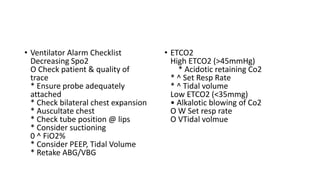
• Ventilator Alarm Checklist
Decreasing Spo2
O Check patient & quality of
trace
* Ensure probe adequately
attached
* Check bilateral chest expansion
* Auscultate chest
* Check tube position @ lips
* Consider suctioning
0 ^ FiO2%
* Consider PEEP, Tidal Volume
* Retake ABG/VBG
• ETCO2
High ETCO2 (>45mmHg)
* Acidotic retaining Co2
* ^ Set Resp Rate
* ^ Tidal volume
Low ETCO2 (<35mmg)
• Alkalotic blowing of Co2
O W Set resp rate
O VTidal volmue
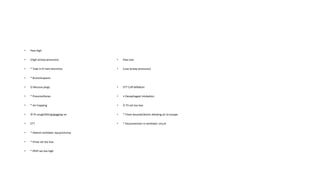
• Paw High
• (High airway pressures)
• * Tube in R main bronchus
• * Bronchospasm
• O Mucous plugs
• * Pneumothorax
• * Air-trapping
• © Pt cough/biting/gagging on
• ETT
• * Patient-ventilator dyssynchrony
• * Pmax set too low
• * PEEP set too high
• Paw Low
• (Low airway pressures)
• ETT Cuff deflation
• • Oesophageal intubation
• O TV set too low
• * Chest wounds/drains allowing air to escape
• * Disconnection in ventilator circuit
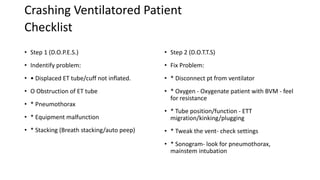
Crashing Ventilatored Patient
Checklist
• Step 1 (D.O.P.E.S.)
• Indentify problem:
• • Displaced ET tube/cuff not inflated.
• O Obstruction of ET tube
• * Pneumothorax
• * Equipment malfunction
• * Stacking (Breath stacking/auto peep)
• Step 2 (D.O.T.T.S)
• Fix Problem:
• * Disconnect pt from ventilator
• * Oxygen - Oxygenate patient with BVM - feel
for resistance
• * Tube position/function - ETT
migration/kinking/plugging
• * Tweak the vent- check settings
• * Sonogram- look for pneumothorax,
mainstem intubation

Ventilator Alarm Checklist.pptx

  • 1.
    • Ventilator AlarmChecklist Decreasing Spo2 O Check patient & quality of trace * Ensure probe adequately attached * Check bilateral chest expansion * Auscultate chest * Check tube position @ lips * Consider suctioning 0 ^ FiO2% * Consider PEEP, Tidal Volume * Retake ABG/VBG • ETCO2 High ETCO2 (>45mmHg) * Acidotic retaining Co2 * ^ Set Resp Rate * ^ Tidal volume Low ETCO2 (<35mmg) • Alkalotic blowing of Co2 O W Set resp rate O VTidal volmue
  • 2.
    • Paw High •(High airway pressures) • * Tube in R main bronchus • * Bronchospasm • O Mucous plugs • * Pneumothorax • * Air-trapping • © Pt cough/biting/gagging on • ETT • * Patient-ventilator dyssynchrony • * Pmax set too low • * PEEP set too high • Paw Low • (Low airway pressures) • ETT Cuff deflation • • Oesophageal intubation • O TV set too low • * Chest wounds/drains allowing air to escape • * Disconnection in ventilator circuit
  • 3.
    Crashing Ventilatored Patient Checklist •Step 1 (D.O.P.E.S.) • Indentify problem: • • Displaced ET tube/cuff not inflated. • O Obstruction of ET tube • * Pneumothorax • * Equipment malfunction • * Stacking (Breath stacking/auto peep) • Step 2 (D.O.T.T.S) • Fix Problem: • * Disconnect pt from ventilator • * Oxygen - Oxygenate patient with BVM - feel for resistance • * Tube position/function - ETT migration/kinking/plugging • * Tweak the vent- check settings • * Sonogram- look for pneumothorax, mainstem intubation